Analyzing the Quantitative Genetics
of Adaptive Speciation
Sasaki, A. and Dieckmann, U.
IIASA Interim Report
Interim Report on work of the International Institute for Applied Systems Analysis receive only limited review. Views or opinions expressed herein do not necessarily represent those of the Institute, its National Member Organizations, or other organizations supporting the work.All rights reserved. Permission to make digital or hard copies of all or part of this work for personal or classroom use is granted without fee provided that copies are not made or distributed for profit or commercial advantage. All copies must bear this notice and the full citation on the first page. For other purposes, to republish, to post on servers or to redistribute to lists, permission must be sought by contacting [email protected]
A-2361 Laxenburg, Austria Web: www.iiasa.ac.at
Interim Report
IR-11-020
Oligomorphic dynamics for analyzing the quantitative genetics
of adaptive speciation
Akira Sasaki ([email protected]) Ulf Dieckmann ([email protected])
Approved by
Detlof Von Winterfeldt Director
Abstract ... 1 Introduction ... 2 Model description ... 5 Resource competition ... 5 Character dynamics ... 5 Results ... 6 Oligomorphic dynamics ... 6
Moment approximation of oligomorphic dynamics ... 7
Approximation of selection differentials ... 7
Dynamics of morph frequencies ... 8
Equilibria of morph frequencies ... 9
Demographic stability ... 9
Dynamics of morph means ... 10
Equilibria of morph means ... 11
Convergence stability ... 11
Dynamics of morph variances ... 12
Equilibria of morph variances ... 12
Evolutionary stability ... 12
Moment closure ... 13
Time to evolutionary branching ... 14
Effects of mutation on morph variances ... 14
Applications of oligomorphic dynamics ... 15
Special case allowing continuous morph distributions... 15
Single-morph dynamics ... 16
Two-morph dynamics ... 17
Frequency dynamics and limiting similarity ... 17
Numerical results ... 21 Discussion ... 22 Acknowledgements ... 24 Appendix A ... 26 Literature cited ... 28 Figures ... 36
Oligomorphic dynamics for analyzing the
quantitative genetics of adaptive speciation
Akira Sasaki1,2,3 1
Department of Evolutionary Study of Biosystems, The Graduate University for Advanced Studies (Sokendai), Hayama, Kanagawa 240-0193, Japan
Email: [email protected], Tel: +81-46-858-1537, Fax: +81-46-858-1544 2
Evolution and Ecology Program, International Institute for Applied Systems Analysis, A-2361 Laxenburg, Austria
3
PRESTO, Japan Science and Technology Agency, 4-1-8 Honcho Kawaguchi, Saitama, Ja-pan
and
Ulf Dieckmann2 2
Evolution and Ecology Program, International Institute for Applied Systems Analysis, A-2361 Laxenburg, Austria
Email: [email protected]
Abstract
Ecological interaction, including competition for resources, often causes frequency-dependent disruptive selection, which, when accompanied by reproductive isolation, may act as driving forces of adaptive speciation. While adaptive dynamics models have added new perspectives to our understanding of the ecological dimensions of speciation processes, it remains an open question how best to incorporate and analyze genetic detail in such models. Conventional ap-proaches, based on quantitative genetics theory, typically assume a unimodal character distri-bution and examine how its moments change over time. Such approximations inevitably fail when a character distribution becomes multimodal. Here, we propose a new approximation, oligomorphic dynamics, to the quantitative genetics of populations that include several morphs and that therefore exhibit multiple peaks in their character distribution. To this end, we first decompose the character distribution into a sum of unimodal distributions corres-ponding to individual morphs. Characterizing these morphs by their frequency (fraction of individuals belonging to each morph), position (mean character of each morph), and width (standard deviation of each morph), we then derive the coupled eco-evolutionary dynamics of morphs through a double Taylor expansion. We show that the demographic, convergence, and evolutionary stability of a population’s character distribution correspond, respectively, to the asymptotic stability of frequencies, positions, and widths under the oligomorphic dynamics introduced here. As first applications of oligomorphic dynamics theory, we analytically derive the effects (a) of the strength of disruptive selection on waiting times until speciation, (b) of
mutation on conditions for speciation, and (c) of the fourth moments of competition kernels on patterns of speciation.
Keywords: adaptive dynamics, quantitative genetics theory, moment dynamics, adaptive
speciation, evolutionarily stable strategy, convergence stability
Classification code: MSC 92 (Biology and other natural sciences) -- 92D10 (Genetics),
92D15 (Problems related to evolution), or 92D40 (Ecology).
1. Introduction
Quantitative genetics theory has been successful in analyzing a wide variety of evolutionary processes, including trait shifts under directional, disruptive, or temporally fluctuating natural or artificial selection (Lande 1979; Bulmer 1992; Falconer 1996); mechanisms for maintain-ing standmaintain-ing genetic variation by mutation-selection balance, fluctuatmaintain-ing selection, or hetero-sis (Kimura and Crow 1964; Bulmer 1972; Lande 1975; Felsenstein 1976; Ellner and Hairs-ton 1994; Ellner and Sasaki 1996; Kondrashov and Yampolsky 1996; Sasaki and Ellner 1997); as well as escalations of male ornaments and female preferences through runaway se-lection (Lande 1981; Lande and Kirkpatrick 1988; Iwasa et al. 1991).
A limitation in many applications of quantitative genetics theory arises from a focus on unimodal character distributions, which simplifies the derivation of equations for the tem-poral change of population genetics quantities. To justify the required moment closures, cha-racter distributions have been assumed to be of Gaussian shape (e.g., Lande 1979) or to be narrowly localized around a single mean (e.g., Iwasa et al. 1991). Moreover, many applica-tions of quantitative genetics theory assume genetic variances and covariances to be constant, to make the analyzed models more tractable. Such approximations must therefore fail once the distribution of a quantitative character starts becoming bimodal. The latter is expected under frequency-dependent disruptive selection. Such selection can arise from a great variety of ecological processes, including symmetric intraspecific competition (Metz et al. 1996; Sa-saki 1997; Doebeli 1996a, 1996b; Dieckmann and Doebeli 1999), asymmetric intraspecific competition (Kisdi 1999; Doebeli and Dieckmann 2000; Kisdi et al. 2001), interspecific competition (Law et al. 1997; Kisdi and Geritz 2001), resource specialization (Meszéna et al. 1997; Geritz et al. 1998; Day 2000; Kisdi 2001; Schreiber and Tobiason 2003; Egas et al. 2004, 2005), temporally fluctuating selection with storage effect (Ellner and Hairston 1994; Sasaki and Ellner 1995, 1997; Ellner and Sasaki 1996), ontogenetic niche shifts (Claessen and Dieckmann 2002), mixotrophy (Troost et al. 2005), phenotypic plasticity (Sasaki and Ellner 1995; Sasaki and de Jong 1999; Van Dooren and Leimar 2003; Ernande and Dieckmann 2004; Leimar 2005), dispersal evolution (Levin et al. 1984; Cohen and Levin 1991; Ludwig
2001; Parvinen and Egas 2004), mutation evolution (Haraguchi and Sasaki 1996), mutualism (Doebeli and Dieckmann 2000; Law et al. 2001; Ferdy et al. 2002; Ferrière et al. 2002; Day and Young 2004), emergent cooperation (Doebeli et al. 2004), predator-prey interactions (Brown and Pavlovic 1992; Van der Laan and Hogeweg 1995; Doebeli and Dieckmann 2000; Bowers et al. 2003), cannibalism (Dercole 2003), evolution of virulence (Boots et al. 2004; Kamo et al. 2007), host-parasite interactions (Haraguchi and Sasaki 1996, 1997; Boots and Haraguchi 1999; Sasaki and Godfray 1999; Koella and Doebeli 1999; Regoes et al. 2000; Gudelj et al. 2004), sex-ratio evolution (Metz et al. 1992; Reuter et al. 2004), evolution of selfing (Cheptou and Mathias 2001; De Jong and Geritz 2001), evolution of mating traits (Van Doorn et al. 2001, 2004), evolution of anisogamy (Matsuda and Abrams 1999; Maire et al. 2001), evolution of cytoplasmic inheritance (Iwanaga and Sasaki 2004), seed-size evolu-tion (Rees and Westoby 1997; Geritz et al. 1999; Mathias and Kisdi 2002), microbial cross-feeding (Doebeli 2002), prebiotic evolution (Meszéna and Szathmáry 2001), resource competition among digital organisms (Chow et al. 2004), and evolutionary community as-sembly (Jansen and Mulder 1999; Bonsall et al. 2004; Loeuille and Loreau 2005). These processes are important for understanding adaptive speciation and many other processes in-volving frequency-dependent interactions within or between species. Analyses of character distributions with an evolutionarily variable number of modes have therefore relied on nu-merical investigations or on game theory and adaptive dynamics theory (e.g., Eshel and Motro 1981; Eshel 1983; Ludwig and Levin 1991; Sasaki and Ellner 1995, 1997; Dieckmann and Law 1996; Sasaki 1997; Dieckmann and Doebeli 1999; Sasaki and Godfray 1999; Doebeli and Dieckmann 2000, 2003). The latter have to assume a minimal degree of population ge-netic complexity and often do not account for polymorphic gege-netic variation around a distri-bution’s modes.
In this study, we propose a new approximation, oligomorphic dynamics, to describe the quantitative genetic dynamics of asexually reproducing populations that contain multiple morphs and therefore exhibit multiple peaks in their character distribution. The main idea of this approximation is simple and our approach proceeds in three steps: we (1) decompose a population’s character distribution into a sum of single-peaked distributions, each corres-ponding to one morph; (2) characterize each morph by its frequency (fraction of individuals belonging to the morph), position (mean character of the morph), and width (standard devia-tion of the morph); and (3) derive the equadevia-tions that govern the dynamics of these quantities.
A central purpose of the oligomorphic approximation is to analyze the transitions through which an evolving character distribution becomes divided into several morphs and reaches a multimodal stationary state. We derive the approximate moment dynamics in terms of the frequencies, mean phenotypes, and variances of the morphs. Assuming that the widths of morphs are small relative to their distances, we derive the equations for the first three
mo-ments through a novel approach of double Taylor expansion. Importantly, the distances be-tween morphs do not have to be small for the oligomorphic approximation to be accurate.
Our theory builds on the dynamics of mean quantitative characters pioneered by Lande (1976, 1979, 1981, 1982), who showed that changes in a unimodal distribution's mean character are proportional to the gradient of mean fitness as a function of mean character. Further work derived the dynamics of higher central moments (such as variance and skew-ness) and made analyses more mathematically tractable by focusing on small deviations of characters from a population’s mean character (Barton and Turelli 1991). Another important extension of Lande's work occurred through the inclusion of frequency-dependent selection (Iwasa et al. 1991; Abrams et al. 1993; Vincent et al. 1993). If restricted to unimodal charac-ter distributions, our oligomorphic approximation reduces to the theory of Taylor and Day (1997). Our oligomorphic approximation is also related to character-displacement models (Roughgarden 1972, 1976; Bulmer 1974; Slatkin 1980; Matessi and Jayakar 1981; Taper and Case 1985). These earlier models, however, assumed either a fixed variance for each species (e.g., Roughgarden 1976), a fixed Gaussian shape of each species’ character distribution (e.g., Slatkin 1980), or simple major-locus inheritance (based, e.g., on single-locus two-allele ge-netics; Bulmer 1974). Reasons why character distributions are expected to exhibit distinctly separated peaks were elucidated by May (1973), Sasaki and Ellner (1995), Sasaki (1997), Gyllenberg and Meszéna (2005), Doebeli et al. (2007), Pigolotti et al. (2007, 2009), Leimar et al. (2008), and Fort et al. (2009).
To illustrate the utility of the oligomorphic approximation, we consider evolutionary processes driven by resource competition (MacArthur 1970; Rosenzweig 1978; Roughgarden 1972). In these models, individuals with similar phenotypes compete more intensely than phenotypically distant individuals. Two antagonistic selection pressures then need to be con-sidered: the first results from frequency-dependent disruptive selection due resource competi-tion, and the second from frequency-independent stabilizing selection towards an optimal phenotype at which, in the absence of competition, the resource is most abundant. Under these conditions, disruptive selection may cause the character distribution to split into several morphs. To derive the moment dynamics for each morph, it is necessary to evaluate the com-petitive effects between individuals belonging to different morphs. This is why a standard moment-closure approach based on Taylor expansions assuming small character deviations around a common mean fails for processes allowing multimodal character distributions. By contrast, the oligomorphic dynamics proposed here successfully overcome this limitation by expanding the phenotypic effect of a competitor around the mean of the morph to which the competitor belongs, rather than around the mean of the morph to which the focal individual belongs.
2. Model description
We call a character distribution oligomorphic if it comprises a finite number of distinct peaks. Below, we first derive the dynamics of an oligomorphic character distribution and then ap-proximate these in terms of moment equations. Throughout, we illustrate our approach by us-ing a continuous-time model of character-mediated competition.
2.1. Resource competition
We consider a continuum of ecological characters x describing the peak of an organism's resource utilization spectrum along a one-dimensional niche space. The resource abundance at niche position x is denoted by K x( ), and the density of individuals with character x is denoted by N x . The competition coefficients between individuals with characters x and ( )
y are given by (a x- y). Because of the formal role it plays in the integral in eq. (1), the
function a d is called the competition kernel. It is assumed to attain its maximum at ( ) 0
d = , implying that competition is strongest between individuals with identical characters, and to decrease monotonically towards 0 as d increases. We also assume that competition is symmetric, so that a x( - y)= a y( - x) for all x and y .
The dynamics of N x are thus given by Lotka-Volterra competition equations for a ( ) continuum of characters, ( ) 1 1 ( ) ( ) ( ), ( ) dN x r a x y N y dy N x dt K x ¥ - ¥ æ ö÷ ç = ç - - ÷÷ ç ÷ è
ò
ø (1)where r denotes the intrinsic growth rate. The carrying capacity K x is usually assumed ( ) to be unimodal around an optimum x = 0, where the resource is most abundant. Without loss of generality, we assume that (0)a = and 1 K(0)= . By definition, 1 a¢(0) = K ¢(0) = 0. For the sake of brevity, below we leave out the integration limits shown in eq. (1).
We denote the total population density by N =
ò
N x dx( ) . The dynamics of N are obtained by integrating both sides of eq. (1),1 1 ( ) ( ) ( ) , ( ) dN rN N a y x y dy x dx dt K x f f æ ö÷ ç = çç - - ÷÷÷ çè
ò
ò
ø (2)where f( )x = N x( ) /N is the relative frequency of character x .
2.2. Character dynamics
The dynamics of the character distribution ( )f x = N x( ) /N are obtained by applying the chain rule and using eqs. (1) and (2),
(
)
1 ( ) 1 1 ( ) 1 ( ) ( ) 1 1 ( ) ( ) ( ) ( ) ( ) ( ) ( ) ( ) ( ) ( ), d d N x dN x dN x dt rN d N rN N x d N d a y x y dy x dx a x y y dy x K x K x w x w x f f t t t f f f f f æ ö÷ ç = = çç - ÷÷÷ çè ø æ ö÷ ç =çç - - - ÷÷÷ çè ø =-ò
ò
ò
(3)where time is rescaled as
0 ( )
t= r
ò
tN t¢ dt¢ to eliminate the dependence on total population density in the frequency dynamics. Thus, the frequency f( )x of a character x changes ac-cording to its fitness1 ( ) 1 ( ) ( ) , ( ) w x a x y y dy K x f = -
ò
- (4)which depends on the population's character distribution f , making selection frequen-cy-dependent. The population's mean fitness is denoted by w=
ò
w x( ) ( )f x dx. For a uni-form competition kernel, a d =( ) 1 for all d , the fitness w x( ) is frequency-independent and stabilizing around x = 0, where the carrying capacity K x( ) is largest. For sufficiently narrow competition kernels, the fitness landscape has a valley where the character distribution f is peaked, implying frequency-dependent disruptive selection. The dynamics of f are governed by the interplay between these selective forces.3. Results
In the following, we introduce oligomorphic dynamics to describe how a population's charac-ter distribution may split into several modes under the influence of frequency-dependent dis-ruptive selection, and how these modes and their shapes are expected to change over time. We then examine the conditions for such splits, which can be seen as describing sympatric specia-tion and/or character displacement in asexual populaspecia-tions. Next, we discuss the relaspecia-tionship of these conditions with three key stability concepts: demographic stability, convergence stabili-ty, and evolutionary stability. We then investigate the effects of mutation, and of the shape of competition kernels and resource distributions, on these conditions, on the possible patterns of speciation, and on the expected times to speciation.
3.1. Oligomorphic dynamics
We assume that the character distribution f( )x consists of a few morphs i=1, 2,L ,n ("a few" in English = "oligo" in Latin). These morphs have relative frequencies p , with i
1 1 n i i= p =
å
, so that 1 ( ) n i i( ). i x p x f f = =å
(5)with ( )
ò
fi x dx= 1. We define the dynamics of the frequencies p so that for each x the icontribution of morphs to df ( ) /x dt is proportional to their contribution to f( )x ,
( ) ( ) ( ) . ( ) i i i i dp x p x d x dt x dt f f f f = (6)
Integrating this equation over all characters x and using eq. (3), we obtain
(
)
( ) ( ) ( ) ( ) ( ) , ( ) i i i i i i i dp x d x p dx p x w x w dx w w p dt x dt f f f f =ò
=ò
- = - (7)where wi=
ò
w x( ) ( )fi x dx is the mean fitness of morph i .To derive the dynamics of the character distribution fi( )x of morph i , we use the product rule, d ( ) d ( ) ( )d
i i i i i i
dt pf x = p dtf x +f x dt p , solve for ( ) d
i
dtf x , and then use eqs. (3), (6),
and (7),
(
)
(
)
( ) 1 ( ) ( ) ( ) ( ) ( )( ) ( ) ( ). i i i i i i i i i i i d x dp x dp x dt p dt dt x w x w x w w w x w x f f f f f f æ ö÷ ç = ççè - ÷÷ø = - - -= (8)3.2. Moment approximation of oligomorphic dynamics
We now derive the approximate dynamics of the first three moments of the character distribu-tions of morphs, given by their frequencies p , means i xi=
ò
xfi( )x dx, and variances2
( ) ( )
i i i
V =
ò
x- x f x dx. For this purpose, we first approximate the selection differentials ( ) iw x - w in eq. (8).
3.2.1.
Approximation of selection differentials
We denote by x =i x- xi the deviation of character x from the mean character x of i
morph i. If x is sufficiently close to x , i.e., if i x is of order e , where e is a suffi-i
ciently small positive constant, we can use a first Taylor expansion, of the interaction coeffi-cients (a x- y) around the morph means y= xj, to approximate the fitness w x of cha-( ) racter x by 2 3 3 1 ( ) 1 ( ) ( ) ( ) 1 1 1 ( ) ( ) ( ) ( ) ( ) ( ) 2 1 1 1 1 ( ) ( ) ( ). ( ) 2 ( ) j j j j j j j j j j j j j j j j j j j j j w x p a x y y dy K x p a x x a x x a x x O x d K x p a x x p a x x V O K x K x f x x e f x x e = - -æ ö÷ ç ¢ ¢¢ = - ç - + - + - + ÷÷ + çè ø ¢¢ = - - - - +
å
ò
å
ò
å
å
(9)Furthermore, we can use a second Taylor expansion of the fitness w x( ) around the morph mean x= xi,
2 2 3 2 ( ) 1 ( ) ( ) ( ) ( ). 2 i i i i i x x x x w x w x w x w x O x = x x = x e ¶ ¶ = + + + ¶ ¶ (10)
Multiplying this equation with fi( )x and integrating over all x yields 2 4 2 1 ( ) ( ) ( ). 2 i i i i x x w x w w x V O x = e ¶ = + + ¶ (11)
The selection differential for morph i is obtained, up to second order in e, by subtracting eq. (11) from eq. (10),
2 2 3 2 ( ) 1 ( ) ( ) ( ) ( ). 2 i i i i i i x x x x w x w x w x w V O x = x x = x e ¶ ¶ - = + - + ¶ ¶ (12)
The two partial derivatives are obtained from eq. (9), in leading order of e , as
(
)
2 ( ) ( ) ( ) ( ) ( ) ( ), i j i j i i j i j x x w x p a x x v x a x x v x O x = e ¶ ¢ ¢ = - - + - + ¶å
(13)(
)
2 2 2 ( ) ( ) ( ) 2 ( ) ( ) ( ) ( ) ( ), i j i j i i j i i j i j x x w x p a x x v x a x x v x a x x v x O x = e ¶ ¢¢ ¢ ¢ ¢¢ = - - + - + - + ¶å
(14)where v is the inverse of carrying capacity, ( )v x =1/K x( ), which implies
2 ( ) ( ) ( ) K x v x K x ¢ ¢ = - and 2 3 2 2 ( ) ( ) ( ) . ( ) ( ) K x K x v x K x K x ¢ ¢¢ ¢¢ = - (15)
The approximation provided by eqs. (12)-(15) is accurate if two conditions are met: (i) for all morphs i , the character distribution of that morph is sufficiently narrowly distributed around its mean, i.e., maxi V is small (of order e ); and (ii) for all morphs i i and j , the
distance dij = xi- xj is sufficiently larger than V and i V , ensuring multimodality. j
The first condition is required for the double Taylor expansion in eqs. (9) and (10), while the second condition is required, not for the derivation of those equations, but only for a natural decomposition of the character distribution in eq. (5). Combining these two requirements, the oligomorphic approximation is applicable whenever
max , min i i ij ij V d < e¢ (16)
where e¢ is a sufficiently small positive constant.
3.2.2.
Dynamics of morph frequencies
The growth rate of the frequency of morph i is obtained from eq. (11), in leading order of e , as
2 2 ( ) ( ) ( ) ( ) ( ) ( ). ( ) ( ) i i k k k k j j i j j j j k k k i w w w x w x p O a x x p a x x p p O K x K x e e - = - + - -= - +
å
å
å
å
(17)Inserting this into eq. (7) gives the dynamics of the frequency pi of morph i, in leading or-der of e , 2 ( ) ( ) ( ). ( ) ( ) k j j i j j j j i k i k k i a x x p a x x p dp p p O dt K x K x e ì ü ï - - ï ï ï ï ï = í - ý + ï ï ï ï ï ï î þ
å
å
å
(18)Since this result has the form of a replicator equation, d ( )
i i i
dt p = w - w p , with i i
i
w=
å
w p , we can interpret bij= a x( i- xj) /K x( )i as the effective interaction coefficient describing the effect of morph j on the frequency of morph i .3.2.3.
Equilibria of morph frequencies
Morph means x= ( ,x1 K,xn)T usually change much more slowly than morph frequencies T
1
( , , n)
p= p K p . This is because the ecological dynamics in eq. (18), which have rates of order 0, are much faster than the evolutionary dynamics in eq. (24) below, which have rates of order 2, as long as the within-morph variances ( 2)
i
V O are sufficiently small. Ac-cordingly, morph means stay almost constant while morph frequencies approach a qua-si-equilibrium p x with ( ) ij j( ) kj j( ) k( )
jb p x = jkb p x p x
å
å
for all i=1,K,n . These conditions can be spelled out as1 1 ( ) ( ) ( ) ( ) ( ) , ( ) j i j j jk ( ) k j j k i k a x x p x a x x p x p x K x
å
- =å
K x - (19)or rewritten in matrix form as
(VA p x) ( )= cu with c= p x( ) (T VA p x) ( ), (20) where A= (Aij)= ( (a xi- xj)) is the interaction matrix, V = diag(1 /K x( ),1 K,1 /K x( n)),
and u = (1,1,K,1)T . With T 1 1
( ( ), , ( n))
K = K x K K x = V u- , we thus obtain the qua-si-equilibrium frequencies of morphs with means x,
1 1 1 ( ) . ( )j j A K p x cA K A K -= =
å
(21)3.2.4.
Demographic stability
Eq. (18) shows that the dynamics of morph frequencies are locally asymptotically stable around p x( ), if the eigenvalues of the Jacobian D= (Dij) with elements
{
T}
( ) T 1 T 1 T 1 1 1 1 ( ) ( ) ( ) 2 ( ) ( ) ( ) ( ) ( ) 2 ( ) ( ) ( ) ( ) ( ) ij i i j p p x i ij il l ij l kl l kl l i kl kl D p p VA p VAp p e VA u VA u VA u u VA u A K x A A K x A K x K x = -- -- -¶ = -¶ é ù ê ú = -ê ú ë û é ù ê ú = ê - ú ê ú ë ûå
å
å
(22)all have negative real parts, where e is the unit vector along the i ith coordinate. Hence, this is the condition for the demographic stability of a population comprised of morphs with means x= ( ,x1K ,xn)T and quasi-equilibrium frequencies p x( )= (p x1( ),K,p xn( ))T ac-cording to eq. (21). If this condition is violated, at least one morph will go extinct before the population becomes demographically stable.
3.2.5.
Dynamics of morph means
The mean character xi=
ò
xfi( )x dx of morph i changes according to{
}
{
}
( ) ( ) ( ) ( ) ( ) , i i i i i i i dx d x x dx x w x w x dx dt dt w x w x dx f f x f = = -=-ò
ò
ò
(23)where x =i x- xi. Substituting eqs. (12)-(15) into the right-hand side of eq. (23) yields, in leading order of e, 3 3 2 ( ) ( ) ( ) ( ) 1 ( ) ( ) ( ). ( ) ( ) i j i i j j x x i i j i j j j i j j i i a x x dx V p O dt x K x K x V a x x p a x x p O K x K x e e = ì ü ï ¶ - ï ï ï ï ï = í- ý+ ï ¶ ï ï ï ï ï î þ ì ¢ ü ï ï ï ¢ ï = í- - + - ý+ ï ï ï ï î þ
å
å
å
(24) By noting that ( ) 1 j ( j) / ( ) jw x = -
å
p a x- x K x , we see that this is equivalent to Wright’sformula ( ) , i i i x x dx w x V dt x = ¶ = ¶ (25)
for the change in a character's mean. Thus, the mean of each morph evolves in the direction towards which its fitness increases, with the rate of this adaptation being proportional to the morph variance and to the steepness of the fitness gradient. The fitness gradient, given by the curly brace on the right-hand side of eq. (24), comprises two components. The first term drives morphs away from each other, while the second term pushes morphs towards the car-rying capacity's maximum.
3.2.6.
Equilibria of morph means
It is clear from eq. (24) that the equilibrium morph means and their stability depend only on the means x and frequencies i p , since the variances i V affect only the speed of conver-i
gence to, or divergence from, those equilibrium morph means. The equilibrium means and frequencies of morph i then satisfy the following equations, in conjunction eq. (21),
( ) ( ) ( ) . ( ) i i j j i j j j j i K x a x x p a x x p K x ¢ ¢ - =
-å
å
(26)Defining the matrix A¢= (Aij¢)= ( (a x¢ i- xj)) and the diagonal matrix
1 1
diag( ( ) / ( ), , ( n) / ( n))
U= K x¢ K x K K x¢ K x , eq. (26) can be rewritten in matrix form as
A p¢ = UAp. Substituting for p the equilibrium frequencies p x( )= cA K-1 derived in eq. (21), we obtain A A K¢ -1 =UK= K¢ with K¢= (K x¢( ),1 K,K x¢( n))T. Spelled out, this gives
1 ( i j)( )jk ( k) ( )i jka x x A K x K x -¢ - = ¢
å
(27)for i=1,K,n, which determines the equilibrium means x of each morph. i
3.2.7.
Convergence stability
To assess the stability of the equilibrium morph means ( ,x x1 2,L ,xn)T under the dynamics in eq. (24), we investigate the corresponding Jacobian. The diagonal elements of this Jacobian are given by ( ) 1 (0) / ( ) ( ) ( ) ( ), ( ) ( ) ( ) i ii i j i j i j j i i i i K x a J V a x x a x x p x p x K x K x K x ì ¢¢ ü ¢¢ ï ï ï ¢¢ ï = í - - - ý + ï ï ï ï î þ
å
(28)where we used eq. (26). Similarly, the off-diagonal elements of the Jacobian are given by
2 ( ) 1 / ( ) ( ) ( ) ( ). ( ) ( ) i ij i i j j i j j i i K x J V a x x p x a x x p x K x K x ¢ ¢¢ ¢ = - - - (29)
It is interesting to compare the condition for the stability of the dynamics of morph means in eq. (24) with the condition for convergence stability (Eshel and Motro 1981; Eshel 1983). In general, a character value x is said to be convergence stable if character values closer to x can invade when the resident character value of the otherwise monomorphic morph is slightly displaced from x . To establish this link, we consider a resident population consisting of an atomic distribution composed of n monomorphic peaks at character values
j
x and with frequencies p xj( ) for j=1,K,n , which can be represented as
( ) ( )
j j
jp x d x- x
å
, where d is Dirac’s delta function. The invasion fitness s x (Metz et y( ) al. 1992) of a variant character value x in a population in which the resident character valuey of morph i is slightly displaced from its equilibrium value x , while the other morphs i
are at their equilibrium value x , is then given by j
1 1
( ) ( ) ( ) ( ) ( ).
The condition for the convergence stability of the character value x is i 2 2 2 2 ( ) ( ) 0. i i y y x y x x y x s x s x x y = = = = ¶ ¶ - < ¶ ¶ (31)
This is equivalent to the condition J <ii 0 for the asymptotic stability of the dynamics in eq. (24) in the special case that only a single morph mean x is displaced at a time. A more gen-i
eral result for a character distribution's stability against simultaneous perturbation in the posi-tions of multiple morphs will be presented elsewhere (Sasaki and Dieckmann, in preparation).
3.2.8.
Dynamics of morph variances
The variance Vi=
ò
x fi2 i( )x dx of morph i changes according to{
}
2 2 ( ) ( ) . i i i i i i dV d dx w x w x dx dt dt f x x f =ò
=ò
- (32)If the character distribution f of each morph i i=1,K,n is symmetric around its
mean x , i fi(xi+xi)= fi(xi- xi), all odd moments of f in terms of i x vanish. Using eqs. i
(12)-(15) then yields, in leading order of e ,
{
2}
5 ( ), i i i i dV F Q V O dt = - + e (33) where 1 2 2 2 ( ) / i i x x F w x x = = ¶ ¶ and [ 4] 4 ( ) i i i i iQ = Ef x =
ò
x f x dx is the fourth moment of the character distribution of morph i .3.2.9.
Equilibria of morph variances
Since [ 4] 2
i i i
Ef x - V = [( 2 ) ]2
i i i
Ef x - V ³ 0, Qi- Vi2 is always positive, so the local asymptotic stability of the dynamics in eq. (33) is determined by the sign of
2 2 2 2 3 2 ( ) 1 2 ( ) ( ) ( ) ( ) 2 ( ) ( ) 1 2 ( ) . 2 ( ) ( ) ( ) ( ) i j i j j x x i j i i j i i i j j j i i i i a x x F p x K x a x x K x a x x K x K x a x x p K x K x K x K x = -¶ = -¶ ì ¢¢ ¢ ¢ æ ö ü ï - - ¢ ¢¢ ÷ ï ï ç ÷ ï = - í - +çç - ÷÷ - ý ï çè ø ï ï ï î þ
å
å
(34)Consequently, V increases if i F >i 0 and decreases if F <i 0.
3.2.10.
Evolutionary stability
When morph frequencies and means are at their equilibrium values, eq. (29) reduces to
2 ( ) ( ) 1 ( ) ( ), 2 ( ) ( ) i j i i j i j j i i a x x K x F a x x p x K x K x ì ¢¢ - ü ï ¢¢ ï ï ï = - í - - ý ï ï ï ï î þ
å
(35)according to eq. (33), diverge to infinity. This happens for morph i , if F is positive at the i
stable equilibrium of the combined dynamics of morph means and frequencies. If, in contrast,
i
F is negative, the variance of morph i gradually vanishes.
It is interesting to compare the condition for the stability of the dynamics of morph variances in eq. (33) with the condition for local evolutionary stability (Maynard Smith 1982; Brown and Vincent 1987). In general, a character value x is said to be locally evolutionarily stable if character values close to x cannot invade an otherwise monomorphic morph with resident character value x . To establish this link, we again consider a resident population consisting of an atomic distribution composed of n monomorphic peaks at character values
j
x and with frequencies p xj( ) for j=1,K,n, resulting in the invasion fitness in eq. (30). The condition for the local evolutionary stability of the character value x is i
2 2 ( ) 0. i y x y x s x x = = ¶ < ¶ (36)
Inserting eq. (30), this yields 2F <i 0, so that all morph means are locally evolutionarily sta-ble if and only if the corresponding morph variances converge to zero. Since F is the i
second derivative of fitness at the mean of morph i , 0F >i implies a fitness minimum and, consequently, that selection on this morph is disruptive.
3.2.11.
Moment closure
Although the stability of the dynamics of morph variances in eq. (33) does not depend on the fourth moments Q of the character distributions i f of morphs i , we need to specify these i
fourth moments so as to close the hierarchy of moment dynamics that jointly describes changes in morph frequencies, means, and variances according to eqs. (18), (24), and (33)-(34).
Approximating f by a Gaussian distribution with mean i x and variance i V yields i
3 [ ] 0 i i Ef x = and [ 4] 3 2 i i i i
Q = Ef x = V . Substituting this into eq. (33) gives 2 2 . i i i dV FV dt = (37)
If, by contrast, the character variations within each morph around its mean obey the house-of-cards model of mutation (Turelli 1984), then [ 2] 2
i i i V = Ef x = cm, [ 3] 0 i i Ef x = , and 4 4 [ ] i i i
Q = Ef x = cm where m is the mutation rate and c and 2 c are constants determined 2
by the strength of stabilizing selection around x . Substituting i Qi= (c4/c V2) i into eq. (33) gives, in leading order of e ,
4 2 ( / ) , i i i dV c c FV dt = (38)
where we dropped the term - FVi i2, since it is of order O e( 4). The local asymptotic stability of the variance dynamics in eq. (38) again depends only on the sign of F , and thus on the i
fitness curvature at x . i
3.2.12.
Time to evolutionary branching
For the Gaussian closure, eq. (37) determines not only the evolutionary stability of equili-brium morph means, but also the time a morph's character distribution needs to undergo evo-lutionary branching. If the fitness landscape ( )w x is locally disruptive at x , implying i
0
i
F > , the variance V ti( )=[2 (F ti c- t)]-1 diverges to infinity from an initial value Vi(0)
within a finite time t , c
1 c [2 i i(0)] .
t = FV - (39)
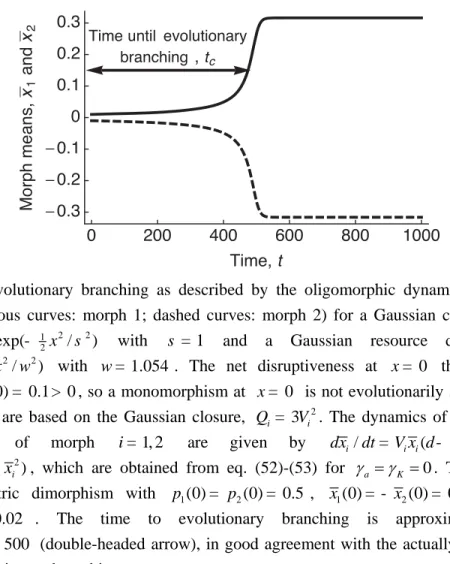
Obviously, the assumption of small morph variances, which is necessary for the oligomorphic dynamics to provide a good approximation, fails before a morph variance approaches infinity. The duration t nevertheless provides a useful approximation of the time to evolutionary c
branching required by a morph that experiences disruptive selection of strength F (Fig. 1). i
For the house-of-cards closure, the transient dynamics to evolutionary branching is more gradual. The variance diverges exponentially with a rate that is proportional to the strength of disruptive selection. Hence, the characteristic time t to evolutionary branching, c
1 c [( 4/ 2) ]i
t = c c F - (40)
is again inversely proportional to F . Despite this similarity, the exponential mode of diver-i
gence described by eq. (38) is in qualitative contrast to the explosive divergence after a long period of near-stasis that results for the Gaussian closure.
3.2.13.
Effects of mutation on morph variances
The variance of quantitative characters subject to stabilizing selection can be maintained by mutation-selection balance: the character diversity that gets depleted by purifying selection is then restored by the generation of variation through mutation (Bulmer 1972; Lande 1975, and references therein; Barton and Turelli 1991). Denoting the rate of mutation by m and as-suming that mutational effects on character values are random with variance m (corres-2 ponding to the constant-variance model or random-walk model of quantitative genetics theory), the dynamics of morph variances in the oligomorphic model is modified as
{
2}
2, i i i i dV F Q V m dt = - +m (41)where F again measures the strength of disruptive selection around i x according to eq. i
(34) in general and to eq. (35) for the case that the x have attained a convergence stable i
For 0F >i , V diverges to infinity as in the absence of mutations, but for i F <i 0, equilibrium morph variances V >i 0 are stabilized. For the Gaussian closure, these are given by 2 , 2 i i m V F m = (42)
and for the house-of-cards closure by
2 4 2 . ( / ) i i m V c c F m = (43)
4. Applications of oligomorphic dynamics
We now use the oligomorphic approximation derived above to understand in detail the dy-namics of, and the morph patterns resulting from, evolutionary branching in the re-source-competition model. The dynamical equations that we integrate numerically describe the frequencies, means, and variances of morphs as given by eqs. (18), (24), and (33)-(34), which we assemble here for ease of reference,
{
}
2 2 2 ( ) ( ) , ( ) ( ) ( ) 1 ( ) ( ) , ( ) ( ) ( ) ( ) ( ) 1 2 2 ( ) ( ) 2 k j j i j j j j i k i k k i i i i j i j j j i j j i i i j i i j i i i j i i a x x p a x x p dp p p dt K x K x dx K x V a x x p a x x p dt K x K x a x x K x a x x dV Q V dt K x K x K ì ü ï - - ï ï ï ï ï = í - ý ï ï ï ï ï ï î þ ì ¢ ü ï ï ï ¢ ï = í- - + - ý ï ï ï ï î þ ì ¢¢ - ¢ ¢ -ïï = - - í -ïïî ¢ +å
å
å
å
å
å
2 3 2 ( ) ( ) ( ) . ( ) ( ) i i i j j i i x K x a x x p K x K x ü æ ¢¢ ö÷ ïï ç - ÷ -ç ÷ ý ç ÷ ç ï è ø ïþ (44)While the numerical analysis of eqs. (44) starts with a fixed number n of morphs, the sub-sequent eco-evolutionary dynamics may effectively reduce this number. This may occur be-cause morph frequencies become negligible or bebe-cause morph means become indistinguisha-ble. For example, starting with five morphs when the equilibrium is dimorphic, three morphs will subsequently be lost in such a manner.
4.1. Special case allowing continuous morph distributions
In the special case in which the competition kernel a and the carrying-capacity function K are both Gaussian, 1 2 2
2
( ) exp( / )
a x = - x s and 1 2 2
2
( ) exp( / )
K x = - x w , and the former is narrower than the latter, s <w, the character distribution in eqs. (44) converges, through in-cessant evolutionary branching, to a continuum of infinitesimally spaced morphs. According-ly, the number of morphs that can be packed along the niche character x is unlimited
(Ma-cArthur 1970; Roughgarden 1972; May 1973, 1974; Slatkin and Lande 1976; Bull 1987). However, many deviations from this special case, e.g., by choosing a competition kernel or carrying-capacity function that are not Gaussian, result in atomic distributions, i.e., in the coexistence of discrete (that is, finitely spaced) morphs (Sasaki and Ellner 1995; Sasaki 1997; Gyllenberg and Meszéna 2005; Szabó and Meszéna 2006; Pigolotti et al. 2007, 2009; Leimar et al. 2008; Fort et al. 2009).
Integrating eqs. (44) with the house-of-card closure in eq. (38) shows that for both 2
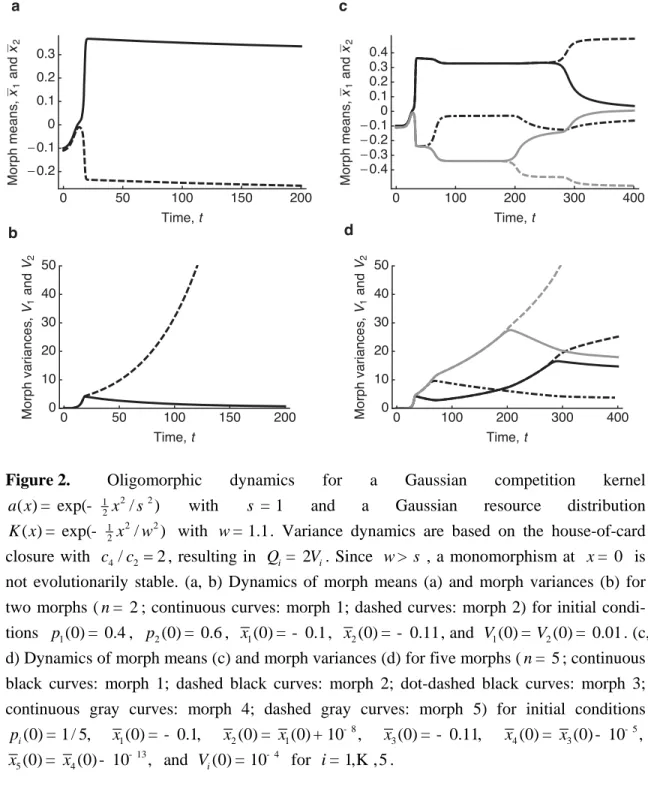
n = (Figure 2A, B) and n = 5 (Figure 2C, D) morph means become displaced from their initial values and relative to each other, while morph variances increase without limit, indi-cating that neither two nor five morphs are enough to evolutionarily stabilize the population. It turns out that this conclusion is independent of n . Below we show how this degeneracy is overcome for s > w or by varying the kurtoses of the competition kernel or the carry-ing-capacity function.
4.2. Single-morph dynamics
When there is only one morph in the population (n =1), its mean and variance change ac-cording to
{
2}
2 ( ) , ( ) 1 2 ( ) ( ) (0) . 2 ( ) ( ) dx K x V dt K x dV K x K x a Q V dt K x K x ¢ = ì æ öü ï ¢ ¢¢ ï ï ¢¢ ç ÷ï = - í +çç - ÷÷÷ý -ç ï è øï ï ï î þ (45)The mean x of a single morph thus always converges to the carrying capacity's maximum at 0
x = .
At this convergence stable equilibrium for the mean, the variance dynamics reduce to
{
}
{
2}
1 (0) (0) . 2 dV K a Q V dt = ¢¢ - ¢¢ - (46)Thus, the convergence stable equilibrium x is also evolutionarily stable, and the morph va-riance V hence remains finite, if and only if
(0)a¢¢ < K¢¢(0). (47)
We can interpret this condition by concluding that evolutionary stability requires the width 1/ a¢¢(0) of the competition kernel, as described by its peak curvature, to exceed the corres-ponding width 1/ K ¢¢(0) of the resource distribution. This is equivalent to s > w, a condi-tion that was already derived by Roughgarden (1972). If, on the other hand, this condicondi-tion is violated, the morph variance V diverges to infinity. This implies that x = 0 is convergence stable, as the morph mean approaches x = 0, but not evolutionarily stable, as the variance around x = 0 increases without limit. The character value x = 0 is therefore an
evolutio-4.3. Two-morph dynamics
4.3.1.
Frequency dynamics and limiting similarity
When there are only two morphs in the population (n = 2), the frequency of one of them, 1
p = p (with p2= -1 p), changes according to
c ( ) (1 ) dp s p p p p dt = - - (48) with 1 2 1 2 (K K )(1 a( )) s K K + - D = and 1 2 c 1 2 ( ) , ( )(1 ( )) K K a p K K a - D = + - D (49)
where Ki= K x( )i is the carrying capacity of morph i =1, 2 and a D( ) with D = x1- x2
is the competition coefficient between morph 1 and morph 2, which decreases as the character displacement D increases. Note that both K and i a D( ) are time-dependent, because x 1
and x change with time, at a speed that is slow compared with the speed of the frequency 2
dynamics in eq. (48). For a given pair x and 1 x , the frequency 2 p is attracted towards the equilibrium value p . c
Eqs. (48) and (49) imply that if the two morphs are sufficiently separated from each other (| D | ? s , where s is the standard deviation of the competition kernel a ), then
( ) 1
a D = and the two morphs are subject to strong balancing selection with equilibrium fre-quency p . If, in contrast, the two morphs are sufficiently close to each other (c | D | = s ), then a D »( ) 1 and the balancing selection is weak. If the two morphs have the same carry-ing capacity (K1= K2), which occurs when the dimorphism is symmetric, x1= - x2, the equilibrium frequency p converges to 1/2. If the ratio c K1/K between the carrying ca-2
pacity of morph 1 and that of morph 2 is smaller than the competition coefficient, 1/ 2 ( )
K K < a D , morph 1 goes extinct. Analogously, for K2/K1< a( )D , morph 2 goes ex-tinct. These results for the two-morph frequency dynamics are fully in line with conventional limiting-similarity theory (May 1974).
4.3.2.
Branching patterns and effects of kurtosis
An interesting application of oligomorphic dynamics as developed above is to study the bi-furcations that occur when inequality (47) is violated, so that evolutionary branching can happen. Below we show that the resultant branching patterns sensitively depend on the kur-toses of the competition kernel a and of the carrying-capacity function K. We therefore consider these functions to be symmetric and allow them to be either platykurtic or leptokurtic. Under these conditions, an initially symmetric dimorphism resulting from the evolutionary branching of a single morph at x = 0 remains symmetric: p t1( )= p t2( )=1 / 2 ,
1( ) 2( )
morphism, with x1(0)¹ - x2(0), in which x1(0) and x2(0) are both close to 0, the symme-try between the two morphs is rapidly established long before their means equilibrate.
Defining x= x1= - x2 and V =V1=V2, substituting these into the mean and va-riance dynamics in eqs. (44), and doubly expanding the resulting equations in Taylor series around x = 0 and x = x- x= x yields
{
}
1{
2}
3 (0) (0) 9 (0) (0) 6 (0) 4 (0) (0) , 6 dx K a xV a K K a K x V dt = ¢¢ - ¢¢ + ¢¢ ¢¢ - ¢¢ - ¢¢¢¢ + ¢¢¢¢ (50) and{
}
{
2}
2 2 1 1 (0) (0) 7 (0) (0) 6 (0) 2 (0) (0) ( ). 2 K a 4 a K K a K dV Q V dt x é ù ¢¢ ¢¢ ¢¢ ¢¢ ¢¢ ¢¢¢¢ ¢¢¢¢ ê - + - - + ú ê ú ë = -û (51) The parameter d= K¢¢(0)- a¢¢(0) measures the net disruptiveness of fitness at 0x , so that d = 0 corresponds to the bifurcation point for primary evolutionary branching. Using the order estimate x= O( d), we obtain in leading order of d
* 2 ** 2 2 1 ( / ) , 1 ( / ) ( ), 2 dx V x x x dt dV x x Q V dt d d é ù = êë- úû é ù = êë- úû (52) with * (0) 1 2 a/ 3 K / 6 x a d g g = ¢¢ - + and ** , (0) 1 a K / 2 x a d g g = ¢¢ - + (53)
where ga= 3- a¢¢¢¢(0) /a¢¢(0)2 and gK = 3- K¢¢¢¢(0) /K¢¢(0)2 measure the excess kurtoses of the competition kernel and carrying-capacity functions, respectively (i.e., the deviations of the fourth moments of a and K from their expectations 3a¢¢(0)2 and 3K ¢¢(0)2 in the Gaussian case). For a net disruptiveness of d= K¢¢(0)- a¢¢(0)< 0, both the character dis-placement D = 2x between the two morphs and the variance V of both morphs converge to zero, indicating that the population converges to monomorphism at x = 0.
For d > 0, this monomorphism is unstable. There are then two qualitatively different
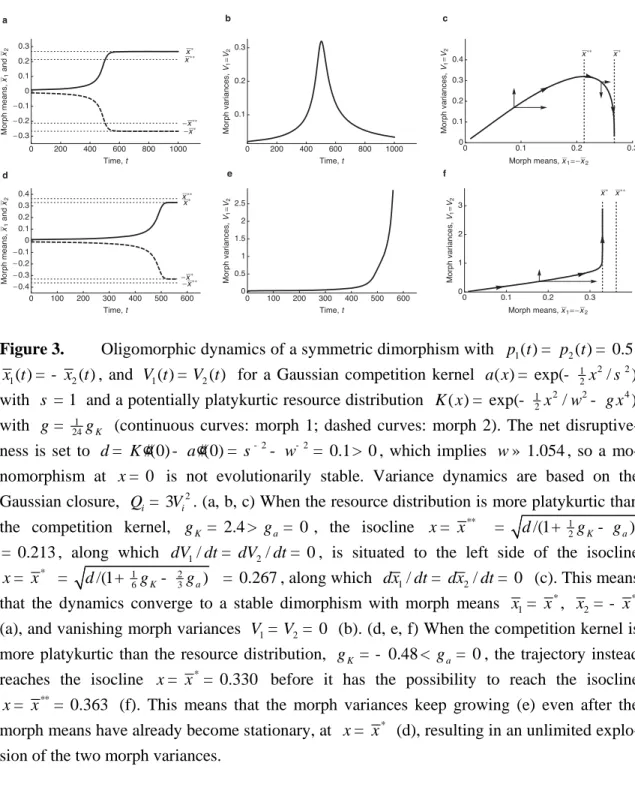
behaviors, depending on the kurtoses of the competition kernel and carrying-capacity function. If the carrying-capacity function is more platykurtic than the competition kernel (gK> ga), then x increases towards x*. As character displacement increases, the morph variances first increase and then decrease towards zero once x exceeds x** (Figure 3A-C). Thus, the population converges to an atomic distribution at ±x*. If the competition kernel is more pla-tykurtic than the carrying-capacity function (ga> gK), then x**> x*, which implies that the morph variances keep increasing even after the morph means have reached their equilibrium (Figure 3D-F). The two morph variances therefore increase without limit, indicating that the dimorphism ±x* is not evolutionarily stable. In this case, a trimorphism, rather than a
di-below. Figure 3C and 3F depicts trajectories ( , )x V , as well as the isoclines dx dt =/ 0 and
/ 0
dV dt = , for gK> ga (Figure 3C) and ga> gK (Figure 3F).
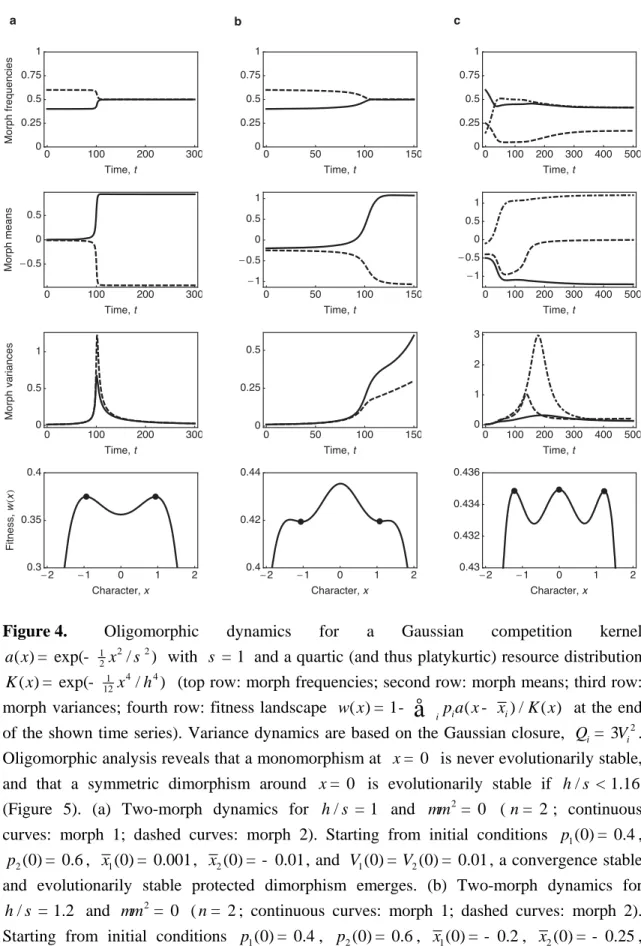
Figure 4 shows results of the numerical analysis of the corresponding two-morph and three-morph dynamics. As a robustness check, we consider an initially asymmetric dimor-phism, and verify that symmetry is nonetheless subsequently established. The carry-ing-capacity function is platykurtic, indeed purely quartic, 1 4 4
12
( ) exp( / )
K x = - x h , and the competition kernel is Gaussian, 1 2 2
2
( ) exp( / )
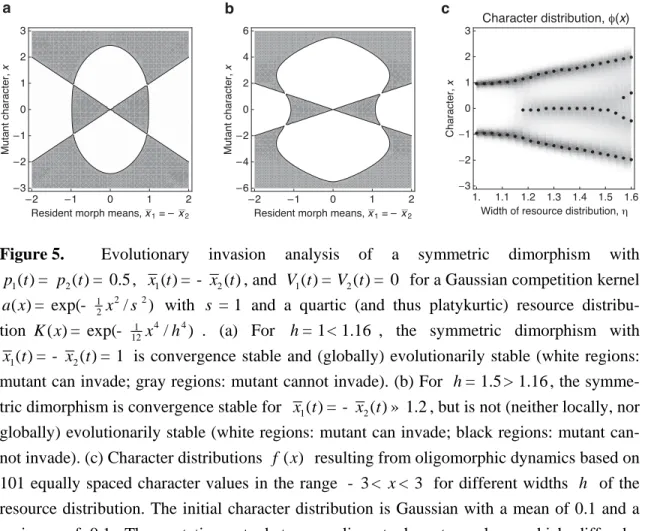
a x = - x s . For these specific functions, a pair-wise invasibility analysis of the symmetric dimorphism ±x* reveals that for h s </ 1.16 this dimorphism is evolutionarily stable, while for h s >/ 1.16 it is destabilized (Figure 5).
4.4. Effects of mutation on evolutionary branching
We now examine how mutations affect the condition for evolutionary branching. For this, we consider a Gaussian competition kernel a and a resource distribution K that can be either Gaussian or platykurtic, 2 1 2 ( ) exp( ) a x = - x and 1 2 2 4 2 ( ) exp( / ). K x = - x w - gx (54)
The character x is scaled so that the standard deviation of the competition kernel equals 1,
w measures the standard deviation of the resource distribution, and g ³ 0 determines the
degree of platykurtosis of the resource distribution. According to inequality (47), the thre-shold for evolutionary branching in the absence of mutation is given by w = . In the special, 1 and highly structurally unstable, case that both competition kernel and resource distribution are Gaussian (g = 0), and when the resource distribution is wider than the competition kernel
(w > ), a continuous distribution with variance 1 w2- 1 is stable (MacArthur and Levins
1967; MacArthur 1969, 1970; Roughgarden 1972; May 1973, 1974; Slatkin and Lande 1976; Bull 1987). If, in contrast, the resource distribution is just slightly platykurtic (g> 0), the dynamic outcome abruptly changes into an evolutionarily stable dimorphism (Sasaki and Ell-ner 1995; EllEll-ner and Sasaki 1996; Sasaki 1997).
If recurrent mutations generate variance, atomic character distributions cannot remain atomic; instead, each morph must feature narrow blurs around its peaks. So far, however, there has been little study of how mutations change the bifurcations associated with evolutio-nary branching, or the character distributions that from evolutioevolutio-nary branching. It is also in-teresting to ask how adding mutations affects the structurally unstable continuous distribu-tions expected for the combination of Gaussian competition kernels with Gaussian resource distributions. In this section, we apply oligomorphic dynamics to answer these three questions. For this purpose, we assume that, owing to mutations, an offspring's character deviates from that of its parent with rate m and variance m2.
4.4.1.
Analytical results
Analyzing the dynamics of a single morph, we focus on cases in which the net disruptiveness 2
1 0
d= - w- > is close to the bifurcation point d = 0, and expand, up to sixth order in the character deviation x= x- x, the selection component (dV dt/ )sel of the variance dynamics. As shown in Appendix A, this gives
2 2 sel 1 1 ( ) ( ) ( ), 2 2 dV Q V Q V V H VQ dt d g æ ö÷ ç ÷ = - - - + -ç ÷ çè ø (55) where V = x f2 ( )x dx
ò
, Q= x f4 ( )x dxò
, and H = x f6 ( )x dxò
. Combining this with the mutation component 2 mut dV m dt m æ ö÷ ç ÷ = ç ÷ çè ø (56)of the variance dynamics, we obtain the total rate of variance change as dV dt/ = sel
(dV dt/ ) + (dV dt/ )mut.
To derive from this a rough estimate of the equilibrium morph variance, we can as-sume that the character distribution is approximately Gaussian, so that Q= 3V2 and
3 15 H = V , which gives 2 3 2 (1 12 ) . dV V V m dt = d - + g +m (57)
Setting the right-hand side to 0, we obtain the approximate equilibrium morph variance V as an implicit function of the bifurcation parameters d or w= (1- d)-1/ 2» 1+d/ 2. Figure 6 compares this with the results of numerical analyses.
As shown by the numerical analyses, mutations postpone the bifurcation towards mul-timodality in the character distribution that results from increasing the strength of disruptive selection. We examine how far mutations shift this bifurcation point, by assuming small devi-ations of characters from the mean of an approximately Gaussian character distribution. For a morph variance V , the two leading terms for the second derivative w¢¢(0) of fitness at the morph mean x = 0 are then given by
(0) .
w¢¢ = d- V (58)
Thus, if d= -1 w-2 exceeds the equilibrium morph variance V defined by eq. (57), the fitness landscape is disruptive at x = 0. The bifurcation point d at which this occurs is therefore obtained by substituting V= d into eq. (57), setting its right-hand side to 0, which yields
3 2
12gd mm 0.
- + = (59)
This means that mutations shift the bifurcation point from d = 0 to 2
m m
or equivalently, from w= to 1 2 3 1 1 . 2 12 m m w g = + (61)
Consequently, for conditions close to d = 0 and g = 0, an arbitrary amount of muta-tion-induced variance mm2 prevents evolutionary branching. The special case of Gaussian competition kernels and resource distributions (which implies a dynamically stable, but structurally unstable, equilibrium character distribution of Gaussian shape), then loses its pa-thological nature (Sasaki and Ellner 1995; Sasaki 1997; Gyllenberg and Meszéna 2005; Pig-olotti et al. 2007, 2009) and instead results in a structurally stable evolutionary outcome fea-turing a single evolutionarily stable morph.
4.4.2.
Numerical results
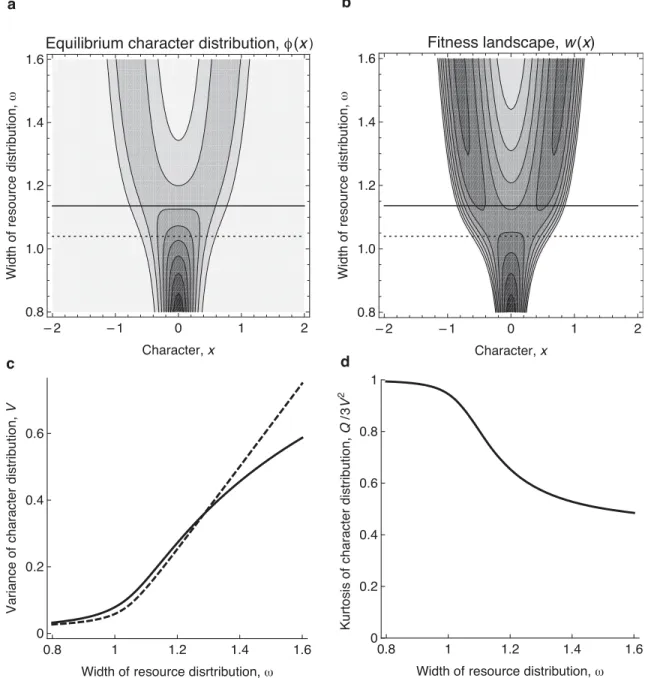
Figure 6A shows how w affects the equilibrium character distribution f ( )x . The distribu-tion stays unimodal for d<0 or w< , in accordance with the predicted bifurcation points 1 without mutation. For g = 0.05 and mm2= 3.2 10× -4, the predicted bifurcation points with mutation are d= (mm2/12 )g 1/ 3= .0 08196 or w = .1 03976. This well approximates the threshold at which the fitness landscape becomes bimodal (dashed line in Figure 6B). The equilibrium character distribution stays unimodal for even larger values of w (Figure 6A), after the fitness landscape becomes bimodal (Figure 6B), with an increasing platykurtosis in the single morph compensating for the increasing disruptiveness, up to about w = 1.136 (Figure 6D).
Figure 6B shows the equilibrium morph variance V as a function of w. The va-riance gradually increases as the bifurcation parameter w is raised. The numerical results (dotted line) are in good agreement with the approximate analytical results (continuous line), which are derived for small d= -1 w-2 and obtained as the root of the cubic equation that results from setting to 0 the right-hand side of eq. (57).
Figure 6D shows the equilibrium morph kurtosis E xf[ 4] /(3V2) as a function of w. The kurtosis gradually decreases from 1 (for a mesokurtic distribution) as the bifurcation pa-rameter w is raised. For w between 1 and 1.136, the equilibrium character distribution re-mains unimodal, but becomes increasingly platykurtic (Figure 6A). Instead of splitting the equilibrium character distribution and creating a dimorphism, disruptive selection is compen-sated by mutation, becoming absorbed in the platykurtosis of an evolutionarily stable morph. If w is further increased, disruptive selection overcomes this mutation-induced morph cohe-sion, so that the equilibrium character distribution starts to become bimodal (Figure 6A).
5. Discussion
Here we have derived oligomorphic dynamics as a new theoretical framework for examining the joint ecological and evolutionary dynamics of populations with multiple interacting morphs. Building on, and integrating, salient aspects from a wide range of preeminent pre-ceding work (including Lande 1976, 1979, 1981, 1982; Roughgarden 1972, 1976; Bulmer 1974; Slatkin 1980; Iwasa et al. 1991; Abrams et al. 1993; Vincent et al. 1993), our approach helps moving beyond a focus on unimodal character distributions, often taken in models of quantitative genetics theory, and on negligible within-morph variance, often taken in models of adaptive dynamics theory. Through a double Taylor expansion of interaction coefficients and fitness landscapes around the means of all morphs existing in a population, we have de-rived the approximate dynamics of morph frequencies, means, and variances.
More in particular, we have shown how oligomorphic dynamics can help investigate processes of adaptive diversification driven by frequency-dependent disruptive selection. For this purpose, we have (1) shown how to interpret conditions for demographic stability, con-vergence stability, and evolutionary stability in terms of the moments of oligomorphic dy-namics, (2) presented alternative moment closures suitable for oligomorphic dydy-namics, (3) derived approximations for assessing the waiting time until evolutionary branching, and (4) analyzed the effects of mutation on equilibrium morph variances. In addition, for a classical model of resource competition we have (5) elucidated the structural instability of continuous character distributions, (6) obtained threshold conditions for primary and secondary evolutio-nary branching, and (7) derived corrections for describing the effects of mutation on evolu-tionary branching.
There is a great variety of aspects that need to be considered when trying to under-stand processes of adaptive speciation in ways that do justice to the complexity of the corres-ponding natural systems (e.g., Dieckmann and Doebeli 2005). Models based on game-theoretical and phenotypic dynamics have been used to investigate complexities in the ecological underpinnings of speciation, whereas models based on population genetics or quantitative genetics have helped analyze complexities in the genetic underpinnings of speci-ation (see, e.g., Dieckmann et al. 2004 for reviews). Oligomorphic dynamics contribute to bridging between these approaches, by extending the multi-morph dynamics of adaptive dy-namics theory with analyses of the effects of morph variance and of the effects of mutation, while extending the single-morph dynamics of quantitative genetics theory with analyses of evolutionary branching and of morph interactions.
In the spirit of such bridge building, we have investigated how mutations affect the bifurcation structure and equilibrium character distribution in processes of adaptive speciation. It turns out that mutations have a large effect on the threshold condition for the relative net disruptiveness of selection (defined as the difference between the strength of disruptive