University of Bradford eThesis
This thesis is hosted in Bradford Scholars – The University of Bradford Open Access
repository. Visit the repository for full metadata or to contact the repository team
© University of Bradford. This work is licenced for reuse under a
Creative Commons
Y.T.N. ALQASRAWI
PhD
UNIVERSITY OF BRADFORD
Developing different approaches for semantic scene
modelling based on Bag of Visual Words
YOUSEF T. N. ALQASRAWI
Submitted for the degree of
Doctor of Philosophy
Department of Computing
School of Computing, Informatics and Media
University of Bradford
Keywords: image classification, image retrieval, bag of visual words, visual vocabulary, features fusion, spatial pyramid layout, concept-based bag of visual words.
Abstract
With the availability of inexpensive hardware and software, digital imaging has become an important medium of communication in our daily lives. A huge amount of digital images are being collected and become available through the internet and stored in various fields such as personal image collections, medical imaging, digital arts etc. Therefore, it is important to make sure that images are stored, searched and accessed in an efficient manner. The use of bag of visual words (BOW) model for modelling images based on local invariant features computed at interest point locations has become a standard choice for many computer vision tasks. Based on this promising model, this thesis investigates three main problems: natural scene classification, annotation and retrieval. Given an image, the task is to design a system that can determine to which class that image belongs to (classification), what semantic concepts it contain (annotation) and what images are most similar to (retrieval).
This thesis contributes to scene classification by proposing a weighting approach, named keypoints density-based weighting method (KDW), to control the fusion of colour information and bag of visual words on spatial pyramid layout in a unified framework. Different configurations of BOW, integrated visual vocabularies and multiple image descriptors are investigated and analyzed. The proposed approaches are extensively evaluated over three well-known scene classification datasets with 6, 8 and 15 scene categories using 10-fold cross validation. The second contribution in this thesis, the scene annotation task, is to explore whether the integrated visual vocabularies generated for scene classification can be used to model the local semantic information of natural scenes. In this direction, image annotation is considered as a classification problem where images are partitioned into 10x10 fixed grid and each block, represented by BOW and different image descriptors, is classified into one of predefined semantic classes. An image is then represented by counting the percentage of every semantic concept detected in the image. Experimental results on 6 scene categories demonstrate the effectiveness of the proposed approach. Finally, this thesis further explores, with an extensive experimental work, the use of different configurations of the BOW for natural scene retrieval.
Declaration
I hereby declare that this thesis has been genuinely carried out by myself and has not been used in any previous application for a degree. The invaluable participation of others in this thesis has been acknowledged where appropriate.
Dedication
This thesis is dedicated to the memory of my grandfather, Naji, whose encouragement served as a source of inspiration, my parents, my wife Rana, daughter Rahaf, and son Mohammad for their patience, understanding, support, and love.
Acknowledgments
In the Name of Allah, the Most Gracious, the Most Merciful
All Praise is due to Allah for His Glorious Ability and Great Power for granting me the health, strength, patience and ability to complete this doctoral thesis.
I am heartily thankful to my supervisors Professor Daniel Neagu and Professor Peter Cowling, whose encouragement, guidance and support from the initial to the final level enabled me to develop an understanding of the subject. They have offered me all the assistance to complete this thesis. It is an honour for me to have them both as my supervisors.
I would like to acknowledge the financial support of the Applied Science University in Jordan which offered me a scholarship for PhD studies in the University of Bradford. I also thank the School of Computing, Informatics and Media (SCIM) for offering all the support and assistance, especially the head of Computing department, Mr. Mick Ridley.
I would like to thank Dr. Paul Trundle and Dr. Sophia Alim for revising and proofreading my work. Also, I am grateful to all friends in the artificial intelligence group for their friendship and support.
I would like to thank Julia Vogel for providing me her image dataset. Also, I would like to thank all people who I have been in contact with during my doctoral study.
Last but not least, my appreciation and love goes to my parents, wife and children for their support, patience and love.
Peer Reviewed Publications and Contributions
Journal papers:
- Alqasrawi Y., Neagu D. and Cowling P.I. (2011): "Fusing Integrated Visual Vocabularies-Based Bag of Visual Words and Weighted Colour Moments on Spatial Pyramid Layout for Natural Scene Image Classification" Signal, Image and Video Processing, Springer.(in print), http://www.springerlink.com/content/b06h4h310u7t1441/
Conferences and workshops:
- Alqasrawi Y., Neagu D. and Cowling P. (2010): "Spatial Pyramid Local Keypoints Quantization for Bag of Visual Patches Image Representation", The 10th International Conference on Intelligent Design and Applications ISDA10, pp. 1270-1274, IEEE Computer Society, Cairo, Egypt.
- Alqasrawi Y., Neagu D. and Cowling P. (2009): "Natural Scene Image Recognition by Fusing Weighted Colour Moments with Bag of Visual Patches on Spatial Pyramid Layout", The 9th International Conference on Intelligent Design and Applications ISDA09 pp. 140-145, IEEE Computer Society, Best Student Paper Award, Pisa, Italy.
- Alqasrawi Y., Neagu D. and Cowling P. (2008): "Overview of Current Approaches Towards Better Image Retrieval Systems", Proceedings of the Ninth Informatics Workshop for Research Students, pp. 76-79, June 2008, University of Bradford. ISBN 978 1 85143 251 6.
Posters, Presentations and Training
Posters:
2009- Showcase poster: A prototype for Content-based Image Retrieval, University of Bradford.
2008- Showcase poster: Natural scene modelling and classification, University of Bradford.
Presentations:
2010- Research Seminar: Natural Scene Image Recognition by Fusing Weighted Colour Moments, University of Bradford.
2009- Presentation and Demonstration to students from Bradford School: Using a Software prototype for Content-based Image Retrieval, University of Bradford.
2009- Presentation and Demonstration to students from Bradford Grammar School: Using a Software prototype for Content-based Image Retrieval, University of Bradford.
2009- Presentation and Demonstration to students from Titus Salt Grammar School: Using a Software prototype for Content-based Image Retrieval, Titus Salt Grammar School, Shipley.
Training:
2010- International Computer Vision Summer School (ICVSS): Registration and Video Analysis. Sicily, Italy, 12-17 July, 2010.
Planed publications:
- Image Annotation based on the bag of visual words model and local semantic concepts.
- Natural scene retrieval using the bag of visual words model and local semantic concepts: A comparative study.
Table of Contents
ABSTRACT ... I DECLARATION ... II DEDICATION ... III ACKNOWLEDGMENTS ... IV PEER REVIEWED PUBLICATIONS AND CONTRIBUTIONS ... VI TABLE OF CONTENTS ... VIII LIST OF FIGURES ... XII LIST OF TABLES ... XIX
CHAPTER 1 ... 1
INTRODUCTION ... 1
1.1 Overview of the Thesis ... 4
1.2 Aims and Objectives ... 6
1.3 Contributions ... 8
1.4 Thesis Structure ... 10
CHAPTER 2 ... 12
LITERATURE REVIEW ... 12
2.1 Image Classification: A Review ... 13
2.1.1 Image classification based on low-level features ... 15
2.1.2 Image classification based on intermediate semantic modelling ... 17
2.1.2.1 Intermediate semantic concepts ... 18
2.1.2.2 Semantic modelling using BOW ... 20
2.2 Image Annotation: A Review ... 36
2.2.1 Automatic image annotation techniques ... 39
2.2.1.2 Single-label image annotation at region level ... 40
2.2.1.3 Multiple image annotation ... 41
2.3 Semantic-based image retrieval: A Review ... 44
2.3.1 Early days of CBIR ... 46
2.3.2 Semantic-based image retrieval ... 48
2.4 Summary ... 50
CHAPTER 3 ... 51
BACKGROUND ... 51
3.1 Image Retrieval ... 52
3.1.1 Textual-based image retrieval ... 52
3.1.2 Content-based image retrieval (CBIR) ... 53
3.1.3 The semantic gap ... 55
3.2 Content-Based Image Description ... 58
3.2.1 Colour features ... 59
3.2.2 Texture features ... 61
3.2.3 Region-based image representation ... 63
3.2.4 Interest point detection and description... 66
3.3 Bag of Visual Words (BOW) ... 70
3.4 Spatial Layout ... 72
3.5 Machine Learning ... 73
3.5.1 Support Vector Machines (SVM) ... 73
3.5.2 k-Nearest Neighbor (kNN) Classifier ... 76
3.5.3 k-Means Clustering ... 77
3.6 Evaluation Criteria ... 78
3.6.1 Confusion Matrix ... 78
3.6.2 k-Fold Cross-Validation ... 79
3.6.3 Precision and Recall ... 80
3.7 Summary ... 82
IMAGE CLASSIFICATION ... 83
4.1 Location-Aware Image Semantic Representation... 86
4.1.1 Local invariant points detection and description ... 86
4.1.2 Visual Vocabulary Construction ... 88
4.1.3 Summarizing image content using the BOW ... 90
4.1.4 Spatial pyramid Layout ... 92
4.2 Pyramidal fusing of BOW and image colour information ... 94
4.3 Experimental work ... 99 4.3.1 Scene classifier ... 99 4.3.2 Image datasets ... 100 4.3.3 Feature extraction ... 104 4.3.4 Experimental results ... 104 4.4 Summary ... 119 CHAPTER 5 ... 120 IMAGE ANNOTATION ... 120
5.1 Natural Scene Dataset ... 123
5.2 Local Semantic Concepts and Local Keypoints ... 124
5.3 Image Annotation Framework ... 132
5.3.1 Scene visual vocabulary construction ... 134
5.3.2 Image region representation ... 135
5.3.2.1 Concept-based bag of visual words (CBOWs) ... 136
5.3.2.2 Local from Global CBOWs ... 142
5.3.2.3 Multiple features... 149
5.3.2.4 Prototypical local semantic concept representation ... 152
5.4 Experimental Work ... 153
5.4.1 Local Semantic Annotators ... 153
5.4.2 Experimental Results ... 157
5.5 Summary ... 165
IMAGE RETRIEVAL ... 167
6.1 Evaluation Methodology... 169
6.2 Image Retrieval Based on Annotated Image Regions ... 171
6.3 Image Retrieval Using Bag of Visual Words ... 175
6.4 Experimental Work ... 177
6.4.1 Experimental setup ... 177
6.4.2 Experiments on image retrieval using COV ... 179
6.4.3. Experiments on image retrieval using BOW ... 191
6.4.3.1 Experimental results: Vogel_6DS dataset ... 191
6.4.3.2 Experimental results: Oliva_8DS ... 197
6.4.3.3 Experimental results: Lazebnik_15DS ... 202
6.5. Summary... 207
CHAPTER 7 ... 209
CONCLUSIONS AND FUTURE WORK ... 209
7.1 Summary of Contributions and Conclusions ... 210
7.2 Future Work ... 215
List of Figures
FIGURE 1-1:IMAGE CLASSIFICATION IS A DIFFICULT TASK DUE TO AMBIGUITIES IN THE APPEARANCE OF IMAGE REGIONS.IN THE LEFT IMAGE,"SKY" AND "WATER" REGIONS LOOK SIMILAR WHILE IN THE RIGHT IMAGE,"TREE" AND
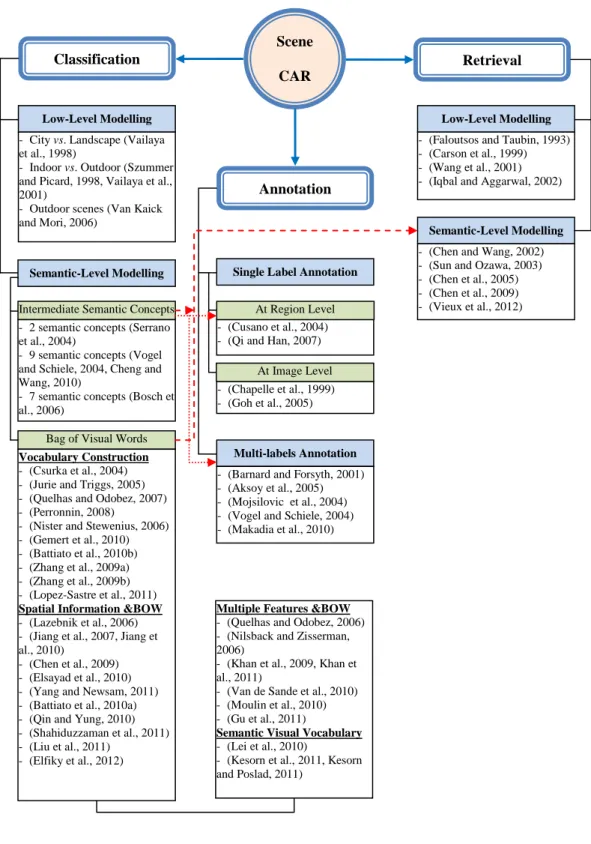
"BUILDING" LOOK SIMILAR (RASIWASIA,2011) ... 5 FIGURE 2-1:BLOCK DIAGRAM OF THE TOPICS COVERED IN THIS CHAPTER WITH SAMPLE REFERENCES USED IN THE SCENE
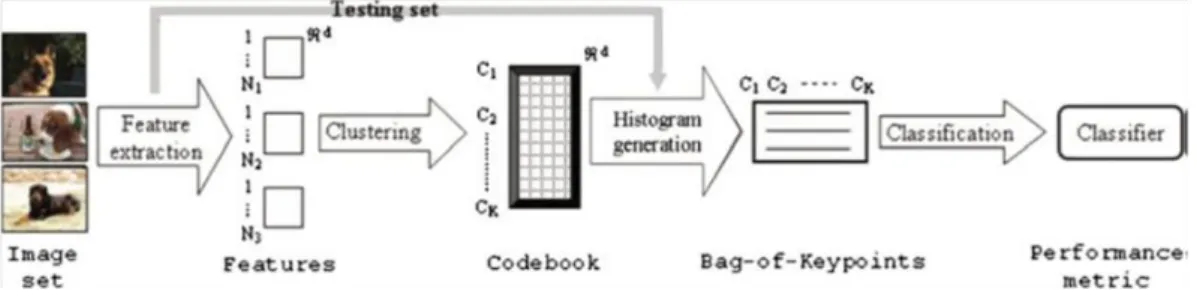
CAR LITERATURE.RED ARROWS SHOW THAT SEMANTIC CONCEPTS AND BOW MODEL CAN ALSO BE APPLIED TO SCENE ANNOTATION AND SEMANTIC-BASED IMAGE RETRIEVAL. ... 14 FIGURE 2-2:GENERAL FRAMEWORK FOR BUILDING BOW IMAGE REPRESENTATION (RAMANAN AND NIRANJAN,2011)
... 21 FIGURE 2-3:SCHEMATIC REPRESENTATION OF THE TWO FUSION APPROACHES.YELLOW BOX SHOWS FUSION BETWEEN
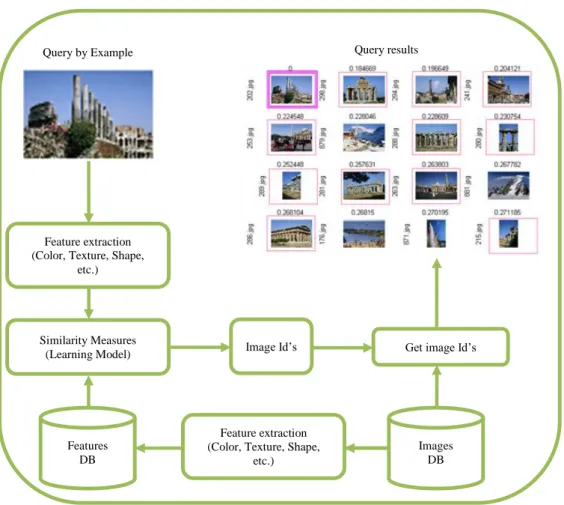
FEATURES BEFORE QUANTIZATION, WHEREAS PINK BOX SHOWS THE FUSION AT BAG OF VISUAL WORDS LEVEL.THE DIAGRAM IS OBTAINED FROM QUELHAS PHD THESIS (QUELHAS,2007). ... 32 FIGURE 3-1:A GENERAL CBIR FRAMEWORK.NUMBERS IN THE QUERY RESULTS REPRESENT THE DEGREE OF SIMILARITIES
BETWEEN THE QUERY IMAGE AND IMAGES IN THE DATABASE.IMAGES IN THE RED SQUARE ARE IMAGES THAT ARE MOST SIMILAR TO THE QUERY IMAGE, I.E. FROM SAME CATEGORY... 55
FIGURE 3-2:AN ILLUSTRATION OF THE SEMANTIC GAP.BOTH IMAGES SHARE THE SAME SEMANTIC CONCEPT OF BEACH BUT THEY HAVE DIFFERENT VISUAL FEATURES SUCH AS COLOUR, TEXTURE ETC.THIS FIGURE HAS BEEN ADOPTED FROM
(RASIWASIA,2011). ... 56 FIGURE 3-3:HSV COLOUR SPACE ... 60 FIGURE 3-4:IMAGE REGIONS ARE SAMPLED BASED ON (A) FIXED PARTITIONING (LUO ET AL.,2006)(B) SEGMENTATION
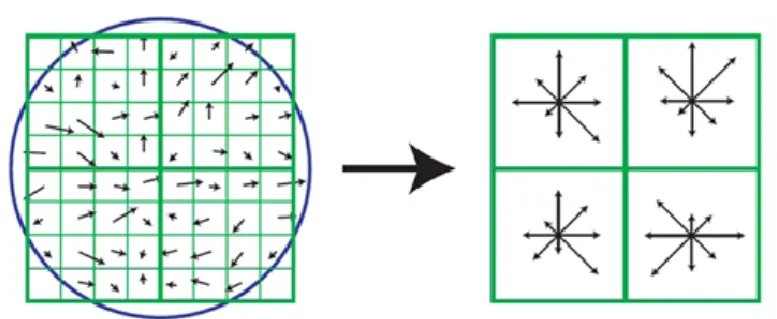
(C)SALIENT DETECTION USING DOG DETECTOR. ... 65 FIGURE 3-5:ILLUSTRATION OF SIFT FEATURE DETECTOR, WHICH CONSIST OF HISTOGRAMS OF ORIENTED GRADIENTS
FIGURE 3-6:THE BAG OF FEATURES APPROACH, CONSISTS OF AN UNORDERED SET OF LOCAL APPEARANCE DESCRIPTORS
(COURTESY OF FEI-FEI, HTTP://VISION.STANFORD.EDU/). ... 71
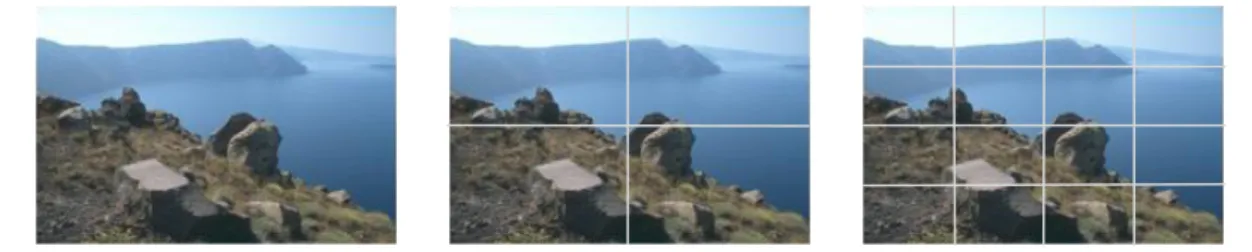
FIGURE 3-7:ILLUSTRATION OF THE SPATIAL PYRAMID SCHEME.THE ORIGINAL IMAGE IS FROM VOGEL’S DATASET (VOGEL AND SCHIELE,2004) AND DECOMPOSED INTO TWO LEVELS (MIDDLE AND RIGHT).FOR EACH CELL A SEPARATED HISTOGRAM IS COMPUTED. ... 73
FIGURE 3-8:OPTIMAL SEPARATING HYPERPLANE (GUNN,1998) ... 75
FIGURE 3-9:PRECISION-RECALL GRAPHS.(RIGHT) PERFECT PRECISION-RECALL GRAPH (FAUZI,2004)... 82
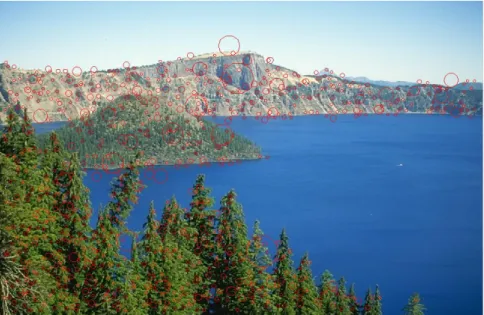
FIGURE 4-1:SAMPLE IMAGES WITH CIRCLES AROUND INTEREST POINTS DETECTED USING DOG DETECTOR. ... 87
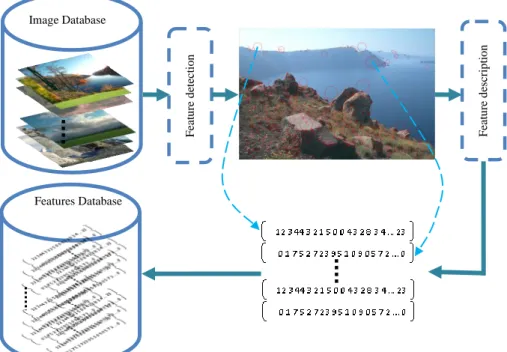
FIGURE 4-2KEYPOINT DETECTION AND DESCRIPTION PROCESS.THE CIRCLES OVERLAID ON THE IMAGE INDICATE KEYPOINTS LOCATED USING DOG FEATURE DETECTOR.EACH KEYPOINT IS DESCRIBED AND STORED IN FEATURE VECTOR.EACH FEATURE VECTOR CONTAINS 128 DESCRIPTIVE VALUES, USING SIFT DESCRIPTORS. ... 88
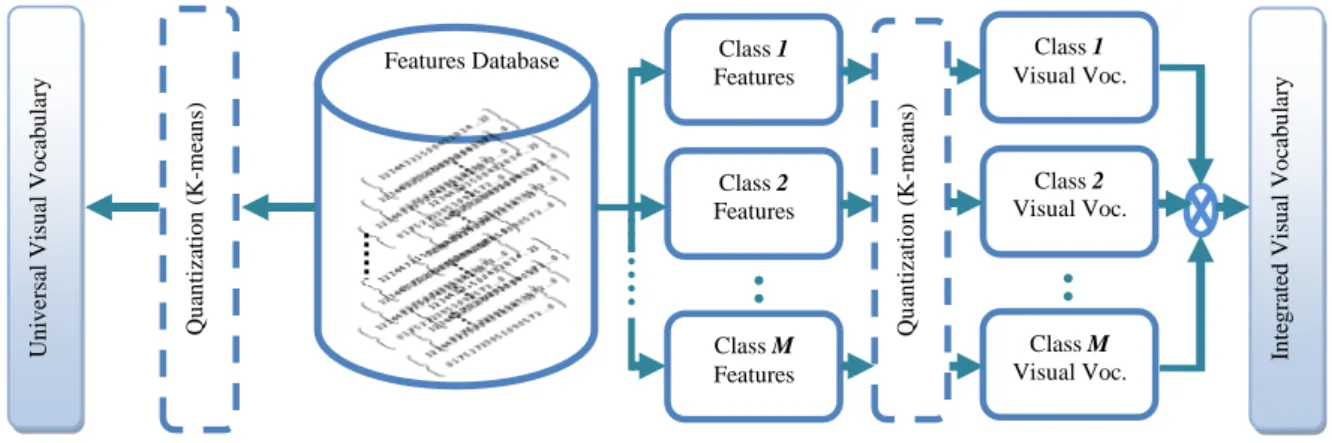
FIGURE 4-3:VISUAL VOCABULARY CONSTRUCTION PROCESS.THE LEFT SIDE OF FEATURES DATABASE SHOWS UNIVERSAL VISUAL VOCABULARY.THE RIGHT SIDE SHOWS THE PROPOSED INTEGRATED VISUAL VOCABULARY.EACH CLASS FEATURES (FOR CLASS 1,2,…,M)REPRESENTS FEATURE VECTORS OF TRAINING IMAGES FOR A SPECIFIC IMAGE CATEGORY. ... 90
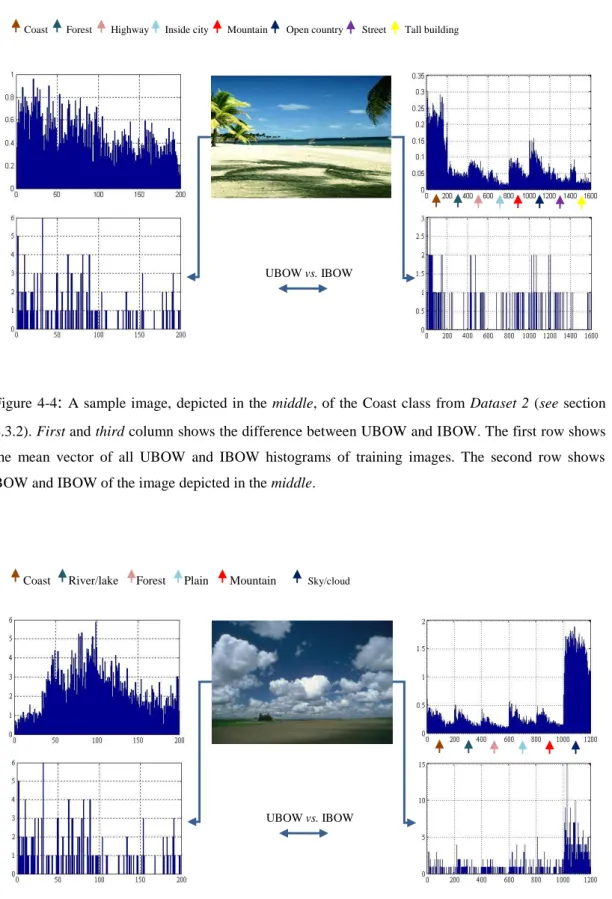
FIGURE 4-4:A SAMPLE IMAGE, DEPICTED IN THE MIDDLE, OF THE COAST CLASS FROM DATASET2(SEE SECTION 4.3.2). FIRST AND THIRD COLUMN SHOWS THE DIFFERENCE BETWEEN UBOW AND IBOW.THE FIRST ROW SHOWS THE MEAN VECTOR OF ALL UBOW AND IBOW HISTOGRAMS OF TRAINING IMAGES.THE SECOND ROW SHOWS BOW AND IBOW OF THE IMAGE DEPICTED IN THE MIDDLE. ... 93
FIGURE 4-5:A SAMPLE IMAGE, DEPICTED IN THE MIDDLE, OF THE SKY/CLOUDS CLASS FROM DATASET1(SEE SECTION 4.3.2).FIRST AND THIRD COLUMN SHOWS THE DIFFERENCE BETWEEN UBOW AND IBOW.THE FIRST ROW SHOWS THE MEAN VECTOR OF ALL UBOW AND IBOW HISTOGRAMS OF TRAINING IMAGES.THE SECOND ROW SHOWS BOW AND IBOW OF THE IMAGE DEPICTED IN THE MIDDLE. ... 93
FIGURE 4-6:(A)SAMPLE IMAGE WITH CIRCLES AROUND INTEREST POINTS.(B)SKY AND WATER CONTAIN LITTLE INFORMATION OF INTEREST.RED BORDERS IN (B) SHOWS IMPORTANT INFORMATION THAT HELPS DISCRIMINATE IMAGE CONTENT. ... 95
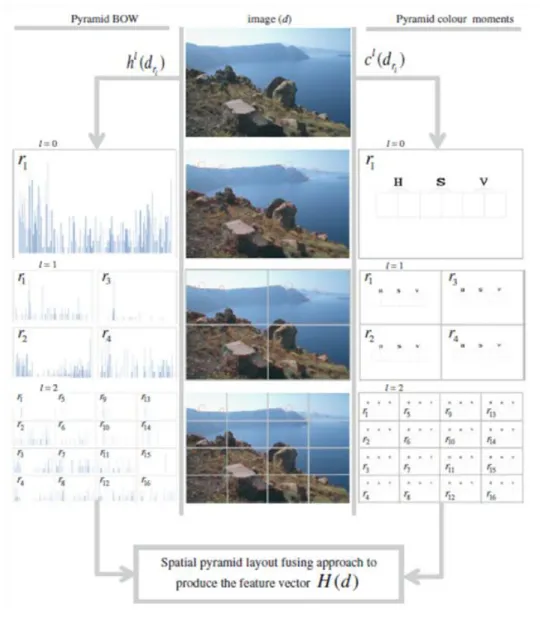
FIGURE 4-7:FEATURE FUSION PROCESS ON SPATIAL PYRAMID LAYOUT (L=2).THE LEFT COLUMN REPRESENTS HISTOGRAMS OF BOW.THE RIGHT COLUMN REPRESENTS COLOUR MOMENTS FOR THE HSV COLOUR SPACE BANDS.THE MIDDLE COLUMN REPRESENTS AN IMAGE AT DIFFERENT LEVELS OVERLAID WITH CIRCLES AROUND INTEREST POINTS. ... 98
FIGURE 4-8:SOME EXAMPLES OF THE IMAGES USED FOR EACH CATEGORY FROM THE DATASET 1,DATASET 2,DATASET3
AND DATASET 4 RESPECTIVELY. ... 103
FIGURE 4-9:THE CLASSIFICATION PERFORMANCE OF IPBOW+PCM COMPARED WITH DIFFERENT BASELINE METHODS FOR EACH SCENE CLASS OF DATASET 2.IT IS CLEAR THAT IN MOST SCENE CLASSES IPBOW+PCM OUTPERFORMS OTHER METHODS.GIST+PCM FEATURES PERFORM BEST FOR THE OPEN COUNTRY SCENE CLASS. ... 109
FIGURE 4-10:A COMPARISON OF THE AVERAGE CLASSIFICATION PERFORMANCE ACCURACY OF DIFFERENT IMAGE REPRESENTATION METHODS ON DATASET 2(A) AND DATASET 1(B). ... 111
FIGURE 4-11:THE CLASSIFICATION PERFORMANCE OF OUR APPROACH COMPARED WITH DIFFERENT METHODS FOR EACH SCENE CLASS OF DATASET 1.IT IS CLEAR THAT IN MOST SCENE CLASSES OUR APPROACH OUTPERFORMS OTHER METHODS. ... 112 FIGURE 4-12:PERFORMANCE COMPARISONS BETWEEN OUR PROPOSED APPROACH (IPBOW+WPCM) BASED ON SIFT
FEATURES AND IBOW IMAGE REPRESENTATION BASED ON RGBSIFT FEATURES (VAN DE SANDE ET AL.,2010) BOTH TESTED ON DATASET 1(A) AND DATASET 3(B). ... 113 FIGURE 4-13:UBOW VS.IBOW FOR DATASET 1(6-CLASSES).FOR EACH SCENE CONCEPT (ROWS),(A) SHOWS SAMPLE
IMAGES FROM THE DATASET (B) THE AVERAGE OF IBOW HISTOGRAMS OF ALL TRAINING IMAGES AND THE IBOW
HISTOGRAM FOR THE CORRESPONDING IMAGE CATEGORY AND SAMPLE IMAGE, RESPECTIVELY (C) THE AVERAGE OF
UBOW HISTOGRAMS OF ALL TRAINING IMAGES AND THE UBOW HISTOGRAM FOR THE CORRESPONDING IMAGE CATEGORY AND SAMPLE IMAGE, RESPECTIVELY.FROM (B) WE CAN SEE THAT MOST IMAGE HISTOGRAMS TEND TO BELONG TO THEIR AVERAGE HISTOGRAMS.THOUGH, SOME CLASSES GET CONFUSED WITH OTHER CLASSES SUCH AS
"RIVER/LAKES" AND "MOUNTAINS" SINCE MANY "MOUNTAIN" IMAGES CONTAIN "WATER" AND VICE VERSA. .. 115
FIGURE 4-14:BOW VS.IBOW FOR DATASET 3(8 CLASSES).FOR EACH SCENE CONCEPT (ROWS),(A) SHOWS SAMPLE IMAGES FROM THE DATASET (B) THE AVERAGE OF IBOW HISTOGRAMS OF ALL TRAINING IMAGES AND THE IBOW
UBOW HISTOGRAMS OF ALL TRAINING IMAGES AND THE UBOW HISTOGRAM FOR THE CORRESPONDING IMAGE CATEGORY AND SAMPLE IMAGE, RESPECTIVELY.FROM (B) WE CAN SEE THAT MOST IMAGE HISTOGRAMS TEND TO BELONG TO THEIR AVERAGE HISTOGRAMS.THOUGH, SOME CLASSES GET CONFUSED WITH OTHER CLASSES SUCH AS
"OPEN COUNTRY" AND "FOREST" SINCE MANY "OPEN COUNTRY" IMAGES CONTAIN "TREES" AND VICE VERSA. 116 FIGURE 4-15:BOW VS.IBOW FOR DATASET 4(15 CLASSES).FOR EACH SCENE CONCEPT (ROWS),(A) SHOWS SAMPLE
IMAGES FROM THE DATASET (B) THE AVERAGE OF IBOW HISTOGRAMS OF ALL TRAINING IMAGES AND THE IBOW
HISTOGRAM FOR THE CORRESPONDING IMAGE CATEGORY AND SAMPLE IMAGE, RESPECTIVELY (C) THE AVERAGE OF
UBOW HISTOGRAMS OF ALL TRAINING IMAGES AND THE UBOW HISTOGRAM FOR THE CORRESPONDING IMAGE CATEGORY AND SAMPLE IMAGE, RESPECTIVELY.FROM (B) WE CAN SEE THAT MOST IMAGE HISTOGRAMS TEND TO BELONG TO THEIR AVERAGE HISTOGRAMS.THOUGH, SOME CLASSES GET CONFUSED WITH OTHER CLASSES SUCH AS
"LIVING ROOM" AND "KITCHEN" SINCE BOTH CLASSES ARE INDOOR IMAGES AND CONTAIN SIMILAR FURNITURE. "OPEN COUNTRY" AND "FOREST" IS ANOTHER EXAMPLE OF CONFUSION IN THEIR VISUAL CONTENTS. ... 118 FIGURE 5-1:A SAMPLE IMAGE FROM THE 'COAST' SCENE CATEGORY.IMAGE REGIONS ARE MANULLAY ANNOTATED WITH
SEMANTIC CONCEPTS.IMAGE REGIONS THAT CONTAIN MORE THAN ONCE SEMATNIC CONCEPTS ARE DISCARDED IN THE ANNOTATION PROCESS. ... 125 FIGURE 5-2:EXEMPLE OF IMAGES FROM EACH SCENE CATEGORY.EACH ROW CONTAINS TWO IMAGES SELECTED FROM THE
SAME CATEGORY.IMAGE REGIONS ARE MANUALLY ANNOTATED WITH LOCAL SEMANTIC CONCEPTS. ... 127 FIGURE 5-3:DISTRIBUTION OF LOCAL KEYPOINTS DETECTED IN IMAGE REGIONS OF EACH SEMANTIC CONCEPT OVER ALL
SCENE CATEGORIES. ... 129
FIGURE 5-4: THE CORRELATION BETWEEN THE DISTRIBUTIONS (%) OF LOCAL SEMANTIC CONCEPTS AND LOCAL KEYPOINTS
... 129 FIGURE 5-5:DISTRIBUTION OF EACH SEMANTIC CONCEPT OVER EACH SCENE CATEGORY. ... 130
FIGURE 5-6:DISTRIBUTION OF KEYPOINTS LOCATED IN REGIONS OF EACH SEMANTIC CONCEPT AND OVER EACH SCENE CATEGORY. ... 130
FIGURE 5-7:DISTRIBUTION OF IMAGE REGIONS LOCATED IN THE UPPER AND LOWER HALVES OF IMAGES. ... 131 FIGURE 5-8:DISTRIBUTION OF LOCAL KEYPOINTS FOUND IN IMAGE REGIONS IN THE UPPER AND LOWER HALVES OF
FIGURE 5-9:FLOW DIAGRAM OF THE PROPOSED FRAMEWORK FOR LOCAL SEMANTIC ANNOTATION ... 133 FIGURE 5-10:UPPER AND LOWER VISUAL VOCABULARIES CONSTRUCTION.IMAGES IN THE MIDDLE ARE SAMPLES FROM
ALL TRAINING IMAGES USED IN THE CONSTRUCTION PROCESS. ... 141 FIGURE 5-11:SUM OF THE CBOW HISTOGRAMS OBTAINED USING UNIVERSAL VISUAL VOCABULARY AT IMAGE LEVEL. 143
FIGURE 5-12:SUM OF THE CBOW HISTOGRAMS OBTAINED USING INTEGRATED VISUAL VOCABULARY AT IMAGE LEVEL. ... 145 FIGURE 5-13:SUM OF THE CBOW HISTOGRAMS OBTAINED USING UNIVERSAL VISUAL VOCABULARY AT THE UPPER HALF
OF THE IMAGES. ... 146 FIGURE 5-14:SUM OF THE CBOW HISTOGRAMS OBTAINED USING UNIVERSAL VISUAL VOCABULARY AT THE LOWER HALF
OF THE IMAGES. ... 147 FIGURE 5-15:SUM OF THE CBOW HISTOGRAMS OBTAINED USING INTEGRATED VISUAL VOCABULARY AT THE UPPER HALF OF THE IMAGES. ... 148 FIGURE 5-16:SUM OF THE CBOW HISTOGRAMS OBTAINED USING INTEGRATED VISUAL VOCABULARY AT THE LOWER HALF OF THE IMAGES. ... 149 FIGURE 5-17:DWT DECOMPOSITION USING TWO LEVELS.(A)DWT SUB-BANDS.(B-D) SHOWS AN EXAMPLE USING DWT
DECOMPOSITION. ... 151 FIGURE 5-18:ACCURACIES OF ANNOTATING IMAGES WITH THE NINE SEMANTIC CONCEPTS USING KNN AND SVM
CLASSIFIERS.BOWS AND IBOWS ARE GENERATED FROM IMAGE REGIONS USING VISUAL VOCABULARIES
CONSTRUCTED IN CHAPTER 4. ... 161 FIGURE 5-19:ACCURACIES OF ANNOTATING IMAGES WITH THE NINE SEMANTIC CONCEPTS USING KNN AND SVM
CLASSIFIERS.BOWS AND IBOWS ARE GENERATED FROM IMAGE REGIONS USING VISUAL VOCABULARIES
GENERATED FROM THE UPPER AND LOWER HALVES OF IMAGES. ... 163 FIGURE 6-1:IMAGE REPRESENTATION USING CONCEPT-OCCURRENCE VECTOR (COV)(VOGEL AND SCHIELE,2007) .. 174
FIGURE 6-2:IMAGE REPRESENTATION USING COV OF LOCAL SEMANTIC CONCEPTS ASSIGNED TO IMAGE REGIONS AT THE UPPER AND LOWER HALVES OF THE IMAGE. ... 175
FIGURE 6-3:PRECISION-RECALL GRAPHS, FOR VOGEL_6DS, USING COV IMAGE REPRESENTATION IMPLEMENTED USING THE GROUND TRUTH ANNOTATIONS (A) AND ANNOTATIONS OBTAINED BY DIFFERENT REGION REPRESENTATION APPROACHES (B-O). ... 183 FIGURE 6-4:RECALL-PRECISION GRAPH, FOR VOGEL_6DS, OF THE PERFORMANCE OF THE COV BENCHMARK AND THE 14
DIFFERENT APPROACHES. ... 184 FIGURE 6-5:RETRIEVAL PERFORMANCE, FOR VOGEL_6DS, IN TERMS OF THE AVERAGE OF MAPS OVER ALL SCENE
CATEGORIES.THE X-AXIS REPRESENTS DIFFERENT APPROACHES USED FOR IMAGE RETRIEVAL. ... 186 FIGURE 6-6:SCATTER PLOT OF THE RETRIEVAL ACCURACY OF THE COV BENCHMARK AND THE 14 APPROACHES PER SCENE CATEGORY.THE X-AXIS REPRESENTS THE NINE SEMANTIC CONCEPTS: SKY,WATER,GRASS,TRUNKS,FOLIAGE,FIELD,
ROCKS,FLOWERS AND SAND, RESPECTIVELY.Y-AXIS IS IN LOGARITHMIC SCALE. ... 189 FIGURE 6-7:THE DISTRIBUTION OF THE NINE SEMANTIC CONCEPTS AVERAGED OVER ALL SCENE CATEGORIES AND FOR ALL
APPROACHES.THE X-AXIS REPRESENTS THE NINE SEMANTIC CONCEPTS: SKY,WATER,GRASS,TRUNKS,FOLIAGE,
FIELD,ROCKS,FLOWERS AND SAND, RESPECTIVELY. ... 190 FIGURE 6-8:PRECISION-RECALL GRAPHS, FOR VOGEL_6DS, USING COV IMAGE REPRESENTATION IMPLEMENTED USING
THE GROUND TRUTH ANNOTATIONS (A) AND OTHER APPROACHES (B-O) PRESENTED IN TABLE 6-2. ... 195 FIGURE 6-9:RECALL-PRECISION GRAPH, FOR VOGEL_6DS, OF THE 14 DIFFERENT APPROACHES PRESENTED IN TABLE 6-2
COMPARED AGAINST THE COV BENCHMARK. ... 196 FIGURE 6-10:RETRIEVAL PERFORMANCE, FOR VOGEL_6DS, IN TERMS OF THE AVERAGE OF MAPS OVER ALL SCENE
CATEGORIES.THE X-AXIS REPRESENTS DIFFERENT IMAGE REPRESENTATION APPROACHES USE FOR IMAGE
RETRIEVAL. ... 197 FIGURE 6-11:PRECISION-RECALL GRAPHS, FOR OLIVA_8DS, USING DIFFERENT APPROACHES PRESENTED IN TABLE 6-2.
... 200 FIGURE 6-12:RECALL-PRECISION GRAPH, FOR OLIVA_8DS, OF THE 14 DIFFERENT APPROACHES PRESENTED IN TABLE
6-2. ... 201 FIGURE 6-13:RETRIEVAL PERFORMANCE, FOR OLIVA_8DS, IN TERMS OF THE AVERAGE OF MAPS OVER ALL SCENE
FIGURE 6-14:PRECISION-RECALL GRAPHS, FOR LAZEBNIK_15DS, USING DIFFERENT APPROACHES PRESENTED IN TABLE
6-2. ... 205 FIGURE 6-15:RECALL-PRECISION GRAPH, FOR LAZEBNIK_15DS, OF THE 14 DIFFERENT APPROACHES PRESENTED IN TABLE
6-2. ... 206 FIGURE 6-16:RETRIEVAL PERFORMANCE, FOR LAZEBNIK_15DS, IN TERMS OF THE AVERAGE OF MAPS OVER ALL SCENE
CATEGORIES.THE X-AXIS REPRESENTS DIFFERENT APPROACHES USED FOR IMAGE RETRIEVAL. ... 207 FIGURE 7-1:PROPOSED MODEL FOR BUILDING MULTIPLE BOWS HISTOGRAM TO REPRESENT THE SEMANTIC
List of Tables
TABLE 3-1:A TOY EXAMPLE OF CONFUSION MATRIX ... 78 TABLE 4-1:THE FIRST PART OF THIS TABLE SHOWS THE CONFUSION MATRIX OF OUR PROPOSED APPROACH
(IPBOW+PCM) WITH NO WEIGHTING TESTED ON DATASET 2.THE DIAGONAL BOLD VALUES ARE THE AVERAGE CLASSIFICATION RATE OF EACH IMAGE CATEGORY.THE OVERALL CLASSIFICATION ACCURACY IS 88.7% AND IS CLEARLY OUTPERFORMS THE GIST FEATURES SHOWN IN THE SECOND PART. ... 106 TABLE 4-2:THE FIRST PART OF THIS TABLE SHOWS THE CONFUSION MATRIX OF OUR PROPOSED APPROACH
(IPBOW+WPCM) TESTED ON DATASET 1.THE DIAGONAL BOLD VALUES ARE THE AVERAGE CLASSIFICATION RATE OF EACH IMAGE CATEGORY.THE OVERALL CLASSIFICATION ACCURACY IS 73.7%.THE SECOND PART OF THIS TABLE REPORTS RESULTS OF OTHER APPROACHES ON THE SAME DATASET.IT IS OBVIOUS THAT OUR APPROACH
OUTPERFORMS OTHER APPROACHES REPORTED IN THE LITERATURE. ... 108 TABLE 4-3:CONFUSION MATRIX OF EIGHT CLASS DATASET,DATASET 3, BASED ON OUR PROPOSED APPROACH.ROWS AND
COLUMNS CORRESPONDS TO CORRECT AND PREDICTED CLASSES RESPECTIVELY.THE DIAGONAL BOLD VALUES ARE THE AVERAGE CLASSIFICATION RATE OF EACH IMAGE CATEGORY.THE OVERALL SYSTEM ACCURACY IS 88.28% AND IS COMPARABLE TO OTHER STATE-OF-THE-ART IMAGE CLASSIFICATION APPROACHES. ... 111
TABLE 4-4:AVERAGE CLASSIFICATION ACCURACY RATE (%) ON DATASET 3 USING UNIVERSAL AND INTEGRATED VISUAL VOCABULARIES WITH DIFFERENT BOW CONFIGURATIONS WITH/OUT PYRAMID COLOUR MOMENTS. ... 111 TABLE 4-5:CONFUSION MATRIX OF DATASET 4 BASED ON OUR PROPOSED APPROACH.ROWS AND COLUMNS
CORRESPONDS TO CORRECT AND PREDICTED CLASSES RESPECTIVELY.THE DIAGONAL BOLD VALUES ARE THE AVERAGE CLASSIFICATION RATE OF EACH IMAGE CATEGORY.THE OVERALL SYSTEM ACCURACY IS 81.03% AND IS COMPARABLE TO OTHER STATE-OF-THE-ART IMAGE CLASSIFICATION APPROACHES. ... 113 TABLE 4-6:CLASSIFICATION RESULTS ON DATASET 4 USING UNIVERSAL AND INTEGRATED VISUAL VOCABULARIES WITH
TABLE 5-1:SIZES OF THE NINE LOCAL CONCEPT CLASSES LOCATED IN EACH SCENE CATEGORY.FOR EXAMPLE, SCENE CATEGORY 'COASTS' CONTAINS 2960 REGIONS LABELED WITH SEMANTIC CONCEPT 'SKY'. ... 124 TABLE 5-2:(KNN AND SEMANTIC PROTOTYPES)ACCURACIES OF EACH EXPERIMENT (ROW), WHERE ELEMENTS IN EACH
ROW ARE THE DIAGONAL ELEMENTS OF THE CONFUSION MATRIX RESULTED FROM EACH EXPERIMENT.ACCURACY IS GENERATED BASED ON 10-FOLDS CV. ... 160 TABLE 5-3:(SVM)ACCURACIES OF EACH EXPERIMENT (ROW), WHERE ELEMENTS IN EACH ROW ARE THE DIAGONAL
ELEMENTS OF THE CONFUSION MATRIX RESULTED FROM EACH EXPERIMENT.ACCURACY IS GENERATED BASED ON
10-FOLDS CV. ... 161 TABLE 5-4:(KNN AND SEMANTIC PROTOTYPES AT UPPER AND LOWER HALVES)ACCURACIES OF EACH EXPERIMENT
(ROW), WHERE ELEMENTS IN EACH ROW ARE THE DIAGONAL ELEMENTS OF THE CONFUSION MATRIX
(UPPER+LOWER) RESULTED FROM EACH EXPERIMENT.ACCURACY IS GENERATED BASED ON 10-FOLDS CV AT EACH HALVES. ... 164 TABLE 5-5:(SVM AT UPPER AND LOWER HALVES)ACCURACIES OF EACH EXPERIMENT (ROW), WHERE ELEMENTS IN EACH
ROW ARE THE DIAGONAL ELEMENTS OF THE CONFUSION MATRIX (UPPER+LOWER) RESULTED FROM EACH
EXPERIMENT.ACCURACY IS GENERATED BASED ON 10-FOLDS CV AT EACH HALVES. ... 165 TABLE 6-1:AN EXAMPLE OF RECALL VS. PRECISION: FOR A QUERY IMAGE, THE FIRST COLUMN SHOWS THE 11 RECALL CUT
-OFF VALUES WHEREAS THE SECOND COLUMN SHOWS THE PRECISION OF RETRIEVED IMAGES AT EVERY RECALL VALUE. ... 171 TABLE 6-2:IMAGE REPRESENTATION USING DIFFERENT APPROACHES.THE SECOND COLUMN DESCRIBES EACH APPROACH
AND SPECIFIES THE SIZE NEEDED FOR EACH REPRESENTATION. ... 177 TABLE 6-3:DIFFERENT APPROACHES USED TO REPRESENT IMAGE REGIONS.THESE APPROACHES ARE USED IN CHAPTER 5
TO ANNOTATE IMAGE REGIONS WITH LOCAL SEMANTIC CONCEPTS. ... 180 TABLE 6-4:THE MAPS OF EACH SCENE CATEGORY USING THE COV BENCHMARK AND THE OTHER 14 DIFFERENT
APPROACHES.THE LAST COLUMN SHOWS THE RETRIEVAL ACCURACY OF EACH OF THE CORRESPONDING APPROACH. ... 185
TABLE 6-5:THE MAPS OF EACH SCENE CATEGORY, FOR VOGEL_6DS, USING THE COV BENCHMARK AND THE OTHER 14
DIFFERENT APPROACHES PRESENTED IN TABLE 6-2.THE LAST COLUMN SHOWS THE RETRIEVAL ACCURACY OF EACH OF THE CORRESPONDING APPROACH. ... 193 TABLE 6-6:THE MAPS OF EACH SCENE CATEGORY, FOR OLIVA_8DS, USING THE 14 DIFFERENT APPROACHES PRESENTED
IN TABLE 6-2.THE LAST COLUMN SHOWS THE RETRIEVAL ACCURACY OF EACH OF THE CORRESPONDING APPROACH. ... 198 TABLE 6-7:THE MAPS OF EACH SCENE CATEGORY, FOR LAZEBNIK_15DS, USING THE 14 DIFFERENT APPROACHES
PRESENTED IN TABLE 6-2.THE LAST COLUMN SHOWS THE RETRIEVAL ACCURACY OF EACH OF THE CORRESPONDING APPROACH... 203
Chapter 1
Introduction
The rapid development of new information technologies, use of digital cameras in our daily lives, photo sharing websites and social networks, have led to an explosion in the amount of visual media such as images and videos available. With the development of inexpensive digital camera equipment and storage, it is now not exclusively for the professional photographer to take and archive pictures. Digital photography has become affordable to amateur photographers and within the reach of our family and friends. With the growth in technological digital imaging, the problems of storing, sorting and searching images have grown too. Moreover, huge amount of images are collected everyday in various fields such as digital books, digital art, medical imaging, aerial and satellite data (Singh and Cunningham, 2008). Each of these fields poses different challenges for image analysis and understanding. The possible applications for image analysis include medicine (Müller et al., 2004), photo and news-journalism (Eakins, 2002), astronomy (Csillaghy et al., 2000), art
and fashion (Datta et al., 2008), retailing (Gangopadhyay, 2001) , military (Li et al., 2000) , education (Rui et al., 1999) etc.
Unlike digital computers, humans are able to interpret the semantic content of images, which is still beyond the capabilities of computer vision systems. For a computer system, an image is not more than a matrix of pixel values which are summarized by low-level features such as colour or texture features. For humans it is an image which contains what he/she can see, such as sky, water or forest. This makes visual content analysis of images a challenging problem in computer vision and other related fields, such as artificial intelligence and image data management (Quelhas, 2007).
One of the main and challenging problems in image content representation is the semantic gap (Smeulders et al., 2000). It is the gap between low-level image features of the image content and the human perception. For example, in content-based image retrieval (CBIR) systems, the user provides a query image and he/she wants the system to retrieve images from the database that are visually similar to the query image. However, retrieved images that are considered by the system visually relevant images to the query image may not semantically relevant (the semantic gap). Feature extraction is an important phase in any CBIR system to represent the image content. Much of the early work in image representation was to develop algorithms to extract different low-level features from image visual content, such as colour, texture and shape. These features are used by the system to build the index of images in the database. However, these low-level features may be unrelated to the concepts expressed in the image, such as sky and grass (semantic information).
Extracting semantic information from image content is a field that tries to mimic the way human perception works, which is still a challenging and difficult task to accomplish in a computational system. One goal of image content analysis is to narrow the semantic gap between the image's visual content and the human understanding of image content. Image classification, annotation and retrieval are challenging tasks in computer vision that are affected by this research problem when matching the semantics of images in the database. The use of image modelling based on local features has provided significant progress in terms of robustness, efficiency and quality of results. Much of the previous work on image classification was based on bag of visual words (BOW) model (Fei-Fei and Perona, 2005, Csurka et al., 2004, Quelhas et al., 2007, Battiato et al., 2010a, Liu et al., 2011, Hou et al., 2011, Jiang et al., 2010), a model that was brought from the text document retrieval field (Salton, 1983).
The bag of visual words model is based on local features extracted from image content using features detector and descriptor, such as difference of Gaussian (DoG) detector and scale-invariant feature transform (SIFT) descriptor (Lowe, 2004). These descriptors are then quantized into a number of clusters, called visual words, where an image is then represented as a histogram of the occurrence of each visual word in an image. This model has shown an impressive performance in image classification and object recognition problems. It is considered as an intermediate semantic representation of the image content. This thesis aims to progress further in this field using the bag of visual words model for representing the semantic information of image content for natural scene categorization, annotation and retrieval.
1.1 Overview of the Thesis
In this thesis, image representation forms the core body of the work which is based on the bag of visual words model. Three challenging tasks are considered in this thesis: (1) image classification (2) image annotation and (3) image retrieval. The three tasks are mainly concerned with natural scene images, whereas object recognition is out of the scope of this thesis.
The main objective of this thesis is to develop models appropriate for representing image content in the context of natural scene image classification, annotation and retrieval. This work will study the representation of images by the BOW model in its various aspects.
In image classification systems, the aim is to separate images based on their visual content into two or more disjoint classes. Image scene category can be considered as a reliable indicator of the object presence within the image which means the later depends upon the former (Oliva and Torralba, 2001). Scene classification differs from object classification, in that a scene is composed of several entities organized in an changeable layout (Quelhas et al., 2005). In many instances, images from two different scenes are visually similar and can be difficult to differentiate between them, such as scenes of beach and lake. Early efforts in scene classification targeted binary classification, such as distinguishing indoor image from outdoor (Szummer and Picard, 1998), city form landscape (Vailaya et al., 1998) etc. Recently, there has been an effort to solve the problem in larger number of scene categories (Vogel and Schiele, 2004, Quelhas et al., 2005, Quelhas et al., 2007, Fei-Fei and Perona, 2005, Lazebnik et al., 2006, Bosch et al., 2008) and a dataset of 15 categories has been used as a benchmark to compare various approaches (Lazebnik
et al., 2006). Many of these approaches aim to provide intermediate representation between low level image features and high-level abstract of images. These are obtained using "themes" or "topic" representation (Fei-Fei and Perona, 2005, Quelhas et al., 2007).
The goal of this thesis, toward this task, is to analyse the visual content of image and identifies the corresponding scene category based on BOW. The main challenge in natural scene categorization is the high variability of the scene appearance, refer to Figure 1-1. This problem can be addressed using visual descriptors that are developed to be invariant to the appearance changes. Representing the appearance of images as a collection of raw pixel values is not robust enough for this task. Image descriptors should be general enough to catch the similarities between images of the same category. Also, it should be invariant
Figure 1-1: Image classification is a difficult task due to ambiguities in the appearance of image regions. In the left image, "sky" and "water" regions look similar while in the right image, "tree" and "building" look similar (Rasiwasia, 2011)
enough to differences in camera location climatic conditions etc.
1.2 Aims and Objectives
The aims and objectives of this work are as follows:
Image Classification Task: Using bag of visual words model based
on local descriptors is not enough to represent the visual content of natural scenes. Natural scene images depict colour information which is not modeled by the BOW approach. One goal in this task is to investigate whether densities of local keypoints located in image regions at spatial pyramid layout can be used to control the fusion of colour information and bag of visual word model in order to improve the performance of natural scene classification task. Also, the visual vocabularies required to build BOW are of an important aspect that needs to be investigated in depth to study their influence in the performance of natural scene classification task. The aim is to study the influence of using integrated visual vocabularies, generated from visual vocabularies obtained from each scene category, to improve the quality of bag of visual words model. Moreover, it is crucial to investigate the effect of using visual vocabularies generated from one dataset to build bag of visual words for another dataset on the same domain.
Image Annotation Task: The goal in this task is to present a design
of natural scene image annotation based on the semantic image representation. Semantic image representation refers to mapping from the space of image appearance features to a semantic space which
represents the semantic concepts, such as water and grass. Semantic scene modelling in this task refers to assigning local semantic concepts to image regions in a supervised manner. The aim in this task is to study if there is any relationship between the distribution of local semantic concepts and local keypoints located in image regions labelled with these semantic concepts. Based on this study, this thesis aims to investigate whether bag of visual words model can be used to efficiently represent the content of natural scene image regions, so images can be annotated with local semantic concepts. Another objective of this task is to study the implications of generating visual vocabularies from image halves, instead of generating them from the whole image, on the performance of annotating image regions with semantic labels.
Image Retrieval Task: Currently content-based image retrieval
solutions rely on visual similarities between images which are not correlated with the similarities humans use to compare images. CBIR systems use low-level features such as colour and texture to return images that are similar to the user query image. Such systems have proven to return inadequate results (Smeulders et al., 2000) because image matching was based on low-level features ignoring semantic contents. By using semantic image representation, the retrieval is performed at a higher level of semantic. The aim of this task is to investigate the plausibility of using different approaches presented in the first two tasks in order to represent the semantic information presented in images for the image retrieval task. The aim here is to
achieve higher precision accuracies for a query image while maintain the recall as high as possible.
1.3 Contributions
This thesis proposes a number of contributions to the fields of natural scene image classification, annotation and retrieval. These contributions can be summarized as follows:
Image Classification Task: Based on bag of visual words model, a
unified framework is developed to classify natural scene images into scene categories. The contributions in this task are threefold: (1) a new weighting method, namely keypoints density-based weighting method, is proposed to control the fusion of colour information of an image and its bag of visual words histogram on a spatial pyramid layout; (2) it is demonstrated that integrating visual vocabularies generated from each scene category has improved the discriminative power of bag of visual words and thus the performance of natural scene classification; (3) visual vocabularies generated for specific scene categories have shown to be appropriate to build bag of visual words for images from different dataset on the same domain. All the proposed approaches are extensively evaluated over three well-known natural scene datasets. This work has been published in (Alqasrawi et al., 2011, Alqasrawi et al., 2009)
Image Annotation Task: A hypothesis is proposed to study the
correlation between the distribution of local semantic concepts and local keypoints detected in image regions and annotated with these
semantic concepts. This hypothesis is justified by an in depth analysis of the distributions of both; local semantic concepts and local keypoints. Based on this hypothesis, concept-based bag of visual words is proposed to represent the visual content of image regions. Also, it is demonstrated that visual vocabularies generated from global scene categories can be used effectively as visual vocabularies to represent local semantic concept. This approach is called local from global. Finally, concept-based bag of visual words is improved by proposing to build visual vocabularies from image halves. Extensive experiments are conducted over a natural scene dataset with six categories. Part of this work has been published in (Alqasrawi et al., 2010).
Image Retrieval Task: An extensive experimental work is conducted
in this task to study the influence of using BOWs approaches proposed in the first task to perform natural scene retrieval. Also, the concept-occurrence vector proposed in (Vogel, 2004) is employed to represent the occurrence of local semantic concepts in natural scene images. Local semantic concepts are labels assigned to image regions represented by the concept-based BOWs histograms presented in the second task. All approaches presented in this task are compared and their performances are reported.
1.4 Thesis Structure
The rest of this thesis is organised as follows.
Chapter 2: Literature Review. This chapter describes prior work done in
the research areas of computer vision in general and content-based image retrieval, image classification and image annotation in particular.
Chapter 3: Background. This chapter introduces the basic concepts and
terminologies used in this thesis. It introduces image retrieval methods, image representation, machine learning and the evaluation methods used in this work.
Chapter 4: Image Classification. This chapter investigates a framework for
image classification using the bag of visual words model. A new weighting method, to control the fusion of image colour information and bag of visual words histograms on a spatial pyramid layout, is proposed. The framework also investigates building visual vocabularies from image categories to build more discriminative bag of visual words histograms on spatial pyramid layout. Extensive experiments were carried out to evaluate the proposed approaches over three well-known natural scene datasets and their performances are reported and compared to a number of baseline methods.
Chapter 5: Image Annotation. This chapter presents a framework for
automatic natural scene image annotation with local semantic concepts from a constrained vocabulary. This chapter is based on bag of visual words models described in Chapter 4. This chapter studies the correlation between the distribution of local semantic concepts and local keypoints located in image regions. Also, this chapter presents local from global approach which study the influence of using visual vocabularies generated from general scene categories to build bag of visual
words at region level. This chapter also investigates the plausibility of building visual vocabularies from image halves rather than from the whole image to build better quality bag of visual words histograms at image region level. The work in this chapter is extensively evaluated over a natural scene dataset with six categories and nine semantic concepts and results are reported.
Chapter 6: Image Retrieval. This chapter presents different approaches
which are based on the BOW model to represent the semantic information of natural scene images for scene retrieval task. Approaches presented in Chapter 4 will be used for image retrieval. The distributions of local semantic concepts assigned to image regions, presented in Chapter 5, will be used for image retrieval. The retrieval results of all approaches presented in this chapter are reported and compared.
Chapter 7: Conclusions and Future Work. This chapter presents a
summary of the research contributions contained in this thesis and suggest areas for future research.
Chapter 2
Literature Review
In the literature, much work has been done in image/object classification, annotation and retrieval based on the bag of visual words approach. This thesis will refer to scene Classification, Annotation and Retrieval as (CAR). This chapter review those approaches most strongly connected or related to the work presented in this thesis. Figure 2-1 presents a hierarchical view of the topics, with sample references, that will be covered in this chapter. While early work in scene CAR focused on building techniques to extract low-level features from images, these techniques were not efficient to represent the high-level semantic of user perception (Smeulders et al., 2000, Datta et al., 2008, Liu et al., 2007). This problem is well known as the semantic gap. Semantic modelling of scenes has been considered an important step towards intermediate representation of images so as to narrow the semantic gap between low-level features and high-level user understanding. Bag of visual words model and local semantic concepts are common approaches to the
semantic modelling of scenes. To this end, the proposed taxonomy presents a review of some of the early works, which are based on low-level features, and advances in scene CAR based on semantic modelling. Such review can help understand the work presented in this thesis as well as to help new researchers to understand different scene CAR approaches and the new directions in semantic scene modelling based on bag of visual words model and local semantic concepts. There are hundreds of publications about visual content representation using the BOW model as it is a promising method for visual content classification (Tirilly et al. 2008), annotation (Wu et al. 2009), and retrieval (Zheng et al. 2008).
2.1 Image Classification: A Review
Image classification is an important application in computer vision. It has been investigated in two complementary research areas, understanding human visual perception of scenes and developing computer vision techniques for automatic scene categorization. This reveals how humans are able to understand, analyze and represent scenes, which is of great research interest in many psychological studies. Knowledge from these studies can help computer vision researchers design and develop systems to close the gap between human semantic and image low-level information (Vogel et al., 2007, Ross and Oliva, 2010).
Scene CAR Classification Retrieval Annotation Low-Level Modelling Semantic-Level Modelling
- City vs. Landscape (Vailaya et al., 1998)
- Indoor vs. Outdoor (Szummer and Picard, 1998, Vailaya et al., 2001)
- Outdoor scenes (Van Kaick and Mori, 2006)
Intermediate Semantic Concepts - 2 semantic concepts (Serrano et al., 2004)
- 9 semantic concepts (Vogel and Schiele, 2004, Cheng and Wang, 2010)
- 7 semantic concepts (Bosch et al., 2006)
Bag of Visual Words
Vocabulary Construction
- (Csurka et al., 2004) - (Jurie and Triggs, 2005) - (Quelhas and Odobez, 2007) - (Perronnin, 2008)
- (Nister and Stewenius, 2006) - (Gemert et al., 2010) - (Battiato et al., 2010b) - (Zhang et al., 2009a) - (Zhang et al., 2009b) - (Lopez-Sastre et al., 2011)
Spatial Information &BOW
- (Lazebnik et al., 2006) - (Jiang et al., 2007, Jiang et al., 2010)
- (Chen et al., 2009) - (Elsayad et al., 2010) - (Yang and Newsam, 2011) - (Battiato et al., 2010a) - (Qin and Yung, 2010) - (Shahiduzzaman et al., 2011) - (Liu et al., 2011)
- (Elfiky et al., 2012)
Single Label Annotation
- (Cusano et al., 2004) - (Qi and Han, 2007)
- (Chapelle et al., 1999) - (Goh et al., 2005)
Multi-labels Annotation
- (Barnard and Forsyth, 2001) - (Aksoy et al., 2005) - (Mojsilovic et al., 2004) - (Vogel and Schiele, 2004) - (Makadia et al., 2010)
At Region Level
At Image Level
Low-Level Modelling
- (Faloutsos and Taubin, 1993) - (Carson et al., 1999) - (Wang et al., 2001) - (Iqbal and Aggarwal, 2002)
Semantic-Level Modelling
- (Chen and Wang, 2002) - (Sun and Ozawa, 2003) - (Chen et al., 2005) - (Chen et al., 2009) - (Vieux et al., 2012)
Multiple Features &BOW
- (Quelhas and Odobez, 2006) - (Nilsback and Zisserman, 2006)
- (Khan et al., 2009, Khan et al., 2011)
- (Van de Sande et al., 2010) - (Moulin et al., 2010) - (Gu et al., 2011)
Semantic Visual Vocabulary
- (Lei et al., 2010)
- (Kesorn et al., 2011, Kesorn and Poslad, 2011)
Figure 2-1: Block diagram of the topics covered in this chapter with sample references used in the scene CAR literature. Red arrows show that semantic concepts and BOW model can also be applied to scene annotation and semantic-based image retrieval.
From the computer vision viewpoint, scene classification is the task of automatically assigning an unlabelled image into one of several predefined classes (e.g., beach, coast or forest). It provides contextual information to help other processes such as object recognition, content-based image retrieval and image understanding (Quelhas et al., 2005, Perina et al., 2010). For instance, if images in the database are grouped into indoor and outdoor scenes, a query for an image containing a grass can be restricted to outdoor scene. However, designing and implementing algorithms that are capable of successfully recognizing image categories remains a challenging problem (Vogel and Schiele, 2004, Bosch et al., 2007a, Quelhas, 2007, Shahiduzzaman et al., 2011, Elfiky et al., 2012). This is because of illumination changes, scale variations, occlusions, large variations between images belonging to the same class and small variations between images in different classes.
As was mentioned in (Bosch et al., 2007a), there are two approaches in image classification. The first approach uses low-level features, such as global colour and texture, applied to classify small number of scene categories (Indoor vs. Outdoor). The second approach uses intermediate semantic representation to represent image content and is normally applied to larger number of scene categories.
2.1.1 Image classification based on low-level features
Early work in scene image classification (low-level processing) was based on low-level image features such as colour and texture, extracted automatically from the whole image or from image regions (Liu et al., 2007, Wang et al., 2001, Vailaya et al., 2001, Szummer and Picard, 1998, Oliva and Torralba, 2001), which are then
processed by machine learning classifier to infer high-level semantic label. Image classification has been first investigated for two-class classification problems (Szummer and Picard, 1998, Vailaya et al., 1998, Vailaya et al., 2001, Luo and Savakis, 2001) using low-level features, such as colour and texture. After feature extraction stage, classifiers are trained to classify images into one of two classes, such as indoor/outdoor scene.
Vailaya et al. (Vailaya et al., 1998, Vailaya et al., 2001) grouped images into semantic categories using low-level image features. Multiple classifiers were combined into a single hierarchical classifier. Images are first classified into indoor/outdoor. Outdoor images are then classified into city or landscape and then landscape is further classified into forest, sunset and mountain classes. Images are first divided into 10x10 blocks and different low-level features where examined for this task. Several classifiers have been examined to improve the indoor/outdoor classification problem. Bayesian network was proposed in (Jiebo and Savakis, 2001) to integrate low-level features with high level concepts whereas SVM classifiers are used for the same task in (Serrano et al., 2004). Also, Szummer and Picard (Szummer and Picard, 1998) addressed Indoor/Outdoor classification problem to distinguish indoor from outdoor scenes. They proposed two stages framework to extract two types of features, colour and texture, from image blocks. Each region has two classifiers, one for colour and the other for texture. Both classifiers decide whether the region belongs to indoor or outdoor scene. An image is assigned to the class using a voting approach.
In (Van Kaick and Mori, 2006), images are divided into rectangular regions to be matched. For each region, colour moments, colour histograms, edge direction
histograms and texture features are extracted. The approach computes similarity between two images based on the cost of the best pair-wise matching of regions. They show improvements in the quality of automatic image classification of outdoor scenes using images from university of Washington.
Methods based on low level features only often failed to successfully represent the high-level semantics of user perception (Liu et al., 2007, Datta et al., 2008). Semantic modelling (mid-level processing) uses an intermediate semantic level representation, falling between low-level image features and (high-level) image classification, in an attempt to narrow the semantic gap between low-level features and high-level semantic concepts (Vogel and Schiele, 2004, Fei-Fei and Perona, 2005). Next, more details about different approaches toward semantic modelling is presented.
2.1.2 Image classification based on intermediate semantic modelling
For low-level modelling, i.e. using low-level features, image content can be modeled from the whole image or from image regions. To improve the classification performance, semantic concepts found in image content can be used as cues to represent the semantic of images content. These cues are called intermediate semantic modelling which is simply named as semantic modelling (Bosch et al., 2007a). The aim of semantic modelling is to classify image regions into semantic classes. Semantic modelling requires identifying semantic concepts that appear in the image (e.g. grass, rock, and sky), and the images can be represented by the frequency of occurrence of these semantic concepts (Vogel and Schiele, 2004).
Two basic strategies can be found in literature that adopts intermediate semantic representation (Cheng and Wang, 2010): (1) use segmentation algorithm or fixed grid layout to detect semantic concepts. Image regions are then labeled with semantic concepts (2) use bag of visual words approach as an intermediate semantic representation. The first strategy identifies the semantic of image content as a set of objects or regions that appear in the image, such as water, sky, rock etc. Images are first segmented into regions or objects and the task is to use classifiers to assign labels to regions or objects (Vogel and Schiele, 2004, Bosch et al., 2006). The second strategy is based on the bag of visual words model. In this strategy, visual words are first generated to label local keypoints extracted using keypoint detectors in order to build the bag of visual words which further used to classify images into semantic classes.
2.1.2.1 Intermediate semantic concepts
Semantic modelling was investigated in (Bosch et al., 2006) to classify images into three different classes: road, suburb and city. Objects in images are first segmented, using object recognition algorithm, and manually labelled with 7 semantic concepts: sky, road, grass, vegetation, dark house, white house, and ground. Image regions are described using colour and texture features. Images are represented by object occurrence vectors counting the frequency of each object in an image. For image classification task, kNN classifier was used to classify new images into one of the three classes. Also, semantic information about the scene content, such as sky and grass, was incorporated with low-level features to improve the classification performance in the context of indoor/outdoor scene classification (Serrano et al., 2004).
Vogel and Schiele (Vogel and Schiele, 2004) proposed a two stages framework to categorize natural scene images based on intermediate semantic annotation. In the first stage, images are first segmented into rectangular regions using 10x10 regular grid. Nine semantic concepts, detected from 700 natural scenes, were used to annotate image regions. These concepts are [sky, water, grass, trunks, foliage, field, rocks, flowers and sand]. Colour and texture features are extracted from all image regions. These features are used to train support vector machines to learn the nine semantic concepts collected from the training images. Given a new image, the trained classifiers are used to annotate image regions with the nine concepts. In the second stage, intermediate semantic representation was obtained by counting the number of occurrence of each of the nine semantic concepts depicted in the image. Theses frequencies are further used for scene classification.
Cheng and Wang (Cheng and Wang, 2010) proposed a contextual Bayesian network model to integrate low-level features with semantic labels for scene classification. First, images are segmented into regions using mean-shift algorithm and low-level features are extracted from each of them. Regions are then manually labelled with the nine concepts determined in (Vogel and Schiele, 2004) then a multiple SVM classifier is trained on training image regions. For test images, segmented regions are labelled by the trained classifiers. Images are labelled with general labels resulted from two steps process: region occurrences, which is similar to concept occurrence vector in (Vogel and Schiele, 2004), and spatial relationships of the regions. For spatial arrangements of the regions, a contextual Bayesian network is proposed based on domain knowledge of the arrangements of semantic concepts depicted in images. Their model reported impressive results on natural
scene classification though some drawbacks exist. First, they employed a segmentation algorithm to segment images into regions which does not produce accurate results. Second, image regions are annotated with nine concepts though they re-annotate images again which is time consuming. Third, for new dataset, domain knowledge needs to be generated again.
An interesting work that use image classification for retrieval was introduced in (Tsai et al., 2006). They developed a system, called CLAIRE, which composed of three modules of SVMs for colour, texture and semantic concept classification for semantic label assignment. Each image is divided into 5 titles or blocks, from which colour and texture features are extracted and fed into two SVMs to learn the labels of the five tiles. Results of both classifiers are used for training semantic concept classifier.
Researchers in computer vision have recently started to make use of techniques based on text document retrieval, to represent image contents in image classification and retrieval systems (Zhu et al., 2002). The bag of words approach is one of these techniques and is very common in text-based information retrieval systems. The analogy between document and image is that both contain information. However, the main obstacle is how to extract semantic “visual words” from image content.
2.1.2.2 Semantic modelling using BOW
In recent years, local invariant features (Lowe, 2004) or local semantic concepts (Bosch et al., 2007a) and the bag of visual words (BOW) (Sivic and Zisserman, 2003) became very popular in computer vision and have shown impressive levels of performance in scene image classification and other computer
vision tasks, such as visual object recognition (Quelhas et al., 2005, Fei-Fei and Perona, 2005, Quelhas et al., 2007, Gokalp and Aksoy, 2007, Lowe, 2004, Quelhas and Odobez, 2006, Csurka et al., 2004, Ramanan and Niranjan, 2011, Lazebnik et al., 2006).
There are two main parts to build an image classification system within the BOW framework. The first relates to the detection and extraction of features that characterize image content at several points or patches. We refer to this part as image representation. The work described in this thesis relates to this part. The second part is the classifier to determine to which class an input or new image belongs to. The elements needed to build a bag of visual words are: feature detection, feature description, visual vocabulary (codebook) construction and image representation, each step is performed independently of the others (see Figure 2-2).
Recently, a range of new methods have been advanced to improve the performance of the conventional BOW paradigm. We can classify these methods into three main categories:
Figure 2-2: General framework for building BOW image representation (Ramanan and Niranjan, 2011)
The first category attempts to improve the descriptive power of visual vocabulary (Quelhas and Odobez, 2007, Wu et al., 2009b, Nister and Stewenius, 2006, Perronnin, 2008, Wu and Rehg, 2009, Alqasrawi et al., 2011, Zhang et al., 2009b, Kesorn et al., 2011, Kesorn and Poslad, 2011, Chimlek et al., 2010, Shiliang et al., 2011, Hou et al., 2011). At this category, researchers aim is to improve the discriminative power and quality of visual vocabularies or visual words which in turn leads to a high accuracy of subsequent classification.
The second category suggests using BOW, multiple features and weighting techniques to combine them (Quelhas and Odobez, 2006, Jiang et al., 2007, Alqasrawi et al., 2009, Yang et al., 2007, Khan et al., 2009, Sheng et al., 2010, Jingyan et al., 2011, Yuan and Xiaochun, 2011, Zhang et al., 2009a, Vigo et al., 2010, Khan et al., 2011, Tirilly et al., 2010).
In the third category, techniques that add spatial information over the BOW have been proven to improve the performance of scene classification tasks (Lazebnik et al., 2006, Bosch et al., 2007b, Lampert et al., 2008, Battiato et al., 2010a).
Although these approaches have achieved promising results on scene image classification tasks, there is found to be no overall best approach. The complexity of natural scenes and wide variety of arrangements of entities in images means that, images with similar visual contents from two different categories are often miss-categorized, (e.g., confusion in visual appearance between coasts and river/lake classes). We believe that some of these problems could be better solved by building
a unified approach that uses knowledge from discriminative visual vocabularies, multiple image features and their spatial arrangements (see Chapter 4).
Next, we will list most related work which mainly used bag of visual words for scene classification/categorization task. Some of these works were applied for object categorization, which is out the scope of this theses, but worth to mention them here.
The main difference between bag of words and bag of visual words is that there is no given visual vocabulary for the image classification task and it has to be learned automatically from a training image set. Zhu et al. (Zhu et al., 2002) are perhaps the firsts who tried to represent images using an analogue of the bag of words approach from the text domain. They proposed a keyblock-based approach for content-based image retrieval. In their work, images are partitioned into equal size blocks which are then indexed using a codebook, whose entries are obtained from the block features. Each block is assigned to the index of the closest keyblock in the codebook.
The bag of visual words approach received a substantial increase in popularity and effectiveness with the development of robust salient features detectors and descriptors such as Scale Invariant Feature Transform (SIFT) (Lowe, 2004). Csurka et al. (Csurka et al., 2004) and Sivic et al. (Sivic and Zisserman, 2003) showed how to use the bag of visual words by clustering the low-level features using the K-means algorithm, where each cluster corresponds to a visual word. To build the bag of visual words, each feature vector is assigned to its closest cluster.
More informative visual words are important to bridge the semantic gap between visual information and user concepts. To add semantic information to the bag of visual word model, many algorithms are proposed targeting more discriminative visual vocabularies (Perronnin, 2008, Wu et al., 2009a, Shiliang et al., 2011).
Vocabulary Construction:
Multi-level bag of visual words was introduced in (Quelhas and Odobez, 2007) where several levels of quantization are obtained using several k-means models with different number of clusters. Their aim was to study the effect of generating visual words from coarser and finer quantization levels. SIFT descriptors are computed on regions around interest points detected by DoG detector. Images are represented by concatenating the BOW histograms associated with the corresponding visual vocabularies. They used different combinations of several levels of quantization ranging from 100 clusters to 5000 clusters. Their approach reported improvements on the classification performance evaluated on 13 scene classes.
A hybrid approach integrating unsupervised probabilistic Latent Semantic Analysis (pLSA) and discriminative classifier (SVM or kNN) in a unified framework was proposed by Bosch et al. (Bosch et al., 2008). Firstly, the pLSA is applied to images represented by bag of visual words to discover object categories as topics (for example, grass and houses) hence an image is modelled as a mixture of topics. Secondly, a multiclass discriminative classifiers, SVM and kNN, are used to learn topic distribution vectors of training images and its class label. Visual vocabularies are obtained by clustering descriptors computed from training images. Different
dense descriptors are investigated and compared to sparse descriptors. Four different datasets are used to validate their model with 8,6,13 and 15 scene class datasets.
Perronnin et al. (Perronnin, 2008) proposed the use of adapted vocabularies by combining universal vocabularies with class-specific vocabularies. In their work, a universal visual vocabulary is learned to describe the visual features of all considered image classes. Then, class-specific vocabularies are combined with the univer