Design and Analysis of
Clustering Algorithms for Numerical, Categorical
and Mixed Data
A thesis submitted to Cardiff University
for the degree o f
Doctor of Philosophy
by
Maria Del Mar Suarez Alvarez
Manufacturing Engineering Centre
Cardiff University
UMI Number: U516748
All rights reserved
INFORMATION TO ALL USERS
The quality of this reproduction is dependent upon the quality of the copy submitted.
In the unlikely event that the author did not send a complete manuscript and there are missing pages, these will be noted. Also, if material had to be removed,
a note will indicate the deletion.
Dissertation Publishing
UMI U516748
Published by ProQuest LLC 2013. Copyright in the Dissertation held by the Author. Microform Edition © ProQuest LLC.
All rights reserved. This work is protected against unauthorized copying under Title 17, United States Code.
ProQuest LLC
789 East Eisenhower Parkway P.O. Box 1346
ABSTRACT
In recent times, several machine learning techniques have been applied successfully to
discover useful knowledge from data. Cluster analysis that aims at finding similar
subgroups from a large heterogeneous collection o f records, is one o f the most useful
and popular o f the available techniques o f data mining.
The purpose o f this research is to design and analyse clustering algorithms for numerical,
categorical and mixed data sets. Most clustering algorithms are limited to either
numerical or categorical attributes. Datasets with mixed types o f attributes are common
in real life and so to design and analyse clustering algorithms for mixed data sets is quite
timely. Determining the optimal solution to the clustering problem is NP-hard. Therefore,
it is necessary to find solutions that are regarded as “good enough” quickly.
Similarity is a fundamental concept for the definition o f a cluster. It is very common to
calculate the similarity or dissimilarity between two features using a distance measure.
Attributes with large ranges will implicitly assign larger contributions to the metrics than
the application to attributes with small ranges. There are only a few papers especially
devoted to normalisation methods. Usually data is scaled to unit range. This does not
The first part o f the thesis concentrates on the development o f a mathematically rigorous
approach to normalisation o f the feature vectors for mixed data sets based on a unified
statistical approach. The most common cases o f metrics, namely the Euclidean metrics
are used as a measure for continuous numerical features, while the matching
dissimilarity measure is used to deal with categorical attributes. The introduced
normalised metrics secure that the average contributions o f all attributes to the measures
are equal to each other from statistical point o f view.
The second part o f the thesis concentrates on the application o f the unified statistical
approach to the general case o f the Minkowski metrics and the development o f a novel
algorithm for hard clustering using the Minkowski distances with an appropriate
objective function. The algorithm may be used in these cases, while the k -prototypes is not applicable.
The third part o f the thesis introduces the RANKPRO (the Random Search with k-prototypes algorithm). It combines the advantages o f the B ees and ^-k-prototypes
algorithms and outperforms the latter algorithm. The RANKPRO balances two
objectives: first it explores the search space effectively due to random selection o f new
solutions, and on the other hand it improves promising solutions fast due to employment
ACKNOWLEDGEMENTS
I would like to thank my supervisor Professor D.T. Pham, for his invaluable guidance
during the course o f this study.
I would also like to thank my family for their love and encouragement.
I am very grateful to Dr. Yuri Prostov for his valuable comments on the thesis and for
discussing the theoretical and practical aspects o f clustering algorithms, related problems
and possible ways to their solution.
I am very grateful to Mr. M. Prostov for his valuable discussions on statistical
approaches to clustering procedures.
I am also grateful to all the members o f the MEC Machine Learning Group for providing
useful technical discussions.
DECLARATION
This work has not previously been accepted in substance for any degree and is not being
concurrently submitted in candidature for any degree.
Signed... (Maria del Mar Suarez Alvarez - Candidate)
Date . 2 . 0 0 % ...
Statement 1
This thesis is being submitted in partial fulfilment o f the requirements for the degree o f
Doctor o f Philosophy (PhD).
Signed (Maria del Mar Suarez Alvarez - Candidate)
D ate... . . . . S s p ...
Statement 2
This thesis is the result o f my own independent work/investigation, except where
otherwise stated. Other sources are acknowledged by explicit references.
Signed f i . . (Maria del Mar Suarez Alvarez- Candidate)
Statement 3
I hereby give consent for my thesis, if accepted, to be available for photocopying and for
inter-library loan, and for the title and summary to be made available to outside
organisations.
Signed /.7...<7VT7...(Maria del Mar Suarez Alvarez - Candidate)
CONTENTS
A B ST R A C T
ii
A C K N O W L E D G E M E N T S
iv
D E C L A R A T IO N
v
C O N T E N T S
vii
L IST O F F IG U R E S
xii
LIST O F T A B L E S
xvi
A B B R E V IA T IO N S
xvii
SY M BO LS
xviii
C H A PT E R 1 IN T R O D U C T IO N
1
1.1 Motivation 1 1.2 Research Objectives 41.3 Methods and approaches 6
1.4 Outline o f the thesis 7
C H A PT E R 2 P R E L IM IN A R IE S AN D L IT E R A T U R E R E V IE W
10
2.1 Data and data types 10
2.1.1 Original Stevens’ classification o f variables 11
2.1.2 Accepted classification o f variables 13
2.2 Constructing data models 14
2.3 Some mathematical notions used in clustering analysis 16
2.3.1 Concepts o f metric and distance 17
2.3.2 Concept o f norm 18
2.3.3 Concepts o f random variables, mathematical expectation, mean, mode and
median 19
2.3.4 Concepts o f statistic and estimators 20
2.3.5 Desirable properties o f estimators 21
2.3.6 Similarity measures 23
2.3.7 Proximity and Similarity indices 25
2.4 Minkowski distance or Lp space 28
2.5 Typical steps in clustering activity 30
2.6 Main types o f clustering 32
2.6.1 Hierarchical clustering 32
2.6.2 Model-based clustering 33
2.6.3 Objective function-based clustering 35
2.6.4 Hybrids o f supervised and unsupervised learning 37
2.6.4.1 Genetic algorithms (Evolutionary approaches for clustering) 39
2.6.4.2 Swarm intelligence (Evolutionary approaches for clustering) 41
2.7 Objective - function based clustering algorithms and its applications 41
2.7.1 Objective - function based clustering for mixed data sets 41
CHAPTER 3 CLUSTERING MIXED DATA SETS (EUCLIDEAN
METRIC) BY USING THE X-PROTOTYPES ALGORITHM
503.1 Background 51
3.2 Some specific features o f the k -means algorithm 54
3.3 Normalisation o f feature vectors 57
3.3.1 Normalisation o f numerical data sets 58
3.3.2 Normalisation o f categorical data sets 61
3.4 Statistical approach to normalisation o f feature vectors 62
3.4.1 Estimators 62
3.4.2 Earlier attempts o f normalisation 64
3.4.3 A new statistical approach to normalisation o f attributes 66
3.4.4 Data sets with mixed attributes 68
3.5 Comparing the accuracy o f the clustering algorithms 71
3.5.1 Accuracy o f clustering and Rand index 71
3.5.2 Assignment problem and calculating the accuracy o f clustering 73
3.6 Applications to data sets 85
3.6.1 Soybean Disease Data Set 85
3.6.2 Wine Data Set 91
3.6.3 Statlog (Heart Diseases) Data Set 96
3.6.4 Credit Approval Data Set 102
CHAPTER 4 CLUSTERING MIXED DATA SETS (MINKOWSKI
METRIC)
110
4.1 Background 110
4.2 Statistical approach to normalisation o f the Minkowski metric (numerical
attributes) 112
4.3 Normalisation o f metrics for data sets with mixed attributes 115
4.4 A general algorithm for normalisation o f mixed metrics 118
4.5 Clustering algorithms based on Minkowski metrics 119
4.5.1 Algorithm 119
4.5.2 Clustering using Minkowski metrics 119
4.6 Applications o f the algorithms based on Minkowski metrics to data sets 125
4.6.1 Adult data set 125
4.6.2 Shuttle data set 128
4.7 Summary 131
C H A P T E R 5 IM P R O V IN G THE K -P R O T O T Y P E S A LG O R IT H M
BY R A N D O M SE A R C H
1335.1 Background 134
5.2. Preliminaries 135
5.2.1 The A:-means and A:-prototypes algorithms 135
5.3 Description o f RANKPRO 142
5.3.1 Normalisation o f metrics for mixed data sets 142
5.3.2 Pseudo code o f RANKPRO 144
5.4 Applications to data sets 146
5.4.1 Comparing the effectiveness o f the clustering algorithms 146
5.4.2 Adult data set 148
5.4.3 Shuttle data set 154
5.4.4 Covertype data set 160
5.4.5 C onnect-4 data set 164
5.5 Summary 167
C H A PT E R 6 C O N C L U SIO N S AN D FU TU R E W O R K
169
6.1 Contributions 169
6.2. Conclusions 170
6.3. Future Research Directions 171
R E FE R E N C E S
173A P P E N D IC E S
192A PPE N D IX A
D ataSets 192A PPE N D IX B
Proof o f unbiasedness and consistency o f estimators used forLIST OF FIGURES
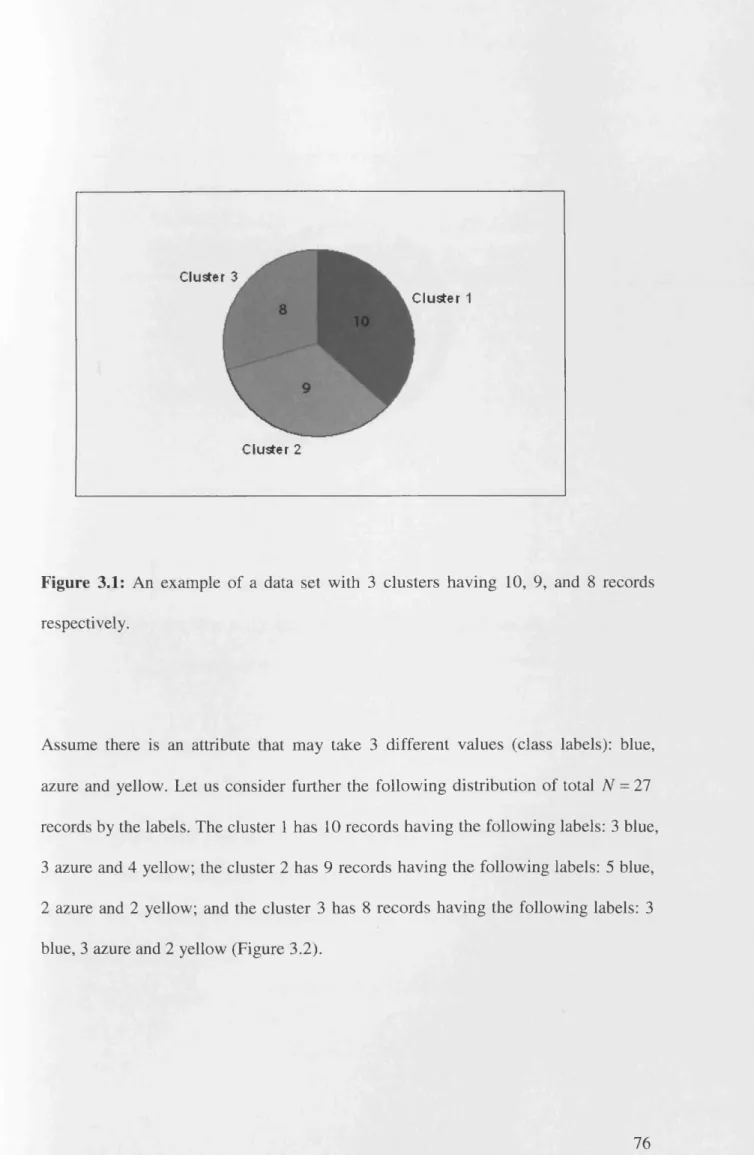
Figure 3.1: An example o f a data set with 3 clusters having 10, 9, and 8 records
respectively. 76
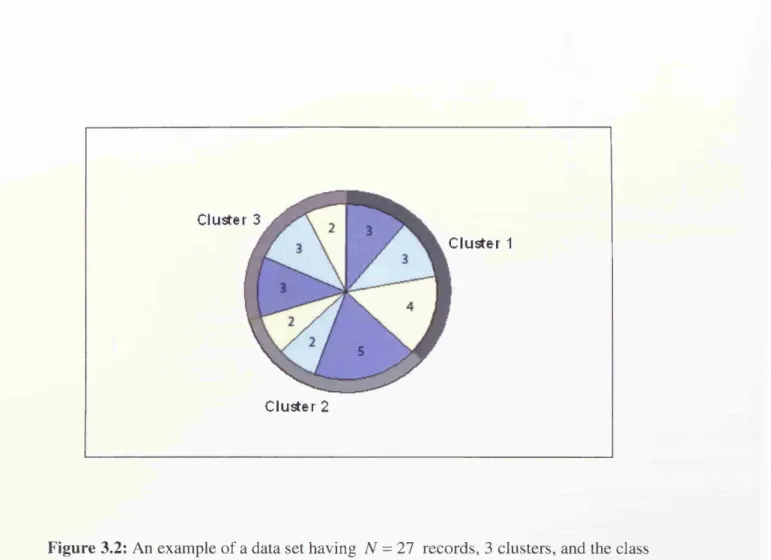
Figure 3.2: An example o f a data set having N = 27 records, 3 clusters, and the class labels o f the records: blue, azure and yellow. The cluster labels are not yet assigned. 77
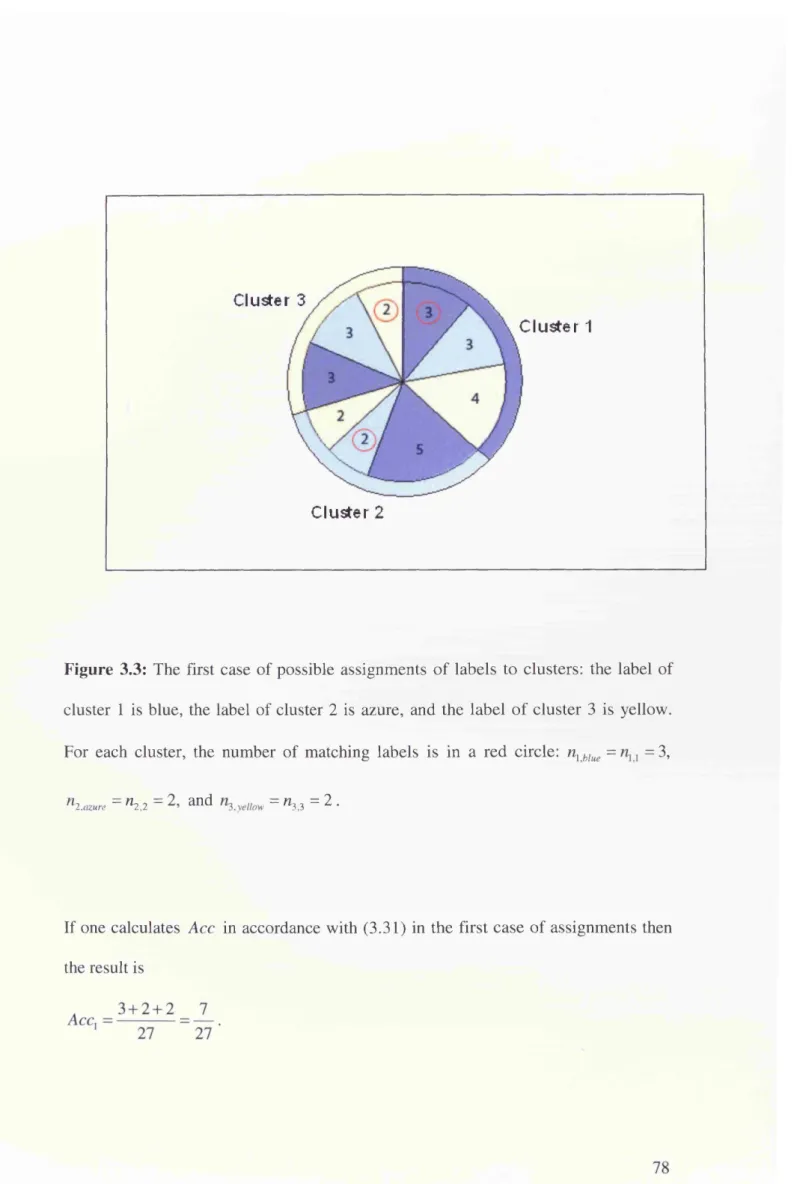
Figure 3.3: The first case o f possible assignments o f labels to clusters: the label o f
cluster 1 is blue, the label o f cluster 2 is azure, and the label o f cluster 3 is yellow. For
each cluster, the number o f matching labels is in a red circle: blue = n lx = 3,
n i , ^ r e = «2,2 = 2. a n d = « 3 .3 = 2
78
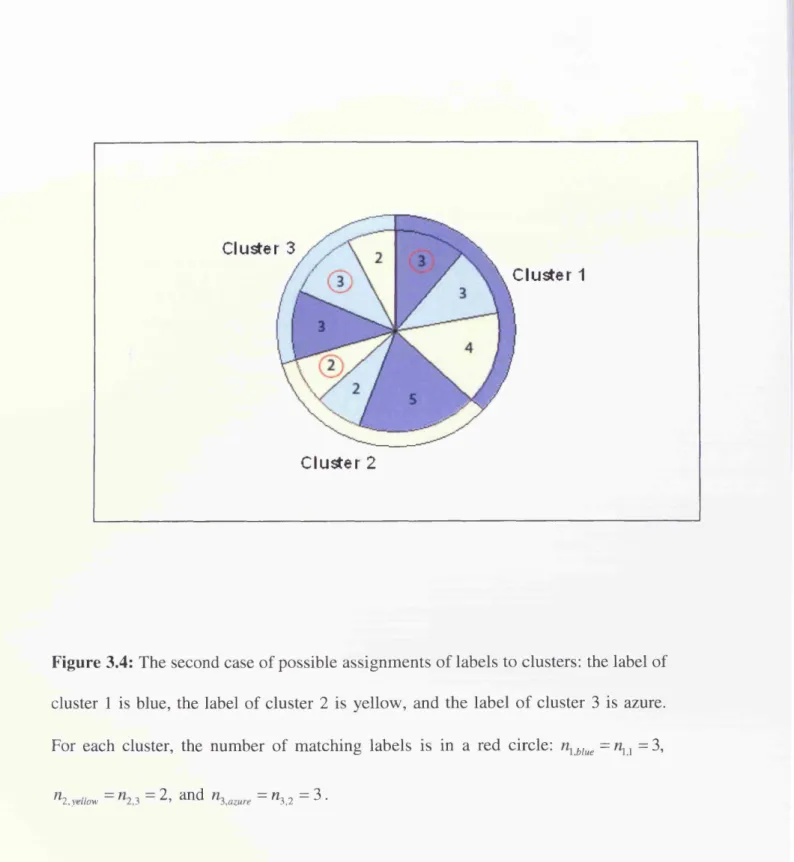
Figure 3.4: The second case o f possible assignments o f labels to clusters: the label o f
cluster 1 is blue, the label o f cluster 2 is yellow, and the label o f cluster 3 is azure. For
each cluster, the number o f matching labels is in a red circle: nxblue= n xx = 3,
n 2,yellow = W2,3 = a i ^ ^ 3 , azure = W3,2 = ^ • ^ 9
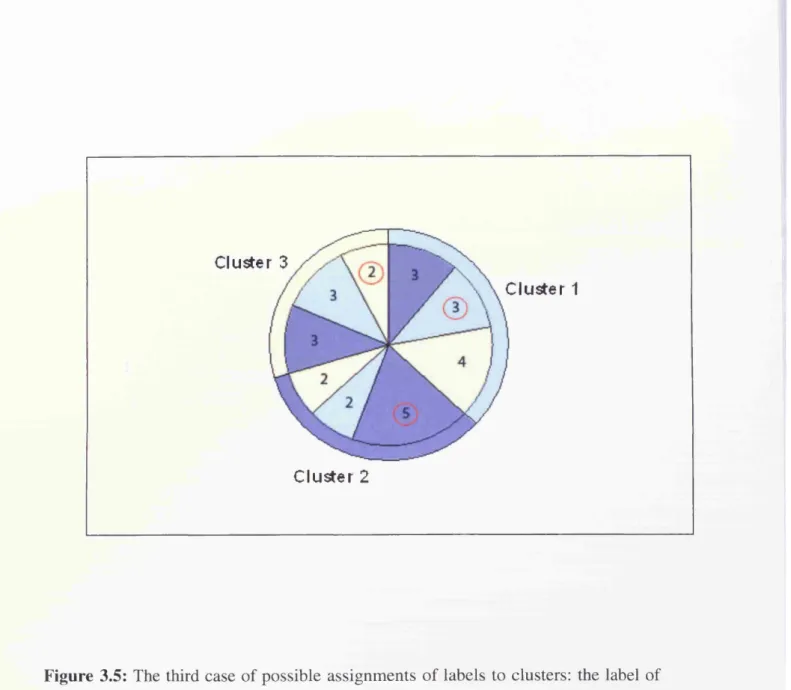
Figure 3.5: The third case o f possible assignments o f labels to clusters: the label o f
cluster 1 is azure, the label o f cluster 2 is blue, and the label o f cluster 3 is yellow. For
each cluster, the number o f matching labels is in a red circle: nx azure =nx 2 = 3,
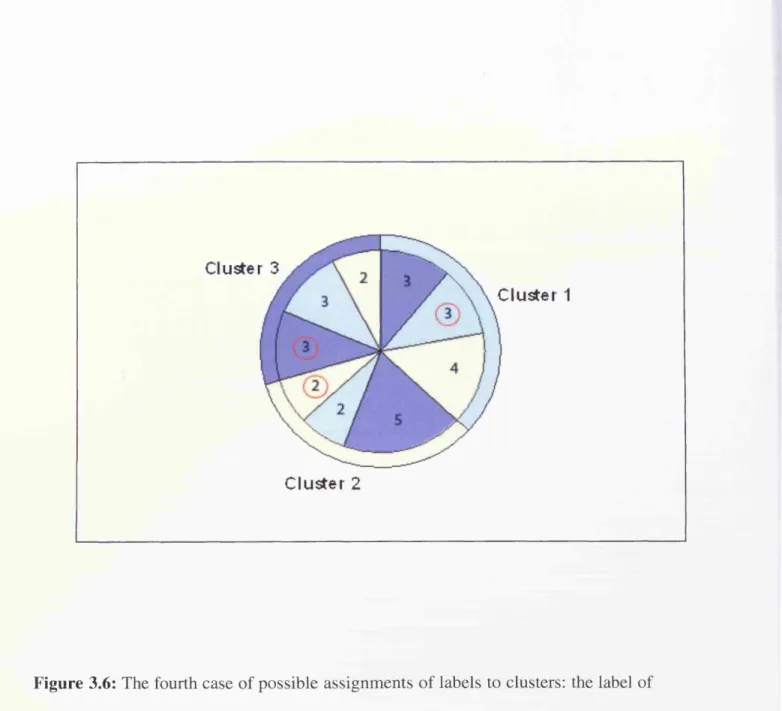
each cluster, the number o f matching labels is in a red circle: azure = nx 2 = 3,
n2,yellow = W2,3 = 2’ and n3,blue = W3,l = 3 ' 8 ^
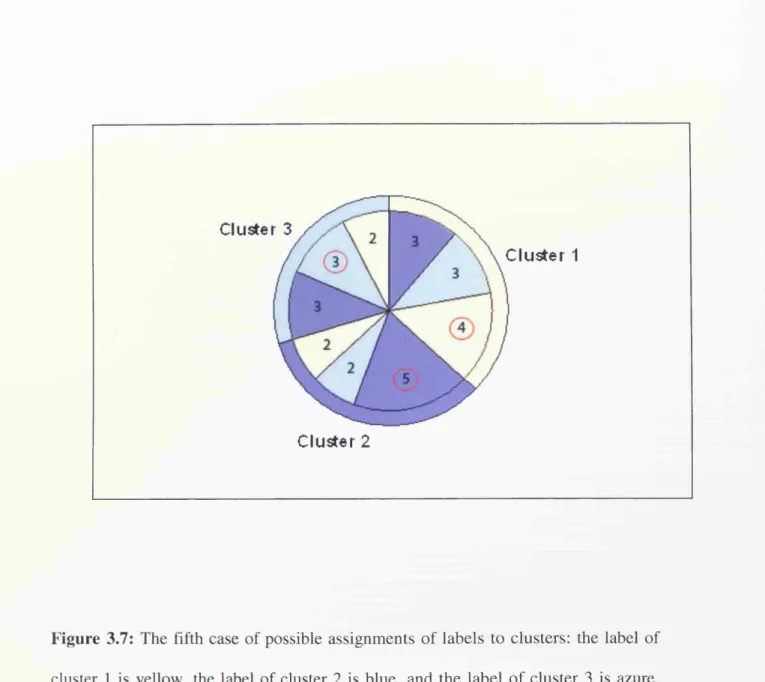
Figure 3.7: The fifth case o f possible assignments o f labels to clusters: the label o f
cluster 1 is yellow, the label o f cluster 2 is blue, and the label o f cluster 3 is azure. For
each cluster, the number o f matching labels is in a red circle: nlyellow = nl3 = 4,
n2,blue = n2,\ ~ and n3 azure — n3 2 — 3 • 82
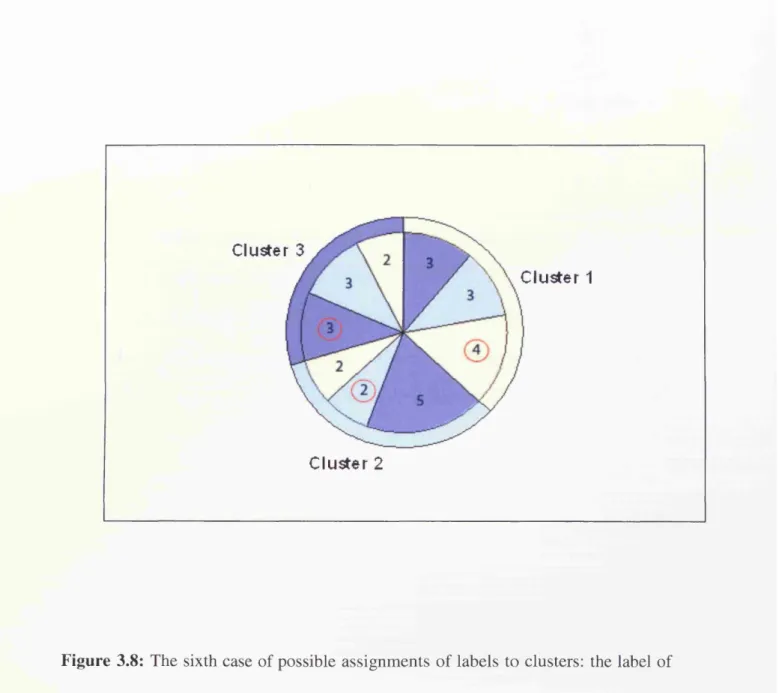
Figure 3.8: The sixth case o f possible assignments o f labels to clusters: the label o f
cluster 1 is yellow, the label o f cluster 2 is azure, and the label o f cluster 3 is blue. For
each cluster, the number o f matching labels is in a red circle: nx llaw = nx 3 = 4,
^2,azure= W2.2 = 2 > » n d « 3,blue = W3,l = 3 • 8 3 Figure 5.1: The average values o f ^ ( S ) vs. taec for the Adult data set with fixed
parameters n , e and r (e = l) . Comparison o f the k -prototypes algorithm and the
RANKPRO algorithm 150
Figure 5.2: The average values o f ./av(S ) vs. for the Adult data set for (e = l) and
(e = 2 ). Comparison o f the k -prototypes algorithm and the RANKPRO algorithm 151
Figure 5.3: The average values o f ^av(S ) vs. for the Adult data set with fixed
parameters n , e and r (e = 2) . Comparison o f the k -prototypes algorithm and the
RANKPRO algorithm 152
Figure 5.4: The average values o f Jav(S )v s . tmc for the Adult data set with fixed
parameters niter and e. Comparison o f the k -prototypes algorithm and the RANKPRO
Figure 5.5: The average values o f ^av(S ) vs. for the Shuttle data set with fixed
parameters n , e and r (e = l) . Comparison o f the k -prototypes algorithm and the
RANKPRO algorithm 156
Figure 5.6: The average values o f J flV(S )v s. for the Shuttle data set for ( e - 1) and
(e = 2 ). Comparison o f the k -prototypes algorithm and the RANKPRO algorithm 157
Figure 5.7: The average values o f J av (S ) vs. taec for the Shuttle data set with fixed
parameters n, e and r (e = 2 ) . Comparison o f the k -prototypes algorithm and the
RANKPRO algorithm 15 8
Figure 5.8: The average values o f Jrav(S )v s. for the Shuttle data set with fixed
parameters niter and e. Comparison o f the k -prototypes algorithm and the RANKPRO
algorithm 159
Figure 5.9: The average values o f ^ ( S ) vs. for the Covertype data set with fixed
parameters n , e and r (e = l) . Comparison o f the k -prototypes algorithm and the
RANKPRO algorithm 161
Figure 5.10: The average values o f J av (S ) vs. for the Covertype data set for ( e = l)
and (e = 2 ). Comparison o f the k -prototypes algorithm and the RANKPRO algorithm
162
Figure 5.11: The average values o f J av(S )v s. for the Covertype data set with fixed
parameters n , e and r (e = 2) . Comparison o f the k -prototypes algorithm and the
Figure 5.12: The average values o f J av (S ) vs. for the Connect-4 data set with fixed
parameters n , e and r (e = l) . Comparison o f the k -prototypes algorithm and the
RANKPRO algorithm 166
Figure B . l : Sets Vx and V2 for N = 7 : a) the set Vx and b) the set V2 199
LIST OF TABLES
Table 2.1: A modified Stevens’ classification o f variables (scale types), and appropriate
statistical notions, mathematical operations and structure. 12
Table 3.1: Clustering o f the soybean data set without normalisation o f the attributes. 86
Table 3.2: Clustering o f the soybean data set with normalisation o f the attributes. 88
Table 3.3: Clustering o f the wine data set without normalisation o f the attributes. 91
Table 3.4: Clustering o f the wine data set with normalisation o f the attributes. 94
Table 3.5: Clustering o f the heart diseases data set without normalisation o f the
attributes. 97
Table 3.6: Clustering o f the heart diseases data set with normalisation o f the attributes.
99
Table 3.7: Clustering o f the credit approval data set without normalisation. 102
Table 3.8: Clustering o f the credit approval data set with normalisation. 105
Table 4.1: Clustering o f the Adult data set without normalisation o f attributes for various
values o f the Minkowski power p M 126
Table 4.2: Clustering o f the Adult data set with normalisation o f attributes for various
values o f the Minkowski power p M 127
Table 4.3: Clustering o f the Shuttle data set without normalisation o f attributes for
various values o f the Minkowski power p M 129
Table 4.4: Clustering o f the Shuttle data set with normalisation o f attributes for various
ABBREVIATIONS
BA Bees Algorithm.
CRS Controlled Random Search.
EM Expectation Maximisation Algorithm.
GA Genetic Algorithms.
LBS Local beam search.
OF-based clustering Objective function-based clustering.
RANKPRO The Random Search with k -Prototypes Algorithm.
SBS Stochastic beam search.
SYMBOLS
A, Records o f a data set.
X ,, Numerical part o f a record o f a data set.
Y ., Categorical part o f a record o f a data
set.
XXj, X 2j Independent random variables.
N Number o f records in a data set or the number o f elements in a sample.
p Number o f numerical attributes in a record.
/ Number o f categorical attributes in a record.
Lp Linear vector space (Minkowski space).
p E Euclidean metric.
p cat Categorical metric.
p max Tchebysheff (Chebyshev) or maximum norm metric.
p* Normalised Minkowski metric.
^ Pm
p H Huang’s mixed metric.
y Weight in the Huang mixed metric.
J Objective function.
J . Hathaway’s objective function.
uim Element o f the partition matrix.
Q m Prototype (centre).
C tn Cluster m .
IC I Number o f elements in the cluster C„ .
| m | m
X = ( X v X 2i..., X N) Random vector formed by a sequence o f random variables,
x
= (x,, x2 ) The actually observed sample value.x*j Normalised attribute value in the data set.
xm a x j Maximum value o f an attribute.
xm m j Minimum value o f an attribute.
Hj and crj Mean and standard deviation o f a random variable.
X j and Sj Estimators for mean and standard deviation o f a sample.
dj(X'j, xfj) Hastie’s attribute dissimilarity.
Z)(jc, , xf) Hastie’s overall measure o f dissimilarity.
Wj Weight assigned to the j -th attribute.
D Hastie’s average object dissimilarity measure.
dj Hastie’s average dissimilarity o f the y'-th
attribute.
E Expectation o f a variable.
E Estimator o f the expectation.
s 2. Estimator o f the sample variance.
a. Inverse o f expectation o f contribution o f the j -th numerical attribute to a
metric.
Pj Inverse o f expectation o f contribution o f the j -th categorical attribute to a metric.
{ p j v p n , . . . , p , qi}
attribute.
A ccs,w
C = {C i,...,C 4} , D = {2>„... , Dt ]
R
Probabilities o f possible states for a categorical
Distance between two categorical attributes.
The N g and Wong accuracy.
Two partitions o f a set.
the Rand index.
m , j Number o f records with the attribute that belongs to the m -th cluster.
n , v Number o f records o f the m -th cluster whose state o f the attribute A is the same
as the assigned av{m)
Acc{(p) Acc T{x) X ' Pm (p(zv z 2) D
Clustering accuracy for an assignment (p.
Clustering accuracy.
Euler gamma function.
Minkowski norm.
Function o f two real valued arguments (Proposition 4).
Sets o f chords used in the proof o f Lemma 4.
Dispersion.
Subgradient o f 0 .(0*
Number o f best sites (BA).
Number o f elite sites (BA).
Size o f neighbourhood around any o f the best sites (BA).
Number o f recruited bees within the neighbourhood for the elite sites (BA).
Number o f recruited bees around other selected sites (BA).
Number o f the approximate solutions (RANKPRO).
Number o f kept elite solutions (RANKPRO).
Number o f solutions used for random search (RANKPRO).
Time specified for the RANKPRO algorithm.
Given number o f simulations for the RANKPRO algorithm.
Average value o f the objective function obtained in nr simulations.
Chapter 1
Introduction
This chapter introduces the motivation and objectives o f the research, and a general
description o f adopted methods and approaches. The chapter also outlines the general
structure o f the thesis.
1.1 Motivation
There is an increasing amount o f data being collected everyday but only the part that can
be used for extracting knowledge becomes valuable. Data Mining (DM ) may be defined
as a process o f extracting useful knowledge in the form o f relations and structure from
large amount o f data. The derived knowledge can then be applied to achieve economic,
operational or other benefits.
In this thesis DM is considered as a synonym to the knowledge discovery process or
knowledge discovery in databases. This process consists o f a set o f processing steps that
should be followed to discover relations and structure in data. DM needs to develop
from raw collections o f data. In this thesis we deal with objective function-based
clustering that is also called partition based clustering.
Partitioning is a natural way o f studying complex problems in a number o f areas like
pattern recognition, classification and clustering. In a number o f fields o f machine
intelligence, an object is represented by a vector variable (the feature vector). In
application to data sets organised as flat files, the rows represent records, the columns
represent features that are called attributes, and hence the feature vector can be defined
as a set o f attributes. Each attribute can take on a finite or infinite (continuous) number
o f possible values. In many traditional applications, it is assumed usually that all the
features are the same type. Clustering o f numerical data sets are the most studied
problem. However, real-life data sets are often mixed, i.e. they consist o f both numerical
and categorical types. Currently methods for analysis o f data in mixed feature space are
still an issue. Hence, design and analysis o f clustering algorithms for numerical,
categorical and mixed data sets are very timely.
In this thesis we w ill deal with normalisation. Strictly speaking normalisation has to be
applied to all records o f data sets before clustering. Indeed, if the data is not normalised
then the average contribution o f each feature to the similarity measure depends on the
units o f measurements o f the feature and, therefore, the contribution o f the features are
scale dependent. If the units o f a measurement are changed then the contribution o f a
feature to the similarity measure can change dramatically. This is why normalisation o f
data sets is widely used in a number o f fields o f machine intelligence.
In the overwhelming majority o f published normalisation procedures, data have been
scaled to unit range. However, after this kind o f data set normalisation, the average
contributions o f all features to the similarity measure may be not equal to each other.
It has been often suggested also to truncate the out-of-range components assuming that it
is just eliminating the outliers. However, truncating the out-of-range components could
lead to loss o f information from the data set.
In spite o f the importance o f data normalisation, there have been only few papers
specifically devoted to normalisation methods for data sets. It has been correctly realised
that a normalisation procedure for numerical data sets, has to be a transformation o f the
attribute to a random variable with zero mean and unit variance. Indeed, this scaling
provides equal contributions o f variables to the Euclidean similarity measure. However,
one needs to apply normalisation not only to numerical attributes but also to categorical
attributes.
A natural way for normalisation o f all numerical, categorical and mixed data sets is to employ a statistical approach. However, early papers on statistical approaches were not
targeted to clustering o f mixed data sets and normalisation o f metrics. It was stated that
methods for analysis o f data in mixed feature space are still an issue. For example, one
can expect that the mean o f the distance between two categorical attributes that may
have only two states (e.g. male - female or white - black) is not the same as the mean o f
the distance between two categorical attributes that may have twenty different states.
nothing was known about statistical consistency o f the proposed estimators. In addition,
the estimators were biased and these approaches were not applicable to some metrics.
Hence, mathematically rigorous treatment o f the normalisation procedure is needed and
explicit presentation o f normalised mixed metrics has to be provided.
After normalisation o f data, appropriate algorithms for efficient and effective clustering
o f data sets with mixed numerical and categorical values have to be developed. Currently
the most popular is the ^-prototypes algorithm for clustering o f mixed data sets. This
algorithm is a generalisation o f the A:-means algorithm. The latter is applicable only to
numerical data sets. These algorithms have the same common drawback, namely the
search process o f new solutions converges often not to a global minimum but to a local
minimum. Hence, new algorithms have to balance two objectives: to explore the search
space effectively and to utilise the most promising solutions during the work o f the
algorithm.
1.2 Research Objectives
The aim o f this research is to design and analyse new clustering algorithms for numerical,
categorical and mixed data sets. Most clustering algorithms are limited to either
numerical or categorical attributes. Datasets with mixed types o f attributes are common
in real life and so to design and analyse clustering algorithms for mixed data sets is quite
timely.
The specific objectives are:
1. To develop a mathematically rigorous approach to normalisation o f feature
vectors for mixed data sets based on a unified statistical approach.
2. To analyse the clustering algorithms with proposed new normalised metrics in
the case o f the matching dissimilarity measure being used to deal with categorical
attributes, and the general Minkowski metrics being used as a measure for
continuous numerical features, including the particular cases p M = 2 (the
Euclidean metric).
3. To develop a new algorithm to be used in the cases where p M * 2 , since the k
-prototypes cannot be used in those cases. This clustering algorithm was earlier
suggested only for fuzzy clustering. It will be developed and applied for hard
clustering using Minkowski norm distances.
4. To develop a new unsupervised clustering algorithm for numerical, categorical
and mixed data sets that will have less probability for premature convergence
than the ^-prototypes algorithm. The algorithm has to balance two objectives: to
explore the whole search space effectively, and to improve promising solutions
fast. The new algorithm has to combine the advantages o f both the Bees and the
1.3 Methods and approaches
For the four objectives targeted in this thesis, several methods and approaches will be
employed. They are summarised as follows:
1. A unified statistical approach to both numerical and categorical attributes is
applied for normalisation o f the feature vectors for mixed data sets in both
cases; the Euclidean and the general Minkowski metrics. Normalised
Minkowski and Euclidean metrics and metrics for mixed data sets are
introduced in an explicit way. The introduced generalised statistical
procedure assures that the means o f the different normalised attributes are
equal to each other and therefore, these variables give equal contributions to
the similarity measures.
2. In the case where p M = 2 , the ^-prototypes clustering algorithm will be implemented and applied to data sets from the UCI repository with and
without normalisation o f attributes and the accuracy o f clustering results will
be compared by both a new approach for calculating the accuracy and the
traditional Rand index.
3. A unified statistical approach to general cases o f the Minkowski distances
and the development o f a novel algorithm for hard clustering using the
Minkowski distances with an appropriate objective function. Implemented
codes are applied to two data sets from the UCI repository with and without
normalisation o f attributes for various values o f the Minkowski power p M .
4. A new clustering algorithm called RANKPRO: the Random Search with k-prototypes algorithm will be presented. The algorithm combines the
advantages o f the Bees and ^-prototypes algorithms. The algorithm balances
two objectives: it explores the search space effectively due to random
selection o f new solutions, and improves promising solutions fast due to
employment o f the ^-prototypes algorithm. The RANKPRO algorithm will be
applied to various data sets, including data sets with mixed numerical and
categorical values and its performance w ill be compared with the
performance o f the ^-prototypes algorithm.
1.4 Outline of the thesis
The thesis is organised in six chapters. The topics addressed in each chapter are as
follows:
Chapter 2: In this Chapter notations and definitions o f some concepts related to
clustering, similarity measures for numerical, categorical and mixed data sets, objective
functions, and statistical estimators, are recalled. The chapter ends with a literature
review o f the most recent applications o f object-function based clustering for mixed data
Chapter 3: In this Chapter a unified statistical approach to both numerical and
categorical attributes is applied in order to normalise the feature vectors for mixed data
sets. The most common cases o f metrics, namely the Euclidean metrics are used as a
measure for continuous numerical features, while the matching dissimilarity measure is
used to deal with categorical attributes. N ew normalised metrics are introduced such that
the average contributions o f all attributes to the measures are equal to each other from
statistical point o f view. Advantages o f the introduced normalised metrics are
demonstrated on examples o f their applications to various data sets.
Chapter 4: In this chapter, a new statistical approach introduced in Chapter 3 is
developed further and applied in the case o f the Minkowski metrics being used as a
measure for continuous numerical features, while to deal with categorical attributes
again the matching dissimilarity measure is used. Various mathematical problems related
to the normalisation o f mixed metrics are resolved. The introduced metrics are applied to
some data sets when it is more advantageous to apply the general Minkowski metrics
(including the Tchebysheff and city-block metrics) instead o f a particular case p M = 2
(the Euclidean metrics). Since the k -prototypes cannot be used in the cases where p M * 2 , a new algorithm to be used in those cases w ill be developed. This clustering algorithm was earlier suggested only for fuzzy clustering. It will be developed
and applied for hard clustering using Minkowski norm distances.
Chapter 5: In this Chapter a new clustering algorithm called RANKPRO: the Random
Search with ^-Prototypes Algorithm is presented. The algorithm combines the
advantages o f a recently introduced by Pham et al. (2006b) population-based search
algorithm called the Bees Algorithm (BA), and ^-prototypes algorithm proposed by
Huang (1997b) as an extension o f the &-means algorithms to cluster large data sets with
mixed numerical and categorical values. The RANKPRO algorithm balances two
objectives: it explores the search space effectively due to random selection o f new
solutions, and improves promising solutions fast due to employment o f the ^-prototypes
algorithm. The efficiency o f the new algorithm is demonstrated by clustering several
numerical, categorical and mixed data sets.
Chapter 6: In this Chapter conclusions and the main contributions o f this thesis are
Chapter 2
Preliminaries and Literature Review
In this Chapter notations and definitions o f some concepts related to data models,
clustering, similarity measures for numerical, categorical and mixed data sets, and
objective functions, are recalled. Some mathematical and statistical notions used in
clustering analysis are also reminded. The chapter ends with a literature review o f the
most recent applications o f objective - function based clustering for mixed data sets.
2.1 Data and data types
It is well known (see e.g. Jain and Dubes, 1988, Cios et al., 2007) that data can have
diverse formats and can be stored trough a variety o f different storage models. In a
number o f fields o f data mining an object is represented by a vector variable, namely the
feature vector A (Jain et al. 1999). In application to databases, the features are called
attributes, and hence A can be defined as a set o f attributes A = [Av A2,...,Ap+l} . The
collection o f objects described by the same features is called a data set. Data sets may be
stored as flat files and in other formats using databases and data warehouses. Flat
(rectangular) files are the most common way to store the data sets and further we will
deal only with flat files. The rows represent objects (also known as records, individuals,
patterns, data points) and the columns represent features.
Each attribute can take on a finite or infinite (continuous) number o f possible values. In
many traditional applications, it is assumed usually that all the features are the same type.
However, real-life data sets are often mixed, i.e. they consist o f both numerical and
categorical types. It is known that the measurement scale o f a categorical variable
consists o f a set o f categories. Only two data types o f attributes are considered here,
namely numerical and categorical because other types o f attributes can be transformed to
these two types. For mixed data, the vector o f features A can be split into A = ( A ”, A c ) ,
namely the vector o f numerical features A" = ( A " , . . . , Aand the vector o f categorical
features A c = ( A tc,..., A f ) .
2.1.1 Original Stevens’ classification of variables.
It is generally accepted that the "levels o f measurement", or scales o f measure are
expressions that typically refer to the classification o f scale types developed by the
psychologist S.S. Stevens. Stevens (1946) argued that measurements can be classified
into four different types o f scales: nominal, ordinal, interval and ratio.
Stevens’s classification said that nominal is synonym o f categorical. There has been, and
continues to be, debate about the merits o f Stevens’s classification, particularly in the
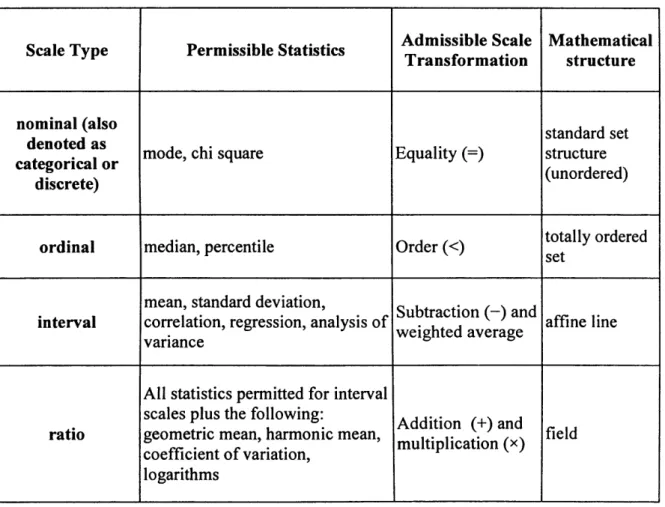
The Table 2.1 presents a slightly modified classification o f variables and appropriate
statistical notions and mathematical operations that should be used for analysis o f each
scale type o f variables
Scale Type Perm issible Statistics A dm issible Scale
T ransform ation M athem atical structure nominal (also denoted as categorical or discrete)
mode, chi square Equality (=)
standard set structure (unordered)
ordinal median, percentile Order (<) totally ordered
set
interval
mean, standard deviation,
correlation, regression, analysis o f variance
Subtraction ( - ) and
weighted average affine line
ratio
A ll statistics permitted for interval scales plus the following:
geometric mean, harmonic mean, coefficient o f variation,
logarithms
Addition (+) and multiplication (x) field
Table 2.1: A modified Stevens’ classification o f variables (scale types), and appropriate
statistical notions, mathematical operations and structure.
2.1.2 Accepted classification of variables.
In this thesis w e accept the term categorical as a general term that can be split into
levels: nominal and ordinal. If categorical variables have ordered scales they are called
ordinal variables, while the variables having no ordered scales are called nominal
variables. Hence, for nominal variables, the order o f listing the categories is irrelevant,
and the statistical analysis should not depend on that ordering (Agresti 1996). We
consider also binary variables as categorical.
Further, in this thesis we accept the scale types: interval and ratio are numerical variables.
For numerical or quantitative features, the feature domain D om (A y ) can be represented
on the real line, i.e. they are continuous variables. For categorical features (sometimes
these features are also called qualitative), the domain is a finite set o f different states.
Evidently, categorical features may be represented by numerical codes o f possible
different states o f the feature. A data set can be represented as a matrix o f size
N x ( p + l) where N is the number o f records, and ( p + l) is the total number o f attributes, i.e. the i -th row o f the matrix represents the i -th record o f the data set ( \ < i < N ) . This row is a vector (xn, . .., xip, y n,.. ., y a ) , whose values xip are
numerical, while the values y n ,^>,ya are categorical.
One can see from the above Table that the central tendency o f a categorical attribute can
by Huang (1997, 1998) in his generalisation o f a very popular clustering algorithm, the
&-means algorithm. If the k -means algorithm can be applied only to numerical data sets, the k -modes algorithm can be applied to categorical data sets. These algorithms will be discussed later.
2.2 Constructing data models
As it has been noted in Chapter 1, the aim o f Data Mining is to extract knowledge from
data. Methods o f machine analysis o f data can be roughly divided into two fundamental
groups: supervised and unsupervised learning.
In supervised learning, characteristics to records o f data sets are given. The
characteristics can be expressed either in the form o f some discrete labels or as some
values o f auxiliary continuous variables. In the former case, w e deal with a classification
problem; while in the later case we deal with a regression, or an approximation, or
continuous prediction problem (see e.g. Cios et al., 2007). Supervised learning includes
various approaches such as statistical methods, including Bayesian methods (Pham and
Ruz, 2009); neural networks; decision trees, rule algorithms, and their hybrids. Any
supervised learning method has to be provided with a training data set that represents
information about some domain o f the data set. In classification problems, the objective
o f supervised learning is to construct a function (classifier) that generates for each record
(individual) a class label as its output. Using a training data set rules are produced; these
rules are used to predict the labels o f new unseen examples (i.e., examples not in the
training set).
Unsupervised learning assumes that the data knowledge process does not involve any
supervision and it discovers a structure in data automatically. Unsupervised learning
includes various approaches such as association rules and clustering. Clustering aims at
finding smaller, more homogeneous groups from a large heterogeneous collection o f
items (Anderberg, 1973, Berry and Linoff, 1997). Computer-assisted analysis must
partition objects into groups, and must provide an interpretation o f this partition (Berry
and Linoff, 1997).
As it is well known, clustering is an inductive process (Bezdek and Pal, 1992, Estivill-
Castro, 2002). This means that using particular observations o f data, isolated facts are
explained first by some empirical generalisations (working hypotheses) and then by a
general theory. In application to clustering o f data sets, this means that any partition
produced by an algorithm or a human is a hypothesis to suggest (or explain) groupings in
the data. The mathematical formulation o f the inductive principle is called clustering
criterion (see e.g. Kim et al., 1988; Doherty et al., 1988, Estivill-Castro and Murray,
1998, Halkidi et al., 2000; 2001). It discriminates one grouping hypothesis over another
one for the same data set. The models are the structures used to represent clusters, while
the induction principle selects a “best fit” model for a given data set. Several induction
By breaking the object into smaller homogeneous parts that can be each analysed and
explained separately, one can understand very sophisticated phenomena. The selected
hypothesis becomes a model for the data, and can potentially constitute a mechanism to
classify unseen instances o f the data. This is the reason why clustering algorithms have
been studied so extensively. In particular, efficient clustering is a fundamental task in
data science, where the goal is to discover similarities within a large data set.
2.3 Some mathematical notions used in clustering
analysis
The cluster analysis in general and the objective function-based cluster analysis in
particular are mathematically based disciplines where one needs to work with various
mathematical notions like norm, metric, distance, and others. Hence the definitions of
these mathematical concepts and the proper use o f the concepts are crucial for cluster
analysis. Indeed, the aim o f clustering is to group the closest data points together. Hence,
clustering relays on calculating distances between records. Thus, to measure
quantitatively the distinction between elements o f the data sets, i.e. to formulate
similarity or dissimilarity criteria, one needs to use the concept o f the distance and other
above mentioned concepts.
2.3.1 Concepts of metric and distance.
Let us consider a set M . A metric on a set M is a function which defines a positive real number (distance) between any two elements x and y o f the set. For all x, y , z in M , a metric should satisfy the following conditions:
Identity o f indiscemibles: p ( x , y ) - 0 if and only if x = y .
Non-negativity: p ( x , y ) > 0 .
Symmetry: p ( x , y ) = p ( y , x) .
The triangle inequality: p ( x , z ) < p ( x , y ) + p ( y , z ) .
An example o f a trivial metric is the discrete metric, i.e. if x = y then p ( x , y ) = 0.
Otherwise, p ( x , y ) = l . However, the most popular example is the Euclidean distance;
the distance between distinct points is positive and the distance from x to y is the same
as the distance from y to x. The latter metric is translation and rotation invariant.
Other examples o f metrics w ill be given later. We will consider mainly Minkowski
2.3.2 Concept of norm.
Let us consider a real vector space/?”, i.e. its elements x e Rnare vectors with real valued entries. A norm o f a vector x is denoted by||jc||. This is a function that assigns a
strictly positive real number to all vectors in the vector space, other than the zero vector.
A norm should satisfy the following conditions:
1
. ||
a'||
> 0 if x * 0 ,and ||x|| = 0 if and only if x = 0 .2. A norm is a linear function, i.e. multiplying a vector by a real number a changes its norm linearly
IMbM-M-3. A norm satisfies the triangle inequality for any two elements x and y .
In the case o f norm beign a distance, this inequality means that the distance from point A
through B to C is never shorter than going directly from A to C.
The above mentioned definitions allow the researcher to dismiss some models suggested
for clustering. For example, Wu and Yang (2002) introduced an alternative to c-means
clustering algorithm and they employed the following function:
d ( x , y ) = 1 - exp(-/?||x - y f ) .
They called this function “distance” and claimed that it is a metric. However, one can
see that d does not satisfy the triangle inequality and therefore this function is not a metric.
There is the following relation between norms and metrics:
Every norm determines a metric and some metrics determine a norm.
Norms are used in Chapters 3 and 4.
2.3.3 Concepts of random variables, mathematical expectation, mean,
mode and median.
Throughout this thesis w e will employ statistical treatment o f data sets. In the framework
o f our approach each record (the row) o f a data set w ill be regarded as a random sample
o f a population under consideration, i.e. a data set is treated as a set o f N observations (samples), while each sample (record) is considered as a realisation o f possible values o f
the feature vector A . O f course, the basic concepts can be found elsewhere (see, e.g.
Spiegel, 1975). Hence, only some concepts o f probability theory and statistics that will
be actively used in the thesis will be recalled. As usual, capital letters X and Y will be used to denote random variables and lower-case letters, x and y to denote the specific values that those variables may take.
For a continuous random variable X that has a density function / (x) , the mathematical expectation o f E ( X) is defined as
oo
E ( X ) = J x f ( x ) d x . —oo
Another term for the mathematical expectation is the mean that is denoted by jux or by
H. It represents the average o f the values o f the random variable.
The median o f the random variable X corresponds to an ordinate which separates the area under the density function graph into two parts having equal areas, i.e. the median is
that value x for which
P ( X < x ) = J > ( X> x ) =
The mode is that value x which occurs most often or, in other words, has the greatest probability o f occurring. At this value / (jc) has its maximum.
2.3.4 Concepts of statistic and estimators.
For statistical treatment o f feature vectors, one needs to know the probability
distributions o f their attributes. Probability distributions are normally unknown because
one has only a random sample. It is known that estimation is a way o f extracting
valuable information about the distribution o f probability that generated it from a sample.
An observable function o f the random data variable is called a statistic. If there is an
unknown real parameter 6 taking values in a real parameter space then a real-valued statistic that is used to estimate the parameter is called an estimator o f this parameter. An
estimator can be treated as a guess o f the true value Qtr o f the parameter 6. It is expected
that estimates are close to the true value 0tr. However, since an estimator is a random
variable and it is characterised itself by its probability distribution, one cannot say with
certainty that an estimate is close to the true value o f a parameter o f the distribution. It is
only possible to hope that the central region o f the distribution o f the estimator is close to
the true value o f the parameter. To express this hope in a mathematical way, the concept
o f unbiased estimators is introduced. The properties o f estimators w ill be considered
below.
2.3.5 Desirable properties of estimators.
For any given parameter, different estimators are possible. Hence, it is generally
accepted that estimators have to satisfy the following main desirable properties: an
estimator has to be unbiased, consistent and efficient.
Let us consider a statistic o f size N . An estimator is said to be unbiased if E[0]n = 0tr for any size N .
Here E means the expectation o f a variable. Roughly speaking, the above definition means that the distribution mean o f the estimator is equal to the true value o f the
parameter for any size o f the statistic. An estimator whose expectation is not equal to the
true value is said to be biased.
An estimator is a consistent estimator o f the parameter, if as sample size increases, the
estimator gets closer and closer to the value o f the parameter being estimated. In other
words, if one has a sequence o f values o f the estimator as a function o f the sample size,
then as the size expands a d infinitum, this sequence converges in probability to the true value o f the parameter being estimated. Otherwise the estimator is said to be inconsistent.
The term o f efficient estimator is used when there exist two or more unbiased estimators
o f the parameter. For example, the sample mean and the sample median are both
unbiased estimators o f the distribution mean. For a given sample size N , it is possible to define the relative efficiency o f one estimator with respect to another one as the ratio of
their variances. Only in some cases an unbiased efficient estimator exists, that has the
lowest variance among unbiased estimators. Since w e w ill not consider more than one
unbiased estimator for a parameter, the property o f efficiency o f estimators will not be
discussed further.
Estimators are used in Chapters 3 and 4; see for example 3.4.1, 3.4.3, 3.4.4, 4.2 and 4.3.
2.3.6 Similarity measures.
It is known that clustering analysis is the organisation o f a collection o f records into
clusters where the elements within a cluster have a certain degree o f similarity, and
hence the similarity is a fundamental concept for definition o f a cluster (see, e.g. Jain et
al., 1999). Any measure o f the degree o f closeness (likeness) is called similarity measure
(Looney 1997). It is very common to calculate the similarity or dissimilarity between
two features using a distance measure. In clustering analysis o f numerical data sets, the
similarity or dissimilarity between two feature vectors Xj = (jc^ ,...,^ ) and
X 2 =( x 2 is often calculated using a square distance measure. Indeed, it is very
natural to use the Euclidean metric (distance) p E (or L2 metric)
For example, the most popular clustering algorithm for numerical data sets is the k-means algorithm that uses the Euclidean distance.
It is evident that the Euclidean distance is a particular case (p M = 2 ) o f the following
Minkowski distance p PM (or Lp metric)
as a measure for continuous numerical features because this metric is in everyday use.
\ 17 Pm
Ppu( x , , x 2)
HI
X, - x 2 = 5 X - I"*Another particular case o f the Minkowski distance is the city block (Manhattan) distance
(or Z>j metric)
A ( X p X2H | X 1- X 1 H = £ | * iy- * y |
7=1
The Tchebysheff (Chebyshev) or maximum norm metric. It gives the maximum o f
absolute difference between the feature vectors.
P m a x ( ^ 1 » ^ 2 ) —II ^ 1 _ ^ 2 lima* — ^ ^ X I JCj . — X 2 j I •
7 1
This metric can be also obtained from the Minkowski distance if the following limit is
taken p M —» oo.
One can see that other distances like the Hamming, Mahalanobis, Hausdorff and so on,
are also used in clustering analysis. The Hamming distance between two strings o f equal
length is the number o f positions at which the corresponding symbols are different. This
distance can be treated as a particular case o f the city block (Manhattan) distance when
all features are binary (Jain and Dubes, 1988). The Mahalanobis distance is based on
correlations between variables and it is used mainly for solving supervised learning
problems. A non-formal explanation o f the Hausdorff distance is the following:
according to this distance two sets are close to each other if every point o f either set is
close to some point o f another set.
Each metric imposes its own geometry. The Euclidean distance leads to spherical shapes
o f equidistant regions. Points with a constant Mahalanobis distance to the centre are
located on a hyperellipsoid that envelops the centre o f the object points (Varmuza and
Filzmoser, 2009). The Hamming distance imposes diamond-like geometry, while the
Tchebysheff distance forms hyper squares (Cios et al., 2007).
It is claimed (Berkhin, 2002) that lower values o f the power p M o f the usual Minkowski
distance correspond to more robust estimations in applications to numerical data
(therefore, less affected by outliers).
It is more difficult to introduce similarity measures for categorical data. Clustering
mixed (numeric and categorical) data is a rather difficult problem. Indeed, when all
attributes are o f the same kind then the inter- and intra-cluster similarity can be defined
according to one similarity measure between records, w hile for mixed data usually one
needs to employ two different similarity measures.
2.3.7 Proximity and similarity indices.
Let us consider a finite set o f observations ui e U . The index o f similarity S{un u}) is a
real valued function defined o n U x U that satisfies the following conditions:
S ( u n Uj) > 0 for any un u} e U .
Normalisation (Identity o f indiscemibles):
S( u, , w,) = 1 for any w, e t / .
Symmetry:
S ( u n Uj) = S ( u jyut) for any un Uj e U .
Contrary to distances that are normally used in application to numerical data , the indices
o f similarity are often applied to all kinds o f variables, including categorical variables
(Duran and Odell, 1974, Giudici, 2003).
Goodall (1966) (see also Jain and Dubes, 1988) proposed an index o f similarity using
probabilistic approach. It was suggested that the index has a uniform distribution when
the data are random. Gower’s similarity coefficient (Gower, 1971) is another popular
measure o f proximity for mixed data types.
Using the above mentioned similarity coefficients and indices, and other dissimilarity
measures (Gowda and Diday, 1991), the standard hierarchical clustering methods can
handle data with numerical and categorical values. However, the quadratic
computational cost makes them unacceptable for clustering large data sets (Anderberg,
1973, Jain and Dubes, 1988).
The proximity index d ( u ii uj ) between two observations is a real valued
function defined on U x U that satisfies the follow ing conditions:
The inequality that is used to measure similarity:
diu^ u^ ) > m a x d ( u f, u ) for any un u, e U . j
Non-negativity:
d (u n Uj) > 0 for any un U j . e U .
Symmetry:
d ( u n Uj) = d{Uj,u^) for any un Uj e U .
If identity o f indiscemibles is used to measure proximity between identical observations:
diu^Ui) = 1 for any u, e U then 0 < d ( u n Uj) < 1 for any observations u„ U j. e U . Note
that this definition o f the proximity index is slightly different from the definition given
by Jain and Dubes (1988).
The proximity index d ( u i, uj ) between two categorical variables un Uj e U can be used
as indicator o f mismatch or as a distance function in the categorical space. In this case
for any ut, U j S U . Huang (1998) used the notation S ( u i9Uj) as the indicator o f
mismatch (simple matching measure)
However, the above notation can be confused with the common notation o f the
Kronecker delta StJ, while the latter delta 8ij =1 if i = j and 8tJ = 0 if i * j . Therefore,
we will use the notation co for matching measure. Hence, the distance between two categorical feature vectors Yj = ( y u , - " , y u) and Y2 = ( <y2i>--->3;2/) is defined as:
Peat (Y,, Y2) = G)(yx l, y 2l) + ... + o)(yu, y2l) where
f° r y,j = y i , for y > j * y 2 j '
2.4 Minkowski distance or
I f
space
P„ 0 „ x 2) = | | x , - x2 IIp
n Y ' "
YyM~xiAp
\ 1 - ' J
where x, and x2 = ( x 2l, . . . , x 2„ ) .
p does not need to be an integer, but it cannot be less than 1, because otherwise the triangle inequality does not hold.
Further we will consider a data set represented as a matrix o f size N x (/? + / ) . Here N is the number o f records, p is the number o f numerical attributes and I is the number o f categorical attributes. Because we consider p as the number o f numerical attributes, we have to change n in the above mentioned definition o f the Minkowski norm for p , and
also we will use p M instead o f p as the Minkowski power and the formula will be:
r p \ ypp
2 Pa/
z X ~ x
\ j~ i2 j \Pm
As we mentioned before, a norm satisfies the triangle inequality for any two elements x and y .
+
The triangle inequality in Lp spaces is: