PRINCIPLES FOR THE DESIGN AND OPERATION OF ELASTIC SCIENTIFIC APPLICATIONS ON DISTRIBUTED SYSTEMS
A Dissertation
Submitted to the Graduate School of the University of Notre Dame in Partial Fulfillment of the Requirements
for the Degree of
Doctor of Philosophy
by
Dinesh Rajan Pandiarajan
Douglas Thain, Director
Graduate Program in Computer Science and Engineering Notre Dame, Indiana
PRINCIPLES FOR THE DESIGN AND OPERATION OF ELASTIC SCIENTIFIC APPLICATIONS ON DISTRIBUTED SYSTEMS
Abstract by
Dinesh Rajan Pandiarajan
Scientific applications often harness the concurrency in their workloads to par-tition and operate them as independent tasks and achieve reasonable performance. To improve performance at scale, the partitions are operated in parallel on large pools of resources in distributed computing systems, such as clouds, clusters, and grids. However, the exclusive and on-demand deployment of applications on these platforms presents challenges. The target hardware is unknown until runtime and variable between deployments when applications are deployed on these platforms. So operating parameters such as the number of partitions and the instances to provision for execution must be determined at runtime for efficient operation.
In this work, I build and demonstrate elastic applications to provide the desired characteristics for operation on distributed computing systems. I present case-studies of elastic applications from different scientific domains and draw broad observations on their design and the challenges to their efficient operation. I develop and evaluate techniques at the middleware and the application layer to achieve efficient operation. In effect, the presented techniques create self-operating elastic applications that dy-namically determine the partitions of their workloads and the scale of resources to utilize. I conclude by showing that self-operating applications achieve high time- and cost-efficiency in their deployed environments in distributed computing systems.
CONTENTS
FIGURES . . . iv
TABLES . . . vii
ACKNOWLEDGMENTS . . . viii
CHAPTER 1: INTRODUCTION . . . 1
1.1 Concurrent Scientific Applications on Distributed Systems . . . 1
1.2 Problem Statement . . . 4
1.3 Overview of Existing Approaches . . . 5
1.4 Case for Applications as Operators . . . 7
1.5 Overview of Dissertation . . . 8
CHAPTER 2: RELATED WORK . . . 11
2.1 Scientific Computing . . . 11 2.2 Service-oriented workloads . . . 13 2.3 Workload Decomposition . . . 14 2.4 Resource Allocation . . . 15 2.5 Middleware Techniques . . . 17 2.6 Application-level adaptations . . . 19
CHAPTER 3: ELASTIC APPLICATIONS . . . 20
3.1 Introduction . . . 20
3.2 Definition and Characteristics . . . 21
3.3 Programming Model and Architecture . . . 22
3.4 Middleware . . . 25
3.5 Example: Elastic Replica Exchange . . . 28
3.6 Comparison against an Existing Construction using MPI . . . 29
3.7 Experimental Illustration of Characteristics . . . 30
3.8 Conclusion . . . 39
CHAPTER 4: CASE STUDIES OF ELASTIC APPLICATIONS . . . 40
4.1 Introduction . . . 40
4.2 Elastic Sort (E-SORT) . . . 41
4.3 Elastic Replica Exchange . . . 44
4.4 Genome Annotation (E-MAKER) . . . 48
4.6 AWE . . . 54
4.7 Elastic Bowtie . . . 58
4.8 Lessons Learned . . . 60
4.9 Conclusion . . . 64
CHAPTER 5: MIDDLEWARE TECHNIQUES . . . 65
5.1 Introduction . . . 65
5.2 Current approaches and drawbacks . . . 66
5.2.1 Solutions . . . 69
5.3 Expose selective information about resources . . . 70
5.3.1 Evaluation . . . 71
5.4 Hierarchical Data Distribution . . . 73
5.4.1 Case study using AWE . . . 76
5.5 Conclusion . . . 81
CHAPTER 6: APPLICATION-LEVEL TECHNIQUES . . . 82
6.1 Introduction . . . 82
6.2 Analysis of the Challenges to Efficient Operation . . . 83
6.2.1 Overview of Application-level Techniques . . . 85
6.3 Application-level Modeling . . . 86
6.3.1 Cost-efficiency Metrics . . . 89
6.4 Application-level Control . . . 90
6.5 Application-level Adaptation . . . 91
6.6 Experimental Evaluations . . . 94
6.6.1 Validation of the estimations from the model . . . 96
6.6.2 Effects of the characteristics of the workload and operating environment . . . 100
6.6.3 Adaptations to the characteristics of the workload and operat-ing environment . . . 102
6.6.4 Over-partitioning of workload . . . 102
6.6.5 Adaptations to varying operating conditions . . . 104
6.7 Conclusion . . . 106
CHAPTER 7: CONCLUSION . . . 108
7.1 Recapitulation . . . 108
7.2 Operators, Agents, and Abstractions . . . 110
7.3 Impact . . . 111 7.3.1 Publications . . . 113 7.4 Future Work . . . 113 7.4.1 Application-level techniques . . . 114 7.4.2 Resource selection . . . 115 7.4.3 Cost optimization . . . 116 BIBLIOGRAPHY . . . 117
FIGURES
1.1 The deployment model of concurrent applications on distributed com-puting systems. . . 6 3.1 Architecture of split-map-merge based elastic applications. . . 23 3.2 Construction and operation of applications using Work Queue. The
code on the left is an outline of an elastic application. . . 27 3.3 Running time performance comparison of MPI- and Work
Queue-based implementations of replica exchange. . . 29 3.4 Failures observed with Replica Exchange using Work Queue. . . 32 3.5 Comparison of running times on the platforms described in Table 1. . 33 3.6 Cumulative distribution function of the completion times of the
itera-tions in Replica Exchange using 18 replicas. . . 34 3.7 Histogram of the completion times of the iterations in Replica
Ex-change using 18 replicas. . . 35 3.8 Illustration of a run across all three platforms described in Table 1. . 36 3.9 Running time of Monte Carlo steps run over 400 replicas with workers
running on multiple distributed computing systems. . . 37 4.1 Logical structure of E-SORT. . . 42 4.2 Running time of distributed sorting (E-Sort) and sequential sorting. . 43 4.3 Elastic implementation of Replica Exchange using Work Queue. . . . 45 4.4 Logical Structure of REPEX. . . 46 4.5 Comparison of the running time and transfer overheads of the global
and localized barrier version of REPEX. . . 47 4.6 Logical Structure of E-MAKER . . . 49 4.7 Comparison of failures in the E-MAKER versions using shared file
system and dedicated data access. . . 50 4.8 Logical Structure of FAW. . . 52 4.9 Plot comparing the throughput of the prioritized and round-robin
ap-proaches in FAW. . . 53 4.10 Logical structure of AWE. . . 55
4.11 Overview of the AWE algorithm and its implementation using Work Queue . . . 56 4.12 Distribution of the execution time of AWE as presented in [8]. . . 57 4.13 Logical structure of Work Queue implementation of the workload
op-erated using Bowtie. . . 58 4.14 Comparison of the running time and memory footprint of Bowtie with
different number of threads when operating on a set of sequences in the Culex quinquefasciatus genome totalling 6GB. . . 59 5.1 Outline of the architecture and operation of applications using
mid-dleware in distributed computing environments. . . 67 5.2 The estimated and actual running time of GNU Sort for various input
sizes on an instance with 12GB RAM running in the Notre Dame SGE platform. . . 72 5.3 Illustration of the choices on the partitions for sorting records in a file
of size 1 GB. . . 73 5.4 Illustration of the choices on the partitions for annotating 200 contigs
of the Anopheles gambiae genome. . . 74 5.5 Estimated running times for annotating 200 contigs of Anopheles
gam-biae genome shown for different network bandwidth values. . . 75 5.6 Outline of the hierarchical configuration in Work Queue. . . 76 5.7 Busy workers over the duration of the AWE run. . . 78 6.1 Estimated running time (in minutes) and operating costs (in $) of
E-MAKER for annotating the Anopheles gambiae genome. . . 84 6.2 Illustration of the optimal partitions that achieve minimum running
time and operating costs for annotating the Anopheles gambiae genome under different network bandwidth values. . . 85 6.3 Illustration of the current strategies for partitioning the defined
work-load in elastic applications. . . 92 6.4 The adaptive approach that continually measures and adapts to the
characteristics of the operating environment. . . 93 6.5 Comparison of the observed values during operation with the
estima-tions from the model for E-Sort and E-MAKER. . . 97 6.6 Comparison of the overheads of the partition, task execution, data
transfer, and merge operations during operation of Sort and E-MAKER. . . 98 6.7 Estimated operating time, operating costs, and cost-time product of
E-Sort for sorting 2 billion records totaling 11GB under various char-acteristics of the operating environment. . . 99
6.8 Estimated operating time, operating costs, and cost-time product of E-MAKER for annotating 800 contiguous sequences of the Anopheles gambiae genome for various characteristics of the operating environment.100 6.9 Illustration of the partitions determined for sorting 2 billion records
totaling 11GB using the application-level model and measurements of the operating environment. . . 103 6.10 Illustration of the partitions determined for annotating 800 sequences
of Anopheles gambiae using the application-level model and measure-ments of the operating environment. . . 104 6.11 Illustration of the effects of over-partitioning in E-Sort and E-MAKER. 105 6.12 Dynamic adaptations of the operating parameters in E-MAKER
TABLES
2.1 KEY DIFFERENCES BETWEEN COMPUTATION-ORIENTED AND SERVICE-ORIENTED PROCESSES . . . 14 3.1 PLATFORMS USED IN THE EXPERIMENTAL STUDY AND
DEMON-STRATION OF ELASTIC REPLICA EXCHANGE . . . 31 3.2 DESCRIPTION OF THE EVENTS SHOWN IN FIGURE 3.9 . . . . 37 4.1 PROFILE OF THE STUDIED ELASTIC SCIENTIFIC
APPLICA-TIONS . . . 41 4.2 SUMMARY OF THE ESTABLISHED GUIDELINES AND THEIR
EFFECTS ON PERFORMANCE . . . 63 5.1 PARAMETERS USED FOR THE EXPERIMENTAL AWE RUN . . 77 5.2 STATISTICS FOR THE AWE RUN ON WW DOMAIN USING A
ACKNOWLEDGMENTS
I thank my advisor, Prof. Douglas Thain, for his technical guidance and inputs on the work performed in this dissertation. He taught me valuable lessons on performing research, building software for an active user base, and communicating ideas. In addition, I got to observe and learn the nuances of effective collaboration, public speaking, and leadership by standing close to him.
I thank Prof. Scott Emrich and Prof. Jesus Izaguirre for their guidance and insights during collaborations on building and operating large scientific applications. I also thank them for taking the time to serve on my dissertation committee.
I thank Prof. Aaron Striegel for serving on my dissertation committee and for showing me to my first job.
I thank Haiyan Meng, Nicholas Hazekamp, Ben Tovar, Hoang Bui, Li Yu, Peter Bui, Shengyan Hong, and Steve Kurtz for the stimulating and vibrant work environ-ment in Cushing 222. I also thank Patrick Donnelly for being an honest and good friend in the many afternoons spent dissecting ideas and thoughts on an assortment of topics.
I am forever thankful to my parents, Pandia and Shoba Rajan, who instilled in me a strong belief that learning is a lifelong process and that it must be pursued at all times. I would not have been able to get to where I am without their sacrifices and support.
I am grateful to my sister, Prathiba Meenakshi, for being a non-judgemental and patient sounding board.
I thank my in-laws, Tim and Andrea O’Connor, for their moral support and many nourishments. They made several things easier during graduate school.
I am also grateful to my grandparents who taught me a number of lessons that I found useful in graduate school - Mohan and Mrinalini Rajan for teaching the importance of approaching problems with a positive and determined mindset, and Umashankar and Shanti Shankar from whom I learned the benefits of a healthy and refreshed mind.
Finally, I am thankful to my lovely wife, Sara Rajan, for her endless love, patience, and support. She played a huge role in both my returning to graduate school and completing it. Her encouragement and support enabled me to stay focused through-out graduate school.
CHAPTER 1 INTRODUCTION
1.1 Concurrent Scientific Applications on Distributed Systems
The scale and complexity of software in scientific- and data-oriented fields contin-ues to increase to sustain the advancement of knowledge in their domains. Examples can be observed in a variety of scientific fields such as bioinformatics [15, 104], molecu-lar dynamics [85, 107], data mining [130], fluid dynamics [99], genetic algorithms [31], and biometrics [82]. In order to achieve reasonable performance at large scales, these applications typically incorporate or exploitconcurrency in their workloads. That is, these applications partition the workloads into concurrent pieces and operate them independently on allocated resources.
Common approaches used for enabling the concurrent operation of scientific appli-cations include design patterns [35, 36, 39], programming abstractions [43, 62, 100], language support [27, 121], runtime support [24], and middleware [108]. A well-known example is the Message Passing Interface (MPI) [43] paradigm that partitions the workload as concurrent processes and operates them simultaneously on a equiva-lent number of CPUs. A more recent example is Hadoop that partitions the workload into concurrent tasks [35, 39] and operates them on multiple compute nodes.
Even with the exploitation of concurrency during execution, these applications have grown to surpass the compute and storage capacity of a single or a small net-work of nodes. Their resource needs are often satisfied only by the aggregate capacity of hundreds to thousands of compute nodes [64]. In other words, the infrastructure
for the operation of concurrent scientific applications are only available in large dis-tributed computing systems [7, 16, 111]. These systems provide the hardware, re-sources, and interfaces for deploying and operating scientific applications at scale. The current generation of the distributed computing systems can be classified as clusters, clouds, and grids.
Clusters. Clusters are a large pool of interconnected resources that are tightly
controlled for access and usage by the organizations maintaining them. Access to the resources is often provided through batch scheduling systems such as SGE [49], PBS [55], Maui [63], etc. Clusters are usually found in university campuses and re-search laboratories. Also, data centers maintained by commercial organizations for internal use are strikingly similar to clusters in how they are operated and accessed. It is common to find the hardware, capacity, capabilities, and performance of resources in a cluster to be homogeneous and fixed. As a result, operation on clusters is lim-ited to the operating environment defined and configured on the resources. Clusters provide dedicated access to resources for the requested duration of operation. How-ever, the duration of operation using resources in clusters is typically bounded by a globally enforced interval (often 48 hours).
Clouds. Operation using resources in grids and clusters are typically restricted
to the participants, members, and stakeholders of the organizations maintaining them. The rapid emergence of cloud computing over the last decade has addressed this limitation and democratized access to large scale computing. Cloud comput-ing providers, such as Infrastructure-as-a-Service (IaaS) and Platform-as-a-Service (PaaS), provide public and on-demand access to resources at scale using a metered pricing model [47, 124]. These providers also offer access to resources of various types and sizes by grouping them into tiers according to the size, capacity, and capabilities of the resources. Further, the operating environment in cloud platforms can be com-pletely configured to suit the needs of the applications. It is important to note the
deployment of applications on cloud platforms incurs monetary costs to the operators who provision and maintain resources for the operation of the applications.
Grids. Grids are a federation of resources aggregated across multiple clusters,
campuses, data centers, and organizations. They are built and operated to enable inexpensive access to large scales of resources to the contributing organizations who otherwise lack access to such scales in the resources directly available under their ownership. Grids are focused on providing a seamless interface to geographically dis-tributed and heterogeneous resources with different access control policies, services, and interfaces for operation. Examples of grids include Condor [111], Open Science Grid [91], and BOINC [20], and Folding@Home [102]. Grids typically operate by harnessing the idle and unused resources in the federation to run large computations. They allocate idle cycles or capacity as resources available for operation and termi-nate them when an higher-priority operator, such as the owner of those resources, begins consumption. As a result, applications operating on grids must be prepared for the addition and termination of resources at a moment’s notice.
The infrastructure offered in these platforms consist of compute, storage, and net-work resources that are often virtualized to enable simultaneous sharing of resources. These platforms are also considered to provide services for mapping jobs onto provi-sioned resources and balancing load across the available resources. Users can harness these platforms through the interfaces they offer for requesting, configuring, and ter-minating the allocation of resources, and for submitting processes for execution on the allocated resources.
As the scale and complexity of scientific applications continues to increase, the number of providers of clusters, clouds, and grids, and the pool of resources offered through them have continued to increase to meet the demand. This trend is beneficial for end-users of the applications since it grants them multiple options for deploying the applications at the scales they require or desire. Further, these platforms enable
end-users to provision resources on-demand and maintain them only for the dura-tion of use. In addidura-tion, the direct access to resources allows end-users to provision resources across multiple platforms or providers to build the desired operating en-vironment for the applications. For instance, an end-user might provision resources from a cluster and complement it with resources provisioned from multiple cloud providers to accelerate the execution when desired.
In summary, the current generation of distributed computing systems have intro-duced the ability to achieve exclusive deployments at large scales by provisioning and maintaining resources exclusively for a single invocation of the application.
1.2 Problem Statement
The advancements provided by the current generation of distributed computing systems described above have also introduced a new set of challenges. The access to a variety of resource providers has resulted in a wide variety of resource and hardware configurations on which the application can be deployed and operated. This is further compounded when end-users federate resources across multiple platforms to achieve the scales needed for operation. That is, the target hardware and operating environment of such applications are unknown until runtime and prone to vary in each invocation of the same application. This presents challenges since existing approaches to the design and operation of large concurrent applications assume prior knowledge of the target environment during their design [24, 43, 108].
The challenges to the design and operation of concurrent scientific applications on the current generation of distributed computing systems can be stated as follows: • How should applications be designed and partitioned on platforms when their
target hardware is unknown and variable at the time of their design?
• How should applications determine and express their resource requirements in terms of the scale of compute instances required for efficient operation?
In addition, platforms such as clouds charge the end-users directly for the re-sources they provision and use. Therefore, the cost of operation must be considered so the end-users can operate the applications in a cost-efficient manner. The chal-lenges described above can be extended and summarized as follows:
How should applications be built and operated so they achieve high cost-efficiency during operation at scale when their target hardware is unknown and variable at the time of their design?
1.3 Overview of Existing Approaches
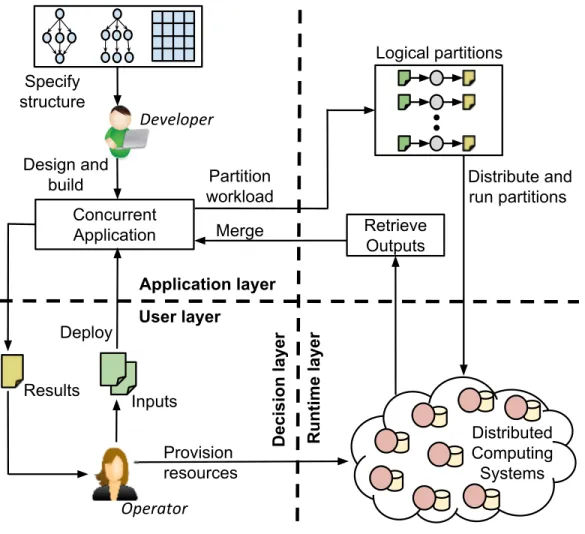
I begin the search for a solution that addresses these challenges with a discussion of the deployment and operation model of concurrent applications on distributed computing systems as illustrated in Figure 1.1. In this figure, thedevelopers are the entities that design and implement the algorithms that define the structure of the workload of the applications. The developers use and incorporate various techniques in the applications to partition their workloads so they can be operated concurrently. On the other hand, the operators are the entities that operate the applications by provisioning resources and deploying the application on these resources. The oper-ators provide the inputs to the application and utilize the results returned by the application. Note that the operators of scientific applications on distributed comput-ing systems are often the end-users who directly benefit from the operation of the application on the provided inputs.
I proceed to use the model presented in Figure 1.1 to discuss the current state-of-the-art in the development and operation of concurrent scientific applications. This discussion will highlight the assumptions and drawbacks of existing techniques and establish the need for a new class of techniques to address the identified challenges.
The techniques currently employed in the development and operation of large concurrent applications can be presented under three categories:
Figure 1.1. The deployment model of concurrent applications on distributed computing systems.
• The developers of the application define the behavior during operation by spec-ifying the target hardware for operation and the runtime behavior on that hardware as part of the design. This allows developers to build and tune the application to specific hardware and achieve efficient operation on them. This approach is beneficial when the application is deployed exactly on the hardware and operating environment assumed during design. Examples of this approach are found in MPI [43] and Cilk [24].
• The operators of the applications specify the resources for operation and tune the operating parameters of the application based on the size, type, and char-acteristics of the resources being provisioned. This approach is prevalent in environments where there are multiple applications and invocations run on the same pool of provisioned infrastructure. The operators here determine the parameters for the operation of the applications such that the provisioned
in-frastructure is utilized in a cost-efficient manner. Hadoop [53] employs this approach in requiring the operators of the Hadoop cluster to define and specify the performance and reliability characteristics for the operation of applications on the cluster.
• The middleware or runtime system between the resources and the applications takes control of the operation of the application and operates the application in a manner it defines as efficient. SEDA [119] is a popular example of this approach. In these approaches, the middleware assumes certain characteristics of the workload or requires these characteristics to be communicated at runtime. The knowledge of the workload characteristics is required for the middleware to make intelligent decisions for their efficient operation.
In summary, these approaches do not support the efficient operation of applica-tions on hardware unknown during design, or exclusive deployments for each invoca-tion, or execution of arbitrary workloads.
1.4 Case for Applications as Operators
To address the challenges described in Section 1.2, I propose and demonstrate that scientific applications must (1) be built as elastic applications and (2) act as operators in their deployed environments in distributed computing systems.
In this work, I show that applications built and run as elastic applications are fault-tolerant, adaptive to the resources available for operation, portable across plat-forms, and simultaneously operate on heterogeneous hardware and operating environ-ments. These characteristics are essential and beneficial for successful operation on current distributed computing environments characterized by metered, on-demand, and exclusive deployments on commodity hardware.
In addition, I argue that elastic applications must assume the responsibilities of their operators in determining the resources to provision for operation, directing the concurrent execution of their workloads, and adapting their execution to the ing conditions. By serving as their operators, applications can measure the operat-ing conditions and precisely harness knowledge of the current and future needs and
characteristics of their workloads to determine the operating parameters for efficient operation. Even when the target hardware is unknown and variable, self-operating applications achieve time- and cost-efficient operation by determining the resource requirements and tuning the concurrent operation of their workloads according to the measured operating conditions.
The key ideas advocated and demonstrated by this dissertation can be summa-rized as follows:
Self-operating elastic applications achieve time- and cost-efficient
opera-tion on distributed computing systems. These applications directly partition
the concurrency in their workloads into independent tasks, submit the tasks for simultaneous execution, determine the resources to allocate, and adapt their oper-ation according to the characteristics of the deployed environment.
1.5 Overview of Dissertation
This dissertation studies concurrent scientific applications and the challenges as-sociated with their operation on the current generation of distributed systems com-prised of clusters, clouds, and grids. It then addresses the challenges by presenting and evaluating techniques for building self-operating elastic applications that over-come the challenges in achieving time- and cost-efficient operation. It organizes this presentation in the following chapters.
Chapter 2: Related Work. This chapter reviews prior work on the
program-ming paradigms and techniques used for the concurrent operation of large workloads on distributed systems. It also discusses current techniques in the middleware and application layer as well as the principles currently advocated in altering the resource configurations according to the requirements of the applications. This chapter shows why these principles and techniques cannot be extended to scientific applications
with fixed-size workloads directly operated by end-users on distributed computing systems.
Chapter 3: Elastic Applications. Large scientific workloads are increasingly
deployed at scale on resources with diverse and commodity hardware configurations. The reasons behind this trend extend from the readily available access to the wide variety of resources offered in cloud platforms to the federation of resources from one or more cluster, cloud, or grid computing platforms. This chapter argues the need forelastic applications and identifies the desired characteristics for operation on diverse hardware configurations. It experimentally demonstrates the characteristics of an elastic application and their benefits for operation on diverse and dynamically changing operating environments.
Chapter 4: Case Studies of Elastic Applications. This chapter utilizes the
established characteristics of elastic applications in the previous chapter to convert a variety of scientific workloads to elastic applications. This chapter shows the conver-sion of six scientific workloads and describes their elastic implementations in terms of their construction, operation, and the solutions devised to address the challenges encountered during construction and operation. The chapter also derives high-level principles for the design of elastic applications from the experiences in building and operating these applications.
Chapter 5: Middleware Techniques. This chapter formulates the principles
for the design of middleware used for the construction and operation of elastic ap-plications. It argues for loosening the guidelines imposed by conventional wisdom on middleware to hide all information about the underlying operating environment. Specifically, the chapter argues that middleware should expose selective information about the underlying operating environment to the applications. The chapter also shows that gains in efficient operation can be achieved when middleware consider and implement strategies for the migration and management of data during operation of
the applications on distributed computing systems at scale.
Chapter 6: Application-level Techniques. This chapter presents techniques
for self-operating applications that overcome the challenges with achieving cost-efficient operation without knowledge of the operating environments at the time of their design. The chapter shows applications that incorporate the techniques of application-level model, control, and adaptation to achieve cost-efficiency in any de-ployed environment without intervention from the end-users who provision resources for the application.
Chapter 7: Conclusions. This chapter summarizes the principles and
tech-niques presented in this dissertation for the efficient operation of scientific applica-tions at scale. It shows how the presented techniques for self-operating applicaapplica-tions fit among the use of abstractions and agents for the design and operation of applications as advocated by previous work. It concludes the dissertation with a vision for how the presented techniques can be extended to construct fully autonomous distributed computing applications and identifies future work needed to achieve this vision.
CHAPTER 2 RELATED WORK
2.1 Scientific Computing
Scientific applications run resource-intensive computations or analysis that are based on a workload determined by the algorithms they implement and the inputs and configuration parameters supplied at runtime. In the previous decades, the scales required for the operation of these applications were only available in super- and high-performance computing environments [68, 106]. These environments provided access to expensive and high-end hardware with low failure rates and uniform performance profiles. These characteristics of the operating environment enabled the applications to be built and tuned for a specific type of hardware on which they were required or expected to be operated.
The above high-performance computing environments were also characterized by restricted access to the stakeholders/members of the organization maintaining them due to the proprietary setups and expensive infrastructure and maintenance costs. This meant the operation of large scientific applications was available to only those with access to these special and restricted environments. As a result, the developers and operators of these applications were limited and often found it easy to collaborate in building and operating the applications at scale.
The last two decades have seen the rise and growth of distributed computing sys-tems in the form of clusters [49, 55, 63], clouds [3, 16], and grids [7, 91, 111]. These distributed computing systems have democratized access to large arrays of computa-tional resources by offering them for public consumption at low costs. By providing
easy and quick access to large-scale resources, these platforms have enabled scientific software to expand in their scale and complexity and enable scientific breakthroughs. To help navigate the challenges of building and operating applications on differ-ent distributed computing systems and their myriad providers, several frameworks and abstractions were invented. Wolski et al, were the first to present such a frame-work for operating applications simultaneously across multiple distributed computing platforms [122]. More recently, [79] demonstrated a framework that transparently runs applications across heterogeneous resources federated from multiple cloud and grid platforms. There have also been work on building programming paradigms operating scientific and data-intensive applications on distributed computing sys-tems [31, 40, 52, 84].
Other efforts have focused on providing broad lessons learned from their expe-riences in operating scientific applications on different platforms [59, 73, 125]. The authors in [59] report and evaluate their experiences in running scientific applications in a virtualized cloud environment. They show that the scheduling and communica-tion overheads need to be carefully considered in evaluating the benefits of running scientific applications on a cloud platform. Lu et al, in [73], describe their experiences in running a bioinformatics application on Windows Azure and present best practices for handling the overheads of large scale concurrent operation on cloud platforms.
However, the challenges of efficient operation on distributed computing systems have been largely left to the application designers. This has resulted in piecemeal ap-proaches that target a specific class of applications [88, 128] or an operating environ-ment [10, 32]. In addition, the use of cloud platforms for operation incurs monetary costs to the operators of the application who provision and maintain the necessary resources. This demands applications to consider and achieve cost-efficiency during operation. Further, the detachment between the developers of the applications and the users or operators of the applications presents new challenges that need to be
considered and addressed. For example, the operators of the applications might de-ploy the applications on hardware at a scale that were not known or considered by the developers of the application during design.
2.2 Service-oriented workloads
Several efforts have focused on solving challenges with the optimal operation and provisioning of resources for service-oriented and multi-tenant environments such as web applications [114], e-commerce systems [117], Software-as-a-Service (SaaS) [14], and databases [96]. Service-oriented workloads handle and satisfy requests from end users for access to data that is stored or processed remotely such as web content, databases, web applications, etc. They are characterized by dynamic workloads that are dictated by the presence and demands of end users.
The techniques for service-oriented environments include load prediction and load mapping [123], estimation [101, 131], analysis of previous deployments and loads [117], and monitoring and adapting the provisioned resources according to the needs of the services [90, 114]. The techniques advocate the adaptation of the operating environment to the demands of the services.
Service-oriented workloads are unknown, unpredictable, and determined by exter-nal factors such as the current demands of users during runtime. These parameters are often externally monitored to determine and adapt the size of resources allocated for their operation. Further, the economy of operation of these workloads are deter-mined by the operating costs incurred in serving multiple users and guaranteeing the negotiated service level agreements. The characteristics of service-oriented processes are summarized and compared against those of scientific applications characterized by fixed workloads in Table 2.1.
tech-TABLE 2.1
KEY DIFFERENCES BETWEEN COMPUTATION-ORIENTED AND SERVICE-ORIENTED PROCESSES
Computation-oriented Service-oriented Instances Multiple instances; one for each
user Single instance; shared across users
Workload Pre-defined Unknown and unpredictable
Deployment Different platforms and environ-ments
Anchored to one platform and en-vironment
Invocation Multiple times, serves users who invoked
Once, serves multiple disparate users
Need for Scale Concurrency/parallelism Load balancing, redundancy, repli-cation
Performance Metric Operating time and costs Service level agreements and profit Operation Lifetime Finite duration Prolonged/indefinite
Changes in Operating
En-vironment Impact throughout lifetime Impact isolated to specific duration
niques for the cost-efficient deployment and operation of scientific applications with fixed workloads to be considered and devised differently.
2.3 Workload Decomposition
The decomposition and partitioning of workloads into concurrent pieces is a well-studied topic in computer science since its early days [86, 95]. Over the years, this study has extended to scientific workloads and workflows to present techniques for improving their scale and time to completion [30, 67, 109].
The partitioning and decomposition of workloads have been studied in shared ex-ecution environments, such as grids and clusters [34, 54]. The work in [34] studies the use of genetic algorithms to determine a scheduling strategy that can be applied to determine the optimal partitions and the resources to provision. Hedayat et al. [54]
describe a distributed workflow management framework for partitioning and operat-ing workflows on multiple clusters. These efforts however do not consider efficient operation as a metric in building and evaluating their solutions.
Recently, a number of efforts have explored novel and unconventional mechanisms to solving the partitioning of workloads in an optimal manner. Agarwal et al. [10] considered a system with a large proportion of recurring jobs and utilized information from prior executions to determine the optimal degree of parallelism to enable during operation. The work in [67] describes the importance of identifying the optimal num-ber of data partitions for MapReduce applications. It presents preliminary insights from an approach combining code and data analysis with optimization techniques.
There have also been efforts that consider the partitioning of a specific class of applications. For instance, the work in [31] studies and establishes a theoretical model to predict execution times and compute the optimal number of workers for genetic algorithms. Another instance is the work in [109] that formulates a graph partitioning algorithm for DAG workflows such that the data transfer overheads between the nodes of the DAG is lowered.
However, the partitioning of workloads to achieve time- and cost-efficient opera-tion in every invocaopera-tion based on the characteristics of the deployed environment have not been considered and addressed. This work considers the partitioning of work-loads in such environments where the applications can be deployed in environments that are unknown and unpredictable during design and vary in each invocation.
2.4 Resource Allocation
The provisioning and allocation of resources for large-scale and resource-intensive applications have been extensively studied in the context of distributed comput-ing [37, 66, 98]. Recently, several efforts have considered the cost-efficient deploy-ment of scientific and data-intensive workloads in cloud platforms [48, 56, 116]. The
authors in [48] and [33] present heuristics for the optimal allocation of resources for an arbitrary batch of independent jobs. They also show that the optimal allocation of resources for an arbitrary batch of independent jobs to be NP-Complete and then present heuristics-based algorithms for allocation.
The effort presented in [56] describes scheduling techniques in the middleware for multi-user environments running on cloud resources. Aneka presented in [116] is a middleware that maximizes resource utilization and cost-efficiency by multiplexing the execution of several applications on available resources and dynamically scaling resources when demand exceeds supply. These frameworks require or propose some coordination between the resource providers and the developers and operators of the applications in order to maximize the utilization of the provisioned resources.
Previous efforts have built and applied elaborate models for optimizing the time and cost of operation of applications in certain operating environments in [23, 120]. They utilize feedback from allocated nodes and apply the model to drive resources allocation based on time and cost constraints of the user. The framework in [23] is targeted at deployments in a hybrid environment comprised of resources drawn from a local cluster and a commercial cloud. The framework schedules jobs on the local cluster and provisions resources in the cloud when the capacity at the cluster cannot satisfy the time constraints of the applications. The Conductor framework in [120] presents an abstraction for efficiently deploying MapReduce applications. It includes a model describing the costs and the computation and storage capacities of various instances offered in a cloud platform. The models are applied to select the services that achieve the lowest cost in running the MapReduce application. The applicability of the framework is restricted to the cloud services and instances that are modeled.
Other efforts have studied and built scheduling techniques for finding the optimal number of resources in grid and cloud computing environments for a given workflow under cost constraints [29, 66, 88]. These efforts focus on allocating resources and
scheduling tasks on those resources such that the workflow completes within the given time and cost constraints. The authors in [57] employ empirical heuristics based on assumptions about the workflow and the characteristics of the provisioned resources to propose a scheduling algorithm that dynamically adapts the resource allocations during run-time. Efforts have also been made in dynamically provisioning resources from cloud platforms to extend traditional scientific computing environments such as clusters and batch systems [45, 75, 76].
There have also been efforts that provide resource allocation techniques for a specific class of applications they study. For example, the work in [132] considers a class of applications with flexibility in the quality of the computational results (e.g., accuracy) they provide. The authors develop a model mapping the parameters that determine the quality of the computations to the resource requirements. The model is then applied to determine the resource allocations that meet the budget and time constraints set by the user while maximizing the quality of the computation results. Stewart et al. [105] build a model describing the resources needs of a multi-component application using instrumentation in the operating system.
The work described in this dissertation focuses on determining the resource allo-cation that achieves efficient operation of large concurrent workloads in any operating environment deployed on the distributed computing systems of clusters, clouds, and grids. This work considers the operating environment to be deployed on resources that are exclusively provisioned and maintained for the operation of an instance of the application. It will present techniques for determining the scale of resources that achieve efficient operation in each exclusive deployment.
2.5 Middleware Techniques
Large-scale, resource-intensive, and scientific applications are built and operated using middleware, such as operating systems [21], batch scheduling systems [49],
exe-cution engines [53, 62]. The applications are typically constructed using the program-ing interfaces provided or imposed by the middleware. This allows the middleware to direct and manage the execution of the application on the available resources.
Several programming frameworks exist for the development and execution of data-intensive workflows and applications [5, 53, 78, 87]. Recently, the use of execution engines for building and running resource- and data-intensive applications have grown in popularity [53, 62, 84]. Hadoop [53] is an open-source implementation that sup-ports the MapReduce programming paradigm [38]. Dryad provides a programming framework and distributed execution engine for DAG-based workloads [62]. CIEL extends the programming and execution model to support dynamic data dependen-cies and arbitrary data-dependent control flows [84]. These frameworks offer several advanced features in allowing users to modify their workflows to run on distributed systems and improve the run-time performance and time-to-completion. However, most of these frameworks require prior installation on the resources allocated for operation and therefore can be an inconvenience for on-demand deployment and op-eration of applications.
These frameworks were designed for operation within a single infrastructure or administrative domain and are similar to batch systems [49, 55] in their scheduling and management of resources. However, unlike batch systems, these distributed execution engines also control and manage the workload or data partitioning, data transfer, and locality when executing their applications. Since these decisions are often hidden from the applications, it is difficult for the operators of the applications to accurately estimate and provision the right size of resources required for their execution. This impacts their runtime performance and lowers their cost-efficiency when deployed on cloud platforms.
2.6 Application-level adaptations
Application-level techniques and adaptations have been proposed and studied in several fields such as databases [61], distributed programs [46], and multimedia [115] systems [11]. The work in [9] considers applications that adapt their workload accord-ing to the resources available for operation and presents compiler-level techniques for building such applications. The authors in [51] survey techniques, such as partition-ing, in the database layer for adapting query plans to changing operating conditions.
Previous efforts have successfully advocated and demonstrated the use of application-level models and techniques for overcoming challenges in various operating environ-ments [32, 44]. The work in [32] advocates application-level scheduling techniques for efficiently running independent jobs on heterogeneous resources in a grid. Doyle et al. [44] formulate and apply an internal model of the behavior of service-oriented programs to predict their memory and storage requirements and provision resources for multiple competing programs running on a shared infrastructure.
This dissertation advocates and applies application-level techniques for achiev-ing cost-efficient deployment and operation of concurrent applications in distributed computing platforms.
CHAPTER 3
ELASTIC APPLICATIONS
3.1 Introduction
The execution environments offered by distributed computing systems can be very challenging since they consist of heterogeneous resources with rapidly changing avail-ability and a high probavail-ability of failure. For example, the Spot-Pricing [17] service offered by Amazon provides virtual machines whenever the market price falls below the user’s threshold. An application running on this service must be prepared for the addition and removal of resources at a moment’s notice. In this way, it is not unlike a grid using a cycle-stealing strategy such as Condor [72] or BOINC [20]. In addition, the execution environments can vary in their behavior and characteristics between invocations of the applications due to differences in the hardware and characteristics of the platforms on which they are deployed.
Previously built scientific applications are not prepared for such execution envi-ronments, because they are usually built around the assumption of fixed, homoge-neous resources at a single location. For example, message-passing applications are usually designed to run on a fixed number of processors – usually a power of two – that cannot change during runtime. A multi-threaded program is usually designed to run on a fixed number of cores selected at startup; changing the number of cores at runtime results in a serious performance penalty.
Further, these scientific applications lack the ability to harness any currently available resources to proceed with execution and this often leads to poor productivity
where valuable time is spent waiting for all requested resources to be available. Also, while fault tolerance can be achieved with checkpointing or other error recovery techniques implemented at the application level, they inherently lack a dynamic fault-tolerance and error-recovery mechanism that will allow for executions to recover from multiple failures, proceed execution or migrate seamlessly to another site in the event of unrecoverable failures. The behavior and performance of such applications vary with hardware, platform, network characteristics [12, 94] and often need to be tuned to suit the platform and hardware used in execution.
In summary, previously built scientific applications are constrained by the avail-ability of dedicated and tightly controlled resources. These applications are inefficient in their utilization of available resources and any resources that become available dur-ing run-time. Such limitations prevent these applications from successfully leveragdur-ing the scale and affordability of operation on distributed computing systems.
This chapter introduces and defineselastic applications as the paradigm of choice in building applications for distributed computing systems. It describes the neces-sary characteristics that every elastic application must exhibit to achieve successful operation on distributed computing systems. It goes on to present the conversion of a scientific application to an elastic application that exhibits these characteris-tics. This chapter concludes with an experimental demonstration of the scalability, resource adaptability, fault-tolerance, and portability of elastic applications during their operation.
3.2 Definition and Characteristics
We define applications that adapt their operation to the characteristics of the deployed environment aselastic applications [92]. These applications exhibit flex-ibility in the execution of the workload, tolerance to failures, adaptability to the resources available for operation, and portability across different platforms. They
can dynamically adapt to the size, scale, and type of resources available at any given moment, and tolerate failures in the hardware and execution environment. Further, their deployment can be moved to a different platform or infrastructure with mini-mal effort and intervention from the operators. As a result, elastic applications are well-suited to operate in the dynamic environments of distributed computing systems such as clusters, clouds, and grids.
The characteristics of elastic applications are described as follows:
• Adaptability. They must adapt to resource availability during run time. That
is, they must dynamically expand their resource consumption to include re-sources that become available during execution. At the same time, they must also adapt to resources being lost or terminated during execution. These adap-tations must occur seamlessly without intervention from the operators.
• Fault-tolerance. They must continue execution in the presence of run-time
failures. They must isolate failures to individual executions or resources and dynamically recover by re-running the failed executions or by migrating them to successfully operating resources.
• Portability. They must be portable across different platforms and
environ-ments with limited effort from users. They must be able to execute on any platform using the software components specified by users for that platform without having to be re-engineered or rewritten.
• Versatility. By leveraging their portability, elastic applications must be able
to simultaneously harness resources with diverse operating environments. In other words, users must be able to run them using resources federated from any cluster, cloud, or grid platform as long as the software compatibility with the different operating environments is established.
These characteristics further enable elastic applications to achievescalabilityand
reproducibilitywithout being tied to a specific operating environment or hardware.
3.3 Programming Model and Architecture
In this work, I consider workloads that can be expressed and operated using the split-map-merge paradigm and show their construction as elastic applications. This paradigm encompasses the bag-of-tasks [35], bulk synchronous parallel [50],
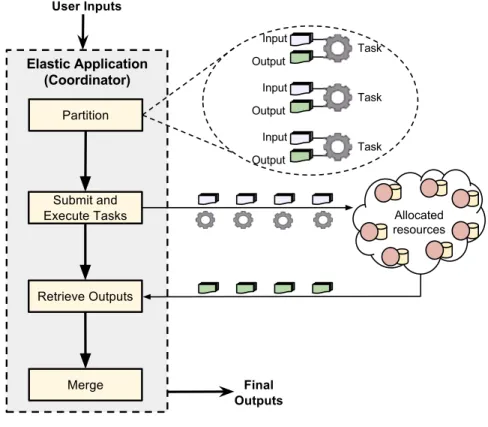
Figure 3.1. Architecture of split-map-merge based elastic applications.
scatter-gather [36], and the popular Map-Reduce [38] (where the split is done during the initial upload of the data to the filesystem of the execution framework) models of concurrent programming. A number of large-scale workloads are expressed and operated using the split-map-merge paradigm [8, 74, 112]. A formal expression for the split-map-merge paradigm is formulated below.
W orkload:f(N)→O, (3.1)
Split(N, k) :N → {s1, s2, . . . , sk}, (3.2)
M ap(k) :f(si)→Oi f or i = 1,2, . . . , k, (3.3)
Equation 3.1 describes the overall operation of the workload which performs a transformation on inputN to produce outputO. The split step in Equation 3.2 takes a parameter k and splits N intok partitions. The map step runs the transformation on each of the k partitions as shown in Equation 3.3. Finally, the merge step in Equation 3.4 aggregates the outputs of the individual map functions to produce the final output O. The merge function could be a simple concatenation of the outputs or a sophisticated function (e.g., merge of values in sorted order) depending on the workload. It is important to note the value ofO is not affected by the choice ofk. The concurrency in split-map-merge workloads results from the simultaneous execution of the map operations.
Figure 3.1 presents a overview of the architecture of elastic applications using the split-map-merge paradigm. The workload of the applications can be expressed in a variety of forms. It could be a directed acyclic graph orworkflow in which the tasks and their relationship are fully elaborated in advance. It could be a data decompo-sition in which a large dataset is broken into pieces and processed independently. It could be an iterative algorithm in which a set of tasks is dispatched, evaluated, and then dispatched again until an end condition is met. These structures can describe a variety of applications, such as Monte-carlo simulations [22], protein folding [8], and bioinformatics [112]. Also, the workloads of the elastic applications can consist of a single, multiple, or iterative split-map-merge phases.
Elastic applications are typically implemented by constructing a long-running
coordinator that submits a large number of short-running tasks. The coordinator
is responsible for observing available resources, decomposing the workload into tasks of appropriate size, submitting and monitoring tasks, handling fault-tolerance, and interacting with users. The individual tasks are usually self-contained executable programs, along with their expected input and output files. The individual tasks may make use of local physical parallelism in the form of multi-core machines or
accelerated hardware such as GPUs, while the coordinator operates at a parallelism of anywhere from one hundred to ten thousand tasks running simultaneously.
3.4 Middleware
The construction and operation of elastic applications on distributed computing environments can consume extensive effort, time, and cost, especially if these ap-plications run large and complex workloads. To lower the level of effort and cost required, developers can take advantage of frameworks and middleware to engineer their applications through the offered API and library interfaces.
A framework chosen for building and operating elastic applications must imple-ment and provide the necessary interfaces for achieving the required properties of resource adaptability, fault-tolerance, portability, versatility, and scalability. In ad-dition, the framework must be able to operate independent of the platform, oper-ating environment, and hardware provisioned for operation. It must also hide the complexities and heterogeneity in the underlying platforms and hardware from the applications. Finally, it must offer easy to use interfaces and facilitate quicker devel-opment and deployment of the applications to different platforms and providers with minimal effort from the developers and operators of the applications.
In this work, we use the Work Queue [127] framework developed by our research lab at the University of Notre Dame. It is important to note that are several other middleware and frameworks can be utilized for building elastic applications [53, 62, 65]. We chose Work Queue since it provided us the opportunity to incorporate, study, and evaluate the application and middleware techniques presented in this work.
The Work Queue [26] framework is used to implement the master-coordinator of the elastic applications. Work Queue provides interfaces for describing the tasks of a workload, submitting the tasks for execution, and retrieving the results of the executions. Work Queue has been used to build a number of elastic applications in
fields such as molecular dynamics, data mining, bioinformatics, and fluid dynamics [8, 83, 92, 93, 112].
The Work Queue framework is based on a master-worker execution model. It consists of the following components:
• Work Queue Library implements and provides the functionality for
coor-dinating the workload execution across workers. It schedules tasks on work-ers, transfers the inputs and outputs of tasks, and reschedules failed tasks. The library also provides data management capabilities, such as caching and scheduling policies that favor workers with pre-existing data.
• Work Queue API provides the interfaces (in C, Python, and Perl) to the
Work Queue library. The API is used to create master (coordinator) programs that create, describe, and submit tasks for execution, and retrieve their outputs upon execution.
• Work Queue Worker is a lightweight process that is run on the allocated
resources. It connects to a specified Work Queue master and executes the dispatched tasks.
The master-coordinator of the elastic applications is implemented by their devel-opers using the Work Queue API. The individual units of execution of the application, referred from here on as tasks, are partitioned and described by the master. The in-put files, the executables and execution commands to run, and the outin-put files of the tasks are specified by the master using the API of Work Queue. The underlying Work Queue library dispatches and coordinates the executions of the tasks across the connected workers, aggregates the completed results and returns them to the master-coordinator. Figure 3.2 presents the outline of the construction and execution of an elastic application using Work Queue.
The Work Queue library dispatches tasks to workers as they establish connection and reschedules tasks running on terminated workers. This allows applications to adapt to the size of the available resources during runtime. Work Queue automatically reschedules tasks that failed due to resource failures and allows the application to examine completed tasks and resubmit tasks with erroneous results, thereby enabling
Figure 3.2. Construction and operation of applications using Work Queue. The code on the left is an outline of an elastic application.
fault-tolerance in its applications. Work Queue requires applications to explicitly specify the software and data dependencies for the tasks so the environment needed for execution can be created at the workers without concern for the native execution environment. This enables Work Queue to provide data management facilities, such as caching and scheduling policies that favor workers with cached data.
The workers are deployed as executables on the provisioned resources and they are invoked as standalone processes. The workers can be compiled, installed, and run on any POSIX compliant environment. This implies that the worker can virtually be deployed and run on any operating environment including Microsoft Windows based environments (using Cygwin [1]).
3.5 Example: Elastic Replica Exchange
We construct an example elastic application to experimentally demonstrate and evaluate the characteristics of elastic applications and the benefits they present for operation on distributed computing systems. In this chapter, we consider the con-struction of replica exchange molecular dynamics simulation as an elastic application. Replica exchange molecular dynamics [25, 107] is a technique used to improve the sampling of the potential energy surface in a protein system. Further details about the replica exchange algorithm and its implementation as an elastic application are presented in Chapter 4.
The replica exchange computations are typically implemented using MPI. Some of the simulation software such as ProtoMol [77] and Gromacs [71] offer built-in MPI implementations for this purpose. However, as we discussed earlier in Section 3.1, the MPI based implementations exhibit disadvantages and inefficiencies when operated on distributed computing systems. So to overcome the shortcomings of MPI based implementations of replica exchange, we built an elastic implementation using the Work Queue framework described above.
The implementation of elastic replica exchange involves the creation of the mas-ter (coordinator) script described in Section 3.3. The masmas-ter is built using the Work Queue API. The master creates and specifies the configuration and input files re-quired for each iteration of the computation and gathers the output files upon their completion by the Work Queue workers. At the end of each iteration, the master checks to see if an exchange can be attempted between two replicas and if so swaps the necessary parameters of those replicas. The master then proceeds to generate the configuration and input files for the next iteration. The master, therefore, coordi-nates the entire simulation across the workers running on the allocated resources for operation. The tasks created by the master use the ProtoMol [77] as the computation kernel for running the simulations on their inputs.
In the next sections, we experimentally study and evaluate this elastic implemen-tation of replica exchange.
3.6 Comparison against an Existing Construction using MPI
0 100 200 300 400 500 0 24 48 72 96 120 144 168 192
Running time (minutes)
Number of Replicas wq mpi
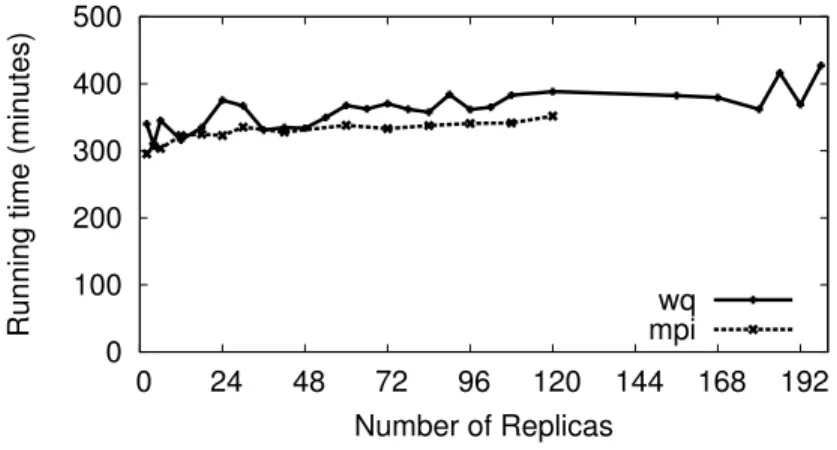
Figure 3.3. Running time performance comparison of MPI- and Work Queue-based implementations of replica exchange.
We first compare the performance of the elastic implementation of replica ex-change using Work Queue against its MPI implementation. For the experiments in this section, we deployed and ran both implementations on the Sun Grid Engine [49] infrastructure at the University of Notre Dame. Each experimental run involved simu-lations over 100 Monte Carlo steps with each step running 10000 molecular dynamics steps. Figure 3.3 compares the running time of the MPI- and Work Queue-based implementations of replica exchange. The number of workers deployed and run was equal to the number of replicas simulated in the experiment. For example, a run with 30 replicas had 30 workers being deployed and run. The running time of these
experiments were measured from the start of simulation to its completion. Therefore, Figure 3.3 does not include the job queuing and scheduling delays. In this figure, we observe that the Work Queue implementation has a slightly higher running time than the MPI implementation. This is attributed to the communication and data transfer overheads between the master and workers running remotely.
An important observation we make in Figure 3.3 is that the MPI runs do not scale well beyond 120 replicas. This is due to the lack of resources at this scale being available simultaneously on the Notre Dame SGE infrastructure. We also note that the Notre Dame SGE has a constraint on the resources available to a user at any given time, thereby limiting the scalability of the MPI implementation even with the availability of more resources. On the other hand, we see that the Work Queue implementation scales well due to its ability to scavenge and utilize resources as they become available. Experiments beyond 120 replicas were achieved by deploying multiple workers on resources with multiple computing cores and invoking their ex-ecution on each core through MPI. This illustrates better scalability characteristics of the Work Queue implementation of elastic replica exchange.
3.7 Experimental Illustration of Characteristics
In this section, we evaluate the operation of elastic replica exchange in terms of the characteristics identified in Section 3.2. We begin by describing the platforms used in the experiments presented in this section.
Campus SGE.The Sun Grid Engine (SGE) at the University of Notre Dame is
a dedicated platform for running high performance scientific applications. The jobs are submitted to the compute nodes via the SGE batch submission system [49]. The compute nodes run Red Hat Enterprise Linux (RHEL) as their operating environ-ment. The compute nodes here are typically composed of high-end hardware. The
TABLE 3.1
PLATFORMS USED IN THE EXPERIMENTAL STUDY AND DEMONSTRATION OF ELASTIC REPLICA EXCHANGE
Name System Processor I/O
Platform A Amazon EC2 2*2 x 1.0-1.2 GHz 7.5 GB memory Platform B Notre Dame SGE 2*2 x 2.6 GHz 8-12 GB memory Platform C Microsoft Azure 2 x 1.6 GHz 3.5 GB memory
workers were queued and submitted as jobs to this grid. Upon being scheduled and run, the workers connect to the master and execute the assigned workloads.
Amazon EC2. The Elastic Compute Cloud or EC2, built by Amazon.com, is
a platform that allows virtual machine instances to be requested, allocated, and deployed on demand by users. Different instance sizes are provided with vary-ing hardware configurations to satisfy different requirements and workloads of the users [18, 89]. The instances allocated can be installed and run with different Linux operating system flavors and kernels and their operating environments can also be customized. Since the instances can be installed and customized to run a Linux environment, the migration of our implementation to EC2 was similar to SGE.
Microsoft Azure. The Windows Azure platform, from Microsoft, offers virtual
instances running an image of the Azure operating system. The virtualized instance is offered through the Azure hypervisor and provides an operating environment based off the Windows Server 2008 R2 VM system [58, 80]. There are two computational roles offered in the platform - the web role that serves as the front end interface to the allocated compute instances, and the worker role that serves as the core computing unit that runs tasks and applications. As a result of this two tiered architecture, we
built wrapper scripts that communicate to the web role and invoke workers on the worker roles. We also used Cygwin-compiled executables in migrating our implemen-tation to this environment.
0 5 10 15 20 25 0 24 48 72 96 120 144 168 192 Number of failures Number of Replicas
Figure 3.4. Failures observed with Replica Exchange using Work Queue. The failures include both application-level (such as failure to reach desired simulation state) and system-level failures (such as timeouts on data transfer).
Figure 3.4 illustrates the number of failures that occurred on the worker sites when running on the campus SGE platform. These failures are attributable to a variety of factors such as stalled workers, application faults, data transmission failures,etc. With the MPI-based implementation, these failures will stall the entire experiment and will need to be restarted and rerun. The Work Queue implementation offers fault-tolerance by rerunning only the failed task in the experimental run, and in the event of any unrecoverable failures at a worker, migrating its execution to a different worker.
We now proceed to port and study the elastic implementation of replica exchange on two cloud computing platforms, Amazon EC2 and Microsoft Azure. We study
and demonstrate the behavior of our elastic implementation on these different plat-forms. Our objective isnot to compare the performance of the distributed computing platforms against each other, as they offer different cost-performance trade-offs us-ing different hardware. Instead, our goal here is to show that our system functions correctly and portably across multiple different environments.
0 200 400 600 800 1000 0 12 24 36 48 60 72 84 96 108 120
Running time (minutes)
Number of Replicas Platform A
Platform B Platform C
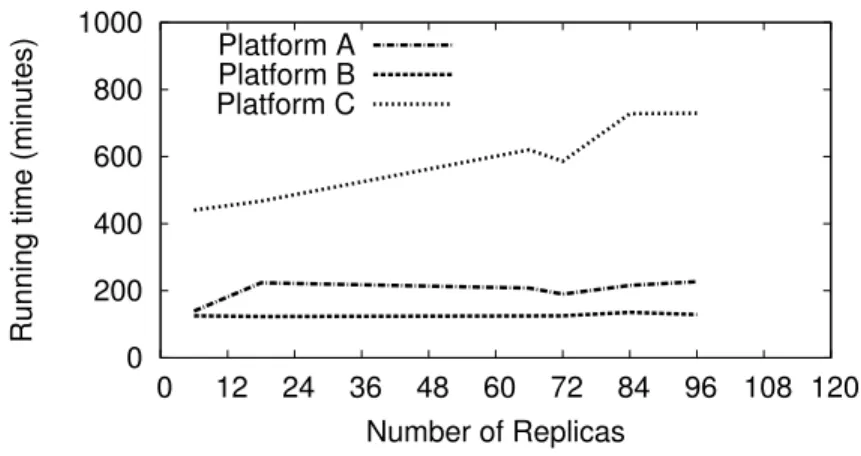
Figure 3.5. Comparison of running times on the platforms described in Table 1.
In the experiments described below, the number of workers deployed were again equivalent to the number of replicas involved in the simulation run. Each experiment ran simulations performed over 100 Monte Carlo steps involving 10000 molecular dynamics steps each. Figure 3.5 shows the running times of experimental runs with varying replica sizes on these platforms. The x-axis represents the number of replicas involved in each run. Figures 3.6 and 3.7 plot statistical data on the completion time of the individual Monte Carlo steps on the three platforms from experimental runs involving 18 replicas. Figure 3.6 plots the cumulative distribution function of the
0 0.1 0.2 0.3 0.4 0.5 0.6 0.7 0.8 0.9 1 50 100 150 200 250 300 350 Probability
Iteration completion time (seconds) Platform A Platform B Platform C
Figure 3.6. Cumulative distribution function of the completion times of the iterations in Replica Exchange using 18 replicas.
completion time of each step. Figure 3.7 gives the corresponding histogram plotting the distribution of completion times after being classified in bins.
From Figures 3.6 and 3.7, we notice significant variations in the completion times of the Monte Carlo steps on one of the platforms (Platform C) as compared to the other two platforms. While these variations can be attributed to one or more of several factors including network latencies and jitter, virtualization effects, firewall, load balancing etc., this is good evidence that our implementation is impervious to any peculiar platform and network characteristics of a distributed computing system. Our implementation demonstrates the ability to hide differences in the characteristics and behavior of different distributed computing platforms from the application.
We also demonstrate the execution of elastic replica exchange across multiple distributed computing platforms. We show this by deploying workers across all three platforms in Table 1. The experimental run involved 75 replicas simulated over 100 Monte Carlo steps running 10000 molecular dynamics steps. Figure 3.8 presents the number of workers connected, the completion time of each Monte Carlo step, and the running cost during this experimental run. The experiment was started with 25 workers being submitted and run on the Platform B. Since there are 75 tasks, as a