A Methodology for Creating Fast Wait-Free Data Structures
∗
Alex Kogan
Department of Computer Science Technion, Israel
Erez Petrank
Department of Computer ScienceTechnion, Israel
Abstract
Lock-freedom is a progress guarantee that ensures overall program progress. Wait-freedom is a stronger progress guarantee that en-sures the progress of each thread in the program. While many prac-tical lock-free algorithms exist, wait-free algorithms are typically inefficient and hardly used in practice. In this paper, we propose a methodology calledfast-path-slow-pathfor creating efficient wait-free algorithms. The idea is to execute the efficient lock-wait-free ver-sion most of the time and revert to the wait-free verver-sion only when things go wrong. The generality and effectiveness of this method-ology is demonstrated by two examples. In this paper, we apply this idea to a recent construction of a wait-free queue, bringing the wait-free implementation to perform in practice as efficient as the lock-free implementation. In another work, the fast-path-slow-path methodology has been used for (dramatically) improving the per-formance of a wait-free linked-list.
Categories and Subject Descriptors D.3.3 [Programming Lan-guages]: Language Constructs and Features – Concurrent program-ming structures; E.1 [Data Structures]: Lists, stacks, and queues General Terms Algorithms, Performance
Keywords Concurrent data structures, non-blocking synchroniza-tion, wait-free queues, lock-free algorithms
1.
Introduction
The evolution of multi-core systems necessitates the design of scal-able and efficient concurrent data structures. A common approach to achieve these goals is by constructingnon-blockingalgorithms. Such algorithms ensure that no thread accessing the data structure is postponed indefinitely while waiting for other threads that oper-ate on that data structure.
Most non-blocking data structure implementations provide a
lock-freeprogress guarantee, ensuring that among all threads that try to apply an operation, at least one will succeed. While some lock-free algorithms are quite scalable and efficient [7, 20, 24], they all allow workloads in which all but one thread starve. Such work-loads cannot occur with wait-freealgorithms, which ensure that
∗This work was supported by the Israeli Science Foundation grant No. 283/10. The work of A. Kogan was also supported by the Technion Hasso Plattner Center.
Permission to make digital or hard copies of all or part of this work for personal or classroom use is granted without fee provided that copies are not made or distributed for profit or commercial advantage and that copies bear this notice and the full citation on the first page. To copy otherwise, to republish, to post on servers or to redistribute to lists, requires prior specific permission and/or a fee.
PPoPP’12, February 25–29, 2012, New Orleans, Louisiana, USA. Copyright c⃝2012 ACM 978-1-4503-1160-1/12/02. . . $10.00
each thread applies its operation in a bounded number of steps, in-dependently of what other threads are doing. This property is valu-able in real-time systems, operating systems or systems operating under a service level agreement, with a (hard or soft) deadline on the time required to complete each operation. It is valuable as well in heterogeneous systems, in which threads may execute at differ-ent speeds and where faster threads may repeatedly delay slower ones, as might happen, for example, in systems composed of dif-ferent computing units, such as CPUs and GPUs.
In practice, while having desirable properties, wait-free algo-rithms are rightly considered inefficient and hard to design [6, 13]. Their inefficiency is said to be largely attributable to the helping mechanism [12], which is a key mechanism employed by most wait-free algorithms. This mechanism controls the way threads help each other to complete their operations, and usually leads to complicated algorithms, as each operation must be ensured to be applied exactly once. In practice, this often results in the usage of a greater number of expensive atomic operations, such as compare-and-swap (CAS), which degrade the performance of wait-free al-gorithms even when contention is low.
Moreover, most helping mechanisms known to us suffer from two problematic properties. First, upon starting an operation, a thread immediately begins to help other threads, sometimes inter-fering with their operations and almost always creating higher con-tention in the system. In most cases, the helped threads could have finished their operations by themselves if only they were given some time to execute without help. Second, the helping mecha-nisms are designed to operate sequentially, in the sense that all concurrently running threads help other operations in exactly the same order. These two properties cause much useless work due to high redundancy.
In this work, we propose a general methodology, denoted fast-path-slow-path, for constructing wait-free data structures. This methodology strives to be as scalable and fast as lock-free algo-rithms, while guaranteeing a bound on the number of steps required to complete each operation. To accomplish these goals, each oper-ation is built fromfast andslowpaths, where the former ensures good performance, while the latter serves as a fall-back to achieve wait-freedom. Normally, the fast path is a customized version of a lock-free algorithm, while the slow path is a customized version of a wait-free one. A thread makes several attempts to apply an operation on the fast path; only if it fails to complete, it switches to the slow path, where the completion is guaranteed. We stress that our design allows threads to execute operations on the fast and slow paths in parallel. In particular, a thread that fails to apply its operation on the fast path does not cause all other threads to waste time waiting for its operation to be completed. Moreover, in con-trast to the common definition of a fast path as “a shortcut through a complex algorithm taken by a thread running alone“[13], our de-sign allows several threads to run on the fast path and finish their operations concurrently.
Similarly to other wait-free algorithms, our methodology em-ploys a helping mechanism, but one that avoids the drawbacks dis-cussed above. In particular, the helping isdelayed and parallel. The first property means that threads will delay any helping at-tempts when concurrent operations exist. The opportunistic idea is that during that delay, the contending operation might be finished, and no further help will be required. The latter property means that threads that do decide to help will attempt to help different op-erations, reducing the contention and redundant work created by sequential helping.
The applicability and effectiveness of our methodology is demonstrated by two examples. First, we use it to create a fast FIFO wait-free queue. The queue design is implemented in Java1. It is evaluated and compared to the lock-free queue by Michael and Scott [20], which is considered one of the most efficient and scal-able lock-free queue implementations [13, 16, 25]. We also com-pare it to the recent wait-free queue by Kogan and Petrank [15]. The evaluation shows that along with the proven wait-free progress guarantee, the queue constructed in this paper delivers in practice the same performance as the queue of Michael and Scott, while both queues perform substantially better than the recent wait-free queue of Kogan and Petrank. As a second example, the fast-path-slow-path methodology has been also used on the wait-free linked-list independently published in these proceedings [23]. There too, this methodology yields a dramatic improvement in the algorithm’s performance, while maintaining the wait-free progress guarantee.
In addition to making wait-free algorithms as fast as lock-free ones, the fast-path-slow-path methodology can be used to provide different level of progress guarantees to different entities. For ex-ample, it can be used to run real-time threads side-by-side with non-real-time threads, as the non-real-time threads use the slow path (or both paths) to obtain a predictable maximum response time, whereas the non-real-time threads only use the fast path without operation-level progress guarantee. Another use of this methodology is in dis-tinguishing phases in the execution. Sometimes emergent phases require predictable guaranteed progress for each thread, while at other times, the system can run only the fast path to achieve fast execution in practice with no such progress guarantee. The inter-operability of the two paths may be useful in any other scenario that requires different progress guarantees according to various ex-ecution parameters.
2.
Related work
The idea of designing a concurrent algorithm with a fast path intended for no contention and a slow path for a contended case has been used in various domains of computer science. For example, it appears in solutions for the mutual exclusion problem [2, 17, 26], write barrier implementations in garbage collectors [18], and in implementations of composite locks [13].
Despite (and, maybe, due to) having strong progress guarantees, very few explicitly designed wait-free data structures are known (for the few that do exist, see [15, 23] and references therein). A common generic method for constructing wait-free data struc-tures is to apply universal constructions, originally proposed by Herlihy[10, 13]. (See [3] for an updated survey of various improve-ments proposed since then.) Such constructions provide a generic method for transforming any sequential data structure implementa-tion into a linearizable wait-free implementaimplementa-tion. The wait-freedom is usually achieved by using a specialannounce array, in which threads write details on the operations they intend to apply. The contending threads traverse this array in a particular order and help pending operations to complete. Threads help other threads in a way that essentially reduces concurrency and creates large
redun-1We also implemented our design in C (cf. Section 4.4).
dancy, especially when the number of contending threads is high: All threads try to apply the same operations, and in exactly the same order. In our work we show that trying to apply operations before involving other threads (i.e., before using theannouncearray) is crucial to the good performance of a wait-free algorithm. More-over, the helping mechanism proposed in this paper allows parallel and delayed helping, eliminating the drawbacks of most previous wait-free constructions.
A related idea was considered by Moir [21], who proposed to implement wait-free transactions by utilizing a lock-free version of a multi-word CAS operation, denoted MWCAS2. A wait-free transaction optimistically applies a MWCAS operation; if it fails, it asks help from a transaction that did succeed. Our methodology is different in many aspects. Most importantly, while Moir’s trans-actions always go through the costly MWCAS operation, which requires, among other things, (logically) locking and unlocking all words referenced by the transaction using expensive atomic opera-tions, our methodology lets most operations finish on the (efficient) fast path, especially in the low contention scenario. The fast path is in practice as fast as the underlying lock-free implementation (e.g., in the queue shown in Section 4, thedequeueoperation on the fast path requires just a single CAS).
Recently, Fatourou and Kallimanis [5] suggested a wait-free universal construction, where they utilize the idea of operation combining[8, 27]. There, a thread accessing the data structure cre-ates a copy of the state of the global object, applies its operation along with all other pending operations of threads accessing the data structure concurrently, and tries to update the shared pointer (to the state of the simulated object) to point to the local (modi-fied) copy of the object’s state. This technique produces efficient wait-free algorithms for data structures having a small state (in particular, the queue and the stack), but is not efficient for data structures with larger states (such as linked-lists, trees, or hash tables). Moreover, the construction in [5] builds on the availabil-ity of a Fetch&Add atomic primitive that has an additional ”wait-free” guarantee in the hardware: it is required that when several Fetch&Add operations conflict, they will be served in a starvation-free manner. This Fetch&Add instruction, especially with the ad-ditional guarantee, is not universally supported. Without this prim-itive, the construction becomes lock-free, and the performance de-grades significantly [5].
3.
The fast-path-slow-path methodology
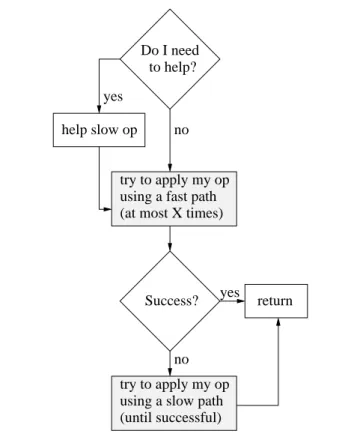
Our methodology for constructing fast wait-free data structures is shown schematically in Figure 1. In a nutshell, the idea is that: each operation is built from afast pathand aslow path, where the former is a version of a lock-free implementation of that operation, and the latter is a version of a wait-free implementation. Both implementa-tions are customized to cooperate with each other. Each thread first tries to apply its operation using the fast path. In most lock-free algorithms known to us, a thread tries to apply its operation by per-forming CAS (or equivalent) primitives on shared variables until it succeeds; if it fails, the thread retries the operation from the begin-ning (or some other earlier stage) (e.g., [4, 7, 9] and many others). In our approach, we limit the number of such retries by a global parameter, calledMAX FAILURES(denoted by X in Figure 1).
If a thread succeeds in applying its operation on the data struc-ture in less than MAX FAILURES trials, it finishes (i.e., returns the execution to the caller of that operation). If a thread fails in MAX FAILUREStrials, it realizes there is high contention and moves to the slow path. There, it publishes its intention to apply an
opera-2Moir provides an implementation of MWCAS, which he calls ”condition-ally wait-free”, i.e., a lock-free implementation that accepts a call-back for an external helping mechanism. See [21] for details.
no no yes Success? return to help? Do I need yes try to apply my op try to apply my op (at most X times) help slow op
using a fast path
using a slow path (until successful)
Figure 1. The fast-path-slow-path methodology.
tion in a specialstatearray. This array holds one entry per thread, and contains information on the type of operation being applied and a phase number. The latter is a simple counter increased by the thread every time it enters the slow path. After the operation is published instate, the thread keeps trying to apply it by following the slow path until it succeeds.
To achieve wait-freedom, we need to ensure that the number of trials in the slow path is bounded. For this purpose, we employ adelayed helping mechanism, which is based upon an auxiliary array of helping records. Thus, in addition to an entry in thestate array, each thread maintains a helping recordreci. There, it stores the ID of another thread,curTidi, and a phase number,lastPhasei. When a threadti starts an operation on the data structure, and before it enters the fast path, it checks whether the threadcurTidi is trying to apply an operation with the same phase number as was recorded earlier inlastPhasei. If so,tihelpscurTidifirst to apply the operation. In any case,tiupdates its helping record with the ID of the next thread (i.e.,curTidi+1 modulo the number of threads) and with the phase number of that next thread, which is read from thestatearray. Only afterwards doestiproceed with the fast path and, if necessary, with the slow path (cf. Figure 1).
Note that in contrast to many wait-free algorithms (e.g., [3, 5, 11, 15, 21]), this helping mechanism does not require a thread to help another concurrently running operation the moment the thread realizes there is contention. Rather, the helping is delayed to the next time the thread accesses the data structure, in the hope that the contending operation will be finished by that time and no further helping will be necessary.
In order to reduce the amortized management cost of helping records, we enhance the helping mechanism further by adding a counter, callednextChecki, to each helping recordreci. Each time a threadticreates a new helping record,tisets thenextCheckicounter to a predefinedHELPING DELAYconstant. Onti’s next operations
on the data structure, ti decrements the nextChecki counter for each operation. Only when this counter reaches zero, doesticheck whether its help tocurTidi is required. Thus,ti actually checks whether its help is required only once in itsHELPING DELAY op-erations.
4.
Fast wait-free queue
In this section, we show how the design methodology presented in Section 3 is applied to construct a fast wait-free queue. The design of the fast path and the slow path is based on the lock-free queue by Michael and Scott [20] (referred to hereafter as the MS-queue) and the recent wait-free queue by Kogan and Petrank [15] (referred to as the KP-queue), respectively. A brief description of the key design features of these two algorithms can be found in Appendix A.
Since the design of the MS-queue was published, several papers have proposed various optimized lock-free queues (e.g., [16, 22]). Yet, we chose to base our example on the MS-queue mainly due to its simplicity. We stress that the main purpose of this work is to create a wait-free implementation that is in practice as fast as the lock-free one, thus, obtaining wait-freedom without paying a performance cost. We do not presume to improve on the most efficient concurrent data structures available today.
4.1 Implementation details 4.1.1 Auxiliary structures
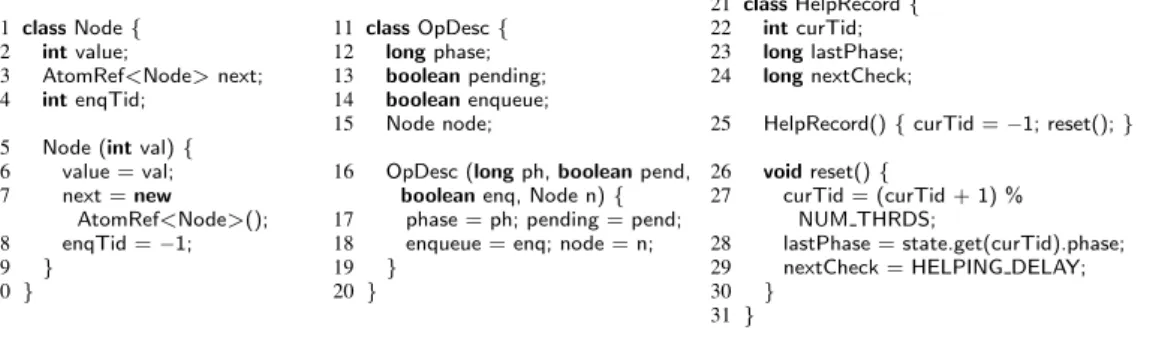
Similarly to many dynamically-allocated queues, our queue is based on an internal singly-linked list with references maintained to its head and tail, denoted, respectively, asheadandtail. The auxiliary structures for list nodes, as well as for helping records and entries of thestatearray that were described in Section 3, are given in Figure 2. Notice theenqTidfield added to theNodeclass. As described in Appendix A.2, this field is used in the KP-queue to identify threads that are in the middle of theirenqueueoperations in order to help them to complete these operation. In our case, this field serves a similar purpose and helps to synchronize between enqueueoperations running on the slow and fast paths, as will be explained in Section 4.1.2. For thedequeueoperation, we use a different mechanism (described below in this section) and thus do not require an additional field in theNodeclass.
TheOpDescclass serves to hold descriptors of operations exe-cuted by threads on the slow path. Each thread maintains one in-stance of this class in the array calledstate.OpDesccontains the phase number (which counts the number of thread’s operations on the slow path), the flags specifying whether the thread has a pend-ing operation on the slow path and if so, its type, and a reference to a list node; this reference has a meaning specific to the type of operation. In addition, each thread maintains one helping record, which is an instance of theHelpRecordclass. The structure of HelpRecordfollows the design presented in Section 3. In partic-ular, it contains fields for the ID of a thread that might need help, the phase number recorded for that thread, and a counter used to determine when the next check for helping should be performed.
The internal fields of the queue are given in Figure 3, and the queue constructor is in Figure 4. While thetailreference main-tained in our queue is implemented as anAtomicReference ob-ject (like in the MS-queue [13]), theheadreference is implemented as anAtomicStampedReferenceobject. The latter encapsulates a reference to an object along with an integer stamp. Both reference and stamp fields can be updated atomically, either together or in-dividually (for more information, including how this object can be implemented in C/C++ languages, refer to [13], pp. 235–236). In our case, the stamp has a role similar to theenqTidfield inNode, i.e., to identify the thread that is in the middle of itsdequeue oper-ation on the slow path. More details are provided in Section 4.1.2.
1 classNode{
2 intvalue;
3 AtomRef<Node>next;
4 intenqTid;
5 Node (intval){
6 value = val; 7 next =new AtomRef<Node>(); 8 enqTid =−1; 9 } 10 } 11 classOpDesc{ 12 longphase; 13 booleanpending; 14 booleanenqueue; 15 Node node;
16 OpDesc (longph,booleanpend,
booleanenq, Node n){
17 phase = ph; pending = pend;
18 enqueue = enq; node = n;
19 } 20 } 21 classHelpRecord{ 22 intcurTid; 23 longlastPhase; 24 longnextCheck;
25 HelpRecord(){curTid =−1; reset();}
26 voidreset(){
27 curTid = (curTid + 1) %
NUM THRDS;
28 lastPhase = state.get(curTid).phase;
29 nextCheck = HELPING DELAY;
30 } 31 }
Figure 2. Auxiliary structures.
32 AtomStampedRef<Node>head;
33 AtomRef<Node>tail;
34 AtomRefArray<OpDesc>state;
35 HelpRecord helpRecords[];
Figure 3. Queue class fields.
36 FastWFQueue (){
37 Node sentinel =newNode(−1);
38 head =newAtomicStampedReference<Node>(sentinel,−1);
39 tail =newAtomicReference<Node>(sentinel);
40 state =newAtomicReferenceArray<OpDesc>(NUM THRDS);
41 helpRecords =newHelpRecord[NUM THRDS];
42 for(inti = 0; i<state.length(); i++){
43 state.set(i,newOpDesc(−1,false,true,null));
44 helpRecords[i] =newHelpRecord();
45 } 46 }
Figure 4. Queue constructor.
47 voidhelp if needed(){
48 HelpRecord rec = helpRecords[TID];
49 if(rec.nextCheck−−== 0){
50 OpDesc desc = state.get(rec.curTid);
51 if(desc.pending && desc.phase == rec.lastPhase){
52 if(desc.enqueue) help enq(rec.curTid, rec.lastPhase);
53 elsehelp deq(rec.curTid, rec.lastPhase);
54 }
55 rec.reset();
56 } 57 }
Figure 5. The method called by threads at the entrance to the fast path. It helps an operation on the slow path if this help is necessary.
4.1.2 Fast path
Do I need to help? Before attempting to apply an operation on the fast path, a threadtiinvokes thehelp if needed()method, where it checks whether some other thread needs its help (Fig-ure 5). The threadtiexecuting this method reads its helping record (Line 48). According to the value of thenextCheckcounter,ti de-cides whether it has to check the status of the thread whose ID is written in the record (Line 49). If so, it accesses the entry of that thread (denote it astj) instate, and checks iftjhas a pending op-eration with a phase number equal tolastPhase(fromti’s helping record) (Lines 50–51). In such a case,tihelps to completetj’s oper-ation according to the type of operoper-ation written intj’s operation de-scriptor (Lines 52–53). The methodshelp deq()andhelp enq() are part of the slow path and are explained in Section 4.1.3. Fi-nally,tiresets its helping record (Line 55), recording the current phase number of the next thread (in a cyclic order) and setting the nextCheckcounter to theHELPING DELAYvalue (cf. Figure 2). Enqueue operation The details of theenqueueoperation exe-cuted by threads running on the fast path are provided in Fig-ure 6. A thread ti starts with a call to the help if needed() method (Line 59), which was explained above. Next,tiinitializes thetrialscounter and tries to append a new node to the end of the internal linked-list. The number of such trials is limited by the MAX FAILURESparameter, which controls whentiwill give up and switch to the slow path. Each trial is similar to the one performed in the MS-queue, that is,tiidentifies the last node in the list by reading tail(Line 63) and tries to append a new node after that last node with a CAS (Line 67). The only difference from the MS-queue is in the waytailis fixed whentiidentifies that someenqueue op-eration is in progress (i.e.,tailreferences some node whosenext reference is different fromnull). In the MS-queue, the fix is done by simply updatingtailto refer to the new last node. In our case, the fix is carried out by thefixTail()method, which is aware of the existence of the slow path. In particular, it checks whether the
enqTidfield of the last node in the list is set to a default value−1 (Line 79). If so, it means that the last node was inserted into the list from the fast path, and thustailcan simply be updated to refer to it (as done in the MS-queue). Otherwise, the last node was in-serted from the slow path. Thus, we need first to update the entry in thestatearray corresponding to the thread whose ID =enqTid (clearing itspendingflag), and only after that can we updatetail. (Without updatingstate, we may create a race between threads trying to help the sameenqueueoperation on the slow path). This functionality is carried out byhelp finish enq(), explained in Section 4.1.3.
Finally, iftifails to append a new node withinMAX FAILURES trials, it calls thewf enq()method (Line 76), which transfers the execution of theenqueueoperation to the slow path.
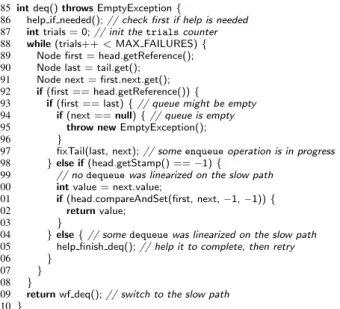
Dequeue operation Figure 7 provides the details of thedequeue operation executed by threads running on the fast path. Sim-ilarly to enqueue, the dequeue operation starts with calling help if needed()(Line 86) and initializing thetrialscounter (Line 87). In thewhileloop (Lines 88–108), a thread tries to update headto refer to the next element in the queue (or throw an excep-tion if it finds the queue empty). If the thread fails to complete this inMAX FAILUREStrials, it switches to the slow path, calling the wf deq()method (Line 109).
We use a slightly modified version of the whileloop of the dequeue operation in the MS-queue [20]: as in the MS-queue, when a queue is found to be empty (Line 93) but there is an enqueue operation in progress (Line 97), the dequeuing thread helps to complete thatenqueue first. In our case, however, the dequeuing thread needs to be aware of the path on which the enqueueoperation is progressing. For this purpose, we use the fixTail()method described above.
We also modify the original MS-queue implementation with re-gard to how the removal of the first element of the queue is handled. As in the case ofenqueue, we need to synchronize between
con-58 voidenq(intvalue){
59 help if needed();// check first if help is needed
60 Node node =newNode(value);
61 inttrials = 0;// init thetrialscounter
62 while(trials++<MAX FAILURES){
63 Node last = tail.get();
64 Node next = last.next.get();
65 if(last == tail.get()){
66 if(next ==null){//enqueuecan be applied
67 if(last.next.compareAndSet(next, node)){
68 tail.compareAndSet(last, node);
69 return;
70 }
71 }else{// someenqueueoperation is in progress
72 fixTail(last, next);// fixtail, then retry
73 }
74 } 75 }
76 wf enq(node);// switch to the slow path
77 }
78 voidfixTail(Node last, Node next){
79 if(next.enqTid ==−1){//nextnode was appended on the fast path
80 tail.compareAndSet(last, next);
81 }else{//nextnode was appended on the slow path
82 help finish enq();
83 } 84 }
Figure 6. Theenqueueoperation on the fast path.
85 intdeq()throwsEmptyException{
86 help if needed();// check first if help is needed
87 inttrials = 0;// init thetrialscounter
88 while(trials++<MAX FAILURES){
89 Node first = head.getReference();
90 Node last = tail.get();
91 Node next = first.next.get();
92 if(first == head.getReference()){
93 if(first == last){// queue might be empty
94 if(next ==null){// queue is empty
95 throw newEmptyException();
96 }
97 fixTail(last, next);// someenqueueoperation is in progress
98 }else if(head.getStamp() ==−1){
99 // nodequeuewas linearized on the slow path
100 intvalue = next.value;
101 if(head.compareAndSet(first, next,−1,−1)){
102 returnvalue;
103 }
104 }else{// somedequeuewas linearized on the slow path
105 help finish deq();// help it to complete, then retry
106 }
107 } 108 }
109 returnwf deq();// switch to the slow path
110 }
Figure 7. Thedequeueoperation on the fast path.
currentdequeueoperations running on the fast and slow paths. For this purpose, we use the stamp of theheadreference. As explained in Section 4.1.3, thedequeueoperation run by a threadtj on the slow path is linearized whentjwrites the ID of the thread for which thedequeueis performed (i.e.,jor the ID of the thread helped by
tj) into thehead’s stamp. Thus, in the fast path, a threadtichecks first if thehead’s stamp holds a default (−1) value (Line 98). If so, then as in the original MS-queue,titries to updateheadto re-fer to the next node in the underlying list (Line 101). Otherwise,ti realizes that the first element of the queue has been removed by a dequeueoperation that runs on the slow path. Thus,tihelps first to complete thatdequeueoperation (Line 105) by updating the state of the thread whose ID is written in thehead’s stamp and swinging headto refer to the next node in the linked-list. This is done by the help finish deq()method, which is explained in Section 4.1.3.
4.1.3 Slow path
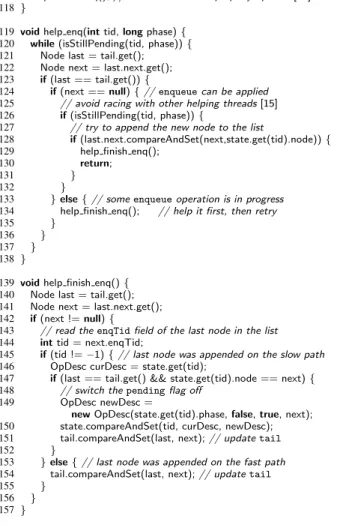
Enqueue operation Theenqueue operation run by a threadti on the slow path is given in Figure 8. It starts from writing a new operation descriptor into the entry oftiin thestatearray. The new descriptor is created with a phase number increased by 1 from the value that appears in the previous descriptor ofti. Essentially, the phase number counts the number of operations run by a thread on the slow path. Also,tiupdates theenqTidfield of the new node it tries to insert into the linked-list, with its ID (iin this example). Afterwards,ticalls thehelp enq()method.
Thehelp enq() method is executed either by a thread that tries to enqueue a new element on the slow path, or by a thread that starts a fast path and has decided to help another thread (this is the method called fromhelp if needed()). Its implementation is similar to that of the KP-queue. A thread tries to append a new node to the end of the linked-list as long as the correspondingenqueue operation remains pending, i.e., as long as it was not completed by another concurrently running and helping thread. When the thread succeeds to append the new node (by swinging thenext reference of the last node in the list to refer to the new node), it callshelp finish enq(), where it clears thependingflag in the
entry instateof the thread for which it executedhelp enq()and updatestailto refer to the newly appended node.
Dequeue operation Similarly to enqueue, thedequeue opera-tion run by threads on the slow path starts with writing a new operation descriptor into thestate array (cf. Figure 9). After-wards, the help deq() method is called. This method is also called by threads that decide to help anotherdequeueoperation inhelp if needed().
In help deq(), assuming the queue is not empty, a thread
ti tries to write its ID (or the ID of the thread that it helps in help if needed()) into the stamp inhead. Oncetisucceeds in doing so, thedequeueoperation ofti(or the thread helped byti) has been linearized. This explains why we actually needheadto be stamped. If, for instance, we used adeqTidfield in list nodes and linearize an operation on the slow path at a successful update of this field (as done in the KP-queue), a race betweendequeueoperations run on the fast and slow paths might ensue: While the operation on the fast path is linearized at the instant theheadreference is updated, the operation on the slow path would be linearized when thedeqTidfield of the first node in the queue is modified.
Following the write of thread’s ID into the stamp, ti calls help finish deq(), where thepending flag of the linearized dequeueoperation is cleared andheadis fixed to refer to the next node in the underlying linked-list.
4.2 Correctness
In the short version of our paper, we provide only the highlights of the proof that the given implementation of the concurrent queue is correct and wait-free, deferring the further details to the longer version. In particular, we review the computation model, define linearization points for queue operations, and explain why our algorithm guarantees wait-freedom.
4.2.1 Computation model
Our model of a concurrent multithreaded system follows the lin-earizability model defined in [14]. In particular, we assume that programs are run byndeterministic threads, which communicate by executing atomic operations on shared variables from some
pre-111 voidwf enq(Node node){
112 longphase = state.get(TID).phase + 1;// increase the phase counter
113 node.enqTid = TID;
114 // announceenqueue
115 state.set(TID,newOpDesc(phase,true,true, node));
116 help enq(TID, phase);// help your own operation to complete
117 help finish enq();// make suretailis properly updated[15]
118 }
119 voidhelp enq(inttid,longphase){
120 while(isStillPending(tid, phase)){
121 Node last = tail.get();
122 Node next = last.next.get();
123 if(last == tail.get()){
124 if(next ==null){//enqueuecan be applied
125 // avoid racing with other helping threads[15]
126 if(isStillPending(tid, phase)){
127 // try to append the new node to the list
128 if(last.next.compareAndSet(next,state.get(tid).node)){
129 help finish enq();
130 return;
131 }
132 }
133 }else{// someenqueueoperation is in progress
134 help finish enq(); // help it first, then retry
135 }
136 } 137 } 138 }
139 voidhelp finish enq(){
140 Node last = tail.get();
141 Node next = last.next.get();
142 if(next !=null){
143 // read theenqTidfield of the last node in the list
144 inttid = next.enqTid;
145 if(tid !=−1){// last node was appended on the slow path
146 OpDesc curDesc = state.get(tid);
147 if(last == tail.get() && state.get(tid).node == next){
148 // switch thependingflag off
149 OpDesc newDesc =
newOpDesc(state.get(tid).phase,false,true, next);
150 state.compareAndSet(tid, curDesc, newDesc);
151 tail.compareAndSet(last, next);// updatetail
152 }
153 }else{// last node was appended on the fast path
154 tail.compareAndSet(last, next);// updatetail
155 } 156 } 157 }
Figure 8. Theenqueueoperation on the slow path.
defined, finite set. Threads are run on computing cores, or proces-sors, and the decision which thread will run when and on which processor is made solely by a scheduler. Normally, the number of processors is much smaller than the number of threads. Each thread is assumed to have an ID in a range between 0 andn−1. In fact, this assumption can be easily relaxed by means of a wait-free re-naming algorithm (e.g., [1]). We also assume that each thread can access its ID and the value ofn.
When scheduled to run, a thread performs a sequence of com-putation steps. Each step is either a local comcom-putation or an atomic operation on at most one shared variable. We assume that the shared memory supports atomic reads, writes, and compare-and-swap op-erations. The latter, abbreviated as CAS, is defined with the follow-ing semantics: CAS(v,old,new) changes the value of the shared variablev tonew (and returnstrue) if and only if its value just before CAS is applied is equal toold. We refer to such CAS opera-tions assuccessful. Otherwise, the value ofvis unchanged,false
is returned, and we refer to such CAS operations as unsuccess-ful. Note that we do not require any special operations to sup-port stamped shared variables. Such variables, required by our im-plementation, can be implemented with atomic operations
men-158 intwf deq()throwsEmptyException{
159 longphase = state.get(TID).phase + 1;// increase the phase counter
160 // announcedequeue
161 state.set(TID,newOpDesc(phase,true,false,null));
162 help deq(TID, phase);// help your own operation to complete
163 help finish deq();// make sureheadis properly updated[15]
164 Node node = state.get(TID).node;// check the node recorded instate
165 if(node ==null){//dequeuewas linearized on the empty queue
166 throw newEmptyException();
167 }
168 // return the value of the first non−dummy node[15]
169 returnnode.next.get().value;
170 }
171 voidhelp deq(inttid,longphase){
172 while(isStillPending(tid, phase)){
173 Node first = head.getReference();
174 Node last = tail.get();
175 Node next = first.next.get();
176 if(first == head.getReference()){
177 if(first == last){// queue might be empty
178 if(next ==null){// queue is empty
179 OpDesc curDesc = state.get(tid);
180 if(last == tail.get() && isStillPending(tid, phase)){
181 // recordnullin thenodefield, 182 // indicating that the queue is empty
183 OpDesc newDesc =
newOpDesc(state.get(tid).phase,false,false,null);
184 state.compareAndSet(tid, curDesc, newDesc);
185 }
186 }else{// someenqueueoperation is in progress}
187 help finish enq();// help it first, then retry
188 }
189 }else{
190 OpDesc curDesc = state.get(tid);
191 Node node = curDesc.node;
192 // avoid racing with other helping threads[15]
193 if(!isStillPending(tid, phase))break;
194 if(first == head.getReference() && node != first){
195 OpDesc newDesc =
newOpDesc(state.get(tid).phase,true,false, first);
196 // try to record a reference to the first node in the list
197 if(!state.compareAndSet(tid, curDesc, newDesc)){
198 continue;
199 }
200 }
201 head.compareAndSet(first, first,−1, tid);// try to stamphead
202 help finish deq();// help thread that won the stamp to complete
203 }
204 } 205 } 206 }
207 voidhelp finish deq(){
208 Node first = head.getReference();
209 Node next = first.next.get();
210 inttid = head.getStamp();// read the stamp onhead
211 if(tid !=−1){// lastdequeuewas linearized on the slow path
212 OpDesc curDesc = state.get(tid);
213 if(first == head.getReference() && next !=null){
214 // switch thependingflag off
215 OpDesc newDesc =
newOpDesc(state.get(tid).phase,false,false, state.get(tid).node);
216 state.compareAndSet(tid, curDesc, newDesc);
217 head.compareAndSet(first, next, tid,−1);// updatehead
218 }
219 }// lastdequeuewas linearized on the fast path−nothing to do here 220 }
221 booleanisStillPending(inttid,longph){
222 returnstate.get(tid).pending && state.get(tid).phase<= ph;
223 }
tioned above either by introducing a level of indirection (this is how AtomicStampedReferencein Java is implemented) or by stealing a few bits from the value of the variable [13].
A concurrent queue is a data structure with operations lineariz-able [14] to those of a sequential queue. The latter supports two op-erations:enqueueanddequeue. The first operation accepts an el-ement as an argument and inserts it into the queue. The second op-eration does not accept any argument, and removes and returns the oldest element from the queue. If the queue is empty, thedequeue operation returns a special value (or throws an exception).
4.2.2 Linearizability
The operations of the concurrent queue presented above are com-posed of the fast and slow paths. Thus, each operation has lin-earization points on each of the two paths, where the points on the slow path can be reached only if the points on the fast path are not reached. Given an operation executed by a threadti, note that the source lines corresponding to the linearization points on the fast path can be executed only byti, while the lines corresponding to the linearization points on the slow path can be executed either bytior by any other threadtjthat tries to helptiby runninghelp enq() orhelp deq()fromhelp if needed(). In the definition below, we refer to adequeueoperation that returns a value assuccessful, while adequeuethat ends by throwing an exception is referred to asunsuccessful. Anenqueueoperation is always successful.
Definition 1. The linearization points for operations applied on the fast path are as follows:
•Anenqueue operation is linearized at the successful CAS in Line 67.
•A successfuldequeueoperation is linearized at the successful CAS in Line 101.
•An unsuccessfuldequeueoperation is linearized in Line 90. The linearization points for operations applied on the slow path are as follows:
•Anenqueue operation is linearized at the successful CAS in Line 128.
•A successfuldequeueoperation is linearized at the successful CAS in Line 201.
•An unsuccessfuldequeueoperation is linearized in Line 174.
Note that the linearization points on the fast path correspond to the linearization points of the MS-queue [20]. Similarly, the lin-earization points for operations applied on the slow path correspond to the points of the KP-queue [15]. The proof of correctness of the linearization points defined above is far beyond the scope of this short paper. Our full proof is composed of two parts. First, we show that nodes corresponding to queue elements are inserted and removed to/from the queue according to the FIFO semantics. In the second part of the proof, we show that each operation executed on the slow path is linearized exactly once.
4.2.3 Wait-freedom
We provide an overview of the proof of the wait-free progress guar-antee. This proof also has two parts. First, we show that the al-gorithm is lock-free. For this purpose, we prove that every time a thread fails to linearize an operation, either by applying an un-successful CAS or by failing to pass one of the verification con-ditions in theif-statements (e.g., in Lines 65, 66, 92, etc.), some other thread makes progress and does succeed in linearizing an op-eration. The proof is based on a straightforward inspection of code lines that modify the underlying linked-list, in a way similar to the lock-freedom proof in [20].
The second part of our proof shows that the number of steps taken by a thread before its pending operation is linearized, is
limited. The following lemma is at the heart of this part. For brevity, we refer to theHELPING DELAYandMAX FAILURESconstants byD
andF, respectively.
Lemma 1. The number of steps required for a thread to complete an operation on the queue is bounded by O(F+D·n2).
Sketch of proof: Consider a pending operation run by a threadti on the slow path. In the worst case, this operation will remain pending until all other threads in the system decide to help it to complete (in Line 52 or Line 53). A threadtjwill decide to help
tiafter it completes at most O(D·n) operations. This is because
tj might complete up toDoperations before it decides to help a thread whose ID is written intj’s helping record, andtjmight help all othern−1 threads before it gets toti. However, oncetjstarts helpingti, it will not stop helping it untiltiactually makes progress. Thus, the number of operations that might linearize before all
other threads decide to helpti is O(D·n2). Furthermore, since the algorithm is lock-free, it is guaranteed that once all threads are helpingti, the operation oftiwill be completed in a constant number of steps.
Now consider the threadtiwhen it starts its operation on the queue on the fast path. It may realize inhelp if needed()that it needs to help another threadtkbefore attempting to execute its own operation. Following similar arguments, the number of operations that might linearize beforetireturns fromhelp if needed()is bounded by O(D·n2). Afterwards,ti makes several attempts to linearize its operation on the fast path. Given that the algorithm is lock-free, it might fail if during its attempts other operations succeed to linearize. As the number of such attempts is limited by MAX FAILURES, after at mostO(F)stepstiwill switch into the slow path, and by the above argument will complete its operation in at mostO(D·n2)steps. Thus, after at mostO(F+D·n2)steps in total,
tiwill complete its operation.
4.3 Performance
In our performance study, we compare our fast wait-free queue with the lock-free MS-queue and the wait-free KP-queue. For the MS-queue, we use the Java implementation given in [13]. The KP-queue has several versions presented in [15]; for our study, we use the optimized one. We employ several versions of the fast wait-free queue, each configured with differentMAX FAILURESand HELPING DELAYparameters. We denote by WF(x,y) the version withMAX FAILURESset toxandHELPING DELAYset toy.
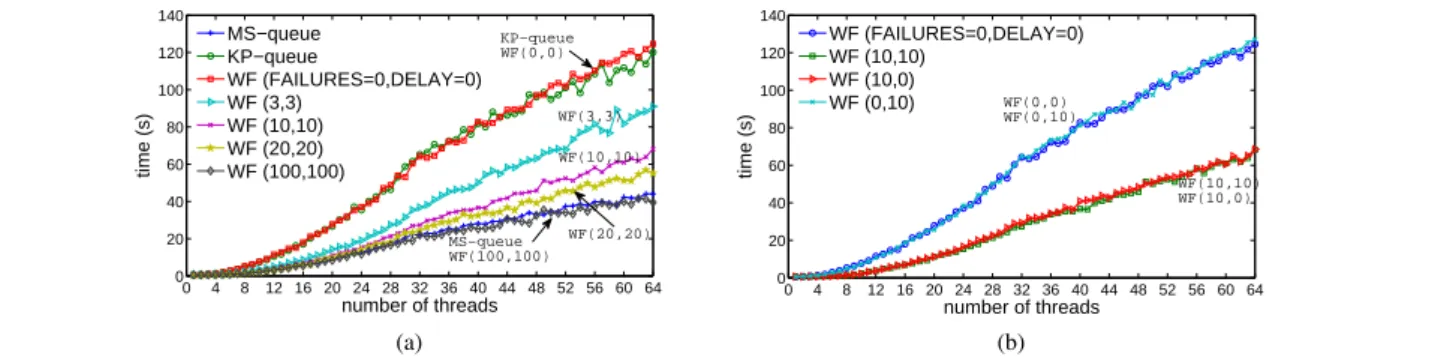
The study was carried out on a machine featuring a shared-memory NUMA server with 8 quadcore AMD 2.3GHz processors (32 physical cores in total), operating under Ubuntu 10.10 and in-stalled with 16GB RAM attached to each processor. All tests were run in OpenJDK Runtime version 1.6.0 update 20, using the 64-Bit Server VM, with -Xmx16G -Xms16G flags. In our tests, we varied the number of threads between 1 and 64. Starting with an empty queue, we performed two common queue benchmarks [15, 16, 20]. First, we ran theenqueue-dequeuebenchmark, where each thread performs numerous (100000, in our case) iterations of anenqueue operation followed by adequeue operation. Second, we ran the 50%-enqueue benchmark, where on each iteration every thread randomly chooses which operation to perform with equal chances toenqueueanddequeue(with 100000 iterations per thread). Note that the queue in both benchmarks remains short or even empty, maximizing the contention between threads performingenqueue anddequeue. To mimic local computations performed by threads after accessing the queue, we inserted a small and random delay af-ter each operation on the queue [16, 20]. The delay was achieved by running some simple calculation in a loop with a randomly chosen number of iterations [16]. We note that the results in tests without local computations were qualitatively the same.
0 4 8 12 16 20 24 28 32 36 40 44 48 52 56 60 64 0 20 40 60 80 100 120 140 number of threads time (s) MS−queue KP−queue WF (FAILURES=0,DELAY=0) WF (3,3) WF (10,10) WF (20,20) WF (100,100) WF(3,3) WF(10,10) MS−queue WF(100,100) WF(20,20) KP−queue WF(0,0) (a) 0 4 8 12 16 20 24 28 32 36 40 44 48 52 56 60 64 0 20 40 60 80 100 120 140 number of threads time (s) WF (FAILURES=0,DELAY=0) WF (10,10) WF (10,0) WF (0,10) WF(0,0) WF(0,10) WF(10,10) WF(10,0) (b)
Figure 10. Total completion time for various queues and theenqueue-dequeuebenchmark.
0 4 8 12 16 20 24 28 32 36 40 44 48 52 56 60 64 0 10 20 30 40 50 60 70 number of threads time (s) MS−queue KP−queue WF (FAILURES=0,DELAY=0) WF (3,3) WF (10,10) WF (20,20) WF (100,100) MS−queue WF(100,100) KP−queue WF(0,0) WF(10,10) WF(3,3) WF(20,20)
Figure 11. Total completion time for various queues and the 50%-enqueuebenchmark. 0 4 8 12 16 20 24 28 32 36 40 44 48 52 56 60 64 0 5 10 15 20 25 30 35 40 number of threads % operations WF (0,0) WF (3,0) WF (10,0) WF (0,3) WF (0,10)
Figure 12. Percentage of operations that help other operations (enqueue-dequeuebenchmark).
We report the total completion time for each of the tested queues, as well as some interesting statistics on the number of operations that actually use the slow path and those that actually decide to help. Each reported point is an average of ten experiments run with the same parameters. We note that the standard deviation (not shown for the sake of readability) for the total completion time figures was up to 15%, with the majority of results having devi-ation around 8% and below. (In our tests on other machines with fewer cores, the standard deviation was smaller than that). Other results, concerning the statistics of the executions, were much nois-ier, as they depended on the actual execution interleaving created by the system scheduler. Nonetheless, every reported performance phenomenon was reproduced in several repeated runs of our bench-marks.
Figure 10 summarizes the total completion time numbers for various queue implementations and theenqueue-dequeue bench-mark. In particular, Figure 10a shows that the WF(0,0) version
exhibits performance very close to that of the KP-queue, while both queues perform roughly 3 times worse than the MS-queue. This happens since all operations in WF(0,0) use only the slow path, which is far less efficient then the MS-queue. Increasing the MAX FAILURESandHELPING DELAYparameters reduces the num-ber of operations that require the slow path. In fact, when both pa-rameters are set to 100, the fast wait-free queue steadily achieves performance similar to that of the MS-queue. Consequently, these results demonstrate that our wait-free design can achieve the per-formance and scalability of a lock-free algorithm.
Our other experiments (as shown in Figure 10b) suggest that giving threads the chance to complete their operation on the fast path (i.e., increasing the number of trials) is highly effective (e.g., the performance of WF(10,0) is similar to WF(10,10)). On the other hand, reducing their helping work (by increasing the delay in making an attempt to help other threads) does not change the performance significantly (e.g., the performance of WF(0,10) is similar to WF(0,0)). Note that even when a threadtiprovides help on each operation (i.e., whenHELPING DELAY=0), it only helps another threadtj that did not make progress since ti’s previous operation. As shown below, this small delay already ensures that the amount of work put into the helping effort is limited.
Figure 11 shows the performance results for the 50%-enqueue benchmark. In general, all queue implementations exhibit similar behavior as in theenqueue-dequeue benchmarks, but the total completion time numbers are 2 time smaller. This is because in the 50%-enqueue benchmark, each thread performs half of the operations of the first benchmark. We note that all measured queues produced similar relative behavior in both benchmarks. Thus, due to lack of space, we will focus only on the enqueue-dequeue benchmark for the rest of this section.
Figure 12 shows the percentage of queue operations that de-cide to help other operations in thehelp if needed()method. Here, increasing theMAX FAILURESparameter decreases the num-ber of times threads help other operations to complete. As we will see below, this is a side-effect of the fact that, with a higher MAX FAILURESparameter, fewer operations enter the slow path and request help. At the same time, increasing theHELPING DELAY pa-rameter has a much greater effect even though all operations hav-ingMAX FAILURESset to 0 enter the slow path. This shows that the delayed helping can potentially reduce the amount of redundant work created by threads helping each other. It is interesting also to note that the percentage of helping operations for all queues in-creases until the number of threads reaches the number of available cores (32) and then slightly, but continuously decreases. The first phenomenon is explained by increased contention, i.e., more op-erations are repeatedly delayed due to contention and thus helped by others. When the number of threads goes beyond the number
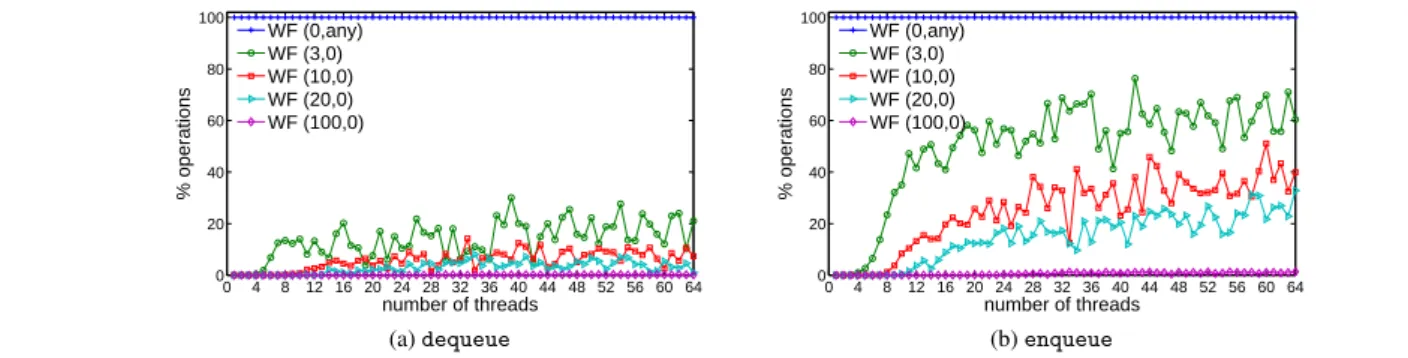
0 4 8 12 16 20 24 28 32 36 40 44 48 52 56 60 64 0 20 40 60 80 100 number of threads % operations WF (0,any) WF (3,0) WF (10,0) WF (20,0) WF (100,0) (a)dequeue 0 4 8 12 16 20 24 28 32 36 40 44 48 52 56 60 64 0 20 40 60 80 100 number of threads % operations WF (0,any) WF (3,0) WF (10,0) WF (20,0) WF (100,0) (b)enqueue
Figure 13. Percentage ofenqueue(a) anddequeue(b) operations completing on the slow path (enqueue-dequeuebenchmark).
of cores, at every moment of execution some threads are switched off. Attempts to help them either return immediately because these threads have no active pending operations, or require one help op-eration. Once this help is done, no further help operations are exe-cuted until the thread regains execution. Thus, a smaller percentage of the total number of operations actually help other operations.
Finally, Figures 13a and 13b show the percentage ofdequeue andenqueueoperations that enter the slow path, respectively. For the former, 3 trials are almost always sufficient to ensure that only 20–30% of the operations complete on the slow path. At the same time, for the latter, in order to avoid many operations from enter-ing the slow path, a higher value ofMAX FAILURESis required. This might be becausedequeue is more efficient, requiring just one CAS. Thus, the chances are greater that adequeueoperation running on the fast path will complete with just a few trials. Note that for both operations, settingMAX FAILURESto 100 almost elim-inates the use of the slow path. Essentially, this number depends on the maximal contention level in the system. (In our tests on other machines with fewer cores, not reported here due to space limits, this number was significantly lower).
Given these results, one may ask why not just always use large values for both parameters so that the slow path will not be used? The proof sketch of the wait-freedom property in Section 4.2 shows that these parameters govern the bound on the worst-case time re-quired to complete each operation on the queue. Thus, they control the tradeoff between the practical performance and the theoretical bound on the worst-case completion time of each operation.
4.4 Memory management
The implementation of our queue is provided in Java, a garbage-collected language, which simplifies the memory management and avoids problems related to it, such as the ABA problem [13]. We have also implemented our queue in C using the Hazard Pointers technique [19] for memory management. Although only minor modifications to the algorithm are required, their precise details are beyond the scope of this short paper.
5.
Summary
We presented the fast-path-slow-path methodology for creating fast and scalable wait-free data structures. The key feature in this methodology is designing each operation as a combination of the fast path and the slow path. Good performance is achieved when the fast path is extensively utilized and due to the fact that con-current operations can proceed on both paths in parallel. Our mea-surements show that most operations can complete without facing too many failed attempts, even in a highly concurrent environment. Thus, operations almost always complete using the fast path only, and the execution is fast. The application of our methodology is
demonstrated in this paper by constructing a new wait-free queue. The performance evaluation of the obtained queue shows that it can be as fast as the efficient lock-free queue of Michael and Scott [20]. Subsequent work [23] utilizes our methodology to improve the per-formance of a wait-free linked-list.
Acknowledgments
We thank Idit Keidar and Dmitri Perelman for letting us use their multi-core machine for the experiments reported above. Also, we thank the anonymous reviewers for their valuable comments.
References
[1] Y. Afek and M. Merritt. Fast, wait-free (2k-1)-renaming. InACM Symp. on Principles of Distr. Comp. (PODC), pages 105–112, 1999. [2] J. H. Anderson and Y.-J. Kim. A new fast-path mechanism for mutual
exclusion.Distrib. Comput., 14:17–29, 2001.
[3] P. Chuong, F. Ellen, and V. Ramachandran. A universal construction for wait-free transaction friendly data structures. InProc. ACM Sym-posium on Parallel Algorithms (SPAA), pages 335–344, 2010. [4] F. Ellen, P. Fatourou, E. Ruppert, and F. van Breugel. Non-blocking
binary search trees. InProc. ACM PODC, pages 131–140, 2010. [5] P. Fatourou and N. D. Kallimanis. A highly-efficient wait-free
uni-versal construction. InProc. ACM Symposium on Parallel Algorithms (SPAA), pages 325–334, 2011.
[6] F. E. Fich, V. Luchangco, M. Moir, and N. Shavit. Obstruction-free algorithms can be practically wait-free. InProc. Int. Conference on Distributed Computing (DISC), pages 78–92, 2005.
[7] T. L. Harris. A pragmatic implementation of non-blocking linked-lists. InProc. Int. Conference on Distributed Computing (DISC), pages 300–314, 2001.
[8] D. Hendler, I. Incze, N. Shavit, and M. Tzafrir. Flat combining and the synchronization-parallelism tradeoff. InProc. ACM Symposium on Parallel Algorithms (SPAA), pages 355–364, 2010.
[9] D. Hendler, N. Shavit, and L. Yerushalmi. A scalable lock-free stack algorithm.J. Parallel Distrib. Comput., 70(1):1–12, 2010.
[10] M. Herlihy. Wait-free synchronization.ACM Trans. Program. Lang. Syst., 13(1):124–149, 1991.
[11] M. Herlihy. A methodology for implementing highly concurrent objects.ACM Trans. Program. Lang. Syst., 15(5):745–770, 1993. [12] M. Herlihy, V. Luchangco, and M. Moir. Obstruction-free
synchro-nization: Double-ended queues as an example. InProc. Conf. on Dis-tributed Computing Systems (ICDCS), pages 522–529, 2003. [13] M. Herlihy and N. Shavit. The Art of Multiprocessor Programming.
Morgan Kaufmann, 2008.
[14] M. Herlihy and J. M. Wing. Linearizability: A correctness condition for concurrent objects.ACM Trans. Program. Lang. Syst., 12(3):463– 492, 1990.
[15] A. Kogan and E. Petrank. Wait-free queues with multiple enqueuers and dequeuers. InProc. ACM Symposium on Principles and Practice of Parallel Programming (PPOPP), pages 223–234, 2011.
[16] E. Ladan-Mozes and N. Shavit. An optimistic approach to lock-free fifo queues.Distributed Computing, 20(5):323–341, 2008.
[17] L. Lamport. A fast mutual exclusion algorithm.ACM Trans. Comput. Syst., 5:1–11, 1987.
[18] Y. Levanoni and E. Petrank. An on-the-fly reference-counting garbage collector for java.ACM TOPLAS, 28(1):1–69, 2006.
[19] M. M. Michael. Hazard pointers: Safe memory reclamation for lock-free objects.IEEE Trans. Parallel Distrib. Syst., 15(6):491–504, 2004. [20] M. M. Michael and M. L. Scott. Simple, fast, and practical non-blocking and non-blocking concurrent queue algorithms. InProc. ACM Symp. on Principles of Distr. Comp. (PODC), pages 267–275, 1996. [21] M. Moir. Transparent support for wait-free transactions. InProc. Conf.
on Distributed Computing (DISC), 1998.
[22] M. Moir, D. Nussbaum, O. Shalev, and N. Shavit. Using elimination to implement scalable and lock-free FIFO queues. InProc. ACM SPAA, pages 253–262, 2005.
[23] S. Timnat, A. Braginsky, A. Kogan, and E. Petrank. Poster paper: Wait-free linked-lists. To appear inProc. ACM Symposium on Princi-ples and Practice of Parallel Programming (PPOPP), 2012. [24] K. R. Treiber. Systems programming: Coping with parallelism.
Tech-nical report RJ-5118, IBM Almaden Research Center, 1986. [25] P. Tsigas and Y. Zhang. A simple, fast and scalable non-blocking
concurrent FIFO queue for shared memory multiprocessor systems. InProc. ACM SPAA, pages 134–143, 2001.
[26] J.-H. Yang and J. H. Anderson. A fast, scalable mutual exclusion algorithm.Distributed Computing, 9:1–9, 1994.
[27] P.-C. Yew, N.-F. Tzeng, and D. H. Lawrie. Distributing hot-spot addressing in large-scale multiprocessors. IEEE Trans. Comput., 36:388–395, 1987.
A.
Building blocks
In our work we show a design methodology, which, when applied on a lock-free and a wait-free version of a data structure, can derive a new wait-free algorithm that will be as fast and scalable as the given lock-free algorithm. In this paper, the application of this methodology is exemplified by a construction of a new and fast wait-free queue algorithm. In order to provide the required background for understanding the design of this construction, we briefly review the principle ideas behind the lock-free queue by Michael and Scott [20] and the recent wait-free queue by Kogan and Petrank [15]. These two queues are referred to in the paper as the MS-queue and the KP-queue respectively, and serve as a basis for our new wait-free queue construction.
A.1 The lock-free MS-queue
The MS-queue [20] utilizes an internal singly-linked list of nodes, which keeps elements of the queue. The algorithm maintains two references to the head and tail of the list with corresponding names: headandtail. In order to enqueue a new element, a thread creates a new node with this element and verifies thattailindeed refers the last node of the list (i.e., a node with thenextreference set to null). If not, the thread fixestailfirst. Otherwise, the thread tries to swing thenextreference of that last node to refer to the new node (using a CAS operation). If it succeeds, the thread fixes tailto refer to the new node (using another CAS). Otherwise, it realizes that some concurrently running thread has changed the list, and restarts the operation.
Thedequeueoperation is even simpler. A thread reads the value of the first node in the list and tries to swing head to refer to the second node in the list (using CAS). If it succeeds, the thread
returns the value it has read; otherwise, it restarts the operation. Special care is given to the case of an empty queue: If a thread finds bothheadandtailreferencing the same node and there is noenqueuein progress (i.e., thenextreference of that node is null), an exception is thrown (or some other action is taken, such as returning a special⊥value). Ifhead andtail reference the same node, but thenextreference of that node is notnull, the dequeuing thread realizes that there is someenqueuein progress. Thus, it first helps thisenqueueto complete (by fixingtail) and then reattempts itsdequeueoperation.
A.2 The wait-free KP-queue
The KP-queue [15] extends the ideas of the MS-queue in two main directions. First, to guarantee wait-free progress, the KP-queue utilizes a dynamic priority-based helping mechanism where younger threads (having lower logical priority) help older threads to apply their operations. The mechanism is implemented by means of (1) an auxiliarystatearray, in which each thread writes details on its current operation, and (2) phase numbers chosen by threads in monotonically increasing order before they try to apply their operations on the queue. Thus, when a threadtiwants to apply an operation on the queue, it chooses a phase number that is higher than phases of threads that have previously chosen phase numbers for their operations. Thentihelps all threads with the phase number smaller than or equal toti’s phase (including itself) to apply their pending operations. It learns about pending operations from the statearray.
Second, to ensure correctness, and in particular, to avoid ap-plying the same operation more than once, the authors propose a three-step scheme used to design each of the two queue opera-tions,enqueueanddequeue. This scheme requires two new fields, enqTidanddeqTid, to be added to each node in the underlying linked-list. These fields hold the ID of a thread that tries to insert (or remove) a node to (from, respectively) the list. They are used by other concurrently running threads to identify the thread that is in the middle of an operation on the queue, and help it to complete its operation in progress.
In more detail, in order to enqueue a new element, a threadti creates a new node with theenqTidfield set toi. Then it writes a reference to this node along with the chosen phase number into the statearray. Afterwards,ti proceeds by helping all threads with a phase smaller than or equal toti’s phase. When it reaches its own operation, and provided its own operation was not completed yet by another concurrently running and helping thread,titries to put its new element at the end of the underlying list (using CAS). If it succeeds,timarks its operation as linearized (i.e., clears the pendingflag) instate(using another CAS) and attempts to fix thetailreference (using a third CAS). Iftifinds a node X behind the node referred bytail, it reads theenqTidfield stored in X, marks the operation of the corresponding thread as having been linearized, and only then fixes thetailreference and tries again to insert its own node.
In order to dequeue an element from the queue, a thread tj passes through the following four stages (after writing a new phase instateand helping other threads, if necessary, and provided the queue is not empty): (1) stores a reference to the first node of the list in its entry instate; (2) tries to write its ID, j, into the deqTidfield of the first node in the list; (3) if successful, marks its operation as linearized in its entry instate, and (4) swings the headreference to the next element in the list. Each of the stages corresponds to a CAS operation. Similarly toenqueue, iftjfails in Stage (2), it reads thedeqTidfield stored in the first node of the list, marks the operation of the corresponding thread as linearized, fixes theheadreference and tries again to remove another node from the list.