2.1 Degree-granting Authority
The institution has degree-granting authority from the appropriate government agency or agencies.
Judgment of Compliance
In Compliance
Narrative of Compliance
The State Council of Higher Education for Virginia (SCHEV) certifies Marymount University to offer degrees, courses for degree credit, or programs of study leading to a degree in the
Commonwealth of Virginia. On June 10, 2004, a letter from SCHEV excluded Marymount University, its branch campuses, and learning sites from annual certification, in accordance with the following requirements for exemption:
Institutions of higher education shall not be required to obtain another authorization from the Council to operate in Virginia if they (i) were formed, chartered or established in this Commonwealth, or chartered by an Act of Congress; (ii) have maintained a main or branch campus continually in the Commonwealth for at least 10 calendar years under their current ownership; (iii) were continuously approved or authorized to confer or grant academic or professional degrees by the Council, by the Board of Education or by an act of the General Assembly during those 10 years; and (iv) are fully accredited by an
accrediting agency that is recognized by, and has met criteria for Title IV eligibility of the United States Department of Education. If authorization to confer or grant academic or professional degrees is revoked, the institution must seek reauthorization and must do so annually until it meets the criteria of the subsection.
In 2004 the Maryland Higher Education Commission (MHEC) approved the post-baccalaureate certificate in Leading and Managing Change at the Bolger Center in Potomac, Maryland, which was also approved by SACS-COC. Marymount currently offers the M.S. in Health Care
Management at Holy Cross Hospital in Silver Spring, Maryland and the M. Ed. at Our Lady of Mercy School in Potomac, Maryland, both of which were approved by MHEC and SACS-COC (M.S. in Health Care Management letter, M. Ed. Letter).
Supporting Documents
SCHEV letter and Certificate to Operate October 9, 2003 SCHEV letter June 10, 2004
Letter from Maryland Higher Education Commission, October 8, 2004 Letter from SACS-COC November 25, 2002
Letter from Maryland Higher Education Commission, September 14, 2006 Letter from Maryland Higher Education Commission, May 11, 2007 Letter from SACS-COC October 2, 2006
2.2 Governing Board
The institution has a governing board of at least five members that is the legal body with specific authority over the institution. The board is an active policy-making body for the institution and is ultimately responsible for ensuring that the financial resources of the institution are adequate to provide a sound educational program. The board is not controlled by a minority of board members or by organizations or interests separate from it. Both the presiding officer of the board and a majority of other voting members of the board are free of any contractual, employment, or personal or familial financial interest in the institution.
Judgment of Compliance
In Compliance
Narrative of Compliance
The Marymount University governing board currently consists of 29 individuals. As a group, the Board is diverse in its composition: 16 are men; three are alumni; five are members of the
Religious of the Sacred Heart of Mary (RSHM); six are attorneys; six are educators; and several hold executive positions in major corporations. A roster of members of the Board is provided in Table 2.2A. The Board of Trustees Bylaws states that “The Board of Trustees shall maintain the University as a Catholic University and shall have control and management of the affairs and business of the University.” The University’s organizational chart clearly shows that the president reports to the Board. The Board is responsible for evaluating the president's performance.
The Bylaws of the Board of Trustees state that the Board must consist of not fewer than 15 nor more than 35 members and a minimum of five of them must be members of the Religious of the Sacred Heart of Mary. “Representation” is also sought “from alumni as well as from other walks of life.” [Board of Trustees Bylaws, Article I Section 1] The president of the University is a member of the Board. The chairman of the Board and other officers of the Board are elected by the members from among the membership “for a one-year term or until their successors shall be duly elected and qualified.” [Board of Trustees Bylaws, Article II Section 1]
The Board meets at least three times per year. [Board of Trustees Bylaws, Article I Section 6] Records of minutes are available for 2004 (February 18, May 19, September 22, December 15); 2005 (May 18, September 21, December 7); 2006 (February 15, May 24, September 20,
December 6); and 2007 (March 14).
Committees of the Board of Trustees are: the Executive Committee; Finance and Investment Committee; Nominating Committee; Academic Affairs Committee; Campus Facilities Committee; Enrollment and Student Services Committee; Audit Committee; Committee on Mission and Ministry; and Development Committee.
The Bylaws of the Board of Trustees delegate specific oversight for the fiscal stability of the University to two standing committees, the Finance and Investment Committee and the Audit Committee. The purpose of the Finance and Investment Committee is to “investigate and report
to the full Board of Trustees, or the Executive Committee of the Board of Trustees, its findings and recommendations concerning the finances of the University, including charges for tuition, room and board, other services and materials, other sources of income, budgets, accounting, short-term and long-term investment of funds, and such other matters as may be delegated to it by resolution of the Board of Trustees.” [Bylaws Article IV Section 2] The Audit Committee of the Board of Trustees provides oversight relating to the “quality and integrity of the University’s financial reporting processes and accounting practices; the adequacy and effectiveness of its systems of internal control over financial reporting, accounting and compliance with laws and regulations pertaining to financial reporting; and the performance, qualifications and
independence of the University’s external auditors.” [Charter of the Audit Committee appended to the Bylaws] Among its oversight responsibilities is the duty to review the University’s significant financial risk exposures, and review and approve the selection, retention,
compensation, and evaluation of the University’s external auditors. Evidence of the Board’s oversight of the University’s financial stability can be found in Board of Trustees minutes. [February 18, 2004; February 16, 2005; May 24, 2006; September 20, 2006; and December 6, 2006]
The Board of Trustees also demonstrates its concern with University mission. The most recent review of the University’s mission statement was initiated by the president at a meeting of the Committee on Mission and Ministry of the Board of Trustees (December 14, 2004). The
committee addressed the wording of the current mission statement and possible ways to improve or update it at an April 27, 2005 meeting. In January 2006 the University Strategic Planning Committee, chaired by the president and comprised of representatives of the administration and faculty, discussed the need to revise the University’s mission statement to reflect “intellectual and moral development with academics as its primary focus.” A task force of the committee was established at its April 24, 2006 meeting, and this initiative was reported to the Board on May 24. The task force worked through the summer and presented a draft mission statement to the Strategic Planning Committee in the fall (October 3, 2006). Following several revisions, the proposed mission statement was circulated to the University community, and the Strategic Planning Committee endorsed the new mission statement at its January 18, 2007 meeting. The Board of Trustees approved the mission statement on March 14, 2007.
The Board reviews the performance of the University president. At its meeting on December 15, 2004 the Board of Trustees in an executive session approved the formation of a committee to review, on an annual basis, the performance of the president and certain senior officers of the University. This committee is composed of the Board chairman, any past chairmen who are current trustees, and an additional trustee. The Committee reviews and approves the president's recommendations for vice presidents' salaries and makes a recommendation for the president's salary.
The Board is engaged in reviewing University policies. For example, the Board requested in 2004 that policies on the awarding of tenure be reviewed. [Board of Trustees Minutes February 18, 2004] Regular reports on the progress of these revisions were made to the Board. [Board of Trustees Minutes February 16, 2005; May 24, 2006] After the faculty discussed and approved the transition from a level III to a level V (doctoral) institution, the Board considered and
approved this on May 14, 2003. The Board recently approved revised Employee and Faculty Handbooks. [Board of Trustees Minutes March 14, 2007; May 2007 Minutes not yet available] None of the members of the Board have contractual, employment, or personal or familial financial interest in the institution. The Board is not controlled by a minority of Board members or by organizations or interests separate from it. Board members are obligated to “maintain the University as a Catholic University” while in all cases acting as a board with no outside
interference. [Board of Trustees Bylaws Article I section 5]
The Board of Trustees has a detailed Conflict of Interest Policy that addresses the definitions and reporting of conflicts, and the procedures for addressing unresolved conflict questions. Each Board member receives a copy of the Policy and is required to acknowledge its receipt and agree to be bound by its disclosure provisions and its contents. [Conflict of Interest Agreement Form] The Conflict of Interest Policy is further discussed in section 3.2.3 of this report.
Supporting Documents Table 2.2A
Board of Trustees Bylaws
Organizational Chart (Complete University Organizational Chart) Board of Trustees Executive Session Minutes, 2004 December 15 Board of Trustees Bylaws, Article I Section 1
Board of Trustees Bylaws, Article II Section1 Board of Trustees Bylaws, Article I Section 6 Board of Trustees Minutes 2004 February 18 Board of Trustees Minutes 2004 May 19 Board of Trustees Minutes 2004 September 22 Board of Trustees Minutes 2004 December 15 Board of Trustees Minutes 2005 May 18 Board of Trustees Minutes 2005 September 21 Board of Trustees Minutes 2005 December 7 Board of Trustees Minutes 2006 February 15 Board of Trustees Minutes 2006 May 24 Board of Trustees Minutes 2006 September 20 Board of Trustees Minutes 2006 December 6 Board of Trustees Minutes 2007 March 14 Board of Trustees Bylaws, Article IV Section 2
Charter of the Audit Committee appended to the Bylaws Board of Trustees Minutes 2004 February 18
Board of Trustees Minutes 2005 February 16 Board of Trustees Minutes 2006 May 24 Board of Trustees Minutes 2006 September 20 Board of Trustees Minutes 2006 December 6
Board of Trustees Committee on Mission & Ministry Minutes December 14, 2004 Board of Trustees Committee on Mission & Ministry Minutes April 27, 2005
University Strategic Planning Committee Minutes January 31, 2006 University Strategic Planning Committee Minutes April 24, 2006 Board of Trustees Minutes 2006 May 24
University Strategic Planning Committee Minutes October 3, 2006 University Strategic Planning Committee Minutes January 18, 2007 Board of Trustees Minutes 2007 March 14
Board of Trustees Executive session minutes December 15, 2004 Board of Trustees Minutes 2004 February 18
Board of Trustees Minutes 2005 February 16 Board of Trustees Minutes 2006 May 24 Board of Trustees Minutes 2003 May 14 Board of Trustees Minutes 2007 March 14 Board of Trustees Bylaws, Article I Section 5 Board of Trustees Conflict of Interest Policy
Board of Trustees conflict of interest agreement form Link to section 3.2.3
2.3 Chief Executive Officer
The institution has a chief executive officer whose primary responsibility is to the institution and who is not the presiding officer of the board.
Judgment of Compliance
In Compliance
Narrative of Compliance
The president of the University, Dr. James E. Bundschuh, is directly responsible to the Board of Trustees for the control and management of the property, business, and activities of the
institution. His role, defined in the Board of Trustees Bylaws, includes without limitation the execution of policies and directives of the Board and the general supervision of “instructional affairs, student services, financial affairs, long range planning, financial development, state and local community relations, and control over all property activities, expenditures and personnel of the University, subject to the direction and control of the Board.”
Dr. Bundschuh has been president since 2001. Following the retirement of Sr. Eymard
Gallagher, RSHM, at the end of the 2000-01 academic year, the Board of Trustees authorized a national search conducted by a comprehensive search committee with membership representing administration, faculty, staff, and students. Nominees recommended by the search committee were interviewed by the Board of Trustees, which elected Dr. Bundschuh as president-elect on February 24, 2001. Dr. Bundschuh joined Marymount as president on July 1, 2001.
Dr. Bundschuh was formerly vice president for Academic Affairs at Xavier University. Since coming to Marymount University he has actively participated in community organizations. He serves on the Washington Board of Trade as well as boards of the Arlington and Fairfax
Chambers of Commerce. He is on the boards of the Council of Independent Colleges in Virginia, the Virginia Foundation for Independent Colleges, and the Washington Research Library
Consortium. He serves on the Commission on Institutional Effectiveness of the American Council on Education. He is also chairman of the Academic Affairs Committee of the Board of Regents of Seton Hall University.
The presiding officer of the Board of Trustees is Mr. Barry J. Fitzpatrick. The president is a member but not the chairman of the Board.
Supporting Documents
2.4 Institutional Mission
The institution has a clearly defined, comprehensive, and published mission statement that is specific to the institution and appropriate for higher education. The mission addresses teaching and learning and, where applicable, research and public service.
Judgment of Compliance
In Compliance
Narrative of Compliance
The Marymount University mission statement is as follows:
“Marymount University is an independent Catholic university that emphasizes academic excellence at the undergraduate and graduate levels. Committed to the liberal arts tradition, the University combines a foundation in the arts and sciences with career preparation and
opportunities for personal and professional development. Marymount is a student-centered learning community that values diversity and focuses on the education of the whole person, promoting the intellectual, spiritual, and moral growth of each individual. Scholarship, leadership, service, and ethics are hallmarks of a Marymount education.”
In each historical phase of its development, the University has reviewed and revised its mission statement to adapt it to a changing institutional character – from a two-year college for women to a comprehensive, coeducational, doctoral-granting university. The most recent review of the mission statement was initiated in 2004 by the president; carried out by a task force of the University Strategic Planning Committee made up of faculty, staff, and administrators; and approved by the Board of Trustees on March 14, 2007. In its most recent adaptation, the University mission statement includes a focus on research and public service in addition to its central focus on teaching and learning.
The mission statement is published in the Graduate and Undergraduate Catalogs, Student Handbook, Employee Handbook, Faculty Handbook, and on the University's Web site.
The University's guiding vision is to "achieve distinction as a comprehensive Catholic university, known nationally for excellence in undergraduate education and regionally for excellence in graduate and non-traditional offerings. Through its curriculum, student life, and special
programs, Marymount University will maintain a pervasive emphasis on ethics, consonant with the University's mission to prepare students intellectually and morally for success within their professions and communities." Flowing from this vision are seven critical success factors that are described as “stepping stones to a future of unprecedented excellence and distinction.” They are academic excellence, Catholic identity, enrollment and retention, student life, facilities master plan, institutional advancement, and financial and operational management. These success factors define the distinctiveness of Marymount University.
Supporting Documents
Mission Statement, Marymount University 2007-2008 Undergraduate Catalog Mission Statement, Marymount University 2007-2008 Graduate Catalog Board of Trustees Minutes 2007, March 14
2007-08 Student Handbook, p. 1 2007-08 Employee Handbook, p. 1
Faculty Handbook, University Organization and Governance Page Link to mission statement on University Web site
2.5 Institutional Effectiveness
The institution engages in ongoing, integrated, and institution-wide research-based planning and evaluation processes that (1) incorporate a systematic review of institutional mission, goals, and outcomes; (2) result in continuing improvement in institutional quality; and (3) demonstrate that the institution is effectively accomplishing its mission.
Judgment of Compliance
In Compliance
Narrative of Compliance
Since the last SACS reaffirmation, Marymount has made a substantial change in its assessment activities to strengthen participation and increase the linkages to planning. Prior to 2004-05, all academic and administrative departments submitted assessment plans and reports to the Office of Institutional Effectiveness (formerly Institutional Research and Assessment) (See Institutional Assessment Reports 2001-02, 2002-03, 2003-04). Beginning in 2004, Marymount initiated a process of three separate formal assessment activities that evaluate student learning, examine academic programs, and analyze administrative effectiveness.
Formal Assessment Processes
All of the assessments processes include an analysis of outcomes, review of data, and recommendations for improvement. They are
• Student Learning Assessment. An annual outcomes-based assessment of student learning at the program level. Programs identify at least three program-specific learning outcomes and measure student mastery. See Student Learning Assessment Reports: 2004-05; 2005-06; 2006-07 plans.
• Program Review. A comprehensive five-year evaluation by academic programs in which they review their effectiveness relative to a series of qualitative and quantitative
considerations [Program Review Considerations]. In 2005 the Program Review process was strengthened to give participating programs greater focus and direction in the process. See Program Reviews 2004-2007.
• Administrative Assessment Reports. An annual division-wide assessment activity in which the five administrative divisions (Academic Affairs, Development, Enrollment and Student Services, Financial Affairs, and University Communications) and the Library and Learning Services identify and assess broad goals and strategic and operational
outcomes. Although Library and Learning Services is organizationally a school, reporting to the vice president for Academic Affairs and provost, it uses the
administrative assessment process because of its service orientation. (See Divisional Assessment Reports: 2005-06; 2006-07 preliminary).
Formal assessment processes are timed to align with the University’s budgeting cycle. The 2006-07 assessment and budgeting calendar in Table 2.5A illustrates due dates for the assessment process, annual survey reports, and budgeting calendar.
Institutional Support for Assessment
There are two organizational bodies that support and promote assessment at Marymount: The Office of Institutional Effectiveness and the University Assessment Committee (UAC). The Office of Institutional Effectiveness supports assessment activity by coordinating the University processes, providing administrative and institutional data (Fact Book and Data Tracking Report), and conducting institutional surveys and reporting their results (2006 Alumni Survey Report, 2006 Graduating Student Survey Report, 2006 Student Satisfaction Survey Report, 2004 National Survey of Student Engagement Report, 2004 Faculty Survey of Student Engagement Report). Institutional Effectiveness data are used to support formal assessment activities and are also used by offices and committees, such as the University Committee on Student Retention, to examine specific issues. In addition, the Office of Institutional
Effectiveness provides methodological and technical expertise to faculty and staff conducting assessment and evaluation (see Table of Contents for Survey Binder). The Office, which reports to the vice president for Academic Affairs and provost, is well supported with professional staff. [AA Non-Instructional Organizational Chart] The executive director oversees a $270,000 budget. The University Assessment Committee (UAC), proposed by the president in 2004 and endorsed by Faculty Council in January 2005, helps shape the University’s assessment activity and reviews all assessment reports to verify appropriateness of analysis. The UAC was created to assure that assessment activity and results are appropriately used in institutional planning; it does this through its annual Report to the President highlighting assessment recommendations. The UAC is chaired by the vice president for Academic Affairs and provost and has faculty and administrative membership. The executive director for institutional assessment and the senior assessment associate serve as ex officio members. [2006-07 UAC Roster]
Institutional Assessment, Planning, and Budgeting
Marymount evaluates its effectiveness through assessment of its strategic plan, which is derived from the University mission. The University’s Strategic Planning Committee (SPC) oversees the drafting and evaluation of the University’s Strategic Plan, A Future of Excellence and
Distinction, endorsed by the Board of Trustees. Most recently, in winter 2006, the University president asked the vice presidents to prepare a progress report on the plan for the SPC. The committee subsequently decided that a comprehensive evaluation of the institution’s position relative to the seven Critical Success Factors that are linked to attainment of the University's guiding vision was necessary to understand Marymount’s fulfillment of its mission and strategic plan. [Academic Excellence, Catholic Identity, Enrollment and Retention, Student Life, Facilities Master Plan, Institutional Advancement, and Financial and Operational Management] This comprehensive evaluation draws upon institutional data and analysis from the three formal assessment processes, other administrative and survey data compiled by the Office of
Institutional Effectiveness, the earlier status reports provided by the vice presidents, and survey-based participation of Marymount’s primary constituents. [Student Survey on all Seven Factors, Faculty and Staff Surveys on the individual factors: Academic Excellence, Catholic Identity, Enrollment and Retention, Student Life, Facilities Master Plan, Institutional Advancement, and Financial and Operational Management]
As a result of this assessment of Marymount's strategic plan, the SPC learned that some aspects of the plan presented challenges in measurement, due to the wording and framing of outcomes. During this most recent review, outcomes have been revised to allow for stronger measurement of success. In addition, measures have been identified for each of the plan's outcomes. [Revised Strategic Plan] Also, based on the evaluation of the plan, some substantive changes have been made. For example, an eighth critical success factor dealing with technology has been
identified. Previously, technology was addressed as part of the Financial and Operational Management Critical Success Factor. The plan revision has been completed by the SPC and forwarded to the president, who will present it to the Board of Trustees for review in fall 2007. Each of the Schools, as well as the Office of Graduate and Adult Education, maintains an action plan (Arts & Sciences, Business Administration, Education & Human Services, Health
Professions, Library and Learning Services, and Graduate and Adult Education) to support and promote the University's strategic plan. The primary purpose of these plans is to ensure that these units appropriately apply and use the University’s strategic plan in their respective
activities. In the schools, department chairs, the school’s leadership team, and faculty members shape the plans using the academic programs’ learning assessment and program review
activities. For Library and Learning Services, planning is assessed through its administrative assessment activity. Additionally, the University Technology Committee (UTC) maintains the Information Technology Strategic Plan which was initiated through a 2004 comprehensive institutional analysis. Beginning in 2007, this plan is assessed through an administrative assessment report.
Marymount’s budgeting and planning processes are linked. Each fall, the president convenes the University Budget Committee (UBC) and charges it with aligning strategic priorities with
projected budgeted revenue. The UBC consists of the president, the divisional vice presidents, and faculty members elected from each school and Library and Learning Services. In addition, the heads of Human Resource Services and Information Technology Services, the controller, and the director of budgets and risk management serve ex officio roles. [University Budget
Committee Structure and Functions]
Using the previous years’ planning and assessment activity to generate and inform budget requests, the vice presidents and executive director of Information Technology, who also serves as the chair of the University Technology Committee, submit prioritized budget requests, as illustrated in UBC meeting minutes. The Academic Affairs budget is vetted through the Instructional Budget and Planning Committee (IB&P) of Faculty Council and through Faculty Council, to promote funding based on the student learning outcomes assessment activity (as illustrated in the IB&P meeting minutes of October 6, 2004; December 1, 2004; November 18, 2005 and Faculty Council minutes of December 8, 2004; November 30, 2005).
All requests for additional financial resources must demonstrate support of the University’s strategic plan. Academic and technological budgetary requests are also linked to the school and Information Technology action plans to ensure the appropriate use of resources. Upon
formulation of a budget, the president advances the budget to the Board of Trustees Financial Affairs Committee for review and comment. The budget is then presented to the full Board of Trustees for approval in February (examples: February 15, 2006; February 16, 2005).
The goal of the UAC is to complete its review of program reviews and divisional assessment reports in time to inform the budgeting process directly. In 2006-07 the UAC did not finish its review work until January (see minutes of October 2006, November 2006, and January 2007), which was approximately the time the budget was being forwarded to the Board of Trustees. To address this issue, during spring 2007 the UAC and UBC both approved revisions to their timelines (see April 20, 2007 UAC Minutes and April 24, 2007 UBC Minutes), which will ensure that budgeting is more directly informed by institutional assessment. The UAC will now begin looking at program reviews over the summer and present its report findings at its
September meeting. Administrative Assessment Reports will be reviewed in time for the October UBC meeting. This revision to the schedule will allow the UAC to report its finding to the UBC prior to budget deliberations in November. In addition, the executive director for Institutional Effectiveness, who serves on the UAC and SPC, now serves on the UBC as an ex officio member to increase the communication between assessment, planning, and budgeting.
Use of Assessment for Institutional Improvement
All areas of the University are committed to using assessment to improve institutional quality. The following are specific examples that illustrate how Marymount uses assessment to improve institutional quality:
• Based on results of the 2006 Liberal Arts Core (LAC) Assessment and 2004 National Survey of Student Engagement Report (National Survey of Student Engagement) and a desire to more closely align the undergraduate core and University mission, the president convened a task force to revise the core. [Core Task Force Minutes 2006 December 8] Upon review of the 2006 LAC Assessment Report, the UAC made a series of
recommendations to strengthen the current and future core. [UAC report on LAC] To date, the task force has defined guiding principles and outlined learning outcomes [April Memo from Chair] that have been endorsed by Faculty Council. The task force projects that the revised core will be implemented in fall 2008.
• Assessment is used to improve the effectiveness of academic programs, as illustrated in the 2004 Program Review of the BBA-Business Law and the BA in Paralegal Studies. The School of Business Administration recommended the elimination of the Paralegal Studies program, [Curriculum and Instruction Committee Minutes January 11, 2006] which is now reflected as part of the BBA-Business law option. [2004-05 Catalog, p. 6; 2006-07 Catalog, p. 8]
• The role of the UAC is shown in the Master's of Interior Design program review conducted in 2006. The UAC felt that the differences in learning outcomes between the graduate and undergraduates programs were unclear. The UAC requested that the department re-examine its curriculum to ensure appropriate differences based on level of coursework. [UAC Original ID Program Review]. The revised Program Review clearly articulates differences between the two degree levels
• In terms of technology, as a result of a 2004 external review recommendation,
Marymount developed an Information Technology Strategic Plan. This plan shapes the technology budgeting request process. [FY 2008 IT Service Budget Request] The plan includes an objective to "Establish a University Administrative Information Systems advisory group ... (to) be the conduit to optimize business process improvements within
the University community." In August 2006, the vice president for Academic Affairs and provost created the Data Advisory Panel (DAP), chaired by the executive director for Institutional Effectiveness. Through its subcommittees, the DAP has become an active forum for improving institutional use of the administrative database [2007 DAP Report to the VPAA] and engaged in discussion on data issues that cut across the University. [DAP Tracking Sheet]
• In order to address challenges associated with student retention [Feb 2005 Presentation to Retention Committee], the University Retention Committee formed a subcommittee on issues that concern academically strong students. [URC Minutes Feb 2005] The
subcommittee conducted an analysis of differences in NSSE responses of students based on SAT scores [NSSE Academically Strong Report] and expanded its research to include a series of focus groups of students. The committee made several recommendations, including increasing the proportion of full-time faculty teaching first-year courses, reviewing cleaning contractors' performance in the residence halls, and developing additional formal interactions between faculty and students outside the classroom. Recommendations have been forwarded to the president and are currently being implemented.
Supporting Documents
Institutional Assessment Report 2001-02 Institutional Assessment Report 2002-03 Institutional Assessment Report 2003-04
Student Learning Outcomes Assessment Handbook 2004-05 Student Learning Assessment Reports 2005-06 Student Learning Assessment Reports
2006-07 Student Learning Assessment Reports (Preliminary) Program Review Guide and Sample Report
Program Review Considerations 2004-2007 Program Reviews
Administrative Assessment Handbook 2005-06 Divisional Assessment Reports
2006-07 Divisional Assessment Reports (Preliminary) Table 2.5A
Office of Institutional Effectiveness Web site 2006-07 Fact Book
Data Tracking Report 2006 Alumni Survey Report
2006 Graduating Student Survey Report 2006 Student Satisfaction Survey
2004 National Survey of Student Engagement Report 2004 Faculty Survey of Student Engagement Report
University Committee on Student Retention, Structure and Function Table of Contents for the Survey Binder
Michael Schuchert CV
Institutional Effectiveness budget
University Assessment Committee Web site Faculty Council Minutes, January 2005
University Assessment Committee Report to the President 2006-07 UAC Roster
A Future of Excellence and Distinction: Marymount University's Strategic Plan Strategic Plan Status Report
CSF 1 - Academic Excellence Evaluation CSF 2 - Catholic Identity Evaluation
CSF 3 - Enrollment and Retention Evaluation CSF 4 - Student Life Evaluation
CSF 5 - Facilities Master Plan Evaluation CSF 6 - Institutional Advancement Evaluation
CSF 7 - Financial and Operational Management Evaluation Student Survey on Strategic Plan
Faculty Staff Survey on Academic Excellence Faculty Staff Survey on Catholic Identity
Faculty Staff Survey on Enrollment and Retention Faculty Staff Survey on Student Life
Faculty Staff Survey on Facilities Master Plan Faculty Staff Survey Institutional Advancement
Faculty Staff Survey Financial and Operational Management Revised Strategic Plan August 2007
Revised Strategic Plan August-Technology School of Arts & Sciences Action Plan
School of Business Administration Action Plan School of Education & Human Services Action Plan School of Health Professions Action Plan
Library and Learning Services Action Plan Graduate and Adult Education Action Plan
Marymount University Information Technology Strategic Plan, 2006-2009 and supporting document
2004 Marymount University Information Technology Environmental Review 2006-07 University Technology Committee Administrative Assessment Report Letter from President Bundschuh 2006 November 08
University Budget Committee, Structure and Functions University Budget Committee Minutes 2005 November 09
Instructional Budget and Planning Committee Description in Faculty Bylaws Instructional Budget & Planning Committee Minutes 2004 October 6
Instructional Budget & Planning Committee Minutes 2004 December 1 Instructional Budget & Planning Committee Minutes 2005 November 18 Faculty Council Minutes, December 8, 2004, pp. 8-9
Faculty Council Minutes, November 30, 2005, p. 2 Board of Trustees Minutes 2006 February 15
Board of Trustees Minutes 2005 February 16
University Assessment Committee Minutes 2006 October University Assessment Committee Minutes 2006 November University Assessment Committee Minutes 2007 January Assessment and Budgeting Activities Timeline
University Assessment Committee Minutes 2007 April 20 University Budget Committee Minutes 2007 April 24 2006 Liberal Arts Core Assessment Results
Core Task Force Minutes 2006 December 08 UAC report on LAC
Memo from LAC Task Force Chair Faculty Council Minutes April 2007
2004 Program Review, BBA Business Law and BA Paralegal Studies Curriculum and Instruction Committee Minutes 2006 January 11 2004-05 Catalog, p. 6
2006-07 Catalog, p. 8
Program Review - Masters in Interior Design (original) UAC Original ID Program Review
Program Review - Masters in Interior Design (resubmission) FY 2008 IT Service Budget Request
LAS Email about Data Advisory Panel 2007 DAP Report to VPAA
DAP Tracking Sheet
Presentation to URC, February 2005 URC Minutes 2005 February
NSSE Academically Strong Report Focus Group Report
Table 2.5A Marymount Assessment and Budgeting Calendar
Student Learning Assessment Program Review Divisional Assessment Marymount Budget Cycle
Institutional Surveys and Data Collection
Jul • Program assesses student work • Program analyzes data and information
• Offices analyze data and results • Offices submit reports to division
• Fiscal year starts • IE forward data from GSS to program chairs
Aug • Program assesses student work • Program compiles report and submits to Dean
• Division compiles report detailing individual office and division-wide findings
• IE distributes University-wide Alumni Survey Report
Sep • Program chair submits report to IE • Dean reviews report • UAC reviews report
• Administrators begin drafting divisional and technology budget requests
Oct • IE Review and Comment • Assessment plan submitted • Program chair submits report to IE • drafting budget requests Divisions and UTC continue • and 5 years from graduation) IE distributes Alumni Survey (1
Nov • IE reviews plan • UAC reviews report • IE meeting with program chairs for next cycle
• Division submits assessment plan to IE
• IB&P meets to prioritize Academic Affairs budget request • President convenes UBC • UBC meets to review budget projections
Dec • UAC reviews previous year’s report • IE compiles institutional data • • IE reviews assessment plan Offices collect data
• UBC meetings to review budget requests
• IB&P finalizes Academic Affairs budget
Jan • Program collects student work and other data
• IE compiles institutional data • Program collects other data and information
• Offices collect data
• UBC finalizes budget proposal • President presents budget proposal to Board of Trustees Budget Committee
• IE distributes University-wide GSS report
• IE distributes Perspectives
Feb • Program collects student work and other data • Program collects other data and information • Offices collect data
• BOT Budget Committee presents budget to BOT for approval
• IE forwards Alumni Survey data to program chairs
Mar - Jun
• Program collects student work and other data
• Program collects other data and
information • Offices collect data • Fiscal year ends
• IE conducts student body survey (NSSE in odd years; Student Satisfaction Survey in even years) (March)
• IE collects GSS (April) • IE conducts and reports Faculty Staff Survey data (May)
Jul • Program assesses student work • Program analyzes data and information
• Offices analyze data and results • Offices submit reports to division
• Fiscal year starts • IE forward data from GSS to program chairs
Key: GSS-Graduating Student Survey UAC-University Assessment Committee
IB&P-Instructional Budgeting and Planning NSSE-National Study of Student Engagement UBC-University Budget Committee
2.6 Continuous Operation
The institution is in operation and has students enrolled in degree programs.
Judgment of Compliance
In Compliance
Narrative of Compliance
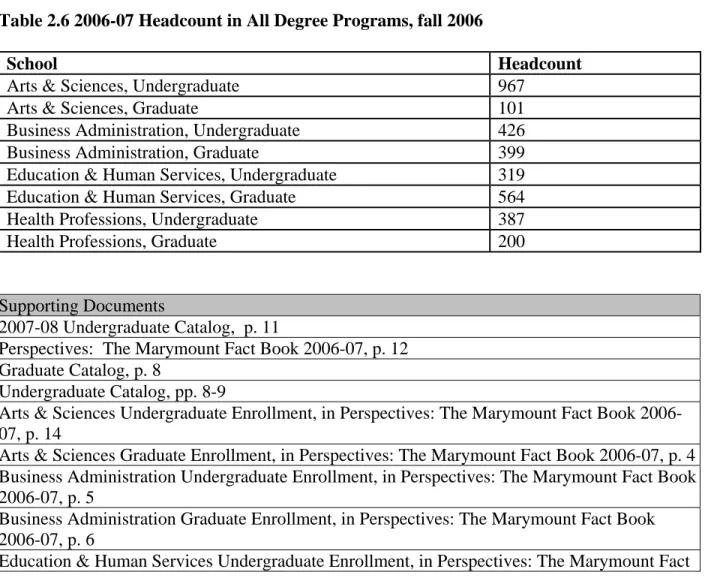
Marymount University (known as Marymount College of Virginia until 1986) was founded as a two-year women’s college in 1950. Its first class of 13 women graduated in 1952. [Catalog] Although substantial changes have occurred in the intervening years, Marymount has remained in continuous operation since its creation. In fall 2006 3,604 students were enrolled in associate, bachelor’s, master’s, and one doctoral program.
Undergraduate and graduate degree programs are listed in the current Graduate and Undergraduate Catalogs. TheMarymount Fact Book provides a detailed breakdown of enrollments by program code in each school; Table 2.6 links to the Fact Book.
Table 2.6 2006-07 Headcount in All Degree Programs, fall 2006
School Headcount
Arts & Sciences, Undergraduate 967
Arts & Sciences, Graduate 101
Business Administration, Undergraduate 426
Business Administration, Graduate 399
Education & Human Services, Undergraduate 319 Education & Human Services, Graduate 564
Health Professions, Undergraduate 387
Health Professions, Graduate 200
Supporting Documents
2007-08 Undergraduate Catalog, p. 11
Perspectives: The Marymount Fact Book 2006-07, p. 12 Graduate Catalog, p. 8
Undergraduate Catalog, pp. 8-9
Arts & Sciences Undergraduate Enrollment, in Perspectives: The Marymount Fact Book 2006-07, p. 14
Arts & Sciences Graduate Enrollment, in Perspectives: The Marymount Fact Book 2006-07, p. 4 Business Administration Undergraduate Enrollment, in Perspectives: The Marymount Fact Book 2006-07, p. 5
Business Administration Graduate Enrollment, in Perspectives: The Marymount Fact Book 2006-07, p. 6
Book 2006-07, p. 7
Education & Human Services Graduate Enrollment, in Perspectives: The Marymount Fact Book 2006-07, p. 8
Health Professions Undergraduate Enrollment, in Perspectives: The Marymount Fact Book 2006-07, p. 9
Health Professions Graduate Enrollment, in Perspectives: The Marymount Fact Book 2006-07, p. 10
2.7.1 Program Length
The institution offers one or more degree programs based on at least 60 semester credit hours or the equivalent at the associate level; at least 120 semester credit hours or the equivalent at the baccalaureate level; or at least 30 semester credit hours or the equivalent at the
post-baccalaureate, graduate, or professional level. If an institution uses a unit other than semester credit hours, it provides an explanation for the equivalency. The institution also provides a justification for all degrees that include fewer than the required number of semester credit hours or its equivalent unit.
Judgment of Compliance
In Compliance
Narrative of Compliance
Marymount University offers the baccalaureate and master’s degree programs listed in Table 2.7.1. The A.A. in Liberal Studies was deleted from the curriculum in 2005. [CIC form; School of Arts & Sciences Minutes, January 12, 2005] The University’s only remaining associate degree program, the 67-credit A.A.S. in Nursing, which leads to licensure as a Registered Nurse,
stopped admitting students in fall 2005 and graduated its remaining students in August 2007. [CIC Minutes, October 5, 2005]
All baccalaureate degree programs require the successful completion of at least 120 semester hours of credit, and all graduate degree programs require the successful completion of at least 30 semester hours of credit, except the transitional Doctor of Physical Therapy for graduates of Marymount’s Master of Science in Physical Therapy (M.S.P.T.).
The M.S.P.T. program was very rigorous and required completion of 86 credit hours beyond the bachelor's degree. The D.P.T. program, which replaced the M.S.P.T., consists of 97 credit hours beyond the bachelor's degree. The scope and depth of the curriculum was significantly enhanced in the areas of patient evaluation, differential and physical therapy diagnosis, health care
management, and wellness and health promotion. Evidence-based practice is integrated throughout the D.P.T. curriculum, and students are expected to utilize evidence-based practice thinking and skills in the expanded clinical component. Coursework in the new D.P.T. program that would not have been included in the master’s curriculum for Marymount graduates became the basis for the 14-credit transitional D.P.T. program for Marymount University graduates: PT 770 Screening for Medical Disorders (2 credits); PT 771 Medical Imaging and Rehabilitation (2 credits); PT 772 Pharmacology in Rehabilitation (1 credit); PT 773 Legal and Ethical Issues for PTs (1 credit); PT 774 Clinical Decision Making (1 credit); PT 775 Business and Marketing (1 credit); PT 776 Coding and Reimbursement (1 credit); PT 777 Professionalism: The Doctoring Profession (2 credits); and PT 778 Critical Assessment and Application of Best Evidence (3 credits). SACS-COC approved the transitional D.P.T. program on January 30, 2006.
Proposed new degree programs and courses originate in the academic departments and must be reviewed and approved at the school level before proceeding through the University approval process. Undergraduate programs and courses approved by their respective schools must
subsequently be approved by the Curriculum and Instruction Committee of Faculty Council (renamed Undergraduate Curriculum and Instruction Committee in 2007) and by Faculty Council before being recommended to the president. Graduate programs and courses approved by their respective schools must subsequently be approved by the Graduate Studies Committee of Faculty Council and by Faculty Council before being recommended to the president. Both the Undergraduate Curriculum and Instruction Committee and the Graduate Studies Committee have formal processes that include submission of required documentation that provides specific information about each new or revised course, including course descriptions, numbers of credits, and course syllabi. [Curriculum Committee forms; Faculty Guide for Developing Graduate Programs and Courses] At each step of the proposal process, attention is paid to whether the proposed program conforms to program length requirements. The program approval process is described in detail in section 3.4.10.
Supporting Documents
CIC Program Deletion form, A.A. Liberal Studies School of Arts & Sciences Minutes 2005 January 12 CIC Minutes 2005 October 5
PT 770 Syllabus PT 771 Syllabus PT 772 Syllabus PT 773 Syllabus PT 774 Syllabus PT 775 Syllabus PT 776 Syllabus PT 777 Syllabus PT 778 Syllabus
SACS-COC approval of transitional D.P.T.
Faculty Council Bylaws, Curriculum and Instruction Committee Faculty Council Bylaws, Graduate Studies Committee
Curriculum Committee proposal forms
Table 2.7.1 Program Length, in Semester Credit Hours (SCH)
Associate Degree Programs
60 SCH
Baccalaureate Degree Programs 120 SCH
(links to 2007-08 program advising sheets)
Graduate/Professional Degree Programs
30+ SCH Beyond UG
(links to 2007-08 program advising sheets)
School of Arts and Sciences
None Art (B.A.) (123) Humanities (M.A.) (30)
Art (B.A.) Art Management track
(123)
Humanities with Secondary-level Teaching Licensure (M.A.) (36) Art (B.A.) Pre-Art Therapy track
(123)
Interior Design Track 1 (M.A.) (36) Art Education (B.A. in Art) (123) Interior Design Track 2 (M.A.) (49) Biology (B.S.) (120) Literature & Languages (M.A.) (30-36)
Biology with Secondary-level
Teaching Licensure (B.A. in Biology) (121-122)
Communications (B.A.) (122)
English (B.A.) (126)
English with Secondary-level
Teaching Licensure (B.A. in English) (120)
English as a Second Language
with K-12 Teaching Licensure (B.A. in English)
Fashion Design (B.A.) (120)
Fashion Merchandising (B.A.) (123)
Graphic Design (B.A.) (123-126)
History (B.A.) (120)
History/Social Science with
Secondary-level Teaching Licensure (B.A. in History) (123)
Interior Design (B.A.) (120)
Liberal Studies (B.A.) (120)
Elementary Education (PK-6)
Teaching Licensure (B.A. in Liberal Studies) (122)
Mathematics (B.S.) (120)
Mathematics with Secondary-level
Teaching Licensure (B.A. in Math)
Philosophy (B.A.) (120)
Politics (B.A.) (120)
Theology and Religious Studies (B.A.) (120)
School of Business Administration
Business Administration (B.B.A.) (121-127)
Business Administration (M.B.A.) (45) Economics in Society (B.A.) (123) Health Care Management (M.S.) (36) Information Technology (B.S.) (120) Human Resource Management (M.A.)
(36)
Information Technology (M.S.) (36-39)
Legal Administration track 1 (M.A.) (36)
Legal Administration track 2 (M.A.) (36)
Management (M.S.) (36)
School of Education and Human Services
Criminal Justice (B.A.) (120) Community Counseling (M.A.) (48)
Criminal Justice—Forensic
Science Concentration (B.S.) (120)
Catholic School Leadership (M.ED) (39) Psychology (B.A.) (120) Elementary Education PK-6 (M.ED) (39) Sociology (B.A.) (120) English as a Second Language (M.ED)
(39)
Learning Disabilities K-12 (M.ED) (39)
Secondary Education (M.ED) (39)
Professional Studies (M.ED) (36)
Forensic Psychology (M.A.) (39)
Pastoral and Spiritual Care (M.A.) (48)
Pastoral Counseling (M.A.) (60)
School Counseling (M.A.) (51)
School of Health Professions
Health Sciences:
Health Promotion Management (M.S.) (36)
Health Promotion Track (B.S.)
(120)
Family Nurse Practitioner (M.S.N.) (40) Pre-Physical Therapy Track (B.S.)
(124)
Nursing Education (M.S.N.) (40) Nursing – Accelerated Program (B.S.N.)
(120)
Physical Therapy (D.P.T.) (95) Nursing (B.S.N.) (122) Physical Therapy Transitional D.P.T.
(MU M.S.P.T. graduates) (14) Nursing -- RN to BSN Program (B.S.N.)
(120)
Physical Therapy Transitional D.P.T. (non-MU M.S.P.T. graduates) (30-31)
2.7.2 Program Content
The institution offers degree programs that embody a coherent course of study that is compatible with its stated mission and is based upon fields of study appropriate to higher education.
Judgment of Compliance
In Compliance
Narrative of Compliance
Marymount University is certified by the State Council of Higher Education for Virginia
(SCHEV) to operate in the Commonwealth of Virginia as a degree-granting institution of higher education. In addition, the Maryland Higher Education Commission (MHEC) has approved two degree programs, the M.S. in Health Care Management, which is offered at Holy Cross Hospital in Silver Spring, Maryland; and the M.Ed. in Professional Studies at Our Lady of Mercy School in Potomac, Maryland. Marymount University has maintained accreditation with the Southern Association of Colleges and Schools since 1958.
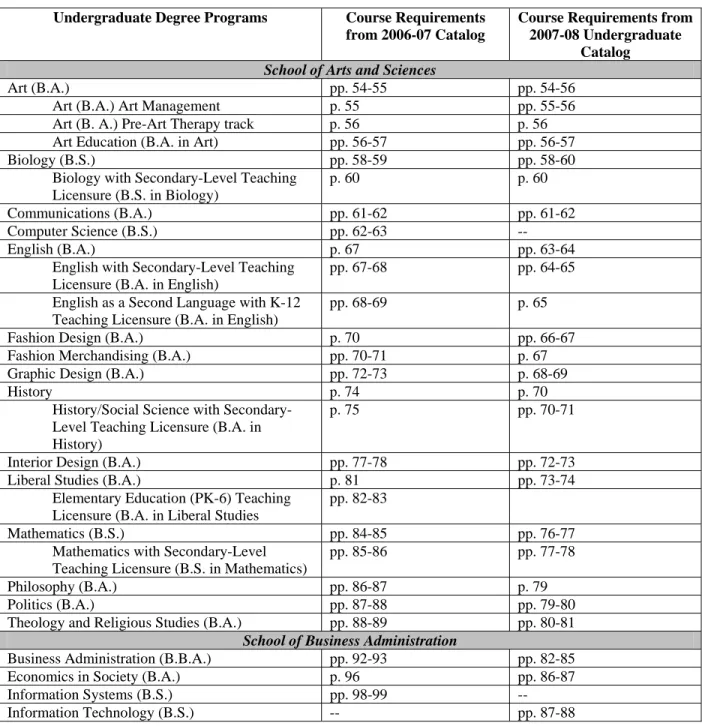
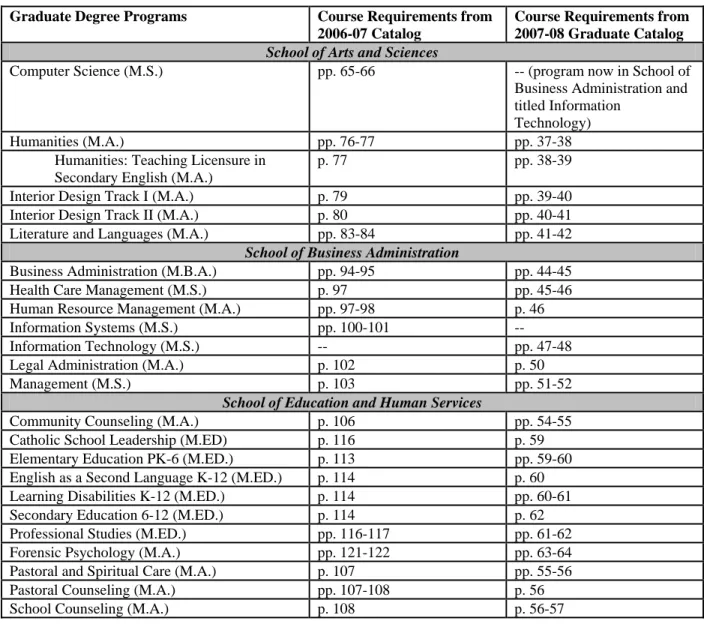
The degree programs available at Marymount University are presented in Table 2.7.2A and Table 2.7.2B. Educational programs offered by the institution fulfill its mission, which is stated in the Graduate and Undergraduate Catalogs. At the undergraduate level, Marymount's
commitment to the liberal arts tradition is reinforced though its robust core curriculum, and its commitment to career preparation is seen in the internship requirements. The action plans of the Schools of Arts and Sciences, Business Administration, Education and Human Services, and Health Professions articulate the relationship between the strategic initiatives of the University and the goals of each school.
Proposed new degree programs and courses originate in the academic departments and must be reviewed and approved at the school level before proceeding through the Faculty Council approval process. Undergraduate programs and courses approved by their respective school must subsequently be approved by the Curriculum and Instruction Committee of Faculty Council (renamed the Undergraduate Curriculum and Instruction Committee in 2007) and by Faculty Council before being recommended to the president. Graduate programs and courses approved by their respective schools must subsequently be approved by the Graduate Studies Committee of Faculty Council and by Faculty Council before being recommended to the president. Both the Undergraduate Curriculum and Instruction Committee and the Graduate Studies Committee have formal processes that include submission of documentation that requires a rationale for the new program with an explanation of how the new program supports the mission of the school and the University. [Curriculum Committee forms; Faculty Guide for Developing Graduate Programs and Courses] At each step of the proposal process, attention is paid to whether the proposed program demonstrates coherence in sequencing, increasing complexity, and linkages between and among program components. This is described in detail in section 3.4.10.
Existing degree programs are reviewed periodically as part of the University assessment process. On a five-year cycle, academic programs engage in a program review, which requires programs to articulate their relationship to the University mission. These reviews also assess the
appropriateness of the curriculum and student enrollment in the program. As of May 2007, most degree programs have gone through this program review process. An example is provided.
In addition to affirmation by SACS, specific University programs are subject to accreditation by the organizations listed below. The governing bodies of these organizations further confirm appropriateness of each degree program to higher education and to the stated mission of Marymount University.
• National Council for Accreditation of Teacher Education (NCATE) accredits teacher preparation programs.
• Council for Interior Design Accreditation (CIDA) accredits the interior design undergraduate program and the first professional track (track two) graduate degree program. CIDA was formerly known as the Foundation for Interior Design Education Research (FIDER).
• Council for Accreditation of Counseling and Related Educational Programs (CACREP) accredits counseling and school counseling programs.
• Commission on Accreditation of Healthcare Management Education (CAHME) accredits the health care management graduate programs.
• Commission on Accreditation in Physical Therapy Education (CAPTE) accredits the physical therapy program.
• National League for Nursing Accreditation Commission (NLNAC) and Commission on Collegiate Nursing Education (CCNE) accredit nursing programs.
• Association of Collegiate Business Schools and Programs (ACBSP) accredits the bachelor's and master's of business administration.
• American Bar Association (ABA) approves the legal administration graduate program and paralegal studies undergraduate program.
Supporting Documents SCHEV letter
Maryland Higher Education Commission letter May 11, 2007 Graduate Catalog, Mission statement, p.10
Undergraduate Catalog, Mission statement, p. 10 Liberal Arts Core curriculum, p 48-49
Internship Requirements, p. 30
School of Arts & Sciences Action Plan
School of Business Administration Action Plan School of Education & Human Services Action Plan School of Health Professions Action Plan
Faculty Council Bylaws, Curriculum and Instruction Committee, p. 5 Faculty Council Bylaws, Graduate Studies Committee, p. 7-8
Curriculum Committee program forms
Faculty Guide for Developing Graduate Programs and Courses Marymount Program Review Guide
National Council for Accreditation of Teacher Education (NCATE) letter Council for Interior Design Accreditation (CIDA) letter
Council for Accreditation of Counseling and Related Educational Programs (CACREP) letter Commission on Accreditation of Healthcare Management Education (CAHME) letter
Commission on Accreditation in Physical Therapy Education (CAPTE) letter National League for Nursing Accreditation Commission (NLNAC) letter Commission on Collegiate Nursing Education (CCNE) letter
Association of Collegiate Business Schools and Programs (ACBSP) letter American Bar Association (ABA) letter
Table 2.7.2A Undergraduate Degree Programs at Marymount University Undergraduate Degree Programs Course Requirements
from 2006-07 Catalog
Course Requirements from 2007-08 Undergraduate
Catalog
School of Arts and Sciences
Art (B.A.) pp. 54-55 pp. 54-56
Art (B.A.) Art Management p. 55 pp. 55-56
Art (B. A.) Pre-Art Therapy track p. 56 p. 56 Art Education (B.A. in Art) pp. 56-57 pp. 56-57
Biology (B.S.) pp. 58-59 pp. 58-60
Biology with Secondary-Level Teaching Licensure (B.S. in Biology)
p. 60 p. 60
Communications (B.A.) pp. 61-62 pp. 61-62
Computer Science (B.S.) pp. 62-63 --
English (B.A.) p. 67 pp. 63-64
English with Secondary-Level Teaching Licensure (B.A. in English)
pp. 67-68 pp. 64-65
English as a Second Language with K-12 Teaching Licensure (B.A. in English)
pp. 68-69 p. 65
Fashion Design (B.A.) p. 70 pp. 66-67
Fashion Merchandising (B.A.) pp. 70-71 p. 67
Graphic Design (B.A.) pp. 72-73 p. 68-69
History p. 74 p. 70
History/Social Science with Secondary-Level Teaching Licensure (B.A. in History)
p. 75 pp. 70-71
Interior Design (B.A.) pp. 77-78 pp. 72-73
Liberal Studies (B.A.) p. 81 pp. 73-74
Elementary Education (PK-6) Teaching Licensure (B.A. in Liberal Studies
pp. 82-83
Mathematics (B.S.) pp. 84-85 pp. 76-77
Mathematics with Secondary-Level Teaching Licensure (B.S. in Mathematics)
pp. 85-86 pp. 77-78
Philosophy (B.A.) pp. 86-87 p. 79
Politics (B.A.) pp. 87-88 pp. 79-80
Theology and Religious Studies (B.A.) pp. 88-89 pp. 80-81
School of Business Administration
Business Administration (B.B.A.) pp. 92-93 pp. 82-85
Economics in Society (B.A.) p. 96 pp. 86-87
Information Systems (B.S.) pp. 98-99 --
School of Education and Human Services
Criminal Justice (B.A.) p. 109 p. 93
Criminal Justice-Forensic Science (B.S.) p. 110 p. 94
Psychology (B.A.) pp. 119-120 pp. 97-98
Psychology: Learning Disabilities Education (B.A. in Psychology)
pp. 120-121 --
Sociology (B.A.) pp. 122-123 pp. 100-101
School of Health Professions
Health Sciences (B.S.)
Health Promotion Track pp. 125-126 pp. 103-104 Pre-Physical Therapy Track pp. 126-127 pp. 103-104
Nursing (B.S.N.) pp. 130-131 pp. 107-108
Nursing – Accelerated (B.S.N.) p. 130 p. 108
Nursing – R.N. to B.S.N. p. 131 pp. 109-110
Course descriptions may be found on pp. 139-223 of the 2006-07 Catalog and pp. 112-160 of the 2007-08 Undergraduate Catalog.
Table 2.7.2B Graduate Degree Programs at Marymount University Graduate Degree Programs Course Requirements from
2006-07 Catalog
Course Requirements from 2007-08 Graduate Catalog
School of Arts and Sciences
Computer Science (M.S.) pp. 65-66 -- (program now in School of Business Administration and titled Information
Technology)
Humanities (M.A.) pp. 76-77 pp. 37-38
Humanities: Teaching Licensure in Secondary English (M.A.)
p. 77 pp. 38-39
Interior Design Track I (M.A.) p. 79 pp. 39-40
Interior Design Track II (M.A.) p. 80 pp. 40-41 Literature and Languages (M.A.) pp. 83-84 pp. 41-42
School of Business Administration
Business Administration (M.B.A.) pp. 94-95 pp. 44-45
Health Care Management (M.S.) p. 97 pp. 45-46
Human Resource Management (M.A.) pp. 97-98 p. 46
Information Systems (M.S.) pp. 100-101 --
Information Technology (M.S.) -- pp. 47-48
Legal Administration (M.A.) p. 102 p. 50
Management (M.S.) p. 103 pp. 51-52
School of Education and Human Services
Community Counseling (M.A.) p. 106 pp. 54-55
Catholic School Leadership (M.ED) p. 116 p. 59 Elementary Education PK-6 (M.ED.) p. 113 pp. 59-60 English as a Second Language K-12 (M.ED.) p. 114 p. 60 Learning Disabilities K-12 (M.ED.) p. 114 pp. 60-61 Secondary Education 6-12 (M.ED.) p. 114 p. 62 Professional Studies (M.ED.) pp. 116-117 pp. 61-62 Forensic Psychology (M.A.) pp. 121-122 pp. 63-64 Pastoral and Spiritual Care (M.A.) p. 107 pp. 55-56 Pastoral Counseling (M.A.) pp. 107-108 p. 56
School of Health Professions
Health Promotion Management (M.S.) p. 128 p. 66 Family Nurse Practitioner (M.S.N.) p. 132 p. 68
Nursing Administration (M.S.N.) pp. 132-133 -- (program no longer admits students)
Nursing Education (M.S.N.) p. 133 p. 68
RN to M.S.N. Program p. 133 p. 69
Physical Therapy (D.P.T.) p. 136 pp. 69-71
Transitional D.P.T. p. 137 pp. 71-72
Course descriptions may be found on pp. 139-223 of the 2006-07 Catalog and pp. 73-108 of the 2007-08 Graduate Catalog
2.7.3 General Education
In each undergraduate degree program, the institution requires the successful completion of a general education component at the collegiate level that (1) is a substantial component of each undergraduate degree, (2) ensures breadth of knowledge, and (3) is based on a coherent rationale. For degree completion in associate programs, the component constitutes a minimum of 15
semester hours or the equivalent; for baccalaureate programs, a minimum of 30 semester hours or the equivalent. These credit hours are to be drawn from and include at least one course from each of the following areas: humanities/fine arts; social/behavioral sciences; and natural science/mathematics. The courses do not narrowly focus on those skills, techniques, and procedures specific to a particular occupation or profession. If an institution uses a unit other than semester credit hours, it provides an explanation for the equivalency. The institution also provides a justification if it allows for fewer than the required number of semester credit hours or its equivalent unit of general education courses.
Judgment of Compliance
In Compliance
Narrative of Compliance
Marymount University’s general education program is called the Liberal Arts Core (LAC). Prior to the 2004-05 academic year, the LAC was overseen by the ad hoc Committee on General Education, a committee of Faculty Council whose membership consisted of faculty who had an interest in the core. In October 2004 the Faculty Council approved creation of an ad hoc Liberal Arts Core (LAC) Advisory Committee with elected representatives from each of the schools and Library and Learning Services; ex-officio members from the Student Government Association, Undergraduate Curriculum and Instruction Committee, and Honors Program; and a Steering Committee in lieu of a chair. [Faculty Council minutes October 27, 2004] This committee’s charge was to develop core course requirements, evaluate and assess the core, approve new core courses, and propose revisions to the core. The director of the Liberal Arts Core is a full-time faculty member who is given course release and a stipend to head up the work of the LAC Advisory Committee. The director reports to the vice president for Academic Affairs and provost.
In September 2006 President Bundschuh created the Liberal Arts Core (LAC) Task Force, which reports to the vice president for Academic Affairs and provost. [LAC Advisory Committee minutes September 27, 2006] The LAC Task Force was charged with aligning core
requirements with the University mission and specifying the courses that fulfill them. The LAC Advisory Committee and the LAC director remain in place to continue assessment activities and any necessary revisions to the current core until a new core is in place. The LAC Task Force met regularly in the fall and spring semesters [Minutes December 8, 2006; January 10, 2007; January 24, 2007; February 7, 2007; March 14, 2007; April 4, 2007; April 18, 2007; May 4, 2007] and developed a rationale for the “new” core, with a target date of fall 2008 for implementation, as discussed further below. Thus, this SACS reaffirmation takes place at a time of transition for the LAC.
Liberal Arts Core in each Undergraduate Degree Program
The LAC at Marymount University is designed to complement and enhance learning in all fields of study, incorporating introductory as well as more advanced courses throughout the
undergraduate experience. The current 54-55 credit core includes specific requirements for collegiate-level courses in writing (9 credits), mathematics (3 credits), science (4 credits), humanities (18 credits), social sciences (12 credits), health and wellness (2-3 credits), and electives outside the student’s major field of study (6 credits). Transfer students must meet these requirements through a process that establishes equivalencies, described in detail in section 3.4.4.
The LAC is an integral component of every bachelor’s degree offered at Marymount University. The focus of the core is upon inquiry and engagement in a quest for learning that will
complement other studies while raising larger questions about human existence. All
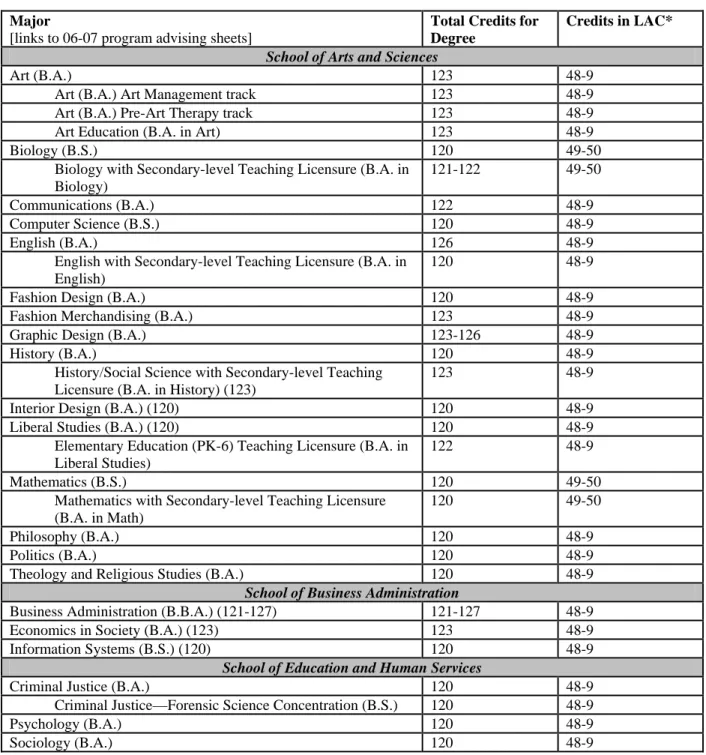
undergraduate majors require 48-50 credits in core courses, as listed above, and an additional 6 credits of electives (many programs offer more elective credit options). In all cases, LAC requirements account for at least 40% of the undergraduate degree, which is a substantial component of the degree program. Table 2.7.3 provides links to the 2006-07 program advising sheets for each undergraduate program, where credits earned through LAC courses are
documented.
The Liberal Arts Core Ensures a Breadth of Knowledge
According to its mission statement, Marymount is a Catholic university committed to the liberal arts tradition; it combines a foundation in the arts and sciences with career preparation and opportunities for personal and professional development. The LAC Goals Statement notes that the core “… engages students to ask what it means to be fully human, so that learning can engage the whole person. It fosters the development of independent, confident, and reflective persons who will make an effective contribution to the world. The core engages a variety of disciplines in its quest, some with roots in the richness of the past and others with relevance to contemporary issues. Thus it provides an atmosphere of inquiry, of respect for diverse
approaches, of respectful dialogue in which competing ideas can be examined and expressed. Through the core program, students develop a capacity to understand and act upon fundamental questions about ethics, commitment, and values.”
While LAC distribution requirements have remained largely in place since the last SACS reaffirmation, some changes were implemented over the years to help students better develop fundamental competencies (100- and 200-level courses) or to expose students to higher levels of thinking and ideas (requirements for 300-level humanities and social science courses). For example:
• The English composition program (EN 101 and EN 102) was revised in 2000, following a successful pilot, to sharpen the courses’ focus on the fundamental competencies of research and communication and to include an emphasis on the use of technology.
• A proposal for a sequence of courses in the social sciences (ECO/POL/PSY/SOC 100) was developed in 2001 and approved by the Curriculum and Instruction Committee and
Faculty Council. [General Education Social Sciences Proposal February 26, 2001] These courses introduce students to diverse methodologies in the social sciences and provide opportunities to practice them.
• To strengthen the core’s alignment with the University mission, the requirements in Theology and Philosophy were increased from one course in either discipline to a course in each discipline. [Faculty Council minutes April 6, 2001]
• To assure some depth of knowledge as well as reinforcement of skills, the LAC Committee established a requirement for 300-level coursework in social sciences and humanities, as well as requirements that humanities courses be selected from both the ancient and modern periods. [General Education Social Sciences Proposal February 26, 2001; Faculty Council minutes April 6, 2001]
The Liberal Arts Core is based on a Coherent Rationale
The LAC at Marymount University is rooted in a legacy of inquiry within the liberal arts tradition of Catholic universities. Thus it draws upon a heritage that has long been concerned with fundamental questions about human existence, modes of knowing, and ethical action. The core “introduces students to the intellectual skills, methods, and modes of inquiry needed in their academic studies, whatever the major. Second, it focuses upon their integral personal
development, so that they may contribute meaningfully to their professions, their communities, and the world.” [LAC Goals Statement]
This understanding has found concrete expression in three fundamental competencies that have guided curriculum development since the Liberal Arts Core Advisory Committee’s discussions of General Education at conferences at the University of North Carolina at Asheville. These are: information literacy, critical thinking, and clear communication. [Catalog]
The LAC Task Force has built upon work of the Advisory Committee in its description of guiding principles for the LAC. These are
• a coherent rationale
• focus on the student learning experience
• simplicity for advising purposes
• a core that supports and enhances the majors
• consistency with typical core requirements at Catholic colleges and universities
• links between a Marymount education and the Washington metropolitan area
In this interim period, the LAC Task Force has been developing a new design with a clearly stated rationale and learning outcomes that are distinctively aligned to the University mission. The Faculty Council voted to support the direction of this design at its meeting of April 25, 2007. In order to provide a smooth transition and oversight of the existing core, the director of the LAC recommended that no new courses be proposed for that core pending the adoption of the new model. The director of the LAC will work with the school deans and department chairs to assure that courses in the revised core and their learning outcomes are appropriate for general education.