https://doi.org/10.1177/1460458220977586 Health Informatics Journal 1 –16 © The Author(s) 2021 Article reuse guidelines: sagepub.com/journals-permissions DOI: 10.1177/1460458220977586 journals.sagepub.com/home/jhi
Creative Commons Non Commercial CC BY-NC: This article is distributed under the terms of the Creative Commons Attribution-NonCommercial 4.0 License (https://creativecommons.org/licenses/by-nc/4.0/) which permits non-commercial use, reproduction and distribution of the work without further permission provided the original work is attributed as specified on the SAGE and Open Access pages (https://us.sagepub.com/en-us/nam/open-access-at-sage).
Generation of reusable learning
objects from digital medical
collections: An analysis based
on the MASMDOA framework
Félix Buendía
Universitat Politècnica de València, Spain
Joaquín Gayoso-Cabada
José-Luis Sierra
Universidad Complutense de Madrid, Spain
Abstract
Learning Objects represent a widespread approach to structuring instructional materials in a large variety of educational contexts. The main aim of this work consists of analyzing the process of generating reusable learning objects followed by Clavy, a tool that can be used to retrieve data from multiple medical knowledge sources and reconfigure such sources in diverse multimedia-based structures and organizations. From these organizations, Clavy is able to generate learning objects that can be adapted to various instructional healthcare scenarios with several types of user profiles and distinct learning requirements. Moreover, Clavy provides the capability of exporting these learning objects through standard educational specifications, which improves their reusability features. The analysis proposed is conducted following criteria defined by the MASMDOA framework for comparing and selecting learning object generation methodologies. The analysis insights highlight the importance of having a tool to transfer knowledge from the available digital medical collections to learning objects that can be easily accessed by medical students and healthcare practitioners through the most popular e-learning platforms.
Keywords
digital medical collections, knowledge management tools, learning object generation, analysis framework
Corresponding author:
Félix Buendía, Escuela Técnica Superior de Informática (ETSINF), Universitat Politècnica de València, Camino de Vera s/n, Valencia 46022, Spain.
Email: [email protected]
Special Issue: Medical Education Informatics—Technology-Led Patient Engagement, Empowerment and Education
Introduction
Learning objects represent a widespread approach to structuring instructional materials in a large variety of educational contexts, from primary and secondary school (K-12 levels) to graduate studies and staff training. Medical education is not an exception and this kind of learning resources is used when teaching undergraduate medical courses or training healthcare professionals. The current paper addresses an analysis of how Reusable Learning Objects (RLOs) in the context of medical education can be generated from existing digital collections by using a tool called Clavy.1 The analysis
pro-posed takes into account the technical features that make learning objects reusable in different educa-tional scenarios and it is performed by examining those technical features involved when accessing, retrieving, and processing online medical resources by means of open computing interfaces.
Given that the context of medical education covers a wide range of topics, we have focused on the radiology area in order to analyze how the related information can be retrieved, organized, and reused for different learning purposes. Radiology teaching files have served such purposes for a very long time.2 Smith and Castillo3 described the Internet-accessible radiology teaching file, especially
addressed to emergency radiologists. Zaidel et al.4 also presented the concept of a web-based radiology
teaching file as a mechanism used by students, residents, physicians and researchers to access Web information associated with clinical studies in this area. D’Alessandro5 commented on the role of the
RadiologyEducation6 website as a digital library of educational radiology resources, and related
initia-tives such as Radiopaedia7 or Radrounds8 offer case catalogs showing how patients are imaged and
diagnosed. In parallel, the emergence of the PACS (Picture Archiving and Communication System) tools provides a technology to store radiology images, thus enabling convenient access to such images from multiple modalities and devices.9 These PACS items and other radiographic images have been
used to generate digital teaching files and imaging repositories10 and, along with the DICOM standard,
have been used to automatically create teaching file cases.11 Some of these educational resources are
organized into specialized repositories such as a MIRC12 (Medical Imaging Resource Center) for
stor-ing teachstor-ing files, but their access as RLOs remains unresolved. In summary, there is an extraordinary number of educational resources available in the radiology area but the challenge is how to convert them into learning objects that can be reused in different training or learning scenarios.
The analysis of the Clavy tool’s capabilities to generate RLOs from existing medical digital
col-lections is based on the MASMDOA framework13 used for comparing and selecting learning object
generation methodologies. Such an analysis framework, along with MedPix (https://medpix.nlm.nih. gov) as an example of an online clinical case database, makes it possible to examine Clavy’s capabili-ties, such as retrieving heterogeneous multimedia information sources from external databases, organizing and structuring the content elements gathered or supporting the RLO generation process, in general. The remainder of the work is structured as follows. We start by reviewing some related work about the generation of RLOs in several medical education contexts and, more specifically, from the radiology perspective. Then, we provide some insights into Clavy’s mechanisms used to access medical collections, retrieve and organize their digital contents, and export them in standard
formats. Next, we address the MASMDOA-based analysis of the Clavy approach to generating
RLOs, using MedPix as a significant case study. It is followed by a discussion on said process of analysis and the criteria applied. We finish with some conclusions and lines of further work.
Literature review
Learning objects have been widely used in medical education as they are considered a “grouping of instructional materials structured to meet a specified educational objective”.14 This broad
but their development requires a minimum set of features to formally characterize them in terms of granularity, self-content, reusability, aggregation, or interoperability.15 Analyzing such learning
object features is a challenging task in e-learning courses,16 and especially so within a medical
educational context. In this sense, a particular issue is the question about what constitutes an RLO and how to make these objects reusable in such a context. The student perspective on this kind of learning objects was described by Blake,17 who commented on some of the barriers to their usage.
The design and analysis of RLOs in healthcare meta-analysis learning has also been described.18
Windle and Wharrad19 introduced some reflections on the characteristics of RLOs in healthcare
education; for example, on the use of context-neutral materials as a way to improve reusable fea-tures. They also mentioned the need to apply non-restrictive licensing models and that “reusability also requires that a resource is platform-independent”. An interesting aspect included in the Windle and Wharrad work was related to the development processes which were involved in the genera-tion of RLOs, their granularity level (e.g. 15 min of scheduled learning activity) and the role of communities of practice in these generation processes.
Evans20 commented on how the development and evaluation of RLOs could enhance the
learning experience of international healthcare students. This initiative was launched in a spe-cific educational context related to nursing, and referred to two examples of RLOs available in this context. Again, the multiple possibilities when creating this kind of resources make it diffi-cult to have strict rules that guide such a generation process. Instead, each medical discipline seems to adapt this concept of learning object to its own peculiarities (e.g., testing a virtual
learn-ing object in the teachlearn-ing of radiographic cephalometry,21 using 3D anaglyph images made from
stereo image pairs in online Anatomy and Physiology courses,22 developing interactive resources
to teach intramuscular medication administration for nursing undergraduates,23 developing
web-based resources by mixing multimedia elements like RLOs in the hospital care of people with dementia,24 or developing resources addressed to occupational therapy education).25 This
diver-sity of areas in which it is possible to generate this kind of learning objects makes the need to deploy computing tools that can support their generation process evident. Moreover, from the previous RLO examples there is also evidence of diverse multimedia materials and formats which can be aggregated during development. This aggregation property is a crucial feature when generating these learning objects since it requires the extraction of such material from multiple medical knowledge sources. In the case of radiology training, there is a large number of information sources, as shown in the previous section. These sources are usually based on a wide range of multimedia formats and different content features. Even simple resources such as images or video recordings can have a complex component, whether coming from the PACS
repositories26 that store them, standard formats such as DICOM to share imaging information
objects,27 virtual reality methods for transforming clinical imaging data into learning objects28 or
“virtual lectures” by means of animations.29 In order to support the generation of resources for
radiology education, some initiatives have been launched, such as the aforementioned use of a
DICOM service to create teaching file cases automatically from PACS11 or the development of
a radiography Digital Teaching Library (DTL).30 However, as Scarsbrook et al.31 commented,
some specific characteristics should be assessed when developing a radiology digital teaching file. Another important aspect in the generation of learning objects is the use of standards to improve their interoperability so that they can be implemented across multiple learning plat-forms. There are several specifications, such as IMS Content Package or SCORM, which are followed to create interactive e-learning courses32 or used as references in radiology education.33
Some of the SCORM-compliant learning initiatives mentioned in the previous reference are
RadMoodle or RadSCOPE® (Radiology Shareable Content for Online Presentation and
SCORM format34 and the ILIAS platform was deployed using this format to facilitate the reuse
of radiology contents.35 Concerning the integration of external sources (e.g., radiology images)
in educational scenarios, a Web application called USRC (University of Saskatchewan Radiology
Courseware)36 was created to link MIRC teaching cases to Blackboard contents and, more
recently, the RadEd37 tool provides a web-based teaching framework that combines the
genera-tion of case-based exercises and the integragenera-tion of image interacgenera-tion. This interest in “content creation” and its concomitant challenges is one of the main contributions by RadEd and is highly related to the approach proposed in the current work.
In the end, while multiple tools and standard formats are available during the process of generat-ing RLO examples, there are few methodological proposals dealgenerat-ing with the analysis of this kind
of process in the healthcare domain. The work of Wharrad and Windle38 examined several case
studies in the development of pharmacology RLOs or learning objects for lifelong healthcare edu-cation, in which a theoretical framework was used to evaluate the process and outputs of RLO crea-tion. This framework also provided a toolkit to perform technical assessment of the new content generated and to measure object attributes such as their media richness or interactivity capabilities. Moreover, a qualitative evaluation of RLOs was performed by a set of students and tutors at the Nursing School of the University of Nottingham.39 In this context, learning objects promoting the
achievement of clinical skills were produced using a validated RLO-development methodology19
whose outcomes were peer-reviewed by end users to ensure their quality and relevance. An addi-tional paper proposed the transfer of knowledge in health care through “digitally collecting learn-ing experiences” within the Witra Care project40 although its authors barely mentioned the analysis
of the process to generate learning objects and simply tagged such objects in eight general attribute categories. In this sense, the use of the MASMDOA framework provides a powerful analysis tool to enable a systematic review of those criteria, which can be involved in RLO generation.
The
Clavy
approach in RLO generation
This section describes the Clavy approach to generating RLOs from existing medical collections that are available through the Internet. These collections have a high educational value, but they are usually very heterogeneous and do not provide specific mechanisms to generate RLOs. This fact can be illustrated, for instance, in the plethora of systems that have arisen in the radiology area presented above. Thus, the main rationale of the approach is to address this shortcoming by sup-porting the generation of such RLOs while taking into account the heterogeneity of available medi-cal knowledge sources, the diversity of multimedia materials, and the contents these sources are composed of, or the variety of standards that can be deployed in the e-learning platforms where these instructional contents are used. The approach introduces a versatile mechanism to retrieve information from external collections, reconfigure it according to diverse structures, and finally, generate this kind of learning objects in several educational specification formats. In this way,
Clavy allows users with different profiles to generate RLOs according to their specific needs and instructional requirements; for example, in e-learning-based online courses that combine medical case assets with interactive quizzes or forum activities. For this purpose, Clavy is able to retrieve multiple types of medical knowledge information, such as research articles, clinical reports, or imaging databases, that integrate various multimedia formats from plain or structured text to com-plex images and video recordings. This broad diversity of medical knowledge presents a daunting task in the generation of learning objects to be deployed in courses addressed to different user profiles (e.g. undergraduate medical students or resident physicians-in-training). The capability of
Clavy to reconfigure these diverse knowledge resources into multiple structures and organizations, from small or medium-size course units to institutional training content, facilitates their reusability
in multiple medical education contexts. Moreover, the possibility provided by Clavy to export diverse instructional contents in the form of standard specifications such as IMS CP (Content Package) or SCORM improves such reusability.
In order to deal with external sources, which are usually poorly structured, Clavy is able to obtain pieces of content from these sources and arrange them in highly specialized digital collec-tions. For this purpose, the Clavy tool supports a three-step workflow in the creation of such col-lections from heterogeneous external digital resources:
•
• The first step enables the importation of resources coming from external knowledge sources.
Clavy allows the aggregation of content from multiple collections by using different gen-eral-purpose plug-ins to import data from standard platforms and formats such as XML documents, JSON files or relational databases, as well as more complex plug-ins targeted to specific collections that have to be accessed through a specific API (Application Programming Interface). This feature lets healthcare experts retrieve pieces of content that are usually poorly structured in external digital medical collections and arrange them in a versatile and powerful organization.
•
• The second step consists of the curation of the resources retrieved. When a collection is
imported in Clavy, experts can access the collection and edit it in its entirety to enrich it or adapt its structure to specific learning scenarios. Therefore, healthcare experts can curate or reconfigure all the information items imported, thus ensuring a coherent and unified struc-ture and reorganizing the collection to satisfy the needs of final users.
•
• The third step is concerned with the exportation of the previously curated and/or
reconfig-ured collection. Indeed, when the experts consider that the collection is ready, Clavy pro-vides a second kind of plug-in to export the complete collection, or part of its content elements, to third-party systems, for example packaged as a SCORM object.
The workflow presented is based on several items that are part of a Clavy collection:
•
• A set of digital resources, which include both local files and external resources represented by URLs (Uniform Resource Locators).
•
• A set of documents, which represent logical aggregations and organizations of resources in
terms of hierarchies of element-value pairs.
•
• A collection schema, which describes the hierarchical organization of content elements in
the collection’s documents.
In this way, instead of adopting a specific metadata standard, Clavy promotes the definition of a suitable schema for each particular collection, following a formalism inspired by generalized
markup languages like SGML and XML.41 Thus, every document in Clavy shares a common
struc-ture described by its collection-specific schema, which can be reconfigured by editing said schema. In this way, it is possible to rename element types, remove useless or non-relevant elements, merge two semantically equivalent element types, and change the hierarchical organization of elements. Figure 1 shows an example screenshot that displays the Clavy schema editor applied to a MedPix
sample case. In this example, there are three elements in the collection hierarchy, representing
Case information, which contains Patient data, the Findings of the case, or the associated
Discussion, a Topics item and a Quiz element. These last two elements are represented in a folder format, hiding their inner structure. In this schema view, some of its elements (displayed in red) are atomic and oriented to delimiting descriptive texts. Others, such as Case or Diagnosis, have an additional hierarchical structure associated which can also be edited in a user-friendly way.
Clavy can be used to build reconfigurable content repositories from a diversity of information sources. This feature enables the selection of certain knowledge items according to a specific need, for example, an educational purpose in a healthcare context, and this selection can be altered in a dynamic way. Moreover, link elements make it possible to include non-hierarchical relationships in the resulting collection structure, which allows users to enrich the knowledge to be represented with references to internal annotations or external resources. The global process is guided through the following steps in the case of building a content repository with a potential educational pur-pose, which involves both instructors and programmers:1
•
• First, instructors discover digital resources from different sources with educational value
suitable to be transformed into learning objects. Then, they use suitable importation plug-ins to import these resources if available, or otherwise they ask programmers to provide such plug-ins. During this starting step, importation plug-ins collect basic content elements and also aggregate these elements by means of hierarchical or non-hierarchical structures. The result in Clavy is an initial metadata schema of the content repository.
•
• Then, instructors can align the organization of the different content items gathered in the
initial metadata schema to get an alternative organization adapted to their own educational requirements. They can also use the document editor to curate some elements by editing
their content or adding missed instructional information (e.g. some required learning goals or related assessment strategies). Figure 2 shows an example screenshot displaying the
Clavy document editor, which enables information about the Case elements to be changed or inserted; for example, its Diagnosis components, the Findings description or the related
Discussion.
•
• Finally, the repository of content objects can be exported using standard specifications such as IMS CP or SCORM, after deciding the final features of such objects; for example, if they include interactive quizzes or links to image annotations or other multimedia items. For this purpose, instructors can use existing exportation plug-ins, or they can rely on the assistance of programmers to get the exportation functionalities required.
A practical example of the Clavy approach is analyzed in the next section, which shows how this tool can be deployed to generate learning objects that can be reused in different medical contexts.
Analysis of the generation approach
This section addresses the process of analysis regarding how the generation approach proposed can be subjected to a systematic procedure able to retrieve information from heterogeneous medical sources and verify the RLOs obtained. This kind of analysis focuses on those critical aspects that characterize the generation of such learning objects by deploying the Clavy tool. The aspects to be analyzed are based on specific criteria provided in the MASMDOA framework and they are mainly focused on the technological dimension; in particular, the generativity, granularity, interoperability, searchability, and reusability criteria described in this framework.13 An additional component in the
methodology of the current research consists of the selection of a significant source of medical con-tents, which has to comply with two main requirements: (i) allowing free online access by means of automatic information retrieval mechanisms and (ii) offering relevant instructional value which can be useful for healthcare practitioners. There are multiple examples of online educational resources, and Prisciandaro42 provided an exhaustive list of sites addressed to medical physicians and classified
into different medical fields. We reviewed some of these sites and selected the MedPix database as a suitable example of a digital medical collection, which included over 12,000 patient case scenarios, 9000 topics, and 59,000 images. Such a medical collection has been used in digital radiology devel-opment31 and radiology atlases.43 After finding a REST-API mechanism to access MedPix contents,
we asked their administrators for permission and obtained a subset of cases to show how they could be converted to RLO samples. The generation of these samples was the target of the analysis process whose MASMDOA criteria are described in the following paragraphs.
Generativity
According to the MASMDOA framework, generativity is the criterion that refers to the way in
which the structure of the learning object is determined and in which simpler learning objects are assembled to produce more complex ones. The medical domain is characterized by a knowledge corpus composed of a large number of information sources whose structure is highly complex and heterogeneous, such as research articles, clinical reports, or imaging databases. Clavy faces the challenge of generating learning objects from all these items by means of specialized plug-ins able to import information coming from multiple sources with different structure organizations. In the
case of MedPix, an importation plug-in was implemented to connect with its API and retrieve a
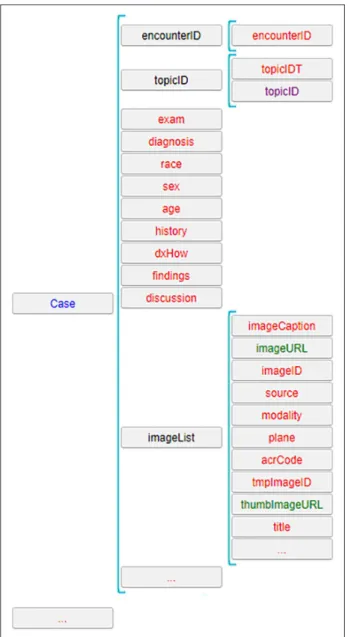
subset of clinical cases (around 6700), 4000 topics, and 1700 questions. Figure 3 shows an excerpt from the initial schema for this collection, which mirrors the basic MedPix case structure in Clavy
terms. This initial schema includes data related to the patient such as sex or age, along with more specific information such as the Findings, Diagnosis or Discussion of the case.
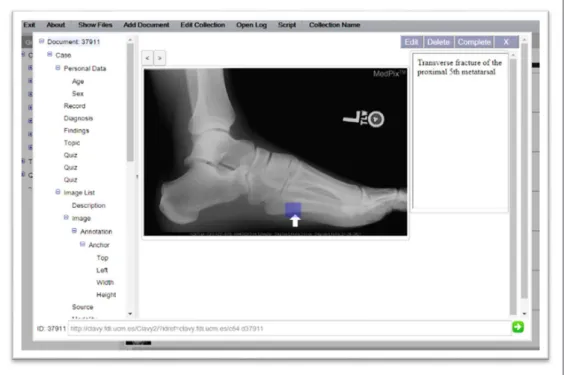
Once the content is stored as a Clavy collection, it can be curated by means of the schema and document editors. In particular, Clavy enables the integration of different types of contents that could be part of the learning objects produced. These contents can be external, with references to URL resources, or come from the same Clavy structure model in the form of annotations or links to internal resources (e.g. a list of x-ray images). For instance, Figure 4 shows a screenshot with an example of annotation incorporated in the Clavy document structure, which displays a comment over an injury detected in one of the MedPix case images. This aggregation property is very important when adding multimedia items that enrich the information model of the learning object to be generated.
Granularity
The granularity criterion addresses the definition of larger or smaller learning objects that can be used to support a fine-grain instructional process (for instance, oriented toward undergraduate students in first-year courses who learn basic medical concepts) versus a more detailed information model addressed to representing complex clinical cases to be studied by resident physicians. Clavy
deals with granularity by means of schema reconfiguration techniques.
For example, the original MedPix schema outlined in Figure 3 contained 88 elements, many of which were not excessively interesting from an educational point of view (for instance, some tech-nical details of the image list). Figure 5 shows the resulting Clavy schema after such a reconfigura-tion. The 88 initial elements were reduced to 33 items, many of them grouped in alternative structures. This reconfiguration procedure allows practitioners to choose the most suitable object
size according to their educational needs and complement such tailored information with the addi-tional data that makes up the learning object or a specific package thereof.
Interoperability
The next MASMDOA criterion to be analyzed is the interoperability provided by Clavy when
generating learning objects under several standard specifications. At this moment, Clavy is able to output collections in the form of IMS Content Packages and SCORM items by using several expor-tation plug-ins.
Figure 6 shows a screenshot that displays part of a SCORM object obtained from a MedPix case represented through a Clavy document. This object includes Quiz items, which illustrate the pos-sibilities of interaction in the learning objects generated by Clavy.
Searchability
Searchability is mainly based on the use of metadata standards that enable locating or searching for learning objects according to specific features in available repositories or collections. The MASMDOA framework represents this criterion as “locatable” property focused on metadata standards to search for learning objects and locate them. In this sense, Clavy does not currently support the use of these standards so its ability to be searched is limited to the local metadata pro-vided by the same tool.
Reusability
The final criterion to be examined refers to the capability of learning objects which can be used or deployed in learning contexts different from those originally addressed. This capability takes advantage of Clavy’s properties to generate alternative learning object structures, define several granularity levels or aggregate multiple items of multimedia information. For instance, the MedPix
example illustrates how Clavy can promote learning object reusability:
•
• In addition to controlling granularity, schema reconfiguration can be used to reorganize
learning object structure. For instance, Figure 5 makes it apparent how information concern-ing the patient in a MedPix clinical case can be grouped behind a Personal Data structural
element, which illustrates how Clavy actually lets instructors change the structure of learn-ing objects and adapt this structure to their particular instructional needs.
•
• Moreover, the same clinical case can be adapted to show basic case information to be
exam-ined or to integrate interactive quizzes to assess user understanding of the case considered, as displayed in Figure 6. That is an example of Clavy’s potential to improve the reusability of those learning objects generated as outcomes, which can be further shared in educational repositories and e-learning platforms.
Discussion
Previous sections have described an approach to generating RLOs based on the Clavy tool and a
set of criteria coming from the MASMDOA framework to analyze such a generation approach and its learning object outcomes. The current section addresses a discussion about the issues derived
from the suitability of the proposed approach and the adequacy of the analysis criteria to examine the generation of RLOs in this context.
First, the concept of learning object used throughout the article has to be viewed from a wide perspective14 that is open to multiple types of instructional materials and addressed to meeting
diverse learning goals. Thus, the concept considered is far from being bound to a specific standard with particular metadata requirements, such as those based on the IEEE LOM specification,32 and
the approach proposed fits better with the generation of learning objects whose origin can be found in existing knowledge sources. Generating learning objects is a time-consuming task so we can take advantage of the huge amount of knowledge information in available digital medical collections. Some problems derived from this situation are the high degree of heterogeneity of the aforementioned medical knowledge sources, the diversity of scenarios in which these objects can be implemented or the licensing issues associated with their usage, which were commented on by
Windle and Wharrad.19 Regarding the heterogeneity of knowledge sources, one of Clavy’s main
contributions is the possibility of managing it by means of specialized “importation” plug-ins, in order to allow practitioners to exploit the instructional value of those prestigious digital medical collections that are present in the diverse healthcare disciplines. Dealing with the heterogeneity issue, Clavy has proved to be an efficient “collector” of information that can be poorly structured in origin. This capacity to organize and reconfigure knowledge is another important contribution that enables medical information to be selected or adapted according to user requirements, either for educational or other purposes. Clavy cannot be considered a learning object repository but a tool to organize content items that after a curation process could potentially become learning objects. Thus, in Clavy terms, we are managing content elements that require previous processing in order to be further deployed in a medical learning context. One of the advantages of Clavy is that these content elements can be easily shaped to suit learning requirements in a specific health-care education scenario. In addition, this shaping or curation process leverages Clavy’s potential
to adapt or personalize such elements in a way that improves their reusability. That is a key feature in RLO generation along with the capability to export such content elements to standardized for-mats that make them interoperable in the several e-learning platforms where healthcare courses can be delivered. The future use of LOD (Linked Open Data) formats will improve the reusability and sharing capability of these medical educational resources.44 Moreover, the possibility of
add-ing or inferradd-ing new knowledge from the originally retrieved Clavy collections is another contri-bution to enhancing the reusability of the learning objects generated. Currently, in Clavy, it is possible to add annotations over the images that are part of a radiology report used for teaching and to include links to external sources such as bibliographic references to electronic medical libraries or online medical databases. In the future, such annotations could be automatically retrieved from DICOM-based imaging systems, or these bibliography references could be extracted through automatic text mining processes in such databases. These features will open new strategies for RLO generation, along with the aggregation of multimedia advances in 3D image processing, virtual reality applications or X-ray simulation tools.45
Of course, there are also limitations to the Clavy approach, which are mainly related to the searchability of its collection contents or the granular definition of the learning objects generated. At this moment, there is little concern about making these collections “searchable” since Clavy is far from being a learning repository and becoming an OER (Open Educational Resources) provider for health sciences, like those mentioned by Minter in the UNMC (University of Nebraska Medical Center) blog.46 Nevertheless, it would be feasible to incorporate some kind of standard learning
object model in medical education47 to tag the objects generated, which would improve Clavy’s
searchability and also enrich their educational contribution. Moreover, mechanisms for defining the granular level of learning object structures should be included in future versions of Clavy. An addi-tional limitation is the fact that Clavy cannot be considered a learning platform compared to those examples mentioned in section “Literature review” such as USRC36 or RadEd37 although it does
include features that could help to generate instructional mechanisms such as interactive question-naires or educational activities linked to multimedia information items. The features provided by
Clavy when generating standard specifications are in line with those recommendations for their use in the radiology e-learning context33 and in medical education in general.48 In this sense, Clavy’s
main purpose in the current work is primarily focused on leveraging this generation process from existing medical digital collections and can be considered its greatest contribution. Finally, from the review of the different quality criteria outlined throughout this “Discussion” section, we can observe the relevance of the MASMDOA framework that provides us with such criteria and a systematic procedure to apply them in order to assess the proposed RLO’s generation approach.
Conclusion
The current work has presented an approach to generating RLOs based on the deployment of a
content management tool called Clavy. This approach along with its learning outcomes has been
analyzed from a point of view based on a set of criteria adopted from the MASMDOA framework, such as the capacity to import heterogeneous medical knowledge sources, the reconfiguration abil-ity in order to shape such imported resources for different learning structures, the aggregation of various multimedia formats that can be integrated in different levels of learning object granularity or the interoperability of the learning objects generated, which allows them to be used in several e-learning platforms. Clavy has proved to be a suitable tool to produce this kind of learning objects in a user-friendly way, enabling the integration of specialized medical collections in the radiology area. Moreover, this selection of MASMDOA analysis criteria has enabled a systematic procedure
future to other healthcare educational domains. Further work will include the possibility of widen-ing the scope of medical collections to be processed or testwiden-ing the RLOs produced in specific medi-cal learning settings.
Acknowledgements
Thanks to Dina Demner Fushman from the MedPix and Open-I team.
Declaration of conflicting interests
The author(s) declared no potential conflicts of interest with respect to the research, authorship, and/or publi-cation of this article.
Funding
The author(s) disclosed receipt of the following financial support for the research, authorship, and/or publica-tion of this article: This work was supported by the Ministry of Science, Innovapublica-tion and Universities, Spain (grants numbers TIN2014 -52010-R and TIN2017 -88092-R).
ORCID iDs
Félix Buendía https://orcid.org/0000-0003-3646-4264
Joaquín Gayoso-Cabada https://orcid.org/0000-0002-1304-469X José-Luis Sierra https://orcid.org/0000-0002-0317-0510
References
1. Buendia F, Gayoso-Cabada J and Sierra JL. Generation of Standardized E-Learning Content from Digital Medical Collections. J Med Syst 2019; 43(7): 188.
2. Martin NL. The who, why and how of radiology teaching files. Radiology 1976: 119(3): 745–746. 3. Smith JK and Castillo M. Internet-accessible radiology teaching file. Emergency Radiology 1995: 2(2):
111–113.
4. Zaidel M, Hopper K and Iyriboz T. Interactive web-based radiology teaching file. J Digit Imaging 1999; 12(1): 203–204.
5. D’Alessandro MP. RadiologyEducation. com: A digital library of radiology education resources. Am J
Roentgenol 2002; 179(3): 574.
6. RadiologyEducation. http://www.radiologyeducation.com/ (accessed 10 October 2018). 7. Radiopaedia.org. https://radiopaedia.org/ (accessed 10 October 2018).
8. Radrounds http://www.radrounds.com/ (accessed 10 October 2018).
9. Choplin RH, Boehme JM and Maynard CD. Picture archiving and communication systems: an overview.
Radiographics 1992; 12(1): 127–129.
10. Halsted MJ, Moskovitz J, Johnson N, et al. A simple method of capturing PACS and other radiographic images for digital teaching files or other image repositories. American J Roentgenol 2002; 178(4): 817–819. 11. Gentili A, Chung CB and Hughes T. Use of the MIRC DICOM service for clinical trials to automatically
create teaching file cases from PACS. Radiographics 2007; 27(1): 269–275.
12. The RSNA Medical Imaging Resource Center-Teaching File System (MIRC-TFS): A Secure, Feature-rich Tool for Radiology Teaching Files. Radiological Society of North America. https://www.rsna.org/ uploadedFiles/ RSNA/Content/Informatics/RSNA_MIRC_Teaching_Files_White_Paper.pdf (accessed 10 October 2018).
13. Maldonado JJ, Fernández-Pampillón AM and Sanz CV. (2015, June). Analysis framework for tailored selection of learning objects methodologies. In: Proc. international conference on collaboration
tech-nologies and systems (CTS2015), Atlanta, Georgia, USA, pp. 148–158.
14. Ruiz JG, Mintzer MJ and Issenberg SB. Learning objects in medical education. Med Teach 2006; 28(7): 599–605.
15. Beck RJ. What are learning objects? center for international education, University of Wisconsin, Milwaukee, USA. http://www4.uwm.edu/cie/learning_objects.cfm?gid=56 (2008, accessed 10 October 2018). 16. Chen H, Moore JL and Chen W. Understand and analyzing learning objects: A foundation for long-term
substantiality and use for e-learning. Knowledge Manage E-Learning 2015; 7(2): 280–296.
17. Blake H. Computer-based learning objects in healthcare: the student experience. Int J Nurs Educ
Scholarship 2010; 7(1): e16.
18. Bath-Hextall F, Wharrad H and Leonardi-Bee J. Teaching tools in Evidence Based Practice: evaluation of reusable learning objects (RLOs) for learning about Meta-analysis. BMC Med Educ 2011; 11(1): 18. 19. Windle R and Wharrad H. Reusable learning objects in health care education. In: Organizational
learn-ing and knowledge: concepts, methodologies, tools and applications. IGI Global, 2012, pp. 966–981.
PA, USA: IGI-Global Publishing.
20. Evans C. Development and evaluation of ‘reusable learning objects’ RLOs to enhance the learning experience of international healthcare students. The Higher Education Academy. http://www.jisctech-dis.ac.uk/assets/documents/internationalisation/connections/Nottingham_Evans_Connections_Final_ Report.pdf (2013, accessed 10 October 2018).
21. Silveira HLD, Gomes MJ, Silveira HED, et al. Evaluation of the radiographic cephalometry learning process by a learning virtual object. Am J Orthod Dentofac 2009; 136(1): 134–138.
22. Kolitsky MA. Teaching anatomy online using retrieval practice, 3D stereoscopic images and virtual human fly-through videos. FASEB J 2013; 27(1 Supplement): 960–28.
23. Tamashiro LMC and Peres HHC. Development and assessment of learning objects about intramuscular medication administration. Revista Latino-Americana de Enfermagem 2014; 22(5): 716–723.
24. Goldberg S. Reusable learning objects in dementia care. British Geriatrics Society. https://britishgeriat-ricssociety.wordpress.com/2015/11/20/reusable-learning-objects-in-dementia-care/ (2015, accessed 10 October 2018).
25. Gee BM, Strickland J and Salazar L. The role of reusable learning objects in occupational therapy entry-level education. Open J Occup Ther 2014; 2(4): 6.
26. Mildenberger P, Brüggemann K, Rösner F, et al. PACS infrastructure supporting e-learning. Eur J
Radiol 2011; 78(2): 234–238.
27. Fiaidhi J, Orabi M and Mohammed S. Sharing DICOM learning objects within a mobile peer-to-peer podacasting environment. Int J Mobile Commun 2008; 6(4): 417–435.
28. Trelease RB and Rosset A. Transforming clinical imaging data for virtual reality learning objects. Anat
Sci Educ 2008; 1(2): 50–55.
29. Sendra-Portero F, Torales-Chaparro OE, Ruiz-Gomez MJ, et al. A pilot study to evaluate the use of virtual lectures for undergraduate radiology teaching. Eur J Radiol 2013; 82(5): 888–893.
30. Cosson P and Willis N. Digital teaching library (DTL) development for radiography education.
Radiography 2012; 18(2): 112–116.
31. Scarsbrook AF, Foley PT, Perriss RW, et al. Radiological digital teaching file development: an over-view. Clin Radiol 2005; 60: 831–837.
32. Kurilovas E. Interoperability, standards and metadata for e-Learning. In: Intelligent distributed comput-ing. Springer, Berlin, Heidelberg, 2009, pp.121–130.
33. Njuguna N, Flanders AE and Kahn Jr CE. Informatics in radiology: envisioning the future of e-learning in radiology: an introduction to SCORM. Radiographics 2011; 31(4): 1173–1179.
34. Wu YH, Lin SH, Chong FC, et al. An e-learning content authoring tool for transforming DICOM into SCORM. In: Proceedings of engineering in medicine and biology society, Shanghai, China, IEEE-EMBS 2005, pp. 2890–2893.
35. Schütze B, Mildenberger P and Kämmerer M. E-learning in radiology-the practical use of the content management system ILIAS; E-Learning in der Radiologie-praktischer Einsatz des Content-Management-Systems. Ilias Rofo Fortschr Geb Rontgenstr Neuen Bildgeb Verfahr 2006; 178(5): 525–530.
36. Pinelle D, Burbridge B and Kalra N. USRC: a new strategy for adding digital images to the medical school curriculum. J Digit Imaging 2012; 25(5): 682–688.
37. Xiberta P and Boada I. A new e-learning platform for radiology education (RadEd). Comput Methods
38. Wharrad H and Windle R. Case studies of creating reusable inter professional e-learning objects. In: A. Bromage L, Clouder J and Gordon TF (eds.) Interprofessional elearning and collaborative work:
prac-tices and technologies. IGI Global, 2010, pp. 260–274. PA, USA: IGI-Global Publishing.
39. Redmond C, Davies C, Cornally D, et al. Using reusable learning objects (RLOs) in wound care educa-tion: Undergraduate student nurse’s evaluation of their learning gain. Nurs Educ Today 2018; 60: 3–10. 40. Meyenburg-Altwarg I and Marschollek M. Knowledge transfer in health care through digitally collect-ing learncollect-ing experiences-results of witra care. Studies in Health Technology and Informatics 2016; 225: 287–291.
41. Coombs JH, Renear AH and DeRose SJ. Markup systems and the future of scholarly text processing.
Commun ACM 1987; 30(11): 933–947.
42. Prisciandaro JI. Review of online educational resources for medical physicists. J Appl Clin Med Phys
2013; 14(6): 368–387.
43. Indrajit IK. Web review: special atlases in radiology and imaging. Indian J Radiol Imaging 2012; 22(1): 76. 44. Dietze S, Taibi D, Yu HQ, et al. Linked dataset of medical educational resources. Br J Educ Technol
2015; 46(5): 1123–1129.
45. Kengyelics SM, Treadgold LA and Davies AG. X-ray system simulation software tools for radiology and radiography education. Comput Biol Med 2018; 93: 175–183.
46. Minter C. How to find OERs for health sciences curriculum. McGoogan Library of Medicine https:// blog.unmc.edu/library/2018/10/26/how-to-find-oers-for-health-sciences-curriculum/ (2018, accessed 10 November 2018).
47. Vaitsis C, Spachos D, Karolyi M, et al. Standardization in medical education: review, collection and selection of standards to address. MEFANET J 2017; 5(1): 28–39.
48. Konstantinidis S, Kaldoudi E and Bamidis PD. Enabling content sharing in contemporary medical edu-cation: a review of technical standards. J Inf Technol Healthcare 2009; 7(6): 363–375.