0
-1
24
3 4 4 5 6 0 3 7 5 6 5 5B
ORNLJI'M- 12408
INVENTORY MANAGEMENT PLAN
FOR
A RESEARCH AND DEVELOPMENT LOCAL AREA NETWORKDennis Strickler
Computing Applications Division Rowena Chester
Kate Ingle Pat Payne
Data Systems Research Division Jim Rome
Fusion Energy Division Kimberly Kertis
University of Tennessee
Date Published: August 1993
Prepared for the
DOE Office of Safeguards and Security Budget Actiivty No. GD 06 01 03
Prepared by
Oak Ridge National Laboratory Post Office Box 2009 Oak Ridge, TN 37831-8058 USA
managed by
MARTIN MARIETTA ENERGY SYSTEMS,
INC.
for theU.S. DEPARTMENT OF ENERGY under contract DE-AC05-840R2 1400
CONTENTS
Abstract
...
Inuoduction...
2.1 Project Background...
2.2 Objectivesof
Inventory Management...
Management Tools...
3.1 Inventory Management Database
...
3.2 Inventory Notebooks...
Hardware Control Procedures...
4.1
Hardware Changes...
4.2
Purchased Items...
Software Control Procedures...
5.1 Software Changes...
5.2 Commercial Software...
5.3
PC Software...
Contingency Planning...
Summary...
References...
1 22
2 2 4 4 7 7 7 8 8 9 9 10 11 12...
111ACRONYMS DOE DSRD ICM
IM
IMDB LAN PC PM RTM(U.S.) Department of Energy Data Systems Research Division inventory control manager inventory management
inventory management database local area network
personal computer project manager research team member
1.
ABSTRACTAn inventory management plan is presented for the local area network (LAN) for the Security Aspects of Database Management Systems, a Department of Energy (DOE)-sponsored project examining computer and network security in a data management environment. The inventory management plan establishes procedures to
ensure
that changes in system hardware and softwareare identified and controlled. Management tools are described, and the roles of the project manager, inventory control manager, and research team members in the implementation of inventory management
are
defined.2. INTRODUCTION 2 . 1 Project Background
The local area network (LAN) (Figure 1) supports a Department of Energy (DOE)-sponsored project, Security Aspects of Database Management Systems. The goal of this project is to perform research on the application of computer and network security procedures in a data management environment. The Data Systems Research Division (DSRD) will install, operate, and maintain the LAN. The research will involve the installation and evaluation of distributed, trusted database systems in a heterogeneous computing environment.
2 . 2 Objectives of Inventory Management
The objective of the inventory management (IM) plan is to provide mechanisms to ensure that changes in system hardware and software are identified and take place in a controlled manner. The application of
IM
is critical where network hardware configuration and software evaluationare important elements of the project and where, due to the nature of the research, changes occur frequently. While inventory management measures require some effort, they significantly reduce the potential for hardware and software failure, and network vulnerability.
A primary goal of the IM plan is to establish procedures and guidelines for the proposal, implementation, and documentation of inventory changes. Another goal is to establish individual roles for the program manager, inventory control manager, and research team members, so that it is clear who is responsible for each IM procedure. Specifically, in the following sections we describe (1) project IM tools, (2) procedures for hardware control, (3) procedures for software control, and (4) contingency planning.
3. MANAGEMENT TOOLS
A person having responsibility for inventory management will be designated as the inventory control manager (ICM). The ICM will maintain a set of central IM tools, including an inventory management database (TMDB) and IM notebooks containing documentation developed by research team members (RTMs). A central IM notebook will contain updated tables generated with the IMDB following significant inventory changes.
ORNL DWG 9334450 FED w LEGEND: - F F b . r W c M . d m -AU.U,c~mpCaczS MMES 1
-
-
. RS23?&&I
1099 COMT
Figure 1 DSRD Security R&D LAN3 . 1 Inventory Management Database
The ICM will develop and maintain an IMDB to store and access critical information on project resources. The IMDB will be updated regularly in order to track the status of items under inventory control.
The IMDB is a relational database using the ORACLE database management system and consists of three tables containing information on the state of (1) the network configuration, (2) project hardware, and (3) project software. The IMDB is created, queried, and manipulated using the standard language SQL. This implies a great deal of flexibility, in that the IMDB may be easily ported to different nodes with varying machine architectures and database management systems. The IMDB contains project-specific information such as purchase data, installation notes, property identification numbers, and network addresses. The SQL tables, relating the elements of hardware and software fields to their network node, are described in Tables 1-3.
3 . 2 Inventory Notebooks
A central IM notebook will be maintained by the ICM and stored in a locked cabinet in the office of the ICM. The central notebook will contain a copy of the Local Area Network (LAN) plan,' including a network description and configuration drawing. The central IM notebook will also contain tables, generated with the IMDB following a significant inventory change, summarizing the present state of network hardware and software.
IM node notebooks, clearly labeled with the network node name (e.g., DSROC6), will be maintained by the ICM and located on a shelf in the office containing the equipment associated with that node. The node notebooks will contain more detailed documentation (e.g., installation notes, defaults taken) specific to that node and will be updated by the RTM who is responsible for a particular hardware or software change.
fl
Table 1. The node tablefl
Column Field Name Format1 Node name 2 Computer type 3
P
address 4IP
name 5 Hardware address 6 Registered user 7 Registered User ID 8 Location (building) 9 Room 10 Operating system 11 Version number 12 Memory size 13 Disk space 14 System notes NODENAME COMFTYPE PADDR IPNAME HARDADDR USERNAME USERID BLDG ROOM OPEX-SYS VERSION MEMORY DISKSIZE NOTES CHAR(6) CHAR(20) CHAR( 15) CHAR(2 1) CHAR( 12) CHAR( 20) CHAR( 12) CHAR( 12) CHAR(6)CHAR(
12) CHAR( 12) NUMBER( 10) NUMBER( 10) CHAR(100)R
Table 2. The hardware table1
Column Field Name Format1 Hardware
2 Installed on node (name) 3 Manufacturer
4 Model
5 Serial no. 6 Property no.
7 Capital equipment no. 8 Purchase requisition no. 9 Purchased from (vendor) 10 Date ordered 11 Date received 12 Date installed 13 Price 14 Comments
HARDWARE
NODEWAME MANUFACT MODEL SERIALNO PROP-NO EQUIP-NO P-REQ-NO VENDOR P-DATE R-DATE I-DAlX PRICE NOTES CHAR(20) CHAR(6) CHAR(20) CHAR( 12) CHAR(20) CHAR(8) CHAR(8) CHAR( 12) CHAR(20) DAW5 DATE DATE NTJMBER(8,2) CHAR( 100) 5I
Table 3. The software table11
Column Field Name Format1 2 3 4 5 6 7 8 9 10 11 12 13 14 15 16 17 Software (name)
Installed on node (name) Version Serial number Developer Media (typenocation) Location of manuals Installation date Modification date Deinstallation date Installation path (loc.) Installation instructions
(ref. to config. notes) Purchase req. no.
Vendor Price
License conditions (internaVcommercial)
maintenandupgrade notes (e.g., eligibility, license, when purchased, when performed) Comments SOFTWARE NODENAME VERSION SERIALNO DEV-NAME
MEDIA
DOC-LOC I-DATE M-DATE D-DATE INSTPATH INST-REF P_REQ-NO VENDOR PRICE LICENSE NOTES CHAR( 20) CHAR(6) CHAR( 12) CHAR (20) CHAR(20) CHAR(40) CHAR(40) DATE DATE DATE CHAR(40) CHAR(40) CHAR( 12) CHAR(20) CHAR( 10,2) CHAR(40) CHAR( 100) 64. HARDWARE CONTROL PROCEDURES
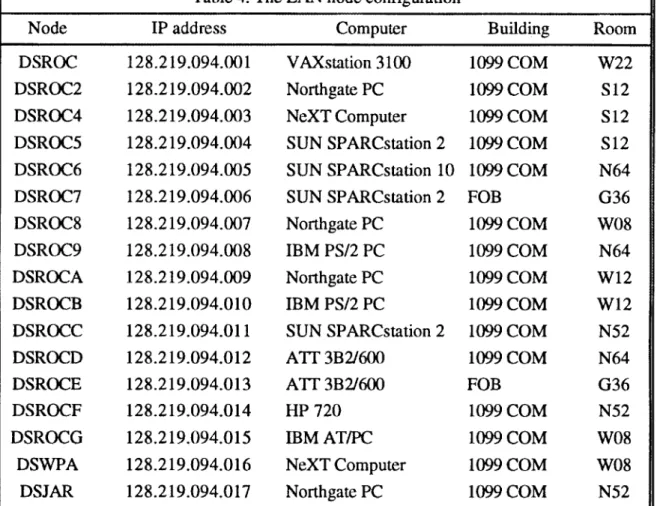
A baseline hardware inventory is defined by the project hardware configuration at the time the LAN plan is implemented. The baseline network node configuration is given in Table 4. Changes to this baseline include, for example, upgrading a workstation architecture, adding a tape drive, or moving a disk from one machine to another. Specific procedures must be followed
in order to maintain control over the evolution of the network hardware. 4 . 1 Hardware Changes
The
IM
procedure for control of hardware modifications to the network is as follows:1. Proposals to change the hardware configuration will be reviewed with the project manager (PM) and RTMs.
The
RTM
implementing a change will notify the ICM when the change is made, providing the necessary data for updating the IMDB.The
RTM
implementing a change will provide the appropriate documentation (e.g., installation notes, property transfer records) in theIM
node notebook.The person with responsibility for IM will modify the IMDB, generate and print tables describing the present state of the network hardware, and replace these tables in the central
IM
notebook.2. 3. 4.
4 . 2 Purchased Items
Additional procedures are required to control hardware changes involving new purchases. These procedures will be carried out by the
RTM
responsible for the purchase:1.
2.
Purchase orders and warranty information will be given to the PM.
Copies of purchase orders and warranty information will be given to the ICM, who will retain them in the IM node notebook and use information from them to update the IMDB. The ICM will be notified when the purchased items are received and when they are installed.
The ICM will be provided with any available information on product support and/or vendor contacts (e.g., name, phone, date of contact) to include in the
IM
notebook near the network node.3.
4.
Table 4. The LAN node configuration
Node IP address Computer Building Room
DSROC DSROC2 DSROC4 DSROC5 DSROC6 DSROC7 DSROC8 DSROC9 DSROCA DSROCB DSROCC DSROCD DSROCE DSROCF DSROCG DSWPA DSJAR 128.2 19.094.001 128.219.094.002 128.219.094.003 128.219.094.004 128.219.094.005 128.219.094.006 128.219.094.007 128.2 19.094.008 1 2 8.2 19.094.009 128.2 19.094.01 0 128.219.094.01 1 128.2 19.094.012 128.2 19.094.01 3 128.2 19.094.014 128.2 19.094.015 128.2 19.094.01 6 1 2 8.2 19.094.0 1 7 VAXstation 3100 1099 COM Northgate PC 1099 COM NeXT Computer 1099 COM SUN SPARCstation 2 1099 COM SUN SPARCstation 10 1099 COM SUN SPARCstation 2 FOB Northgate PC 1099 COM
IBM PS/2 PC 1099 COM
Northgate PC 1099 COM IBM PS/2 PC 1099 COM SUN SPARCstation 2 1099 COM ATT 3BY600 1099 COM
ATT 3BY600 FOB
HP 720 1099 COM
IBM AT/PC 1099 COM
NeXT Computer 1099 COM Northgate PC 1099 COM w 2 2 512 512 512 N64 G36 W08 N64 w12 w12 N52 N64 G36 N52 W08 W08 N52 5. SOFTWARE CONTROL PROCEDURES
The baseline software inventory is defined as the system and application software at the time the LAN plan is implemented. Changes will occur frequently and may include, for example, the installation of a new operating system, operating system security patches, a new version of the database management system, or changes in the network backup software. The software inventory includes internally developed tools, shareware, and commercial software products.
5 . 1 Software Changes
In general, the procedures listed here apply to commercial products and system software, and not to temporary routines developed and used by individuals in their user directories. The procedure for software inventory control is as follows:
Proposals to install or deinstall commercial and/or system software will be reviewed by the PM and RTMs.
The RTM implementing a software change will notify the ICM when the change is completed, providing the necessary data for updating the IMDB.
The person implementing the change will log detailed instructions for the installation and use of the software, including references to existing documentation, in the IM node notebook, and sign and date the log. Installation media will
be
placed in a locked cabinet. The ICM will updatethe
IMDB,
generate and print tables reflecting the present state of the network software, and replace those tables in the central IM notebook.Commercial Software
Additional procedures are required to control changes involving commercial software. These procedures will be carried out by the
RTM
responsible for the purchase:1.
2.
Purchase orders and license documentation will be given to the PM.
Copies of purchase orders and license agreements will be given to the ICM, who will place them in the IM node notebook and use the purchase information to update the
IMDB.
The ICM will be notified when the purchased items are received and when they are installed.
The ICM will be given any available information on product support and/or vendor contacts to include in the
IM
node notebook.3.
4.
5 . 3 PC Software
1. Personal computer (PC) self-audit software will be used to check network PCs for software license compliance. PCs will be audited by the ICM at least four times per year. PCs assigned to an individual
RTM
are subject to inspection at any time, andthe
RTM is responsible for license compliance. PC software license information andlordocumentation will be stored in a cabinet in the same office as the equipment. Prior to the installation of
PC
executable software, a virus check will be made. 2.6. CONTINGENCY PLANNING
A fireproof and waterproof project safe is used to store system backup tapes and logs. In addition, copies of critical and non-replacable installation notes and procedures from the node notebooks will be retained in the safe. Software and files can be restored to existing or alternate hardware in the case of file destruction or if disaster recovery is necessary.
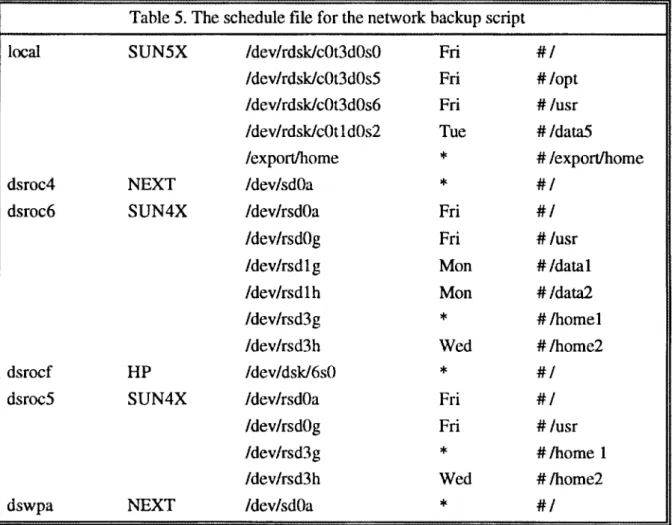
Specific workstation file systems are backed up according to a designated schedule. A network backup script, running the UND( dump utility remotely under rsh, is executed by the cron utility five nights per week. An example of the backup schedule, an input file for the backup script, is given in Table 5. Backup tapes will be replaced daily, and backup tapes and logs will be stored in the project safe on a daily basis, by a designated
RTM.
Table 5. The schedule file for the network backup script SUNSX /dev/rdsk/cOt3dOs0
/dev/rdsk/cOt3dOs5 /dev/rdsk/cO t 3dOs6 /dev/rdsk/cOt 1 dOs2 /exporthome
dsroc4 NEXT /dev/sdOa
dsroc6 SUN4X /dev/rsdOa
/dev/rsdOg /dev/rsd 1 g /dev/rsd 1 h /dev/rsd3g /dev/rsd3 h dsrocf HP ldevldsW6sO
dsroc5 SUN4X /dev/rsdOa
/dev/rs dog /dev/rs d3 g /dev/rsd3 h
dswpa NEXT /dev/sdOa
Fri Fri Fri Tue
*
*
Fri Fri Mon Mon*
Wed*
Fri Fri*
Wed*
# / ##/opt ## /usr # /data5 # /expodhome # / # / ## /usr # /datal ## /data2 # home1 # /home2 # / # / # /usr #/home 1 # home2 # / 107. SUMMARY
An inventory management plan
has
been developed to identify and control LAN system changes. Procedures are designed to provide inventory management in a dynamic research and development network environment. The roles of project members in the implementation ofinventory control are defined.
8. REFERENCES
1. Kate Ingle, "LAN Plan for the Security Aspects of Database Management Systems," in preparation.
Configuration Management in Trusted Systems, NCSC-TG-006, vol. 1, National
Computer Security Center (March 28,1988).
Automated Data Processing Systems Development Methodology, WCSD/INF/86-3, Vol.
1, R3, Martin Marietta Energy Systems, Inc. (March 1990).
Manual of Security Requirements for the Classified Automated Information System
Security Program (Draft), DOE M 5639.6A-1, U.S. Department of Energy (December
21, 1992).
Barb King et al., Central Waste Management Division Waste Management Support
Network Configuration Management Plan (Draft), WDSRD, Martin Marietta Energy
Systems, Inc. (March 1993).
2.
3. 4.
5 .
1-5. R. 0. Chester 6. JimRome
7.
K.K.Kertis 8. P.W.
Payne 9. K. A. Ingle 10-14. D.J. Strickler 15. J. A. Holmes 16.R.
H. Fowler 17. G. E. Whitesides 18. Richard Ward 19. Ken Childs 20. Lester Petrie INTERNAL DISTRIBUTION 2 1-
Johnny Tolliver 22. Eddy Ford 23. Suzanne Walters 24. Laboratory Records, O W - R C 25-26. Laboratory Records Department27. Central Research Library 28. Document Reference Section 29. ORNL Patent Office
EXTERNAL DISTRIBUTION
30. Office of the Assistant Manager for Energy Research and Development,
US.
Department of Energy Field Office, Oak Ridge, P. 0. Box 2000, Oak Ridge, TN 3783 131. W. G. Watson, Department of Energy, Federal Building, Oak Ridge, TN 37830-8571,
Room
G-02032. Q. Nguyen, Department of Energy, Federal Building, Oak Ridge,
TN
37830-8571,Room G-030
33-34. Office of Scientific and Technical Information, P. 0. Box 62, Oak Ridge, TN 3783 1