Introduction
Contents
Definition SNA
Levels of Analysis
Research Interest
Social Network Analysis
When shown an organizational chart of their social system, most of its members will reply that in reality, information flows quite differently. These informal paths build a so-cial network that is not recorded anywhere, yet significantly contributes to a system's performance and effectiveness.1 For this reason, it is important that the leadership of an organization, (1) is aware of the importance of those informal networks, (2) is inten-tionally integrating them into the everyday working process, and (3) is reducing possi-ble obstacles and hurdles.
The social network analysis (SNA), as a theoretical concept and a practical tool, pro-vides assistance with this challenge. Below, this sociological approach will be defined, its objectives outlined, the methodological procedure explained, and its advantages and disadvantages will be pointed out in order to establish a basis for all members of the HFM / RTG-163-project to form an opinion about and come to a decision on whether the SNA is the most appropriate instrument for improving organizational effectiveness of coalition operations.
Contents
1. What Is Social Network Analysis?
2. Linking Social Network Analysis and Organizational Effectiveness 3. Implementing A Social Network Analysis
4. Valuation, Alternative, and Recommendation 5. References and Bibliography
1. What Is Social Network Analysis?
The SNA emphasizes the importance of networks, i.e. the importance of the em-beddedness of individual or organizational actors in their social framework. Because of this focus, the SNA is the only socioscientific method which deals with relations be-tween actors instead of dealing with their traits. Wasserman and Faust2 credit this rela-tional perspective with the following assumptions: (1) Actors and their behaviors are regarded as being interdependent. (2) Relations between actors are channels of trans-fer or resource flows. Based on these statements, a SNA should reveal relational pat-terns for the purpose of learning about the capacity and effectiveness of a network consisting of these relations. Linked to this is a third assumption stating that (3) the whole is more than the sum of its parts - thus, that the network does possess charac-teristics that single actors might not hold.3 Hence, the SNA functions as a hinge be-tween the micro-level of the actor and the macro-level of society's structure in which he/she is embedded. The social network conciliates in both directions. On the one hand, it imparts norms and expectations of society towards the individual actors, and thereby controls and canonizes their behavior. On the other hand, the actors do not primarily form a society, but a loose network which only in a next step develops into a consistent and independent institution.4 In short, the SNA is concerned with the question of what the social network serves the single actor, how it is influenced by him, how he shapes it and what part he plays in it.
Because of this hinge-like function, the SNA can be conducted at different levels of society. Potential actors not only are individuals, but also organizational departments or even entire states, etc. Actors are the nodes of a network that are to be investigated and its outgoing connections. The typical five levels of analysis are: (1) The dyad, the smallest unit possible. It is a connection between two actors. (2) The triad, consisting of three nodes. (3) The ego-centric network, consisting of a focal actor (Ego), his direct contacts (Alter) and the relations between them. (4) The group (Clique) within a net-work, and finally, (5) the whole or complete network.5
In an SNA, an analyst can focus on either of two areas of interest: Either he/she just wants to observe and describe what the network looks like and consequently explain
Range of Application Basic Assumption Definition of Effectiveness Conclusion
the structure, or he/she goes one step further and is also interested in the conse-quences of a network, such as its impact on the effectiveness of an organization. Regarding the content, the SNA is applied to all topics social scientists are traditionally interested in. For this reason, the applications in science and practice cover a multitude of fields (from the diffusion of innovations over company ties to peace research) – as this network-analytical perspective is perceived as an enrichment to the other trait-focused approaches. In our case, applications concerning the importance of informal networks for the effectiveness of organizations are of particular interest. This will be addressed in the following paragraph.
2. Linking Social Network Analysis and Organizational Effectiveness
The assumption of the SNA concerning cooperation in organizations is that the types and intensities of individual relationships in the social network form the key factors for their effectiveness.6 Evidence supporting this assumption is to be found in most of the literature. Cross and Parker7, for example, confirm the hypothesis noting that well-funded and managed network connectivity is critical to effectiveness, learning and in-novation, and that the SNA helps to identify and resolve weak points and obstacles in a network. Boskamp8 also stressed the importance of informal networks by suggesting to deliberately promote them to enhance organizational effectiveness. He justifies this with the fact that exclusively linear communication flows along hierarchical lines have been proven not to be very effective. Ashworth and Carley9, however, warn against the rash conclusion that effectiveness is exclusively ascribed to the influence of a network, because also non-social factors such as resources and attributes of the task and the context contribute significantly to it.
The measurement of organizational effectiveness must be started with a discussion of the definition of this term. The reason for this is that a meaningful link between SNA and the aim to improve an organization's effectiveness is largely dependent on how effectiveness is defined and operationalized. Is effectiveness (1) the fruitful co-operation of partnerships and alliances - investigated by the flow of information, knowl-edge, problem solving or decision-making? (2) Or is effectiveness understood as achieving an organization's strategic objectives which have been well defined in ad-vance? (3) Could effectiveness also be defined as high quality of decision-making at leadership level? In this context, connections of the leadership, their embeddedness in the network, and the way information enters and leaves the net plays an important role. (4) Or can effectiveness be understood as the conducive integration of informal net-works - operationalized as transfer of knowledge and information and functional, hier-archical, and physical obstacles which are hampering them? (5) Or is effectiveness the rapid diffusion and integration of innovations? The latter is a process that depends on a network’s awareness of the diverse expertise within itself and the actual application of this.10 Creech and Ramji11 explicitly point out that the definition of organizational effec-tiveness and its indicators must be found in cooperation with the members of the inves-tigated organization.
To sum up, the SNA is often used to investigate the organizational effectiveness and the assumption was proven correct that a widely ramified and well managed informal network indeed contributes to its improvement. The SNA can demonstrate how a net-work is designed, where its strengths and weaknesses lie and what development po-tential exists for effective integration into the organizational structures. But the results are strongly influenced by the definition of the dependent variable "effectiveness". For a more holistic analysis of effectiveness, it is also recommendable to include the influ-ence of resources and task characteristics into the investigation.
3. Implementing A Social Network Analysis
If it has been decided to apply an SNA, its actual realization has to be planned. In their book The Hidden Power of Social Networks12, Cross and Parker provide a good over-view of this process. This section provides a brief outline of these six stages.
Identifying A Strategically Important Network within An Organi-zation Data Collection: Estimation of Meaningful Relationships Visualization of Data
(1) The first step of implementation is the identification of a group in which successful cooperation is very important for the organization. Normally, the benefit of an analysis gets bigger if it is not based on the formal organization, but if informal networks are involved that are strategically and operationally significant for the system and possibly cross functional, hierarchical and physical boundaries.
It is also important to pay attention to the size of a network. Theoretically, an SNA can be conducted with a whole organization, i.e. with a complete network. In practice, how-ever, it is advisable to focus on a subgroup of the organization and to limit the size to a maximum of 250 persons in order not to put too much strain on the participants’ moti-vation, because an analysis should contain the entire information about every interac-tion of each individual member with each other member.
Therefore, it is essential to strike the difficult balance between (a) a well demarcated and meaningful object of investigation and (b) an object that still meets the claim of the SNA that the sum of its parts makes a statement about the whole. When limiting on a subgroup of an organization, it is particularly important that no links between the vari-ous actors are left out. If such a bridge is missing, the results of the analysis will make false statements about the network.
(2) The second step of an SNA is the collection of data needed to map the relations within the network. As mentioned in the previous section concerning organizational effectiveness, there are relationships that reveal cooperation, goal achievement, quality of decisions, integration of informal networks, or the integration of innovations. In addi-tion, there also exist relationships that allow statements about the stability of a network or about well-being and social assistance.
Mostly, the data is collected by means of a paper-pencil- or an online-survey. Under special circumstances or data records there are also studies which use oral interviews, observations, documentary analysis (such as minutes, e-mail correspondence, diaries, etc.) or experiments. The diversity of the application range of the SNA allows no stan-dard survey tool, but the instrument must be specifically designed for each investiga-tion. The literature provides hints and clues for formats and formulations of questions. Generally, the procedure is that the persons to be surveyed either get a list of names of their network or have to generate the names themselves. Subsequently, they are asked about their relationships with these (potential) cooperation partners. The ques-tions can roughly be categorised into (a) status generators that produce an evaluation of the relationship or (b) into resources generators that provoke a statement about the person’s capabilities and resources.
It is considered as very difficult and complex to collect qualitatively outstanding data within the scope of an SNA. The biggest problem is that the SNA provides no strategy to deal with missing data. Therefore, it is extremely important that all members of a network are investigated. With an incomplete data record, valid statements about the network can not be formulated. The project HRM / RTG-163 hinders the fulfilment of this condition by the fact that people generally do not like to make statements about third parties - certainly not in the context of work or under pressure. In NATO Head-quarters (HQ) both circumstances are unfortunately given.
(3) The fact that the collected data is very complex requires illustrative methods, so that the results are more tangible. Thus, the visualization of the results is inseparably con-nected to the methodology of SNA. Generally speaking, social networks can be repre-sented as graphs. A graph is a set of vertices and edges which represent the connec-tions between the vertices.13 Special computer programs create two- or three-dimensional maps out of the scientific data.a Out of this sociograms can be read the roles of actors, their centrality, and prestige. For a more detailed analysis and for an-swering a research question, a tabulation of the calculated values is preferable. Two other arguments also militate in favor of a mathematical analysis: (a) An illustration of networks with more than 40 members gets very confusing. (b) This confusion can lead
a
A comprehensive overview of software packages (e.g. NetMiner, UCINET, Pajek, etc.) offers the website <http://www.insna.org/software/software_old.html> or <http://www.insna.org/software/
Quantitative Anal-ysis of The Data
Feedback-Workshops
Evaluation of Im-proving The Or-ganizational Effec-tiveness
Advantages
Disadvantages
to a skewed perception of the network - only patterns that match with the preconcep-tion of the analyst will be identified.
(4) With the data obtained, countless evaluations can be done. Appendix A provides a table that briefly introduces the most important key metrics. These measures give an idea of the extent of statements that can be made about social networks. To calculate these data, the above-mentioned software programs can also be used. Despite the numerous calculations which can be made within an SNA, it is important to emphasize that the effects on their results usually turn out to be relatively small. “Blockbuster” re-sults cannot be expected.
(5) Although the visual as well as the quantitative analysis of network data is a very useful way to understand the relationship between actors, they do not necessarily ex-plain why certain links do or do not exist, or why some groups are more successful and powerful than others. To get a better understanding of the dynamics behind a network, a feedback workshop with various members of the network is performed in a fifth step. Among the participants should be both central and peripheral members from each hier-archical level some of which have been members of the network for a long time and some of which have only recently joined the network.
Such workshops include two parts: The first part is an introduction to the method of SNA and a presentation of the main results of the participants' network. In the second half of these feedback workshops, participants are divided into smaller groups and asked to brainstorm on how to promote adequate connectivity and how to ensure that the organizational context does not urge the network back into inefficient patterns. Af-terwards these ideas are gathered in a plenary session. The proposals are then used as a basis for formulating an action plan to improve group performance and effective-ness.
Thus, these workshops are both a diagnostic tool for detecting vulnerabilities and needs for action as well as a first step towards improving cooperation within a network. (6) A social network analysis provides only a snapshot of a network. By repeating the survey after several months, it can be shown whether changes in the network have already become apparent due to the measures taken. Thus, the subsequent analysis serves as evaluation of the action plan which has been formulated to increase the ef-fectiveness of networks.
With this sixth and last step an SNA is completed.
4. Valuation, Alternative, and Recommendation
To decide whether an SNA is applicable in a particular case, it is advisable to know its pros and cons. This last section sums up the practicability of this method in the frame-work of the HRM / RTG-163-project. Its advantages are:
The SNA is the only method in social sciences that allows investigating relation-ships between actors and social processes.
With high-quality network data, many meaningful calculations can be made. Based on these results the network and the underlying dynamics can be demonstrated exactly and clearly.
The SNA permits investigations at both the macro as well as at the micro level. That means either a single actor and his personal network, or a total network can be in-vestigated.
Thanks to the focus on the connections between actors, the SNA impartially uncov-ers critical hidden links and weaknesses. Therefore, it enables the development of measures to improve the organizational cooperation and effectiveness.
So, the SNA is an enrichment for the instruments of social sciences. But it also brings about some practical disadvantages - particularly regarding an investigation of a NATO HQ.
The SNA is a very laborious and complex method which is not easy to apply. This difficulty is further reinforced by the fact that there is no SNA specialist in the HFM / RTG-163-team. An application to such a large and extensive investigation object like a NATO HQ is practically impossible for scientists not familiar with the method
Preconditions
Alternative: A Classic Survey Study
of SNA.
Another difficulty in implementing an SNA is that networks often are not explicitly definable because there are no clear boundaries regarding communication flow and cooperation. A NATO HQ is not operating in a vacuum. It cooperates with host and sending nations, UN agencies, with private military partners, civilian partners, the media and the local population. Including these cooperation partners into the inves-tigation is not feasible in practice. Thus, a part is torn out of the whole – a fact that contradicts the basic assumption of SNA that the whole is more than the sum of its parts.
The data collection is also hampered by the fact that the SNA demands high-quality and complete data. It does not allow for missing data. In a NATO HQ, where (1) personnel work under pressure and in uncertainty, and (2) where people are de-ployed only for a few months the claim of a complete data set will hardly be met. In the context of coalition operations the collection of data could also be affected,
because people questioned in such an environment might not be willing to provide information on interaction partners on whom their personal safety is dependent. The results of an SNA often show a yield not proportional to the effort. Frequently,
there are only very marginal effects.
Furthermore, network data alone is often not meaningful enough. For a compre-hensive investigation of an organization, information about individual characteristics of the actors, context variables and task attributes are necessary, too. Therefore, it would be ideal to consider the SNA as an addition to the otherwise trait-focused methods of social sciences.
It seems that there are also difficulties in including the SNA into a coherent cause-effect-diagram of preconditions/context and effectiveness in order to draw meaning-ful conclusions.
The fact that deployments in NATO HQ are limited to a few months puts into ques-tion whether under such circumstances networks are created that significantly influ-ence the efficiency and effectiveness of a HQ.
The inconstancy of a HQ over time also affects the results' significance. Step 5 (feedback-workshop) and 6 (evaluation) of an SNA would possibly not be con-ducted with the people previously questioned because they would already have left the HQ. Finding and reaching those people in their new jobs is expected to be diffi-cult and cumbersome.
This valuation results in a very mixed picture of the usability of the SNA in our context. On the one hand the method achieves results that no other social scientific instrument is able to produce. On the other hand, these results are only meaningful under very strict conditions.
Before coming to a final recommendation for an application of SNA, at least two condi-tions must be clarified: (1) To provide a complete data record it must be clarified whether all members of a NATO HQ can be obliged to give full particulars about their networks. (2) To achieve meaningful conclusions it must be examined what kind of re-lationships are directly linked to effectiveness. Only if both conditions are met and the remaining difficulties and the above mentioned disadvantages of the method are ac-cepted does it make sense to apply the SNA.
A meaningful and advisable counter-proposal to the SNA will now be presented, so that the decision on which method is applied to the project is not only based on one-sided information. An alternative to the application of a SNA would be a classic survey study, based on a regression model.
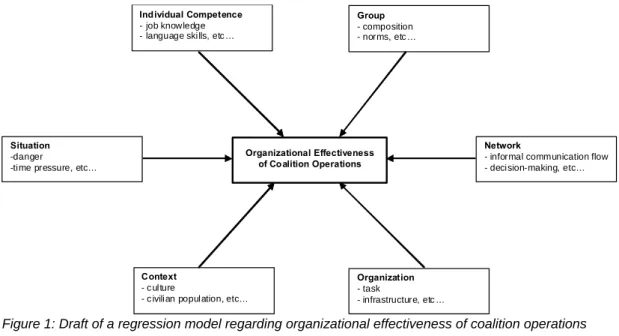
The regression analysis is a statistical method with the objective to learn more about the relationship between one or more independent, explanatory variables and a de-pendent variable of interest. Thereby can be identified the quantitative "net impact" of the independent variables on the target variable. In the case of HFM / RTG-163 the influence of factors such as individual competence, group, organization, context, and situation could be included into the investigation - as a matter of course along with the influence of social network aspects. To illustrate this idea, Figure 1 shows a draft of such a regression model regarding organizational effectiveness of coalition operations.
Figure 1: Draft of a regression model regarding organizational effectiveness of coalition operations To fill such a model with content, a theoretical basis is needed. In the case of organiza-tional effectiveness, the following theoretical approaches could be combined and de-veloped into a tailored model for the HFM / RTG-163-project:
The Command Team Effectiveness Model (CTEF)14 is applied to evaluate, monitor, and promote the effectiveness of teams. It presumes that effective commanders need to understand: (1) the conditions they start with (context, organization, and people), (2) the behaviours and processes that occur in the course of the operation, (3) how the outcomes are measured, and (4) what processes and conditions must be adjusted to improve the effectiveness.
The Five-Factor-Model of Leadership15 states that a competent leadership of a mis-sion is based on more than just individual skills. In addition to this factor, the organ-isational effectiveness of a coalition operation is also influenced by (1) the ability to understand and manage the dynamics of a team, (2) the capacity to work in a given organizational framework or even to improve it, (3) the understanding of the general context, and (4) the ability to make appropriate situational assessments.
The theoretical Model of Mission Effectiveness16 helps to determine the best condi-tions for a successful mission. The model differentiates between objectives and means that lead to effectiveness. It assumes that general (e.g. training, experience, responsibility distribution, communication) and functional resources (equipment, hi-erarchy, information) influence objectives and their achievement.
The SNA supplies an important component for designing a model. The hypothesis is that the density and the intensity of the informal network within an organization or operation is the major factor for organizational effectiveness.
An aggregation of these approaches to a consistent and well-arranged model which is successfully applied to a complex multinational research subject like a NATO HQ would not only be an added value for future design and concept of coalition operations, but also for research on international organizations.
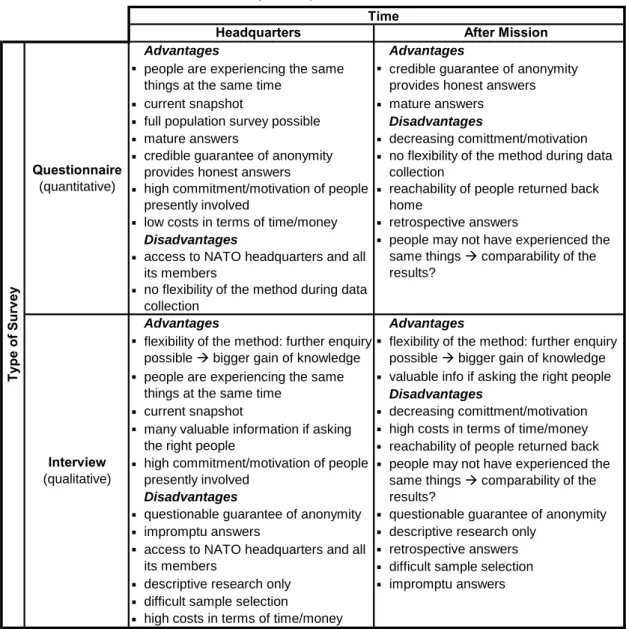
As mentioned, the best way to collect data on these factors is to conduct a survey. There exist different versions: One can roughly differentiate between written and oral surveys. In the context of the HFM / RTG-163-project, the question arises whether col-lecting the data directly in a HQ or asking the people after their deployment. The sub-sequent 2x2-table (Table 1) provides information about the advantages and disadvan-tages of the different variants:
Organizational Effectiveness of Coalition Operations
Network
- informal communication flow - decision-making, etc… Situation
-danger
-time pressure, etc…
Group - composition - norms, etc … Individual Competence
- job knowledge - language skills, etc …
Context - c ulture
- c ivilian population, etc…
Organization - task
Table 1: Pros and cons of the different survey techniques ▪ ▪ ▪ ▪ ▪ ▪ ▪ ▪ ▪ ▪ ▪ ▪ ▪ ▪ ▪ ▪ ▪ ▪ ▪ ▪ ▪ ▪ ▪ ▪ ▪ ▪ ▪ ▪ ▪ ▪ ▪ ▪ ▪ ▪ ▪ ▪
high costs in terms of time/money
people may not have experienced the same things Æ comparability of the results?
impromptu answers descriptive research only difficult sample selection mature answers
credible guarantee of anonymity provides honest answers
Disadvantages
retrospective answers
questionable guarantee of anonymity Questionnaire (quantitative) Interview (qualitative) current snapshot mature answers
credible guarantee of anonymity provides honest answers
decreasing comittment/motivation no flexibility of the method during data collection
Advantages
reachability of people returned back home
people may not have experienced the same things Æ comparability of the results?
reachability of people returned back decreasing comittment/motivation flexibility of the method: further enquiry possible Æ bigger gain of knowledge valuable info if asking the right people current snapshot
access to NATO headquarters and all its members Ty pe of S u rv ey ▪ ▪
access to NATO headquarters and all its members
no flexibility of the method during data collection
people are experiencing the same things at the same time
descriptive research only
questionable guarantee of anonymity
Advantages
people are experiencing the same things at the same time
full population survey possible
difficult sample selection
Disadvantages
impromptu answers
high commitment/motivation of people presently involved
low costs in terms of time/money
flexibility of the method: further enquiry possible Æ bigger gain of knowledge
Advantages
Time
high commitment/motivation of people presently involved
Disadvantages
many valuable information if asking the right people
high costs in terms of time/money After Mission
Advantages
Disadvantages
retrospective answers Headquarters
The comparison of the different survey techniques in Table 1 strongly suggests collect-ing the data with a written questionnaire on-site in a NATO HQ. The reason for this is that the method allows surveying all members of a HQ within a reasonable period of time and involving reasonable cost and effort. The advantage is that all the surveyed people subject themselves to similar conditions and that they all experience the same events. Since the survey content deals with their current situation, their motivation is definitely higher if they are asked on-site than if they are questioned in retrospect. The convenience of a close-ended questionnaire compared to a (guided) interview is that (1) the responses are more considerate, (2) the guarantee of anonymity appears more credible, and (3) the answers are easier to quantify and compare. The only obstacles that must be overcome are (1) the access to a NATO HQ, and (2) the inflexibility of a close-ended questionnaire. The access is expected to be granted as this study is con-ducted within a NATO Research Task Group. The problem of inflexibility can also be eased with a thorough and constructive pretest and a well elaborated and comprehen-sive questionnaire.
The procedure in a survey would roughly be that: (1) The purpose of the survey and the expectations regarding the results are clarified. (2) In a next step the target variable organizational effectiveness is precisely defined and described. (3) Based on this con-cept designation, possible influencing factors are identified consulting the relevant lit-erature and through conversations with experts, assumptions about their impact on effectiveness are made, and theoretical relationships are revealed. (4) Subsequently,
Comparison be-tween SNA and A Classic Survey Study
Recommendation
these factors are made measureable by a well-founded operationalization and ques-tionnaire. (5) After the survey, the data is statistically evaluated; i.e. a regression analy-sis is made. It will show the influence of various factors on organizational effectiveness. (6) Following the interpretation of the results, measures to improve the effectiveness can be planned and implemented and an evaluation of these measures can control their possible effect.
The advantages of a questionnaire over an SNA are: (1) The results are more multifac-eted because several factors are taken into consideration. The social network is not solely held responsible for the effectiveness of a coalition operation. (2) A questionnaire is easier to apply and usually produces more significant effects. (3) A written survey is also suitable for very large objects of investigation, like a NATO HQ. With an increasing number of respondents, results and comparisons get even more meaningful. (4) The anonymity of the survey – in the context of a NATO operation surely desired by the respondents – can be better ensured within the framework of a classic survey than an SNA. The investigation of a social network is even based on function and position of each individual. (5) Another advantage is that a classic survey study is less costly and time-consuming – certainly not an insignificant factor for a limited project.
For all these reasons, we recommend renouncing the application of SNA. Its compli-cated application, its marginal effects, and its high demands on the data could make achieving the project objectives difficult. A classic, written survey on-site shall be con-ducted instead of an SNA. This questionnaire will be based on a theoretical model with diverse factors influencing organizational effectiveness - including social network as-pects. With the implementation of such a survey, the conditions for a comprehensive and meaningful investigation would be met. So, the measures to improve the organiza-tional effectiveness of coalition operations could be formulated and taken based on meaningful and strong results.
5. References and Bibliography 1 C
ROSS, R. & PARKER, A. (2004). The Hidden Power of Social Networks: Understand-ing How Work Gets Done in Organizations. Boston: Harvard Business School Press, p. vii.
2 W
ASSERMAN, S. & FAUST, K. (1994). Social Network Analysis: Methods and Applica-tions. Cambridge: Cambridge University Press, p. 4.
3 J
ANSEN, D. (2003). Einführung in die Netzwerkanalyse: Grundlagen, Methoden, For-schungsbeispiele. Opladen: Leske + Budrich, p. 13.
4 W
EYER, J. (2000). Kapitel X: Soziale Netzwerke als Mikro-Makro-Scharnier. Fragen an die soziologische Theorie. In: J. WEYER (Hrsg.), Soziale Netzwerke: Konzepte und Methoden der sozialwissenschaftlichen Netzwerkforschung (S. 237-254). München: Oldenbourg, p. 239.
5 J
ANSEN. (2003), p. 58-67.
6 A
SHWORTH, M. J. & CARLEY, K. M. (2006). Who You Know Vs. What You Know: The Impact of Social Position and Knowledge on Team Performance. Journal of Mathe-matical Sociology, 30, 43-75, p. 44.
7 C
ROSS & PARKER (2004), p. 10.
8 B
OSKAMP, P. (1996). Das Konzept des sozialen Netzwerks – Anwendungsmöglichkei-ten im Kontext von Führen und LeiAnwendungsmöglichkei-ten in Organisationen in P. BOSKAMP & R. KNAPP (Hrsg.), Führung und Leitung in sozialen Organisationen (S. 161-198). Neuwied: Lu-chterhand, p. 180.
9
ASHWORTH & CARLEY. (2006), p. 65.
10
CROSS & PARKER. (2004), p. 8/9.
11
CREECH, H. & RAMJI, A. (2004). Knowledge networks: Guidelines for assessment (Working paper). Winnipeg, Manitoba: International Institute for Sustainable Devel-opment. [On-line]. Available: http://www.iisd.org/pdf/2004/networks_guidelines _for_assessment.pdf (12.12.08), p. 3.
12
CROSS & PARKER. (2004), p. 144 et sqq.
13 J
ANSEN. (2003), p. 13. 14 E
SSENS, P., VOGELAAR, A., MYLLE, J., BLENDELL, C., PARIS, C., HALPIN, S. & BARANSKI, J. (2005). Military Command Team Effectiveness: Model and Instrument for Assess-ment and ImproveAssess-ment. Technical Report for the NATO HFM-087/RTG-023, p. 29 et sqq.
15 S
EILER, S. (2007). Determining factors of intercultural leadership: A theoretical frame-work. In C. M. COOPS & T. SZVIRCSEV TRESCH (Eds.), Cultural Challenges in Military Operations (p. 217-227). Rome: NATO Defense College, p. 219 et sqq.
16 S
ZVIRCSEV TRESCH, T. & PICCIANO, N. (2007). Effectiveness within NATO's Multicul-tural Military Operations. In C. M. COOPS & T. SZVIRCSEV TRESCH (Eds.), Cultural Challenges in Military Operations (p. 11-23). Rome: NATO Defense College, p.14.
Appendix A
Attributes of the network Specification
1. Criteria of interaction
a) Content of transaction e.g. information, orders, services, goods b) Attributes of ties
Asymmetry/Balance/Reciprocity The ratio of reciprocal relationships - those relationships that are
mu-tual/balanced/reciprocated - to total relation-ships within a network.
Centralization The difference between the numbers of links for each node divided by maximum possible sum of differences. A centralized network will have many of its links dispersed around one or a few nodes, while a decentralized network is one in which there is little variation between the numbers of links each node possesses. Clustering coefficient A measure of the likelihood that two associates
of a node are associated themselves. A higher clustering coefficient indicates a greater 'cliqu-ishness'.
Cohesion The degree to which actors are connected directly to each other by cohesive bonds. Groups are identified as ‘cliques’ if every indi-vidual is directly tied to every other indiindi-vidual, ‘social circles’ if there is less stringency of di-rect contact, which is imprecise, or as 'structur-ally cohesive blocks' if precision is wanted. Structural cohesion The minimum number of members who, if
re-moved from a group, would disconnect the group.
Connectedness The ability of actors to reach one another recip-rocally, that is, the ability to choose a relation-ship between both parties.
Frequency of contact Number of interaction of two connected actors. Intensity Intensity of the relation of a tie.
Path Length The distances between pairs of nodes in the network. Average path-length is the average of these distances between all pairs of nodes. Radiality Degree to which an individual’s network
reach-es out into the network and providreach-es novel information and influence.
Reachabilty The degree to which any member of a network can reach other members of the network. Roles How must participants behave in certain
rela-tionships?
Structural equivalence Refers to the extent to which nodes have a common set of linkages to other nodes in the system. The nodes don’t need to have any ties to each other to be structurally equivalent. Structural hole Static holes that can be strategically filled by
connecting one or more links to link together other points.
2. Structural attributes
Betweenness The extent to which a node lies between other nodes in the network. This measure takes into account the connectivity of the node's neigh-bors, giving a higher value for nodes which bridge clusters. The measure reflects the num-ber of people who a person is connecting indi-rectly through their direct links.
Centrality This measure gives rough indication of the social power of a node based on how well it "connects" the network. "Betweeness", "Close-ness", and "Degree" are all measures of cen-trality.
Eigenvector centrality A measure of the importance of a node in a network. It assigns relative scores to all nodes in the network based on the principle that con-nections to nodes having a high score contrib-ute more to the score of the node in question. Flow betweenness centrality The degree to which a node contributes to sum
of maximum flow between all pairs of nodes (not that node).
In-degree centrality The number of incoming ties a person has for a given relationship
Out-degree centrality The number of outgoing ties a person has for a given relationship
Closeness The degree to which an individual is near all other individuals in a network (directly or indi-rectly). It reflects the ability to access informa-tion through the "grapevine" of network mem-bers. Thus, closeness is the inverse of the sum of the shortest distances between each individ-ual and every other person in the network. Degree The count of the number of ties to other actors
in the network.
Density The number of individuals who have a given type of tie with each other, expressed as a percentage of the maximum possible. (Individual-level) Density The degree to which a respondent's ties know
one another/proportion of ties among an indi-vidual's nominees. Network or global-level density is the proportion of ties in a network relative to the total number possible (sparse versus dense networks).
Expertise What expertise is represented in the network? Hierarchy What hierarchy levels does the network
com-prise?
Homogeneity Similarity of the actors within a system. Homophily The degree to which similar actors in similar
roles share information.
Openness How many relations does the network entertain to other networks?
Size Number of actors in the network.
Stability Duration 3. Functional attributes e.g. security, conveying of values
4. Key roles
Bottleneck/Bridge Central nodes that provide the only connection between different parts of the network
Local Bridge An edge is a local bridge if its endpoints share no common neighbors. Unlike a bridge, a local bridge is contained in a cycle.
Brokerage measures People who broker connections with the same group (coordinators), those who broker connec-tions between their own group and another (representatives and gatekeepers), and those who broker connections between two different groups (liaisons)
Cut point An actor whose removal results in unconnected paths in the network
Isolate An actor with no ties to other actors.
Star/central position Participant with many ties to other participants; reachable for all.