Prolonging the Hide-and-Seek Game:
Optimal Trajectory Privacy for Location-Based Services
George Theodorakopoulos
1, Reza Shokri
2, Carmela Troncoso
3,
Jean-Pierre Hubaux
4and Jean-Yves Le Boudec
41Cardiff University, UK,2ETH Zurich, Switzerland,3Gradiant, Spain,4EPFL, Lausanne, Switzerland, 1
[email protected],[email protected],[email protected],
4
ABSTRACT
Human mobility is highly predictable. Individuals tend to only visit a few locations with high frequency, and to move among them in a certain sequence reflecting their habits and daily routine. Thispredictability has to be taken into account in the design of location privacy preserving mecha-nisms (LPPMs) in order to effectively protect users when they expose their whereabouts to location-based services (LBSs) continuously. In this paper, we describe a method for creating LPPMs tailored to a user’s mobility profile taking into her account privacy and quality of service requirements. By construction, our LPPMs take into account the sequen-tial correlation across the user’s exposed locations, provid-ing the maximum possibletrajectoryprivacy, i.e., privacy for the user’s past, present location, and expected future loca-tions. Moreover, our LPPMs are optimal against astrategic adversary, i.e., an attacker that implements the strongest inference attack knowing both the LPPM operation and the user’s mobility profile. The optimality of the LPPMs in the context of trajectory privacy is a novel contribution, and it is achieved by formulating the LPPM design problem as a Bayesian Stackelberg game between the user and the adver-sary. An additional benefit of our formal approach is that the design parameters of the LPPM are chosen by the opti-mization algorithm.
Categories and Subject Descriptors
C.2.0 [Computer-Communication Networks]: General—
Security and protection; K.4.1 [Computers and Society]: Public Policy Issues—Privacy
Keywords
Location Privacy; Trajectory Privacy; Location Transition Privacy; Optimal Location Obfuscation; Privacy-Utility Tradeoff; Bayesian Stackelberg Game
Permission to make digital or hard copies of all or part of this work for personal or classroom use is granted without fee provided that copies are not made or distributed for profit or commercial advantage and that copies bear this notice and the full cita-tion on the first page. Copyrights for components of this work owned by others than ACM must be honored. Abstracting with credit is permitted. To copy otherwise, or re-publish, to post on servers or to redistribute to lists, requires prior specific permission and/or a fee. Request permissions from [email protected].
WPES’14,November 3, 2014, Scottsdale, Arizona, USA. Copyright 2014 ACM 978-1-4503-2948-7/14/11 ...$15.00. http://dx.doi.org/10.1145/2665943.2665946.
1.
INTRODUCTION
Location-Based Services (LBSs) provide users with valu-able information about their surroundings such as traffic sta-tus (e.g., Beat the Traffic, or INRIX Traffic Maps, Routes & Alerts), nearby points of interest (e.g., Google Maps), or friends’ activities (e.g., Foursquare or Google Latitude). De-spite the potential benefits of location sharing, information about our current, future, or frequently-visited locations is highly sensitive, as it can be used to infer our habits, pref-erences, political and religious affiliations, and even to en-danger our physical security if it falls in the wrong hands.
Hence, the need arises to protect users’ location privacy, while maintaining the usability and quality of LBSs. This task must account for the three following considerations:
First and foremost, as Shannon’s maxim states, “One ought to design systems under the assumption that the en-emy will immediately gain full familiarity with them.” In other words, the adversary will adapt his attack to the pro-tection mechanism. This in turn shall lead to an updated mechanism, then to a novel attack, and so on ad infinitum. This is commonly known as thearms-race problem. To cut the arms race short, in our approach the defender antici-pates the adversary’s reaction, and so the initial design is already robust against an informed adversary.
Second, in order to ease the deployment of a Location Privacy Preserving Mechanism (LPPM) it must be user-centric, i.e., users must be able to use it independently of other users’ behavior, and without the permission or collab-oration of a third party. Hence, decisions taken to protect privacy (e.g., hiding, perturbing, or faking locations) need to be made locally to the users. Our approach only requires users to perform a local look-up in a pre-computed table, and hence it can be easily integrated in mobile devices fre-quently used to access LBSs.
Third, the protection of users current location is intri-cately bound with protecting also past and future locations. The privacy protection offered by an LPPM is severely im-pacted by the frequency with which locations are revealed to the LBS, since locations exposed in quick succession are highly correlated. When correlated locations are exposed, inferring the user’s current location provides the adversary with tools to reduce the uncertainty on the user’s immediate past or future whereabouts. Our LPPMs take location cor-relation into account to effectively protect a user’s location privacy along her trajectory.
We propose a framework to design user-centric LPPMs that – given a user’s quality requirements, privacy require-ments, and mobility profile – can (1) protect the privacy of
past locations (i.e., the current obfuscation is chosen to be compatible with past ones), (2) protect the privacy of future locations (i.e., the current obfuscation is chosen to be com-patible with likely next locations), (3) protect the privacy of transitions between locations (i.e., the current obfuscation is chosen to hide sensitive movements between successive loca-tions, even if individually they are not sensitive), (4) protect locations that the user visits between two LBS accesses (i.e., the current obfuscation is chosen to protect locations that the user visits without issuing an LBS queries). To the best of our knowledge, this is the first work that addresses the two latter objectives as separate targets in need of protec-tion. The two former objectives have already been addressed in the literature, but proposals do not consider informed ad-versaries, or they do not operate in a user-centric manner.
Our LPPMs can find the optimal privacy protection mech-anism in any given scenario, i.e., they achieve the best pro-tection among all possible mechanisms against a strategic adversary with knowledge of mobility profiles and LPPM al-gorithm. In other words, LPPMs designed under our frame-work provide privacy level that constitutes an upper bound on the privacy that is achievable by any other defense. The proposed framework can handle a wide range of correlation levels without making any prior assumption on the user mo-bility and LBS access patterns: From cases where there is high correlation between exposed locations, e.g., LBSs that require continuous requests to the provider (e.g., navigating with Google maps), to cases in which there is complete in-dependence among exposed locations, e.g., LBS that require sporadic location updates (e.g., checking-in in Foursquare). The key technique used in our solution is a Bayesian Stack-elberg game between the privacy defender and adversary, launched by the user every time she wishes to share her lo-cation with the LBS. The two main benefits of this game theory technique are the following. First, it can naturally express the objective of optimizing privacy under the dou-ble constraint of anticipating the adversary’s attack and re-specting the user’s quality requirements. Second, it allows us to efficiently search in an infinite space of potential so-lutions, guaranteeing that the computed solution is optimal without testing each and every single one of them (compu-tationally impossible) and without limiting ourselves to the heuristic (but undeniably creative) solutions that human in-genuity can concoct. We provide a general design method that can be instantiated for particular privacy objectives, periods of observation, and patterns of exposure. For the sake of illustration, we provide examples to specifically pro-tect two plausible privacy objectives: propro-tecting the most recent locations (including the current one) and protecting the current and future locations.
We run our solution on real users’ trajectories to obtain optimal location obfuscation mechanisms that maximize pri-vacy, defined as the adversary’s error in estimating the user’s true location. Our results show that our method is more ef-fective at protecting location privacy than mechanisms that only consider the current exposed locations. We also show that quality of service can be traded off for privacy, but the maximum privacy achievable strongly depends on users’ behavior (i.e., on the predictability of their movements).
2.
RELATED WORK
In this section we qualitatively compare our approach to previous work on location privacy. The comparison focuses
on schemes that provide trajectory privacy [8] rather than sporadic privacy [22, 9, 7], i.e., privacy of locations exposed to the LBS independently of each other. A quantitative comparison with the latter is provided in Section 5, where we show that our trajectory-aware approach outperforms sporadic privacy-preserving mechanisms.
A first class of trajectory-aware mechanisms in the liter-ature aims at protecting user privacy when trajectories are published in bulk. Protection is achieved by grouping differ-ent users’ trajectories in a wide area such that the aggregate trajectory can be ascribed to at leastkusers [1]; mixing the trajectories ofkusers [16]; eliminating some events from the published dataset [14, 23]; or replacing locations with larger regions defined by a pre-defined grid [13]. Other algorithms need access to the complete trajectory before protection can be applied [26], or they delay the location exposure so as to gather additional information about subsequent user loca-tions [12, 3]. In contrast, our approach decides in real time how to protect the location that the user is about to expose. Other trajectory-aware mechanisms assume either the ex-istence of a trusted third party (e.g., the cellular service provider) [17, 11], or of nearby users that can be leveraged to achieve joint privacy protection [4, 10, 15]. Both scenarios violate the user-centricity design requirement in this paper. In addition to addressing trajectory privacy in a user-centric and real-time manner, our major qualitative differ-ence from prior work is that we address the problem for-mally. We formalize the privacy-preserving mechanism de-sign problem as a Bayesian Stackelberg game, similarly to Shokri et al. [22]. This has two main advantages. First, it allows to provide optimal privacy against any adversary describable by our model. Second, it allows to define fine-grained knobs for expressing users’ privacy and quality re-quirements. We would like to emphasize that our approach is not an extension to Shokri et al., but uses the same methodology to achieve a different goal, i.e., to protect tra-jectory privacy instead of sporadically exposed locations.
Other formal approaches to the location privacy problem extend the concept of differential privacy to location privacy, defining a new privacy metric: geo-indistinguishability [2, 5, 6, 20]. The solutions in [2, 5, 20] focus on sporadic locations and are not applied on trajectory privacy. Andr´eset al.[2] state that in the case of successive location disclosures, the geo-indistinguishability that their mechanism provides de-creases linearly in the number of disclosed locations. How-ever, this solution is not optimal and can be outperformed by [22] when the adversary has prior knowledge. In Section 5, we show that our algorithm compares favorably against that of Shokriet al.when protecting trajectory privacy, hence we can conclude that our algorithm also offers better protection than that of Andr´eset al.The solution in [6] deals with mo-bility traces, but is non optimal.
3.
PROBLEM STATEMENT
User Mobility and LBS Access Pattern. Consider a user moving withinM discrete locationsR={r1, . . . , rM}.
The user’s movements are represented as a discrete-time tra-jectory of locations at timesT ={1,2, . . .}. Anevent hr, ti
denotes that the user is at location r ∈ Rat time t∈ T. Slightly abusing notation, the time-subscripted variable rt
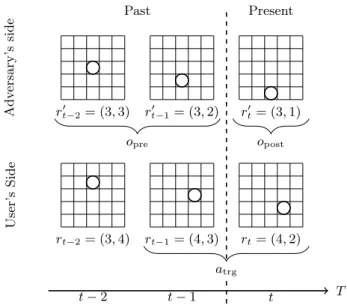
rt−2= (3,4) rt−1= (4,3) rt= (4,2) rt0−2= (3,3) r 0 t−1= (3,2) r 0 t= (3,1) t−2 t−1 t T Past Present U ser’ s S id e A d v ers a ry’ s si d e opost opre atrg
Figure 1: A user moves from location (3,4) at timet−2, to (4,3) att−1, to (4,2) at current timet. The user wants to protect locations at timest−1 andt, and these are denoted byatrg (target events). At past times t−2 and t−1, the
LPPM exposed pseudolocations (3,3) and (3,2) (denoted byopre), and to protectatrg the LPPM currently exposes
location (3,1) (denoted byopost).
Rarer, ri, rj, whereas typical time-subscripted locations are
rt, rt−1, rt+1.
User mobility is modeled probabilistically. Any model is possible, as long as it allows to compute probabilities of the user visiting various sequences of locations. In this paper, we choose to model mobility as a first-order Markov chain onR, but we must stress that our contribution is not tied to this choice since our method can compute the optimal protection for any other mobility model.
We assume an LBS access pattern in which the user ac-cesses the LBS at each time instant t∈ T, i.e., from each location that she visits. We assume this for simplicity, and at the end of this section we show that we can accommodate sparser LBS-access patterns. After all, the most interesting case is when LBS-access times are close enough to each other so that successively exposed locationsare correlated. If they are not, the problem becomes equivalent to sporadic location disclosure, studied in [22].
LPPM Functionality. The user wants to protect her pri-vacy from an adversary who observes the locations exposed to the LBS (so the adversary could be the LBS provider itself, an eavesdropper, other LBS users, etc.). Hence, she uses an LPPM that obfuscates her real locations before they are sent to the LBS. We model obfuscation as a replacement operation in which a fake location from a setR0
is sent to the LBS instead of the real location. We takeR0
to be the same asR. We call these fake locationspseudolocations or obfus-cated locations and denote them byr0. The corresponding eventshr0, tiare termedpseudoevents.
The problem we tackle is the design of an LPPM algorithm
f(·) that takes as input the real location (or locations) to be protected and the pseudolocations previously sent to the adversary, and then probabilistically selects the
pseudoloca-atrg f() LPPM h() Attack opost ˆatrg P,opre f()
Figure 2: Information available to the LPPM and the adver-sary: The LPPM wants to protect location(s) atrg by
pro-ducing appropriate pseudolocation(s) opost. The adversary
observes the outputopostof the LPPM and, using his
knowl-edge of the LPPM functionf, estimatesatrg; the adversary’s
estimate is ˆatrg. The prior knowledge of the adversary and
of the LPPM consists of the transition matrix P and the pseudolocationsopre that have been produced in the past.
tion (or pseudolocations) to expose to the adversary. The pseudolocation set is fixed, and it coincides with the location set. The adversary knows the probabilistic model that de-scribes user mobility, and also knows the LPPM algorithm
f(·). Notice here the self-reference: We designf(·) assuming an adversary who knows thef(·) that will be designed and can respond optimally to it.
We introduce the notation used in the paper with the example shown in Figure 1. Assuming that the current time ist, the elements of the framework are defined as follows:
• atrg denotes the target events that the user wants to
protect, or equivalently, the events that the adver-sary wants to infer. In the example, the user wants to protect her location at timest−1 and t and thus
atrg= (rt−1, rt) ={h(4,3), t−1i,h(4,2), ti}.
• opre is a subset of the pseudoevents that the LPPM
created and sent to the LBSup to but beforethe cur-rent time. These are the pseudoevents that matter for the estimation of atrg: Typically, opre would be
a sequence of consecutive pseudoevents starting with a recent time instant (as old ones do not matter for estimating atrg) and leading up to the current time.
These are known both to the adversary and to the LPPM. In the example, the relevant pseudolocations are those exposed at times t−1 and t−2 and thus
opre= (r0t−2, r
0
t−1) ={h(3,3), t−2i,h(3,2), t−1i}. • opostis the pseudolocation (or set of pseudolocations)
that the LPPM produces to protectatrg and that will
be sent to the LBS at current time. In the example the user exposes pseudolocation (3,1) at timet, thus
opost= (r0t) ={h(3,1), ti}.
• f(opost|atrg, opre) is the probability that the LPPM
producesopost, given its knowledgeopre and the
loca-tionsatrgit is trying to protect. This function encodes
the defensive mechanism. It can be viewed as a code-book that prescribes, for each value ofatrgandopre, a
randomization over the possible values ofopost.
Notice thatatrgneed not be the same length asopost: In the
example, the LPPM exposes the current pseudoevent (only time t), while the goal is to protect events at the current and the previous time instants (tandt−1).
Attacker Model and Privacy Metric. In short, privacy is quantified as the adversary’s error in estimating the user’s
true location(s) atrg. Figure 2 illustrates the information
flow of events and pseudoevents to the LPPM and to the adversary. The detailed notation is as follows:
• ψ(atrg|opre) is the adversary’s prior probability
dis-tribution on the inference target atrg, given his prior
knowledgeopre. It encodes what the adversary can
de-duce aboutatrg before observing the LPPM’s current
outputopost.
• aˆtrgdenotes the adversary’s estimate ofatrg. Similarly
toatrg, it can be seen as a time-indexed vector whose
elements belong to the setRof locations.
• h(ˆatrg|opre, opost) is the probability that the adversary
estimates ˆatrg to be the true value of atrg, given his
knowledge of prior pseudolocationsopreand given the
pseudolocation(s)opostexposed at current timet. Note
that, by definition,h(.) can contain multiple observed exposed pseudolocations that happen across any time period (e.g., multiple days).
• dp(ˆatrg, atrg)≥0 is the privacy gain when the
adver-sary’s estimate is ˆatrg and the true value of the
infer-ence target isatrg. It is zero only if ˆatrg =atrg. The
value of dp for each pair of locations reflects the
sen-sitivity of the user with respect to different location. The user must assigns low values if she is sensitive to-wards a particular location atrg. We treat dp as an
input to our framework.
The privacy that an LPPM f(·) achieves against an ad-versary implementing attackh(.) is then the expected value ofdp(ˆatrg, atrg), given prior observationsopre:
P rivacy(ψ, f, h, dp;opre) =E{dp(ˆatrg, atrg)|opre} (1)
= X atrg,ˆatrg Pr{ˆatrg, atrg}dp(ˆatrg, atrg) = X atrg opost ˆ atrg
ψ(atrg|opre)f(opost|atrg, opre)h(ˆatrg|opre, opost)
dp(ˆatrg, atrg).
This formula represents the adversary’s expected estima-tion error. An alternative pessimistic quantificaestima-tion of pri-vacy, we could take the minimum estimation error over all possible values ofatrg, which would be a worst-case scenario.
Regarding dp(ˆatrg, atrg), intuitively it can be seen as a
distance between ˆatrg andatrg that measures the similarity
between the inferred and real locations with respect to the user’s privacy concerns. For instance, it can be the sum, the minimum, or the maximum of the Euclidean distances be-tween the corresponding locations of each vector, i.e., the to-tal, minimum, or maximum error of the adversary over each pair of corresponding locations in the two vectors. Contribu-tions todp(ˆatrg, atrg) can beweighted to encode theprivacy
sensitivity of individual locationsr∈atrg, e.g., ifris a very
sensitive location the contribution of estimating ˆr∈ˆatrg to
dp(ˆatrg, atrg) could be large even if r and ˆr differ by very
little. Alternatively, dp(ˆatrg, atrg) could be the Hamming
distance between the two vectors, i.e., the number of loca-tions at which the estimate differs from the true value.
Furthermore, dp(ˆatrg, atrg) can encode the privacy
sensi-tivity of transitions between locations, rather than individ-ual locations. For instance, visiting the bank and visiting a government official may not be very sensitive if consid-ered separately, but visiting the official immediately after the bank may be much more sensitive, especially if the user just made a large withdrawal from the bank and the official is in charge of land development licensing. Moreover, tran-sitions between regions reveal the direction of travel. For instance, the adversary may learn whether the user enters or exits a building, e.g., a hospital.
Appropriate dp(·) needs to be chosen depending on the
user’s privacy concerns, and whether she wants to protect sensitive locations or sensitive transitions. We note that somedp(·) definitions are more general than others: adp(·)
that protects the transition between two successive locations automatically protects the locations themselves, so it could be used to protect both objectives simultaneously.
Quality Metric. Sending pseudoevents instead of true events to the LBS may help with privacy, but it can degrade the quality of the LBS’s response. We model the quality loss stemming from exposing pseudolocations as follows:
• qtrgdenotes the relevant events with respect to quality.
Similarly toatrg,qtrg is a time-indexed vector.
How-ever, its time indices are not necessarily the same as those ofatrg: The events that matter for quality may
be different from the ones that matter for privacy.
• dq(qtrg, opost, opre) represents the quality loss whenqtrg
is the true value of the quality-relevant events, the LPPM currently reportsopostand it has reportedopre
in the past. The functiondq is an input to our
frame-work and it reflect the user’s requirements with respect to quality of service, and is related to need for accurate location information at the service provider to return useful service to the user.
The expected quality loss caused by an LPPMf(·) is the expected value of dq(qtrg, opost, opre) over all qtrg andopost,
for a given historyopre:
Qloss(f, dq, opre) =E{dq(qtrg, opost, opre)|opre} (2)
= X
qtrg,opost
Pr{qtrg, opost|opre}dq(qtrg, opost, opre)
= X
qtrg,opost
Pr{qtrg|opre}Pr{opost|qtrg, opre}
dq(qtrg, opost, opre)
In the equation above,f(·) is hidden inPr{opost|qtrg, opre},
which can be unwrapped as Pr{opost|qtrg, opre}= X atrg Pr{opost, atrg|qtrg, opre} (3) =X atrg
Pr{opost|atrg, qtrg, opre}Pr{atrg|qtrg, opre}
=X
atrg
f(opost|atrg, opre)Pr{atrg|qtrg, opre}.
We assume that there is a maximum expected quality loss
Qmaxloss that users are willing to tolerate. Formally,
The quality loss dq(qtrg, opost, opre) can be seen as a
dis-tance between two vectors: qtrg and the combination of
opost, opre. It will be zero if an accurate, noiseless,
trajec-tory is reported by the LPPM (i.e., if these two vectors are identical), and positive otherwise. If the application needs high location precision to function well, thendq(·) will be
large even for small differences betweenqtrgandopost, opre.
Moreover,dq(·) can encode variable sensitivity across
lo-cations. For example, in locations with many nearby restau-rants, an application that finds the nearest restaurant can tolerate a lot of noise, while isolated areas may require more precision. The quality loss function could be instantiated, among other possibilities, as a Euclidean or Hamming dis-tance between real (qtrg) and reported locations (opost, opre).
The versatility ofdq(·) extends to encoding quality loss for
applications that depend on the wholetrajectory of locations, rather than just on a single location, e.g., consider a car in-surance company that monitors the driving behavior of a customer: quantities such as speed and sudden acceleration or deceleration cannot be evaluated on single locations.
3.1
Sparse LBS Access Pattern
So far we have assumed that users access the LBS at ev-ery single time instant although in reality one cannot expect that LBS accesses are uninterrupted (e.g., users may access an online navigation system to travel around some parts of a city, but not in others). In this scenario, an adversary may be concerned about the user’s whereaboutsbetweentwo LBS accesses, i.e., at times when there are no corresponding exposed pseudolocations. Therefore, these intermediate lo-cations also need to be protected (recall objective (4) in the introduction).
Our dense-LBS-access assumption can also express such a privacy objective. We can accommodate these inference targets by extending the definition ofdp(ˆatrg, atrg) to
incor-porate the privacy sensitivity of any intermediate locations that the adversary can infer from ˆatrg. For example, assume
that, from the estimates ˆrt−1and ˆrtof locationsrt−1andrt,
the adversary can estimate two intermediate locations vis-ited att−1+andt−(e.g., the attacker can use Viterbi de-coding [19] to infer the most likely trajectory, or the forward-backward algorithm [19] to compute the probability distri-bution of locations at some times between t−1 and t). In this case, dp((ˆrt−1,rˆt),(rt−1, rt)) would be expressed as
dp((ˆrt−1,ˆrt−1+, . . . ,ˆrt−,ˆrt),(rt−1, rt−1+, . . . , rt−, rt)).
We note that this approach to handle the estimation of locations where the LBS is not accessed is not particular to LPPMs designed under our framework, hence it can be used to complement other privacy-preserving solutions in the literature.
4.
TRAJECTORY PRIVACY AS A
STACK-ELBERG GAME
4.1
General Privacy Scenario
As we have discussed in Section 3, our goal is to design an LPPM that protects user privacy (by maximizingdp), while
preserving quality of service (by respecting the maximum quality loss threshold Qmaxloss for dq). Designing an LPPM
reduces to choosing appropriate values for the probabilities
f(opost|atrg, opre). In addition, the design process must
an-ticipate that the adversary will know the values chosen forf, which means that she will choose the attackhaccordingly.
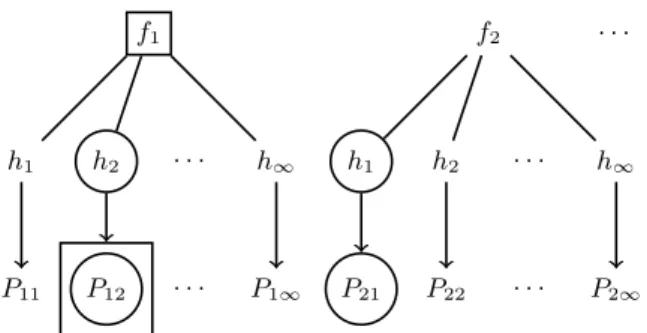
· · · f1 h1 P11 h2 P12 · · · · · · h∞ P1∞ f2 h1 P21 h2 P22 · · · · · · h∞ P2∞
Figure 3: The LPPM can choose among an infinite selec-tion of probability funcselec-tionsf. For each one of thefi, the
adversary chooses one of his infinite selection of attackshj
to minimizePij; for instance,h2 is the best response tof1,
resulting in PrivacyP12, andh1 is the best response tof2,
resulting in PrivacyP21. Callhmin(f) the minimizinghfor a
givenf. Anticipating the adversary’s choice for eachf, the LPPM chooses the f that maximizes Privacy(f, hmin(f));
for instance, if P12 > P21, the LPPM would choose f1
over f2. Call fmax the maximizing f. The resulting pair
fmax, hmin(fmax) is the Stackelberg equilibrium, and the
pri-vacy achieved is Pripri-vacy(fmax, hmin(fmax)).
Figure 3 details the reasoning involved in solving our task, which is equivalent to solving a Stackelberg game. The dis-tinguishing feature of this game is that there is a leader, who commits to a choice, and afollower, who observes the leader’s choice and then makes a choice of his own. In our task, the leader is the user and her choice is the LPPM, the follower is the adversary who chooses an attack given the user’s choice. The Stackelberg equilibrium is a pair of choices (f∗ for the LPPM and h∗ for the attack) such that neither the user nor the adversary would gain anything by changing their respective choices. In other words, h∗
is the choice that minimizes privacy against f∗, andf∗ is the choice that maximizes privacy against an adversary who will make her choice after observingf∗while respecting the quality constraint. Note thatf∗ does not necessarily max-imize privacy against h∗, i.e., if the user could be certain that the adversary would choose h∗, then a better choice than f∗ could exist. The LPPM design tries to limit the worst possible privacy loss, knowing only that the adversary will choose the most effective attack against whateverf the LPPM implements.
Formally, the general LPPM design task is to choose f
andhthat solve the Stackelberg game max-minimization max
f minh P rivacy(ψ, f, h, dp;opre) (5)
subject to
Qloss(f, dq, opre)≤Qmaxloss. (6)
Other thanf andh, all functions and parametersψ,dp,
opre, dq, Qmaxloss are inputs to the problem: ψ – the user’s
mobility, anddp– the user’s location sensitivity, are specific
to the user we aim to protect; the last two dq, Qmaxloss are
specific to the LBS application and perhaps also depend on the user’s tolerance to quality deterioration; the prior observations opre depend on the particular time when the
user wants to protect her privacy.
We now give two specific examples of the general LPPM design task for two plausible privacy objectives. The first
objective is to protect thek+ 1 most recent locations (in-cluding the current one at timet), having already exposed pseudolocations for thekpast time instants, by choosing an appropriate pseudolocation to expose at time t. The sec-ond objective is to protect the currentandfuture locations, assuming nothing has been exposed so far, by choosing a pseudolocation for timetand for future time instants. We emphasize that one can instantiate any number of objectives by selecting the time period one wishes to protect (atrg),
the events that have been exposed already (opre), and the
time period for which the LPPM can expose pseudolocations (opost).
4.2
Joint Protection of Past-Present Locations
Consider a user who, at timet, wants to publish her lo-cationrt. She has already published her locationsrτ at the
kprevious time instantsτ={t−1, t−2, . . . , t−k}. These locations have been sent by the LPPM to the LBS as pseu-dolocationsoτ. As explained in Section 3, locations exposed
prior to timet−k, i.e., from 1 tot−k−1, are considered to have no influence on the choice of the user at timet.
The simplest privacy objective (atrg) that the user could
have is to protect her current location only: atrg=rt. We
call this single location privacy. But as we have argued in [24], thetransition from the previous location rt−1 to the
current position may be sensitive, or, in general, the transi-tion from thek-tuplerτ tortmay be sensitive. A different
objective, therefore, is to protect the whole vectorrτin
addi-tion tort: atrg= (rt, rτ). Observe that the latter objective
(transition privacy) is more general the previous one (single location privacy): Choosing a function dp((ˆrt,ˆrτ),(rt, rτ))
that just ignoresrτ and ˆrτ makes the two cases equivalent.
The prior observationsopreare the set of pseudolocations
oτ, and the pseudolocation opost that the LPPM produces
is just the one corresponding to the current timet: ot. The
quality loss dq is a function of past and present exposed
pseudolocations, (ot, oτ), and ofqtrg. As stated in Section 3
qtrg does not need to coincide withatrg, and can consist of
any subset of events from time 1 up to and includingt. In fact, it does not even need to overlap with (rt, rτ).
Making the appropriate substitutions in (1), we derive the privacy definition for the specific case of protecting past and present locations as follows:
P rivacy(ψ, f, h, dp;oτ) = X rt,rτ,ot,rˆt,rˆτ ψ(rt, rτ|oτ) f(ot|rt, rτ, oτ) h(ˆrt,ˆrτ|ot, oτ) dp((ˆrt,rˆτ),(rt, rτ)) (7)
The quality loss is also straightforward to define using (2):
Qloss(f, dq, opre) =E{dq(qtrg, ot, oτ)|oτ} = X qtrg,ot Pr{qtrg, ot|oτ}dq(qtrg, ot, oτ) = X qtrg,ot Pr{qtrg|oτ}Pr{ot|qtrg, oτ} dq(qtrg, ot, oτ)
Notice that setting k = 0 eliminates opre (which would
mean that none of the previous pseudolocations exposed to the adversary are assumed to correlate with the current
lo-cation), and the target eventsatrgreduce to the current time
tonly. In total, only the current location matters for privacy and for quality, and the design task reduces to the sporadic case handled by Shokri et al.’s framework [21].
4.3
Joint Protection of Present-Future
Loca-tions
We now consider a user who, as before, wants to publish her location rt at time t. However, in contrast with the
previous case, she is not concerned about the past locations she has visited, but rather about future ones. This concern can be motivated as follows:
Disclosing the current location might not be important in and of itself, but it might make it much easier for the adversary to infer the next location, which happens to be very sensitive. For instance, the user might currently be on a street that only leads to an abortion clinic. Hence, disclosing her current location is almost equivalent to disclosing that she will go to the clinic. Symmetrically, her current location might be very sensitive, and her next (expected) location can be linked easily to her current one. For instance, she might about to leave the abortion clinic and enter a street that is only used as the clinic’s exit. Furthermore, as argued in [24], neither the current nor the next location might be particularly sensitive separately, but the transition from one to the other might be.
The conclusion in all these cases is that the current lo-cation must be protected jointly with the (possible) next one(s), where the user will be at time t+ 1 and later. For this reason,atrgincludes time subscripts larger thant, and
so doesopost, i.e., the LPPM should take into account at the
present timetwhat it is likely to output in future times, so that the current choice of ot does not limit future choices.
The intuition is that the LPPM should choose the current pseudolocation ot so that future paths that the user will
likely take can be protected with pseudolocations that are compatible withot.
For simplicity, we consider an example where the LPPM anticipates only the next location, rather than several suc-cessive future locations, thereforeatrgis (rt+1, rt) andopost
is (ot+1, ot), and no prior locations matter for privacy, so
opre is omitted.
Substituting in (1), privacy in this example is defined as
P rivacy(ψ, f, h, dp) = X rt+1,rt ot+1,ot ˆ rt+1,ˆrt ψ(rt+1, rt)f(ot+1, ot|rt+1, rt) h(ˆrt+1,rˆt|ot+1, ot)dp((ˆrt+1,rˆt),(rt+1, rt)), (8)
and the quality loss, from (2), is defined for a generalqtrgas
Qloss(f, dq) =E{dq(qtrg, ot, ot+1)}
= X
qtrg,ot,ot+1
Pr{qtrg, ot, ot+1}dq(qtrg, ot, ot+1).
4.4
Optimal Attacks and Defenses via Linear
Programming
Having reduced the LPPM design to a Stackelberg game max-minimization, we now compute the equilibrium of the game, which is equivalent to computing the optimal defense
Note that there is an infinity of candidate fs and hs (all possible probability distributions), so enumeration (as shown in Figure 3) cannot be used directly as an algorithm to find the equilibrium. To overcome this problem, we use a standard technique for transforming the computation of a game theoretic equilibrium to a linear program. This tech-nique introduces auxiliary variables xopost, for each possi-ble value ofopost, which roughly correspond to the amount
of privacy gained when the LPPM reports each particular value of opost. As previous research [22] has expanded on
this transformation technique, we merely present the key features of the resulting linear program:
We want to maximizeP
opostxopost under the constraint
xopost≤ X
atrg
ψ(atrg|opre)f(opost|atrg, opre)dp(ˆatrg, atrg), ∀ˆatrg, opost, (9)
and under the constraint X
qtrg
opost
Pr{qtrg|opre}Pr{opost|qtrg, opre}dq(qtrg, opost, opre)
≤Qmaxloss. (10)
Equation (9) is equivalent to the min-maximization (5), and equation (10) is just the quality constraint (6).
In this way, we can compute the optimal LPPMf∗. The optimal attack h∗ can either be computed via (5), or by solving another linear program called the dual. We do not go into detail about the dual here and point the interested reader to prior research [22] and to standard textbooks on linear programming [25].
Having computed the optimal LPPMf∗and the optimal attackh∗, the resultingP rivacy(f∗, h∗) is the level of pri-vacy achieved by the user, and the resultingQloss(f∗) is the
application’s incurred quality loss.
Alternative quantifications of privacy. As we men-tioned at the beginning of this section, the optimal LPPM
f∗ depends on all inputs ψ, dp, opre, dq, Qmaxloss, so if any of
these functions or variables changes, a new LPPM must be computed to maximize privacy. Alternatively, it is possi-ble to compute an LPPM that maximizes theaverage pri-vacy across a range of different values, e.g.,opre, or across
a range of different applications represented by different functionsdq. One could also be conservative and compute
instead an LPPM that maximizes the minimum privacy
across a range of values, e.g., opre. In this paper, we take
ψ, dp, opre, dq, Qmaxloss to be given inputs, but we note that it
is not difficult to adapt the framework to accommodate al-ternatives.
5.
EVALUATION
By formulating the LPPM design as an optimization prob-lem, the LPPM algorithmf(·) is guaranteed to be optimal among all possible algorithms that respect the same con-straints. Hence, there is no point in evaluating our design with simulations or any other heuristic evaluation method. We nevertheless compare to a sporadic LPPM to stress the importance of using a trajectory-aware LPPM. The spo-radic LPPM that we use is the optimal one, as presented in prior work [22]. Due to incompatible assumptions, we cannot compare to the trajectory-aware LPPMs in the liter-ature (see discussion of related work in Section 2). We also
show, for two illustrative scenarios, how our LPPM design allows to trade off privacy and quality. Finally, we discuss the run-time complexity of our design in Section 5.3.
For the comparison to the sporadic LPPM and for the illustration of the privacy-quality tradeoff, we use a real data set of location traces. These traces, which are one day long, belong to 10 randomly chosen mobile users (vehicles) in the San Francisco Bay area from the epfl/mobility dataset at CRAWDAD [18]. These 10 examples serve to illustrate the optimality of the LPPMs designed by our method, since the technique is user-centric and does not need information about other users.
We discretize both time and location: we divide the Bay Area into 10×25 equal-size locations, and consider a day to be composed by 288 time units, one per each 5 minutes. We emphasize that the granularity of both time and locations can be arbitrarily selected depending on the required accu-racy in quantifying privacy and service quality.1 We consider all the locations that are visited by each user, which on av-erage is 23.4 locations per user. We also consider all the transitions that each user has made between these locations in our dataset.
For both the comparison to the sporadic LPPM and for the privacy-quality tradeoff, we need to specify all the input parameters/functionsdp,dq,Qmaxloss,opre,ψ.
Without loss of generality, we select the privacy gaindp
and the quality loss dq functions to be the Hamming
dis-tance: dp(ˆatrg, atrg) = 1aˆtrg=6 atrg and dq(qtrg, opost, opre) =
1qtrg6=(opost,opre). Using the Hamming distance means,
tak-ing the privacy gain as an example, that the only bad case for privacy is when the attacker correctly estimates the ex-act value of the target locations (i.e., when ˆatrg is exactly
equal toatrg). All other estimates are equally good for
pri-vacy, regardless, e.g., of the physical distance between the attacker’s estimate and the true value ofatrg. As our
quan-tification of privacy is theexpected value ofdp(ˆatrg, atrg) –
and the expected value of 1ˆatrg6=atrgis just the probability of ˆ
atrg6=atrg– in effect we quantify privacy as the probability
that the adversary will make an erroneous estimate. For the maximum tolerable quality lossQmax
loss, we do not
specify a single value, but rather compute the achievable privacy for multiple values, so as to observe the privacy-quality tradeoff.
For the previously reported eventsopre, we do not specify
a single value. Instead, the privacy values that we compute and present in the following figures are averaged over all possible values ofopre, because such an average is more
rep-resentative of the privacy that a user can expect to achieve: X
opre
Pr{opre}P rivacy(ψ, f, h, dp;opre).
We must stress that the actual values obtained in the evalu-ation depend on context (e.g., user mobility). In this sense, they amount to the “total” privacy of the user, not just the
1
Note that locations need not necessarily form a grid. In general, a higher number of locations corresponds to higher granularity, and, as a result, to more precise and more accu-rate quantification and protection of location privacy. The only requirement is for time and locations to be discrete. Of course, more locations and more time instants make the computation of the LPPM more demanding in resources. The run-time computation discussion in Section 5.3 elabo-rates on the effect of the number of time instants and loca-tions on the complexity of the problem.
0.1 0.2 0.3 0.4 0.5 0.6 0.1 0.15 0.2 0.25 0.3 0.35 0.4 0.45 0.5 0.55 0.6
Privacy against Continuous Attack
Privacy against Sporadic Attack
Figure 4: Users’ single-location privacy, using a sporadic LPPM against two attacks: sporadic attack vs. correlation-aware attack. For 10 different users (lines), and for various values of the service quality thresholdQmax
loss (dots), we see
that the privacy against a correlation-aware attack (vertical axis) is always less than the privacy against a sporadic attack (horizontal axis).
privacy that is due to the LPPM alone. However, the evalu-ation shows that, other context being the same, our LPPMs achieve the highest “total” privacy value among all mecha-nisms.
To compute the prior probability ψ(atrg) on the target
events, we use the aforementioned traces to build a first-order Markov chain on the discretized set of locations. As mentioned in Section 3, choosing a Markov chain over a different mobility model is arbitrary, but our method can handle other mobility models as well.
In relation toψ, notice that, in general, we need to spec-ify the conditional prior on the target events ψ(atrg|opre),
i.e., the priorgiventhe previously reported eventsopre(see
Equation (1)). But from the traces we can only compute the unconditional prior ψ(atrg). The connection between
opre andatrgwill typically be given by whatever LPPM was
in use whenopre was reported, in conjunction with the
un-conditional prior. In [24], we show how this connection can be established, and how ψ(atrg|opre) can be computed, for
the joint protection of past and present privacy that we il-lustrate in this section.
5.1
Comparison to Optimal Sporadic LPPM
A trajectory-oblivious (sporadic) LPPM is typically eval-uated against an attack that is also sporadic, i.e., an attack in which location correlation is not taken into account. To provide quantitative justification for the inadequacy of such LPPMs and their evaluation when the exposed locations are correlated, we show in Figure 4 that a correlation-aware at-tack can achieve much lower privacy than a sporadic atat-tack. Of course, a sporadic LPPM protects single locations only, so to compare meaningfully, we pick as objective of the correlation-aware attack the single-location privacy objec-tive, i.e.,atrg=rt(see Section 4.2). The difference between
the correlation-aware attack and the sporadic attack is that the former uses the conditional prior probability on the
tar-0.1 0.2 0.3 0.4 0.5 0.6 0 0.1 0.2 0.3 0.4 0.5 0.6 0.7
Location Privacy (Present)
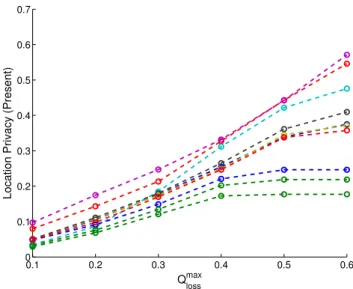
Q
loss max
Figure 5: Privacy-quality tradeoff in the first scenario (single-location privacy): Protecting the current location (atrg=rt), whenopre is the pseudolocation reported in the
previous time instant ot−1. Each curve corresponds to one
user.
get location ψ(rt|opre) (foropre =ot−1), whereas the latter
uses the unconditional priorψ(rt).
Each attack is paired against the same sporadic LPPM (the optimal one [22], as mentioned earlier), and the results are plotted across the 10 mobile users and for various values of the service quality threshold Qmaxloss. As all data points
are below thex=ydiagonal, we conclude that privacy in the correlation-aware attack (x-axis) is lower than privacy in the sporadic attack (y-axis). The only cases where the two attacks are equally (un-)successful are when the quality loss threshold is so high that the sporadic LPPM can inject enough noise to blur even the inference of a correlation-aware attack.
5.2
Privacy-Quality Tradeoff
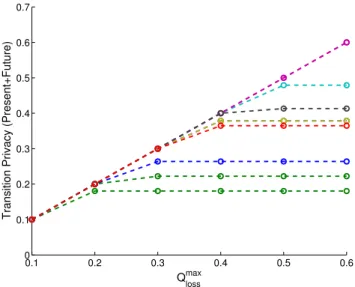
In this section, we illustrate the privacy-quality trade-off of our LPPMs for two particular scenarios: Protecting single-location privacy for the current location, taking into account the immediately previous pseudolocation (atrg=rt
and opre =ot−1), shown in Figure 5; and protecting
tran-sition privacy for the current and future locations (atrg =
(rt, rt+1)), as described in Section 4.3, shown in Figure 6.
Under each of these two scenarios, we construct the op-timal protection mechanism for each of the 10 users in our traces (i.e., the mechanism that provides the maximum pri-vacy for her). We plot this maximum pripri-vacy as a function of the service quality threshold Qmaxloss. We see in both
fig-ures that the achievable privacy increases asQmax
lossincreases.
This is not surprising, as higher values ofQmaxlosslet the LPPM
inject more and more noise.
However, in both scenarios we observe two effects: First, a saturation effect takes place for most users as Qmax
loss
in-creases. Their privacy reaches a plateau beyond which any further increase inQmaxlossdoes not contribute to a
correspond-ing increase in privacy. Second, the privacy plateau, as well as the privacy level for any value ofQmaxloss, is not the same for
0.1 0.2 0.3 0.4 0.5 0.6 0 0.1 0.2 0.3 0.4 0.5 0.6 0.7
Transition Privacy (Present+Future)
Q loss max
Figure 6: Privacy-quality tradeoff in the second scenario (transition privacy): Protecting the current and the next location (atrg= (rt, rt+1)). Each curve corresponds to one
user.
equally well, but rather there is some inherent privacy limit for each user that is connected to the user’s mobility. Users with more predictable mobility cannot be protected as ef-ficiently as less predictable ones, regardless of the amount of noise that the LPPM injects. Looking at the figures, more predictable users correspond to the lowest curves in Figures 5 and 6, whereas users with more random mobility correspond to the highest curves.
It is worth noting at this point that both these effects are not artefacts of our LPPM. Our LPPMs provide the best possible protection, so these effects are inherent in the mobility patterns of the users.
5.3
Computational Considerations
Our mechanism is intended to be computed offline and used online: The LPPM function f(opost|atrg, opre) is
pre-computed offline and then downloaded to the device. Then, whenever the user attempts to expose a location, the LPPM looks up and performs the appropriate randomization on pseudolocationsopost, based on the actual values of the
tar-get events to be protectedatrg and the previously exposed
vector of pseudolocationsopre. In this way, the only
compu-tational burden of the resource-constrained mobile device is a look-up and a randomized selection ofopost.
The offline computation of the LPPM functionfrequires solving a separate linear program for each value ofoprethat
may arise in practice. But most of the theoretically possible values of the vectoropre are nonsensical sequences of
loca-tions, e.g., sequences where successive locations are too far away from each other, so these need not be taken into ac-count, which saves considerable time. Similarly, the number of variables in each linear program is theoretically equal to the total number of pairs ofatrg and opostvectors, since a
value for f must be computed for each such combination. This number is Mlength(atrg)+length(opost) (recall that M is the total number of locations – see Section 3), but in practice it is much smaller. The actual number of linear programs and of variables is closer to the number of likely trajectories
of the corresponding length (the number of linear programs is equal to the number of trajectories of length length(opre),
whereas the number of variables is equal to the number of trajectories of length length(atrg) + length(opost)).
It is very important to notice also that the computation offneeds to be done only once, so the associated cost only needs to be incurred once. A recomputation of f is only necessary if, for example, the user parameters or applica-tion parameters dp, dq, Qmaxloss change, or if the user wants
to protect a different aspect of her privacy (e.g., previous, present, and next location, instead of just present and next location), which would translate to a change in atrg, or if
one wishes to take into account different prior knowledge of previously reported pseudolocationsopre (e.g., take into
ac-count the 3 previously reported pseudolocations instead of just one).
6.
CONCLUSIONS
Existing location privacy-preserving mechanisms either ig-nore the information leaked by the exposure of correlated locations, or ignore that the adversary will adapt his at-tack to the protection mechanism. Hence, in practice, these schemes do not provide the promised level of privacy. In this paper, we have proposed a framework that simultane-ously considers correlation and the background knowledge of the adversary, namely the mobility profile of the user, the previously exposed locations, and the internal algorithm im-plemented by the protected mechanism; while at the same time respecting the user’s service quality requirements.
Our framework allows users to design LPPMs that protect not only her current location, but also her past and future whereabouts. Furthermore, our solution is the first to deal with protecting the privacy of transitions between locations, and with preserving the privacy of locations from which the user does not access the location based service. Two key advantages of the framework are that it is not limited to a particular scenario, but can be used to compute optimal defenses for different privacy and quality user preferences; and that it finds an optimal defense among a wide variety of conceivable mechanisms, effectively any mechanism that can be modeled as a probability distribution describing how obfuscated locations are produced from real locations.
Using real mobility traces, we show that users can relax their quality of service requirements in exchange for privacy, but the predictability of their movements determines the
maximum protection they can obtain. The privacy level
achieved by the LPPMs computed using our framework can be considered an upper bound on the privacy achievable by any defense in presence of a strategic adversary who knows the users’ mobility patterns. Hence, our solution is ideal to be used as benchmark to measure the effectiveness of future defenses.
Acknowledgments. Carmela Troncoso’s research is par-tially supported by EU FP7 projects PRIPARE (GA No 610613) and LIFTGATE (GA No 285901). George Theodor-akopoulos’s research was partially supported by EU FP7 EINS (GA No 288201).
7.
REFERENCES
[1] O. Abul, F. Bonchi, and M. Nanni. Never walk alone: Uncertainty for anonymity in moving objects
databases. In24th International Conference on Data Engineering (ICDE 2008), pages 376–385. IEEE, 2008. [2] M. E. Andr´es, N. E. Bordenabe, K. Chatzikokolakis,
and C. Palamidessi. Geo-indistinguishability: Differential privacy for location-based systems. In ACM Conference on Computer and Communications Security (CCS’13), pages 901–914. ACM, 2013. [3] C. A. Ardagna, G. Livraga, and P. Samarati.
Protecting privacy of user information in continuous location-based services. In15th International Conference on Computational Science and Engineering (CSE), pages 162–169. IEEE, 2012. [4] A. R. Beresford and F. Stajano. Location privacy in
pervasive computing.IEEE Pervasive Computing, 2(1):46–55, 2003.
[5] N. E. Bordenabe, K. Chatzikokolakis, and C. Palamidessi. Optimal geo-indistinguishable mechanisms for location privacy.arXiv preprint arXiv:1402.5029, 2014.
[6] K. Chatzikokolakis, C. Palamidessi, and M. Stronati. A predictive differentially-private mechanism for mobility traces. InPrivacy Enhancing Technologies, pages 21–41. Springer International Publishing, 2014. [7] R. Cheng, Y. Zhang, E. Bertino, and S. Prabhakar.
Preserving user location privacy in mobile data management infrastructures. In6th International Workshop on Privacy Enhancing Technologies (PET 2006), pages 393–412, 2006.
[8] C.-Y. Chow and M. F. Mokbel. Trajectory privacy in location-based services and data publication.SIGKDD Explorations Newsletter, 13(1):19–29, June 2011. [9] M. L. Damiani, E. Bertino, and C. Silvestri. The
PROBE framework for the personalized cloaking of private locations.Transactions on Data Privacy, 3(2):123–148, 2010.
[10] J. Freudiger, R. Shokri, and J.-P. Hubaux. On the optimal placement of mix zones. InPETS ’09: Proceedings of the 9th International Symposium on Privacy Enhancing Technologies, pages 216–234, 2009. [11] S. Gao, J. Ma, W. Shi, G. Zhan, and C. Sun. TrPF: A
trajectory privacy-preserving framework for participatory sensing.IEEE Transactions on Information Forensics and Security, 8(6):874–887, June 2013.
[12] G. Ghinita, M. L. Damiani, C. Silvestri, and
E. Bertino. Preventing velocity-based linkage attacks in location-aware applications. In17th ACM
SIGSPATIAL International Symposium on Advances in Geographic Information Systems (ACM-GIS 2009), pages 246–255. ACM, 2009.
[13] G. Gid´ofalvi, X. Huang, and T. B. Pedersen. Privacy-preserving data mining on moving object trajectories. In8th International Conference on Mobile Data Management (MDM 2007), pages 60–68. IEEE, 2007.
[14] B. Hoh, M. Gruteser, H. Xiong, and A. Alrabady. Achieving guaranteed anonymity in gps traces via uncertainty-aware path cloaking.IEEE Transactions in Mobile Computing, 9(8):1089–1107, 2010.
[15] L. Huang, H. Yamane, K. Matsuura, and K. Sezaki. Silent cascade: Enhancing location privacy without communication QoS degradation. InSecurity of Pervasive Computing (SPC), pages 165–180, 2006. [16] M. E. Nergiz, M. Atzori, Y. Saygin, and B. G¨u¸c.
Towards trajectory anonymization: a
generalization-based approach.Transactions on Data Privacy, 2(1):47–75, 2009.
[17] X. Pan, X. Meng, and J. Xu. Distortion-based anonymity for continuous queries in location-based
mobile services. In17th ACM SIGSPATIAL
International Symposium on Advances in Geographic Information Systems (ACM-GIS 2009), pages 256–265, 2009.
[18] M. Piorkowski, N. Sarafijanovic-Djukic, and M. Grossglauser. CRAWDAD data set epfl/mobility (v. 2009-02-24).
[19] L. R. Rabiner. A tutorial on hidden Markov models and selected applications in speech recognition. Proceedings of the IEEE, 77(2):257–286, 1989. [20] R. Shokri. Optimal user-centric data obfuscation.
arXiv preprint arXiv:1402.3426, 2014.
[21] R. Shokri, G. Theodorakopoulos, G. Danezis, J.-P. Hubaux, and J.-Y. Le Boudec. Quantifying location privacy: the case of sporadic location exposure. In Proceedings of the 11th international conference on Privacy enhancing technologies (PETS’11), pages 57–76, 2011.
[22] R. Shokri, G. Theodorakopoulos, C. Troncoso, J.-P. Hubaux, and J.-Y. Le Boudec. Protecting location privacy: optimal strategy against localization attacks. InACM Conference on Computer and
Communications Security (CCS’12), pages 617–627, 2012.
[23] M. Terrovitis and N. Mamoulis. Privacy preservation in the publication of trajectories. In9th International Conference on Mobile Data Management (MDM ’08), pages 65–72. IEEE, 2008.
[24] G. Theodorakopoulos, R. Shokri, C. Troncoso, J.-P. Hubaux, and J.-Y. Le Boudec. Prolonging the hide-and-seek game: Optimal trajectory privacy for location-based services.arXiv preprint, 2014. [25] R. J. Vanderbei.Linear programming, volume 114.
Springer, 2008.
[26] T.-H. You, W.-C. Peng, and W.-C. Lee. Protecting moving trajectories with dummies. In8th
International Conference on Mobile Data Management (MDM ’07), pages 278–282, May 2007.