Measuring missing heritability: Inferring the
contribution of common variants
David Golana,1, Eric S. Landerb,c,d,2, and Saharon Rosseta,2
aDepartment of Statistics and Operations Research, School of Mathematical Sciences, Tel-Aviv University, Tel-Aviv, Israel 69978;bBroad Institute of MIT and Harvard, Cambridge, MA 02142;cDepartment of Biology, Massachusetts Institute of Technology, Cambridge, MA 02139; anddDepartment of Systems Biology, Harvard Medical School, Boston, MA 02155
Contributed by Eric S. Lander, October 10, 2014 (sent for review June 15, 2014) Genome-wide association studies (GWASs), also called common variant association studies (CVASs), have uncovered thousands of genetic variants associated with hundreds of diseases. However, the variants that reach statistical significance typically explain only a small fraction of the heritability. One explanation for the“ miss-ing heritability”is that there are many additional disease-associ-ated common variants whose effects are too small to detect with current sample sizes. It therefore is useful to have methods to quantify the heritability due to common variation, without having to identify all causal variants. Recent studies applied restricted maximum likelihood (REML) estimation to case–control studies for diseases. Here, we show that REML considerably underesti-mates the fraction of heritability due to common variation in this setting. The degree of underestimation increases with the rarity of disease, the heritability of the disease, and the size of the sample. Instead, we develop a general framework for heritability estima-tion, called phenotype correlation–genotype correlation (PCGC) regression, which generalizes the well-known Haseman–Elston regression method. We show that PCGC regression yields unbiased estimates. Applying PCGC regression to six diseases, we estimate the proportion of the phenotypic variance due to common variants to range from 25% to 56% and the proportion of heritability due to common variants from 41% to 68% (mean 60%). These results sug-gest that common variants may explain at least half the heritability for many diseases. PCGC regression also is readily applicable to other settings, including analyzing extreme-phenotype studies and adjusting for covariates such as sex, age, and population structure. genome-wide association studies
|
statistical genetics|
heritability estimation
C
omprehensive genomic studies have begun to uncover the genetic basis of common polygenic inherited diseases and traits, identifying thousands of loci and pointing to key biological pathways. However, the genetic variants implicated so far ac-count for less than half the estimated heritability of most diseases and traits (1). Explaining the remainder of the heritability— often termed“missing heritability”—is of considerable biological interest and medical importance. This is our third article on exploring the mystery of missing heritability.In our first paper (2), we noted that some of the apparently missing heritability may arise from a methodological issue. Spe-cifically, we showed that the presence of genetic interactions among loci might substantially inflate estimates of the total (nar-row-sense) heritability and thus overstate the extent of missing heritability. However, this likely is only a partial explanation.
In our second paper (3), we explored the design of association studies to discover genetic variants associated with the risk of a disease or trait. Specifically, our paper focused on rare variant association studies (RVASs), for which large-scale comprehen-sive efforts are just becoming feasible with advances in se-quencing technology. The approach involves sese-quencing every human gene in a large case–control study to see whether the aggregate frequency (or“burden”) of a set of rare variants differs between cases and controls. (Rare variants may be defined
op-erationally as having frequency ≤0.5%.) We studied how the power of RVASs depends on various factors, such as the selec-tion coefficient against null alleles, the type of rare variants to be aggregated (based, for example, on allele frequency and muta-tional type), and the population studied. We concluded that RVASs with adequate power to detect genetic effects of interest should involve at least 25,000 cases.
In this third paper, we turn our focus to common variant as-sociation studies (CVASs). (Such studies typically are referred to simply as genome-wide association studies, or GWASs, but we prefer the term CVAS to highlight the complementarity with RVAS.) CVAS involves testing millions of common genetic variants for correlation with disease in case–control studies. CVAS has the advantages that one can enumerate the complete set of common variants in a population; each variant is frequent enough to be tested individually; and variants may provide in-formation about a nearby region (as the result of linkage dis-equilibrium). Whereas RVAS only now is becoming feasible, CVAS became practical with the advent of inexpensive large-scale genotyping arrays roughly a decade ago. CVASs have been performed for hundreds of diseases, involving a total of ap-proximately 2 million samples. The fruits of these studies include the discovery of hundreds of loci for inflammatory bowel disease, schizophrenia, early heart disease, and type 2 diabetes (4).
Whereas early association studies in the 1990s used loose thresholds for statistical significance (e.g.,P≤0.05) and were notoriously irreproducible, CVAS imposes an extremely stringent threshold for statistical significance (on the order of
Significance
Studies have identified thousands of common genetic variants associated with hundreds of diseases. Yet, these common variants typically account for a minority of the heritability, a problem known as“missing heritability.”Geneticists recently proposed indirect methods for estimating the total heritability attributable to common variants, including those whose effects are too small to allow identification in current studies. Here, we show that these methods seriously underestimate the true heritability when applied to case–control studies of disease. We describe a method that provides unbiased estimates. Ap-plying it to six diseases, we estimate that common variants explain an average of 60% of the heritability for these dis-eases. The framework also may be applied to case–control studies, extreme-phenotype studies, and other settings.
Author contributions: D.G., E.S.L., and S.R. designed research, performed research, con-tributed new reagents/analytic tools, analyzed data, and wrote the paper.
The authors declare no conflict of interest.
Freely available online through the PNAS open access option.
1Present address: Department of Genetics, Stanford University, Stanford, CA 94305. 2To whom correspondence may be addressed. Email: [email protected] or
This article contains supporting information online atwww.pnas.org/lookup/suppl/doi:10. 1073/pnas.1419064111/-/DCSupplemental.
P ≤ 5×10⁻⁸) to reduce the number of false discoveries, which otherwise would be inflated when testing many hypotheses of which the vast majority are false (corresponding to non-associated SNPs). As a result, the discoveries have proven to be highly replicable. Although CVAS has been very effective at reliably identifying disease-associated loci, the genetic variants detected tend to have modest effects on disease risk and thus may be challenging to study biologically or clinically.
An open question has been how much of the heritability of a trait is attributable to common variants. A straightforward approach for inferring the heritability due to common variants is to add up the estimated heritability contributed by each of the genetic variants that have achieved clear genome-wide statistical significance. This calculation typically yields a relatively low proportion—e.g., 5–10% for height (5–8), which has estimated heritability of 80%. The obvious problem with the approach is that it provides only a lower bound that likely is a substantial underestimate because it ignores the many loci that have not yet reached genome-wide significance. Thus, there has been con-siderable interest in ways to estimate the total heritability at-tributable to common variants in an indirect manner that does not require definitively identifying the loci.
Visccher and coworkers [Yang et al. (9)] made major con-tributions to this program, focusing on the situation of quanti-tative phenotypes studied in a random population sample. The fundamental idea is to estimate the heritability due to common variants by studying the extent to which the phenotypic similarity across pairs of individuals in a sample is explained by their ge-notypic similarity at common variants. Rather than using simple correlation, they used a family of elegant statistical models, called linear mixed models (LMMs), and estimated the herita-bility using a technique called restricted maximum likelihood (REML) estimation. By applying REML to a study of height, they estimated that the common variants examined explained
∼50% of the heritability, which was considerably greater than the 5–10% obtained from summing the contributions of variants that have achieved statistical significance. Following this pioneering work, the REML approach has been applied to many other CVASs of quantitative phenotypes, yielding significant increases in estimated heritability explained by common variants.
Subsequently, the same group [Lee et al. (2011) (10)] sought to extend this approach to disease traits (or, more generally, any binary phenotypes) in case–control studies. Modifying the REML method for this setting, they applied it to three diseases studied by the Wellcome Trust Case Control Consortium (WTCCC): type 1 diabetes, Crohn’s disease, and bipolar disorder. The estimated heritability explained by common variants was considerably higher than that obtained from summing the contributions of individual loci. Their approach has since been applied to numerous other disease phenotypes, with similar results (see, e.g., refs. 11–13).
Here, we reexamine the REML approach for disease traits in case–control studies. We identify a flaw in the underlying assumptions that creates a serious bias in the REML estimate for disease traits. Consequently, we show that the REML approach of Lee et al. (10) underestimates the heritability explained by common variants. The magnitude of the bias is affected by many factors, most notably the study size, the prevalence of the disease in the population, the proportion of cases in the study, the true underlying heritability, and the number of genotyped SNPs [some of these factors were noted independently by others (14, 15)]. For example, the simulation studies below show that for a disease with 0.1% prevalence in which common variants ac-tually explain 50% of the heritability, the REML approach ap-plied to a balanced case–control study of 4,000 individuals will yield, on average, an estimate as low as 30–35% (depending on the number of SNPs used). Importantly, this bias increases with study size, suggesting that the inaccuracy of REML estimates will increase as larger and larger CVASs are conducted.
Instead, we propose a general framework for heritability es-timation, which we term phenotype correlation–genetic corre-lation (PCGC) regression, which produces unbiased estimates for case–control studies of disease traits. The approach general-izes traditional regression-based approaches used in genetics (16, 17). We show that PCGC regression yields substantially higher estimates of the heritability explained by common variants for several diseases, including Crohn’s disease, bipolar disorder, type 1 diabetes, early-onset myocardial infarction (MI), schizophrenia, and multiple sclerosis (MS). The PCGC framework also is suit-able for other settings involving phenotype-guided sampling, in-cluding selection of extreme phenotypes for quantitative traits.
Below, we begin by outlining a general model for a quantita-tive trait, and review methods for heritability estimation in this situation. We then turn to case–control studies of disease traits and describe current efforts for estimating heritability. We discuss the challenges induced by case–control sampling and use simu-lations to demonstrate that current methods result in serious downward-biased heritability estimates. To overcome this prob-lem, we introduce an alternative approach, PCGC regression for heritability estimation, and demonstrate that it provides unbiased estimates and improved accuracy. We then use PCGC regression to estimate the heritability due to common SNPs in several case– control studies. Our results show that the fraction of heritability explained by common SNPs is larger than previously thought. We conclude by describing several extensions of our PCGC frame-work to other CVAS scenarios, such as accounting correctly for additional covariates and analyzing extreme-phenotype studies.
Results
General Model of Quantitative Traits.In the general case, a quan-titative phenotypepdepends on genotypegand environmente, according to a functionψ. For the ith individual, we have pi= ψ(gi,ei). Here, the genotypegi=(gi1, gi2, . . . gin) is the diploid genotype at every variant site across the genome, wheregikis the number of copies of a designated allele at the kth variant site, andfjis the frequency of the designated allele. (We will assume that the variant sites are in linkage equilibrium and all alleles are biallelic, although these assumptions may be relaxed.)
This definition is completely general. It may be used with whole-genome sequence data, with the variant sites corresponding to every nucleotide in the human genome. Moreover, the functionψ allows for arbitrary gene–gene (GxG) and gene–environment (GxE) interactions.
For convenience, we will work below with“normalized” pheno-typespiand genotypesgik, where the quantitiespiandgikhave been centered to have mean 0 and standardized to have variance 1. Additive Model for Quantitative Traits.Analyses of heritability typ-ically assume a much simpler additive model. We do so here, as-suming that our quantitative trait follows a simple additive model with no GxG or GxE interactions. We also assume there is no correlation in the environmental effects among individuals. We write
pi=gi+ei
gi= X
k
ukgik; [1]
whereukdenotes the normalized effect of thekth variant. This model is illustrated in Fig. 1A.
Defining Heritability. Heritability quantifies how much of the
variability ofpis the result of variability ing. There are two types of heritability: broad-sense heritability H2, which measures the full contribution of genes, and narrow-sense heritabilityh2, which
is meant to capture the “additive” contribution of genes (see
GENET
ICS
PNAS
ref. 2 for definitions). For our additive model, these definitions coincide, and we have
H2=h2=X
k
u2
k: [2]
Estimating Heritability from Significantly Associated Variants. Sup-pose a certain subsetSof variants has been shown definitively to be associated with our quantitative trait, based on a large CVAS with a stringent threshold for statistical significance. The heri-tability explained by these known loci may be estimated as
^ h2S= X k∈S ^ u2k: [3] As noted above,h2
Sprovides a lower bound for the heritability.
However, h2
S may greatly underestimate the actual heritability
explained by common SNPs if the sum in Eq.3fails to include many additional variants associated with the trait because they have not reached statistical significance in the sample—for ex-ample, because of low effect sizes or lower minor allele frequen-cies. It is clear that most current disease studies have many false negatives, inasmuch as the number of loci identified has been continuing to grow with sample size.
Estimating the Aggregate Impact of All Variants.The challenge thus is to estimate the heritability attributable to all common variants associated with a disease, without actually identifying these variants. The basic idea follows from the classical notion, artic-ulated by Galton (18) in the 19th century, that the heritability of a trait is captured by the extent to which genetic similarity be-tween individuals predicts their phenotypic similarity. The chal-lenge is to convert this notion into a mathematical procedure for estimating heritability.
Yang et al. (9) made the key observation that because we are interested in the value Σu2
k rather than each of the individual
effect sizes uk, the effect sizes may be regarded as “nuisance parameters.”They adopted a“random effects” model in which the uk are treated as identical and independently distributed
random variables drawn from a distribution with mean 0 and varianceσ2
u. (Higher values ofσ2uimply larger effects, resulting in higher heritability, and vice versa.)
Under our additive model above with random effects, we have the following elegant relationship:
corrpi;pj
=Epipj
=h2Gij; [4]
where Gij denotes the genetic correlation between individuals iandj, given by Gij=corr gi;gj =1 m Xm k=1 gikgjk: [5]
Eq.4provides an intuitive method for estimating heritability— regressing the empirical phenotypic correlations (pipj) onto the genetic correlationsGij. The estimated slope of this regression is an unbiased estimator of the heritability. This procedure is known in the genetics literature as Haseman–Elston regression (16, 17). We refer to the general idea of regressing the pheno-typic correlations onto the genetic correlations and using the slope for heritability estimation as PCGC and note that Haseman– Elston regression is a special case of PCGC regression.
To apply Eq.4, we need to know the genetic correlationGij between people. However, a problem shared by all heritability estimation methods is that these correlations are unknown and need to be estimated from the data. A classical approach used in human genetics is to use the expected kinship coefficient for individuals in a pedigree (for example, 50% for siblings, 3.125% for second cousins, or 0 for unrelated individuals). However, the genetic correlation between related individuals may vary consid-erably around the kinship coefficient, and unrelated individuals may have substantial cryptic sharing, resulting in nonzero corre-lations. For example, the genetic correlation between siblings varies around the expected value of 50% with an SD of 3.6% (19). Hence, more accurate estimates ofGijmay be obtained by directly examining partial genotype or complete sequence information. We return to the problem of estimatingGijbelow.
assumed to depend on the sum of a genetic effect and an environmental effect. The scatterplot shows the joint distribution of the genetic and environmental effects, the upper left shows the marginal distributions of the environmental effect, the upper right shows the marginal distributions of the genetic effect, and the lower portion shows the marginal distribution of the phenotype. (A) Quantitative phenotype in a random sample of the population. (B) Disease phenotype in a random sample of the population. (C) Disease trait in a balanced case–control study. Disease phenotypes were simulated under a liability threshold model with disease prevalence of 10% (B) and 0.1% (C), with red points indicating affected individuals (liability above the threshold) and black points indicating unaffected individuals (liability below the threshold). InC, the marginal distributions of the genetic and environmental effects no longer are normally distributed, and there is an induced positive correlation between the genetic and environmental effects (r=0.53).
Improving Heritability Estimates with REML.Although the PCGC regression approach for estimating heritability is easy to un-derstand and implement, and produces unbiased estimators, it does not, in fact, make full use of all available information. In a sense, PCGC regression looks only at pairs of individuals at a time, whereas there is additional information in looking at trios of individuals simultaneously, or even at the entire cohort si-multaneously. More precisely, the PCGC regression estimator is a moments-based estimator. In statistics, maximum likelihood estimators generally are preferred because they can extract more information and provide more precise estimates.
To use maximum-likelihood estimation, one is required to put forward an explicit probabilistic model of the data (by contrast, the PCGC regression approach requires only independence as-sumptions, namely that the genetic and environmental effects are independent, and that the environmental effects of different individuals are independent). The common additional assumptions are that the genetic componentgand the environmental compo-nenteof the phenotype both follow a normal (Gaussian). In this case, the phenotypepis distributed normally, and the joint dis-tribution of the phenotype vectorp=(p1,p2,. . .,pn) is given by p∼N
0;Gh2+I1−h2; [6] whereIdenotes the identity matrix, andGis the genetic lation matrix whose off-diagonal entries are the pairwise corre-lationsGijand its diagonal is 1. This model is a special case of a more general statistical approach known as random effects mod-els, and the problem of estimating heritability is a special case of the problem of estimating variance components.Yang et al. (9) use this framework for the estimation of her-itability, which allows them to apply well-established methods such as REML to obtain estimates ofh2. The resulting REML estimates are better than those based on the regression approach (i.e., they require fewer observations to reach the same accuracy of the estimate). For example, Yang et al. (9) use REML to estimate the narrow-sense heritability of height explained by common SNPs at 53.7±10.0%. By contrast, the PCGC regression estimate (which in this case, reduces to standard Haseman–Elston regression) using the same data are 51.0±13.5% (9).
Model for Disease Traits.From the description above, estimating the heritability due to common variants may be considered largely solved for the case of a quantitative trait. However, the primary focus of medical genetics is disease traits—which are binary (affected vs. unaffected) rather than quantitative. Disease traits pose further challenges.
Disease phenotypes traditionally have been modeled by a liability threshold model (illustrated in Fig. 1B; see ref. 2 for details). The model assumes the existence of a quantitative trait, called the“liability score”and denotedl. As above, we havel= g+ e, where the genetic component g and the environmental component e both are normally distributed and uncorrelated with each other. Individuals are affected if and only if their lia-bility score exceeds a thresholdt. The value oftdetermines the prevalence of the disease in the population, so the liability threshold model can accommodate diseases of any frequency by adjusting the threshold parameter accordingly.
Heritability may be calculated based on either the unobserved liability scale (denotedh2
l) or the observed binary disease
phe-notype (denoted h2
o). Geneticists typically are interested in
knowingh2
l, but because the liability score is unobserved, they
must estimate it indirectly based onh2
o. Dempster and Lerner
(20) discovered a surprisingly simple relationship between these two heritabilities:
h2l=Kð1−KÞ φðtÞ2 h
2
o; [7]
whereKis the prevalence of the disease in the population,tis the threshold, andφis the standard Gaussian density.
Adapting REML to Case–Control Studies of Disease Traits.Lee et al. (10) sought to use this framework to adapt the REML method to disease traits. In the case of a random sample from the pop-ulation, they offer a simple recipe: (i) code the disease pheno-type as a 0/1 variable, (ii) use the REML procedure for a quantitative trait to calculate the heritability of the 0/1 on this observed scale, and (iii) convert the resulting estimate to the liability scale as in Eq.7. There is an important caveat: although the liability is a continuous quantitative trait, the 0/1 variable itself is not and therefore does not actually fit the likelihood function assumed in the REML method (Eq.6). Although this approach yields unbiased estimates (SI Appendix, section 5.4.2), the resulting estimates no longer are maximum-likelihood esti-mates; thus, some of the favorable properties of maximum likelihood estimates no longer are guaranteed to hold.
Real disease studies, however, rarely involve a random sample from the population: the number of affected individuals cap-tured in the sample would be too small. Instead, geneticists use case–control studies, in which cases are considerably over-sampled relative to their prevalence in the population. Because of this oversampling of cases, several assumptions of the prob-abilistic model of REML are violated: (i) the marginal distri-butions of the genetic and environmental effects, as well as of the liability, no longer are normal; (ii) the multivariate distribution of these effects no longer is multivariate normal; and (iii) the genetic and environmental effects no longer are independent. We illustrate two of these problems below.
Problem 1: Nonnormality of the Liability.Whereas the liability score follows a normal distribution in the case of a random population sample, it does not when case–control sampling is used: the oversampling of cases inflates the right tail of the liability score distribution, resulting in a nonnormal distribution of the liability score in the study (Fig. 1C).
Lee et al. (10) acknowledge the nonnormality induced by case–control sampling and propose the following analog to Eq.7 to account for this issue in transforming REML estimates from the observed to the liability scale:
^ h2l= K 2ð1−KÞ2 P1−PφðtÞ2 ^ h2o; [8]
whereKandPare the prevalence of the disease in the population and the study respectively, and ^h2o refers to the REML estimate
of heritability, when the phenotype is coded as 0/1, and treated as continuous. The same correction was derived by others in a Bayesian framework (21). Intuitively, the termPKð1−2ð1−PÞKφðÞt2Þ2is a generalization of Eq.7, accounting for the nonnormality of the liability caused by the oversampling of cases. In a random sampling scheme, we have K=P, and Eq.8boils down to Eq.7as expected.
Problem 2: Case–Control Sampling Causes“Induced”GxE Interactions. Although Lee et al. (10) consider the issue of the nonnormality of the liability score induced by the case–control sampling, their analysis misses a subtle but important problem. It turns out that case–control sampling creates an induced positive correlation between the genetic and environmental effects for the samples in the study, as can be seen in Fig. 1C. Although there is no GxE interaction in the population, there is an obvious interaction be-tweengandeunder case–control sampling.
GENET
ICS
PNAS
strated in ref. 2 that the presence of GxG interactions leads to un-derestimation of the fraction of heritability explained, we suspected that the presence of such induced GxE interactions might result in underestimation of the heritability. To test this idea, we simulated the entire generative process of a case–control study of a disease.
In each simulation run, we generated data for millions of individuals using a liability threshold model corresponding to the desired population prevalence K. For each individual, we gen-erated genotypes at 10,000 independent loci, with minor allele frequencies between 0.05 and 0.5. The effect of each SNP was drawn from a normal distribution, as in Yang et al. (9). The li-ability was computed according to the polygenic model of Eq.1, with the variance of the genetic effect set to achieve the desired heritability. Each individual then was classified as affected or unaffected according to the appropriate threshold. Finally, all affected individuals were sampled for the study as cases, whereas unaffected individuals were chosen with a probability set to achieve the desired proportion of casesPin expectation. This process was repeated until 4,000 individuals (with the desired proportion of cases) were collected for the study. We note that the choice of simulating SNPs at linkage equilibrium was mo-tivated by a theoretical result from Patterson et al. (22), which shows that the resulting distribution of correlation matrices is equivalent to the distribution obtained from a larger number of SNPs in linkage disequilibrium.
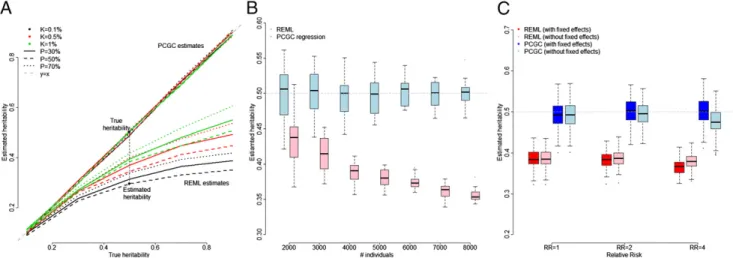
Our simulations confirm our expectation: heritability esti-mates obtained by applying REML and correcting using Eq.8 are strongly downward biased (Fig. 2A). The magnitude of the bias increases when (i) the disease is rarer, (ii) the proportion of cases is closer to half, and (iii) the heritability is higher. Indeed, these circumstances each increase the induced GxE interaction.
representative of a balanced case–control study of a disease in which true underlying heritability due to common SNPs is 50%. If the prevalence is 0.1% (comparable to the frequencies of MS or Crohn’s disease), then the REML method yields an estimated heritability of only 29.4% on average. The bias decreases for more common diseases. For prevalences of 0.5%, 1%, 5%, and 10%, the expected heritability estimate in a balanced case– con-trol study is 34.9%, 37.9%, 43.7%, and 48.1%, respectively.
In addition to the factors described above, the bias of REML estimates depends on other factors—most importantly, it increases with the study size. To illustrate the effect of study size on the bias of REML estimates, we simulated case–control studies with a varying number of individuals (between 2,000 and 8,000) but kept all other parameters constant (we simulated 10,000 SNPs in linkage equilibrium, prevalence of disease in the population was set to 1%, average proportion of cases in the study was 30%, and the heri-tability was set to 50%). The average REML estimates of herita-bility decreased with study size, from 43.6% (SE: 0.7%) with 2,000 individuals to 35.3% (SE: 0.2%) with 8,000 individuals (Fig. 2B).
We note that Lee et al. (10) tested their method using simu-lations, which appeared to confirm that the REML method provides unbiased estimates. However, these simulations did not explicitly simulate genotypes. Instead, they proceeded as follows: they (i) generated individuals in batches of 100; (ii) assigned genetic correlations to all pairs of individuals, by assuming that individuals in the same batch have correlation 0.05 and individ-uals in separate batches have correlation 0; and (iii) simulated phenotypes, by generating liabilities according to Eq. 6 and comparing them to the thresholdt. All affected individuals were retained for the simulation, together with an equal number of randomly selected unaffected individuals. The problem with this simulation scheme is that most batches contain few cases—indeed,
Fig. 2. Comparison of REML and PCGC regression. (A) REML yields biased estimates for case–control studies of diseases, whereas PCGC regression yields unbiased estimates. We simulated case–control studies for nine combinations ofK(prevalence) andP(proportion of cases among overall samples), and for five values ofh2(0.1, 0.3, 0.5, 0.7, and 0.9). For each combination of parameters, we show the average of 10 heritability estimates obtained by applying the REML method of Lee et al. (10) and PCGC regression to our simulated case–control data. REML produced biased estimates, whereas PCGC regression produced unbiased estimates for all scenarios. The bias of REML estimates increases as both the true heritability and overrepresentation of cases increase. To dem-onstrate the severity of the bias, consider the scenario of a disease with prevalence of 0.1% in a balanced case–control study (values typical for Crohn’s disease or MS). When the true heritability is 50%, the estimated heritability would be 30% on average, as indicated by the black dots. (B) Heritability estimates for case–control studies with increasing sample size. Simulated case–control studies are as previously described, with the prevalence of the disease, the pro-portion of cases, and the heritability fixed at 1%, 30%, and 50%, respectively. The size of simulated studies ranged from 2,000 to 8,000. The bias of heritability estimates from REML increases with study size, whereas those from PCGC regression estimates remain unbiased. (C) Heritability estimation in the presence of fixed effects. We simulated case–control studies with an additional“sex”covariate, which either has no effect on the disease or increases the relative risk (RR) by twofold or fourfold. The prevalence of the disease in the population was 0.5%, the heritability was set to 50%, and the numbers of cases and controls were equal. Applying REML with or without accounting for the additional covariate resulted in underestimation of the heritability. Moreover, inclusion of the covariate as a fixed effect resulted in even lower estimates of heritability when the effect of the covariate on the phenotype was considerable. By contrast, PCGC regression correctly accounted for the presence of the covariate.
often zero or one for a disease with low frequencies. Because there were few cases within each batch, the genetic correlation between most case pairs, most control pairs, and most case–control pairs was exactly 0 (with a small number of nonzero correlations set at 0.05). In some simulation scenarios, up to 99.98% of the correlations were set to 0. In short, the simulation did not resemble actual genetic correlations. Our simulations above overcome this problem by ex-plicitly simulating genotypes (SI Appendix, section 5).
PCGC Regression as a General Method for Estimating Heritability. Given the serious bias in REML estimates for case–control studies, we sought to develop an alternative approach based on PCGC regression. Because PCGC regression estimates are mo-ment estimators, they (in contrast to maximum-likelihood esti-mators) do not require assuming an entire probabilistic model to obtain unbiased estimates; this is a useful feature in situations in which the actual probabilistic setup is complex.
PCGC regression is based on the simple idea that the heritability of a trait controls the strength of the relationship between genotype and phenotype. In the general case, the relationship among genetic correlation (Gij), phenotypic correlation (pipj), and the heritability
due to common variants (h2Þmay be expressed as
Epipj
=fh2;Gij
; [9]
where the functionfdepends on (i) the design of the study and (ii) the properties of the phenotype. Given the functionf, we can estimateh2by searching for the value that provides the best fit when across all pairs of individuals—for example, by minimizing the sum of squares between the actual and predicted phenotypic similarities: ^ h2=min0≤h2≤1 X i≠j h pipj−f h2;Gij i2 : [10]
The simplest situation is one in which (i) the individuals com-prise a random sample from the population and (ii) the pheno-type is an additive polygenic quantitative trait, in which case we have fðh2;G
ijÞ=h2Gij. The value of h2 may be estimated by
linear regression; the estimate is the slope obtained by regressing the values ofpipj onto the values ofGij. This practice is known
as Haseman–Elston regression.
PCGC regression may be extended to other study designs, although explicit expressions forfare harder to obtain. However, when focusing on studies of largely unrelated individuals, the values ofGij are mostly small. Accordingly, f can be
approxi-mated by a Taylor series atGij=0:
fh2;Gij = df dGij h2;0Gij+O G2ij : [11]
Provided that g and e are normally distributed, we show (SI Appendix, section 1.3) thatdGdfijðh2;0Þis linear inh2, and thus
fh2;Gij =ch2Gij+o G2ij [12] for some constantcthat depends on the properties of the phe-notype and the study, but not on the heritability.
In this situation, we can use linear regression to estimateh2. The only question is how to calculate the constantc. We provide step-by-step calculations for determiningcunder several relevant study designs (SI Appendix, sections 1–4).
As an example, consider the situation of case–control studies, as above. We show (SI Appendix, section 1.3) that the value ofc is given by
c=Pð1−PÞφðtÞ 2
K2ð1−KÞ2 ; [13]
which is the reciprocal of the coefficient in Eq.6. [Notably, the REML correction is derived by Lee et al. (10) to correct for the problem of nonnormality (problem 1 above), whereas the use of regression in combination with thiscaddresses both the marginal nonnormality and the induced GxE correlations (problem 2) simultaneously.] As a test, we applied PCGC regression to the simulated case–control data. The results (Fig. 2A) confirmed that the approach indeed yields estimates that are unbiased and con-siderably more accurate than those achieved by the method of Lee et al. (10). We tested PCGC regression across many scenarios: simulating a wide range of disease prevalence (SI Appendix, Figs. S5 and S6), populations with cryptic relatedness (SI Appendix, Fig. S7); different numbers of SNPs (SI Appendix, Fig. S8), increasing study sizes (Fig. 2B), and alternative polygenic architectures (SI Appendix, Figs. S11 and S12); and estimating heritability in the presence of additional covariates (see below for more details, or seeSI Appendix, section 5.6). In all scenarios, PCGC regression yielded unbiased estimates of heritability.
Estimating the Heritability Due to Common SNPs.So far, we have
discussed PCGC regression as a general method for estimating heritability. Its input is a matrix Gof genetic correlations and a vector pof phenotypes, and its output is an estimate of the heritability (the same generally is true for any correlation-based heritability estimation method). It is important to note that the interpretation of the resulting estimate depends heavily on the actual Gused. Yang et al. (9) pioneered the approach of esti-matingGfrom genotyped common SNPs, and thus the result is an estimate of the heritability explained (or tagged) by common SNPs. If, for example,Gwere to be estimated using SNPs from only one chromosome, the result would be an estimate of the heritability explained by common SNPs on that chromosome (23). The commonly used estimate of the genetic correlation is the empirical correlation, computed over the setAof variants gen-otyped or sequenced: ^ Gij= 1 jAj X k∈A gikgjk: [14]
BecauseGtypically is estimated by using only genotyped SNPs, the resulting estimate is interpreted as the heritability due to genotyped SNPs (sometimes referred to as “chip heritability,” i.e., the heritability explained by the SNPs on the genotyping chip). Hence, it is expected to underestimate the heritability explained by all common SNPs, because the genotyped SNPs are in imperfect linkage disequilibrium (LD) with the ungeno-typed common SNPs. Yang et al. (9) suggest a method for quan-tifying and correcting this underestimation. We adopt their correction when appropriate, because our focus is on methods for estimating heritability and not on estimating correlation ma-trices (SI Appendix, section 7). We address alternative approaches inDiscussion.
Applying PCGC Regression to Case–Control Studies of Disease.We applied PCGC regression to six case-control studies of disease: the WTCCC studies of Crohn’s disease, bipolar disorder, and type 1 diabetes investigated by Lee et al. (10); studies of MS and schizophrenia to which the same REML methodology was applied (11, 24, 25); and a study of early-onset MI (26). Where necessary, we applied stringent quality control, as suggested by Lee et al. (10), to mitigate batch effects (SI Appendix, section 10). We in-cluded sex as a covariate (SI Appendix, section 2) and removed the top 10 principal components of the correlation matrix to control
GENET
ICS
PNAS
problem of imperfect LD between causal SNPs and genotyped SNPs (which, as noted above, results in underestimation of heri-tability), we applied the correction proposed by Yang et al. (9) (SI Appendix, section 7); we note that this correction also was applied by Lee et al. (10) for their REML estimates.
As expected, PCGC regression estimates were higher than REML estimates for all six diseases (Table 1). Specifically, the estimated heritability attributable to common variants increased from 39.3% to 47% for bipolar disorder, from 20.2% to 24.6% for Crohn’s disease, from 14.6% to 16.3% for type 1 diabetes (excluding chromosome 6 from the analysis), from 38.2% to 42.1% for schizophrenia, and from 33.3% to 38.2% for MI. The most notable increase was for the least frequent disease: for MS, the estimated heritability attributable to common variants in-creased from 33.5% to 45.3%.
We can infer the proportion of the overall heritability attrib-utable to common variants by dividing these values by published estimates of the total heritability (derived from population studies of the phenotypic correlations among relatives; Table 1). Mindful of the considerable uncertainty in these published esti-mates, we estimate that the proportion of the overall heritability attributable to common variants for these diseases ranges from 41% to 68% (mean 60%).
Extending PCGC Regression to Incorporate Covariates in Heritability
Estimation. PCGC regression similarly can deal with other
im-portant situations. Although genetic and environmental effects often are assumed to represent the sum of many small effects and thus to be distributed normally, some specific effects may be very large. For example, men are considerably taller than women, the prevalence of Alzheimer’s disease increases sharply with age, and lung cancer is more prevalent in smokers than nonsmokers. Such covariates (sex, age, smoking) also are referred to as“fixed effects” and must be accounted for in attempting to estimate the herita-bility due to common variants.
In the case of a randomly sampled continuous phenotype, REML methodology can be naturally extended to account for additional covariates, and this extension indeed is implemented in the popular GCTA software (27). In the scenario of case– control studies, Lee et al. (10) continue to treat the phenotype as quantitative, apply the extended REML approach to account for
resulting estimates of heritability to the liability scale. However, the presence of fixed effects only aggravates the problems arising from case–control sampling, and as a result, the heritability esti-mates obtained in this manner are even more biased. The in-creased bias is seen in our simulations (Fig. 2CandSI Appendix, Fig. S13) and also is supported by theoretical arguments (28).
By contrast, PCGC regression can be extended readily to ac-count for covariates while still yielding unbiased estimates. This is done by replacing the constant c from Eq. 7 with a set of constantscijthat depend on the covariates for individualsiandj.
Deriving the specific values ofcijis more involved (SI Appendix, section 2). Briefly, we letzidenote the covariates for individuali,
which includes all relevant additional data (smoking habits, sex, age, and so on). Rather than having studywide parameters denoting (i) the fractionK of cases in the population, (ii) the liability thresholdt, and (iii) the probabilityPthat an individual in the study is affected, we have individual-specific parameters, where each individual has (i) an individual-specific probabilityKi
of being affected, conditional on her specific covariates; (ii) a corresponding individual-specific liability thresholdti; and (iii) a
corresponding individual-specific probabilityPiof being affected,
conditional on both her specific covariates and the fact that she was selected for the study.
Using these definitions, we show (SI Appendix, section 2.2) that cij= φðtiÞφ tj " 1−Pi+Pj P−K Pð1−KÞ +PiPj P −K Pð1−KÞ 2# ffiffiffiffiffiffiffiffiffiffiffiffiffiffiffiffiffiffiffiffi Pið1−PiÞ p ffiffiffiffiffiffiffiffiffiffiffiffiffiffiffiffiffiffiffiffi Pj 1−Pj q Ki+ð1−KiÞ Kð1−PÞ Pð1−KÞ Kj+ 1−Kj Kð1−PÞ Pð1−KÞ : [15]
Our simulations confirm that PCGC regression accounts cor-rectly for additional covariates (Fig. 2C).
The relatively complex formulas for PCGC regression in the fixed-effects scenario shed light on a key difference between REML-based methods and PCGC regression. When no fixed effects are involved, both the REML method of Lee et al. (10) and PCGC regression appear rather similar: both may be viewed as a two-step procedure, in which the first step entails applying
Table 1. Estimates of phenotypic variance explained and proportion of heritability explained by common variants from REML and PCGC regression for six diseases: bipolar disorder, Crohn’s disease, early-onset MI, MS, schizophrenia, and type 1 diabetes
Phenotypic variance explained by common variants, % (SE) Phenotype Prevalence, % REML PCGC
Estimated total heritability, % Heritability explained by common variants, % Bipolar disorder 0.5 39.3 (4.3) 47.0 (7.1) 71 66 Crohn’s disease 0.1 20.2 (3.1) 24.6 (4.3) 50–60 41 MI 1 33.3 (6.1) 38.2 (9.1) 56 68 MS 0.1 33.5 (3.5) 45.3 (5.5) 25–75 60 Schizophrenia 1 38.2 (3.3) 42.1 (5) 64 66 Type 1 diabetes (w/o HLA) 0.5 14.5 (4.0) 16.3 (5.5)
With HLA (SI Appendix, section 11) 0.5 51.3 72–88 58
SEs are given in parentheses. PCGC and REML estimates are corrected for estimated genetic correlations, as discussed in refs. 9 and 10, and include sex and the top 10 principal components as fixed effects (SI Appendix, sections 2 and 8, respectively). SEs for PCGC regression estimates are estimated using 100 jackknife iterations (SI Appendix, section 6), and REML SEs are produced by the GCTA software (27). For population prevalence and family-based estimate references, seeSI Appendix, Table S8. The heritability explained by common variants was obtained by dividing (i) the PCGC estimate of the proportion of phenotypic variance explained by common variants by (ii) the reported heritability. Where a range of values is given for the heritability, we use the largest value; this provides a conservative estimate. For type 1 diabetes, the REML and PCGC analyses exclude chromosome 6, which includes the large effect of the MHC. Based on family studies, the MHC has been estimated to explain∼50% of the heritability of type 1 diabetes, which would correspond to 36–44% of the phenotypic variance (39). Based on direct analysis of the relative risk of various MHC haplotypes, we obtain a conservative estimate that the MHC explains at least 35% of the phenotypic variance (SI Appendix, section 11); we use this value as the contribution of the MHC. w/o, without.
a simple recipe appropriate for quantitative traits to a disease trait coded as 0/1 and the second step entails applying a“correction”to the result, to account for issues overlooked in the first step.
Although Lee et al. (10) use the same approach when fixed effects are involved (i.e., they apply a standard REML procedure and an ex post facto correction), PCGC regression no longer may be viewed in this manner. Accounting for the fixed effects is an intrinsic part of the estimation process, rather than an ex post correction. We no longer regress the product of the phenotypes ontoGij and divide the resulting slope by a single factorc to
obtain liability-scale heritability estimates. Instead, we have a differentcijfor every pair of individuals, and we regresspipjonto
the productcijGij.
Thus, although REML-based methods and PCGC regression may appear similar, they actually are fundamentally different. PCGC regression constructs the estimates from first principles, which is why its estimates are unbiased in the presence of both case–control sampling and covariates.
Applying PCGC Regression to Extreme-Phenotype Studies of Quantitative Traits.PCGC regression also can be applied to other study designs in which unbiased REML estimates are not available because of the complexity of the situation. A particularly important design is an
“extreme-phenotypes” study, in which only individuals with ex-tremely high or low values of the phenotype are selected for gen-otyping. Lander and Botstein (29) showed that such designs are efficient for genetic mapping, because most of the power resides in individuals with extreme phenotypes.
Extreme-phenotype studies pose challenges similar to those of case–control studies for REML-based estimation of heritability, because the assumptions of the normality and GxE indepen-dence no longer hold (SI Appendix, Fig. S15). As a result, REML estimates will be biased.
Our PCGC regression framework can deal with extreme-phenotype studies in a fashion analogous to that of case–control studies. For example, when sampling individuals whose pheno-types are either below theKth quantile, or above theð1−KÞth quantile, the value ofcis given by (SI Appendix, section 4)
c= 1+φðtÞt K 2 ; [16]
wheret=Φ−1ð1−KÞis the upper threshold for inclusion on the liability scale, andφis the standard Gaussian density, as before. We derive similar expressions for studies in which different quan-tiles are used for including extremely high or extremely low phe-notypes in the study, as well as several other generalizations (SI Appendix, section 4). Simulations confirm that the PCGC esti-mates are unbiased (SI Appendix, Fig. S16).
To study the potential benefit of extreme-phenotype studies, we used simulations to measure the improvement in the accuracy of heritability estimates obtained by extreme-phenotype sampling (SI Appendix, section 4). We find, for example, that the accuracy obtained by randomly samplingNindividuals from the population can be achieved by sampling approximatelyN/8 individuals from each of the top and bottom deciles (SI Appendix, Fig. S17). We observe similar accuracy benefits when comparing the SEs of heritability estimates of HDL levels in GWASs based on random-sampling vs. GWASs based on extreme-phenotype random-sampling (SI Appendix, section 10.3).
Discussion
The genetic architecture of most common traits and diseases is complex, involving contributions from genetic variants at many genes and, potentially, interactions among them. These genetic variants likely span the range of allele frequencies, from common
variants in the population to rare variants present at extremely low frequencies.
CVASs (typically called GWASs) of traits and diseases already have uncovered numerous statistically significant associations with common variants at individual genetic loci. However, sta-tistical analyses suggest that many more associated variants lurk below the surface—falling short of statistical significance because of inadequate sample sizes. Accordingly, it would be valuable to have reliable methods to infer the overall contribution of com-mon variants without the need to identify each individual locus. REML Methods for Estimating Heritability.Visscher and coworkers (9) pioneered the random-effects approach for using CVAS data to estimate the narrow-sense heritability of a quantitative trait due to common variants. By modeling effect sizes as random variables, this method elegantly circumvents the need to estimate the effect size of each SNP. Instead, it focuses on estimating the overall heritability due to the entire set of common variants. Applying this REML methodology to a wide range of quantita-tive phenotypes indicates that for many phenotypes, common genetic variants account for a substantial portion of the overall heritability—much more than the portion explained by the in-dividual loci that so far have attained genome-wide significance. Visscher and coworkers (10) subsequently sought to extend the REML methodology to disease phenotypes. Disease studies typically involve case–control designs, wherein cases are con-siderably oversampled relative to their frequency in the pop-ulation; this sampling design violates various assumes of the REML framework. Lee et al. (10) attempted to account for these issues by applying a post hoc correction. However, as demon-strated by our extensive simulations (and by actual genetic studies of six diseases), their method yields strongly downwardly biased estimates of the heritability due to common variants in a variety of interesting and relevant scenarios. The bias depends on properties of the disease, including the prevalence in the population and the true underlying heritability. Most troublingly, the bias increases with study size and with the proportion of cases in the sample. (The bias also depends on the number of SNPs actually genotyped, although this is of secondary importance.) We conclude that REML methods do not provide a suitable framework for estimating heritability for disease phenotypes.
PCGC Regression. To solve this problem, we developed PCGC
regression, which provides a powerful framework for estimating the heritability due to common variants in a wide range of sce-narios. Extensive simulations show that PCGC regression yields heritability estimates that are unbiased (as expected mathemat-ically) and more accurate than the REML approach, when ap-plied to case–control studies.
PCGC regression is a general framework for heritability esti-mation. In the case of an unascertained quantitative phenotype, it boils down to the well-known regression method of Haseman and Elston. When dealing with case–control studies, PCGC re-gression allows unbiased estimation of heritability, even in the presence of covariates. As such, it subsumes several recent an-ecdotal observations (14, 15), provides a theoretical foundation, and, importantly, allows for the incorporation of covariates. In addition to case–control studies, the PCGC regression frame-work can readily accommodate other complex study designs. One important application is extreme-phenotype studies for quantitative traits, which may be more cost-effective than ran-dom sampling studies for the purposes of identifying causal loci and estimating heritability.
One limitation of PCGC regression is that it is based on a first-order approximation of the relationship between phenotypic similarity and genetic correlation. This approximation is expec-ted to be accurate when individuals in the study largely are un-related. However, in populations with a high degree of cryptic
GENET
ICS
PNAS
gression can be extended by using second-order, or higher-order, approximations (SI Appendix, section 1.4). We note, however, that for the WTCCC population, using first- or second-order approximations yielded very little difference.
Design of Simulations.Our paper highlights a critical issue con-cerning the design of genetic simulations. Lee et al. (10) did not observe the serious bias inherent in REML methods for case– control studies because they used a highly incomplete simulation. In particular, they did not explicitly generate genotypes and phe-notypes for each individual, but rather arbitrarily assigned genetic-correlation values to pairs of individuals. This shortcut eliminated critical correlations between genotype and phenotype. By contrast, our simulations use a generative approach: they explicitly (i) as-sign effect sizes to each variant, (ii) generate genotypes for each individual, and (iii) ascertain cases and controls based on phe-notype, by selecting or rejecting individuals. These simulations readily revealed the large downward bias in REML estimates.
One issue with the generative approach is the considerable running time of each simulation, which greatly limits the possible number of individuals and SNPs that can be simulated, as well as the prevalence of the disease simulated. To overcome this problem, we developed a dynamic programming approach, allowing direct sampling of genotypes of cases (SI Appendix, section 5.8). We implemented this approach in a software package called simCC, which is freely available from our website. Simulations using simCC are considerably faster; therefore, we could expand our simulations from 10,000 SNPs to 100,000 SNPs, with qualitatively similar results (SI Appendix, Fig. S18).
We note that our simulations fail to be fully realistic because they do not model linkage disequilibrium among variants. Although the mathematical result by ref. 22 means that this limitation has little impact on the results in the context of herita-bility estimation, it is interesting to ask how linkage disequilibrium might be included for the benefit of other endeavors. Several authors have used an approach that takes actual genotypes from an existing study (e.g., WTCCC), assigns effect sizes, and then calculates phenotypes (e.g., refs. 13, 23, 30). However, as currently implemented, this approach has the serious flaw that it does not impose selection to obtain cases and controls and, accordingly, cannot yield a realistic correlation structure for a case–control study (such as the striking correlation effects in Fig. 1C). One could solve this problem by using a vastly larger collection of ac-tual genotypes, such that one could obtain cases by imposing stringent selection (i.e., discarding 90–99% of samples, depending on the disease frequency); however, current datasets are too small for his approach. Alternatively, it may be possible to use programs such as HapGen (31) to simulate realistic genotypes from a smaller sample of actual genotypes. Whether this approach is feasible at the required scale is a topic for further study.
Improved Estimates of Genetic Correlation. We demonstrate that
PCGC regression yields unbiased heritability estimates, given knowledge of the genetic correlation matrixG. However,Gis unknown, and estimates ofGare used by most heritability esti-mation methods. As pointed out by Yang et al. (9), replacing the true value ofGwith a noisy estimate results in underestimation of the heritability. This effect is not unique to heritability esti-mation and is known as“diluted”regression (or“ errors-in-var-iables”): when regressing a dependent variable y onto a noisy measurement of an explanatory variablex, the estimated slope is attenuated. It is important to stress that this bias is not a result of the heritability estimation method, but rather to the use of noisy estimates of genetic correlations instead of the true correlations. Yang et al. (9) overcome this problem by quantifying the bias via simulations, and correcting for it post hoc. This eliminates the bias but increases the variance of the estimate. We adopt their
using real data.
Several recent papers (13, 21, 30, 32–35) focused on improving the estimation of the genetic correlation matrices, by accounting for sparsity (33, 34), LD and LD-dependent genetic architecture (30), prior information regarding effect sizes of different SNPs (35), or the relationship between minor allele frequency and effect size (30). As better methods for estimating the genetic correlation matrix are developed, they may be used in PCGC regression in place of the correction method of Yang et al. (9). More accurate estimates of the genetic correlation matrix are expected to increase the estimated proportion of heritability due to common SNPs even further.
Deviating from the Probabilistic Assumptions of the Model. A key assumption throughout most works addressing the problem of heritability estimation in general, and estimating heritability us-ing case–control GWAS in particular, is that the genetic and environmental effects follow a normal distribution. The as-sumption of normality typically is justified by the central limit theorem, as both the genetic and environmental effects are as-sumed to be the sum of many small contributions, resulting in an approximately normal distribution.
These assumptions might prove invalid when some covariates have a considerable effect on the phenotype: for example, the effect of sex on height or coronary artery disease. When the problematic covariate is known and observed, it can easily be accounted for directly by including it as a fixed effect in the model. However, not all important covariates may be known or observed. When the phenotype is quantitative, normality assumptions can be tested; therefore, situations in which the normality assumption is invalid can, at the very least, be identified. On the other hand, for disease phenotypes, the liability is unobserved, and it is unclear how to test the normality assumptions, as well as what the effect of deviating from these assumptions would be. This question remains to be addressed in future work.
We assume throughout that the underlying genetic architec-ture is additive. However, one common speculation is that GxG interactions play a considerable role in human disease (36). In this case, one still might attempt to estimate the additive heri-tability explained by common SNPs by means described here. However, the proper interpretation of the result might depend on the exact genetic architecture.
Another key assumption is that the selection of individuals for the study is guided only by their phenotypes. Although this often is the situation with case–control designs, other, more compli-cated selection schemes exist. Two important examples are covariate-driven sampling [in which the selection is guided by both the phenotype and by a risk factor of interest, e.g., type 2 diabetes patients with a low body mass index (BMI) and controls with a high BMI (37)] and case–control matching (in which, for each case in the study, an effort is made to recruit a control with similar characteristics). Such designs pose an interesting chal-lenge for future research.
Role of Common Variants in Common Disease.Beyond the
methodo-logical results in this paper, our key biomethodo-logical finding is that the heritability of disease traits attributable to common genetic variants is even higher than current estimates. For the diseases analyzed above, the heritability estimated by PCGC regression is 9–34% (mean 19%) higher than the estimates produced by REML.
The phenotypic variance attributable to common variants is 25%, 38%, 42.1%, 45%, and 47% for Crohn’s disease, early-onset MI, schizophrenia, MS, and bipolar disorder, respectively. For type 1 diabetes, our estimate is 16.3% when we exclude the large effects due to the major histocompatibility complex (MHC), and 51.3% when we include it. [The contribution of the MHC can be estimated from family studies (38, 39), as well as by considering
the contribution of the individual common variants as fixed effects (SI Appendix, section 11).]
We can estimate the proportion of heritability explained by common variants by dividing (i) the proportion of phenotypic variance explained by common variants by (ii) the proportion of the phenotypic variance explained by additive genetic factors— that is, the total heritability—based on phenotypic similarity among relatives (e.g., monozygotic and dizygotic twins). We note that estimates of the total heritability involve substantial un-certainty [due to small study size and potential artifacts resulting from the underlying genetic architecture (2)] and may vary con-siderably across studies; where multiple estimates had been reported, we used the largest value. The proportions are 41%, 58%, 60%, 64%, 66%, 66%, and 68% for Crohn’s disease, type 1 diabetes, MS, schizophrenia, bipolar disorder, and early-onset MI, respectively, with a mean value of 60% (Table 1).
Our improved estimates still may underestimate the true proportion of heritability explained by common variants for three reasons. First, we calculated the proportion of heritability explained by using the largest estimate of the total heritability, when multiple estimates had been reported; this yields a con-servative estimate. Second, as noted above, uncertainty about the genetic correlation matrix decreases the heritability explained. Improved estimates of the genetic correlations likely will in-crease the estimated heritability explained by common SNPs. Third, our analysis assumes that the contributions of variants are drawn from a uniform prior distribution, regardless of biological context. Instead, variants might be categorized based on bio-logical annotation (e.g., those within or near coding regions,
regulatory elements, and so on). A distinct correlation matrix might be estimated for each set and the matrices used simulta-neously for heritability estimation, a task that can be accom-modated readily by PCGC regression (SI Appendix, section 3). A refined correlation structure should provide a better model of the genetic architecture of disease, and thus would be expected to yield higher estimates of the heritability explained by common variants, as well as to provide useful scientific insights.
Our results suggest that larger CVASs will identify many ad-ditional common variants related to common diseases, although many additional common variants likely still will have effect sizes that fall below the limits of detection given practically achievable sample sizes. Still, common variants clearly will not explain all heritability. As discussed in the first two papers in this series (2, 3), rare genetic variants and genetic interactions likely will make important contributions as well. Fortunately, advances in DNA sequencing technology should make it possible in the coming years to carry out comprehensive studies of both common and rare genetic variants in tens (and possibly hundreds) of thou-sands of cases and controls, resulting in a fuller picture of the genetic architecture of common diseases.
ACKNOWLEDGMENTS.We are grateful to the Wellcome Trust Case Control Consortium for making data on multiple diseases available (www.wtccc.org. uk), the ANZgene Consortium for sharing the MS data, Sekar Kathiresan for sharing the MI data, and Dan Rader for sharing the HDL data. D.G. was supported by a Colton fellowship and a fellowship from the Edmond J. Safra Center for Bioinformatics at Tel Aviv University. E.S.L. was supported in part by NIH HG003067 and by funds from the Broad Institute. S.R. was supported in part by Israeli Science Foundation Grant 1487/12.
1. Maher B (2008) Personal genomes: The case of the missing heritability. Nature
456(7218):18–21.
2. Zuk O, Hechter E, Sunyaev SR, Lander ES (2012) The mystery of missing heritability: Genetic interactions create phantom heritability.Proc Natl Acad Sci USA109(4):1193–1198. 3. Zuk O, et al. (2014) Searching for missing heritability: Designing rare variant
associ-ation studies.Proc Natl Acad Sci USA111(4):E455–E464.
4. Welter D, et al. (2014) The NHGRI GWAS Catalog, a curated resource of SNP-trait associations.Nucleic Acids Res42(Database issue, D1):D1001–D1006.
5. Visscher PM (2008) Sizing up human height variation.Nat Genet40(5):489–490. 6. Weedon MN, et al.; Diabetes Genetics Initiative; Wellcome Trust Case Control
Con-sortium; Cambridge GEM Consortium (2008) Genome-wide association analysis identifies 20 loci that influence adult height.Nat Genet40(5):575–583.
7. Lettre G, et al.; Diabetes Genetics Initiative; FUSION; KORA; Prostate, Lung Colorectal and Ovarian Cancer Screening Trial; Nurses’Health Study; SardiNIA (2008) Iden-tification of ten loci associated with height highlights new biological pathways in human growth.Nat Genet40(5):584–591.
8. Gudbjartsson DF, et al. (2008) Many sequence variants affecting diversity of adult human height.Nat Genet40(5):609–615.
9. Yang J, et al. (2010) Common SNPs explain a large proportion of the heritability for human height.Nat Genet42(7):565–569.
10. Lee SH, Wray NR, Goddard ME, Visscher PM (2011) Estimating missing heritability for disease from genome-wide association studies.Am J Hum Genet88(3):294–305. 11. Lee SH, et al.; ANZGene Consortium; International Endogene Consortium; Genetic
and Environmental Risk for Alzheimer’s disease Consortium (2013) Estimation and partitioning of polygenic variation captured by common SNPs for Alzheimer’s disease, multiple sclerosis and endometriosis.Hum Mol Genet22(4):832–841.
12. Do CB, et al. (2011) Web-based genome-wide association study identifies two novel loci and a substantial genetic component for Parkinson’s disease.PLoS Genet7(6):e1002141. 13. Zaitlen N, et al. (2013) Using extended genealogy to estimate components of
heri-tability for 23 quantitative and dichotomous traits.PLoS Genet9(5):e1003520. 14. Yang J, Zaitlen NA, Goddard ME, Visscher PM, Price AL (2014) Advantages and pitfalls
in the application of mixed-model association methods.Nat Genet46(2):100–106. 15. Chen G-B (2014) Estimating heritability of complex traits from genome-wide
associ-ation studies using IBS-based Haseman-Elston regression.Front Genet5:107. 16. Haseman JK, Elston RC (1972) The investigation of linkage between a quantitative
trait and a marker locus.Behav Genet2(1):3–19.
17. Elston RC, Buxbaum S, Jacobs KB, Olson JM (2000) Haseman and Elston revisited.
Genet Epidemiol19(1):1–17.
18. Galton F (1886) Regression towards mediocrity in hereditary stature.J Royal Anthr Inst15:246–263.
19. Visscher PM, et al. (2006) Assumption-free estimation of heritability from genome-wide identity-by-descent sharing between full siblings.PLoS Genet2(3):e41. 20. Dempster ER, Lerner IM (1950) Heritability of threshold characters.Genetics35(2):212–236. 21. Zhou X, Carbonetto P, Stephens M (2013) Polygenic modeling with bayesian sparse
linear mixed models.PLoS Genet9(2):e1003264.
22. Patterson N, Price AL, Reich D (2006) Population structure and eigenanalysis.PLoS Genet2(12):e190.
23. Lee SH, et al.; Schizophrenia Psychiatric Genome-Wide Association Study Consortium (PGC-SCZ); International Schizophrenia Consortium (ISC); Molecular Genetics of Schizophrenia Collaboration (MGS) (2012) Estimating the proportion of variation in susceptibility to schizophrenia captured by common SNPs.Nat Genet44(3):247–250. 24. Bahlo M, et al.; Australia and New Zealand Multiple Sclerosis Genetics Consortium (ANZgene) (2009) Genome-wide association study identifies new multiple sclerosis susceptibility loci on chromosomes 12 and 20.Nat Genet41(7):824–828.
25. Ripke S, et al.; Multicenter Genetic Studies of Schizophrenia Consortium; Psychosis Endophenotypes International Consortium; Wellcome Trust Case Control Consortium 2 (2013) Genome-wide association analysis identifies 13 new risk loci for schizo-phrenia.Nat Genet45(10):1150–1159.
26. Kathiresan S, et al.; Myocardial Infarction Genetics Consortium; Wellcome Trust Case Control Consortium (2009) Genome-wide association of early-onset myocardial infarction with single nucleotide polymorphisms and copy number variants.Nat Genet41(3):334–341. 27. Yang J, Lee SH, Goddard ME, Visscher PM (2011) GCTA: A tool for genome-wide
complex trait analysis.Am J Hum Genet88(1):76–82.
28. Burton PR (2003) Correcting for nonrandom ascertainment in generalized linear mixed models (GLMMs), fitted using Gibbs sampling.Genet Epidemiol24(1):24–35. 29. Lander ES, Botstein D (1989) Mapping mendelian factors underlying quantitative
traits using RFLP linkage maps.Genetics121(1):185–199.
30. Speed D, Hemani G, Johnson MR, Balding DJ (2012) Improved heritability estimation from genome-wide SNPs.Am J Hum Genet91(6):1011–1021.
31. Spencer CCA, Su Z, Donnelly P, Marchini J (2009) Designing genome-wide association studies: sample size, power, imputation, and the choice of genotyping chip.PLoS Genet5(5):e1000477.
32. Crossett A, Lee AB, Klei L, Devlin B, Roeder K (2013) Refining genetically inferred relationships using treelet covariance smoothing.Ann Appl Stat7(2):669–690. 33. Golan D, Rosset S (2011) Accurate estimation of heritability in genome wide studies
using random effects models.Bioinformatics27(13):i317–i323.
34. Guan Y, Stephens M (2011) Bayesian variable selection regression for genome-wide association studies and other large-scale problems.Ann Appl Stat5(3):1780–1815. 35. Zhang Z, et al. (2014) Improving the accuracy of whole genome prediction for complex
traits using the results of genome wide association studies.PLoS One9(3):e93017. 36. Manolio TA, et al. (2009) Finding the missing heritability of complex diseases.Nature
461(7265):747–753.
37. Voight BF, et al.; MAGIC investigators; GIANT Consortium (2010) Twelve type 2 di-abetes susceptibility loci identified through large-scale association analysis.Nat Genet
42(7):579–589.
38. Wei Z, et al. (2009) From disease association to risk assessment: an optimistic view from genome-wide association studies on type 1 diabetes.PLoS Genet5(10):e1000678. 39. Risch N (1987) Assessing the role of HLA-linked and unlinked determinants of disease.
Am J Hum Genet40(1):1–14.
GENET
ICS
PNAS