Universal Intelligence: A Definition of Machine
Intelligence
Shane LeggÆMarcus Hutter
Received: 22 September 2006 / Accepted: 28 August 2007 / Published online: 10 November 2007 Springer Science+Business Media B.V. 2007
Abstract A fundamental problem in artificial intelligence is that nobody really knows what intelligence is. The problem is especially acute when we need to consider artificial systems which are significantly different to humans. In this paper we approach this problem in the following way: we take a number of well known informal definitions of human intelligence that have been given by experts, and extract their essential features. These are then mathematically formalised to produce a general measure of intelligence for arbitrary machines. We believe that this equation formally captures the concept of machine intelligence in the broadest reasonable sense. We then show how this formal definition is related to the theory of universal optimal learning agents. Finally, we survey the many other tests and definitions of intelligence that have been proposed for machines.
Keywords AIXI Complexity theoryIntelligenceTheoretical foundations
Turing testIntelligence testsMeasures Definitions
Introduction
‘‘Innumerable tests are available for measuring intelligence, yet no one is quite certain of what intelligence is, or even just what it is that the available tests are
measuring.’’ R. L. Gregory (1998)
What is intelligence? It is a concept that we use in our daily lives that seems to have a fairly concrete, though perhaps naive, meaning. We say that our friend who
S. Legg (&)
IDSIA, Galleria 2, Manno-Lugano 6928, Switzerland e-mail: [email protected]
M. Hutter
RSISE@ANU and SML@NICTA, Canberra ACT 0200, Australia e-mail: [email protected]
got an A in his calculus test is very intelligent, or perhaps our cat who has learnt to go into hiding at the first mention of the word ‘‘vet’’. Although this intuitive notion of intelligence presents us with no difficulties, if we attempt to dig deeper and define it in precise terms we find the concept to be very difficult to nail down. Perhaps the ability to learn quickly is central to intelligence? Or perhaps the total sum of one’s knowledge is more important? Perhaps communication and the ability to use language play a central role? What about ‘‘thinking’’ or the ability to perform abstract reasoning? How about the ability to be creative and solve problems? Intelligence involves a perplexing mixture of concepts, many of which are equally difficult to define.
Psychologists have been grappling with these issues ever since humans first became fascinated with the nature of the mind. Debates have raged back and forth concerning the correct definition of intelligence and how best to measure the intelligence of individuals. These debates have in many instances been very heated as what is at stake is not merely a scientific definition, but a fundamental issue of how we measure and value humans: Is one employee smarter than another? Are men on average more intelligent than women? Are white people smarter than black people? As a result intelligence tests, and their creators, have on occasion been the subject of intense public scrutiny. Simply determining whether a test, perhaps quite unintentionally, is partly a reflection of the race, gender, culture or social class of its
creator is a subtle, complex and often politically charged issue (Gould 1981;
Herrnstein and Murray1996). Not surprisingly, many have concluded that it is wise
to stay well clear of this topic.
In reality the situation is not as bad as it is sometimes made out to be. Although the details of the definition are debated, in broad terms a fair degree of consensus about the scientific definition of intelligence and how to measure it has been
achieved (Gottfredson 1997; Sternberg and Berg 1986). Indeed it is widely
recognised that when standard intelligence tests are correctly applied and
interpreted, they all measure approximately the same thing (Gottfredson 1997).
Furthermore, what they measure is both stable over time in individuals and has significant predictive power, in particular for future academic performance and other mentally demanding pursuits. The issues that continue to draw debate are the questions such as whether the tests test only a part or a particular type of intelligence, or whether they are somehow biased towards a particular group or set of mental skills. Great effort has gone into dealing with these issues, but they are difficult problems with no easy solutions.
Somewhat disconnected from this exists a parallel debate over the nature of intelligence in the context of machines. While the debate is less politically charged, in some ways the central issues are even more difficult. Machines can have physical forms, sensors, actuators, means of communication, information processing abilities and environments that are totally unlike those that we experience. This makes the concept of ‘‘machine intelligence’’ particularly difficult to get a handle on. In some cases, a machine may display properties that we equate with human intelligence, in such cases it might be reasonable to describe the machine as also being intelligent. In other situations this view is far too limited and anthropocentric. Ideally we would like to be able to measure the intelligence of a wide range of systems; humans, dogs,
flies, robots or even disembodied systems such as chat-bots, expert systems,
classification systems and prediction algorithms (Johnson1992; Albus1991).
One response to this problem might be to develop specific kinds of tests for specific kinds of entities; just as intelligence tests for children differ to intelligence tests for adults. While this works well when testing humans of different ages, it comes undone when we need to measure the intelligence of entities which are profoundly different to each other in terms of their cognitive capacities, speed, senses, environments in which they operate, and so on. To measure the intelligence of such diverse systems in a meaningful way we must step back from the specifics of particular systems and establish the underlying fundamentals of what it is that we are really trying to measure.
The difficulty of developing an abstract and highly general notion of intelligence is readily apparent. Consider, for example, the memory and numerical computation tasks that appear in some intelligence tests and which were once regarded as defining hallmarks of human intelligence. We now know that these tasks are absolutely trivial for a machine and thus do not appear to test the machine’s intelligence in any meaningful sense. Indeed even the mentally demanding task of
playing chess can be largely reduced to brute force search (Hsu et al.1995). What
else may in time be possible with relatively simple algorithms running on powerful machines is hard to say. What we can be sure of is that as technology advances, our concept of intelligence will continue to evolve with it.
How then are we to develop a concept of intelligence that is applicable to all kinds of systems? Any proposed definition must encompass the essence of human intelligence, as well as other possibilities, in a consistent way. It should not be limited to any particular set of senses, environments or goals, nor should it be limited to any specific kind of hardware, such as silicon or biological neurons. It should be based on principles which are fundamental and thus unlikely to alter over time. Furthermore, the definition of intelligence should ideally be formally expressed, objective, and practically realisable as an effective intelligence test.
In this paper we approach the problem of defining machine intelligence as follows:
Section ‘‘Natural Intelligence‘‘ overviews well known theories, definitions and tests of intelligence that have been developed by psychologists. Our objective in this section is to gain an understanding of the essence of intelligence in the broadest possible terms. In particular we are interested in commonly expressed ideas that could be applied to arbitrary systems and contexts, not just humans.
Section ‘‘A Definition of Machine Intelligence’’ takes these key ideas and
formalises them. This leads touniversal intelligence, our proposed formal definition
of machine intelligence. We then examine some of the properties of universal intelligence, such as its ability to sensibly order simple learning algorithms and connections to the theory of universal optimal learning agents.
Section ‘‘Definitions and Tests of Machine Intelligence‘‘ overviews other definitions and tests of machine intelligence that have been proposed. Although surveys of the Turing test and its many variants exist, for example, Saygin et al.
(2000), as far as we know this section is the first general survey of definitions and
intelligence, the absence of such a survey is quite remarkable. For any field to mature as a science, questions of definition and measurement must be meticulously investigated. We conclude our survey with a summary comparison of the various proposed tests and definitions of machine intelligence.
Section ‘‘Discussion and Conclusions’’ ends the paper with discussion, responses to criticisms, conclusions and directions for future research.
The genesis of this work lies in Hutter’s universal optimal learning agent, AIXI,
described in 2, 12, 60 and 300 pages in Hutter (2001b,a,2007b,2005), respectively.
In this work, an order relation for intelligent agents is presented, with respect to which the provably optimal AIXI agent is maximal. The universal intelligence measure presented here is a derivative of this order relation. A short description of
the universal intelligence measure appeared in Legg and Hutter (2005), from which
two articles followed in the popular scientific press (Graham-Rowe 2005; Fie´vet
2005). An 8 page paper on universal intelligence appeared in Legg and Hutter
(2006b), followed by an updated poster presentation (Legg and Hutter2006a). In the current paper we explore universal intelligence in much greater detail, in particular the way in which it relates to mainstream views on human intelligence and other proposed definitions of machine intelligence.
Natural Intelligence
Human intelligence is an enormously rich topic with a complex intellectual, social and political history. For an overview the interested reader might want to consult
‘‘Handbook of Intelligence’’ edited by R. J. Sternberg (2000). Our objective in this
section is simply to sketch a range of tests, theories and definitions of human and animal intelligence. We are particularly interested in common themes and general perspectives on intelligence that could be applicable to many kinds of systems, as these will form the foundation of our definition of machine intelligence in the next section.
Human Intelligence Tests
Contrary to popular public opinion, most psychologists believe that the usual tests of intelligence, such as IQ tests, reliably measure something important in humans
(Neisser et al. 1996; Gottfredson 1997). In fact, standard intelligence tests are
among the most statistically stable and reliable of psychological tests. Furthermore, it is well known that these scores are a good predictor of various things, such as academic performance. The question then is not whether these tests are useful or measure something meaningful, but rather whether what they measure is indeed ‘‘intelligence’’. Some experts believe that they do, while others think that they only succeed in measuring certain aspects of, or types of, intelligence.
The first modern style intelligence test was developed by the French psychologist Binet in 1905. Binet believed that intelligence was best studied by looking at relatively complex mental tasks, unlike earlier tests developed by Francis Galton
which focused on reaction times, auditory discrimination ability, physical coordi-nation and so on. Binet’s test consisted of 30 short tasks related to everyday problems such as; naming parts of the body, comparing lengths and weights, counting coins, remembering digits and definitions of words. For each task category there were a number of problems of increasing difficulty. The child’s results were obtained by normalising their raw score against peers of the same age. Initially his test was designed to measure the mental performance of children with learning
problems (Binet and Simon1905). Later versions were also developed for normal
children (Binet1911). It was found that Binet’s test results were a good predictor of
children’s academic performance.
Terman of Stanford University developed an English version of Binet’s test. As the age norms for French children did not correspond well with American children, he revised Binet’s test in various ways, in particular he increased the upper age limit. This resulted in the now famous Stanford-Binet test (Terman and Merrill
1950). This test formed the basis of a number of other intelligence tests, such as the
Army Alpha and Army Beta tests which were used to classify recruits. Since its development, the Stanford-Binet has been periodically revised, with updated versions being widely used today.
Wechsler believed that the original Binet tests were too focused on verbal skills and thus disadvantaged certain otherwise intelligent individuals, for example the deaf or people who did not speak the test language as a first language. To address this problem, he proposed that tests should contain a combination of both verbal and nonverbal problems. He also believed that in addition to an overall IQ score, a profile should be produced showing the performance of the individual in the various areas tested. Borrowing significantly from the Stanford-Binet, the US army Alpha test, and others, he developed a range of tests targeting specific age groups from
preschoolers up to adults (Wechsler1958). Due in part to problems with revisions of
the Stanford-Binet test in the 1960s and 1970s, Wechsler’s tests became the standard. They continue to be well respected and widely used.
Owing to a common lineage, modern versions of the Wechsler and the
Stanford-Binet have a similar basic structure (Kaufman2000). Both test the individual in a
number of verbal and non-verbal ways. In the case of a Stanford-Binet the test is broken up into five key areas: fluid reasoning, knowledge, quantitative reasoning, visual-spatial processing, and working memory. In the case of the Wechsler adult intelligence scale (WAIS-III), the verbal tests include areas such as such as knowledge, basic arithmetic, comprehension, vocabulary, and short term memory. Non-verbal tests include picture completion, spatial perception, problem solving, symbol search and object assembly.
As part of an effort to make intelligence tests more culture neutral John Raven
developed the progressive matrices test (Raven 2000). In this test each problem
consists of a short sequence of basic shapes. For example, a circle in a box, then a circle with a cross in the middle followed by a circle with a triangle inside. The test subject then has to select from a second list the image that best continues the pattern. Simple problems have simple patterns, while difficult problems have more subtle and complex patterns. In each case however, the simplest pattern that can explain the observed sequence is the one that correctly predicts its continuation.
Thus, not only is the ability to recognise patterns tested, but also the ability to evaluate the complexity of different explanations and then correctly apply the philosophical principle of Occam’s razor. We will return to Occam’s razor and its importance in intelligence testing in Subsection ‘‘A Formal Definition of Machine Intelligence‘‘ when considering machine intelligence.
Today several different versions of the Raven test exist designed for different age groups and ability levels. As the tests depend strongly on the ability to identify abstract patterns, rather than knowledge, they are considered to be some of the most ‘‘g-loaded’’ intelligence tests available (see Subsection ‘‘Theories of Human Intelligence’’). The Raven tests remain in common use today, particularly when it is thought that culture or language bias could be an issue.
The intelligence quotient, or IQ, was originally introduced by Stern (1912). It
was computed by taking the age of a child as estimated by their performance in the intelligence test, and then dividing this by their true biological age and multiplying by 100. Thus a 10-year-old child whose mental performance was equal to that of a normal 12-year-old, had an IQ of 120. As the concept of mental age has now been discredited, and was never applicable to adults anyway, modern IQ scores are simply normalised to a Gaussian distribution with a mean of 100. The standard deviation used varies: in the US 15 is commonly used, while in Europe 25 is common. For children the normalising Gaussian is based on peers of the same age. Whatever normalising distribution is used, by definition an individual’s IQ is always an indication of their cognitive performance relative to some larger group. Clearly this would be problematic in the context of machines where the performance of some machines could be many orders of magnitude greater than others. Furthermore, the distribution of machine performance would be continually changing due to advancing technology. Thus, for our purposes, an absolute measure will be more meaningful than a traditional IQ type of measure.
For an overview of the history of intelligence testing and the structure of modern
tests, see Kaufman (2000).
Animal Intelligence Tests
Testing the intelligence of animals is of particular interest to us as it moves beyond strictly human focused concepts of intelligence and testing methods. Difficult problems in human intelligence testing, such as bias due to language differences or physical handicap, become even more difficult if we try to compare animals with different perceptual and cognitive capacities. Even within a single species measurement is difficult as it is not always obvious how to conduct the tests, or even what should be tested for. Furthermore, as humans devise the tests, there is a persistent danger that the tests may be biased in terms of our sensory, motor, and
motivational systems (Macphail1985). For example, it is known that rats can learn
some types of relationships much more easily through smell rather than other senses
(Slotnick and Katz1974). Furthermore, while an IQ test for children might in some
sense be validated by its ability to predict future academic or other success, it is not always clear how to validate an intelligence test for animals. If survival or the total
number of offspring was a measure of success, then bacteria might the be most intelligent life on earth!
As is often the case when we try to generalise concepts, abstraction is necessary. When attempting to measure the intelligence of lower animals it is necessary to focus on simple things like short and long term memory, the forming of associations, the ability to generalise simple patterns and make predictions, simple counting and basic communication. It is only with relatively intelligent social animals, such as birds and apes, that more sophisticated properties such as deception, imitation and the ability to recognise oneself become important. For simpler animals, the focus is more on the animal’s essential information processing capacity. For example, the work on understanding the capacity of ants to remember patterns when retracing a path back to a source of food without the aid of
pheromones (Reznikova and Ryabko1986).
One interesting difficulty when testing animal intelligence is that we are unable to directly explain to the animal what its goal is. Instead, we have to guide the animal towards a problem by carefully rewarding selected behaviours with something like food. In general, when testing machine intelligence we face a similar problem in that we cannot assume that a machine will have a sufficient level of language comprehension to be able to understand commands. Thus a simple solution is to use basic ‘‘rewards’’ to guide behaviour, as we do with animals. Although this approach is extremely general, one difficulty is that solving the task, and simply learning what the task is, become confounded and thus the results need
to be interpreted carefully (Zentall1997). Due to our need for generality, we will
use this reward based approach for our formal measure of machine intelligence. Specifically, we will adopt the reinforcement learning framework from artificial intelligence (see Subsection ‘‘Basic Agent–Environment Framework’’).
For good overviews of animal intelligence research see Zentall (2000) or Herman
and Pack (1994).
Desirable Properties of an Intelligence Test
There are many properties that a good test of human intelligence should have. One important property is that the test should be repeatable, in the sense that it consistently returns about the same score for a given individual. For example, the test subject should not be able to significantly improve their performance if tested again a short time later. Statistical variability can also be a problem in short tests. Longer tests help in this regard, however they are naturally more costly to administer.
Another important reliability factor is the bias that might be introduced by the individual administering the test. Purely written tests avoid this problem as there is minimal interaction between the tested individual and the tester. However this lack of interaction also has disadvantages as it may mean that other sources of bias, such as cultural differences, language problems or even something as simple as poor eyesight, might not be properly identified. Thus, even in a written test the individual
being tested should first be examined by an expert in order to ensure that the test is appropriate.
Cultural bias in particular is a difficult problem, and tests should be designed to minimise this problem where possible, or at least detect potential bias problems when they occur. One way to do this is to test each ability in multiple ways, for example both verbally and visually. While language is an obvious potential source of cultural bias, more subtle forms of bias are difficult to detect and remedy. For example, different cultures emphasise different cognitive abilities, and thus it is difficult, perhaps impossible, to compare intelligence scores in a way that is truly objective. In part this is a question of what intelligence is. Indeed the problem of how to weight performance in different areas is fundamental and we will need to face it again in the context of our formal definition of machine intelligence.
When testing large numbers of individuals, for example when testing army recruits, the cost of administering the test becomes important. In these cases less accurate but more economical test procedures may be used, such as purely written tests without any direct interaction between the individuals being tested and a psychologist.
An intelligence test should be valid in the sense that it appears to be testing what it claims it is testing for. One way to check this is to show that the test produces results consistent with other manifestations of intelligence. A test should also have predictive power, for example the ability to predict future academic performance. This ensures that what is being measured is somehow meaningful, beyond just the ability to answer the questions in the test.
Standard intelligence tests such as a modern Stanford-Binet are thoroughly tested for years on the above criteria, and many others, before they are ready for wide spread use. Many of these desirable properties, such as reliability, tester bias, cost and validity, are also relevant to tests of machine intelligence. To some extent they are also relevant to formal definitions of intelligence. We will return to these desirable properties when analysing our definition of machine intelligence in Subsection ‘‘Properties of Universal Intelligence‘‘, and later when comparing tests of machine intelligence in Subsection ‘‘Comparison of Machine Intelligence Tests and Definitions’’.
Static vs. Dynamic Tests
Stanford-Binet, Wechsler, Raven progressive matrices, and indeed most standard intelligence tests, are all examples of ‘‘static tests’’. By this we mean that they test an individual’s knowledge and ability to solve one-off problems. They do not directly measure the ability to learn and adapt over time. If an individual was good at learning and adapting then we might expect this to be reflected in their total knowledge and thus picked up in a static test. However, it could be that an individual has a great capacity to learn, but that this is not reflected in their knowledge due to limited education. In which case, if we consider the capacity to learn and adapt rather than the sum of knowledge to be a defining characteristic of
intelligence, then to class an individual as unintelligent due to limited access to education would be a mistake.
What is needed is a more direct test of an individual’s ability to learn and adapt: a
so called ‘‘dynamic test’’ (Sternberg and Grigorenko2002; for related work see also
Johnson-Laird and Wason1977). In a dynamic test the test subject interacts over a
period of time with the tester, who now becomes a kind of teacher. The tester’s task is to present the individual with a series of problems. After each attempt at solving a problem, the tester provides feedback to the individual who then has to adapt their behaviour accordingly in order to solve the next problem.
Although dynamic tests could in theory be very powerful, they are not yet well established due to a number of difficulties. One of the drawbacks is that they require a much greater degree of interaction between the test subject and the tester. This makes dynamic testing more costly to perform and increases the danger of tester bias.
Dynamic testing is of particular interest to us because in a formal test for machines it appears that we can overcome these problems by automating the role of the tester.
Theories of Human Intelligence
Complementary to the experimental study of human intelligence, theories have been developed that attempt to better characterise the fundamental nature of intelligence. It is useful for us to briefly sketch this work as some of these issues have parallels within the context of machine intelligence.
One central question is whether intelligence should be viewed as one ability, or many. On one side of the debate are the theories that view intelligence as consisting of many different components and that identifying these components is important to understanding intelligence. Different theories propose different ways to do this. One of the first was Thurstone’s ‘‘multiple-factors’’ theory which considers seven ‘‘primary mental abilities’’: verbal comprehension, word fluency, number facility, spatial visualisation, associative memory, perceptual speed and reasoning
(Thur-stone 1938). Another approach is Sternberg’s ‘‘Triarchic Mind’’ which breaks
intelligence down into analytical intelligence, creative intelligence, and practical
intelligence (Sternberg1985), however this model is now considered outdated, even
by Sternberg himself.
Taking the number of components to an extreme is Guilford’s ‘‘Structure of Intellect’’ theory. Under this theory there are three fundamental dimensions: contents, operations, and products. Together these give rise to 120 different
categories (Guilford 1967; in later work this increased to 150 categories). This
theory has been criticised due to the fact that measuring such precise combinations of cognitive capacities in individuals seems to be infeasible and thus it is difficult to experimentally study such a fine grained model of intelligence.
A recently popular approach is Gardner’s ‘‘multiple intelligences’’ where he argues that the components of human intelligence are sufficiently separate that they
human brain he identifies these intelligences to be linguistic, musical, logical-mathematical, spatial, bodily kinaesthetic, intra-personal and inter-personal intel-ligence. Although Gardner’s theory of multiple intelligences has certainly captured the imagination of the public, it remains to be seen to what degree it will have a lasting impact in professional circles.
At the other end of the spectrum is the work of Spearman and those that have followed in his footsteps. Here intelligence is seen as a very general mental ability that underlies and contributes to all other mental abilities. As evidence they point to the fact that an individual’s performance levels in reasoning, association, linguistic, spatial thinking, pattern identification etc. are positively correlated. Spearman called
this positive statistical correlation between different mental abilities the ‘‘g-factor’’,
whereg stands for ‘‘general intelligence’’(Spearman 1927). Because standard IQ
tests measure a range of key cognitive abilities, from a collection of scores on
different cognitive tasks we can estimate an individual’s g-factor. Some who
consider the generality of intelligence to be of primary importance take theg-factor
to be the very definition of intelligence (Gottfredson2002).
A well known refinement to theg-factor theory due to Cattell is to distinguish
between, ‘‘fluid intelligence’’, which is a very general and flexible innate ability to deal with problems and complexity, and ‘‘crystallized intelligence’’, which measures the knowledge and abilities that an individual has acquired over time
(Cattell 1987). For example, while an adolescent may have a similar level of
fluid intelligence to that of an adult, their level of crystallized intelligence is
typically lower due to less life experience (Horn1970). Although it is difficult to
determine to what extent these two influence each other, the distinction is an important one because it captures two distinct notions of what the word ‘‘intelligence’’ means.
As theg-factor is simply the statistical correlation between difference kinds of
mental abilities, it is not fundamentally inconsistent with the view that intelligence can have multiple aspects or dimensions. Thus a synthesis of the two perspectives is
possible by viewing intelligence as a hierarchy with theg-factor at its apex and
increasing levels of specialisation for the different aspects of intelligence forming
branches (Carroll 1993). For example, an individual might have a high g-factor,
which contributes to all of their cognitive abilities, but also have an especially well developed musical sense. This hierarchical view of intelligence is now quite popular
(Neisser et al.1996).
Ten Definitions of Human Intelligence
‘‘Viewed narrowly, there seem to be almost as many definitions of intelligence as there were experts asked to define it.’’ R. J. Sternberg quoted in Gregory
(1998)
In this subsection and the next we will overview a range of definitions of intelligence that have been given by psychologists. Many of these definitions are well known. Although the definitions differ, there are reoccurring features; in some
cases these are explicitly stated, while in others they are more implicit. We start by considering ten definitions that take, in our view, a similar perspective:
‘‘It seems to us that in intelligence there is a fundamental faculty, the alteration or the lack of which, is of the utmost importance for practical life. This faculty is judgement, otherwise called good sense, practical sense, initiative, the faculty of adapting oneself to circumstances.’’ A. Binet (Binet and Simon
1905)
‘‘The capacity to learn or to profit by experience.’’ W. F. Dearborn quoted in
Sternberg (2000)
‘‘Ability to adapt oneself adequately to relatively new situations in life.’’ R.
Pinter quoted in Sternberg (2000)
‘‘A person possesses intelligence insofar as he has learned, or can learn, to
adjust himself to his environment.’’ S. S. Colvin quoted in Sternberg (2000)
‘‘We shall use the term ‘intelligence’ to mean the ability of an organism to
solve new problems…’’ W. V. Bingham (1937)
‘‘A global concept that involves an individual’s ability to act purposefully, think rationally, and deal effectively with the environment.’’ D. Wechsler
(1958)
‘‘Individuals differ from one another in their ability to understand complex ideas, to adapt effectively to the environment, to learn from experience, to engage in various forms of reasoning, to overcome obstacles by taking
thought.’’ American Psychological Association (Neisser et al.1996)
‘‘…I prefer to refer to it as ‘successful intelligence.’ And the reason is that the
emphasis is on the use of your intelligence to achieve success in your life. So I define it as your skill in achieving whatever it is you want to attain in your life within your sociocultural context—meaning that people have different goals for themselves, and for some it’s to get very good grades in school and to do well on tests, and for others it might be to become a very good basketball
player or actress or musician.’’ R. J. Sternberg (2003)
‘‘Intelligence is part of the internal environment that shows through at the interface between person and external environment as a function of cognitive
task demands.’’ R. E. Snow quoted in Slatter (2001)
‘‘…certain set of cognitive capacities that enable an individual to adapt and
thrive in any given environment they find themselves in, and those cognitive capacities include things like memory and retrieval, and problem solving and so forth. There’s a cluster of cognitive abilities that lead to successful
adaptation to a wide range of environments.’’ D. K. Simonton (2003)
Perhaps the most elementary common feature of these definitions is that intelligence is seen as a property of an individual who is interacting with an external
environment, problem or situation. Indeed, at least this much is common to practically all proposed definitions of intelligence.
Another common feature is that an individual’s intelligence is related to their ability to succeed or ‘‘profit’’. The notion of success or profit implies the existence of some kind of objective or goal. What the goal is, is not specified, indeed individuals’ goals may be varied. The important thing is that the individual is able to carefully choose their actions in a way that leads to them accomplishing their goals. The greater this capacity to succeed with respect to various goals, the greater the individual’s intelligence.
The strong emphasis on learning, adaption and experience in these definitions implies that the environment is not fully known to the individual and may contain new situations that could not have been anticipated in advance. Thus intelligence is not the ability to deal with a fully known environment, but rather the ability to deal with some range of possibilities which cannot be wholly anticipated. What is important then is that the individual is able to quickly learn and adapt so as to perform as well as possible over a wide range of environments, situations, tasks and problems. Collectively we will refer to these as ‘‘environments’’, similar to some of the definitions above.
Bringing these key features together gives us what we believe to the essence of intelligence in its most general form:
Intelligence measures an agent’s ability to achieve goals in a wide range of environments.
We take this to be our informal working definition of intelligence. In the next section we will use this definition as the starting point from which we will construct a formal definition of machine intelligence. However before we proceed further, the reader way wish to revise the 10 definitions above to ensure that the definition we have adopted is indeed reasonable.
More Definitions of Human Intelligence
Of course many other definitions of intelligence have been proposed over the years. Usually they are not entirely incompatible with our informal definition, but rather stress different aspects of intelligence. In this subsection we will survey some of these other definitions and compare them to the position we have taken. For an even more extensive collection of definitions of intelligence, indeed the largest collection that we are aware of, visit our online collection.
The following is an especially interesting definition as it was given as part of a group statement signed by 52 experts in the field. As such it obviously represents a fairly mainstream perspective:
‘‘Intelligence is a very general mental capability that, among other things, involves the ability to reason, plan, solve problems, think abstractly, comprehend complex ideas, learn quickly and learn from experience.’’
Reasoning, planning, solving problems, abstract thinking, learning from expe-rience and so on, these are all mental abilities that allow us to successfully achieve goals. If we were missing any one of these capacities, we would clearly be less able to successfully deal with such a wide range of environments. Thus, these capacities are implicit in our definition also. The difference is that our definition does not attempt to specify what capabilities might be needed, something which is clearly very difficult and would depend on the particular tasks that the agent must deal with.
Our approach is to consider intelligence to be theeffectof capacities such as those
listed above. It is not the result of having any specific set of capacities. Indeed, intelligence could also be the effect of many other capacities, some of which humans may not have. In summary, our definition is not in conflict with the above definition, rather it is that our definition is more abstract and general.
‘‘…in its lowest terms intelligence is present where the individual animal, or
human being, is aware, however dimly, of the relevance of his behaviour to an objective. Many definitions of what is indefinable have been attempted by psychologists, of which the least unsatisfactory are 1. the capacity to meet novel situations, or to learn to do so, by new adaptive responses and 2. the ability to perform tests or tasks, involving the grasping of relationships, the degree of intelligence being proportional to the complexity, or the
abstract-ness, or both, of the relationship.’’ J. Drever (Drever1952)
This definition has many similarities to ours. Firstly, it emphasises the agent’s ability to choose its actions so as to achieve an objective, or in our terminology, a goal. It then goes on to stress the agent’s ability to deal with situations which have not been encountered before. In our terminology, this is the ability to deal with a wide range of environments. Finally, this definition highlights the agent’s ability to perform tests or tasks, something which is entirely consistent with our performance orientated perspective of intelligence.
‘‘Intelligence is not a single, unitary ability, but rather a composite of several functions. The term denotes that combination of abilities required for survival
and advancement within a particular culture.’’ A. Anastasi (1992)
This definition does not specify exactly which capacities are important, only that they should enable the individual to survive and advance with the culture. As such this is a more abstract ‘‘success’’ orientated definition of intelligence, like ours. Naturally, culture is a part of the agent’s environment.
‘‘The ability to carry on abstract thinking.’’ L. M. Terman quoted in Sternberg
(2000)
This is not really much of a definition as it simply shifts the problem of defining intelligence to the problem of defining abstract thinking. The same is true of many other definitions that refer to things such as imagination, creativity or consciousness. The following definition has a similar problem:
‘‘The capacity for knowledge, and knowledge possessed.’’ V. A. C. Henmon
What exactly constitutes ‘‘knowledge’’, as opposed to perhaps data or informa-tion? For example, does a library contain a lot of knowledge, and if so, is it intelligent? Or perhaps the internet? Modern concepts of the word knowledge stress the fact that the information has to be in some sense properly contextualised so that it has meaning. Defining this more precisely appears to be difficult however. Because this definition of intelligence dates from 1921, perhaps it reflects pre-information age thinking when computers with vast storage capacities did not exist. Nonetheless, our definition of intelligence is not entirely inconsistent with the above definition in that an individual may be required to know many things, or have a significant capacity for knowledge, in order to perform well in some environ-ments. However our definition is broader in that knowledge, or the capacity for knowledge, is not by itself sufficient. We require that the knowledge can be used effectively for some purpose. Indeed unless information can be effectively utilised for a number of purposes, it seems reasonable to consider it to be merely ‘‘data’’, rather than ‘‘knowledge’’.
‘‘The capacity to acquire capacity.’’ H. Woodrow quoted in Sternberg (2000)
The definition of Woodrow is typical of those which emphasise not the current ability of the individual, but rather the individual’s ability to expand and develop new abilities. This is a fundamental point of divergence for many views on intelligence. Consider the following question: Is a young child as intelligent as an adult? From one perspective, children are very intelligent because they can learn and adapt to new situations quickly. On the other hand, the child is unable to do many things due to a lack of knowledge and experience and thus will make mistakes an adult would know to avoid. These need not just be physical acts, they could also be more subtle things like errors in reasoning as their mind, while very malleable, has not yet matured. In which case, perhaps their intelligence is currently low, but will increase with time and experience?
Fundamentally, this difference in perspective is a question of time scale: must an agent be able to tackle some task immediately, or perhaps after a short period of time during which learning can take place, or perhaps it only matters that they can eventually learn to deal with the problem? Being able to deal with a difficult problem immediately is a matter of experience, rather than intelligence. While being able to deal with it in the very long run might not require much intelligence at all, for example, simply trying a vast number of possible solutions might eventually produce the desired results. Intelligence then seems to be the ability to adapt and learn as quickly as possible given the constraints imposed by the problem at hand. It is this insight that we will use to neatly deal with temporal preference when defining
machine intelligence (see Measure of success in Subsection ‘‘Formal Agent–
Environment Framework‘‘).
‘‘Intelligence is a general factor that runs through all types of performance.’’ A. Jensen
At first this might not look like a definition of intelligence, but it makes an important point: intelligence is not really the ability to do anything in particular, rather it is a very general ability that affects many kinds of performance.
Conversely, by measuring many different kinds of performance we can estimate an individual’s intelligence. This is consistent with our definition’s emphasis on the agent’s generality.
‘‘Intelligence is what is measured by intelligence tests.’’ E. Boring (1923)
Boring’s famous definition of intelligence takes this idea a step further. If intelligence is not the ability to do anything in particular, but rather an abstract ability that indirectly affects performance in many tasks, then perhaps it is most concretely described as the ability to do the kind of abstract problems that appear in intelligence tests? In which case, Boring’s definition is not as facetious as it first appears.
This definition also highlights the fact that the concept of intelligence, and how it is measured, are intimately related. In the context of this paper we refer to these as definitions of intelligence, and tests of intelligence, respectively.
A Definition of Machine Intelligence
‘‘Indeed the guiding inspiration of cognitive science is that at a suitable level of abstraction, a theory of natural intelligence should have the same basic form as the theories that explain sophisticated computer systems.’’ J. Haugeland
(1981)
Having presented a very general informal definition of intelligence in Subsection ‘‘Ten Definitions of Human Intelligence’’, we will now proceed to formalise this definition mathematically in a way that is appropriate for machines. We will then study some of the properties of this definition in the remainder of this section.
Basic Agent–Environment Framework
Consider again our informal definition of intelligence:
Intelligence measures an agent’s ability to achieve goals in a wide range of environments.
This definition contains three essential components: an agent, environments and goals. Clearly, the agent and the environment must be able to interact with each other, specifically, the agent needs to be able to send signals to the environment and also receive signals being sent from the environment. Similarly, the environment must be able to receive and send signals to the agent. In our terminology we will adopt the agent’s perspective on these communications and refer to the signals sent
from the agent to the environment as actions, and the signals sent from the
environment to the agent asperceptions.
Our definition of an agent’s intelligence also requires there to be some kind of goal for the agent to try to achieve. Perhaps an agent could be intelligent, in an abstract sense, without having any objective to apply its intelligence to. Or perhaps
the agent has no desire to exercise its intelligence in a way that effects its environment. In either case, the agent’s intelligence would be unobservable and, more importantly, of no practical consequence. Intelligence then, at least the concrete kind that interests us, comes into effect when the agent has an objective that it actively pursues by interacting with its environment. Here we will refer to this
objective as itsgoal.
The existence of a goal raises the problem of how the agent knows what the goal is. One possibility would be for the goal to be known in advance and for this knowledge to be built into the agent. The problem with this however is that it limits each agent to just one goal. We need to allow agents that are more flexible, specifically, we need to be able to inform the agent of what the goal is. For humans this is easily done using language. In general however, the possession of a sufficiently high level of language is too strong an assumption to make about the agent. Indeed, even for something as intelligent as a dog or a cat, direct explanation is not very effective.
Fortunately there is another possibility which is, in some sense, a blend of the above two. We define an additional communication channel with the simplest possible semantics: a signal that indicates how good the agent’s current situation is.
We will call this signal thereward. The agent’s goal is then simply to maximise the
amount of reward it receives. So in a sense its goal is fixed. This is not particularly limiting however, as we have not said anything about what causes different levels of reward to occur. In a complex setting the agent might be rewarded for winning a game or solving a puzzle. If the agent is to succeed in its environment, that is, receive a lot of reward, it must learn about the structure of the environment and in particular what it needs to do in order to get reward. Thus from a broad perspective, the goal is flexible. Not surprisingly, this is exactly the way in which we condition an animal to achieve a goal: by selectively rewarding certain behaviours (see Subsection ‘‘Animal Intelligence Tests‘‘). In a narrow sense the animal’s goal is fixed, perhaps to get more treats to eat, but in a broader sense it is flexible as it may require doing a trick or solving a puzzle of our choosing.
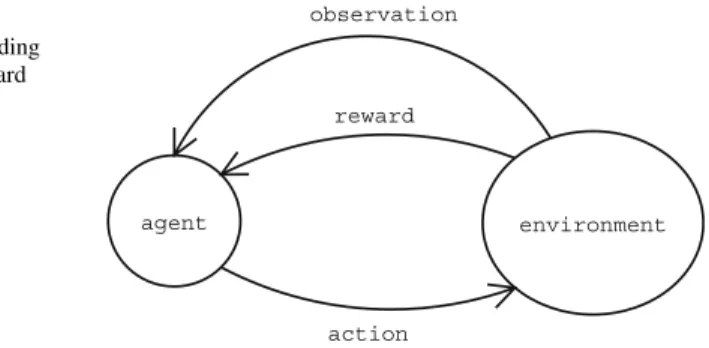
In our framework we will include the reward signal as a part of the perception generated by the environment. The perceptions also contain a non-reward part,
which we will refer to asobservations. This now gives us the complete system of
interacting agent and environment, as illustrated in Fig.1. The goal, in the broad
flexible sense, is implicitly defined by the environment as this is what defines when rewards are generated. Thus, in the framework as we have defined it, to test an agent in any given way it is sufficient to fully define the environment.
This widely used and very flexible structure is in itself nothing new. In artificial intelligence it is the framework used in reinforcement learning (Sutton and Barto
1998). By appropriately renaming things, it also describes the controller-plant
framework used in control theory (Bertsekas and Tsitsiklis1996). The interesting
point for us is that this setup follows naturally from our informal definition of intelligence and our desire to keep things as general as possible. The only difficulty was how to deal with the notion of success, or profit. This required the existence of some kind of an objective or goal. The most flexible and elegant way to bring this into the framework was to use a simple reward signal.
3.1 Example To make this model more concrete, consider the following ‘‘Two Coins Game’’. In each cycle two 50¢ coins are tossed. Before the coins settle the player must guess at the number of heads that will result: either 0, 1, or 2. If the guess is correct the player gets to keep both coins and then two new coins are produced and the game repeats. If the guess is incorrect the player does not receive any coins, and the game is repeated.
In terms of the agent–environment model, the player is the agent and the system that produces all the coins, tosses them and distributes the reward when appropriate, is the environment. The agent’s actions are its guesses at the number of heads in each iteration of the game: 0, 1 or 2. The observation is the state of the coins when they settle, and the reward is either $0 or $1.
It is easy to see that for unbiased coins the most likely outcome is 1 head and thus the optimal strategy for the agent is to always guess 1. However if the coins are significantly biased it might be optimal to guess either 0 or 2 heads depending on the bias. If this were the case, then after a number of iterations of the game an intelligent agent would realise that the coins were probably biased and change its strategy accordingly.
With a little imagination, seemingly any sort of game, challenge, problem or test can be expressed in this simple framework without too much effort. It should also be emphasised that this agent–environment framework says nothing about how the agent or the environment actually work; it only describes their roles.
Formal Agent–Environment Framework
Having introduced the agent–environment framework, we will now formalise it, along with the other components of our informal definition of intelligence. We begin with agent–environment interaction.
Agent–Environment Interaction
The agent sends information to the environment by sending symbols from some
finite set, for example, A:¼ fleft;right;up;downg: We will call this set the
Fig. 1 The agent and the environment interact by sending action, observation and reward signals to each other
action space and denote it by A: Similarly, the environment sends signals to the
agent with symbols from a finite set called theperception space, which we will
denoteP:Thereward space, denoted byR;will always be a subset of the rational
unit interval ½0;1 \Q: Every perception consists of two separate parts; an
observation and a reward. For example, we might have P:¼ fðcold;0:0Þ;
ðwarm;1:0Þ;ðhot;0:3Þg where the first part describes what the agent observes
(cold, warm or hot) and the second part describes the reward (0.0, 1.0, or 0.3).
To denote symbols being sent we will use the lower case variable namesa,oand
rfor actions, observations and rewards respectively. We will also index these in the
order in which they occur, thusa1is the agent’s first action,a2is the second action
and so on. The agent and the environment will take turns at sending symbols, starting with the environment. This produces a history of observations, rewards and
actions which we will denote by, o1r1a1o2r2a2o3r3a3o4 …. This turn taking
behaviour is not a serious restriction, nor is the fact that the first signal sent is a perception.
The Agent
Formally, the agent is a function, denoted byp, which takes the current history as
input and chooses the next action as output. We do not want to restrict the agent in any way, in particular we do not require that it is deterministic. A convenient way of representing the agent then is as a probability measure over actions conditioned on
the complete interaction history. Thus,p(a3|o1r1a1o2r2) is the probability of action
a3in the third cycle, given that the current history is o1r1a1o2r2. A deterministic
agent is simply one that always assigns a probability of 1 to a single action for any given history. As the history that the agent can use to select its action expands indefinitely, the agent need not be Markovian. Indeed, how the agent produces its distribution over actions for any given history is left open. In artificial intelligence
the agent will of course be a machine and sopwill be a computable function. In
general however,pcould be anything: an algorithm that generates the digits ofpffiffiffie
as outputs, an incomputable function, or even a human pushing buttons on a keyboard.
The Environment
We define the environment, denoted byl, in a similar way. Specifically, for any
k2Nthe probability ofokrk, given the current interaction historyo1r1a1o2r2a2
…ok-1rk-1ak-1, is given by the probability measurel(okrk|o1r1a1o2r2a2…ok-1
rk-1 ak-1). For the moment we will not place any further restrictions on the
environment.
3.2 Example To illustrate this formalism, consider again the Two Coins Game
introduced in Example 1. Let P:¼ f0;1;2g f0;1g be the perception space
received reward. Likewise letA:¼ f0;1;2g be the action space representing the agent’s guess at the number of heads that will occur. Assuming two fair coins, we
can represent this environment byl:
lðokrkjo1. . .ak1Þ:¼ 1 4 if ok¼ak12 f0;2g ^rk¼1; 3 4 if ok6¼ak12 f0;2g ^rk¼0; 1 2 if ok¼ak1¼1^rk¼1; 1 2 if ok6¼ak1¼1^rk¼0; 0 otherwise: 8 > > > > < > > > > :
An agent that performs well in this environment would be,
pðakjo1r1a1. . .okrkÞ:¼
1 forak¼1;
0 otherwise:
That is, always guess that one head will be the result of the two coins being tossed. A more complex agent might keep count of how many heads occur in each cycle and then adapt its strategy if it seems that the coins are sufficiently biased.
Measure of Success
Our next task is to formalise the idea of ‘‘profit’’ or ‘‘success’’ for an agent. Informally, we know that the agent must try to maximise the amount of reward it receives, however this could mean several different things. For example, one agent might quickly find a way to get a reward of 0.9 in every cycle. After 100 cycles it will have received a total reward of about 90 with an average reward per cycle of close to 0.9. A second agent might spend the first 80 cycles exploring different actions and their consequences, during which time its average reward might only be 0.2. Having done this exploration however, it might then know a way to get a reward of 1.0 in every cycle. Thus after 100 cycles its total reward is
only 80· 0.2 + 20· 1.0 = 36, giving an average reward per cycle of just 0.36.
After 1,000 cycles however, the second agent will be performing much better than the first.
Which agent is the better one? The answer depends on how we value reward in the near future versus reward in the more distant future. In some situations we may want our agent to perform well fairly quickly, in others we might only care that it eventually reaches a level of performance that is as high as possible.
A standard way of formalising this is to scale the value of rewards so that they
decay geometrically into the future at a rate given by a discount parameterc[(0,1).
For example, with c= 0.95 a reward of 0.7 that is 10 time steps into the future
would be given a value of 0.7· (0.95)10&0.42. At 100 time steps into the future a
reward of 0.7 would have a value of just over 0.004. By increasingctowards 1 we
weight long term rewards more heavily, conversely by reducing it we weight them less so. In other words, this parameter controls how short term greedy, or long term farsighted, the agent should be.
To work out the expected future value for a given agent and environment interacting, we take the sum of these discounted rewards into the infinite future and work out its expected value,
VlpðcÞ:¼1 CE X1 i¼1 ciri ! : ð1Þ
In the above,riis the reward in cycleiof a given history,cis the discount rate,ciis
the discount applied to theith reward into the future, the normalising constant is
C:¼Pi?=1 ci, and the expected value is taken over all possible interaction
sequences between the agentp and the environmentl.
Under geometric discounting an agent withc= 0.95 will not plan further than
about 20 cycles ahead. Thus we say that the agent has a constant effective
horizon of 1=ð1cÞ: Since we are interested in universal intelligence, a limited
farsightedness is not acceptable because for every horizon there is a task that needs a larger horizon to be solved. For instance, while a horizon of 5 is sufficient for tic-tac-toe, it is insufficient for chess. Clearly, geometric discounting has not solved the problem of how to weight near term rewards versus long term rewards, it has simply expressed this weighting as a parameter. What we require is a single definition of machine intelligence, not a range of definitions that vary according to a free parameter.
A more promising candidate for universal discounting is the near-harmonic, or
quadratic discount, where we replace ci in Eq. 1 by 1/i2 and modifying C
accordingly. This has some interesting properties, in particular the agent needs to look forward into the future in a way that is proportional to its current age. This is
appealing since it seems that humans of agekyears usually do not plan their lives
for more than, perhaps, the nextkyears. More importantly, it allows us to avoid the
problem of having to choose a global time scale or effective horizon (Hutter2005).
Although harmonic discounting has a number of attractive properties (Hutter
2006a), an even simpler and more general solution is possible. If we look at the
value function in Eq. 1, we see that discounting plays two roles. Firstly, it
normalises rewards received so that their sum is always finite. Secondly, it weights the reward at different points in the future which in effect defines a temporal preference. A direct way to solve both of these problems, without needing an external parameter, is to simply require that the total reward returned by the
environment can never exceed 1. For such a reward summable environmentl, it
follows that the expected value of the sum of rewards is also finite and thus discounting is no longer required,
Vlp:¼E X 1 i¼1 ri ! 1: ð2Þ
One way of viewing this is that the rewards returned by the environment now have the temporal preference already factored in. The cost is that this is an additional condition that we place on the space of environments. Previously we
required that each reward signal was in a subset of½0;1 \Q; now we have the
‘‘Response to Common Criticisms‘‘ for further discussion about why this constraint is reasonable).
Space of Environments
Intelligence is not simply the ability to perform well at a narrowly defined task; it is much broader. An intelligent agent is able to adapt and learn to deal with many different situations, kinds of problems and types of environments. In our informal definition this was described as the agent’s general ability to perform well in a ‘‘wide range of environments.’’ This flexibility is a defining characteristic and one of the most important differences between humans and many current AI systems: while Gary Kasparov would still be a formidable player if we were to change the rules of chess, IBM’s Deep Blue chess super computer would be rendered useless without significant human intervention.
As our goal is to produce a definition of intelligence that is as broad and encompassing as possible, the space of environments used in our definition should be as large as possible. As the environment is a probability measure with a certain structure, an obvious possibility would be to consider the space of all probability measures of this form. Unfortunately, this extremely broad class of environments causes serious problems. As the space of all probability measures is uncountably infinite, some environments cannot be described in a finite way and so are incomputable. This would make it impossible, by definition, to test an agent in such an environment using a computer. Further, most environments would be infinitely complex and have little structure for the agent to learn from.
The solution then, is to require the environmental probability measures to be computable. Not only is this condition necessary if we are to have an effective measure of intelligence, it is also not as restrictive as it might first appear. There are still an infinite number of environments with no upper bound on their maximal complexity. Also, it is only the measure that describes the environment that is computable, and so the way in which the environment responds does not have to be deterministic. For example, although a typical sequence of 1’s and 0’s generated at random by flipping a coin is not computable, the probability measure that describes this distribution is computable and thus it is included in our space of possible environments. Indeed there is currently no evidence that the physical universe cannot be simulated by a Turing machine in the above sense (for further discussion of this point see Subsection ‘‘Response to Common Criticisms’’). This appears to be the largest reasonable space of environments.
A Formal Definition of Machine Intelligence
In order to define an overall measure of performance, we need to find a way to combine an agent’s performance in many different environments into a single overall measure. As there are an infinite number of environments, we cannot simply
take a uniform distribution over them. Mathematically, we must weight some environments higher than others. But how?
Consider the agent’s perspective on this situation: there exists a probability measure that describes the true environment, however this measure is not known to the agent. The only information the agent has are some past observations of the environment. From these, the agent can construct a list of probability measures that are consistent with the observations. We call these potential explanations of the true environment, hypotheses. As the number of observations increases, the set of hypotheses shrinks and hopefully the remaining hypotheses become increasingly accurate at modelling the true environment.
The problem is that in any given situation there will be a large number of hypotheses that are consistent with the current set of observations. Thus, if the agent is going to predict which hypotheses are the most likely to be correct, it must resort to something other than just the observational information that it has. This is a frequently occurring problem in inductive inference for which the most common approach is to invoke the principle of Occam’s razor:
Given multiple hypotheses that are consistent with the data, the simplest should be preferred.
This is generally considered the rational and intelligent thing to do (Wallace
2005), indeed IQ tests often implicitly test an individual’s ability to use Occam’s
razor, as pointed out in Subsection ‘‘Human Intelligence Tests‘‘.
3.3 Example Consider the following type of question which commonly
appears in intelligence tests. There is a sequence such as 2, 4, 6, 8, and the test subject needs to predict the next number. Of course the pattern is immediately clear: the numbers are increasing by 2 each time, or more mathematically, the
kth item is given by 2k. An intelligent person would easily identify this pattern
and predict the next digit to be 10. However, the polynomial 2k4–20k3+ 70k2–
98k+ 48 is also consistent with the data, in which case the next number in the
sequence would be 58. Why then, even if we are aware of the larger polynomial, do we consider the first answer to be the most likely one? It is because we apply, perhaps unconsciously, the principle of Occam’s razor. The fact that intelligence tests define this as the ‘‘correct’’ answer, shows us that using Occam’s razor is considered the intelligent thing to do. Thus, although we do not usually mention Occam’s razor when defining intelligence, the ability to effectively use it is an important facet of intelligent behaviour.
In some cases we may even consider the correct use of Occam’s razor to be a more important demonstration of intelligence than achieving a successful outcome. Consider, for example, the following game:
3.4 Example A questioner lays twenty $10 notes out on a table before you and then points to the first one and asks ‘‘Yes or No?’’. If you answer ‘‘Yes’’ he hands you the money. If you answer ‘‘No’’ he takes it from the table and puts it in his pocket. He then points to the next $10 note on the table and asks the same question. Although you, as an intelligent agent, might experiment with answering both ‘‘Yes’’
and ‘‘No’’ a few times, by the 13th round you would have decided that the best choice seems to be ‘‘Yes’’ each time. However what you do not know is that if you answer ‘‘Yes’’ in the 13th round then the questioner will pull out a gun and shoot you! Thus, although answering ‘‘Yes’’ in the 13th round is the most intelligent choice, given what you know, it is not the most successful one. An exceptionally dim individual may have failed to notice the obvious relationship between answers and getting the money, and thus might answer ‘‘No’’ in the 13th round, thereby saving his life due to what could truly be called ‘‘dumb luck’’.
What is important then, is not that an intelligent agent succeeds in any given situation, but rather that it takes actions that we would expect to be the most likely ones to lead to success. Given adequate experience this might be clear, however often experience is not sufficient and one must fall back on good prior assumptions about the world, such as Occam’s razor. It is important then that we test the agents in such a way that they are, at least on average, rewarded for correctly applying Occam’s razor, even if in some cases this leads to failure.
There is another subtlety that needs to be pointed out. Often intelligence is thought of as the ability to deal with complexity. Or in the words of the psychologist
Gottfredson, ‘‘… gis the ability to deal with cognitive complexity—in particular,
with complex information processing’’(Gottfredson 1997). It is tempting then to
equate the difficultly of an environment with its complexity. Unfortunately, things are not so straightforward. Consider the following environment:
3.5 Example Imagine a very complex environment with a rich set of relationships between the agent’s actions and observations. The measure that describes this will have a high complexity. However, also imagine that the reward signal is always maximal no matter what the agent does. Thus, although this is a very complex environment in which the agent is unlikely to be able predict what it will observe next, it is also an easy environment in the sense that all policies are optimal, even very simple ones that do nothing at all. The environment contains a lot of structure that is irrelevant to the goal that the agent is trying to achieve.
From this perspective, a problem is thought of as being difficult if the simplest good solution to the problem is complex. Easy problems on the other hand are those that have simple solutions. This is a very natural way to think about the difficulty of problems, or in our terminology, environments.
Fortunately, this distinction does not affect our use of Occam’s razor. When we talk about an hypothesis, what we mean is a potential model of the environment from the agent’s perspective, not just a model that is sufficient with respect to the agent’s goal. From the agent’s perspective, an incorrect hypothesis that fails to model much of the environment may be optimal if the parts of the environment that the hypothesis fails to model are not relevant to receiving reward. However, when Occam’s razor is applied, we apply it with respect to the complexity of the hypotheses, not the complexity of good solutions with respect to an objective. Thus, to reward agents on average for correctly using Occam’s razor, we must weight the environments according to their complexity, not their difficulty.
Our remaining problem now is to measure the complexity of environments. The
Kolmogorov complexity of a binary stringxis defined as being the length of the
shortest program that computesx:
KðxÞ :¼min
p flðpÞ:UðpÞ ¼xg;
wherepis a binary string which we call aprogram,l(p) is the length of this string in
bits, andU is a prefix universal Turing machineU called thereference machine.
To gain an intuition for how this works, consider a binary string 0000…0 that
consists of a trillion 0’s. Although this string is very long, it clearly has a simple structure and thus we would expect it to have a low complexity. Indeed this is the
case because we can write a very short programpthat simply loops a trillion times
outputing a 0 each time. Similarity, other strings with simple patterns have a low Kolmogorov complexity. On the other hand, if we consider a long irregular random
string 111010110000010…then it is much more difficult to find a short program
that outputs this string. Indeed it is possible to prove that there are so many strings of this form, relative to the number of short programs, that in general it is impossible for long random strings to have short programs. In other words, they have high Kolmogorov complexity.
An important property ofKis that it is nearly independent of the choice ofU:To
see why, consider what happens if we switch fromU , in the above definition ofK,
to some other universal Turing machineU0:Due to the universality property ofU0;
there exists a programqthat allowsU0to simulateU:Thus, if we giveU0bothqand
pas inputs, it can simulateU runningpand thereby computeUðpÞ:It follows then
that switching fromU toU0in our definition ofKabove incurs atmostan additional
cost of l(q) bits in minimal program length. The constant l(q) is independent of
which stringxwe are measuring the complexity of, and for reasonable universal
Turing machines, this constant will be small. This invariance property makesKan
excellent universal complexity measure. For an extensive treatment of Kolmogorov
complexity see Li and Vita´nyi (1997) or Calude (2002).
In our current application we need to measure the complexity of the computable measures that describe environments. It can be shown that this set can be
enumeratedl1,l2,l3,… (see Theorem 4.3.1 in Li and Vita´nyi (1997)). Using a
simple encoding method we can express each index as a binary string, writtenhii. In
a sense this binary string is a description of an environment with respect to our
enumeration. This lets us define the complexity of an environmentli to be
K(li):¼K(hii). Intuitively, if a short program can be used to describe the program
for an environmentli, then this environment will have a low complexity.
This answers our problem of needing to be able to measure the complexity of environments, but we are not done yet. In order to formalise Occam’s razor we need to have a way to assign an a priori probability to environments in such a way that complex environments are less likely, and simple environments more likely. If we
consider that each environmentliis described by a minimal length program that is a
binary string, then the natural way to do this is to consider each additional bit of program length to reduce the environment’s probability by one half, reflecting the fact that each bit has two possible states. This gives us what is known as the