
An Analysis of the Coherence of Descriptors in Topic Modeling
Derek O’Callaghan∗, Derek Greene, Joe Carthy, P´adraig Cunningham
School of Computer Science & Informatics, University College Dublin, Ireland.
Abstract
In recent years, topic modeling has become an established method in the analysis of text corpora, with probabilistic techniques such as latent Dirichlet allocation (LDA) commonly employed for this purpose. However, it might be argued that enough attention is often not paid to the issue of topic coherence, the semantic interpretability of the top terms usually used to describe discovered topics. Nevertheless, a number of studies have proposed measures for analyzing such coherence, where these have been largely focused on topics found by LDA, with matrix decomposition techniques such as Non-negative Matrix Factorization (NMF) being somewhat overlooked in comparison. This motivates the current work, where we compare and analyze topics found by popular variants of both NMF and LDA in multiple corpora in terms of both their coherence and associated generality, using a combination of existing and new measures, including a distributional semantics measure based on an algorithm provided by the increasingly popular word2vec tool. Two out of three coherence measures find NMF to regularly produce more coherent topics, with higher levels of generality and redundancy observed with the LDA topic descriptors. In all cases, it appears that the associated term weighting strategy plays a major role. The results observed with NMF suggest that this may be a more suitable topic modeling method when analyzing certain corpora, such as those associated with niche or non-mainstream domains.
Keywords: Topic modeling, Topic coherence, LDA, NMF
1. Introduction
Topic modeling is a key tool for the discovery of latent semantic structure within a variety of document collections, where probabilistic models such as latent Dirichlet allocation (LDA) have effectively become the de facto standard method employed (Blei, Ng, and Jordan, 2003). The discovered topics are usually described using their corresponding topN highest-ranking terms, for example, the top 10 most probable terms from an LDA φtopic distribution over terms. In the case of probabilistic topic models, a number of metrics are used to eval-uate model fit, such as perplexity or held-out likelihood (Wal-lach, Murray, Salakhutdinov, and Mimno, 2009b). At the same time, it might be argued that less attention is paid to the issue oftopic coherence, or the semantic interpretability of the terms used to describe a particular topic, despite the observation that evaluation methods such as perplexity are often not correlated with human judgements of topic quality (Chang, Boyd-Graber, Gerrish, Wang, and Blei, 2009). However, a number of mea-sures have been proposed in recent years for the measurement of coherence, based on approaches that include co-occurrence frequencies of terms within a reference corpus (Newman, Lau, Grieser, and Baldwin, 2010; Mimno, Wallach, Talley, Leenders, and McCallum, 2011; Lau, Newman, and Baldwin, 2014) and
∗Corresponding author
Email addresses:[email protected](Derek O’Callaghan),[email protected](Derek Greene),
[email protected](Joe Carthy),[email protected]
(P´adraig Cunningham)
distributional semantics (Aletras and Stevenson, 2013). The in-tuition is that pairs of topic descriptor terms that co-occur fre-quently or are close to each other within a semantic space are likely to contribute to higher levels of coherence.
Non-probabilistic methods based on matrix decomposition are also used for topic modeling, such as Latent Semantic Anal-ysis (LSA) (Deerwester, Dumais, Landauer, Furnas, and Harsh-man, 1990) or Non-negative Matrix Factorization (NMF) (Lee and Seung, 1999; Arora, Ge, and Moitra, 2012b). Here, topic term descriptors can be generated in a similar fashion to those of probabilistic models, for example, using the topN highest-ranked terms from an NMF topic basis vector. In our previ-ous work, we generated topics using both LDA and NMF with two particular corpora, where a qualitative analysis of the corre-sponding term descriptors found the most readily-interpretable topics to be discovered by NMF (O’Callaghan, Greene, Con-way, Carthy, and Cunningham, 2013). An example of the is-sues we encountered can be illustrated with the following topics that were discovered by LDA and NMF for the same value of
kwithin a corpus of online news articles (described in further detail in Section 5):
• LDA: iran, syria, syrian, iraq, weapon, president, war, nuclear, military, iranian
• NMF:syria, syrian, weapon, chemical, assad, damascus, rebel, military, opposition, lebanon
At a glance, both topics appear both relevant and coher-ent, with no identifiable irrelevant terms, where the topics may
be interpreted as being associated with the ongoing Syria con-flict. A closer inspection of the terms suggests that the LDA topic is in fact a general topic about the Middle East, while the NMF topic is far more specifically concerned with Syria (in-cluding thelebanonterm in this context), which could also be interpreted as being more coherent depending on the end user’s expectations. This issue regarding the possibility for LDA to over-generalize has been raised previously by Chemudugunta, Smyth, and Steyvers (2006). However, a study by Stevens, Kegelmeyer, Andrzejewski, and Buttler (2012) of the coherence of topics discovered by LSA, NMF and LDA within a single corpus composed of online New York Times articles from 2003 (Sandhaus, 2008), concluded that NMF produced the more in-coherent topics. As our previous findings suggest that this is-sue is unresolved, we perform an evaluation of LDA and NMF using a range of corpora, where our two major objectives are the measurement and comparison of 1) topic coherence, and 2) topic generality. The latter is considered at two levels; the ten-dency for a method to generate topics containing high-frequency descriptor terms from the underlying corpus, and also the ap-pearance of terms in multiple descriptors for a particular model, signifying the presence of overlap or dependence between the topics.
To this end, we compiled six new and existing corpora con-taining documents that had been (manually) annotated with cla-sses, including online news articles from the BBC, the Guardian, and the New York Times, in addition to Wikipedia project page content. A consistent set of pre-processing steps was applied to these, and topics were discovered with LDA and NMF. Al-though multiple variants exist for both topic modeling meth-ods, we restricted the experiments to those that appear to be commonly used, with popular implementations being run ac-cordingly (McCallum, 2002; Pedregosa, Varoquaux, Gramfort, Michel, Thirion, Grisel, Blondel, Prettenhofer, Weiss, Dubourg, Vanderplas, Passos, Cournapeau, Brucher, Perrot, and Duch-esnay, 2011), in addition to recommended parameter values (Steyvers and Griffiths, 2006). Two out of three coherence mea-sures, including a new measure based on word2vec (Mikolov, Chen, Corrado, and Dean, 2013a) term vector similarity, find NMF to regularly produce more coherent topics, while higher levels of generality and redundancy are observed with the LDA topic descriptors. However, it appears that the associated term weighting strategy plays a major role, as modifications to both document term pre-processing (NMF) and descriptor term post-processing (LDA) can produce markedly different results. Sep-arately, we also find that LDA produces more accurate document-topic memberships when compared with the original class an-notations.
2. Related Work
2.1. Topic Modeling
Topic modeling is concerned with the discovery of latent se-mantic structure or topics within a set of documents, which can be derived from co-occurrences of words in documents (Steyvers and Griffiths, 2006). This strategy dates back to the early work
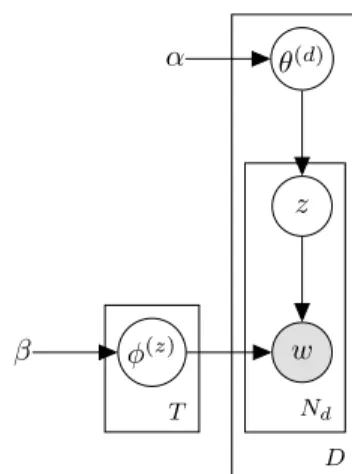
w z θ(d) α φ(z) β Nd D T
Figure 1: Plate notation for the graphical LDA topic model.
on latent semantic indexing by Deerwester, Dumais, Landauer, Furnas, and Harshman (1990), which proposed the decompo-sition of term-document matrices for this purpose using Sin-gular Value Decomposition. Probabilistic topic models have become popular in recent years, having been introduced with the Probabilistic Latent Semantic Analysis (PLSA) method of Hofmann (2001), also known as Probabilistic Latent Seman-tic Indexing (PLSI). Here, a topic is a probability distribution over words, with documents being mixtures of topics, thus per-mitting a topic model to be considered a generative model for documents (Steyvers and Griffiths, 2006). With this process, a document is generated by first sampling a topicz from the document-topic distributionθ, followed by a wordwfrom the corresponding topic-word distributionφ. The extension of this model by Blei, Ng, and Jordan (2003), known as latent Dirich-let allocation (LDA), suggested using a DirichDirich-let prior onθwith an associated hyperparameterα. Griffiths and Steyvers (2004) proposed also using a Dirichlet prior onφ, with correspond-ing hyperparameterβ. The plate notation for this model can be found in Figure 1.
Griffiths and Steyvers (2004) also used collapsed Gibbs sam-pling to indirectly estimate these distributions, by iteratively es-timating the probability of assigning each word to the topics, conditioned on the current topic assignments of all other words, using count matrices of topic-word (CW T) and document-topic
(CDT) assignments: P(zi=j|z−i, wi, di, .) ∝ CW T wi,j+β PW w=1Cw,jW T +W β CdDT i,j+α PT t=1CdDTi,t+T α (1)
Following this process, the distributions for sampling a word
ifrom topicj (φj), and topicj for documentd(θd) are
esti-mated as: φj= C W T ij +β PW w=1C W T wj +W β θd= C DT dj +α PT t=1C DT dt +T α (2)
There have been a number of additional variants of LDA proposed in recent years. However, in this paper, we are primar-ily concerned with the coherence of topic modeling in general, and so the discussion here is accordingly restricted to a) popular LDA variants, and b) those used by the topic coherence exper-iments described in Section 2.2. Two popular toolkits that are often used for topic modeling with LDA areMALLET (McCal-lum, 2002), which provides a fast implementation of the Gibbs sampling method described above, and gensim ( ˇReh˚uˇrek and Sojka, 2010), which implements the online variational Bayes method of Hoffman, Blei, and Bach (2010). The motivation for the latter method was the application of LDA to data streams or large datasets. In addition to the method implementations provided by MALLET and gensim, other prominent methods featuring in the topic coherence experiments that have not been discussed so far include the Correlated Topic Model (CTM) of Blei and Lafferty (2006), which attempts to directly model cor-relation between the latent topics themselves, and the P´olya Urn method proposed by Mimno, Wallach, Talley, Leenders, and McCallum (2011), which extended Gibbs sampling to incorpo-rate information used in the corresponding coherence metric.
Non-negative matrix factorization (NMF) is a technique for decomposing a non-negative matrixV ∈Rinto two non-negative
factorsW andH, whereV ≈W H(Lee and Seung, 1999). Al-though it has been used in multiple domains, it is also applicable to topic modeling (Arora, Ge, and Moitra, 2012b). In this con-text,V is ann×mterm-document matrix, andW andH are reduced rank-k factors whose product is an approximation of
V, with dimensionsW =n×kandH =k×m. This enables a parts-based representation, whereW contains a set ofktopic basis vectors, andH provides the coefficients for the additive linear combinations of these basis vectors to generate the corre-sponding document vectors inV. The weights in aW topic ba-sis vector can be used to generate a topic descriptor conba-sisting of high-ranking terms (analogous to the most probable terms in an LDAφ distribution), while aH vector of coefficients can be interpreted as the ktopic membership weights for the cor-responding document. Two common objective functions (Lee and Seung, 2001) used to generateW andHare the Euclidean squared error: n X i=1 m X j=1 (Vij−(W H)ij)2=||V −W H||2F (3)
and the Kullback-Leibler (KL) divergence, whenV andW H
both sum to 1 (thus acting as normalized probability distribu-tions): D(V||W H) = n X i=1 m X j=1
Vijlog Vij
(W H)ij
(4) NMF with KL divergence was previously shown to be equiv-alent to PLSA by Gaussier and Goutte (2005). As an alter-native to the multiplicative update rules approach of Lee and Seung (2001) for determiningW andH, Lin (2007) proposed the use of a projected gradient method with alternating non-negative least squares. Separately, to address the instability
in-troduced by standard random initialization ofW andH, Bout-sidis and Gallopoulos (2008) introduced deterministic initial-ization with Non-Negative Double Singular Value Decomposi-tion (NNDSVD), which is particularly suitable for sparse ma-trices. As with LDA, here we are primarily concerned with popular NMF variants, where the focus is upon the implemen-tation of the method proposed by Lin (2007), with the squared error objective function and NNDSVD initialization, as pro-vided by thescikit-learnmachine learning library (Pedregosa, Varoquaux, Gramfort, Michel, Thirion, Grisel, Blondel, Pret-tenhofer, Weiss, Dubourg, Vanderplas, Passos, Cournapeau, Brucher, Perrot, and Duchesnay, 2011).
2.2. Topic Coherence
Although perplexity (held-out likelihood) has been a com-mon method for the evaluation of topic models, the study of Chang, Boyd-Graber, Gerrish, Wang, and Blei (2009) found that this was often negatively correlated with human judge-ments of topic quality (using topics discovered with PLSI, CTM, and LDA), and suggested that evaluation should be focused upon real-world task performance that includes human anno-tation. This has led to a number of studies that have focused upon the development of topiccoherencemeasures, which cap-ture the semantic interpretability of discovered topics based on their corresponding description terms (for example, the topN
most probable terms from aφdistribution estimated by LDA). Newman, Lau, Grieser, and Baldwin (2010) calculated the cor-relation between human judgements and a set of proposed mea-sures, and found that a Pointwise Mutual Information (PMI) measure achieved best or near-best out of all evaluated mea-sures. This was based on co-occurrence frequency of each set of top 10 (LDA) topic terms within a reference corpus (Wikipedia), using a sliding window of 10 words, with the mean pairwise term PMI used as an individual topic score, where the intu-ition was that terms that regularly co-occurred were likely to produce coherent topic descriptors. A similar co-occurrence measure was suggested by Mimno, Wallach, Talley, Leenders, and McCallum (2011), which used log conditional probability (LCP) rather than PMI (conditioned on the higher-ranking term in each term pair), and was found to produce higher correlation with human judgements than that of the latter. In contrast to Newman, Lau, Grieser, and Baldwin (2010), the co-occurrence frequencies were calculated using the corpus being modeled, rather than relying upon a reference corpus. Here, LDA topics were discovered using the Gibbs sampling method along with their proposed extension.
Both of these measures were employed in the study of Stevens, Kegelmeyer, Andrzejewski, and Buttler (2012), which com-pared the coherence of topics generated by LSA, NMF and LDA using a model-level summarization. Although they found that each of these methods had certain strengths, they also con-cluded that NMF tended to produce more incoherent topics than either of the other two methods. Aletras and Stevenson (2013) proposed measuring LDA topic coherence using distributional similarity (DS) between the top terms, where each term was represented as a vector in a semantic space, with topic coher-ence calculated as mean pairwise vector similarity; Cosine
sim-ilarity, Jaccard simsim-ilarity, and the Dice coefficient were used. As before, these were correlated with human judgements, in ad-dition to the PMI measure, a normalized variant of PMI (Bouma, 2009) (NPMI, range =[−1,1]), and LCP. They found the term vector similarity measures to compare favorably with those based on PMI, in particular, Cosine similarity, while LCP performed poorly in general, where they suggested that the latter is sen-sitive to the size of the modeled corpus. Lau, Newman, and Baldwin (2014) performed an empirical comparison of these four PMI, NPMI, LCP and DS measures in the context of the original evaluation tasks used by Chang, Boyd-Graber, Gerrish, Wang, and Blei (2009) (using PLSI, LDA, and CTM), where the NPMI and DS measures were those most strongly corre-lated with the human raters at the topic level. To address the sparsity issue with using the corpus being modeled to calcu-late term co-occurrence for LCP, as pointed out by Aletras and Stevenson (2013) (and also an earlier work by Lau, Baldwin, and Newman, 2013), they proposed instead using the same ref-erence corpus as required by the PMI measures.
More recently, R¨oder, Both, and Hinneburg (2015) proposed a unifying framework that represented coherence measures as a composition of parts, with the objective of achieving higher correlation with human judgements. This was an attempt to address certain issues raised in their earlier work in relation to coherence measures based on term co-occurrence (Rosner, Hin-neburg, R¨oder, Nettling, and Both, 2013). The emphasis was largely on topics discovered by LDA, as they followed the eval-uation schemes of Newman, Lau, Grieser, and Baldwin (2010), Aletras and Stevenson (2013), and Lau, Newman, and Bald-win (2014). One clear observation that can be made about these previous works is the attention given to LDA or similar probabilistic topic modeling methods, where matrix factoriza-tion methods such as NMF are very much in the minority. The current work aims to address this issue with a comparison of topics discovered with NMF and LDA across multiple corpora, particularly in light of our previous findings that the former pro-duces more readily-interpretable topics (O’Callaghan, Greene, Conway, Carthy, and Cunningham, 2013).
3. Data
A range of corpora were analyzed in this evaluation, where we were focused upon both new and existing corpora contain-ing documents that had been (manually) annotated with classes. The first new corpus contained news articles from the BBC website1. At the start of January 2014, we retrieved all tweets
up to the 3,200 Twitter REST API2 limit for 71 manually
se-lected Twitter accounts affiliated with the BBC or its journalists (for example, @BBCNews, @BBCSport, @bbcscitech), which yielded a total of 91,616 tweets. All unique URIs containing the domains bbc.co.uk or bbc.com were extracted from these tweets, and the corresponding web pages (where still accessi-ble) were then retrieved, with the exception of a set of
black-1http://www.bbc.com
2https://dev.twitter.com/docs/api
listed URI prefixes (for example, those related to careers, adver-tising and other non-news content). From the retrieved pages, we extracted and fetched web pages for all unique URIs con-taining either of the two BBC domains that had not been previ-ously fetched; this process was performed twice. We then fil-tered all retrieved articles that were published outside the time period 2009-01-01 to 2013-12-31, or whose publication date could not be ascertained from the corresponding page metadata. The article body text was extracted using the Java Boilerpipe library3(Kohlsch¨utter, Fankhauser, and Nejdl, 2010), with
arti-cles containing empty body text being filtered. The final corpus consisted of all articles in the top 40sections, as annotated by the BBC and extracted from the page metadata, where each ar-ticle is assigned to exactly one section.
A similar process was used to generate a corpus contain-ing news articles from the Guardian website4, where 29 manu-ally selected Twitter accounts affiliated with the Guardian or its journalists (for example, @guardian, @GdnPolitics, @guardian-film) yielded a total of 184,284 tweets. Unique URIs contain-ing the domainsguardian.co.ukortheguardian.comwere used to fetch the article text, with the final corpus consisting of ar-ticles found in the top 24 annotatedsectionsas extracted from the metadata, with each article featuring one section annota-tion. Two additional news corpora were extracted from the New York Times Corpus, which contains over 1.8 million ar-ticles written and published by the New York Times (NYT) be-tween January 1, 1987 and June 19, 2007, in addition to arti-cle metadata annotations (Sandhaus, 2008). The first of these corpora consisted of articles from 2003, as also analyzed by Stevens, Kegelmeyer, Andrzejewski, and Buttler (2012) in their coherence evaluation of multiple topic modeling methods, with the second containing a stratified 10% sample of articles from 2000 to 2007. In contrast to our extracted BBC and Guardian corpora, the NYT articles can contain multiple section anno-tations. For both extracted corpora, identifiablemeta-sections covering multiple topics were excluded, such as “Front Page”, “Corrections”, and “Magazine”.
The final two corpora consisted of pages found on Wikipedia. We initially selected eight top-level categories from the WikiPro-ject Council Directory5 that had active sub-categories and/or
task forces, and also selected the set of active sub-categories. As the sub-categories found in each top-level category directory are often not peers of each other in the hierarchy, sub-categories at the highest level were chosen, for example a sport category was selected as opposed to a category for a particular team. For each category, a list of page titles in the classes ’FA’, ’FL’, ’A’, ’GA’, ’B’, ’C’ was retrieved from the corresponding category class page, and the page text was extracted from a Wikipedia dump from January 2014 by means of a wrapper around the WikiExtractor utility6. This resulted in 42,170 page titles for
3https://code.google.com/p/boilerpipe/ 4http://www.theguardian.com 5http://en.wikipedia.org/wiki/Wikipedia: WikiProject_Council/Directory 6http://medialab.di.unipi.it/wiki/Wikipedia_ Extractor
Documents Terms Classes BBC 161,469 17,079 40 Guardian 194,153 22,141 24 NYT 2003 70,134 20,429 20 NYT 2000+ (10%) 65,335 21,461 20 Wikipedia (high-level) 5,682 28,699 6 Wikipedia (lower-level) 4,970 24,265 10
(a) Corpus size
Min Max Mean Median Standard deviation
BBC 10 7241 242.00 167 362.53 Guardian 10 19080 299.08 250 276.65 NYT 2003 10 7816 282.40 260 239.42 NYT 2000+ (10%) 10 16997 302.88 275 298.26 Wikipedia (high-level) 10 7510 897.35 607 901.03 Wikipedia (lower-level) 10 7520 924.31 604 929.62
(b) Document length statistics (terms)
Table 1: The six corpora used in the topic coherence evaluation, including the number of documents and terms following pre-processing (described in Section 4.1).
194 categories containing text with≥10terms, with some ti-tles belonging to multiple categories. The two corpora con-sisted of a selection of top-level categories and lower-level sub-categories respectively. Details of all six corpora used in the evaluation can be found in Table 1, and pre-processed versions are made available online for further research7.
4. Methodology
4.1. Topic Discovery and Descriptor Generation
A set of common pre-processing steps were applied to all six corpora. We initially compiled a “standard” set of 671 En-glish stopwords from a variety of sources including those fea-tured in the machine learning library scikit-learn (Pedregosa, Varoquaux, Gramfort, Michel, Thirion, Grisel, Blondel, Pret-tenhofer, Weiss, Dubourg, Vanderplas, Passos, Cournapeau, Brucher, Perrot, and Duchesnay, 2011), the Natural Language Toolkit (NLTK) (Loper and Bird, 2002), and the MALLET toolkit (Mc-Callum, 2002), in addition to English honorifics and contrac-tions documented on Wikipedia8 9. These stopwords were fil-tered, along with any terms containing common top-level-domains such as “.com” or “.co.uk”. URIs and terms containing digits were also filtered, and ascii normalization was performed to re-move diacritics. Terms were converted to lowercase, and a lem-matizer was applied (NLTK wrapper around WordNet’s built-in morphy function). Stemming was not performed as it often led to the subsequent generation of topic descriptor terms that were not interpretable by an end user. Finally, low-frequency terms occurring in fewer than l of the totalmdocuments were also excluded, where thelthreshold was set tomax(10, m/1000).
Although multiple variants exist for both LDA and NMF (for example, Blei, Griffiths, Jordan, and Tenenbaum, 2004; Rosen-Zvi, Griffiths, Steyvers, and Smyth, 2004; Saha and Sind-hwani, 2012), we restricted the experiments to those that are popular and/or were used by the topic coherence papers dis-cussed earlier in Section 2.1. In the case of LDA, we used the fast Gibbs sampling implementation provided by the MAL-LET toolkit (McCallum, 2002), with the same parameters as found in the coherence evaluation code provided by Stevens, Kegelmeyer, Andrzejewski, and Buttler (2012)10apart from an
increased number of iterations. This included the recommended
7http://mlg.ucd.ie/topiccoherence/ 8http://en.wikipedia.org/wiki/English_honorifics 9http://en.wikipedia.org/wiki/Wikipedia:List_of_ English_contractions 10https://github.com/fozziethebeat/ TopicModelComparison
values (Steyvers and Griffiths, 2006) for the Dirichlet hyper-parametersαandβ of50/k (k= number of topics) and 0.01 respectively (these are actually the default parameter values in MALLET), in addition to hyperparameter optimization for an asymmetric Dirichlet prior over the document-topic distribution
θ(Wallach, Mimno, and McCallum, 2009a). LDA operates on bag-of-wordsdocument representations, and the corresponding feature sequences used by MALLET were created for each cor-pus following the pre-processing steps described above.
For NMF, the same pre-processed corpus documents were transformed to log-based Term Frequency-Inverse Document Frequency (TF-IDF) vectors (Salton and Buckley, 1988), and subsequently normalized to unit length. We used the squared error NMF variant as provided by scikit-learn (Pedregosa, Varo-quaux, Gramfort, Michel, Thirion, Grisel, Blondel, Prettenhofer, Weiss, Dubourg, Vanderplas, Passos, Cournapeau, Brucher, Per-rot, and Duchesnay, 2011), which is an implementation of the fast alternating least squares method proposed by Lin (2007). The Kullback-Leibler objective function was not considered for this evaluation due to its equivalence to PLSA (Gaussier and Goutte, 2005), itself a probabilistic precursor to LDA. To ad-dress the instability introduced by random initialization in stan-dard NMF, the deterministic NNDSVD initialization method was also employed (Boutsidis and Gallopoulos, 2008).
For each topic found by applying these variants of LDA and NMF, a descriptor was created as follows:
1. NMFw: the top 10 highest-ranking terms from the topic’s basis vector inWk, a factor ofV
T F−IDF.
2. LDAu: the top 10 most probable terms from the topic’s
φdistribution.
Thew(weighted) andu(unweighted) notation reflects the term weighting strategy employed, in addition to the simplest bag-of-wordsweighting strategy based on term frequencies. The IDF pre-processing step used by NMFwdown-weights the
con-tribution of TF in the case of frequent (more general) terms, while also boosting the contribution of rarer terms that may be more discriminating. As the analogous term weighting with LDAuis effectively that of TF, we refer to it as unweighted for the purpose of this evaluation. Although it is customary to gen-erate LDA term descriptors using the most probable terms, Blei and Lafferty (2009) state their preference for selecting the top terms ranked using the score defined in Equation 5:
term-scorek,v=βk,vb log b βk,v (QKj=1βj,vb ) 1 K ! (5)
This is inspired by TF-IDF weighting, where the first ex-pression βk,v, the probability of term v for topick, is
analo-gous to TF, while the second expression down-weights terms that have high probability across allktopics, somewhat similar to IDF. As this operation mirrors the weighted nature of NMFw,
we also discovered topics by applying NMF to TF input vectors
VT F (minus the IDF component), which in turn mirrors the un-weighted nature of LDAu. Thus, the following topic descriptors
are also generated:
3. NMFu: the top 10 highest-ranking terms from the topic’s basis vector inWk, a factor ofVT F. As this is based on a pre-processing operation, these topics are entirely separate to those of NMFw.
4. LDAw: the top 10 highest-ranking terms, weighted using Equation 5. As this is based on a post-processing opera-tion, these topics are the same as those used by LDAu At this point, we note that other work that measured coher-ence of topics found by LDA appears to be largely focused upon the LDAu topic term descriptors of option 2 (Newman, Lau,
Grieser, and Baldwin, 2010; Mimno, Wallach, Talley, Leenders, and McCallum, 2011; Stevens, Kegelmeyer, Andrzejewski, and Buttler, 2012; Aletras and Stevenson, 2013; Lau, Newman, and Baldwin, 2014).
4.2. Measuring Topic Coherence and Generality
Having generated a set of topic models, the following topic coherence measures were calculated for each of the four term descriptor methods NMFw, LDAu, NMFu, and LDAw, with N = 10:
1. TC-NPMI - Normalized PMI (Aletras and Stevenson, 2013; Lau, Newman, and Baldwin, 2014) (the unnormalized version originally proposed by Newman, Lau, Grieser, and Baldwin (2010) was also calculated, but the normal-ized version is reported here given its superior perfor-mance as demonstrated by Lau, Newman, and Baldwin, 2014): TC-NPMI= N1 2 N X j=2 j−1 X i=1 logP(wj,wi)+ P(wi)P(wj) −logP(wi, wj) + (6)
2. TC-LCP - Mean pairwise log conditional probability (Mimno, Wallach, Talley, Leenders, and McCallum, 2011):
TC-LCP= N1 2 N X j=2 j−1 X i=1 logP(wj, wi) + P(wi) (7)
3. TC-W2V - As an analog to the DS measures of Aletras and Stevenson (2013), we propose the creation of term vectors wv using a word2vec model (Mikolov, Chen, Corrado, and Dean, 2013a). This tool provides two neu-ral network-based algorithms for estimating word repre-sentations in a vector space; Continuous Bag-of-Words
(CBOW), where the current word is predicted based on its context, and Skip-gram, which predicts context words based on the current word. These approaches have been found to generate word vectors that explicitly encode lin-guistic regularities from large amounts of unstructured text data (Mikolov, Sutskever, Chen, Corrado, and Dean, 2013b), and so are appropriate for use with a large refer-ence corpus in the analysis of topic coherrefer-ence. Here, the coherence score is the mean pairwise Cosine similarity of two term vectors generated with a Skip-gram model:
TC-W2V= N1 2 N X j=2 j−1 X i=1 similarity(wvj, wvi) (8)
For each coherence measure, we generated an aggregate score for a particular(descriptor method,k)model by taking the mean of the constituent topic scores. Similar model-level coherence scores were also used in the evaluation of Stevens, Kegelmeyer, Andrzejewski, and Buttler (2012). As suggested by Mimno, Wallach, Talley, Leenders, and McCallum (2011), a smoothing count= 1was included as required to avoid taking the logarithm of zero.
In addition to measuring topic coherence, we also analyzed the generality of the topic descriptors for the four methods NMFw, LDAu, NMFu, and LDAw. Here, generality is considered at two levels; 1) the overlap or dependence between topics, based on the appearance of terms in multiple descriptors for a partic-ular model, and 2) the tendency for a method to generate topics containing high-frequency descriptor terms from the underlying corpus. As discussed by Arora, Ge, Halpern, Mimno, Moitra, Sontag, Wu, and Zhu (2012a), some level of similarity is to be expected, but lower numbers of unique terms across topic descriptors can be an indication of less useful models. The fol-lowing steps were performed for each(descriptor method,k)
model:
1. The mean pairwise Jaccard similarity between the topic descriptorsT Dwas calculated. Higher similarity values indicate increased topic dependency:
MPJm,k= 1 k 2 k X j=2 j−1 X i=1 |T Di∩T Dj| |T Di∪T Dj| (9)
2. The probability distribution of descriptor term occurrences across all topics was generated. Terms having high occur-rence frequencies often appear to be general terms from the underlying corpus.
Only the top N (10) descriptor terms are considered, as these are the terms that would be presented to an end user. The generality of the remaining terms for a particular topic is effec-tively irrelevant. In addition, we do not consider the raw term values due to the different methods being evaluated.
5. Evaluation
In this section, we provide an evaluation of the four topic descriptor methods NMFw, NMFu, LDAu, and LDAwin terms
of their corresponding coherence and generality, using the model-level measures described in Section 4. We also analyze the as-sociated document-topic memberships by referencing the un-derlying corpus class labels. As we find similar patterns across all six corpora, we illustrate the differences in coherence and generality between the methods by focusing specifically on the BBC corpus results.
5.1. Model coherence
Tokenized versions of the documents belonging to each of the six corpora were generated using the pre-processing steps described in Section 4.1, where the final statistics can be found in Table 1. For each corpus, the documents were transformed to log-based TF-IDF unit vectors, topics were discovered using the scikit-learn implementation of NMF (including NNDSVD initialization), and the corresponding NMFw topic descriptors
were generated from the highest-ranking top 10 terms found in each topic basis vector. Similarly, NMF was also applied to TF vector representations of the documents to generate the corresponding NMFu topic descriptors. In the case of LDA, the MALLET implementation was applied to the sets of docu-ment feature sequences, from which the LDAuand LDAwtopic descriptors were generated respectively from the top 10 most probable topic terms, and the top 10 topic terms following the Blei and Lafferty normalization described in Equation 5. In all cases, topics were discovered for values ofk∈[10,100] (inter-vals of10), where this seemed to be a reasonable range given the number of annotated classes (see Table 1), using the param-eters for NMF and LDA as described in Section 4.1.
Coherence scores were then calculated for the four topic de-scriptor methods, with co-occurrence frequencies generated for the unique descriptor terms across all models using a reference corpus for TC-NPMI and also for TC-LCP, due to the issues as-sociated with using the corpus being modeled for the latter that were highlighted by Aletras and Stevenson (2013), and Lau, Newman, and Baldwin (2014). This reference corpus consisted of a Wikipedia dump from January 2014, where the tokeniza-tion process included filtering the same 671 stopwords as used in pre-processing of the six corpora used for evaluation, term lemmatization, with all remaining terms retained. Following to-kenization, the term co-occurrence frequencies were calculated using a sliding window of 20 terms. This tokenized Wikipedia corpus was also used to create the word2vec model as required by TC-W2V, using the same parameters as thedemo-word.sh script provided with revision 37 of the source code11, i.e. the
Skip-gram model with word vector dimensions =200, max con-text window skip length =5, hierarchical softmax enabled, neg-ative sampling disabled, and sample threshold = 1e-3. The word2vec Cosine similarity between each pair of unique topic descriptor terms was calculated at this point.
Mean model-level coherence scores for the four topic de-scriptor methods are presented for NPMI, LCP and TC-W2V in Figure 2, Figure 3, and Figure 4 respectively. The
11https://code.google.com/p/word2vec/
wi=school,wj=year wi=school,wj=education
P(wj) 0.08 0.01
P(wi, wj) 0.005 0.004
TC-NPMI 0.12 0.38
TC-LCP -0.85 -1.01
TC-W2V 0.20 0.54
Table 2: Examples of pairwise differences between TC-LCP and the other three coherence measures. TC-LCP tends to produce higher scores when one or both terms are more general, this can be seen with the score from the pair containing the general termyear(P(wj) = 0.08) compared to that of the other pair with
the more specific termeducation(P(wj) = 0.01).
coherence score scale is less important here, where the rela-tive difference between the methods is more interesting. For TC-NPMI and TC-W2V, a certain level of separation is ob-servable between the weighted (w) and unweighted (u) topic descriptor methods. It appears that the weighted methods are producing more coherent topics, where NMFwis regularly the most coherent method with LDAw also performing strongly, while the model-level coherence of the LDAutopic descriptors (generated from the most probable terms for a particular topic) is always lower. This pattern is replicated across all six cor-pora. However, the situation seems to be somewhat reversed in the case of TC-LCP, where LDAu is found to be most co-herent, with the NMF methods performing poorly and LDAw
positioned in-between.
We now illustrate the differences between TC-LCP and the other two measures with an analysis of the coherence scores of two pairs of terms that were included in one of the BBC topic descriptors that appears to education-related, where these scores can be found in Table 2. The term pair(school, year) yields a higher TC-LCP score than that of(school, education), while the reverse is true for the other measures. At a glance,
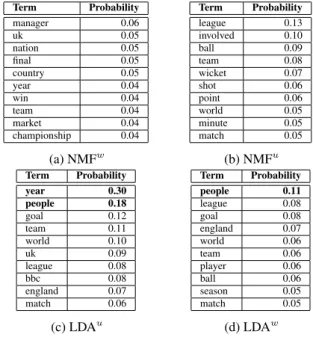
Term Probability manager 0.06 uk 0.05 nation 0.05 final 0.05 country 0.05 year 0.04 win 0.04 team 0.04 market 0.04 championship 0.04 (a) NMFw Term Probability league 0.13 involved 0.10 ball 0.09 team 0.08 wicket 0.07 shot 0.06 point 0.06 world 0.05 minute 0.05 match 0.05 (b) NMFu Term Probability year 0.30 people 0.18 goal 0.12 team 0.11 world 0.10 uk 0.09 league 0.08 bbc 0.08 england 0.07 match 0.06 (c) LDAu Term Probability people 0.11 league 0.08 goal 0.08 england 0.07 world 0.06 team 0.06 player 0.06 ball 0.06 season 0.05 match 0.05 (d) LDAw
Table 3: Top ten most frequent topic descriptor terms for the BBC corpus with k= 100.
● ● ● ● ● ● ● ● ● ● 0.05 0.10 0.15 0.20 0.25 10 30 50 70 90 k TC−NPMI ● NMFw NMFu LDAu LDAw (a) BBC ● ● ● ● ● ● ● ● ● ● 0.05 0.10 0.15 0.20 0.25 10 30 50 70 90 k TC−NPMI ● NMFw NMFu LDAu LDAw (b) Guardian ● ● ● ● ● ● ● ● ● ● 0.05 0.10 0.15 0.20 0.25 10 30 50 70 90 k TC−NPMI ● NMFw NMFu LDAu LDAw (c) NYT 2003 ● ● ● ● ● ● ● ● ● ● 0.05 0.10 0.15 0.20 0.25 10 30 50 70 90 k TC−NPMI ● NMFw NMFu LDAu LDAw (d) NYT 2000+ ● ● ● ● ● ● ● ● ● ● 0.05 0.10 0.15 0.20 0.25 10 30 50 70 90 k TC−NPMI ● NMFw NMFu LDAu LDAw
(e) Wikipedia (high-level)
● ● ● ● ● ● ● ● ● ● 0.05 0.10 0.15 0.20 0.25 10 30 50 70 90 k TC−NPMI ● NMFw NMFu LDAu LDAw (f) Wikipedia (lower-level)
Figure 2: Mean topic TC-NPMI coherence scores fork∈[10,100].
both term pairs appear coherent. However, it might be argued that(school, education)is somewhat more coherent than(school, year), due to the general nature of theyearterm. TC-NPMI, being based on PMI, considers the probability of both terms in a particular term pair, where frequent terms will be down-weighted with respect to those that occur less frequently, such as educationfrom this example. Lau, Newman, and Baldwin (2014) discuss the bias of the unnormalized version of this mea-sure (TC-PMI) towards lower frequent terms, which should be corrected by TC-NPMI. At the same time, this example clearly demonstrates that the TC-NPMI score is higher for the(school, education)pair, which is further supported by the correspond-ing word2vec Cosine similarity. As the TC-LCP measure only considers the probability of one (the highest-ranking) term for a particular term pair, the appearance of general terms is less of an
issue, particularly when both terms are general. This behaviour, coupled with the tendency for LDA to generate high-ranking topic terms that are more general (Chemudugunta, Smyth, and Steyvers, 2006) is likely the reason for the higher LDAu TC-LCP scores.
5.2. Model Generality
We also analyzed the generality of topic descriptors pro-duced by the NMFw, NMFu, LDAu, and LDAwmethods, where we were specifically interested in the overlap or dependence be-tween topics, based on the appearance of terms in multiple de-scriptors for a particular model, and the tendency for a method to generate topics containing high-frequency descriptor terms from the underlying corpus. The mean Jaccard similarity be-tween the topic descriptors generated by all four methods was
● ● ● ● ● ● ● ● ● ● −2.2 −2.0 −1.8 −1.6 −1.4 10 30 50 70 90 k TC−LCP ● NMFw NMFu LDAu LDAw (a) BBC ● ● ● ● ● ● ● ● ● ● −2.2 −2.0 −1.8 −1.6 −1.4 10 30 50 70 90 k TC−LCP ● NMFw NMFu LDAu LDAw (b) Guardian ● ● ● ● ● ● ● ● ● ● −2.2 −2.0 −1.8 −1.6 −1.4 10 30 50 70 90 k TC−LCP ● NMFw NMFu LDAu LDAw (c) NYT 2003 ● ● ● ● ● ● ● ● ● ● −2.2 −2.0 −1.8 −1.6 −1.4 10 30 50 70 90 k TC−LCP ● NMFw NMFu LDAu LDAw (d) NYT 2000+ ● ● ● ● ● ● ● ● ● ● −2.2 −2.0 −1.8 −1.6 −1.4 10 30 50 70 90 k TC−LCP ● NMFw NMFu LDAu LDAw
(e) Wikipedia (high-level)
● ● ● ● ● ● ● ● ● ● −2.2 −2.0 −1.8 −1.6 −1.4 10 30 50 70 90 k TC−LCP ● NMFw NMFu LDAu LDAw (f) Wikpedia (lower-level)
Figure 3: Mean topic TC-LCP coherence scores fork∈[10,100].
calculated, and the results for values ofk ∈[10,100]are pre-sented in Figure 5. As with the coherence scores discussed in Section 5.1, a pattern is observable across all six corpora, where the highest levels of similarity are always found with the LDAu descriptors, with NMFw producing those that are least simi-lar in most cases. LDAwalso generates relatively low levels of
similarity, while it is interesting to note that there is a separation between the unweighted methods LDAuand NMFu, where the
similarity of the latter is closer to those of the weighted meth-ods. The overlap in topics produced by LDAu due to lower
numbers of unique terms across its topic descriptors may be an indication of less useful (coherent) models, as suggested by Arora, Ge, Halpern, Mimno, Moitra, Sontag, Wu, and Zhu (2012a). It is likely that the different behaviour observed with the Wikipedia corpora is related to the corresponding smaller
number of annotated classes. Here, the pattern atk = 10(the value ofkthat is closest to the actual number of classes) appears similar to that of the other corpora.
This overlap can also be demonstrated by looking at the fre-quency of terms occurring inX (multiple) descriptors, where Figure 6 contains the results forX∈[2,3,4,≥5]from all four methods, withk= 100. Here, it can be seen that LDAu
consis-tently generates higher frequencies of terms occurring inX≥5
descriptors. Further investigation finds that these are often gen-eral terms from the underlying corpus. For example, Table 3 contains the top ten most frequent topic descriptor terms for the BBC corpus withk = 100. Although certain terms are oc-curring frequently for all four methods (also seen in Figure 6), those of LDAuappear to be general terms that may be less dis-criminating when coherence is considered, withyearand
peo-● ● ● ● ● ● ● ● ● ● 0.1 0.2 0.3 0.4 10 30 50 70 90 k TC−W2V ● NMFw NMFu LDAu LDAw (a) BBC ● ● ● ● ● ● ● ● ● ● 0.1 0.2 0.3 0.4 10 30 50 70 90 k TC−W2V ● NMFw NMFu LDAu LDAw (b) Guardian ● ● ● ● ● ● ● ● ● ● 0.1 0.2 0.3 0.4 10 30 50 70 90 k TC−W2V ● NMFw NMFu LDAu LDAw (c) NYT 2003 ● ● ● ● ● ● ● ● ● ● 0.1 0.2 0.3 0.4 10 30 50 70 90 k TC−W2V ● NMFw NMFu LDAu LDAw (d) NYT 2000+ ● ● ● ● ● ● ● ● ● ● 0.1 0.2 0.3 0.4 10 30 50 70 90 k TC−W2V ● NMFw NMFu LDAu LDAw
(e) Wikipedia (high-level)
● ● ● ● ● ● ● ● ● ● 0.1 0.2 0.3 0.4 10 30 50 70 90 k TC−W2V ● NMFw NMFu LDAu LDAw (f) Wikpedia (lower-level)
Figure 4: Mean topic TC-W2V coherence scores fork∈[10,100].
pleoccurring in30%and18%of topic descriptors respectively. In the case of LDAw,peopleis also highly-ranked, albeit with lower probability. Both it and NMFu feature football-related terms, indicating the presence of topic overlap. A number of general terms such asukandyearare also present with NMFw. However, their relatively lower probability suggests that this is less of an issue in comparison to the other methods.
5.3. Document-Topic Membership
Our main objectives in this work were the analysis of topic descriptor coherence and generality. In addition, we completed our evaluation with a brief look at the agreement between the document-topic membership and the underlying corpus class labels. Although both LDA and NMF permit the assignment of documents to multiple topics, we focused solely on disjoint
analysis where membership was assigned using the highest-ranking topic for each document. This can be justified due to the fact that the classes in the six corpora are also largely disjoint. All documents assigned to multiple classes were ex-cluded. We used Adjusted Mutual Information (AMI) to mea-sure this agreement, which produces results in the range[0,1]
and corrects for chance agreement, while also accounting for the fact that MI tends to be larger with clusterings containing higher numbers of clusters.
AMI scores for NMFw, NMFu, and LDAu(k∈[10,100])
can be found in Figure 7. The LDAwtopic descriptor method
is not included here as its descriptors are derived from the post-processed LDA topic-term distributions; it has the same document-topic distributions as LDAu. The agreement scores are rela-tively low for the non-Wikipedia corpora, where LDAu
pro-● ● ● ● ● ● ● ● ● ● 0.01 0.02 0.03 0.04 0.05 10 30 50 70 90 k Mean pairwise J accard ● NMFw NMFu LDAu LDAw (a) BBC ● ● ● ● ● ● ● ● ● ● 0.00 0.02 0.04 0.06 0.08 10 30 50 70 90 k Mean pairwise J accard ● NMFw NMFu LDAu LDAw (b) Guardian ● ● ● ● ● ● ● ● ● ● 0.01 0.02 0.03 0.04 0.05 10 30 50 70 90 k Mean pairwise J accard ● NMFw NMFu LDAu LDAw (c) NYT 2003 ● ● ● ● ● ● ● ● ● ● 0.01 0.02 0.03 0.04 10 30 50 70 90 k Mean pairwise J accard ● NMFw NMFu LDAu LDAw (d) NYT 2000+ ● ● ● ● ● ● ● ● ● ● 0.005 0.010 0.015 10 30 50 70 90 k Mean pairwise J accard ● NMFw NMFu LDAu LDAw
(e) Wikipedia (higher-level)
● ● ● ● ● ● ● ● ● ● 0.010 0.015 0.020 0.025 0.030 10 30 50 70 90 k Mean pairwise J accard ● NMFw NMFu LDAu LDAw (f) Wikipedia (lower-level)
Figure 5: Mean pairwise Jaccard similarity of topic descriptors (using top 10 topic terms) fork∈[10,100].
duces slightly higher scores than NMFw, with NMFu perform-ing poorly in all cases. Higher agreement scores with little dif-ference between the methods are observed with Wikipedia. It is likely that these results are related to the smaller number of annotated classes in the Wikipedia corpora. They may also sug-gest the presence of a certain level of inaccurate document an-notations.
5.4. Discussion
For all six corpora, we have observed differences between the scores generated by the weighted (NMFw, LDAw) and un-weighted (LDAu, NMFu) topic descriptor methods. In the case of the aggregate model-level coherence scores, the weighted methods perform strongly for all measures apart from TC-LCP. This appears to contrast with the evaluation of Stevens, Kegelmeyer,
Andrzejewski, and Buttler (2012), where they found that the TC-LCP scores were often in agreement with those of the un-normalized version of TC-NPMI (the two coherence measures used in their evaluation), with the TC-LCP scores for NMF matching or exceeding those of LDA fork≤100. Lau, New-man, and Baldwin (2014) also observed strong correlation be-tween the human coherence ratings and those of TC-LCP and TC-NPMI. However, as they did not compare topics discovered by the multiple methods they used with each other, it is unclear whether we can draw many parallels between their correlation-based findings and those of our own evaluation.
The measures related to topic generality find higher levels of similarity between the descriptors generated by LDAu, along with the promotion of general high-frequency corpus terms among multiple descriptors. This effect is less noticeable with LDAw,
0 30 60 90
2 3 4 >=5
Topic Descriptor occurrences (>1 descriptor)
Number of ter ms NMFw NMFu LDAu LDAw (a) BBC 0 50 100 2 3 4 >=5
Topic Descriptor occurrences (>1 descriptor)
Number of ter ms NMFw NMFu LDAu LDAw (b) Guardian 0 25 50 75 100 125 2 3 4 >=5
Topic Descriptor occurrences (>1 descriptor)
Number of ter ms NMFw NMFu LDAu LDAw (c) NYT 2003 0 25 50 75 100 125 2 3 4 >=5
Topic Descriptor occurrences (>1 descriptor)
Number of ter ms NMFw NMFu LDAu LDAw (d) NYT 2000+ 0 30 60 90 2 3 4 >=5
Topic Descriptor occurrences (>1 descriptor)
Number of ter ms NMFw NMFu LDAu LDAw
(e) Wikipedia (higher-level)
0 20 40 60 80 2 3 4 >=5
Topic Descriptor occurrences (>1 descriptor)
Number of ter ms NMFw NMFu LDAu LDAw (f) Wikipedia (lower-level)
Figure 6: Frequency of terms occurring inX(multiple) topic descriptors, forX∈[2,3,4,≥5]from all four methods withk= 100. LDAuconsistently generates higher frequencies of terms occurring inX≥5descriptors.
and is significantly lower with NMFw. Wallach, Mimno, and McCallum (2009a) have pointed out that it is often customary to create a corpus-specific stopword list to address this issue, even if some of these play meaningful semantic roles. They also suggest that using an asymmetric prior over the LDA document-topic distributionθ can result in topics that are unaffected by stopwords, with stopwords themselves being isolated in a small number of topics. However, although we have enabled this particular option in MALLET, we still observe the presence of general terms in multiple descriptors, which is only decreased when the Blei and Lafferty (2009) normalization of LDAw is
applied. We also note the differences in generality scores when the value ofkis considerably different to the number of under-lying corpus classes, as observed for both Wikipedia corpora
withk >10.
Steyvers and Griffiths (2006) suggested the use of probabil-ity distribution divergence measures such as Jensen-Shannon divergence when calculating the similarity between terms or documents following topic discovery; this is also applicable to the topics themselves. Although such measures can be applied to both LDA topics and those discovered by NMF, they were not employed here as we were specifically concerned with the topNtopic descriptors that could ultimately be presented to an end user. Separately, Stevens, Kegelmeyer, Andrzejewski, and Buttler (2012) also evaluated the impact of differentvalues on the calculation of the two coherence measures they employed. They found that using a small value of= 10−12resulted in a
par-0.25 0.50 0.75 10 30 50 70 90 k AMI NMFw NMFu LDAu (a) BBC 0.25 0.50 0.75 10 30 50 70 90 k AMI NMFw NMFu LDAu (b) Guardian 0.25 0.50 0.75 10 30 50 70 90 k AMI NMFw NMFu LDAu (c) NYT 2003 0.25 0.50 0.75 10 30 50 70 90 k AMI NMFw NMFu LDAu (d) NYT 2000+ 0.25 0.50 0.75 10 30 50 70 90 k AMI NMFw NMFu LDAu
(e) Wikipedia (higher-level)
0.25 0.50 0.75 10 30 50 70 90 k AMI NMFw NMFu LDAu (f) Wikipedia (lower-level)
Figure 7: AMI scores for NMFw, NMFu, and LDAu, fork∈[10,100]. LDAwis not included as it is derived from the post-processed LDA topic-term distributions (it has the same document-topic distributions as LDAu).
ticularly in the case of the PMI-based measure. We also cal-culated the TC-NPMI and TC-LCP scores using this value, where a similar decrease in coherence was observed for a sub-set of the NMF models. However, a close inspection of some of the coherence score distributions found that this smallvalue produced significant outliers for term pairs that did not occur together in the reference Wikipedia corpus. The fact that an in-dividual topic descriptor’s score was calculated using the mean of the constituent term pairwise scores meant that it was sen-sitive to such outliers, which could lead to a low score even in the case of a single term pair not occurring together while the remaining term pairs were highly coherent. It might in fact be argued that taking the median of these pairwise scores is more appropriate. However, we felt that the presence of descriptor
terms that do not occur together must be acknowledged, where the use of = 1, as originally suggested by Mimno, Wallach, Talley, Leenders, and McCallum (2011), acts as a compromise between both extreme cases.
6. Conclusions
In this work, we have described an analysis of the semantic interpretability, also known as topic coherence, of the sets of top terms generally used to describe topics discovered by a par-ticular algorithm. This has been achieved with an evaluation of popular variants of both probabilistic (LDA) and matrix decom-position (NMF) topic modeling techniques on multiple corpora, using a combination of existing and new measures that focus
on topic coherence and generality. A common pre-processing procedure has been employed for both techniques where pos-sible, without relying on particular actions such as the gen-eration of corpus-specific stopword lists. We have found that NMF regularly produces more coherent topic descriptors than those generated by the standard approach used with LDA, with higher levels of topic generality and redundancy observed with the latter. It appears that a key role is played by the associated term weighting strategy, where modifications to document term pre-processing and descriptor term post-processing can produce markedly different results.
This evaluation has provided insight into the characteristics and differences between the topic models produced by NMF and LDA. While LDA may offer good general descriptions of broader topics, our results indicate that the higher coherence and lower generality associated with NMF topics mean that the latter method is more suitable when analyzing niche or non-mainstream content. Similarly, although improvements in topic coherence have been found with the use of n-gram terms (Lau, Baldwin, and Newman, 2013), here we have restricted the eval-uation to use the common unigram-based approach. Regardless of the topic modeling technique employed, it is clear that close reading of any generated topics is essential.
As certain issues have been raised in relation to coherence measures that are based on individual term pair co-occurrence within a reference corpus (Rosner, Hinneburg, R¨oder, Nettling, and Both, 2013) (albeit, where NMF not was considered), in future work, we would like to investigate alternative measures. We would also hope to perform a user survey in order to cor-relate human judgements with our automated results, although this would likely be different to prior coherence studies that re-quested ratings of individual topics, (Newman, Lau, Grieser, and Baldwin, 2010; Mimno, Wallach, Talley, Leenders, and McCallum, 2011; Lau, Newman, and Baldwin, 2014), where descriptor comparisons would instead need to be considered.
7. Acknowledgements
This research was supported by 2CENTRE, the EU funded Cybercrime Centres of Excellence Network, Science Founda-tion Ireland (SFI) under Grant Number SFI/12/RC/2289, and the EU FP7 funded VOX-Pol Network of Excellence.
References
Aletras, N. and Stevenson, M. (2013). Evaluating Topic Co-herence Using Distributional Semantics. In Proceedings of the Tenth International Workshop on Computational Se-mantics, IWCS-10, pages 13–22.
Arora, S., Ge, R., Halpern, Y., Mimno, D. M., Moitra, A., Sontag, D., Wu, Y., and Zhu, M. (2012a). A Practical Algorithm for Topic Modeling with Provable Guarantees. ArXiv, abs/1212.4777.
Arora, S., Ge, R., and Moitra, A. (2012b). Learning Topic Mod-els - Going beyond SVD. In FOCS, pages 1–10. IEEE Computer Society.
Blei, D. and Lafferty, J. (2009). Topic Models. In Text Mining: Theory and Applications. Taylor and Francis.
Blei, D. M., Griffiths, T. L., Jordan, M. I., and Tenenbaum, J. B. (2004). Hierarchical Topic Models and the Nested Chinese Restaurant Process. In Advances in Neural Information Processing Systems, NIPS. MIT Press.
Blei, D. M. and Lafferty, J. D. (2006). Correlated Topic Models. In Proceedings of the 23rd International Conference on Machine Learning, pages 113–120. MIT Press.
Blei, D. M., Ng, A. Y., and Jordan, M. I. (2003). Latent dirich-let allocation. Journal of Machine Learning Research, 3:993–1022.
Bouma, G. (2009). Normalized Pointwise Mutual Information in Collocation Extraction. In Proceedings of the Inter-national Conference of the German Society for Computa-tional Linguistics and Language Technology, GCSL ’09. Boutsidis, C. and Gallopoulos, E. (2008). SVD based
initial-ization: A head start for nonnegative matrix factorization. Pattern Recogn., 41(4):1350–1362.
Chang, J., Boyd-Graber, J., Gerrish, S., Wang, C., and Blei, D. M. (2009). Reading Tea Leaves: How Humans Inter-pret Topic Models. In Advances in Neural Information Processing Systems, NIPS.
Chemudugunta, C., Smyth, P., and Steyvers, M. (2006). Mod-eling General and Specific Aspects of Documents with a Probabilistic Topic Model. In Advances in Neural Infor-mation Processing Systems, pages 241–248.
Deerwester, S. C., Dumais, S. T., Landauer, T. K., Furnas, G. W., and Harshman, R. A. (1990). Indexing by latent semantic analysis. Journal of the American Society of In-formation Science, 41(6):391–407.
Gaussier, E. and Goutte, C. (2005). Relation Between PLSA and NMF and Implications. In Proceedings of the 28th Annual International ACM SIGIR Conference on Research and Development in Information Retrieval, SIGIR ’05, pages 601–602, New York, NY, USA. ACM.
Griffiths, T. L. and Steyvers, M. (2004). Finding scientific top-ics. Proceedings of the National Academy of Sciences of the United States of America, 101(Suppl 1):5228–5235. Hoffman, M. D., Blei, D. M., and Bach, F. R. (2010). Online
Learning for Latent Dirichlet Allocation. In Advances in Neural Information Processing Systems, pages 856–864. Hofmann, T. (2001). Unsupervised Learning by
Probabilis-tic Latent SemanProbabilis-tic Analysis. Machine Learning, 42(1-2):177–196.
Kohlsch¨utter, C., Fankhauser, P., and Nejdl, W. (2010). Boiler-plate detection using shallow text features. InProceedings of the third ACM international conference on Web search and data mining, pages 441–450. ACM.
Lau, J. H., Baldwin, T., and Newman, D. (2013). On Colloca-tions and Topic Models. ACM Trans. Speech Lang. Pro-cess., 10(3):10:1–10:14.
Lau, J. H., Newman, D., and Baldwin, T. (2014). Machine Reading Tea Leaves: Automatically Evaluating Topic Co-herence and Topic Model Quality. In Proceedings of the European Chapter of the Association for Computational Linguistics, EACL-14, pages 530–539.
Lee, D. D. and Seung, H. S. (1999). Learning the parts of objects by non-negative matrix factorization. Nature, 401:788–791.
Lee, D. D. and Seung, H. S. (2001). Algorithms for Non-negative Matrix Factorization. In Leen, T., Dietterich, T., and Tresp, V., editors, Advances in Neural Information Processing Systems 13, pages 556–562. MIT Press. Lin, C.-J. (2007). Projected Gradient Methods for
Nonnega-tive Matrix Factorization. Neural Comput., 19(10):2756– 2779.
Loper, E. and Bird, S. (2002). NLTK: The Natural Language Toolkit. In Proceedings of the ACL-02 Workshop on Effec-tive Tools and Methodologies for Teaching Natural Lan-guage Processing and Computational Linguistics - Volume 1, ETMTNLP ’02, pages 63–70, Stroudsburg, PA, USA. Association for Computational Linguistics.
McCallum, A. (2002). MALLET: A Machine Learning for Lan-guage Toolkit, http://mallet.cs.umass.edu.
Mikolov, T., Chen, K., Corrado, G., and Dean, J. (2013a). Effi-cient Estimation of Word Representations in Vector Space. ArXiv, abs/1301.3781.
Mikolov, T., Sutskever, I., Chen, K., Corrado, G., and Dean, J. (2013b). Distributed Representations of Words and Phrases and their Compositionality. In Advances in Neu-ral Information Processing Systems, NIPS.
Mimno, D., Wallach, H. M., Talley, E., Leenders, M., and Mc-Callum, A. (2011). Optimizing Semantic Coherence in Topic Models. In Proceedings of the Conference on Em-pirical Methods in Natural Language Processing, EMNLP ’11, pages 262–272, Stroudsburg, PA, USA. Association for Computational Linguistics.
Newman, D., Lau, J. H., Grieser, K., and Baldwin, T. (2010). Automatic Evaluation of Topic Coherence. In Human Language Technologies: The 2010 Annual Conference of the North American Chapter of the Association for Com-putational Linguistics, HLT ’10, pages 100–108, Strouds-burg, PA, USA. Association for Computational Linguis-tics.
O’Callaghan, D., Greene, D., Conway, M., Carthy, J., and Cun-ningham, P. (2013). An Analysis of Interactions Within and Between Extreme Right Communities in Social Me-dia. In Atzmueller, M., Chin, A., Helic, D., and Hotho,
A., editors, Ubiquitous Social Media Analysis, volume 8329 of Lecture Notes in Computer Science, pages 88– 107. Springer Berlin Heidelberg.
Pedregosa, F., Varoquaux, G., Gramfort, A., Michel, V., Thirion, B., Grisel, O., Blondel, M., Prettenhofer, P., Weiss, R., Dubourg, V., Vanderplas, J., Passos, A., Cour-napeau, D., Brucher, M., Perrot, M., and Duchesnay, E. (2011). Scikit-learn: Machine Learning in Python. Jour-nal of Machine Learning Research, 12:2825–2830. ˇ
Reh˚uˇrek, R. and Sojka, P. (2010). Software Framework for Topic Modelling with Large Corpora. In Proceedings of the LREC 2010 Workshop on New Challenges for NLP Frameworks, pages 45–50, Valletta, Malta. ELRA. R¨oder, M., Both, A., and Hinneburg, A. (2015). Exploring the
Space of Topic Coherence Measures. In Proceedings of the Eighth ACM International Conference on Web Search and Data Mining, WSDM ’15, pages 399–408, New York, NY, USA. ACM.
Rosen-Zvi, M., Griffiths, T., Steyvers, M., and Smyth, P. (2004). The Author-topic Model for Authors and Docu-ments. In Proc. 20th Conference on Uncertainty in Ar-tificial Intelligence, UAI ’04, pages 487–494, Arlington, Virginia, United States. AUAI Press.
Rosner, F., Hinneburg, A., R¨oder, M., Nettling, M., and Both, A. (2013). Evaluating topic coherence measures. In Ad-vances in Neural Information Processing Systems, NIPS. Saha, A. and Sindhwani, V. (2012). Learning Evolving and
Emerging Topics in Social Media: A Dynamic NMF ap-proach with Temporal Regularization. In Proceedings of the 5th ACM international conference on Web search and data mining, pages 693–702. ACM.
Salton, G. and Buckley, C. (1988). Term-weighting Approaches in Automatic Text Retrieval. Inf. Process. Manage., 24(5):513–523.
Sandhaus, E. (2008). The New York Times Annotated Corpus. Philadelphia: Linguistic Data Consortium.
Stevens, K., Kegelmeyer, P., Andrzejewski, D., and Buttler, D. (2012). Exploring Topic Coherence over Many Models and Many Topics. In Proceedings of the 2012 Joint Con-ference on Empirical Methods in Natural Language Pro-cessing and Computational Natural Language Learning, EMNLP-CoNLL ’12, pages 952–961, Stroudsburg, PA, USA. Association for Computational Linguistics.
Steyvers, M. and Griffiths, T. (2006). Probabilistic Topic Mod-els. In Landauer, T., Mcnamara, D., Dennis, S., and Kintsch, W., editors, Latent Semantic Analysis: A Road to Meaning.Laurence Erlbaum.
Wallach, H. M., Mimno, D., and McCallum, A. (2009a). Re-thinking LDA: Why Priors Matter. In Advances in Neural Information Processing Systems, NIPS.
Wallach, H. M., Murray, I., Salakhutdinov, R., and Mimno, D. (2009b). Evaluation Methods for Topic Models. In Proceedings of the 26th Annual International Conference on Machine Learning, ICML ’09, pages 1105–1112, New York, NY, USA. ACM.

![Figure 2: Mean topic TC-NPMI coherence scores for k ∈ [10, 100].](https://thumb-us.123doks.com/thumbv2/123dok_us/10063289.2906044/8.892.106.756.86.767/figure-mean-topic-tc-npmi-coherence-scores-k.webp)
![Figure 3: Mean topic TC-LCP coherence scores for k ∈ [10, 100].](https://thumb-us.123doks.com/thumbv2/123dok_us/10063289.2906044/9.892.101.765.120.785/figure-mean-topic-tc-lcp-coherence-scores-k.webp)
![Figure 4: Mean topic TC-W2V coherence scores for k ∈ [10, 100].](https://thumb-us.123doks.com/thumbv2/123dok_us/10063289.2906044/10.892.98.766.120.778/figure-mean-topic-tc-w-v-coherence-scores.webp)
![Figure 5: Mean pairwise Jaccard similarity of topic descriptors (using top 10 topic terms) for k ∈ [10, 100].](https://thumb-us.123doks.com/thumbv2/123dok_us/10063289.2906044/11.892.106.757.127.791/figure-mean-pairwise-jaccard-similarity-topic-descriptors-using.webp)
![Figure 6: Frequency of terms occurring in X (multiple) topic descriptors, for X ∈ [2, 3, 4, ≥ 5] from all four methods with k = 100](https://thumb-us.123doks.com/thumbv2/123dok_us/10063289.2906044/12.892.109.758.121.799/figure-frequency-terms-occurring-multiple-topic-descriptors-methods.webp)
![Figure 7: AMI scores for NMF w , NMF u , and LDA u , for k ∈ [10, 100]. LDA w is not included as it is derived from the post-processed LDA topic-term distributions (it has the same document-topic distributions as LDA u ).](https://thumb-us.123doks.com/thumbv2/123dok_us/10063289.2906044/13.892.101.766.120.773/figure-scores-included-derived-processed-distributions-document-distributions.webp)
