This is a post-peer-review, pre-copyedit version of an article published in the Journal
of Signal Processing Systems. The final authenticated version is available online at:
https://doi.org/10.1007/s11265-018-1351-1
This version is subjected to Springer Nature terms for reuse that can be found at: https://www.springer.com/gp/open-access/authors-rights/aam-terms-v1
(will be inserted by the editor)
StreamDrive: A Dynamic Dataflow Framework For
Clustered Embedded Architectures
Arthur Stoutchinin · Luca Benini
the date of receipt and acceptance should be inserted later
Abstract In this paper, we present StreamDrive, a dy-namic dataflow framework for programming clustered embedded multicore architectures. StreamDrive sim-plifies development of dynamic dataflow applications starting from sequential reference C code and allows seamless handling of heterogeneous and application-specific processing elements by applications. We ad-dress issues of efficient implementation of the dynamic dataflow runtime system in the context of constrained embedded environments, which have not been suffi-ciently addressed by previous research. We conducted a detailed performance evaluation of the StreamDrive
implementation on our Application Specific
MultiPro-cessor (ASMP) cluster using the Oriented FAST and Rotated BRIEF (ORB)algorithm typical of image pro-cessing domain. We have used the proposed incremental development flow for the transformation of the ORB original reference C code into an optimized dynamic dataflow implementation. Our implementation has less than 10% parallelization overhead, near-linear speedup when the number of processors increases from 1 to 8, and achieves the performance of 15 VGA frames per
Arthur Stoutchinin ST Microelectronics, Grenoble France Tel.: +33-4-76586276 ORCiD: 0000-0002-7650-9570 E-mail: [email protected] Luca Benini
Electrical, Electronic, and Information Engineering Depart-ment,
University of Bologna, Italy, and
Integrated Systems Laboratory,
Swiss Federal Institute of Technology (ETH), Zurich ORCiD: 0000-0001-8068-3806
E-mail: [email protected]
second with a small cluster configuration of 4 process-ing elements and 64KB of shared memory, and of 30 VGA frames per second with 8 processors and 128KB of shared memory.
Keywords embedded, multicore, shared memory, dataflow, kahn process, heterogeneous, accelerator
1 Introduction
Advanced embedded computing platforms are often de-signed asclusteredmulti-cores [33, 43, 36, 10]. In a clus-tered architecture, processing elements are grouped in tightly-coupled clusters sharing a finite amount of re-sources such as local memory, a DMA, external access ports, etc. The main disadvantage of such platforms is that software engineers must explicitly deal with par-allelism, with heterogeneous and application-specific computing elements, with limited in-cluster memory constraints, and with data transfers across the memory hierarchy. In this paper, we address the programming issues with clustered multi-core platforms.
The dataflow computing model aims at addressing the aforementioned programming challenges for em-bedded applications that exhibit streaming behavior, eg. image and video processing, multimedia, network-ing, etc. However, adoption of the dataflow program-ming model by industry has been hindered by two important issues: (i) the necessity to drastically mod-ify the existing sequential software and software de-velopment flow, and (ii) an unappealing trade-off be-tween model expressiveness and efficient implementa-tion. Indeed, restricted dataflow models, such as the Synchronous Dataflow Model (SDF) [30], the Cyclo Static Dataflow Model [5], or the Parameterized Syn-chronous Dataflow Model [3] are amenable to analysis,
automation techniques, and efficient implementation, but are too constrained in expressiveness to meet the needs of many real-time industrial applications. On the other hand, dynamic dataflow models, such as Kahn Process Networks (KPN) [27], Boolean Dataflow [26] and Dynamic Dataflow (DDN) [6] are difficult to de-velop and often do not result in an efficient implemen-tation [19, 50, 34].
In a preliminary publication [55], we presented the StreamDriveframework that supports parallelization of streaming applications and aims at reducing the effort required in doing this. StreamDrive supports two
exe-cution modes: preemptive for KPN execution, and
co-operativefor DDN execution. Based on the simultane-ous support for these two execution modes, we propose an incremental transformation flow starting from a se-quential reference application and moving towards an optimized dynamic dataflow implementation. Support-ing the two execution modes simultaneously is essen-tial for providing such incremental transformation flow because the initial transformation of a sequential algo-rithm into a KPN often requires minimal modification of the original code. Moreover, the process of trans-forming the KPN into a DDN by adding dataflow fir-ing rules is relatively straightforward. Another benefit of this methodology is that application-specific hard-ware blocks, acting as KPN processes, can be seam-lessly integrated together with software DDN actors at the application level.
The StreamDrive application programming inter-face (API) is built on top of the C language and re-lies on familiar standard development tools, and the resulting parallel code is not radically different from the initial reference software. Although several dataflow APIs have been proposed in the past (see section 2), none simultaneously combines the support for the KPN and DDN execution modes, while relying on standard C development tools without introducing language re-strictions, and remains sufficiently lightweight for tar-geting constrained embedded platforms. The Stream-Drive communication API allows actors to share the dataflow buffers and efficiently supports data-parallel actors. Finally, the StreamDrive provides a lightweight runtime execution environment where particular atten-tion is paid to minimize the overhead for the run-time support in terms of both, execution cycles and memory footprint requirements. Specific challenges addressed in our work include a low-overhead scheduler, dealing with small memories and the memory hierarchy that needs to be explicitly managed by software. Generally, these issues are insufficiently addressed in existing run-time environments and embedded real-time operating sys-tems.
In [55], we also presented a detailed performance analysis of the dynamic dataflow execution model using a real-life application in a context of a small-scale em-bedded platform. We have implemented StreamDrive
on the embedded Application Specific MultiProcessor
(ASMP) platform from ST Microelectronics [52]. We present the results of the evaluation carried out over the Oriented FAST and Rotated BRIEF (ORB) application use cases, which are commonly used in mobile and au-tomotive camera image processing pipelines [49]. Our evaluation showed that the StreamDrive-based ORB implementation achieves real-time performance, low par-allelization overhead, small memory footprint, scales near linearly from 1 to 8 processing cores, and main-tains performance even with long external memory la-tency and limited available bandwidth. Compared to other reported publications, our runtime implementa-tion has lower overhead, and our speedup is closer to linear due to efficient combination of two types of par-allelism: functional and data parallelism.
This article extends the preliminary version [55] in the following ways. First, we explain in details the StreamDrive communication protocol. Second, we pro-vide a detailed description of the incremental trans-formation flow starting from the reference code and ending with optimized dataflow implementation, using the ORB as a running example. We explain the de-tails of all the key aspects of the proposed methodol-ogy. Finally, we quantify and analyze the performance improvement of a dataflow execution with respect to the KPN execution, and demonstrate that the KPN scheduling overhead is relatively important in a typical embedded multiprocessor context.
The article is organized as follows: related work is explained in section 2; in section 3 we give the overview of the ASMP platform, explain its shared memory ar-chitecture and its support for the application-specific hardware; in section 4 we present the StreamDrive API and its implementation choices, and we illustrate the StreamDrive incremental transformation flow with an example; finally, we discuss our evaluation results in section 5.
2 Related Work
The dataflow execution model is a popular research topic in the embedded domain because it is a good match for many applications and hardware platforms. Several approaches of dataflow programming have been proposed with the objective to balance conflicting con-cerns of expressiveness, analyzability, and
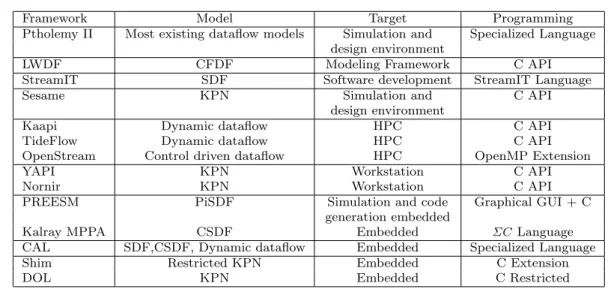
implementabil-ity [54].Table 1 summarizes selected representative
Framework Model Target Programming Ptholemy II Most existing dataflow models Simulation and Specialized Language
design environment
LWDF CFDF Modeling Framework C API
StreamIT SDF Software development StreamIT Language
Sesame KPN Simulation and C API
design environment
Kaapi Dynamic dataflow HPC C API
TideFlow Dynamic dataflow HPC C API
OpenStream Control driven dataflow HPC OpenMP Extension
YAPI KPN Workstation C API
Nornir KPN Workstation C API
PREESM PiSDF Simulation and code Graphical GUI + C
generation embedded
Kalray MPPA CSDF Embedded ΣCLanguage
CAL SDF,CSDF, Dynamic dataflow Embedded Specialized Language
Shim Restricted KPN Embedded C Extension
DOL KPN Embedded C Restricted
Table 1 Selected related work summary
A large number of frameworks propose specialized languages and tools for developing dataflow applica-tions (the reader is referred to [4] for a comprehensive survey). The premise of these frameworks is that an application can be specified at a high abstraction level and automatically transformed into an efficient imple-mentation. However, in practice there has been a no-ticeable gap between a high-level description and the ef-ficient implementation that the automated tools failed to close. As a result, often restricted dataflow mod-els are used such as Synchronous Dataflow (SDF) [30], Cyclo Static Dataflow [5], Parameterized SDF [3], Het-erochronous Dataflow [20], etc., while achieving the effi-ciency with more expressive Kahn Process Networks [27], or Dynamic Dataflow [26] remains difficult [19, 50, 34]. Another major inconvenience of these frameworks is that they requires significant changes to reference software and to the existing softsoftware development flow -reference applications are typically specified as sequen-tial programs using imperative programming languages such as C/C++ or Matlab. The disruptive changes in software development flow and being able to only de-liver efficient implementation for a restricted set of the dataflow models hinders adoption of these technologies by industry.
An alternative is to integrate coarse grain dynamic dataflow programming structures into familiar languages, using a lightweight API with an associated runtime en-vironment. Several such KPN and dynamic dataflow APIs have been proposed in the literature. Many of them target large computing systems and often rely on off-the-shelf OSes. Kaapi [17], Sesame [40], Shim [12] are based on POSIX threads. The QUARK (QUeing And Runtime for Kernels) [61], TIDeFlow [38], and OpenStream [44], have been developed in the context of
the High-Performance Computing (HPC) applications. YAPI [28] and Nornir [60] support the KPN execution model on workstation computers. These runtime envi-ronments come with heavy performance and memory footprint overheads. This is an acceptable choice for running applications in big-size computers. In the em-bedded domain we need a lightweight approach: the small memory and the high performance requirements preclude using the full OS, a kernel-level scheduler, and dynamic data structures.
One example of a minimalist dataflow API similar
to StreamDrive is thelightweight dataflow(LWDF) [53].
The LWDF implements the core functional dataflow
(CFDF) model [41]. In the CFDF, an actor has a set of valid modes in which it can execute. The actor
specifi-cation is divided into separateenableand invoke
func-tions. Theenableis designed to be used as a “hook” for
the dynamic scheduler to rapidly query actors at run-time, and check whether or not they are executable. The invokefunction implements actor functionality and can generally change the mode of the actor for the next in-vocation. This is similar to the StreamDrive, where ac-tors proceed deterministically to some “next mode” of execution while changing their firing rules. Plishker et al. [42] have presented an analysis method that can ex-ploit the core functional dataflow to improve the sched-uler. The LWDF focus is on providing a framework for modeling and exploring the scheduler strategies, and it does not address the implementation efficiency issues of dynamic dataflow applications.
Several publications addressed supporting static and quasi-static dataflow execution model on embedded plat-forms. For example, the Parallel and Real-time Em-bedded Executives Scheduling Method (PREESM) is a framework offering rapid prototyping and automatic
code generation for heterogeneous multi-core embedded systems. PREESM targets the TI’s Keystone DSP ar-chitecture and supports the PiSDF model [39]. Another example is the Kalray MPPA system programmed
us-ing the specializedΣC language [21] and implementing
the Cyclo Static Dataflow [5].
In order to overcome the limitations of the static dataflow, the Scenario-Aware Dataflow (SADF) [56] views applications as collections of different SDF graphs. SADF is able to perform some worst-case and stochastic analyses, and to provide implementation with limited run-time overhead, while relaxing some of the limita-tions of the SDF. However, this approach is still lim-ited to a range of applications that follow a sequence of fairly static scenarios. From a syntactic perspec-tive, the SADF model resembles the Heterochronous Dataflow [20], and therefore requires complete re-write of application reference code and usage of specialized development tools.
The above approaches are different from the Stream-Drive in that they restrict the computation model to a subclass of dataflow process networks and rely on static scheduling for achieving efficiency.
In order to support dynamic dataflow execution, several research leverage on CAL programming lan-guage [14, 15], and its ISO-standardized subset, RVC-CAL [31, 32]. The RVC-RVC-CAL provides a dataflow frame-work with high level of abstraction and modularity as a basis for platform independent description of dataflow programs for execution on multicore platforms.
In [18, 58], the Actor Machine is used to
gener-ate an application-specific runtime dataflow scheduler from CAL targeting the Epiphany architecture [37]. The generated scheduler is less efficient compared to the StreamDrive because the actor machine does not mem-orize actors blocking conditions and therefore reeval-uates these blocking conditions multiple times, while explicit enumeration of actor states leaves large mem-ory footprint. The communication library is tailored to Epiphany’s distributed shared memory and does not support sharing of communication buffers. Finally, work in [18] does not support the dynamic mapping of actors on processing elements.
Yviquel et al [62, 63] use the RVC-CAL infras-tructure for developing a dynamic dataflow framework targeting a shared memory multi-core platform. The framework pays particular attention to the efficient im-plementation of dataflow communication functions. In particular, the shared memory is used to implement the zero-copy communication channels. The essential difference from StreamDrive lies in how the race con-ditions are avoided: while StreamDrive defines a com-munication protocol that ensures the race-free
execu-tion, the work in [63] guarantees the atomicity of the
sequence read-input/execute/write-output by
postpon-ing the update of dataflow channels state until the ac-tor has finished execution. Apart from potential per-formance overhead, this would be incompatible with the KPN mode of execution. This framework also sup-ports broadcasting single data to several target actors (if all concerned FIFO channels are mapped to the same shared memory bank) that reminds the StreamDrive broadcast operation. However, there is no equivalent
to the collect operation and no support for the data
parallelism. Finally, the work in [63] relies on static
scheduling of actors to platform processing elements. The RVC-CAL offers a standardized framework for developing dynamic dataflow applications. However, there are very few applications available in CAL, mostly video codecs, while the majority of new applications continue to be developed in standard languages. Thus, the most important difficulty of using CAL is that it requires a complete re-write of the reference applica-tions. CAL tools are also less mature that standard development tools such as the gcc compiler, etc.
Shim [12, 13, 59] and the Distributed Operation Layer (DOL) [23, 22] addressed implementation issues of the KPN execution model in the embedded context. Shim implements a KPN restricted to support only synchronous (rendezvous) communication. This choice eases scheduling, and programs are, by definition, al-ways executable in finite space because synchronous communication does not need buffering. Shim language is based on C (but is not a C subset) augmented with few constructs for concurrency, communication, and ex-ceptions. Compared to the StreamDrive, Shim imposes many syntactic restrictions on the input language which makes porting existing reference applications more dif-ficult. Furthermore, Shim does not address the runtime implementation issues, instead it relies on costly stan-dard runtime support such as Pthreads library.
DOL implements the KPN execution model using cooperative protothreads [11]. While cooperative schedul-ing eliminates context-switchschedul-ing overhead and simpli-fies the runtime stack handling, the protothreads im-pose a number of important language restrictions lead-ing to additional performance overhead and to artifi-cial changes to the sequential reference code. Using the protothreads precludes implementation of real-time sys-tems that may require preemptive scheduling. DOL as-signment of actors to processors is static reducing load balancing ability. Unlike StreamDrive, DOL only im-plements the KPN execution model which leads to ad-ditional performance penalty compared to the dataflow execution because there are no firing rules: the
sched-uler keeps trying to execute actors even when their blocking condition persists.
Like the work in [63] cited earlier, DOL takes advan-tage of shared memory in order to implement copy-free dataflow communication channels. In particular, DOL’s windowed FIFOs [25] give actors direct access to data buffers to avoid copying. However, the windowed FIFO buffers cannot be shared between multiple actors, and do not support the broadcast and collect operations.
Gangwal et al [16] proposed thequery/claim/release
protocol, similar to the StreamDrive communication protocol. One important difference between the
Stream-Drive implementation and thequery/claim/release
pro-tocol is that the StreamDrive synchronization counters count actual data bytes present in the communication buffers instead of tokens. This enables communicating actors to refer to different token sizes while still bene-fiting from an efficient synchronization support. Most
importantly, the query/claim/release protocol do not
allow buffers to be shared between multiple actors. StreamDrive actors’ ability to share data buffers is essential for reducing memory requirements and the communication overhead, but also for supporting the data parallelism. Zaki et al [64] developed Partial Ex-pansion Graphs (PEGs) to help exploit the data par-allelism in addition to functional/pipeline parpar-allelism for SDF graphs. Similar to the StreamDrive, several instances of dataflow actors may be instantiated de-pending on relative load of the actor in terms of the execution time. Compared to StreamDrive, the PEG methodology has a number of important restrictions: (1) it is applicable to SDF graphs, (2) the data-parallel actors cannot have internal state, and (3) the data-parallel actor instances must execute in different pro-cessing cores. The work in [64] also develops a dynamic scheduling heuristics and shows that this scheduler per-forms better than the static one when actor execution loads are variable. However, their runtime implementa-tion incurs higher performance overhead compared to StreamDrive: the synchronization and scheduling are
ensured by a specialbuffer manageractor built on top
of the underlying RTOS services, while StreamDrives’ broadcast and collect synchronization is built into the
scheduler itself. Finally, proposedParticle Swarm
Op-timization (PSO) approach for calculating the degree of the data parallelism for dataflow actors is general enough and can be applied on top of the StreamDrive as well.
Dynamic dataflow scheduling in the context of multi-core systems has been studied by Michalska at al [34, 35]. The techniques proposed in these publications can be easily integrated with the StreamDrive distributed scheduler.
The above mentioned published research has not fully addressed the question of efficient execution of dynamic dataflow models, such as DDN and KPN, in small-scale clustered embedded architectures. Further-more, they do not address the integration of specialized hardware blocks with programmable components in a single dataflow representation.
The integration of the application-specific hardware blocks has been previously addressed in the context of the high level synthesis (HLS) design flow. Several au-thors used RVC-CAL language as a single starting point for description of SW and HW components in a hetero-geneous platform [47, 1, 2, 51]. Serot et Al [57] devel-oped CAPH programming language for describing and implementing stream-processing applications on recon-figurable hardware, such as FPGAs. CAPH is based upon the dynamic dataflow model, supports an auto-mated compilation producing VHDL code, and struc-turally reminds CAL.
These methodologies propose the software/hardware co-design flow that automates analysis, synthesis, op-timization, and design space exploration for a given dataflow application. While targeting an application-specific solution, they pursue three design objectives: (1) higher degree of program analyzability and fast de-sign cycle, (2) platform independent description that can be utilized for any implementation platform, and (3) rapid exploration of design alternatives. However, as explained earlier, CAL (and similarly, CAPH) is a specialized language with limited code base. The main-stream programming languages for heterogeneous com-puting are C and C-like languages. Porting a C appli-cation to CAL requires considerable effort and invest-ment, comparable to developing a dynamic dataflow application from scratch.
On the other hand, we are interested in develop-ing specialized hardware blocks for a particular target platform that can be reused accross a given application domain, eg. the convolution for image processing. This requires analyzing multiple applications and a “generic” hardware block development approach. The hardware-software partitioning and architecture exploration in our work has been conducted using higher-level simu-lation, with hardware block models derived from refer-ence C functions with minimal modifications of original code. The specialized hardware blocks in our work have been designed using traditional RTL development flow. If desired, in order to speed-up the design cycle and to make the design technology-independent, the HLS tools such as CatapultC can also be used for these hardware blocks implementation.
3 Target Platform
StreamDrive targets small-scale clustered embedded ar-chitectures, where heterogeneous processing elements (PEs) are grouped into small clusters sharing a finite amount of resources including local memory. In this paper, we focus on programming a single cluster of such PEs. We are targeting image processing domain with real-time requirements of processing multiple im-age frames per second, we adopt the strategy of dis-tributing computations of different image frames on dif-ferent clusters. Thus, in a multicluster configuration, each cluster executes the same dataflow application ap-plied to different image frame.
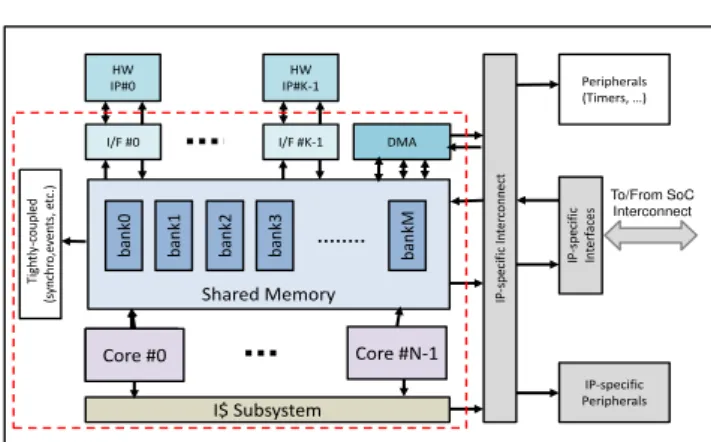
Fig. 1 shows the block diagram of our target ar-chitecture, the STMicroelectronics’ ASMP cluster. It is
composed by a number of programmable cores,
spe-cialized hardware blocks (HWPEs), and a DMA, all connected together to a shared Tightly-Coupled Data Memory (TCDM). The HWPEs are essential for achiev-ing the required performance while keepachiev-ing the cost and the power consumption low. In order to even further op-timize power-efficiency of the system, the HWPEs can run each in their own different dedicated clock domain, thus allowing for the adjustment of their frequency in accordance with application requirements. Seamless in-tegration of the hardware blocks is one of the important advantages of the StreamDrive framework.
The key element of the ASMP cluster is its
logarith-mic interconnect [45] that allows multiple concurrent
accesses to the multi-bank TCDM memory. In order to minimize the number of stalls due to conflicting simul-taneous accesses to the same bank, the banking factor (i.e. the ratio between the number of TCDM memory banks and the number of access ports), needs to be cor-rectly dimensioned. Such shared memory organization, although it has a limited scalability, corresponds well to the small-scale cluster architecture that we target. Our experience, confirmed by other studies on similar architectures [8], shows that this type of interconnect can support up to 32 access ports, each with a through-put close to 32-bits/cycle with latency compatible with the RISC core internal pipeline, under the embedded IP target frequencies.
The connection between the HWPEs and the shared
memory is ensured by thehardware block interface(I/F
0, .. I/F K-1 in the figure) that serves as a bridge for streaming hardware blocks. The programmable cores, the hardware block interface, and the DMA, all sup-port the StreamDrive communication protocol based on shared memory - this creates a common infrastruc-ture for the core-to-core, the core-to-hardware-block, or the hardware-block-to-hardware-block communication.
To/From SoC Interconnect Shared Memory STxP70 #0 I$ Subsystem I/F #0 Core #N-1 Core #0 I/F #K-1 HW IP#0 HW IP#K-1 IP -spe ci fi c In ter conn ec t DMA IP-specific Peripherals IP -spe ci fi c In terf ac es Peripherals ~d]u Œ•U Y• Ti gh tl y-coup led (s yn ch ro ,e ven ts , e tc .) ban k0 ban k1 ban k2 ban k3 ban kM
Fig. 1 The ASMP Cluster Block Diagram
The shared tightly-coupled memory organization is im-portant for taking full advantage of the StreamDrive features.
The size of the TCDM has important impact on area-efficiency (GOPS/mm2) of the system: the larger the TCDM the lower area-efficiency. Generally, rela-tively small TCDM memory cannot fit the entire appli-cation working set. The StreamDrive cluster includes a DMA used for data movement between the TCDM and larger external off-chip memory. The DMA ensures ad-ditional function of synchronizing data transfers with the rest of the processing.
Finally, the ASMP cluster includes a small num-ber of tightly-coupled peripherals aiming at accelerat-ing synchronization, event handlaccelerat-ing, etc.
The current ASMP cluster implementation targets mobile image processing applications and includes 8 RISC processor cores running at relatively low fre-quency (500 MHz), with 32K of instruction cache each. The processor cores are extended with a small dedicated set of specialized instructions resulting in a 2-4X
accel-eration of important image processing functions1 The
cluster also includes two hardware blocks: the Gaussian filter and the Scaler interpolation block, - along with 256 KB of the TCDM memory. Overall, one ASMP cluster delivers up to 8Gops at 500 MHz not counting the hardware blocks, while the TCDM peak bandwidth reaches 32 GB per second. A predecessor of this ar-chitecture, featuring 4 clusters and 16 processors per cluster, with no hardware blocks, achieved power con-sumption of 2W in 28nm technology [33]. ASMP targets an even lower power and silicon area budget, position-1 This set includes relatively generic instructions, such as
aMAC4CLIPwhich performs SIMD multiplication on bytes of
two input operands, saturates the two 16-bit results, and ac-cumulates them with the result operand; as well as instruc-tions dedicated to specific image processing funcinstruc-tions, such
as aXORSBCW, used in Support Vector Machine (SVM), which
ing this platform well within the low-power, low-cost embedded profile.
Although the logarithmic interconnect technology constraints limit the scale of a tightly-coupled cluster to a couple of dozens of processing elements, multiple clusters can be put together allowing massive up-scaling in performance while maintaining the initial power- and area- efficiency. However, the multi-cluster aspects are out of this paper’s scope.
As described in this section, our StreamDrive imple-mentation leverages the tightly-coupled shared memory available in clustered platformes similar to ASMP. How-ever, the StreamDrive framework can be retargeted to other architectures, for example, to distributed shared memory clusters. In this case, attention should be payed to efficiently implementing StreamDrive communica-tion layer, in particular the broadcast and the collect
connections (refer to next section). The StreamDrive scheduler is already distributed, however the global scheduling list will need to be implemented differently, perhaps using a work-stealing approach. As a bottom line, it is important to keep in mind that StreamDrive targets systems with small-scale clusters, not exceeding douzens of processing elements, as opposed to large-scale massively parallel systems.
4 StreamDrive Overview
In this section, we discuss the StreamDrive API and the runtime system, and illustrate the incremental trans-formation flow of a sequential code into a dynamic dataflow implementation.
In the dataflow model of computation, an
applica-tion is represented as a graph of actors2 connected by
the communication channels, ordataflow buffers. The actors carry the actual computation while exchanging application-specific units of data, calledtokens, over the
communication channels. Tokens are written and read
onto the communication channels in FIFO order. In StreamDrive, actors are connected to communication
channels via input and output ports. Reading from an
input port blocks the actor until all required tokens are available in the channel, and writing to an output port blocks the actor until enough empty room is available in the channel for the writing. For example, an actor performing an image filtering operation could be read-ing an input image line-by-line and writread-ing the filtered image line-by-line. Then, the input and output commu-nication tokens correspond to one line of the image.
2 In this paper, we also use term actor for the KPN
pro-cesses for the sake of coherence.
Two major dataflow models of computation sup-ported by the StreamDrive are the Kahn Process Net-works and the Dynamic Dataflow NetNet-works.
4.1 The StreamDrive API
The StreamDrive API is based on the C program-ming language and provides methods for defining the dataflow actors, for constructing the dataflow graph, and for controlling the runtime scheduler.
Each StreamDrive actor defines its private variables and its input and output ports. Actor ports specify the size of tokens exchanged on the given port. The actor’s private variables and its communication ports are
ac-cessible from inside the actor functions via the THIS
pointer. StreamDrive actors also define four basic
func-tions:CONSTRUCTOR,DESTRUCTOR,INIT, andWORK. The
CONSTRUCTOR and theDESTRUCTOR perform all actions required at actor creation and release time, in particular the actor ports are created inside the actor constructor
function. TheINITfunction configures the actor for
ex-ecution by initializing actor’s internal state. Finally, the
WORKimplements the actor functionality.
The StreamDrive uses a copy-free communication protocol, leveraging on the shared TCDM available in hardware. The API defines four communication
func-tions:reserve andpush for writing the data to an
out-put channel, andpop and release for reading the data
from an input channel. Before writing into an output channel, a source actor must acquire a pointer to an
available empty buffer entry via the reserve call. The
function is blocking if no room is available inside the given output buffer. When the data have been written to the buffer, the source actor signals the availability of
new tokens via thepush call. On the destination side,
an actor must acquire a pointer to an input token via
thepopcall before reading the data. Thepopfunction is
blocking if there is not enough available tokens in the FIFO. The destination actor does not need to make a copy of the data but instead can use data directly from the shared communication buffer. When the des-tination actor no longer needs the data, it must signal the source actor that the buffer can be reused via the releasefunction.
The StreamDrive API also provides methods for cre-ating actors and their ports, and for connecting actors via communication buffers. The StreamDrive graph de-scription can be parameterized in number of actor in-stances and their connections. The API supports the configuration of dataflow graphs between executions by disabling actors, actor connections and by changing ac-tor parameters. It is important to note that the ap-plication graph does not need to change depending on
whether actors are implemented as software functions or as hardware blocks.
The StreamDrive model requires explicit manage-ment of the memory hierarchy, in particular of trans-ferring data between the external and the local shared memory. Our experience is that streaming applications have regular memory access patterns and the advan-tages of explicit memory hierarchy management out-weigh its inconveniences. The StreamDrive API imple-ments a specific DMA support. A DMA function is simi-lar to that of an actor: its implementation ensures that a synchronization is generated upon the DMA trans-fer completion in order to signal that a token is ready. In section 5 we show that using this mechanism, a very efficient hiding of external memory latency can be achieved.
Finally, the API provides a few functions for control-ling the runtime scheduler. Of particular importance is the function for specifying the dataflow firing rules. A firing rule is specified by requiring certain number of free slots (output ports) or ready tokens (input ports) to be available in a given communication port before the next firing of the actor can take place. The firing rules can change for each new actor firing, supporting fully dynamic dataflow model. In the absence of firing rules, an actor behaves as a KPN process, possibly blocking during execution.
4.2 The Incremental Parallelization Flow
One important objective of the StreamDrive is to sup-port the incremental transformation of a sequential ref-erence code into an optimized dataflow form. In order to facilitate such transformation, the process is divided into a number of conceptually simple steps, each con-secutive step is an incremental improvement over the previous one:
1. Identification of the dataflow part of the sequential application.
2. Identification of the dataflow actors and building the initial Kahn Process Network, KPN.
3. Refinement of the initial KPN by reducing actors granularity.
4. Identification and implementation of data parallel actors.
5. Conversion of the Kahn Process Network into the
Dataflow Network by introducing the dataflowfiring
rules.
6. Optimization of the performance vs memory foot-print trade-off.
The initial transformation of a sequential reference code into KPN form is facilitated by the fact that
1 s t a t i c u n s i g n e d int n _ l e v e l s = 8; // RO 2 s t a t i c s i z e _ t n _ f e a t u r e s = 5 0 0 ; 3 ... 4 int * n _ f e a t u r e s _ p e r _ l e v e l ; // to be t r a n s f o r m e d 5 ... 6 m a i n ( int argc , c h a r ** a r g v ) { 7 c h a r * s c e n e _ o b j = a r g v [ 1 ] ; 8 c h a r * s c e n e _ d b = a r g v [ 2 ] ; 9 I m a g e _ t img ; 10 D e s c r _ t d e s c r _ d b ; 11 M a t c h _ t m a t c h _ d b ; 12 P o i n t _ t * k e y p o i n t s = ( P o i n t _ t *) m a l l o c ( n _ l e v e l s * s i z e o f ( P o i n t _ t ) ) ; 13
o r b _ i n i t (& img , s c e n e _ o b j , & d e s c r _ d b , s c e n e _ d b , & m a t c h _ d b ) ;
14
o r b _ r u n (& img , k e y p o i n t s , & d e s c r _ d b ) ;
15
m a t c h (& d e s c r _ d b , & m a t c h _ d b ) ;
16
... s h o w r e s u l t s ...
17
o r b _ d e i n i t (& img , k e y p o i n t s , & d e s c r _ d b , & m a t c h _ d b ) ; 18 } 1 v o i d o r b _ r u n ( I m a g e _ t img , P o i n t _ t * k e y p o i n t s , D e s c r _ t * d e s c r i p t o r s ) { 2 I m a g e _ t * i m g _ p y r a m i d = ( I m a g e _ t *) m a l l o c ( n _ l e v e l s * s i z e o f ( I m a g e _ t ) ) ; 3 ... c o m p u t e r e s c a l e d i m a g e p y r a m i d f r o m the img ... 4 c o m p u t e K e y P o i n t s ( i m g _ p y r a m i d , k e y p o i n t s ) ; 5 for ( l e v e l = 0; l e v e l < n _ l e v e l s ; ++ l e v e l ) { 6 P o i n t _ t * k e y p = & k e y p o i n t s [ l e v e l ]; 7
computeOrientation( level , & i m g _ p y r a m i d [ l e v e l ] , k e y p ) ; 8 D e s c r _ t * d e s c r = & d e s c r i p t o r s [ l e v e l ]; 9 I m a g e _ t * b l u r _ i m g = ( I m a g e _ t *) m a l l o c ( s i z e o f ( I m a g e _ t ) ) ; 10
computeGaussianFilter( level , & i m g _ p y r a m i d [ l e v e l ] , b l u r _ i m g , . . . ) ;
11
computeDescriptors( level , b l u r _ i m g , keyp , d e s c ) ; 12 f r e e ( b l u r _ i m g ) ; 13 } 14 f r e e ( i m g _ p y r a m i d ) ; 15 }
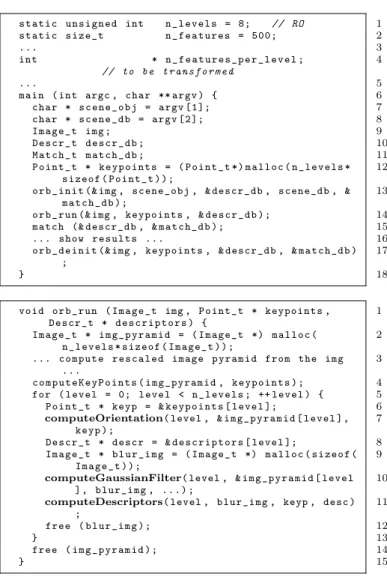
Fig. 2 Extract from the reference ORB application
streaming applications are typically structured into a sequence of processing kernels that roughly correspond to parallel Kahn processes. Transforming a sequential kernel into a Kahn process often requires minimal mod-ifications to the code, consisting mostly of inserting KPN communication statements at appropriate places. The biggest effort goes into achieving good perfor-mance vs memory footprint trade-off beyond the initial basiclevel. In this respect, the StreamDrive is not dif-ferent from other parallelization approaches - usually a good understanding of the model is required in order to achieve high performance levels.
Importantly, all transformation steps can be per-formed incrementally, one actor at a time, allowing at each stage to debug and verify functional correctness of the transformation. In order to gain a more pre-cise idea of the StreamDrive incremental parallelization flow, we illustrate the process using a real-life
1 v o i d c o m p u t e K e y P o i n t s ( I m a g e _ t * i m g _ p y r a m i d , P o i n t _ t * k e y p o i n t s ) { 2 ... 3 for ( l e v e l = 0; l e v e l < n _ l e v e l s ; ++ l e v e l ) { 4 P o i n t _ t * k e y p = & k e y p o i n t s [ l e v e l ]; 5 int c o r n e r C o u n t ; 6 K e y p _ t * r e s u l t s = f a s t 9 _ n o n m a x ( level , & i m g _ p y r a m i d [ l e v e l ] , ... , & c o r n e r C o u n t ) ; 7 keyp - > d a t a = ( K e y p _ t *) m a l l o c ( c o r n e r C o u n t * s i z e o f ( K e y p _ t ) ) ;
8 c o p y ( keyp - > data , results , c o r n e r C o u n t ) ;
9 computeHarrisResponse( level , i m g _ p y r a m i d [ l e v e l ] , keyp , . . . ) ;
10 cullKeypoints( level , keyp , n _ f e a t u r e s _ p e r _ l e v e l [ l e v e l ] , . . . ) ;
11 f r e e ( r e s u l t s ) ;
12 }
13 }
1 K e y p _ t * f a s t 9 _ n o n m a x ( int level , I m a g e _ t * img , ... , int * n _ c o r n e r s ) { 2 int n C o r n e r s ; 3 K e y p _ t * c o r n e r s = f a s t 9 _ d e t e c t ( img , ... , & n C o r n e r s ) ; 4 int * s c o r e s = f a s t 9 _ s c o r e ( corners , n C o r n e r s , . . . ) ; 5 K e y p _ t * n o n m a x = n o n m a x _ s u p p r e s s ( corners , scores , n C o r n e r s , ... , n _ c o r n e r s ) ; 6 r e t u r n n o n m a x ; 7 } 1 K e y p _ t * f a s t 9 _ d e t e c t ( I m a g e _ t img , ... , int * n u m _ c o r n e r s ) { 2 int x s i z e = img - > w i d t h ; 3 int y s i z e = img - > h e i g h t ; 4 int r s i z e = 5 1 2 ; 5 * n u m _ c o r n e r s = 0; 6 K e y p _ t * c o r n e r s = ( K e y p _ t *) m a l l o c ( s i z e o f ( K e y p _ t ) * r s i z e ) ; 7 for ( y = e d g e _ t h r e s h o l d ; y < y s i z e -e d g -e _ t h r -e s h o l d ; y ++) { 8 for ( x = e d g e _ t h r e s h o l d ; x < x s i z e -e d g -e _ t h r -e s h o l d ; x ++) { 9 ... c o m p u t e k e y p o i n t or not ... 10 if ( c o r n e r ) { 11 if (* n u m _ c o r n e r s == r s i z e ) { 12 r s i z e * = 2 ; 13 c o r n e r s = ( K e y p _ t *) r e a l l o c ( corners , s i z e o f ( K e y p _ t ) * r s i z e ) ; 14 } 15 c o r n e r s [* n u m _ c o r n e r s ] = * c o r n e r ; 16 * n u m _ c o r n e r s ++; 17 } 18 } 19 } 20 r e t u r n c o r n e r s ; 21 } 1 K e y p _ t * n o n m a x _ s u p p r e s s ( K e y p _ t * corners , int * scores , int n u m _ c o r n e r s , ... , int * n u m _ n o n m a x )
{ 2 * n u m _ n o n m a x =0; 3 K e y p _ t * n o n m a x = ( K e y p _ t *) m a l l o c ( n u m _ c o r n e r s * s i z e o f ( K e y p _ t ) ) ; 4 ... c o m p u t e n o n m a x c o r n e r s ... 5 f r e e ( c o r n e r s ) ; 6 r e t u r n n o n m a x ; 7 }
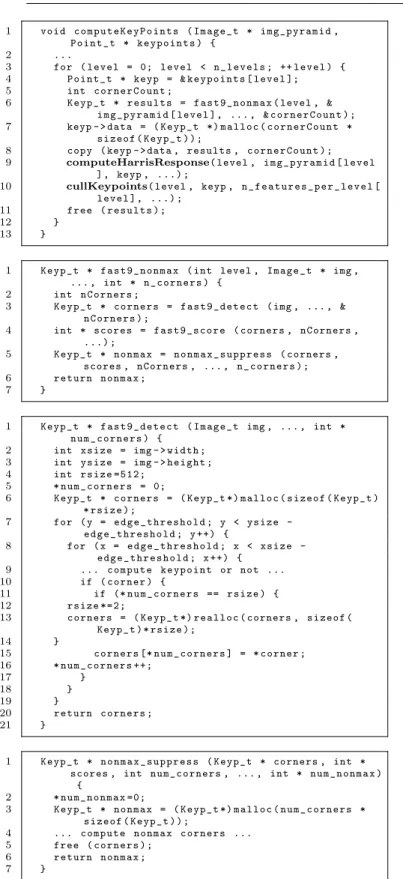
Fig. 3 Compute Keypoints function from the ORB
applica-tion
Fast and Rotated Brief (ORB) application. The ORB algorithm identifies a set of objects inside an image and matches their descriptors to the descriptors of
ob-1 v o i d o r b _ r u n ( I m a g e _ t img , P o i n t _ t * k e y p o i n t s , D e s c r _ t * d e s c r i p t o r s ) { 2 I m a g e _ t * i m g _ p y r a m i d = ( I m a g e _ t *) m a l l o c ( n _ l e v e l s * s i z e o f ( I m a g e _ t ) ) ; 3 ... c o m p u t e r e s c a l e d i m a g e p y r a m i d f r o m the img ... 4 G r a p h B u i l d _ t b u i l d _ p a r m ; 5 G r a p h E x e c _ t e x e c _ p a r m ; 6 b u i l d _ p a r m . i m g _ p y r a m i d = i m g _ p y r a m i d ; 7 b u i l d _ p a r m . n _ l e v e l s = n _ l e v e l s ; 8 ... 9 B u i l d _ G r a p h ( b u i l d _ p a r m ) ; 10 E x e c _ G r a p h ( e x e c _ p a r m ) ; 11 T e r m _ G r a p h () ; 12 f r e e ( i m g _ p y r a m i d ) ; 13 }
Fig. 4 Theorb runfunction modified to execute under the StreamDrive runtime.
jects in a trained database. The objects are identified
by detecting keypoints of interest via the FAST
algo-rithm [48]. The corner keypoints are selected via the nonmax suppression and then sorted using Harris re-sponsemeasure [24] to retain only the “best” keypoints.
For these keypoints, the algorithm computes object
ori-entation, and objects’ BRIEF descriptorof the object associated with each keypoint. The descriptor
compu-tation requires theGaussian filteredimage. In order to
be independent from the distance-to-object, processing is repeated over a series of images representing scaled
down original image, the pyramid. ORB puts to
evi-dence several important parallelization challenges: (1) ORB computation is irregular - some parts of the im-age may not have any keypoints, while others contain many; progressively reduced pyramid image sizes; (2) thenonmax and thesort computations are inherently serial; (3) the working set footprint is larger than can fit with the small L1 level memory, therefore our imple-mentation extensively. uses DMA for transferring data to and from the external memory.
As a preparation step, the ORB application has been transformed from the floating-point version to the fixed-point suitable for an embedded implementation. The shown extract has been slightly amended for the purpose of the illustrating important points.
4.2.1 Identification of the dataflow graph
The ORBmain function (line 6 in the top listing)
re-ceives the names of the image to process and of the
ob-jects database as arguments. Inside themainfunction,
the orb initloads the input image from a file; loads
the trained objects database initializing thematch db
for matching image objects vs the database objects; and
initializes some global parameters. The orb run
com-putes the keypoints and the object descriptors. The
classifying the objects found inside the input image.
Fi-nally, theorb deinitreleases resources allocated
dur-ing the processdur-ing.
The very first step for transforming this code is to identify the part of the code which will become a
dataflow graph. We will focus on the orb run
func-tion where the compute intensive processing is required. The match function, accounting for about half of the processing requirements of the application, is another good candidate but is more communication than
com-pute bound. In our actual implementation, theorb run
and thematchhave been implemented as two separate
dataflow graphs. In order to simplify the illustration, we do not include building the scaled image pyramid
(lines 2-3 inside the orb run function) as part of the
graph. Thus, we assume that the pyramid has been built during a pre-processing step and the results have been
stored in external memory 3. We divide the ORB
ap-plication into two parts: (1) themain partwhich takes
care of the input and output, user interactions,
allo-cating and freeing resources, etc., and (2) thedataflow
part which corresponds to the compute intensive part
of the application. This dataflow part is executed as a dataflow graph under the control of the StreamDrive dataflow scheduler.
Figure 4 shows the transformed orb run function
from the main part of the application, The ORB com-putation has been replaced with the StreamDrive API calls for building, executing and releasing the dataflow
graph. TheBuild GraphAPI call takes an
application-specific structure as a parameter used to pass construc-tion time arguments to the graph such as the pointer at the image pyramid, number of pyramid levels, image dimensions, etc. A dataflow graph, once built, can be executed multiple times, for example looping over
sev-eral input images. In this case, theExec Graph
param-eter can be used to pass different execution paramparam-eters for each graph execution.
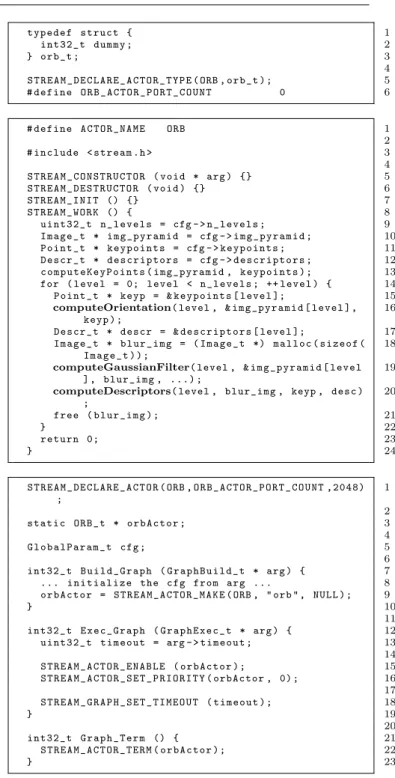
The Figure 5 shows the dataflow part of the
ap-plication. The singleORBactor is defined via two files,
theorbActor.hshown in the top of the figure, and the
orbActor.c, second listing from the top. The.hfile de-fines actor’s private data structure and actor ports. This
actor has neither input, no output ports. The.cfile
de-fines four functions: the actorconstructorand
destruc-tor, called at actor construction and termination time,
respectively; the init function called before the graph
execution starts; and theworkfunction which performs
3 In actual implementation, we have implemented two
vari-ants of the ORB: (1) with a rescaler tightly-coupled HW block and where the pyramid construction is part of the dataflow graph, and (2) with the pyramid construction as a pre-processing step. 1 t y p e d e f s t r u c t { 2 i n t 3 2 _ t d u m m y ; 3 } o r b _ t ; 4 5 S T R E A M _ D E C L A R E _ A C T O R _ T Y P E ( ORB , o r b _ t ) ; 6 # d e f i n e O R B _ A C T O R _ P O R T _ C O U N T 0 1 # d e f i n e A C T O R _ N A M E ORB 2 3 # i n c l u d e < s t r e a m . h > 4 5 S T R E A M _ C O N S T R U C T O R ( v o i d * arg ) {} 6 S T R E A M _ D E S T R U C T O R ( v o i d ) {} 7 S T R E A M _ I N I T () {} 8 S T R E A M _ W O R K () { 9 u i n t 3 2 _ t n _ l e v e l s = cfg - > n _ l e v e l s ; 10 I m a g e _ t * i m g _ p y r a m i d = cfg - > i m g _ p y r a m i d ; 11 P o i n t _ t * k e y p o i n t s = cfg - > k e y p o i n t s ; 12 D e s c r _ t * d e s c r i p t o r s = cfg - > d e s c r i p t o r s ; 13 c o m p u t e K e y P o i n t s ( i m g _ p y r a m i d , k e y p o i n t s ) ; 14 for ( l e v e l = 0; l e v e l < n _ l e v e l s ; ++ l e v e l ) { 15 P o i n t _ t * k e y p = & k e y p o i n t s [ l e v e l ]; 16
computeOrientation( level , & i m g _ p y r a m i d [ l e v e l ] , k e y p ) ; 17 D e s c r _ t * d e s c r = & d e s c r i p t o r s [ l e v e l ]; 18 I m a g e _ t * b l u r _ i m g = ( I m a g e _ t *) m a l l o c ( s i z e o f ( I m a g e _ t ) ) ; 19
computeGaussianFilter( level , & i m g _ p y r a m i d [ l e v e l ] , b l u r _ i m g , . . . ) ;
20
computeDescriptors( level , b l u r _ i m g , keyp , d e s c ) ; 21 f r e e ( b l u r _ i m g ) ; 22 } 23 r e t u r n 0; 24 } 1 S T R E A M _ D E C L A R E _ A C T O R ( ORB , O R B _ A C T O R _ P O R T _ C O U N T , 2 0 4 8 ) ; 2 3 s t a t i c O R B _ t * o r b A c t o r ; 4 5 G l o b a l P a r a m _ t cfg ; 6 7 i n t 3 2 _ t B u i l d _ G r a p h ( G r a p h B u i l d _ t * arg ) { 8 ... i n i t i a l i z e the cfg f r o m arg ... 9 o r b A c t o r = S T R E A M _ A C T O R _ M A K E ( ORB , " orb " , N U L L ) ; 10 } 11 12 i n t 3 2 _ t E x e c _ G r a p h ( G r a p h E x e c _ t * arg ) { 13 u i n t 3 2 _ t t i m e o u t = arg - > t i m e o u t ; 14 15 S T R E A M _ A C T O R _ E N A B L E ( o r b A c t o r ) ; 16 S T R E A M _ A C T O R _ S E T _ P R I O R I T Y ( o r b A c t o r , 0) ; 17 18 S T R E A M _ G R A P H _ S E T _ T I M E O U T ( t i m e o u t ) ; 19 } 20 21 i n t 3 2 _ t G r a p h _ T e r m () { 22 S T R E A M _ A C T O R _ T E R M ( o r b A c t o r ) ; 23 }
Fig. 5 The ORB code wrapped into dataflow graph with
single actor
the actors’ workload. Notice that for the initialORB
ac-tor, the construcac-tor, destructor and init functions re-main empty, while the work function is a copy-paste of the code from sequential reference. The only slight change from the reference code is that arguments such
as pointers to theimg pyramid, to thekeypoints, etc.
is setup during the dataflow graph construction from
Build Grapharguments (line 8 in the bottom listing). The three dataflow graph function corresponding to
the StreamDrive API, theBuild Graph, theExec Graph,
and theTerm Graphare shown in the bottom listing of
the Figure 5. TheSTREAM DECLARE ACTORfunction
de-clares an actor, with the last parameter specifying how much stack room this actor needs to have allocated. The
STREAM ACTOR MAKEfunction from theBuild Graph al-locates resources for the actor and calls its
construc-tor. Similarly, the STREAM ACTOR TERM function from
the Term Graph calls actor destructor before releasing
actor resources. The Exec Graph function configures
the dataflow graph by enabling actors - it is possible to only enable a subset of all actors for any particular execution. Each actor is given a scheduling priority, the default is 0. Finally, there are no graph connections in our initial single-actor dataflow graph.
Notice two important points about our transformed application: (1) apart from little “syntactic sugar”, the code changes to the initial sequential version are min-imal; (2) the dataflow part runs under the control of our StreamDrive scheduler and executed in the KPN mode (there are no firing rules yet). It is clear that the process of identification of the main part and the dataflow part of the application is application-specific. The global variables that are used in the dataflow part
need to be identified and declared with the cfg
struc-ture.
4.2.2 Building the initial dataflow graph
As next transformation step, the initial dataflow graph is built: we need to (1) identify sections of code (kernels) which can be transformed into dataflow actors, and (2) introduce the communication channels connecting the actors. This step is facilitated by the fact that streaming applications are typically structured into a sequence of processing kernels that are a natural choice for paral-lel Kahn actors. For example, from the Figure 2, the
ComputeOrientation, ComputeGaussianFilter, and
ComputeDescriptors seem to be good candidates for
dataflow actors. TheComputeKeyPointsshown in
Fig-ure 3 is itself composed of kernels, the fast9 detect,
the nonmax suppress, the ComputeHarrisResponse,
and theCullKeypoints. These will be our initial choice
of the dataflow actors.
The channel introduction requires identifying, for the input channels, of the data that are read by this
actor but written outside of it, and for theoutput
chan-nels, the data that are written by the actor and read elsewhere. This remains a manual task, although tools, such as Sprint [7] may be considered in future work.
1 t y p e d e f s t r u c t { 2 u i n t 3 2 _ t _ c F a s t T h r e s h o l d ; 3 } f a s t _ t ; 4 S T R E A M _ D E C L A R E _ A C T O R _ T Y P E ( FAST , f a s t _ t ) ; 5 6 # d e f i n e F A S T _ I N _ E S I Z E ( s i z e o f ( I m a g e _ t ) ) 7 # d e f i n e F A S T _ O U T _ E S I Z E ( s i z e o f ( K e y p _ t ) ) 8 # d e f i n e F A S T _ P O R T _ I N 0 9 # d e f i n e F A S T _ P O R T _ O U T 1 10 # d e f i n e F A S T _ P O R T _ C O U N T 2 1 S T R E A M _ C O N S T R U C T O R ( v o i d * arg ) { 2 S T R E A M _ A C T O R _ M A K E _ P O R T _ I N ( F A S T _ P O R T _ I N , " i n _ p " , F A S T _ I N _ E S I Z E ) ; 3 S T R E A M _ A C T O R _ M A K E _ P O R T _ O U T ( F A S T _ P O R T _ O U T , " o u t _ p " , F A S T _ O U T _ E S I Z E ) ; 4 } 5 S T R E A M _ D E S T R U C T O R ( . . . ) { 6 S T R E A M _ A C T O R _ T E R M _ P O R T _ I N ( F A S T _ P O R T _ I N ) ; 7 S T R E A M _ A C T O R _ T E R M _ P O R T _ O U T ( F A S T _ P O R T _ O U T ) ; 8 } 9 S T R E A M _ I N I T () {} 10 S T R E A M _ W O R K () { 11 i n t 1 6 _ t f a s t T h r e s h o l d = THIS - > _ c F a s t T h r e s h o l d ; 12 u i n t 8 _ t n _ l e v e l s = cfg - > n _ l e v e l s ; 13 I m a g e _ t * i m g _ p y r a m i d = cfg - > i m g _ p y r a m i d ; 14 u i n t 3 2 _ t l e v e l ; 15 16 for ( l e v e l = 0; l e v e l < n _ l e v e l s ; ++ l e v e l ) { 17 int c o r n e r C o u n t ; 18
f a s t 9 _ d e t e c t ( level , & i m g _ p y r a m i d [ l e v e l ] , ... , & c o r n e r C o u n t ) ; 19 } 20 } 1 v o i d f a s t 9 _ d e t e c t ( I m a g e _ t * img , ... , int * n u m _ c o r n e r s ) { 2 int x s i z e = img - > w i d t h ; 3 int y s i z e = img - > h e i g h t ; 4 // i n t r s i z e = 5 1 2 ; 5 K e y p _ t * h e a d e r = ( K e y p _ t *) S T R E A M _ O U T _ R E S E R V E ( F A S T _ P O R T _ O U T , 1) ; 6 * n u m _ c o r n e r s = 0; 7 // K e y p _ t * c o r n e r s = ( K e y p _ t *) m a l l o c ( s i z e o f ( K e y p _ t ) * r s i z e ) ; 8 for ( y = e d g e _ t h r e s h o l d ; y < y s i z e -e d g -e _ t h r -e s h o l d ; y ++) { 9 for ( x = e d g e _ t h r e s h o l d ; x < x s i z e -e d g -e _ t h r -e s h o l d ; x ++) { 10 ... c o m p u t e k e y p o i n t or not ... 11 if ( c o r n e r ) { 12 K e y p _ t * t o k e n = ( K e y p _ t *) S T R E A M _ O U T _ R E S E R V E ( F A S T _ P O R T _ O U T , 1) ; 13 // if (* n u m _ c o r n e r s == r s i z e ) { 14 // r s i z e * = 2 ; 15 // c o r n e r s = ( K e y p _ t *) r e a l l o c ( c o r n e r s , s i z e o f ( K e y p _ t ) * r s i z e ) ; 16 // } 17 // c o r n e r s [* n u m _ c o r n e r s ] = * c o r n e r ; 18 * t o k e n = * c o r n e r ; 19 * n u m _ c o r n e r s ++; 20 } 21 } 22 } 23 header - >... = * n u m _ c o r n e r s ; 24 S T R E A M _ O U T _ P U S H ( F A S T _ P O R T _ O U T , * n u m _ c o r n e r s +1) ; 25 r e t u r n ; 26 }
Fig. 6 Initial FAST dataflow actor
Once again, due to the intrinsic structure of the stream-ing applications, the channel introduction turns often to be relatively straightforward. From the ORB
image pyramid in its input channel, and produces the
array of cornerCount FASTkeypoints with their FAST
scores. Thenonmax suppress takes the keypoints
gen-erated by the fast9 detect as input and generates
the set of corner keypoints by removing “uninteresting”
keypoints from the set. The ComputeHarrisResponse
reads these corners and computes the Harris response
for each of them, which is a measure of “relevance”
of each keypoint. TheComputeHarrisResponseoutput
is the set of keypoints with their associated Harris
re-sponse. TheCullKeypointsperforms the sorting of the
keypoints with respect to their Harris response and re-duces the keypoint set further by retaining at most the
n features per level best keypoints. From these
re-maining keypoints, theComputeOrientationcomputes
each keypoint orientation. The ComputeOrientation
has two input channels, the keypoints generated by the CullKeypoints and the scaled input image from corresponding image pyramid level. The output of the
ComputeOrientationis a set of keypoints with their
as-sociated orientation measure. TheComputeDescriptors
takes two input channels as well, the output keypoints
from the ComputeOrientation and the Gauss filtered
input image. The ComputeDescriptors output is the
final set of keypoints and their descriptors.
In order to introduce new actors, each processing
kernel needs to be wrapped into the StreamDrive
syn-tactic structure similar to the earlier ORB actor.
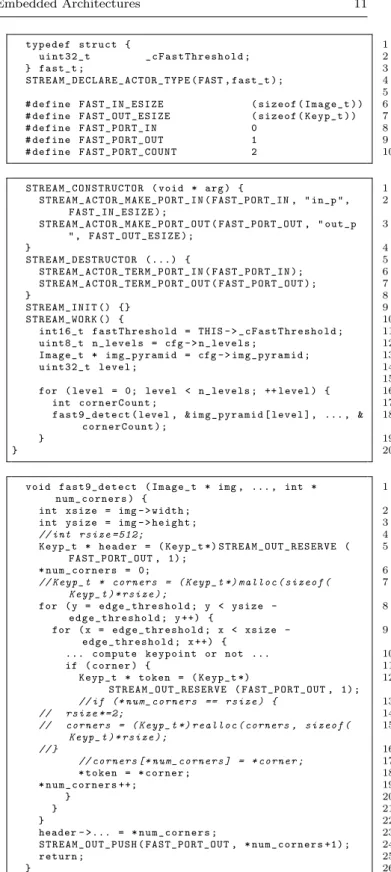
Fig-ure 6 shows as example the FAST actor corresponding
to the fast9 detect kernel. Inside the actor .h file,
the actor ports are declared, where theXXX ESIZE
de-fines port token size. TheFASTinput tokens are of type
Image tand output tokens are corners of typeKeyp t.
Inside the .c file, the actor constructor and
destruc-tor functions create and destroy, respectively, the acdestruc-tor
ports. The change to the original fast9 detect
func-tion is minimal and consists in inserting the Stream-Drive communication primitives for writing the out-put data to the outout-put port. At this point we do not use the input port yet, because we did not create an actor that can write the data to this port, therefore
ourFASTactor keeps reading theimg pyramiddirectly
from external memory. The STREAM OUT RESERVE and
theSTREAM OUT PUSHimplement the StreamDrive
com-munication protocol. Thus, areserveis called for every
new corner and at the end all corners arepushedto the
output channel. In order to communicate the number of
corners to the downstream actor, theFASTreservesone
headertoken at the beginning of the processing. When the number of corners is known at the end of the
outer-most loop, theheader is pushed to the output channel
FAST NON MAX
HAR
RIS CULL ANGLE BRIEF
GAUSS
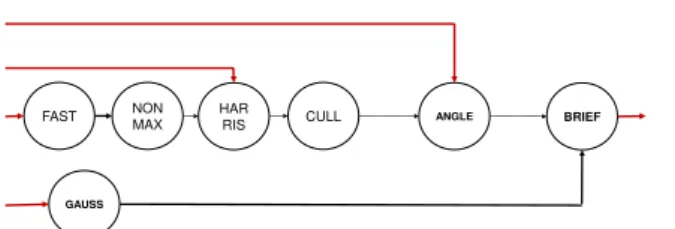
Fig. 7 Initial ORB dataflow graph: The actors correspond to the original kernels;FAST,GAUSS, HARRIS, and ANGLEread input image data directly from the external memory,BRIEF
writes result descriptors directly to the external memory.
together with the corner tokens 4. It is interesting to
notice that using the streaming style communication
allows us to get rid of inefficientmalloc,realloc, and
freecalls.
The dataflow graph refinement is performed incre-mentally, one actor at a time, verifying the transforma-tion correctness at each graph transformatransforma-tion. At the
end of the process, the initial ORB actor is no longer
needed and is removed from the graph. The resulting ORB graph is drawn in the Figure 7.
Figure 8 shows the correspondingBuild Graph
func-tion with seven actors. TheSTREAM BINDfunction
con-nects the output port of a source actor to the input port of the destination actor, while specifying the com-munication buffer depth and the memory level at which the buffer needs to be allocated. So far we have not ad-dressed the memory size and actor granularity issues, therefore all buffers have been allocated in large exter-nal memory.
Notice that several ports remain unused in the cur-rent graph. These are ports that do not have actors
to connect to. For example, theFAST actor input port
which reads the input image from memory does not have a matching output port to connect to. Similarly, theGAUSSinput port, theHARRISandANGLEports that
read input images from memory, as well as the BRIEF
output port that writes final descriptors out to mem-ory, do not have matching ports to connect to. All these ports correspond to input and output channels to the dataflow graph. This data initiate inside the external memory and need to be copied from this external mem-ory to the L1 memmem-ory for processing.
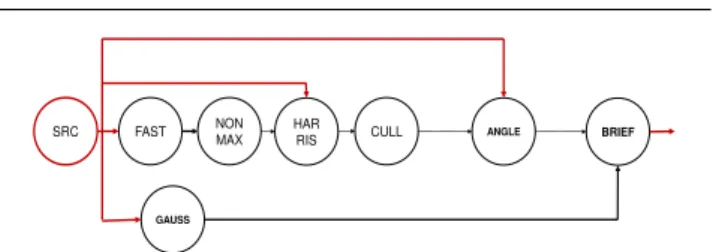
We use the DMA engine to copy the external data to the L1 memory. For this, we use the StreamDrive DMA API. For the input channels, we introduce the
new SRC actor which implements the DMA transfers.
TheSRC actor does not have input ports and has one
output port to which data from the DMA transfer are
sent. For transferring results from the BRIEF actor to
the external memory, we add the StreamDrive DMA 4 any field of the Keyp tstructure can be used to
1 S T R E A M _ D E C L A R E _ A C T O R ( GAUSS , G A U S S _ A C T O R _ P O R T _ C O U N T , 1 0 2 4 ) ; 2 S T R E A M _ D E C L A R E _ A C T O R ( FAST , F A S T _ A C T O R _ P O R T _ C O U N T , 1 0 2 4 ) ; 3 S T R E A M _ D E C L A R E _ A C T O R ( NONMAX , N O N M A X _ A C T O R _ P O R T _ C O U N T , 1 0 2 4 ) ; 4 S T R E A M _ D E C L A R E _ A C T O R ( HARRIS , H A R R I S _ A C T O R _ P O R T _ C O U N T , 1 0 2 4 ) ; 5 S T R E A M _ D E C L A R E _ A C T O R ( CULL , C U L L _ A C T O R _ P O R T _ C O U N T , 1 0 2 4 ) ; 6 S T R E A M _ D E C L A R E _ A C T O R ( ANGLE , A N G L E _ A C T O R _ P O R T _ C O U N T , 1 0 2 4 ) ; 7 S T R E A M _ D E C L A R E _ A C T O R ( BRIEF , B R I E F _ A C T O R _ P O R T _ C O U N T , 1 0 2 4 ) ; 8 9 s t a t i c G A U S S _ t * g a u s s A c t o r ; 10 s t a t i c F A S T _ t * f a s t A c t o r ; 11 s t a t i c N O N M A X _ t * n o n m a x A c t o r ; 12 s t a t i c H A R R I S _ t * h a r r i s A c t o r ; 13 s t a t i c C U L L _ t * c u l l A c t o r ; 14 s t a t i c A N G L E _ t * a n g l e A c t o r ; 15 s t a t i c B R I E F _ t * b r i e f A c t o r ; 16 17 G l o b a l P a r a m _ t cfg ; 18 19 i n t 3 2 _ t B u i l d _ G r a p h ( G r a p h B u i l d _ t * arg ) { 20 ... i n i t i a l i z e the cfg f r o m arg ... 21 22 g a u s s A c t o r = S T R E A M _ A C T O R _ M A K E ( GAUSS , " g a u s s " , N U L L ) ; 23 f a s t A c t o r = S T R E A M _ A C T O R _ M A K E ( FAST , " f a s t " , N U L L ) ; 24 n o n m a x A c t o r = S T R E A M _ A C T O R _ M A K E ( NONMAX , " n o n m a x " , N U L L ) ; 25 h a r r i s A c t o r = S T R E A M _ A C T O R _ M A K E ( HARRIS , " h a r r i s " , N U L L ) ; 26 c u l l A c t o r = S T R E A M _ A C T O R _ M A K E ( CULL , " c u l l " , N U L L ) ; 27 a n g l e A c t o r = S T R E A M _ A C T O R _ M A K E ( ANGLE , " a n g l e " , N U L L ) ; 28 b r i e f A c t o r = S T R E A M _ A C T O R _ M A K E ( BRIEF , " b r i e f " , N U L L ) ; 29 30 S T R E A M _ B I N D ( f a s t A c t o r , F A S T _ P O R T _ O U T , n o n m a x A c t o r , N O N M A X _ P O R T _ I N , F A S T _ O U T _ D E P T H , M E M _ E X T ) ; 31 S T R E A M _ B I N D ( n o n m a x A c t o r , N O N M A X _ P O R T _ O U T , h a r r i s A c t o r , H A R R I S _ P O R T _ I N , N O N M A X _ O U T _ D E P T H , M E M _ E X T ) ; 32 S T R E A M _ B I N D ( h a r r i s A c t o r , H A R R I S _ P O R T _ O U T , c u l l A c t o r , C U L L _ P O R T _ I N , H A R R I S _ O U T _ D E P T H , M E M _ E X T ) ; 33 S T R E A M _ B I N D ( c u l l A c t o r , C U L L _ P O R T _ O U T , a n g l e A c t o r , A N G L E _ P O R T _ I N , C U L L _ O U T _ D E P T H , M E M _ E X T ) ; 34 S T R E A M _ B I N D ( a n g l e A c t o r , A N G L E _ P O R T _ O U T , b r i e f A c t o r , B R I E F _ P O R T _ I N , A N G L E _ O U T _ D E P T H , M E M _ E X T ) ; 35 S T R E A M _ B I N D ( g a u s s A c t o r , G A U S S _ P O R T _ O U T , b r i e f A c t o r , B R I E F _ P O R T _ B L U R , G A U S S _ O U T _ D E P T H , M E M _ E X T ) ; 36 }
Fig. 8 Listing of the Build Graph function that constructs the initial ORB graph.
API calls inside the BRIEF actor. Figure 9 shows the
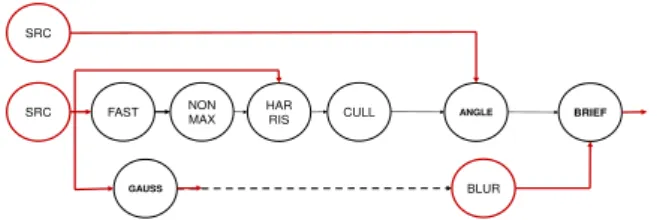
ORB graph with theSRCactor broadcasting the input
image to several ORB actors.
At the end of this step, the initial dataflow graph is built with several dataflow actors identified. Following important points facilitate this transformation step: (1)
the actorgranularity of executionof the original
appli-cation has been preserved; (2) we have avoided dealing with limited memory constraints by allocating all
com-SRC FAST NON MAX
HAR
RIS CULL ANGLE BRIEF
GAUSS
Fig. 9 ORB dataflow graph with the DMA actor added: the
input image data are read via the DMA by theSRCactor and are broadcast to the FAST, GAUSS,HARRIS, and ANGLE actors.
TheBRIEFactor uses the StreamDrive DMA API for writing
result descriptors to the external memory.
munication buffers in sufficiently large external mem-ory; (3) the actor execution order corresponds to that of the original application because we have preserved
the sequential codegranularityand dependencies.
4.2.3 The dataflow graph refinement
The next transformation step is the dataflow graph
re-finement by reducing actorgranularityso that dataflow
communication buffers fit with limited L1 memory. The
dataflow actorgranularityrefers to the amount of data
that the actor needs for executing without being blocked, and is directly related to the size of actor input and out-puttokens.
# Actor Port Token size
FAST IN One image line
OUT One keypoint
NONMAX IN One keypoint
OUT One keypoint
HARRIS IN One keypoint
REF One image line OUT One keypoint
CULL IN One keypoint
OUT One keypoint
ANGLE IN One keypoint
REF One image patch OUT One keypoint GAUSS IN One image line
OUT One image line
BRIEF IN One keypoint
BLUR One image patch OUT One descriptor
Table 2 Granularity of actors in the ORB application
Table 2 shows refined token sizes for the ORB graph
actors. Notice that we have chosen to fetch the ANGLE
and theBRIEFimage data onepatchat a time: a patch
is a small area around each keypoint. Because patches for different keypoints may overlap, we end up fetching same image pixels multiple times. However, the alter-native of keeping the keypoints in raster scan order and
1 t y p e d e f s t r u c t { 2 u i n t 3 2 _ t c F a s t T h r e s h o l d ; 3 u i n t 8 _ t * l i n e _ p [ 3 ] ; 4 } f a s t _ t ; 5 S T R E A M _ D E C L A R E _ A C T O R _ T Y P E ( FAST , f a s t _ t ) ; 6 7 // P o r t s 8 # d e f i n e F A S T _ I N _ E S I Z E ( s i z e o f ( L i n e _ t ) ) 9 # d e f i n e F A S T _ O U T _ E S I Z E ( s i z e o f ( K e y p _ t ) ) 10 # d e f i n e F A S T _ P O R T _ I N 0 11 # d e f i n e F A S T _ P O R T _ O U T 1 12 # d e f i n e F A S T _ P O R T _ C O U N T 2 1 S T R E A M _ C O N S T R U C T O R ( v o i d * arg ) { 2 S T R E A M _ A C T O R _ M A K E _ P O R T _ I N ( F A S T _ P O R T _ I N , " i n _ p " , F A S T _ I N _ E S I Z E ) ; 3 S T R E A M _ A C T O R _ M A K E _ P O R T _ O U T ( F A S T _ P O R T _ O U T , " o u t _ p " , F A S T _ O U T _ E S I Z E ) ; 4 } 5 S T R E A M _ D E S T R U C T O R ( . . . ) { 6 S T R E A M _ A C T O R _ T E R M _ P O R T _ I N ( F A S T _ P O R T _ I N ) ; 7 S T R E A M _ A C T O R _ T E R M _ P O R T _ O U T ( F A S T _ P O R T _ O U T ) ; 8 } 9 S T R E A M _ I N I T () {} 10 S T R E A M _ W O R K () { 11 i n t 1 6 _ t f a s t T h r e s h o l d = THIS - > _ c F a s t T h r e s h o l d ; 12 u i n t 8 _ t n _ l e v e l s = cfg - > n _ l e v e l s ; 13 14 K e y p _ t * h e a d e r = ( K e y p _ t *) S T R E A M _ O U T _ R E S E R V E ( F A S T _ P O R T _ O U T , 1) ; 15 16 u i n t 3 2 _ t l e v e l ; 17 18 for ( l e v e l = 0; l e v e l < n _ l e v e l s ; ++ l e v e l ) { 19 int x s i z e = cfg - > i m g _ w i d t h [ l e v e l ]; 20 int y s i z e = cfg - > i m g _ h e i g h t [ l e v e l ]; 21 int c o r n e r C o u n t = 0; 22 23 // B u i l d F A S T w i n d o w 24 for ( i = 0; i < 3; i ++) { 25 THIS - > l i n e _ p [ i ] = ( L i n e _ t *) S T R E A M _ I N _ P O P ( F A S T _ P O R T _ I N , 1) ; 26 } 27 28 for ( y = e d g e _ t h r e s h o l d ; y < y s i z e -e d g -e _ t h r -e s h o l d ; y ++) { 29 int c o u n t ;
30 f a s t 9 _ d e t e c t ( level , THIS - > line_p , ... , & c o u n t ) ; 31 c o r n e r C o u n t += c o u n t ; 32 // R o t a t e F A S T w i n d o w 33 S T R E A M _ I N _ R E L E A S E ( F A S T _ P O R T _ I N , 1) ; 34 for ( i = 0; i < 2; i ++) { 35 THIS - > l i n e _ p [ i ] = THIS - > l i n e _ p [ i + 1 ] ; 36 } 37 THIS - > l i n e _ p [2] = ( L i n e _ t *) S T R E A M _ I N _ P O P ( F A S T _ P O R T _ I N , 1) ; 38 } 39 40 S T R E A M _ I N _ R E L E A S E ( F A S T _ P O R T _ I N , 2) ; 41 42 header - >... = c o r n e r C o u n t ; 43 S T R E A M _ O U T _ P U S H ( F A S T _ P O R T _ O U T , c o r n e r C o u n t +1) ; 44 } 45 }
Fig. 10 The FAST actor KPN definition.
fetching reference image line by line led to poor perfor-mance.
Choosing actor granularity represents an important trade-off: finer granularity reduces the actor memory
1 v o i d f a s t 9 _ d e t e c t ( int xsize , L i n e _ t * l i n e [3] , ... , int * n u m _ c o r n e r s ) { 2 * n u m _ c o r n e r s = 0; 3 for ( x = e d g e _ t h r e s h o l d ; x < x s i z e -e d g -e _ t h r -e s h o l d ; x ++) { 4 ... c o m p u t e k e y p o i n t or not ... 5 if ( c o r n e r ) { 6 K e y p _ t * t o k e n = ( K e y p _ t *) S T R E A M _ O U T _ R E S E R V E ( F A S T _ P O R T _ O U T , 1) ; 7 * t o k e n = * c o r n e r ; 8 * n u m _ c o r n e r s ++; 9 } 10 } 11 r e t u r n ; 12 }
Fig. 11 The FAST actor fast9 detect function.
footprint while increasing the synchronization overhead5;
coarser granularity suffers very little synchronization overhead but may require too much memory. Although granularity vs. performance is an application-specific trade-off, the parallelization should preserve
applica-tion’snaturalgranularity. In this contextnaturalmeans
as close to the intrinsic algorithm structure as possible. In an image processing application, choosing one im-age line as a dataflow token is natural because it cor-responds to the second level in the image processing nested loop: (1) frame, (2) line, (3) pixel. As an alter-native, sets of lines, tiles, or similar, are lessnaturalin a sense that they are algorithm-specific, require some non-intuitive changes to the initial application code, and result is often radically different from the sequen-tial algorithm.
Refining actors’ granularity requires changing its
WORK function. Figures 10 and 11 show the FAST
ac-tor with refined input granularity: the input token cor-responds to one image line. Compared to the
previ-ous actor version from Figure 6, the outermost level
loop has been moved to the WORK function. Since the
fast9 detectworks on three lines at a time, we pass
it a window of three lines, THIS->line p, which is
rotated on every iteration of the WORK function. The
STREAM IN POPand theSTREAM IN RELEASEimplement the consumer side StreamDrive communication proto-col.
Once the granularity of the actors has been reduced, the communication channels can be moved to the L1 memory. However, some channels may need to buffer too many tokens to fit with the L1 memory. For
exam-ple, the SRC actor transfers the input image from the
external to L1 memory one line at a time, while the
FAST and the HARRIS actors consume these lines also
one at a time. However, the ANGLE cannot start
con-5 The synchronization overhead includes actions required
to verify the token availability, and the associated scheduler actions