Measuring Websites from a Global Perspective
School of Electrical Engineering
Thesis submitted for examination for the degree of Master of Science in Technology.
Espoo, 17.01.2014
Thesis supervisor:
Professor Jörg Ott
Thesis advisor:
Author: Magnus Boye
Title: Measuring Websites from a Global Perspective
Date: 17.01.2014 Language: English Number of pages: 4+86 Department of Communications and Networking
Professorship: Networking Technology Code: S-38
Supervisor: Professor Jörg Ott Advisor: Pasi Sarolahti, PhD
Since the invention of the World Wide Web the content and services provided on the web have changed signicantly. In search of cost savings governments and businesses push online services, and the web has therefore become ever more important to many people. It is therefore important to understand the performance of web page delivery, in order to improve the user experience of the web.
The goal of this Master's thesis is to evaluate the network performance of web page delivery in relation to content distribution networks. We use the global mea-surement platform PlanetLab to perform active meamea-surements of the performance of DNS and HTTP when downloading web pages. Domain names are resolved using iterative resolution, Google DNS, OpenDNS, and the default DNS server of measurement nodes. This enables us to asses how the choice of DNS resolver af-fects CDN server selection. The measurements reveal that network latency has the greatest impact on DNS resolution time and that nearby DNS servers will generally have the lowest resolution time. We developed an eective method of identifying CDNs and applied it to the measurement data. We analyze the accuracy of the DNS resolvers and determine that the use of a recursive DNS server close to the end-user typically results in server selections more similar to the optimal server selection of a CDN. However, we did not establish a relationship between resolver accuracy and HTTP performance. Finally, we compare the throughput of CDNs and observe that CDNs are likely optimized for dierent le sizes.
I would like to thank Professor J¨org Ott and Pasi Sarolahti for their insightful com-ments and guidance during my work with this Master’s thesis.
The work was supported by the European Commission’s Seventh Framework Pro-gram (FP7/2007-2013) grant number 317647 (Leone).
Espoo, 17.01.2014
Contents
1 Introduction 1
1.1 Active and Passive Measurements . . . 2
1.2 Domain Name System . . . 3
1.3 Problem Statement . . . 4
2 Background 7 2.1 Domain Name System . . . 7
2.1.1 Message and Record Formats . . . 9
2.1.2 Resource Record Types . . . 11
2.1.3 Protocol . . . 11
2.1.4 Issues and Vulnerabilities . . . 13
2.1.5 DNS Security Extensions . . . 14
2.1.6 Third-Party Resolvers . . . 15
2.2 Web Pages and HTTP . . . 16
2.3 Content Distribution Networks . . . 20
2.3.1 Anycast . . . 21
2.3.2 Load Balancing . . . 22
2.3.3 Application Layer Redirection . . . 23
2.3.4 DNS Redirection . . . 23 2.3.5 CDN Providers . . . 28 3 Measurements 31 3.1 Metrics . . . 31 3.2 Measurement Application . . . 34 3.3 PlanetLab . . . 38 3.4 Measurement Procedure . . . 39 4 Analysis 43 4.1 Measurement Data . . . 43 4.2 DNS and HTTP Performance . . . 46 4.2.1 Resolution Time . . . 46 4.2.2 Record TTL . . . 50 4.2.3 Connect Time . . . 53
4.3 Content Distribution Networks . . . 55
4.3.1 Identifying Content Distribution Networks . . . 55
4.3.2 CDN Servers . . . 58 4.3.3 Resolver Accuracy . . . 63 4.3.4 Connect Time . . . 67 4.3.5 Throughput . . . 69 5 Discussion 73 6 Conclusions 77
Chapter 1
Introduction
With the invention of the World Wide Web (WWW), the rapid growth of the Inter-net began. The “web” provided an easy platform for communication and publishing content, and two decades later it is still the primary method for accessing online con-tent and services. Over the years the concon-tent and services offered have changed and nowadays services like Google Docs challenge the need for traditional desktop appli-cations by moving all functionality into the browser, and the data into “the cloud”. The content of web pages have changed from being mostly static text and images, to offering highly dynamic and interactive interfaces with much richer graphical el-ements including video. It can be argued that the changes in content have been made possible by advances in network technologies and that these advances have been driven by the increasing Internet traffic. The increasing importance of online services on the web have also created a need for better ways of evaluating the quality of such services. The concept of quality can cover multiple aspects of a service de-pending on the perspective, but this Master’s thesis focuses on the network-related aspects of service quality, as these are quantified automatically more easily.
Three parties are involved when Internet services are delivered: the consumer, the internet service provider (ISP), and the content provider. The consumers are paying for Internet access and potentially content, and thus have an interest in making sure that the purchased service performs as expected. The ISPs and content providers have a financial incentive to keep their customers happy. Additionally, content providers may be hosting servers inside ISP networks and therefore wish to know how the network of an ISP performs.
Although video streaming traffic accounted for 64% of Internet traffic in 2012 [1], web pages remain an important part of the Internet due to the services provided on web pages. This makes the performance of web page delivery an important area of research as it affects practically all Internet users.
1.1
Active and Passive Measurements
Content providers can monitor the performance of their services with little effort, but only at point of which traffic enters the Internet. However, since the Internet is a best-effort service, there is no guarantee that good performance at the server side is equal to good performance at the client side.
The first step of delivering a good experience for a service provider, is to ensure adequate capacity on the server side, such that service does not deteriorate due to overload. Evaluating service performance at the client-side can either be done ac-tively or passively, and each method has its advantages and disadvantages. Passive measurements can be used to monitor one or more end-users, depending on the link where traffic is captured. The main benefit of passive measurements is that the
per-formance ofreal Internet traffic is measured, and that no additional traffic is injected
into the network which would distort measurement results. Passive measurements are useful when the goal is to study general tendencies of real traffic, because traffic is generated by actual users. This of course requires users to use a specific service in order for its performance to be measured. Passive measurements can deliver large amounts of data, but has privacy issues since sensitive user data may be captured. For this reason, passive measurements require legal paperwork and adherence to data protection laws in the country of measurement.
Active measurements have fewer privacy issues because all measurement traffic is artificially generated and therefore does not contain sensitive information. The main privacy concern of active measurements is the origin of measurements, e.g. source IP address and geographical location, but this information can easily be anonymized. If the origin of measurements were not anonymized it would be possible link individu-als or households with e.g. websites visited. The key benefit of active measurements is greater control in terms of which services are measured and the behavior of mea-surement software. Another benefit of active meamea-surements is that they can be used for network monitoring by taking measurements with regular intervals. Additionally,
measurement applications could be used to diagnose network problems by triggering them when failures occur. The disadvantage of active measurements is that they compete with existing traffic on a network and that the measurements change the traffic profile of a network. The effects of cross-traffic can be reduced by monitoring the local network passively for traffic, but this may be problematic from a privacy point of view. If a software-based measurement agent is used, cross-traffic detec-tion may be limited to the host running the software and therefore not be able to detect traffic generated by other devices on the local network. For hardware-based measurement agents, cross-traffic detection is complicated by the local area network configuration and the presence of both wired and wireless interfaces. An accurate way of determining cross-traffic is to pass all traffic through the measurement agent operating as a switch, and simply count the number of bytes processed by the net-work interfaces without ever inspecting traffic. From a performance perspective this is not the best solution and the setup requires end-users to connect the measurement agent correctly.
The goal of this Master’s thesis is to evaluate the DNS and HTTP performance of web sites. In order to analyze content distribution networks the measurements will have to be carried out at many geographical locations. Performing passive measurements in many locations would have taken a great deal of time to orchestrate and would have complicated the performance comparison for specific services. For these reasons we decided to perform active measurements as this allowed specific services to be measured in the same way across all measurement locations.
1.2
Domain Name System
The Domain Name System (DNS) is an integral part of the Internet and is often referred to as the phone book of the Internet. DNS is most commonly used to resolve
domain names like www.aalto.fi into one or more IP addresses before connecting
to a service. The resolution of domain names can be done either iteratively or recursively. Iterative resolution consists of querying multiple DNS servers until the authoritative name server of the domain name is found. This server will always return the most recent version of the requested DNS record. When resolving a domain name recursively, a single query is sent to a recursive DNS server which will then resolve the domain name iteratively. Recursive DNS servers typically
cache the results of the iterative queries undertaken on behalf of its clients and is allowed to answer queries using the cached results. The validity of the cached DNS information is controlled by the authoritative name server that originally delivered the information.
Home gateways often implement a recursive DNS server so that all clients on the local area network can benefit from faster DNS replies. In a typical setup LAN clients query the home gateway which in turn queries the recursive DNS servers of the ISP when necessary. In recent years the use of third-party DNS servers outside of ISP networks have become popular for various reasons. We believe that the most significant reasons include IP addresses of resolvers being easy to remember and that DNS information is less likely to be censored by third-party DNS servers. Third-party DNS services have been criticized for not actually improving performance and for even impairing the service of users [2]. The main point of the criticism is that the latency between client and server typically defeats any performance optimizations. Even if the DNS resolver of an ISP is slow, its proximity to the end-users still makes the resolution time shorter than when using any third-party resolver in most cases. Additionally, third-party DNS resolvers are suspected of providing suboptimal server selections for content distribution networks. Because of the distance between end-users and third-party DNS servers, the assumption that the source IP address of a DNS query is equivalent to the location of the end-user is no longer valid. Understanding the performance and use of DNS is therefore an important aspect of not only web site performance, but the performance of most Internet services.
1.3
Problem Statement
Since the invention of the World Wide Web the content of the web has changed significantly and the web pages of today are sophisticated, providing desktop-like interfaces with a high degree of interactivity. The change in content has also made the web ever more important to a lot of people across the world. In search of cost savings, governments and banks push online services providing critical services to society and businesses. It is therefore ever more important to understand the per-formance of web page delivery, in order to monitor and improve the user experience of the web.
The aim of this Master’s thesis is to evaluate the network performance of web page delivery. This will be accomplished by means of active measurements of a set of popular websites. The performance of DNS and HTTP will be measured on a page-element level in order to analyze potential performance differences depending on the origin of content. Finally, using the collected DNS information the performance of web pages will be linked to the use of content distribution networks.
This Master’s thesis is structured as follows. Chapter 2 introduces the Domain Name System, web pages, HTTP, and content distribution networks. Chapter 3 explains the research goals of this thesis, performance metrics of interest, and how these will be measured. In Chapter 4 the collected measurement data is analyzed and the results of the analysis are discussed in Chapter 5. Finally, the conclusions are summarized in Chapter 6.
Chapter 2
Background
2.1
Domain Name System
In the early days of the Internet, IP addresses associated with hostnames were stored
is a single hosts file (hosts.txt), which was distributed using FTP to all hosts in the
Internet. Changes to hostnames or IP addresses were submitted to the maintainer of the hosts file, which would then update the file. The changes would propagate through the internet as each host downloaded the latest version of the hosts file. This approach offered basic name resolution and worked reasonably well due to the limited number of hosts in the Internet. However, the centralized nature of this solution also meant that it had poor scalability and with the increase in number of hosts connected to the Internet, a more efficient and scalable solution for name resolution was needed.
The Domain Name System (DNS) [3] was designed to solve the problem of resolving hostnames. Domain names are hierarchical and consists of a series of labels, each a subdomain of the previous, except for the first label which is the root domain. In written form a domain name is separated by dots and ordered by decreasing level in the hierarchy such that every domain name ends with the root domain. The
domain name www.aalto.fi. consists of four labels: www, aalto, fi, and the root
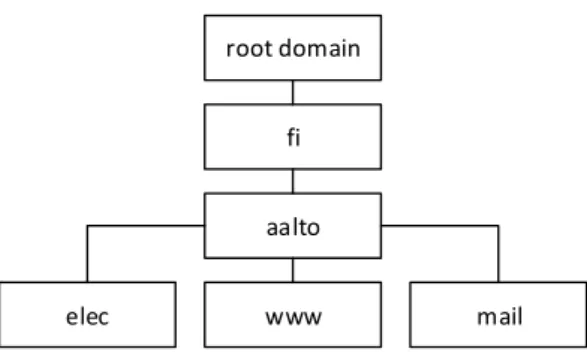
label which is empty. Because all domains names contain the root domain, the last dot is generally omitted. Figure 2.1 shows an example of the DNS hierarchy of six
domain names including the root domain: ”fi.”, ”aalto.fi.”, ”elec.aalto.fi.”,
root domain
fi
aalto
www mail
elec
Figure 2.1: Example of DNS hierarchy.
DNS is essentially a distributed database and it was thought that it would also be used to store other information besides hostname to IP address mappings, e.g. email addresses associated with a domain. Nowadays, the primary use of DNS is resolution of domains into IP addresses and providing information about email servers. The hierarchical structure of DNS is one of the main reasons for its ability to scale well. Each domain label in Figure 2.1 can be controlled by separate authoritative name server, or by a single authoritative name server for the root domain. An authoritative name server can delegate control of its subdomains to one or more name servers and thereby reduce its load. A domain and its subdomains can also
have the same authoritative name server, which is the case for theaalto.fiand its
subdomains elec,www, and mail.
The second feature of DNS that improves scalability is record time-to-live (TTL) values, which specifies how long DNS records are valid. The TTL value of DNS records determine how frequently clients must refresh DNS information by resolving a domain name. When a DNS client receives a response to a DNS query, it is allowed to store the received records in its local cache until their TTL expires. Any subsequent DNS queries will be answered using the local cache without querying a DNS server. This greatly reduces the load on the DNS infrastructure, depending on the lifetime of records. Allowing DNS records to be used for a certain period of time also makes the DNS system tolerant to failures.
The fault tolerance of DNS depends on the rate at which DNS information expires at end-users. It will take longer time for a service providing DNS records with high TTL values to become unavailable to all users if the its authoritative name servers were to fail. Records with longer lifetime have a higher probability of remaining valid until a DNS problem is resolved. On the other hand, the use of high TTL
values also poses a problem if a service provider were to change DNS records. In this case the clients with cached DNS records could experience service disruption until the cached records expire and the domain name is resolved again. In order to take down the DNS infrastructure an attacker would need to make all the au-thoritative name servers of the root domain unavailable for a substantial amount of time. Distributed denial of service attacks have been targeted against the DNS root servers, but attackers have not been able to sustain the attack for long enough to affect the DNS infrastructure [4]. Ten out of thirteen DNS root servers are using anycast to distribute DNS queries across hundreds of servers, and it is therefore difficult to overload all root servers at the same time.
2.1.1 Message and Record Formats
The DNS protocol uses UDP as transport protocol, because the lack of a connection-setup phase reduces name resolution time and network load. Naturally DNS suffers from the lack of reliability like any protocols carried over UDP, but with the amount of DNS traffic on the internet today, it was a good decision to optimize with respect to traffic volume rather than reliability.
Type Class TTL Data length Data Record name 16 bit
Figure 2.2: DNS record format.
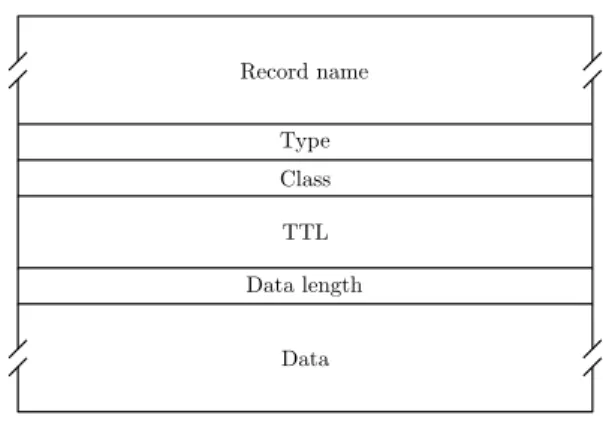
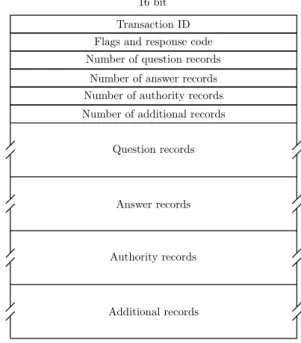
The DNS protocol uses a single message format for both queries and responses. The message format is shown in Figure 2.3. A DNS message consists of a header and four record sections: questions, answers, authorities, and additional records. The header contains information about the number of records in the record sections and how a message should be processed by DNS clients and servers. Figure 2.2 shows the format of a DNS resource record. Each resource record consists of six fields: name,
Transaction ID Flags and response code Number of question records
Number of answer records Number of authority records Number of additional records
16 bit
Question records
Answer records
Authority records
Additional records
Figure 2.3: DNS message format.
type, class, TTL, data length, and data. The record name indicates which domain the record contains information about and the type tells what type of data is stored in the data field. When DNS was designed several network types existed and the class field was included in the message format as a way of separating information by network type. Nowadays, only the Internet class is used and the class field is an unnecessary legacy field that reminds us of a time when the Internet was less dominant than today. The RFCs concerning DNS define the possible record types and the format used in the data field for each type [3]. Over the years, extensions to DNS have been made in the form of extra resource record types. These extensions are compatible with the original DNS specification and the new record types specified in separate RFC documents.
Type Description
A 32 bit IPv4 address record. AAAA 128 bit IPv6 address.
CNAME Alias pointing to another domain name.
NS Nameserver record containing information about an authoritative name server of a domain. MX Mail exchange record telling what servers should
handle email for a domain.
2.1.2 Resource Record Types
The record name field in a DNS record contains the fully qualified domain name about which the record contains information. The use of full domain names and not a single domain label is necessary because a name server can be the authoritative name server of multiple domains. Using full domain names prevents ambiguity. In order to reduce the size of DNS responses, domain names are compressed using a pointer scheme. Subsequent records in the same message contain references to previously used domain names rather than repeating the full domain name. Table 2.1 shows a list of the most commonly used DNS record types. The importance of these record types have not changed with time and improvements to DNS have typically been implemented as extra record types complementing the previously specified record types. IPv4 and IPv6 addresses are represented by A and AAAA records, respectively. The data field of these records has a fixed length of 32 bit or 128 bit. The CNAME record type is used to create domain aliases and contains the full alias
domain name. For instance, the domain www.aalto.fi uses a CNAME record to
point to the domain aalto.fi. Whereas A, AAAA, and CNAME record are the
typical record types of interest to end-users, the NS record defines the hierarchy of DNS. The NS record contains information about authoritative name servers of a domain and is used to delegate control of subdomains to other name servers. The data field of an NS record contains the domain name of an authoritative name server of the domain name. When resolving a domain name iteratively NS records are used to determine the name servers relevant to the resolution of the domain name.
2.1.3 Protocol
Although the DNS message format supports up to 65535 question records in a single DNS query, the de facto standard is that only one question record is sent per query and servers will ignore queries with multiple questions. Move advanced queries involving e.g. DNSSEC will include extra query information in the additional records section of the query as specified by Extension Mechanisms for DNS [5].
A typical DNS query message contains a single question record matching the record
type of interest. Thus if the client wants to know the IPv4 address of aalto.fi, the
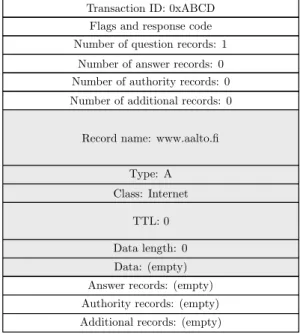
question record will be of type A and the name field contain “aalto.fi”. Figure 2.4
shows an example of a DNS query message. The transaction ID of the message is selected randomly such that two pending queries never have identical IDs. Given
the size of the transaction ID space, collisions are possible if many queries are sent by the same client. In this case, the transaction ID space can be extended by also randomizing the UDP source port of queries. This effectively increases the identifier space with a factor of 65535, thereby making collisions highly improbable.
Transaction ID: 0xABCD Flags and response code Number of question records: 1
Number of answer records: 0 Number of authority records: 0 Number of additional records: 0
Data length: 0 Data: (empty) Answer records: (empty) Authority records: (empty) Additional records: (empty)
Type: A Class: Internet
TTL: 0 Data length: 0 Data: (empty) Record name: www.aalto.fi
Figure 2.4: Example of a DNS query message.
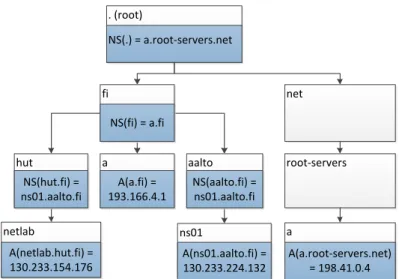
DNS records can be obtained through either recursive resolution or iterative reso-lution. A typical DNS resolver will send queries with the “recursion desired” flag enabled to a recursive DNS server either in the home gateway or provided by the ISP. When the flag is set, the DNS server is allowed to forward the query if it cannot be answered using cached information. Of course, the query will only be forwarded if the server configuration allows it. When using recursive name resolution, the DNS client only needs to send a single query message unless the packet is lost. The re-cursive name server will then handle the more complex iterative resolution of the domain name, if necessary. Iterative name resolution consists of sending the same query message repeatedly to different name servers. If the DNS resolver has no cached information, the first DNS server contacted is one of the 13 authoritative name server of the root domain, also know as root servers. If a DNS server is not the authoritative name server of the queried domain name, it will return an NS record telling which server most likely knows more about the domain in question.
1. The DNS client sends the DNS message shown in Figure 2.4 to a DNS root server.
2. The root server does not have an A record for the full domain name and therefore returns an NS record saying that the authoritative name server of
thefi domain can provide a better answer.
3. The DNS client repeats the query to the name server of the fi domain, and
this server returns an NS record for the aalto.fidomain.
4. The DNS client has now received the address of the authoritative name server
of theaalto.fidomain and when this server is queried it returns one or more
A records for the aalto.fidomain.
Because NS records contain the domain name of an authoritative name server of a
domain, it may be necessary for the resolver to obtain an A or AAAA record for this domain before being able to continue the resolution of the original domain name. For this reason, the use of so-called glue records in DNS responses containing NS or CNAME records are necessary in order to connect different parts of the DNS hierarchy together at the network layer. Without any IP address information it would not be possible to query name servers defined in NS records.
2.1.4 Issues and Vulnerabilities
In 2008 Dan Kaminsky described how DNS caches could easily be poisoned due to a flaw in common DNS server implementations [6]. The transaction ID of DNS messages is only 16 bits long and Kaminsky demonstrated that it was possible to predict transaction IDs. By correctly predicting the transaction ID of a DNS query, an attacker could send malicious responses that would be accepted as valid by a DNS resolver. The attack could be used to poison DNS caches with invalid DNS information, and thereby potentially redirect traffic to malicious servers. The attack was possible because most DNS software used fixed source port numbers of DNS requests and did not randomize the transaction ID. The use of sequential transaction IDs made it possible to send relatively few fake DNS responses and have one of them accepted with high probability. The problem was mitigated by randomizing both source UDP port and transaction ID, thereby increasing the transaction ID space. The DNS protocol still has a weakness but the probability of an attacker guessing
both the source port and transaction ID is extremely low. It is also infeasible for an attacker to flood a DNS client with all possible combinations, as once the correct answer is received by the DNS client all subsequent messages with the correct transaction ID are ignored.
2.1.5 DNS Security Extensions
The DNS Security Extensions (DNSSEC) [7] [8] were designed to improve the se-curity of the original DNS standard, which did not offer any means of ensuring authenticity and integrity of DNS records. Applications protocols such as HTTP
have long been protected by Transport Layer Security1 (TLS), and this has
gener-ally mitigated the threat of DNS tampering by teaching users always to make sure a
web page URL starts with httpsbefore providing sensitive information. However,
TLS does not protect against DNS poisoning and it is possible to redirect users by manipulating DNS information. Victims could be redirected to malicious servers and be tricked into providing sensitive information. DNSSEC is important because it prevents attackers from manipulating DNS information and in combination with TLS, it will significantly improve online security.
DNSSEC ensures authenticity and integrity of DNS records using public-key cryp-tography in a similar fashion to TLS. The hierarchical structure of DNS can be mapped to chains of trust in a public-key infrastructure. Each authoritative name server has a public and private key, and the public key is available as a DNSKEY record. An authoritative name server that delegates control of subdomains is known as the parent of the subdomains. The parent vouches for its subdomains by signing a hash of the public key of the subdomains. The signed hash is stored as a Delega-tion Signature (DS) record at the parent name server. The parent name server can in turn be signed by its parent and so on, until the chain of trust reaches a trust anchor. A trust anchor is a public key distributed out-of-band and which is the root of a trust chain. The root domain has been signed and its public key distributed with DNS resolvers and can therefore be used to validate DNSSEC information. Backwards compatibility is maintained by signing hashes of existing record types and storing the signature in a Resource Record Signature (RRSIG) record. If a client has DNSSEC capabilities it will indicate so in the additional records section of its DNS queries. DNS responses will contain the requested record along with its
corresponding RRSIG record and the DNSKEY record of the domain. The client will verify that the DNSKEY of the domain is trusted by verifying the chain of trust from the domain name to a trust anchor. If the key is trusted it is used to authenticate and verify the integrity of the resource records in the DNS response. The specification of DNSSEC started more than 10 years ago, but actual deployment in the Internet is still limited. As of November 9, 2013 36% of the top-level domains had been signed by the DNS root [9] and less than 0.5 percent of the subdomains of
comhad been signed [10]. The slow adoption can mainly be attributed to DNSSEC
being more cumbersome to manage. Cryptographic keys must be managed safely and improper configuration will result in DNSSEC-capable clients rejecting DNS in-formation and thereby be unable to access services. Many services managing domain names are providing tools to help configure DNSSEC, so hopefully the adoption rate will increase in the future.
2.1.6 Third-Party Resolvers
Google DNS and OpenDNS are the two most popular third-party DNS services. Google claims that its service “speeds up your browsing experience” by offering faster DNS resolution through higher capacity and improved caching compared to ISP DNS servers. Furthermore, the user base of Google DNS is much larger than that of any ISP and the probability of cache-misses should therefore be lower. Google DNS serves 70 billion DNS queries per day on average and is the worlds largest DNS resolution service [11]. OpenDNS served an average of 49 billion DNS queries per day between October 9 and November 7, 2013 [12]. Both services rely on anycast to direct end-users to nearby servers.
Ager et al. [13] evaluated the performance of Google DNS, OpenDNS, and the default resolver of measurement nodes using active measurements. The measurements were performed using colleagues and friends, and this approach provided 50 vantage points in different ISP networks, spread across 28 countries. The measurement locations were connected to the Internet through commercial ISPs, but the characteristics of the connections were not described. The study focused on DNS performance of web pages, and measured the name resolution of the main domain along with the domains of page elements. The 5000 most popular domain names and the 2000 least popular domain names were selected from Alexa’s global rankings [14]. In
addition, the web pages of the top 1000 Alexa rankings were analyzed and 3500 domain names of page elements were selected. This selection of domain names was made such that some domains should have low cache-miss probability, while others should most likely have a high cache-miss probability. The measurement procedure was designed to measure the impact of cache misses, by issuing sequential DNS queries for the same domain name to the same DNS resolver such that differences in resolution time could be recorded. The measurements showed that the default resolver generally outperforms Google DNS and OpenDNS, but not in all cases. The better performance of the default resolver comes from the fact that the latency to the client is much lower than between the third-party resolvers and the client. The client must be very close to a Google DNS or OpenDNS server in order for the performance to be comparable to the default resolver. Additionally, the study showed that some internet service providers load balance queries to their DNS servers, and thereby impair the performance of their setup because the servers did not use a shared DNS cache. Subsequent queries for the same domain name might not be directed to a server with the requested record in its cache. Ager et al. concluded that the proximity of the client and DNS resolver is the limiting factor for DNS resolution time. Furthermore, any optimizations made by Google DNS or OpenDNS could not be confirmed, and if present generally did not yield better performance compared to using the default DNS resolver. Finally, it was observed that for the tail of the distribution of DNS resolution times, OpenDNS performed significantly worse than Google DNS.
2.2
Web Pages and HTTP
A web page is basically a file containing text and HyperText Markup Language (HTML) [15] syntax, defining the layout and files needed to render a page. HTML has become more advanced over the years and so has web pages. Modern web pages can be highly dynamic and rely heavily on JavaScript to provide interactivity and create content. The main content type categories of web pages are: HTML, JavaScript, style sheets, images, and plugins. The HTML text provides text con-tent and the general structure of a web page along with embedded JavaScript, style sheets, and images. The JavaScript content of a web page typically consists of linked libraries and scripts utilizing these libraries. Style sheets allow web page designers to easily manipulate the look of a page without modifying HTML syntax. Images
constitute the graphical content of web pages and can be embedded in the HTML text, but are usually files linked to using HTML tags. Plugins are software that provide functionality not natively supported by web browsers. Two popular plugins for web browsers are Java and Flash. Flash became a popular choice for video play-back because this was not supported by the HTML standard. Java in the form of Java applets is used on the web for instance by online banking solutions, but many companies are abandoning Java applets due to security issues and the lack of Java support on mobile devices. The specification of HTML 4.01 was completed in 1999 at a time where the web was quite different compared to the web pages of today. The standardization of HTML 5 is expected finish in the near future and is a ma-jor overhaul. Browsers which implement HTML 5 will support a range of features natively which previously required plugins. These features will be accessible as new HTML tags and JavaScript functions, and hopefully result in a more coherent and cross-platform compatible web.
GET /search?q=KEYWORD HTTP/1.1 host: www.google.fi
accept-encoding: gzip,deflate,sdch
accept-language: en-US,en;q=0.8,da;q=0.6
user-agent: Chrome/30.0.1599.114 Safari/537.36 accept: text/html
cache-control: no-cache
Figure 2.5: Example of HTTP headers in a GET request.
Web pages are delivered over the Internet using the HyperText Transfer Proto-col (HTTP), which is an application-layer protoProto-col running on top of TCP. The download of any file over HTTP can be divided into three phases: domain name resolution, TCP connection establishment, and file transfer. In the first phase the domain name is resolved by the DNS resolver of the operating system. If the resolver has the IP address of the domain in its cache, this address is used in the second step. Otherwise, the resolver continues by sending a recursive DNS query to its default DNS server. In the second phase, a TCP connection is established to the IP address of the domain on port 80 which is the default HTTP port. Once the connection has been established, the HTTP client can send a request to the HTTP server. The HTTP server either responds with the requested file, a redirection command, or an error page. Figures 2.5 and 2.6 show examples of the HTTP headers for a GET
request and a response, respectively. In a request the header contains the path of the requested file along with the domain name it belongs to. It is necessary to in-clude the domain name in the request, because an HTTP server may serve multiple domain names on the same IP address. The header also contains information about the HTTP clients capabilities, such as HTTP version, web browser, and accepted compression schemes. The first line of a response always contains the HTTP version used by the server, a three-digit status code, and optionally a human-readable status message. The remaining lines of the response header contain information relevant to the decoding of the payload of the response, such as content type, content length, encoding, and compression scheme. HTTP responses often contain a creation and expiry time, along with information about the cacheability of the payload. This information is used by HTTP clients to refresh content when needed and for HTTP caches to determine whether content should be cached.
HTTP/1.1 200 OK
cache-control: private, max-age=0 content-encoding: gzip
content-type: text/html; charset=UTF-8 Date: Sun, 10 Nov 2013 09:15:41 GMT Expires: Sun, 10 Nov 2013 09:17:41 GMT
Figure 2.6: Example of HTTP headers in a response.
Figure 2.7 shows the process of downloading a web page and its elements. The name resolution phase is repeated once for each unique domain name. In HTTP 1.0 a new TCP connection is used to transfer each file and the connection-establishment is thus repeated before every file transfer. Delivering a single file per HTTP connection, makes HTTP clients and servers easy to implement, but at the cost of less efficient transfers. HTTP 1.1 supports persistent connections where multiple requests can be sent over the same TCP connection, thereby reusing the connection for multiple file transfers. Figure 2.8 shows the process of downloading a web page using persistent connections. The figure shows how the files downloaded in Figure 2.7 could be down-loaded using only two TCP connections. Technically, the connection-establishment phase of a file transfer is only required once per domain name as all files hosted on the same domain could ideally be transferred over a single connection. The benefit of persistent connections is that the initial TCP handshake is avoided and the con-gestion window is larger for subsequent file transfers, because the connections do not have to undergo slow start again. Persistent connections improve performance on
high-latency links because the number of packet round-trips is reduced. However, the HTTP client must wait for the server to respond before requesting another file and this adds a round-trip time. The extra round-trip time can be avoided by us-ing pipelinus-ing where multiple requests are sent immediately after each other on the same HTTP connection. The server then responds to each request in the order they were sent and this results in the best utilization of an HTTP connection. The most noticeable problem with HTTP pipelining is head-of-line blocking, where processing of one request delays the processing of the subsequent requests, as requests must be processed in the order they were sent. This reduces the throughput compared to using multiple TCP connections. Modern web browsers therefore use both multiple connections and pipelining to achieve the best download performance [16] [17]. We could not find any statistics on the usage of HTTP pipelining, but the tendency appears to be that HTTP servers support persistent connections but not necessarily pipelined requests. The most popular web browsers support this pipelining [18], but this is of little use if servers do not.
Time
DNS resolution TCP connect File transfer
Parse file
TCP connect File transfer
TCP connect
DNS resolution File transfer
Domain A
Domain A Domain B
TCP connect
DNS resolution File transfer
Domain B
Figure 2.7: Web page download without persistent connections.
Time
DNS resolution TCP connect File transfer
Parse file
File transfer
TCP connect
DNS resolution File transfer
Domain A
Domain B File transfer Figure 2.8: Web page download using persistent connections.
The main HTML file of a web page is the starting point of any web page down-load. The web browser parses the HTML syntax while it receives the file from the HTTP server and determines which additional files need to be downloaded, such that transfer of these files can begin while the first file is still being transferred. For this reason, most web browsers render web pages progressively as they receive page elements. Browsers impose limits on HTTP transfers in terms of maximum number
of overall and per-hostname simultaneous connections allowed. These limits vary from browser to browser, but typically 6 connections per hostname are allowed. The maximum number of connections independent of domain names varies a lot between browsers. Internet Explorer 9 allows up to 35 connections and Firefox 18 allows 11 connections [18].
Several studies deal with the performance of web page downloads, but unfortunately these studies are focused on the performance over mobile networks and their results are thus not directly comparable to measurements in wired networks.
Pries et al. studied the composition of the top 1 million web pages from Alexa [14] and presented an updated model of the characteristics of web page content [19]. The web page download performance was not measured, because their goal was to develop a model of web content. By considering previous models for HTTP content, it was concluded that web pages are growing in file size and number of page elements. Additionally, web pages are being downloaded from a greater number of servers than previously and this may affect download performance. Their measurements showed that the mean uncompressed file sizes was roughly 50% larger than the median file size.
2.3
Content Distribution Networks
With the growth of the Internet came the need for greater capacity to deliver con-tent. The only way for a service provider to handle millions of simultaneous users is to distribute requests across many servers. When it comes to operating content distribution infrastructures, two approaches or a combination of both are gener-ally used. The first and perhaps most common approach, is to build data centers which contain a large number of servers. Data centers concentrate capacity in lo-cations with good connectivity to the Internet, and this enables easy maintenance and thereby reduced operational expenses. Furthermore, data centers are designed for high reliability with redundant links to the Internet through multiple network operators. The second approach consists of distributing the capacity of a data center across many geographical locations. These locations may be within data centers, ISP networks, or at Internet exchanges. Each location has little capacity compared to a data center and may not have as high reliability, depending on the location.
However, the use on many locations with different links to the Internet, makes it practically impossible for a service provider to end up in a situation where all servers are disconnected from the Internet. Granted, it is unlikely this would happen to a data center, but data centers can be said to be more of an “all eggs in one basket” approach. For this reason service providers use multiple independent data centers for additional redundancy.
The purpose of content distribution networks (CDNs) is to distribute the load of a service across an infrastructure such that data can be delivered with high perfor-mance and thereby give users a higher quality of service. Architectures with few or many hosting locations can be used to optimize content delivery. However, the concept of a CDN is often associated with a distributed architecture, perhaps be-cause the largest CDN provider Akamai has such an architecture. A good CDN is characterized by not only distributing traffic across multiple servers, but also distributing the traffic geographically across multiple locations. Using multiple lo-cations increases network capacity, improves redundancy, and reduces the average distance between client and server. In most cases shorter distance is equivalent to lower network latency and thereby higher throughput. With the use of multiple servers and locations, an important part of a CDN is to direct end-user requests to an optimal server. Determining the optimal CDN server can be done at different layers of the network stack and with varying degrees of precision. The following sections explain the most common methods of distributing the traffic of a service provider in the Internet and at the ingress point of hosting locations.
2.3.1 Anycast
The Internet Protocol carries all types of Internet traffic and the routing mecha-nisms for IP traffic can be used to distribute traffic on a global scale [20]. The Border Gateway Protocol (BGP) is an exterior gateway protocol used to route traf-fic between autonomous systems (AS) which are the largest topological units in the Internet. A service provider with its own AS number advertises its network prefixes through BGP and thereby connects its network to the rest of the Internet. The service provider can advertise its IP prefix from multiple locations in the Internet. When border routers in other autonomous systems calculate the optimal route to the prefix, the route will depend on the location of the border router in the Internet. This causes packets going to the service provider to be routed to the closest server
according to BGP. This concept is known as anycast routing and can be used for global load balancing at the network layer. Anycast routing is only useful if servers are hosted in geographical locations far apart, as the distribution of traffic might otherwise not be beneficial. Anycast routing provides stateless traffic distribution and is typically used for stateless services such as DNS. It is also possible to use any-cast for statefull services, but when routes change connections will potentially break. It is only worth optimizing routing in the Internet for large service providers. For instance, Google DNS uses anycast routing to direct user to servers in 25 different IPv4 networks [21].
2.3.2 Load Balancing
Google DNS uses two IP addresses, 8.8.8.8 and 8.8.4.4 for their recursive DNS servers. These addresses are routed using anycast, but considering the amount of traffic Google DNS handles, request must be distributed across multiple servers in multiple hosting locations. Because DNS is a stateless protocol, this can be done using network-layer load balancers. Each IP address points to a load balancer which will direct incoming packets to servers based on some distribution algorithm. The distribution could be as simple as round robin, but could also be based on additional parameters such as server load. In contrast to load balancing of stateless servers, stateful protocols such as TCP require packets to always be directed to the same server. This requires a stateful load balancer to remember the server assigned to a specific traffic flow such that packets belonging to the flow are directed to the correct server. The rate at which packets can be processed depends on the number of pa-rameters taken into consideration before forwarding a packet. If a service provider has the need for load balancing, it is probably meaningful to optimize the server configurations for load balancing. This could be done by using dedicated servers for different services, e.g. DNS, HTTP. If a single load balancer were used for multiple service types, it would be necessary to look at transport-layer information in order to direct traffic flows correctly. On the other hand, if different services had their own load balancer it would only be necessary to consider network-layer informa-tion for stateful services and stateless services could be balanced independent of any information contained in packets.
2.3.3 Application Layer Redirection
Anycast routing provides load balancing based on network topology and dose not consider the actual load of servers. An anycast address could therefore point towards a location where servers are experiencing high load. The network-layer load balancer at such a location could have more detailed information about the current load of servers. However, because server load constantly changes, the load balancer may still direct traffic to an overloaded server. In this case the request can either be dropped or be redirected at the application layer. The latter is of course preferable as a dropped request appears as an error to the end-user, whereas a redirection appears as increased processing time. Redirection at the application layer relies on mechanisms in the application protocol and is thus not transparent to the client. A good example of application-layer redirection is HTTP where certain response codes are used to indicate that the requested file has changed location. It is then up to the HTTP client to interpret this response code and initiate a new request to the address specified in the header of the redirection response.
Application-layer redirection has a number of disadvantages that makes it preferable to do proper load distribution below this layer of the network stack. First of all,
an overloaded server always has to process a request even if the request will be
redirected. Traffic is thus not directed away from an overloaded server but merely deflected by it. Although redirection responses can be sent quickly, the resources spent redirecting clients may disrupt service for existing clients. Secondly, because the redirection information is supplied at the application layer it cannot be cached by local gateways. In a network where multiple clients share a common gateway, caching could reduce the load on an overloaded server by caching redirection responses. In order for a gateway to cache redirection responses it would have to be able to understand the application-layer protocol where the address of the alternate server is supplied. If the application protocol is encrypted, the gateway has no chance of detecting redirections.
2.3.4 DNS Redirection
Despite application layer redirection generally being undesirable, the most popular method of load balancing technically relies on an application-layer protocol. DNS is the preferred method of redirecting users to an optimal server because it is transpar-ent to all services that use domain names. Operating systems typically implemtranspar-ent a
DNS client as a shared library used by all applications that need to resolve domain names. This essentially makes DNS act like a pseudo-layer between the application layer and network layer. DNS can be used to provide transparent redirections to all applications by having a DNS server return different responses to queries, depending on some load balancing algorithm. Furthermore, because DNS is an integral part of the Internet, most home gateways have a built-in DNS cache that performs recursive name resolution on behalf of clients on the local network. This enables redirections to be cached and thereby improve performance for other clients on the network.
Service Provider HTTP Server (Origin Server)
Client Service Provider
DNS Server Akamai Edge Server Akamai DNS Server Request A record Respond with CNAME
Request A record of CNAME
Respond with A recor
d of edge server
Send HTTP request Forward
request
Return file
Cache file and return it to client
Figure 2.9: Example of HTTP download using Akamai.
Figure 2.9 shows how HTTP files are served using the Akamai CDN [22]. The following steps are completed in order to download a file from an Akamai CDN server:
1. The client or a recursive resolver begins by resolving the domain name of the service provider, e.g. www.cnn.com.
which has been configured to return a CNAME record pointing to a domain name controlled by Akamai, e.g. www.cnn.com.edgesuite.net.
3. The DNS resolver continues by resolving the domain name controlled by Aka-mai.
4. The Akamai DNS server returns an A record containing the IP address of an appropriate HTTP edge server. Akamai uses multiple levels of DNS redirection and may also return yet another CNAME record in this step, in which case the client repeats step 3.
5. The client has finally obtained an IP address of an edge server and sends an HTTP request to it.
6. If the edge server has the requested file in its cache it will return it to the client immediately. Otherwise, it will forward the request to the origin server of www.cnn.com.
7. The origin server will return the file to the edge server.
8. The edge server saves the file in its cache and delivers it to the client.
Content distribution networks use multiple levels of DNS redirection to direct clients to an optimal server. The optimal sever is selected based on a set of parameters, including IP address of the client, type of service, and current load of the CDN. Redirections are made by returning different NS, CNAME, or A records depending on the server selection parameters. Each redirection narrows down the area within which a CDN server will be selected. This is a good design choice, because it allows optimal redirection to be made without requiring global knowledge of the state of the CDN. Table 2.2 shows a simplified trace of how the domain name
newsimg.bbc.net.uk is resolved iteratively. The table shows which name server was queried, the most important records in the response, and the TTL of that record. The trace shows that three CNAME records are encountered while resolving the domain name. The first CNAME points to another CNAME controlled by BBC. If the DNS records had been configured optimally, the first domain would
have pointed to the news.bbc.co.uk.edgesuite.net domain, instead of another
CNAME. The edgesuite.net domain is controlled by Akamai and provides the
first level DNS redirection using an NS record. When the authoritative name server
CNAME record is the second level of DNS redirection. When the alias domain name is resolved the third redirection is received and this is the final server selection.
When the domain a1733.g.akamai.netis resolved, Akamai makes the final server
selection and returns two A records with IP addresses of suitable severs with respect to the client.
Name Server Record Name and Data Record TTL
k.root-servers.net NS(uk)= ns1.nic.uk 2 days
ns1.nic.uk NS(bbcimg.co.uk) = ns1.tcams.bbc.co.uk 2 days ns1.tcams.bbc.co.uk CNAME(news.bbcimg.co.uk)=
newsimg.bbc.net.uk
1 hour
ns1.nic.uk NS(bbc.net.uk) = ns0.tcams.bbc.co.uk 2 days ns1.nic.uk NS(bbc.co.uk) = ns1.rbsov.bbc.co.uk 2 days ns1.rbsov.bbc.co.uk A(ns0.tcams.bbc.co.uk) = 212.72.49.2 1 day ns0.tcams.bbc.co.uk CNAME(newsimg.bbc.net.uk)=
news.bbc.co.uk.edgesuite.net
300 seconds
k.root-servers.net NS(net) = a.gtld-servers.net 2 days a.gtld-servers.net NS(edgesuite.net)= ns1-2.akam.net 2 days ns1-2.akam.net CNAME(news.bbc.co.uk.edgesuite.net)=
a1733.g.akamai.net
2 hours
a.gtld-servers.net NS(akamai.net) = zc.akamaitech.net 2 days zc.akamaitech.net NS(g.akamai.net) = n1g.akamai.net 9 hours n1g.akamai.net A(a1733.g.akamai.net)=87.108.18.42
A(a1733.g.akamai.net)=87.108.18.40
20 seconds
Table 2.2: DNS trace of resolution of newsimg.bbcimg.co.uk.
When the TTL values of the records returned by Akamai are considered, only the records returned in the final response could have been selected based on actual server load. It was therefore suspected that the previous redirections were simply directing the DNS client to a DNS server responsible for an Akamai region. However, by
resolving a1733.g.akamai.net from multiple locations in the Internet, it was
ob-served that the two first levels of DNS redirection were repeated independently of the location. This suggest that Akamai server selections are based on global knowledge of the state of the CDN and that server selection is not handled by region-specific DNS servers. Akamai has a large monitoring infrastructure where performance in-formation is gathered from every CDN location and aggregated [23]. By utilizing this information, it would be possible for end-users to get an optimal server selection from a single Akamai DNS server without multiple levels of redirection. The extra steps needed to resolve Akamai domain names are therefore likely due to redun-dancy, or they may play a part in the server selection that is not entirely obvious.
The TTL of the final two A records indicates that Akamai believes the performance of the selected servers will be optimal within the next 20 seconds.
DNS is a good solution for directing clients to servers based on their estimated location. However, one key feature of DNS has become a problem for CDNs with the increasing popularity of third party resolvers outside of ISP networks. DNS caches are an important part of the DNS infrastructure and most home gateways provide a recursive DNS resolver that typically forwards requests to the DNS servers provided by the ISP. The location of a client is the most important piece of information when it comes to selecting an optimal CDN server. The location is estimated using the source IP address of DNS queries. When the domain name pointing to a CDN is resolved iteratively by a client, an authoritative name server of a CDN will see the client as the source of the query. However, when a recursive DNS server resolves a request on behalf of a client, the recursive DNS server will be seen as the source of the query. This has not been a problem in the past because most users relied on ISP DNS caches for name resolution. These servers were geographically close to the end-user and the selected CDN server was the same as if the end-user had resolved the CDN domain name. The problems arise when the distance between the recursive DNS server and the client becomes large, as is the case for services like Google DNS and OpenDNS. Even with the use of anycast routing, the distance is much greater than between clients and ISP name server. When a third-party DNS resolver queries the authoritative name server of a CDN, the CDN returns the address of an optimal server for the third-party resolver, but not for the client it is sending the query on behalf of.
The only solution to this problem is for the third-party resolver to include the address of its client in the query message, or to deploy additional servers such that third-party DNS servers are as close to end-users as ISP DNS servers. The experimental IETF draft “Client Subnet in DNS Request” [24] defines a extension using Extension Mechanisms for DNS (EDNS0) [5]. The extension enables recursive DNS servers to include the IP address and network mask of the client that a query is being processed on behalf of. The most important fields of extension are source netmask, address, and scope netmask. The source netmask field defines the number of bits from the clients IP addres that are included in the address field. The scope netmask field is used by DNS servers, to specify which IP addresses the answer is intended for and can be cached for. The source netmask is useful from a privacy perspective,
because it allows a recursive resolver to only reveal a limited amount of information about the original sender of a query. Google is contributing to the specification of the extension and according to Otto et al. the extension is already in use by Google DNS [2].
The performance of content distribution networks is an active area of research. Many studies focus on video streaming because of the rise in traffic volume of this content type. Another reason for video streams being a popular content type to measure is the need for large files to evaluate the performance of CDNs in terms of bandwidth. Web pages generally consists of many small files and the average bandwidth during download of such files is therefore not representative of the CDNs throughput capacity. The duration of TCP connections is not long enough for transfers to reach their maximum transfer rate.
2.3.5 CDN Providers
Akamai is the largest CDN provider in the world and started offering commercial services in 1999, less than ten years after the invention of the World Wide Web. The traffic volume of Akamai is at least as big as the traffic volume of all other providers combined [25]. The Akamai infrastructure is optimized to reduce latency between clients and servers, by locating CDN servers as close to the end-user as possible, at the edge of the network. This meant deploying a very large number of servers across the globe and Akamai operates by far the most CDN locations of any of CDN provider.
Akamai offers to deploy servers within ISP networks at no cost and it is possible that ISPs do not charge Akamai either. This is because the presence of Akamai servers is as beneficial to ISPs as it is to Akamai [26] [27]. Both ISPs and Akamai have to pay for transit traffic and locating servers in ISP network thus reduces transit traffic and thereby the expenses of both parties. Akamai states that compared to a cen-tralized CDN architecture, its architecture provides improved redundancy, greater throughput, and reduced latency [25]. However, operating servers in many locations comes at an increased cost compared to large data centers. According to Triukose et al. [28], Akamai could consolidate their server locations without noticeable changes in performance, but with significant cost savings. Triukose also concluded that the Akamai architecture favors clients with high-speed connections because it is easier to achieve high throughput over short distances in the Internet. As of 2013, Akamai
op-erates more than 130,000 servers and is present in 2,200 points of presence (Internet exchanges) and 1,200 networks, spread across 81 countries.
Akamai does not operate its own network, but relies on the Internet as its backbone network [25]. This is likely less expensive and less complex, but at the cost of not being able to control quality of service. Because the Internet is a best-effort service, Akamai servers behave like islands in the network with no need to communicate with other Akamai edge servers. Edge servers naturally have to communicate with the part of the Akamai infrastructure responsible for server selection and load bal-ancing. The part of the Akamai architecture that serves files over HTTP operates in conjunction with the servers of their customers. The CDN essentially works as an enormous HTTP cache that fetches content from customer servers when needed, and end-users are directed to caches rather than the customer’s servers.
Level 3 and Limelight are two competing CDN providers that take a different ap-proach to content distribution networks compared to Akamai. Both providers have a more centralized architecture with servers located in a few data centers, as op-posed to the many CDN locations of Akamai. The design philosophy of Level 3 and Limelight is that operating large data centers with lots of capacity provides good performance at a reduced cost compared to a distributed architecture. There is no doubt that locating servers closer to end-users will reduce latency, but the question is whether the difference in latency between a centralized CDN and a distributed CDN has any significant performance impact.
Otto et al. measured CDN redirections and HTTP latency for Akamai and Limelight from 10,000 locations [2]. The CDN redirections were measured using Google DNS, OpenDNS, ISP name servers, and iterative resolution. Their measurements showed that 90% of the locations observed no similarity between DNS answers by the au-thoritative DNS servers of Akamai, and the answers by Google DNS and OpenDNS. The same was true for 50% of the measurement locations for Limelight. The DNS answer obtained from the ISP name servers had a much higher degree of similarity than the third-party DNS resolvers for both Akamai and Limelight. The HTTP latency measurements showed that using iterative resolution or the ISP DNS server resulted in the best selection of a CDN server for both CDN providers. The differ-ence in HTTP latency between iterative resolution and third-party resolvers, was more noticeable for Akamai. The HTTP latency of servers selected using iterative resolution and third-party resolvers were equivalent for 30% of the measurements
locations for Limelight. The same could only be said for 10% of the locatios for Akamai. This indicates that the performance of Akamai depends more on good CDN redirection than Limelight.
The performance of server selections of Akamai and Limelight were also evaluated using the “Client Subnet in DNS Request” extension. Source netmasks of 32 bit, 24 bit, and 16 bit were used. The results showed that the full client IP address always resulted in the best performance. For 60% of the measurement locations the 16 bit netmask resulted in performance similar to using the full address. The performance observed for the 24 bit prefix was comparable to that of the full IP address.
Su et al. tried to infer good paths in the Internet from the server selections made by Akamai [29]. Their research showed that Akamai typically managed to avoid congested network paths and that mapping an overlay network to Akamai’s archi-tecture could improve performance of the overlay network. Their research indicated that Akamai uses more information than just client location, latency and server load to select servers. Akamai is likely monitoring congestion in the internet from their many hosting locations and optimizes server selection based on this information.
In this chapter the protocols needed to download web pages were introduced. The structure of the Domain Name System was explained along with the process of name resolution. Finally, the key mechanisms of content distribution networks were introduced.
Chapter 3
Measurements
3.1
Metrics
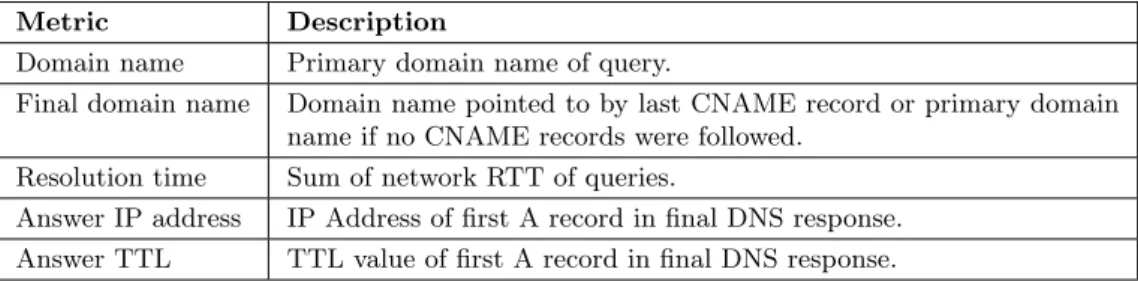
The download of a web page consists of DNS resolution and HTTP download. In order to study the performance of web page delivery performance indicators of this process must be identified. From an end-user’s point of view the performance can be summed up to the total download time of a web page. The DNS resolution time and HTTP download time will therefore be used to describe the performance of the protocols. By including all steps of the resolution process in the resolution time, packet loss and server errors are also captured by the metric. Although the download time is important to the end-user, it is not a good metric for estimating the performance of the network path between client and server. The congestion control mechanisms of TCP affect throughput and download time is therefore not a good metric for assessing network performance. One of the most important factors affecting TCP throughput is latency and measuring the latency between client and server will therefore give a better picture of potential throughput. The latency can be measured as the TCP connect time, as there is a fixed relationship between this value and the actual round-trip time (RTT). It is also possible to measure the RTT using ICMP, but since some routers in the Internet treat TCP and ICMP traffic differently [30], TCP connect time is a better indicator of potential TCP throughput. CDNs often use DNS redirection and by recording the messages exchanged during the resolution process it will be possible to analyze the server selection mechanisms of CDNs along with general DNS characteristics of the domain names used by web
sites. Because CDNs direct users to servers based on their estimated location, mea-suring websites from a single locations will not yield any interesting results with respect to content distribution networks. To observe different CDN server selections it is necessary to perform measurements from multiple locations in the Internet. If the locations are sufficiently far apart from each other, CDNs should return differ-ent IP addresses of servers. By performing measuremdiffer-ents from the geographically distributed measurement platform PlanetLab, it will be possible to measure CDN performance from a global perspective.
We decided to measure popular websites as these likely rely on content distribution networks to improve their service. Measuring popular websites fulfills two goals of this thesis: measuring websites that are important to many users and measuring the use of CDNs to deliver websites. Thirty-three websites were selected from the rankings of Alexa [14] from the following categories: news, shopping, social networks, video, search engines, email, and Finnish news. Websites were selected according to their popularity internationally with the assumption that such sites optimize their content delivery at a global level. The number of users is not necessarily an indication of international popularity, as the potential user base of a website largely depends on the language of the site. The Finnish news sites were measured because these were not expected to utilize CDNs. Measurements of those websites could therefore be used to evaluate the performance differences between sites using and not using CDNs.
Table 3.1 shows a list of the selected websites and their URLs. Some URLs redirected HTTP clients immediately and these URLs were replaced with the destination of the redirection, unless the redirection was based on client location. Some URLs immedi-ately redirected HTTP clients to an HTTPS version of a page, and these URLs were also replaced with the HTTPS version of the URL. The reason for replacing URLs that lead to redirection pages is that these web pages do not contain any content. Furthermore, if a user visits a website frequently they might have a bookmark for it and thereby skip the redirection page. The measurements are therefore equivalent to a user accessing websites directly using a bookmark in a web browser.
Category URLs News http://news.yahoo.com/ http://edition.cnn.com/ http://www.huffingtonpost.com/ http://www.weather.com/ http://www.reddit.com/ http://www.bbc.co.uk/news/ http://www.nytimes.com/ https://news.google.com/ http://www.foxnews.com/ Shopping http://www.amazon.com/ http://www.ebay.com/ http://www.ikea.com/ Social networks https://www.facebook.com/
https://twitter.com/ http://www.linkedin.com/ https://plus.google.com/ https://pinterest.com/ http://www.flickr.com/ Video http://www.youtube.com/ https://vimeo.com/ http://www.dailymotion.com/ http://www.netflix.com/ http://www.hulu.com/ Search engines http://www.google.com/ncr
http://www.bing.com/ http://www.yahoo.com/ E-mail http://www.gmail.com/
http://mail.live.com/ http://mail.yahoo.com/ Finnish news http://www.iltalehti.fi/etusivu/
http://www.hs.fi/
http://www.iltasanomat.fi/ http://www.yle.fi/