Open Research Online
The Open University’s repository of research publications
and other research outputs
Developing Teacher Educators In Uganda Using a
Mentoring Approach: a case study
Thesis
How to cite:Lyseight-jones, Pauline Elaine (2017). Developing Teacher Educators In Uganda Using a Mentoring Approach: a case study. EdD thesis The Open University.
For guidance on citations see FAQs.
c
2017 The Author Version: Version of Record
Copyright and Moral Rights for the articles on this site are retained by the individual authors and/or other copyright owners. For more information on Open Research Online’s data policy on reuse of materials please consult the policies page.
1 | P a g e
THE OPEN UNIVERSITY
Doctorate in Education (Ed. D)
DEVELOPING TEACHER EDUCATORS IN
UGANDA USING A MENTORING
APPROACH: A CASE STUDY
Pauline Elaine Lyseight-jones, BA (Hons), M.Sc.
2 | P a g e
Note: this research took place while I was working as a volunteer on a teacher
educators’ education placement in Uganda. The placement was arranged by VSO for
UNICEF. I am grateful for the understanding given to me by both organisations to enable me to undertake this self-funded independent study. The college in which I was based thrives under new leadership (from September 2013). Mentors and centre co-ordinating tutors (CCTs) are given pseudonyms throughout.
3 | P a g e
Abstract
This study is about intent and experience in a primary teacher education mentoring initiative in Uganda. The initiative’s intent was to extend teacher educators’
capacities, enabling them to improve primary education quality in all government schools across Uganda. The main research question was about how mentoring is understood in a mentoring programme to improve teacher education in Uganda. A framework is used map three constituencies: the expectations of the mentoring initiative originators as expressed through local documentation and the expectations and experiences in the initiative of mentors and co-ordinating centre tutors (CCTs). Semi-structured interviews were the main form of data collection and included twenty-eight CCTs who were based in one primary teachers college (PTC) in Eastern Uganda and fifteen international volunteer educators (mentors) based in separate PTCs across Uganda (recruited by an NGO, VSO).
The study found that mentoring is interpreted in a range of ways within the mentoring programme. These interpretations affected both sides of the mentoring relationship to different degrees and at different points in the development of the initiative. Even with the broad parity in seniority and experience of CCTs and mentors, the
operationalising of the initiative resulted in mentors leading (or facilitating) the mentoring relationship. Yet the acceptance of personal professional learning in CCTs is a key phenomenon if the work is to be sustainable. The areas of challenge were the expectations of the foreign volunteer educator mentor in the placement, the impact on motivation of intermittent funding and the negotiation of productive professional relationships.
4 | P a g e
Acknowledgements
I am more than indebted to the many people who gave me their time to talk about their work: particularly to CCTs at my own college, my colleague volunteer
educators/mentors, personnel from VSO, UNICEF and district education staff.
I am similarly indebted to EC, KC, SH, JL-J and MY for reading and commenting, more than once and to June Ayres for epitomising the best of the Open University when I was far away from home (and when I got back).
My supervisors have been all that I would ask for and more and I thank them for their constructive guidance, particularly Maggie Smith who has been with this work since the beginning and who has been endlessly constructive, realistic and encouraging.
This work represents the second of two ambitions completed. There is no accounting
for someone else’s dream so I thank my family and friends for their tolerance.
I dedicate this work to my children, Adam and Jerusha, to Jen and my grandchildren, and to my brothers. Ad astra.
5 | P a g e
Contents
Abstract ... 3 Acknowledgements ... 4 Map of Uganda ... 11 Glossary ... 12 CHAPTER 1 Introduction ... 141.1 Outline of the thesis ... 19
CHAPTER 2 Literature review ... 22
2.1 Primary teacher educators’ improvement programme: mentoring initiative ... 22
2.2 Uganda: a backdrop to the development of primary phase education ... 26
2.2.1 Universal Primary Education (UPE) and some of its implications for the Ugandan primary education sector ... 31
2.2.2 The Thematic Curriculum ... 37
2.2.3 Teacher Development and Management System (TDMS) ... 37
2.2.4 Co-ordinating centre tutors (CCTs) and their work ... 46
2.3 Mentoring: a developing activity ... 50
2.3.1 Mentoring and mentoring relationships ... 50
2.4 Summary ... 69
CHAPTER 3 Methodology ... 71
3.1 Research strategy ... 71
3.2. Research design ... 74
3.3 Data collection: three constituencies ... 79
3.4 Data collection: methods ... 82
3.4.1 Local documents ... 84
3.4.2 Mentor and CCT semi-structured interviews ... 85
3.4.3 Participant observation ... 87
3.5 Participation and recruitment ... 89
3.5.1 Research cohorts ... 89
3.5.2 Prerequisites: anonymity, confidentiality and consent ... 92
3.5.3 CCT group ... 93
3.5.4 Mentor group ... 93
3.5.5 Participant inclusion issues ... 94
6 | P a g e
3.6.1 Issues with access and recruitment ... 95
3.6.2 CCTs: participation and access ... 96
3.6.3 Mentors: participation and access ... 97
3.7 Issues with data collection ... 97
3.8 Data analysis ... 102
3.9 Ethical issues ... 107
3.10 Data collection and analysis: advantages and limitations ... 122
CHAPTER 4 Findings ... 126
4.1 Framing the research from the first constituency: the mentoring initiative originators ... 127
4.2 Framing the mentoring initiative: the view from two constituencies: mentors and CCTs ... 135
4.2.1 Positioning the mentors ... 135
4.2.2 Positioning the CCTs ... 138
4.3 Mentors: expectations, work and success ... 139
4.3.1 Mentors: what are mentors’ expectations? ... 139
4.3.2 Mentors: what was the work? ... 145
4.3.3 Mentors: success within the mentoring initiative ... 150
4.4 CCTs: expectations, work and success ... 155
4.4.1 CCTs: expectations of the mentoring initiative ... 156
4.4.2 CCTs: work and the resources to do the mentoring work ... 158
4.4.3 CCTs: aspects of success: professional support, professional skills and personal support ... 161
4.5 Associated issues: persistent discovered themes ... 170
4.6 Mapping using Dawson’s framework ... 178
4.6.1 Intent and planning to practice and participation: from three constituencies ... 178
4.7 Commentary: aspects of the landscape of the mentoring initiative ... 185
4.7.1 Mapping response ... 186
CHAPTER 5 Main findings, recommendations and conclusions ... 212
5.1 Responding to the research questions ... 212
5.1.1 How is mentoring understood in an initiative to improve teacher education in Uganda? ... 212
5.1.2 What are the expectations of mentors and CCTs in a primary teacher educators’ mentoring initiative in Uganda? ... 214
7 | P a g e
5.1.3 What is the work of mentors and CCTs in a primary teacher educators’
mentoring initiative in Uganda? ... 216
5.1.4 What do mentors and CCTs understand by success in mentoring? ... 218
5.2 Theory to practice ... 220
5.3 Main findings ... 223
5.4 Contributions to theory and implications for policy and practice ... 231
5.5 Dissemination of research information ... 237
5.6 Further research ... 238
5.7 Reflective evaluation of the study ... 239
5.8 Conclusion ... 244
8 | P a g e
Appendices
Contents ... 5
Appendix 1: the mentoring initiative priorities ... 257
Appendix 2: the CCTs’ role ... 258
Appendix 3: CCT workload and support ... 259
Appendix 4: mentoring, coaching and the overlap... 260
Appendix 5: ethical approval ... 261
Appendix 6: local documents used as references for document analysis ... 262
Appendix 7: CCT semi-structured interview schedule ... 263
Appendix 8: mentor semi-structured interview schedule ... 265
Appendix 9: participant observation schedule ... 267
Appendix 10: coded CCT semi-structured interview schedule: John Aaron... 268
Appendix 11: coded mentor semi-structured interview schedule: Dorcas ... 270
Appendix 12: consent form for persons participating in a research project ... 272
Appendix 13: schedule of mentors’ semi-structured interviews ... 273
Appendix 14: schedule of CCT semi-structured interviews ... 274
Appendix 15: communication modes and issues ... 275
Appendix 16: mentor projected placement workplan ... 277
Appendix 17: edited extract from mentor interview schedule 3a: first annotations .. 278
Appendix 18: edited extract from CCT interview schedule 11: first annotations ... 283
Appendix 19: mentor interview schedule 3a: summary note from first annotations .. 289
Appendix 20: CCT interview schedule 11: summary note from first annotations ... 290
Appendix 21: mentor and participant constructed cameos ... 291
Appendix 22: mentors: pre-placement roles ... 293
Appendix 23: mentors’ prior skills for the work ... 294
9 | P a g e
Figures
Figure 1: primary teachers college (PTC) - simplified professional structure - pre-TDMS ... 41 Figure 2: core primary teachers college (CPTC) – simplified professional structure with pre-service and outreach departments ... 42 Figure 3: operational relationship between CPTC, CCTs and link schools ... 47 Figure 4: representation of the case: interwoven stories ... 78 Figure 5: interchange of expectations, work and impact of the mentoring initiative, CCTs and mentors ... 80
10 | P a g e
Tables
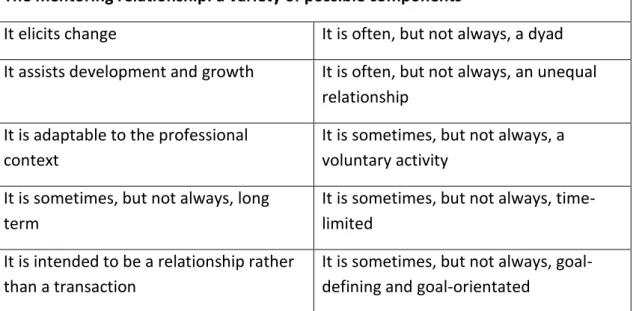
Table 1: some dualities in mentor/mentee relationships ... 60
Table 2: facets of a range of mentoring relationship dyads ... 64
Table 3: mentoring design elements (Dawson, 2010, 2014) ... 68
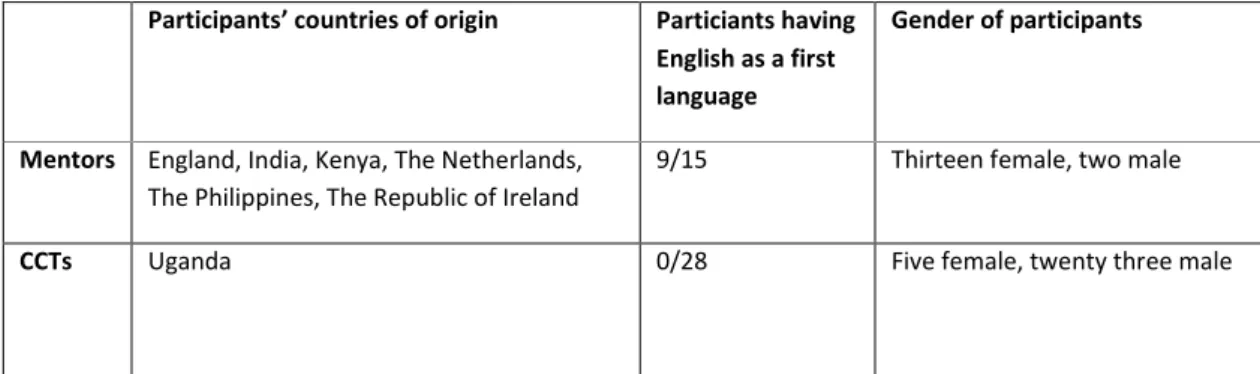
Table 4: some factors of mentor and CCT participant groups ... 89
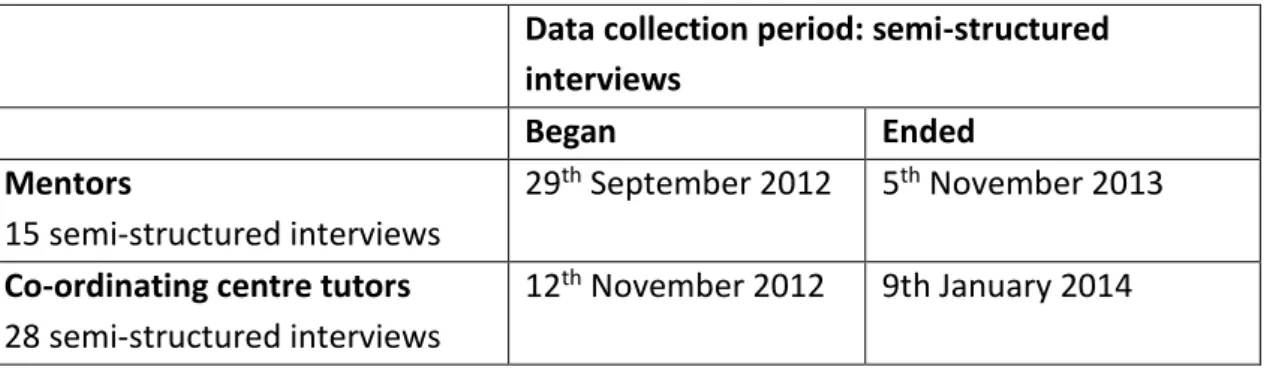
Table 5: data collection duration periods ... 96
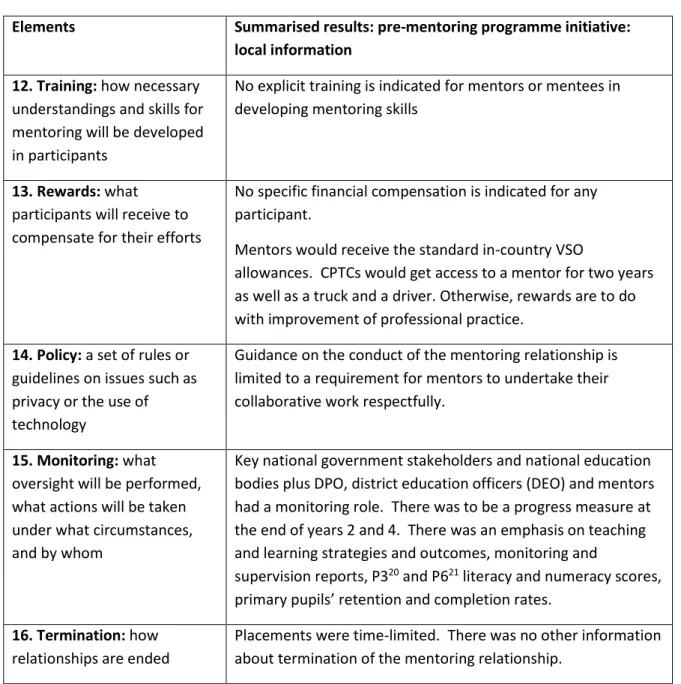
Table 6: summarised results of document analysis of mentoring initiative local documents using mentoring design elements (Dawson, 2014; 2010) ... 130
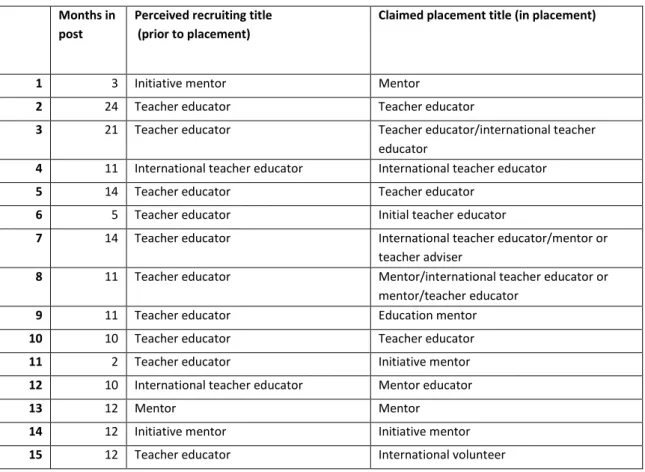
Table 7: volunteer educators' placement titling ... 137
Table 8: mentor-identified attributes for mentoring ... 140
Table 9: resources and tools which CCTs identified as associated with the mentoring initiative ... 160
Table 10: array: Dawson's framework elements (2014, 2010) (adapted from Table 1, summary of design elements 1 to 4, Dawson, 2014, p. 140) ... 185
11 | P a g e
Map of Uganda
https://www.gov.uk/foreign-travel-advice/uganda Map updated on the 30th November 2015
12 | P a g e
Glossary
BAICE British Association for International and Comparative Education BERA British Education Research Association
CC Co-ordinating centre CCT Co-ordinating centre tutor
CPD Continuing professional development CPTC Core Primary Teachers College
DEO District education officer
DES Directorate of education standards DPO Deputy principal outreach
DPP Deputy principal pre-service DTE Diploma in teacher education EFA Education for all
ITE Initial teacher education LRA Lord’s Resistance Army
MDG Millennium Development Goals MIS Municipal inspector of schools MoES Ministry of education and sports
13 | P a g e
NCDC National Curriculum Development Centre NRM National Resistance Movement
P1 - 7 Denoting each of seven years of primary education in Uganda PCA Project co-ordination agreement
PST Pre-service tutor
PTA Parent teacher association PTC Primary teachers college
SMC School management committee SSA Sub-Saharan Africa
TDMS Teacher development and management strategy (Tanzania) TDMS Teacher Development and Management System (Uganda) TIETD Teacher and instructor education and training department UNEB Uganda National Examinations Board
UPE Universal Primary Education USAID United States aid
UNICEF United Nations Children’s Fund VSO Voluntary Service Overseas
14 | P a g e
CHAPTER 1 Introduction
This research is about expectations and assumptions and how and to what extent these are realised in a specific mentoring initiative which was part of the drive to improve the quality of primary education in all government schools across Uganda. The initiative was innovative in its use of international volunteer educators (mentors). This research focuses upon the expectations and assumptions of programme
originators (UNICEF and VSO), programme deliverers (mentors) and programme participants (principally centre co-ordinating tutors - CCTs). Proposals for the mentoring initiative which is the focus of this research included two key premises. Firstly, that changing the quality of the CCTs’ work would lead to improvements in
primary schools and consequentially, the quality of children’s education would
improve (DES, TIETD, 2010). The second proposition was that the methods which had previously been used to address the quality of primary education had not worked well enough and that an alternative method, mentoring of the CCTs, should be used (DES, TIETD, 2010). If the second proposition is correct it has potential implications for the way in which quality change in primary education is addressed in Uganda and possibly in other sub-Saharan or lower income countries which face similar challenges.
Initial overview of the mentoring initiative
In 2007 Uganda had introduced a Thematic Curriculum (Altinyelken, 2010; NCDC, 2015) which required schools to teach the first three years of primary school in local language rather than English, which was previously the case. In 2009 Uganda reviewed its basic quality framework for education institutions, (MoES, 2010). The senior
15 | P a g e
education personnel who were to implement these developments, who were teacher educators of various kinds, were judged to need additional technical capacity building (DES and ITIED, 2010). One response to this was to recruit volunteer teacher
educators (mentors) internationally via VSO, an international development and volunteer placement NGO. Based in primary teachers colleges (PTC) across Uganda, initially for up to two years, the mentors were to work under the direction of UNICEF (Busuulwa, 2010). The original intent was for there to be a volunteer teacher educator in all twenty-three PTCs which had an outreach capacity (out of the full national cohort of forty-five PTCs) (DES, TIETD, 2010). Having been recruited as teacher educators, the volunteers were re-designated as mentors by UNICEF, in line with the approach to securing improvement in education quality which was set out in the mentoring initiative programme proposal (DES and ITIED, 2010). This proposal identified mentoring as a key relationship between the mentors and the Ugandan primary teacher outreach tutors (CCTs) with whom they were principally to work.
The context of primary education in Uganda
In lower income countries, and certainly in sub-Saharan Africa, making a good school education available and accessible from, at least, the primary years has been a priority activity, closely related to the Millennium Development Goals (MDGs) and Education for All (EFA) agendas (UNESCO, 2014; Najjumba & Marshall, 2013; Waage, et al., 2010; Baron & Morin, 2009; Penny, et al., 2008). Over the years, there have been many programmes which have sought to address the quality of education in such countries. Yet there remains work to be done as addressing endemic low quality of primary
16 | P a g e
education requires a multi-faceted approach. There will be many contributing factors to poor outcomes for individual children and for groups of children and a range of responses (World Bank, 2015; Conn, 2014). Even with gains over the period of EFA children in many low income, sub-Saharan countries from rural homes and from poor homes are still neither attending school at all nor remaining in school for the full primary education phase (UNESCO, 2015). This study focusses on the issue of teacher education and the professional development of teacher educators through a
mentoring initiative.
The rationale for the research
My interest in this research began in June 2011 when I arrived in Uganda as a
volunteer teacher educator. I had been recruited from England by VSO for a teacher educator initiative led by UNICEF. I had been accepted to begin the Ed. D programme in May 2012. I had intended to research whether, or to what extent, equalities policies with which I was familiar in England (which were geared to raising the attainment of minority ethnic pupils) were applicable in a black African country. At my first meeting with UNICEF, six days after I arrived in Uganda, I was told that the placement title had changed to ‘mentor’. I had had no prior professional experience as a mentor. At that time, I understood the change from teacher educator to mentor to be a conceptual shift, intended to convey a way in which the work should happen. I was not sure that I could be a mentor. I was not sure what a mentor really was. I thought that it would be a highly personal activity which would require a depth of relationship development which I had not sought. I felt a real caution about how an outsider to most aspects of
17 | P a g e
Uganda and its primary teacher educator system could take the role that I imagined to be that of a mentor with any confidence or credibility.
There were expected project results for the mentoring initiative. These had been jointly agreed through the Government of Uganda Ministry of Education and Sports (MoES) and with UNICEF. Some of these expected results were included in the
volunteer educators’ placement outline. The results framework for the initiative included improvements in standards in all Ugandan primary schools, improvements in teacher and pupil attendance and a reduction in the rate of pupil dropout. Access to this information, which I had not had in full prior to arriving in Uganda, increased my concern about my ability to do the mentor role in which I found myself.
In my early months in post I became increasingly involved in personal interpretation and re-interpretation of the work. It was that personal exploration which I wanted to take further. The research questions were constructed to allow for exploration of expectations and assumptions implicit in the mentoring initiative. The questions also allow for exploration of the views and experiences of two main groups of people: those who were brought to the initiative as international volunteer educator/mentors and Ugandan nationals who were primary teacher educators (CCTs).
The main research question, which contributes towards understanding whether mentoring can be a useful professional development strategy in the drive to secure quality primary education in Uganda, is:
18 | P a g e
How is mentoring understood in an initiative to improve teacher education in Uganda?
This is addressed through three supplementary questions:
a. What are the expectations of mentors and CCTs in a primary teacher educators’
mentoring initiative in Uganda?
b. What is the work of mentors and CCTs in a primary teacher educators’
mentoring initiative in Uganda?
c. What do mentors and CCTs understand by success in mentoring?
Uganda, primary educators and mentoring
The context for education in Uganda is complex. Research and reports show a history of turmoil which is interwoven with compelling political will to transform the
educational (and the future economic and social landscape) by ensuring that all primary age children are in school and educated (Cunningham, 2014; Najjumba & Marshall, 2013; Penny, et al., 2008; MISR, 2009). The mechanisms to achieve this have been successful in a number of ways: there is much increased pupil registration, the teacher supply has increased and more teachers are qualified (UNESCO, 2015; Ezenne, 2012). There is in place a delivery system for continuing professional development (CPD), school management development and community mobilisation (GOU and EDP, 2010; MoES, 2000). The new cohort of staff, the centre co-ordinating tutors, have been at the forefront of securing these changes but, as time has passed, other areas needed attention and other needs have arisen. Mentoring, which was part of the CCT
19 | P a g e
role, was instituted ‘to help the teacher perform better in their jobs and improve performance in primary schools’ (BEPS, n.d., p. 32).
One area for improvement was to ensure that CCTs, and others who are directly involved in primary teacher quality in Uganda, have the skills to do their work (UNESCO, 2014; Uwezo Uganda, 2014; DES and ITIED, 2010; Winkler & Sondergaard, 2007) (Winkler & Sondergaard, 2007). The long-game is for CCTs’ work to be effective enough to raise the quality of teaching in schools leading to improvements in pupils’
achievement and outcomes. Mentoring, which is intended to bring about professional and personal change, is also a personal and an interpersonal activity (Bozeman & Feeney, 2007). It requires insight into, knowledge of and openness to the
circumstance of the other. These points are explored within the research through analysis of mentors’ and CCTs’ work in the mentoring initiative, their expectations, activity and notions of success.
1.1 Outline of the thesis
Chapter 2 focuses on two main themes: primary education in post-independence
Uganda and mentoring in education. The need to improve the quality of Uganda’s
primary schools is demonstrated through pupils’ continuing poor academic outcomes (Uwezo Uganda, 2014; 2012). The chapter looks at some of the factors which were implicated in the drive to improve these outcomes. It develops further the discussion about responding to those outcomes through working with primary teacher educators. The chapter surveys a range of mentoring relationships and contexts and concludes
20 | P a g e
that a firm definition of mentoring is less important than clarity about what was expected by the mentoring initiative. A framework (Dawson, 2014; 2010) is identified which assists with securing this clarity.
In chapter 3 the methodology for the research is explored. This is a qualitative study
which takes place in a setting where there is considerable variation in research
participants’ genders, ages, backgrounds, nationalities, ethnicities and first languages. The challenges that this presents are set out alongside the rationale for using case study with ethnographic aspects. The issues which related to identifying participants and collecting data are considered alongside the intercultural nature of the research ground and the effect of this interweaving on the logistics of data collection. A mentoring framework is considered which can assist with designing and specifying a mentoring model (Dawson, 2014; 2010).
In chapter 4Dawson’s mentoring framework (Dawson, 2014; 2010) is used to map the
initiative. Information from CCTs and mentors’ interviews is mapped against the resulting information. Specific elements from the framework are explored in depth: objectives, resources and tools and rewards. Three persistent discovered themes are explored: what is expected of volunteers, how CCTs saw their own professionality and financing – views from mentors and CCTs. There is a consideration of relationships within the mentoring initiative and about the advantages and limitations of the data analysis process.
21 | P a g e
Chapter 5 discusses the research findings and how they relate to the research
questions. It considers aspects of the research which would need to be reviewed if this work were to be repeated. The chapter sets out what implications the research
suggests for policy and practice at a range of levels. There is an account of the next steps which could be taken to build on this study.
22 | P a g e
CHAPTER 2 Literature review
This chapter provides the contextual framing of the research. It begins with an account of the Uganda-based mentoring initiative on which this research focuses. It moves on to focus on aspects of the Ugandan primary education sector since
independence in 1962 but particularly since the introduction of Universal Primary Education (UPE) (Ezenne, 2012; MoES, 2004) in 1997 to 2016. The chapter describes a complex context for the development of quality primary education in Uganda. There is little research about mentoring in teacher education in Uganda with concomitant impact on the availability of directly applicable literature. A section on mentoring and mentoring relationships drawn mainly from international literature on mentoring in education is also provided.
2.1 Primary teacher
educators’ improvement
programme: mentoring
initiative
The mode of teacher education which was expected to predominate within the improvement programme was mentoring, although the initiative proposal has no explicit definition of mentoring or of coaching which could show the similarities and points of divergence between mentoring and coaching (MoES, 2010). The draft
proposal for the initiative introduced it as ‘mentoring/coaching’ (DES and ITIED, 2010). It stated that, as opposed to the more familiar or usual workshop mode of workshop-based training,
23 | P a g e
‘the most effective training approach is workplace based capacity building and sustained mentoring and coaching’ (2010, pp. 8-9)
The proposals for the mentoring initiative were developed prior to recruitment of the volunteer educators who were to bring their specialist technical skills to the initiative. The placement outline (Busuulwa, 2010) which was the main volunteer recruitment document included information from the draft proposal. The final mentoring initiative proposal more clearly signposted the mentoring role in the draft work plan by
including it as an explicit task for volunteer educators (DES and ITIED, 2010). This updated information was not available to volunteer educators prior to taking up the placement. In Uganda, workshop-style training for teacher educators and other education staff typically involved a residential programme, running for several days and which brought together staff from several educational institutions for syndicated or cascaded training1. There is doubt about the value of workshops, whether there is a
financial benefit in continuing to run one-off workshops which have no follow-up and,
‘rarely lead to effective development and implementation of reforms they are intended to enable’ (DES and ITIED, 2010, p. 10)
This poor outcome is suggested to be because the workshops may have trainers who are not effective as they are using processes and methods which do not work well enough:
‘CCTs receive training on the various new MoES initiatives, strategies, reforms and policies to enable them to support teachers and head teachers to
1 Syndicated training: same agreed programme to all participants. Cascaded training: there are levels at
24 | P a g e
implement them. This training has relied mostly on one approach – the workshop approach, with mostly once off short workshops of variable quality and conducted by trainers who may themselves not be very good trainers and have also received inadequate or ineffective training’ (DES and ITIED, 2010, p. 8)
The draft proposal asserts that repeat funding of workshops and lost opportunity costs need to be taken into account when the finances of running workshops are compared with cyclical and sustained mentoring or coaching (DES and ITIED, 2010). International teacher educators were identified (DES and ITIED, 2010) as professionals who would
‘address the key issue of technical capacity among inspectors, CCTs and PTC tutors’
(DES and ITIED, 2010, p. 14) and needed to be ‘expert’ (DES and ITIED, 2010, p. 10). While based at a CPTC this was not to be the workplace:
‘[Teacher educators’] workplace[s] would not be a training venue, but will rather be the primary schools that they visit on a daily basis as they work with mentor/coach, CCTs and inspectors and the PTCs’ (DES and ITIED, 2010, p. 14) Teacher educators were expected to undertake explicit ‘coaching/mentoring/support supervision for CCTs and DIS/MIS’ (DES and ITIED, 2010, p. 21) which would include joint school visiting, lesson observation, observing CCTs facilitating workshops at co-ordinating centre schools and giving them feedback ‘on how to improve their practices’ (DES and ITIED, 2010, p. 21). The mentoring initiative argued for securing the services of international teacher educators whose ‘expertise is not currently available in Uganda, in particular in the areas of effective literacy and numeracy strategies’ (DES and ITIED, 2010, p. 14). Of ‘critical importance’ (DES and ITIED, 2010,
25 | P a g e
p. 10) to the success of the intended activities were securing a teacher educator cadre with ‘excellent coaching/mentoring skills’ (2010, p. 10), who would be:
‘excellent primary practitioners and professionally qualified primary teachers with primary teaching, primary teacher education and coaching/mentoring and monitoring and support supervision experience’ (DES and ITIED, 2010, p. 17) The initiative had challenging ambitions for what it should achieve including
improvements to pupils’ academic achievements, their attendance rates and
reductions in corporal punishment in all government primary schools (Appendix 1). The rationale for the initiative was sound. It was addressing the stagnation in effective improvement practice which would not be changed by doing things in the same way as before (Uwezo Uganda, 2014). The initiative had to respond to two challenges to change. The first challenge was to implement a specific piece of education policy (DES and ITIED, 2010; MoES, 2010) which was intended to make every school have in place the systems, features and processes which would encourage quality education. The second challenge for the initiative was to improve the professional activities of primary teacher educators who were considered as influential in securing teaching and learning quality in the field. The judgement about focussing the initiative on mentoring as a delivery mode is not immediately as secure. This is because there was no discussion about how mentoring, as an approach, was to differ in practice from previous practice improvement work with Ugandan teacher educators, whether within a workshop structure or not.
26 | P a g e
2.2 Uganda: a backdrop to the development of primary phase education
I suggest that as much as it is important to know about mentoring and mentoring relationships it is also important to know about Uganda and its primary education context. This is both to inform the reader and to make clearer the depth of the
backstory which I, as a volunteer educator and, later, as a mentor/researcher gradually learned about and worked within. Located in East Africa, landlocked Uganda was a British Protectorate from 1894 until it gained its independence and became a
sovereign state in 1962 (Ezenne, 2012; British Library, n.d.). Until 1974 the education system remained much as it had prior to independence, modelled on the British tripartite system (Ezenne, 2012; Viko, 2012). The economic basis of the country faltered in the 1970’s and education quality was affected and ‘deteriorated substantially’ (Liang, 2002, p. 10).
The context for the current Ugandan primary and teacher education system is one which includes the influence of British colonialism, Ugandan regime change and the aftermath of civil war and armed insurgency (GOU and EDP, 2010) while being a low income and developing country and, at periods, a fragile state. These contextual features have a continuing impact on the Ugandan primary and primary teacher education system today. In recent years Uganda was aiming to meet the time bound Millennium Development Goals (MDG) which included the establishment of Universal Primary Education (UPE) (Millenium Project, 2006; UN, 2005). The section begins by looking at post-independence Uganda, the state of the economy and its impact on the primary education sector. Challenges such as the long-standing insurgency led by the
27 | P a g e
Lord’s Resistance Army (LRA) meant that post-independence Uganda did not transform contemporaneously into post-conflict Uganda. The effect of conflict on the
development of a secure education system is considered. The section includes accounts of the policy responses to the state of primary and teacher education in Uganda including the introduction of the Teacher Development and Management System (TDMS), the introduction of UPE and its repercussions, and the establishment of CCTs as the outreach arm of core primary teacher colleges (CPTC).
Post-independence education in Uganda
From 1962 to 1986 Uganda experienced considerable upheavals, the years from 1971 to 1986 found Uganda being characterised as ‘one of Africa’s most notorious killing fields’ (Carson, 2005, p. 3). Uganda had ten presidents from independence to 1986 with country leadership moving from elected rule to military rule. The current incumbent, Yoweri Museveni, came into power in 1986. Museveni’s National
Resistance Movement (NRM) took power after a bitter bush war (1981 to 1986) led by its military arm, the National Resistance Army (NRA). By 1986 Uganda had ‘a
dilapidated economy’ (Ruganda, 2005, p. 27) with inflation at 240% and just a third of the school aged population on roll (Ruganda, 2005). Government expenditure on education as a percentage of the Gross National Product (GNP) was 4.1% in 1970 dropping to 1.2% in 1990 compared with comparable figures for sub-Saharan Africa of 3.0% and 4.0% respectively (Liang, 2002, p. 12). From the 1970s the Ugandan
education system deteriorated until it reached a crisis position in the mid-1990s,
‘where the education system had virtually collapsed and less than half of the primary teachers were trained’ (Hartwell, et al., 2003, p. 31).
28 | P a g e
Between 1988 and 2006 an internal violent insurgency led by the LRA disrupted day-to-day life of particularly, although not solely, the populations of northern Uganda (Cunningham, 2014). The repercussions arising from this insurgency were
considerable, with psycho-social problems born of displacement and fear, disrupted social and traditional learning structures as well as the physical destruction of homes, gardens (farms) and villages (Cunningham, 2014; Harris, 2012). Primary education became discontinuous or unavailable for many children in the north and the east of the country, even those who had previously had access. A Uganda Ministry of
Education and Sports (MoES) report identified the education system as being in a ‘poor state’ due to the ‘chaotic administrations of 1971-1986’ (MoES, 2000, p. 14):
‘characterised by such deficiencies as:
Utter neglect of educational institutions and the erosion of quality at all levels;
Under resourcing of essential facilities:
Lack of provision of instructional materials;
Preponderance of untrained teachers, estimated at 60%;
Low teacher morale and high absenteeism;
Rigid teacher training requirements;
A high percentage of education costs shouldered by parents;
High dropout rate of girls from school;
Poor management and accountability.’
29 | P a g e
This represented a considerable agenda for change. Winkler and Sondergaard (2007) summarise the position in their report into the efficiency of Uganda’s education system:
‘Uganda has done an admirable job of increasing access to primary education over the past decade. However, increased access has come at the expense of the quality of instruction. International evidence generally shows that
improvements in quality—in terms of student knowledge--are more strongly related to economic growth than are improvements in access. Uganda needs to make a very serious effort to improve quality at all levels, while maintaining
its impressive accomplishments with respect to coverage. Improvements in internal efficiency can help Uganda achieve both quality and quantity.’ (Winkler & Sondergaard, 2007, p. 5)(original emphases).
The challenges of quality teaching, pupil attendance and pupil achievement
Introduced in 1997, the drive towards securing free universal primary education offered all families the opportunity for all or some of their children to be educated, as a right (Altinyelken, 2010; Nakabugo, 2008; Penny, et al., 2008). The Uganda teacher cohort, as a group, remains prone to high levels of absenteeism with 21% of teachers being absent on the Uwezo 2014 survey day (Uwezo Uganda, 2014).2 The percentage
of pupils completing primary school rose from 40% (2000) to 44% (2007) but only about 11% of pupils acquired basic learning levels (UNESCO, 2014) and learning quality
2 Uwezo undertakes annual national household surveys in Kenya, Tanzania and Uganda which use simple
30 | P a g e
amongst the poor declined from an already low rate between 2004 and 2007 with Uganda reported as facing ‘a serious triple challenge, needing to strengthen access, quality and equity’ (UNESCO, 2014).
Summarising the findings of World Bank, UNESCO and its own reports, Uwezo Uganda pointed to ‘dismal learning outcomes in basic literacy and numeracy’ (Uwezo Uganda, 2014, p. 7). Uwezo reports figures from the Uganda National Examinations Board (UNEB) which show 1,897,114 pupils beginning in P13 in 2008. By 2014 there were
only 585,863 children taking the summative Primary Leaving Examination (PLE) at the end of P74 of whom 68,760 failed (Uwezo Uganda, 2014). It is not possible to enrol in a
secondary school in Uganda without a P7 pass so the PLE has an important gate-keeping function, limiting or allowing access to secondary education.
Unsatisfactory teaching quality and an over-reliance on content are issues which affect sub-Saharan Africa (SSA) as a whole. Akyeampong el al (2013) identify pre-service training as the priority for raising standards in primary education in SSA. Murphy and Wolfenden (2013) locate a response to the need to improve teacher quality across the region in a pedagogy of mutuality which uses teacher educators and teachers as brokers working at local level with adapted materials. Uganda has sought to improve
3 P1: primary 1 is the first year of primary education in Uganda. Children can enter P1 when they are
five.
31 | P a g e
its educational shortcomings on several levels (Penny, et al., 2008) including work on teacher education.
2.2.1 Universal Primary Education (UPE) and some of its implications for the Ugandan
primary education sector
With the introduction of UPE the stresses to the primary education system became even more acute than had previously been the case (Nakabugo, 2008; Penny, et al., 2008). Initially UPE brought free primary education for four children in each family (and explicitly included girl children and disabled children) (Chabbott, 2010). This restriction on numbers was later abandoned and all children became eligible for free primary schooling. The immediate result was that government primary schools were overwhelmed by parents registering their children.
Large classes and teacher supply
This high level of pupil registration has continued with a gross intake rate to primary education of 143%5 in 2011 (94% net) (UNESCO, 2014). Class sizes rose considerably
with classes of up to 300 children (MoES, 2004, p. 14) being recorded in some instances. An average pupil: teacher ratio of 48:1 in 2011 represented a drop from 57:1 in 1999 (UNESCO, 2014) and was reported as 46:1 in 2013 (The World Bank, 2015). These figures mask considerable variation as urban schools tended to have
lower teacher pupil ratios than rural schools. The schools’ rural nature made already
5 Multiple registration, pupils being registered at more than one school at the same time, might
32 | P a g e
scarce services either more scarce or more arduous to get access to and there could be a heightened residual sense of insecurity or danger (especially for women teachers) from being in such remote locations (Mulkeen & Chen, 2008). Significantly, ‘many teachers would rather leave teaching than work in hard-to-reach areas’ (MoES, 2004, p. 22) and such areas ‘continue to be underserved’ (MoES, 2004, p. 22).
Teaching quality, skills and knowledge
The teacher supply situation exacerbated the class size issue in some locations. Of themselves, large classes which can be found in many Ugandan primary schools do not lead to pupil underperformance (O'Sullivan, 2006). One response might be to develop better ways of managing large classes than to secure smaller class sizes (Nakabugo, 2008). Nakabugo quotes teachers’ views after they had had the opportunity to try
new strategies for working with large classes. The teachers conveyed that they had a fundamentally different perception of what constituted the problem and that they misunderstood a teaching strategy which might have improved the outomes for pupils (Nakabugo, 2008). This suggests that interpretation might be holding back practice implementation.
The relatively modest educational qualifications needed for entry to the two-year primary teacher training course leaves emerging trained teachers having gaps in their knowledge about key curriculum subject areas (SABER, 2012) which primary teacher college (PTC) courses have not yet addressed. UNEB, which oversees Uganda’s
33 | P a g e
how to teach reading and writing, how to interpret the curriculum and its assessment
and how to use assessment to improve pupils’ learning (UNEB, 2012).
Training for teaching and teacher capability
In a pressured system (as set out earlier) the Ugandan government resolved to increase the number and proportion of qualified staff in schools. This was largely secured through the Teacher Education and Management System (TDMS) (Hartwell, et al., 2003; MoES, 2000). This drive is in line with other countries across sub-Saharan Africa. Marphata et al. (2010) reported a participatory primary outcomes
improvement project which took place in Burundi, Malawi, Senegal and Uganda. Pupil outcomes, teacher qualifications and training data were collected. Their research report notes decreasing numbers of unqualified teachers and increasing numbers of undertrained or teachers with time-limited contracts. They also noted with some ambivalence the increased incidence of undertrained or temporary staff and conceded that while recruiting local staff might bring specific benefits there remained a need to make sure that staff received professional training as the teachers lack ‘training and expertise in pedagogy, skills and knowledge’ (Marphatia, et al., 2010, p. 7).
Although remaining moderate by international standards or by the standard required to train as a secondary school teacher in Uganda (Kagoda & Ezati, 2013; Hardman, et al., 2011) the qualifications needed to enter training as a primary teacher have been raised. The requirement now is completion of lower secondary education (eleven years in school), gaining O levels in six specified subjects and leading to a teaching
34 | P a g e
certificate after a two-year course. Kadoga and Ezati’s (2013) small qualitative study on the contribution of primary teacher education to quality primary education in Uganda considers that the usual age of entry of students (seventeen) to primary initial teacher education (ITE) is problematic. They find the quality of ITE students wanting and their motives questionable as:
‘in Uganda majority of the students seeking admission to PTC are mainly those who have either failed to get the required grades to join higher education of
two years, or don’t have the tuition fees for the next two years secondary education’ (sic) (Kagoda & Ezati, 2013, p. 37) .
There is contention over whether teachers’ professional qualifications affect pupil
outcomes. Ugandan primary teachers’ qualifications have been positively linked with the achievement of their pupils (de Kemp & Eilor, 2008) but Najjumba and Marshall (2013) challenge the strength of this connection in their more recent large-scale, quantitative study on improving learning in Uganda which used the 2006 to 2011 datasets from the National Assessment of Progress in Education (NAPE). The latter study found that while teacher qualification has a positive impact on pupil
performance it is at a negligibly low level of statistical significance and ‘points to low teacher effectiveness’ (Najjumba & Marshall, 2013, p. 62). Looking at the length of the
teachers’ time in service they concluded that:
‘for primary-level content knowledge—no experiential learning is taking place, meaning that teachers who are exposed to this content for longer periods of time are not able to answer more test questions than their counterparts with less experience’ (Najjumba & Marshall, 2013, p. 81)
35 | P a g e
The minimal impact on pupil outcomes of teacher qualification level takes us back to the interpretation of aspects of teaching strategy and the retention of teachers’
personal learning. Until 2013 the Ugandan curriculum for initial primary teacher education allocated over twice as many hours to teaching methodology as it did to mathematics, English and science combined (UNESCO, 2014). This suggests that if the curriculum were thoroughly taught and learned emerging qualified primary teachers would know to teach but would not be so versed in what to teach. Evidence of
primary pupils’ learning outcome levels would call even this assertion into question
(Najjumba & Marshall, 2013). Based on the qualifications required for entering
primary teacher training the area which needed to be supported was trainee teachers’ pedagogy. In practice, candidates’ mastery of English, mathematics and science, could
not be assured. This suggests that the content of the PTC curriculum was not being taught or learned effectively or that emerging qualified teachers ignored the pedagogical content of their training once they began to teach in their own
classrooms. This might be part of the explanation for a systematic review of teacher attendance in developing countries (Guerrero, et al., 2012) found that where there
were interventions to improve teachers’ attendance in class any positive impact on pupils’ attainment came early in the intervention and then tailed off. The sole fact of
the teacher being in the classroom and teaching did not, of itself, improve pupils’
attainment over time.
Mutazindwa et al., from the Uganda Directorate of Education Standards (DES), reported that outreach tutors were being used to support the pre-service work in
36 | P a g e
colleges, which meant that they were not supporting change in outreach. They predicted that unless college tutors received support:
‘they will continue to teach in the old traditional teacher centered way. The New Curriculum will then become an ‘innovation without change’ and a great opportunity to change primary school teaching for the better will have been lost.’ (Mutazindwa, et al., 2013, p. 4)
Kagoda and Ezati (2013) in their study which looked at the extent to which the PTC curriculum was fit for purpose, asserted that PTC tutors (teacher educators) in Uganda were poorly qualified, were not graduates and that they were ‘sometimes challenged by teacher trainees who join colleges with higher qualifications, with deeper
knowledge and wider content knowledge’ (Kagoda & Ezati, 2013, p. 37) .
Kagoda et al.’s critique of PTC tutors implies that being a graduate teacher trainer is linked with additional relevant professional competance. A counter viewpoint is that teachers of teacher educators are not necessarily experienced in teacher education or in primary teaching (O'Sullivan, 2010) and that being a university lecturer does not mitigate this. A ‘knowledge and professional vacuum’ (O'Sullivan, 2010, p. 386) left school practice supervisors unprepared for the mentoring task, which alongside
research and enquiry skills, were of high importance for teacher educators. There was
‘a capacity gap’ (O'Sullivan, 2010, p. 386) amongst the cohort who train the teacher educators. There is a dearth of practical direction from research or reports about what should done to improve teaching quality other than that which is essentially doing what has been done before and expecting a different result (Mutazindwa, et al., 2013).
37 | P a g e
The mentoring initiative appears to deviate from this habit by:
accepting the evidence that there are weaknesses in teaching quality in
Uganda’s primary schools and in its primary teacher education
identifying a specific cadre of staff (CCTs) who are key to improvements
placing CCTs and their development at the centre of the initiative
2.2.2 The Thematic Curriculum
In 2007 the national Thematic Curriculum, for years P1 to P7 was introduced to schools before the revised primary teacher education curriculum (see above) had been
introduced into PTCs ( JICA and IDCJ, 2012; GOU and EDP, 2010). The curriculum was intended to have ‘a much greater emphasis on the development of literacy, numeracy and key life skills’ (Read & Enyutu, 2004, p. para. 1.2). Teachers already in school who had attended training on the Thematic Curriculum training judged that they had had insufficient training to enable them to put the new curriculum into place (GOU and EDP, 2010; Altinyelken, 2010). Pupils taught using the Thematic Curriculum were reported to be even less accomplished at reading local language texts than English texts, even though the curriculum is taught in local language (Uwezo Uganda, 2014).
2.2.3 Teacher Development and Management System (TDMS)
The conditions which encourage inadequate quality teaching share similarities across developing countries and sub-Saharan Africa (Mhando, 2006). These include inadequately educated staff, ITE which emphasises theory and subject knowledge, minimal emphasis on pedagogy for participation and active learning, demoralised teaching force, low level
38 | P a g e
resourcing in school, and assessment which supports simple recall of rote-learned
information6. Within SSA the need to improve education quality was not confined to Uganda
nor were the suggested solutions. Major partners worked with countries in sub-Saharan Africa on a range of schemes aimed at bringing about sustained change, typically addressing teacher and teacher educator improvement (Mena Report, 2012) with a focus on producing quality teachers, implementing quality pedagogy in schools and securing suitable resources. Some programmes incorporated securing children’s healthcare, nutrition and improved parental
involvement (Conn, 2014). Conn’s meta-analysis found that the greatest gains in pupils’
attainment were found where teaching methods and teacher coaching were central and that
there were gains to pupils’ cognitive skills after specific health-related programmes (e.g.
malaria control) (Conn, 2014).
This section focusses on one of Uganda’s key education improvement programmes, the
Teacher Development and Management System (TDMS). Uganda was not alone in seeking to put into place a comprehensive education plan like TDMS which had, at its core, improving the quality of teaching. By way of comparison, the section also refers to quality education
development in Tanzania, one of the five countries which shares a border with Uganda.
There was a continuing need to improve the quality of education in Ugandan schools by improving pre-service and in-service teacher education and teacher education pedagogy (Verspoor, 2008). Pre-dating the drive towards UPE, a key strategy to
6 Rote learning is one of a range of learning skills which can be used. The issues are range and
appropriateness: the opportunity for teachers to teach in a range of ways and for pupils to learn in a range of ways and then to know when and how best to apply what is learned.
39 | P a g e
address some of the existing challenges was the Teacher Development and
Management System (TDMS) (Hartwell, et al., 2003) which began in 1994 (Ministry of Education and Sports, 2000). The programme was conceived as part of the outcomes of the Education Policy Review Commission and was characterised as in ‘its
conception...undeniably Ugandan’ (MoES, 2000). There were three main levels of operation to the TDMS: national (linked directly with the requirements of the education ministry); district (working through CPTCs and local (working via newly-constituted co-ordinating centres each with an allied model school (MoES, 2000; SABER, 2012). The TDMS established priorities and a delivery structure for the continuing professional development of serving primary teachers and primary school managers in what is a considerably decentralised education system (MoES, 2000). The
TDMS focused on improving teachers’ terms and conditions of service, improving
community participation in primary education, putting into place a resource allocation system for instructional materials and on strengthening teacher education
(pre-service, in-service and management) (MoES, 2000). The TDMS was well funded and had high prestige (MoES, 2000).
Tanzania introduced two pertinent programmes which were aimed at specific education improvement: the Tutors’ Education Programme (TEP) and the Teachers’ Development and Management Strategy (TDMS). The TEP aimed to improve the quality of teacher educators’
work, introducing participatory teaching and active learning. The strength of the TEP was that
it recognised the gaps and areas for development in teacher educators’ education. Previously
the tacit understanding was that by virtue of their qualifications teacher educators would be able to teach student teachers effectively (MoEVT, 2007; Mhando, 2006). The Tanzania TDMS
40 | P a g e
began in 2008 and built on the Primary Education Development Plan7 and Secondary Education
Development Plan8 (MoEVT, 2007). The TDMS concentrated on capacity building, teachers’
working environment, teacher motivation and rewards and on working with higher education providers (MoEVT, 2007; Mhando, 2006). The Tanzania TDMS accepted that teachers were a
key variable in assuring pupils’ attainment (Niwagaba & Okurot-Ibore, 2014; Moulton, 2000).
It also accepted that in developing countries variations in out-of-school conditions were not
effective indicators of pupils’ success in school (Niwagaba & Okurot-Ibore, 2014; MoEVT,
2007). The solutions were to be found mainly in the school. ‘Great mastery of subject matter’
(MoEVT, 2007) was noted as the prerequisite to quality education but not the sole determinant. This position begs the question about the place of pedagogy in system improvement in schools (Conn, 2014; Koomba, et al., 2013). In using the term ‘strategy’ instead of ‘system’ the TDMS characterised ‘strategy’ as being suitably militaristic in tone, as a
war was being faced (MoEVT, 2007) and the outcome of the war would be:
‘a comprehensive, holistic, and all encompassing programme for attracting, obtaining,
training, developing, and retaining adequate and high quality teachers and managers
for all levels and aspects of the education system.’ (MoEVT, 2007, p. 7)
The school improvement drive would necessarily be located in school and its related
institutions and systems. The Tanzania TDMS had as its end game the improvement of pupil outcomes through improving the quality of school teaching and the school environment. Its terms of reference included a commitment to address the training and development of teacher educators, education managers and adminisrtrators (MoEVT, 2007). There was also a requirement to ensure that there were sufficient, high quality teacher education tutors (MoEVT, 2007) who were teaching the necessary subject or specialist areas (MoEVT, 2007). Its
7 Began 2001. 8 Began 2004.
41 | P a g e
implementation was accompanied by concern from two key parties: teacher education tutors and student teachers. Its emphasis on tutors’ professional development was viewed askance
by education inspectors (who had not had this updated training) and by the student teachers, who were finding that these approaches were not being used in practice schools (Hardman, et al., 2012; Mhando, 2006).
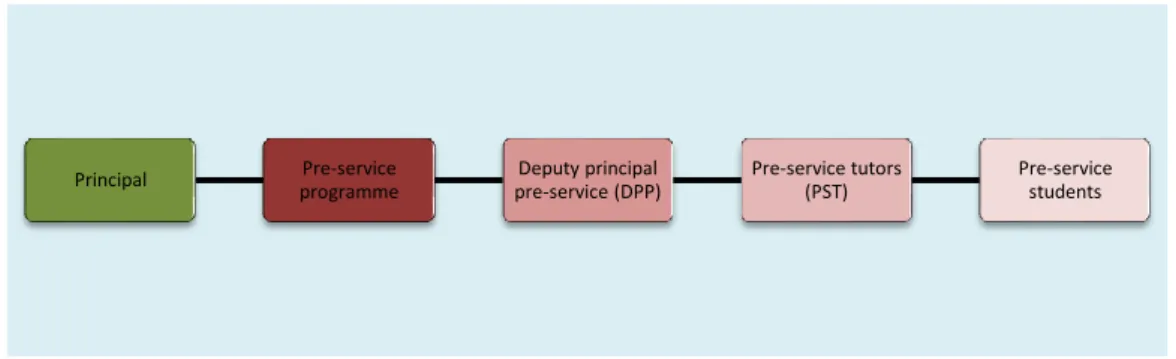
The Uganda TDMS is significant for this study. It created the role of the CCT as the main delivery mechanism for enabling community mobilisation, training untrained serving teachers and training head teachers in leadership, child-centred education and team working (Hartwell, et al., 2003). Prior to this PTCs had no outreach function, their task being limited to ITE (Figure 1).
Figure 1: primary teachers college (PTC) - simplified professional structure - pre-TDMS
As a result of TDMS twenty-three of forty-seven government colleges were selected to become CPTCs; the others (as well as the two private PTCs) remained with a brief for ITE only (Figure 2). Principal Pre-service programme Deputy principal pre-service (DPP) Pre-service tutors (PST) Pre-service students
42 | P a g e
Figure 2: core primary teachers college (CPTC) – simplified professional structure with pre-service and outreach departments
CCTs were appointed from the pre-existing cadre of PTC tutors. They were assigned to a core primary teachers college (CPTC) with a newly created outreach function (MoES, 2000). Overall school improvement remained the responsibility of the head teacher and the SMC. CCTs were intended to lead continued professional development. School inspection was the strategic responsibility of the Department of Education Standards (DES) and was operationally devolved to districts and municipalities. The creation of a CCT cadre to be the bridge between college
and school represents an essential difference in approach between Uganda’s TDMS and
Tanzania’s TDMS. The Tanzania TDMS asks for excellent practitioners (teachers and tutors) to
be identified. Sharing their professional excellence, including mentoring, would be part of their work (MoEVT, 2007). What is not set out in the Tanzania TDMS is what might excellence
be, who recognises it and what happens to the excellent practitioner’s substantive role except
that such ‘super model teachers’ be funded to ‘act as mentors, master teachers and
facilitators in inservice training programmes’ (MoEVT, 2007, p. 26). There is no explicit
strategic objective within the strategy linked with this aspiration (MoEVT, 2007). In CCTs, Uganda had identified a new, dedicated cadre of staff to take the school improvement work forward. CPTC Principal Outreach programmes Deputy principal outreach (DPO) Co-ordinating tutors (CCTs) at co-ordinating centres Outreach schools' teaching staff Pre-service programme Deputy principal pre-service (DPP) Pre-service tutors (PST) Pre-service students
43 | P a g e
CPTC’s education staffing was increased (Figure 2), with CCTs to provide in the field professional support and guidance to serving teachers. There was a deputy principal outreach (DPO) as line manager. CCTs were trained, with college principals, at nationally organised training for the CCT role, (Outreach Tutor Training Certificate). This focus on the professional development of both CCTs and PTC principals, allied to the aim that all tutors and principals would be graduates (MoES, 2000), implied an ambitious intent and ambitious direction by the national government for the TDMS.
Through the targeted work of CCTs, the TDMS’ objective to increase the number of certified teachers in post was successful. Prior to 1997, about a half of serving
teachers were qualified. By 2004 the percentage had risen to 80% (MoES, 2004) which was a considerable achievement as the overall number of teachers had increased by nearly 45,000 over the same period. By 2011 90% of primary phase teachers were professionally qualified (UNESCO, 2014) and a second TDMS emphasis was evolving, that of providing professional development to the general primary teaching cohort (Achieving Quality Education for All Regional Summit, 2011) . By 2014 the percentage of qualified teachers had increased to 95% (Najjumba, et al., 2013; UNESCO, 2014, p. 376). Even with these gains, Uganda needs to increase its teaching force by 6% each year if there are to be sufficient teachers for the pupil population (UNESCO, 2014). It
also needs to continue to improve the quality of teachers’ professional practice
44 | P a g e
The creation and development of the Co-ordinating Centre Tutor role
From its inception, the CCT post was seen as ‘vital’ in terms of pedagogical, school and district education leadership (MoES, 2004, p. 25). The role was considerable (Appendix 2). The TDMS had attracted ‘the most qualified and experienced teacher educators’
(MoES, 2004, p. 45). CCTs had ‘emerged as the flag bearer and entry point of the TDMS into the primary system’ (MoES, 2000, p. 62). Hartwell et al. (2003) say that they:
‘constitute the professional and training advisors to the District as a service from the PTCs. They have no authority to compel the schools, the inspectors, nor the district to heed their advice. They provide the link to professional training and qualifications for teachers, while serving as local advisors’
(Hartwell, et al., 2003, p. 35).
This presented CCTs with a considerable task to train the untrained and to secure necessary improvements with a clear mandate from national government but only personal influence at district level. Hartwell et al. found that ‘the TDMS, and
particularly the role of the CCT, has been exceptional in reaching and changing school and classroom practice’ (2003, p. 10). O’Sullivan (2010), in her case study which
reviewed Uganda’s two-year Diploma in Teacher Education (DTE) which teacher educators were required to complete, found that the teacher educators themselves had not been prepared well enough to train Uganda’s primary teachers effectively. This was partially due to teacher educators’ educators being university lecturers with
secondary teaching experience (O'Sullivan, 2010). Under-preparation or
45 | P a g e
of secondary trained teachers to supplement the stretched pre-service tutor (PST) cohort as they implemented the new PTC curriculum (Mutazindwa, et al., 2013). The current pedagogies of Ugandan teacher educator education appeared to be ineffective if the effectiveness was measured by the quality of pupil learning outcomes
(O'Sullivan, 2010). The DTE training, mainly located as it was on subject content and
knowledge, had little emphasis on pedagogy, on how Uganda’s primary ITE students
might teach or how teacher educators might teach teachers in training. The national drive to improve the quality of teachers, already in service, through the TDMS, was hampered by a curriculum for teacher educators which opted for the status quo in
terms of pedagogy and assessment (O’Sullivan, 2010).
CCTs’ creation meant that CPTCs had a new function where the quality of teachers in practice was to be developed and monitored by college tutors. Prior to this, the
colleges’ role in securing teaching quality stopped at the point of student graduation.
Hartwell et al. (2003) , in their detailed and focused study of the role, contribution and performance of CCTs within the context of TDMS, evaluated strategies in place to improve basic (primary) education in Uganda, using a multi-method, multi-level approach to gather data. The researchers visited and observed a range of education staff in the field, conducted interviews with key people and led regional and national workshops. The resulting thorough report sets out the complexity of the development of basic education improvement in Uganda (Hartwell, et al., 2003) with one main conduit for such work: the TDMS. The researchers cited the high workload for CCTs with other activities tending to get precedence over practical, in-school development work (Appendix 3). The researchers noted the encroaching of erstwhile school
46 | P a g e
inspectors’ work into the CCTs’ work programme, as well as CCTs’ lack of executive authority to insist on change occurring. In addition, there was understaffing in PTCs which could affect the CCTs’ ability to get out into the field. There were teaching methods in PTCs which were overly didactic and not focused enough on ensuring that participants can apply what they are learning in practical situations These features are interwoven with the challenges to education growth and improvement in a low-income country with increasing pupil numbers working in a post-conflict situation where resources can be scarce or insufficient, and important services either hard to come by or intermittently available (e.g. water, decent sanitation).
2.2.4 Co-ordinating centre tutors (CCTs) and their work
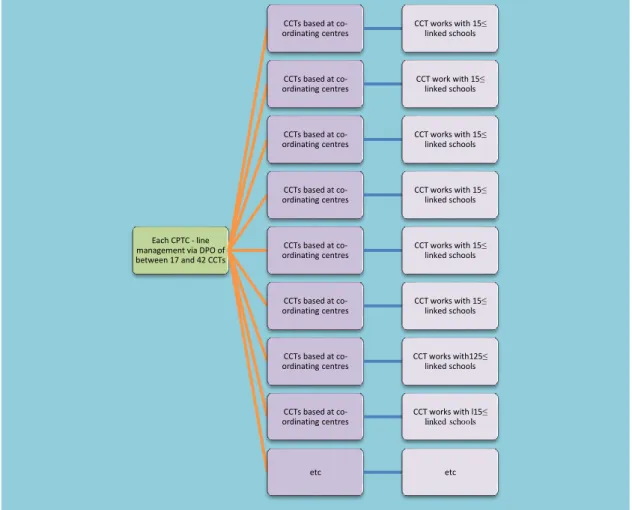
CCTs were assigned a group of schools with which they were to work (Figure 3). One of the schools was designated as the co-ordinating centre school or model school. This is where the CCT was to be based when in the field (SABER, 2012; MoES, 2000). The co-ordinating centre school would have an office, resource centre and
accommodation. The CPTC-led CCT structure supported 539 co-ordinating centres at designated primary schools (Sugrue, et al., 2003; MoES, 2000). This was a considerable financial and managerial commitment.
47 | P a g e
Figure 3: operational relationship between CPTC, CCTs and link schools
The CCT was to ‘be the change agent in his/her cluster of schools with a focus on improved pupil learning’ (Hartwell, et al., 2003, p. 8).
This innovative delivery system was increasingly being used as a conduit for a range of information needs (Appendix 3) with CCTs being asked to respond to an increasing range of requests from the district offices and from central government. This was the
‘seemingly elastic scope of CCT operations’ (Najjumba, et al., 2013, p. 58). This detraction from the central original foci for teacher support and development work was not confined to Uganda:
Each CPTC - line management via DPO of between 17 and 42 CCTs CCTs based at co-ordinating centres CCT works with 15≤ linked schools CCTs based at co-ordinating centres CCT work with 15≤ linked schools CCTs based at co-ordinating centres CCT works with 15≤ linked schools CCTs based at co-ordinating centres CCT works with 15≤ linked schools CCTs based at co-ordinating centres CCT works with 15≤ linked schools CCTs based at co-ordinating centres CCT works with 15≤ linked schools CCTs based at co-ordinating centres CCT works with125≤ linked schools CCTs based at co-ordinating centres CCT works with l15≤ linked schools etc etc
48 | P a g e
‘ one of the risks of support services is that they can become the mechanism for delivering other kinds of training, thus disteacting from the role of pedagogical support’ (Mulkeen, 2010, p. 121)
In Malawi the primary education resource centres were increasingly used by NGO and other organisation for fundraising activities which had the side-effect of sidelining the intended work of the advisers and their availability to undertake that work (Mulkeen, 2010) and:
‘in The Gambia the cluster monitors were expected to provide both monitoring and support functions, but were also drawn into administrative tasks, including checking on textbook delivery, verifying statistical returns, and recording the quality of buildings and latrines.’ (Mulkeen, 2010, p. 121)
CCTs had increases in their field work tasks at the same time as their school cohorts were increased (from an intended school group size of 15-20 to frequently having up to thirty government schools – Appendix 3). CCTs’ fuel allowances had decreased in real terms, they travelled to fewer schools and their motorbikes were increasingly in need of repair. CCTs were receiving less professional support and little secretarial support (Hartwell, et al., 2003)(Appendix 3). The original intention for CCTs to be able to have an active professional development role in the schools in their clusters was not realised (Winkler & Sondergaard, 2007). The Ugandan National Household Survey (UNHS) 2009/10 reported CCTs visiting just 12% of their schools (urban, rural, public and private combined) in the previous 12 months (cited in Najjumba, et al., 2013).