The Restrictiveness of Rules of Origin in
Preferential Trade Agreements
Paul Gretton Jyothi Gali
Productivity Commission Canberra, Australia
Paper presented at the 34th Conference of Economists 2005 University of Melbourne 26 to 28 September
The paper is based on a Supplement to the Productivity Commission Research Report on Rules of Origin under the Australia—New Zealand Closer Economic Relations Trade Agreement. The Supplement was prepared under the broad guidance of former Commissioner John Cosgrove and with the assistance of Peter Lloyd. Helpful comments were received from John Williams, Duc Nguyen-Hong and Jonathan Pincus.
The paper and the views expressed should be attributed to the authors and not to the Productivity Commission.
The Restrictiveness of Rules of Origin in Preferential Trade
Agreements
ABSTRACT
Rules of origin are the criteria used to determine where a good has been made for the purpose of ensuring only the products of countries which are party to a preferential trade agreement (PTA) obtain concessional entry under the agreement. Because origin rules act as non-tariff barriers to trade, their welfare impact is not easily measured or evaluated. This study adopts an index approach to assess the degree of restrictiveness of rules of origin in 20 agreements. This new index quantifies the trade restrictions embodied in rules of origin into a summary measure to facilitate comparisons on a common basis across PTAs. Results from the index calculations show substantial variation in the restrictiveness of origin rules across PTAs. The results show that NAFTA and related agreements and agreements entered into by the European Union tend to have the most restrictive rules. They also show that origin rules of longer standing agreements entered into by Australia tend to be less restrictive than rules of recent agreements.
JEL codes: C82, F13, F14, P52
Key words: rules of origin, preferential trade agreements, trade restrictiveness index, free trade agreement
Rules of origin (RoO) are the criteria used to define where a product has been made for the purposes of ensuring that only the products of countries which are party to a preferential trade agreement (PTA) obtain the benefits of the agreement. In the case of the Australia–New Zealand Closer Economic Relations Trade Agreement (CER) for example, RoO would be used to determine whether a product exported to New Zealand from Australia, which comprises inputs or components sourced from another country, can be considered to be an Australian product and thus receive preferential access to the New Zealand market (and vice versa).
Origin rules are a necessary part of trade agreements. However, depending upon how they are specified, they can — to varying degrees — restrict trade, misdirect investment, inhibit productivity growth and reduce welfare from levels otherwise attainable.1 They can also
raise the administrative costs to firms of doing business (including complying with paperwork requirements) and the Customs Services face costs in administering and auditing the RoO.2 The global increase in the number of PTAs will result in diverse RoO, adding to
the complexity and compliance costs of engaging in trade. However, because RoO act as regulatory (non-tariff) barriers to trade, their impact is not easily measured or evaluated.
1 There is a small but expanding literature on this subject — see, for example, Krueger (1993), Krishna and Krueger (1995b), Vermulst et al. (1994), Hoekman (1993), Estevadeordal (1999) and Brenton (2003). 2 As Krueger (1993, p. 16) observed, ‘Even when RoOs are not highly protectionist in intent, they increase
2
To assist in addressing the issues raised in the terms of reference for the study into RoO under the CER Trade Agreement (Campbell 2003) and to help fill an information gap concerning the impact of origin rules, the Commission estimated the relative restrictiveness of RoO for various PTAs using an index framework (PC 2004a,b). The index method is a useful way to assess the degree of restrictiveness of origin rules when price and quantity measures about their impact are not available. The index measures provide insights into the extent to which RoO-related regulatory barriers may restrict trade and raise costs, from what they otherwise may be.
The index was calculated for the CER Agreement and for 17 other PTAs. The RoO regimes considered were operative in the early 2000s. Subsequently, the coverage of origin rules considered was extended to include those in the Australia–United States Trade Agreement (AUSFTA) and the Thailand–Australia Free Trade Agreement (TAFTA) which came into force on 1 January 2005 (PC 2004c).
This paper first provides some background on the use of indexes in trade analysis. It then outlines the framework adopted for measuring the restrictiveness of RoO followed by a summary of how that framework has been applied in the construction of restrictiveness indexes for the 20 PTAs considered. The next section of the paper presents key results from the study.
Because the information base for compiling restrictiveness indexes is limited, the results should be seen as indicative of orders of magnitude, rather than as a precise measure of restrictiveness.
1 Background
It is well known that a PTA can have both positive and negative effects on the welfare of a member country. The selective reductions in tariffs benefit the importing country. Where trade is created, consumers and producers can benefit from lower prices. However, the discriminatory nature of the tariff reductions also diverts trade away from cheaper sources outside of the PTA area. The net effect of trade diversion on welfare may be positive and negative. Overall, there is a presumption that members will gain from any new trade — especially if the new trade also results in lower unit costs due to economies of scale and productivity improvements or to increased competition.
Two important forces are at work through RoO that will influence the net outcome of an agreement. On the one hand, the origin requirements encourage firms to divert demand to higher-cost suppliers within the PTA region. This would reinforce, through regulation, the incentives for trade diversion inherent in the bilateral tariff reductions of a PTA and reduce welfare from what was otherwise attainable. On the other hand, more restrictive RoO (and the high compliance costs which can accompany them) may induce some firms to eschew the preferential PTA arrangements and trade on an most favoured nation (MFN) tariff basis.
This by itself will nullify some of the adverse effects that would otherwise arise from trade diversion.
The economic impacts of origin rules depend on how restrictive are the rules and on the extent to which the external tariff regimes of the member countries differ. Highly restrictive rules can erode potential welfare gains from lower tariffs.
The prospect of realising net welfare benefits from a PTA are improved if RoO are less trade restricting. This would favour trade creation and lower input trade diversion, lowering consumer prices and improving the location of resources and national output.3 There is therefore considerable interest in the degree of restrictiveness of origin rules. Ideally, the restrictiveness of RoO would be measured in terms of price and quantum effects in product markets and flow-on effects to national welfare. Such information would ideally be considered together with measures of the impact of preferential tariffs. However, in practice such information is difficult to obtain and could be contentious.
An index approach is one way to assess the degree of restrictiveness of government interventions where price and quantity measures of the impact of those interventions, such as RoO, are not readily available. An index quantifies prevailing restrictions into a summary measure to facilitate comparisons of RoO provisions on a common basis across PTAs and the likely impact of different RoO regimes within a PTA. The index looks at the origin rules in isolation of other effects of a PTA.
Different RoO restrict trade to different degrees and use different instruments. An index methodology therefore focuses on the extent to which a range of identified RoO-related regulatory barriers may restrict trade between members and non-members. In doing so, it also recognises that RoO have effects that reduce or modify the value of tariff concessions in trade agreements — for example, by affecting the eligibility of firms for concessions or through added compliance or administration costs.
Index methodologies have previously been applied to analyse origin rules in NAFTA and European Union-related agreements (Estevadeoral 2000, Brenton and Manchin 2002, Augier, Gasiorek and Lai-Tong 2003, Estevadeordal and Suominen 2003). Indexes developed in those studies have focused on particular provisions of RoO — for example, whether a change in tariff classification (CTC) is at the tariff item (HS 8-digit), sub-heading (6-digit), heading (4-digit) or the chapter (2-digit) level. They have also taken into account other factors affecting the restrictiveness of origin rules, including: tariff phase-out schedules; cumulation; duty drawback; tolerance; and outward processing provisions in a PTA.
This study expands on the range of RoO factors examined in earlier studies and includes, for example, details of regional value content requirements and factors influencing market
3 With this in mind, Productivity Commission (2004a, p. 121) provided a set of general design principles for origin rules within a PTA.
4
access in the index. It also decomposes the RoO-related component of the PTA Member Liberalisation Index (MLI) described in Adams et al. (2003).4
The 20 agreements included in the analysis were selected because Australia is a member — CER, South Pacific Regional Trade and Economic Cooperation Agreement (SPARTECA) and the Singapore–Australia Free Trade Agreement (SAFTA) — or other established agreements that are likely to affect the trade flows of Australia’s major trading partners or the provisions of which are potentially relevant to future PTAs involving Australia. The other established agreements included are: North American Free Trade Agreement (NAFTA); Pan Euro (PANEURO);5 European Free Trade Agreement (EFTA); ASEAN Free Trade Agreement (AFTA); Andean Subregional Integration Agreement (ANDEAN); European Union–Egypt; Israel–United States; Acuerdo Comercial–Mercado Comúdel Sur (MERCOSUR); European Union–Poland; European Union–Mexico; Chile–United States; Chile–MERCOSUR; United States–Singapore; United States–Jordan; and Singapore–New Zealand.
In addition to these 18 agreements, as noted above, the index methodology has been applied to measure the relative restrictiveness of origins rules associated with TAFTA and AUSFTA — agreements that Australia has entered into recently.
2 The
index
methodology
The index methodology involves specifying a regimen of provisions or criteria used to determine origin in a PTA, a weight for each criterion reflecting its relative importance in the index and a score reflecting the restrictiveness of the variant implemented in the RoO regime. Because economic theory and existing studies do not provide a readily available ‘standard’ against which any particular method or provision for determining origin can be judged, the weights and scores were assigned subjectively by reference to other studies and the nature of the provision. The methodology allows RoO to be analysed in terms of their characteristics, with the index value of a particular regime reflecting ex ante the restrictiveness of the origin rules faced by firms. However, the index alone does not provide a measure of the ex post effects of an implementation of RoO such as the adverse impacts on firms choice of production technology and ways of working, and national welfare.
For a particular RoO regime, the index value reflects the number of restrictions applied, the relative importance of each of those restrictions (the weight) and the restrictiveness of each
4 In that ‘liberalisation index’, a higher index value indicated a more liberal agreement. This study follows the convention adopted in analyses of restrictions in services trade (for example, McGuire et al. 2000, Nguyen-Hong 2000 and Kalirajan 2000), whereby a higher index value indicates more restrictive (less liberal) provisions. These studies also discussed the potential pros and cons of various methods of measurement of regulatory barriers.
5 The Pan-European (PANEURO) system of RoO applies to preferential relations between the European Union, the European Free Trade Area and the central and eastern European economies within a network of PTAs.
variant (the score). Overall, a higher index value indicates a more restrictive trading environment on account of RoO. Nevertheless, in interpreting index values, it should be borne in mind that, while an index provides a measure to quantify all relevant restrictions related to preferential RoO that can be identified by available information sources, a higher score may simply reflect a greater availability of information rather than a more restrictive regime. This study attempts to overcome this limitation by using the best known, reviewed and compiled sources of information on preferential RoO. In addition, it should be noted that the provisions in the PTAs are assessed in the index according to the actual provision in agreements, rather than the extent to which the provision may have been implemented. Where the degree to which PTA members implement RoO provisions differs, the index values reported may also differ from their ‘true’ or underlying values.
The index is a measure of the restrictiveness of a RoO regime, at the margin. That is, it assumes that the provisions are relevant to firms’ decision-making and activities. For example, RoO provisions would typically not be relevant for items with MFN tariffs of zero (ie where the margin of preference afforded to a PTA member is zero), since compliance with an origin rule would not confer a financial benefit to the PTA exporter. It would also not be relevant when RoO have no effect on firms’ production and trade decisions.
The determination of weights for restriction categories is designed to reflect the economic significance of restrictions in a PTA on firms’ productive efficiency. However, their expected impact on merchandise trade flows of member and non-member countries also depends on the external tariff environment of a PTA.6
3
Index structure and restrictiveness ranking
In constructing the index, a bottom-up approach has been used, whereby the detailed information on each agreement was collected and assessed for regulations governing preferential RoO, before being aggregated into a single restrictiveness index value for each agreement. The detailed information was grouped into three broad groups:
• primary criteria reflecting the main methods of origin determination; • supplementary criteria for other provisions related to preferential RoO; and • other effects of RoO.
The basic structure of the index is reported in table 1 while full details of the index are provided in the annex table. The categorisation adopted reflects the methods, or tests, of origin determination canvassed by the World Customs Organization (WCO), and regulations that have evolved to support the application of those tests.
6 To account for this effect within the index framework adopted, the estimated index for each PTA examined was re-weighted by the mean and relative standard deviation of MFN tariff rates in each country in a PTA. Both the original and re-weighted indexes are presented in chapter 4 of PC (2004b).
6
The possible restrictiveness of each of the eleven criteria listed in table 1 was first measured by identifying the variants by which each criterion is applied and then subjectively assigning restrictiveness scores to each item according to the likely restrictiveness of the variant. The scores assigned range from zero for the least restrictive variant to one for the most restrictive variant identified. According to this structure, the greater the likely restrictiveness of a provision, the higher the score it has received. The score of zero is also applied when a provision is not identified as part of a RoO regime.
To complete the index, the score assigned to each item was aggregated according to the weights shown in table 1. In principle, it would be most desirable to determine the index weights empirically using regression techniques after controlling for all factors that may determine trade and industrial organisation, at the margin. In practice, this has not been possible and rules of thumb have been employed.
Table 1 Restriction categories for preferential RoO
Number Restriction category Weight
Primary criteria 0.60
1 Change in tariff classification 0.20
2 Regional value content or percentage criterion 0.20
3 Specified manufacturing process test and/or sector-specific rules 0.20
Supplementary criteria 0.25
4 Type of cumulation 0.05
5 Provisions that go beyond cumulation 0.05
6 Duty drawback 0.05
7 Territoriality or outward processing 0.05
8 Geographic location of manufacturing process 0.05
Other effects of RoO 0.15
9 Degree of certainty 0.05
10 Compliance and administration costs 0.05
11 Rigidity 0.05
Total weight 1.00
The primary criteria consist of three sub-categories. The weight assigned to the primary criteria, as a group, is 0.6 out of a total weight of one. This relatively high weight was assigned to this group because of the likely predominance of the tests in origin determination. Group weights are further disaggregated into subgroups on the basis of frequency of use and their likely importance in RoO regimes. Details of the disaggregation are provided in the annexe to this paper and elaborated in PC (2004b).
Two main origin tests — the CTC (change in tariff classification) and regional value content (RVC) methods — are each given a relatively high weight of 0.2, reflecting their predominance as primary tests in RoO regimes.
Sector-specific rules are generally defined through the specified manufacturing process test.7 These tests are applied in conjunction with other tests (commonly, the CTC method). However, they are still essentially primary criteria and can be relatively restrictive. They are therefore given a separate weight of 0.2.
Sector-specific RoO are also commonly more stringent than rules of general application, especially for so-called ‘sensitive’ sectors, as they are generally designed to shield those sectors from import competition. Because of the potentially large relative impact that sector-specific rules can have on the restrictiveness of the RoO regimes, the weight of 0.2 is considered appropriate in the presence of such provisions.
There are several other features of RoO which can influence whether or not origin is conferred on a product and hence determine the impact of the RoO regime on trade flows. These are cumulation rules, tolerance or de minimis thresholds, duty exception and drawback provisions, the extent of permissible outward processing and the last stage of manufacturing process requirement. These features are included as supplementary criteria and allocated one-fourth of the total index weight, with uniform weights being allocated between five sub-categories.
Where different variants of the same criterion are applied, the origin rule was scored according to the variant assessed as the one most commonly applied — that is, the most common threshold level when multiple threshold levels are used and the most common digit level of CTC when multiple levels are used. For example, the CTC can be applied at the chapter (2-digit), heading (4-digit) or item levels (6 or 8-digit). An agreement using the CTC method was scored according to the level most commonly applied. This relatively conservative approach may understate the true restrictiveness of a regime at the margin, which quite possibly could be determined by the most restrictive variant applied (eg the chapter 2-digit level in the CTC test).
In this framework, the highest restrictiveness scores were assigned to more complex origin rules using the more restrictive variants of each criteria and/or incorporating sector-specific provisions. Lower scores were assigned to rules that are relatively ‘clean’ — that is, free of deliberately restrictive provisions (such as sector-specific rules). The development of the index involved progressive refinement of measures as new information came to hand or as alternative formulations were considered. This process indicated that the orders of magnitude for the index and restrictiveness rankings did not change materially between plausible alternative formulations.
Information on rules of origin regulations has been gathered from a number of sources, including Vermulst (1994), LaNasa (1995), Driessen and Graafsma (1999), WTO (2002), Moïsé (2002), Brenton (2003), and Estevadeordal and Suominen (2003). These sources were complemented by additional information collected directly from the individual agreements (including that provided by documentation accessible in electronic form using the internet).
8
4 Results
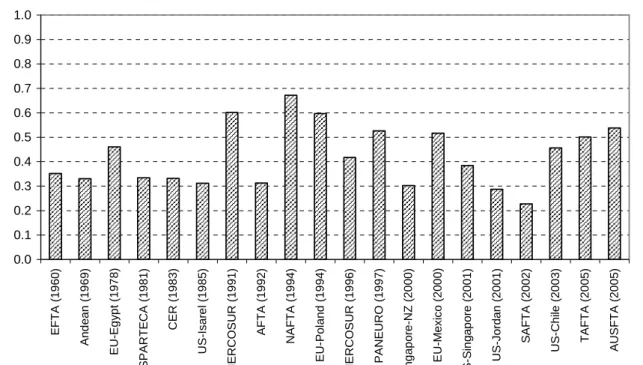
Results from index calculations show variation in restrictiveness of origin rules across PTAs. They suggest that the restrictiveness of RoO in the CER Agreement is low to moderate, relative to the level of restrictiveness identified in the other agreements considered (figure 1). They also suggest that NAFTA and related agreements and agreements entered into by the European Union, have the most restrictive rules. These agreements tend to be associated with regimes that adopt multiple criteria for determining origin, more restrictive variants of individual criteria and product specific rules, particularly in areas otherwise supported by higher tariffs. In addition, the more restrictive RoO tend to be associated with PTAs where member countries have higher average tariffs and non-tariff barriers and where differences in tariffs in each member country are also relatively high (PC 2004a).
Figure 1 Restrictiveness of preferential RoO in selected PTAs
Index score ranges from zero (least restrictive) to 1 (most restrictive).
0.0 0.1 0.2 0.3 0.4 0.5 0.6 0.7 0.8 0.9 1.0 E FTA ( 1 9 6 0 ) And ean ( 1 9 69) E U -E g y p t ( 197 8) SPA R T EC A (19 81) CE R ( 1 9 83) U S -I s a re l (1 9 8 5 ) ME RCO S UR ( 1 9 91) A FTA ( 1 9 9 2 ) NA F T A ( 1 9 94) EU-P ol and ( 1 9 94) Chil e-ME RCO S UR ( 1 9 96) P A NE URO ( 1 9 97) S ing ap or e -NZ ( 2 0 00) E U -M ex ic o ( 200 0) US-S in gap or e ( 2 0 01) US -J or dan ( 2 0 01) SA F T A ( 2 0 02) US-C hile ( 2 0 03) T A F T A ( 2 0 05) AUS F T A ( 2 0 05)
Source: Productivity Commission (2004b,c).
The index suggests that the origin rules for TAFTA and AUSFTA are of medium to high restrictiveness. This reflects the product-specific nature of the rules, which often involve multiple criteria and more restrictive variants of some criteria. In particular, regional value content tests will apply in conjunction with one or more of the other tests in around one
quarter of trade items with non-zero tariffs under TAFTA origin rules.8 Under the AUSFTA origin rules, about 15 percent of non-zero items in the US tariff will be subject to regional value content requirements. Where regional value content requirements do not apply, more restrictive variants of other provisions are often applied. For example, in AUSFTA, a NAFTA-based ‘yarn-forward’ rule applies, which in many cases requires that the yarn used to make fabric must be ‘formed’ within the territory of the trade agreement. This rule is widely regarded as being highly prescriptive concerning the sourcing of inputs into textile production and hence highly restrictive.9
The indexes also suggest that the TAFTA and AUSFTA rules will be more restrictive than those historically applying in pre-existing agreements made by Australia — CER, Singapore–Australia Free Trade Agreement (SAFTA) and South Pacific Region Trade and Economic Cooperation Agreement (SPARTECA).10 These other agreements are free from
product-specific rules and more restrictive variants of provisions in use for determining origin.
5 Summing
up
Index methodologies have been applied in the assessment of North American and European Union-related trade agreements. Indexes developed in previous studies have focused on primary provisions of origin rules. Other, supplementary factors affecting the restrictiveness of origin rules have also been taken into account. The Commission’s study expands the analysis to trade agreements involving Australia. It also expands the range of factors taken into account in calculating the index. The final index includes for example, details of regional value requirements, change of tariff heading requirements, technical tests and a range of factors influencing market access in the index.
In summary, the results show significant variation in the restrictiveness of RoO across PTAs. This variation and the uneven incidence of individual provisions across PTAs are likely to affect the extent and the pattern of merchandise trade between member and non-member economies and the allocation of resources. Variation in external tariffs and the tariff concessions based on them are also likely to contribute to those effects.
8 Items of trade as defined at the 6-digit sub-heading level of the Harmonized Commodity Description and Coding System (Harmonized System) for the classification of international trade.
9 The basic origin rule for textile and clothing articles under NAFTA and like agreements is the yarn– forward rule. Variations of this rule are used in more recent US trade agreements, such as with Chile and Singapore.
10 Under SAFTA and CER, members offer trade concessions to each other on a reciprocal basis. SPARTECA is a non-reciprocal trade agreement under which Australia and New Zealand offer duty free and unrestricted or concessional access for virtually all products originating from Forum Island Countries. The Agreement on Trade and Commercial Relations between the Government of Australia and the Government of Papua New Guinea (PATCRA II) is also non-reciprocal. The rules of origin for this agreement are similar to those applying in SPARTECA.
10
Further empirical research is warranted to provide a quantitative assessment of the welfare implications of rules of origin in preferential trade agreements.
Annex table Restrictiveness index for preferential RoO — index in detail
Weight Score Restriction category
PRIMARY CRITERIA
0.20 Change in tariff classification
0.00 Tariff item (HS 8-digit)
0.20 Sub-heading (HS 6-digit)
0.50 Heading (HS 4-digit)
1.00 Chapter (HS 2-digit)
Regional value content or percentage criterion
0.10 Percentage of originating material
0.00 Less than 25% 0.20 26-35% 0.40 36-45% 0.60 46-55% 0.80 56-65% 1.00 More than 65%
0.02 Formulation of regional value content
0.00 Any method
0.30 Import content
0.60 Domestic content
1.00 Value of parts
0.02 Elements of production costs for domestic content
0.00 All costs included
0.10 Taxes and duties paid on materials excluded
0.20 Indirect labour also excluded
0.30 Other capital costs also excluded
0.40 Inner containers also excluded
0.50 Other packaging expenses also excluded
0.70 Selling, general and administrative expenses also excluded
1.00 Profits also excluded
12
Annex table (continued)
Weight Score Restriction category
0.02 Treatment of determined manufactured raw materials
0.00 Imports from all zero tariff line items to member economies are treated as
eligible expenditures
0.50 Imports from selected zero tariff line items to member economies are
treated as eligible expenditures
1.00 No provision for allowing DMRM in calculating domestic content
0.02 Methods of qualifying production costs
0.00 Any method
0.25 Transaction value method
0.50 Net cost method
1.00 Factory cost method
0.02 Valuation of non-originating materials
0.00 Not relevant or unspecified
0.25 Free into store (fis)
0.50 Cost, insurance and freight (cif)
0.75 Free on board (fob)
1.00 Ex-factory cost
0.10 Type of specified manufacturing process test applied
0.00 No test
0.50 Positive test for specific process
1.00 Negative test for specific process
0.10 Sector-specific rules
0.00 All sectors treated uniformly
0.50 Single manufacturing sector (eg TCF) only
1.00 Multiple sectors (eg TCF & PMV)
SUPPLEMENTARY CRITERIA 0.05 Type of cumulation 0.00 All 0.20 Diagonal 0.40 Full 0.60 Bilateral 1.00 No cumulation
0.05 Provisions that go beyond cumulation
0.00 Cumulation allowed
0.10 Tolerance or de minimis allowed
0.25 Absorption principle
0.50 Tracing test
1.00 Absorption principle, tracing and tolerance tests not used
Annex table (continued)
Weight Score Restriction category
0.05 Duty drawback
0.00 Drawback allowed
1.00 Drawback not allowed
0.05 Territoriality or outward processing
0.00 Territoriality or outward processing included
1.00 Territoriality or outward processing excluded
0.05 Geographic location of manufacturing process
0.00 Anywhere or not specified
0.50 Any partner country
1.00 Exporting partner country only
OTHER EFFECTS OF RoO
0.05 Degree of certainty
0.00 Higher certainty (eg CTC alone or technical test)
1.00 Lower certainty (eg RVC or combination of CTC and RVC or technical
test)
0.05 Compliance and administration costs
0.00 Most PTA members are only a member of one PTA
0.50 Most PTA members are involved in more than one PTA with similar RoO
1.00 Most PTA members are involved in more than one PTA with multiple RoO
0.05 Rigidity
0.00 No rigidity: waiver provision applied to all tariff items
0.25 Partial rigidity: waivers allowed for a minority of tariff items
0.50 More than partial rigidity: waivers allowed for a majority of tariff items
1.00 Global rigidity: no waiver, RoO applies to all tariff items
14
References
Adams, R., Dee, P., Gali, J. and McGuire, G. 2003, The Trade and Investment Effects of Preferential Trading Arrangements — Old and New Evidence, Productivity Commission Staff Working Paper, Canberra, May.
Augier, P., Gasiorek, M. and Lai-Tong, C. 2003, The Impact of Rules of Origin on Trade Flows. URL: http://www.inra.fr/Internet/Departements/ESR/UR/lea/actualites/ROO2003 /articles/gasiorek.doc (accessed 15 August 2003).
Brenton, P. 2003, Rules of Origin in Free Trade Agreements, Trade Note 4, World Bank Group. URL: http://siteresources.worldbank.org/INTRANETTRADE/Resources/ TradeNote4.pdf (accessed 10 September 2003).
Brenton, P. and Manchin, M. 2002, Making EU Trade Agreements Work: the Role of Rules of Origin, Working Document no. 183, Centre for European Policy Studies. URL: http://shop.ceps.be/BookDetail.php?item_id=93 (accessed 10 December 2003).
Campbell, I. 2003, Terms of Reference, Study of the Rules of Origin Arrangements under the Australia–New Zealand Closer Economic Relations Trade Agreement, Canberra, 28 August.
Driessen, B. and Graafsma, F. 1999, ‘The EC’s wonderland: an overview of the Pan-European harmonised origin protocols’, Journal of World Trade, vol. 33, no. 4, pp. 19– 45.
Estevadeordal A. 1999, Negotiating Preferential Market Access: the Case of NAFTA, Working Paper 3, Inter-American Development Bank, http://www.iadb.org (accessed September 2003).
—— 2000, ‘Negotiating preferential market access: the case of the North American Free Trade Agreement’, Journal of World Trade, vol. 34, no. 1, pp. 141–66.
Estevadeordal, A and Suominen, K. 2003, Measuring Rules of Origin in the World Trading System and Proposals for Multilateral Harmonization, Integration, Trade and Hemispheric Issues Division, Integration and Regional Programs Department, Inter-American Development Bank.
Hoekman, B. 1993, ‘Rules of origin for goods and services’, Journal of World Trade, vol. 3. Kalirajan, K. 2000, Restrictions on Trade in Distribution Services, Productivity
Commission Staff Research Paper, AusInfo, Canberra.
Krueger, A. O. 1993, Free Trade Agreements as Protective Devices: Rules of Origin, Working Paper No. 4352, National Bureau of Economic Research.
Krishna, K. and Krueger, A. 1995, Implementing Free Trade Areas: Rules of Origin and Hidden Protection, Working Paper No. 4983, National Bureau of Economic Research. LaNasa, J. A. 1995, An Evaluation of the Uses and Importance of Rules of Origin, and the
Effectiveness of the Uruguay Round’s Agreement on Rules of Origin in Harmonizing and Regulating Them, Working Paper 1/96, Jean Monnet Center, New York University
School of Law. URL: http://www. jeanmonnetprogram.org/papers/96/ 9601ind.html (accessed 10 September 2003).
McGuire, G., Schuele, M. and Smith, T. 2000, ‘Restrictiveness of international trade in maritime services’, in Findlay, C. and Warren, T. (eds) 2000, Impediments to Trade in Services: Measurement and Policy Implications, Routledge, London and New York. Moïsé, E. 2002, ‘Rules of origin’, chapter 10 in OECD Regional Trade Agreements and the
Multilateral Trading System: Consolidated Report, Paris.
Nguyen-Hong, D. 2000, Restrictions on Trade in Professional Services, Productivity Commission Staff Research Paper, AusInfo, Canberra, August.
Productivity Commission 2004a, Rules of Origin under the Australia–New Zealand Closer Economic Relations Trade Agreement, Research Report, Canberra.
—— 2004b, ‘Restrictiveness Index for Preferential Rules of Origin’, Supplement to the Productivity Commission Research Report, Rules of Origin under the Australia–New Zealand Closer Economic Relations Trade Agreement, Research Report, Canberra, June. —— 2004c, Trade and Assistance Review 2003-04, Annual Report Series, Productivity
Commission, Canberra, December.
OECD (Organisation for Economic Co-operation and Development) 2003, Tariffs and Trade, OECD Query and Simulation package, OECD, Paris.
Vermulst, E. A. 1994, ‘Rules of origin as commercial policy instruments? — revisited’, in Vermulst, E., Waer, P. and Bourgeois, J. (eds) 1994, Rules of Origin in International Trade, The University of Michigan Press, Ann Arbor.
Vermulst, E., Waer, P. and Bourgeois, J. (eds) 1994, Rules of Origin in International Trade; a Comparative Study, University of Michigan Press, Ann Arbor.
WTO (World Trade Organization) 2002, Rules of Origin Regimes in Regional Trade Agreements: Background Survey by the Secretariat, Committee on Regional Trade Agreements. WT/REG/W/45. URL: http://docsonline.wto.org/DDFDocuments/t/WT/ REG/W45.doc (accessed 5 May 2003).
—— 2003, MFN tariff rates for agriculture and non-agricultural products. URL: http://www.wto.org/english/tratop_e/tariff/eif_e.xls (accessed 22 September 2003).