MILLER, EMILY, M.F.A. Implementing Biophilic Attributes in Elementary Schools. (2018)
Directed by Dr. Amanda Gale. 94pp.
Students spend the majority of their day indoors (Kats, 2012). The school environment becomes an crucial location for children to experience contact with nature where it may otherwise be limited. The framework for this study included the Attention Restoration Theory, Stress Reduction Theory, and Biophilic Design. This study
investigated the effects of biophilic attributes of water, plants, animals, natural materials, color, light, and air in elementary school classrooms with fourth and fifth-grade students. The quasi-experimental study included a pre-test, followed by the implementation of biophilic attributes in the two classrooms a week later, and a post-test five weeks after the implemented biophilic attributes remained in the classrooms. The expectation was that the presence of the biophilic attributes in the day to day environment of these classrooms would improve students’ awareness of nature.
Findings showed that the implemented biophilic attributes did alter the awareness of nature in one of the classrooms, while the other classroom was not influenced after the post-test. This research begins to contribute to our understanding of the student
awareness of biophilic attributes in elementary schools. There is a total of 1,845 public elementary schools consisting of grades PK-8, in the state of North Carolina. The research could be beneficial in understanding what attributes can be expanded in the classroom environment to benefit the students. It could also become beneficial in improving the designs of new and existing schools, as it could be a low-cost
implementation. The goal of this study was to assess the awareness of biophilic design attributes in elementary school classrooms.
IMPLEMENTING BIOPHILIC ATTRIBUTES IN ELEMENTARY SCHOOLS
by Emily Miller
A Thesis Submitted to
the Faculty of The Graduate School at The University of North Carolina at Greensboro
in Partial Fulfillment
of the Requirements for the Degree Master of Fine Arts
Greensboro 2018
Approved by
______________________________ Committee Chair
DEDICATION
To my parents, Jeff and Cecile, my sister Sarah, and brother Peter; thank you for all your love and support throughout this process. Thank you for all the positive
reminders that I can accomplish anything when I put my mind to it. To the love of my life, Tyler, thank you for never giving up on me, always encouraging, and being my rock. You all have helped me achieved my goals and made me a better person in the process, I love you all. This would not have been possible without you.
APPROVAL PAGE
This thesis written by Emily Miller has been approved by the following
committee of the Faculty of The Graduate School at The University of North Carolina at Greensboro.
Committee Chair _________________________________ Committee Members _________________________________ _________________________________
____________________________ Date of Acceptance by Committee
_________________________ Date of Final Oral Examination
ACKNOWLEDGEMENTS
I would like to thank my thesis chair, Dr. Amanda Gale, and committee members Dr. Maruja Torres-Antonini and Dr. Anna Marshall-Baker for all your support and guidance throughout this process. Amanda, thank you for pushing me to get me to where I am in my life. Your persistence and guidance have helped me to not only complete my thesis but pursue my professional goals as well. Maru and Anna, thank you for the guidance and feedback you both have provided me throughout my time at UNCG. I have learned so much through all three of you and am so grateful to have gotten to know and work with you all.
Thank you to the Graduate School and the Department of Interior Architecture for providing me financial support to pursue and complete my master’s degree and teaching me valuable skills that I can continue to use in my professional career. There are many opportunities I would not have been able to achieve without the help of the Interior Architecture Department.
Thank you to my work colleagues who have been encouraging and supportive to help me finish this degree. And a special thanks to my family and friends who have made this opportunity possible.
TABLE OF CONTENTS
Page
LIST OF TABLES ... vii
LIST OF FIGURES ... viii
CHAPTER I. INTRODUCTION ... 1
II. REVIEW OF LITERATURE ... 4
Theoretical Framework ... 4
Attention Restoration Theory ... 4
Stress Reduction Theory ... 8
Biophilia ... 10
Biophilic Design ... 10
Biophilic Design in Rating and Certification Systems ... 17
Living Building Challenge... 17
WELL Building Standard ... 18
Educational Settings ... 20 Student Age ... 25 III. METHODOLGY ... 28 Research Questions ... 28 Site ... 29 Procedure ... 37 Instrument ... 40 The Intervention ... 42 Data Collection ... 47
Data Collection and Coding ... 48
IV. FINDINGS ... 50
Data Preparation ... 52
Pre-test & Post-test Biophilic Attributes Results ... 54
Fourth-grade Pre-test & Post-test Biophilic Attributes Results ... 54
Fifth-grade Pre-test & Post-test Biophilic Attributes Results ... 57
V. DISCUSSIONS AND CONCLUSIONS ... 60
Limitations ... 67
REFERENCES ... 72
APPENDIX A. INSTRUMENT ... 75
APPENDIX B. BIOPHILIC DESIGN MATRIX ... 76
APPENDIX C. IRB APPROVAL ... 86
APPENDIX D. SCHOOL APPROVAL ... 87
APPENDIX E. CODING INSTRUCTIONS ... 88
APPENDIX F. PARENTAL CONSENT FORMS ... 91
LIST OF TABLES
Page
Table 1. Decibel Readings (dbA) ... 38
Table 2. Illumination Readings (lux) ... 39
Table 3. Biophilic Attributes ... 43
Table 4. Summary Table of Fourth-grade ... 51
Table 5. Summary Table of Fifth-grade Core 1 ... 51
Table 6. Summary Table of Fifth-grade Core 2 ... 52
Table 7. Summary Table of Fifth-grade Core 3 ... 52
Table 8. Descriptive Statistics for Fourth-grade ... 53
Table 9. Paired-samples t-test for Fourth-grade ... 53
Table 10. Descriptive Statistics for Fifth-grade Classes ... 54
Table 11. Paired-samples t-test for Fifth-grade Classes... 54
Table 12. Descriptive Statistics of Fourth-grade Biophilic Attributes ... 55
Table 13. Paired-samples t-test of Biophilic Attributes for Fourth-grade... 56
Table 14. Descriptive Statistics of Fifth-grade Biophilic Attributes ... 57
LIST OF FIGURES
Page
Figure 1. Biophilic Design Dimensions, Elements, and Attributes ... 11
Figure 2. Fifth-grade Floor Plan ... 31
Figure 3. Fifth-grade Biophilic Attribute Locations ... 33
Figure 4. Fourth-grade Classroom ... 35
Figure 5. Fourth-grade Biophilic Attribute Locations ... 36
Figure 6. Timeline ... 37
Figure 7. Existing Biophilic Attributes in Fifth-grade Classrooms ... 40
Figure 8. Existing Biophilic Attributes in Fourth-grade Classroom ... 41
Figure 9. Expanded Timeline ... 45
Figure 10. Fourth-grade Biophilic Attributes Implemented ... 46
CHAPTER I INTRODUCTION
The interior quality of an educational setting encourages a connection to the built environment. There is a known affiliation between the quality of the interior built
environment and student education (Uline, Tschannen-Moran, and Wolsey, 2009). The design of an educational setting nurtures the cognitive, social, and emotional
development of students, creating a significant importance in a child’s development (Uline et al., 2009; Maller, 2009). Direct experience with nature during middle-childhood, eight to twelve years of age, has the most powerful effect on children’s psychosocial growth and development (Maller, 2009). Direct experience with nature also known as hands-on contact with nature has been shown to positively impact children’s mental, emotional, and social health (Maller, 2009). Furthermore, any type of exposure to nature can improve children’s cognitive abilities, resistance to negative stresses and depression, and symptoms of Attention Deficit Hyperactivity Disorder (ADHD) (Taylor & Kuo, 2009).
Children’s access to nature is generally limited by the modern urban environment (Maller, 2009). On average 85% to 90% of students’ days are spent in inside schools (Kats, 2012). An educational environment is considered an environment that allows people to gather to expand upon knowledge (Stavrianos, 2016). Due to the long amount of time spent in classrooms an educational setting becomes an ideal location for children
to be exposed to nature and its natural systems, thereby gaining the benefits of contact with nature or natural elements (Maller, 2009). Children have a natural bond with, and a need to explore nature, this also known as biophilia. Biophilia can occur in any human as it is a natural feeling of the connection to nature. Opportunities to learn about the natural world must be provided for biophilia to develop in a child. When children are unable to experience nature, biophobia may occur. Biophobia is defined as the fear or dislike of nature, resulting in the possible perception of a child seeing nature as a disposable
resource (White & Stoecklin, 2008). To promote healthy developmental stages, providing opportunity for play and investigation through continuous contact with nature is essential (White & Stoecklin, 2008).
Nature deficit disorder is the term for children experiencing withdrawal of contact with nature and unrestricted play in interior environments (Driessnack, 2009). Due to the design and construction of the built environment, nature deficiency can be more
commonly seen in children (McGee & Marshall-Baker, 2015). Many schools still contain classrooms with little to no windows, which can limit the amount of nature the student is exposed to. Nature deficiency and biophobia are linked. Biophilic design may help solve the effect of nature deficiency in children. Biophilic design is a process in which natural elements are incorporated into the interior spaces of the built environment (Gillis & Gatersleben, 2015). Kellert (2005) developed a framework for biophilic elements, which includes: environmental features, natural shapes and forms, natural patterns and
processes, light and space, place-based relationships, and evolved human-nature relationships. When individuals are exposed to natural views such as landscapes, their
wellbeing has been shown to improve through increased positive feelings and a drop-in blood pressure and muscle stiffness (Minton, & Batten, 2016). Furthermore, green spaces, defined as areas with landscaping such as trees, plants, and grass have been shown to reduce stress and maintain or recover direct attention (Carrus, Pirchio,
Passiatore, Mastandrea, Scopelliti, & Bartoli, 2012). Therefore, to add exterior elements like green spaces to the interior could provide some of the same benefits. Biophilic design requires an awareness of nature and the biophilic elements in the built
environment. Awareness of nature is significant for children between the 8 to 12 age range because it directly affects their environmental development towards nature and natural systems. By exposing individuals to aspects of nature, their awareness increases to help them understand why they may feel calmer or less stress when in direct contact with certain elements of nature such as plants or animals.
Therefore, this study sought to determine the effects of biophilic attributes in elementary school classrooms with fourth and fifth-grade students. The expectation was that the presence of the biophilic attributes in the day to day environment of these
classrooms would improve students’ awareness of nature. There is a total of 1,845 public elementary schools consisting of grades PK-8, in the state of North Carolina (Department of Public Instruction, 2016). By having a better understanding of how biophilic attributes contribute to student awareness of nature the research could be beneficial to those schools and students.
CHAPTER II
REVIEW OF LITERATURE
This chapter is divided into three sections, the theoretical framework, educational settings, and student age. The first section discusses the theoretical framework, Attention Restoration Theory, Stress Reduction Theory, and Biophilia, within the study. Biophilia, is “the idea that humans possess a biological inclination to affiliate with natural systems and processes” (Kellert, Heerwagen, & Mador, 2008, p.3). Biophilia was first introduced by E. O. Wilson in 1984 and has been researched by several disciplines within education and healthcare settings. There are two main theories, Attention Restoration Theory and Stress Reduction Theory that relate to biophilia in the proposed research.
Theoretical Framework
Attention Restoration Theory
Attention restoration theory (ART) is grounded in cognitive psychology. The theory was developed in 1989 by Kaplan and Kaplan. ART suggests that exposure to nature restores attention (Kaplan and Kaplan, 1989). In the 1970s, Kaplan and Kaplan followed participants in a wilderness program in which people were in the woods for up to two weeks at a time. The participants reported to the researchers during and after their time in the wilderness. Participants reported thinking more clearly and feeling peaceful. The participants felt more at peace when in nature as opposed to participating in a physical activity in the woods such as rock climbing (Kaplan & Talbot, 1983).
ART can be applied to environments with children, where there is trouble focusing attention on tasks. According to the Center for Disease Control and Prevention, one in five children each year are living with some type of mental disorder (Children's Mental Health Report, 2018). Some of the most common mental disorders among
children ages 3 to 17 include Attention Deficit Hyperactive Disorder (ADHD), behavioral or conduct problems, anxiety, and depression (Children's Mental Health Report, 2018). According to Taylor & Kuo, (2009) symptoms of attention deficit in children with ADHD may decrease after exposure to nature.
Studies have been conducted providing evidence that natural elements are important factors on a human’s health and wellbeing (Irvine & Warber, 2002; Taylor et al., 2009). Irvine and Warber (2002) tested the importance of reincorporating natural elements into the design of interiors, in this study specifically healthcare facilities. Literature was collected using theoretical and empirical articles between the dates of 1960-2001. The context used to select literature was well-being in regard to physical, psychological-emotional, social, and spiritual. The articles were then quantitatively reviewed concentrating on theories, hypotheses, and experimental evidence.Findings showed the relationship of the interior elements to the setting of the environment is crucial (Irvine & Warber, 2002). Through ART, psychological effects on stress can be reduced and deficits in attention can be restored or minimized, social health is promoted, and aggressive behavior is lessened (Irvine & Warber, 2002).
Taylor & Kuo, (2009) investigated the importance of exposure to nature in children using ART. The study included twenty-five children ranging from 7 to 12 years
old that were professionally diagnosed with ADHD. During the study, a series of puzzles that presented attentional fatigue were given to the children. After the completion of the puzzles, each participant walked through three different outdoor environments (an urban park, a downtown area, and a residential area) – each with similar landscapes, ambient noises, and minimal pedestrian traffic levels. After each walk, the participants rated their experience. Findings showed the children were able to concentrate on tasks better after a walk in the park and rated it as a more positive experience than the downtown and residential areas (Taylor et al., 2009). This research suggests that schools should
implement green spaces and natural elements for children to walk in throughout the day to provide attention restoration.
Two studies were conducted at a senior in Australia by Rosenbaum, Sweeney, & Massiah (2014) to understand how senior center activities affect a patron’s health. The first study was conducted to look at the perceived restorative qualities of the center and consisted of the center manager and 11 patrons who frequent the center, all of which participated in an hour-long recorded interview. The first study concluded that many patrons felt restored when participating in the senior center activities, as it became a distraction from their lives outside of the center. The second study built off the first and focused more of ART and the fatigue relief. In this study, 85 patrons were surveyed on restoration, fatigue, quality of life, and behavior. The surveys were divided into patrons who found the center restorative, n=37 and non-restorative, n=48. Findings showed that patrons who found the center restorative reported lower levels of mental exhaustion, bodily fatigue, energy fatigue, and productivity fatigue (Rosenbaum et al.,2014). There
was also a higher quality of life and emotional well-being reported during a patron’s time at the center when perceived as restorative. The restorative group also felt encouraged to interact with others at the center (Rosenbaum et al., 2014). This research suggests the importance of perceptions of restorative environments and may be applied to this study.
The four distinct characteristics of ART, these include being away, fascination, extent, and compatibility (Carrus et al., 2012; Kaplan, 1995). Being away involved placing yourself in a natural setting for a prolonged break (Kaplan, 1995). The location does not have to be distant and can include mountains, lakes, stream, forests, oceans, and/or meadows.Kaplan (1995), explains fascination as providing processes for people to be captivated with nature, the elements of nature allow someone to think about other things as well as the natural patterns that are pleasing to the eye. The natural elements must hold an individual’s attention such as snow fall, formation of clouds, sunsets, or leaves on tree falling (Kaplan 1995). Extent includes the distance to the natural environment, it may be either a small area or large region. It may also function at a conceptual level of connecting oneself to past eras and past environments which would lead to a larger scope (Kaplan, 1995). Examples for extent may include roof top gardens, ponds, streams, and walking paths. Last of all, compatibility is comprised of natural settings and human preferences, people function more easily in the natural environment than they do in a designed setting (Kaplan, 1995).
The Attention Restoration Theory (ART) involves two types of attention, voluntary and involuntary. Voluntary attention (also known as direct attention) is understood as the brain’s ability to concentrate (Irvine & Warber, 2002). Involuntary
attention can be understood as effortless, it is the ability to concentrate on things that are not routinely engaging (Irvine & Warber, 2002).
Through contact with nature, attention is redirected providing mental stimulation towards the tasks in schools. ART becomes an important theory in schools as students have trouble focusing on tasks in the classroom, which can be seen from the high levels of distractions in the classroom environment. By implementing natural elements into the classroom, the natural elements would assist in restoring their attention aiding in their ability to concrete on tasks in the classroom.
Stress Reduction Theory
Stress reduction theory (SRT) was developed in 1983 by Altman and Wohlwill. SRT is used to explain emotional and physiological reactions to the natural environment. By exposing a person to the natural environment, a positive response is activated, with exposure to nature the person can experience a decrease in stress (Kaplan, Talbot, Altman, & Wohlwill, 1983). This theory created a theoretical basis for biophilia through the person-nature relationship (Carrus et. al, 2012). The Stress Reduction Theory differs from Attention Restoration Theory, as SRT primarily focuses on the reduction of stress with exposure to nature and ART focusing on the restoration of attention with exposure to nature.
Studies have been conducted to test the effects of natural environments in
healthcare settings (Daykin, Byrne, Soteriou, & O'Connor, 2008; Ulrich, Simons, Losito, Fiorito, Miles, & Zelson, 1991). Daykin, Byrne, Soteriou, & O'Connor (2008) reviewed 600 papers focused on environment, design and art in healthcare settings over a 20-year
timeframe. The study concluded that the type of environment, design, and art work in the healthcare environment can positively or negatively affect patients. By exposing patients to natural settings, they recovered from stress faster and reduced the length of stay. Patients also preferred natural light and views, overall linking the reduction of stress and recovery to natural environments.
Ulrich et al. (1991), evaluated the benefit of nature by visually exposing subjects to scenes found in nature and the urban environment. The study involved 18 Swedish subjects from the Lund Institute of Technology, each subject was exposed to 60 colored slides representing aspects of nature with water, large amounts of vegetation, or urban environments without water or vegetation. The subject rated their feelings before and after the slides were shown. Electrocardiogram (EKG), pulse transit time (PTT), spontaneous skin conductance responding (SCR), and frontalis muscle tension (EMG) were all measured during the first two and a half minutes for base reading and monitored throughout the slides. The study concluded that scenes with water were more beneficial to the participant’s stress levels providing a more calming effect than scenes of urban environments (Ulrich et al. 1991).
SRT has been an associated theory for biophilia and can be directly applied to a school setting as students have a need to reduce stress in the classroom. By implementing biophilic design in classrooms, the Stress Reduction Theory can assist school students in reducing stress levels and create positive experiences with natural environments.
Biophilia
Biophilia, introduced by E. O. Wilson in 1984, is the emotional connection humans have to other living organisms (Kellert, et al., 2008). Biophilia hypothesis, written by Kellert (2008) hypothesized that humans need exposure to nature for their wellbeing (Kellert et al., 2008). The basis for the biophilia hypothesis has been taken from the Attention Restoration Theory (ART) and the Stress Reduction Theory (SRT). Both theories suggest environments can be stressful and people may be able to recover from stress and fatigue through exposure to nature (Gillis & Gatersleben, 2015). Biophilic Design
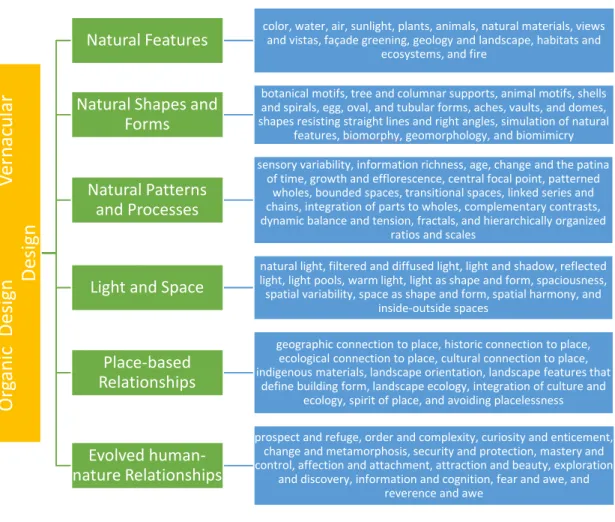
Biophilic design is based off of the biophilia hypothesis (Gillis, & Gatersleben, 2015) and describes the design application of biophilia into the built environment Kellert (2005) Research on biophilic design suggests that the built environment can become more restorative through implementing natural elements. Biophilic design has been acknowledged in the last decade with the publication of the “14 Patterns of Biophilic Design” by Terrapin. Biophilic design is also being incorporated into several building rating systems, including the Version 4 of the LEED rating system, Version 1 of the WELL Building Standards, and Version 3 of the Living Building Challenge. However, the original and most comprehensive categorization of biophilic design is described by Kellert and is separated into two dimensions, six elements, and 72 attributes, see Figure 1.
Figure 1. Biophilic Design Dimensions, Elements, and Attributes
Kellert (2005) categorized the biophilic dimensions within biophilic design as
organic and place-based. Organic is defined as building spaces and forms that directly,
indirectly, or representatively provoke an attraction for the natural environment (Kellert, 2005). Place-based is described as the design of the built environment to conform to a particular physical or cultural place which is inhabited (Kellert, 2005). In 2008, Kellert and colleagues refined the biophilic design into six biophilic design elements and roughly 72 attributes of biophilic design (Kellert, et al., 2008). The six biophilic design elements are broadly categorized as environmental features, natural shapes and forms, natural
O
rg
a
n
ic
D
e
si
g
n
V
e
rn
a
cu
la
r
D
e
si
g
n
Natural Featurescolor, water, air, sunlight, plants, animals, natural materials, views and vistas, façade greening, geology and landscape, habitats and
ecosystems, and fire
Natural Shapes and Forms
botanical motifs, tree and columnar supports, animal motifs, shells and spirals, egg, oval, and tubular forms, aches, vaults, and domes, shapes resisting straight lines and right angles, simulation of natural
features, biomorphy, geomorphology, and biomimicry
Natural Patterns and Processes
sensory variability, information richness, age, change and the patina of time, growth and efflorescence, central focal point, patterned
wholes, bounded spaces, transitional spaces, linked series and chains, integration of parts to wholes, complementary contrasts, dynamic balance and tension, fractals, and hierarchically organized
ratios and scales
Light and Space
natural light, filtered and diffused light, light and shadow, reflected light, light pools, warm light, light as shape and form, spaciousness, spatial variability, space as shape and form, spatial harmony, and
inside-outside spaces
Place-based Relationships
geographic connection to place, historic connection to place, ecological connection to place, cultural connection to place, indigenous materials, landscape orientation, landscape features that
define building form, landscape ecology, integration of culture and ecology, spirit of place, and avoiding placelessness
Evolved human-nature Relationships
prospect and refuge, order and complexity, curiosity and enticement, change and metamorphosis, security and protection, mastery and control, affection and attachment, attraction and beauty, exploration
and discovery, information and cognition, fear and awe, and reverence and awe
patterns and processes, light and space, place-based relationships, and evolved human nature relationships (Kellert, et al., 2008). Each element is categorized as either organic or place-based. Kellert, et al., (2008) explains environmental features consists of twelve biophilic attributes including the use of animals, color, water, air, views and vistas, façade greening, geology and landscape, sunlight, plants, natural materials, habitats and ecosystems, and lastly, fire. Natural shapesand forms consist of 11 biophilic attributes including the use of images of botanical motifs, tree and columnar supports, animal motifs, shells and spirals, egg, oval, and tubular forms, aches, vaults, and domes, shapes resisting straight lines and right angles, simulation of natural features, biomorphy, geomorphology, and biomimicry (Kellert, et al., 2008). Natural patterns and processes
consist of 15 biophilic attributes including the use of sensory variability, information richness, age, change and the patina of time, growth and efflorescence, central focal point, patterned wholes, bounded spaces, transitional spaces, linked series and chains, integration of parts to wholes, complementary contrasts, dynamic balance and tension, fractals, and lastly, hierarchically organized ratios and scales (Kellert, et al., 2008). Light
and space consists of 12 biophilic attributes including the use of natural light, filtered and
diffused light, light and shadow, reflected light, light pools, warm light, light as shape and form, spaciousness, spatial harmony, spatial variability, space as shape and form, and inside-outside spaces (Kellert, et al., 2008). Place-based relationships consists of 11 biophilic attributes including the use of geographic connection to place, historic connection to place, ecological connection to place, cultural connection to place,
landscape ecology, integration of culture and ecology, spirit of place, and avoiding place lessness (Kellert, et al., 2008). The last biophilic element Kellert, et al., (2008) explains is
Evolved Human-Nature Relationships consisting of 12 biophilic attributes including the
use of prospect and refuge, order and complexity, curiosity and enticement, change and metamorphosis, security and protection, mastery and control, affection and attachment, attraction and beauty, exploration and discovery, information and cognition, fear and awe, and lastly, reverence and spirituality (Kellert, et al., 2008).
Human exposure to biophilic design attributes can occur through three
experiences of nature: direct, indirect, or vicarious. Direct experience is defined as being physically present in the natural setting that has not been designed where contact with plants and animals occur (Maller, 2009; Kellert, 2005). Indirect contact with nature would be considered physical contact with representations of plants and animals or an artificial form of nature (Maller, 2009; Kellert, 2005). Vicarious experience, also known as symbolic, is living organisms and environments portrayed through images,
representations, or metaphorical expressions of nature (Maller, 2009; Kellert, 2005). Several studies have been conducted on biophilic design in healthcare settings (Huelat, 2008; Ulrich et al., 1991; Gillis & Gatersleben, 2015; Whitehouse, Varni, Seid, Cooper-Marcus, Ensberg, Jacobs, & Mehlenbeck (2001); McGee & Marshall-Baker, 2015). Gillis, & Gatersleben, (2015), looked at peer-reviewed literature on people’s perceptions and attitudes, behaviors, experiences, and feelings towards the natural and built environment in context with biophilia. Specifically focusing on three biophilic experiences including direct experience of nature, indirect experience of nature, and
experience of space and place that contribute to positive well-being and overall health of an individual (Gillis, & Gatersleben, 2015). In the category of direct experience with nature, the attribute of plants was most documented both in the built environment and found in nature. The attribute of natural light has been discussed extensively regarding the positive effects it provides to occupants in an interior environment, but there is little documentation on the restorative aspects of natural light. The attribute of water is restorative in both sight and noise, in addition to the clarity and quality also playing an important factor in being considered restorative. Research regarding plants includes positive morale and increased productivity. Natural materials have a need for more research in reference to biophilic design needing to be expanded past the material of wood. Overall, the literature reviews found that there are overlapping attributes between biophilic design and restorative design, therefore, it becomes difficult to distinguish clearly between the two types of design (Gillis, & Gatersleben, 2015). Finally, the literature revealed that the category of biophilic design may fall under restorative design and the Attention Restoration Theory can be used as a framework for a restorative experience. Biophilic design can be advantageous to the occupants of an interior environment through the implementation of attributes found in nature on human health and wellbeing (Gillis, & Gatersleben, 2015). Some of the benefits of biophilia and contact with nature include improved attention and memory (Kellert, 2008). Exposure to nature and natural elements may enhance a person’s everyday life through health,
The implementation of biophilic design in the built environment creates what is known as a restorative environment for the occupants of the space. A restorative environment is known as environments that produce positivity, draws attention without added stress or demand, and can aid in the recovery of mental fatigue and stress more quickly and fully (Gillis & Gatersleben, 2015). These environments are opposite of what many people are used to in urban environments, which are usually stressful, demanding, and over stimulate individuals.
A study conducted by Whitehouse, Varni, Seid, Cooper-Marcus, Ensberg, Jacobs, & Mehlenbeck (2001) looked at how a garden influenced children, parents, and staff in a hospital. The study took place over a two-week period with over 200 participants.
Behavior mapping and tracking, as well as surveys and interviews were conducted and used to understand how people reacted to the garden. Many people visited the garden to relax and rest and reported feeling more relaxed and less stress or content. The adults who visited the garden reported the fountain with the sound of running water to be their most enjoyed feature (Whitehouse et al., 2001). While the children reported both the fountain with the sound of running water and artwork consisting of a windmill, shadow wall, constellation wall, dinosaurs, and animal tiles to both be their favorite feature tied at 83%. Another aspect to the study was to understand how the consumer satisfaction with the healing garden influenced the participants. Of the 52 people interviewed, 50% of them said the garden increased their satisfaction with the hospital, 72% would recommend others to visit the garden, 20% would recommend the hospital to others based on the healing garden, and lastly, 74% or participants thought hospitals should
have healing gardens (Whitehouse et al., 2001). Consumers also reported an overall better quality of service provided by the hospital staff due to positive mood changes from the garden (Whitehouse et al., 2001).
The Biophilic Design Matrix (BDM) to aid in assessing the amount of biophilic attributes in the existing classrooms. McGee and Marshall-Baker (2015) developed the Biophilic Design Matrix to assist designers or other specialists in identifying and quantifying biophilic features through a visual inventory of interior spaces. The
framework for this instrument is based off Kellert’s list of 72 biophilic attributes to apply to solely interior environments. The BDM includes a scoring of whether the attributes are present in the interior environment or not and allows for both photographic documents and a frequency count for each biophilic attribute. Due to biophilic attributes being commonly present in hospital settings, the BDM was tested in 24 child life play spaces in the South Atlantic region of the U.S. The researchers took images of each room and tallied frequencies to score the biophilic quality of each space. It was concluded there was an inter-rater reliability of 89% and 94% to assess biophilic attributes in the built environment (McGee & Marshall-Baker, 2015).
Although there is documentation on nature and restorative environments along with their benefits towards an individual, there is a need for research in Biophilic Design and the effects of specific biophilic attributes on the interior environment. Biophilia has been applied extensively to patients in healthcare settings, but there is limited research in other built environments such as schools. This study aims to provide a starting point for more research to be conducted in educational settings.
Biophilic Design in Rating and Certification Systems
As the well-being of occupants in the built environment continue to be assessed, biophilic design is being included in rating and certification systems in the design
industry. The criteria provide guidelines for those involved in the design, operations, and maintenance of interior spaces to integrate aspects of biophilia to help toward the
certification process. Two such certification programs include: The Living Building Challenge and the WELL Building Standard.
Living Building Challenge
The Living Building Challenge is a holistic set of performance standards that certifies with new construction, renovations, and exterior spaces such as landscaping and infrastructure projects (International Living Future Institute, 2018). The Living Building Challenge has three types of certifications, net zero, petal, and living. Each program consists of seven Petals, which act as performance categories: Place, Water, Energy, Health & Happiness, Materials, Equity and Beauty. There is a total of twenty imperatives distributed among the seven petals. Imperatives are specific strategies or goals that help provide understanding for a topic or guideline. If the imperative is not met, the petal cannot be achieved toward certification.
There are three requirements or imperatives within the Health and Happiness Petal, one of which includes biophilic design. Requirement nine, “Biophilic
Environment” is weighted the same as all the other requirements. Under this requirement, project teams must explore the project’s biophilic design potential, develop biophilic
basis, plan and apply biophilic attributes to the project (International Living Future Institute, 2018).
The Living Building Challenge also includes a biophilia design initiative that is used as a resource for designers and architects (2018 International Living Future Institute, 2018). The initiative provides a resource for ideas, events, and networking opportunities, as well as access to network archives and file resources related to biophilic design. Designers may also develop their own draft of biophilic implementation strategies and documents to the Living Building Challenge (International Living Future Institute, 2018).
This rating system can be used to certify educational environments. The Perkins Seed Classroom in Seattle, WA and the Discovery Elementary School in Arlington, VA are private schools that achieved certified living status. The certification fee can be anywhere from $5000 to $15000, which can limit public schools with restricted funding (International Living Future Institute, 2018).
WELL Building Standard
The WELL Building Standard is a building certification program that focuses exclusively on health and well-being of individuals in the built environment
(International WELL Building Institute, 2018). The WELL Building Standard can be used for new construction and renovation projects and is currently piloting the second version. Version 2 contains 11 concepts including air, water, nourishment, light, movement, thermal comfort, sound, materials, mind, community, and innovations. The concept of biophilia was previously recognized by the WELL Building Standard (2018) by its inclusion as three features within the certification system. Within version 2
biophilia is integrated within three features under the Mind concept, Access to Nature, Restorative Spaces, and Enhanced Access to Nature. Access to nature specifically asks for a descriptive narrative on how the project will integrate and encourage access to nature within the built environment (International WELL Building Institute, 2018). Direct connection to nature must be achieved through at least two of the following: plants, water, light, or nature scenes. Indirect connection to nature is to occur using color, patterns, natural materials, or images. Lastly, the space layout in juxtaposition to
placement of the natural elements shall enhance occupant exposure (International WELL Building Institute, 2018).
Restorative Spaces has two parts one focuses on the interior spaces and the second focuses on exterior spaces (International WELL Building Institute, 2018). The International WELL Building Institute (2018) explains that each part requires the space be available to all occupants. These spaces must meet be designed for relaxation and not for the purpose of work; adhere to accessible design, have dimmable lighting options, incorporate sounds from nature, thermal comfort, lightweight furniture, that may be added or removed for comfort, visual privacy, and incorporation of nature through patterns and color; and educational resources informing the occupant why the space was created and how it may be used (International WELL Building Institute, 2018).
Enhanced Access to Nature has one part and must include at least two of the following spaces: 1. outdoor access to nature with at least 25% of the exterior site to include some type of landscaping or gardens accessible to regular building
included discussing the access to nature (International WELL Building Institute, 2018). 2. Indoor access to nature through indoor plants in direct line of sight to at least 75% of occupied spaces, if water features are included water safety must be addressed, and a descriptive narrative of how the occupants may enjoy the use of nature incorporated into the space. 3. Views to nature are to be accomplished by at least 75% of occupied spaces in direct line of sight to exterior views of nature and a description of how the built environment encourages the occupants to have constant access to nature. Lastly, 4. Nearby access to nature can be achieved through at least one green space within 1,00 ft walking distance from the built environment, this green space must be at least 1.25 acres. In addition, a narrative must be included encouraging the proximity of the green space to the built
environment. (International WELL Building Institute, 2018).
An Environmental Charter School- Middle School in Pittsburgh, Pennsylvania and Sandy Springs Friends School – Upper School in Maryland, USA are schools that have achieved the WELL Building Standard status (International WELL Building Institute, 2018). The importance of biophilic design is continuing to grow through standards and guidelines. More resources and networking are becoming readily available for designers and architects to understand the theory of biophilia and implement it in new construction and renovations.
Educational Settings
Educational settings will be the primary focus of this study to understand the implications on children in the learning environment. As children spend a majority of
their day in a classroom, special attention is needed in the design of educational environments to allow for children to reap the benefits of contact with nature (Maller, 2009; Kellert, 2005). Several studies have been conducted on biophilic design in
healthcare settings (Huelat, 2008; Ulrich et al., 1991; Gillis & Gatersleben, 2015; McGee & Marshall-Baker, 2015). Hands-on contact with nature is essential to a child’s
development to aid children's emotional, mental, and social health. Perceptions of educators on how nature effects the students become instrumental in the promotion of nature incorporated into the educational environment (Maller, 2009). Two important factors that create an effective educational setting for children are stress reduction and maintaining or recovering direct attention (Carrus, et al., 2012). If the children are less stressed in the classroom, they will be able to focus more attention on class assignments. Recovering their attention, the task can be understood without added stress on the student. These factors are connected to psychological variables that relate to the child’s well-being and cognitive development (Carrus, et al., 2012). By acknowledging
awareness of nature, children may start to be able to recognize the positive implications nature has on them and have a desire to spend more of their time in nature.
Along with the benefits of having an overall better wellbeing, the amount of landscaping such as plants or trees that students are exposed to can affect their academic performances (Wu, McNeely, Cedeno-Laurent, Pan, Adamkiewicz, & Dominci, 2014). A study investigating test scores from 905 Massachusetts public elementary schools with various levels of green surroundings between 2006 to 2012 found that the higher
exposure students have to ‘greenness’, the better the academic performance in both subjects of Math and English (Wu et. al, 2014).
Tanner (2009) assessed elements of interior and exterior educational settings to identify and test design strategies that could influence student learning outcomes in fifth-grade students in 19 Georgia school districts. This study evaluated patterns of movement and circulation, which included outside walkways, paths, public areas, reference, and outdoor spaces; patterns of daylighting including natural light in classrooms and source of light; and patterns of views including views overlooking life, unrestricted views, living views, functional views, and green areas (Tanner, 2009). Tanner (2009) found that the evaluated patterns of movement and circulation had positive implications such as better test scores and suggested for schools focus on modifying existing buildings or designing new schools around these elements (Tanner, 2009).
A study by Carrus, Pirchio, Passiatore, Mastandrea, Scopelliti, & Bartoli, (2012), researched the importance of outdoor green spaces and the impact of experience in
relation to these green spaces on children ages 18-36 months. Preliminary interviews with the child-care personnel identified two key moments in children’s daily routines:
structured activities with educators and free play. The study consisted of 16 children in a recently opened childcare center in Rome, Italy. During free play in the daycare and exterior green spaces, the children were observed regarding visual-spatial tasks and social behavioral. The study found, external green spaces for children during school correlated with better performances in activities requiring direct attention as well as producing positive social relations and stress reduction (Carrus et al., 2012). When students were in
green spaces, they had socialized with one another more in group play and there was also a higher level of self-organized play. The results also showed less of a need for teacher interventions such as help requests from teachers for tasks. The authors address that student performance can be enhanced after exposure to green space (Carrus et al., 2012).
Two high-poverty middle schools in one mid-Atlantic state were used for this study, looking at the effects of building conditions on students (Uline, Tschannen-Moran, and Wolsey, 2009). One school was located in an urban setting with students of grades six to eighth and one in a rural setting with grades four to eighth, each with similar built environment quality and student performance levels. Observations, focus groups, and interviews were conducted with a group of 20 students, parents, teachers, and
administrators at each school. The interviews and focus groups were concentrated on the interior of the school, specifically examining conditions and features that affected
learning. Results revealed both schools created a sense of place, educational environment, and interior attributes for the students. Connections among students along with the built environment were developed through the climate. The building conditions and design of a school fosters a sense of place, control, competence, and commitment to the place and its purpose for its students (Uline, Tschannen-Moran, and Wolsey, 2009).
Hathaway, Hargreaves, Thompson, & Novitsky (1992) studied fourth-grade elementary school students’ academic performance and attendance in different lighting conditions over two years. Five different school locations were used for this study, all fourth-grade students with 71 students at Site 1; 37 students at Site 2; 48 students at Site 3; 59 students at Site 4; and 113 students at Site 5. In addition to the five sites, there were
four different types of lighting used including high-pressure sodium vapor (HPSV) lamps, full spectrum fluorescent lamps, a full spectrum fluorescent with UV supplements, and cool-white fluorescent lamps. Site 1 was lit HPSV lamps with access to natural light, classrooms at site 2 were lit with the full spectrum lamps. Both sites 3 and 5 were lit with the same type of lighting, the full spectrum lights with UV supplements. Lastly, site 4 was lit with the white fluorescent lamps. Results showed that students at sites 2, 3, and 5 had a greater attendance rate, and higher academic achievement compared to site 1. Overall the study concluded that daily exposure to certain types of electric lighting can cause poor attendance rates and performance. Specifically, the indirect high-pressure sodium vapor lamps negatively affected the students at site 1 (Hathaway et al., 1992). They found that full spectrum lighting positively affected students’ academic
performance. Specifically, those students learned faster, had higher test scores, and 1/3 fewer absences due to illness resulting in about 3.5 fewer absent days per year
(Hathaway, et al., 1992).
While lighting has been shown to affect students’ performance and attendance, sound may also affect a student’s performance and lack of attention in the classroom. An elementary school in Indonesia looked at 24 rooms through one elementary school to determine the noise levels of the school and the potential negative outcomes noise may have on student performance (Burchari, & Matondang, 2017). The study measured noise levels in the existing conditions as well as around the school and administered
questionnaires to the students in the school regarding noise effecting their learning abilities. According to Burchari, & Matondang (2017), noise levels in elementary schools
can bring negative physiological side effects to students such as dizziness and emotional or uncomfortable feelings as well as learning experiences and student performance.
Schools are becoming increasingly more important in a child’s development, therefore an access to nature is essential to the children (Maller, 2009). The research involving natural views and how they benefit the student needs to be built upon in the classroom. There is a need to study how nature can directly influence and effect the students in the built environment.
Student Age
Stages for a child’s development occur in three stages: early childhood (ages ¾ to 7), early/middle grade school (ages 8 to 12), and adolescence (ages 13 to 17) (Maller, 2009). During the early childhood development, the focus on the development of compassion between a child and natural world occurs (White & Stoecklin, 2008). The most productive way to foster the relationship of child to animal is through live animal contact, animal-based stories, and songs. Developing empathy to the natural world is essential to latter stages of environmental education. The essential developmental phase for the early/middle grade school range is exploration, meaning a bond to the earth. Here children seek adventures in neighborhoods and communities to explore and experience the wild and semi-wild natural world. Activities that are focused towards exploration include: hunting and gathering, creating imaginary worlds, treasure hunts, exploring natural landscapes, following pathways and streams, and caring for animals and gardens (White & Stoecklin, 2008). Lastly, social action begins at age 12, at this stage a child will start to discover their self and specifically focusing on maturing into an adolescent role
and feeling connected to society. An inclination to save the world can be seen, if children adequately developed empathy and exploration in earlier developmental phases. Lastly, there is an attentiveness towards the sense of environmental preservation at a local level (White & Stoecklin, 2008). The importance of exposure to nature on a child during these developmental phases help shape the attitude the child has towards nature.
Another study created a research model for schools to determine if the potential of hands-on contact with nature would improve the emotional wellbeing and social
relationships of primary-aged school children. Maller (2009), conducted interviews with 30 principals, teachers and professionals in the environmental education industry from 27 institutions over a year to determine educators’ perceptions of the benefits of connections with nature on children’s mental, emotional, and social health. The key findings from the study as through the perceptions of educators were that contact with nature improves a child’s confidence and interest with school. Individuals in the study had different perceptions of what types of contact with nature in schools would be most benefit to the students and educators spending time with the children on a regular basis, were intrigued to learn how to enhance the children’s personal development through contact with nature. Connectedness to other people, particularly for the middle and upper primary school children ages 8 to 12, was a major outcome of this model. The educators believed an added benefit on hands-on contact with nature in education was that by connecting children to school, they may continue to partake in learning and their school community. The most important developmental age for children is the middle-childhood age of 8 to 12 and can directly affects mental growth and development (Maller, 2009). Contact with
nature promotes attentive abilities in children and effects their motor coordination (Maller, 2009).
At the early/middle grade school level, children explore and learn their place in the world through environmental education. This would include discovering and experiencing wild and semi-wild nature found in neighborhoods and communities (Baldwin, Powell, & Kellert, 2011). At this age, plants that inhabit wildlife are more of an interest to the children (Baldwin, Powell, & Kellert, 2011). To enhance a child’s social, mental, and emotional help, they need physical contact with nature (Maller, 2009).
There is an increase in research on the benefits of nature on children, specifically at the middle-childhood age. The research on age should be expanded to understand the precise attributes of nature that positively influences the children as green space could be a large variety of objects in nature. There are also gaps in research of how long biophilic attributes should be implemented in a setting to understand the lasting impacts on
children. In addition, there is not a known quantity of biophilic attributes that should be implemented in the built environment to study the lasting effect on children when
exposed to biophilic attributes. This study attempts further understand the implications of biophilic design on elementary school children in a classroom creating restorative effects on students and increasing their awareness of nature.
CHAPTER III METHODOLGY
The goal of this study was to determine if exposure to biophilic attributes affected students’ awareness of nature in elementary school classrooms. Awareness of nature was measured through the pre-test and post-test narratives, in the form of an open-ended writing assignment. The intervention, or independent variables, were biophilic attributes light, water, plants, animals, air, natural colors, and naturalistic shapes and forms. The dependent variable is children’s awareness of nature. The instrument, sample, data collection, and data analysis will be described in this chapter. The quasi-experimental study included a pre-test, followed by the implementation of biophilic attributes in the two classrooms a week later, and a post-test five weeks after the implemented biophilic attributes remained in the classrooms. Data collection occurred two times, during pre-test and post-test.
Research Questions
The research will use a quasi-experimental design, to determine how biophilic design affects children’s awareness of nature in an elementary school setting.
1) How does biophilic design influence children’s awareness of air in an educational environment?
2) How does biophilic design influence children’s awareness of water in an educational environment?
3) How does biophilic design influence children’s’ awareness of plants in an educational environment?
4) How does biophilic design influence children’s’ awareness of animals in an educational environment?
5) How does biophilic design influence children’s’ awareness of light in an educational environment?
6) How does biophilic design influence children’s’ awareness of natural material in an educational environment?
7) How does biophilic design influence children’s’ awareness of color in an educational environment?
Site
Two elementary school classrooms in Queen’s Grant Community Charter School located in Mint Hill, North Carolina were used for this study. Queen’s Grant Community Charter School is a public charter school that was established in 2002, had roughly 755 students enrolled at the time of data collection, and included kindergarten through eighth grade. The school is S.T.E.M. oriented focusing on science, technology, engineering, and mathematics. The sample included children in fourth and fifth-grade. The age of the students was not asked, therefore estimates the typical age in the fourth and fifth-grade levels were used, typically range in age from 8 to 12 years old. One fifth-grade and one fourth-grade classroom at Queen’s Grant Community Charter School were used for this study. There were four sample groups, one class from the fourth-grade and three classes from the fifth-grade. The fifth-grade classes which are identified in this study as Core 1,
Core 2, and Core 3, all share the same classroom, at different times of the day. Each core spends an average of one and half hours in the classroom at one time rotating through various times of the day.
The fourth-grade classroom had 27 students in the class, three of which were not included in the study due to either a non-consent from the parent of the student or the student being absent for one of the administered instruments. The fourth-grade classroom was primarily used a mathematics classroom and the fifth-grade classroom was used as a science classroom. The fifth-grade classroom contained three cores, which were classes that rotated throughout the day with the same teacher. There were 28 participants in the fifth-grade core 1 class, three of which were not included in the study due to either a non-consent from the parent of the student or the student being absent for one of the
administered instruments. There were 28 students in the fifth-grade core 2 class, ten of which were not included in the study due to either a non-consent from the parent of the student or the student being absent for one of the administered instruments. There were 28 students in the fifth-grade core 3 class, four of which were not included in the study due to either a non-consent from the parent of the student or the student being absent for one of the administered instruments. The fourth-grade classroom had a total of 24 students and fifth-grade classroom had a total of 72 students participate in the study. There was only one class to participate from the fourth-grade classroom because the schedules for students in both grades were not similar enough to allow for the same amount of time in the classrooms.
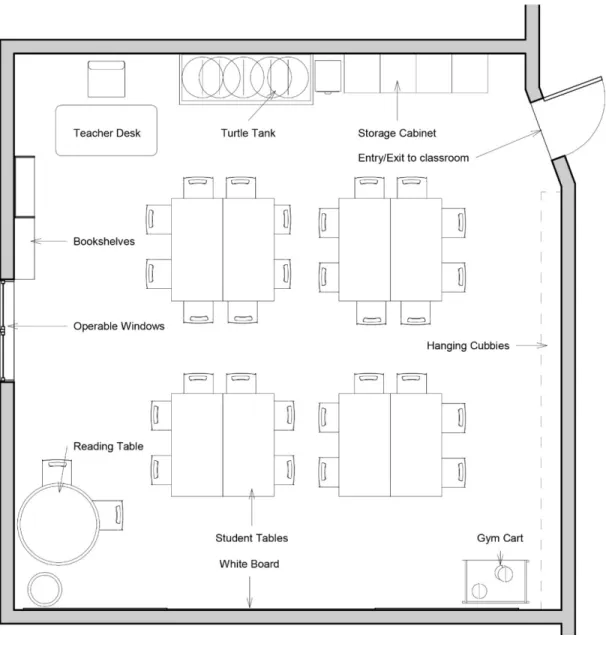
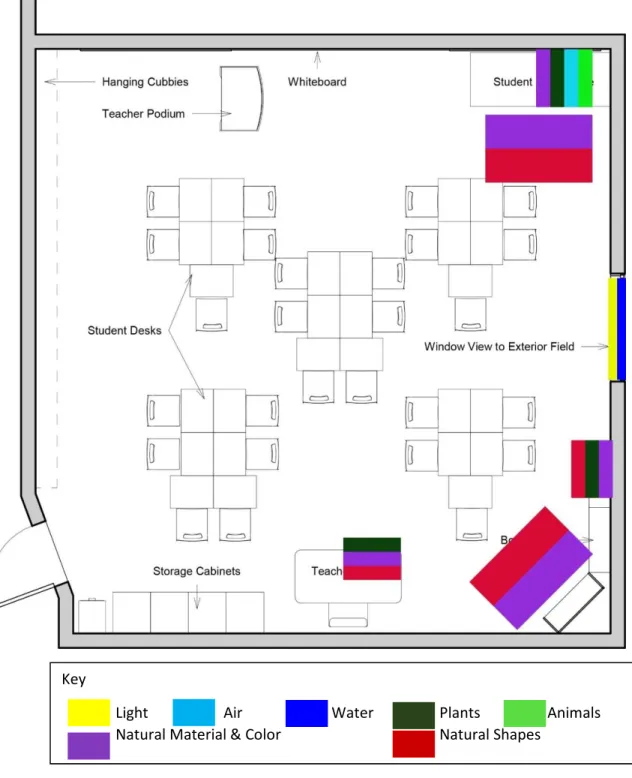
Figure 2. Fifth-grade Floor Plan
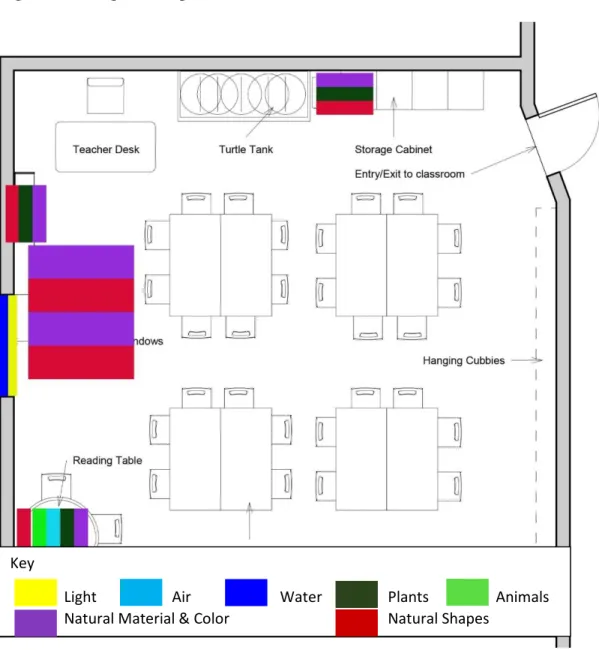
The fifth-grade classroom is roughly 715 square feet, contained two operable windows with views of an exterior garden, Figure 2. After using the Biophilic Design Matrix to examine the existing biophilic attributes, it was determined that there were 28 biophilic attributes present in the fifth-grade classroom. These biophilic attributes included: color, water, air, plants, animals, natural materials, views and vistas, botanical motifs, tree and columnar supports, representations of animals, egg, oval, and tubular forms, shapes resisting straight lines, sensory variability, age, change, and the patina of time, central focal point, bounded spaces, transitional spaces, integration of parts to wholes, natural light, filtered and diffused light, reflected light, light pools, warm light, spaciousness, spatial variability, geographic connection to place, ecological connection to place, and indigenous materials, Appendix B. After evaluating the existing biophilic quality of the classroom, the researcher examined the 72 attributes to determine which attributes could be implemented in the classroom. The attributes of water, air, plants, animals, light, natural materials, and color were selected by the researcher to be
implemented in both classrooms. These attributes were selected because many of the 72 attributes were inapplicable to an elementary school grade level. The seven chosen attributes were selected due to being categorized in the Environmental Features element of biophilic design. The twelve attributes listed in this category are the most identifiable in the built environment. The other six elements of biophilic design contained complex attributes for an elementary school student to fully comprehend. The seven selected attributes were able to be implemented into a classroom more easily through being combined with one another.
Figure 3. Fifth-grade Biophilic Attribute Locations
Key
Light Air Water Plants Animals
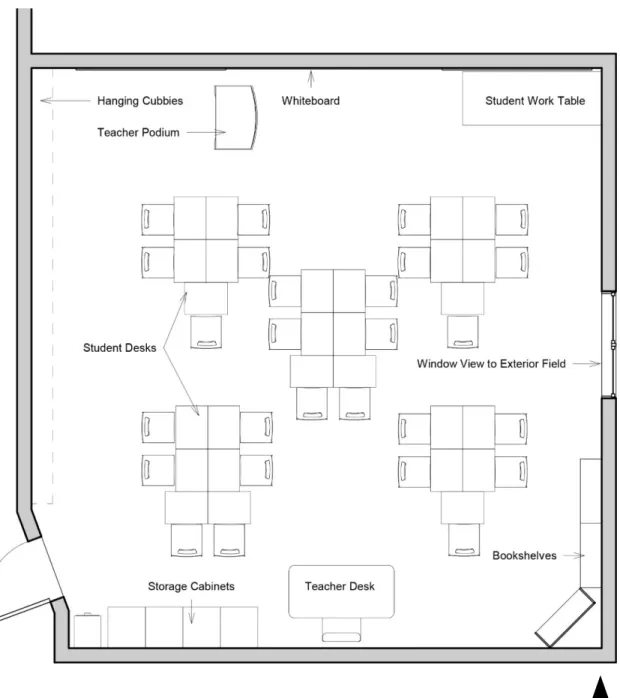
The fourth-grade classroom, is roughly 715 square feet, contains two operable windows with views of a playground area and trees, Figure 3. After using the Biophilic Design Matrix to examine the existing biophilic attributes, it was determined that there were 21 biophilic attributes present in the classroom: color, air, natural materials, views and vistas, botanical motifs, tree and columnar supports, representations of animals, egg, oval, and tubular forms, biomimicry, central focal point, patterned wholes, bounded spaces, transitional spaces, natural light, filtered and diffused light, light and shadow, reflected light, warm light, light pools, spaciousness, and spatial variability, Appendix B. After evaluating the existing biophilic quality of the classroom, the researcher examined the 72 attributes to determine which attributes would be implemented in the classroom. The attributes of water, air, plants, animals, light, natural materials, and color were selected by the researcher to be implemented in both classrooms. The seven chosen attributes were selected due to the same reasoning as the fifth-grade classroom attributes, they are categorized in the Environmental Features element of biophilic design. The twelve attributes listed in this category are the most identifiable in the built environment. As the same attributes were implemented in both classrooms, the attributes were able to be implemented into the classroom more easily through being combined with one another.
Figure 4. Fourth-grade Classroom
Figure 5. Fourth-grade Biophilic Attribute Locations
Key
Light Air Water Plants Animals
Procedure
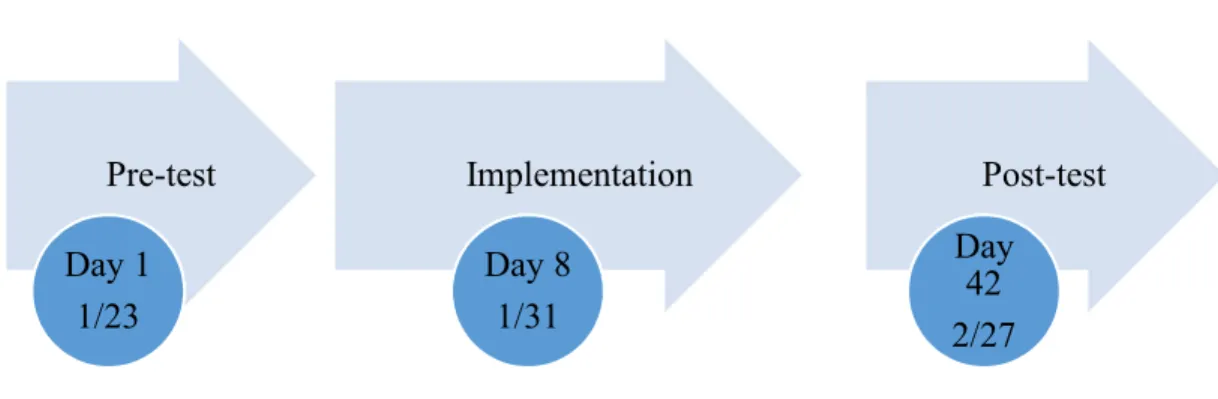
The study took place over a six-week timeframe, the schedule is shown in Figure 6. The pre-test was administered to the students shortly after returning from winter break towards the end of January.
Figure 6. Timeline
Prior to determining which biophilic elements would be implemented in each classroom, a biophilic matrix was used to document the quantity and types of biophilic attributes in the classrooms. The Biophilic Interior Design Matrix (BDM), provides a numeric score through inventorying a space on the type of biophilic design elements and their subset attributes (McGee & Marshall-Baker, 2015). Using the BDM allowed for the two classrooms to be assessed to understand which biophilic attributes were existing in the space before the study started and what attributes could be expanded upon for the study. The BDM was not used to score the spaces, each category was evaluated and given either a check or X mark in the table to indicate if the types and amount of biophilic attributes, Appendix B. Photographs were used to document for the existing attributes present in each classroom. This information was used to determine the quantity and types of biophilic attributes that would be used during the intervention.
Pre-test Day 1 1/23 Implementation Day 8 1/31 Post-test Day 42 2/27
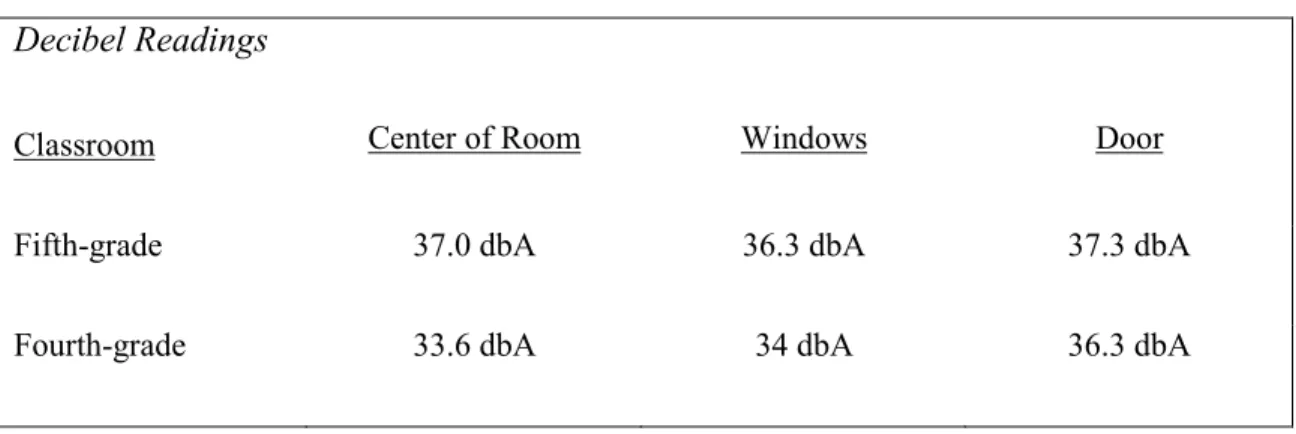
Each classroom was evaluated for illumination and sound levels to determine the existing built environment conditions that the students encounter daily in the classroom. Sound levels within each classroom were measured on a teacher work day, for an accurate measurement of the sound levels in the existing conditions of the classroom without the added noise from students. The measurements were taken three times and then averaged in three locations within the classroom; center of the classroom, standing next to the windows, and standing next to the door, see Table 1. The illumination levels were recorded in each classroom during three lighting conditions; daylight only, electric light only, and a combination of daylight and electric lighting, see Table 2. The
measurements were taken during the existing conditions evaluations, there was cloud coverage during one reading, which lowered the amount of natural light in the classroom. Table 1. Decibel Readings (dbA)
Decibel Readings
Classroom Center of Room Windows Door
Fifth-grade 37.0 dbA 36.3 dbA 37.3 dbA
Table 2. Illumination Readings (lux)
Illumination Readings
Classroom Natural light Artificial Light Combination
Fifth-grade 95.5 lux 194.3 lux 271.3 lux
Fourth-grade 250 lux 242.6 lux 293 lux
Upon finalization of the instrument, materials were submitted, reviewed, and approved by the UNCG Institutional Review Board (IRB). The IRB determined that this study did not constitute human subjects research as defined under federal regulations [45 CFR 46.102 (d or f)] and did not require IRB approval. Study# 17-0165 was stamped for approval from the IRB office (Appendix C), parental (Appendix F) and student consent forms (Appendix G) have been stamped and were given to the teachers for distribution to both parents and the students before starting the study. Additional approval was required by Queens Grant Charter School (Appendix D). After receiving approval, the stamped and approved documents were given to the two teachers who distributed them to the parents and their students. All signed consent forms were collected before the administration of the instrument. rate. The instruments were not collected by the
researcher, if parental consent was not given. Each student was given the same number or identifier from the teacher for the data to be compared for the pre-test and post-test. In the case where an instrument was received in the pre-test and not the post-test or vice versa, the instrument was excluded from the study because the data could not be compared. The students were given the instrument and told to write as much or as little as they wanted and were not assisted by the teachers during the duration of this assignment.
Instrument
The instrument consisted of an in-class writing assignment in the form of a narrative response to a prompt, see Appendix A. The assignment was developed with the teachers to ensure that the students would be capable of comprehending the prompt. The question, “Write about an experience you had with your family or friends. What did you see, feel, taste, hear, and smell?” was open ended. The prompt was written to lessen nature bias, in that the prompt is generic but also makes the student think about their five senses, which would result in more descriptions from each student.
The instrument was piloted with three children ranging in ages of 8 to 12 to gauge the difficulty of assignment before being administered by the two teachers in the
classrooms. Reading and comprehension levels for this age group was found to be acceptable the pilot testing and therefore was unaltered for this study.
Figure 7. Existing Biophilic Attributes in Fifth-grade Classrooms. (a) Cubbies;
(b)Teaching Wall; (c) Window Wall; (d) Back Wall (All images original to researcher).
(c) (d)
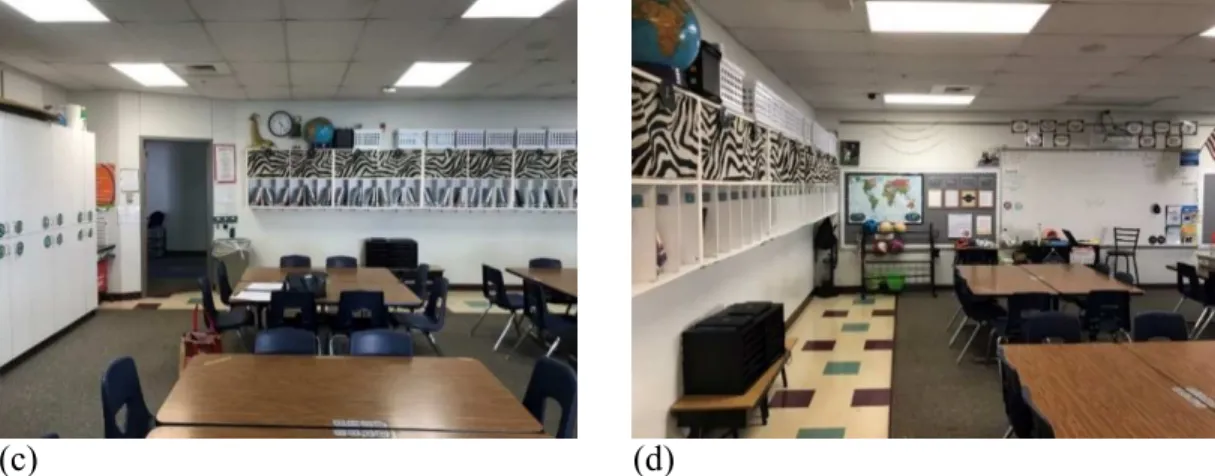
Figure 8. Existing Biophilic Attributes in Fourth-grade Classroom. (a) Cubbies; (b)Teaching Wall; (c) Back Wall; (d) Window Wall (All images original to researcher).
(a) (b)
The Intervention
The biophilic attributes that were implemented in the classrooms consisted of: light, water, plants, animals, color, natural materials, and naturalistic shapes and forms, see Table 3. This study focused specifically on the seven biophilic attributes of air, water, plants, animals, light, natural materials, and color found in the element category of environmental features. Air as a biophilic attribute is significant in the “quality,
movement, flow, and stimulation of other sense” (Kellert, 2008, P.7). Water is important through “the perception of quality, quantity, movement, and clarity” (Keller, 2008, P.7). Plants are a basic need of humans as a food source and may enhance comfort,
satisfaction, well-being, and performance in the interior built environment (Kellert, 2008). Natural materials are preferred over artificial material because they are not stagnant Natural material weathers and patinas through the course of nature. Color is symbolic recognition of the world around us, there is an innate human attraction to colorful and natural tones. Light for this study takes into consideration natural, electric light, filtered and diffused light. Natural light provides comfort and can improve a person’s well-being in the built environment. Filtered and diffused light can be used to alleviate glare from sunlight and stimulate a person through the visual connection of interior to exterior spaces (Kellert, 2008).
Air was also included in this study as each classroom had operable windows, the teachers agreed on days with nice weather to open the windows, allowing for natural air to circulate through the classroom. Light was provided by opening or partially opening the blinds allowing daylight to enter the room. The blinds were left open through the