ScholarWorks
Walden Dissertations and Doctoral Studies Walden Dissertations and Doctoral Studies Collection
1-1-2011
The Effect of Two Reading Programs on First
Grade Students' Reading Fluency
Christy Stewart Bowling Walden University
Follow this and additional works at:https://scholarworks.waldenu.edu/dissertations
Part of theEducational Assessment, Evaluation, and Research Commons,Other Education Commons, and theReading and Language Commons
This Dissertation is brought to you for free and open access by the Walden Dissertations and Doctoral Studies Collection at ScholarWorks. It has been accepted for inclusion in Walden Dissertations and Doctoral Studies by an authorized administrator of ScholarWorks. For more information, please [email protected].
Walden University
COLLEGE OF EDUCATION
This is to certify that the doctoral study by Christy Stewart Bowling
has been found to be complete and satisfactory in all respects, and that any and all revisions required by
the review committee have been made. Review Committee
Dr. Thomas Schnick, Committee Chairperson, Education Faculty Dr. Carol Tanksley, Committee Member, Education Faculty Dr. Michelle Brown, University Reviewer, Education Faculty
Chief Academic Officer David Clinefelter, Ph.D.
Walden University 2011
Abstract
The Effect of Two Reading Programs on First Grade Students’ Reading Fluency by
Christy Stewart Bowling
Ed.S., Lincoln Memorial University, 2000 M. Ed., Lincoln Memorial University, 1999
BS, Kennesaw State University, 1998 BA, Kennesaw State University, 1995
Doctoral Study Submitted in Partial Fulfillment of the Requirements for the Degree of
Doctor of Education
Specialization in Administrator Leadership
Walden University January 2011
Abstract
School districts struggle to achieve Adequate Yearly Progress (AYP) in reading in first grade. Nine percent of first grade students at the study site were not meeting state performance standards in the area of language arts. Specifically in the area of fluency, 38% of first grade students were not achieving AYP. Because of the close connection between oral fluency and early reading achievement, first grade students need to be more fluent to attain state standards. Based on LaBerge and Samuels theory of automaticity within reading fluency, the purpose of this study was to identify the impact of the Scholastic Guided Reading Program and Harcourt Trophies basal reading program on students reading fluency, as measured by the Dynamic Indicators of Basic Early Literacy Skills Oral Reading Fluency (DIBELS). Over eight months, the fluency levels of 129 first grade students were assessed three times. Repeated measures analysis of variance
(ANOVA) showed a significant increase in the DIBELS gain scores between the pretest Fall Y2 Word Fluency (WF) scores in relation to the posttest Winter Y2 Oral Reading Fluency (ORF) scores for those students who received Scholastic Guided Reading
instruction. Students who received Harcourt basal reading instruction gain scores showed a slight regression in fluency between the pretest Fall Y2 WF and the posttest Winter Y2 ORF. These results suggest that individual leveled reading instruction increases students’ fluency skills. Improving reading fluency early is essential; students who become
proficient readers have the ability to contribute and participatee in all areas of societal change.
The Effect of Two Reading Programs on First Grade Students’ Reading Fluency by
Christy Stewart Bowling
Ed. S., Lincoln Memorial University, 2000 M. ED., Lincoln Memorial University, 1999
BS, Kennesaw State University, 1998 BA, Kennesaw State University, 1995
Doctoral Study Proposal Submitted in Partial Fulfillment of the Requirements for the Degree of
Doctor of Education
Specialization in Administrator Leadership
Walden University January 2011
UMI Number: 3434868
All rights reserved
INFORMATION TO ALL USERS
The quality of this reproduction is dependent upon the quality of the copy submitted. In the unlikely event that the author did not send a complete manuscript
and there are missing pages, these will be noted. Also, if material had to be removed, a note will indicate the deletion.
UMI 3434868
Copyright 2011 by ProQuest LLC.
All rights reserved. This edition of the work is protected against unauthorized copying under Title 17, United States Code.
ProQuest LLC
789 East Eisenhower Parkway P.O. Box 1346
Dedication
This dissertation is dedicated to my husband, Jim, my daughter, Brooke, and my parents, who have loved, supported, encouraged and allowed me the freedom to
continually explore new opportunities for personal, professional and scholarly growth. Without them, there is no way I would have undertaken the monumental commitment of this doctoral program. Their value of education is truly beyond my comprehension. I am just a lucky beneficiary. Throughout the process, my siblings have unknowingly, in their own ways, given me the motivation to complete this work.
For all those who told me I could not or would not, I dedicate this work to each of you and say, ―Yes, I can.‖; ―Yes, I will.‖; ―Watch me!‖
Acknowledgments
I would like to take this opportunity to thank my support system at work for persevering throughout this journey of educational enlightenment. We, as a professional family, have been through so much and we have grown stronger through the trials and tribulations of school life. With all that has been placed before us, we have survived and continue to thrive. Thank you faculty and staff!
Thank you, Dr. Schnick, for your determination with this process. Who would have thought I could have made it this far? You did. I appreciate your encouragement and candor.
i Table of Contents
List of Tables ... iv
List of Figures ...v
Section 1: Introduction to the Study ...1
Introduction ...1
Problem Statement ...3
Purpose of the Study ...4
Research Question and Hypotheses ...5
Definition of Terms...6
Limitations and Delimitations ...7
Assumptions ...7
Significance of the Study ...8
Conclusion ...9
Section 2: Literature Review ...11
Introduction ...11
The History of Fluency Instruction ... 12
Dynamic Indicators of Basic Early Literacy Skills ... 17
Harcourt Trophies ... 19
Scholastic Guided Reading Program ... 21
Reading Fluency ... 23
Conclusion ...26
ii
Introduction ...27
Research Design and Approach ...28
Research Question and Hypotheses ...29
Setting ...29
Instrumentation and Materials ...30
Harcourt Trophies ... 31
Scholastic Guided Reading ... 31
Data Analysis ...32
Measures for Ethical Protection of Participants... 32
Section 4: Results of the Study ...34
Introduction ...34 Participant Data ...34 Data Analysis ...35 Explanation ...38 Conclusion ...40 Section 5: Conclusion ...41 Introduction ...41 Interpretation of Findings ...43
Implications for Social Change ...44
Recommendations for Further Study ...46
Closing Statement ...47
iii
Appendix A: School Improvement Plan Multiyear Results ...60 Appendix B: Summary of Reliability and Validity Data on DIBELS ...61 Appendix C: Class 1 Data - Combined first grade classes Scholastic Guided Reading ...63 Appendix D: Class 2 Data - Combined first grade classes Harcourt Trophies ….………65 Curriculum Vitae ...667
iv List of Tables
Table 1 Means and Standard Deviations of the Gain Scores ... 37 Table 2 Repeated Measures Contrasts on Gain Scores ... 38
v List of Figures
Figure 1. Pretest and posttest control group design ...28 Figure 2. Repeated-measures contrasts on gain scores ...39
Section 1: Introduction to the Study
Introduction
Early literacy is at the forefront of elementary education. Researchers have investigated how students become skilled at reading (Calhoon, 2005; Conderman & Strobel, 2006; Griffin & Rasinski, 2004) and the factors associated with reading difficulties. Researchers have also identified effective procedures to determine which students are in jeopardy of experiencing reading difficulty and how schools must
intervene early to prevent later difficulties (O’Connor, Hary, & Fulmer, 2005; Therrien & Kubina, 2006). At a rural north Georgia school, first grade students are not meeting Georgia Performance Standards in reading fluency. Because of the close connection between oral fluency and early reading achievement, first grade students must be more fluent to meet state standards.
Early literacy assessments play a significant role in preventing literacy problems as they enable school personnel to screen all students and detect potential difficulties (Calhoon, 2005; Hudson, Lane, & Pullen, 2005). Screening early and providing quality core reading instruction, along with differentiation and intervention instruction to small groups of struggling readers, will help students avoid problems as they learn how to read.
One research-driven screening instrument is the Dynamic Indicators of Basic Early Literacy Skills of Oral Reading Fluency (DIBELS/ORF). In the 2007-2008 school year, more than 2,200 school districts from 49 states and Canada had implemented DIBELS as a screening tool to date (Wilson, 2005). Data obtained from DIBELS
screenings are used to identify students with reading difficulties. Information from this assessment tool also serves to inform teachers of specific student needs.
DIBELS uses short (1-3 min.) subtests which were developed from the National Reading Panel (2000) and the National Research Council (1998) reports. These measures include phonological awareness, knowledge of alphabetic print, and language
development. After students have been screened, schools design intervention programs to address students’ needs. Myriad intervention programs exist and the qualities of each have been debated. The two programs chosen for this research project include guided reading and use of the locally-adopted basal reading series at the school where I have chosen to conduct this study.
In this study, I addressed fluency problems at my school by implementing two different instructional approaches to teach reading fluency. DIBELS was employed to calculate the effectiveness of teaching students fluency through the adopted basal reading series as compared to teachers using the guided reading program. The DIBELS
measurement instrument assisted decision makers in validating the instructional program from which first grade students would benefit most in regard to improved reading
fluency.
The No Child Left Behind reform (NCLB), 2002 is, in part, a document which addresses the issue of student achievement throughout their educational careers. NCLB, (2002) legislation has been presented to public school administrators in an effort to make certain that all students are reading on grade level by the time they complete grade 3 (U.S. Department of Education, 2001). Under the requirements of this legislation, school
localities are being held responsible for successfully making adequate yearly progress (AYP). A school’s inability to meet the criteria necessary to make AYP, based on the
subgroups identified, labels the school as a needs improvement school. If the school
continues to not make AYP for three consecutive years sanctions and corrective actions are taken by the state to improve the students’ academic success at that school. The latest version of the act focuses on closing the achievement gap among the following
subgroups: ethnicity, socioeconomic status, English language learners, and special education students. These groups have all been previously identified as unable to
meet/achieve the expected academic standards for future school success (USDOE, 2002).
Problem Statement
Timely reading instruction is vital both for students’ immediate and long term reading development. Learners in the formative years who struggle and resist reading frequently stay behind their peers during their school careers (Kuhn, 2004), and all of
their academic subject areas suffer (Hoerr, 2006; Welsch, 2006; Wiley, & Deno, 2005).
At the school in which this study takes place, first grade students have scored below average on Georgia Performance Standards in the area of reading. Some teachers at the
study school believe that the currently adopted reading series, Harcourt Trophies©,
(2003), does not meet the needs of struggling readers. The first grade Trophies series provides phonics instruction to build word recognition skills that enable students to become more proficient decoders while at the same time championing echo reading, choral reading, repeated reading and readers theatre to provide students several
individual student reading ability; a major component of the Scholastic Guided Reading program.
Other limiting factors may hinder overall reading achievement for students at my school. For example of the 157 first grade students that participated in the Spring 2008 GCRCT administration 10 were students with disabilities; for 12, English was their second language; and 48 were economically disadvantaged, qualifying them for free and reduced lunch (GOSA, 2008). Because NCLB (2002) focuses on closing the achievement gap among all students, including the delineated subgroups, ongoing assessments must occur to guide instructional practices to best meet the needs of the struggling students.
Purpose of the Study
This quasi-experimental quantitative examination used a nonequivalent (pretest and posttest) control group designed to compare students’ reading gains between two reading programs. An analysis of variance was performed (ANOVA). Five teachers piloted the Scholastic Guided Reading Program and five teachers used Harcourt Trophies, the adopted basal reading series. The study’s dependent variable was the posttest scores. The independent variable included was the grouping of students. The variant was the pretest scores. The research determined the effect of the curricula on students’ reading fluency as assessed by the DIBLES oral reading component. The students were taught fluency strategies in the first grade through the Scholastic Guided
Research-based practices are to be used in all classrooms based on the NCLB (2002) legislation (USDOE, 2004). I acknowledged and incorporated the most effective fluency strategies of the two reading programs used in first grade. Reliable evidence showed that the programs used in this study are considered research-based due to evidence of the programs’ positive impact on students’ reading success in the past (Hudson, R.; Lane, H.; Pullen, P.,2005).
Research Question and Hypothesis
RQ1: What is the difference in the individual student gain scores on the fluency domain in DIBELS for students utilizing Scholastic Guided Reading program as compared to students utilizing Harcourt Trophies reading program?
H0: There is no significant difference in the individual student gain scores on the
fluency domain in DIBELS for students utilizing Scholastic Guided Reading program as opposed to students utilizing Harcourt Trophies reading program.
H1: There is a significant difference in the individual student gain scores on the
fluency domain in DIBELS for students utilizing Scholastic Guided Reading program as opposed to students utilizing Harcourt Trophies reading program.
Vandasy, Sanders and Peyton’s (2005) research guided this study. Like Vandasy et al., I evaluated two reading programs designed to improve individual reading fluency, and used the first grade population at my school using the in-school sample. The results of my study are available to other educators in the district as they adopt their own reading materials for struggling students at their schools.
Definition of Terms
Assessment: determining a student’s proficiency with selected skills (Harcourt, 2003).
Basal: textbooks designed to be used at specific grade levels as a comprehensive instructional program. Designed to teach reading skills and comprehension (Education, 2010).
Dynamic Indicators of Basic Early Literacy Skills: an assessment tool to screen
students in Kindergarten through 3rd grade including measures: Initial Sound Fluency,
Letter Naming Fluency, Phoneme Segmentation Fluency, Nonsense Word Fluency, and Oral Reading Fluency (Kaminski, Cumming, Powell-Smith, Good, 2008).
Early Intervention Program (EIP): program intended to help students develop increased reading understanding and comprehension (GDOE, 2003)
Fluency: the speed and accuracy with which text is read orally (Speece & Ritchey, 2005)
Guided Reading: a teaching of lessons that includes the teacher engaging and guiding a small group of students whose reading abilities are similar and students are all able to read similar levels of texts (Pinnell, 2003).
Strategy: an instructional method to meet the educational needs of students (Calhoon, 2005).
Limitations and Delimitations
Control over placement of students in classrooms was limited due to the availability of remedial education funds and the subsequent rules related to the use of these funds for specific student identified needs. In addition, this study was restricted to the reading programs used (Scholastic Guided Reading Program and Harcourt Trophies). I was unable to control assessment times (during the school day) and assessment
locations (in the student’s classrooms, another room, or in the corridors outside the classroom).
The delimitations include; a diminutive variety of results, the decisive sampling method for deciding upon participants and the ensuing transiency, gender,
socio-economic status, and teachers’ educational foundation. The research was restricted to my school and the kindergarten and first grade homerooms for an eight month period. The study was initiated beginning in the fourth quarter of the students’ kindergarten year and ending with the conclusion of the first semester of first grade. A rural community in north Georgia is the home to my study. The school serves students of all abilities. The research consisted of learners in ten first grade classrooms.
Assumptions
I assumed that teachers implemented the suggested lessons from their respective reading programs as summarized and illustrated in the teachers’ editions. I also assumed that first grade teachers would not utilize other reading programs which would confound
the results of this study. I assumed that teachers were trained in the respective reading program which they were assigned to teach during the study period.
Significance of the Study
This topic of reading fluency is important to teachers and curriculum leaders at the school because two different approaches to teaching reading are currently used, and there is no evidence that one program improves fluency over the other. It is worthwhile to determine the connection between the acquisitions of reading fluency in a controlled empirical study in order to weigh the efficacy of the two programs’ facilitation of students’ reading fluency.
The participant school focuses on a multiyear School Improvement Plan (SIP) (see Appendix A). Progression in the area of reading fluency within the Reading section of the Georgian Criterion Reference Competency Test (GCRCT) is of key importance within this plan. Information gathered through this study was used to guide the staff in developing action steps and strategies within the SIP.
Data-driven results were beneficial during the textbook adoption process. Research results were utilized in deeming appropriate reading materials to be purchased not only at my school, but by the school district at large. Millions of dollars are spent on textbooks, marking a considerable outlay of funding for taxpayers within the county. The previous reading series implementation alone cost the county 1.3 million dollars (C. Cohen, personal communication, August 4, 2008). Due to the significant cost of reading materials for students, all stakeholders should be aware and informed of the decisions in
regard to any textbook adoption. Decisions are best made when unbiased data on student achievement and resultant information are aligned with current reading theories.
The results of the study are important to all educators because the findings can be used to guide them as they evaluate reading programs and materials’ ability to best meet all students needs in the area of reading. If a single program has the ability to improve students’ reading potential, it should be explored for other schools and districts. Furthermore, it is the responsibility of the schools’ instructional leaders to provide all students the opportunity to be triumphant readers. The study also provides information related to increased reading achievement, thus facilitating the districts’ decision when choosing individualized reading programs that will promote reading success for all students.
Conclusion
In section 1, a challenging problem was described at the rural school in north Georgia: The need to increase reading fluency in order to impact reading achievement as measured by a standardized test such as the Georgia Criterion Reference Competency Test (GCRCT). The concern over reading fluency was a result of gaps in learning as evidence by classroom based and standard test scores. The purpose of this study was to identify increases in students’ reading fluency related to the implementation of the two different reading programs’, focus on imbedded fluency instructional strategies, as measured by DIBELS. The research was centered on one research question: What is the difference in the individual student gain scores on the fluency domain in DIBELS for students utilizing Scholastic’s Guided Reading Program as opposed to students utilizing
Harcourt Trophies? A review of literature focusing on reading programs designed to teach fluency as well as the basis for using DIBELS as a measurement tool will be presented in section 2. Information related to research design of methods for this study will be presented in section 3.
Section 2: Literature Review Introduction
Reading is the foundation of learning, and it is essential to provide early
intervention for these students to overcome reading deficiencies. Several reading series and programs seek to address and meet all students’ needs. This modified
quasi-experimental quantitative study compared the impact of Scholastic Guided Reading and Harcourt (2003) basal reading series on students’ reading fluency, as measured through the DIBELS instrument. In this section, I present a literature review on current reading programs designed to teach fluency in first grade. I also present background information on the assessment tool, DIBELS.
The fluent reader takes in a large amount of information at any given moment. It takes mental energy to decode words and gain meaning at the same time. Beginning readers, however, are not experienced with decoding words, and often need to devote their cognitive effort to decoding sounds as they read. Meanwhile, they are not
comprehending the text. They cannot do two things at once, at least not yet. This skill is, in part, the theory of automaticity. There are some automaticity researchers who try to improve the speed at which students recognize words ( Huey, 1908; LaBerge & Samuels, 1974). There are other researchers who use repeated readings to develop automaticity (Kuhn, 2004; Samuels, 1997).
Many education publications focus on effective strategies to increase oral reading
fluency (Hoerr, 2006;Welsch, 2006; Wiley, & Deno, 2005). Students who struggle with
education than are students who do not struggle with reading at an early age. Reading fluently is often a challenge associated with students who have qualified for programs designed for students with specific learning disabilities (Welsch, 2006).
In this section, I review the history of fluency instruction as well as the methods employed to study the teaching of reading. In this section, I also explain the programs used at a school in north Georgia, with specific attention on the instructional fluency component within the National Reading Panel (2000).
The History of Fluency Instruction
Since the research on the psychology of reading began in the nineteenth century, the advancement of reading fluency has been associated with successful reading. Huey (1908) compared the growth of fluent reading to the improvement of motor skills in playing tennis, stating that both skills benefitted from practice. ―Repetition progressively frees the mind from attention to details, and makes facile the total act, shortens the time, and reduces the extent to which consciousness must concern itself with the process‖ (p. 104). This attentiveness to fluency was not a point of focus until 1974 when LaBerge and Samuels offered their theory of automatic processing.
The automaticity representation of reading, projected by LaBerge and Samuels (1974), is an introductory theory in the exploration of oral reading fluency. LaBerge and Samuels established that, as readers become more comfortable and capable at identifying words, they are more likely to be able to recognize and understand the text they read. This recognition stems primarily from the extra obtainable brain space automaticity provides in grasping the encountered text (Samuels, 1979). As a result, improvement in
the processing of units, words, and connected text cognitively releases the reader to think about the meaning of the text. This theory of automatic information processing resulted in research on increasing the speed at which students recognized words (Kuhn, 2004).
The verbal efficiency model from Perfetti (1977, 1985) suggests that delayed word recognition slows down the automaticity of reading and comprehension. Perfetti maintained that delayed word recognition consumes the engaged memory within the brain and prevents the understanding of the text while the student reads. Based on this tenet, researchers have found that rapid smooth reading of high-frequency words and rapid interpretation of words are required to increase text understanding and reading advancement (Griffin, Wiebe, & Rasinski, 2004; Hudson et al., 2005; Kuhn, 2004).
The issue of fluency was also studied by Huey (1908), who concluded that readers’ rates of reading varied across the type of text being read, an aspect of reading that researchers have continued to study (National Institute of Child Health and Human Development [NICHD], 2000). Huey also suggested that reading rates differ as a function of the physical state of the reader, prior experience with the subject matter being read, concentration, and the reader’s strategies. Huey (1908) noted that some readers survey a text prior to reading and make decisions about how much to read, when to skip parts of the text, and which content words contribute to meaning making.
Huey’s work on the phylogeny, or development of the reading process, parallels Vygotsky’s (1978) explanation of language development, although Huey (1908) did this work prior to Vygotsky’s influence in the United States. Like Vygotsky, Huey discussed gestures, drawings, and scribbles as precursors to the written language development of
individuals. Huey’s interest in the development of the use of symbols for representation and the eventual evolution of an alphabet and conventions of printed language led him to suggest that alphabets are the most highly developed form of written language.
Huey was dedicated to understanding effective reading pedagogy. After tracing the history of reading instruction programs and examining contemporary materials available for use in schools by teachers, Huey (1908) condemned most reading instruction programs, characterizing them as ―most striking... [in] the inanity and disjointedness of their reading content‖ (pp. 278–279). Grounded in informal reading instruction that occurred in literate homes during that time, Huey suggested that reading be taught in a way that is natural, much the way oral language is taught, rather than as a ―mechanical tool‖ (p. 306). Huey believed that children needed to be taught to read books that interested them and about the sound system of language (phonics) by using what they could already read. This belief led him to conclude that phonics is best taught when children are about eight years old. This principle is consistent with the views of Montessori (1912).
Huey (1908) explored many of the critical phonological concerns that currently face scholars and teachers of reading. Huey recognized the complexity involved in the reading process and the essential role of meaning making in that process. From this recognition, Huey further advocated the use of instructional materials that drew from the interests and personal schemas of individual students.
Fluency researchers (Baker et al., 2008, Otaiba, 2006; Speece, Ritchey, 2005; Welch, 2006) have examined the validity of teaching fluency and how much it improves
reading achievement. Longitudinal studies on the relationship between oral reading fluency (ORF) and comprehensive models of development in ORF for at-risk and
typically developing children have been undertaken, building on the findings of previous studies on early student’s reading development.
Fluency advocates established that in order for students to learn to read, students are best educated using guided oral reading (Good & Kaminiski, 2007; The National Reading Panel [NPR], 2000; Stahl, 2004; Therrien & Kuhn, 2006). Their findings indicate that this strategy made a positive and significant impact on word recognition, fluency, and comprehension across a range of grade levels. In the area of independent silent reading, the NRP (2000) was unable to find a positive relationship between programs that encourage large amounts of independent reading and improvements in reading achievement, although the NPR lamented the neglect of fluency in the pedagogy of reading comprehension.
Kuhn (2004) maintained that fluent readers no longer have to intentionally decode the majority of words they encounter in a text; instead they can recognize words both automatically and accurately. Fluency plays an important role in terms of a reader’s ability to construct meaning from text, the ultimate goal of reading instruction. These benefits are most readily obtained in flexible grouping formats, which provide students the opportunities to hold each other accountable.
Extensive research points to the effectiveness of early identification and
intervention in preventing reading difficulties (Calhoon, 2005; Graves, Plasencia-Penado, Deno, & Johnson 2005; Vadasy, Sanders, & Peyton, 2005; Vaughn, Mathes, Linan-
Thompson, & Francis, 2005). Along with those early interventions, new screening instruments have also been identified as important diagnostic tools for at-risk struggling readers (Bordingnon, 2004; Hudson, Lane, & Pullen, 2005; Jenkins, Peyton, Sanders, & Vadasy, 2004; Otaiba, Rivera, 2006). One of those tools was the Curriculum-Based Measurement (CBM) tool, DIBELS, developed from research in the 1970s and 1980s by the Institute for Research and Learning Disabilities at the University of Minnesota. DIBELS was designed to evaluate the effectiveness of interventions for children
receiving reading support (Kaminski & Cummings, 2007), with the goal of maximizing student learning and growth.
A variety of researchers have used the DIBELS tool in their research on literacy. Kaminiski and Good (1996), for example, used the DIBELS in their evaluation of literacy among students in kindergarten through sixth grade, using the DIBELS data to (a)
recognize need for support early, (b) confirm a need for support, (c) plan support, (d) evaluate and modify support as needed, and (e) periodically review outcomes for all children.
Christ (2006) and Graves et al. (2005) have also used the DIBELS in their research on curriculum-based measurements of oral reading fluency (CBM-R). These researchers recognized procedures used to catalog the stage and movement of student growth with affiliation involving a reader’s fluency and speed. Students who read with ease and have the ability to achieve some fluency are more likely to read a greater
find reading difficult. Graves, et al defended that as a result of reading expansively; readers develop in all the proficiencies that contribute to fluency.
Dynamic Indicators of Basic Early Literacy Skills
DIBELS has come to symbolize the standard for early-literacy assessment throughout much of the country (Manzo, 2005). Teachers in Title I schools in more than 40 states, and over 4,800 school systems, currently use DIBELS to screen kindergarten through sixth graders for potential reading concerns and to monitor reading progress. DIBELS is given as a standardized, individually administered test, which focuses on accuracy and fluency with connected text. The idea is for students to read with accuracy and fluency. By the end of first grade, students are to read 40 words within one minute. DIBELS is given three times throughout the year monitoring beginning reading skills.
This is a systematic approach to assess which students are not meeting critical benchmarks in early literacy skills. DIBELS provides data for teachers to group and provide differentiated intervention instruction. The DIBELS assessment also allows for student monitoring to ensure that a struggling reader is making progress.
Much research supports the validity of fluency measures that comprise DIBELS (Burke, 2006, Riedel, 2007; Good III, Baker, Peyton, 2009; Roehrig, Petscher, Nettles, Hudson, Torgesen, 2008; Shilling, Carlisle, Scott, Zeng, 2007). Progress in the first semester, first administration, was a solid predictor of first grade reading results. DIBELS screening tool was used to identify and then progressively monitor students with reading difficulty. Oral Reading Fluency (ORF) was considered a better predictor of
important factor. Using the second assessment mid-year ORF to guide
instruction/remediation in 1st grade increased student comprehension.
Researchers at the University of Michigan (Shilling et al., 2007) studied the predictive and concurrent validity of ORF with the Iowa Test of Basic Skills (ITBS) in Grades 1-3 in Michigan Reading First schools. ORF correlations with the ITBS total reading score ranged from .65 to .75 and the ITBS reading comprehension score subtest ranged from .63 to .75.
Although many praise the DIBELS test for its simplicity of use and consistency in calculating which children may have reading difficulties later, the use of DIBELS has drawn some criticism. Pressley, Hilden, and Shankland (2005), for example, found DIBELS to be effective in assessing reading speed and comprehension, but under-developed in terms of the other claims of its utility. Individuals have criticized the test content itself. Manzo, (2005), for example, has questioned whether children’s speed at reading nonsense words or carefully crafted passages is at all related to comprehension. Pressley, too, has cautioned that DIBELS is guiding some teachers to surmise the wrong end goal, which is to read the words fast.
Another critic, Routman (2008), has echoed the above sentiments, arguing that reading accuracy is more important than reading speed. Routman’s research has uncovered no relationship between DIBELS and reading achievement All researchers agree that extensive opportunities for reading practice are essential for fluent reading. When students have engaged in extended lessons of reading, word recognition
practice are afforded more time to process and apply meaningful reading text more efficiently.
Harcourt Trophies
Harcourt’s (2003) reading program for first grade is titled Trophies, a researched-based, developmental reading/language arts program that provides systematic instruction on phonics, direct, and guided reading. It also integrates language arts components and provides state-of-the-art assessment tools.
Harcourt’s (2003) Trophies first grade reading series contains 35 weeks of daily lesson plans divided into five teachers’ edition volumes of the five themes. The kit is composed of the following: (a) reading materials (six big books, six little books, two volumes of practice books, five sets of 34 below level reader titles, five sets of 34 on level readers titles, five sets of 34 advance level reader titles, six sets of 34 decodable readers book collection); (b) teaching tools (teachers’
editions, big alphabet cards, teachers’ resource book, sentence strips); and (c) an assessment handbook.
Harcourt (2003) offers the lessons in subject matter format. The resources are presented in picture layout design in spiral bound teacher’s volumes. The lessons cover various components in the reading series. Shared literature, listening comprehension, phonemic awareness, early literacy skills, reading, writing and cross-curricular centers are covered with teaching strategies provided for each component (Beck, Farr, & Strickland, 2003).
Within the Harcourt (2003) reading series, additional support materials meet the needs of all learners (below level, English-language learners, advanced, and special needs students). Specific areas of enrichment and reviewing are available to the teacher in the lessons within the teachers’ editions. There are identified pages that teachers can view to choose a assortment of activities to address the needs of all learners within the classroom.
Each theme has a worksheet that is found within the consumable practice books the students are given at the beginning of the year. Parents are encouraged to work with the students to review the materials completed in class. The suggested lesson planner presents subject material activities in a weekly and daily format. Teachers’ editions are easy to follow and provide many examples that guide teachers through the program.
Within the Trophies program the teachers are given many strategies for teaching reading and language arts. Instruction strategies include: phonemic awareness instruction, explicit, systematic phonics instruction, fluency instruction, vocabulary instruction, text comprehension instruction, reading aloud, assessment, writing, listening and speaking, research and information skills, reaching all learners, and classroom management.
Toward developing fluent readers, Trophies provides, explicit, systematic phonics instruction to build word recognition skills that enable students to become efficient decoders. Trophies also provides the following tools that enable teachers to assess student progress on an ongoing basis: oral reading passages in the back of each teachers edition, guidelines to help teachers use these passages, and oral reading assessments.
Teaching guidelines within the Harcourt series encourage rereading two days a week, thus focusing specifically on fluency instruction. The primary method to improve
fluency with in this program is intended for reading practice in the provided leveled accessible texts. Included in this reading series is the practice of repeated oral reading, this method gives the emergent reader more reading opportunities with the same text. Other strategies found within the program; echo reading, choral reading, repeated reading, and readers theatre.
Scholastic Guided Reading Program
The Scholastic Guided Reading Programsdeliver the resources teachers need to
prepare students in becoming deliberate and self-sufficient readers. The Guided Reading program was produced and vigilantly leveled by Fountas and Pinnell (1996) an authority on guided reading. Guided practice focuses on comprehension, phonics, phonemic awareness, vocabulary, and fluency—all of which aligns to NCLB (2002). The program itself utilizes books that have been labeled and leveled (A-Z). Each leveled book has been labeled based on the degree of difficulty within the text. Teachers use the leveling chart provided within the program to find appropriate books for their students (Pinnell, 2003).
The introductory levels of this program begin introducing students to reading print. Students who can apply reading phonic skills can retain a core list of high
frequency words. Leveled readers allow students the repetition of using these words until understanding begins. Guided reading entails a teacher working with a small group of students who demonstrate similar reading behaviors and can all read similar texts. With the practiced support of the teacher, the text becomes easy for students to read and to understand. Within the text for the leveled readers there are some challenges and
opportunities for problem solving, however, it is simple enough for students to read with some fluency. The teacher chooses the text to help students expand their knowledge.
A large number of books that are organized based on level of difficulty from the beginning reader to the most advanced readers are included in this program. In the researcher’s school, the collection is housed in a central area, the workroom on the first grade hallway. Each book has several copies so the teacher can work with students at the same level in a small group at the same time. The program consist of ten levels for grades K–1 with an additional three or four levels for each later grade.
According to Pinnell (2003), [a] leveled book set has several advantages, including the following:
An organized set of books makes it easier to select books for groups of children. Having a gradient of text provides a way to assess children's progress over time. A book collection is established that does not need to be replaced but is revised and expanded over time.
As the collection expands, the varieties of text will provide opportunities for children to increase their reading power through experiencing diverse texts. (p. 3) Each level of book has many different stories. These stories allow for variety within the program to meet the interest levels of all students. The school wherein this research took place contains numerous books that range in genre, including fiction, nonfiction, and bibliographies.
Reading Fluency
According to the National Reading Panel (2000) fluency is reading text with speed, accuracy, and expression. These skills must be developed though repeated performances. Conderman and Strobel (2006) suggested primary classes be educated using all literacy components and practice them on a daily basis. These researchers believe the guided reading technique consist of three main components (a) student practice reading a weekly passage, (b) ongoing teacher feedbacks, and (c) biweekly progress monitoring. Despite the increased importance in documenting student growth, few teachers have strong assessment skills (Conderman & Strobel, 2006).
Effective instructional strategies to increase oral reading fluency for struggling readers is a wide spread topic in educational publications. Difficulties with reading has been noted as one of the main reasons students names are submitted for special education testing and then qualifying needing special education services. Weakness with reading fluently have frequently been associated with students having reading disabilities and special needs (Welsch, 2006). ―Repeat reading has gained popularity as a technique for helping students achieve reading fluency‖ (Therrien & Kubina, 2006). This strategy has been successfully utilized with all students, regardless of academic abilities. Coyne (2006) gives a framework for reading teaching and involvement across three dimensions: the content instruction (what to teach), the delivery of instruction (how to teach), and the timing of instruction (when to teach). Curriculum based measurements of oral reading have been an aid in targeting students who have the potential to fail the reading portion of the state standardized test (Wiley & Deno, 2005). Using a research based assessment to
monitor students’ reading success is vital to individualizing the course content for students.
Astleitner (2005) believes in the ―Principles‖ as general guidelines for social change. He offers thirteen instructional principles from his review on effective
instructional methods from educational and psychological research (2005). The thirteen principles consist of
(a) Instructing based on a design for reflexive learning, (b) Multiple supporting of cognitive, motivational, and emotional characteristics, (c) Considering the
strengths of students, (d) Knowledge acquiring and applying in varying contexts, (e) Supporting and evaluating basic knowledge but also higher order thinking skills, (f) Stimulating argumentation skills, (g) Realizing and guiding self regulated learning, (h) Increasing the efficiency of learning, (i) Arousing and sustaining interest, (j) Increasing positive feelings, (k) Decreasing negative feelings, (l) Establishing respect and responsibility, (m) Using self instructional learning materials. (p. 3)
He believes that when schools focus on instructional planning and evaluating with the goals of the school in mind, teachers are bound to apply effective best practices, having all students succeed. It is understood and believed that social change was executed through using ideas from this action study, at my school.
Fluency is one component necessary for reading comprehension. Fluent readers are able to read with speed, accuracy, and proper expression. This strategy is one that the NRP found teachers most neglected in the classroom. When the NRP (2000) reviewed the
literature on effective methods and materials for fluency instruction, they found widespread agreement that reading practice builds fluency. The strongest evidence favored guided repeated oral reading techniques. The NRP did not find empirical evidence for encouraging children to do silent independent reading. It is not to say that independent reading is not helpful, but to date, there are no controlled studies to demonstrate its efficacy.
Kuhn (2004) focused on fluency instruction and teacher guided learning is generally more effective than unassisted learning. The rationale of the assisted approach is to help students build reading fluency by providing support and feedback for the reader. Kuhn (2004) focused on fluency’s role in the reading development, addressed the progression of automatic word recognition, and discussed fundamentals of fluency that allows oral reading to sound similar to spoken language. Kuhn’s project was to assess the effectiveness of modified repeated–reading strategies. One group of students was taught through the fluency oriented oral reading and the wide reading approach and the other group of students was taught by just listening to the stories. Kuhn stressed the importance of reading out loud to students but, even more so, the importance of having students actively engaged in the process of reading, connecting to the text if they are to become fluent skilled readers.
Welch (2006) articulated a snapshot of ideas for teachers to use in the classroom for increasing fluency of students’ reading. To become a successful reader students must be fluent readers. His research reveals that students exhibiting reading difficulties are often recommended for special education. He proceeds to list twenty ways to Increase
Oral Reading Fluency. These include using: repeat reading, repeated reading with a teacher model, repeated reading with modeling by a more proficient peer, repeated reading modeling with an audiotape/CD, pre-practice preview, paired reading, choral reading, shared reading, praise/attention, appropriate – level text, predictable or patterned text, word drill, phrase drill, letter – naming drill, corrective feedback, models of fluent reading, class wide peer tutoring, readers’ theatre, a computer, and a parent/school reading program.
The underlying variables that may be understandably or supposedly drawn in the expansion of oral reading fluency included phonemic word fluency skill with words or text, nonsense word fluency, and word fluency. Variables that are yet to be explored however could be potentially significantly correlated include students socioeconomic status and teachers’ interpersonal skills.
Conclusion
Based on the review of literature it can be argued that the development of fluency skills is a core component of reading skill development. It can also be argued that
students who are able to read more fluently are in turn, more able to attach meaning to text, thus becoming more proficient readers. Additionally, this literature review revealed the validity of using DIBELS, in particular the ORF subtest, to assess students’
acquisition of reading fluency skills. The research design and methods for this study will be presented in section 3.
Section 3: Research Method
Introduction
The purpose of this modified quasi-experimental study was to explore the success of two reading programs—Scholastic Guided Reading Program and Harcourt basal readers—in their instruction on fluency as measured by the DIBELS/ORF. Identified classes of first grade students enrolled at my school in north Georgia will serve as participants. Ten classrooms were chosen by decisive sampling to participate in the study: 2 gifted classes, 4 average classes with special education students, and 4 Early Intervention Program (EIP) classes. I am the principal at the school.
All children exiting kindergarten were tested using the DIBEL/ORF in the spring. The test was administered one-on-one with directions presented orally. Testing
administrators used the letter naming fluency, phoneme segmentation fluency, nonsense word fluency, and word use fluency subtests. The testing administrator stopped each section of the test after one minute, per testing protocol.
Students who scored in the intensive range on the DIBELS were placed in the EIP classes. Students who scored in the strategic and meeting benchmark ranges were
randomly placed in other first grade (average) classrooms. Students scoring at benchmark or above were placed in gifted classrooms. Students who enrolled late or transferred into the school during the course of the study were placed within classes based on numbers, which was out of my control. Students who were repeating first grade were placed appropriately within the EIP classrooms.
Research Design and Approach
To address the research questions, I used a quantitative, modified
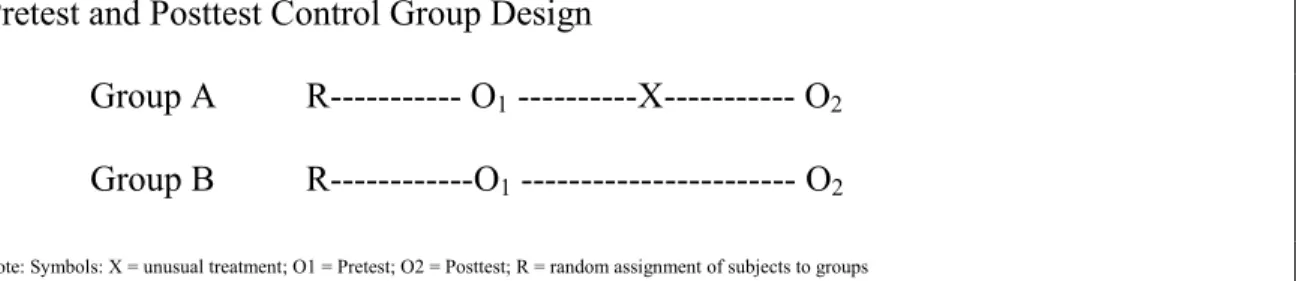
quasi-experimental group design with a nonequivalent control group. Within this design, two treatment groups were pretested, administered a treatment, and post tested. Data analysis includes analysis of variance (ANOVA) or regression analysis to look for differences between groups and correlation or predictive factors between variables. An advantage of using the non equivalent control group design is that established classes are selected; possible effects from reactive arrangements are minimized. In the study, the groups (students) are not even aware that they are involved in this research. Figure 1 illustrates the pretest-posttest control group design. Due to the transient nature of the school, modifications were made in order to complete the study. Only data collected from students present during all three assessments were considered as part of this research. Kuhn (2004), Otaiba (2006), Speece, Ritchey (2005), and Welch (2006), suggested that there is a connection between guided oral reading and reading fluency. It was assumed that using a guided oral reading program would increase reading fluency on the
DIBELS/ORF.
Pretest and Posttest Control Group Design
Group A R--- O1 ---X--- O2
Group B R---O1 --- O2
Note: Symbols: X = unusual treatment; O1 = Pretest; O2 = Posttest; R = random assignment of subjects to groups
Research Question and Hypothesis
RQ1: What is the difference in the individual student gain scores on the fluency domain in DIBELS for students utilizing the Scholastic Guided Reading Program as opposed to students utilizing the Harcourt Trophies reading series?
H0: There is no significant difference in the individual student gain scores on the
fluency domain in DIBELS for students utilizing the Scholastic Guided Reading Program as opposed to students utilizing the Harcourt Trophies reading series.
H1: There is a significant difference in the individual student gain scores on the
fluency domain in DIBELS for students utilizing the Scholastic Guided Reading Program as opposed to students utilizing the Harcourt Trophies reading series.
For the rationale of this research study, the analysis of variance was used to compute gain scores between the two groups. The scores were computed using Spring Year 1, Fall Year 2, and Winter Year 2 DIBELS/ORF benchmark scores, from the two respective groups of participants.
Setting
Vandasy et al.’s (2005) research served as a model for my own work. Like Vandasy et al, I used a modified quasi-experimental quantitative research design to compare the efficacy of two treatments on improving individual reading fluency. The classes of students were not intact and the population of students was assumed to be fluid during the school year. While understanding that arbitrary assignments are desired, this was a convenience sample of classes available to me. Five randomly assigned classrooms (i.e., 1 gifted, 2 average, and 2 EIP) were assigned the Scholastic Guided Reading
Program. The other five classes (i.e., 1 gifted, 2 average, and 2 EIP) were taught using the Harcourt Trophies series. Students’ classroom assignments were based on curricular decisions in place to comply with state and federal funding sources. Additionally, some students were placed in specific classrooms due to late enrollment or their repeating a grade level.
The study was conducted at a rural north Georgia elementary school. The student body consisted of 1,109 students; 157 of those students being first grade. School ethnicity was 55% European American, 15% African American, 18% Latino American, 8%
multiracial and 4% Asian American. The gifted population made up 9% of the student population, students with disabilities accounted for 14% of the student body, and 6% were characterized as having limited English proficiency. A student population with 46% free and reduced lunch qualified the school as a Title I school.
Instrumentation and Materials
Kindergarten children enrolled at the study school at the end of the previous school year were assessed using DIBELS. All students in Kindergarten participated in the DIBELS assessment without exclusions or modifications unless the student was covered by an Individualized Education Plan (IEP). When assessing students with IEP’s, all accommodations and modifications were followed. The rationale of DIBELS was to provide confirmation of students’ reading readiness for placement within the first grade. Students were assessed in three areas: initial sound fluency, letter naming fluency, and word use fluency. Many of the skills measured by DIBELS relate to reading readiness. Using the DIBELS assessment information was beneficial to evaluating the two reading
programs. Additionally, DIBELS is routinely administered to all first grade students in August, December, and April of each school year. Appendix B shows the preexisting reliability and validity information regarding DIBELS.
Harcourt Trophies
Trophies provides explicit, systematic phonics instruction to build word recognition skills that enable students to become efficient decoders. The rereading for fluency feature within the program for first grade has students reread with expression, pacing, and intonation. Focus on the fluency component occurred two days a week using the following activities: echo reading, choral reading, repeated reading and readers theatre.
Scholastic Guided Reading
In each assigned classroom guided reading procedures took place on a daily basis. The teacher worked with small groups of students between ten and thirty minutes a day, depending on reading ability. Then, the teacher provided introductions to the reading material that supported students’ later efforts at problem solving. Individual students read the whole text or a combined part of the story. Students decoded new words while
reading for understanding and comprehending. The teacher prompted, encouraged, and confirmed students’ efforts at problem solving. The teacher and students engaged in conversations that monitored and measured students’ understanding what they were reading. The teacher and students revisited the story to reveal and use a range of
comprehension tactics. Repeating this procedure on a daily basis proved to be a valuable strategy in students’ reading fluency success.
Data Analysis
SPSS, version 14.0 for Windows, was used to analyze data. Descriptive statistics calculated for scores within classes of students in the two opposing reading programs. Data analysis included analysis of variance (ANOVA), which evaluated mean differences between the two treatments. The Spring Y1 test was used to determine student placement in classes to prescribe intervention/enrichment strategies. The statistic of interest for this study is the difference from Fall Y2 to Winter Y2. The ANOVA was performed using data from the DIBELS scores during the Spring Y1, Fall Y2 and Winter Y2 testing period.
Measures for Ethical Protection of Participants
No risks were involved within this study. Participants were not aware a study was being performed, as they were actively engaged in their normal routine at school. Daily classroom routines were maintained as teachers followed the prescribed instructional reading programs’ guidelines. Confidentiality of student scores was also maintained, as numbers were used in place of student names. The only persons with access to the student DIBELS data were the EIP/Title I teachers and the homeroom teachers. The data are stored in a locked filing cabinet for five years and will be destroyed at the end of the five years. Data on my computer have been burned to a disk, deleted from the computer, and then stored with the other information in the locked filing cabinet. Consent was obtained from the Institutional Review Board (IRB), # 06-23-10-0332397, prior to conducting this research.
Ethical considerations maintaining the well being of the study participants were well thought out. Students assigned to the classrooms involved in the study had no knowledge of their participation. The study was based on the repeated use of DIBELS at my school, an assessment measure that has been in place for many years. All study participants data was strictly confidential. Access to data was limited to teachers directly involved with the study. Confidentiality was maintained throughout the study. All names were coded to protect the participants.
The teachers involved in this study approached me to ask if they could use the Scholastic Guided Reading Program. Knowledge of the first grade student population, teachers’ training, data from the study, stakeholder agreement, and careful consideration were given, resulting in the approval for the program’s implementation in the respective classes.
Section 4: Results of the Study
Introduction
In this study, I compared the efficacy of two instructional reading programs on first grade students’ reading fluency as assessed with DIBELS. In this section, I provide the outcomes of my assessments based on word fluency difference scores among two classes of students. Class 1 was taught using the Scholastic Guided Reading program; Class 2 was taught using the county adopted basal reading program, Harcourt, Trophies.
Participant Data
One hundred twenty-nine first grade students from rural north Georgia
participated in this study. Participants’ scores from each class over the course of the study are shown in Appendix C and D. The classes of students were not intact and the
population of students was assumed to be fluid during the school year. The students were chosen to be a part of this study due to the increase in the number of first grade students not making adequate yearly progress in the area of reading fluency. While accepting that random assignments are favored, this was a convenience sample of classes available to me. Five random assigned classrooms (i.e., 1 gifted, 2 average, and 2 EIP) were assigned the Scholastic Guided Reading Program. The other classes consisted of students who were taught through the Harcourt Trophies series (i.e., 1 gifted, 2 average, and 2 EIP) were assigned. The classrooms are based on curricular decisions that have been in place due to state and federal funding sources. Students were placed in classrooms due to late enrollment and repeating a grade level. The participants enrolled at my school for
kindergarten the previous year were given Spring Y1 DIBELS assessments. The data served as a pretest for treatment Class 1 and nontreatment Class 2. Students were placed in classes based on the initial DIBELS assessment. The assessment also directed student placement into individual classrooms.
The nontreatment intervention was composed of Harcourt Trophies basal reading series. The treatment intervention consisted of Scholastic Guided Reading program. The nontreatment and treatment lasted for five months. Each teacher used only the reading series assigned for the study: Class 1 (Scholastic Guided Reading) and Class 2 (Harcourt Trophies reading series). The total length of the data collection was eight months. I analyzed the posttest data results to determine if there were significant gains in the individual students reading fluency scores after the treatment and nontreatment periods.
Data Analysis
The research question addressed in this study was the following: Is there a difference in the individual student gain scores on the fluency domain in DIBELS for students utilizing Scholastic Guided Reading program as compared to students utilizing Harcourt Trophies reading program? The null posited no significant difference in the individual student gain scores on the fluency domain, Initial Sound fluency (initial test), Word Fluency (pretest) as compared to the Oral Reading Fluency (posttest), in DIBELS for students utilizing Scholastic Guided Reading (Class 1) program as opposed to students utilizing Harcourt Trophies reading program (Class 2). The alternative
hypothesis posited that there would be a significant difference in the individual student gain scores on the fluency domains, Initial Sound fluency (initial test), Word Fluency (pretest) as compared to the Oral Reading Fluency (posttest), in DIBELS for students utilizing Scholastic Guided Reading program (Class 1) as opposed to students utilizing Harcourt Trophies reading program (Class 2).
Data exist so that students were able to be grouped according to the design. Data collection began in the spring of Year 1 as students were completing kindergarten.
Participating teachers were provided a spreadsheet with the data from the DIBELS scores (Appendix C and D). Using descriptive statistics such as means and standard deviations, I analyzed the differences in students’ fluency performances within each class. Word Fluency showed possible trends in fluency learning and the instructional program utilized.
The ANOVA was completed to establish significant differences among the gains scores in the reading fluency of first grade students. The multivariate test showed a
significant difference among measures (F = 17.85, p < .05). The level of significance for
the hypothesis included in this study was .05 standard generally accepted for research in the social sciences (Table 1).
Table 1
Means and standard deviations of the gain scores
Measurement N M SD Class 1 SY1 66 46.75 14.05 Class 2 SY1 63 39.87 14.39 Class 1 FY2 66 38.33 18.77 Class 2 FY2 63 32.71 18.12 Class 1 WY2 66 66.13 39.79 Class 2 WY2 63 32.03 28.58
Analysis of variance performed on the pretest Initial Sound Fluency Spring Y1, Fall Y2 Word Fluency, and posttest Winter Y2 Oral Reading Fluency, indicated some significant differences in the comparative results. Use of the analysis of fluency across the study for each assessed areas, during each data collection period. Using the Spring Y1, Fall Y2, Winter Y2, scores allowed me to thoroughly examine the results of different teaching methods. Strengths and weaknesses could be found in each program and there was a statistical difference in the final outcome of this study. I also examined fluency’s overall statistical gain scores using just the Spring Y1 and Winter Y2 scores. The results from Spring Y1 to Fall Y2 in both Class 1 and Class 2 went down significantly. This significant drop in scores can be attributed to the end of the school year and the lack of instruction during the eight week summer break. Any time students are away from the
school environment for an extended period of time, there will be some regression. However, students who were given individual leveled instruction upon returning from summer break increased significantly, as shown in this study.
As shown in Table 2, no significant differences were shown between gain scores for Class 1 SY1 and gain scores Class 1 FY2 or between gains scores Class 2 SY1 and gain scores for Class 2 FY2. There were, however, significant differences in gain scores from Class 1 FY2 and Class 1 WY2. No significant gain score differences between Class 2 FY2 and Class 2 WY2 were revealed.
Table 2
Repeated measures contrasts on gain scores
Source df t Sig
Gains from Class 1 SY1 to Class 1 FY2 66 3.47 .001
Gains from Class 2 SY1 to Class 2 FY2 62 3.32 .002
Gains from Class 1 FY2 to Class 1 WY2 66 5.73 .000
Gains from Class 2 FY2 to Class 2 WY2 62 -.17 .865
Explanation
The results of the study were calculated and showed the differences between the students who were taught using the Scholastic Guided Reading program (Class 1) and students taught using the Harcourt Trophies basal reader (Class 2). As shown in the box plot (see Figure 2) generated using the ANOVA within subjects test, a significant difference was found between gain scores of Class 1 and Class 2. This indicated that
students’ fluency rates were impacted significantly for students in Class 1 from the Fall Y2 to Winter Y2 as compared to students in Class 2 whose scores did not increase from the Fall Y2 to Winter Y2.
Figure 2. Mean achievement gain scores for each study measurement. The vertical line is the mean achievement gain score. The horizontal line shows the gains.
Using the t test to average academic standings for each class and for each of the
three assessment periods, Spring Y1, Fall Y2, Winter Y2, added to the study and allowed further investigation into the different methods of teaching and corresponding results for
Class2WY2 Class1WY2 Class2FY2 Class1FY2 Class 2SY1 Class1SY1 200 150 100 50 0 45 19 10 23
improving fluency. The t test was also used for the average overall gain score. Just using the Spring Y1 and Winter Y2 scores were used.
Conclusion
In Section 4, I described the data collection, the data gathered, and findings related to the research question. Quantitative findings included results for determining whether students taught with the Scholastic Guided Reading Program improved reading fluency more than students taught using the Harcourt Trophies basal reader. Test results used for the data analysis of this study were collected from data distributed to the researcher from the Early Intervention and Title 1 teachers at my school.
The results indicate Class 1 students benefitted from the instruction using the Scholastic Guided Reading Program. The Scholastic Guided Reading program positively impacted student reading fluency results over the course of the year. The findings are significant and are to be taken into account when school districts adopt new reading series curriculum materials.
Section 5: Conclusion
Introduction
In this final section, I restate the research problem and methods used to address that problem. My goal in this study was to compare two teaching methods and the impact each method had on improving students’ fluency based on DIBELS assessments. In the sections, outcomes are reviewed and indications are stated.
Struggling readers often continue to fall behind their peers throughout their school careers, and all of their academic subject areas suffer (Calhoon, 2005; Graves, Plasencia-Penado, Deno, & Johnson 2005; Vadasy, Sanders, & Peyton, 2005; Vaughn, Mathes, Linan- Thompson, & Francis, 2005). This study developed from the fact 38% of first grade students in a rural north Georgia school have scored below average on Georgia Reading Performance Standards’ fluency domain. Some teachers at the study school
believed that the currently adopted reading series, Harcourt Trophies©, (2003), was not
meeting the needs of struggling readers.
These teachers wanted to explore effective alternative reading programs to improve students’ reading fluency based on students’ present levels. During Year 1, five
of the ten classroom teachers implemented the Scholastic Guided Reading Program©,
(2002). Guided reading is supported by research as a method to increase reading fluency (Kuhn, 2004; National Institute of Child Health and Human Development, 2001; Pinnell, 2003, 2006; Rasinski, 2004; Samuels, 1979, 1997; Speece & Ritchey 2005; Wiley & Deno, 2006). The other five classroom teachers continued to use the county adopted basal