The copyright of this thesis vests in the author. No
quotation from it or information derived from it is to be
published without full acknowledgement of the source.
The thesis is to be used for private study or
non-commercial research purposes only.
Published by the University of Cape Town (UCT) in terms
of the non-exclusive license granted to UCT by the author.
University
of
Cape
University
of
Cape
Town
PREDICTING ACADEMIC DISHONESTY USING THE THEORY OF PLANNED BEHAVIOUR
STEPHANIE PULKER PLKSTE002
DR SUKI GOODMAN
ASSOCIATE PROFESSOR JEFFREY BAGRAIM (SUPERVISORS)
A dissertation submitted in partial fulfilment of the requirements for the award of the Degree of Master of Social Science in Organisational Psychology
Faculty of Humanities University of Cape Town
2012
COMPULSORY DECLARATION:
This work has not been previously submitted in whole, or in part, for the award of any degree. It is my own work. Each significant contribution to, and quotation in, this dissertation from the work, or works of other people has been attributed, and has been cited and referenced.
University
of
Cape
Town
Acknowledgements 1 Abstract 2 Introduction 3 Literature review - Academic dishonesty- The Theory of Planned Behaviour
- The Theory of Planned Behaviour and academic dishonesty
5 5 12 16 Method - Research design - Sample - Measures - Procedure 25 25 24 26 27 Results - Factor analysis - Reliability analysis - Correlation analysis - Behaviour
- Partial Least Squares analysis
29 29 31 31 33 33 Discussion
- Relationships between the variables
- The Theory of Planned behaviour as a model of prediction of academic dishonesty
- Limitations and suggestions for future research
37 38 39 44
Implications for tertiary academic institutions 47
Conclusions 48
References 49
Appendix A Appendix B Appendix C
University
of
Cape
Town
AcknowledgementsI wish to express my sincere gratitude to my supervisors, Jeffrey Bagraim and Suki Goodman. Without their valuable guidance, support and patience, this study would not have been realised. I also wish to thank Parker, the webmaster of the commerce faculty at the University of Cape Town for his assistance with the electronic distribution of the questionnaire to the students. I would also like to thank Petrus Nel of the University of the Free State for his valuable guidance with the structural equation modelling. Finally, I wish to thank all the students who participated in this study.
University
of
Cape
Town
AbstractThis study investigates academic dishonesty among undergraduate commerce students using the Theory of Planned Behaviour (TPB). A total of 579 respondents from three tertiary institutions in the Western Cape in South Africa completed an online survey about their attitudes, subjective norms, perceived behavioural control towards academic dishonesty, their intentions to engage in academic dishonesty behaviours and their previous academic dishonesty behaviour. Correlation analyses indicated significant, positive relationships between all of the antecedents of the TPB. Structural Equation Modelling (SEM) using the Partial Least Squares (PLS) method showed that the antecedent variables of the TPB were significant predictors of academic dishonesty behaviour and provided support for the use of the TPB in predicting academic dishonesty behaviour. The information in this study can be used to further understand the occurrence of, and students’ perceptions towards academic dishonesty. This information can be used to design interventions to prevent academic dishonesty at tertiary institutions.
University
of
Cape
Town
Academic dishonesty has been identified as a common problem at academic institutions globally (De Jager & Brown, 2010; Davis, Grover, Becker, & McGregor, 1992; Jones, Johnson-Yale, Millermaier, & Perez, 2008). A recent high profile incidence of academic dishonesty implicated the former German minister of defence after the discovery that that he had plagiarised large sections of his doctoral thesis (“German minister gives up doctorate”, 2011, February 22). The minister was stripped of his doctoral title and resigned as minister (“De Maiziere named”, 2011, March 2). Although the former minister admitted that he had erred in breaching academic standards, he denied that he had cheated deliberately (“German minister loses doctorate”, 2011, February 24).
Cases of plagiarism accusations among high profile individuals in South Africa have also been reported. In 2006, renowned South African writer Antjie Krog was accused of plagiarism by Stephen Watson, the head of the English department at the University of Cape Town at the time (“Antjie Krog denies plagiarism claims,” 2006, February 21). Watson accused Krog of using material from Ted Hughes’ 1976 essay Myth and Education in her book Country of my Skull (“Antjie Krog denies plagiarism claims”). Watson also alleged that the concept for Krog’s 2004 collection of poetry entitled the songs say ‘tsau’ was stolen from his book Return of the Moon: Versions from the /Xam. Krog denied the allegations and stated that Watson’s claims were an attempt to destroy her (Krog, 2006).
Shamim Shaik, brother of Shabir Shaik (former financial advisor to President Jacob Zuma) had his doctoral degree in Mechanical Engineering from the University of KwaZulu-Natal (UKZN) withdrawn after it was discovered that he had plagiarised parts of his thesis (“Chippy Shaik stripped of doctorate”, 2008, March 2 ). Although Shaik denied the allegations, his degree was withdrawn by the senate at UKZN after he was found guilty of plagiarism.
Plagiarism is just one form of a variety of behaviours which constitute academic dishonesty (Arhin & Jones, 2009). Other forms include, but are not limited to, cheating, collusion, and fraudulence (Akbulut et al., 2008; Arhin & Jones,). For the purposes of this study, the term academic dishonesty will be used when referring to any of these behaviours.
University
of
Cape
Town
Studies in the area of academic dishonesty have attempted to investigate the factors that contribute to it (de Bruin, 2007; Passow, Mayhew, Finelli, Harding, & Carpenter, 2006; Sisti, 2007; Stephens, Young, & Calabrese, 2007; Whitely, 1998). A small example of these factors include past cheating behaviour, type of assessment, attitudes towards academic dishonesty, institutional policies, year of study, and age (Akbulut et al., 2008; Passow et al.; Whitely).
The Theory of Planned Behaviour (Ajzen, 1985) has been used to investigate various social behaviours. The premise of the theory is that behaviour will be as the result of a preceding intention to engage in that behaviour (Ajzen). Three components (attitudes, subjective norms, and perceived behavioural control), are said to contribute to the formation of an intention to engage in a behaviour. The theory has had success in predicting dishonest actions and intentions (Beck & Ajzen, 1991) and more specifically, academic dishonesty intentions and behaviours (Harding, Mayhew, Finelli, & Carpenter, 2007; Mayhew, Hubbard, Finelli, Harding, & Carpenter, 2009; Stone, Jawahar, & Kisamore, 2010).
University
of
Cape
Town
LITERATURE REVIEWThe aim of this study is to investigate academic dishonesty using the TPB. The various forms of academic dishonesty will be discussed, followed by an explanation of the TPB. Subsequently, previous use of the TPB in explaining academic dishonesty is explored.
Academic Dishonesty
Academic dishonesty is a problem with which higher educational institutions are perpetually faced (Davis, et al., 1992). It remains a relevant topic of interest as reported incidences of academic dishonesty are increasing and becoming more pervasive despite institutional policies to curb it (Davis, et al., 1992; Jones, Johnson-Yale, Millermaier, & Perez, 2008; McCabe, Treviño & Butterfield, 2001, Whitely, 1998). This is of concern in and of itself, but also as there is some evidence to suggest that students who engage in academic dishonesty are more likely to engage in dishonest actions in the workplace (Nonis & Swift, 2001). The reputations of tertiary institutions and professions are placed at risk due to academic dishonesty (Etter, Cramer & Fin, 2006).
Tertiary academic institutions are regarded as establishments with high levels of academic integrity and instances of academic dishonesty threaten this (Etter, et al., 2006; Passow, et al., 2006). Academic dishonesty is concerning as it is detrimental to the moral development of students (Passow et al.). The validity of measures of student academic progress is degraded if students engage in academic dishonesty (Passow et al.). Some vocations, such as those in the health care industry, emphasise professional and ethical practises (Harper, 2006; Lingen, 2006). Academic dishonesty in institutions that prepare students for such vocations could threaten the ethical integrity of the institutions as well as the professions (Harper; Lingen).
University
of
Cape
Town
Definitions of academic dishonesty.Academic dishonesty is been defined as “the intentional participation in deceptive practices regarding one's academic work or the work of another” (Gaberson, 1997, p.14). Academic dishonesty is multifaceted and is comprised of various forms of plagiarism, cheating in tests and examinations, unauthorised help, and evading the process of assessment (Akbulut et al., 2008; Arhin & Jones, 2009; Faucher and Caves, 2009; Nonis & Swift, 2001; Passow et al., 2006; Teferra, 2001). Several forms of academic dishonesty are defined below.
Plagiarism. Akbulut et al. (2008) defined plagiarism as the illicit use of any form of information without acknowledging the original source. Plagiarism of sources obtained from the internet is concerning (Jones et al., 2008). It has been suggested that the students do not view plagiarism offences as severely as academic staff (De Jager & Brown, 2010). Students may commit plagiarism without intending to do so, and that intent should be the main factor in determining whether or not an individual is guilty of plagiarism (De Jager & Brown).
Cheating. Cheating is said to occur when students submit work that is copied from the work of a peer, or allows another student to copy from their work (Faucher & Caves, 2009; Passow et al., 2006). This can occur in examination and homework settings (Harding, et al., 2007). Academic dishonesty was reported in test settings where students communicated by way of a code which they had developed prior to the test, using body language or the clicking of writing utensils (Davis et al.; Faucher & Caves, 2009).
Unauthorised use of information. The use of unauthorised information is another form of academic dishonesty. This form of academic dishonesty has been reported in test and examination settings (Arhin & Jones, 2009; Davis et al., 1992; Faucher & Caves, 2009). It was reported that some students hide calculators down their pants prior to a test, and hide notes in a plastic bag in their mouths for use during a test (Davis et al.). Students may write crib notes onto their arms and hide these under long sleeves (Arhin & Jones; Faucher & Caves). It has been reported that students would record information for an examination onto a cassette tape prior
University
of
Cape
Town
to writing a test and then utilise a walkman or similar device in the examination to playback the recorded information (Arhin & Jones; Faucher & Caves). More recently, iPods have been used to store pre-recorded information (Faucher & Caves). Students then take these into the examination under the premise that the music on the iPods is being used to block out noise (Faucher & Caves).
Evading the process of assessment. Students avoid assessment processes by not writing examinations themselves, or by claiming that that parts of an examination paper was missing (Teferra, 2001; Faucher & Caves, 2009). These practises have been reported in higher educational institutions. In a study of the prevalence and implications of academic dishonesty at higher educational institutions in Ethiopia, it was identified that students would not hand in examination attendance or registration forms so that the student can sit for another examination if the current examination is failed (Teferra). Teferra found that students would remove the difficult sections of the examination question paper so that if they fail, they can claim that their failure is the fault of the institution for not supplying them with a complete question paper. Students may employ the use of an impersonator to write their examinations on their behalf (Faucher & Caves).
Faculty facilitated academic dishonesty. Faculty members may also be guilty of committing academic dishonesty. By colluding with students and giving them information as to the contents of their examinations, faculty members could be said to be guilty of academic dishonesty (Faucher & Caves, 2009). An indirect method of aiding academic dishonesty is that of faculty members allowing students to go the bathroom unsupervised during examinations. This could allow students the opportunity to go through notes that they have hidden on their person prior to the examination (Faucher & Caves).
Schmelkin, Gilbert, Spencer, Pincus and Silva (2008) identified another indirect way in which faculty members could facilitate academic dishonesty in students. The study indicated that faculty members do not always report every incidence of academic dishonesty that they witness. Jones, et al. (2008) found that even though 46% of students reported having plagiarised, only 15% of those students had been caught. This could mean that faculty did not notice the plagiarism, or that they were
University
of
Cape
Town
disinclined to report it (Jones et al., 2008). It has been proposed that failure to report academic dishonesty reinforces the academic dishonesty behaviours in the student, as the student believes that he will not get caught (Schmelkin et al.). Failure to report academic dishonesty may perpetuate the cycle of academic dishonest behaviours by students (Schmelkin et al.).
Faculty members may be reluctant to report academic dishonesty behaviours to avoid becoming involved in extensive litigation processes (Davis et al., 1992). Faculty members may not report academic dishonesty for fear of being seen as the person responsible for having a detrimental effect on a student’s career (Davis et al.).
The use of technology and academic dishonesty.
It has been suggested that academic dishonesty is being facilitated by the increased use of technology in educational settings (Faucher & Caves 2009; Harper, 2006; Whitely & Starr, 2010). Several studies have reported the negative influence of technology in educational settings (Faucher & Caves; Harper; Whitely & Starr). Students store information on cellphones, personal digital assistants (PDAs) for use in examination settings (Harper; Jones et al, 2008).
Students use the internet to find the correct answer when taking a test online and cellular telephones are used to text answers to peers taking a test (Faucher & Caves, 2009). Harper (2006), illustrated a variety of high-tech cheating methods. These methods involved using cellular telephones with built-in cameras to send images of notes and the test paper to other peers taking the test. Items such as the “KeyKatcher”, a device that captures keystrokes from a keyboard on a computer, are readily available for purchase over the internet (Harper).
In an investigation of the use of technology by US students in academic settings, it was found that almost one third of students reported knowing someone who had made use of some form of technology to cheat (Jones et al., 2008). These forms of technology included the use of cellular telephones to store information or contact a
University
of
Cape
Town
friend during an examination, and personal digital assistants (PDAs) in which students can also store information.
The use of the internet in education has increased substantially, with courses being offered online, and online libraries and search engines being used for research (Jones et al., 2008). The use of the internet in academic settings has lead to the development of different forms of traditional academic dishonesty (Sisti, 2007). These forms include “copy-paste” plagiarism, new ways of storing information to be used in tests and examinations, and alternative methods of purchasing assignments (Etter, Cramer, & Finn, 2006; Jones et al.; Sisti).
Copy-paste plagiarism is defined as the use of one or more complete sentences from the internet (Sisti, 2007). This form of plagiarism is appealing to students as it requires little effort, and can be executed quickly (Jones et al., 2008; Sisti).
A popular method of obtaining information is reported to be the illicit use of online chat rooms, blog sites and forums (Akbulut et al., 2008). The internet provides a medium for people to buy and sell pre-written essays (Harper, 2006). A variety of websites promise non-plagiarised term papers for sale (Sisti, 2007). Studies have reported that this method of cheating is one of the least popular of the internet based academic dishonesty methods (Akbulut et al.; Sisti)
Internet access is used to find the correct answers when taking a test online (Faucher & Caves, 2009). Students can obtain information illicitly in traditional test and examination settings by accessing the internet via their cellular telephones (Moran, 2008).
With the internet making distance learning more accessible, distance learning has increased (Jones et al., 2008). Academic dishonesty in distance learning has also become easier, as this form of learning is not as well facilitated as traditional residential learning (Harper, 2006). This could lead to someone else, other than the learner, taking online assessments (Harper).
University
of
Cape
Town
Academic dishonesty in the African context.Limited studies of academic dishonesty have been conducted to assess the prevalence of academic dishonesty in the African context (Johnson Nenty & Radimo, 2009; Teferra 2001). It has been proposed that the high prevalence of academic dishonesty in developing countries such as Ethiopia and Nigeria could largely be explained by the low socio-economic status of the majority of the population of these countries (Teferra). People living in these countries may believe that a university degree could be a way in which to obtain a better job and liberate oneself from poverty (Teferra). Thus, pressure to obtain a university degree could be high. Teferra proposed that this high level of pressure could encourage academic dishonesty.
The influence of technology on academic dishonesty in developing countries such as Ethiopia may not be as large as more developed countries in which sophisticated technologies are readily available to students (Teferra, 2001). Teferra stated that in many African countries, electronic communication is very poorly developed, and even conventional communication is unreliable. Thus, Teferra expected that electronic academically dishonest behaviours would be more difficult to commit due to the limited nature of technology available. Students who intend to commit academically dishonest behaviours thus have to come up with other methods in which do to so (Teferra).
Records of academic dishonesty in some African countries are not easily found (Teferra, 2001). This could be attributed to the prestigious nature of universities in developing African countries; faculty might be reluctant to report cases of academic dishonesty for fear of damaging the reputation of their universities (Teferra). The difficulty in obtaining records could be due to the fact that in many African countries, oral tradition is far more entrenched than that of writing and thus accurate reports of academic dishonesty are sometimes difficult to find (Teferra).
University
of
Cape
Town
Academic dishonesty in South Africa.Although much research on academic dishonesty has been conducted in the United States and elsewhere, there is a limited amount of research into academic dishonesty in the South African context (de Bruin, 2007). Research done in the South African context analysed the responses of 683 psychology students from a South African university (de Bruin). It was reported that 38% of the students had indicated that they had committed a form of academic dishonesty at least once in their academic careers. However, de Bruin states that this measure of academic dishonesty is of premeditated academic dishonest behaviours, and that the actual incidence of academic dishonesty may be higher as impulsive academic dishonesty behaviours were not measured.
De Bruin (2007) focussed on two personality factors: Conscientiousness, and excitement seeking. The results indicated a significant, positive relationship between academic dishonesty and the variable of excitement seeking, and a significant, negative relationship between academic dishonesty and conscientiousness. Together, however, the personality variables only explained 5.1% of the variance in academic dishonesty. De Bruin subsequently proposed that the influence of these personality variables on academic dishonesty will be subject to situational limitations on behaviour.
The measure of academic dishonesty in the study by de Bruin (2007) only included incidences of academic dishonesty in tests and examinations and did not include measures that could be facilitated by the technology such as copy-paste plagiarism or e-academic dishonesty as defined by Akbulut et al. (2008).
In an investigation into the views of plagiarism among academic staff at the University of Cape Town, it was found that there were inconsistencies in the perceptions of what constitutes plagiarism and in the methods of dealing with student plagiarism (De Jager & Brown, 2010). Academic dishonesty behaviour was found to be a problem with up to 89 cases of academic dishonesty being reported in one year (De Jager & Brown).
University
of
Cape
Town
Research into academic dishonesty behaviours have used different theories and approaches to investigate its antecedents (Akbulut et al., 2008; Harper 2006; Passow et al., 2006; Schmelkin et al., 2008; Whitely, 1998). Several studies have investigated academic dishonesty with the use of the Theory of Planned Behaviour, and have found it to be useful in predicting academic dishonesty behaviours, and intentions to engage in academic dishonesty (Beck & Ajzen, 1991; Harding et al., 2007; Stone et al., 2010).
The Theory of Planned Behaviour
The TPB (figure 1) is an extension on the Theory of Reasoned Action (TRA) (Ajzen, 1985). The TPB has been used to investigate different social behaviours since its development, and in some recent studies, it has also been used to investigate academic dishonesty (Harding et al., 2007; Stone et al., 2010). The TPB aims to understand and predict intentions to perform or not to perform social behaviours in various contexts (Ajzen, 1991; Ajzen & Fishbein, 2005; Beck & Ajzen, 1991).
The TPB and the TRA are based on the assumption that human beings are rational and that any human social behaviour is predetermined by an intention to engage in target behaviour (Ajzen, 1985). The intention to engage in a target behaviour is strengthened by the degree of control the individual has over the performance of the target behaviour (Ajzen). If the individual holds a strong intention to engage in a target behaviour, then the likelihood of the behaviour being performed is increased (Ajzen, 1991).
The TPB has been shown to be successful in explaining intentions to engage in a variety of human social behaviours such as shoplifting, recycling, and school attendance, among others (Armitage & Connor, 1999; Azjen & Madden, 1986; Beck & Ajzen 1991; Davis, Ajzen, Saunders, & Williams, 2002; Harding et al., 2007; Hrubes, Ajzen, & Daigle, 2001; Passow et al., 2006; Schifter & Ajzen, 1985; Stone et al., 2010; Tonglet, Phillips & Read, 2004).
University
of
Cape
Town
Figure 1. The Theory of Planned Behaviour (Ajzen, 1991)
Intentions.
According to the TPB, intentions are the product of three antecedents: the attitude towards the behaviour, the subjective norm, and perceived behavioural control over the behaviour (Ajzen, 1991). The strength of the influence of the three antecedents on intention may vary according to the behaviour and the context (Ajzen). A strong intention to perform a target behaviour will be the result of a favourable attitude and subjective norm towards the behaviour, as well as strong perceived behavioural control (Ajzen).
Attitudes.
The attitude towards a target behaviour is the individual’s evaluation of the behaviour in question (Ajzen, 1985). This is based on the individual’s positive or negative beliefs about the outcomes of performing the target behaviour which are referred to as behavioural beliefs. The attitude towards a target behaviour is the product of the values placed on these behavioural beliefs (Ajzen). If an individual has mostly positive beliefs towards the outcome of a target behaviour, then the individual will form a positive attitude towards the behaviour. (Ajzen). A favourable attitude towards the target behaviour will increase the intention of the individual to perform the behaviour (Ajzen). Attitudes Subjective Norm Perceived Behavioural Control Intention Behaviour Normative beliefs Control beliefs Behavioural beliefs
University
of
Cape
Town
Subjective norms.The subjective norm is defined as the individual’s “perception of the social pressures put on him to perform or not perform the behaviour in question” (Ajzen, 1985, p.12). The subjective norm is a function of the normative beliefs held by the individual (Ajzen). Normative beliefs are comprised of individuals’ beliefs that referents (those important to them) feel that they should engage or not engage in the behaviour, and the individuals’ motivations to comply with them (Ajzen). Individuals will develop a favourable subjective norm towards behaviour if their referents with whom they are motivated to comply believe that they should perform the behaviour (Ajzen). According the TPB, the stronger the subjective norm, the stronger the intention to perform a target behaviour (Ajzen). However, if individuals experience social pressure from their referents not to engage in a target behaviour, then they may feel pressure to avoid engaging in the behaviour.
Perceived behavioural control.
Perceived behavioural control is the individual’s “perception of the ease or difficulty of performing the behaviour of interest” (Beck & Ajzen, 1991, p. 183). Perceived behavioural control is determined by control beliefs about the availability of the required resources and opportunities required to perform a target behaviour (Ajzen, 1991). These beliefs are based on a combination of past experiences of the behaviour, information obtained from others about the behaviour, as well as other factors that will increase the ease of performing the behaviour (Ajzen). If individuals believe that they have the required resources and opportunities necessary to perform a target behaviour, and perceive few obstacles, then their perceived behavioural control will most likely be strong (Ajzen). If the perceived behavioural control is a reflection of actual control, then there will be a direct relationship between perceived behavioural control and the target behaviour (Beck & Ajzen).
The components of the TPB have also been used in conjunction with other factors to investigate behaviour.
University
of
Cape
Town
The Theory of Planned behaviour with the inclusion of additional factors. One of the most common criticisms of the Theory of Planned Behaviour is that the constructs in the theory are not sufficient to predict behaviour, and that other constructs such as moral norm and past behaviour should be included in order to predict behaviour more accurately (Beck & Azjen, 1991; Tonglet et al., 2003). Ajzen (1991) stated that “the Theory of Planned Behaviour is open to the inclusion of additional predictors if it can be shown that they capture a significant proportion of the variance” (p. 199).
Many researchers have taken Ajzen’s (1991) statement into consideration, and studies have been conducted using the Theory of Planned Behaviour with the addition of other constructs in order to explain behaviour more accurately (Armitage & Connor, 1999; Beck & Ajzen, 1991; Harding et al., 2007; Passow et al., 2006; Stone et al., 2010; Tonglet et al., 2004).
Tonglet, et al. (2004) added the constructs of moral norm, past recycling behaviour, situational factors and recycling outcomes, recycling consequences, and concern for the environment as predictors of behaviour to the TPB in order to investigate the determinants of recycling behaviour. It was reported that the TPB alone predicted 26% of the variance in recycling behaviour; however, the explained variance increased to 33.3% when the constructs of moral norm, past recycling behaviour, situational factors and recycling outcomes, recycling consequences and concern for the environment were added to the theory.
Additional support for the inclusion of other variables to the TPB was reported by Armitage and Connor (1999) who added the variables of self-identity and social desirability as additional antecedents of intention to the TPB model. It was found that once the variables of the TPB were accounted for, the addition of the construct of self-identity contributed an additional 4% in predicting intention. However, the results showed little support for the construct of perceived behavioural control. Stone et al. (2010) added two personality variables, prudence and adjustment, to the TPB in a study that predicted academic misconduct intentions among undergraduate business students. The results did not suggest any significant relationship between the
University
of
Cape
Town
construct of adjustment and the components of the TPB model, but the construct of prudence was found to influence cheating behaviour directly.
In a meta-analysis of 161 articles of the efficacy of the TPB in predicting various forms of unspecified behaviour, Armitage and Conner (2001) found that the variable of self-efficacy was more effective than perceived behavioural control in explaining the variance in intention. However, the authors conceded that this could be because their self-efficacy measures may have been more clearly operationalised than measures of perceived behavioural control. Thus, they stated with caution that the construct of self-efficacy should be used instead of the construct of perceived behavioural control. This finding supports the results of a previously mentioned study by the same authors in which it was found that perceived behavioural control was not a significant predictor of intentions or behaviour (Armitage & Conner, 1999). This finding suggests that the component of perceived behavioural control may not contribute to the original TRA.
The Theory of Planned Behaviour and Academic Dishonesty
The Theory of Planned Behaviour has found strong support in explaining and predicting academic dishonesty (Beck & Ajzen, 1991; Harding et al., 2007; Mayhew et al., 2009; Passow et al., 2006; Stone et al., 2010). The variables of a favourable attitude towards academic dishonesty, subjective norms in favour of academic dishonesty and perceived behavioural control have been found to be positively related to both intentions to engage in academic dishonesty, as well as academically dishonest behaviours (Stone et al.; Mayhew et al.). In a study using the TPB to explain academic dishonesty in Engineering and Humanities students it was found that the constructs of attitudes, subjective norms and perceived behavioural control were more strongly related to intention to engage in academic dishonesty than to academic dishonesty behaviour (Harding et al.).
In a comparison of the TRA and the TPB, Chang (1998) found that the TPB was more effective in predicting unethical behaviours. Beck and Azjen (1991) found support for the TPB in an investigation of the usefulness of the theory in the prediction of dishonest actions. The results of Beck and Ajzen’s study showed that
University
of
Cape
Town
the Theory of Planned behaviour was able to predict the intentions to engage in dishonest behaviour with a high degree of accuracy, and had moderate success in predicting dishonest behaviours.
Theory of Planned Behaviour was found to account for 27.8% of the variance in academic dishonest behaviour, with each component of the model having a significant, semipartial correlation to measures of academic dishonesty (Whitely, 1998). This result is supported by other studies of the Theory of Planned Behaviour and dishonest actions (Chang, 1998; Beck & Ajzen, 1991) and studies of the TPB and academic dishonesty (Armitage & Connor 2001; Stone et al.; 2010; Harding et al., 2007) This gives support for the efficacy of the theory in explaining academically dishonest behaviours.
Stone et al. (2010) evaluated the effectiveness of the Theory of Planned Behaviour on the prediction of academic dishonest behaviours in undergraduate business students. Thirty-six percent of the variance in academic dishonest behaviour was explained by the Theory of Planned Behaviour, with 21% of the variance in intentions explained by the components of attitudes, subjective norms and perceived behavioural control. In a meta-analytic review of the efficacy of the Theory of Planned Behaviour, Armitage and Connor (2001) found that the theory explained 20% of the variance in behaviour, adding further support to the usefulness of the theory.
Attitudes towards academic dishonesty.
Studies have shown that students who hold favourable attitudes towards academic dishonesty are more likely to engage in academic dishonesty behaviours than students who hold unfavourable attitudes towards academic dishonesty (Whitely, 1998). Students may not hold unfavourable attitudes towards academic dishonesty if they do not view it as being morally wrong (Arhin & Jones, 2009). This could be because academic dishonesty has been incorporated into student culture and is viewed by students as normal (Bates, Davies, Murphey & Bone, 2005; Passow et al., 2006). This process is known as neutralisation (Bates et al.).
University
of
Cape
Town
In a study which investigated factors influencing Engineering students to cheat by type of assessment (frequency of cheating in test settings and frequency of cheating in examination settings), attitudes towards cheating in test settings significantly explained 2% of the variance of frequency in cheating in tests when controlling for the variables of moral obligation not to cheat, demographics, pre-college cheating behaviour, and co-curricular participation (Passow et al., 2006). For cheating in examination settings, attitudes towards cheating did not contribute significantly to any of the explained variance.
A favourable attitude towards cheating on tests has been shown to be significantly related to both intention to cheat, as well as cheating behaviour (Beck & Azjen, 1991). A recent study of the theory of planned behaviour and academic dishonesty used academic misconduct as the target behaviour. Academic misconduct behaviour involved behaviours such as plagiarism, cheating on a test, and copying homework from other students. The results showed that attitudes were significantly related to intention to engage in academic misconduct as well as academic misconduct behaviour (Stone et al., 2010). This is in line with the results found by Harding et al. (2007).
Mayhew et al. (2009) found varied success for the variable of attitudes as a predictor of intention to cheat. In their study of undergraduate engineering and humanities students, attitude to engage in cheating was not a significant predictor of intention to cheat for students in moral consolidation. However, attitudes towards cheating were found to be a significant predictor of intentions to cheat (Mayhew et al.).
Proposition 1: There will be a significant relationship between a favourable attitude towards academic dishonesty and students’ intentions to engage in academic dishonesty
Proposition 2: A favourable attitude towards academic dishonesty will be a significant predictor of intention to engage in academic dishonesty behaviours
University
of
Cape
Town
Subjective norms and Academic Dishonesty.Academic dishonesty is reported to be higher when students perceive that society is permissive of academic dishonesty (Whitely, 1998). Students may also justify academic dishonesty as being acceptable with the notion that everyone does it (Crittenden, Hanna & Peterson).
It has been reported that instances of academic dishonesty were lower when students perceived that their peers would disapprove if they engaged in academic dishonesty (McCabe & Treviño, 1997). This could be explained by the fact that students held an unfavourable subjective norm towards academic dishonesty. The unfavourable subjective norm could be due to their normative beliefs to comply with their peers who were perceived to be disapproving of academic dishonesty. An unfavourable subjective norm towards academic dishonesty could have lead to a decrease in the intention to engage in academic dishonesty. This may have lead to lower reports of academic dishonesty among the students.
Studies have shown that a subjective norm that is in a favour of academic dishonesty is significantly related to intentions to engage in academic dishonesty and academic dishonesty behaviour (Stone et al., 2010; Beck & Ajzen, 1991; Harding et al., 2007). When cheating in test situations is the target behaviour, subjective norms were seen to be significantly related to both intention to cheat as well as cheating behaviour (Beck & Ajzen). Subjective norms were found to be significantly related to academic misconduct, and academic misconduct intentions (Stone et al.). A similar result was reported by Harding et al.
Subjective norms have also been shown to be a significant predictor of intention to engage in a behaviour. In a study of students from the engineering and humanities faculties, it was found that a subjective norm that was favourable towards academic dishonesty significantly predicted intentions to cheat (Mayhew et al., 2009).
Proposition 3: There will be a significant relationship between students’ favourable subjective norms about academic dishonesty and the intention to engage in academic dishonesty.
University
of
Cape
Town
Proposition 4: A subjective norm that is perceived to be favourable towards academic dishonesty will be a significant predictor of intention to engage in academic dishonesty behaviour.
Perceived behavioural control and academic dishonesty.
Academic dishonesty was found to be higher when students perceived that their peers had engaged in academic dishonesty (McCabe & Treviño, 1997). This could be explained, in terms of the TPB, by strong perceived behavioural control in students. Knowing that peers have previously successfully engaged in academic dishonesty may increase students’ control beliefs which may lead to a strong PCB. This could lead to an increased intention to engage in academic dishonesty, which may subsequently lead to academic dishonesty occurring.
It has been reported that there is a significant relationship between academic dishonesty at a lower academic level and academic dishonesty in tertiary institutions, and academic dishonesty was higher in students who perceived themselves to be successful cheaters (Whitely, 1998). Applying this to the TPB, Students who have experience in cheating and who believe that they have the ability to cheat successfully, may hold a control belief that they are able to cheat successfully. This may lead to strong PBC and thus an increased intention to engage in academic dishonesty.
The addition of the component of perceived behavioural control was found to improve the predictive power of the TRA, leaving the TPB more effective at predicting dishonest behaviours (Beck & Ajzen, 1991). Perceived behavioural control was found to be a strong contributor to the formation of intentions to engage in dishonest actions (Beck & Ajzen). Perceived behavioural control was found to be significantly related to intentions to engage in academic misconduct, as well as to academic misconduct behaviour (Stone et al., 2010; Harding et al., 2007).
Structural equation modelling has shown that there is a direct path not only from perceived behavioural control to intentions, but also from perceived behavioural
University
of
Cape
Town
control to academic misconduct behaviour, indicating that perceptions of control over cheating behaviour is a significant predictor of intention to engage in academic dishonesty behaviour (Stone et al., 2010). Perceived behavioural control has been found to be a significant predictor of cheating behaviours, but not of intention to cheat (Mayhew et al., 2009).
Proposition 5: There will be a significant relationship between perceived behavioural control and student’s intentions to engage in academic dishonesty
Proposition 6: Perceived behavioural control over academic dishonesty behaviours will be a significant predictor of intention to engage in academic dishonesty behaviours.
Proposition 7: Perceived behavioural control over academic dishonesty behaviours will be a significant predictor of academic dishonesty behaviour.
Intentions and academic dishonesty
Intentions have been shown to be related to attitudes, subjective norms, perceived behavioural control, and behaviour across a variety of academic dishonesty behaviours (Beck & Ajzen, 1991; Harding et al., 2007; Stone et al., 2010). Intentions to cheat correlated strongly with cheating behaviour (Beck & Azjen), academic misconduct behaviour (Stone et al.) and academic dishonesty behaviour (Harding et al.).
Recent studies have shown that intentions to engage in academic dishonesty are a significant predictor of academic dishonesty behaviour (Mayhew et al., 2009; Stone et al., 2010). Mayhew et al. found that intentions to cheat were strongly related to cheating behaviour in undergraduate engineering and humanities students. Intention has also been found to be a significant predictor of academic misconduct behaviours (Stone et al.).
University
of
Cape
Town
Proposition 8: The intention to engage in academic dishonesty will be significantly related to academic dishonesty behaviour
Proposition 9: An intention to engage in academic dishonesty will be a significant predictor of academic dishonesty behaviours.
University
of
Cape
Town
Table 1Empirical research for the TPB and academic dishonesty
Study Relevant variables Findings
Beck & Ajzen, 1991
- Cheating intentions - Attitudes towards cheating - Cheating subjective norms - PBC about cheating - Intention to cheat
- Self reported cheating behaviour - Perceived moral obligation
- TPB predicted intentions to cheat
- TPB predicted cheating behaviour with moderate accuracy
- Inclusion of PBC to TRA model showed significant improvement in prediction - Perceived moral obligation did not contribute much to explained variance in cheating behaviour
Chang, 1998 - Attitudes towards unethical behaviour - Subjective norms about unethical - behaviour
- PBC about unethical behaviour - Intentions for unethical behaviour - Unethical behaviour
-TBP better at predicting unethical behaviour than TRA
- PBC better predictor of behavioural intentions than attitude.
Passow, Mayhew, Finelli, Harding, & Carpenter, 2006
- Attitudes towards cheating in examinations and homework - SN about cheating in examinations and homework
- PBC about cheating in examinations and homework
- cheating behaviour in examinations - cheating behaviour in homework
- TPB predicted 36% of variance in cheating in examination
- TPB predicted 14% of variance in cheating in homework
- Decision to cheat influenced by type of assessment Harding, Mayhew, Finelli, & Carpenter, 2007
- Faculty of study (Humanities or Engineering) - Attitudes towards AD -SN about AD - PBC about AD - Intention to cheat - AD behaviour
- Moral obligation not to cheat
- Cheating reported more frequently by Engineering students
- Attitude, SN, PCB all significantly related to intention and behaviour
- Intention significantly related to behaviour - Use of TPB and moral obligation as model of decision making supported by results
Stone, Jawahar, & Kisamore, 2010
- Attitudes towards cheating - SN about cheating
- PBC about cheating - Intention to cheat - Cheating behaviour
- TPB explained 21% of variance in cheating intentions
- TPB explained 36% of variance in cheating behaviour
Whitely, 1998 - Attitudes towards cheating - SN about cheating
- PBC about cheating - Cheating behaviour
- Students with favourable attitudes, SN and PBC more likely to cheat
- TPB accounted for 27.8% of variance in cheating behaviour
Nonis & Swift, 2001
- Dishonest actions at work - Beliefs about dishonest actions
- Students were more likely to engage in dishonest acts if they felt these were acceptable McCabe, Trevino, & Butterfield, 2001 - Cheating behaviour
- Perceived chance of getting caught cheating
- Cheating lower when there was a perceived chance of being caught
University
of
Cape
Town
The majority of the research on academic dishonesty has been conducted abroad and there is limited research on this topic in the South African context. There is even less research on the use of the TPB as a model of prediction of academic dishonesty. This study will investigate whether the TPB can be used as a model to predict academic dishonesty in the South African context.
University
of
Cape
Town
METHODThere are four sections in this chapter. The research design is discussed before describing the characteristics of the research sample. Information on the measures used is presented and the data collection procedures are explained.
Research design
A descriptive design was used to investigate student intentions to engage in academic dishonesty (Hair, Babin, Money, & Samouel, 2003). This design was regarded as appropriate because propositions derived from the TPB will be used to guide the measures used to answer the research question (Hair et al.). This is a cross sectional study, and made use of an electronic, self-administered survey (Hair et al.).
Sample
Respondents were undergraduate students from the commerce faculties of three tertiary institutions in the Western Cape (N= 579). The study initially intended to draw samples from four different universities, however, one university did not respond timeously to requests for access to students. The ages of the respondents ranged from 17 years to 49 years. The mean age of the respondents was 21.5 years (M = 21.5, SD = 3.31). Males comprised 52% of the sample (N = 219), and females comprised 47.5% (N = 198).
The largest proportion of respondents, 24.5%, were in their second year of study, while third and fourth year students comprised 21.6% and 22.8% of the sample respectively. Students in their first year of study comprised 18.9% of the sample. A small percentage of the sample were in their fifth and sixth year of study (8.9% and 3.4% respectively).
University
of
Cape
Town
MeasuresBehaviour. The dependent variable in this study was the target behaviour of academic dishonesty. Academic dishonesty behaviours were measured using an adapted version of O’Rourke et al.’s (2010) 17 item index. The index in O’Rourke’s study had good internal consistency reliability with α = .81. Examples of these items included behaviour such as I used unauthorised notes during an examination, and I had someone do my assignment or hand-in tutorial work for me. A full list of the adapted items can be found in table 7. Respondents were presented with various academic dishonesty behaviours, and asked to indicate if they had ever engaged in the behaviours. An affirmative response to a statement was scored as 1 and a negative response was scored as 0.
The independent variables under investigation in this study were the variables of the Theory of Planned Behaviour: Attitudes, subjective norms, perceived behavioural control and intentions. The scale items for each of these variables can be found in appendix A.
Intentions. Intention to engage in academic dishonesty was measured using four items selected from Stone et al. (2010). The scale used by Stone et al. consisted of eight items and had good internal consistency reliability (α = .90). The four items with the highest factor loadings in the original scale were selected. Responses to items such as how likely are you to consider turning in another’s work done as your own?, were recorded on a 5-point Likert scale ranging from 1 (highly likely) to 5 (highly unlikely).
Attitudes towards academic dishonesty. Attitudes towards academic dishonesty were measured using four items Stone et al.’s (2010) scale measuring attitudes towards academic misconduct. The scale used by Stone et al. consisted of seven items and had good internal consistency reliability with α = .81. The four items with the highest factor loadings in the original scale were selected. Responses to items such as I would let another student cheat off my test if he/she asked, were recorded on a 5-point Likert scale ranging from 1 (strongly disagree) to 5 (strongly agree).
University
of
Cape
Town
Subjective norms. Subjective norms about academic dishonesty were measured using four items selected from Stone et al. (2010). The scale used by Stone et al. consisted of seven items and had good internal consistency reliability with α = .85. The four items with the highest factor loadings in the original scale were selected. Responses to these items such as in the past year, how often, if ever, have you suspected another student of cheating during a test or exam?, were recorded on a 5-point Likert scale ranging from 1 (strongly disagree) to 5 (strongly agree).
Perceived Behavioural Control. Perceived behavioural control to commit academic dishonesty was measured using four items selected from Stone et al. (2010). The scale used by Stone et al. consisted of four items and had good internal consistency reliability with α = .80. All four items from the original scale were used in the current study. Responses to items such as, If I wanted to cheat on assignments or papers, it would be easy, were recorded on a 5-point Likert scale ranging from 1 (strongly disagree) to 5 (strongly agree).
Procedure
Ethical clearance was obtained from the Ethics Committee of each participating university. One of the universities gave consent to participate in the study on condition that there would be no way in which to identify which data had come from that university. It was thus not possible to include a question asking respondents which university they were from.
Data was collected using electronic, self-administered questionnaires. The questionnaire was created on the survey platform, Survey Monkey, and a link to the questionnaire was sent to the commerce faculty webmaster at the University of Cape Town. The webmaster placed an announcement informing students about the survey on the University of Cape Town’s resource sharing platform, Vula. Students from other institutions were sent announcements via email.
Students received an invitation to complete the questionnaire via email and via a log-in screen on Vula. The log-invitation contalog-ined a llog-ink to the questionnaire as hosted by Survey Monkey. A cover letter (appendix C) to the questionnaire informed students
University
of
Cape
Town
of the purpose of the study and that any identifying information would be removed from the results before they were sent to the researchers. Consent was indicated by clicking continue to complete the survey. Respondents completed the survey and submitted their responses electronically. All participation was voluntary and anonymous. Any data that could be used to identify the students was removed before the data were received for analysis.
To encourage participation, an incentive in the form of a R1 000.00 lucky draw was offered to those who completed the survey. Students entered the lucky draw on completion of the survey so that identifying information could be kept separate from the survey responses. Once the survey had been closed, an online random number generator was used to select the number of the winning student.
University
of
Cape
Town
RESULTSThere are four subsections in this chapter. The results of the factor analyses on the scales are presented first. This will be followed by the results of the reliability analysis. The frequency of the academic dishonesty behaviours will then be presented. Subsequently, the results of the correlation analyses and Partial Least Squares (PLS) analyses, that were used to investigate the propositions presented in the literature review, are presented.
Factor analysis
In order to determine the factorial validity of the scales, exploratory factor analyses were conducted (Hair et al., 2003).
Principal components factor analysis was used to assess the four items from the attitude scale. The items loaded on one factor and explained 54% of the variance (eigenvalue = 1.62). Table 2 shows the factor loadings of the items in the attitude scale.
Table 2
Attitude scale items factor loadings
Factor Loading
I would let another student cheat off my test if he/she asked. -0.76 Students should go ahead and cheat if they know they can get away with it. -0.75 I would not report an incidence of cheating by a student whom I consider to be a friend -0.60 Reporting incidences of cheating is NOT necessary just to be fair to honest students
who do not cheat
-0.49
Eigenvalue 1.62
Proportion of total 0.54
Note .Factor Loadings Extraction: Principal components. N = 492. Casewise deletion of missing data Factor analysis using the principal components extraction method was used to assess the four items which comprised the subjective norms scale. The items loaded on one factor and explained 53% of the total variance (eigenvalue = 2.12). Table 3 shows the factor loadings of the items in the subjective norms scale.
University
of
Cape
Town
Table 3Subjective norms scale items factor loadings
Item Factor
In the past year, how often, if ever, have you suspected another student of cheating during a
test or exam? -0.69
In the past year, how often, if ever, have you suspected that another student plagiarized an
assignment? -0.75
How frequently do you think cheating during tests and examinations occurs at your
university? -0.75
How frequently do you think plagiarism occurs at your university? -0.73
Eigenvalue 2.12
Proportion of total 0.53
Note. Factor Loadings; Extraction: Principal components. N = 492. Casewise deletion of missing data
Factor analysis using the principal components extraction method was used to assess the four items which comprised the perceived behavioural control scale. The items loaded on one factor and explained 66% of the variance (eigenvalue = 2.63). Table 4 shows the factor loadings of the items in the perceived behavioural control scale.
Table 4
Perceived behavioural control scale items factor loadings
Item loading
If I wanted to cheat on assignments or papers, it would be easy. -0.71 If I wanted to cheat on exams, it would be easy. -0.83 At this university, it would be fairly easy for me to cheat. -0.86
It is easy to cheat and NOT get caught. -0.84
Eigenvalue 2.63
Proportion of total 0.66
Note. Factor Loadings; Extraction: Principal components. N = 485. Casewise deletion of missing data. Factor analysis using the principal components extraction method was used to assess the four items constituting the intention scale. The items loaded onto one factor and explained 53% of the variance (eigenvalue = 2.13). Table 5 shows the factor loadings of the items in the intention scale.
University
of
Cape
Town
Table 5Intention scale items factor loadings
Item Loading
How likely are you to consider turning in another’s work done as your own? -0.75 How likely are you to consider copying from someone else during a test? -0.76 How likely are you to consider using unapproved materials (“crib notes”) during a test? -0.74 How likely are you to consider plagiarizing to complete an assignment or paper? -0.68
Eigenvalue 2.13
Proportion of total 53.32
Note. Factor Loadings; Extraction: Principal components. N = 485. Casewise deletion of missing data.
Reliability
To test the internal consistency of the scales, reliability analysis was conducted. Cronbach’s alpha reliability coefficient (α) was calculated for each scale. An α value of .7 or above is considered to be adequate (Hair et al., 2003). Two items from the scale measuring attitudes towards cheating were removed to increase the reliability of the scale to α =.544. Reliability of the subjective norms scale and of the scale measuring perceived behavioural control were satisfactory with α = .702 and α = .823 respectively. The scale measuring intentions had acceptable reliability (α = .698). Correlation analysis
Pearson product-moment correlation was used to assess the relationships between the variables and test propositions 1, 3, and 5. There were significant, positive correlations between the Theory of Planned Behaviour (TPB) variables (attitudes, subjective norms, perceived behavioural control and intention. The results of the analysis are displayed in table 6.
University
of
Cape
Town
Table 6Means, standard deviations and correlations between study variables.
M SD 1 2 3 4
1. ATT 2.49 .663 (.544)
2. SN 2.84 .777 .179** (.702)
3. PBC 2.27 .850 .189** .384** (.823)
4. INT 1.64 .639 .426** .289** .271** (0.698)
Note: ** p < 0.01, N = 417. ATT = Attitudes; SN = Subjective Norms; PBC = Perceived Behavioural Control; INT = Intentions; Scale reliabilities are reported on the diagonal.
Significant positive relationships were found between intentions, attitudes, subjective norms and perceived behavioural control. The strongest relationship found was that between attitudes and intentions (r = .426, p < 0.01). This result indicates that proposition 1 is supported by the data.
Subjective norms had a significant, positive relationship to intention (r = .289, p < 0.01). This supports proposition 3. A Significant, positive relationship was also found between perceived behavioural control and intentions (r = .271, p < 0.01). Thus, proposition 5 is supported by the data.
Behaviour
The occurrence of behaviour was calculated to determine the incidence rate of academic dishonesty amongst respondents in this study. These results are displayed in table 7. The behaviour reported most frequently was “I allowed someone to copy my assignment or hand-in tutorial work”, which 59.24% of respondents reported they had done. Just under half (46%) of the respondents reported that they had worked with other students on an assignment intended to be completed individually (I worked with another student on an assignment or hand-in tutorial that was supposed to be done independently). A small percentage (3%) of respondents reported having copied from someone in examination settings (I copied from someone during an exam).
University
of
Cape
Town
Table 7Occurrence of cheating behaviour
Behaviour item %
I allowed someone to copy my assignment or hand-in tutorial work 59 I worked with another student on an assignment or hand-in tutorial that was
supposed to be done independently 46
I copied all or part of someone’s assignment or hand-in tutorial work 44 I added items to a reference list that were not used in writing the paper 35 I added items to a reference list even though I had not read them 32 I gave answers to someone (or allowed someone to copy my answers) during a test 22 I used exact words or ideas from a WWW source without acknowledging the source 17
I copied from someone during a test 15
I used exact words or ideas from a book or other printed publication without
acknowledging the source 15
I turned in an assignment or hand-in tutorial written by someone else 14
I did someone’s assignment or hand-in tutorial work for them 11
I invented or altered data (e.g., entered nonexistent results into a database; adjusted
data to get a significant result) 11
I had someone do my assignment or hand-in tutorial work for me 9 I gave answers to someone (or allowed someone to copy my answers) during an
exam 6
I used unauthorized notes during a test 5
I used unauthorized notes during an exam 4
I turned in an assignment or hand-in tutorial that I had submitted for another course 4
I copied from someone during an exam 3
Partial Least Squares (PLS) analysis
Partial least squares analysis was conducted to test if the TPB was successful in predicting academic dishonesty behaviour. PLS path modelling is a technique appropriate for research in which the main aim is prediction (Henseler, Ringle, &
University
of
Cape
Town
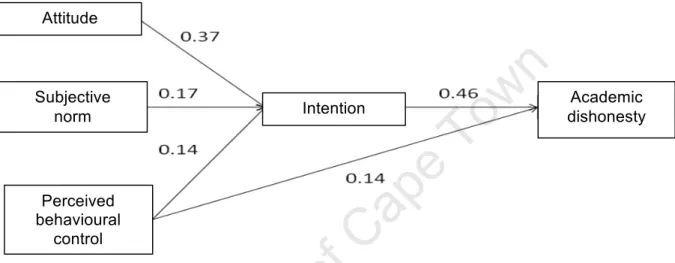
Sinkovics, 2009). PLS path modelling is suitable for this research as it is investigating if the TPB model can predict academic dishonesty. Another reason for the use of PLS in this study is that PLS is suitable for when there are single indicators for latent variables (Henseler et al.). The measure of academic dishonesty behaviour was a count of the behaviours which makes PLS suitable for the purposes of this study. The PLS path model is variance based and holds fewer restrictions than the co-variance based model. The PLS model does not assume that the data is normally distributed, and multiple measures of a construct may be used. In this study, multiple measures of the constructs of attitudes, subjective norms, perceived behavioural control and intention were used. Table 8 shows the path coefficients between the constructs.
Table 8
Path coefficients between TPB variables
Variables Correlation Path Coefficients (Smart PLS) SE t
ATT – INT 0.43 0.37 0.04 8.35
SN – INT 0.29 0.17 0.04 10.88
PBC – INT 0.27 0.14 0.04 3.23
PBC – BEH 0.27 0.14 0.05 2.74
INT – BEH 0.50 0.46 0.04 3.82
Note. ATT = attitudes; INT = intentions; SN = subjective norms; BEH = behaviour
All of the paths between the theory of planned behaviour variables and intention, and intention and behaviour were significant. The path coefficients between perceived behavioural control and intention and between perceived behavioural control and behaviour were low, but still significant (t=3.23 and t=2.74 respectively). These results indicate that attitudes, subjective norms and perceived behavioural control are all significant predictors of intention, and intention is a significant predictor of behaviour. The path coefficients also indicate that intention is a significant predictor
University
of
Cape
Town
of academic dishonesty. Thus, the results provide evidence to support propositions 2, 4, 6, 7 and 9.
The highest path coefficient observed was between intention and behaviour (t = 3.82). Overall, it was found that attitudes, subjective norms and perceived behavioural control explained 24.37% of the variance in intentions, while intentions explained 26.64% of the variance in behaviour.
Figure 2. Path coefficients between TPB variables. All paths are significant.
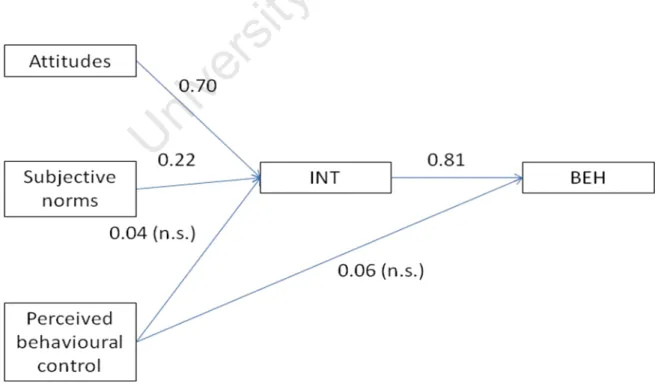
For comparative purposes, Structural Equation Modelling (SEM) was conducted to test the fit of the model to the data. The resuls of the SEM can be seen in Appendix B. The results of the goodness of fit test showed that perceived behavioural control was not a significant predictor of intention or of behaviour. This result indicates that in this context, the TPB may be no more effective than the TRA in predicting academic dishonesty behaviours.
A summary of the findings of the propositions can be seen in table 9.
Academic dishonesty Attitude Perceived behavioural control Subjective norm Intention