POLITECNICO DI MILANO
Facoltà di Ingegneria dell’Informazione
POLO REGIONALE DI COMO
Master of Science in
Computer Engineering
MUSIC RECOMMENDER SYSTEM
Supervisor: Prof. Sara Comai
Master Graduation Thesis by: Carlos Álvarez Angulo Student Id. number 737815
Abstract
The growing use of Internet as an information source, has led to the proliferation of technologies to deploy rich web based applications. Among these applications are present the music service providers. These systems allow users to listen to music without downloading it to the computer. Some use recommendations techniques to improve the user experience.
The objective of this project is to develop a music recommendation system. The system will determine the musical preferences of the users based on the analysis of their interaction during use. This way the system is able to estimate what artist or group would match user preferences to the user at a given time. It has been taken into account the fact that we do not always want to hear the same artists or genres, we do have favorite bands, but sometimes we appreciates a surprise, a new discovery.
The system uses music information collected from online music services that make available their music catalogs for developers‟ community to be used inside new applications. It has been created a web system that connects to the music service providers to obtain these musical catalogs. This system implements the necessary communication features to use this information in the client web browser.
This system helps users discover new artists, albums or songs making the musical catalog available for listening. The dynamic characteristics of the interface allows the user to browse music collections while listening to a song or playing a video. The user will receive information related to her interaction patterns in form of recommendations of items. These items will probably match user preferences and they are shown as the user interacts with the system and only when it has enough information about user preferences.
1. Introduction
The Internet evolution continuously generates several changes in social habits related to communication and lifestyle. The bandwidth growing originated the birth and late spreading of complex file-sharing systems. This systems known as peer to peer software let users share files they had stored locally in their personal computers with other users connected to the same system. Music sharing started thanks to software like Napster (www.napster.com) or late Audiogalaxy (www.audiogalaxy.com). These peer to peer systems revolutionized the music industry and so the habits of people related to musical collect and playback. Now it was easier to search music, easier to store music, and much cheaper to get it. This new situation led to massive music storage for sharing purposes and affected the way music was reproduced, changing from complete and straight album reproduction to the creation of complex playlists composed of many artist and musical genres.
The continue increasing in connection speed and trends in web development technologies, given rise to large web systems nowadays visited daily. Among these advanced systems, there are systems that allow users to listen music online without the need of downloading it to their personal computer. This issue solves a big problem originated by peer to peer software. This is the music copyright problem confronted with the music purchaser rights. The time to define the line delimiting the freedom a user has to share something he allegedly bought legally had come. Big music distribution companies started legal battles against the most important peer to peer software owners, the success of these legal processes depended on the copyright laws in each peer to peer hosting country. Despite some peer to peer software systems stand till nowadays, this web music services came up as new music sharing formulas.
The music listening services own big music catalogs, in order to provide a wide public use. These same services manage the copyright problems for each country. They adapt the musical catalog according the copy and reproduction rights of the musical label associated to each album. Most of these music services are paid, some provide free access to the musical catalog, but no reproduction rights. There is a wide variety of these systems and new alternatives are constantly emerging increasingly improved. Some are simple players providing playlist functionality (prostopleer.com), others accompany the player with a recommendation system of similar artists (www.spotify.com), also there are complex collaborative systems in which hundreds of people leave comments on songs (www.pandora.com, www.lastfm.com ) and have the chance of interact with each other as in the newly emerging social networks.
Music Recommender systems can be seen as a surrogate of real-world radio stations and music magazines. These real-world organizations main purpose is to promote certain artists, sometimes because the radio directors or magazine editors find noteworthy the quality of their musical works, sometimes just because of economic interest. Some people listen to these stations and read magazines in order to make decisions about what music to acquire:
either by traditional means or through some share-alike network. Music recommenders have the chance of making accessible to users not only the market-defined “good music”, but also new emerging groups, minor rare music and independent label‟s productions.
Approaches to recommendation
Recommendation is an important field strongly related to web business which has been intensely researched in the past years, since electronic commerce web sites started their activity. Among the reviewed approaches, many solutions were found for data analysis, data colleting, or data-objects representation. According these, models like content-based, collaborative or context-based give differenced solutions to select key information to face recommendations. In parallel to the recommender model‟s development also evolves the mathematical world related to the most pure heuristic bases of recommender systems.
The most common mathematical [1] models used in current recommender systems have been reviewed helping the author of this project to build up a solid idea about what recommendation is and how can it be achieved. These mathematical approaches to recommenders:
- Logic recommender systems [17] try to find an exact match among the recommendation options compared the user profile. The data representation is build using the attributes that define objects. Attribute types as used as they are with no further abstraction.
- Vector space-based systems [28] due to its numeric data modeling, estimate which objects best suit the user profile statements. Data object surrogates represent attributes in vector form being each cell a concrete attribute.
- Probabilistic systems [17] estimate a concrete object‟s importance using a probability function. This function estimates the probability the object has in order to meet the preferences stated in the user profile.
The application of these methods depends on the features of the recommendation problem itself. An important step of the design phase is how to adapt the problem abstraction to a suitable mathematical model,
This project has been designed in order to meet some logic-based recommender features. In one hand, due to the need of overcoming the numerical representation of data, needed to use other mathematical approaches, in other hand because is allows the closest data representation domain to this problem.
Project definition
The objective of this project is to develop a music recommendation system. The system will determine the musical preferences of users based on the analysis of their interaction during use. This way it‟s possible to estimate what artist or group would be pleasing to the user at a given time. It has been taken into account that we do not always want to hear the same artists or genres, we have favorite bands, but sometimes a listener needs to be surprised, enjoy a new discovery. A music recommender needs a music catalog to be recommended, this project offers a review of several music services and their features, making use of musical information available online provided by some (friendly) music services. These services allow developers to access their musical collection to contribute with the proliferation of new applications. It has been created a web component that connects to music service providers to obtain this data. The web system implements the essential communication skills to use this information within the client web browser.
This system helps users discover new artists, albums or songs making this music information accessible. For doing this, a complete analysis of the state-of-the-art for music recommendation has been performed, giving clear highlights about the recommendation techniques used in many systems which implement recommendation thought diverse mathematical models. The dynamic characteristics of the interface allows the user to browse music collections while listening to a song, album, or playing a video. The users will receive information related to their interaction patterns (profiles) as personalized recommendations of items which probably they would like, while they use the application.
Goals and scope outline
The goals of this project are outlined below:
- Create a music recommendation system able to infer the user‟s musical preferences in a given time. The scope is not to know the user; instead it‟s about estimating what he could like right now.
- Explore the music services available nowadays looking for a complete and freely accessible music catalog and free streaming services.
- Develop a working system capable of making the most of free online services to provide the user with a completely free system which brings the opportunity of discovering new music.
Topics which won‟t be covered:
- This application is not for commercial use. So many issues related to it, like international translation or fine browser compatibility are out from this work outlines. - The intention of this work in not to create a big music recommender or a big music
streaming web site. The application itself stands as a data collector and as a benchmark for checking if the data obtained from web services is valid to be used for recommendation purposes.
Thesis structure
This project is composed by two parts of differenced nature. First it has been performed an introductory review about recommendation, explaining why the recommender systems are so important for electronic commerce, what kind of systems do perform recommendation focusing arguments in music recommendation. Along the section 2 of this document, it‟s presented a general recommender system‟s overview, including a possible taxonomy [6], a technical overview [17] and a classification [1].
Section 3 includes a complete music recommender‟s overview, including previously proposed approaches, and reviews of commercial and non-commercial systems which are currently online. Following this introduction to music recommenders, the problem this project is facing is defined (Section 4) and so the selected methodology to achieve it (Section 5). The development has been sliced in three iterations, which faithfully represent the real project evolution. Sections 6.2, 6.3 and 6.4 deeply explain the actions and decisions taken in each one.
After presenting this project, the conclusions‟ section (7) includes some observations inferred from the whole project execution. The contributions achieved in this project, are just my two cents for the huge knowledge about recommendation out there.
2. The recommender systems
2.1. Introduction
The roots of recommender systems were settled due to special needs of works in diverse fields: cognitive science [19], information retrieval [20] or economics [21]. Recommender systems emerged as an independent research area in the middle 90s and their important role to enhance data accessibility attracted the attention of both, academic and industrial worlds.
Recommender systems are a useful way to expand search algorithms since they help users discover items they might not have found by themselves. A recommendation is basically to present the user with some items which would match his preferences. There exist different approaches [1] to collect information about the users, by monitoring their interaction, by asking them to perform some actions or to fill some forms with personal information. The user's interaction with the system provides two types of information:
Implicit information: Collected from the user interaction itself. For example, by keeping the items the user has interacted with, and item related information like viewing times, item‟s reproductions or user related information as group membership.
Explicit information: The users provide this information every time they give opinion about items, rating or liking some item. Generally all the information elaborated by the user consciously.
The recommender system collects both kinds of information to generate the user profile. This profile stores information not only about the user likes, also information about the user itself, current placing, current personal needs, sex, age, professional position, and so. The way it's used by the recommendation system varies a lot among the different systems. The information stored within is also a determinant factor in the recommender algorithm design.
2.2. Taxonomy for recommender systems
A possible taxonomy of the recommender systems it has been proposed in [1]. The categories in which is divided describe diverse models of abstraction for user profile, how it is generated, and how is it late maintained and how does it evolve as the system runs.
User profile representation: An accurate profile is an important task since the recommendation success depends on how the system represents the user's interests. Next are listed some models applied in current recommender systems:
- History-based
Some systems keep a list of purchases, the navigation history or the content of e-mail boxes as a user profile. Additionally, it is also common to keep the relevant feedback of the user associated with each item in the history. Amazon1 web site is a clear example.
- Vector-space
In the vector space model, items are represented with a vector of features, usually words or concepts which are represented numerically as frequencies, relevance porcentaje or probability.
- Demographic
Demographic filtering systems create a user profile through stereotypes. Therefore, the user profile representation is a list of demographic features which represent the kind of user.
- User-item ratings matrix
Some collaborative filtering systems maintain a user-item ratings matrix as a part of the user profile. The user-item ratings matrix contains historical user ratings on items. Most of these systems do not use a profile learning technique. Systems like Jamendo2 include this technique to represent user profile.
- Classifier-based models
Systems using a classifier as a user profile learning technique, elaborate a methodology to monitor continuously input data in order to classify the information. This is the case of neural networks, decision trees and Bayesian networks.
- Weighted n-grams
Items are represented as a net of words with weights scoring each linking between nodes. For example in [22] ), the system is based on the assumption that words tend to occur one after another a significantly high number of times, extracts fixed length consecutive series of n
characters and organizes them with weighted links representing the co-occurrence of different words. Therefore, the structure achieves a context representation of the words.
1 www.amazon.com
Initial profile generation:
- Empty: the profile is built as the users interact with the system. - Manual: the users are asked to register their interest beforehand.
- Stereotyping: Collecting user-related information like city, country, lifestyle, age or sex.
- Training set: providing the users with some items among which they should select one.
Profile learning technique: The way the profile changes during time.
- Not needed: Some systems do not need profile learning technique. Some because they load the user related information from a database or it‟s dynamically generated. - Clustering: Is the process of grouping information objects regarding some common features inherited to its information context. User profiles are often clustered in order to groups according to some rule. To assess which users share common interests. Recommenders like Last.fm3 or iRate4 perform this technique [12].
- Classifiers: Classifiers are general computational models for assigning a category to an input. To build a recommender system using a classifier means using information about the item and the user profile as input, and having the output category represent how strongly to recommend an item to the user. Classifiers may be implemented using many different machine learning strategies including neural networks, decision trees, association rules and Bayesian networks [1].
- Information retrieval techniques: When the information source has no clear structure, pre-processing steps are needed to extract relevant information which allows estimation of any information container‟s importance. This process comprises two main steps: feature selection and information indexing.
Relevance feedback: The two most common [1] ways to obtain relevance feedback is to use information given explicitly or to get information observed implicitly from the user‟s interaction. Moreover, some systems propose implicit-explicit hybrid approaches.
- No feedback: Some systems do not update the user profile automatically and, therefore, they do not need relevance feedback. For example, all the systems which update the user profile manually.
- Explicit feedback: In several systems, users are required to explicitly evaluate items. These evaluations indicate how relevant or interesting an item is to the user, or how relevant or interesting the user thinks an item is to other users. Some systems invite
3 www.last.fm 4 irate.sourceforge.net
users to submit information as track playlists. iRate uses this approach to provide its recommender with finer information about user‟s preferences.
- Implicit feedback: Implicit feedback means that the system automatically infers the user‟s preferences passively by monitoring the user‟s actions. Most implicit methods obtain relevance feedback by analyzing the links followed by the user, by storing a historic of purchases or by parsing the navigation history.
2.3. Design paradigms for recommender systems
One of the most practical issues for designing optimal-response recommendation systems is to represent and ontology the actors involved in the recommendation process in a suitable way for the selected model.
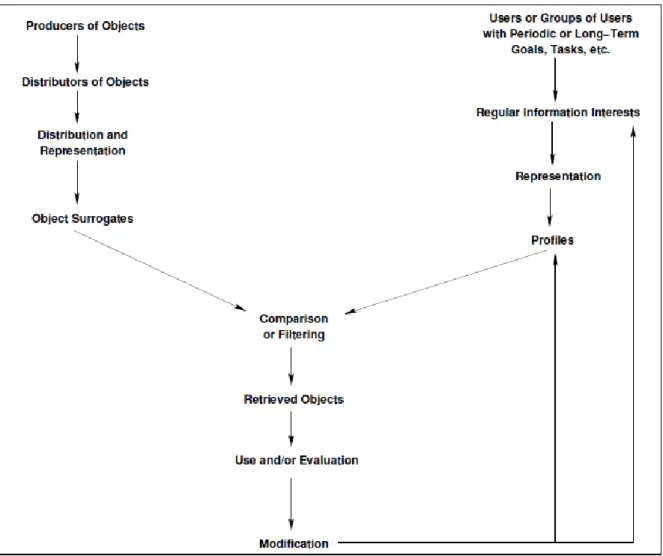
A general model for recommender system design optimally explained in [11] provides an interesting overview of this kind of systems. Next diagram [fig 1] makes a clear idea of this general model.
Design paradigms will provide solutions for assessing, the domain representation for actor surrogates and for algorithms the system may use over this surrogates to infer their utility. These design paradigms have been optimally reviewed in [17]. It is convenient to concretely determine the domain for the recommender system. This domain, in order to be a useful starting point for system design, should model or represent the following entities and processes:
Objects of interest
These are the objects subject to evaluation which stand as main information units the system will use to make recommendations. For a music recommender, these objects might be artist, albums and tracks.
Users
Each user has a user profile modeled following some design pattern depending on the design paradigm chosen for the system. This profile is the item against the objects of interest will be compared. The profile is the representation of the user preferences, related somehow to the objects the user could consider interesting. So the user profile will be a representation built with a set of item surrogates or with some generalization of those.
User environment
More transient information about the user, like local time and day, the task in which the user is involved currently, user mood, etc. It shortly amplifies the user profile expressiveness.
It should be noted that the performance of the frameworks presented next, will suffer severely due to limitations in the scope of available features. For instance, when item surrogates do not feature attributes that represent some the actual features people perceives on those objects. Obviously, this is not a problem of the frameworks themselves, but about the manifestation of the knowledge-representation designers.
2.3.1. Logic Recommender systems
This model is based on the idea of exact match: the system rejects or accepts objects depending on whether they satisfy the constraint statements present in the user profile. As described in [17], objects that match the constraints in the profile, since share the same characteristics, are considered to have the same utility value.
Domain representation
The object surrogates are represented as a group of attributes associated to some object identifier or to some description text. Each of these attributes has a well-defined type, which fully conveys the semantics of the attribute value. Regarding user profiles, those
collections of statements that define which attributes values are considered useful. These statements effectively restrict the range of values an object‟s attribute may take so that it is considered useful.
Comparison process
The main operation for comparison is checks whether the set of attributes associated to a given object satisfy the constraints encoded in the user profile. It is searched within an object repository which matches perfectly those constraints. The number of attributes to consider is fixed. This process turns each list of attributes attached to indexed objects into a list of boolean assessments that represent whether a constraint present in the profile is satisfied or not.
Usually, to avoid too strict specification, the list of constraints is parsed in disjunctive normal form: as soon as a constraint is satisfied, the object is accepted.
Drawbacks and limitations
The profile expressiveness is acquired explicitly by making the system ask users about their long-term information needs, this is forcing these users to express themselves. Then the reliability of the information conveyed by a profile might be suspicious, allowing the possibility of mistaken answers encoded as correct.
2.3.2. Vector Space-Based Recommender systems
These systems profit multidimensional properties of vector-spaces to represent item‟s surrogates. The surrogates must be numerically performable in order to be placed inside a multi-dimensional environment. In [28] it is explained an approach to recommendation using this model.
Domain representation
As the name of this model suggests, domain entities surrogates are vectors, where each dimension represents a certain object attribute. Attribute type should be real numbers. User profiles represent features which satisfied certain used needs in the past. Objects whose surrogates are found to be similar to those appearing on the user profile, are assumed to have the a utility value proportional to the degree of similarity they share.
Comparison process
While the boolean model tried to compute exact match, vector-space model aims at computing the degree of similarity between object surrogates and the set of prototypes specified within the user profile. Item surrogates can be compared using vector-space related methods. In order to compare two real-valued vectors, the Euclidean distance or Cosine of the angle, method provides reliable vector matching [24].
Drawbacks and limitations
Vector space models do not allow to directly employ categorical attributes in the object surrogates. In order to do so, these categorical variables must be mapped to a subset of the real line. And this mapping function must preserve the ordering relationship, if any, in the value set. Sometimes, these variable semantics are not amenable to be expressed as an ordered set of numbers, leading to leave out these, since the framework does not offer support for them.
2.3.3. Probabilistic Recommender systems
Domain representation
User preferences are represented as a probability distribution. Object‟s surrogate attributes become the variables for this probability distribution. Therefore, the problem is to estimate the parameters for the probability distribution that maximize the likelihood of observed user behavior. As [17] shows this gives an interesting twist to the problem of modeling long-term user information needs, since user profile can be seen as a stochastic process that produces statements assessing which objects are interesting.
The probabilistic framework, in principle, allows integration of both numeric and categorical observations.
Comparison process
The uncertainty hypothesis for recommender systems relies on whether an object belongs or not to the set of objects that satisfy user‟s information needs. This hypothesis is calculated for each object element‟s surrogate .
The probability is calculated as follows:
This inference method, in contrast with the previously discussed, requires to estimate the parameters that define , also called likelihood of , as well as , called hypothesis prior. is not relevant for the problem of interest, because it is based on the interaction user needs which are not required to solve recommendation . The most usual way to estimate is applying the Maximum Likelihood estimation5 procedure, deeply explained in [27]. This estimation requires to have available a set of surrogates for objects that are known to be in the relevant set.
Drawbacks and limitations
In practice numeric attributes can be difficult to handle since they imply integrating the estimated probability density function, as stated in [24]. Numeric attributes can be clustered, or better said, encoded as a set of discrete symbols. These resulting synthetic categorical attributes are not the exact equivalent of their numeric meaning, because any mapping function from the infinite set of numbers to a finite, not very large set of integer numbers implies a loss of information. The assignment of points to target symbols and the measurement of the associated distortion phenomena is optimally obtained if:
- Maximizing the homogeneity of assignments
- Maximizing the minimum separation between cluster assignees
This fact is considered a NP-hard problem6 since no exact, polynomial solutions are known. Therefore lots of numerical approximations to this problem have been analyzed as optimally reviewed in [18].
2.4. Classification for recommender systems
Not general agreement about classification for recommenders it has been found while reviewing previous works. The recommendation systems were optimally classified in [6] by sorting the system's recommendation approach in a quite generalized overview. The way in which the recommendation is faced in terms of scope:
The heuristic based techniques focus on the pure algorithmic part of the implementation. The big advantage of these techniques is that they are not based on a complex system architecture. Therefore these solutions can be easily plugged into whatever kind of recommender system designed following some algorithm-independent approach [13].
The model based solutions move a step forward by creating a complete pattern of recommender system. Each model defines its item's surrogates, the profile generation and maintenance. The algorithms used then for matching purposes might be analytically selected, based on the desired system's behavior.
A different overview differences each approach according decisions taken when designing item surrogates are mainly guided by the approach selected to estimate the utility of a given item A for a particular user U. There are two main branches for this overview, on one hand based on the social properties of networks, such as the collaborative filtering [3], on the other hand relied in the user interaction and preferences, like content-based filtering [4]. The proposal described in [1] studies the possibility of combining both techniques, referred as hybrid recommendation systems, obtaining finer recommendations from better suited user profiles. I found further complete the solution explained in [6] and resumed next.
- Content-based systems: item surrogates will be composed of attributes that characterize their information content.
- Collaborative systems: item surrogates are reduced to their minimum expression, and their utility estimation is more a matter of statistical or probabilistic prediction.
- Context-based systems: item surrogates are composed of contextual information. - Hybrid systems: using combination of all of the above methods.
2.5. Conclusion
This review shows the variety of decisions to make when planning a recommender system, offering a complete summary that eases the decision making process upon analysis‟ phase. Some decisions visualized after this analysis state that the user profile employed in this recommender could be based on history based generation, due to the monitoring capabilities of the web interface itself. The user profile will be refreshed when new information is retrieved from interaction, therefore user profile is continuously evolving. The only relevant feedback taken into account for this purpose is the purely implicit. It is retrieved optimally by the case-designed web interface. The most suited solution found for this purpose relies on logic-recommenders as mathematical model and data domain representation, while its features as recommendation model still could be more precisely estimated after next section, where music recommenders are introduced.
3. Music recommender systems
3.1. Overview
There exist a variety of web systems ready to help users discover new music, some are commercial applications, some are open source projects easy to inspect, therefore providing useful information about their model design. Commercial systems are completely closed to users, no reviews detailed in their documentation or internal logic explained at all. Some documented users could infer the model of these services, but it is impossible to get detailed information about the recommendation algorithm or user profile concept implemented in this systems.
Most of commercial systems often implement a complex recommender structure, some examples are Last.fm, Grooveshark or Spotify. All of them incorporate a music recommendation algorithm as an important part of their working. This algorithm is an information-filtering system itself, which plugged into musical systems, tends to sharp the music collection presented according the user's preferences. Some of the most important (in terms of popularity) music services are Last.fm7, Pandora8, Spotify9, Magnatune10, but also implement recommender algorithms lots of Internet sites as Apple music store11, (ITunes is the most popular according [5]), or the Amazon e-Commerce website12.
There exist pure music recommenders like Emergent-music13 inside commercial world and for inside non-commercial world as iRate14. Despite these systems are not large complex communities as those mentioned above, they successfully fulfill recommendation actions. It ought to be considered that collaborative approaches strongly depend on the number of regular users the system is managing. I understand a regular user as someone interacting frequently with the system; otherwise, a latent user will not be useful for collaborative purposes. Some of them are reviewed next while those selected to be used for this purpose, upon being deeper studied; are listed in section 6.2. First Iteration
7 Last.fm website: www.last.fm.com 8
Pandora system: website: www.pandora.com
9 Spotify desktop system: www.spotify.com 10 Magnatune radio website: magnatune.com
11 Apple Itunes Store: www.apple.com/itunes/what-is/store.html 12
Amazon website: www.amazon.com
13 www.emergentmusic.com 14 irate.sourceforge.net
3.2. Approaches to music recommendation
The collaborative filtering, whose recommendation heuristics depend on the rankings established by the system users [6], sets out some important efficacy problems. It can happen that some song or some artist isn't ranked by any user, this artist or song won't be presented as a recommendation itself [7]. This mood clearly decreases the number of songs or artists available for recommendation, just because the items tend to be ranked increasingly and the most commercial music will be on the top of ranks due to popularity not to real user likes. The social features of the collaborative filtering converts the recommendation technique into a kind of filter which depends on social indicators not really in the user musical preferences, inviting the user to try something because some people liked it before, forgetting a little bit about the current hearing intentions.
The content-based filtering selects items based on the correlation between the content of the items and the user‟s preferences as opposed to a collaborative filtering system that chooses items based on the correlation between people with similar preferences [6]. Music content is often classified with some metadata tags, as artist name, genre, year, release country, and so, but sometimes audio features are also analyzed like melody, harmony, bass or tempo. These features are conveyed as surrogates about content. The available music not matching any feature of some played song or artist, will never be presented to the user as a recommendation, this causes the isolation of many music styles unknown for users [7]. So there's not too much chance of discovering some new music using this kind of heuristics if no extensions are performed.
The most successful music recommendation systems combine diverse features from each model [6], generating quite different approaches [23]. Many models feature new specific algorithms to achieve the same objective: Provide the user with new and interesting music information.
3.3. Commercial systems
3.1.1. LAST.FM
Last.fm website15 is one of the most outstanding music recommenders out there. It clearly illustrates the concept of collaborative filtering recommender system. Users access recommendations by connecting to a web-based music streaming service. The tracks played on that stream are the recommended items. Like while listening to the “random” broadcast, users can tell the system whether they find the item being broadcasted interesting or just plainly ban the author of the item being broadcasted.
There are two kinds of recommendations streams: one for subscribers and another for non-subscriber. Depending on the user being a subscriber the recommendation algorithm precision varies. In the cases of non-subscriber users, the items broadcasted are selected according to a group of user profiles that are found to be similar. Subscribers can access a music stream whose contents are governed only by their user profile. It is then expected that the items on that personalized stream match more closely user preferences.
Audioscrobbler.com is an open source project16 that acts as a data harvester for Last.fm web service. It uses and requires functionality of a quite complex and expensive infrastructure. This seems to be mostly paid through a donation system, where users are expected to donate the amount they feel the system deserves. Users that donate money become subscribers accessing enhanced services.
In order to build up the user profile, the Las.fm system has implemented three different approaches:
- User adding explicitly items (artists) to their profiles through Last.fm web interface.
- Get the AudioScrobbler.com plug-in, available for a wide range of media players, which records which tracks are played. Once a certain number of playback events have been recorded, a report is sent automatically to the Last.fm servers. This information is integrated together with other previous statements in the user profile.
- User can connect to Last.fm Radio, consuming a stream of music over which features a significative proportion of not very popular artists. Users, through a set of web controls in the website, can tell the system whether they approve or ban the artist whose work is being played at the moment. This feedback is also integrated into the user profile.
Last.fm has chosen a very simple approach to elaborate recommendations, even if they are good some limitations can be observed that are related to the probabilistic-nature of the recommender algorithm. One main limitation is that the system requires a huge number of observations in order to get good estimates of the conditional probabilities.
15 www.last.fm
3.1.2. FLYFI (Emergent music)
Emergent Music17, at starting point presents the user with a list of top downloaded tracks and top listened tracks for the current week. This certainly suggests some collaborative filtering inside their recommender engine. The user can create playlists of songs which are saved automatically inside the user profile. Users are allowed to either download published tracks or listen to them through its streaming service. However, there is not always the option to do so: artists decide whether to make or not publicly available their works.
The playlist creation feature acts as an user activity sniffer, creating relations between songs. These relations and the songs included help the recommender to build the user profile. Recommended items are ordered by its expected affinity with user‟s taste. Besides that, users can also perform simple searches on the recommended items, specifying several keywords. Feedback on recommendations is given by explicitly rating of presented items. The interface offered for this task is quite simple. The problem comes with the number of recommended items which may be greater than one hundred, which implies a hard task for the user to give each item individual feedback.
Emergent Music is a Music Recommender exclusively based on collaborative filtering algorithms and techniques. It also provides a desktop application called Goombah. It has a more complete interface than the web system, interacts with their database to provide the user with recommendations and music associated to the played song. Other feature is a partnership-like playlist scrobbler18 in association with ITunes. This software must be installed locally and acts as a boosting element for the recommendation engine. It creates relations among the tracks listed inside the current ITunes playlist and between the user profile and these tracks, which are loaded from the user‟s music collection.
17 Flyfi web site: www.emergentmusic.com
3.2. Non-commercial music recommenders
3.2.1. JAMENDO
Jamendo is an online community19 of free, legal and unlimited music published with Creative-Commons licenses. All the music published on the Jamendo site can be used free for personal use. The Creative Commons license allows the owner of the music to retain some rights, while giving users the ability to download and listen to this music freely. Commercial rights are applied to each musical piece separately and are handled through the Jamendo site. This allows the site to offer free music to its users yet allows publishers to earn some income from the commercial rights to their works.
The site also features a group of selections, Radio Stations, and Playlists created by users. The site also features social networking aspects such as user profiles, user friends, community forums and inter user-messaging. Songs can be streamed or downloaded, depending on the copyright laws ruling in the country where the download is sent.
The music stored in Jamendo database is cataloged by artist, album and by tagging options. Content-based filtering is present in the recommendation engine as well as a collaborative solution that models the interaction between users. There exist user clustering classifiers that can be composed using some of the many interaction possibilities a user can have with other system elements. Some features as groups of friends or the internal messaging among them are quite useful for a collaborative approach due to its semantic contribution by linking their musical preferences with the common features defining their profiles.
The system provides a web service, which can be used by developers for example for adding free music to their web sites. It is provided an api documentation20 where it‟s explained clearly what to do to interact with this web service.
Jamendo is an incipient music recommender with constant growing and increasing popularity nowadays. Now it has more than 10.000 albums available for streaming or download. They provide help for new groups to promote their work offering flexible licensing features. It‟s a really interesting web site but still with an immature music catalog.
3.2.2. iRATE RADIO
iRATE21 is an Open Source project, whose purpose is to help artists to publish their works. Conceptually is a file-sharing application, where artists publish their works on the iRATE servers by adding links to the files they wish to share. iRATE distributes this music by presenting network users with recommendations.
The recommendation engine is mainly made up by a collaborative filtering system strongly influenced by user feedback. The system creates correlations between user profiles
19
Jamendo website: www.jamendo.com
20 Api documentation for Jamendo web service: developer.jamendo.com/en/wiki/MusiclistApi_draft 21 iRATE Project: irate.sourceforge.net
and their track ranking to achieve the clustering all over the users.
iRATE developers emphasize that the system does not intend to become a smart P2P network. This is further enforced by making sure that the only music made available is licensed under the any of the Creative Commons licensing patterns. Users are required to rate explicitly the songs the system presents them. This is achieved by getting the users to install a Java-based application, which downloads the music published on the system servers. As soon as the client application downloads a song, it is played back at the user. The user has the opportunity to rate it using the client application user interface. Songs rated with the minimum score are immediately stopped by the system, starting the playback of the following song if exist.
3.2.3. FOAFING THE MUSIC
Foafing the music22 is an open project of the Pompeu Fabra University sited in Catalunya, Spain. The system uses the Friend of a Friend (FOAF) and Rich Site Summary (RSS) vocabularies for recommending music to users. The FOAF vocabulary contains terms for describing personal information like name, nick, mailbox, interest, images, membership in groups, organization, etc. This vocabulary helps the system to build consistent user profiles which include relations among users.
The recommendations are built by getting information about user preferences from the FOAF profile, then, it checks using a music repository whether the interest is about music artist and selects several similar to the items found. In order to collect these similar artists, the system creators have developed a focused web crawler that searches the relations between artists. After collecting many similar artists, the system scores them depending on the number of playbacks of each song.
The system‟s most interesting feature is that upon the artist of interest according the user profile are selected; the system filters music-related information from Rss feeds. From this filtering process the system will retrieve new music releases, download or audio streaming links from mp3-blogs or Podcast sessions and audio playlist generated based on audio similarity.
Music Related News
An extra feature this system includes is the music related news which are all about the musical interest inferred from the user‟s FOAF profile. They make use of a very interesting service called Pubsub23 whose purpose is to maintain up to date a big information index. Pubsub collects news from over 13 million weblogs and around 50.000 newsgroups, and adverts the user if some new content matching his search terms have been published.
Upon the news are collected, the FOAF system uses the TF/IDF algorithm to score the news documents and present them to the user ordered by relevance, as explained in [12].
22 FOAFing the music Project: foafing-the-music.iua.upf.edu 23 Pubsub Website: www.pubsub.com
4. Problem definition
Aim
This project aims to create a free web-based music recommendation system able to estimate the user‟s musical preferences and elaborate recommendations of several musical elements according to these preferences.
Information sources
The system intends to use various online music services, through which obtain listings of groups and artists presented to the user. The music collections retrieved from music services act as a browsing environment to let the user navigate through music. Each music service provides several features, some common to all, others are particular features. The system aims to combine the traditional functions of various musical information providers, to get more results and more information to offer.
User interaction
The user interaction is done through a web interface accessible from any platform with a web browser. This interface provides great opportunities for interaction enabling continuous navigation through thousands of albums and artists. It is designed to allow the user easy and intuitive interaction, it should be mentioned that the longer the interaction is, the more complete information about user´s likes is stored, therefore better recommendations generated. This recommender system is basically a software element that studies the user's browsing patterns and then decides what to present next.
System features
In order to provide the system with a complete musical collection, several music web services have been reviewed. Unfortunately, the lack of a relational music database limits somehow the freedom for managing music data in my own way. Therefore the music catalogs are loaded dynamically from these music services when the user interaction requires them. Upon this data is loaded, the system extracts the significant information about the musical items (item surrogates) to evaluate what kind of music the user is interacting with. By monitoring this interaction the system is able to build a user profile, which is not understood as a constant definition of user‟s preferences, instead it‟s conceptualized as an adaptive changing pattern. In this way, the system is able to store a historic of user interaction as a long-term user-system relationship but still reacts more sensitively to recent occurred events, preserving the system from over valuating the most frequented items, storing also mid-term interaction memory.
Improvements
It has been observed that most music recommenders rely on collaborative filtering techniques to support sometimes or to boost others the recommender system functionality. The nature of this filtering slightly diverges from the pure concept of recommendation, which is strictly based on the current user‟s preferences.
It has been proved in [25] that collaborative filtering provides good recommendations to users with no previous knowledge about user likes (explicit). The fact inspiring this project‟s aim is to base recommendation explicitly in implicit information retrieved from user actions.
The problems commented in section 6.4 have been probably solved by current commercial systems due to experience obtained during its time online. It‟s believed so because these systems provide good recommendation results to users as well as economic benefits to founders (in the opposite case they won‟t be online). This project offers a content-based context-content-based recommender, able to provide new musical content, without being influenced by any collaborative-like procedure. Problems related to the content-based model described in section 3.2 have been solved using custom designed algorithms (section 6.3 and section 6.4) as commented in section 6.4.
5. Methodology
The selected methodology used for developing this work is the Rapid Application Development explained in [10]. Its characteristics fit very well to the needs identified after the planning of project execution. These characteristics are:
- Iterative
- Based on goals and use cases - Using GUI tools, CMS, etc. - Periodic testing system - Track Changes
The nature of the problem makes necessary several iterations over a changing pattern. This model will be continuously improved, as we proceed through the knowledge of the data with which it works, more reliable will be its behavior. The aim of this iterative process is to refine the relationship with the chosen web components whose reaction is not known a priori. The iterations are designed to improve the system performance about web components.
Iteration‟s steps:
1. Determine objectives, alternatives, and triggers for iteration. 2. Evaluate alternatives, identify and solve problems.
3. Develop prototypes and verify the results of previous design. 4. Specify objectives for the next iteration.
6. Development
6.1. Summary
The project development from the first analysis of the tools necessary to implementation and final testing has been carried out using the method of rapid application design. The most outstanding feature of this methodology relays on its iterative nature. The overall process has been divided into several stages of development. Each stage is determined by previous targets and final conclusions setting out the objectives of the next iteration. Each stage includes activities related to analysis, design, implementation of prototypes and their late testing. The following summarizes the stages that emerged during the project planning and the activities belonging to each one.
6.1.1. First Iteration
1. Objectives:
- Estimate the potential of music services available. - Determine a developing framework if convenient. - Check the characteristics of data from music services. 2. Analysis
- Some Web services available and free music - Functionality offered by these.
- Estimate advantages and disadvantages of using a CMS for development. 3. Design
- Methods to access music services.
- Elements of communication with music services. - Web structure for elements of communication. 4. Prototype requirements
- Web platform that enables communication with the music services, to ensure data collection and allow further analysis.
- Data type that encapsulates all types of data obtained from music services 5. Conclusions
- Deeper knowledge about available music data - Election of a framework
6.1.2. Second Iteration
1. Objectives:
- Establish a methodology for recommendation.
- Start building the web system according the selected framework. 2. Analysis
- Definition of user interaction with the system. - Algorithms for recommendation
3. Design
- Consolidation of data from several music services. - First version of user interface.
4. Prototype requirements
- Prototype testing for check behavior
- Simulation of final web system and incorporate the prototype of the recommender algorithm.
5. Conclusions
- The recommender system does not satisfy the forecasted objectives.
6.1.3. Third Iteration
1. Objectives:
- Finding an alternative to previous algorithm. - Implementing User Management
- Bugs and exception handling in web system 2. Analysis
- Feasibility of developing new recommender algorithm adapted to the problem. - Algorithm domain overview.
- Study final interface.
- Solutions for user‟s management. 3. Design
- Technical design of an alternative recommendation algorithm - Connecting the access control module to the web system 4. Prototype requirements
- Expanded web-based system implementing the user access control. - Data persistence system running.
5. Conclusions
- The project's objectives are covered. - System expansion options.
6.2. First Iteration
Objectives
Before starting the development of the application it is verified that the necessary elements for building up of the system are available. The system needs a great amount of musical information that ought to be presented to the user in a visually appealing way. Dealing with musical artists or groups and their albums, their description should be accompanied with some picture. This visual information improves interface intuitiveness easing the interaction with the system, while making it more attractive. In this phase, the tools designed to verify the data will be ready to run. Besides the visual aspect, musical content offered should be available for listening. At least a small sample of the song to guide the user on the "type" of music he‟s actually inspecting. It would be checked whether music services actually provide listening options, the number of available songs for streaming, use limitations and so.
Analysis of music web services
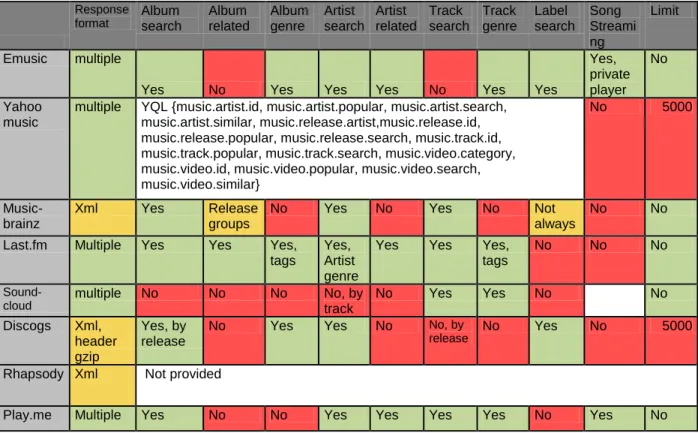
Several music web services have been reviewed, focusing on what functions do they provide to developers in order to mainly determine the feasibility of the project. Among the reviewed music services there are Emusic24, Yahoo music25, Soundcloud26, Discogs27, Rhapsody28, Musicbrainz29, Last.fm30 and Play.me31. The following table [fig 1], summarizes the characteristics of web services and the methods provided for free, as explained in the API documentation of each one. In this classification, are included only some of its features, those essential for the system regular running. These features are related to the classification of the artists and their works, genre, ability to make searches by albums, artists or songs, playing tracks, etc. 24 www.emusic.com 25 new.music.yahoo.com 26 soundcloud.com 27 www.discogs.com 28 www.rhapsody.com 29 musicbrainz.org 30 www.last.fm 31 www.playme.com
Response format Album search Album related Album genre Artist search Artist related Track search Track genre Label search Song Streami ng Limit Emusic multiple
Yes No Yes Yes Yes No Yes Yes
Yes, private player No Yahoo music
multiple YQL {music.artist.id, music.artist.popular, music.artist.search, music.artist.similar, music.release.artist,music.release.id, music.release.popular, music.release.search, music.track.id, music.track.popular, music.track.search, music.video.category, music.video.id, music.video.popular, music.video.search, music.video.similar} No 5000 Music-brainz Xml Yes Release groups
No Yes No Yes No Not always
No No
Last.fm Multiple Yes Yes Yes, tags
Yes, Artist genre
Yes Yes Yes, tags No No No Sound-cloud multiple No No No No, by track No Yes Yes No No Discogs Xml, header gzip Yes, by release
No Yes Yes No No, by release
No Yes No 5000
Rhapsody Xml Not provided
Play.me Multiple Yes No No Yes Yes Yes Yes No Yes No
fig 2 Table briefing the most outstanding features searched and the related support of each web service.
A conclusion derived from this review is the variability in the functions provided by each service. The difference between web services themselves is evident when focusing on storage facilities, services range from a single pool of songs and their metadata like Soundcloud, to large relational databases as Musicbrainz web service.
After evaluating the web services and their methods, were further studied access platforms (API) of some web services that have been considered the most profitable for this purpose. The selected web services are briefly commented next:
Musicbrainz
Free web service. It is a huge relational database of music, which can be accessed through a XML-based web service. Contains the greatest amount of musical information, the data amount is impressive, it contains several millions of songs, thousands of artists and albums is awesome. The problem with its use in this project is mainly the lack of graphic content, despite a link that refers to the corresponding item on Amazon, no links to listen or download tracks are available.
It's a big music library that provides textual information to find new artists or new relationships between them and their albums, but because of its size, there are many stored items that cannot be presented to the user for not including much needed information as links to pre-visualizations or album art images. Due to this lack of multimedia information about music elements, this service is not going to be used for this project.
Last.fm
Last.fm provides developers with a powerful web service with a huge and comprehensive music catalog. This service provides many details about groups or artists and their albums, as well as images in various sizes for artist and album art. It also includes a tagging system in which users can add personal tags that can be used to classify music privately as a way to create personal collections. Many tags are applied to each artist, album or song depending on their popularity. Tags help to extract the musical genre of the album or song, among other things, being a serious drawback that these tags are not present for every artist, album or track. The complete web service and musical catalog makes the last.fm web service to be one of the most suitable for the purpose of this project, but also has some limitations: it doesn‟t allow listening or downloading songs. The API does not provide solutions for previewing or downloading a track, listening is only available through the web site, and only by payment account.
Play.me
Tests using the Play.me Web Service determined that not all items announced on its API website have real support in the web service.
It has been implemented a software layer or wrapper to access the web service API, intending to evaluate the usefulness of the service for this purpose. The information provided inside the API documentation and returned-data definitions are not completely accurate. At the time of representing the information graphically in the browser, the images of artists and albums are crucial. With them, the platform providing information to the recommender algorithm has a rich visual interface which makes it more entertaining than a pure text-based web page. The images about musical items are represented as links to the content, but often do not charge due to broken link or, unhopefully, due to internal server errors. Play.me web service includes a very interesting field inside music items, this is the genre, very useful in order to catalog content and thus be able to recommend music based on musical genre. Other interesting feature is the possibility of listening a short 30 second sample of each song.
The most serious drawback found for Play.me is the musical catalog, even if it is big, is not comparable with the one owned by Last.fm or by Musicbrainz.
Development-framework analysis
A good study of the features offered by different development frameworks may save time and be decisive for achieving a robust and efficient final result. The content management systems or CMS, provide effective solutions to manage users, exchanging messages between them or sending electronic mail. Also facilitate the control of access to webpage elements with roles assigned to different users. Another function of CMS is to facilitate the maintenance of a web site, with methods to update content such as news or articles by performing simple actions.
Some time has been spent analyzing several open source CMS, including Magnolia32, AtLeap 1.033 and Pligg34 which includes social networking features. All of them provide plenty of facilities for the maintenance of web sites. However, what is sought for this project is to simplify the management of potential users of the application and make use of a framework for safe and easily maintain their profiles. Most of these systems are designed to manage web sites of news or articles, short stories and frequently updated information, providing further support for user authentication systems with different levels of access.
This system needs to manage users, but the dynamic characteristics of the application, do not fit with the facilities offered by these CMS. Communication between users in this case, is practically absent. The system aims to focus on the user, not in the relationships between users. The system can be easily expanded to extend the communication between users, but this feature remains as an outline of this work intention.
Design of communication element with music services
The system needs information from music services to provide interaction, now it is defined how to allow communication with the web services of each provider. Ideally, a single Web service, providing all the information necessary for the application would simplify the system‟s web architecture and also a better performance could be achieved. However, no free music service providing a large multimedia music collection in order to complete the desired music objects.
For this reason, it is necessary to implement several components that allow communication with the selected music services. The information provided by services: the methods available, the structure of metadata and answer format, have different characteristics depending on each service. Play.me offers opportunity to listen to tracks, a thirty seconds simple. Last.fm classifies information using labels, but the lack of genre classification inside the Musicbrainz web service reduces drastically its usefulness for this purpose.
Communication with music systems is done through their API. The interaction is performed using http requests which are sent to the each web service.
32
www.magnolia-cms.com
33 atleap.dev.java.net 34 www.pligg.com
Communication with Last.fm web service
In order to make use of the Last.fm database, they provide API documentation35 where to find information related to methods or response formats. It‟s possible to find previous implementations of wrappers written in several programming languages. There exist some Java bindings written by Janni Kovacs which are BSD-licensed36 and are available for development purposes. It is a project hosted on Google code37. Not all the features implemented in this wrapper have been used, only the related to musical content retrieval. In order to establish communication between the html test page and this service, a middle Java servlet38 has been implemented to receive Ajax39 requests from the browser and bridge them directly to Last.fm web service. The serialized data sent back by the web service comes formatted in json40. This object definition language allows perfectly the object notation as the time its structure eases quite much the parsing process.
Communication with Musicbrainz web service
Musicbrainz xml web service41 is a huge service. It‟s being continuously growing due partially to its feature that allows user to easily send metadata about music releases. In order to communicate with this service it‟s possible to use some useful java code also available for free use. This wrapper also hosted on Google code42, implements a complex set of functions that allows access to some interesting tools available in this web service. Only music information retrieval functions have been tested. The xml data is parsed and converted into java objects, this utility has been employed for checking data integrity, response time and other issues related to communication. Unfortunately Musicbrainz has no truly usefulness for this purpose.
Communication with Play.me web service
Play.me web service does not have any API wrapper coded previously by the community. A Java API has been created to provide communication with the API of this Play.me43. As the others, the service receives http requests and sends back responses formatted in various data-types as shown in [fig 1]. After having a look to the methods provided in the API documentation, the related to music retrieval have been implemented and tested. It is necessary to check whether the data sent back by the web service meets the specifications inside the API documentation.
35 Last.fm api documentation: www.lastfm.es/api/intro 36 creativecommons.org/licenses/BSD
37
Last.fm java bindings: code.google.com/p/lastfm-java
38 Servlet technology: www.oracle.com/technetwork/java/index-jsp-135475.html 39 www.ajax.org
40 www.json.org 41
Musicbrainz xml web service: musicbrainz.org/doc/XMLWebService
42 Musicbrainz java code: sourceforge.net/projects/javamusicbrainz 43 Play.me API: lab.playme.com/api_overview
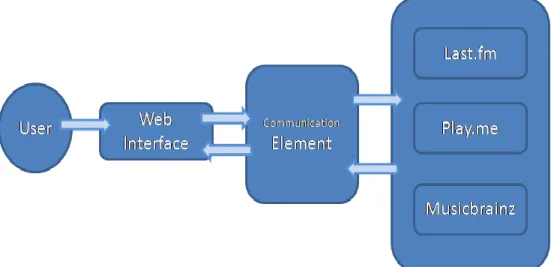
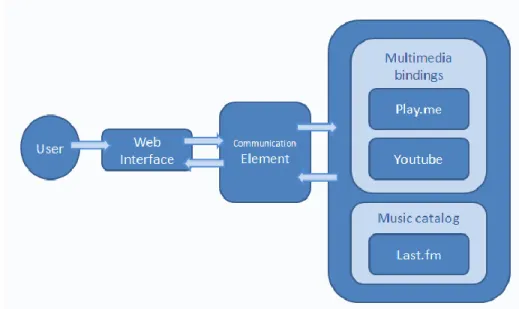
The element of communication uses these software components that connect the system with web services. Upon receiving a request from the web interface, the communication element prepares the requests for each music service. The responses from each music service are analyzed by extracting the necessary information from each service response, and then generating a full data object with which the web system can perform its activity. The following diagram represents the structure of access to music services and communication with the web component.
fig 3 First system‟s prototype structure
Prototype’s requisites
The implementation of the prototypes to allow communication with music services makes possible accurate verification of specifications detailed in the respective API documentations. Many methods promised certain features that after testing, it was found that were not covered or function behavior was not the expected. Also allows studying the actual structure of the data returned on each call:
A call to the Web service Last.fm, which are requested albums belonging to a particular artist, returns a collection of elements, with a particular structure. For example:
Album { id, albumname, artistname, genre, { tracks } }
It happens that the structure is not complete, receiving the call basic information about the item in question in the form:
Album { id, albumname, artistname, *, { * } }
To complete the structure, it is necessary to submit a second query, which calls for the metadata associated with the ID of an album or track list identifier associated with an album. Once the requests, you can have the necessary information.