T
he widespread availability and portability of mobile phones has led them to become the de facto platform for ubiquitous comput-ing. As mobile phones’ battery life and capabilities continue to grow, they’re supporting increasingly complex applications that leverage information about a user’s situa-tion—their location, activity, and so on. Mod-ern smart phones are especially well-suited to this task because they’re often integrated with sensing devices that facilitate obtaining detailed and meaningful descriptions of a user’s situa-tion. For example, smart phones can use accel-erometers and microphones to accurately deter-mine user activity1 and can use Global System for Mobile Communications (GSM), WiFi, and GPS capabilities to determine users’ locations and provide meaningful descrip-tions of their situadescrip-tions.2To facilitate the gathering and processing of sensor data, we’ve devel-oped BeTelGeuse, an open source platform that supports collecting data from phone sensors, Bluetooth-enabled sensors, and Internet data sources. BeTelGeuse also infers higher-level con-text from sensor data, for example, by inferring user activity from accelerometer measurements using the activity plug-in. Contrary to existing tools, BeTelGeuse isn’t limited to a specific run-time environment or to a specific set of sensors. We designed BeTelGeuse to be extensible, as well
as easy to use and configure. It’s freely available under the GNU Lesser General Public License from our Web site (http://betelgeuse.hiit.fi). In this article, we present BeTelGeuse’s design goals and architecture and evaluate its performance.
Design Goals
Our design goals for BeTelGeuse are: Multiplatform support.
• As we discuss in the
“Related Work” sidebar, existing platforms are typically limited to a specific runtime environment. This limits the studies that re-searchers can carry out because the study’s participants will depend on the number of available devices. To enable large-scale stud-ies, the data collection platform should run on different devices and runtime environments. Extensibility.
• New kinds of sensing devices
and data sources are continuously becoming available so researchers must be able to easily extend the platform to support them. More-over, the platform’s sensor interface shouldn’t be limited to a specific type of sensor con-nectivity, such as Bluetooth, 802.11, or inte-grated sensors.
Data accessibility.
• A platform that collects
context data can provide applications with context information so it should be easy to integrate it with applications and services. Moreover, if researchers use the platform to run user studies, they should be able to access data remotely without requiring access to the physical device.
Joonas Kukkonen,
Eemil Lagerspetz, Petteri Nurmi, and Mikael Andersson
Helsinki Institute
for Information Technology HIIT
BeTelGeuse is an extensible data collection platform for mobile devices
that automatically infers higher-level context from sensor data. The
authors introduce the BeTelGeuse architecture and evaluate its impact on
mobile phone performance.
BetelGeuse:
a Platform for Gathering
Smarter PhoneS
High-level context.
• Existing
plat-forms are limited to gathering raw sensor measurements rather than
inferring high-level abstractions of the user’s location. High-level ab-stractions are often more
meaning-ful and provide better clues about the user’s actual situation, motivation, and information needs.
W
ecategorize existing data collection platforms based on the nature of data that they collect. Platforms that col-lect objective data are nonintrusive as they gather sensor data about users’ actions and situations without user involvement. The advantages of objective data are that users don’t have to be interrupted and data collection doesn’t suffer from subjective interpretations or from recall failures. On the other hand, sensor data is often noisy and erroneous, and unable to convey mean-ingful information about the users’ situational, motivational, or informational needs. To this end, many platforms increasingly support subjective data collection. The most common way to collect subjective data is to use experience sampling, that is, explicitly ask for user feedback at regular intervals or in specific situations.1 One alternative is to automatically infer meaningful descriptions from sensor data.Several researchers have developed various platforms that support objective data collection. Most of these platforms are limited to a specific runtime environment or to a specific set of sensors. For example, ContextPhone logs various phone events (phone and application usage, for example), but can be used only on Nokia S60 devices.2 Platforms that support multiple runtime environments are typically limited to a specific set of sensors or data type. For example, Intel PlaceLab3 is limited to location data and BeTelGeuse’s earlier version supports only Bluetooth-enabled sensors.4
Several platforms that support objective and subjective data collection have been proposed. Most of these platforms only run on devices from the Microsoft Windows CE operating system family. The first such tool was the Context-Aware Experience Sampling tool (CAES), which runs on PDAs using the Microsoft PocketPC operating system.5 However, the CAES tool is no lon-ger supported (the project was last updated in 2003). The most comprehensive platform so far is MyExperience,6 which sup-ports a wide range of sensors, contains a comprehensive event mechanism, supports a variety of experience sampling modali-ties, and has been extensively tested. Unfortunately, MyExperi-ence is restricted to mobile devices running the Windows Mobile operating system.
Frameworks that automatically infer higher-level contexts from sensor data have been proposed. These systems typically focus on a specific contextual variable, and they don’t have generic data collection capabilities. Examples include Oppor-tunity Knocks,7 which focuses on location information, and the Context Recognition Network, which focuses on activity
infor-mation.8 Because these frameworks focus only on the detec-tion of activities, they serve the same purpose as the plug-ins in BeTelGeuse.
BeTelGeuse’s main advantages are its support for multiple plat-forms and that its sensing capabilities scale according to the cli-ent device’s capabilities. Thus, researchers can use BeTelGeuse on most platforms, but the amount and nature of data collections depends on the target device’s available sensors and capabilities. Additionally, BeTelGeuse isn’t limited to merely logging data; it can automatically and nonintrusively infer higher-level context from sensor data. Although earlier platforms support (subsets of) these features, BeTelGeuse is the first platform to support all of them. One of BeTelGeuse’s limitations is that it currently doesn’t contain built-in experience sampling functionality, but we’re working on a plug-in for that.
REfEREnCES
1. S. Consolvo and M. Walker, “Using the Experience Sampling Method to Evaluate Ubicomp Applications,” IEEE Pervasive Computing, vol. 2, no. 2, 2003, pp. 24–31.
2. M. Raento et al., “ContextPhone: A Prototyping Platform for Con-text-Aware Mobile Applications,” IEEE Pervasive Computing, vol. 4, no. 2, 2005, pp. 51–59.
3. T. Sohn et al., “Experiences with Place Lab: An Open Source Toolkit for Location-Aware Computing,” Proc. 28th Int’l Conf. Software Engi-neering (ICSE 06), ACM Press, 2006, pp. 462–471.
4. P. Nurmi et al., “BeTelGeuse—A Tool for Bluetooth Data Gathering,”
Proc. 2nd Int’l Conf. Body Area Networks (BodyNets), ACM Press, 2007; http://portal.acm.org/citation.cfm?id=1460232.1460253&coll= GUIDE&dl=GUIDE&CFID=25695462&CFTOKEN=85841578//. 5. S.S. Intille et al., “A Context-Aware Experience Sampling Tool,” CHI
03 Extended Abstracts on Human Factors in Computing Systems, ACM Press, 2003, pp. 972–973.
6. J. Froehlich et al., “MyExperience: A system for in situ Tracing and Capturing of User Feedback on Mobile Phones,” Proc. 5th Int’l Conf. Mobile Systems, Applications and Services (MobiSys), ACM Press, 2007, pp. 57–70.
7. D.J. Patterson et al., “Opportunity Knocks: A System to Provide Cog-nitive Assistance with Transportation Services,” Proc. 6th Int’l Conf. Ubiquitous Computing (UbiComp 04), LNCS, Springer, vol. 3205, 2004, pp. 433–450.
8. D. Bannach et al., “Distributed Modular Toolbox for Multi-Modal Context Recognition,” Proc. 19th Int’l Conf. Architecture of Computing Systems (ARCS 06), vol. 3894, LNCS, Springer, 2006, pp. 99–113.
User experience.
• BeTelGeuse is aimed
at two interconnected user groups: researchers who run user studies and extend BeTelGeuse by writing custom parsers or plug-ins, and us-ers or study participants who run Be-TelGeuse on their personal devices as part of a study or for their personal use (GPS traces or heart-rate data, for instance). From a researcher’s perspective, user experience implies that BeTelGeuse should be easy to configure. For study participants, user experience refers to the plat-form’s generic usability and that the tool doesn’t have a noticeable impact on the client device’s performance. We describe BeTelGeuse’s architec-ture in more detail.
BetelGeuse architecture
BeTelGeuse’s high-level system struc-ture is inspired by the microkernel ar-chitecture pattern. We have a separate core that offers the smallest set of func-tionality needed to run the tool. The core also defines interfaces for compo-nents that provide extended function-ality. This allows a single implemen-tation of the main functionality and custom extensions for different run-time environments. Our design has also been inspired by other context-aware frameworks. Similar to widgets in the Context Toolkit,3 parser components act as abstractions of sensors, and we use a blackboard architecture inspired by the work of Terry Winograd.4 Figure 1 shows BeTelGeuse’s high-level archi-tecture. The BeTelGeuse core contains data gathering, Bluetooth discovery, parser interfaces, the blackboard, and data transmission classes.
Implementation
To fulfill our goal of multiplatform support, we implemented BeTelGeuse’s
core using Java Micro Edition. We only use features that are commonly available in the Java implementations of most mobile and desktop devices. More specifically, BeTelGeuse’s core is compatible with mobile systems that conform to the Mobile Informa-tion Device Profile (MIDP) 2.0 (http:// jcp.org/aboutJava/communityprocess/ final/jsr118) and Connected Limited De-vice Configuration (CLDC) 1.1 (http:// jcp.org/aboutJava/communityprocess/ final/jsr139) specifications, which are based on Java 1.3 and make BeTelGeuse compatible with desktop systems. Ad-ditionally, BeTelGeuse requires a JSR-82-compliant (http://jcp.org/aboutJava/ communityprocess/final/jsr082) Java Bluetooth stack.
These devices satisfy BeTelGeuse’s platform requirements:
Mobile phones that support Java
•
and Bluetooth, such as second and third editions of various Nokia S60 devices and Sony Ericsson W800i devices. (For a list of more than 100 compatible devices, please see http:// developers.sun.com/mobility/device/ pub/device/list.do).
GNU/Linux PCs that run a
stan-•
dard Java installation with the freely available AvetanaBluetooth Java Bluetooth stack installed (http:// sourceforge.net/projects/avetanabt). Windows PCs that run a standard
•
Java installation and the freely avail-able Bluesock Java Bluetooth stack (https://bluesock.dev.java.net). PDAs with Microsoft Windows
•
Mobile running IBM J9 Java Vir-tual Maching with a commercial version of AvetanaBluetooth. We’ve tested BeTelGeuse on a Hewlett Packard hx4700 PDA running Mi-crosoft Windows Mobile 2003 2nd Edition.
On smartphones, MIDP-specific socket connection classes are plugged into the core. For GNU/Linux and Windows, we used Java 1.5 socket classes. The Bluetooth parsers remain the same across platforms. We’ve included platform-specific parsers depending on the device that Be-TelGeuse is deployed on—we en-abled Python S60 extensions, for example, on Nokia S60 smart-phones. BeTelGeuse’s
extensibil-Plug-ins External programs Location plug-in BeT elGeuse Data transmitter BeTelGeuse blackboard External programs Mobile HTTP server Bluetooth manager Bluetooth parsers Python S60 parser
Phone resources Phone information
GSM information Camera Integrated sensors
Browser
GPRS/EDGE/WLAN
Bluetooth sensors Heart rate
Temperature Acceleration
Smarter PhoneS
ity also makes it possible to inte-grate platform-specific tools, such as MyExperience or ContextPhone.
Configuration
BeTelGeuse loads parameter values from a configuration file on startup. The configuration specifies Bluetooth mappings, frequency of data polling on each sensor, and whether to send data to a server or save it on the device. Users can modify the configuration through a MIDlet user interface. Alternatively, researchers or the study participants can specify a custom configuration file. We’re currently implementing support for modifying the configuration re-motely via command messages to the BeTelGeuse blackboard.
Blackboard
The BeTelGeuse blackboard acts as a hub for communications between dif-ferent components and lets external components access the blackboard, such as when providing or receiving context data. BeTelGeuse Java plug-ins connect to the blackboard using direct method calls, whereas external components and plug-ins must use a local socket.
The blackboard uses a Simple Sen-sor Interface-like protocol (SSI; www. ssi-protocol.net). The messages begin with a command code, and most have component-type, user-id, and component-id fol-lowing the code. The blackboard con-firms command messages, but not data packets. The command code identifies the message. For example, “c” identi-fies a create message, which results in the blackboard creating a receiver and data container for the caller. The component-type, component-id, and user-id spec-ify the message’s target components (a subset or all of the components). This is useful in scenarios in which a number of components want to establish a dia-logue. The current protocol version lets external components create, delete, and list components and components’ own-ers, and download or upload data.
Data on the blackboard resides in memory. The blackboard is data-type agnostic and views the data as an opaque string of bytes. Components reading the data are responsible for interpreting it. By default, blackboard components interact in a publish–sub-scribe communication pattern. When a component receives new data, it notifies
the blackboard, which, in turn, notifies consumers, that is, other components that have subscribed to the data. Each new data packet overwrites previous field values of the same component (GPS coordinates override old ones, but a longitude value only overwrites the old longitude value). Components might subscribe to receive data whenever a specific event occurs. For example, the GPS can be read at regular intervals or whenever the GSM cell changes. If a component subscribes to data changes, it’s only notified when the data changes in the specified magnitude. Table 1 lists other supported event types. Compo-nents aren’t required to subscribe to events; for example, parsers produce data but don’t consume data produced by other blackboard components.
Data transmitter
Although programs on the client de-vice can access context data via the blackboard, remote researchers or ex-ternal applications can’t access data this way. To achieve data accessibility, BeTelGeuse contains a data transmit-ter, which synchronizes data with re-mote or local persistent storage and
TABLE 1
Sensors currently supported by BeTelGeuse.
Sensor Examples of measured data Examples of events
Bluetooth GPS (NMEA 0183) sensors
latitude, longitude, altitude, time, number of satellites LatitudeChange, LongitudeChange, timestamp, value equal/greater/smaller than a specified threshold
Alivetec Heart Monitor (www.alivetec.com)
ECG, 3-axis acceleration ecgChange, accelerationChange, value equal/ greater/smaller than a specified threshold I-CubeX
(http://infusionsystems.com)
distance (ultrasound), 3-axis acceleration,
temperature, humidity, orientation, background light
value change events, value equal/ greater/smaller than a specified threshold Python S60 Parser (Nokia S60
3rd edition phones, requires signed Python)
GSM cell information: identifier, area, network and country codes, network name, signal strength. Call and SMS data: outbound and inbound calls and SMS, SMS access times. Phone status information: battery level, phone profile
value change events, value equal/ greater/smaller than a specified threshold, callStart, callEnd, callAnswer,
msReceive, smsOpen, smsSend, profileChanged,
batteryLow
Local device Bluetooth proximity information (In periodic
scanning mode) deviceAddressPresentdeviceLost , deviceNamePresent,
Core BeTelGeuse internal events source parserCreated, parserDisconnected, parserDeviceLost,
We implemented remote storage using a server-side component that stores the context data into a MySQL database. The data transmitter sends data using any Internet connectivity method that the client device sup-ports—3G, GPRS, or wireless LAN, for example. The communications use a lightweight protocol, implemented on top of TCP. The protocol borrows ideas from existing sensor protocols, especially the SSI protocol, which is well-suited for communications be-tween sensors and a controlling de-vice. However, the SSI protocol is in-sufficient for our purposes because it doesn’t contain messages for sending sensor names and identifiers, sending incremental sensor information, es-tablishing a persistent session, or re-connecting to an existing session.
When local storage is used, data is stored on the device in a sequential file. The file resembles a data trans-mission log and the data transmit-ter can upload it to the BeTelGeuse server when Internet connectivity is available. Currently we don’t support automatic replay of the transmission log, but the file can be uploaded man-ually. Internet connectivity rapidly drains the client device’s battery life, but modern mobile devices support memory cards with a capacity of sev-eral gigabytes, so we can store sevsev-eral months of data locally.
Bluetooth manager
The Bluetooth manager scans for Bluetooth devices and manages con-nections to Bluetooth sensors. The scanning can be performed periodi-cally or initiated manually. Users can configure the scan interval using the MIDlet user interface or through re-mote access. Scanning in periodic mode is advantageous because it en-ables collecting (Bluetooth) proximity data, such as for social network analy-sis.5 The periodic mode facilitates
sen-performed at startup, after which ers must manually trigger the scans us-ing the MIDlet interface. This mode is useful when the sensor configuration doesn’t change and proximity data isn’t needed. Manual mode also helps avoid Bluetooth usage conflicts between scans and sensor data transmissions. On certain devices, such as older Nokia S60 second edition smartphones, Blu-etooth scans require exclusive access to the Bluetooth stack, which can cause the receiving Bluetooth buffer to over-flow with sensor data. Manual mode also slightly improves battery life.
The Bluetooth manager automati-cally connects to devices that users specify in the configuration and in-stantiates appropriate parsers. A de-vice is specified by its (partial) friendly name (contains “GPS,” for example) or Bluetooth address. Users can add new devices using the MIDlet inter-face or by editing the configuration file. When a Bluetooth scan finishes, the Bluetooth manager connects any matching discovered devices and cre-ates appropriate parsers.
Connections to sensor devices might be lost for various reasons: wireless communication might be blocked, nearby devices can cause interference,
sensor batteries might fail, or the sen-sors might become unreachable as us-ers move. When a sensor connection is lost, the Bluetooth manager tries to re-store the connection. The reconnection mechanism is based on an exponential back-off scheme. After a user-configu-rable maximum timeout is reached, the Bluetooth manager drops the sensor or continues the reconnection attempts
mobile httP Server
Because Web applications are in-creasingly based on locally executed JavaScript, we can easily enable Web applications to access context data. Our solution integrates a lightweight component, which reads HTTP re-quests and returns context data, into the BeTelGeuse core. Web applications that run on the device’s browser can access context data using Ajax. We support HEAD, GET, and POST requests that follow the HTTP 1.0 specification. To minimize overhead and delays, the server simply reads the URL and query string from the HTTP request (/index. html?param=value) and returns sen-sor data. By default, the mobile HTTP server returns the context information in JavaScript Object Notation (JSON), which makes the information directly accessible as native objects and data structures for JavaScript code run-ning on the device’s Web browser. The mobile HTTP server also supports HTML and text formats. By default, all context data is returned, but the server can also be queried for a spe-cific sensor’s data. We use a query mechanism based on a Unix-style directory format. The URL, http:// localhost/gps/latitude, for example,
returns only GPS latitudes. Web ap-plications can specify the data for-mat separately as a query param-eter: the call http://localhost/gps/ latitude?format=html returns the lati-tude in HTML. Similar to the data transmitter and the BeTelGeuse server, the mobile HTTP server facilitates data access and contributes to our data accessibility goal.
Because Web applications are increasingly based
on locally executed JavaScript, we can easily
enable Web applications to access context data.
Smarter PhoneS
Context Parsers
Context parsers are abstractions of sen-sors that read and parse data, and write it to the blackboard. The parsers can operate in streaming or request mode. In streaming mode, data is continu-ously read from the sensor, whereas, in request mode, the sensor is polled for data when a certain event occurs or at user-configurable intervals. The request mode is useful for long-term data collection.
BeTelGeuse-compatible sensor types that can be used include external Blue-tooth sensors, integrated phone sensors, software sensors, and Internet sensors. An Internet sensor could read Google Calendar entries, for example, and push the data to the blackboard. Developers can limit sensors to a specific platform. We use a platform-specific parser on Nokia S60 devices, for instance. De-velopers can also integrate BeTelGeuse with sensors using another communica-tion technology. Table 1 lists the sensors BeTelGeuse currently supports.
To add support for new sensor types, developers must implement a new con-text parser or extend an existing one. Developers might also implement con-text parsers, written primarily in Java, as external plug-ins that push their data to the blackboard. When writing a parser for a new Bluetooth sensor, developers must assign the parser with
an identifier and register it with the Bluetooth manager to ensure that the Bluetooth manager can automatically instantiate the parser. The BeTelGeuse Web site has details about implement-ing a parser and registerimplement-ing it with the Bluetooth manager.
Plug-ins and extensions
Researchers can extend BeTelGeuse in various ways. They can develop new parsers or plug-ins. Additionally, they
can develop Web-based extensions on top of the data transmitter.
Python S60 Parser
The Python S60 Parser provides in-formation about phone status and usage on Nokia S60 devices and ac-cess to internal phone sensors. Cur-rently, BeTelGeuse supports GSM information, call and SMS logging, and phone status information. The Python S60 Parser works similarly as other parsers. Thus, it registers to the blackboard, and other components can subscribe to data or events from the parser. In addition, it’s possible to access phone calendar information or internal sensors, such as the micro-phone, camera, or integrated GPS.
Location Plug-in
The location plug-in consists of a server module and two client-side modules: a GSM positioning module and SerPens.6 The GSM positioning module uses GSM fingerprinting to estimate the us-ers’ location whenever GPS is unavail-able. SerPens is a collaborative tagging tool that lets users assign public and pri-vate labels to their locations. The labels are tied to a taxonomy that supports different granularities, such as coun-try, region, and street. Users use private tags to indicate personally meaningful locations whereas public tags can be
used to label landmarks. SerPens pro-vides more meaningful data than mere coordinates, and can give clues about the context of the user. The location plug-in helps to achieve our high-level context information goal.
activity Plug-in
Whereas location typically provides clues about users’ generic situation (home, work, school, and so on), ac-tivity information can provide clues
about the environmental constraints that influence users’ interaction. For example, while users are walking, they must pay attention to the environment, which often results in abrupt bursts and short-lived interaction patterns. Thus, mobile user studies could significantly benefit from detailed activity informa-tion. BeTelGeuse contains an activity plug-in that detects basic activities from accelerometer data. Our current implementation supports the Alivetec Heart Monitor (see Table 1) and de-tects the following activities: resting, walking, brisk walking, jogging, run-ning, and commuting. We’re currently modifying our plug-in to support the built-in accelerometers of recent Nokia smart phones and extending the num-ber of identified activities.
BetelGeuse Server
External applications or remote re-searchers running a multiperson study often need easy access to data from several devices. To facilitate data ac-cess, we’ve implemented a server com-ponent that maintains sessions with connected BeTelGeuse instances. It receives data sent by each instance and stores it in a MySQL database. The BeTelGeuse server uses a series of data filters for distributing data to external programs on reception. For example, the location server uses the BeTelGeuse server to obtain relevant location data (GSM + GPS).
Performance evaluation
In analyzing BeTelGeuse’s impact on client devices, we consider two aspects of performance: the memory requirements and the impact on bat-tery life.
BeTelGeuse’s memory footprint is between 5.6 and 7.3 Mbytes, de-pending on the configuration and the amount of sensors that are con-nected. The local version requires somewhat less memory than the on-line version. These figures include the memory required to run the Java virtual machine. In terms of
instal-Researchers can develop new parsers, plug-ins,
lation size, BeTelGeuse requires only 179 Kbytes.
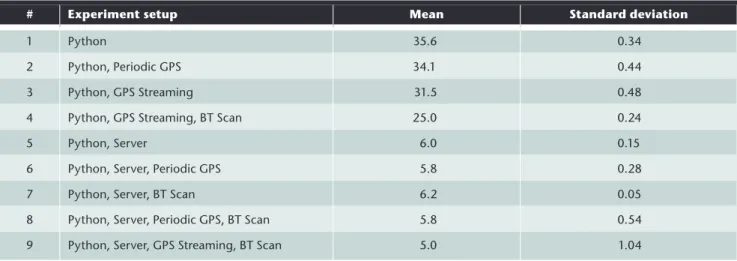
To measure the impact on the cli-ent device’s battery life, we con-ducted a set of experiments in which we used BeTelGeuse under different configurations and measured the time it took to drain the battery of five fully-charged, brand-new Nokia E61i devices (with standard BP-4L 1500 mAh batteries). We considered nine different configurations and av-eraged the results over the devices. As we considered new devices, our results should be interpreted as up-per bounds for up-performance. How-ever, the homogeneity of the devices lets us draw better conclusions about the performance differences.
Table 2 shows our results. As our baseline, we used a version in which only the Python S60 parser collects data. This version lasted between 35 and 36 hours. Adding a GPS device that was read once per minute decreased the battery lifetime to 34 hours. Running Bluetooth scans on top of this had only a minor impact. These values span well over a day, which makes these setups well suited for long-term data collec-tion. Changing the GPS from periodic reading mode to continuous stream-ing had a more significant effect on the battery lifetime, with the mean lifetime decreasing to 25.7 hours. Again, the
Bluetooth scanning had only a minor impact on the performance (mean 25 hours). Thus, BeTelGeuse’s battery us-age is well-optimized with respect to Bluetooth.
The final experiments measured the effect of Internet connectivity on battery usage. In these experiments, we configured the transmitter to send data once every minute. As Table 2 in-dicates, the mean lifetime is roughly 5 to 6 hours, with the variation being caused by the amount of Bluetooth connectivity. For long-term data col-lection, the transmission rate should be decreased.
Case Studies
We used BeTelGeuse to collect large amounts of context data, and inte-grated it as a context source into a mobile application.
Gathering and analyzing Location Data
We’ve used BeTelGeuse to collect GSM and GPS data from seven users for more than one month. The participants used a Nokia E61i mobile phone and an ex-ternal Bluetooth GPS receiver. The GPS was polled every 60 seconds. We also scanned for nearby Bluetooth de-vices and gathered internal phone in-formation with the Python S60 parser. An informal user study indicated that
BeTelGeuse was easy to use, but par-ticipants considered the GPS receiver’s short battery lifetime inconvenient. We’ve also used BeTelGeuse to collect GPS traces with different spatial and temporal characteristics from 10 to 15 different countries.2
Context-adaptive Widgets
Capricorn is an adaptive, Web-based widget engine for mobile devices,7 which uses BeTelGeuse as a context source and enables widgets to adapt their information based on the user context. For example, a context-aware travel planner can automatically fill in the origin of travel using location in-formation provided by SerPens, and a news or weather service can provide localized information using location information provided by BeTelGeuse. As Capricorn is a Web application, it accesses context information through the BeTelGeuse mobile HTTP server on the device.
W
e’re currentlyimprov-ing the data transmit-ter by adding support for data encryption and event-based connectivity. We’re also extending BeTelGeuse to use new context sensors and continu-ing to develop additional plug-ins.
1 Python 35.6 0.34
2 Python, Periodic GPS 34.1 0.44
3 Python, GPS Streaming 31.5 0.48
4 Python, GPS Streaming, BT Scan 25.0 0.24
5 Python, Server 6.0 0.15
6 Python, Server, Periodic GPS 5.8 0.28
7 Python, Server, BT Scan 6.2 0.05
8 Python, Server, Periodic GPS, BT Scan 5.8 0.54
Smarter PhoneS
Specifically, we’re extending the ac-tivity recognition plug-in and devel-oping an experience sampling plug-in that supports context-triggered
questionnaires. Furthermore, we’re planning to use BeTelGeuse in vari-ous context-aware applications as a context source.
REFEREncES
1. J. Lester, T. Choudhury, and G. Borriello, “A Practical Approach to Recognizing Physical Activities,” Proc. 4th Int’l Conf. Pervasive Computing (Pervasive 06), vol. 3968, LNCS, Springer, 2006, pp. 1–16. 2. P. Nurmi and S. Bhattacharya,
“Identify-ing Mean“Identify-ingful Places: The Nonparamet-ric Way,” Proc. 6th Int’l Conf. Pervasive Computing (Pervasive 08), vol. 5013, LNCS, Springer, 2008, pp. 111–127. 3. A.K. Dey, G.D. Abowd, and D. Salber,
“A Conceptual Framework and a Toolkit for Supporting the Rapid Prototyping of Context-Aware Applications,” Human-Computer Interaction, vol. 16, nos. 2–4, 2001, pp. 97–166.
4. T. Winograd, “Architectures for Con-text,” Human–Computer Interaction, vol. 16, no. 2, 2001, pp. 401–419. 5. N. Eagle and A.S. Pentland, “Reality
Min-ing: Sensing Complex Social Systems,”
Personal and Ubiquitous Computing, vol. 10, no. 4, 2006, pp. 255–268.
6. S. Bhattacharya et al., “SerPens—A Tool for Semantically Enriched Location Infor-mation on Personal Devices,” Proc. 3rd Int’l Conf. Body Area Networks, ICST, 2008; http://portal.acm.org/citation. c f m? id =14 6 0 2 5 7.14 6 0 2 9 7& c ol l = GUIDE&dl=GUIDE&CFID=25695462 &CFTOKEN=85841578//.
7. F. Boström et al., “Capricorn—An Intel-ligent User Interface for Mobile Widgets,”
Proc. 10th Int’l Conf. Human-Computer Interaction (MobileHCI 08), ACM Press, 2008, pp. 328–330.
the
Authors
Joonas Kukkonen is a research assistant at the Helsinki Institute for Informa-tion Technology HIIT. His research interests include recommender systems and personalization of mobile applications. He is an MSc student in the Depart-ment of Computer Science at the University of Helsinki. Contact him at joonas. [email protected].
Eemil Lagerspetz is a research assistant at the Helsinki Institute for Informa-tion Technology HIIT and an MSc student at the University of Helsinki. His re-search interests include mobile data management and data communications. He has a BSc in computer science from the University of Helsinki. Contact him at [email protected].
Petteri nurmi is a researcher at the Helsinki Institute for Information Technol-ogy HIIT. His research interests include personalization of mobile applications and services, and mobile human computer interaction. He has an MSc in com-puter science from the University of Helsinki. Contact him at petteri.nurmi@ cs.helsinki.fi.
Mikael Andersson is a research assistant at the Helsinki Institute for Informa-tion Technology HIIT and an MSc student in communicaInforma-tions engineering at the Helsinki University of Technology. His research interests include computer networking with a focus on application layer services, and locationing and data-gathering on mobile devices. Contact him at [email protected].
Advertising Sales Representatives Recruitment: Mid Atlantic Lisa Rinaldo P: +1 732 772 0160 F: +1 732 772 0164 E: [email protected] New England John Restchack P: +1 212 419 7578 F: +1 212 419 7589 E: [email protected] Southeast Thomas M. Flynn P: +1 770 645 2944 F: +1 770 993 4423 E: flynntom@mindspring. com Midwest/Southwest Darcy Giovingo P: +1 847 498 4520 F: +1 847 498 5911 E: [email protected] Northwest/Southern CA Tim Matteson P: +1 310 836 4064 F: +1 310 836 4067 E: [email protected] Japan Tim Matteson P: +1 310 836 4064 F: +1 310 836 4067 E: [email protected] Europe Hilary Turnbull P: +44 1875 825700 F: +44 1875 825701 E: impress@impressmedia. com Product: US East Joseph M. Donnelly P: +1 732 526 7119 E: [email protected] US Central Darcy Giovingo P: +1 847 498 4520 F: +1 847 498 5911 E: [email protected] US West Lynne Stickrod P: +1 415 931 9782 F: +1 415 931 9782 E: [email protected] Europe Sven Anacker P: +49 202 27169 11 F: +49 202 27169 20 E: sanacker@ intermediapartners.de Advertising Personnel Marion Delaney,
IEEE Media, Advertising Dir.
Phone: +1 415 863 4717 Email: [email protected] Marian Anderson Sr. Advertising Coordinator Phone: +1 714 821 8380 Fax: +1 714 821 4010 Email: [email protected] Sandy Brown Sr. Business Development Mgr. Phone: +1 714 821 8380 Fax: +1 714 821 4010 Email: [email protected]