WAVE: Popularity-based and Collaborative
In-network Caching for Content-Oriented Networks
Kideok Cho, Munyoung Lee, Kunwoo Park, Ted Taekyoung Kwon, Yanghee Choi School of Computer Science and Engineering
Seoul National University, Seoul, Korea
Email:{kdcho, mylee, kwpark, tk, yhchoi}@mmlab.snu.ac.kr
Sangheon Pack School of Electrical Engineering
Korea University, Seoul, Korea Email: [email protected]
Abstract—In content-oriented networking, content files are typically cached in network nodes, and hence how to cache content files is crucial for the efficient content delivery and cache storage utilization. In this paper, we propose a content caching scheme, WAVE, in which the number of chunks to be cached is adjusted based on the popularity of the content. In WAVE, an upstream node recommends the number of chunks to be cached at its downstream node, which is exponentially increased as the request count increases. Simulation results reveal that the average hop count of content delivery of WAVE is lower than other schemes, and the inter-ISP traffic volume of WAVE is the second lowest (CDN is the lowest). Also, WAVE achieves higher cache hit ratio and fewer frequent cache replacements than other on-demand caching strategies.
Index Terms—Content chunk caching, caching strategy, content-oriented networks
I. INTRODUCTION
For efficient content delivery, end hosts should be able to exploit closer/multiple copies of the requested content. To address such issues, content delivery network (CDN) technologies and application-specific solutions like P2P have became so popular. However, content providers should pay the cost to use CDN services, and CDN may experience sub-optimal performance due to the traffic engineering of Internet service providers (ISPs) [1]. P2P systems incur a lot of inter-ISP traffic and are unstable in terms of content availability and download performance. To overcome these limitations and support content retrievals efficiently, content-oriented networking architectures are proposed where network entities such as routers (or co-located storage servers) cache files [2], [3], [4], [5]. By exploiting in-network storages (and content-based routing in some cases), they provide faster content delivery and offer better content availability than the current Internet.
There are many issues to be solved such as architectural designs [2], [3], [4], [5], content name-based routing [6], [7], security [2], [3], [8], and legacy application support [9], [10]. We focus on in-network caching. There have been studies on how to populate/maintain in-network storages considering content requests with different popularity and huge in-network storages. For example, in-network storages can be partitioned for different application classes to provide service differentia-tion [11]. Content types (e.g., uploaded, cached, etc.) can be used to decide which content files will be cached first [12].
Depending on the caching strategies, the performance of content-oriented networking can vary significantly.
As on-demand caching becomes prevalent, a larger file may incur longer transfer delay and more processing overhead for each caching operation (store the file into cache, deliver the file from the cache, etc.). To mitigate the overhead, a file can be divided into small sized chunks in content-oriented networks (e.g., [3]). Chunk-based caching has merits over file-based caching. For instance, different chunks of the same file can be delivered from multiple sources. Replacing some chunks instead of a whole file may increase the storage efficiency. In chunk-based delivery, how to distribute chunks of the same file may be crucial. For instance, to support some applications (e.g., video streaming) that require sequential delivery of chunks, the forepart of a file should be delivered to end hosts faster than the following part. Therefore, it is desirable for a caching scheme to consider the inter-chunk distance as well.
There have been many studies to distribute files efficiently in web caches and CDNs [13], [14], [15], [16], [17]. However, they have limitations to be applied in content-oriented net-works directly. For instance, [13], [14], [15], [16] assume the specific topologies such as a tree or hierarchical structure. [17] assumes an explicit coordination between caches, which incurs the substantial communication and maintenance overheads. [15] assumes that the content request pattern is known in advance. Since a large number of caches are to be deployed in content-oriented networks, a specific topological assumption, an explicit and tight coordination, and a priori knowledge on request patterns may not be applicable or affordable.
In this paper, we propose a chunk-based caching scheme, WAVE, that aims at efficient content delivery and cache usage while lowering the overhead of cache management. WAVE distributes content chunks towards end hosts considering the content popularity as well as inter-chunk (distance) relation. The main characteristics of WAVE are summarized as follows.
1) Popularity-based:WAVE adjusts the number of chunks
to be cached considering the content popularity (i.e., access count). As the access count increases, WAVE exponentially increases the number of chunks to be cached and disseminates them more widely.
2) Simple: WAVE requires no knowledge of access
two counters per file. Also, WAVE can operate with any content routing schemes since it uses only the information from where the content request arrives.
3) Decentralized: There is no central server in WAVE
since caching decisions are made at individual routers independently.
4) Incrementally deployable: In WAVE, an upstream
router suggests caching to its downstream router by marking a chunk to be cached. If a downstream router does not wish to store the chunk by any reason, it can ignore the suggestion and leave caching to other downstream routers. Thus, WAVE can be deployed with-out inter-domain cooperation; even in the same domain, WAVE routers can operate with legacy routers. The remainder of this paper is organized as follows. In Section II, we describe the WAVE scheme. Section III presents the simulation results. Section IV concludes this paper with future work.
II. WAVE: A CONTENTCACHINGSCHEME A. Assumptions
We assume that content routers (or C-routers, for short) will cache the chunks of files by exploiting in-network storages [2], [3], [4], [5], [6], [7]. If only a subset of the routers have the storage modules, they can form an overlay caching network among themselves1. We also assume original servers (who
publish the content files) as well as C-routers can recommend its downstream C-routers to cache the chunks.
As a file is divided into small size chunks, an end host requests the file in the unit of a chunk (e.g., Interest packets in CCN [3]). Thus, a file that consists of 100 chunks will be requested by sending out 100 chunk requests from the host. Also, the chunk index can be identified and associated with the requested file at the C-routers. We believe it is not scalable to have a centralized entity that can monitor and control in-network caching, especially across different domains. Thus, in WAVE, each C-router makes caching decisions (e.g., what to cache and what to replace) independently of other C-routers. However, we need some collaboration among C-routers to avoid inefficient caching situations (e.g., all C-routers cache the same set of chunks). In WAVE, a C-router suggests caching of a chunk to its downstream C-router by marking the chunk when it forwards the chunk. For this, acache suggestionflag bit is needed in the chunk (e.g., in the Data packet header in CCN [3]). If the downstream router does not have a storage or has its own caching policy (e.g., since it belongs to a different domain), it may ignore the caching suggestion and leave caching to other downstream routers.
For content routing, we assume that a chunk request will be routed towards its original server. If the requested content is cached at a C-router along the path (or discovered by content routing), the chunk will be transferred from the C-router, and the chunk request will not be forwarded towards the original server [16], [17].
1WAVE can be extended to support a single cache or an uncooperative cache scenario [18], which will be investigated in our future work.
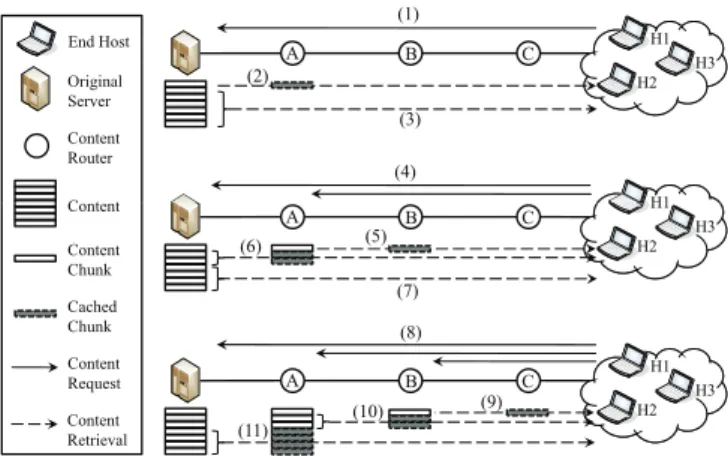
End Host Original Server Content Router C t t (1) C B A H1 H2 H3 (4) H1 (3) (2) Content Content Chunk Content Request Cached Chunk Content Retrieval C B A H1 H2 H3 C B A H1 H2 H3 (8) (7) (11) (10) (9) (6) (5)
Fig. 1. Illustration of WAVE operations. B. WAVE Operations
WAVE operations are illustrated in Fig. 1. There are an original server, three end hosts (H1,H2, H3), and three
C-routers (A, B,C). Suppose a file consisting of 7 chunks is requested by the three end hosts.
(1) A file request (more precisely, 7 chunk requests) from end host H1 will be routed to the original server. (2) The original server will transfer the file to H1. Since this is the
first retrieval for the content, the original server marks (i.e., sets the cache suggestion bit to 1) the first chunk to make
it cached, and forwards it to C-routerA, from which the file
request comes. The first chunk will be cached at C-router A
and forwarded toH1. Note that thecache suggestionbit will
be reset to 0 at C-routerA to prevent the additional caching at downstream C-routers. (3) The rest of chunks of the file will be transferred to H1 without any caching. (4) Suppose another request for the same file fromH2 is routed towards the original server. Note that the first chunk will be served from C-router A while others will be served by the original server. (5) C-routerAwill mark the first chunk to be cached at
the downstream C-routerB, and (6) the original server marks the next 2 chunks (i.e., exponentially increasing number of chunks) to make them cached at C-router A. The chunk 1
(or 2 and 3) will be cached at C-router B (or C-router A) and forwarded toH2. Thecache suggestionbits of the three
chunks will be reset to 0, respectively. (7) The rest of the chunks will be forwarded to H2 without caching. (8) The
third request from H3 will be served from C-router B (i.e., the first chunk), C-router A (i.e., the 2nd and 3rd chunks),
and the original server (i.e., the remainder). During the file transfer toH3, the similar caching process will be performed. (9) The first chunk is cached at C-routerC; (10) the 2nd and
3rd chunks are cached at C-router B; and (11) the next 4 chunks from the original server are cached at C-routerA.
C. Chunk Caching Algorithm
There are three main decisions to make for content caching: what to cache, what to replace, and where to cache. WAVE dynamically adjusts the number of chunks to be cached
Algorithm 1 Chunk Caching Algorithm
1: x: chunk marking window (CMW) base (e.g., 2,3,...)
2: n: chunk marking window (CMW) state (initial value: 0)
3: t: total number of cached chunks
4: cached: index of the latest cached chunk at the downstream router (initial value: 0)
5: i: index of the requested chunk
6:
7: ifcached < i≤!nj=0x
j then
8: mark chunkito be cached
9: cached←i
10: else if i≤cachedthen
11: mark chunkito be cached
12: cached←i 13: n← #logxi$ 14: end if
15:
16: Transfer the requested chunki 17:
18: ifi==tthen 19: n←n+ 1
20: end if
depending on the popularity of files. We take a conservative approach in choosing chunks to be cached since the processing overhead of cache update should be reduced.
(1) What to cache (or how to distribute chunks): The
chunk caching algorithm of WAVE is described in Algo-rithm 1. The number of chunks to be cached (at the down-stream C-router of a given router) is determined by the chunk marking window (CMW), which exponentially increases as the number of requests for the file increases. The CMW size is determined by: (i) a base x that determines the speed of
chunk caching, and (ii) the current staten(nis called CMW state). Thus, given x and n, the current CMW ranges from
!n−1
j=0xj+ 1to !n
j=0xj. The CMW state,n, increases by 1 if all of the cached chunks are transferred. As the CMW will be small if the requests (of a file) are not frequent, WAVE can prevent an unpopular file from being widely distributed. On the other hand, WAVE can distribute a popular file fast with the exponentially increasing CMW size. For this WAVE operation, a C-router maintains two counters for a file for each router interface: CMW state n, and the index of the latest
chunk whosecache suggestionbit is set. We use a variable
cached for the latter counter. Thus, the number of total
variables in a C-router is2×the number of cached f iles×
the number of interf aces. Note that WAVE maintains the
variables for each file, not for each chunk.
When a C-router (or the original server) caching the chunks receives a request for chunkithrough a router interface, it first checks whether the request chunk indexiis within the CMW
range (line 7). If so, chunk i will be marked to suggest its
downstream router to cache the chunk (line 8) and the C-router will update cached (line 9). After that, the requested
chunk i will be forwarded to the downstream C-router (line 16). After forwarding all the cached chunks, the C-router will increment n by 1 to increase the CMW size exponentially (lines 18-20). If the downstream C-router receives a marked
CMW: CMW State (n):
cached: 1 2 3 4 5 6 7 8 9 10 11 12
1 2 3
0
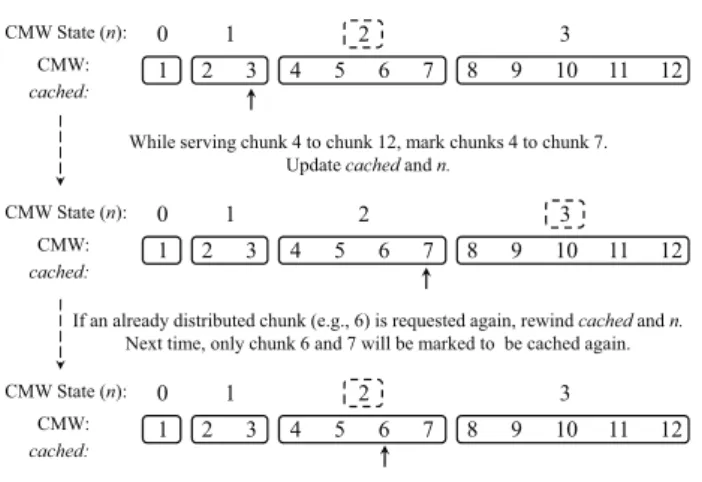
While serving chunk 4 to chunk 12, mark chunks 4 to chunk 7. Update cachedand n.
CMW State (n): 0 1 2 3
If an already distributed chunk (e.g., 6) is requested again, rewind cached andn. Next time, only chunk 6 and 7 will be marked to be cached again. CMW: cached: 1 2 3 4 5 6 7 8 9 10 11 12 CMW: CMW State (n): cached: 1 2 3 4 5 6 7 8 9 10 11 12 1 2 3 0
Fig. 2. Content caching example in a C-router.
chunk, it will cache the chunk, reset the cache suggestion
bit, and forward it towards the end host.
Since C-routers perform the cache replacement indepen-dently, it is possible for any of the network-wide distributed chunks to be replaced at any downstream C-router. Therefore, a replaced chunk may be requested again (line 10). In this case, the C-router will mark the chunk to suggest it to be cached again (line 11). Also,cachedfalls back toi(line 12) and the CMW statenwill be modified to"logxi#(line 13). Note that the requested chunk indexiis included in the updated CMW. The chunk caching algorithm is illustrated in Fig. 2. We assume the file consists of 12 chunks, and the CMW base is 2. Suppose that the given C-router caches all the chunks; the current CMW statenis 2, andcachedis 3. While transferring
chunks (starting from index 4 to index 12) to its downstream C-router2, the C-router will mark the chunks in the CMW
(chunks 4-7). Then, the chunks 4-7 will be cached at the downstream C-router. Now, cached and n are set to 7 and
3, respectively. If a chunk that has already been distributed (say, chunk 6) is requested again, cachedand nare set to 6
and 2(="log26#). Therefore, chunks 6 and 7 within the current CMW will be marked and forwarded again.
(2) What to replace:When a cache is full and a new chunk to be cached arrives, a victim chunk should be chosen to be replaced. WAVE uses the least recently used (LRU) approach, the most representative cache replacement algorithm used in cache networks [7], [16]. Note that WAVE can use other cache replacement algorithms such as least frequently used (LFU) or least recently/frequently used (LRFU). Since the caching unit of WAVE is a chunk, there would be a huge overhead if the access history information of individual chunks is maintained. Therefore, WAVE maintains the access history in the unit of a file to find a victim chunk to be replaced. When the last cached chunk is replaced, the access history for the file can be removed.
(3) Where to cache:Since there can be a large volume of 2Chunks from index 1 to index 3 have already been transferred to its downstream C-routers towards the soliciting host.
0 2 4 6 8 10
WAVE ProbCache AllCache CDN C/S
Average Number of Hops
Schemes
3.955 4.264
5.004 5.458 7.890
(a) Average hop count
0 10000 20000 30000 40000 50000 2 4 6 8 10 12 14 16 18 20 Link Stress (TB)
Link Stress Rank
C/S AllCache ProbCache WAVE CDN (b) Link stress 0 10000 20000 30000 40000 50000 60000 70000 80000 90000
WAVE ProbCache AllCache CDN C/S
Average Inter-ISP Traffic (TB)
Schemes 42810 47484 58912 34105 81199
(c) Inter-ISP traffic reduction Fig. 3. Performance comparison of WAVE against ProbCache, AllCache, CDN, and client-server.
in-network storages, it is important to decide where to cache the files. Thedirectionandlocationfor chunk caching should
be carefully considered. WAVE distributes the chunks in the
directionfrom which the chunk requests come, considering
the spatial locality. Regarding the location to distribute the chunks, there can be a few choices: one-hop distribution (i.e., only the next hop caches the chunk), multi-hop distribution (i.e., a chunk is cached after traversing half of the remain-ing hops), ISP crossremain-ing distribution (i.e., a chunk is cached after the boundary of domains is crossed). Basically, WAVE distributes chunks in a hop-by-hop manner to fully utilize in-network storages. The performance of WAVE with different distribution options is omitted due to the space limitation.
III. SIMULATIONRESULTS A. Simulation Environments
To evaluate WAVE, we conducted simulations using a dis-crete event-driven simulator. GT-ITM [19] is used to generate a network topology that consists of 1 transit domain and 5 stub domains. There are 5 and 10 C-routers in a transit domain and a stub domain, respectively. Total 1,000 end hosts are connected to 50 C-routers in stub domains. Also, 10 original servers are co-located with randomly selected C-routers, and 100,000 files are randomly distributed at the original servers. Thus, each original server stores 10,000 files, on average. Every content is 1 GB size and each content is divided into 100 chunks. The probability distribution of requests of 100,000 files follows Zipf distribution with parameter 0.85. In our simulations, the default storage size of every C-router is set to 10 GB for content caching.
We compare WAVE with other on-demand caching schemes, AllCache, UniCache, and ProbCache. In AllCache, content chunks being delivered are blindly cached by all the C-routers between the end host and the original server. AllCache repre-sents a scheme simply adopting a cache replacement algorithm without carefully considering what to cache. UniCache caches a content chunk at one of the C-routers along the path; thus, the caching probability at each router is 1/hop count. In
ProbCache, a content chunk is cached with a fixed probability by each C-router between the host and the original server. (The probability is set to 0.1 since the performance of ProbCache is best with that value in our simulations.) For cache replacement,
two well-known algorithms, LRU and LFU are used in all schemes. We only present the results with LRU since LFU shows the similar trend with LRU. Also, we compare WAVE with the client-server and CDN schemes. In the CDN scheme, the request is routed to the closest CDN server. For the CDN server deployment, a CDN server is deployed at the best position in each stub domain in terms of hop count. The storage size of a CDN server is the same as the sum of in-network storage in a single stub domain.
B. Network-wide Performance
We evaluate the performance of the above in-network caching schemes in terms of the average hop count, link stress, and inter-ISP traffic. We omit the results of UniCache since UniCache shows similar performances with ProbCache.
(1) Average Hop Count: As shown in Fig. 3a, the
in-network caching schemes including WAVE reduce the average hop count between a host and a content-holding place (either the original server or a C-router that caches the content files) than the client-server model, resulting in faster content retrieval. That is, in-network caching schemes can cache the content files closer to end hosts than the original server. For the popular content, the cached place (i.e., C-router) can be even closer to end hosts than the CDN server. As the average hop count is reduced, the in-network caching schemes can reduce the total traffic volume per ISP. Among the in-network caching schemes, WAVE achieves the shortest average hop count than other schemes thanks to its popularity-based caching. Since AllCache blindly caches all content chunks passing through, it may replace popular chunks with unpopular ones which yields poor performance than WAVE and ProbCache. Therefore, in the content-oriented networks, adopting any cache replacement algorithm without careful consideration for what to cache may lead to sub-optimal performances.
(2) Link Stress:To show the traffic mitigation of in-network caching schemes, we measure the link stress, which is defined as the traffic amount transferred over a particular link, and plot top 20 links in a descending order. As shown in Fig. 3b, the in-network caching schemes use the links in a more load-balanced fashion than the client-server model. Since the CDN servers that store most popular files are placed at the center of each stub domain, the CDN can achieve the lowest link
0 0.2 0.4 0.6 0.8 1
WAVE ProbCache UniCache AllCache
Cache Hit Ratio
Schemes First-hop C-router Average 0.446 0.520 0.311 0.481 0.314 0.478 0.211 0.396
(a) Cache hit ratio
1.0×10⁷ 2.0×10⁷ 3.0×10⁷ 4.0×10⁷ 4.5×10⁷
WAVE ProbCache UniCache AllCache
Number of Cache Replacements
Schemes Non-accessed Accessed 42.8% 91.9% 87.1% 96.0% (b) Cache replacement 0 5 10 15 20 25
WAVE ProbCache UniCache AllCache
Average Cache Hit Count/Caching Count
Schemes 23.50 1.47 0.69 0.09 (c) Caching efficiency 0.9 0.95 1 1.05 1.1 10 20 30 40 50 60 70 80 90 100
Relative Hop Count Ratio
Content Chunk Index
AllCache UniCache ProbCache WAVE
(d) Relative hop count ratio
0 0.2 0.4 0.6 0.8 1 1 10 100 1000
Cache Hit Ratio
Number of Chunks/Content First-hop C-router Average 0.371 0.473 0.430 0.524 0.446 0.520 0.452 0.513
(e) Cache hit ratio: chunk size
1 10 100 1000 10000 100000 1 10 100 1000
Unnecessary Cahing Overhead (GB)
Number of Chunks/Content
55046
5329
667.4
127.3
(f) Unnecessary caching overhead: chunk size Fig. 4. Cache performance comparison of WAVE against ProbCache, UniCache, and AllCache model.
stress performance. We can see that WAVE and ProbCache can distribute the content files to multiple C-routers, resulting in the comparable link stress performance to the CDN.
(3) Inter-ISP Traffic Reduction: The CDN achieves the
minimum inter-ISP traffic in our simulation since the top popular files are stored in the CDN servers in advance. Note that in-network caching schemes have to download files at least once if the original servers reside in other ISPs. Overall, the in-network caching schemes can reduce the inter-ISP traffic significantly compared to the client-server model. Since WAVE can cache popular content files more than any other in-network caching schemes, WAVE incurs the lowest average inter-ISP traffic volume among them. AllCache incurs more content downloads from the original servers outside the ISP and hence more average inter-ISP traffic than WAVE and ProbCache since popular content files may be replaced by the unpopular ones due to its popularity-blind caching.
C. Cache-related Performance
In this section, we compare WAVE with the other in-network caching schemes in terms of cache-related perfor-mance (e.g., cache hit ratio, cache replacement count, etc). The caching operations such as chunk distribution and cache replacement can affect the overall performance of in-network caching schemes since they need some processing overhead such as memory access and computations (e.g., selecting which content/chunk needs to be replaced).
(1) Cache Hit Ratio: Fig. 4a shows the cache hit ratio
(in terms of chunks) of the caching schemes. We plotted the cache hit ratio at the first-hop C-router (white bar) and the
average cache hit ratio over all C-routers in the networks (shaded bar). WAVE achieves the highest cache hit ratio than the other schemes by caching the popular chunks more (i.e., at least 13.2% higher hit ratio at the first-hop C-router and 3.9% higher on average). ProbCache and UniCache achieve lower cache hit ratio than WAVE since each caching decision is made with a fixed probability which cannot reflects the popularity of content files. Similarly, AllCache shows the lowest cache hit ratio due to its popularity-blind and aggressive caching.
(2) Cache Replacement Count: To show the efficiency
of the cache management, we measure the number of cache replacements as shown in Fig. 4b. WAVE incurs negligible cache replacements due to the efficient caching considering the popularity. Meanwhile, ProbCache and UniCache incur more frequent cache replacements than WAVE since they always cache a chunk with a certain probability. ProbCache shows better performance than Unicache due to the best caching probability it chooses. Similarly, since chunks are always cached at all the C-routers along the path, AllCache incurs the most frequent cache replacements.
We further classify the replaced chunks into two groups depending on whether they have been accessed after caching or not: accessed and non-accessed ones. As shown in Fig. 4b, less than half (42.8%) of chunks are replaced without being accessed in WAVE due to its popularity-based chunk caching algorithm. On the other hand, more than 87% of content chunks are not accessed before being replaced in the other schemes. In particular, AllCache exhibits a vast majority of non-accessed chunks due to its popularity-blind operations.
(3) Caching Efficiency: The caching efficiency of in-network caching schemes is shown in Fig. 4c, which is defined as the average number of cache hit counts divided by the number of caching events (i.e., this is incremented whenever a chunk is cached). It represents how many times a chunk will be used after it is cached. In WAVE, a chunk will be used 23.5 times on average once it is cached, which is at least 16 times higher than other schemes. ProbCache shows better caching ef-ficiency performance than Unicache since ProbCache chooses the best caching probability in our simulations. Also, AllCache shows the lowest caching efficiency performance (0.09 times on average) among the compared schemes.
(4) Relative Hop Count:Recall that in WAVE, the chunks
with the smaller indices are distributed before the ones with the larger indices. To see how chunks are distributed (towards the end hosts) depending on their indices, we measure the relative hop count, which is defined as the ratio of how many hops a chunk is distant from the end hosts on average depending on its index to the average hop count (shown in Fig. 3a). As shown in Fig. 4d, WAVE distributes the chunks with the lower indices (up to around index 60) closer to the end hosts than the chunks with the higher indices. For the first chunk, WAVE makes it cached about 8% closer than the other chunks on average and 15% closer than the last chunk. On the other hand, chunks are cached almost at the same distance regardless of the chunk indices in the other schemes. Since the preceding chunks are cached nearer to the end hosts than the following ones, WAVE may be more amenable to supporting sequential delivery for multimedia data.
(5) Number of Chunks: We vary the number of chunks
that constitute a file and measure the impact of the number of chunks on the cache hit ratio. As shown in Fig. 4e where
x-axis is the number of chunks that constitute a file, the case of one chunk (i.e., 1 chunk is equal to a file) shows the lower cache hit ratio than the cases of other chunk sizes. Note that the case of one chunk is the same as leave copy down (LCD) scheme in the hierarchical web caches [16]. If a file consists of a single chunk, the replacement penalty is high when the popular file is replaced by the unpopular one, resulting in the lowest cache hit ratio. On the other hand, as the chunk sizes becomes smaller, the penalty is reduced since the number of chunks to be replaced will be much smaller than the size of a whole content file. In our simulation environments, chunk size variations (10, 100, 1000 chunks constitute a file respectively) exhibit similar cache hit ratio.
Fig. 4f shows the unnecessary caching overhead which is defined as the total volume of non-accessed chunks. As the number of chunks becomes larger, the unnecessary caching overhead decreases. Therefore, increasing the number of chunks constituting a file will reduce the unnecessary caching overhead. However, increasing the number of chunks necessar-ily accompanies other overhead: control overhead (i.e., many request packets), transfer overhead (i.e., the portion of header increases), and cache lookup overhead (i.e., the amount of index data).
IV. CONCLUSION
In this paper, we proposed WAVE for efficient caching and delivery of content. To reflect the content popularity, WAVE exponentially increases the number of chunks of a file to be cached as its request increases. WAVE achieves higher cache hit ratio and less frequent cache replacements than other on-demand caching schemes. We will extend WAVE to support random seeking for multimedia files and analyze performance with different chunk sizes and various distribution options. Also, multi-source/multi-path extension will further be inves-tigated.
ACKNOWLEDGMENT
This research was supported in part by the IT R&D program of KCA(11-913-05-002: Fundamental Research on In-network Caching and Routing for Named-data Networking) and in part by the IT R&D program of KCA(10913-05004: Study on Ar-chitecture of Future Internet to Support Mobile Environments and Network Diversity).
REFERENCES
[1] W. Jiang, R. Zhang-Shen, J. Rexford, and M. Chiang, “Cooperative content distribution and traffic engineering in an ISP network,”Proc. SIGMETRICS, June 2009.
[2] T. Koponen et al, “A data-oriented (and beyond) network architecture,”
Proc. ACM SIGCOMM, Aug. 2007.
[3] V. Jacobson et al, “Networking named content,”Proc. ACM CoNEXT, Dec. 2009.
[4] A. Zahemszky, A. Csaszar, P. Nikander, and C. Esteve, “Exploring the pub/sub routing&forwarding space,”Proc. ICC Workshop Future-Net, June 2009.
[5] K. Cho et al, “How can an ISP merge with a CDN?,”IEEE Communi-cations Magazine, Oct. 2011.
[6] M. Lee, K. Cho, K. Park, T. T. Kwon, and Y. Choi, “SCAN: scalable content routing for content-aware networking,”in Proc. IEEE ICC, June 2011.
[7] E. J. Rosensweig and J. Kurose, “Breadcrumbs: efficient, best-effort content location in cache networks,”Proc. INFOCOM, April 2009. [8] S. Arianfar, T. Koponen, S. Shenker, and B. Raghavan, “On
Preserv-ing Privacy in Information-Centric Networks,”ACM SIGCOMM ICN Workshop, 2011.
[9] V. Jacobson et al, “VoCCN: voice over content-centric networks,”Proc. ACM ReArch Workshop, Dec. 2009.
[10] Z. Zhu, S. Wang, X. Yang, V. Jacobson, and L. Zhang, “ACT: Audio Conference Tool Over Named Data Networks,”ACM SIGCOMM ICN Workshop, 2011.
[11] G. Carofiglio, V. Gehlen, and D. Perino, “Experimental Evaluation of Memory Management in Content-Centric Networking,”IEEE ICC, 2011.
[12] M. Diallo, S. Fdida, V. Sourlas, P. Flegkas, and L. Tassiulas, “Leveraging caching for Internet-scale content-based publish/subscribe networks,”
IEEE ICC, 2011.
[13] H. Che, Z. Wang, and Y. Tung, “Analysis and design of hierarchical web caching systems,”Proc. IEEE INFOCOM, 2001.
[14] A. Chankhunthod, P. B. Danzig, C. Neerdaels, M. F. Schwartz, and K. J. Worrell, “A hierarchical internet object cache,”Proc. USENIX ATEC, 1996.
[15] Sem Borst, Varun Gupta, and Anwar Walid, “Distributed caching algorithm for content distribution networks,”Proc. INFOCOM, 2010. [16] N. Laoutaris, S. Syntila, and I. Stavrakakis, “Meta algorithms for
hierarchical web caches,”Proc. IEEE IPCCC, 2004.
[17] X. Tang and S. T. Chanson, “Coordinated en-route web caching,”IEEE Transactions on Computers, vol. 51, no. 6, pp. 595-607, 2002. [18] A. Ghodsi et al, “Information-Centric Networking: Seeing the Forest for
the Trees,”Proc. ACM HotNets-X, 2011.
[19] E. W. Zegura, K. Calvert, and S. Bhattacharjee, “How to model an internetwork,”Proc. IEEE INFOCOM, 1996.