Greenwich Academic Literature Archive (GALA)
– the University of Greenwich open access repositoryhttp://gala.gre.ac.uk
__________________________________________________________________________________________ Citation:
Peter, Sophie Elizabeth (2012) The use of tagging to support the authoring of personalisable learning content. PhD thesis, University of Greenwich.
__________________________________________________________________________________________ Please note that the full text version provided on GALA is the final published version awarded by the university. “I certify that this work has not been accepted in substance for any degree, and is not concurrently being submitted for any degree other than that of (name of research degree) being studied at the University of Greenwich. I also declare that this work is the result of my own investigations except where otherwise identified by references and that I have not plagiarised the work of others”.
Peter, Sophie Elizabeth (2012) The use of tagging to support the authoring of personalisable learning content. ##thesis _type## , ##institution##
Available at: http://gala.gre.ac.uk/9399/
__________________________________________________________________________________________
! "!
The use of tagging to support the authoring of
personalisable learning content
SOPHIE ELIZABETH PETER
A thesis submitted in partial fulfillment of the requirements of the University of Greenwich for the Degree of Doctor of
Philosophy
! ""!
DECLARATION
ÒI certify that this work has not been accepted in substance for any degree, and is not concurrently being submitted for any degree other than that of Doctor of Philosophy being studied at the University of Greenwich. I also declare that this work is the result of my own investigations except where otherwise identified by references and that I have not plagiarised the work of othersÓ.
Student: ÉÉÉÉ.ÉÉÉÉÉÉ.. Date: É20/09/2012ÉÉÉÉ.. Sophie Peter Supervisor: ÉÉ.##É..ÉÉ..ÉÉ.É Date: É20/09/2012ÉÉÉÉ... Prof. L. Mackinnon Supervisor: ÉÉÉÉÉÉÉÉÉÉ Date: É20/09/2012ÉÉÉÉ... Prof. E. Bacon Supervisor: ÉÉÉÉÉÉÉÉÉÉ Date: É20/09/2012ÉÉÉ... Dr. M. Kiernan
! """!
ACKNOWLEDGEMENTS
I would first like to express my gratitude to my supervisors, Professor Liz Bacon, Professor Lachlan Mackinnon and Dr Mary Kiernan for their time, expertise and knowledge that they have given to me during the preparation of this thesis.
Thanks are also due to numerous colleagues at the University of Greenwich who have supported and encouraged me during this time. I would particularly like to mention Dr Ed de Quincey who has constantly given me support and advice.
I would also like to thank my parents and my sister Emma who have always supported and believed in me. Thanks also to my children Lucy and Claudia, as they frequently understood when I was working and unable to give them attention! Finally, I would like to thank Mark for his support and for tirelessly keeping my spirits up over the past few months.
! "$!
ABSTRACT
This research project is interested in the area of personalised and adaptable learning and in particular within an e-learning context. Brusilovsky (1996) and Santally (2005) stress the importance of adaptive systems within e-learning. Karagiannikis and Sampson et al. (2004) argue that personalised learning systems can be defined by their capability to adapt automatically to the changing attitudes of the Òlearning experienceÓ which can, in turn, be defined by the individual learner characteristics, for example the type of learning material.
The project evolved to cover areas including personalised learning, e-learning environments, authoring tools, tagging, learning objects, learning theories and learning styles. The main focus at the start of the project was to provide a personalised and adaptable learning environment for students based on their learning style. During the research, this led to a specific interest about how an academic can create, tag and author learning objects to provide the capability of personalised adaptable e-learning for a learner.
Research undertaken was designed to gain an understanding of personalised and adaptive learning techniques, e-learning tools and learning styles. Important findings of this research showed that e-learning platforms do not offer much in the way of a personalised learning experience for a learner. Additionally, the research showed that general adaptive systems and adaptive systems incorporating learning styles are not commonly used or available due to issues with flexibility, reuse and integration.
The concept of tagging was investigated during the research and it was found that tagging is underused within e-learning, although the research shows that it could be a good ÔfitÕ within e-learning. This therefore led to the decision to create a general-purpose discriminatory tagging methodology to allow authors to tag learning objects for personalisation and reuse. The main focus for the evaluation of this tagging methodology was the authoring side of the tagging. It was found that other research projects have evaluated the personalisation of learning content based on a learnerÕs learning style (see Graf and Kinshuk (2007)). It was therefore felt that there was a
! $!
sufficient body of existing evidence in this area whereas there was limited research available on the authoring side.
The evaluation of the discriminatory tagging methodology demonstrated that the methodology could allow for any discrimination between learners to be used. The example demonstrated within this thesis includes discriminating according to a learnerÕs learning style and accessibility type. This type of platform independent flexible discriminatory methodology does not exist within current e-learning platforms or other e-learning systems. Therefore, the main contribution of this thesis is therefore a platform independent general-purpose discriminatory tagging methodology.
! $"!
Table Of Contents
1 Introduction ... 1
1.1 Rationale ... 1
1.2 Initial hypothesis ... 2
1.3 Aims and objectives ... 3
1.4 Structure of thesis ... 3
2 Learning theories and learning styles ... 6
2.1 Introduction ... 6
2.2 Theories and approaches of learning ... 7
2.2.1 Learning theories ... 7
2.2.1.1 Behaviourism theory ... 7
2.2.1.2 Cognitivism theory ... 9
2.2.1.3 Constructivism theory ... 11
2.2.2 Teaching and learning approaches ... 13
2.2.2.1 Pedagogy approach ... 13
2.2.2.2 Andragogy approach ... 14
2.2.2.3 Heutagogy approach ... 16
2.3 Learning styles ... 17
2.3.1 Overview of learning styles ... 17
2.3.2 Examples of learning styles used within adaptive systems ... 21
2.3.2.1 Kolb Learning Style ... 21
2.3.2.2 Honey and MumfordÕs Learning Styles Model ... 22
2.3.2.3 Felder and Silverman index of learning styles ... 24
2.3.2.4 FlemingÕs VARK ... 26
2.3.2.5 Dunn and Dunn Model ... 27
2.3.3 Criticisms of learning styles ... 29
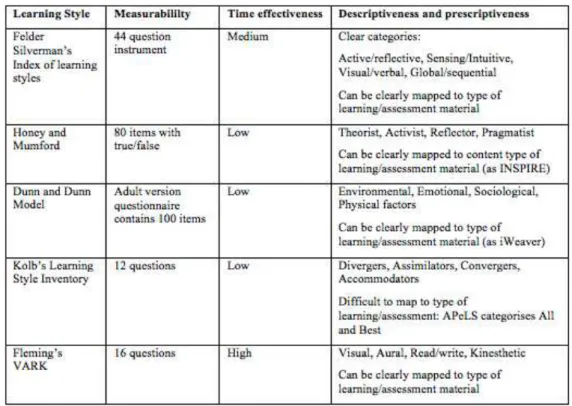
2.3.4 Evaluation of learning styles for adaptability and personalisation ... 31
2.4 Summary ... 35
3 E-learning systems ... 38
3.1 Introduction ... 38
3.2 Authoring tools for education ... 39
3.2.1 General authoring and editing tools ... 39
3.2.2 E-Learning Platforms or Learning Management Systems ... 41
3.2.3 Adaptive hypermedia systems ... 43
3.2.3.1 General adaptive educational hypermedia ... 45
3.2.3.2 Adaptive hypermedia systems incorporating learning styles ... 47
3.2.4 Evaluating adaptive hypermedia systems ... 50
3.3 Personalised and adaptive learning ... 54
3.3.1 Personalised and adaptive learning issues ... 54
3.3.2 Evaluation of the personalisation and adaptability offered by popular e-learning platforms ... 56
3.4 Tagging objects and standards ... 61
! $""!
3.4.2 Metadata and standards ... 63
3.4.3 XML, RDF and OWL ... 67
3.4.4 E-learning systems incorporating tagging ... 69
3.4.4.1 Web Annotation Systems ... 70
3.4.4.2 Systems incorporating tagging ... 71
3.5 Summary ... 74
4 Design of a methodology for tagging learning objects for personalisation and reuse 77 4.1 Introduction ... 77
4.2 Overview of the authoring and tagging methodology ... 78
4.2.1 Overview of instructor authoring incorporating tagging ... 79
4.2.2 Overview of the learner part of the methodology: ... 80
4.3 Learning material tagging design ... 81
4.3.1 OWL and RDF Design ... 81
4.3.2 The XML tags design ... 83
4.3.3 Metadata design ... 86
4.3.3.1 The subject and topic hierarchy ... 86
4.3.3.2 Description metadata ... 88
4.3.3.3 Keyword metadata ... 89
4.3.3.4 Learning material file type metadata ... 89
4.3.3.5 Learning material resource type metadata ... 90
4.3.3.6 Knowledge level metadata ... 90
4.4 The learning style representation ... 91
4.5 The learner profile ... 96
4.6 The personalised learning package ... 97
4.7 The methodology overview demonstration incorporating another discriminatory tagging example ... 99
4.8 Summary ... 108
5 Implementation: Moodle incorporating tagging for personalisation and reuse ... 110
5.1 Introduction ... 110
5.2 Moodle as the development tool ... 111
5.3 Enhanced Moodle functionality ... 113
5.3.1 Authoring and tagging the learning content for VARK discrimination ... 115
5.3.1.1 Authoring the subject and topic hierarchy ... 116
5.3.1.2 Authoring the learning and assessment objects tags ... 119
5.3.1.3 Learning object authoring example ... 122
5.3.2 Searching the tagged learning resources ... 124
5.3.2.1 VR learner type example search ... 128
5.3.2.2 AK learner type example search ... 130
5.4 Platform independency and multiple users ... 132
5.5 Summary ... 136
6 Experimental design ... 138
6.1 Introduction ... 138
6.2 The critical reflection ... 139
6.3 The tagging search in the learning repository study ... 140
! $"""!
6.4.1 Structured walkthrough ... 143
6.4.1.1 Structured walkthrough task 1 ... 143
6.4.1.2 Structured walkthrough task 2 ... 145
6.4.2 Cognitive walkthrough ... 146
6.4.2.1 Cognitive walkthrough: Task 1 ... 148
6.4.2.2 Cognitive walkthrough: Task 2 ... 149
6.4.3 Questionnaires ... 150
6.4.3.1 Pre-study questionnaire ... 151
6.4.3.2 Post-study questionnaire ... 152
6.4.4 Unstructured interview ... 153
6.5 Summary ... 154
7 Results and analysis ... 157
7.1 Introduction ... 157
7.2 Critical reflection ... 158
7.3 Testing the tagging search in the learning resource repository ... 162
7.3.1 User with VA learning style type ... 162
7.3.2 User with RK learning style type ... 164
7.4 Expert evaluation ... 166
7.4.1 Interface design ... 167
7.4.2 Tagging content ... 168
7.4.3 Moodle ... 169
7.4.4 Authoring learning objects ... 169
7.4.5 Tagging for learning styles ... 171
7.4.6 The tagging methodology ... 172
7.4.7 Task completion times ... 174
7.4.8 Frequency analysis ... 176
7.5 Evaluation results ... 182
7.6 Conclusion ... 185
8 Conclusion and further work ... 189
8.1 Introduction ... 189 8.2 Research conclusion ... 190 8.3 Main contributions ... 198 8.4 Future work ... 199 8.5 Final statement ... 200 Appendix A ... 202
A.1 Task sheet for structured walkthrough study ... 202
A.2 Task sheet for cognitive analysis study ... 208
Appendix B ... 211
B.1 Related publications published during the duration of this thesis ... 211
! "%!
List of Figures
Figure 1: Curry's onion model of learning styles (Curry 1983) ... 19
Figure 2: Coffield's family of learning styles ... 20
Figure 3: Kolb's four learning styles (figure from Coffield 2004) ... 22
Figure 4: Coffield's variable factors for the Dunn and Dunn model ... 28
Figure 5: E-learning platforms and their overall score ... 61
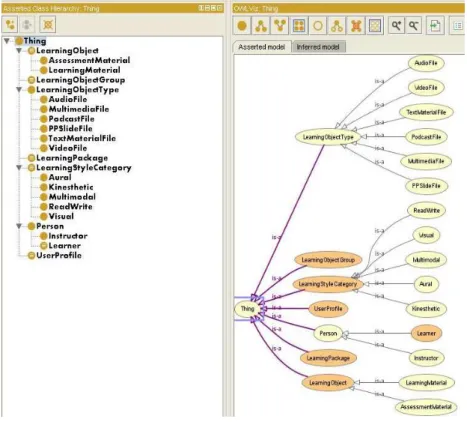
Figure 6: Classes and subclasses in protege ... 82
Figure 7: Snippet of example XML code ... 84
Figure 8: A code snippet of the XML schema ... 85
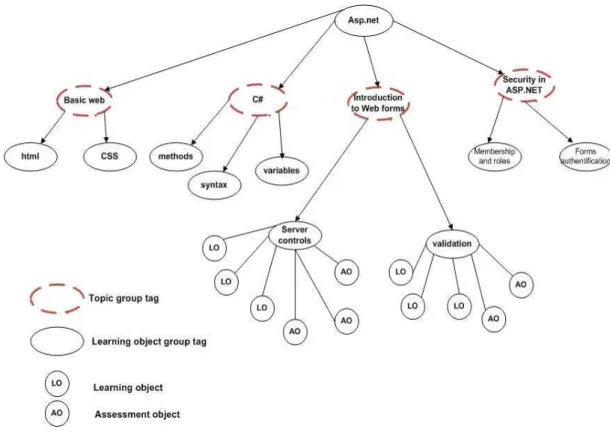
Figure 9: Example subject, topic and LOG hierarchy ... 87
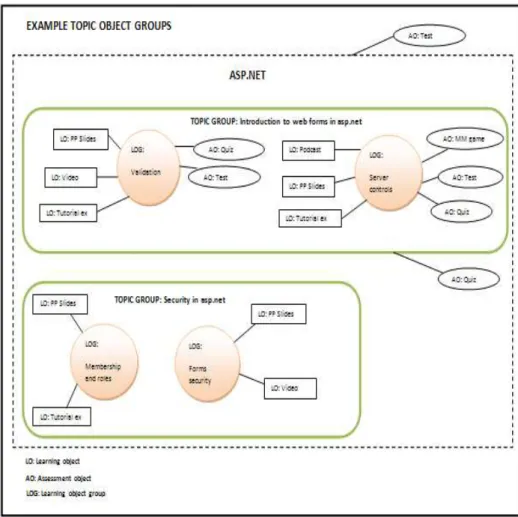
Figure 10: Topic groups and learning object groups ... 88
Figure 11: Sample questions for the VARK online questionnaire ... 92
Figure 12: Multimodal (VARK) type of learner ... 92
Figure 13: Learning style: learning file type diagram showing overlap ... 95
Figure 14: Learning style: learning resource types diagram showing overlap ... 95
Figure 15: The learner profile ... 96
Figure 16: View of the personalised learning package ... 99
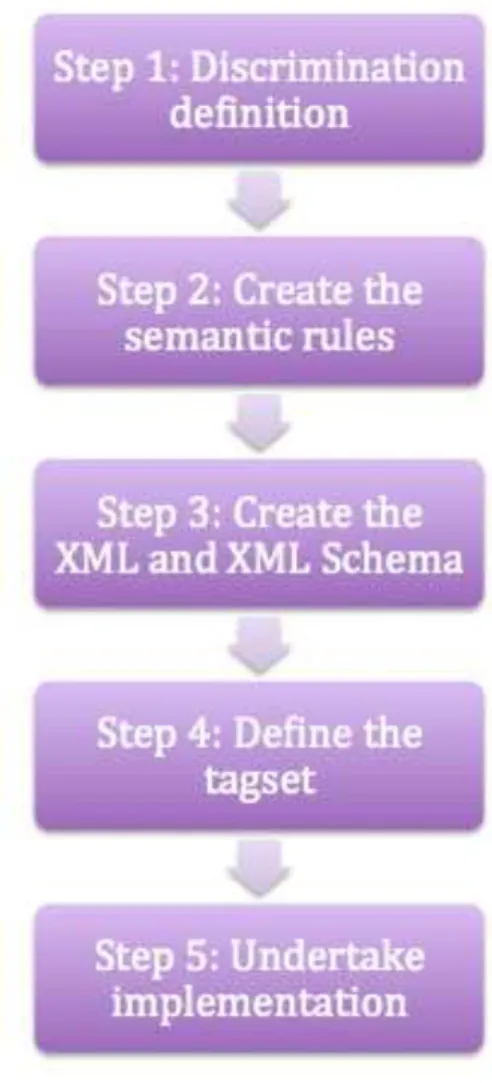
Figure 17: Discriminatory methodology steps ... 101
Figure 18: XML showing tagging for accessibility ... 104
Figure 19: XML schema for accessibility ... 106
Figure 20: User interest tags in Moodle ... 113
Figure 21: Block showing Moodle tags for learner's interests ... 113
Figure 22: Course categories and sub-categories ... 117
Figure 23: Instructor view for sub-category course ... 118
Figure 24: Resource selection of the new searchable resource type ... 119
Figure 25: Shareable object choice ... 120
Figure 26: Add new searchable file window ... 121
Figure 27: The completed form for the learning object example ... 123
Figure 28: The search block available from the Moodle start page ... 124
Figure 29: Learning object search screen ... 126
Figure 30: Example learning object search results ... 127
Figure 31: Moodle saving confirmation window ... 128
Figure 32: Learner with VR learning ... 129
Figure 33: Recommended objects for learner with VR learning style search ... 130
Figure 34: Learner with AK learning style search ... 131
Figure 35: Recommended objects for learner with AK learning style search ... 132
Figure 36: C# prototype implementation learning object upload screen ... 133
Figure 37: The xsd within the C# prototype ... 134
Figure 38: Example for structured walkthrough task 1 ... 145
Figure 39: Learning object search window for structured walkthrough task 2 ... 146
Figure 40: Search screen for user with VA learning style type ... 163
Figure 41: Search results for user with VA learning style type ... 163
Figure 42: Search screen for user with RK learning style type ... 165
Figure 43: Search results for user with RK learning style type ... 165
Figure 44: Results for question: "the ability to re-use learning material within an e-learning environment is helpful" ... 170
! %!
Figure 45: Results for question: "if a system like this was available I would use it". ... 170
Figure 46: results for question: "how do you rate your experience with VARK?" ... 171
Figure 47: Total time taken for tasks 1 and 2 ... 174
Figure 48: A Wordle showing the frequency analysis of responses ... 176
List of Tables
Table 1: Categorisation of learning styles ... 34Table 2: Learning styles, systems and purpose ... 50
Table 3: E-learning platform evaluation results ... 59
Table 4: VARK learning style and object mapping representation ... 94
Table 5: Tag set for the accessibility example ... 107
Table 6: Tag set for VARK discrimination ... 116
Table 7: Available learning objects for task 1 ... 149
Table 8: Showing Moodle scores before and after tagging ... 161
! &!
1
Introduction
1.1
Rationale
Much research has been undertaken about how we learn and how a learnerÕs learning style affects this learning process. From the behaviourist approach of Skinner (1974) and Watson (1930) to the constructivist approach of Vygotsky (1978) and Piaget (1973) there has been an on-going debate about how to develop instructional design theory, in order to provide a much richer learning environment for learners. Some of the research within this field shows we are far from being able to pass a unanimous judgement on both technical and pedagogical aspects of e-learning in general, and personalised e-learning in particular.
Personalisation of e-learning is viewed by many authors (see amongst others Eklund and Brusilovsky (1998), Kurzel, Slay and Hagenus (2003), Martinez (2000), Sampson, Karagiannidis and Kinshuk (2002) and Voigt and Swatman (2003)) as the key challenge for the learning technologists. According to Kurzel (2004) the tailoring of e-learning applications can have an impact on content and how itÕs accessed; the media forms used; method of instruction employed and the learning styles supported.
The word ÒpersonalisationÓ is used widely. However, it is felt that this term often refers to a fairly limited understanding of the concept. It is thought that people often think that personalisation on the web is similar to a scenario such as Amazon, which remembers the user, their particular buying pattern and behaviour and offers them a ÒpersonalisedÓ page. Often personalisation like this can be little more than tracking the usersÕ shopping habits using cookies to store this information. However the question is how can e-learning be individually ÔcustomisedÕ or ÔpersonalisedÕ on a mass scale? Issues here are that there is still an on-going debate about what ÔpersonalisationÕ actually means and also that there is no set of ÔstandardsÕ available for guidance. The mass system i.e. where one educational approach is delivered to all students, may
! '!
work for the majority, but the minority are failed by it, so the use of personalisation of learning is seen as a means to improve the failing performance of the minority by addressing their needs directly, within the mass system, and potentially achieving an overall improvement for all students.
Furthermore, the current state of digital content available for e-learning indicates a wide variety of formats, platforms and subject areas are in use with very little, if any, interoperability.
Learning styles and how we learn is a vast research area. Brusilovsky and Mill‡n (2007) argue that learning styles are typically defined as the way people prefer to learn. The concept and validity of learning styles are a hotly debated topic, however, that aside; many research projects incorporate learning styles into their adaptive e-learning systems (for example Graf and Kinshuk (2007)). These systems are not widely used today and one reason for this is that the functionality offered is inflexible.
In considering the problem of the common e-learning systems that generally provide a Ôone size fits allÕ model, this research is interested in looking at the area of personalised learning and to investigate the ability to offer personalised learning according to a learnerÕs learning style.
1.2
Initial hypothesis
The initial research hypothesis is as follows:
ÒA mechanism can be developed to personalise learning materials to an individual learner according to their learning styleÓ.
! (!
1.3
Aims and objectives
The hypothesis will be the basis for this research and the aims of this research project are as follows:
¥ To understand the body of knowledge relative to personalised and adaptive learning techniques, e-learning tools and learning styles.
¥ To develop a unique approach that supports the personalisation of learning materials and the use of learning styles.
In order to achieve these aims, the following research objectives have been identified:
¥ To carry out a critical and comprehensive review of research within the area of e-learning tools, personalised and adaptive learning, and learning styles.
¥ To investigate current trends and technologies within e-learning.
¥ To create and evaluate a model to offer personalised learning based on a learnerÕs learning style.
1.4
Structure of thesis
The structure of this thesis is as follows:
Chapter 2 gives an overview of teaching and learning theories and how these relate to e-learning and learning design. Specifically, the learning theories described are behaviourism, cognitivism and constructivism and the learning approaches described are pedagogy, andragogy and heutagogy. This chapter describes these theories and approaches and looks at any benefits and criticisms.
This chapter also describes learning styles and how they have been both promoted and criticised by researchers. It describes current research and categorization of learning styles and learning styles that are used within
! )!
adaptive e-learning environments. It then goes on to describe a selection of common learning styles in detail and some criticisms of learning styles.
The author published the learning style research described within this chapter in a paper in 2008. The title of the paper was ÒEvaluation of a suitable learning style for iLearn: a personalised e-learning platformÓ and contained the evaluation of learning styles for personalisation and adaptability (see Peter et al. (2008)).
Chapter 3 describes and evaluates the different types of authoring tools that are available. These include general authoring tools e.g. HTML pro (2008), e-learning platforms (e.g. Moodle) and adaptive web based educational systems. Additionally, this chapter goes on to describe adaptive systems that incorporate learning styles e.g. INSPIRE (Grigoriadou et al (2001)).
Additionally this chapter also describes personalised and adaptive learning and then specifically looks at e-learning platforms. The chapter evaluates how much personalised and adaptive learning current e-learning platforms provide. The author published the e-learning platform research described within this chapter in a paper in 2009. The title of the paper was Òevaluating the personalised and adaptable learning provided by e-learning platformsÓ (see Peter et al. (2009)).
This chapter also discusses tagging objects and standards within e-learning systems. Specifically it describes learning and assessment objects, standards and to what extent they are currently being tagged within e-learning systems. This metadata research is discussed within a paper published by the author in 2010. The title of the paper is ÒDesigning metadata for learning and assessment objectsÓ (see Peter et. al. (2010)). The tagging section from this thesis is also part of a published paper published by the author in 2011. The title of this paper is ÒTagging learning objects in Moodle for personalisation and reuseÓ (see Peter et al. (2011)).
! *!
Chapter 4 describes the design of a tagging model for learning object personalisation and reuse. It gives an overview of the tagging model, learning material tagging and metadata design, learning style representation, learner profile and the personalised learning package. The initial metadata tagging model design was published within a paper published by the author in 2010. The title of the paper is ÒDesigning metadata for learning and assessment objectsÓ (see Peter et al. (2010)).
Chapter 5 describes the implementation of a prototype, which is an extension of Moodle incorporating tagging for personalisation and reuse. Moodle is a tool that has leant itself to this implementation, however, this model can be developed in other environments and platforms as necessary. This chapter describes Moodle as a development tool, and the enhanced functionality for both authoring and searching learning objects. The author published the initial instructor tagging implementation in 2011. The title of this paper is ÒTagging learning objects in Moodle for personalisation and reuseÓ (see Peter et al. (2011)).
Chapter 6 describes the experimental design. It describes the studies that have been devised to test and evaluate the model and the prototype. Different parts of the model and prototype are tested, and these studies consist of a critical reflection, walkthroughs, questionnaires and unstructured interviews. The studies are described in detail in this chapter.
Chapter 7 describes the results and analysis of the research. Results for a number of studies are described, including studies undertaken by expert evaluators.
Chapter 8 provides an overall conclusion to the research project with recommendations and also describes how the work could be taken forward.!
! +!
2
Learning theories and learning styles
2.1
Introduction
!
Many research studies have been conducted about how we learn and how learners learning style affects the learning process. The research undertaken within this chapter is intended to address the research aim Òto understand the body of knowledge relative to personalised and adaptive learning techniques, e-learning tools and e-learning stylesÓ.
As the hypothesis for the research is Òa mechanism can be developed to personalise learning materials to an individual learner according to their learning styleÓ, the overall purpose of the research described in this chapter is to evaluate learning theories and approaches to see how they ÔfitÕ with personalised learning environments and to investigate learning styles and evaluate them for their suitability to use within a personalised and adaptive learning style environment.
At the beginning of this chapter, the theories of learning and teaching and learning approaches will be discussed in detail. The main theories of learning explained are behaviourism, cognitivism and constructivism and the main learning approaches considered are pedagogy, andragogy and heutagogy. In particular, this research will look at the differences between these theories and approaches of learning and discuss any criticisms or benefits of using them. This research will investigate which theory or approach will be the best fit to enable personalised and adaptive learning.
Learning styles and how we learn is a large research area and this will also be discussed within this chapter. Many learning styles, for example Kolb (Kolb, 1976) and Dunn and Dunn learning style model (Dunn and Dunn, 1974) have been developed and this chapter describes these common learning styles in detail including how they are categorised and measured. Many educationalists and researchers have criticised learning styles over the years, and these criticisms of learning styles will also be discussed.
! ,!
Finally this chapter investigates learning styles further and in particular evaluates learning styles for their suitability for use within a personalised adaptive learning environment. Specifically, some common learning styles are evaluated with a criterion to see how well their categories would be able to be mapped to learning objects within a personalised learning environment. The evaluation tools for these learning styles will also be assessed.
Within the conclusion of this chapter the project hypothesis, aims and objectives will be revisited to see whether they have changed or have been satisfied by the research undertaken.
2.2
Theories and approaches of learning
2.2.1 Learning theories !
Three important learning theories have had a major impact in learning and instructional design and these are behaviourism, cognitivism and constructivism. Additionally, there is an on-going debate about how to develop instructional design theory in order to provide a much richer learning environment for learners.
The three theories of behaviourism, cognitivism and constructivism will be discussed in further detail within the next section of this chapter.
2.2.1.1 Behaviourism theory
The behaviourism approach (Pavlov (1927), Skinner (1974) and Watson (1930) amongst others) sees the mind as a Òblack boxÓ that responds to a stimulus.
Skinner (1974) states Òlearning is a chance in observable behaviour caused by external stimuli in an environmentÓ. Skinner (1974) also argues that
! -!
behaviourism ignores any consideration of the thought process that may occur in the mind. BehaviourismÕs focus is to observe any changes in behaviour and whether a new behavioural pattern is being repeated until it becomes automatic. Therefore, behaviourism deals with studying learner behaviours that can be observed and measured.
Watson (1930) defined learning as Òa sequence of stimulus and response to actions in observable cause and effect relationshipsÓ. Furthermore, Forrester (2002) states that the behaviouristsÕ example of conditioning demonstrates the process where a human learns to respond to neutral stimuli in a way that would normally be associated with unconditioned stimuli.
There are a number of known experiments demonstrating the conditioning behaviourism theory. One of the most well known experiments is the PavlovÕs dog behaviourism experiment. According to Forrester (2002) this experiment focused on the digestive process in animals. When conducting the experiment, Pavlov found that the dog would salivate (a response) when hearing a bell. This experiment showed that this occurred because the dog had started to associate feeding with the bell ringing. Watson (1930) therefore believed that humans might similarly react to stimuli generated internally (for example hunger) or externally (for example a loud noise).
Forrester (2002) also states that Skinner expanded this further by focusing on human behaviour and he proposed that voluntary or automatic behaviour is either strengthened or weakened by the immediate presence of a reward or punishment.
As far as e-learning and behaviourism is concerned, Modritscher (2006) highlights that Atkins (1993) gives four aspects relevant for realising online courses with respect to the behaviourist school:
¥ That the learning material should be broken down into instructional steps where possible.
! .!
¥ That course designers have to define sequences of instructions for the learner using either conditional or unconditional branching.
¥ That some learners may be routed to miss or repeat sections to maximize learning efficiency.
¥ To allow for the demonstration of an operation, procedure or skill and break it into parts.
Additionally, Modritscher (2006) suggested that overall behaviourists recommend a structured and deductive approach when designing an online course. He states that this will therefore ensure that the learner can rapidly acquire basic concepts, skills and factual information.
It has been found that limitations of this approach come from the actual understanding of learning. Alonso et al. (2004) state that the limitation is that people could imitate any behaviour that they had not reinforced. Bandura (1977) also states that the individual could model their behaviour by observing the behaviour of another person.
BehaviourismÕs focus therefore is to observe any changes in behaviour when learning and so therefore, behaviourism deals with studying learner behaviours that can be observed and measured. The limitations of this approach are that the learner could imitate behaviour or could copy another learnerÕs behaviour.
2.2.1.2 Cognitivism theory
The cognitivism theory emerged as a response to the behaviourist theory and itÕs limitations. There is no one agreed definition of cognitivism but generally it is thought that cognitivism theory deals with the thought process the student undertakes when learning. Many authors have made contributions to the debate about cognitivism and they are described within this section.
! &/!
Ally (2004) argues that this approach Òsees learning as an internal process that involves memory, thinking, reflection, abstraction, motivation and meta-cognitionÓ. Ally (2004) also suggests that cognitive psychology is interested in the information processing and memory used when learning.
Furthermore, Thompson et al. (1996) argue that the cognitive theory concentrates on the conceptualisation of a studentÕs learning processes and so therefore they maintain that cognitivism focuses on the way information is received, organised, retained and used by the brain.
Sampson and Karagiannidis (2002) suggest that the foundation of cognitive theories argue for active involvement by learners, emphasis on structure and organisation of knowledge, and adding new knowledge to the learnerÕs existing cognitive structures.
Modritscher (2006) promotes that the cognitive school of thought, which recognises the importance of individual differences and of including a variety of learning strategies to accommodate those differences. He also suggests that cognitive psychology focuses on learnersÕ receiving and processing of information to transfer it into long-term memory for storage. He therefore argues that if instructional designers wish to design for the cognitive focused approach then they need to consider:
¥ Putting learning content into small groups
¥ Supporting different learning styles up to higher concepts such as motivation, collaboration or metacognition.
Additionally, Modritscher (2006) states that although the cognitive-focused approached is suitable for learners who want to reach higher-level objectives, he argues that there is a major weakness if a learner does not have the relevant pre-requisite knowledge as the content would not be suitable for them.
Alonso et al. (2004) argue that the influence of cognitive science on instructional design is evidenced by the use of advanced learning material
! &&!
organisers, metaphors, chunking the instructional material into meaningful parts and the careful organisation of instructional materials from simple to complex.
This research has shown that the cognitivism theory was developed in response to the behaviourst theory and that it is interested in the memory and information processing used by the learner when learning. The work also demonstrates that instructional designers should consider a number of techniques when designing for this theory, including putting the content into small chunks and giving careful consideration with the organisation of the material.
2.2.1.3 Constructivism theory
Within the contructivism approach (Dewey (1916), Bruner (1986), Montessori (1914), Piaget (1973) and Vygotsky (1978) amongst others), learners interact with the environment and then construct their own knowledge based on that interaction. Forrester (2002) states that constructivists believe all humans have the ability to construct knowledge in their own minds through a process of discovery and problem solving.
Furthermore, Alonso et al. (2004) suggest that constructivism builds upon both behaviourism and cognitivism in the sense that it accepts multiple perspectives and maintains that learning is a personal interpretation of the world. They argue that the constructivist theory maintains that learners construct or interpret their own learning based upon their own experiences.
Forrester et al. (2002) explains how Piaget (1973) observed human development as progressive states of cognitive development. He describes how his four stages, which commence at infancy and progress into adulthood, characterise the cognitive abilities necessary at each stage to construct meaning of ones environment.
! &'!
Within the constructivist approach, the emphasis is on the learner rather than the teacher. With this in mind, Applefield et al. (2000) state that Òconstructivism is an epistemological view of knowledge acquisition emphasising knowledge construction rather than knowledge transmission and the recording of information conveyed by othersÓ. The role of the learner is conceived as one of building and transforming knowledge.
Applefield et al. (2000) therefore propose that pedagogical recommendations based on the constructivist principles of learning are as follows:
¥ Learners should be encouraged to raise questions, generate hypotheses and test their validity.
¥ Learners should be challenged by ideas and experiences that generate inner cognitive conflict or disequilibrium.
¥ StudentÕs errors should be viewed positively.
¥ Students should engage in reflection through journal writing, drawing, modeling and discussion. Learning occurs through reflective abstraction.
¥ The learning environment should provide opportunities for dialogue.
¥ The students should communicate their ideas to others, defend and justify them.
¥ Students should work with big ideas, across experiences and disciplines.
In addition, they add to this that the overriding goal of constructivism educators is to stimulate thinking in learners that results in meaningful, deeper understanding and transfer of learning to real world contexts. It is therefore desirable that constructivist lessons have a clear content goal designed around an authentic learning task, question or problem.
Sampson and Karagiannidis (2002) state that constructivist theory implies that instructional designers determine which method and strategies will help learner to actively explore topics and advance their thinking. Additionally, Alonso et al. (2004) assert that one of the most useful tools for the
! &(!
constructivist designer is hypertext and hypermedia because it allows for a branched design rather than a linear format of instruction.
Furthermore, Modritscher (2006) state that some examples of constructivist learning can be found within the scope of experimental learning, self-directed learning, context-aware learning and reflective practice. He states that this learning theory has some disadvantages, such as problems in adequately evaluating the learning process, lack of instructional resources to respond to the multitude of student interest.
The research has shown that constructivism builds upon both behaviourism and cognitivism and within this theory the learner construct their own learning based on their own individual experiences. Hypertext and hypermedia has been highlighted as one of the most useful tool for the constructivist designer and they generally lessons for constructivist learners should have a clear content goal design around authentic learning tasks.
2.2.2 Teaching and learning approaches
The main teaching and learning approaches are pedagogy, andragogy and heutagogy. Pedagogy is defined as teacher-centered, andragogy is defined as student-centred and heutagogy is defined as self-determined. These approaches are now described in more detail within the next section of this chapter.
2.2.2.1 Pedagogy approach
According to McAuliffe et al. (2008) pedagogy dates back to the monastic schools of Europe in the Middle Ages. They also suggest that this tradition of pedagogy was adopted and spread to schools throughout Europe and America in the 18th and 19th centuries. Additionally, they state that pedagogy is derived from the Greek word ÔpaidÕ, which means child, and ÔagogosÕ which means leading. Furthermore, Knowles (1970) argues that
! &)!
assumptions regarding learning and learners were based on observation of monks in the teaching of simple skills to children.
Pedagogy describes the traditional relationship between a teacher and a learner. Hase and Kenyon (2000) state that it was always the teacher who described what the learner needed to know, and how that knowledge and skills should be taught and within the research of McAuliffe et al. (2008) this is supported.
Additionally, McAuliffe et al. (2008) suggest that pedagogy is a teaching theory rather than a learning theory and is usually based on transmission. They go on to suggest that the pedagogical model is a content model that is concerned with the transmission of information and skills, where the teacher decides in advance what knowledge or skill should be transmitted. Within this model, this information will be arranged in logical unit, which will be transmitted in sequence.
Additionally, according to Coffield et al. (2004), Dewey (1916) states that pedagogy is often dismissed as futile because: ÔNothing has brought pedagogical theory into greater dispute than the belief that it is identified with handing out to teachers recipes and models to be followed in teachingÕ.
Pedagogy therefore is a traditional teaching approach that is interested in the transmission of information and skills from a teacher to a learner. Criticism of this approach is that this does not allow for any flexibility or consideration of the individual learnerÕs needs. All material will usually be delivered in sequence, without any element of personalisation for the learner.
2.2.2.2 Andragogy approach
In 1970, Knowles proposed a change in the way educational experiences for adults should be designed and suggested an approach called andragogy.
! &*!
Hase and Kenyon (2000) state that the andragogy approach contrasts quite sharply with the pedagogy approach. Pedagogy is concerned with the teaching of children, whereas they state that andragogy and the principles of adult learning that were derived from it transformed face-to-face teaching and provided a rationale for distance education based on the notion of self-directedness.
Furthermore Hase and Kenyon (2000) highlight that Knowles (1970) defines self-directed learning as Òthe process in which individuals take the initiative, with or without the help of others, in diagnosing their learning needs, formulating learning goals, identifying human and material resources for learning, choosing and implementing learning strategies, and evaluating learning outcomesÓ.
McAuliffe et al. (2008) explain that the term is defined from the Greek words ÔanereÕ which means ÔmanÕ and ÔagogusÕ which means leading and this term is used by adult theorists and educators to describe the theory of adult learning. They state that the andragogical model considers the following issues to be addressed in the learning process:
¥ To allow for the learner to know why something is important to learn
¥ To show the learner how to direct themselves through the information
¥ To relate the topic to the learnerÕs experience
McAuliffe et al. (2008) also state that there is a great deal of debate and criticism of andragogy, particularly when compared to other teaching and learning theories. For example, Hase and Kenyon (2000) argue that since society has rapidly changed and we now live in a highly technical society, learning should be more self-determined.
Andragogy therefore is self-directed learning, which is in contrast to pedagogy which is the transmission of knowledge from a teacher to a student. McAuliffe et al. (2008) suggest that andragogy can be considered
! &+!
an effective application to various learning situations of the maturing adult learner.
2.2.2.3 Heutagogy approach
Hase and Kenyon (2000) state that the concept of truly self-determined learning, called heutagogy, builds on the humanistic theory and approaches to learning described in the 1950s. McAuliffe et al. (2008) state that the term is derived from the Greek word for ÔselfÕ and ÔleadingÕ and was coined by Hase and Kenyon (2000) in the late 1990Õs. It attempts to challenge some ideas about teaching and learning that still prevail in teacher centered learning and it is suggested that heutagogy is appropriate to the needs of learners in the 21st century, particularly in the development of individual capacity.
Hase and Kenyon (2000) also state that a heutagogical approach recognises the need to be flexible in the learning where the teacher provides resources but the learner designs the actual course he or she might take by negotiating the learning. They, therefore, state that learners may read around critical issues or questions and determine what is of interest and relevance to them and then negotiate further reading and assessment tasks.
They also state that heutagogical approaches to education and training emphasise: the humanness in human resources; the worth of self; capability; a systems approach that recognises the system environment interface; and learning as opposed to teaching. Hase and Kenyon (2000) go on to suggest that a shift in thinking towards heutagogy will enable the control of learning to shift more appropriately to the learner. Furthermore, they state it will enable a far more creative approach to learning, no matter what the context.
With this in mind, Canning and Callan (2010) undertook a study based on student responses to experience, study and professional development. They consider how students are supported in taking control of their own learning.
! &,!
They found that students in their study showed that they were on their way to developing a heutagogical approach to learning by demonstrating:
¥ That they were self-aware.
¥ That they were able to articulate feelings, experiences and ideas.
¥ That they engaged in shared discussions with others.
¥ That they investigated appropriate academic sources in developing their own ÔtheoriesÕ and knowledge.
¥ That they were confident in their study skills and able to access the facilities of their institution.
Canning and Callan (2010) therefore suggest that this assessment demonstrates that this has given the students a personal heutagogy in which they are able to revisit and continue to build upon.
Heutagogy therefore challenges some ideas about traditional teaching and learning. Hase and Kenyon (2000) suggest that a shift in thinking towards heutagogy will enable the control of learning to shift more appropriately to the learner. They state that this will enable a far more creative approach to learning, no matter what the context.
2.3
Learning styles
2.3.1 Overview of learning styles
Many definitions exist for learning styles, Brusilovsky and Mill‡n (2007) state that Òlearning styles are typically defined as the way people prefer to learnÓ and Dunn et al. (1989) define learning styles as Òa biologically and developmentally imposed set of personal characteristics that make the same teaching method effective for some and ineffective for othersÓ. Both definitions demonstrate that learning styles are classifying learner according to the way they learn.
! &-!
Learning styles have also been both promoted and criticised by researchers and this section describes the research undertaken into learning styles. In particular, learning styles that are used within adaptive e-learning environments are described in detail. These adaptive systems incorporating learning styles are discussed in more detail in Chapter 3.
Coffield et al. (2004) state that the field of learning styles consists of a wide variety of approaches that stem from different perspectives, which have some underlying similarities and some conceptual overlap.
Keefe (1979) states that learning styles are characteristic, cognitive, affective and psychological behaviours that serve as relatively stable indicators of how learners perceive, interact with, and respond to the learning environment. Since this time, there have been many definitions and many conflicting studies about the effectiveness of learning styles. Sampson and Karagiannidis (2002) state that learning styles have been at the centre of controversy for several decades and there is still little agreement about what learning styles really are, however, one major distinction agreed by the majority of learning styles research is the visual, auditory and kinesthetic distinction.
Haapala (2006) states that according to Felder (1997), learning styles may be defined in part by the answers to five questions that are essential in defining the characteristics of the concept Òlearning styleÓ:
1) What type of information the student preferentially perceives. 2) Which modality is sensory information most effectively perceived. 3) Which organisation of information the student is most comfortable
with.
4) How the student prefers to process information. 5) How the student progresses toward understanding.
Previous attempts have been made to try to categorise learning styles. Two examples of this are the learning style categorisation proposed by both Curry (1983) and Coffield (2004).
! &.!
Curry (1983) (see Figure 1) proposes an onion metaphor consisting of three layers as follows:
¥ The outermost layer is the instruction preference model. These are the environmental, emotional and sociological preferences of a learner.
¥ The middle layer is the information processing models. This is the process of acquiring and processing information.
¥ The innermost layer is focusing on the personality traits of a learner.
! Figure 1: Curry's onion model of learning styles (Curry 1983)
!
Additionally, to enhance CurryÕs onion model, Claxton and Murrell (1987) proposed the following fourth layer between CurryÕs two outer layers:
¥ The social interaction layer. This layer contains the collaborative aspects that occur during learning.
Coffield et al. (2004) states that although CurryÕs model has been used as a useful pragmatic way to present different models, they state that however attractive the onion metaphor may be, it is far from clear what actually lies at the centre of the Onion model of learning styles.
! '/!
With this in mind, Coffield et al. (2004) undertook a very detailed evaluation of learning styles, in which they identified 71 models, 13 of which were categorised into families of learning styles shown in Figure 2.
! Figure 2: Coffield's family of learning styles
During this research it has been found that a number of learning style models are being used for the purpose of personalisation and adaption within e-learning. These learning styles are Kolb Learning Styles Theory (Kolb, 1985), Felder and Silverman Index of Learning Styles (Felder and Silverman, 1988) and Honey and Mumford Index of Learning Styles (Honey and Mumford, 1992), VARK (Fleming, 2001) and Dunn and Dunn (Dunn and Dunn, 1974). These common learning styles will be described in more detail in the next section of this chapter and Chapter 3 describes the adaptive systems incorporating the learning styles in more detail.
! '&!
2.3.2 Examples of learning styles used within adaptive systems
2.3.2.1 Kolb Learning Style
Kolb (1976) argues that learning is the process whereby knowledge is created through the transformation of experience. Kolb (1985) also suggests that knowledge results from the combination of grasping experiences and transforming it.
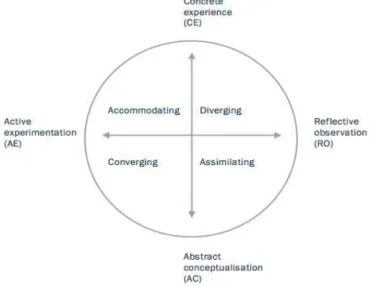
This learning style theory proposed by Kolb (1985) is based on the Experiential Learning Theory and the main styles proposed in this model (summarised in Figure 3) are as follows:
¥ The converging learner style (abstract, active).
o This style type includes the learner being good at problem solving and taking decisions. They prefer to deal with technical rather than interpersonal issues.
¥ The diverging learner style (concrete, reflective).
o This style type includes being imaginative and aware of meanings and values and views concrete situations from many perspectives.
¥ The assimilating learner style (abstract, reflective).
o This style type prefers abstract conceptualisation and reflective observation. They are concerned with ideas and abstract concepts rather than with people.
¥ The accommodating learner style (concrete, active).
o This style type likes doing things, carries out plans and gets involved in new experiences. They are good at adapting to change and are at ease with people but can seem impatient.
The model suggests that the learner should cycle through all four styles in order to gain a full understanding of the topic.
! ''!
The assessment tool for KolbÕs theory is the learning style inventory (LSI). The tool offers 12 sentences that describe learning and the learner is asked to rank these to best describe how they learn.
Many studies have evaluated the KolbÕs theory and have highlighted issues and weaknesses with the learning style inventory. In particular, Coffield et al. (2004) state that issues have been raised about the scoring method for this tool in particular the test retest reliability. Studies have demonstrated the problem according to Coffield et al. (2004) and they give as an example Ruble and Stout (1992) who found that 56% of their respondents maintained the same learning style, however, at the second test 16% changed to the opposite learning style, e.g. from assimilator to accommodator.
! Figure 3: Kolb's four learning styles (figure from Coffield 2004)
2.3.2.2 Honey and MumfordÕs Learning Styles Model
The learning style model by Honey and Mumford (1992) is based on KolbÕs Experiential Learning Theory (Kolb, 1985).
Coffield et al. (2004) state that instead of asking people directly how they learn, as KolbÕs Learning Style Indicator does, the Honey and Mumford
! '(!
model provides them with a questionnaire in which it probes general behavioural tendencies rather than asking questions about learning.
According to Honey and Mumford (1992), a learning style is a description of the attitudes and behaviour that determines an individualÕs preferred way of learning. The learning style categories that they propose are activists, reflectors, theorists and pragmatists. Strengths and weaknesses are defined for each of these learning style categories. However, Honey and Mumford (2000) argue that no single style has an advantage over any other as they state that the strengths and weaknesses of a style may be important in one situation but not another.
Activities and preferences are defined by Honey and Mumford (1992) and they define what the different learning style categories react positively to and they are as follows:
Activists react positively to:
¥ Action learning, business game simulations, job rotation, discussion in small groups, role playing, training others and outdoor activities.
Reflectors react positively to:
¥ E-learning, learning reviews, listening to lectures or presentations, observing role plays, reading and self-study/self-directed learning.
Theorists react positively to:
¥ Analytical reviewing, exercises with a right answer, listening to lectures, self-study/self-directed learning, solo exercises and watching Ôtalking headÕ videos.
! ')! Pragmatists react positively to
¥ Action learning, discussion about work, discussion in small groups, group work with tasks where learning is applied.
The measurement tool for this method is the learning styles questionnaire. This tool consists of 80 questions that probe preferences for four learning styles with 20 items for each style.
Coffield et al. (2004) argue that since its development it has attracted considerable interest, application and research. Initially it was welcomed as an improvement on KolbÕs Learning Style Indicator, but evaluations have since taken place (e.g. Duff and Duffy, 2002) that criticise the tool casting doubt on the psychometric robustness of the Learning Style Questionnaire and its ability to predict performance.
2.3.2.3 Felder and Silverman index of learning styles
Felder and Silverman (1988) state that Òstudents learn in many ways Ð by seeing and hearing; reflecting and acting; reasoning logically and intuitively; memorizing and visualising and drawing analogies and building mathematic models; steadily and in fits and startsÓ.
The Index of learning styles model defines a learning style as Òthe characteristic strengths and preferences in the ways individuals take in and process informationÓ (Felder and Silverman, 1988).
! '*!
¥ Sensing - intuitive
o Sensor learners prefer facts, data, solving problems and experimentation. Sensors are good at memorising facts and are careful but may be slow.
o Intuitive learners prefer principles, theories and discovering possibilities. Intuitive learners are good at grasping new content and can be quick but may be careless.
¥ Visual-verbal
o Visual learners remember best what they see: sights, pictures, diagrams, symbols, films and demonstrations. They probably will forget something if it is said to them.
o Verbal learners prefer sounds, words, hearing and discussing information. They remember much of what is said to them, they get a lot out of discussion, prefer verbal explanation to visual explanation and learn effectively by explaining to others.
¥ Active-reflective
o Active learners prefer trying it out and seeing if it works. They do not learn in situation that requires them to be passive (e.g. in a lecture). Active learners work best in groups.
o Reflective learners prefer to think it through first. They do not learn much in situations that provide no opportunity to think about the information being presented. Reflective learners work best alone
¥ Sequential-global
o Sequential learners follow linear reasoning processes when solving problems. They prefer to move step-by-step through the material progressing logically to a solution. They learn best when material is presented in a steady progression of complexity and difficulty.
o Global learners make intuitive leaps and may be unable to explain how they came up with solutions. They prefer to see the big picture and work intuitively and they sometimes do better by jumping directly to more complex and difficult material.
! '+!
The Index of Learning Styles (ILS) tool is a self-assessing measuring tool consisting of 44 questions. The questions relate to the categories described within this section.
2.3.2.4 FlemingÕs VARK
Fleming (2001) defines a learning style as an individualÕs characteristics and preferred ways of gathering, organizing and thinking about information. VARK has the categories Visual, Aural, Read/Write, Kinesthetic and Multimodal. Fleming (2006) argues that it builds on the VAK inventories that have been around for many years and he states that VARK has added a second ÔvisualÕ modularity for read/write learners.
Fleming states that VARK is a questionnaire that provides users with a profile of their learning preferences. Fleming (2006) states that VARK above all is designed to be a starting place for a conversation among teachers and learners about learning.
Within VARK, the Visual learners are defined as ones that prefer maps, charts, graphs, diagrams, brochures, flow charts, highlighters, different colours and pictures. The Aural learners are defined as ones that like to explain new ideas to others, discuss topics, use audio recorders, attend lectures and discussion groups etc. The Read/Write learners prefer lists, essays, reports, textbooks, definitions, handouts, manuals and web pages etc. The Kinesthetic learners like field trips, trial and error, doing things, hands-on approaches and using their senses etc. In some cases learners will be categorised across these categories and this is described as the multimodal learning style type.
Various studies have taken place evaluating and using VARK as a tool for assessing learning style. For example, Drago et al. (2004) undertook a study using VARK to see how it applied to on-line learning. They suggested that online students are more likely to have stronger visual and read-write learning styles. They also found that read-write students and those that were
! ',!
strong across all learning styles were likely to evaluate course effectiveness lower than other students while aural/read-write learners and students that were not strong on any learning style were more likely to evaluate course effectiveness higher than other students.
The questionnaire proposed by Fleming contains 16 questions about how the learner prefers to learn to assess the appropriate learning style. The learner will then be provided with their learning style based on the answers. The learning style score can be any combination of V,A,R or K.
2.3.2.5 Dunn and Dunn Model
Within the Dunn and Dunn Model, the learning style is divided into 5 major strands called ÔStimuliÕ (Dunn and Dunn, 2003). These strands comprise of Environmental, Emotional, Sociological and Physical factors. Coffield et al (2004) highlight that Dunn and Griggs (1988) state that an important principle in the Dunn and Dunn model is the idea that studentsÕ potential and achievement are heavily influenced by relatively fixed traits and characteristics.
From these strands four variables affect the preferences and each have different factors (see Figure 4), as follows:
¥ Environmental:
o Including sound, temperature, light and seating or room layout.
¥ Emotional:
o Including motivation, degree of responsibility, persistence and need for structure.
¥ Sociological:
o Including learning groups, help/support from authority figures, working alone or with peers and motivation from parent/teacher.
! '-!
¥ Physical:
o Including modality preferences (e.g. visual, auditory or kinesthetic), intake (food and drink), time of day and mobility. This model measures preferences rather than strengths. Dunn and Dunn have produced many self-reporting instruments, examples of which are a learning style inventory for children and the Productivity Environmental Preference Survey (PEPS) for adults. The instruments identify strong preferences, preferences, non-preferences, opposing preferences and strong opposite preferences. The unique combination of these will result in identifying the learnerÕs learning style.
! Figure 4: Coffield's variable factors for the Dunn and Dunn model
Coffield et al. (2004) suggest that the Dunn and Dunn model has a number of strengths, for example, it offers a positive inclusive affirmation of the learning potential of all students and it encourages the teacher to respect the different abilities of learners. They also state that it encourages a range of teaching and assessment techniques, and teachers and students to talk about learning. Coffield et al. (2004) also highlight some limitations to this model, which include:
¥ The model is based on the idea that preferences are relatively fixed and sometimes constitutionally based. The view that preferences are fixed may lead to labeling and generalisation.
! '.!
¥ A belief that students should work with their strong preferences and avoid their weak ones may lead to self-limiting behaviour and beliefs rather than openness to new styles and preferences.
¥ How far can a self-report measure really ever be objective?
2.3.3 Criticisms of learning styles
Many researchers and educators have been critical about learning styles, for example the findings of Coffield et al. (2004) study discussed within the previous section of this thesis were mainly critical of the use of learning styles. Some of the limitations for each particular learning style are discussed in the previous section.
Coffield et al. (2004) state that most of the criticism comes from the fact that there is a lack of any common framework and this has resulted in confusion about their use. They also assert that no substantial, uncontested and hard empirical evidence exist and that the learning style matching approach has a significant positive effect on the studentsÕ achievement.
Coffield et al. (2004) also state that the critics of learning styles can be divided into two main camps. First, they state that there are those who accept the basic assumptions of the discipline (e.g. the positivist methodology and the individualistic approach), but who claim that certain models or certain features within a model do not meet the criteria of that particular discipline. They discuss the view of a second group of critics who adopt an altogether more oppositional stand. They also state that they do not accept the basic premise on which this body of research, theories, findings and implications for teaching has been built.
Coffield et al. (2004) state that the critics argue, Òthat the learning style theorists claim to ÔmeasureÕ the learning preferences of students. But these ÔmeasurementsÕ are derived from the subjective judgments which students make about themselves in response to the test items when they Ôreport on
! (/!
themselvesÕÓ. Basically saying that however much analysis is done, the foundations are shaky.
The learning styles measuring tools have also had criticism. Most of the learning styles have an online questionnaire, which the student must complete to obtain their learning style type. Additionally, Coffield et al. (2004) state that four criteria have to be fulfilled as a minimum standard for any instrument, which is to be used to redesign pedagogy. These criteria are construct validity, predictive validity, internal consistency reliability, and test and re-test reliability.
Nixon et al. (2007) state that one tutors could give them an impoverished view of pedagogy and so therefore tutors could end up seeing their role as being one of compliance, conformity and performance with standards set for them. Furthermore, they state that learning style models facilitate their promotion as models of Ôgood practiceÕ, even though there is little robust evidence in support of their effectiveness.
Further learning styles criticism has come from Popescu et al. (2007) who suggest that as learning is so complex it cannot be completely expressed by learning styles. They also argue whether Learning Styles have ever been proved to have some influence over learning. They therefore propose that it would be better to take the best of each model and use a complex set of features, each with its own importance and influence. With this in mind, Popescu et al. (2007) propose the Unified Learning Style Model (ULSM), which includes characteristics from various learning style models.
Although many have criticised learning styles to date there is no alternative to learning styles. The number of learning style models available show that there is a widely accepted belief that we do have certain characteristics that impact on the way that we learn given no other confounding factors and learning styles can reflect this.