University of South Carolina University of South Carolina
Scholar Commons
Scholar Commons
Theses and Dissertations
Spring 2020
Ready Coder One: Action Research Exploring the Effects of
Ready Coder One: Action Research Exploring the Effects of
Collaborative Game Design-Based Learning on Gifted Fourth
Collaborative Game Design-Based Learning on Gifted Fourth
Graders' 21st Century Skills and Science Content Knowledge
Graders' 21st Century Skills and Science Content Knowledge
Mary Kathleen O'Grady-JonesFollow this and additional works at: https://scholarcommons.sc.edu/etd Part of the Curriculum and Instruction Commons
Recommended Citation Recommended Citation
O'Grady-Jones, M. K.(2020). Ready Coder One: Action Research Exploring the Effects of Collaborative Game Design-Based Learning on Gifted Fourth Graders' 21st Century Skills and Science Content Knowledge. (Doctoral dissertation). Retrieved from https://scholarcommons.sc.edu/etd/5965
This Open Access Dissertation is brought to you by Scholar Commons. It has been accepted for inclusion in Theses and Dissertations by an authorized administrator of Scholar Commons. For more information, please contact [email protected].
R
EADYC
ODERO
NE:
A
CTIONR
ESEARCHE
XPLORINGT
HEE
FFECTSO
FC
OLLABORATIVEG
AMED
ESIGN-B
ASEDL
EARNINGO
NG
IFTEDF
OURTHG
RADERS’
21
STC
ENTURYS
KILLSA
NDS
CIENCEC
ONTENTK
NOWLEDGEby
Mary Kathleen O’Grady-Jones Bachelor of Science
University of Illinois Urbana-Champaign, 1986 Master of Science
Northern Illinois University, 1994
Submitted in Partial Fulfillment of the Requirements For the Degree of Doctor of Education in
Curriculum and Instruction
College of Education University of South Carolina
2020 Accepted by:
Michael M. Grant, Major Professor Fatih Ari, Committee Member Anna C. Clifford, Committee Member
Hengtao Tang, Committee Member
© Copyright by Mary Kathleen O’Grady-Jones, 2020 All Rights Reserved.
DEDICATION
First and foremost, to my husband, Marshall, for your tireless support of my journey. Thank you for all the sacrifices you made to give me the space to succeed. Thank you for the endless listening, pep talks, long walks, and well-timed beer lunches. I love you and I cannot wait to see what our next chapter brings.
For our daughter, Meghan, whose boundless enthusiasm and support brightened the rough days. You bring such joy to our lives. I love you forever and for always. We are saving a space on the shelf for your great works.
To my parents, James and Mary Kae O’Grady, for teaching me to form my own questions and seek my own answers; for bringing the world to our dining room table. You instilled in me a thirst for learning that continues. I am filled with gratitude and love.
To my immediate family- Sally, Jim, Heather, Brian: Tom, Steve, Nikelle, Amanda, Brenna, Tommy, Zan, Lewis, Susie, Steve and Madeline Jaina: I love you all. Thank you for cheering me on and helping me make this dream come true. On the Jones side- Mack, Betty, Russell, Jeanine, Payton and Walton, Tony, Gina Alex and Zack: Thank you for your love and support throughout this journey. You are dear to me.
To my amazing students who took on this project with enthusiasm and
ACKNOWLEDGEMENTS
To some special people who have shown me love and constant support- Brenda and Steve Harmon: Thank you for your friendship, great conversations and all the jigsaw puzzles. Brenda, your love and warmth have always meant so much to me. Mary Beth and Bob Reese: Thank you for checking in and sharing words of
encouragement. Mary Beth your drive and determination have always inspired me. Elizabeth and Jim Barnhart: Thank you for your calm wisdom and perspective. Elizabeth, you helped me see that while this was bigger than me, I was up to the task.
To my fellow Zoolanders- We made it!!!
Diane Lawson: Thank you for being my elementary partner in group projects, my sounding board for ideas, my strength when things got tough. I do not know how I would have made it without you.
The Avengers Writing Team: Diane Lawson, Lori Latham, and Kristy Rykard. I am going to miss my text messages blowing up on Sunday afternoons. You all have given me strength on hard days and a laugh to keep us all going.
To the members of my committee Fatih Ari, Anna Clifford, and Hengtao Tang. Thank you for your advice and feedback along the way.
Michael Grant, thank you for answering my endless questions, calming frayed nerves, guiding me through this process, and helping me to think deeper and more carefully about words and descriptions. Your faith in me and your guidance and feedback have helped me to grow in ways that I never expected.
ABSTRACT
The purpose of this action research was to describe the impact of digital game building on fourth grade gifted and talented (GT) students’ growth in problem-solving, creativity, collaboration, and science content knowledge. Traditionally, gifted education has focused on acceleration of content, disconnected enrichment activities, and thinking skills practiced in isolation of real-world problems. Increasingly, there is a call to involve students in real world experiences through projects that explore real issues using
technology in ways that could transform the field. The ability to create rather than consume technology has gained attention linking creativity and collaboration to using coding languages.
Data collection included pre- and postsurvey on creativity and collaboration, pre- and posttest of science concepts, student design and reflection journals, video recordings, focus group interviews and students’ games. The participants came from two classes of GT students (n = 46). Quantitative data analysis showed significant growth from pre- to postsurvey for the Collaboration Survey. Students showed significant growth from pre- to posttest for the science content knowledge. The Creativity Survey showed no
significant difference from pre- to postsurvey although it should be noted that student scores were high at the beginning of the study. Qualitative data analysis revealed five themes including overcoming challenges of group work, developing a culture of
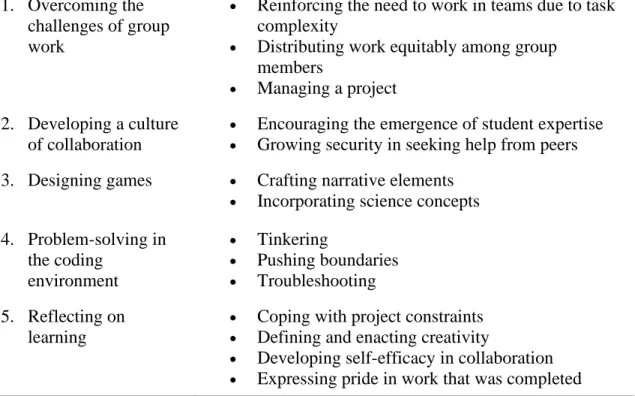
collaboration, creating narrative and connecting science, problem-solving is Scratch’s coding environment, and reflecting on learning.
The findings of this study indicate that involving gifted students in game design-based learning in science had a positive impact on student perceptions of their abilities in problem-solving, creativity, and collaboration. Given GT students’ reluctance to work in groups, the collaboration scores were particularly relevant. Students took a leading role in learning creating a classroom culture of collaboration. As students encountered coding issues, they sought their own solutions and shared knowledge. Emergence of student expertise led to an environment where students felt comfortable seeking knowledge from each other.
This research has implications for the exploration of ways to support gifted students in their growth in creativity, collaboration, and problem-solving within
TABLE OF CONTENTS
Dedication ... iii Acknowledgements ... iv Abstract ... iii List of Tables ...x List of Figures ... xi Chapter 1 Introduction ...1 National Context ...1 Local Context ...3 Statement of Problem ...5Researcher Subjectivities and Positionality for Action Research ...6
Definition of Terms...10
Chapter 2 Literature Review ...13
Introduction ...13
Exploring the Landscape of Technology in Gifted Education ...15
Defining 21st Century Skills...20
Pedagogies to Support Game Design-Based Learning ...25
Game Design-Based Learning ...29
Game Design as Project-Based Learning ...31
Chapter 3 Method ...40 Research Design...40 Setting ...43 Participants ...44 Innovation ...45 Data Collection ...52
Procedures and Timeline...59
Rigor and Trustworthiness ...62
Plan for Sharing and Communicating Findings ...64
Chapter 4 Analysis and Findings ...65
Quantitative Analysis and Findings ...65
Qualitative Analysis, Findings, and Interpretations ...72
Analysis of Qualitative Data ...73
Themes ...78
Chapter Summary ...129
Chapter 5: Discussion, Implications and Limitations ...133
Discussion ...133
Implications...154
Limitations ...164
Closing Thoughts ...166
References ...169
Appendix A: Informed Consent Letter ...189
Appendix C: Sound and Light Energy Assessment ...193
Appendix D: Sound and Light Standards Alignment ...199
Appendix E: Reflection Prompts ...205
Appendix F: Co-Measure ...207
LIST OF TABLES
Table 2.1. Comparison of Project-Based Learning to Game Design-Based Learning ...32
Table 3.1. Participants Areas of Identification and Assessments ...45
Table 3.2. Comparison of Project-Based Learning to Game Design-Based Learning ...46
Table 3.3. List of Sessions and Activities for Game Design-Based Learning ...48
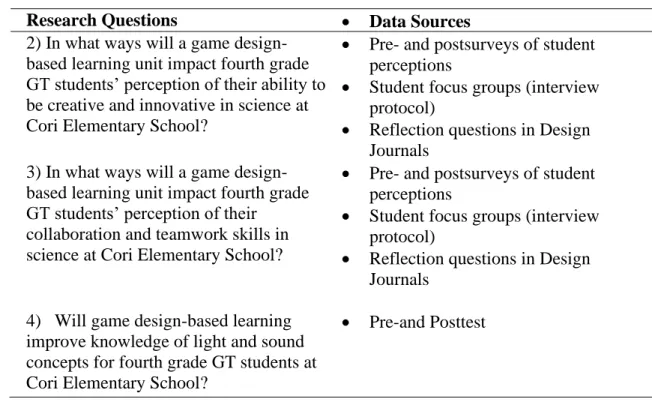
Table 3.4. Alignment Between Data Sources and Research Questions ...52
Table 3.5. Alignment of Focus Group Questions with Research Questions ...58
Table 3.6. Data Collection Procedures ...60
Table 4.1. Mean and Standard Deviation of Creative Self-Efficacy in Science Items (n = 36) ...67
Table 4.2. Mean and Standard Deviation for Creative Self-Efficacy Items (n = 36) ...68
Table 4.3. Descriptive Statistics for Collaboration Pre- and Postsurvey (n = 36) ...70
Table 4.4. Descriptive Statistics for Light and Sound Pretest and Posttest (n = 42) ...71
Table 4.5. Summary of Qualitative Data Sources...72
Table 4.6. Codes from Game Design Documents. ... 76
Table 4.7. Codes from Video Observations ...77
Table 4.8. Summary of Themes and Categories from Qualitative Data ...79
Table 4.9. Examples of Games with Storyline Focus ...102
Table 4.10.Examples of Students’ Quiz Games and Storylines ...104
Table 4.11.Game Designs with Science Woven into the Narrative ...106
LIST OF FIGURES
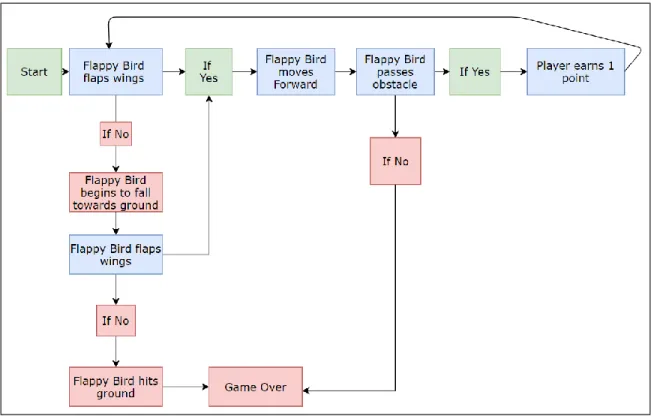
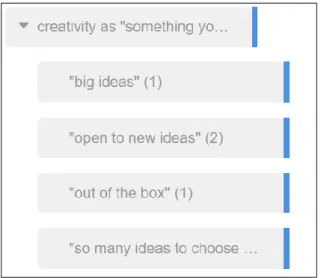
Figure 3.1. Example Flappy Bird flowchart. ...50 Figure 4.1. Screenshot from Delve showing in vivo codes applied
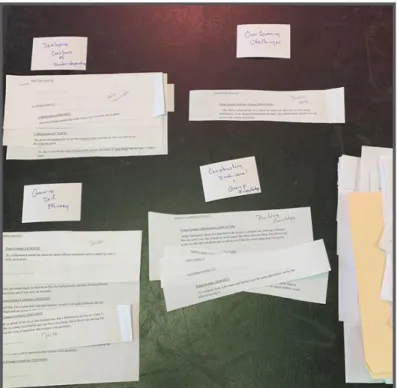
to student responses. ...74 Figure 4.2. Examples of process coding. ...74 Figure 4.3. Photograph of sorting codes into categories. ...75 Figure 4.4. The emergence of student expertise as supported by information
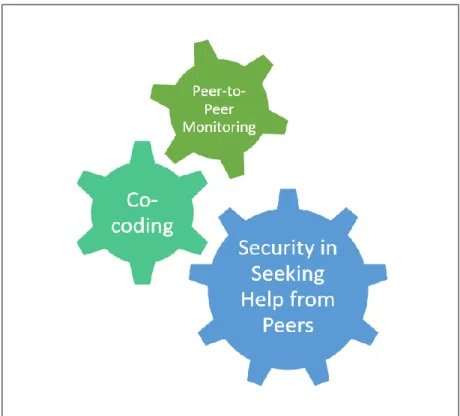
seeking and sharing as well as the building and testing of code. ...88 Figure 4.5. Illustration of the ways co-coding and peer-to-peer monitoring
interacted with student security in seeking help from peers. ...99 Figure 4.6. Screen shot from Light and Sound Football by Brayden, Oliver, and
Justin. ...106 Figure 4.7. Screenshot of Betty and Mr. Chicken by Hannah, Gavin, and Connor
showing Mr. Chicken explaining opaque. ...109 Figure 4.8. Screenshot from Light Game by Erin, Logan, Gabe, Rachel showing
the sprite inviting the player to help with a study sheet. ...111 Figure 4.9. Screenshot from “A Walk by the Sea” by Cole, Lacey, and Marcus
showing the coding for how players were invited into the game. ...111 Figure 4.10. Screenshot from Katie’s game showing the mix color
function in Scratch. ...114 Figure 4.11. Screenshot from Madison’s game showing a character’s change of
hair color woven into the storyline. ...114 Figure 4.12. Screenshots from Glitter Pets by Kumari, Tyler, Khloe, and Ankita
showing change of color in character clothing. ...115 Figure 4.13. Screenshot from Rishi and Cal’s game showing the maze lines that they
Figure 4.14. Screenshot from Hunter’s game showing both recordings he made and
sounds from the Scratch library. ...116
Figure 4.15. Screenshot from Kumari’s game showing the codes added to make the sprite both speak and produce a speech bubble. ...118
Figure 4.16. Screenshot of game by Adam, Jackson, and Gavin showing the sprite hidden in the tree. ...119
Figure 4.17. Screenshot from Tyler, Ankita, Kumari, and Khloe’s game showing the use of if-then-else block and scoring using the variable “Goal Cheer”. ...120
Figure 4.18. Screenshot from Ayden, Brenna, Jacob, and Steven’s game showing the use of hide and show to power up and down the character’s lives. ...120
Figure 4.19. Clip of the code that Eli was struggling to make work correctly. ...123
Figure 5.1. Screenshot of our “I have a question” board. ...150
CHAPTER
1
INTRODUCTION
National Context
Gifted education has traditionally taken the lead when it comes to research in building critical and creative thinking skills. The growing movement to promote world-class skills (P21, 2009) fits naturally with the goals of gifted education in terms of skill development-creativity, collaboration, and problem-solving. When it comes to integrating technology, the gifted community — while not completely quiet — does not have much to say. Chen, Yun Dai, and Zhou (2013) found that “most of the publications on the topic are still in an advocacy mode, not truly reporting research in the exact sense of the word” (p. 173).Coding has been suggested as a new digital literacy that is critical for GT students (Hagge, 2017; Siegle, 2017). These discussions have been informational or anecdotal. Current research into the use of technology with GT students centers on student motivation (Housand & Housand, 2012) differentiation of instruction (Housand, Housand, & Renzulli, 2017), need for professional development (Besnoy, Dantzler, & Siders, 2012; Robinson, Dailey, Hughes, & Cotabish, 2014), teacher perspectives (Zimlich, 2015), and digital citizenship centered around cyberbullying (MacFarlane & Mina, 2018).
Furthermore, technology integration in gifted education at the elementary school level has even less evidence (Periathiruvadi & Rinn, 2012). The possibilities technology
expression outlets are limitless (Chen et al., 2013). Game design-based learning with its unique set of affordances may offer a path to transformation. The benefits of game design-based learning have been explored across grade levels and subject areas. The few game design studies that involved GT students say little about the impact on giftedness in relation to the game design intervention (e.g., Akcaoglu, 2013; Wang, Huang, Hwang, 2016). While many of the studies focus on motivation in general (Akcaoglu, 2013; An, 2016; Hwang, Hung, & Chen, 2014; Tüzün, Yilmaz-Soylu, Karakuş, Inal, & Kizilkaya, 2009; Vos, Van Der Meijden, & Denessen, 2011) and motivation towards science, technology, engineering, and math (STEM) career interests (Jenson & Droumeva, 2015; Kim & Bastani, 2017), others focus on process and artifacts (Baytak & Land, 2011; Ke, 2014; Khalili, 2014; Pedersen, Arslanyilmaz, & Williams, 2009; Salen, 2007).
The process of game planning, designing, and testing, can promote a climate where students turn to each other to solve design problems (Akcaoglu, 2014; Baytak & Land, 2011; Ching & Kafai, 2008). This turning towards peers reflects the type of collaboration and teamwork that are called for by world-class skills and represents a shift in where students go for answers to questions and problems. In the process of game design, students are called upon to analyze and design systems, make decisions about the direction of the game and to troubleshoot programming issues making game design a vehicle for teaching problem-solving skills (Akcaoglu, 2014; Kalelioğlu & Gülbahar, 2014; Li, 2012; Yang & Chang, 2013). These skills align with the Partnership for 21st Century Skills (2009) definition for problem-solving. Increasingly, the ability to create rather than just consume technology has gained attention linking creativity and
collaboration to using coding language (Kafai & Burke, 2014; McDooley, Ellison, Welch, Allen, & Bauer, 2016; Sáez López, González, & Cano, 2016).
Local Context
I teach Science, Technology, Engineering, Art, and Math (STEAM) classes for grades K-5 at Cori Elementary School (a pseudonym). In order to protect the identity of participants all state data references have been removed. Cori Elementary School is one of nine elementary schools in a suburban district in the southeast. GT students make up 15.7% of our student population (N=815). At each grade level, GT students are enrolled in heterogeneous classrooms. Gifted students are pulled from their class each day to receive instruction in reading, writing, and mathematics from a teacher who is certified in GT. We have a heavy focus on using reading, science, and social studies units that were developed at the College of William and Mary. These units focus on higher questioning, using concept models, and complex problem-solving (CW&M, 2014) that align with 21st century skills (P21, 2009). None of these units involve the integration of technology beyond use as a research tool.
At Cori Elementary, teachers use a variety of technology resources for students including Schoology, Google Classroom, and Discovery Education. Fourth grade
students have Chromebooks to access internet resources and complete work. Students are on a seven-day related arts rotation that includes among others, technology, STEAM and Media. The media specialist has created a maker space within the library. Students begin participating in Hour of Code starting in third grade. They are also exposed to both Alice, a block-based programming tool developed at Carnegie Mellon University, and
Scratch, a similar block-based programming tool, developed at Massachusetts Institute of Technology. Both environments have been used in game design-based learning.
In our district there has been a focus on STEAM learning with the intention of building students’ world class skills as defined by the Profile of a Graduate. Several teachers have been trained in the use of interactive lessons through Discovery Education. Teachers are in the process of adapting the science kit materials that we have in order to place more emphasis on the processes of experimentation, exploration, and innovation.
The growing interest in STEAM programs and a shift in state standards has caused a refocus on science and engineering skills. State science standards call for student to design and create experiments (creativity) talk to, bounce ideas off, and problem-solving with each other (collaboration and problem solving). These directly match the goals of gifted education, 21st century skills, and state science standards with the affordances of game design-based learning.
Moving towards a classroom that is more collaborative and creative calls for a shift not only in teaching practices but also for student learning behaviors. From my observations over 20+ years of teaching, I have found that students are often more focused on the grade than on the learning. They often do not want to collaborate for fear of someone doing better than they did. They often do not want to try things that are out of their comfort zone. Grant (2016) claims that we do a disservice to our gifted students by continuing to focus on achievement. “Only a fraction of gifted children eventually become revolutionary adult creators” (Winner, 2014 as cited by Grant, 2016, p. 10.) In a time where we need innovators and creators more than ever, we face an educational culture that values achievement over originality (Grant, 2016). This clearly demonstrates
a need to shift focus towards achievement that is more inclusive and calls upon the 21st century skills that our students will need to become innovators and problem solvers.
A game design-based learning experience could offer my students the opportunity to practice 21st century skills, gifted goals, and science standards in a game building environment that is focused on building skills and not bound by the constraints of academic achievement. I believe there is room within the science curriculum to situate this unit and offer students the opportunities to explore and experiment.
Statement of Problem
Gifted education, while maintaining high curriculum standards for critical and creative thinking, has limited integration of technology into its recommended
instructional strategies of best practices for gifted students. Within many gifted instructional units that are approved by my district, technology is used primarily for research and student presentation using word processing and presentation software. Kafai and Burke (2014) point out that “such activities do not capture the creative and collaborative potential of computing” (p. 116). At the very core of gifted practices are critical and creative thinking skills. The affordances of technology activities such as coding and game design can offer our brightest students’ opportunities to gain not only thinking skills and science skills but also technology skills that could be critical to their futures.
Purpose Statement
The purpose of this action research was to describe the impact of digital game building on fourth grade GT students’ growth in problem-solving, creativity,
Research Questions
This action research will explore the following four questions about the impact of digital game building.
1. What kinds of problem-solving interactions occur during a game design-based learning science unit for fourth grade gifted and talented students at Cori Elementary School?
2. In what ways will a game design-based learning unit impact fourth grade gifted and talented students’ perception of their ability to be creative and innovative in science at Cori Elementary School?
3. In what ways will a game design-based learning unit impact fourth grade gifted and talented students’ perception of their collaboration and teamwork skills in science at Cori Elementary School?
4. Will game design-based learning improve knowledge of light and sound concepts for fourth grade gifted and talented students at Cori Elementary School?
Researcher Subjectivities and Positionality for Action Research
I have been an elementary teacher for over 25 years and most of my experience has been teaching gifted students. I remember my first year of teaching. I had five gifted kids and no idea what to do. As a beginning teacher, I was challenged to figure out how best to meet their needs. They were bused to another school one day a week for the gifted program, but the other four days were mine. I found that differentiating through projects was the key. Those five students started me on a journey to learn about gifted education and how to best meet the needs of each individual child.
I am curious about a wide range of topics and open to new learning and
understanding. I like to play with new ideas and new technologies. Early on in my use of technologies, I remember becoming stuck and frustrated because something was not working. I stopped and asked myself what would you do if this was a quilting project? I was able to back out of the spot I was stuck in, start taking apart the pieces to find what went wrong. Yes, I was that kid who always took stuff apart to see how it worked. As a kid, I began to recognize that my curiosity sometimes leads me down paths that do not necessarily move me forward, or that move me in directions that are interesting, but not relevant.
I have a Masters in Instructional Design and many years of experience in
integrating technology projects into the classroom. I have always been the one that others come to for technology questions. I am also the one who always believes that something big can be accomplished and that together we can do great things. A former principal used to joke that if she wanted something done all she had to do was tell me it was not possible. I loved the challenge and I always found a way.
Recently, I have become frustrated with what I see as ineffective use of technology, and worse, I see the frustration in my students and their parents. I am concerned with the amount of money being spent on technology in schools in hopes of results, but we are just replacing paper with digital. The iPad becomes the textbook and the app replaces the worksheet. Learning management systems have become a dumping ground for content with little interaction for students.
I find myself in the pragmatic paradigm. Pragmatic approaches value the collaboration that I am looking not only to measure in my research but also looking to
develop with my students. I was quite taken by Kinash’s (2006) description of working collaboratively and even authoring with a student who was involved in the study. I see this as a way to empower students, particularly my gifted students, to become generators of new knowledge. In action research the participant’s insights and understandings are valued and add to the body of knowledge being developed. The pragmatic approach looks for individual interpretations of one reality (Creswell, 2014; Hammond, 2013; Margolis, 2003). Working in a school and with students, this understanding will be important. I have struggled with the concept of measuring collaboration and creativity. What do these look like and mean to me? What do they look like and mean to my students? It is clear that our interpretations may be different at the various stages of the research.
A pragmatic approach will allow me to collect data on student thoughts and perceptions. Hammond (2013) describes action research as being a “collaborative and communicative process” (p. 613). I see this as an opportunity to work with my students to build our understanding of what is really happening within the course of this study. I prefer that my positionality be an insider in collaboration with other insiders (Herr & Anderson, 2005), but I need to recognize the power structures that exist and indeed need to exist between a teacher and students. While I see my classroom community as a team or school family, I am ultimately the one in charge of the students. So, in many ways, I am an outsider. I think that with my students and parents, I will need to be honest about the goals and what I hope we accomplish.
This action research will occur in my classroom during the regular school day, I will want to allow students to express their own goals and take ownership of their work
or even opt out if they do not feel that this work will be beneficial to them. I will have to be careful that my teacher pleasers, those students who are likely to give an answer they think I want to hear, do not change or hide their thoughts in order to meet my goals. I think honoring their feelings and thoughts throughout the process and treating them as collaborators will be important. I think too that acknowledging that not finding what you expect is part of the process of learning.
I chose my research topic because of both my interest in games and my interest in technology. I am passionate about the value of gameplay in the classroom and the benefits it brings to students. I expect that my study will have a positive impact on students. I know that I will need to be reflective of the impact of my biases on those students who do not resonate with the study I am proposing. So, while I am busy speaking my truth, I need to make sure that my students are empowered to speak their truths.
Definition of Terms
21st century skills-21st century skills encompass a wide range of thinking skills that have become the focus many states as being critical to student success. The Partnership for 21st Century Skills (P21, 2009) while recognizing the importance of contentment knowledge expanded learning to include learning and innovation skills, information, media, and technology skills, and life and career skills. Within this framework collaboration, creativity and problem-solving were highlighted as essential to student success.
Collaboration- Student interactions towards shared or common goals. The Partnership for 21st Century Skills (2009) includes “working effectively and respectfully with diverse teams” as well as “shared responsibility” in their definition of
collaboration. Kafai and Burke (2014) point out the effective participation in communities of learning involve searching out, organizing and distributing responsibilities. This collaboration with others was essential to creation of artifacts together. For this study, collaboration was measured by student reflections on “sharing ideas, collaborating on projects, and building on one another’s work” (Resnick, 2014, “Introduction,” para 3).
Constructionist learning theory- Posits that students build knowledge through construction of artifacts that are both personally meaningful and shared with an audience (Harel & Papert, 1991; Kafai & Resnick, 1996). The artifact represents something to think with and shifts the focus from product to process (Papert, 1993).
Creative self-efficacy- One’s beliefs about their ability (Bandura, 1977) to be creative.
In science, creative self-efficacy tied to intellectual risk taking in science (Beghetto, 2009) and production of more and varied solutions to problems Brockhus van der Kolk, Koeman, & Badke-Schaub, 2014).
Creativity- Henriksen, Mishra, and Fisher (2016) describe creativity as “a dynamic process emerging through a system of interactions” (p.29). Trilling and Fadel (2009) link creativity to innovation, problem-solving, and invention. Resnick (2014) describes creative learning as the combination of interactions between meaningful projects, peer collaboration, passion, and play. Beghetto and Karwowski (2017) further point out that there must be a balance between
originality and usefulness. For this study, creativity was measured by generation of new ideas, design and development of multiple iterations (Resnick, 2014).
Game design-based learning-Resnick (2006) describes the use of computers “like
paintbrushes ... opening new opportunities for children to playfully explore, experiment, design, and invent” (p. 192). This will involve students using a game building tool to explore, experiment, design and build their own games.
Gifted and talented- According to the National Association for Gifted Children (2020), gifted individuals show an ability that is significantly above their peers in one or more domains. Domains include intellectual, creative, artistic and academic fields such as mathematics, language, or science, these students are usually score in the top 10 % or higher.
Problem-solving- Partnership for 21st Century Skills (2009) defines problem solving as “analyzing how parts of a whole interact with each other to produce overall outcomes in complex systems.” Jonassen, Holland, Moore, and Marra (2003) identify eleven types of problems for learning. Three of these were relevant to game design-based learning decision making problems, design problems, and troubleshooting problems.
Problem-solving within game design- Akcaoglu (2014) identifies three problems associated with game design. They are system analysis and design, decision-making, and troubleshooting. Problem-solving will be defined by “tinkering with materials, testing boundaries, taking risks, iterating again and again” (Resnick, 2014, “Introduction,” para 3).
Project-based learning- Project-based learning isstudent-centered student providing choice in project and process and is centered on a problem that is real world and presents an authentic challenge (Holm, 2011). Components of project-based learning include 1) anchor, 2) task and artifacts, 3) process, 4) resources, 5) scaffolding, 6) collaboration and 7) reflection (Grant, 2002).
CHAPTER 2
LITERATURE REVIEW
IntroductionThe purpose of this action research was to describe the impact of digital game building on fourth grade GT students’ growth in problem-solving, creativity,
collaboration, and science content knowledge at Cori Elementary School.
The review of the literature will focus on four research questions: 1) What kinds of problem-solving interactions occur during a game design-based learning science unit for fourth grade GT students at Cori Elementary School? 2) In what ways will a game design-based learning unit impact fourth grade GT students’ perception of their ability to be creative and innovative in science at Cori Elementary School? 3) In what ways will a game design-based learning unit impact fourth grade GT students’ perception of their collaboration and teamwork skills in science at Cori Elementary School? 4) Will game design-based learning improve knowledge of light and sound concepts for fourth grade GT students at Cori Elementary School?
Methodology for the literature review
Methods for literature review began by identifying the three key concepts that I am tying together under the umbrella of technology: 1) games, 2) 21st century skills, and 3) gifted education. As I found articles that fit parts of what I was looking for, I expanded search terms for each of the major topics. I made note of keywords and began using
century skills. For several articles, I looked up the author’s dissertation to see if it was centered on the same topic. This led to good sources and models to follow.
As my search grew, the term games was expanded to include video games, game design, game-based learning, coding, play, artifacts, Scratch, game design-based learning, and connected gaming. An initial search for 21st century skills included, critical thinking, problem solving, creativity, innovation, collaboration, and teamwork. The term
collaboration was later expanded to include cooperative learning, participatory learning, and participation. It was this later search that lead to the term connected gaming. In searching for gifted education, I had two purposes: to discover how technology is currently being used in gifted education and to match the goals of gifted education with 21st century skills. Searches were conducted using a combination of terms from each category.
I used references from articles to become familiar with those in the field studying similar concepts. I would look up articles that were cited as well as use Google Scholar to complete an author search to seek out newer or updated studies.
I had four main sources for searches, EdSource, ERIC, ProQuest Dissertations and Theses Global and the AECT Member Library. In searching these databases, I limited my early inquiries to a ten-year period in order to get the most up to date
information. I used the AECT Member Library when I was looking for a specific article or author.
My literature review is divided into four sections. The first section will begin by exploring the landscape of technology use in gifted education. The second section will define 21st century skills and their measures. The third section introduces the pedagogies
that support technology integration for gifted learners. The final section explores how game design-based learning can be a vehicle for building problem-solving, creativity and innovation, and collaboration and teamwork skills.
Exploring the Landscape of Technology in Gifted Education
In exploring the status of technology use in gifted education, much of the literature focuses on advocacy (Hagge, 2017; Lee, 2011; MacFarlane & Mina, 2018; Siegle, 2004, 2017) rather than research. There is a need in the field of gifted education to study various technology integrations and their impact on gifted students. This research must go beyond how student are consumers of technology to explore how gifted students can become producers and creators with technology (McDooley et al., 2016; Sáez López et al., 2016) This section will include a) an overview of the concept of giftedness, b) current status of research and uses of technology in gifted education, c) potential roles of technology for gifted students, and d) student needs in regards to building digital talents.
Concept of Giftedness
The concept of giftedness typically falls into two categories. Many programs are designed to advance those who are defined as the good lesson learners (Renzulli, 2012; Renzulli & Reis, 2014). This group is represented by their ability to comprehend, store and retrieve information. This learner is usually a good test taker, rule follower, and flat producer (i.e., their products tend to follow directions without deviating). Many current gifted curriculum units are geared toward the good lesson learners. The Center for Gifted Education at the CW&M (2013) produces units of study that promote student
achievement through advanced content, reasoning processes, and overarching themes and concepts.
The second category of gifted students is identified as the creative
producers. These gifted students are the experimenters, the inventors, the authors, and the artists. They take creative risks (Beghetto & Karwowski, 2017; Kaufman &
Beghetto, 2009) and produce artifacts that are significant to those around them (Renzulli, 2012; Renzulli & Reis, 2014)
The Enrichment Triad Model (Renzulli & Reis, 2014) expands the concept of giftedness and reaches to the creative productive potential of students. This further recognizes the students with specific behavioral manifestations of giftedness, for example, specialty in different domains of knowledge, such as leadership, artistic, or creative. The Enrichment Triad Model moves students through three stages 1) general exploratory activities, 2) group training activities, and 3) individual and small group exploration of real problems. General exploratory activities expose students to a wide range of content within a specific domain of knowledge. Group training activities
prepare students who show interest and aptitude for a specific subject to engage in deeper research and understanding of a field. In the final stage individuals or small groups are engaged in creating solutions to real-world projects that have an impact outside the classroom. For example, a student may move from learning about an ecosystem to identifying a problem and learning what is already being done, and finally, to creating and sharing their own solution to a local, national, or global issue. This clear alignment with project-based learning will be explored further in a separate section of the literature review.
Current Status of Research and Technology Use
Research on technology use in gifted education is limited (Chen, et al., 2013; Periathiruvadi & Rinn, 2012). Two specific studies highlight the quality and dearth of research with technology use in gifted education.
In 2012, Periathiruvadi and Rinn conducted a review of the literature on gifted education and technology. Over a ten-year period, they found 23 articles that contained empirical research about gifted students using technology. Of those 23 articles, only three addressed issues of technology use in gifted elementary programs. These issues included self-regulation and concentration, strategic thinking through gameplay, and the use of laptops. While each of these efforts helps our understanding of how technology is being used in gifted classrooms, they do not explore how students are using technology in authentic ways to produce representations of their knowledge and understanding. In an extensive survey of 255 gifted teachers, Besnoy et al. (2012) found that gifted teachers most often used technology to support individual learners as a research tool (79%), for independent learning (73%), to promote student-centered learning (71%), and for individual instruction (65%). Gifted teachers also reported using technology to
support student learning groups with cooperative groups (60%) and small group instruction (59%). While gifted teachers used technology as a communication tool (65%), technology was less often used as a productivity tool (54%), or as a problem-solving or decision-making tool (53%). Each of these categories of technology use explores ways in which teachers use technology to support student learning. While the data were collected through a self-reported survey, this points to a trend of technology being used as a vehicle to individualize and differentiate content for gifted learners. For
example, Housand and Housand (2012) discuss the benefits of online mentoring opportunities for students in their individual areas of interest. Missing from these examples, though, is how students use technology as creators of new products and information.
Potential Role of Technology in Gifted Education
Among gifted students there is a need to connect and feel a sense of belonging to a community that many high intelligence students do not always feel they receive in their regular classroom setting (Housand & Housand, 2012). Advances in technology offer gifted students the ability to connect with like-minded peers which increases both sense of identity and motivation (Housand & Housand, 2012; Siegle, 2004). For example, Swan, Coulombe-Quach, Huang, Godek, Becker, & Zhou (2015) found that offering virtual labs to rural students increased their skills in collaboration across
distances. Students also expressed an appreciation for being grouped with their gifted peers. These feelings of belonging and acceptance foster increased engagement and enthusiasm (Housand & Housand, 2012). Technology can support students by offering the ability to connect across geographic regions with other students who share the same intensity of interest often found in gifted students.
Another advantage to these connections is that technology allows students to work on authentic projects that are of personal interest (Grant, 2011). Advances in technologies allow students to collectively practice a variety of skills that professionals use to create works and solve problems (Siegle, 2004). For example, various mentoring programs connect students with experts in order to collaborate on solving real problems (Housand & Housand, 2012). Technology connects gifted students by lowering barriers
to work that is authentic and desired (Siegle, 2004; Zimlich, 2016). Siegle (2004)
elegantly states, “Students can be productive draftsmen, composers, and graphic artists by approaching problems and using software in a similar manner as career professionals" (p. 35). This demonstrates the potential transformative power that the affordances of
technology can have on the field of gifted education and those students who are identified as gifted.
Technology offers an avenue to expand reach and improve the quality of programs offered to gifted students (Besnoy et al., 2012; Chen et al., 2013; Siegle, 2004). Through technology, the quality of programs is no longer dependent on location. Swan et al. (2015) found that offering virtual learning labs allowed rural students to take advanced courses that their district could not implement in a face to face setting. Given the specialized nature of interests and abilities of some gifted students, the ability to reach out to academic communities beyond the school allows students to access information and mentoring that might not be available at their school.
Moving forward, Chen et al. (2013) point out that there is a need for well-designed research that goes beyond advocacy to explore the role and effectiveness of technology in gifted education. While technology use has many advocates, who recognize the potential benefits of integration for gifted students, the field remains relatively untouched and open to exploration and further research.
Student Needs
Students need guidance as they develop digital literacy, build 21st century skills, and build avenues for creative expression (Besnoy et al., 2012; Chen et al., 2013;
literacy skills provides opportunities for students to become efficient and effective problem solvers (Besnoy et al., 2012; Siegle, 2004). An increase in concerns about cyberbullying of gifted students (MacFarlane & Mina, 2018) expands the need to help students build digital citizenship skills that are age appropriate and forward
focused. Gifted students are often interested in pursuing knowledge that is beyond that of their peers. Building a safe digital environment for these students to expand their
knowledge is essential.
Furthermore, a focus on developing 21st century skills shifts the role of technology from play toy to effective tool for problem-solving (Zimlich, 2015). The Partnership for 21st Century Learning (2009) outlines a range of skills that will be necessary for future success. These include learning and innovation skills, information, media and technology skills, and life and career skills. Under this framework, it is no longer acceptable for students to be merely good test takers and academics. They must become creators, problem solvers, and innovators. In addition, all of these skills need to be practiced in real-world cooperative settings that can be provided through technology interventions.
Defining 21st Century Skills
This section of the literature review explores definitions of 21st century skills. My research focuses specifically on three areas 1) problem solving, 2) creativity and
innovation, and 3) collaboration and teamwork. This section will also explore the intersection of gifted education goals and 21st century skills.
Problem-Solving
Problem solving has emerged as a key component for student success not only gifted students but all students. The number of states adopting Partnership for 21st
Century recommended skills has increased to 21 states, causing a shift in teaching toward engaging students in more opportunities to engage in critical thinking and problem solve. Problem-solving involves the ability to analyze the interactions of parts in a complex system (P21, 2009), which includes testing boundaries and taking risks (Resnick, 2014). For example, students engage in exploration of possible solutions (Yang, Lin, Hong & Lin, 2016) manipulating and testing materials along the way to a workable solution. The Problem-Solving Inventory (PSI) (Serin, Bulut, Serin & Saygili, 2010) has been used to measure self-perception levels of problem-solving skills. The PSI contains 24 items covering self-confidence in problem-solving (12), self-control (7), and
avoidance (5). The inventory was tested on 568 students from grades four through eight and the Cronbach Alpha was found to be at 0.80. Kalelioğlu and Gülbahar (2014) paired the PSI with student interviews and observations to find that student self-perceptions about problem-solving ability were low. The authors further claim that students need more support in learning problem solving skills.
Creativity and Innovation
Interest and exploration of creativity is by no means new to the field of education. Creativity is a dynamic process that balances original and novel ideas with the usefulness of the solution (Beghetto & Karwowski, 2017; Henriksen et al., 2016; Johnson &
Johnson, 2014). Creativity is linked to innovation, problem solving, and invention (Trilling & Fadel, 2009). Key creative behaviors include representation invention,
component association, outcome improvement, alternative curiosity, and space imagination (Leu & Chiu, 2015).
Creative self-efficacy. Self-efficacy is grounded in a person’s belief in their ability to perform a specific task (Bandura, 1977). In a study exploring the differences in creative self-efficacy in students in creative fields and students in technical fields,
Brockhus et al. (2014) found that creative abilities and endeavors cross a variety of domains. For example, students in the fields of industrial design and architecture (creative) were compared to students in mathematics and physics (traditionally seen as not creative). Demonstrating that students who believed in their abilities to be creative produced more and varied solutions to problems. Creative self-efficacy was tied to intellectual risk-taking in science (Beghetto, 2009). The scientific process requires the use of both creative thinking and problem solving thus employing divergent and convergent thinking in order to reach creative solutions (Thompson, 2017). The connection between intellectual risk-taking and creative self-efficacy “highlights the importance of science learning environments that encourage and support students in developing their creative self-efficacy beliefs” (Beghetto, 2009, p.219).
Measuring creativity. Creativity is a combination of novel and personally meaningful interpretations that also meet the requirements of a specific task (Beghetto & Kaufman, 2017). Both creativity and problem-solving skills will be necessary to solve myriad complex problems facing our global society (Johnson & Johnson, 2014). When measuring creativity researchers often look to fluency, flexibility, and originality (Guo & Woulfin, 2016; Karademir, 2016; Kashani-Vahid, Afrooz, Shokoohi-Yekta, Kharrazi, & Ghobari, 2017; Kobsiripat, 2015). Fluency refers to the number of solutions to a task.
Flexibility refers to the number of categories a solution falls into. Originality is the uniqueness of a solution. Surveys have been used to measure creative self-efficacy (Beghetto, 2009; Brockhus et al., 2014).
As technology continues to impact global interdependence, developing and encouraging creativity in students becomes essential to their future as creators and innovators.
Collaboration and Teamwork
Collaboration and teamwork involve working effectively and respectfully with diverse teams (P21, 2009) as well as sharing responsibilities, sharing ideas and building on each other's work (Guo & Woulfin, 2016; P21, 2009; Resnick, 2014). Resnick (2017) highlights the natural ways collaboration occurs in the Computer Clubhouse setting. These collaborations include being inspired by other's work but not working together, groups that are attracted by complementary skills, and desire to create a project that is larger than an individual can manage. Johnson and Johnson (2014) posit that knowing how to develop and maintain cooperative systems will be vital to solving the challenges faced in the 21st century. The classroom needs to be a practice ground for these skills. A place where students promote each other's success and in doing so gain positive cognitive outcomes such as articulating solutions to problems, challenging each other's reasoning, and teaching gained knowledge to classmates (Johnson & Johnson, 2014).
Working collaboratively can present challenges for GT students because of their personalities and mindsets (Mofield &Peters, 2018). Some GT traits like heightened emotion (NAGC, 2019), task commitment (Subotnik, Olszewski-Kubilius, & Worrell, 2011), and perfectionism (Mofield & Peters, 2018) can lead to difficulty with group
dynamics. Several researchers found that GT students respond positively to group work when they are participating in a task that is challenging, complex, and requires multiple people to complete (Diezmann & Watters, 1997; Lou, Abrami, & d'Appolonia, 2001; Ross & Smyth, 1995; Winstanley, 2010). Salomon and Globerson (1989) suggested that when there is an equitable distribution of workload students responded positively to group work.
Measures of collaboration and teamwork. Co-Measure was developed to assess student collaboration (Herro, Quigley, Andrews, & Delacruz, 2017). This rubric includes peer interactions, positive communication, inquiry rich/multiple paths, authentic approach and task, and transdisciplinary thinking. Within each of these categories the authors list several behavioral benchmarks that can be used to measure
collaboration. Reynolds (2016) identified collaborative information seeking (CSI) strategies that included teammate to teammate, student to teacher, and cross team collaborations. Ching and Kafai (2008) used observation to identify collaborative patterns of interaction in a game-design setting. They found that students engaged in periodic monitoring of other’s work, responding to direct questions, and immediate intervention such as fixing a problem for another student.
Connection of 21st Century Skills to Gifted Education
In his book Originals, Grant (2016) highlights the dangers of continuing to focus solely on achievement for gifted students. Accelerating students farther and faster does not necessarily benefit students. He also points out that our times call for more
innovators and creators yet within our school systems we have a culture that values achievement over originality (Grant 2016). The Three-Ring Conception of Giftedness
explores the intersection of ability, task commitment and creativity (Callahan, Moon, Oh, Azano, & Hailey, 2015; Renzulli & Reis, 2014). Within this model a student’s creative giftedness emerges based on exposure to specific domains or areas of interest. This type of giftedness is more closely tied to specific problems where action including creative production, collaborative exploration of a topic and problem-solving are valued more than traditional test results. The Enrichment Triad Model was developed to offer opportunities for students to first explore topics of interest, then gains skill sets and finally to take action thus promoting thinking skills and creativity (Callahan et al., 2015; Renzulli & Reis, 2014). These represent a shift in thinking about gifted students and the types of learning experiences that they will need for a successful future.
Pedagogies to Support Game Design-Based Learning
There are three main pedagogies that support technology in gifted education. I begin by examining constructionist learning theory, followed by project-based learning, and then how game design-based learning is situated in these pedagogical foundations.
Constructionist Learning Theory
Constructionist learning theory (Harel & Papert, 1991; Kafai & Resnick, 1996) focuses on building knowledge through construction of artifacts that are both personally meaningful and shared either locally or with a broader audience. Constructionist based learning environments offer students the opportunity to engage in meaningful projects that connect them to the world beyond the classroom. Papert (1993) referred to the artifacts as objects to think with shifting the focus from product to process. Design tools such as Scratch provide students with that object. Students can explore concepts, reformulate ideas and implement their own designs (Baytak & Land, 2011). Artifacts
should reflect student learning (Grant & Branch, 2005; Marx, Blumenfield, Krajcik, & Soloway, 1997).
Artifacts may take on many forms, but they must be shareable with the broader community (Marx et al., 1997) and represent an authentic effort to solve real-world problems (Holm, 2011).
Another element of constructionist learning is the social aspect of learning. "Learning flourishes as a social activity, with people sharing ideas, collaborating on projects, and building on one another’s work" (Resnick, 2014, p. 1). Constructionist learning promotes playful experimentation. Testing and repeated trials are a valuable part of the learning process where students are encouraged to test and improve on their designs (Baytak, 2009; Resnick, 2014). An underlying assumption of constructionism is that the design activities have social relevance for all students in the setting (Rieber, Davis, Matzko, & Grant, 2001). For example, Baytak and Land (2011) had students design games based on environmental issues to be shared with younger students at their school. Students were given opportunities to make personal choices and they created their artifacts with a broader audience in mind. This allows students to make personal and meaningful connections with new knowledge (Papert, 1993). Within the context of game design-based learning, students are building and sharing games that have personal value as well as social value.
Project-based Learning
Project-based learning is student-centered in that it involves student choice in both project and product around a problem that is real world and presents an authentic challenge (Holm, 2011). Learning occurs when students are working on projects that are
personally meaningful (Grant & Branch, 2005; Resnick, 2014). The process of generating new ideas, designing prototypes, and repeated refining engages student problem solving and thinking skills (Holm, 2011). Components of project-based learning include 1) anchor, 2) task and artifacts, 3) process, 4) resources, 5) scaffolding, 6) collaboration and 7) reflection (Grant, 2002). Each of these is described in further detail below.
Anchor. The anchor or driving question (Holm, 2011; Marx et al., 1997)
provides the backdrop for the learning and development of projects. This anchor needs to meet three criteria a) worthwhile and meeting with the existing curriculum, b) encompass real-world problems that are meaningful to students, and c) present a match with student knowledge and skill sets (Marx et al., 1997). Each of these acts in order to launch students into a successful project-based learning experience. For example, Grant (2011) explored a project-based learning unit that was anchored in the concepts of civil rights. This gave students a real-world problem that was meaningful and at the same time achievable for learners.
Task and Artifact. The task will lead students through discovery to the creation of their own personally meaningful artifact. Artifacts allow students to concretize knowledge by creating objects that embody ideas (Baytak, 2009; Baytak & Land, 2011; Grant, & Branch, 2005; Kafai, & Resnick, 1996; Kafai & Burke, 2014). Technology projects can take many forms including but not limited to presentations, websites, interactive games, or recorded performances.
Process/Resources. Outlining the steps to begin a project-based learning experience helps students to focus their efforts. In project-based learning teachers serve as resource, facilitator, and guide. Teachers model thinking and structuring of the
problem to facilitate student independence (Marx et al., 1997). For example, students can engage in WebQuests that guide them through relevant resources (Grant, 2011). These resources help students access information that is both relevant to the project and age appropriate.
Scaffolding. Scaffolding can take on many forms from questioning and
brainstorming to electronic forms or project management resources. For example, student can be provided with templates for information gathering (Grant, 2011). Teacher
scaffolding provides the structure and support that students need to be successful in project-based learning.
Collaboration. Within project-based learning student collaboration becomes an essential part of student growth. Students share ideas, extend their thinking, and become experts to each other (Marx et al., 1997). Elements such as structured peer reviews and reflections allow students to give and receive critique of work throughout the process (Grant, 2011). Collaborations reaching beyond the walls of the school extending toward the community add value to the learning experience (Marx, et al., 1997).
Reflection. Reflecting on learning and planning for future projects is a key element to successful learning. Reflection involves relating new information to existing knowledge and understanding how learning and problem-solving strategies can be
applied to future situations (Hmelo-Silver, 2015) Helping students reflect through the use of short responses at the end of class or design logs builds closure for the learning
Game Design-Based Learning
Much interest in game design grew out of the demand for students to understand computer science and computational thinking. The New Media Consortium Horizon Report (2017) listed coding as a form of literacy that will drive K-12 technology adoption over the next two years (Adams Becker, Freeman, Giesinger Hall, Cummins, & Yuhnke, 2016). Opportunities for students to learn coding skills are growing through
organizations such as Hour of Code, Girls Who Code, and Google's CS First.
Many platforms for coding and game design have emerged. ALICE and Scratch are two examples. ALICE is a visual programming language developed at Carnegie Mellon University. ALICE is a block-based programming environment that allows students to build interactive narratives and games. Scratch was developed at
Massachusetts Institute of Technology (MIT). Scratch is especially appealing to younger children because it has a ‘‘low- floor (easy for the students to pick up) and high-ceiling (allow students to create more sophisticated programs)” (Lye & Koh, 2014, p.
54). Researchers (Baytak & Land, 2011; Lye & Koh, 2014) have found that elementary students are able to access advanced levels of programming concepts using Scratch.
Vos, Van Der Meijden, and Denessen (2011) compared playing games to learn code and teaching code in the context of game design and found significant differences between groups in both motivation and deep strategy. They further reported that game construction enhanced student motivation and students enjoyed game design more than the game playing experiences.
Game design-based learning has been studied by numerous researchers in both formal classroom settings (Baytak & Land, 2010, 2011) and informal camp (Akcaoglu,
2014) and club settings (Burke, O’Byrne, & Kafai, 2016; Kafai & Burke, 2014). While each setting is unique, they all share some common characteristics that include 1)
context, 2) game design and building activities, 3) teacher/ mentors 4) collaboration, and 5) reflection.
Context. Whether the context is curriculum based in science, social studies, or developed out of student interest, in game design students are involved in developing rich complex worlds that have narratives, rules, conflicts (Yang & Chang, 2013). Creation of these worlds engages students in activities that cross over several knowledge domains. Herro et al. (2017) describe this as transdisciplinary approaches within the context of STEAM education.
Game design and building activities. Many game design and building activities offer students insight into the structure used in games. These activities include
deconstructing games, modifying existing games, and story development for
games. Deconstructing existing games allows students to explore and understand both programming and game mechanics (Reynolds, 2016). Game modding (modifications to existing games) has become popular and more accessible to players (Kafai & Burke, 2016). Students are already engaged in making the games that they play more
personalized. This trend has made game deconstruction and reconstruction a natural part of the gaming world. Akcaoglu (2016) uses the acronym GRASPS to help student
identify basic game elements including Goals, Rules, Assets, Spaces, Play mechanics and Scoring. Identifying elements of games and creating flow charts of games allows
students to see the complex systems involved in game design (Akcaoglu, 2016). When students are introduced to specific problem-solving challenges there is an opportunity to
teach problem solving skills along with game design (Akcaoglu, 2016). These included opportunities for students to engage in decision-making, systems analysis, and
troubleshooting of programs.
Collaboration. Collaboration plays a large role in game design, students become experts in programming and are eager to share (Hwang et al., 2014; Ke & Im,
2014). Ching and Kafai (2008) found that as students worked whether in clusters or individually, they engaged in monitoring of others progress, pauses to respond to questions, and immediate interventions. Student interactions around problem-solving include suggesting improvements, dialoguing about challenges and directly responding to requests for help by fixing problems in another person’s program (Ching & Kafai).
Reflection. Repeated testing, improvements and redesigning are a part of the reflective process in game design learning (Baytak, 2009). This allows students to share their growth experiences as they discover new understandings. Baytak (2009) in a study where fifth grade students designed games for second graders found that having feedback from the intended audience showed students the gaps in their games. These students responded reflectively and planned to make their work better.
Game Design as Project-based Learning
Game design-based learning fits under both constructionism and project-based learning. Table 2.1 summarizes the parallels between the elements of project-based learning and the elements of game design-based learning. The following section explains the specific connections between project-based learning and game design-based learning including 1) anchor, 2) task and artifacts, 3) process and resources, 4) scaffolding, 5) collaboration, and 6) reflection.
Table 2.1. Comparison of Project-based Learning to Game Design-Based Learning Components of
Project-based Learning (Grant, 2002)
Components of Game Design-Based Learning
Anchor Context for game design
Task and Artifacts Game Design and Building Activities Process Resources Deconstructing games Design activities Troubleshooting Problem-solving challenges
Scaffolding Teachers/Mentor roles in Game Design-Based
Learning
• Catalyst
• Consultant
• Connector
• Collaborator (Resnick, 2017)
Collaboration Clustered work-student interactions
• Information seeking strategies (Reynolds, 2016)
• Suggestions for improvement
• Dialogue about challenges
• Directed response
• Fixing other’s programs (Ching & Kafai, 2008)
Reflection Iterations of design
Sharing and critiquing
Anchor. The anchor for game design-based learning can come from student interest or it can be driven by the needs of curriculum. In several game design studies the anchor came from standards or needs of the school setting such as social issues
(Ruggiero, 2017), biology (Yang & Chang, 2013), environmental issues (Baytak, 2009, Baytak & Land, 201), Newton’s Laws of Motion (Li, 2010) and social studies topics (An,
2016; Vos et al., 2011) among others. The context of the coursework serves as the anchor for further investigations and the underlying theme of the games that are built.
Task and Artifacts. Within game design-based learning, students are called upon to construct worlds that include characters, rules, interactions, and conflicts (Kafai & Burke, 2016, Yang & Chang, 2013). The task in game design-based learning is the design and development of a playable game and all its elements. The development process allows student to further explore a given topic as they incorporate details and concepts into their work.
Processand Resources. The process and resources for game design-based learning include activities such as deconstructing games (Reynolds, 2016), design challenges, troubleshooting code (An, 2016; Akcaoglu, 2014) and problem-solving challenges (Akcaoglu, 2014). The resources that are made available would fit into the category of “just in time” support (Renzulli, 2012, p. 154)- that which students need in a given time to move forward in their learning. This shifts the role of the teacher to that of a mentor providing scaffolding more often than direct instruction.
Scaffolding. The roles of the mentor include catalyst, consultant, connector, and collaborator (Resnick, 2017). The catalyst asks questions to encourage exploration and spark ideas. The consultant is there to advise, support, and encourage. The connector helps students find others with expertise that they may need. This includes connecting students to each other for the purpose of collaboration.
Collaboration. Collaboration among students is an important part of both game design-based learning and project-based learning. Collaborations are not limited to students-to-student interactions, teachers and mentors become involved in their own
projects that they invite students to join (Resnick, 2017). Reynolds (2016) identified collaborative information seeking strategies that included, collaboration between teammates using their own expertise, teammates accessing digital resources, cross team collaborations using their own expertise, classmates accessing digital resources, teacher collaboration using his/her own expertise, and teacher working with students to access digital resources. Ching and Kafai (2008) through observation of students engaged in game design noted that students tended to work either independently or in
clusters. Independent students collaborated through periodic monitoring and responding to questions. Their responses included offering suggestions, engaging in dialogue, and giving directions (Ching & Kafai). Student who worked in collaborative groups tended to respond to questions and engage in immediate intervention. Their response included engaging in dialogue, giving directions, and stepping in to fix issues. In the context of game design-based learning students collaborate in various ways that are authentic to real-world problem-solving situations.
Reflection. Through various iterations of game design, testing, and
troubleshooting, students are called upon to reflect on what is working and what needs to be improved (Baytak, 2009; Baytak & Land, 2011; Prater, 2016). For example, Baytak and Land (2011) had students test drive their games with their younger target audience. This reflection takes place repeatedly as students build, evaluate, change, and refine their designs (Øygardslia, 2018; Pareto, Haake, Lindström, Sjödén, & Gulz, 2012; Salen, 2007). “Thus, the students continually re-conceptualized their ideas throughout the design process” (Baytak, 2009, p.113).