
REAL-TIME IMMERSIVE HUMAN-COMPUTER
INTERACTION BASED ON TRACKING
AND RECOGNITION OF DYNAMIC HAND GESTURES
BY
Gan Lu
BEng (Hons)
Thesis submitted to the University of Central Lancashire in partial fulfilment of the requirements for the degree of
Doctor of Philosophy
August 2011
The work presented in this thesis was carried out in the Applied Digital Signal and Image Processing (ADSIP) Research Centre, School of Computing, Engineering and Physical
Declaration
I declare that while registered with the University of Central Lancashire for the degree of Doctor of Philosophy I have not been a registered candidate or enrolled student for another award of the University of Central Lancashire for any other academic of professional institution during the research programme. No portion of the work referred to in this thesis has been submitted in support of any application for another degree or qualification of any other University or Institution of learning.
ABSTRACT
With fast developing and ever growing use of computer based technologies, human-computer interaction (HCI) plays an increasingly pivotal role. In virtual reality (VR), HCI technologies provide not only a better understanding of three-dimensional shapes and spaces, but also sensory immersion and physical interaction. With the hand based HCI being a key HCI modality for object manipulation and gesture based communication, challenges are presented to provide users a natural, intuitive, effortless, precise, and real-time method for HCI based on dynamic hand gestures, due to the complexity of hand postures formed by multiple joints with high degrees-of-freedom, the speed of hand movements with highly variable trajectories and rapid direction changes, and the precision required for interaction between hands and objects in the virtual world.
Presented in this thesis is the design and development of a novel real-time HCI system based on a unique combination of a pair of data gloves based on fibre-optic curvature sensors to acquire finger joint angles, a hybrid tracking system based on inertia and ultrasound to capture hand position and orientation, and a stereoscopic display system to provide an immersive visual feedback. The potential and effectiveness of the proposed system is demonstrated through a number of applications, namely, hand gesture based virtual object manipulation and visualisation, hand gesture based direct sign writing, and hand gesture based finger spelling.
For virtual object manipulation and visualisation, the system is shown to allow a user to select, translate, rotate, scale, release and visualise virtual objects (presented using graphics and volume data) in three-dimensional space using natural hand gestures in real-time. For direct sign writing, the system is shown to be able to display immediately the corresponding SignWriting symbols signed by a user using three different signing sequences and a range of complex hand gestures, which consist of various combinations of hand postures (with each finger open, half-bent, closed, adduction and abduction), eight hand orientations in horizontal/vertical plans, three palm facing directions, and various hand movements (which can have eight directions in horizontal/vertical plans, and can be repetitive, straight/curve, clockwise/anti-clockwise). The development includes a special visual interface to give not only a stereoscopic view of hand gestures and movements, but also a structured visual feedback for each stage of the signing sequence. An excellent basis is therefore formed to develop a full HCI based on all human
gestures by integrating the proposed system with facial expression and body posture recognition methods. Furthermore, for finger spelling, the system is shown to be able to recognise five vowels signed by two hands using the British Sign Language in real-time.
Contents
Acknowledgements ... IV Glossary of abbreviations ... V
Chapter 1 INTRODUCTION
1.1 Introduction to the Research ... 2
1.2 Objectives of the Research ... 3
1.3 Thesis Organisation ... 4
Chapter 2 LITERATURE REVIEW AND PROPOSED APPROACH
2.1 Introduction ... 62.2 Human-Computer Interaction Techniques ... 6
2.3 Hand Anatomy ... 9
2.4 Hand Posture Capture ... 11
2.4.1 Vision based hand posture capture ... 11
2.4.2 Glove based hand posture capture ... 16
2.5 Hand Posture Recognition ... 21
2.5.1 Hand posture feature extraction ... 21
2.5.2 Hand posture feature classification ... 22
2.6 Hand Movement Tracking ... 24
2.6.1 Vision based hand movement tracking ... 24
2.6.2 Sensor based hand movement tracking ... 30
2.7 Hand Movement Recognition ... 30
2.7.1 Movement feature extraction ... 30
2.7.2 Movement feature classification ... 34
Chapter 3 SYSTEM DEVELOPMENT
3.1 Introduction ... 39
3.2 ShapeHand Data Glove System ... 39
3.2.1 Introduction of ShapeHand system ... 39
3.2.2 ShapeHand system setup ... 41
3.2.3 ShapeHand system performance evaluation ... 42
3.3 InterSense Tracking System ... 51
3.3.1 Introduction of InterSense system ... 51
3.3.2 InterSense system setup ... 55
3.3.3 InterSense system performance evaluation ... 56
3.4 Stereoscopic Display System ... 59
3.4.1 Introduction of stereoscopic display system ... 59
3.4.2 Stereoscopic display system setup ... 60
3.4.3 Stereoscopic display system performance evaluation ... 63
3.5 Hardware Integration ... 64
3.6 Software Development ... 66
3.6.1 Software development framework ... 66
3.6.2 Data integration through coordinate transformation ... 71
3.7 System Performance Evaluation ... 74
3.8 Concluding Remarks ... 77
Chapter 4 VIRTUAL OBJECT MANIPULATION
4.1 Introduction ... 794.2 Hand Gesture Recognition for Virtual Object Manipulation ... 79
4.3 Object Distance Computation ... 80
4.4 Results and Evaluation of Virtual Object Manipulation System ... 84
Chapter 5 DIRECT SIGN WRITING
5.1 Introduction ... 93
5.2 Hand Gesture Recognition for Direct Sign Writing ... 97
5.2.1 Hand posture recognition ... 98
5.2.2 Hand orientation identification ... 100
5.2.3 Recognition performance evaluation ... 103
5.3 Hand Movement Recognition for Direct Sign Writing ... 106
5.3.1 Hand movement recognition ... 106
5.3.2 Identification of repeated movements ... 108
5.3.3 Identification of movement planes ... 109
5.3.4 Identification of movement directions ... 111
5.3.5 Identification of path linearity ... 112
5.3.6 Recognition performance evaluation ... 115
5.4 Visualisation Interface for Direct Sign Writing ... 118
5.4.1 Visual interface design ... 118
5.4.2 Visual interface performance evaluation ... 121
5.5 System Evaluation and Results ... 123
5.6 Concluding Remarks ... 135
Chapter 6 CONCLUSIONS AND RECOMMENDATIONS
FOR FUTURE WORKS
6.1 Introduction ... 1386.2 Real-time HCI System based on Dynamic Hand Gestures Tracking and Recognition ... 138
6.3 Virtual Object Manipulation ... 139
6.3 Direct Sign Writing ... 140
References
... Appendix A PublicationsAppendix B Fingerspelling Recognition Appendix C Recognition of ‘Children’ Gesture
ACKNOWLEDGEMENTS
It has been a long journey to the conclusion of my PhD study. Along the way many people graciously helped and cared for me, to them I am most thankful.
Firstly, it is a genuine pleasure to express my most sincere gratitude to my Director of Studies, Professor Lik-Kwan Shark, who supported me in so many ways. His professional supervision and knowledge guided me through this research and trained me. Through these years, not only has he imparted to me knowledge for this research, but also the logical and scientific mindset. His support has enabled me to complete my PhD study at the University of Central Lancashire.
Thanks also to my second supervisor, Dr. Geoff Hall and my third supervisor, Professor Ulrike Zeshan, for helping me through all stages of this research project. Their inspiration and technical support formed the basis of the research.
Others who deserve special thanks include: Dr. L. Xiao for her general guidance; Dr. X. Chen and Dr. C. Zhang for their technical guidance; Mr. W. Duan, Dr. D. Xu, Y. Li, Dr. J. Yang and Mr. Kent, for evaluating and commenting on the developed system; Colleagues Dr. D. George, Miss X. Guan, Mr. J. Chang, Dr. S. Volety, Dr. K. Nag and Dr. M. Sha, for the friendly and enjoyable atmosphere they created.
As an overseas student, the kindness and care from friends in the UK helped me to overcome any home sickness. Special thanks to the Good’s family and Miss Chou, who helped to evaluate the developed system, as well as correcting my spoken English and treating me as a family member. Their loving care encouraged me to hold firmly to my goal. Also thanks to the families of Dr. Z. Wu, the Towers, Dr. P. Marston and the Meiers, for taking care of me; the Christian brothers and sisters in church who prayed for me. With my great gratitude, I should like to thank my family and my friends in China, who spurred me to strain towards the goal. Without their unfailing love and support I would have proved much more difficult to get through my research.
Finally, I acknowledge the wonderful Divine providence which has been sustaining, guiding and empowering me to accomplish the task. This work is dedicated to Him. May His name be glorified now and forever!
GLOSSARY OF ABBREVIATIONS
Abbreviation
2D 3D API APF ASL BSL CONDENSATION CPU CT DAS DC DHM DTW DOF DSW DVI EEG EMG FSD GPU HCI HMM IMU ISWA MCMC MEMS MFC MMHCI PCA PF RAMDefinition
Two-Dimension Three-DimensionApplication Programming Interface Annealed Particle Filter
American Sign Language British Sign Language
Conditional Density Propagation Central Processing Unit
Computerised Tomography Directory Assistance Service Direct Current
Dexterous HandMaster Dynamic Time Warping Degrees-of-Freedom Direct Sign Writing Digital Visual Interface Electroencephalograph Electromyography Fourier Shape Descriptor Graphic Processing Unit Human-Computer Interaction Hidden Markov Model Inertial Micro Unit
International SignWriting Alphabet Markov Chain Monte Carlo
Micro-Electro-Mechanical Systems Microsoft Foundation Class
Multimodal Human-Computer Interaction Principal Component Analysis
Pagefile
SVM SW UK UKF VR URU U.S.A
Support Vector Machines SignWriting
United Kingdom
Unscented Kalman Filter Virtual Reality
Ultrasonic Receiving Unit United States of America
Chapter 1
INTRODUCTION
1.1
INTRODUCTION TO THE RESEARCH
Since the concept of human-computer interaction (HCI) emerged in the later 50’s, the ever growing development in the computer world enables HCI to play a crucial role in human’s daily life [1]. Nowadays, HCI is a discipline of designing, evaluating, and implementing interactive computer systems for human use and includes the study of major phenomena surrounding them [2]. Its applications are wide and cover the areas of computer graphics, software engineering, human factors, psychology, etc [1-4]. In addition, as described in [5, 6], for virtual reality (VR) or virtual immersive environment, HCI technologies provide a better understanding of three-dimensional (3D) shapes and spaces, and have enabled VR to be practically used in areas such as industrial design, data visualisation, training, and others. However, due to the high computational cost associated with 3D, the complexity of human and object dynamic behaviour in 4D, as well as the difficulty for precise interaction in the virtual world [6], challenges are presented to provide users a real-time, natural, intuitive, effortless, and precise method for HCI.
Analysis of current hand based HCI techniques, particularly associated with VR, suggests that there are two dominant methods which can be classified as indirect and direct methods [7-10]. The former includes the use of keyboard based control, mouse based 3D widgets, and hand-held input devices like wireless 3D wands, to simulate the movement of the hand to control the virtual environment, which makes it awkward for HCI and has high cognitive load, because they are not natural and intuitive. In contrast, the latter is more intuitive and effective, which is based on the use of natural hand gestures, despite it faces challenges in terms of complexity of the hand configuration with 27 degrees-of-freedom (DOF) for just one hand [11], as well as the computational cost for hand movement tracking, and therefore is adopted in this research.
This research is concerned with the development of a real-time immersive HCI system based on dynamic hand gestures. Started with the literature review of currently available, especially the hand based, HCI techniques, presented in this thesis is the development of a novel HCI system based on tracking and recognition of dynamic hand
demonstrated the system is able to track and recognise the dynamic hand gestures in real-time as well as to enable a user to visualise them in the stereoscopic mode. To evaluate the system’s usability performance, a graphic based virtual cube and a real CT (Computerised Tomography) medical image based volume object, have been created for immersive virtual object manipulation, and the system showed that the user can interact with them based on natural hand gestures directly. In terms of speed, the system can operate at 54 frames per second in the worst case with a latency time of approximately 94 ms by using a PC with 3 GHz CPU (Central Processing Unit). Particularly, based on the built platform, algorithms has been developed in terms of dynamic hand gesture and movement recognition, enables it being a unique system to perform direct sign writing (DSW) and finger spelling. System performance has been evaluated both systematically and holistically, where results showed that the system is able to produce SignWriting (SW) symbols based on various dynamic hand gestures and movements, and to recognise five vowel-letters for the British fingerspelling signs. The work has led to two conference papers published and one journal paper accepted (see Appendix A).
1.2
OBJECTIVES OF THE RESEARCH
The main aim of this research project is to develop a real-time immersive HCI system based on tracking and recognition of dynamic hand gestures. The specific objectives of this research are:
1) To design and implement a HCI system to enable real-time tracking and recognition of dynamic hand gestures and movements in 3D.
2) To design and construct an immersive and interactive VR environment for virtual object visualisation and manipulation based on hand gestures and positions.
3) To design and develop a DSW system for sign input based on dynamic and complex hand gestures made using various combinations of hand postures, orientations and movements.
1.3
THESIS ORGANISATION
The previous sections of this chapter gave a brief outline of the challenges in the direct hand based HCI, and the objectives of the research were stated.
Chapter 2 presents the literature reviews of the hand based HCI techniques. It starts with a review of various HCI techniques, and focuses on the hand modality for HCI. Furthermore, through a survey of the techniques for tracking and recognition of hand gestures and movements, the system prototype is proposed.
Chapter 3 presents the development of the system’s hardware and software. Starting with the investigation of each sub-system, it introduces the hardware integration of the sub-systems as well as the software development for the integrated system. Performance evaluation of the developed system is also presented.
Chapter 4 presents the development and implementation of virtual object manipulation in stereoscopic 3D space based on the system described in Chapter 3 as well as its evaluation results including the system’s usability and performance.
Chapter 5 contains the development of a novel DSW system. The DSW concept is introduced and the implementation details are presented. A number of tests are presented to demonstrate the functionality and capability of the system developed.
The final chapter highlights the original contributions of this research, and makes recommendations for future works in this field.
Chapter 2
LITERATURE REVIEW AND
2.1
INTRODUCTION
Presented in this chapter are the literature reviews of hand based HCI techniques. It starts with an overview of various HCI techniques in Section 2.2. With the hand modality for HCI as the research focus, the hand anatomy is introduced in Section 2.3. This is followed by a survey of the techniques for capture and recognition of hand postures in Sections 2.4 and 2.5, as well as tracking and recognition of hand movements in Sections 2.6 and 2.7, respectively. Based on the literature reviews, an approach for this research is proposed in Section 2.8 with concluding remarks.
2.2 HUMAN-COMPUTER INTERACTION TECHNIQUES
With the ever increasing use of computerised machines in society, HCI has attracted tremendous interests in recent scientific studies, for it is a discipline concerned with the design, evaluation and implementation of interactive computing systems for human use, as well as their influence to each other [12-14]. Traditional HCI applications utilise indirect function-like metaphors such as keyboard based control, mouse based 3D widgets, or hand-held input devices like 3D wands. Compared to the normal human communication manner, these metaphors are non-ergonomic because they are not natural and intuitive. As the human forms the core of any HCI system, and thanks to the recent advances of technology, researches have attempted to capture and process possible physiological signals from every human body part directly to enable natural, intuitive, and immersive interaction for various applications. This section aims to give a brief review of current available techniques for direct HCI.
Early HCI techniques mainly use sight, sound and hand [13-15]. The use of sight for HCI includes gaze detection and tracking, with the gaze defined as the direction to which the eyes are pointing in space. One of the first eye based interaction attempts is a gaze based information display made in 1990, which replaces the mouse by tracking the gaze
direction as well as displaying its selected information [16]. Although this method of driving computers was unable to register button clicks, the dwell time was proposed as a possible solution, and it aroused a new dimension of HCI for handicapped users. In the same year, Starker and Bolt applied gaze-tracking to identify which item on the screen attracts the user most based on the eye movements and its fixation results in the identified item to be zoomed-in for a closer look [17]. Another gaze based HCI is eye-typing, which is normally implemented by placing a virtual keyboard on the screen, and by tracking the user’s gaze direction and behaviour to input the letter that the user is focusing on. The eye-typing technique could be used by the handicapped users, and the advances about it can be found in [18, 19]. Also, Tanriverdi and Jacob used gaze as a means of virtual object interaction [18, 19]. Compared to the hand based object interaction in virtual environments, eye based interaction has been claimed to be significantly faster but has greater difficulty to recall spatial information of the virtual objects with which it is interacting. More gaze based HCIs can also been found in [20-22]. Overall speaking, although gaze interaction has some advantages, such as faster pointing, it has difficulties in terms of low gaze measurement accuracy and drifting problem associated with the eye trackers due to fast eye movement, where the measured point of regard gradually falls off from the actual point of gaze [23].
Since sound or audio is one of the most natural modality methods for communication among human beings, it also plays a key role in the development of a natural interface to enhance human-machine communication. Its applications in HCI can mainly refer to speaker and speech recognition [18, 19, 24, 25]. The former is a process of automatically recognising who is speaking on the basis of individual utterances [26], thereby enabling the HCI system to verify their identities to provide control access [26-32]. The latter is a process of converting or interpreting a spoken speech into texts or symbols which the machine can understand, and has wide applications in HCI to make interaction more direct and intuitive [33, 34]. Example applications include virtual environment and object manipulation [35, 36], voice-activated remote machine operation [37], speech-driven menu for Directory Assistance Service (DAS) [34], and device control for handicapped persons [38]. Generally speaking, speech modality presents a natural and intuitive means for direct HCI. However, because of the complex phoneme articulation, large vocabulary, speaker’s timbre and manner variability, context dependence, background noise, etc.,
speech recognition faces great challenges and attracts research of various processing methods such as, Dynamic time warping (DTW), hidden Markov model (HMM) networks, and neural networks. A more detailed review can be found in [39, 40].
Due to naturalness, intuitiveness and effectiveness, hand gestures form one of the most common and significant modes in object manipulation and human communication [41, 42]. As described in [43, 44], hand gestures provide a vital means for interacting and manipulating daily objects as well as an expressive means for interactions among people. In the context of HCI, recognition of hand gestures has wide applications for design and manufacturing, information visualisation, robotics, art and entertainment, sign language understanding, medicine, and health care. Tremendous research has been conducted in the area of hand gestures for HCI during the past few decades, and further discussions of various developed techniques will be given in the next section.
Apart from these three HCI techniques, which are based on sight, sound and hand, other new modalities have also been explored recently to enrich HCI. Examples include facial expressions [45], body movements [21], electromyography (EMG) [46], electroencephalograph (EEG) [47], and even human emotion [48]. In particular, EEG is a new method for HCI which interfaces directly with the human brain. Through the sensor monitoring the brain physical processes that correspond to certain forms of thought, users explicitly manipulate their brain activity to produce signals for computer or device control. This may provide a fantastic dimension of HCI in the future. Furthermore, a new stream has been formed recently which combines multiple modalities together to empower more advanced HCI that is called multimodal HCI (MMHCI) [21]. In MMHCI, modalities are interconnected and interdependent with each other, which enable a robust and efficient interaction and it is likely to become a widespread research topic.
Although various HCI techniques are available, the hand based modality provides a more natural, intuitive and immersive interaction in several hand-orientated HCI applications such as virtual object manipulation and direct sign language recognition, which are the focuses of this research. Moreover, by maturing the hand based HCI, it
should provide a better basis for it to be included as a main modality in a large-scale MMHCI system in the future.
2.3 HAND ANATOMY
Due to the high DOF of the hand, tracking and recognition of hand gestures present a challenging task. As shown in Fig. 2-1a, the human hand consists of a broad palm (metacarpus) with 5 digits, attached to the forearm by the wrist joint (carpus) [49, 50]. The folding of the four fingers over the palm enables the grasping of objects. Starting from the one closest to the thumb, each finger has a colloquial name of:
• Index finger, pointer finger, or forefinger;
• Middle finger;
• Ring finger; and
• Little finger, small finger or pinky finger.
Furthermore, the human hand has 27 bones, including eight bones for the carpus or wrist, five for the metacarpals or palm, and fourteen for the digital bones that are the fingers and thumb, as shown in Fig. 2-1b. In particular, the fourteen digital bones, also called phalanges, are distributed as two in the thumb (the thumb has no middle phalanx) and three in each of the four fingers. Start from the position of the nail, these are the distal phalanx, the middle phalanx, and the proximal phalanx. Moreover, the four proximal phalanges of the fingers, proximal phalanx and metacarpal bone of the thumb and can perform bending (pitch) and adduction/abduction (yaw), but other phalanges can only perform bending. According to the hand anatomy, Rehg and Kanade [51] proposed a hand kinematic structure which contains 27 DOF for just one hand, as shown in Fig. 2-2, where each finger has 4 DOF, the thumb has 5 DOF, and the wrist has 6 DOF for its rigid global hand motion [11, 51, 52].
based HCI to track and recognise dynamic hand gestures, which include hand postures and their movements. A general review of the available techniques for capture and recognition of hand postures as well as tracking and recognition of hand movements are conducted in the following sections.
Figure 2-1. (a) hand and (b) its anatomy (from [53]).
Figure 2-2. Kinematic hand model with arrows illustrating the joint axes for each joint hinge in the chain (modified from [11, 51, 52]).
(a) (b) x p y z r y
2.4 HAND POSTURE CAPTURE
According to the literature review, the capture of hand posture data can be done by vision based and glove based approaches.
2.4.1 Vision Based Hand Posture Capture
Vision based posture capture is based on the use of video cameras to acquire hand images and processing of hand images to extract hand configuration data. Two approaches are presented in the following based on the number of video frames used to derive hand posture. The first one is vision based hand configuration extraction which uses the information contained in individual video frame only, and the second one is vision based hand posture tracking which uses the coherent information contained in neighbouring video frames.
A. Vision based hand configuration extraction
One of the most commonly used hand configuration data derived from a video frame containing hands is their silhouettes. However, there are some challenges to yield the hand silhouette from hand images [54]. Like other vision based methods, it has high computational cost due to a large number of image pixels to be processed, and the problem of self occlusion due to restricted camera views and complex hand gestures made by two hands with high DOF. A more specific problem in this method is hand image segmentation based on skin colour detection to extract the hand silhouette, because it requires no other skin-like objects and background, and the shape accuracy is susceptible to the lighting conditions [41, 55, 56].
Some algorithms have been attempted to address the difficulty associated with hand image segmentation, for example, in [57], Bretzner et al. developed an approach to combine silhouette and colour cues in a hierarchical object model for image segmentation, and used multiple scales of colour image features and particle filtering for recognition.
Although performing feature detection in colour space improves the robustness of the system when it operates in a poor contrast image, this approach was only demonstrated successfully with no other skin coloured objects present in the scene. In [58], it segments the hand silhouette based on the knowledge of its position in the image. However, the determination of the hand position is not necessary easy in many situations. Attempts have also been made to combine other available features to achieve a better hand segmentation. In [59], Coogan et al. proposed a unified system for segmentation and tracking of the face and hands, where skin detection is accomplished by combining 3 features: colour, motion and position. No assessment of the tracking performance has been done according to this paper, but an obvious challenge associated with this method is the increased computational cost.
To reduce the computational cost, other hand configuration data have been produced from hand images. One is the hand contour, which can be extracted easily from the silhouette of the segmented hand region. It simplifies the analysis of images by drastically reducing the amount of data to be processed and provides the useful structural information of hand boundaries [60]. In the sign language recognition system described in [61], Munib et al. proposed a contour detection method based on the ‘Canny edge detection’ technique [60], which uses an adaptive threshold with hysteresis to eliminate the streaking of edge contours and to handle images with different signal-to-noise ratios. From the results, this technique is shown to generate good edge detection performance for hand configuration extraction and the system is able to recognise American Sign Language (ASL) hand gestures with an accuracy around 98.5% for the training data and 80% for the testing data. However, this system still faces difficulty in dealing with a non-uniformed background, and is not able to operate in real-time. To improve it, Eigenvector has also been applied in contour extraction, which is a small set of basis image feature vectors extracted from the high-dimensional (or high-ordered) contour points which are attained from the raw image, with the redundant feature vectors being discarded. One possibility is to adopt the PCA (principal component analysis) algorithm [54]. By seeking an orthogonal basis across a low-dimensional subspace, PCA yields the principal components, which contain most of the variances of the image. In reverse, the original image can be restored through a linear combination of the principal components or basis vectors, where the vector coefficients are the result of projecting the image onto
the respective basis vectors. Furthermore, the Fourier shape descriptor (FSD) has also been applied to represent the obtained contour, which is a closed boundary, via the
frequency domain [62, 63]. By matching the features, which are the derived Fourier
transform coefficients, with the stored feature templates, the hand shape can be identified. Although the FSD approach dramatically reduces the computational cost, the large gesture vocabulary (e.g. ASL) poses a problem for collecting an adequate training set to build the templates and may lose compactness in the subspace required for efficient processing [64]. Moreover, the attained templates may vary due to the different camera view angles from which they are taken.
B. Vision based hand posture tracking
Vision based hand posture tracking uses the relationship of hand configurations in neighbouring video frames to overcome unreliable hand segmentation and occlusion, and it can be categorised into two methods, the appearance based and hand model based methods [65].
Appearance based tracking methods
The appearance based tracking methods directly use hand configurations extracted from 2D video images, to find the best matching regions of hand from consecutive frames and to establish coherent relations between frames. Compared to the hand model based methods, it has advantages in terms of algorithm complexity and computational cost [66]. However, due to the camera view angle and high degrees of freedom of the hand, the obtained hand images and hand configurations may be partially occluded. As a result, the hand configuration on the current video frame may be significantly different from the previous one or even incomplete causing a failure in the hand matching process. To address the occlusion problem, although different techniques have been proposed, such as region-based, active-contour based, feature-based and regression-based methods [67-70], none of them yields a satisfactory solution.
Hand model based tracking methods
The severe occlusion problem associated with the appearance based tracking methods could be reduced to some extent by adopting the hand model based methods. These methods rely on the use of a 3D kinematic hand model with sufficiently high degrees of freedom, where the modelling of the hand is through finding the best match between the hand posture extracted from the image and the 2D posture appearances projected on to the image plane by the candidate 3D hand models. Compared to the appearance based method, with the constraints of hand model configuration, it has better pose-estimation performance for the occluded hand posture.
The earliest model based hand tracking system is the DigitEyes system proposed by Rehg and Kanade in 1994 [50]. The algorithm consists of two steps: feature extraction and state estimation. Upon obtaining the model parameters from the previous video frame, the parameters are then tested against the current video frame, and are updated to decrease the mis-correspondence. Subsequently, the updated parameters are used as the initial parameters for the next video frame, and the whole procedure is repeated thereafter. The system was shown to be able to recover the state of a 27-DOF hand model from ordinary gray-scale video at a speed of 10 Hz. However, this system has several disadvantages that prevent it from practical use. Firstly, a rapid hand posture change results in loss of tracking. Secondly, the feature extraction and state estimation process is sensitive to noise. Finally, although self-occlusion is reduced compared to the appearance based method, it still exists.
Another 3D hand model tracking method based on a deformable point distribution was proposed by Heap and Hogg in 1996 and is defined by a surface mesh which is built based on the statistical analysis of modelled hand examples [71]. The result shows that it provides a compact and accurate model for the range of legal hand shapes, together with real-time tracking performance. However, the inherent occlusion problem is still unresolved.
In 2001, Stenger et al. introduced a hand model built using 27-DOF truncated quadrics for tracking (see Fig. 2-3), which is used to yield a 2D hand contour for comparison with the hand image data [72]. The comparison employs an Unscented Kalman Filter (UKF) to estimate and update the current motion and configuration parameters of the hand model. This minimises the geometric error between the model profiles and hand image contours. By using a single camera, the result shows that the system is able to track 7-DOF of the hand motion, namely, the global hand motion (6-DOF) and thumb bending (1-DOF), with all other joints being kept fixed. The drawback is the computational complexity which grows linearly with the number of cameras, and is not suitable for real-time application.
Figure 2-3. 27-DOF hand model constructed from 39 truncated quadrics: (a) front view and (b) exploded view (from [72]).
In 2006, Stenger et al. proposed another model based hand tracker that combines hierarchical detection and Bayesian filtering [73]. The essence of the tracker is a tree-based filter, which approximates the optimal Bayesian filtering equations. This filter presents a tree-based posterior distribution, where the nodes of the tree correspond to templates generated from a 3D model and the leaves define a partition of the state space with piecewise constant density. The advantage of this distribution is that the regions with low probability template candidates are rapidly discarded in a hierarchical search, which accelerates the processing speed, and the distribution can be approximated to arbitrary precision. However, it has a problem that certain independent assumptions must be made prior to the probabilistic distribution, which makes it impractical.
To summarise, hand model based tracking methods offer a way for complete modelling of all hand postures which reduced the occlusion problem of the appearance
based tracking to some degree [74]. However, it is subject to several problems including:
• Susceptible to hand variation and deformation with model template re-calibration
generally required for individuals;
• High complexity for the hand model building process;
• High computational cost due to a large hand model database to cover all hand shapes
under different views; and
• Inherent self-occlusion.
2.4.2 Glove Based Hand Posture Capture
From the previous section, it can be seen that the approach of vision based hand posture capture has some inherent difficulties. These difficulties can be overcome by wearing a pair of data gloves with sensors to capture finger and joint information at the expense of introducing a small inconvenience to the user [75, 76]. Furthermore, since the data gloves usually provide sufficient hand degrees of freedom data and high sampling rate, it has no occlusion problem and hand posture tracking can be done directly without posture estimation. Various gloves have been explored over the last few decades. An introduction to these gloves is given in the following roughly based on a chronological order.
The first data glove, Sayre glove, was introduced by Defanti and Sandin in 1977, at the University of Illinois, Chicago [77]. This inexpensive and light-weight glove monitors hand motions via the flexible tubes (not fibre optics) with a light source at one end and a photocell at the other. The amount of light passing between its source and the photocell decreases when the tube is bent by finger bending. By correlating the voltage from the photocell with finger bending, the hand finger movements are monitored.
In the early 1980s, researchers at the MIT Media Lab developed a LED-studded glove for a body tracking system [78]. A camera is used to track the movements of the LEDs to capture the movements of the hand fingers.
In 1983, a glove designed by Grimes from Bell Telephone Laboratories was developed for translating discrete hand positions into electrical signals representing alpha-numeric characters [79]. Sensors were sewn on the glove to detect the bending of finger joints, contacts between various hand portions, movements of the hand with respect to the floor, as well as twisting and bending of the wrist. This glove is capable of recognising 80 unique combinations of sensor readings to produce a subset of the 96 printable ASCII characters. Although the initial works demonstrate its potential, this glove was never commercialised.
Another optical sensor based data glove was inspired by the invention of the optical flex sensor, which is a patent filed by Zimmerman in 1982 [80]. This optical sensor consists of a flexible tube with a reflective interior wall, a light source placed within one end of the flexible tube, and a photosensitive detector placed within the other end. The sensor detects a combination of direct light rays and reflected rays when the flexible tube is bent. Based on such sensor, in 1987, Zimmerman and his colleagues developed a glove that monitored 10 finger joints, with the optical fibres ran along the backs of each finger, and mounted on the user’s hand by a lightweight Lycra glove [81]. As the finger flexion bends the fibre, it results in attenuation of the light received by the sensor, and the joint angles are determined by a processor analysing the signal strength received from the fibre, based on the calibration for each user. A 3D magnetic tracker with 6-DOF is also attached to the back of the hand to track the position and orientation of the palm. This data glove was commercialised by VPL Research at a reasonable cost, which is called the VPL data glove. Despite its light-weight, real-time operation, and does not rely on line-of-sight observation, it suffers from low accuracy and insufficient capturing speed [82].
Another commercialised glove developed in the 1980s is the Dexterous HandMaster (DHM) [76]. It is an exoskeleton-like device worn on the hand and fingers using Hall-effect sensors as potentiometers at the joints, by which the bending of the three joints of each finger and thumb as well as abductions are accurately measured. Its highly accurate sensors make it an excellent tool for fine work or clinical analysis, even though it is cumbersome to put on and take off. The drawback is it is unstable when the hand is
shaken or moves rapidly.
Inspired by the VPL data glove, the Mattel toy company manufactured in 1989 a well-know glove peripheral with lower cost for the Nintendo video games, the Power Glove [76]. Resistive-ink flex sensors, embedded in the plastic on the back of the fingers, register overall bending of the thumb and fingers, with two bits of precision per finger. Mounted on the back of the hand are the acoustic trackers that locate the glove in space with respect to a companion unit mounted on the television monitor. However, this data glove is not accurate enough due to its limitation of the A/D converters used to convert the finger bending to digit signals Glove, and is no longer available on the market [76].
Kramer and Leifer developed the CyberGlove at Stanford University as part of their work to translate ASL into spoken English in 1989 [83]. This was then manufactured by the Immersion Corporation. It consists of a custom-made cloth glove with up to 22 thin foil strain gauges sewn into the fabric to sense finger and wrist bending. The glove performance is smooth and stable, having resolutions within a single degree of bending [76]. Moreover, it is comfortable and has an acceptable accuracy for complex gestural work or object manipulations. In addition to the CyberGlove, the Immersion Corporation also developed three other data glove products, which are considered as haptic data gloves [84]. They are the Cyber Touch, which provides vibration to each finger to simulate the touch sensation when it touches the virtual object; the CyberGrasp, which has a force feedback system enabling it to feel the size and shape of computer-generated 3D objects in a simulated virtual world; and the CyberForce device, which is a force feedback armature that not only conveys realistic ground forces to the hand, but also provides 6-DOF position tracking with translations and rotations of the hand in 3D space. Along with the CyberGrasp system, the CyberForce system can realistically measure the user’s hand motion.
In 2002, the Essential Reality Company developed the P5, a low-cost data glove [85]. It works by means of infrared sensors, where the receiver attached to the computer receives the signals from the hand and measures the hand movements in 3D space. The
glove is also able to interpret the bending of the finger by the optical sensors running along the back of the fingers. However, due to the lack of compatible software, the development has since then been discontinued.
Recently, selections of data gloves with a broad range of features are available on the market. The pinch glove, developed by Fakespace, is based on the contact made by fingers, using conductive patches in the glove [86]. With the requirement of fingers touching each other to make an electrical contact, the recognisable gestures are not necessarily natural, and the number of identifiable gestures is limited. Other data gloves include the 5DT data glove and the DG5-Vhand, with the former having optical sensors attached along the fingers to generate finger-bend data, and the latter incorporating a three axes accelerometer to enable it to measure the hand acceleration in 3D. All of these data gloves suffer from the low accuracy problem [87, 88].
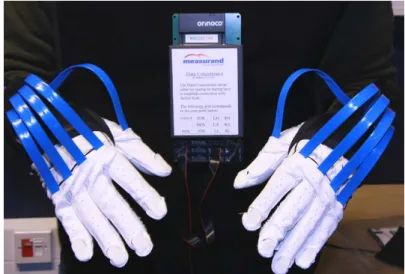
The most sophisticated and accurate data gloves at the present time are the CyberGlove II developed by Immersion, and the ShapeHand by Measurand [89-91]. They are wireless and capable of measuring finger bending and adduction. Moreover, they can be easily integrated with the full-body motion capture system. The CyberGlove II provides 22 high-accuracy joint-angle measurements by using a proprietary resistive bend-sensing technology to transform hand and finger motions into real-time digital joint-angle data. In contrast, the ShapeHand data glove is based on flexible tapes embedded with 40 fibre-optic curvature sensors arranged to sense bend and twist along the length of each tape. By attaching the tapes to run along each finger with one end at the finger tip and the other end fed to a small data acquisition box at wrist, the gesture movements of fingers introduce deformation of the tapes, the bend and twist measured at each sensor location with respect to the end of the tape at wrist enables relative positions and orientations of each finger joint to be determined. Furthermore, its ambidextrous and independent glove design enables the ShapeHand data glove to suit different hand sizes and easy to maintain, as shown in Fig. 2-4.
Figure 2-4. ShapeHand data gloves (modified from [89]).
Since the ShapeHand data glove is one of the most accurate data gloves at the present time, its performance has been accessed and evaluated (see Chapter 3), which proves such data glove is suitable for the purpose of this project, hence has been adopted in this project for the hand posture data capture.
Ambidextrous design
2.5 HAND POSTURE RECOGNITION
From the hand posture captured, the useful hand features are extracted and classified to achieve hand posture recognition. Different hand feature extraction and classification techniques are available as discussed in the following.
2.5.1 Hand Posture Feature Extraction
A wide range of hand features has been derived from hand configuration data for hand posture recognition [92-94]. Lengths and widths of fingers, palm and hand have been considered in some research [95-97]. For example, in [95], it uses the lengths of finger and palm to correct the hand posture classification error, and in [97], it uses the lengths of finger, palm and hand from an obtained hand gesture image for recognition of digits made in sign languages. Although different attempts have been made to adopt the length and width measurements as hand gesture recognition features, they have been proved to be more suitable for the personal identification applications [98, 99].
Some research tried to use the fingertip positions as features for hand posture recognition. In [100], Hsiao et al. argues that the positions of fingertips and the centre of the palm are the most important hand posture features. They proposed an algorithm to estimate the position of each fingertip with respect to palm and to recognise hand postures based on finger-palm distance vectors. However, it seems that the posture recognition based on fingertip positions is more applicable for object manipulation and machine operation rather than for the communication purpose, such as, sign languages [101-104].
On the other hand, the hand joints angles and the angles between two fingers are more suitable for recognition of hand postures in sign languages [105-108]. A typical example is the DigitEyes hand tracking system, which considered the finger phalange lengths and joint angles as features for hand modelling [109]. The advantage of using the joint angle features is that it is more invariant to the size and position of the hand [94].
Apart from these, most research works choose to consider the hand holistically, which use the appearance of the hand, such as the shape and contour, as features for hand posture recognition [110, 111]. The general concept of such approach is to find the best match between the input hand shape and the hand shape templates. The difficulty associated with this approach comes from the large variance of the hand sizes and orientations.
2.5.2 Hand Posture Feature Classification
Based on the literature review, there are three commonly used feature classification methods for hand posture recognition, Fuzzy systems, HMM networks and Neural Networks.
The Fuzzy theory was introduced by Zadeh in 1965 [112]. Since it deals with the ambiguous inputs adaptively and produces approximate results rather than exact ones, it has been applied to the usually imprecise hand features [113]. Early attempts on the use of fuzzy systems for hand posture recognition were reported by Holden et al., where fuzzy expert systems were used to classify finger bending into three states, slightly bent, greatly bent and completely closed, for recognition of hand gestures in Australasian sign language [114, 115]. The system evaluation was conducted based on a dictionary of 21 signs and the system performance was shown to be significantly better than the system without the fuzzy method. In [116], Su presented a fuzzy rule-based approach for spatio-temporal hand gesture recognition. For each posture input, it is tested by the fuzzy rules prior to the comparison with the hand posture templates, where the templates are selected based on the hyper-rectangular composite neural networks. The system has been tested against a database with 90 sign words consisting of 34 basic hand shapes as shown in Fig. 2-5, and the author declared a recognition rate of 94.1%. Another example is Bedregal’s hand gesture recognition system for Brazilian Sign Language, where the interval fuzzy rule based method is used to classify the hand joint data acquired from the data gloves [117]. Through these literatures, it can be seen that the Fuzzy system may be considered as a possible approach with good performance for hand posture recognition,
because it is capable to deal with the uncertainty in the hand measurement parameters.
Other feature classification methods for hand posture recognition are largely based on the HMM and Neural Networks, which matches the extracted features with the pre-modelled feature templates [92, 93, 118, 119]. Since these techniques are also applied widely for movement classification, they will be discussed together in the section of movement classification.
2.6 HAND MOVEMENT TRACKING
For hand movement tracking, it can also be done by vision based or sensor based approaches.
2.6.1 Vision Based Hand Movement Tracking
For the vision based hand movement tracking approach, video cameras are often used to capture a sequence of images containing hand movements over a period of time, and the hand trajectory is retrieved according to the hand positions obtained from each image. This approach can also be further divided into appearance based and model based methods.
A. Appearance based movement tracking
For the appearance based movement tracking methods, the derivation of an object movement trajectory in a scene is through the analysis of the motion of the features or
brightness patterns associated with the object in the image sequence [120, 121]. The
simplest approach is to track the movement of the segmented object centre. A more sophisticated approach was proposed by Bobick and Davis. It computes the motion energy images through a series of low resolution images, wherein it tracks the centres of the human’s body parts and results in the spatial movement information of the body parts to be obtained [122]. This is then followed by matching the movement trajectory against stored action energy image models to recognise the movement. In some other articles of Bobick and Davis, they generated a binary motion-energy image to represent the place where the motion occurred, and a motion-history image that is a grey-scale image with the intensity proportional to the recentness of the movement. The human movement is determined through the comparison with the predefined temporal templates [123, 124]. The result showed that the system worked at a low speed of 9 Hz and failed when two people presented in one scene due to the occlusion from each other. Also, it cannot deal with non-specified body parts. In [125], Kolsh and Truk used a set of KLT (stands for the initials of the authors) feature trackers to track the motion of a hand. The features are taken from the bounded skin colour blob of the hand and its centre position is determined by the median feature. The system has achieved a detection rate of 92.23%. In [126], a
kernel-based tracking technique associated with a Kalman filter has been used to track objects in video images. By spatially masking a target with an isotropic kernel, the spatially smooth similarity function can be defined and localisation of the target is achieved by searching the basin of attraction of this function. Although the concept of tracking the centre of the segmented object is simple, it is sensitive to background noise.
In [127], Freeman et al. used the x-y image pixel movements and orientation histograms to extract human movement cues, and in [128], Polana and Nelson used a series of grid based tiles with movement features in each tile mapped into a vector to describe the state of movement at a time. However, both of them are subject to camera view variance. Regressive tracking methods have been investigated. For example, Heisele et al. presents an algorithm for tracking moving objects in a sequence of coloured images taken from a non-stationary camera [129]. For each image frame, an object is determined by a divisive clustering algorithm that specifies its colour and position. By adaptively renewing the clusters of the objects using a parallel k-means clustering algorithm, the centroids of the clusters are tracked.
Another attempt for appearance based movement tracking is based on computing the optical flow or the 2D field of instantaneous velocities of brightness values in the image plane [130-132]. Although this method is independent to camera motion, it is computational expensive, very sensitive to noise and lighting condition and requires the motion to be smooth and continuous thus implying a high rate of image acquisition. Still, it faces the challenge of tracking occlusion [67, 120, 130].
Therefore, although the appearance based movement tracking is conceptually simple, it has challenges in terms of computational load, sensitive to lighting, background noise, shadow and reflection, and different view perspectives. Moreover, the occlusion problem is extremely severe especially for movement tracking of multiple objects in a scene [133]. Users are often required to wear coloured suit or gloves to avoid these ambiguities [123, 134].
B. Model based movement tracking
To alleviate the problems associated with the appearance based movement tracking methods, especially occlusion and background noise, the other approach for vision based movement tracking is to use a 2D or 3D model.
2D model based movement tracking
For the 2D model based methods, the modelling is typically based on image projection of objects or parts of objects and the tracking is based on object position displacement. In the work of [135], Ju et al. defined a ‘cardboard person model’ based on parameterised models of optical flow, where a person’s limbs are represented by a set of connected planar patches. Although it is able to track the walking movement, the orientation of the walker is assumed to remain unchanged. Bregler et al. tested several 2D object modelling methods, and finally used the expectation-maximisation method to estimate and constrain the pose with simple kinematics [136]. The result showed that it could only recognise non-trivial gestures. Lu et al. proposed a layered deformable model to recover human body parts and their movements in gait analysis, where 22 parameters has been used to model the body parts, and are categorised as four layers to allow limb deformation [137]. The model has been tested on 10,005 frames from 285 gait sequences captured under various conditions with the mean-shift algorithm used for tracking, and yields an average error rate of 7% in recovering the parameters of human limbs from their extracted silhouettes for human body pose determination. Ronfard et al. tracked people in static video frames using learned models of both the appearance and geometry of body parts [138]. The learning of articulated body planes uses Relevance Vector Machines which is a SVM-like (Support Vector Machines) classifier and offers a well-founded probabilistic interpretation and improved sparsity for reduced computation. The drawback is that the video frames must be static and the detection rate varies from 36% to 85%.
Segmenting and tracking multiple humans are difficult in complex situations due to the extended occlusion, where a single blob may contain multiple subjects due to their proximity and/or the shadows and reflections produced by the moving objects. Zhao et al. proposed a 2D model based tracking method where the subject hypotheses are generated
using an elliptic shape model from multiple camera-views whereby its shadow models can be predicted [139]. These are then tracked by a Kalman filter. The results show that over 95% of human in the testing frames are correctly detected and tracked. Although the occlusion problem has been handled well, such a simple model cannot be casted in fine-grain objects, e.g., hands. Also, the multiple camera requirements make its implementation impractical. In their latter article [140], an attempt has been made to track multiple humans in a crowded scene using a single stationary camera. A Bayesian framework for multi-object tracking including a colour-based joint likelihood was used for simultaneous detection and tracking, and the MCMC-based (Markov Chain Monte Carlo) method was used to compute the optimal solution. Authors declared promising results, however, it did not solve the tracking difficulty among different object classes, and an assumption is made that the object shape under tracking must be relatively invariant. Incidentally, the paper points out another commonly used tracking filter, the particle filter, which scales poorly as the dimensionality increases because it keeps a non-parametric distribution of the joint state probability.
A difficulty associated with vision based motion tracking is that it is difficult to estimate body poses if the body movement and the camera viewing direction are coincident. In such views, the image variation caused by the motion is very small, typically much smaller than the image noise, which prevents it from successful tracking. To tackle this problem, generative modelling has been applied, which learns the model from the joint probability of both the inputs data and the estimated body pose, and then picks the most likely body pose estimation [141]. For example, the input data of the appearance configurations, e.g., appearances from different view angles, can be predicated by giving a body pose hypothesis from the subject model or calibrated camera to generate the joint probability [142, 143]. Jaeggli et al. proposed a generative model for the relationship between a body pose and its image appearance using a sparse kernel regressor, where they compare binary PCA and distance transforms to encode the appearance and this is followed by an estimation of the globally optimal trajectory through the entire sequence [142]. The tested movement is a combination of walking and running. Also in [143], Lee and Elgammal introduced a parameterised generative function where for an observed motion, contours of different body configurations, viewpoints, and shape styles have been generated. This is followed by the recovery of 3D
configuration which is achieved by searching for the best matching of the models according to visual observation. Although the generative modelling method yields good results in simple human motion tracking, it is difficult to handle complex human motions due to its high dimensionality.
To reduce the computational cost for articulated motion modelling with a large dimensionality, another attempt made in [144] is to analyse and model subparts locally with the constraints of different subparts reinforced by a Markov network, which is a generative model that characterises the dynamics and the image observations of each individual subparts as well as the motion constraints among different subparts. In the most challenging condition, a 10-part articulated body can only be tracked at 0.56 frames/second. Moreover, the occlusion problem is very severe.
The temporal-flow 2D models are also used for motion tracking. Yacoob and Davis proposed a temporal-flow model which is presented as a set of orthogonal temporal-flow bases that are learned using PCA of instantaneous flow measurements [145]. Spatial constraints on the temporal-flow are also developed to model the motion of regions in rigid and articulated motion. The author claims the results are accurate, albeit tracking of some body parts failed.
3D model based movement tracking
Unlike the 2D methods, which are not able to recover the actual object position in 3D space, the 3D model based movement tracking methods aims to continuously recovering all 6-DOF data of an object, namely, the its position and orientation data [146].
Earlier attempts were made using a kinematic model for articulated body parts. Rehg and Kanade introduced a 3D hand kinematic model to predict occlusions, where the index and middle fingers are tracked using a 9-DOF kinematic model [147]. The weakness found through the results is that the tracking cannot be done in real-time. In [148], a hierarchical model has been proposed to track human body in monocular video sequences,
where the kinematics is encoded using Hierarchical PCA, and dynamics are encoded using HMM networks. Although the results show that it can recover 3D or 2D skeletons from 2D images, the error rate increases drastically with the increase of ambiguity degree of the front view. In the research by Sahheen et al., they defined that 3D model based tracking usually relies on filtering, local optimisation, or global optimisation, where the global optimisation can be further divided in to single hypothesis and multiple hypothesis optimisation [149]. They compared these underlying mathematical models and evaluated the performance of one representative algorithm for each class as well as comparing several likelihoods and parameter settings. A conclusion is made that multiple hypothesis optimisation performs better than single hypothesis optimisation and global optimisation is better than filtering or local optimisation for markerless human motion capture with 3D models. However, all of them suffer from low accuracy and low tracking rate.
Motion filters have been used in many 3D tracking methods to smooth the pose estimation and to provide predictions which improve the reliability of the tracker. Stochastic tracking frameworks such as CONDENSATION (Conditional Density Propagation) and particle filtering are applied to handle the condition of complex non-Gaussian probability density functions e.g., kinematic singularity and joint endstops [150]. However, these filters are ineffective because the number of required particles is exponentially proportional to the dimensionality and evaluation of the likelihood is computational expensive [121, 151]. Davison et al. addressed these problems by developing an Annealed Particle Filter (APF) which uses a weighting function to approximate the likelihood [152]. Despite it allows the use of larger particle distributions with less computational effort, which improves the tracking results, many particles are wasted in randomly generated configurations.
Hence, despite efforts of using various 3D modelling techniques to improve vision based tracking, particularly in the area of occlusion and background noise, they are not able to resolve these difficulties completely and also increase the computation expense in terms of the model construction.
2.6.2 Sensor Based Hand Movement Tracking
Although vision based hand movement tracking is uncumbersome and unintrusive, it has disadvantages in terms of low accuracy, high computational load, and high sensitivity to various background noise and camera-view variance, as well as its inherent occlusion problem. The inherent weaknesses of the vision based approach, especially the image segmentation, camera-view variance and occlusion problems, can be reduced by the sensor based method to some degree, at the expense of introducing a little inconvenience for sensor mounting. While a large number of commercialised tracking sensors are available on the market, the research conducted in this report adopted the InterSense IS-900 tracking devices to track the hand and head movement of users due to its advantages in terms of resolution, accuracy, update frequency, latency, tracking range and cost. More details of such tracking devices will be given in Chapter 3.
2.7 HAND MOVEMENT RECOGNITION
Similar to hand posture recognition, hand movement recognition has also attracted substantial research due to its wide applications e.g., surveillance, medical studies and rehabilitation, robotics, video indexing, and animation for film and games [153]. The process also consists of feature extraction and classification, and they will be discussed as follows.
2.7.1 Movement Feature Extraction
Literature review reveals that movement feature extraction can be conducted based on the regularity features or spatio-temporal features. Compared to the latter, the feature extraction based on the movement regularity has advantages in terms of speed as well as robustness for its view and time invariance, and the commonly used methods are the Fourier analysis and autocorrelation techniques.
Fourier analysis is a powerful tool which has been applied in multiple disciplines. In movement recognition, one of its techniques, the Fourier transform, has been explored for repetitive movement feature extraction [154-158]. A standard procedure for the Fourier transform applied in movement recognition starts with the removal of the DC (Direct Current) component and followed by the search for the fundamental frequency. With the fundamental frequency and the span length of the movement known, the movement feature of a repetitive movement, i.e., the number of peaks and valleys, can be easily extracted. Although Fourier analysis is simple and effective, its results only reveal the frequency of the repetitive movements, and it is not possible to retrieve the features without the knowledge of the movement length. Also, the repeating manner of the movement must behave in a very similar way; otherwise, multiple frequencies will appear. Furthermore, the sampling frequency must be at least double of the highest frequency of the periodic motion to avoid false results [159].
Fourier series has also been investigated for movement feature extraction. Since the Fourier series conventionally targets to the analysis of periodic waveform [160, 161], early attempts have been limited to the analysis of periodic movements, e.g., walking and running [162, 163]. However, Cosgriff [164] proposed that a closed shape contour, which is not necessary repetitive, can be recognised as a periodic waveform, since a starting point to count through the contour can also be considered as the starting point for the next counting-through process [165-167]. By mapping the contour pixels to complex
coordinates and applying the Fourier analysis with the contour length normalised to 2π,
the Fourier coefficients obtained are known as the Fourier descriptor and a shape contour can be uniquely identified according to the distribution of the Fourier coefficients. Due to its frequency characteristics, the Fourier descriptors have the following properties:
• Translation: the translation of a contour is equivalent to add a constant to its DC
component with the DC component value indicating the centre position of the contour;
• Rotation: the rotation of a contour about its origin by angle θ in the complex plane is
equivalent to multiply its Fourier descriptor by eiθ; and
• Scaling: the scaling of a contour is equivalent to multiply its Fourier descriptor by
In practical applications, a movement trajectory is not necessary a close curve, where an alternative is to dilate the recorded movement trajectory first, and then extract its boundary to obtain its Fourier descriptor [168]. However, similar to the application for hand configuration extraction discussed in Section 2.4.1, although this approach has some advantages, it has drawbacks in losing fine-grain features and demanding a large trajectory templates for high precision movement classifications. Additionally, in [169], the authors use the Fourier descriptor to analysis the human’s gait by considering the human silhouette contour and gait as periodic.
Although the FSD approach dramatically reduces the computational cost, the large gesture vocabulary (e.g. ASL) poses a problem for collecting an adequate training set to build the templates and may lose compactness in the subspace required for efficient processing [64]. Moreover, the attained templates may vary due to the different camera view angles they are taken from
Autocorrelation techniques have also been applied for movement feature extraction which is to find the cues of movement similarities, that is, its periodicity [157, 159, 170, 171]. However, the drawback associating with this method is that it only yields good results for pure periodic movements.
Therefore, although the movement analysis approaches based on the regularity features are fast and robust in terms of view and time invariance, they are more applicable to periodic movement feature extraction and recognition, such as human walking gait, cycling movement, rotating and swinging [163, 172].
On the other hand, the movement analysis based on spatio-temporal features analyses the movement shape information over time, and the commonly extracted curve features are curvature, torsion, velocity and acceleration [173-177]. These features can be used to segment a movement into different intervals according to its significant changes in order to do further classification. In [174], Faria and Dias used the features of curvature and hand orientation to segment hand movements, histogram techniques to build movements
![Figure 2-2. Kinematic hand model with arrows illustrating the joint axes for each joint hinge in the chain (modified from [11, 51, 52])](https://thumb-us.123doks.com/thumbv2/123dok_us/10988555.2986584/20.892.217.747.704.988/figure-kinematic-model-arrows-illustrating-joint-joint-modified.webp)
![Figure 2-4. ShapeHand data gloves (modified from [89]).](https://thumb-us.123doks.com/thumbv2/123dok_us/10988555.2986584/30.892.248.716.99.515/figure-shapehand-data-gloves-modified.webp)

![Figure 3-18. Asymmetric frustum parallel axis projection (modified from[230]).](https://thumb-us.123doks.com/thumbv2/123dok_us/10988555.2986584/72.892.236.743.87.391/figure-asymmetric-frustum-parallel-axis-projection-modified.webp)
