PACIS 2011 Proceedings
(PACIS)
9 July 2011
Considering Cognitive Load Theory Within
E-Learning Environments
Abdullah Alasraj
University of Wollongong, [email protected]
Mark Freeman
University of Wollongong, [email protected]
Paul Chandler
University of Wollongong, [email protected]
ISBN: [978-1-86435-644-1]; Full paper
This material is brought to you by the Pacific Asia Conference on Information Systems (PACIS) at AIS Electronic Library (AISeL). It has been accepted for inclusion in PACIS 2011 Proceedings by an authorized administrator of AIS Electronic Library (AISeL). For more information, please [email protected].
Recommended Citation
Alasraj, Abdullah; Freeman, Mark; and Chandler, Paul, "Considering Cognitive Load Theory Within E-Learning Environments" (2011).PACIS 2011 Proceedings. 14.
CONSIDERING COGNITIVE LOAD THEORY WITHIN
E-LEARNING ENVIRONMENTS
Abdullah Alasraj, School of Information Systems and Technology, Faculty of Informatics,
University of Wollongong, Wollongong, NSW, Australia, [email protected]
Mark Freeman, School of Information Systems and Technology, Faculty of Informatics,
University of Wollongong, Wollongong, NSW, Australia, [email protected]
Paul Chandler, Faculty of Education, University of Wollongong, Wollongong, NSW,
Australia, [email protected]
Abstract
This study seeks to investigate how cognitive load influences knowledge construction and what is the role of layered integrated instructional techniques in facilitating the construction and automation of schemas whilst users are interacting with e-learning tools. Initially the literature on how Cognitive Load Theory (CLT) plays a role in e-learning tools is presented, this is followed by the considerations that need to be taken when developing e-learning tools with CLT as a focus so that learners can gain the best possible learning outcomes.
This paper finally presents three different ways that e-learning tools can be designed when considering the cognitive load of learners. These three methods are: integrated layering with no previous information displayed; integrated layering with previous information displayed; and integrated layering with the current stem highlighted. Each of these methods has theory that supports their design, however the context of the learner needs to be taken into consideration when developing the e-learning tools.
1
INTRODUCTION
Information and communication technology (ICT), has altered and improved several features of the way in which we live and are educated. Despite this there continues to be limitations in the transformation of learning to e-learning, especially in relation to impact and activity of the learning environment (Collis 2002). The advancement of ICT in education has been seen in the increased use of the Internet for communications and accessing of information (Oliver & Towers 2000), flexible delivery opportunities afforded by ICTs and the use of ICT to support educational programs for customized students and educational needs (Kennedy & McNaught 1997). This has led to an emerging focus on programs and courses that develop performance and competency, aptitude and abilities, looking at how information is used, rather than what information is being learnt. This paper presents several methods for the increased study of the learner of e-learning tools, with a focus on the cognitive load placed on the learner while engaging with the tools.
With this shift towards performance and competency, there is a greater place for instructional technological tools (particularly e-learning tools), at least because of their ability to access a variety of forms and types of information, sources of information, and to support the creation of learning environments that are student-centred and based on inquiry and information access. Furthermore, information literacy has begun to be linked to teamwork, collaboration, project management skills, negotiation and communication skills, and problem solving capabilities. Such attributes are further supported and developed through the use of e-learning tools in educational settings.
Settings involving instructional design via e-learning are typically developed months before the learner commences learning, and therefore, the temporal distance between learning and instructional design places increased responsibility on the learner to understand the content of the program independently from instructor assistance (Morrison & Anglin 2005). This places greater pressure on the instructor to ensure sufficient assistance is provided to the learner. Challenges are presented to the learner who is concurrently engaging with the educational material, as well as the delivery technologies (the e-learning tool). Although basic e-learning settings can be easily achieved, they often lack critical criteria and properties that are vital for the achievement of learning outcomes (Herrington et al. 2006). Therefore, a thorough understanding and application of Cognitive Load Theory (CLT) throughout the instructional design is critical for ensuring that course materials and tasks are designed at a manageable level for the learners’ mental ability. The purpose of an integrated instructional design is to provide multiple sources of information which include text and diagrams in a format where the related information is merged into a single unit of information. This format will not require the learner to use their limited short-term memory resources to mentally integrate the material and thus reduces their cognitive load and facilitates more effective learning outcomes.
CLT is defined as a universal set of learning principles that are proven to result in efficient instructional environments as a consequence of leveraging human cognitive learning processes (Clark et al. 2006). If the concepts of CLT are not applied to e-learning tools then the results of the learning outcomes could be severely hampered. Teaching practices therefore are instrumental in the creation of environments which stimulate learning in a successful manner. Over recent years, there has been a emphasis on the outcomes of learning as well as student satisfaction with both learning and teaching irrespective of the environment within which it occurs. The fundamental principle basic concepts to learner then basically then tend to describe the circumstances that lead to learning, identification of teaching practices as well as the learning activities themselves (Bransford et al. 1999). These support a learning environment that stimulates the learner.
Learning can also occur within many contexts, either remotely (electronically) or physically. Basic concepts to the learner may be provided electronically, with group learning or via material comprehension, all in accordance with the objectives of the designated outcome (Tsai 2011). Within
every aspect of these basic concepts, concrete guidelines need to exist that focus on particular requirements as well as assessment measurements.
This study proposes three different instructional design methods to reduce the learner’s cognitive load by using e-learning tools to support the learning outcomes of learners, whilst gaining understanding of basic process concepts. These methods could be used in any process based instructional design. Examples in the ICT space could include: the human memory process; the input-processing-output concept; the phases in systems analysis and design and online transaction processing. They could be also applied to other management concepts for example presenting Porter’s Five Forces to students or presenting the Value Chain Model which are taught to ICT students. It is critical to understand such principles of learning theories as they underpin the various learning contexts, and help to explain why analysis of CLT might be useful for promoting more effective learning strategies. Basic principles of learning theories will allow for a more critical engagement with various aspects of e-Learning, including the efficacy of utilising various e-Learning tools.
2
HUMAN MEMORY
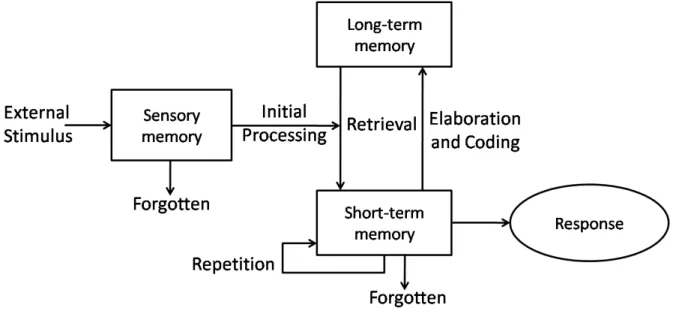
Sweller (2003) defines human cognitive architecture as the way cognitive structures are organized and interrelated. Information is being stored and processed by short-term memory and long-term memory so as to be able to retrieve it for subsequent use. Information enters the human information processing system via a variety of channels associated with the different senses, commonly referred to as sensory memory; at this stage the information can be forgotten or initially processed into short-term memory. Short-term memory, also referred to as working memory is the momentary storage of information that is processed to perform cognitive tasks; information at this stage can be forgotten or elaborated and coded into long-term memory. Miller (1956) stated that short-term memory has the capacity of about seven plus or minus two "chunks" of information, with a duration of between 18 to 20 seconds (Peterson & Peterson 1959). Long-term memory is the memory storage within human memory, previously learned and stored information is processed in long-term memory which is also very important to other cognitive abilities such as problem solving, but humans cannot use the contents of long-term memory until it enters short-term memory; through retrieval (Sweller 2003). Figure 1 below shows the human memory processing model as discussed.
Figure 1. Human memory processing model.
With the use of e-learning tools the human mind could process a large amount of information that exceeds its capacity which would reduce the learner’s ability to gain the necessary knowledge from
the tool and add it to existing knowledge so it can to be used in new situations (Mayer & Moreno 2003). Therefore, CLT suggests that the short-term memory can experience an overload if there are more than a few chunks of information are processed at the same time, and this ultimately works to inhibit the learning process. Moreover, related cognitive attributes of the learner and the knowledge structures can affect the efficacy of different methods of instruction. In order to best develop resourceful methods and programs, e-learning tools need to be modified to reflect the cognitive attributes of the learner.
Because Short-Term Memory (STM) presents severe limits on the amount of information that can be held in mind simultaneously (Miller 1956) and its duration (Peterson & Peterson 1959), STM has been described as the bottleneck of the human information processing system. Also, short-term memory became an essential and intrinsic part of human cognition (Atkinson & Shiffrin 1968).
3
COGNITIVE LOAD THEORY
In the early 1980’s, Cognitive Load Theory (CLT) was developed. According to Kirschner (2002), this theory deals with the limitations of short-term memory and its interaction with an unlimited long-term memory. Chandler and Sweller (1991), and Cooper (1998) have defined the total amount of mental activity that short-term memory must deal with simultaneously as the cognitive load. CLT describes that intrinsic load or information complexity of learning materials is determined by the level of element interactivity. CLT defines an element as anything that is processed in short-term memory as a single unit.
The basic process of understanding new knowledge involves the reconstruction of existing schemas to generate new higher-order schemas which contains the new knowledge. Therefore for less skilled learners the process of acquiring a new task or solving a complex task, would involve processing the elements as units into a number of low-order schemas which is then combined to form a higher-order schema (Sweller & Chandler 1994). Once the schema has been constructed for a complex task, all the related interactions are incorporated in the schema and this schema is then treated as a single element by learners short-term memory, reducing the load for short-term memory.
3.1 Categories of Cognitive Load Theory
Cognitive load theorists have developed three distinguishable types of cognitive load that can affect a learner, these are: intrinsic, extraneous and germane load. The three main types of cognitive load have to be considered by the instructor in determining the most suitable instructional techniques for the learner in order to optimize learning outcomes.
Schema construction and automation are the two major processes involved in learning. Although schema is stored in the long term memory, the actual construction of schema involves extraction and manipulation of information is dealt with in short-term memory (Sweller 1998). The manner in which information is processed in the short-term memory has significance in the learning process and crux of CLT.
3.1.1 Intrinsic Cognitive Load
Intrinsic Cognitive Load (ILC) imposed on short-term memory is low when non interacting elements are learned in isolation, therefore the ‘learning to read process’ requires a high intrinsic cognitive load because it is high in element interactivity. Learning to read necessarily involves many elements being processed simultaneously. Learners’ abilities and levels differ greatly; therefore, the intrinsic cognitive load learned materials need to differ. For example, the intrinsic cognitive load associated with reading spans across a huge continuum depending on the amount of knowledge stored in long-term memory. The intrinsic cognitive load and element interactivity decrease as reading becomes increasingly
automated. Clark et al. (2006) have defined ICL as “the mental work imposed by the complexity of the content” (p. 9).
CLT describes that ICL or information complexity of learning materials is determined by the level of element interactivity. CLT defines an element as anything that is processed in the short-term memory as a single unit. For instance, an adult would recognize a word such as “book” which will be processed as s single element in the short-term memory. However for a person such as a child who does not recognize the word but single characters will have four elements. This indicates that an element differs between learners. Hence the element can be either a schema that is already learnt or a unit of new information. The load on short-term memory during learning process is dependent upon the number of elements that has to be processed simultaneously which depends on the extent of interactivity between the elements (Sweller 1999).
The variation of ICL is based on the degree of interactions between elements in the learning material. Materials that have single learning elements that need to be learned in isolation are said to have a low level of element interactivity. Therefore for these materials the short-term memory is low and said to have a low ICL (Sweller & Chandler 1994). Likewise, in complex materials the higher the degree of interactivity between elements, as materials cannot be learnt isolation, learners need to learn the individual elements but it will not make sense unless they understand the relationship between the individual elements. This also explains that what actually defines an element also depends on prior learning.
The basic process of understanding new knowledge involves reconstruction of existing schemas to generate new higher-order schemas which contains the new knowledge. Therefore for less skilled learners the process of acquiring a new task or solving a complex task, would involve processing the elements as units into a number of low-order schemas which is then combined to form higher-order schema (Sweller & Chandler 1994). Once the schema has been constructed for a complex task, all the related interactions are incorporated in the schema and this schema is then treated as a single element by the short-term memory, reducing the load for the short-term memory.
In summary ICL describes the number of interactions between elements in one particular task which can vary from individual to individual. Element interactivity is also dependant on a learner’s previous knowledge. This indicates that the level of elements interactivity in e-learning tools cannot be identified by only analysing the material itself. Element interactivity can be determined by the number of interacting elements that a learner is required to understand (Sweller & Chandler 1994). For understanding how humans make decisions with regard to their learning while using e-learning tools it is important to understand the level of ICL placed on the learner.
3.1.2 Extraneous Cognitive Load
Extraneous Cognitive Load (ECL) results from poorly designed instructional materials (Sweller et al. 1998). These are imposed by the actual instructional techniques, procedures and materials used during instruction; an example of this is overly complex e-learning tools where the learner spends more mental effort understanding the tool rather land learning the concepts from the tool itself. ECL can interfere with schema acquisition and automation, and hence hinder the learning process. Furthermore, Sweller (1994) argues that ECL is being governed by the instructional process which gives the instructor the ability to vary the e-learning tool developed to reduce ECL. Paas et al. (2003a) suggest that reduction in ECL can be achieved by employing a more effective instructional design. Sweller and Cooper (1985) demonstrated that worked examples were a more effective way of teaching algebra as a way to reduce the learners ECL.
It is very important not to expose short-term memory with an unnecessary ECL while the learner is in the process of constructing and acquiring schemas. Kalyuga et al. (2003) argue that this is the point when the instructional guidance given can be used as a substitute for the yet to be acquired schemas.
In addition, the techniques employed can have a significant impact on learning and acquiring schemas for novices.
Chandler and Sweller (1991; 1992) explained ECL as the load that is not inherent within the instruction, but is imposed by the instructional designer as they structure and present information. ECL is a concern when ICL is high (Paas et al. 2003a; Paas et al. 2003b). This is because intrinsic and extraneous load are additive, but when intrinsic load is low, the learner will typically have less trouble grasping the underlying content (Paas et al. 2003a), but instructional designers should always strive to limit cognitive load placed on the learner.
In order to learn new material, the learner’s ECL is determined by the instructional design of the e-learning tool. As such to reduce the total cognitive load, the ECL needs to be reduced to ICL. If the ICL is low an inappropriate instructional design may not make much difference as the total cognitive load is not likely to exceed the short-term memory capacity of the individual. However, the instructional design plays a major role when the ICL is high and extraneous load becomes more significant.
Generally, the main concern for instructional designers is to develop the most appropriate method for an organisation or present the information to its learners in the best possible manner which involved taking into consideration a number of factors. Sweller (1999) noted that the limitations imposed by the short-term memory are important in instructional design process, as such, the instructional design should be analysed from a cognitive load perspective.
3.1.3 Germane Load
Finally the third type of cognitive load is Germane (or relevant) load. This final type of cognitive load is that remaining free capacity in short-term memory may be redirected from ECL toward schema acquisition (Sweller et al. 1999). Germane cognitive load the process of constructing and storing schemas in long-term memory, it is concerned with the construction and automation of schema development.
3.2 Cognitive Theory Effects
It could be stated that the three cognitive load types add to form the total amount of cognitive load imposed on short-term memory which must not exceed the memory capacity if it is not to become overloaded. Total cognitive load can be reduced and the resources of short-term memory will be freed if the extraneous load can be reduced. An adequate detailed discussion on the techniques of measuring cognitive load within the CLT framework may be found in the work of Paas et al. (2003b). Thus, it should be the goal of e-learning tools to reduce cognitive load in their design to allow for better learning outcomes.
E-learning Instructional design which aims to present information in various formats such as diagrams with text may not always be effective procedure as some of the information is either unnecessary or redundant. Redundancy can increase the cognitive load which will interfere with the learning process. The interference caused by unwanted information in the learning process is known is Redundancy Effect. This effect can be identified where the same information is presented in different forms (Chandler & Sweller 1991).
Redundancy is often critical with e-learning instructional formats. Integrated formats should be effective at reducing cognitive load due to spilt-attention (Yeung et al. 1998) when dealing with multiple sources of information that cannot be understood in isolation. However, if multiple sources of information can be understood in isolation, it decreases the cognitive load. In non-integrated format of learning is where the learner identifies the one of source of information that needs to be understood and ignore the other redundant sources of information. The goal of e-learning tools should be only to have redundancy when the information cannot be presented in isolation.
Split-attention occurs when learners have to mentally integrate two or more sources of unrelated information and each source of information is dependent on each other in order for the learners to understand the material. The short-term memory load imposed by the need to mentally integrate the disparate sources of information interferes with learning.
Yeung et al. (1998) discussed the relationship between the occurrence of spilt-attention effect or the redundancy effect with the learner’s level of expertise. A learner with low level of expertise may require some additional information to understand producing a split-attention effect whereas for a learner with high level of expertise that additional information would be unnecessary thus producing a redundancy effect. CLT as such outlines that the design of effective instructional material cannot be defined accurately due to the level of expertise of learners. This finding was further supported by Kalyuga et al. (1998) where split-attention was replaced by redundancy with high knowledge trainees in their experiment, resulting in increased learning outcomes.
3.3 The Use of CLT in E-Learning
E-learning tools require skilled instructional designers for them to be effective. However, these designers go through challenges that are different from those usually experienced in traditional classroom instruction (Morrison & Anglin 2005). “E-learning” is a general term used to refer to various forms of learning through the use of computers. One form of e-learning is distance education, which takes place at a computer with an Internet connection where instructors and students are in separate locations and the students study during different times (Simonson et al. 2006). E-learning puts greater responsibility on the instructor to make sure sufficient assistance is given to the learner in many different ways. Just as important, the learner learns about the educational content at the same time they are learning about delivery technologies. This may put much pressure on students, specifically those who do not have much experience with technologies (Clarke et al. 2005).
Distance education programs have the potential to add greater complexity for instructional designers since a learner must be learn how to be capable of managing the educational technologies, program content, and delivery environment simultaneously. During the design of e-learning, other challenges that must be taken into account are the context of learning tasks as well as the consideration learner attributes such as distance education experience, and levels of prior familiarity and knowledge regarding their subject domains. These considerations may greatly impact the interactions of the learners and their success in e-learning settings (Dillon & Jobst 2005). Lastly, other considerations such as means of assessment, engagement, interaction, communication, and learning strategies are also associated with the efficacy of distance learning via e-learning settings (Richardson & Newby 2006; Simonson et al. 2006).
While simple e-learning settings may easily be designed, these designs may not have certain essential properties that are vital to achieve successful learning like learner engagement and flexibility (Herrington et al. 2006). These limitations are usual in Learning Management Systems (LMS) in which customary pedagogical approaches are incorporated into web-based courses. On the contrary, newer and more complex pedagogical strategies like e-learning 2.0 can take up a lot of time but is more likely to give students a more engaging learning experience. The term “e-learning 2.0” is used to portray the use of several Web 2.0 applications like wikis, podcasts, blogs, and virtual worlds (e.g. Second Life) in learning environments (Downes 2005). These applications can add collaborative opportunities, greater richness to the content and new communication possibilities in courses. However, similar features can also enforce extreme cognitive demands levels on a number of learners. As a matter of fact, e-learning environments may stall learning if the instructional design does not manage or account for increased cognitive demands. In order to be effective, e-learning designs should balance an interactive and interesting environment with manageable mental effort levels. This is harder to achieve in distance learning due to the fact that as soon as course materials and tasks are given to the learners, the designers will have very little control over the learner insight and learning processes. More often than not, there is an existing gap between how the course materials are being
used, what designers expect to happen in a course, the usefulness of the material and the actual opinion of learners (Martens et al. 2007).
Burke (2007) discussed the expansion of teaching opportunities to students though the use of Instructional Design Theory to develop insights to increase the competency of teachers and administrators in relation to the field of management education, its objective centres to ways in defining effective communication of course material and how educators appropriately identify its relationship with research and studies made in the past, with an adaption of Mayer’s theory of multimedia learning (Mayer & Moreno 2003), the study considered what standards are effective in bridging communication of course objectives. Burke and James (2008) gauged the value of PowerPoint presentations and whether they are a novel stimulus in shaping perceptions amongst students during the learning process. From this perspective, the ability of educators to operate effectively on learning tools to create appropriate learning outcomes. This research considers these novel approaches when determining the possible instructional design architectures for reducing CLT and increasing learning outcomes.
Evaluating the value of the use of e-Learning is another important aspect to consider. Sitzmann et al.’s (2006) study, the apparent potential of using technology such as Web Based Instruction (WBI) remains to be seen. It demonstrates how the effective application of instructional models as well as formalized training can help reap the benefits of e-Learning tools. How learning can to align programmes with the capabilities of WBI is also highlighted (Sitzmann et al.’s 2006). Learners can gain useful insights that can generate competency and adherence to established goals and objectives. Thus, it is necessary for designers not only to know and understand the causes of increased cognitive demands impressed on students taking up e-learning courses, but also to measure their perceptions of tasks in the e-learning environments in order to guarantee efficiency from both instructor and learner perspectives.
3.4 Dealing with cognitive load in e-Learning tools
Advanced learning settings that are ICT-based, such as e-learning tools, respond to the learner’s actions and consist of many different forms of interactivity. They include high levels of learner control, linked networks of information, and multiple presentations. Such settings are projected to enhance active acquisition and construction of new knowledge. A high level of cognitive load in an interactive learning setting could result from a number of variables including related cognitive processes, from uncertainty and a nonlinear relationship between these variables, and by momentary interruptions. In a number of cases, the learner has to bear the burden of determining when to make use of further assistance from instructors (if available) and what kinds of assistance to ask for. While a more experienced learner could deal with such burdens, it may go beyond the cognitive resources available to the learner who is less experienced.
The cognitive load structure could be applied effectively to various forms of dynamic presentations with e-learning tools such as instructional games, simulations, and animations. For example, the continuous presentation of animations may be too cognitively challenging for a novice learner because of a high level of transitivity. A less experienced learner may be helped from if a series of comparable static charts and diagrams if they were used instead. The impacts of computer animations and static diagrams on the learner’s level of understanding and comprehension have been investigated by Hegardy et al. (2003). There was no evidence proving that animations resulted in higher levels of understanding than static diagrams. The understanding of diagrams however, was improved by asking learners to forecast how the object from the static diagrams will behave and by giving them an oral explanation of the dynamic processes. Forecasting motion from static diagrams most likely engaged the mental animation and spatial visualization processes of the learners (Hegardy et al. 2003). Nevertheless, animated diagrams could still be more favourable for a more experienced learner who has attained an adequate knowledge base for handling restricted short-term memory capacity and
issues of transitivity. Most favourable forms of adapting pictorial dynamic presentations to the level of expertise of the intended learner involve choosing appropriate levels of animation.
The relationship between the expertise level of the learner and the efficacy of static and animated illustrations in the activity domain of altering graphs of quadratic and linear equations in mathematics was studied by Kalyuga (2008). The results indicated that the performance of less experienced learners were notably higher after studying static illustrations. However, more experienced and knowledgeable learners exhibited better performance after studying animations. As the expertise level of the learner increased, it was shown that the animated instruction group’s performance progressed to a higher level of learning as opposed to the static group’s performance. The knowledge structures of more qualified and skilled learners may assist them in handling the animations’ transitivity, but processing static graphic details may necessitate repeated activities for the learners. Static graphics are less useful to more knowledgeable learners since their existing dynamic knowledge structures would have to be assimilated with redundant details shown in graphics. Extra cognitive sources may also be called for such processes, decreasing effects of relative learning and raising short-term memory demands. Interactive simulations can offer suitable environments for delving into hypotheses and garnering instant feedback, therefore improving the problem solving skills and critical thinking development. Then again, high short-term memory load levels may well be accountable for instructional failures and breakdowns of most simulations. Thus it is important to consider the learners level of domain expertise when designing the e-learning environment.
4
CONCEPTUAL WORK
It is important to consider the traditional learning environment were information is exchanged from the instructor to the learner in a face-to-face setting, in this environment concepts can be built up over time so that the learners cognitive load can be managed and they can achieve the greatest possible learning outcomes. In this traditional environment text-books were typically used with diagrams and text next to each other having an impact on a learner’s split-attention which is an affect of cognitive load and redundancy (Chandler & Sweller 1991). However, as presented, e-learning tools have the ability to reduce spilt-attention and gain greater learning outcomes (Kalyuga et al. 1998).
In order to best ascertain a research design to further assess such which of the instructional designs are appropriate for different contexts, knowledge about cognitive load in dynamic presentations such as instructional games, simulations and animations need to be explored. In particular, the relationship between the expertise of the learner and the efficacy of static and animated technical illustrations in the activity domain was explored (also, previously by Kalyuga et al. 2008). Such methods have pointed to the way in which static graphics are less useful to experienced learners, due to their existing dynamic knowledge structures needing to be assimilated with redundant details seen in the graphics. Therefore, extra cognitive sources can be also called for such processes, decreasing effects of relative learning and raising short-term memory demands.
The instructional design of an effective e-learning setting should consider the way the human memory works and what are its cognitive restrictions. Majority of cognitive processes in learning take place knowingly and involve information from the knowledge base of the learner. These elements (i.e., consciousness and knowledge base) are related with short-term memory and long-term memory, which are, as mentioned earlier, the two main components of the human’s cognitive architecture. The short-term memory mainly processes the information consciously while long-term memory stores the knowledge gathered from the information processed. The vital attributes of these two components have been well recognised and have become central issues in recent conceptual frameworks for instruction and learning.
The mental resources expended by the learner when learning and conducting various activities are restricted by the duration of short-term memory that represents a key factor affecting the resourcefulness and efficacy of learning. As mentioned earlier, short-term memory may experience an
overload if more than a few chunks of information are processed at the same time, resulting in the inhibition of learning. The long-term memory, on the other hand, is not restricted in duration and capacity, and significantly impacts how short-term memory operates. Long-term memory lets the learner deal with numerous interacting aspects of information in terms of bigger units or chunks in short-term memory which results in the reduction of cognitive load. The related cognitive attributes of the learner and the knowledge structures available may greatly affect the efficacy of many different methods of instruction. Hence, for it to be effective and resourceful, methods and learning programs that are ICT-based should be modified to be apt to the cognitive attributes of the learner.
4.1 Possible Instructional Design Architectures
The following section presents the three different ways in which e-learning systems could be developed with reducing the learner’s cognitive load in mind. All three systems are designed to present information to the learner on a procedural task, such as explaining the steps in the Systems Development Life Cycle.
4.1.1 Integrated layering with no previous information displayed
The first method of layered instruction is to present the information to the learner with no previous information being displayed. It is expected that this method will focus the learner on the current step of information being displayed. The benefits on this method are that the ICL imposed on the learners short-term memory is low when non interacting elements are learned in isolation, each step in the process.
Using the example of learning the System Development Life Cycle (or Waterfall process) involves many elements being process procedurally, each step could be considered in isolation. CLT describes that the level of element interactivity determines intrinsic load of information complexity of learning materials, for this method interactivity is separated in step of the process. Moreover, CLT defines an element as anything that is processed in short-term memory as a single unit. For instance, a developer would recognize a term such as “System Analysis” and it be processed as a single element in short-term memory. However, for a person without background in development who doses not recognise the term but single elements this will have two elements. The load on short-term memory during the learning process is dependent upon the number of elements that has to be processed simultaneously, which depends on the extent of interactivity between the elements (Sweller 1999). The variation of ICL is based on the degree of interactions between elements in the learning materials. Materials that have single learning elements that need to be learned in isolation are said to have a low level of element interactivity. Therefore, for these materials short-term memory is low and said to have a low ICL (Sweller & Chandler 1994). Likewise, the complex the material the higher the degree of interactivity between elements as the materials can not be learnt by individual materials in isolation, therefore this method would not be appropriate in this situation.
4.1.2 Integrated layering with pervious information displayed
The second method of layered instruction is to present the information to the learner with all previous information being displayed. It is believed that this method would allow building up the details and linking the elements that are intrinsic in interactivity. The basic process of understanding new knowledge involves reconstruction of existing schema to generate new higher-order schemas, which contain new Knowledge. Therefore, for a less a skilled learner the process of acquiring a new task or solving a complex task, would involve processing the elements as units into a number of low-order schemas which is then combined to form higher-order schema (Sweller & Chandler 1994). Once the schema has been constructed for a complex task, all the related interaction can be incorporated in the schema and then this schema is treated as a single element by short-term memory, thus reducing the load for the short-term memory. CLT describes the number of interactions between elements in one
particular task which can very form individual to individual. Elements interactivity is also depends on learner previous knowledge. This indicates that the level of elements interactivity in instructional materials cannot be identified by only analysing the material. The number of interacting elements can determine element interactivity that a learner is required to understand (Sweller & Chandler 1994). For the example of learning the System Development Life Cycle (or Waterfall process) involving many elements being process procedurally the concept of building up the ideas may lead to greater learning outcomes as the learner can review the prior steps when combining their low-order schemas into a high-order schema.
However, it is very important not to face the short-term memory with an unnecessary extraneous cognitive load while the learner reader is in the process of constructing and acquiring schema. Kalyga et al. (2003) argue that this is the point when the instructional guidance given can be used as a substitute for the yet to be acquired schemas. In addition, the techniques employed can have a significant impact on learning and acquiring schemas for novice.
4.1.3 Integrated layering with the current step highlighted
The third method of layered instruction is to present the information to the learner with all previous information being displayed and the current step being highlighted. It is believe that by building up the details with focus on the current step and allowing the learner to read previous statements is of an advantage for some learning activities, as showing in the second method. However, this method attempts to let the user focus on the current step in the procedural learning process, as emphasis is given to that step.
Having the current step highlighted, could result in an increase in ECL with increased mental effort resulting from a learner having to change focus on the tool to understand the previous steps. Hence, instructional designers should always strive to limit cognitive load. Finally, the main concern for instructional designers is to develop the most appropriate method for an organization or present the information to its learners in the best possible manner which involved taking into consideration a number of factors. Sweller (1999) noted that the limitations imposed by the short-term memory are important in instructional design process such as the instructional design should be analysed form a CLT perspective.
5
CONCLUSION
This study has discussed the problem of cognitive load when it comes to the use of e-learning tools. Cognitive Load Theory (CLT) implies that the instructional materials usually impose two different and independent sources of cognitive load; Intrinsic Cognitive Loads (ICL) and Extraneous Cognitive Loads (ECL). ICL is governed by the internal complexity of the instructional material whereas ECL is based on the way the instructional material is structured as well as the activities of the learner. ECL may also place unnecessary heavy load on the short-term memory that can negatively influence the construction and automation of schema (Chandler & Sweller 1991; Sweller & Chandler 1994). According to Cognitive load theory it is therefore important for the designers of curricula and instructional materials to consider the limitations of the short-term memory and ECL.
Generally, the main concern for instructional designers is to develop the most appropriate method for an organisation or present the information to its learners in the best possible manner, which involves taking into consideration a number of factors. Sweller (1999) noted that the limitations imposed by short-term memory are important in instructional design process and as such, instructional design should be analysed from a cognitive load perspective.
This paper has presented three different ways that e-learning tools can be designed when considering the cognitive load of learners. These three methods are: integrated layering with no previous information displayed; integrated layering with previous information displayed; and integrated
layering with the current stem highlighted. Each of these methods has theory that supports their design, however the context of the learner needs to be taken into consideration when developing the e-learning tools.
As this paper has presented three conceptual methods for displaying the information of procedural tasks to the learner, research should be conducted using all three different methods to determine the learning outcomes of each method, as different methods are believed to be appropriate for different learners. It is critical to understand the different ways in which cognitive load is affected by the use of learning tools. Furthermore, this research seeks to deepen existing knowledge related to the use of e-learning tools in different educational settings, as well as improve the efficacy of using e-e-learning tools. This is made possible by further empirical exploration into the relationship between cognitive load and e-learning strategies, as demonstrated by this paper. These conceptual methods discussed in the paper could be evaluated once they have been put into practice using the Technology Acceptance Model (TAM) (Davis 1989) or the Unified Theory of Acceptance and Use of Technology (UTAUT) (Vankatesh et al. 2003). This would provide further insight into learner preferences in using the instructional design architectures for reducing CLT and increasing learning outcomes.
References
Atkinson, R.C. and Shiffrin, R. (1968). Human memory: A proposed system and its control processes. In K. W. Spence (Ed.), The psychology of learning and motivation: Advances in research and theory Volume. 2, pp. 89-105). Academic Press, New York.
Bransford, J.D., Brown, A.L. & Cocking, R.R. (Eds.)(1999). How People Learn: Brain, Mind, Experience and School. National Research Council. Washington, DC: National Academic Press. Burke, L.A. (2007), Lessons Learned From Instructional Design Theory: an Application in
Management Education, Business Communication Quarterly, 70 (1), 414-430.
Burke, L.A. and James, K.E. (2008), PowerPoint-Based Lectures in Business Education: An Empirical Investigation of Student-Perceived Novelty and Effectiveness, Business Communication Quarterly, 71 (3), 277-296.
Chandler, P. and Sweller, J. (1991). Cognitive load theory and the format of instruction. Cognition and Instruction, 8 (4), 293-332.
Chandler, P. and Sweller, J. (1992). The spilt-attention effect as a factor in the design of instruction. British Journal of Educational Psychology, 62, 233-246.
Clark, R. C., & Mayer, R. E. (2005). E-Learning and the science of instruction (2nd ed.). San Francisco, CA: Pfeiffer.
Clarck, R.C., Nguyen, F. and Sweller, J. (2006). Efficiency in Learning: Evidence-Based Guidelines to Manage Cognitive Load. Pfeiffer, San Francisco, CA.
Collis, B. (2002). Information technologies for education and training. In Adelsberger, H., Collis, B, & Pawlowski, J. (Eds.) Handbook on Technologies for Information and Training. Springer Verlag. Berlin.
Cooper, G. (1998). Research into cognitive load theory and Instructional design at UNSW', Sydney, Australia, University Of New South Wales, PhD Thesis.
Davis, F.D. (1989). Perceived usefulness, perceived ease of use, and user acceptance of information technology. MIS Quarterly, 13 (3), 319-339.
Dillon, A., and Jobst, J. (2005). Multimedia learning with hypermedia. In R. Mayer (Ed.), The Cambridge handbook of multimedia learning (pp. 569–588). Cambridge, MA, Cambridge University Press.
Downes, S. (2005). E-learning 2.0, eLearn Magazine. (available at
http://www.elearnmag.org/subpage.cfm?section=articles&article=29-1). Retrieved: May 12, 2011. Hegarty, M., Kriz, S., and Cate, C. (2003). The roles of mental animations and external animations in
understanding mechanical systems. Cognition and Instruction, 21 (4), 209-249.
Herrington, J., Reeves, T.C. and Oliver, R. (2006) Authentic Tasks Online: a synergy among learner, task, and technology, Distance Education, 27 (2), 233-247.
Kalyuga, S. (2008). Relative effectiveness of animated and static diagrams: An effect of learner prior knowledge. Computers in Human Behavior, 24 (3), 852-861.
Kalyuga, S., Ayres, P., Chandler, P. and Sweller, J. (2003). The Expertise Reversal Effect. Educational Psychologist, 38 (1), 23-31.
Kalyuga, S., Chandler, P., and Sweller, J. (1998). Levels of expertise and instructional design. Human Factors, 40 (1), 1-17.
Kennedy, D. and McNaught, C.(1997). Design elements for interactive multimedia. Australian Journal of Educational Technology, 13 (1), 1-22.
Martens, R., Bastiaens, T. and Kirschner, P.A. (2007). New Learning Design in Distance Education: the impact on student perception and motivation. Distance Education, 28(1), 81-93.
Mayer, R.E. and Moreno, R. (2003). Nine ways to reduce cognitive load in multimedia learning. Educational Psychologist, 38, 43-52.
Miller, G.A. (1956). The magical number seven plus or minus two: Some limits on our capacity for processing information. Psychological Review, 63, 81-97.
Morrison, G.R. and Anglin, G. J. (2005). Research on cognitive load theory: Application to e-learning. Educational Technology Research and Development, 53 (3), 94-104.
Oliver, R. and Towers, S. (2000). Benchmarking ICT literacy in tertiary learning settings. In R. Sims, M. O’Reilly & S. Sawkins (Eds). Learning to choose: Choosing to learn. Proceedings of the 17th Annual ASCILITE Conference (pp 381-390). Lismore, NSW: Southern Cross University Press. Paas, F., Renkl, A. and Sweller, J. (2003a). Cognitive Load Theory and Instructional Design: Recent
Developments. Educational Psychologist, 38 (1), 1-4.
Paas, F., Tuovinen, J.E., Tabbers, H.K. and Van Gerven, P.W.M. (2003b). Cognitive load
measurement as a means to advance cognitive load theory. Educational Psychologist, 38 (1), 63–71. Peterson, L. and Peterson, M. (1959). Short-term retention of individual verbal items. Journal of
Experimental Psychology, 58, 193-198.
Richardson, J.C., and Newby, T. (2006). The Role of Students’ Cognitive Engagement in Online Learning. American Journal of Distance Education, 20 (1), 23-37.
Simonson, M., Smaldino, S., Albright, M. and Zvacek, S. (2006). Teaching and Learning at a Distance. Upper Saddle River, Merrill Prentice Hall.
Sitzmann, T., Kraiger, K., Stewart, D., and Wisher, R. (2006), The Comparative Effectiveness of Web-Based and Classroom Instruction: A Meta Analysis, Personnel Psychology, 59 (1), 623-664. Sweller, J. (1994). Cognitive load theory, learning difficulty, and instructional design. Learning and
Instruction, 4 (4), 295-312.
Sweller, J. (1999). Instructional design in technical areas. ACER Press, Camberwell.
Sweller, J. (2003). Evolution of human cognition architecture. The psychology of learning and motivation, 43, 215-266
Sweller, J. and Chandler, P. (1994). Why some material is difficult to learn. Cognition and Instruction, 12 (3), 185-233.
Sweller, J. and Cooper, G. A. (1985). The use of worked examples as a substitute for problem solving in learning algebra. Cognition and Instruction, 2, 59-89.
Sweller, J., van Merriënboer, J.J.G. and Paas, F. (1998). Cognitive architecture and instructional design. Educational Psychology Review, 10, 251-296.
Tsai, A. 2011, 'A Hybrid E-Learning Model Incorporating Some of the Principal Learning Theories', Social Behavior & Personality: An International Journal, 39 (2), 145-152.
Venkatesh,V., Morris, M. G., Davis,G.B., Davis, F.D. (2003) User acceptance of information technology: Toward a unified view. MIS Quarterly, 27 (3), 425-478.
Yeung, A., Jin, P. and Sweller, J. (1998). Cognitive load and learner expertise: Split attention and redundancy effects in reading with explanatory notes. Contemporary Educational Psychology, 23, 1-21.