University of Massachusetts Amherst
ScholarWorks@UMass Amherst
Masters Theses 1911 - February 2014
2009
Developing an Evaluation Approach to Assess
Large Scale Its Infrastructure Improvements: I-91
Project
Melissa Paciulli
University of Massachusetts Amherst
Follow this and additional works at:
https://scholarworks.umass.edu/theses
Part of the
Civil Engineering Commons
This thesis is brought to you for free and open access by ScholarWorks@UMass Amherst. It has been accepted for inclusion in Masters Theses 1911 -February 2014 by an authorized administrator of ScholarWorks@UMass Amherst. For more information, please contact
Paciulli, Melissa, "Developing an Evaluation Approach to Assess Large Scale Its Infrastructure Improvements: I-91 Project" (2009).
Masters Theses 1911 - February 2014. 362.
DEVELOPING AN EVALUATION APPROACH TO ASSESS LARGE SCALE ITS INFRASTRUCTURE IMPROVEMENTS: I-91 PROJECT
IN MASSACHUSETTS
A Thesis Presented by
MELISSA PACIULLI
Submitted to the Graduate School of the
University of Massachusetts Amherst in partial fulfillment of the requirements for the degree of
MASTER OF SCIENCE IN CIVIL ENGINEERING
September 2009 Transportation Engineering
DEVELOPING AN EVALUATION APPROACH TO ASSESS LARGE SCALE ITS INFRASTRUCTURE IMPROVEMENTS: I-91 PROJECT
IN MASSACHUSETTS
A Thesis Presented by
MELISSA PACIULLI
Approved as to style and content by:
___________________________________
John Collura, Chair
___________________________________ Michael A. Knodler Jr., Member
___________________________________ Daiheng Ni, Member
___________________________________ Song Gao, Member
_____________________________ Richard N. Palmer, Department Head Civil and Environmental Engineering
DEDICATION
I would like to dedicate this work to my Grandfather, Norman Bradley Whitman, who was instrumental in encouraging me to continue my education.
iv
ACKNOWLEDGMENTS
I would like to extend thanks to my advisor, Dr. John Collura for his patience, direction and understanding as I have navigated through this process. I would also like to thank my Committee Members, Dr. Michael Knodler, Dr. Daiheng Ni and Dr. Song Gao for their continued support. A special thank you to all of my fellow classmates, I have enjoyed discussing and experiencing my education with all of you.
I would also like to thank my family, especially Douglas, Savana and Jonas for all of their understanding, and cooperation as I worked on homework, papers and requested many quiet times. Lastly I would like to thank my friends and colleagues, especially Chris and Kathryn, who have acted as excellent sounding boards, providing sound advice and a listening ear.
v
ABSTRACT
DEVELOPING AN EVALUATION APPROACH TO ASSESS LARGE SCALE ITS INFRASTRUCTURE IMPROVEMENTS: I-91 PROJECT
IN MASSACHUSETTS
SEPTEMBER 2009
MELISSA PACIULLI, B.A. WESTFIELD STATE COLLEGE M.S.C.E., UNIVERSITY OF MASSACHUSETTS AMHERST
Directed by: Professor John Collura
Intelligent Transportation Systems (ITS) can include multiple technologies and applications combined to improve the overall efficiency and effectiveness of the transportation system or network. These applications are deployed with the anticipation that the desired project goals and objectives established by multiple stakeholders will be achieved. Once a system is deployed, the project goals and objectives should be evaluated. The evaluation can provide both quantitative and qualitative feedback to assess the impacts associated with the investment in building, designing and implementing these systems.
This research includes a methodology to evaluate large scale ITS infrastructure projects using the Interstate 91 (I-91) ITS Project as a case study. The methodology developed includes a review of literature, a clear definition of project goals, objectives and intended outcomes, the development of hypotheses for project outcomes, specific measures of effectiveness, pre and post-data collection methods and criterion to measure the success rate of achieving the intended objective.
The following recommendations should be considered by the I-91 ITS Project Team as next steps in conducting an ITS evaluation; identify and prioritize the goals and objective areas, develop a multi-phase evaluation approach, identify existing data sources of pre-deployment data, identify missing data requirements and document the existing communication protocol prior to
vi
deployment. Such a large scale evaluation requires an extensive level of effort, and priority should be given to developing a multi-phase approach. This research may be also used towards the development of an Evaluation Plan which is recommended as a component of the six step process outlined in the Evaluation Guidelines, from the United States Department of
vii
TABLE OF CONTENTS
ACKNOWLEDGMENTS ... IV ABSTRACT ... V
LIST OF TABLES ... VIIII LIST OF FIGURES ... IX CHAPTER 1.INTRODUCTION ... 1 1.1 Overview ... 1 1.2 Research Problem ... 3 1.3 Objective ... 3 2.LITERATUREREVIEW ... 4 2.1 Evaluation of ITS ... 4
2.2 Specific Project Evaluations ... 5
2.4 Summary of Literature ... 9
3.THEI-91ITSINFRASTRUCTUREPROJECT ... 11
3.1 Project Overview ... 11
3.2 Pre Deployment Operating Protocol ... 13
3.3 Post Deployment Expected Operating Protocol ... 15
4.METHODOLOGYFOREVALUATION ... 17
4.1 National Guidelines ... 17
4.2 Hypothesis ... 23
4.3 Data collection methods ... 23
4.4 Summary of Evaluation Methodology ... 26
5.CASESTUDY:SUGGESTEDI-91EVALUTIONFRAMEWORKDETAILS ... 27
5.1 Expand the statewide transportation communications network ... 28
5.2 Improve incident management effectiveness and efficiency ... 33
5.3 Improve traffic operations and highway maintenance effectiveness and efficiency ... 36
5.4 Provide real time traffic and roadway condition information to motorist ... 42
5.5 Improve regional transit operations ... 46
5.6 Summary ... 47
6.SUMMARY,CONCLUSIONSANDRECOMMENDATIONS ... 52
APPENDICES A. PROJECT OVERVIEW: I-90/94 FIBER BACKBONE NETWORK AND SPURS BUILD OUT (PHASE II) ... 58
B. PROJECT OVERVIEWS: 511EVALUATION ... 62
C. PROJECT OVERVIEW: FLEETFORWARD: A STRATEGIC PLAN FOR THE FLEETFORWARD EVALUATION ... 63
viii
LIST OF TABLES
Table Page
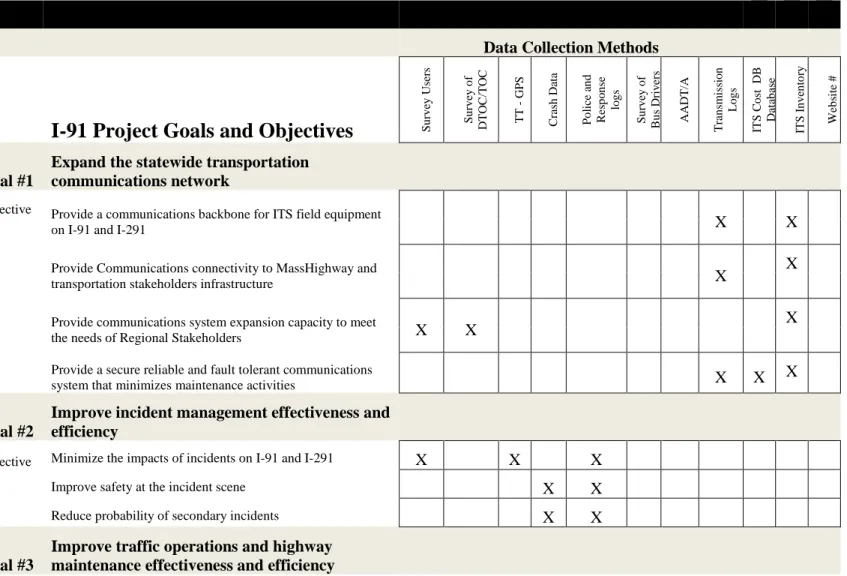
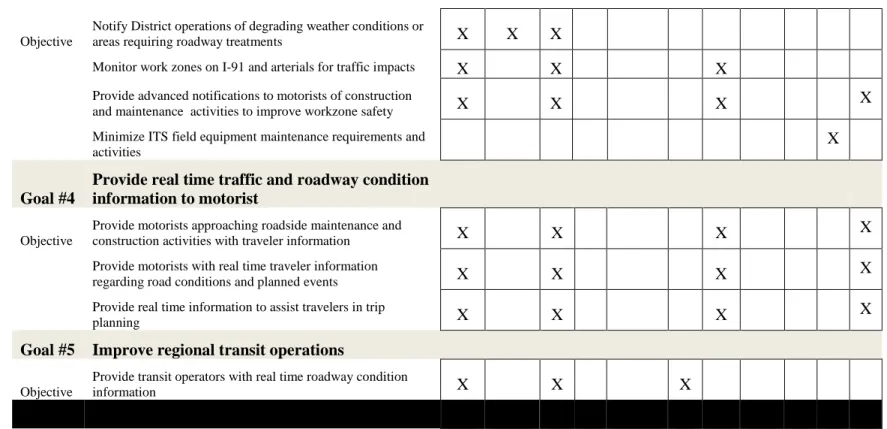
4:1 The I-91 Goals and Objectives ... 19 5:1 Data Collection Methods with Goals ... 50
ix
LIST OF FIGURES
Figure Page
3.1: MassHighway RFQ/P Existing Operating Environment ... 14 3.2: MassHighway RFQ/P Existing Operating Environment ... 16
1 CHAPTER 1
INTRODUCTION
1.1 Overview
Intelligent Transportation System (ITS) can include multiple technologies and applications combined to improve the overall efficiency of the transportation system or network. These ITS applications may have multiple objectives such as providing information to travelers on the transportation system, improving traffic management, such as traffic flow, incident response or traveler delay and increasing the efficiency of the transportation network overall. 1 ITS
applications offer a solution to increase the capacity, mobility and functionality of the network through the use of advanced technologies.
A traditional approach to project development includes planning, design, deployment, operation and evaluation. The evaluation is a necessary component of project design, deployment and operation in order to determine that the project goals and objectives have been achieved and to provide insight into process improvements. The evaluation of a project can be conducted pre and post deployment and can be both formative and summative. A formative approach evaluation is conducted during project development and throughout the remainder of the project life cycle. The intention of this type of evaluation is to offer project feedback while the project is developing to assist in shaping the development and refining the project overall. A summative evaluation is completed after the project is completed and is utilized to assess how the project met the intended
2
goals. This type of evaluation can also be referred to as an impact or post evaluation. 2 For the purpose of this proposed research the evaluation methodology will be based on a summative approach.
ITS impact assessments are summative in nature and are conducted post deployment. The analysis is conducted given a set of performance criteria with measures of effectiveness directly related from the project goals and objectives. These evaluations require data pre deployment in order to properly quantify the outcomes. Common performance measurements used for
evaluation are safety, travel time, throughput, customer satisfaction, air quality and emissions and fuel consumption. 3 Criterion is established for these measures and can include both quantitative data and qualitative data. Measures may include an evaluation of crash statistics, travel time, survey of users for customer satisfaction and others.
The use of ITS technologies to provide solutions to transportation problems are becoming increasingly utilized, however the need for additional evaluation and documentation still exists. The financial resources required to obtain necessary data pre and post deployment often inhibit the evaluation capabilities. By creating an active evaluation plan, the project team can utilize existing resources and cooperation among stakeholders, to assist the pre-deployment data requirements. Documented benefits, or measures of effectiveness, from previously deployed projects, exist but are limited in number. 4 As more evaluations are conducted and documented, increased viability and awareness of ITS technologies will become increasingly more recognized by the transportation community as potential solutions in a constrained environment.
2
http://www.nsf.gov/pubs/2002/nsf02057/nsf02057.pdf , National Science Foundation
3 Fundamentals of Intelligent Transportation Systems Planning, Mashrur A. Chowdhury and Adel Sadek, 4 http://www.itsbenefits.its.dot.gov/its/benecost.nsf/images/Reports/$File/DataNeeds2001.pdf
3
1.2 Research Problem
Large scale ITS deployments often require multiple technologies and contain multiple goals and objectives. The need for evaluation is imperative to increase the utilization of ITS in
transportation planning, this requires additional documentation of ITS applications, deployments and benefits. As a result of the complexity of the project and limited resources, as well as possible institutional issues, an evaluation plan has not yet been developed as part of the I-91 project lifecycle. Institutional issues can limit the ability of the project team to coordinate efforts to conduct an effective evaluation at the necessary and logic steps in the project life cycle. 5There are often institutional issues that limit the ability to conduct an evaluation. Quantifying a large scale ITS infrastructure project would be extremely beneficial to the transportation community and would thereby increase utilization of these technologies. This need is identified at the federal level in support of continued use in ITS planning, development and deployment.
1.3 Objective
The objective of this research was to develop an ITS evaluation methodology for a large scale infrastructure improvement project. The I-91 ITS Project will serve as a case study in this research. This Project has multiple objectives with many stakeholders. This research includes a review of large scale infrastructure ITS projects that have already been deployed and which utilized methodologies to perform evaluations. The methodology developed as part of this research would provide the I-91 Project team with an approach to assess the impacts of the I-91 ITS project upon deployment. This methodology should also be of interest to other individuals developing large scale ITS infrastructure improvement projects.
4
CHAPTER 2
LITERATURE REVIEW
2.1 Evaluation of ITS
While it is recognized that project evaluations can be done both pre and post deployment the focus of this research and literature review is based on post deployment or summative evaluations. Recent legislation titled the Safe, Accountable Flexible, Efficient Transportation Equity Act: A legacy for Users (SAFETEA –LU) has established requirements and guidelines for ITS project evaluations that receive funding from the United States Department of Transportation (USDOT) in order to effectively evaluate and measure the project outcomes in a uniform manor. The requirements include an Executive Summary of the project, a general overall assessment, and 2 specific evaluation products based on the activities of the project. These evaluations can be either qualitative or quantitative. ITS projects that receive funding from the United States Department of Transportation (USDOT) are required to provide project evaluation.6
The recommended evaluation process should include six components.
1. Form an Evaluation Team
2. Develop the Evaluation Strategy 3. Develop the Evaluation Plan
4. Develop One or More Test Plans
5. Collect and Analyze Data and Information 6. Prepare the Final Report
6www.its.dot.gov/evaluation/eguide_resource.htm ITS Evaluation Framework- Phase II, Washington State
5
Suggested evaluation measures of effectiveness are offered in the ITS Evaluation Resource Guide, for each area of the National ITS Program goal. The National Project goals include Safety, Mobility, Travel Time Delay, Travel Time Variability, Capacity/Throughput, Customer Satisfaction, Productivity and Energy and Environment. Criteria for these measures are not offered within the guide, however examples of Final Evaluation Reports which may contain specific findings relative to project goals, are offered to guide practitioners.7
A search of existing literature on evaluation of ITS applications provided reports focused mainly on single systems and technologies. The evaluations were either pre or post deployment and contained qualitative and quantitative data evaluations. Large scale infrastructure ITS projects with many project objectives and multiple technologies with integration of those technologies were limited.
The following projects contained similarities to the I-91 project, using a methodological approach to evaluate the projects utilizing both post deployment using qualitative and quantitative methods. The criteria for the evaluation of the project goals are limited, but are reviewed.
2.2 Specific Project Evaluations
In an report published in 2004 by the Arizona Department of Transportation (DOT’s), titled Rural ITS Progress Study – Arizona 2004, the overall rural system underwent an evaluation of the post deployed ITS systems currently operational. The primary purpose of this project was to evaluate how the Arizona DOT’s rural ITS was functioning with respect to measuring the performance of the system, recording the benefits, identifying costs, determining travelers perception and how well Arizona was adhering to their strategic ITS plan. This large scale evaluation was intended to gage the overall system and not any one specific application.
6
The methodology utilized in this analysis was to conduct an initial literature review of existing performance measures and previous ITS plans, to survey the institutional users of the system and the general public, and to evaluate the ITS infrastructure performance data. The general
conclusion, was that Arizona was following the ITS strategic plan, users were becoming familiar with the system and the overall performance was good. Recommendations include, that the further deployment of ITS technologies should be supported and overall operational and management costs while high, should be a priority. The study also highlights some needed improvements which include, increased field equipment performance, communication systems, central software, information quality and format, maintenance, and public outreach.8
The Arizona based study evaluated the performance of a rural ITS infrastructure with 18 key ITS elements including Regional Weather Information System (RWIS), Traveler 511 system and Emergency detection and response system.
In a 2007 publication titled ITS Evaluation Framework – Phase 2, published by the Washington State Transportation Center an evaluation methodology that was previously developed and tested on a group of five advanced traveler information system (ATIS) projects was then applied to a larger group of diverse ITS projects ranging from planning to safety. The evaluation
methodological approach was qualitative and included a survey containing a general script that addressed project background, system features, system operations, system usefulness, public response, project management and lessons learned. This methodology did not include
performance measures or measures of effectiveness based on individual ITS applications, but did provide a framework that was applicable to multiple ITS technologies to gather qualitative data. Examples of ITS projects that were evaluated with this framework include the Whatcom Regional
8 Rural ITS Progress Study – Arizona 2004, Wendtland, M, Kolcz, A, Christenson, R, ITS Engineers and
7
ITS Fiber Optic Integration project, Traveler Information System Expansion and the I-90 Wind Warning System. 9
The I-90/94 Fiber Backbone Network and Spurs Build Out (Phase II) published by the Wisconsin Department of Transportation, is mainly a qualitative evaluation of the ITS fiber optic project. The Wisconsin Department of Transportation obtained 36 strands of “dark fiber” located along the I-94 right of way. This fiber was not operational but provided the State to utilize this infrastructure at a lower cost to construct a “fiber optic backbone” to enable a communication network which would make a Traffic Operations Center (TOC) feasible. The project goals are defined in the mission statement “Essentially the fiber backbone provides a means of integrating regional urban ITS deployments, rural deployments, and makes it possible to have a single statewide operations center. Since the hub locations and field equipment and facilities connected to those hubs consist of highway operations, public safety, and emergency management
organizations, integration across these functional areas becomes possible whether urban or rural, and can involve Federal, State and Local jurisdictions. “The specific project goals include Traffic Management and Highway Operations which include the development of an Arterial, Freeway and Transit management System integrated into a TOC”. Also included in the TOC is a Public Safety Communications System consisting of an Incident Management System and Emergency Management and a Roadway Security and monitoring which includes a Traveler Information System. The integration of rural ITS deployments, Road Weather System, and Traveler
Alternative Routing Messaging systems are expected outcomes of this project when completed. The specific measures of effectiveness include qualitative data collection methods outlining existing connections along the infrastructure between the TOC and stakeholders, see Appendix A.
9
www.its.dot.gov/evaluation/eguide_resource.htm ITS Evaluation Framework- Phase II, Washington State Transportation Center, Peter M. Briglia, Jr. Jaime M Kopf, Mark E. Hallenbeck
8
Lessons learned on this project are also outlined and include institutional issues, integrating ITS components and innovative financing and public/private partnering. The report does not
highlight specific criteria or data analysis methods of evaluating the measures of effectiveness. 10
The Strategic Plan for the Fleet forward Evaluation, prepared by Cambridge Systematics, Inc. contains Evaluation Guidelines, Evaluation Goals and Objectives, and Evaluation Activities for the FleetForward project along the I-95 corridor. The FleetForward project includes real time traffic data from the ATIS systems that SmartRoute Systems has deployed in the metropolitan regions of major east coast cities, and the Information Exchange Network provided by the I-95 corridor Coalition which contains is regional based real-time traffic data. This data is expected to provide information on traffic incidents, construction and congestion specifically targeted and tailored to the Commercial Motor Vehicle industry.
The evaluation plan, prepared by Cambridge Systematics, clearly outlines the project goals, objectives and planned measures of effectiveness including, on-time delivery, fuel consumption, employee turnover, etc., as seen in Appendix C, but does not list specific criteria for
measurement. The methods that will mainly be utilized for the evaluation are a test of the system with 36 user’s pre and post deployment, and a qualitative discussions with operations,
documentation of the accessibility of information with the given architecture and finally the effectiveness of the private, public partnership will be measured by completion of the intended project goals. No specific criteria are given to quantify the measures of effectiveness.11
The Evaluation Plan, Model Deployment of a Regional Multi-Modal 511 Traveler Information System, published by the Battelle Memorial Institute, outlines a clear evaluation approach
10
I90/94 Fiber Backbone Network and Spurs Build- Out (Phase II) Wisconsin Department of Transportation Final Report and Local Evaluation, 2006
9
directly outlining the objectives, hypothesis, measures and data collection source. The National evaluation of the Arizona 511 Traveler Information System was conducted to offer guidance as a model deployment to assist and document performance and the lessons learned in the deployment of the enhanced system. The model deployment is intended to demonstrate the potential of the 511 system to bring together multiple data options and sources to provide useful traveler assistance in a telephone interface. The primary objectives of the evaluation are to measure the following; the “pushing of the envelope” in 511 service standards; utilize innovative user interface with advance capabilities; provide data via automatic route segments; and provide the minimum 511 systems requirements such as providing current traffic conditions; major
disruptions in public transit; construction and unplanned traveler interference; weather conditions; and significant traffic disruptions. 12
The evaluation plan includes clearly outlined objectives, within the national framework of ITS goal areas including, mobility, efficiency and customer satisfaction. The objectives, measures and data collection methods can be seen in Appendix B. The evaluation plan includes specific
information on obtaining and measuring data communication logs. Other data collection methods include the use of focus groups both pre and post enhancement and a survey of the 511 users to broaden the feedback and provide information on customer satisfaction.
2.4 Summary of Literature
The literature findings related to ITS evaluation methodology and criteria provided useful resources for evaluating large ITS infrastructure type projects. While each of the ITS projects referenced have different components, larger scale projects consist of many systems and multiple technologies often to achieve multiple project goals. Larger evaluations such as the Arizona Rural
12 Final, Evaluation Plan Model Deployment of a Regional Multi-Modal 511 Traveler Information System,
10
ITS Project Summary, provide a closer look at an ITS methodology that can be utilized to qualitatively evaluate multiple ITS technologies. Cost/benefit evaluations can be conducted with technologies on a project by project basis. While the I-90/94 Fiber Optic offers specific measures of effectiveness this evaluation was qualitative in nature and did not offer specific criteria for post – deployment evaluation of the system.
These methodologies, in combination with project specific evaluations of ITS technologies can be combined to provide a complete methodology for evaluating large scale ITS infrastructure
projects utilizing both qualitative and quantitative methods with specific target criteria.
Observations based on this review of literature, suggest that an evaluation framework should include:
1. Project goals clearly identified.
2. Project goals and objectives should be prioritized to National ITS goals. 3. Use of both qualitative and quantitative methods should be considered.
4. Involvement of all project stakeholders to clearly outline expected project outcome measures and hypothesis.
5. Criteria related to the measures of effectiveness should be considered pre-deployment. 6. Consideration to pre-deployment data collection requirements should be included.
11
CHAPTER 3
THE I-91 ITS INFRASTRUCTURE PROJECT
3.1 Project Overview
The Massachusetts Highway Department (MassHighway) is beginning construction on a 31.7 million dollar, ITS infrastructure improvement project located in Western Massachusetts, along the I-91 corridor. This project will include multiple technologies to be deployed along the I-91 Corridor to I-291 establishing a communication network linking many stakeholders in the region and state.
The project will include installation of fiber optic (6 conduit) along the I-91 corridor and installation and placement of 34 cameras – closed circuit for video surveillance, 11 Overhead/6 mounted Variable Message Signs (VMS), Travel Time will be collected and displayed along 10 segments, and the connection of a TOC bringing together Emergency Management Systems, Traveler Information Systems and connections to the State TOC and traveler information system. This project extends from the southern border of Connecticut to the southern border of Vermont.
The project objectives are stated as “The overall vision of MassHighway I-91 ITS project is to provide for the design, deployment, and operations of a communications infrastructure and ITS capabilities for the region and I-91 corridor as part of the Commonwealth’s transportation system…..This Project will monitor the I-91 and I-291, and provide the resultant real-time travel information to enhance public safety and provide transportation agencies with the tools to
12
improve operations, promote the coordinated management of incidents, and keep the public informed.” 13
Operational evaluations are often included as part of a completed construction project, to ensure proper functionality of system equipment and components, which is the case for the I-91 project. To date, an evaluation plan has not been established to define measures of effectiveness and criteria to conduct an evaluation of this I-91 ITS project. Examples of potential data collection methods and criteria are offered in the case study section of this report.
The project goals and objectives are defined in the Masshighway, I-91 ITS Project, Design Build RFQ/Procurement report, Concept of Operations, RFQ report, however, there is also an additional goal, as part of this project, to bring broadband capability to municipalities along the I-91 corridor who currently do not have this technology due to infrastructure limitations. Conduit will be made available for lease along the I-91 corridor for economic development purposes, bringing
broadband access to areas in Western Massachusetts that currently do not have this technology. Recently passed legislation, “An Act Providing For Economic Recovery Through Broadband Initiatives”,14 in the Commonwealth of Massachusetts provided extended time frames for “right of use” and lease of this infrastructure to not exceed 25 years. This will increase private interest in utilizing this infrastructure for the purpose of economic development. For the purpose of this research, the transportation engineering objectives are analyzed and the economic development measures will require further research.
13
I-91 ITS Project Design Build RFQ/P Procurement Concept of Operations Report, January 2007 MassHighway
13
3.2 Pre Deployment Operating Protocol
The I-91 ITS Project, Design Build RFQ/P Procurement, Concept of Operations Report, Version 1.0 (RFQ/P) outlines the Region’s current communication protocol between the Western
Massachusetts, MassHighway District 2 office (DTOC) and the Boston location of the MassHighway State central command, (TOC) which is responsible for coordinating and collecting much of the ITS data and disseminating information to the Commonwealth via SmarTraveler, 511 and other ITS technologies. 15
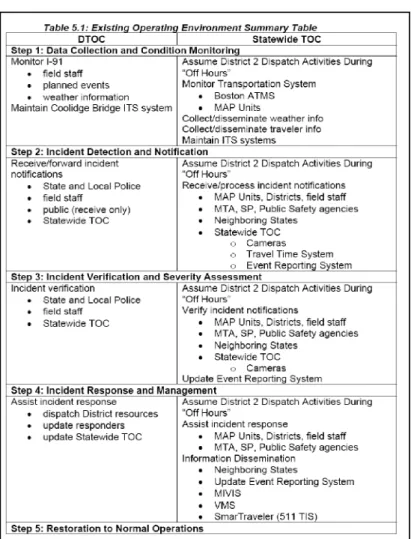
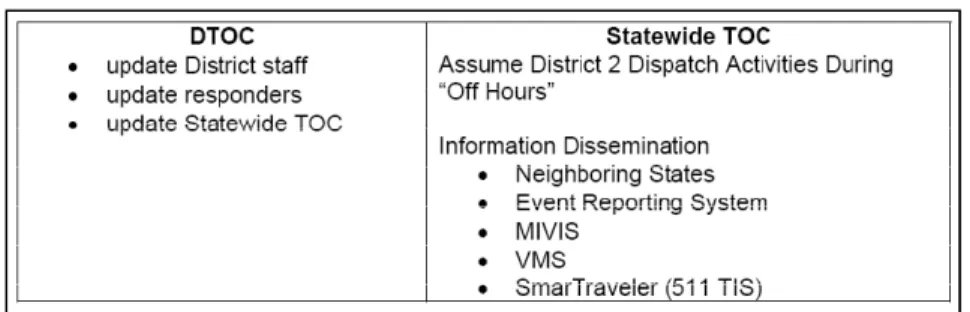
The RFQ/P summarizes the operating environment into five steps, as shown in Figure 3:1; to collect and disseminate information on traffic related incidents and conditions. The five steps are; Data Collection and Conditions Monitoring, Incident Detection and Notification, Incident Verification and Severity Assessment, Incident Response and Management and Restoration to Normal Operations. The current protocol, as understood from the RFQ/P, in the pre-deployment stage of the project, the DTOC as handling the monitoring the I-91 traffic and the Coolidge Bridge ITS System, through field staff and advance information on pre-planned events in the Region. The weather data is received from the State MassHighway Statewide Road Weather Information System (RWIS). Incident detection and notification data is received at the DTOC through the TOC, field staff, the public and other safety groups. In order to verify an incident the DTOC communicates with MassHighway field staff and State or Local police. Response and Management is handled by the DTOC, dispatching the necessary personnel to the incident and when necessary, coordinating efforts with other necessary emergency management personnel. Notification to the TOC is also a main responsibility of the DTOC at each step. Normal
15 I-91 ITS Project Design Build RFQ/P Procurement Concept of Operations Report, January 2007
14
operations are restored and transmitted via radio and phone between the DTOC and field personnel.
The TOC handles these steps during the “off hours” of the DTOC. The TOC also collects and disseminates the weather related data. Data can be disseminated through the Motorist Assistance Pool (MAP), safety agencies, neighboring States and the Massachusetts statewide ITS system which includes the SmarTraveler, 511 and the Massachusetts Interagency Video Information System (MIVIS).
The current ITS field technology available for notification of incidents and conditions is one Variable Message Sign (VMS) located on I-91.
15
Figure 3.1: MASSHIGHWAY RFQ/P Existing Operating Environment (cont.)
3.3 Post Deployment Expected Operating Protocol
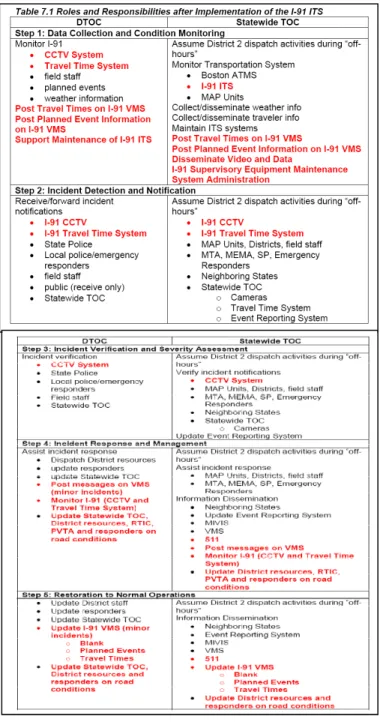
The expected post-deployment operating environment has significant changes in the five step process. All major incidents will be handled through the Statewide TOC, and information will be disseminated by the TOC using a Standard Operating Procedure (SOP) developed by
MassHighway, and currently in place. The TOC will manage the I-91 VMS signs, collect all data and monitor major incidents, the DTOC will have the ability to monitor and post information regarding minor incidents that may impact traffic. All posting will be communicated and
coordinated with the TOC. The TOC will also be responsible for maintaining a database with all ITS equipment maintenance and functionality. The difference in roles and responsibilities are
16
shown in Figure 3:2, below. . The travel time system is no longer a component of this system due to funding issues. 16
16 I – 91 ITS Project, Design and Build RFQ/P Procurement, Concept of Operations Report, January 26,
2007
Figure 3.2: MASSHIGHWAY RFQ/P Expected Operating Environment Post-Deployment
17
CHAPTER 4
METHODOLOGY FOR EVALUATION
4.1 National Guidelines
In order to develop a methodology for evaluation of ITS projects it is important to understand the purpose of a framework. The framework is a system in which criteria are defined against project specific goals to measure the intended project outcome including success or failure. Through a review of the USDOT Guidelines and I-91 project specific literature, a methodology is developed with the anticipation that it be applied to the I-91 ITS project. The measures of effectiveness and analytical methods for the I-91 case study will further be described in Chapter 5.
As outlined in the National ITS Evaluation Guidelines, a six step process or guidelines include:17
1. Form an Evaluation Team
2. Develop the Evaluation Strategy 3. Develop the Evaluation Plan
4. Develop One or More Test Plans
5. Collect and Analyze Data and Information 6. Prepare the Final Report
Utilizing the recommended six steps, this methodology for evaluating large scale ITS
infrastructure projects using the I-91 ITS project as a case study, may serve as an Evaluation Plan in this process. Suggested measures of effectiveness are offered in the ITS Evaluation Resource Guide, for each area of the National ITS Program goal. The National Project goal areas include Safety, Mobility, Travel Time Delay, Travel Time Variability, Capacity/Throughput, Customer
18
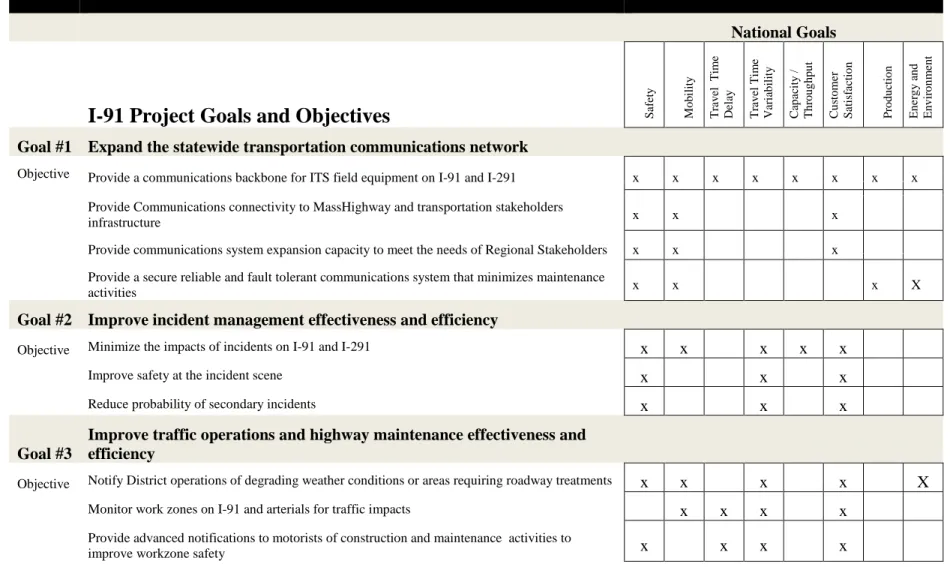
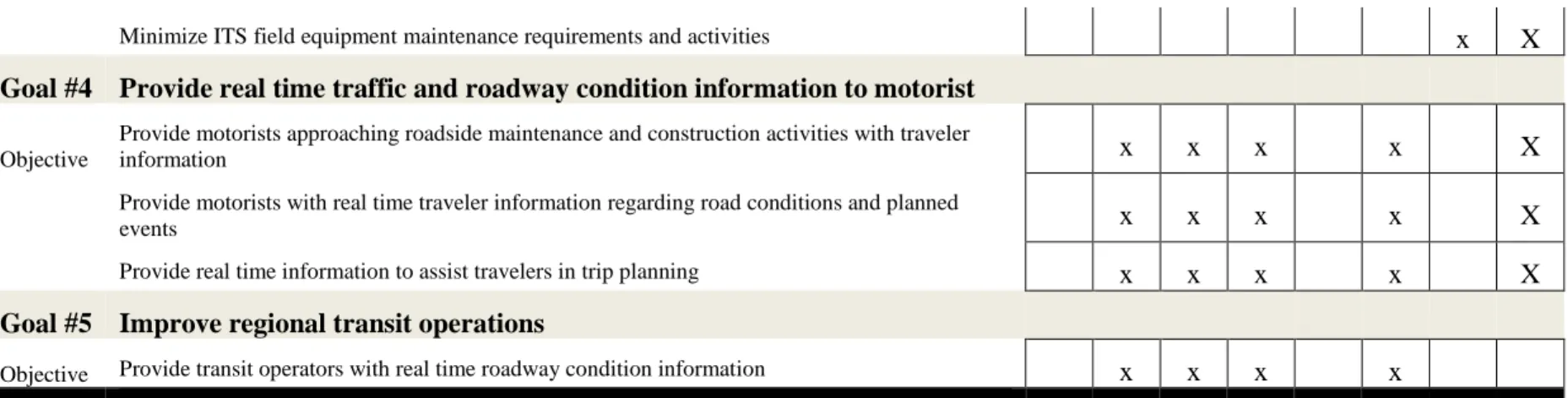
Satisfaction, Productivity and Energy and Environment. Through prioritization of the I-91 project goals and objectives into categories, consistent measures can be used for the analysis. Table 4.1 aligns the I-91 project goals and objectives with the National goals. As recommended by the USDOT Evaluation Guidelines, The Project Team should prioritize the objectives and categorize these measures by importance.
19
Table 4:1 The I-91 Goals and Objectives (continued on next page)
National Goals
I-91 Project Goals and Objectives
Safet y M o b il it y T ra v el T im e D el ay T ra v el T im e V ar ia b il it y C ap ac it y / T h ro u g h p u t C u st o m er S at is fa ct io n P ro d u ct io n E n er g y a n d E n v ir o n m en t
Goal #1 Expand the statewide transportation communications network
Objective Provide a communications backbone for ITS field equipment on I-91 and I-291 x x x x x x x x
Provide Communications connectivity to MassHighway and transportation stakeholders
infrastructure x x x
Provide communications system expansion capacity to meet the needs of Regional Stakeholders x x x
Provide a secure reliable and fault tolerant communications system that minimizes maintenance
activities x x x X
Goal #2 Improve incident management effectiveness and efficiency
Objective Minimize the impacts of incidents on I-91 and I-291 x x x x x
Improve safety at the incident scene x x x
Reduce probability of secondary incidents x x x
Goal #3
Improve traffic operations and highway maintenance effectiveness and
efficiency
Objective Notify District operations of degrading weather conditions or areas requiring roadway treatments x x x x X
Monitor work zones on I-91 and arterials for traffic impacts x x x x
Provide advanced notifications to motorists of construction and maintenance activities to
20
Table 4:1 The I-91 Goals and Objectives (cont.)
Minimize ITS field equipment maintenance requirements and activities x X
Goal #4 Provide real time traffic and roadway condition information to motorist
Objective
Provide motorists approaching roadside maintenance and construction activities with traveler
information x x x x X
Provide motorists with real time traveler information regarding road conditions and planned
events x x x x X
Provide real time information to assist travelers in trip planning x x x x X
Goal #5 Improve regional transit operations
21
The recommendations for performance measures are given in Appendix A of the ITS Evaluation Guidelines and are listed as follows:18
Safety: Can be measured by:
1. Reduction in the overall rate of crashes
2. Reduction in the rate of crashes resulting in fatalities 3. Reduction in the rate of crashes resulting in injury
Mobility: Can be measured by:
1. Reduction in travel time delay 2. Reductions in travel time variability
Travel Time Delay: Can be measured by:
1. Recommendations are to utilize the floating car method for adaptive traffic signal control systems; however the use of any GPS device or observation method to evaluate the TT delay can be utilized dependent on the system being evaluated.
Travel Time Variability: Can be measured by:
1. This measure generally relates to origin destination travel time and is mainly utilized for freight evaluation. The variability can be computed using standard deviation of travel time values.
Capacity/ Throughput: Can be measured by:
22 1. Increase in throughput or effective capacity.
Customer Satisfaction: Can be measured by:
1. The Difference between users’ expectations and experience in relation to a service or product.
Productivity: Can be measured by:
1. Cost Savings
Energy and the Environment: Can be measured by:
1. Reduction in emissions.
2. Reduction in fuel consumption.
Aligning the specific project goals with a National goal structure allows for a simple approach to be used for evaluating ITS projects that span multiple areas and with multiple goals and
objectives. The goals and objectives can be evaluated with specific measures relative to the broader subject area. Some of the goals may not fit within these measures, or may impact several areas, requiring alternative measures. Examples of alternative measures can include the
“deployment of an ITS infrastructure required to support ITS functions”. 19 This can be useful in the I-91 ITS project, where the establishment of the infrastructure is the first goal which will enable all subsequent development of the ITS.
23
4.2 Hypothesis
Also recommended in the National Guideline, is the development of a “what if” or hypothesis for each objective stating the expected outcome of each objective. A multi-phased evaluation can also be developed and included within the hypothesis to assess broader goals and subsequent objectives. Using a multi – tier approach may be useful as the system is expected to become fully operational and realize the expected full benefits as the systems continues to expand and develop over time.
The hypotheses stated in the 511 Model Deployment Final Evaluation Plan, were directly linked to the project goals and also the National hierarchy. This project was intended to expand the 511 system and increase the overall use of this technology utilizing ITS technology. The main objective was to increase and improve usage of the system and the quality of the information supplied to the user by providing additional information. The National ITS goal area is under Customer Service. To support this goal area, the hypothesis states that the additions or enhancements to the system will increase customer satisfaction thereby increasing use of the system. To measure these affects, the number of users or inputs from phone selections will increase. The data collection methods for retrieving this information, includes a focus group, survey and direct analysis of the data logs containing call information. 20
4.3 Data collection methods
20 Final, Evaluation Plan Model Deployment of a Regional Multi-Modal 511 Traveler Information System,
24
Data collection methods vary by purpose and can include both, numerical information or written information, serving as a specific piece of information, in which to compare alternatives. There are many data collection methods; however for the purpose of this research, frequently used collection methods and those utilized in the results of the literature search, will be discussed and recommended as part of this methodology. 21
A qualitative approach can utilize surveys or a listing of specific or general questions that offer an open ended response collected in a focus group or interview. In the report from Washington State, ITS Evaluation Framework – Phase 2, a questionnaire or survey type interview developed for use on a previous evaluation was then used to evaluate 16 additional ITS projects to document technical, management and organizational lessons learned.22 This framework was useful in providing a general understanding of the project dynamics using a qualitative method. In the Wisconsin I90/94 Fiber Backbone evaluation, the measure of effectiveness, were established from an operational perspective. The systems that were impacted by the infrastructure improvement project were categorized by ITS market package for evaluation. Additional information was also collected concerning institutional issues for cooperation among
stakeholders, and surrounding the integration of the ITS components as well as procurement and financial issues. 23Qualitative measures can provide an open ended response, providing details that may be overlooked when analyzing data solely for functionality of a system. The use of a qualitative approach can offer flexibility in responses and prove extremely useful when
evaluating larger interrelated systems with many communication connections. In a multi-phase
22www.its.dot.gov/evaluation/eguide_resource.htm ITS Evaluation Framework- Phase II, Washington
State Transportation Center, Peter M. Briglia, Jr. Jaime M Kopf, Mark E. Hallenbeck
23 I90/94 Fiber Backbone Network and Spurs Build- Out (Phase II) Wisconsin Department of
25
approach, qualitative measures can also be useful in establishing a general overview of system operability, communication, and connectivity as well as providing an open ended response which may highlight issues or benefits that were not anticipated as an outcome from the project.
Quantitative data collection methods can include gathering Average Annual Daily Traffic (AADT) counts or volumes, Average Daily Traffic (ADT), speed and distance data for vehicles, crash history and injury specifics or the number of public transportation riders. These data can then be measured against target criterion, relating to each project goal or objective. The Fleet Forward Evaluation Plan outlines specific data collection areas relating to the project goals. To improve the operational efficiency of motor carriers, by improving customer satisfaction, reducing operating cost, increasing revenues and improving safety from the motor carrier perspective is measured through on-time delivery, fuel consumption, equipment and driver utilization, employee turnover, vehicle maintenance costs and other quantifiable methods. Data is collected and documented as a base case pre-deployment. 24The 511 Model Deployment Final Evaluation Plan also contains specific quantifiable data collection sources. These include collection of data logs and system usage logs. The criterion is an increase or decrease in call volume, usage and percentage of users accessing new and enhanced system capabilities. Other quantifiable data can include travel time or delay data, crash data information on primary and secondary crashes, current incident response time and weather related response time as well as transit ridership.
Travel time can be collected with the use of a “floating car” or an “average speed”. To utilize the “floating car” method, a driver will travel at the speed in which the traffic seems to be moving, passing the same number of vehicles as the vehicle experiences. In the “average speed” method,
26
the driver travels at the same speed as the traffic. Both methods collect travel time. 25 Another method is to utilize a GPS unit to collect time and space data which can then be derived for the output data. Travel time data is an imperative data set to collect and measure against in an evaluation of ITS.
4.4 Summary of Evaluation Methodology
An evaluation methodology for large ITS infrastructure projects should utilize a combination of categorical assignment utilizing either the recommended national goal areas or ITS market packages and project specific measures of effectiveness and if possible, criterion. A multi-tiered approach would be effective in establishing a broad approach to evaluate project goals that are unable to be deployed until further development of the project to provide a consistent measure for transference of information and documentation. Hypotheses should be discussed and agreed by the project team, to align the expected project outcomes, and provide a level of detail and priority for project goals. The specific criterion and projected measures can be drilled down into a comprehensive multi-tiered multi-phased approach.
27
CHAPTER 5
CASE STUDY: SUGGESTED I-91 EVALUTION FRAMEWORK DETAILS
The I-91 ITS project goals can be categorized into the National ITS goals allowing utilization of the suggested measures of effectiveness from the National guidelines. Hypotheses are suggested in this research for each objective for consideration by the Project Team. It is imperative that the existing conditions and current level of infrastructure such as highway geometry, current ITS applications, communication systems and protocol, travel time, AADT, ADT and emission levels are documented prior to construction and final deployment.
The I-91 project is currently under construction and is being built in a dynamic environment both operationally and functionally. Recent legislation was passed by the Commonwealth of
Massachusetts enabling extended leasing allowance for the available fiber optic cable that is part of this project. The impact of this recent legislative change is the ability for a private entity to invest in the additional fiber infrastructure to bring broadband to the Western Massachusetts area, as long term economies of scale can now be realized. The RWIS and 511 systems that are
expected to play a role in disseminating traveler information will be available later in the project lifecycle as the technological advancements continue to be deployed and integrated into the larger ITS state wide infrastructure. The suggested hypotheses, data gathering methods, measures of effectiveness and criterion are based on available resources such as the I-91 ITS Project, Design Build RFQ/P Procurement, Concept of Operations Report, changes to the original project design have been made as the project moves forward.
28
5.1 Expand the statewide transportation communications network
5.1.1 Provide a communications backbone for ITS field equipment on I-91 and I-291
Hypothesis: The construction and establishment of a communication backbone will allow for a dedicated high speed transmissions for the ITS field equipment to the DTOC and TOC. This will allow for traffic and weather information to be processed and disseminated providing feedback for travelers along I-91 and I-291 to reduce traffic variability.
Pre-deployment: A comprehensive inventory and qualitative evaluation of the current ITS field equipment within the I-91, I-291 area should be conducted and documented.
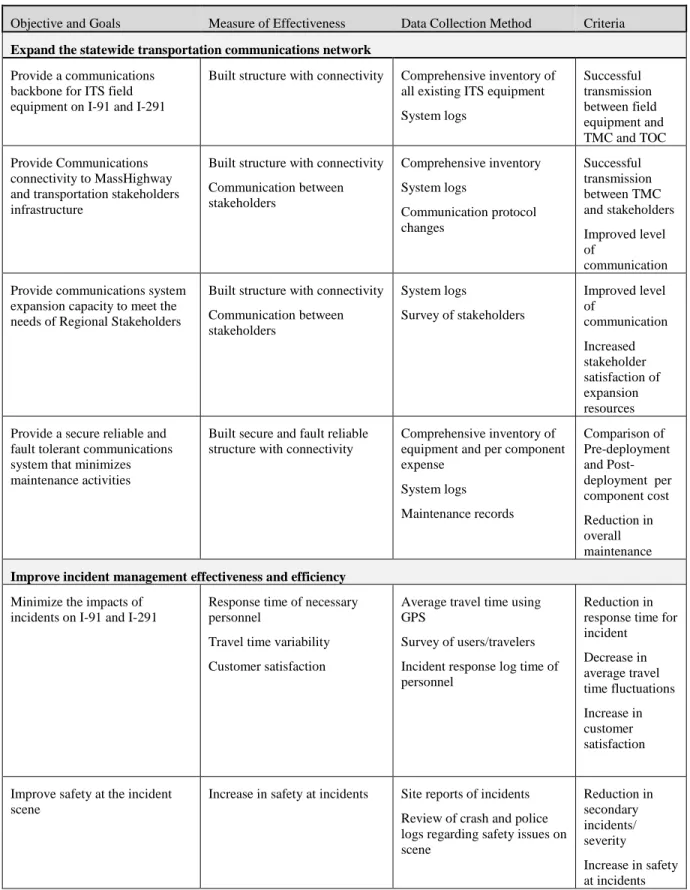
Measure of effectiveness: The completed construction and establishment of an ITS and communication network along I-91 and I-291 should be the measure of effectiveness for this goal.
Post-deployment: Successful transmission between the I-91 and I- 291 ITS field equipment and the TOC and DTOC should be measured through successful transmission logs. Integration of the existing or pre-deployment ITS equipment with the newly installed ITS field equipment which will operate on the I-291 and I-91 backbone, should also be documented. Computer methods to evaluate pass/fail transmission records should be established prior to deployment in order to provide a benchmark for the post-deployment analysis.
Analytical Technique: Qualitative analysis, documenting the establishment of the communication network and completed construction of the fiber optic backbone along I-91 and I-291. The
29
success rate of transmission logs between ITS field equipment and TMC should be documented; integration with existing ITS equipment should also be documented.
Criteria:
• The completed construction and operability of the fiber optic backbone with DTOC and TOC links.
• Successful transmission between existing ITS field components, newly installed ITS field components and the DTOC and TOC.
5.1.2 Provide communications connectivity to MassHighway and transportation
stakeholders’ infrastructure
Hypothesis: The establishment of a communication fiber optic backbone network will allow for a secure, safe and speedy communication backbone in which critical information and traffic related data can be transferred among transportation stakeholders within the Region and State.
Pre-deployment: A comprehensive inventory and qualitative evaluation of the current status of the transportation communication network, communication protocol and ITS application within the I-91, I-291 area should be documented including current methods to evaluate pass/fail transmissions.
Measure of Effectiveness: The completed construction and establishment of an ITS and
communication network along I-91 and I-291 should be the primary measure of effectiveness for this goal. A secondary measure should be the increased level of communication among
30
Post-Deployment: Measurement through the evaluation of transmission logs between entities. Successful transmission of information, and transferred data between MassHighway, DTOC and TOC and other identified transportation stakeholders will provide the data for measuring the effectiveness. Computer methods to evaluate pass/fail transmission records should be established prior to deployment in order to provide a benchmark for this post-deployment analysis.
Documentation of communication protocol with changes should also be established.
Analytical technique: Qualitative analysis, documenting the establishment of the communication network and completed construction of the fiber optic backbone along I-91 and I-291. The success rate of transmission logs should be documented; however the benchmark may be close to zero transmissions due to the current communication, attention to transmission time should also be considered. Surveys of the TOC employees in District 2, MassHighway and in other areas of operations related to field equipment, and other transportation stakeholders would also provide qualitative information on the functionality of the communication system and the effectiveness of the communication.
Criteria:
• The completed construction and operability of the fiber optic backbone with DTOC and TOC links.
• Improvement in the level of communication of the transportation stakeholders.
5.1.3 Provide communications system expansion capacity to meet the needs of Regional
Stakeholders
31
Hypothesis: The establishment of a communication fiber optic backbone network with increased capabilities and expansion capacity will provide critical ITS information and traffic related data to reach a wider audience and meet the needs of Regional stakeholders.
Pre-deployment: A comprehensive inventory and qualitative evaluation of the current status of the transportation communication network, communication protocol and existing infrastructure, as well as customer satisfaction with the current traveler communication system within Western Massachusetts Region.
Measure of Effectiveness: The completed construction and establishment of an ITS and
communication network along I-91 and I-291 should be the primary measure of effectiveness for this goal. A secondary measure should be the increased level of communication among regional stakeholders.
Post-Deployment: Measurement through the evaluation of transmission logs between entities. Successful transmission of information, and transferred data between regional stakeholders will provide the data for measuring the effectiveness. Additionally, surveys of regional stakeholders impacted by this communication infrastructure should be conducted to evaluate the customer satisfaction.
Analytical Technique: Qualitative analysis, documenting the establishment of the
communication network and completed construction of the fiber optic backbone along 91 and I-291 and the customer satisfaction of the increased capacity for information sharing among regional stakeholders.
32
• The completed construction and operability of the fiber optic backbone with DTOC and TOC links.
• Improvement in the level of communication of the regional stakeholders.
• Increased customer satisfaction regarding the level of communication resources available to Regional Stakeholders.
5.1.4 Provide a secure reliable and fault tolerant communications system that minimizes
maintenance activities
Hypothesis: The construction and deployment of a dedicated fiber optic backbone for ITS transmissions and communications will provide a secure, safe and reliable communication backbone that will minimize maintenance and repair activity.
Pre-deployment: A comprehensive inventory and qualitative evaluation of the current status of the ITS field equipment, TMC and transportation communication network, within the I-91, I-291 area should be documented including current level of pass/fail transmissions and maintenance activity. A database of current maintenance and repair records for ITS equipment currently operating should be documented.
Measure of Effectiveness: The consistent, secure and reliable transmissions of ITS related data between the field equipment and DTOC and TOC along I-91 and I-291 should be the primary measure of effectiveness for this goal. A secondary measure should be the decrease in maintenance and repairs of ITS equipment per component.
33
Post-Deployment: Quantitative data should be gathered on pass/fail transmission and
maintenance activities on ITS field equipment, DTOC, TOC and transportation communication network. A per component cost should be calculated to assess the cost/value of the system components. Maintenance and repairs of the equipment may not be required for some time, however establishing a pre-deployment per component cost should provide a benchmark to compare for similar equipment.
Analytical Technique: Quantitative analysis of the per component cost/value of the ITS field equipment, and the DTOC and TOC components documented in the database records. The success rate of transmission logs should be documented; attention to transmission time should also be considered.
Criteria:
• The reduction in per component cost/value.
• The number of successful, secure transmissions between ITS field equipment and DTOC
and TOC.
• Reduction in overall maintenance of ITS components, including DTOC and TOC.
5.2 Improve incident management effectiveness and efficiency
5.2.1 Minimize the impacts of incidents on I-91 and I-291
Hypothesis: With strategically placed CCTV and VMS signs along the I-91 and I-291 corridors, traffic impacts will be minimized by obtaining, processing and conveying incident information quickly to necessary response personnel.
34
Pre-deployment: Current notification, response time, and other information available on incidents should be gathered from State Police, EMT and Local Police. Average travel time along these two corridors can also be gathered through the use of a Global Positioning System (GPS) during average travel conditions, frequently to capture incident travel time as well. A survey of users, could obtain customer satisfaction and perceptions of current incident management and the perceived affects on travel time.
Measure of Effectiveness: The primary measure of effectiveness is a decrease in response time of necessary response personnel to incidents along the I-91 and I291 corridors. A secondary measure is a decrease in the variance of travel time along these corridors.
Post-deployment: Evaluation of average daily travel time along the I-91 and I-291 corridor in order to capture travel time fluctuations which may be the result of an incident, correlation of incidents with travel time data would provide a comparison. Response time to incidents should be gathered from State Police, EMT and Local Police. Follow up surveys on customer satisfaction should be conducted on users of the system to include perceptions on incident management and affects on travel time.
Analytical Technique: Quantitative evaluation of travel time along the corridors using generally accepted statistical methods including t tests, F tests, and chi squared tests. A survey of users could also provide qualitative customer satisfaction information.
Criteria:
• Reduction in response time for incident.
• Decrease in average travel time fluctuations.
35
5.2.2 Improve safety at the incident scene
Hypothesis: With strategically placed CCTV and VMS signs, along the I-91 and I-291 corridor, traffic safety at incidents can be improved by providing advance warning and alternate route guidance as well as increasing the efficiency in incident detection and management of incidents through early detection.
Pre-deployment: Current site reports of incident response and management should be gathered from State Police, EMT and Local Police. A review of crash reports and police logs, along I-91 and I-291 should be conducted, with specific focus on safety at the scene of an incident.
Measure of Effectiveness: The primary measure of effectiveness is a decrease in secondary incidents and overall improvement in safety at incidents, along the I-91 and I-291 corridors.
Post-deployment: Quantitative evaluation and review of crash reports along I-91 and I-291 should be conducted, with specific focus on secondary incidents.
Analytical Technique: A quantitative evaluation of safety related measures during incident management should be conducted. Percentages of occurrence of secondary incidents and safety incidents should be calculated.
Criteria:
• Reduction in secondary incidents, reduction in severity.
• Increase in overall safety during incident management.
36
Hypothesis: With strategically placed CCTV and VMS signs, along the I-91 and I-291 corridor, secondary incidents can be decreased by providing advance warning and alternate route guidance as well as increasing the efficiency in incident detection and management of incidents through early detection.
Pre-deployment: A review of crash reports along I-91 and I-291 should be conducted, with specific focus on secondary incidents. Statistical probability should be calculated on current traffic volumes using historic data on secondary incidents from the crash data and reports.
Measure of Effectiveness: The primary measure of effectiveness is a decrease in the number of secondary incidents, along the I-91 and I-291 corridors.
Post-deployment: A review of crash reports along I-91 and I-291 should be conducted, with specific focus on secondary incidents. Statistical probability should be re-calculated on traffic volumes using historic data on secondary incidents from the crash data and reports.
Analytical Technique: A quantitative evaluation of secondary crashes should be conducted using generally accepted statistical methods such as the Bernoulli distribution, F tests, and chi squared tests.
Criteria:
• Reduction in secondary incidents or accident occurrence.
• Reduction in severity.
• Decrease in probability of secondary incidents.
37
5.3.1 Notify District operations of degrading weather conditions or areas requiring
roadway treatments
Hypothesis: Through the video feed from cameras along I-91 and I-291, and Variable Message Signs (VMS) can relate timely weather warnings and notification to the DTOC and TOC, for use by MassHighway personnel to maintain the roadway maintaining safe and efficient travel.
Pre-deployment: Weather maintenance and response logs should be evaluated for MassHighway personnel to document current response time for weather treatments. Documentation of existing weather maintenance applications and quantity would provide a benchmark for comparison on seasonal use. A complete documentation listing of pre-deployment protocol for information sharing of weather data should be documented. Travel time during alternative weather conditions such as winter weather including snow, ice, etc. should be documented. A survey of users could also be conducted to gather information on customer satisfaction regarding maintenance of the roadway and sharing of weather related information.
Measure of effectiveness: The primary measure of effectiveness should be the decrease in
communication time for weather related information from the roadway to the DTOC and TOC. A secondary measure would be a reduction in the amount or cost of application of weather
maintenance materials as the efficiency of early notification is realized. An additional measure would be a reduction in weather related crashes as well as an overall improvement in customer satisfaction of roadway maintenance and sharing of weather information.
Post-deployment: Weather maintenance and response logs post-deployment should be evaluated for response time of weather related treatments. Documentation of any changes to weather maintenance applications and protocol of information sharing for weather information with particular focus on changes in application amounts. Travel time during alternative weather
38
conditions such as winter weather, including snow, ice, etc. should be documented. A survey of users should also be conducted to gather information on customer satisfaction regarding maintenance of the roadway and sharing of weather related information.
Analytical Technique: A quantitative evaluation of communication time should be conducted for weather related information and application as well as application amounts. As a result of efficient and timely weather response, a statistically significant reduction in weather related crashes may be realized. Qualitative data can be collected through user surveys of the system for customer satisfaction.
Criteria:
• Reduction in weather related incidents.
• Decrease in response time for weather related maintenance.
• Increased customer satisfaction on the maintenance of the roadway.
• Decrease in the application amounts used for weather maintenance as a result of early detection and intervention.
5.3.2 Monitor work zones on I-91 and arterials for traffic impacts
Hypothesis: The TOC and DTOC can utilize video feedsfrom cameras along I-91 and I-291 to update VMS for use by MassHighway personnel on work zones and arterials to minimize traffic impacts and continue to adhere to the 12 minute rule.26
Pre-deployment: AADT should be documented along the I-91 and I-291 corridor as well as the on/off ramps that provide users alternative routes to I-91 and I-291. Travel time along the corridor
26 MassHighway, Engineering Directive, Measures to Limit Motorist Travel Delays Through Construction
39
should be collected via GPS. A survey of existing users of the I-91, I-291 corridor should be considered to establish current travel behavior and customer satisfaction.
Measure of effectiveness: The primary measure of effectiveness is a decrease in travel time around work zones.
Post-deployment: AADT should be collected at identified work zone anticipated locations in pre-deployment, documented along the I-91 and I-291 corridor as well as ramps that provide users alternative routes to I-91 and I-291. Travel time data should be collected along the corridors via GPS. A survey of users should be conducted to obtain customer satisfaction data.
Analytical Technique: Quantitative evaluation of a decrease in travel time and work zone impacts should be calculated. Qualitative evaluation utilizing surveys on customer satisfaction should also be conducted.
Criteria:
• Reduction in travel time around work zones.
• Increase in customer satisfaction.
• Increase in alternative route traffic volumes when associated with work zones.
5.3.3 Provide advanced notifications to motorists of construction and maintenance
activities to improve work zone safety
Hypothesis: Providing advanced notification of work zones and alternative route choice for travelers along the corridor when confronted with work zones or maintenance, will decrease travel time variability and delay along the corridors and improve work zone safety.
40
Pre-deployment: Travel time along the corridor should be collected via GPS. A survey of existing users of the I-91, I-291 corridor should be considered to establish current travel behavior and route choice. Information on work zones will be disseminated via the 511 system,
SmarTraveler, Regional Traveler Information Center (RTIC) website or notification on the VMS system. Website traffic counts or website volume, should be established as a basis for analysis, the 511 system has currently not been deployed for the Western Massachusetts Region, but future consideration should be given to measure access volume on the 511 system related to work zone traffic impacts.
Measure of effectiveness: The primary measure of effectiveness is a decrease in travel time around work zones. A secondary measure is an increase in information accessed on the 511 system, SmarTraveler and the RTIC website and lastly changes to route choice and travel behavior given prior notification of workzone information through these sources.
Post-deployment: AADT should be collected at identified locations in post-deployment,
documented along the I-91 and I-291 corridor at key decision points as well as ramps that provide users alternative routes to I-91 and I-291. Travel time should again be measured along the
corridors via GPS. A survey of users, identifying any changes to travel behavior with prior notification of work zones should be conducted and customer satisfaction of the information dissemination. Website volume for RTIC should be collected and future access data from 511 systems should also be collected when available.
Analytical Technique: A qualitative evaluation of user travel behavior should be conducted, identifying travel behaviors relative to route choice, when given notification of work zones. Quantitative evaluation of a decrease in travel time, changes in route choice and other work zone impacts such as workzone safety or delay should be calculated. Website, traffic volume counts
41
should be compared to pre-deployment volumes on the RTIC website, SmarTraveler and the 511 system.
Criteria:
• Reduction in travel time around work zones.
• Increase in RTIC website traffic.
• Increase in customer satisfaction.
• Increase in alternative route traffic volumes when associated with work zones.
5.3.4 Minimize ITS field equipment maintenance requirements and activities
Hypothesis: The construction and deployment of the ITS field equipment will require limited maintenance and repair increasing the value to cost ratio.
Pre-deployment: A comprehensive inventory and qualitative evaluation of the current status of the ITS field equipment should be documented including maintenance and repair records per ITS equipment currently operating should be documented.
Measure of Effectiveness: The measure of effectiveness should be a decrease in maintenance and repairs of ITS equipment per component.
Post-Deployment: Quantitative data should be gathered on maintenance activities on ITS field equipment. A per component cost should be calculated to assess the cost/value of the system components. Maintenance and repairs of the equipment may not be required for some time,
42
however establishing a pre-deployment per component cost should provide a benchmark to compare for similar equipment.
Analytical Technique: Quantitative analysis of the per component cost/value of the ITS field equipment.
Criteria:
• The reduction in per component cost/value.
• Reduction in overall maintenance of ITS components.
5.4 Provide real time traffic and roadway condition information to motorist
5.4.1 Provide motorists approaching roadside maintenance and construction activities
with traveler information
Hypothesis: Providing real time traffic and roadway condition information through the use of VMS, 511 Information systems and critical traffic information to the RTIC will decrease travel time along congested corridors and influence travel behavior through alternative route choice.
Pre-deployment: Travel time along the corridor should be collected via GPS. A survey of existing users of the I-91, I-291 corridor should be considered to establish current travel behavior. Traffic information will be disseminated via the 511 systems, RTIC website, SmarTraveler or notification on the VMS system. Website traffic counts or website volume, should be established as a base for analysis, the 511 system has currently not been deployed for this Region, but future consideration should be given to measure volume on the 511 system related to work zone traffic impacts. ADT volumes on ramps along I-91 and 291 should be documented to establish base travel data.