IMPLEMENTING BLENDED LEARNING: A CASE
STUDY
By
MONIQUE WILLIAMS
Submitted in fulfilment of the requirements for the degree of
Master of Education
in the Faculty of Education at the
Nelson Mandela University
DECEMBER 2018
NAME: _____________________________________________________________ STUDENT NUMBER: _________________________________________________ QUALIFICATION: ____________________________________________________ TITLE OF PROJECT: _________________________________________________ ___________________________________________________________________ ___________________________________________________________________ ___________________________________________________________________ ___________________________________________________________________ DECLARATION:
In accordance with Rule G5.6.3, I hereby declare that the above-mentioned treatise/ dissertation/ thesis is my own work and that it has not previously been submitted for assessment to another University or for another qualification.
SIGNATURE: ________________________________________________________ DATE: _____________________________________________________________
ACKNOWLEDGEMENTS
First and foremost, I want to acknowledge my Heavenly Father for enabling me to complete this research project and providing me with the opportunity.
To my dear husband, Roché, my precious son, James Joe, and my parents, thank you for your love, support, motivation and patience.
I wish to further acknowledge my supervisor, Dr E Scheckle, for her time, guidance, encouragement and support throughout this project. Her comments have inspired me to greater heights and assisted me tremendously in my academic writing and analytical thinking. I will miss our coffee shop meetings dearly.
I wish to further acknowledge my colleagues/participants for their time and interest in my study.
Finally, I would like to express my sincere gratitude to Ms Marina Ward for her assistance with articles that I needed for my study.
ABSTRACT
One of the many characteristics of the 21st century learner is that they are highly technologically skilled. This characteristic poses today’s teachers with many challenges in order to teach these learners and create optimal learning experiences. It is evident that teachers have their own preferred teaching methods which they believe work best and some teachers teach the way that they were taught at school in ways that have become part of their habitus. Blended learning is a teaching method that can promote effective learning experiences in the 21st century learning environment.
This study focussed on teachers’ experiences with blended learning and their current ideas on how learners learn optimally and whether the practice of blended learning changed their ideas of learning. Furthermore, the study determined the teachers’ present technology acceptance and established teachers’ personal views regarding the challenges that teachers face to teach 21st century skills, what they think 21st century teaching is about and new insights on dealing with these challenges.
Through experiencing blended learning teachers who made use of a textbook based teaching method made shifts not only to a blended approach, but also shifted their thinking away from what they prefer to what learners get out of the learning experience. Although challenges occur when using a blended teaching approach, their experiences with blended learning were mostly positive and they found learners to be more involved in the learning process. These outcomes created feelings of worthiness in the teachers since they create such positive learning opportunities for their learners.
Although the teachers made shifts, some teachers continue to have a fear of technology since they had not received adequate training to incorporate technology into their teaching approaches. It is crucial for the DBE and schools to provide teachers with opportunities to improve their technological skills in order for teachers to create opportunities for blended learning experiences for the 21st century learner.
TABLE OF CONTENTS
ACKNOWLEDGEMENTS ... 3 ABSTRACT ... 4 TABLE OF CONTENTS ... 5 LIST OF FIGURES ... 8 CHAPTER ONE ... 9INTRODUCTION AND OVERVIEW ... 9
1. INTRODUCTION ... 9
2. THEORETICAL FRAMEWORK ... 13
2.1. 21st century learner ... 13
2.2 Blended learning as a pedagogy for teaching, learning and assessment ... 14
2.3 Pedagogies possible with ICT ... 15
2.4 Impact of ICT on teaching, learning and assessment ... 15
2.5 Integrating blended learning across the curriculum ... 16
2.6 Change management ... 16
3. STATEMENT OF THE RESEARCH PROBLEM ... 17
4. RESEARCH OBJECTIVE ... 17 5. RESEARCH QUESTION ... 18 6. METHODOLOGY ... 18 7. The sample ... 20 8. ETHICAL CONSIDERATIONS ... 20 9. DIVISION OF CHAPTERS ... 20 10. CONCLUSION ... 21 CHAPTER TWO ... 22 LITERATURE REVIEW ... 22 1. INTRODUCTION ... 22
1.1. Teachers’ response to and use of ICT ... 22
1.2. 21st century learners ... 24
1.3. 21st century skills ... 28
1.4 How teachers can accommodate 21st century needs ... 32
1.6. Models of blended learning ... 36
1.7. Blended learning benefits ... 39
1.8. ICT infused learning environment ... 40
1.9. Current teachers’ technology acceptance ... 44
1.10. Everett Rogers’ innovation adoptions lifecycle ... 45
1.11. Reluctance to change ... 47 2. CONCLUSION ... 47 CHAPTER THREE ... 49 METHODOLOGY ... 49 1. INTRODUCTION ... 49 2. PARADIGM ... 49 2.1. INTERPRETIVE PARADIGM ... 50 3. CASE STUDY ... 51 4. RESEARCH DESIGN ... 52
4.1. Rationale for using qualitative research ... 52
4.2. Strengths of qualitative research... 53
4.3. Weaknesses of qualitative research ... 54
5. SAMPLE ... 54 5.1.1. Characteristics of sample ... 54 6. METHODS ... 55 6.1. Research instruments ... 55 7. ANALYSIS ... 63 8. METHODOLOGICAL LIMITATIONS ... 64 9. VALIDITY ... 65 10. RELIABILITY ... 65 11. ETHICAL CONSIDERATIONS ... 66 12. SUMMARY ... 66 CHAPTER FOUR ... 67
RESULTS AND FINDINGS ... 67
1. INTRODUCTION ... 67
2. RESEARCH FINDINGS ... 67
2.1. 1st Questionnaire ... 67
2.2. 2nd Questionnaire and Focus Group... 71
2.4. Workshop... 86
2.5. Experiences with Blended Learning (Visual representations) ... 88
2.6. Discussion after Blended Learning ... 101
2.7. CONCLUSION ... 103
CHAPTER FIVE ... 104
CONCLUSIONS AND RECOMMENDATIONS ... 104
1. INTRODUCTION ... 104
2. TEACHERS’ ATTITUDES TOWARDS TECHNOLOGY ... 104
3. WORKSHOP AS AN INTERVENTION ... 105
4. SHIFTS ... 105
5. CASE STUDY AND METHODOLOGY ... 106
6. LIMITATIONS OF THE STUDY... 107
7. RECOMMENDATIONS FOR FURTHER RESEARCH ... 108
8. CONCLUDING REMARKS ... 108 REFERENCES ... 110 APPENDICES ... 122 Appendix A: ... 122 Appendix B: ... 123 Appendix C: ... 125 Appendix D: ... 126 Appendix E:... 131 Appendix F: ... 134 Appendix G: ... 138 Appendix H: ... 140
LIST OF FIGURES
Figure 1: Broad Conceptualization of Blended Learning ... 11
Figure 2: CCR Framework of the 21st century learner ... 26
Figure 3: Position on Innovation Adoption Lifecycle... 70
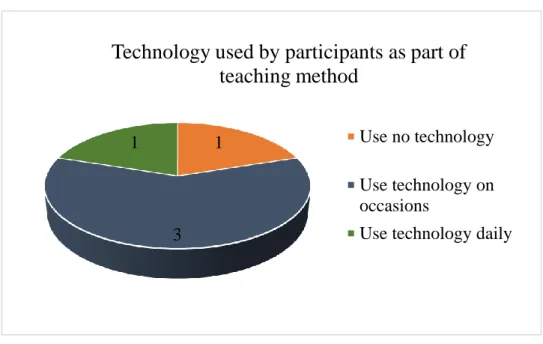
Figure 4: Technology used by participants as part of their teaching method ... 78
Figure 5: Preferred teaching methods ... 79
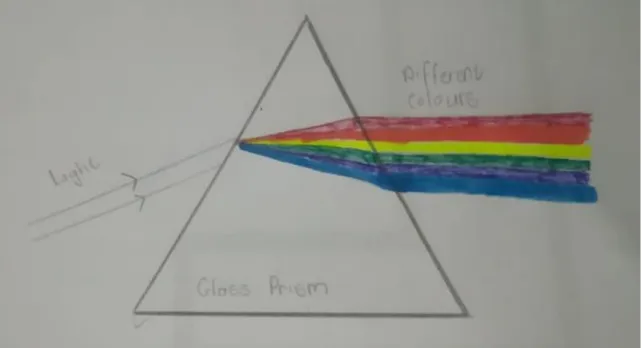
Figure 6: Sam’s visual representation ... 89
Figure 7: Claire’s visual representation ... 92
Figure 8: John’s visual representation ... 94
Figure 9: Dean’s visual representation ... 96
Figure 10: Kyle’s visual representation ... 99
CHAPTER ONE
INTRODUCTION AND OVERVIEW
1. INTRODUCTION
This is a case study where I explore teachers’ attitudes to implementing blended learning. As a teacher and ex-learner in my current school, I have experienced and observed that over all these years most of my colleagues still teach in the same way and they still make use of the same teaching approaches as they did when I was a learner in their classes. This phenomena prompted the question whether or not the teachers in my school are aware of the possibilities of technology and what it offers to the current 21st century learner. Thus, I decided to investigate this concern through looking into how these teachers think 21st century learners learn best, what their current teaching approaches are, and specifically to the possibilities of using technology. I also probed why they use their approaches and whether or not they believe that they are catering for 21st century learning. We also discussed the possibilities of blended learning and as some had had no exposure to this, I included a workshop on blended learning after which they all committed to experimenting with this approach. In the course of the case study I was interested in whether there were shifts in their attitudes to incorporating technology and whether this could be used alongside traditional approaches.
As far back as the 19th century John Dewey (1915, 6) stated that ‘ … if we teach today’s students as we taught yesterday’s, we rob them of tomorrow’. Dewey’s opinion still holds true for teachers who teach today’s learners and who need specific skills to cope with living in the 21st century (Sawchuk, 2009). The literature highlights many challenges that teachers face when teaching 21st century learners.
The first challenge relates to the so-called ‘generation gap’. McCrindle and Wolfinger (2014) explain that today’s school-going learners, also described as Generation Z, are part of a generation that is global, social and technological. Those with means have never known a world without the internet or cell phones, and they are networked with social networks and many means of communication (McCrindle and Wolfinger, 2014; International Education Advisory Board, 2014; Palfrey and Gasser, 2008). As a result of growing up with modern
technology, 21st century learners are developing a different skillset to those developed by learners from the 20th century, of whom some are now their teachers (Sawchuk, 2009).
A second challenge that today’s teachers are experiencing is to accommodate and promote the typical 21st century skills that generation Z (children born 1995-2012) learners have already mastered, largely outside of formal schooling, in the school learning environments that teachers have to create and manage. Friesen and Jardine (2012) reported on 21st century learners speaking out against out-dated teaching and demanding that schools must accommodate their learning needs. 21st Century skills reside in the three core competencies of life and career skills, learning and innovation skills, and information, media and technology skills (Florida, 2007; Partnership for 21st Century Skills, 2011). Scardamalia (2001) also reported that learners indicated that they want to learn via current media of their time and that they want to be engaged intellectually. Technology, specifically digital media, has transformed the way today’s learners socialise, play and also the way in which they learn (Scardamalia, 2001). Florida (2007) stresses that schools must accommodate this information, media and technology-skills that many learners have already mastered. Sawchuk (2009) supports the notion that education systems should provide opportunities for learners to embrace 21st century learning, but he adds that teachers should be the catalyst. Friesen and Jardine (2012) expand this notion when they indicate that it would be expected of teachers to address these needs, even though they are operating in classrooms and schools designed for 20th century learning. The schools and teachers are faced with new demands in order to accommodate Generation Z. Teachers are in the front lines of the Generation Z learning migration into adolescence and the teachers often recognise that this group is different and therefore they will need different teaching and learning (Lenhart, 2010).
The third challenge which teachers then experience is to create a learning environment, using technology, which can accommodate 21st century learning (Friesen & Jardine, 2012). These envisaged learning environments often involve more learner-centred strategies and require teachers to step back and allow learning to take place without their hands-on direction (International Education Advisory Board, 2010). Teachers’ beliefs about teaching and learning, and their previous experiences with technology will have an influence on whether or not they will develop, employ and promote the learning environments as required by learners (Balanskat, 2006). Teaching for learning is the primary focus of a teacher and his or her teaching beliefs are shaped in accordance with the teacher’s philosophy on how learners learn. In order to facilitate the learning of the three core sets of 21st century skills, teachers will have to reconsider their current thinking about learning (Elmore, 2014). Elmore (2014) states that
the different ways in which different teachers affect learning, also referred to as modes of learning (Elmore, 2014), might also influence whether they will be willing to embrace learning technologies in the learning environment. It is evident from literature that changes in pedagogical practice, learner expectations, technology and demographics have already resulted in the development of different modes of teaching and learning, or modifying the more traditional approaches, in order to include a more dynamic interaction between teachers and learners (Learning and Teaching Services, 2014). Elmore’s ideas provided a useful starting point to understanding teachers’ attitudes to incorporating ICT and widening their teaching repertoires.
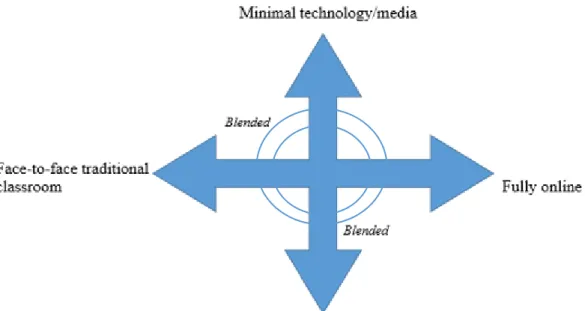
One way to create a technology-infused learning environment for the 21st century learner is to make use of blended learning, which combine technology and traditional methods. Blended learning environments can enhance learners’ meaningful learning practicing 21st century skills (Zurita, Hasbun, Baloian & Jerez, 2014). Blended learning is defined as the combination of traditional teaching methods, digital tools and online education (Gulc, 2014; Bonk & Graham, 2006). However, this is a very narrow interpretation, and blended learning can be further, or better explained with the following conceptual model.
Figure 1: Broad Conceptualization of Blended Learning
Source: Picciano, A.G. 2007. Posting to the Official Website of the 2007 Sloan-C Summer Workshop held in Victoria, British Columbia
There are many possibilities for including technology and blending ICTs with traditional approaches which are explained later in this chapter. The last challenge faced by teachers is their willingness to change and embark on the process required to design and implement alternative learning environments. There are various reasons why people may be reluctant to change their old ways. Kanter (2012) explains that people resist change because they do not want to feel as if they have lost control. Teachers tend to like habits and their routines become automatic therefore any change can create the feeling of not being in control. This issue is of particular relevance in the South African context, where, according to Gennrich and Janks (2013), a strong sense of teacher habitus may hinder real change in practice. Change is also resisted when it makes people feel incompetent and often a change process will make people question their current skills. All stakeholders play a critical role during a change process and it is often the management and leadership during the change process that will determine whether or not the innovation will be characterised as successful (Fullan, 2007). The success of a change innovation depends on how the change is incorporated within the organisation and the steps which is used in order to implement the new innovation (Barber & Moushed, 2007). This challenge will have to be faced by both individual teachers, as well as the school management, when an innovation such alternative learning environments is attempted.
Barber and Moushed (2007) believe that today’s teachers face, or will face, various challenges when they attempt to facilitate learning for the new generation. The 21st century learner might be a challenge for teachers since the majority of today’s teachers were not trained to teach 21st century learners. Furthermore, Generation Z’s technological skills, and the teachers’ possible lack thereof, can also be experienced as a challenge by many teachers when they want to accommodate these skills in the learning environment. This will require change to be implemented and this creates a challenge for teachers since people tend to be reluctant to change. A possible solution currently mooted is for teachers to create learning environments that are technology-infused with acknowledgement of different Modes of Learning, with an emphasis on blended learning.
2. THEORETICAL FRAMEWORK
This section summarises the theoretical framework that underpins this study. Maxwell (1996) suggests that a theoretical framework is the system of theories and norms that supports and informs research. The research draws on the Socio-cultural theory. This theory emphasizes the interactions of people and their surrounding culture (Jaramillo, 1996). Parents, siblings and peers are responsible for helping the learners develop academically as human learning is considered a largely social process (Jaramillo, 1996). Therefore, the Socio-cultural theory, both in its understanding of the possibilities of blended learning and in its participatory research approach, is applicable to this case study. It recognises the social aspect in learning both for teachers and learners and the need for interaction and collaboration in learning. As my study recognises the importance of the social in motivating the 21st century learner to collaborate and engage, this socio-cultural underpins the following section on the 21st century learner. In addition, as this study focussed on teachers’ attitudes to incorporating blended learning, the social elements of learning were recognised in the focus group interactions and blended learning workshop. These provided safe spaces to negotiate understandings and for teachers to scaffold and support each other in shifting to blended learning.
2.1. The 21st century learner
The difference between the learners of the 20th century and those we teach now are well known. In the 20th century learners were learning about technology, whereas in the 21st century learners are learning through technology. The 21st century generation can be defined as highly intellectual individuals who have an unbelievable sense of knowledge with regards to technology and these children are born into a world where technology is fluctuating and becoming everything around us. As mentioned, the term 21st century skills refers to three core set of skills such as life and career skills, learning and innovation skills and information, media and technology skills (Arora, 2010; Barr, Harrison and Conery, 2011; Florida, 2007). Teachers experience various challenges when attempting to create a learning environment suitable for 21st century learning. One challenge which teachers face is to create teaching methodologies that is relevant to 21st century learners since they did not receive training to teach this advanced generation (International Education Advisory Board).
2.2 Blended learning as a pedagogy for teaching, learning and assessment
One way to create opportunities to acquire these skills is to use blended learning as a pedagogy for teaching, learning and assessment. The word ‘blended’ is defined as combining two or more things together. Blended learning can be defined as the combination of face-to-face, traditional classroom methods and computer-mediated activities, whether it is online or not. Blended learning as a pedagogy combines the classroom and online education in various ways since it is further defined as a combination of face-to-face traditional interaction with a teacher in a school location, with additional instruction which is performed in an online learning environment that accompany digital content and teamwork with fellow learners” (Gulc, 2014). It can also be to simply integrate videos, blogs and other media into class work.
There are various reasons why blended learning is considered as an alternative teaching method which is encouraged in order to promote effective learning (Heick, 2013). It is explained that blended learning contains of programming which is designed in such a way that it reaches all modes of learning alike. It enables one to support learning that focuses on the best learning mode in order to achieve the specific outcome. Teachers can blend different modes of learning when teaching in order to achieve different learning outcomes (Elmore, 2014). One of the most recent blended learning models that addresses this is called ‘flipping’ (Picciano and Dziuban, 2007). ‘Flipping’ reinforces learner-centered learning, allowing the learners to master content in an individual way, at their own pace since learners engage in learning at home.
The aim of blended learning is to promote, develop and evaluate the combination of established ways of learning and teaching and the opportunities offered by technology in order to improve learners’ learning and increased flexibility in how, when and where they study (Heick, 2013). The use of ICT within blended learning allows learners to access video of lectures, track assignments and progress, interact with educators and peers and review supporting materials such as PowerPoint presentations, clips, articles and many more (Picciano and Dziuban, 2007). Through incorporating ICT into the learning process it serves to facilitate a simultaneous independent and collaborative learning experience (Gulc, 2014). The internet also helps to develop learners’ personal voices by providing them with platforms for collaboration (Tay, Lim, Lim and Koh, 2012).
2.3 Blended Learning Pedagogies possible with ICT
According to Cox and Abbott (2004) there are various effective educational practices with ICT which could be useful for teachers to form part of their educational framework if they are to integrate ICT effectively into the learning environment. There exists a need for teachers to understand the relationship between ICT resources and the concepts and processes in their learning area. Teachers should also be able to use their learning area expertise to select relevant ICT resources which will assist in meeting the specific learning objectives. They should be aware of the potential of ICT resources with regards to their role in challenging learners thinking (Cox and Abbott, 2004). Another effective pedagogical practice mentioned by Cox and Abbott (2004) is for teachers to develop confidence in using ICT resources in order to know how to plan lessons where ICT is used in ways which will challenge learners’ understanding and promote greater thinking and reflection.
The use of ICT is changing teaching, learning and assessment in several ways (Reid, 2002). There is a belief that ICT can empower teachers and learners through changing teaching and learning processes from being teacher-centered to learner-centered. This change will lead to increased learning gains for learners, creating opportunities for learners in order to develop their creativity, communication skills, problem-solving abilities and higher-order thinking skills (Reid, 2002). It is evident that more substantial gains in learner attainment are achievable where the use of ICT is planned, structured and integrated effectively since they spend more time working at or practising the skills being studied and tested (Higgins, 2001). Knowledge, insight and critical literacy are also improved when ICT is incorporated into the learning the process.
2.4 Impact of ICT on teaching, learning and assessment
According to Balanskat (2006) the impact of ICT is well documented as ICT is used as a tool to achieve a wide range of educational objectives. These objectives are recognised as more modified learning, modernisation in teaching, planning and assessment procedures (Balanskat, 2006). With ICT, teachers are able to create their own material and thus have more control over the material used in the classroom than they have had in the past. It is evident that involving learners in the construction of beneficial material as a part of a learning exercise is a way to make school more meaningful for learners (Reid, 2002). ICT can enhance the way that
children discovery and validate foundations of information. It can support children in developing ideas, analysing information and obtaining high quality collaboration and communication (Brown and Davis, 2004).
2.5 Integrating blended learning across the curriculum
Internationally, blended learning are integrated by teachers across the curriculum and the curriculum has taken a new approach to ICT through allowing learners to engage with ICT inside and outside the school environment (Selwyn, Potter and Cranmer, 2010). In South Africa, blended learning is also integrated across CAPS through the implementation of an educational model called ‘Spark’. ‘Spark’ one example of a blended learning model which is aligned with the South African National Curriculum and may provide the curriculum with additional depth for the benefit of both the academic staff and the learners (Brewer and Harrison, 2013). The integration of blended learning across the curriculum is not automatic or intuitive since there are skills that need to be developed to enable learners to accumulate the full benefits of a multi-modal blended curriculum. For any blended learning approach to work there needs to be a tutor who can develop the learner’s skills and help facilitate their learning (Brown and Davis, 2004). Any integration process such as the implementation of blended learning across the curriculum requires the effective management of the change process.
2.6 Change management
Change management can be defined as the way people manage the process, tools and techniques of change in order to achieve a result. The success of change is not only measured by the outcome but it also lies within the implementation process and strategy of the initiative (Barber and Mourshed, 2007). Michael Fullan cited in Herold and Fedor (2008) views every stakeholder in the educational change as a change agent since he believes that there is vast potential for significant change through constructing alliance with other change managers.
Fullan (2007) proposed that there are four phases in the change process. The first phase is recognised as the initiation phase. This phase is underpinned in the idea of introducing something new. The second phase proposed by Fullan (2007) during the change process is the implementation of the idea (Rowley, 2007). During this phase three major factors affect the implementation of an initiative such as the characteristics of the change and the local and external factors which have an influence on the implementation.
The third phase is recognised as continuation. This is described as a decision about the institutionalization of an innovation based on the reaction to the change (Fullan, 2007). This reaction can be positive or negative. This third continuation phase depends on whether or not the change gets embedded into the structure of the school through policy, budget or the timetable (Barber and Mourshed, 2007).
The final phase recognised by Fullan is called the outcome phase and attention to certain perspectives on the change process may support the achievement of a positive or successful change outcome. One perspective which will promote a successful change outcome would be participation of every individual involved during the process at all times. Change starts with the contact which is made with the people who are involved in the change process and evolves along with the continuous interaction. The involved individuals must be addressed positively and they must be encourage to be actively involved since they are very important agents in and throughout the change process (Rowley, 2007).
3. STATEMENT OF THE RESEARCH PROBLEM
The problem which is identified is that teachers often function with a singular, typical 20th century orientated, mode of teaching and they are unaware of the possibilities of blended learning as a pedagogy.
4. RESEARCH OBJECTIVE
As noted earlier teachers face many challenges when teaching 21st century learners. This study focussed on exploring possibilities of blended learning with a group of teachers. This study also focussed on teachers’ current ideas on how learners learn optimally and whether the practice of blended learning changed their ideas of learning. The study determined the teachers’ present technology acceptance and ICT skill level. The study established teachers’ personal views regarding the challenges that teachers face to teach 21st century skills, what they think 21st century teaching is about and new insights on dealing with these challenges. It was anticipated that the study might be able to suggest strategies to address these challenges which teachers face and how to manage the accompanying change process.
5. RESEARCH QUESTION
The main research question is:
What informs teachers’ attitudes to Blended Learning?
The sub-questions which need to be asked to inform the central question are:
What are teachers’ understanding of 21st century learning? How do teachers experience using technology?
How can exposure to Blended Learning shift teachers’ attitudes?
6. METHODOLOGY
The main goal of this study was to investigate the changes that primary school teachers undergo in their current teaching approaches when they adopt technology-infused blended learning. To serve this goal a research design approach was chosen to obtain the most insightful information possible with regards to the perceptions of teachers of incorporating a technology-infused blended innovation within their learning environments. I, therefore, decided to use a qualitative research approach since it would allow me to probe in depth with regards to the participants’ opinions and experiences with ICT.
The qualitative research design for the study was informed from a constructive-interpretative paradigm: I was interested in how teachers adapt their preferred teaching approaches when they start teaching with technology in a blended learning environment (Henning, Van Rensburg & Smit, 2004:179). Interpretive approaches rely on naturalistic methods such as interviewing and analysis of existing texts. These methods ensure an adequate dialog between the researchers and those with whom they interact in order to collaboratively construct a meaningful reality (Angen, 2000).
Creswell’s (1998, p. 61) definition of a case study, ... an exploration or in-depth analysis of a ‘bounded system’, fits well with this study that ‘bounds’ members of the target population since the researcher will be making use of grade seven teachers in one school. Stake (2005) argues that the researcher may not know in advance whether the individuals in a case study have some common characteristics. He also advises that the sole criterion for selecting cases for a case study should be the opportunity to learn, and that understanding the individual cases of the collective case study will lead to better understanding, and perhaps better theorizing, about a still larger collection of cases (Stake, 2005). Through using a case study it allowed me to gain in-depth understandings from my participants.
For qualitative fieldwork he promotes the drawing of a purposive sample, as oppose to random sampling advanced by science case study proponents. For this study the samples was drawn from the group of grade seven teachers at the school. Five teachers in the specific school were invited to take part in the study. These teachers were diverse in terms of race, gender, age, their number of years’ experience and different levels of technology use. Participants was also selected according to the specific learning area which they teach to the grade sevens in order to ensure a variety of learning areas for the research study.
Data was collected according to the following timeline:
DATA METHOD MOTIVATION FOR USING THIS METHOD
Open-ended
Questionnaires (See Appendix E & F)
To determine the participants’ present technology acceptance, position on the innovation adoption lifecycle and perceptions on 21st century learning and teaching.
Focus Group (See Appendix G)
To explore teachers’ views on challenges they face to teach 21st century skills and their experiences of using technology. To understand their current teaching approaches.
Workshop (See
Appendix H)
To demystify and develop technology-infused learning environments that incorporate blended learning.
Teacher Intervention To allow teachers to try out developing and teaching a series of technology-infused blended learning lessons.
Visual representations To establish the impact on participants initial perceptions on 21st century teaching and learning.
To establish their experiences with blended learning.
To explore their views on the challenges that teachers face to teach 21st century skills.
To understand teachers’ challenges and successes of using blended learning.
The data collected was analysed through organising the data and identifying main themes.
7. The sample
A collective case study involving five teachers from a school in the Eastern Cape Province of South Africa was undertaken. These teachers teach numerous subjects to numerous grades, including grade seven learners. As indicated earlier, these teachers were diverse in terms of race, gender, age, their number of years’ experience and different levels of technology capability.
8. ETHICAL CONSIDERATIONS
I submitted and obtained ethical clearance from Nelson Mandela University’s (NMU) ethics committee (See Appendix A). All material used for research purposes was kept safe and secure and for a limited period (five years) the anonymity and confidentiality of teachers, learners and schools will be ensured and data will be used only for research purposes (including possible future journal publication). The research participants’ identities were kept confidential in the study as pseudonyms were used throughout the study. Permission from the Department of Education (See Appendix B), the principal of the sample school (See Appendix C) and the participants (See Appendix D) were obtained. I behaved ethically through respecting my participants’ opinions and not sharing any personal information gathered from them.
9. DIVISION OF CHAPTERS
In the first chapter I introduced the study and gave a detailed overview of the study. In the second chapter I provide the reader with literature relevant to my topic. In the third chapter
I discuss the research methodology and the methods used in order to gather data. The fourth chapter provides the reader with the results and findings of the study and in the last chapter I share my conclusions of the study and provide recommendations.
10. CONCLUSION
Chapter 1 focused on the introduction to this research and offered the reader the theoretical framework, research problem, research objectives and research question that underpin this study. In addition it also acts as a blueprint of how the rest of this thesis will unfold. Some of the challenges which teachers experience when teaching 21st century learners were briefly mentioned. The importance of considering changes in learning approaches evinced by 21st century learners provided a basis to recognise the importance of teachers’ attitudes to blended learning and how the implementation of blended learning can accommodate 21st century learners and their learning experiences.
CHAPTER TWO
___________________________________________________________________________
LITERATURE REVIEW
___________________________________________________________________________
1. INTRODUCTION
As mentioned in Chapter 1, it is important for teachers to accommodate 21st century learners and their learning. Once teachers are aware of 21st century learners, their skills and how they learn, they can attempt to accommodate these learners by aligning their teaching practices with 21st century learners and their approaches to learning. The acquisition of knowledge or skills through teaching in the 21st century can be enhanced by the use of Information Communication Technology (ICT), more specifically technology infused blended learning. This chapter focusses on teachers’ attitudes to blended learning as a recognition of 21st century learning and learners’ practices. It further discusses how blended learning can be used as an effective teaching method to accommodate 21st century learning and the various pedagogies possible when blending. It also focusses on technology acceptance that current teachers have and their ICT level, and more specifically on the innovation adoption lifecycle of people. In addition, this chapter explores why people are reluctant to change.
1.1.Teachers’ response to and use of ICT
Computers are used in schools worldwide to develop the knowledge and skills required for people to be able to operate in the 21st century information age. Education around the world have started implementing policies to encourage the use of ICT in the facilitation of teaching and learning. The South African government also recognised the role of ICTs in education since the South African White Paper on e-Education states:
“As in other spheres of social and economic development, ICTs have the potential to improve the quality of education and training. It is for these reasons that Government has been quick to seize the opportunity presented by the practical benefits of ICTs to support teaching and learning in the twenty-first century” (South Africa Department of Education (SADoE), 2004, p.8).
“Every South African learner in the general and further education and training bands will be ICT capable (that is, use ICTs confidently and creatively to help develop the skills and knowledge they need to achieve personal goals and to be full participants in the global community) by 2013” (SADoE, 2004, p.10).
There are many factors that contribute to the successful adoption of ICT in schools. Flecknoe (2002) focusses on the openness of teachers to listen to learners and what they want out of the learning experience. Wilson-Strydom, Thomson & Hodgkinson-Williams (2005) found that the most commonly-noted reason for teachers not implementing technology-integrated lessons was the non-availability of computers in the learning environment. Furthermore, Kozma, McGhee, Quellmalz & Zalles (2004) reported that the insufficient technical support and training for using computers was a major barrier for teachers to implement ICT in their teaching. Granger, Morbey, Lotherington, Owston & Wideman (2002) recognised the time-limit which teachers have in order to prepare for technology-infused lessons.
In a study completed in South Africa by Hodgkinson-Williams, Siebörger & Terzoli (2007), a champion teacher was recognised in almost every school where working ICT facilities was evident. The respective champion teacher took the lead in the use, maintenance and management of these facilities and also took on the responsibility for maintaining the computers and sourcing technological help to teachers who were in need of it.
Teacher development and ICT literacy training are extremely important to the success of ICTs within teaching and learning (Hodgkinson-Williams, Siebörger & Terzoli, 2007). One of the challenges to ICT adoption and integration in schools was the lack of teacher training. In the study done by Hodgkinson-Williams, et al (2007) government school teachers complained that the SADoE made no application-based training available for in-service teachers. However a later study by Slay, Siebörger and Hodgkinson-Williams (2008) recounted the various forms of ICT training that the teachers in the study had experienced. What emerges is that training that teachers received a undergraduate level is often insufficient for the continuing evolution of ICT technologies and their potential for teaching and learning.
Another aspect which hinders teachers from incorporating technology into their teaching is teachers’ willingness to change from the older methods of ‘chalk and talk’ teacher-centred teaching to that of learner-teacher-centred teaching methods (Richards, 2005). Teachers are unwilling to adapt their pedagogy to accommodate the meaningful use of ICTs in teaching and learning activities (Hodgkinson-Williams, Siebörger & Terzoli, 2007).
Numerous studies have been undertaken to investigate the use of interactive whiteboards (IWBs) in classroom environments in developed countries. In a study done by Slay, Siebörger and Hodgkinson-Williams (2008) it was found that teachers reported on the efficiency, flexibility, versatility of an IWB and the opportunity to access multimedia content, as well as the ability to manage the class more easily while using an IWB. According to Glover and Miller (2001) teachers view the efficiency of an IWB as a major advantage, referring to the ability to effortlessly access one resource after another from the board. Another benefit was the flexibility and versatility of the IWB as a teaching tool to allow teachers to support multiple needs within lessons (Miller & Glover, 2002). Another major advantage of an IWB recognised by Wood (2002) is the ability to face the class whilst teaching, which allows teachers to maintain class control and to be more in touch with the learners. In a recent study, of learners’ perceptions on the use of IWBs in their classrooms, Wall, Higgins and Smith (2005) found that learners saw IWBs as effective tools for initiating and facilitating the learning process, especially when they were given the opportunity to use the IWB themselves. The learners also commented on the visual nature of the IWB, which they reported that it support concentration and attention.
According to a study done by Slay, Siebörger and Hodgkinson-Williams (2008) the learners also reported on disadvantages of the IWB. The most frequently cited disadvantage by teachers and learners was the lack of ICT skills among the teachers. The fact that in-service teachers do not have sufficient ICT skills is one of the largest ICT-related problems facing schools in the Eastern Cape (Department of Education, 2003). South Africa, as a developing country, are willing to develop benefits of using ICT technology, including IWB, to improve learner engagement and achievement. In the Eastern Cape Province, only 4.5% of all schools have computers for teaching and learning (Department of Education, 2003). Furthermore, the South African study by Slay, Siebörger and Hodgkinson-Williams (2008) illustrates the disruptive effects that technology can have when not fully understood or used optimally. Slay, Siebörger and Hodgkinson-Williams (2008) suggests sufficient training for teachers in order to equip them with the necessary skills to use these ICTs and ongoing support.
1.2. The 21st century learners
When defining today’s learners’, it is evident that they are different in various ways from previous generations and they have various characteristics which contribute to an unique
generation (Trilling and Fadel, 2009). These students are curious and therefore learners for life. They want input on their education and how they obtain new knowledge. 21st century learners don’t know a world without computers and therefore are often very digitally literate. These learners believe that the future is about making a difference and demand freedom to explore their creativity which can lead to change. Being in connection with others at all times is what these learners demand, therefore they are characterised as good team players and effective collaborators (Trilling and Fadel, 2009).
21st century learners are characterised as learners who are very independent and who have an attitude that nothing is impossible, therefore they tend to thrive in a challenging atmosphere. They are increasingly aware of the world around them and are open to change processes.
According to the International Education Advisory Board (2010), 21st century children like to be in control and they like to make their own choices. This generation is group-orientated and are very social since they seek opportunities to identify with others and associating with peers even around the world. 21st century learners are inclusive since they are part of a diverse generation and are taught to be tolerant of all diverse orientations. These learners are characterised as practicing users of digital technology since they are surrounded by digital media and because of this access they naturally gravitate towards it. This generation also think differently from previous generations since they accept, adapt and make use of resources productively. They are characterised as risk takers and determined to achieve success but don’t want to work too hard (International Education Advisory Board, 2010).
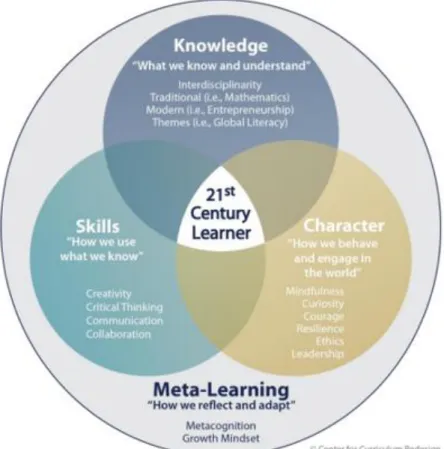
Fadel, Bialik & Trilling (2015) describe the 21st century learner in the following framework:
Figure 2: CCR Framework of the 21st century learner
Source: Fadel, C, Bialik, M, & Trilling, B. 2015. Four-Dimensional Education: The Competencies Learners Need to Succeed. Stanford University.
The Centre for Curriculum Redesign (CRR) (Fadel, Bialik, & Trilling , 2015) aims to adopt a holistic approach in order to redesign the curriculum. Thus, developing a complete framework for the four dimensions of education: knowledge, skills, character, and metacognition (Fadel, Bialik, & Trilling , 2015). It is through this vision that the CRR acknowledges that the knowledge sphere should be built upon a balance of traditional and modern subjects, as well as interdisciplinary. Within a curriculum, skills and knowledge are interrelated. A learners’ skills are used in the development of knowledge and in turn engagement with skills improve their knowledge base (Fadel, Bialik, & Trilling , 2015). The manner in which learners’ engage with and behave in the world can be described as their character. The process of learning how to learn and self-reflection is fostered through metacognition. Thus, knowledge, skills, character and metacognition are the developmental dimensions in which a curriculum should be developed (Fadel, Bialik, & Trilling , 2015).
The Centre for Curriculum Redesign addresses the fundamental question of "WHAT should students learn for the 21st century?" and believe that once it is evident what students
should learn education can accommodate the process on how students learn best (Fadel, Bialik & Trilling, 2015).
As the world of the 21st century bears little resemblance to that of the 19th century, education curricula need to be redesigned for the four dimensions of Knowledge, Skills, Character and Meta-Learning. Adapting to 21st century needs means revisiting each dimension and the interplay between them. The unpredictable context which we face today requires a paradigm switch so that the goal of education is no longer only to impart information but to teach students to steer an ever-changing world. For this they will need versatility as a hedge against rapidly changing conditions, an increased capability to engage with complex challenges, along with a diverse set of competencies such as adaptability, increased collaboration between cultures, etc. towards the goal of a sustainable humanity through content individuals (Fadel, Bialik & Trilling, 2015).
According to Fadel, Bialik & Trilling (2015) traditional disciplines currently take up most of the available time and leave little space for newer subjects, branches and topics. As a consequence of the infinite amount of information that needs to be covered and the pressure of preparing for standardized tests, relatively few teachers are able to constantly provide the time needed to effectively integrate new learning goals into the curriculum. Fadel et al. (2015) suggest that we redesign curriculum to both broaden and deepen understanding and current content will need to be reconsidered. That process involves distilling each discipline to its core essential questions, and restructuring the information to highlight these concepts and meta-concepts as well as their processes, methods and tools.
In addition to learning content deeply, it is suggested that students need to apply knowledge using 21st Century skills namely: creativity, critical thinking, communication, and collaboration. However, skills are only one further dimension. In addition to skills, students will need to learn character qualities which enables them to engage effectively in the 21st century. Fadel, Bialik & Trilling (2005) states in order to deepen and enhance the learning in these three dimensions — knowledge, skills, and character qualities—there is an important additional fourth dimension needed for a fully comprehensive 21st century education: meta-learning (often called meta-learning to learn—the internal processes by which we reflect on and adapt our learning). Furthermore, Fadel explains that it is not enough to covertly include this fourth dimension in all the other dimensions—its significance must be highlighted explicitly, so that we are constantly reminded to incorporate meta-learning strategies into the knowledge, skills, and character portions of our learning experiences, learning how to strive to improve no matter what goals we set for ourselves (Rubin, 2017).
1.3. 21st century skills
Today’s students are digitally focused. According to Kharbach (2013) the average student spends at least four hours daily interacting with their digital gadgets. This digital culture which has infused our learners’ life has brought about a set of changes to their learning habits (Kharbach, 2013).
Today learners require the mastering of several skills to be successful in a fast changing, digital society. Students today will likely have several careers in their lifetime, thus they will require various skills in order to be successful in the workplace. The term “21st century skills” is generally used to refer to certain abilities that promoters believe schools need to teach to help students thrive in today’s world. These skills are also accompanying with deeper learning, which is based on mastering skills such as logical reasoning, complex problem solving and teamwork. Stepping into the 21st century, society has undergone an accelerating pace of change in economy and technology. These changes have an effect on the workplace and also on the demands on our education system which prepares learners for the workforce. These changes also demand different skills which enable people to be flexible and adaptable in different roles or in different career fields. In 2002 the Partnership for 21st Century Skills grouped these skills into three main groups (Pacific Policy Research Center, 2010).
The first group is learning and innovation skills. Learners must be able to communicate and collaborate since learning is a social activity, not only in schools, but also in workplaces and other environments. The communication and collaboration skills sets refer to the ability to communicate clearly and to collaborate effectively with diverse populations. In order to master learning and innovation skills individuals must be able to think critically and be able to solve problems effectively. Critical thinking and problem solving skills include the ability to reason effectively, resolve problems and to reflect critically on decisions and processes. Critical thinking is the ability to analyze, interpret, evaluate, summarize and synthesize information (Trilling & Fadel, 2009). The availability of advanced technologies in the 21st century allow us to access, manipulate, create, analyze, manage, store and communicate information. This critical thinking skill set endorses innovative thinking and the ability to work creatively with others. In a review of the interconnection between technology, learning and creativity, Loveless and Dore (2002) indicate how technology provide individuals with opportunities to be creative. Creativity can be nurtured by teachers and learning environments can be developed that encourage questioning and openness to new ideas. Hence, these
creativity and innovation skills can be developed with practice over time (Wegerif & Dawes, 2004).
The second group, called life and career skills, focuses on the ability of individuals to work effectively with diverse teams, be open-minded to ideas, set and meet goals, manage projects effectively and being responsible to both one’s self and the larger community. Leadership and responsibility skills are needed in order to cope in the 21st century. These skills include the ability to work with the interest of the larger community in mind and to build on the strengths of others to reach a shared goal. One also requires skills in order to be productive and accountable in life today. In order to be productive and accountable one must be able to set and meet goals, prioritize, manage time, work ethically and cooperate with others.
To be successful in a career in the 21st century social and cross-cultural skills are very important. These involve the ability to present oneself professionally and to respect social and cultural differences. Understanding cultural and social differences and using those differences to develop new ideas and new solutions to problems are increasingly important in the workplace (Partnership for 21st Century Skills, 2011). The Partnership for 21st Century Skills argue that learners should be able to interact effectively with others, conduct themselves in a respectful and professional manner, work effectively in diverse teams, respond open-mindedly to different ideas and values, and be able to work effectively with people from a range of social and cultural backgrounds.
The last group is known as information, media and technology skills. Information literacy is the ability to know when information is needed and to have the ability to locate, evaluate and use the required information effectively. Information literacy skills include the ability to access information efficiently, assessing information critically and using information creatively. Andretta (2005) argues that these literacies form the basis for lifelong learning and they are common to all disciplines and should be to all learning environments in the 21st century.
The literature on 21st century media skills argues that it is essential for individuals to be able to access and understand media. 21st century media skills also refer to the ability of individuals to effectively produce and deliver media products and learners needs skills in evaluating and producing representations in a variety of media. Increasingly high in demand is digital literacy since one need to master the use of digital and communications technology. Digital literacy is defined as the ability to use information and communication technologies to find, assess, form and communicate information, requiring both intellectual and technical skills. In the 21st century technological literacy is demanded as a skill to be mastered, due to
the fact that everything in the world revolves around technology. As far back as the end of the 20th century Gilster (1997) identified that web technologies already started replacing the television, telephones and newspapers as the primary means by which people were informed, connected and entertained. In supporting digital and learning literacies teachers should attempt to design flexible learning opportunities, review how technologies are integrated into the curriculum, support students to make use of technologies and to develop effective strategies for learning with technology.
1.3 21st century learning
Kharbach (2013) identifies the 21st century as the Life Long Learning Era. With the advance of technology a new educational system started and learning is now endless. This is evident in the development of home schooling, distance education, adult education, learning centres, educational television and videos and computer-based learning software. Many of these seeds will affect the learning of children, but many others will affect people of all ages, as learning becomes a lifelong enterprise.
Due to the complexity of the learners present in the learning environment, learning is also changing and demand new methods to accommodate learning in the 21st century. According to the Pacific Policy Research Center (2010) ICT is transforming how we learn and the meaning of social relationships. Today, success lies in being able to communicate and use information to solve problems and in being able to command and expand the power of technology to create new knowledge. According to Rich (2010) 21st century learning is “learner-driven”. Learners now learn differently since the Internet is releasing intellectual energy that comes from our desires to have a voice and to participate. Learning is now equipped with powerful tools which allow learners to obtain and create knowledge more quickly (Rich, 2010).
21st century learners prefer to use technology to study in their own time and don’t necessarily want to sit in a classroom to learn (International Education Advisory Board, 2010). These learners require learning environments where they can use technology to complete tasks in creative ways and they have a need for alternative methods to complete tasks. 21st century learners prefer to learn collaboratively since they want to learn with others and share what they have learnt with their peers. Rich (2010) further describes 21st century learning as unlimited. Learners are no longer limited by the information available in libraries, they now search the Internet for information and have unlimited information almost immediately. Since ICT has
always been part of their lives they expect it to support their learning and to be part of their learning experiences.
To create effective learning environments for these digital learners is challenging. Teachers are challenged daily to create opportunities for learners to develop the skills required in order to cope with life as we know it today. Computer-generated tools and open-source software create borderless learning environments for learners. Education is no longer one-size-fits-all or confined to the classroom. Teachers can use technology to create an engaging and personalised learning environment to meet the emerging learning needs of this generation (Rich, 2010).
Teachers of 21st century skills will need to be experts and have expertise in teaching the same 21st century skills that they are encouraging their students to excel in (Pacific Policy Research Center, 2010). Teachers will have to communicate and collaborate with each other and with students, become flexible with managing new classroom dynamics, be able to support independent student learning and be willing to adapt their teaching styles to accommodate new pedagogical approaches to learning.
The Partnership for 21st Century Skills (2009) defines 21st century learning environments as “the support systems that organize the condition in which humans learn best – systems that accommodate the unique learning needs of every learner and support the positive human relationships needed for effective learning. Therefore, 21st century learning environments are the physical spaces, tools, and learning communities that encourage and enable learners and teachers to attain the skill-sets that the 21st century requires. The Partnership for 21st Century Skills is of the opinion that 21st century learning environments should create learning practices, support and physical environments that will support the teaching and learning of 21st century skill outcomes. These learning environments should enable learners to learn in real world 21st century context and allow equitable access to quality learning tools, technologies and resources.
Cornell (2002) argues that 21st century learning needs to take place in contexts that promote interaction and a sense of community that enable formal and informal learning.
Life today requires competencies and knowledge in the context of fostering cooperative learning. Learners learn socially and through cooperating with one another. Inquiry learning create unique ways for students to share what they have learnt with one another (Kuhlthau, Maniotes & Caspari, 2015). The emerging ICTs change the way we learn. Information technology has an impact on education and also change the way that we learn.
The Partnership for 21st Century Skills (2009) argues that all 21st century initiatives must focus on both core academic subject mastery and skills outcomes. The Partnership for 21st Century Skills (2009) recommend a developing teacher professional development program and workshops that focus specifically on 21st century skills instruction and providing professional development opportunities into teacher standards.
Supporters of 21st century skills favour student-centered methods like problem-based learning and project-based learning which allow students to collaborate, work on authentic problems and engage with community (Silva, 2008). According to Andreas Schleicher in Fadel, Bialik & Trilling (2015) the reason for why we find it challenging to rebuild school curricula around the 21st century world is that we lack an organizing framework that can assist in prioritising educational competencies.
1.4 How teachers can accommodate 21st century needs
Trilling and Fadel (2009) found five key findings that may help guide and reshape learning to meet the needs of the 21st century learner. They suggest that teachers create more authentic learning experiences, since 21st century learners need more real-world problem solving opportunities in a suitable environment. Teachers should allow mental model building, since these learners should be provided with opportunities to be involved in situations that incorporate new experiences which will change their views over time. It is important for teachers to create lessons that have an emotional connection to what is being learned and to create more personalized learning opportunities for learners. Trilling and Fadel (2009) suggests that teachers embed social learning into lessons where learners learn from each other. They also suggest that teachers incorporate online communication within the learning environment.
In order for teachers to accommodate the needs of the 21st century learner, teachers too need to develop some crucial skills to fit in the 21st century educational paradigm and to adequately prepare today's students for their future (Trilling & Fadel, 2009). Trilling & Fadel (2009) suggest that teachers share and model the use of current internet tools, participate in professional networks, assist learners as they build their learning networks, provide sufficient learning opportunities for learners to become digitally literate and inspire every learner to be quality digital global citizens.
Scott (2015) suggest specific pedagogies and perspectives that will offer learners the best opportunities to acquire competencies and skills needed to successfully navigate a complex
and uncertain future. One of the perspectives is to renew the focus on quality. In order to achieve the goal of highly competent and committed teachers using active pedagogies, government must ensure that there is an adequate supply of well-trained and motivated teachers and school leadership, improve teachers’ training and offer sufficient professional development opportunities.
Teachers’ need to foster participation within a 21st century learning environment (McLoughlin & Lee, 2008). In the 21st century, learning and social interaction is encouraged through participatory learning. Potential school-entering learners, and current learners, are already exposed to a peer-participation. Through this participation, learners are able to collaboratively, and socially, identify new developments regarding social networks and the impact on her personal improvement. It is evident that teachers should be experimenting with social networks to engage and provide new opportunities for the learners in a 21st century learning environment (McLoughlin & Lee, 2008). McLoughlin and Lee (2008, p.9) highlight that it adds a “further dimension to participative learning by increasing the level of socialization and collaboration with experts, community and peer groups, and by fostering connections that are often global in reach”.
Scott (2015) suggests that teachers personalize and customize learning. As people learn in a variety of ways and may take multiple pathways to skills acquisition, education must be reorganized around each ‘learner’s journey’ (Leadbeater & Wong, 2010). Twenty-first century education will require more personalized learning with an emphasis on supporting creativity. Scott (2015, p.12) stress that “personalization has implications for what, how and where we teach”. Personalization occurs through collaboration, provides for more rapid sharing of innovation and good practice, and quickly captures information about learners’ aptitudes and progress.
Furthermore, it is important for teachers to emphasize project and problem-based learning within the learning environment. McLoughlin and Lee (2008) highlight that students receive opportunities to direct and manage their own learning process and cite evidence about the effectiveness of giving learners control over and responsibility for their learning. This is the main concept behind project and problem-based learning and is central to twenty-first century pedagogy. With project and problem-based learning, students learn by designing and constructing actual solutions to real-life problems.
Collaboration and communication is another 21st century trend that shifts learning from teacher-centred settings to collaborative ones where students communicate. Collaborative learning is the intentional grouping and pairing of learners for the purpose of achieving a
learning goal. Collaborative learning is a broad term for a variety of educational approaches involving joint intellectual effort by learners, or learners and teachers together. In most collaborative learning situations, learners work in groups of two or more, mutually searching for understanding, solutions, or meanings, or creating a product (Scott, 2015).
The 21st century learner needs to be engaged and motivated, since research emphasizes the importance of the teacher’s role in motivating learners and finding ways for them to build intrinsic motivation. According to Malone and Smith (2008) motivation is based on developing the interest of learners, maintaining their involvement and encouraging confidence in their abilities to perform a specific task. Teachers can foster learning and motivation by ensuring that success is recognized and praised. Scott (2015) also suggest that teachers should foster motivation by clarifying the purpose of lessons with learners and sharing their long-term learning goals.
Scott (2015) argues that innovation and creativity are very valuable competencies in knowledge societies. Creativity is deeply social, with most creative insights typically emerging from collaborative and creative circles. In the 21st century teachers must be courageous in their pursuit to disrupt conventional wisdom and development of a learning environment that encourages learners to improvise and be innovative above rote learning (Scott, 2015). Scott (2015) argue that learners’ are not being taught to create knowledge. Learners’ have the misconception that knowledge is static and complete and in order for them to become an expert, they must consume knowledge rather than produce it. In the 21st century “the ultimate goal of learning is to stimulate learners’ capacities to create and generate ideas, concepts and knowledge (McLoughlin & Lee, 2014). A 21st century teacher will play a key role in helping learners recognise and develop their creativity by encouraging, identifying and fostering creativity in the learning environment.
It is important that teachers employ appropriate learning tools within the learning environment which will ensure the accommodation of 21st century needs. The transformation of pedagogy goes beyond the idea that new technologies will produce new forms of learning and new competencies. While technological developments play an important role in learning and can create new and unprecedented opportunities, technology alone cannot ensure a successful learning experience (Davies, Fidler and Gorbis, 2011). There are many different instructional tools available to teachers to stimulate learning and help learners create new knowledge in collaboration with their peers. Teachers can use instructional tools such as strategic questioning, capitalizing on learners’ interest in mobile technologies and making the most of social media.