Faculty of Computer Science Interactive Media Lab Dresden
Master’s Thesis
Towards Collaborative Session-based
Semantic Search
Sebastian Straub
A thesis submitted in fulfillment of the requirements for the degree of Master of Science (M.Sc.)
Supervisor: Prof. Dr.-Ing. Raimund Dachselt Advisors: Dr.-Ing. Annett Mitschick
Dr.-Ing. Anke Lehmann Date: October 5, 2017
iii
Declaration of Authorship
Hiermit versichere ich, dass ich die vorliegende Arbeit mit dem Titel Towards Col-laborative Session-based Semantic Search selbstständig und ohne Benutzung anderer als der angegebenen Hilfsmittel angefertigt habe. Alle Stellen, die anderen Quellen im Wortlaut oder dem Sinn nach entnommen wurden, sind als solche mit Angaben der Herkunft kenntlich gemacht. Dies gilt auch für alle bildlichen Darstellungen. Die Arbeit wurde bisher in gleicher oder ähnlicher Form noch nicht als Prüfungsleistung eingereicht.
v
Abstract
Towards Collaborative Session-based Semantic Search by Sebastian Straub
In recent years, the most popular web search engines have excelled in their ability to answer short queries that require clear, localized and personalized answers. When it comes to complex exploratory search tasks however, the main challenge for the searcher remains the same as back in the 1990s: Trying to formulate a single query that contains all the right keywords to produce at least some relevant results. In this work we want to investigate new ways to facilitate exploratory search by making use of context information from the user’s entire search process. Therefore we present the concept of session-based semantic search, with an optional extension to collaborative search scenarios. To improve the relevance of search results we expand queries with terms from the user’s recent query history in the same search context (session-based search). We introduce a novel method for query classification based on statistical topic models which allows us to track the most important topics in a search session so that we can suggest relevant documents that could not be found through keyword matching.
To demonstrate the potential of these concepts, we have built the prototype of a session-based semantic search engine which we release as free and open source soft-ware. In a qualitative user study that we have conducted, this prototype has shown promising results and was well-received by the participants.
vii
Zusammenfassung
Towards Collaborative Session-based Semantic Search von Sebastian Straub
Die führenden Web-Suchmaschinen haben sich in den letzten Jahren gegenseitig darin übertroffen, möglichst leicht verständliche, lokalisierte und personalisierte Antworten auf kurze Suchanfragen anzubieten. Bei komplexen explorativen Rechercheaufgaben hingegen ist die größte Herausforderung für den Nutzer immer noch die gleiche wie in den 1990er Jahren: Eine einzige Suchanfrage so zu formulieren, dass alle notwen-digen Schlüsselwörter enthalten sind, um zumindest ein paar relevante Ergebnisse zu erhalten.
In der vorliegenden Arbeit sollen neue Methoden entwickelt werden, um die explorati-ve Suche zu erleichtern, indem Kontextinformationen aus dem gesamten Suchprozess des Nutzers einbezogen werden. Daher stellen wir das Konzept der sitzungsbasierten semantischen Suche vor, mit einer optionalen Erweiterung auf kollaborative Suchsze-narien. Um die Relevanz von Suchergebnissen zu steigern, werden Suchanfragen mit Begriffen aus den letzten Anfragen des Nutzers angereichert, die im selben Suchkon-text gestellt wurden (sitzungsbasierte Suche). Außerdem wird ein neuartiger Ansatz zur Klassifizierung von Suchanfragen eingeführt, der auf statistischen Themenmo-dellen basiert und es uns ermöglicht, die wichtigsten Themen in einer Suchsitzung zu erkennen, um damit weitere relevante Dokumente vorzuschlagen, die nicht durch Keyword-Matching gefunden werden konnten.
Um das Potential dieser Konzepte zu demonstrieren, wurde im Rahmen dieser Arbeit der Prototyp einer sitzungsbasierten semantischen Suchmaschine entwickelt, den wir als freie Software veröffentlichen. In einer qualitativen Nutzerstudie hat dieser Pro-totyp vielversprechende Ergebnisse hervorgebracht und wurde von den Teilnehmern positiv aufgenommen.
ix
Acknowledgements
First of all I would like to express my very great appreciation to my advisors Annett Mitschick and Anke Lehmann for their patient guidance and valuable feedback. Your continued support of my work was of vital importance to me.
I am grateful to Prof. Raimund Dachselt for the opportunity to write this thesis about a topic of my own choosing. I know that this is not a matter of course and I hope I didn’t blow it for future students who come forward with ideas for their own theses. My special gratitude goes out to my colleagues at Avantgarde Labs, whom I had the pleasure to work with during my entire MA studies. You provided me with a playground where I could try out anything that I have learned during my studies and so it is not an understatement when I say that this work wouldn’t have been possible without that great experience.
And finally, I am particularly grateful to my parents, my brother, my sister and my dear friends here in Dresden and back home for their unfailing support and the highly appreciated distractions that kept me going whenever I was ready to scrap the whole thing. You guys are awesome!
i
Contents
Abstract. v Zusammenfassung. vii Acknowledgements. ix 1. Introduction 1 2. Related Work 5 2.1. Topic Models . . . 5 2.1.1. Common Traits . . . 52.1.2. Topic Modeling Techniques . . . 6
2.1.3. Topic Labeling . . . 8
2.1.4. Topic Graph Visualization . . . 9
2.2. Session-based Search . . . 10
2.3. Query Classification . . . 12
2.4. Collaborative Search . . . 13
2.4.1. Aspects of Collaborative Search Systems . . . 14
2.4.2. Collaborative Information Retrieval Systems . . . 14
3. Core Concepts 19 3.1. Session-based Search . . . 19 3.1.1. Session Data . . . 20 3.1.2. Query Aggregation . . . 21 3.2. Topic Centroid . . . 22 3.2.1. Topic Identification . . . 23 3.2.2. Topic Shift . . . 27 3.2.3. Relevance Feedback . . . 29
3.2.4. Topic Graph Visualization . . . 30
3.3. Search Strategy . . . 32
3.3.1. Prerequisites . . . 33
3.3.2. Search Algorithms . . . 33
3.3.3. Query Pipeline . . . 35
3.4. Collaborative Search . . . 38
3.4.1. Shared Topic Centroid . . . 38
3.4.2. Group Management . . . 39 3.4.3. Collaboration . . . 40 3.5. Discussion . . . 42 4. Prototype 45 4.1. Document Collection . . . 46 4.1.1. Selection Criteria . . . 46
ii 4.1.2. Data Preparation . . . 46 4.1.3. Search Index . . . 50 4.2. Search Engine . . . 52 4.2.1. Search Algorithms . . . 53 4.2.2. Query Pipeline . . . 55 4.2.3. Session Persistence . . . 58 4.3. User Interface . . . 59 4.4. Performance Review . . . 64 4.5. Discussion . . . 65 5. User Study 67 5.1. Methods . . . 67 5.1.1. Procedure . . . 68 5.1.2. Implementation . . . 68 5.1.3. Tasks . . . 70 5.1.4. Questionnaires . . . 70 5.2. Results . . . 71 5.2.1. Participants . . . 71 5.2.2. Task Review . . . 72
5.2.3. Literature Research Results . . . 75
5.3. Discussion . . . 76
6. Conclusion 79 Bibliography 83 Weblinks . . . 90
A. Appendix 91 A.1. Prototype: Source Code . . . 91
A.2. Survey . . . 92
A.2.1. Tasks . . . 92
A.2.2. Document Filter for Google Scholar . . . 95
A.2.3. Questionnaires . . . 96
A.2.4. Participant’s Answers . . . 100
1
Chapter 1
Introduction
“And how will you inquire into a thing when you are wholly ignorant of what it is? Even if you happen to bump right into it, how will you know it is the thing you didn’t know?”
— Plát¯on, Mén¯on
This quote from a fictional dialogue between ancient Greek philosopher Socrates and the politician Meno which was written by Plato has become known asMeno’s Paradox
orThe Paradox of Inquiry: At its core, it states that there is no need to search for something we already know and there is no way to recognize anything that we don’t know, therefore acquiring knowledge should be impossible. For a theist this problem is solved by referring to a higher power which has knowledge of the absolute truth and by following the rules of the higher power, even mere mortals can recognize this truth and therefore gain knowledge. Atheists however can only deduce knowledge from what they themselves define as axioms, the suitability of which they can assess by observation of the universe, but in the end there is no way to prove even the most basic axioms due to the lack of an absolute reference frame.
From a practical perspective, the implications of Meno’s paradox are of little relevance to us: Humans have very different and often contradictory assumptions about the world, but in most cases these assumptions still allow them to get through their daily lives without getting into too much trouble with their environment. However, the issue of acquiring knowledge about things we don’t know anything about is a very practical one which we constantly encounter.
Searching for information has become much more efficient and convenient with the rise of web search engines that allow access to knowledge sources that go far beyond what libraries traditionally used to offer. The popular search engines go through great lengths to offer search results that are localized and even personalized, like a search for “movies” might return a list of movies which are currently running in nearby theaters and which fit your cinematic profile. Yet while these retrieval methods do a great job when we have a clear goal, looking for information about topics we are already well aware of, most search engines fail to support the users in acquiring new knowledge in fields that they are unfamiliar with. This leads to the question how we can support people in exploratory search tasks when the goal is blurry at best and it is unclear how relevant sources that contain the desired knowledge can be discovered. To address this issue, we present the concept of a session-based semantic search engine. Session-based search implies that we interpret each user’s queries in the context of their previous queries from the same search session, which includes all requests that are submitted in order to fulfill a single information need. The designationsemantic
2 1. Introduction
refers to the capability of the system to find relevant search results not just based on the keywords that are part of any query in a session but on other contextual information that has been explicitly or implicitly provided by the user.
So instead of compelling the user to refine a query until the search engine gets all the data it needs in a single request, we save all relevant context information in a temporary search session and interpret subsequent queries under that prior, without the need to build up a user profile first. This way, we can immediately improve the ranking of search results and let the search engine guide the user by suggesting topics that are relevant in the current context.
We are going to use probabilistic topic models to uncover the hidden thematic struc-ture in arbitrary document collections. A topic model allows us to discover the dominant topics of documents that are reviewed by the user in the course of a search session, which we will harness to improve the ranking of search results in subsequent queries and to suggest documents that were previously not considered based on the query terms that the user has submitted. This is an important step to support the user in acquiring knowledge while not being fully aware of the relevant terminology in a field. Through probabilistic inference we can model the most important topics in a search session and recommend documents about topics that are likely to be relevant in the current search context but which the user possibly has not considered before. In order to enable groups of people to efficiently work on the same research task, we extend this concept to the collaborative setting. Our goal is to create a system that encourages collaborative work by improving the ranking and presentation of search results based on shared context information that has been provided by all group members. While we are going to offer additional functionality that can make use of the shared search context, we will not define a comprehensive alternative to existing collaborative search systems. Instead, the methods we propose are intended as an extension to improve the efficiency of collaborative search in various situations. To put these concepts to the test, we present the prototype of a session-based semantic search engine which we publish together with this work as free software. This is, to the best of our knowledge, the first open source release of a search engine of this kind. It implements search sessions which serve as a wrapper for all context information provided by the user and allows to retrieve documents using a combined search algorithm based on the user’s previous queries in the session as well as a model of the most relevant topics in the current search context. While the prototype is limited to the single-user setting, it has been designed with a possible extension to collaborative search in mind.
In a small-scale, qualitative user study we investigate whether the semantic capabil-ities of the prototype are beneficial when compared to conventional academic search engines. To this end we let participants perform several literature research tasks us-ing either the prototype or a popular commercial academic search engine. We will compare the search results of the participants as well as their assessment of the us-ability of both systems to get an impression of the prototype’s fitness for exploratory search. To ensure that the search results are comparable, we rely on a full-text in-dex of 1.2 million scientific papers from thearXiv, a publicly accessible repository of scientific papers in various disciplines.
The rest of this thesis is organized as follows: We give an overview of related re-search concerning statistical topic models, session-based re-search, query classification
1. Introduction 3
and collaborative search. In Chapter 3 we present the core concepts that define a session-based semantic search engine in the single-user and the collaborative set-ting. These include the foundations of session-based search, the topic centroid as a data structure that tracks the most relevant topics in a search session, a comprehen-sive search strategy that harnesses the context information in a search session and an extension of these concepts to the collaborative setting. Next we introduce the prototype that was built as part of this work: We describe the process that led to the construction of the search index, give an overview of the implementation of the search engine’s core functions, provide insights into some of the unique UI features and show the practicality of the prototype in a technical performance review. Fi-nally, we present the results of the qualitative user study we conducted, in which we compare the prototype with a conventional literature search engine.
5
Chapter 2
Related Work
In this chapter we will give an overview of the related work concerning the main topics we are going to discuss in this work: First, we review statistical topic models, which enable us to uncover the hidden thematic structure in arbitrary document collections and consequently to recommend documents based on these topics instead of just the user’s query terms. Next, we discuss session-based search, an information retrieval method that interprets user queries in the context of a search session. This inclusion of the search context relieves the user from the requirement to formulate a single query that addresses all aspects of a complex research task. With query classification, which is the issue of the following section, we can combine the context information from a search session with the knowledge about the topics in the document collection to reason about the searcher’s actual intentions, which can help to further improve the ranking of search results. Finally, we review the literature on collaborative search, which will serve as a foundation for our concepts to influence search results based on contextual information that is implicitly shared between all members of a group.
2.1. Topic Models
An important prerequisite for efficient exploratory search is to have knowledge about the latent topics in the document collection which are not inherently visible through keyword matching. The goal is to not only serve documents whose content matches a query string, but to better understand the search interest of the user and to find documents that are most relevant to that search interest. This however requires a consistent annotation of documents based on their contents, which is a huge effort when done manually by humans. However, with statistical topic models it is possible to discover the abstract topics that occur in each document of a collection in an unsupervised learning process.
2.1.1. Common Traits
Topic modeling is the process of uncovering the thematic structure hidden inside a collection of unclassified documents. The methods for topic modeling that we are going to present share a number of assumptions about the data model and how topical information is extracted from that data. The data model consists of a collection of documents d1, . . . , dm, where each document can be represented as a list of tokens
6 2. Related Work
Atopicis defined as a multinomial distribution over a fixed vocabulary. This implies that a topic can be represented as a vector whose length is equal to the size of the vocabulary, where each index position represents the weight of the word for this topic at the same position in the vocabulary. Intuitively, this means that a topic is identified by terms that co-occur more frequently in the documents of this topic than in others. This assumption has its root in the distributional hypothesis [Har54] which states that words that occur in the same context usually carry similar meanings.
Because word order is not relevant for the definition of a topic, each document can be represented using the more memory-efficient bag-of-words model, preserving only the term frequency, but not the order of occurrence. We can further reduce the size of the dictionary without sacrificing precision by removing certain terms. These include stop words and very frequent terms, which will likely occur in most new documents, as well as rare words that probably won’t occur in new documents. Stemming or lemmatization can further reduce the vocabulary size by joining different grammatical inflections of the same words. This kind of dimensionality reduction not only enables us to calculate topic models for larger document collections in-memory, it also helps with generalization and reduces the probability of overfitting.
2.1.2. Topic Modeling Techniques
We will now show a selection of techniques for generating statistical topic models.
Latent Semantic Analysis (LSA)
One of the earliest techniques that aim to automatically identify topics in unstruc-tured text is Latent Semantic Analysis (LSA), which was introduced by Deerwester et al. in 1990 [DDF+90]. At its core, LSA is quite similar to contemporary topic models: it relies on the bag-of-words model and defines a topic as a distribution over a fixed vocabulary. The central data structure is the term-document matrix, where rows contain the terms of the vocabulary and columns correspond to documents. Each cell contains the frequency of a term in the corresponding document, or more typically the specific term weight, usingtf-idf as weighting function.
Topics are discovered by reducing this matrix to a vector space of lower dimension-ality, which the authors call the latent semantic space. This mapping is created by applying a Singlular Value Decomposition (SVD). A reasonable approximation is usually feasible, because the matrix tends to be sparsely populated, and it helps eliminating noisy data, therefore increasing the significance of individual entries. The rows of the decomposed matrix should now represent a set of linearly independent vectors that can be interpreted as concepts or topics, because terms that carry similar meaning should be mapped to the same direction in the latent semantic space. As a result of the SVD, we can record the weight of the influence of each term on each decomposed topic vector, which gives us insights into the meaning of each topic and allows us to classify new documents using these frequency distributions.
An issue of LSA used to be the high computational cost and the requirement to have the full term-document matrix in memory to efficiently perform the SVD. These limitations however have been overcome in recent years, when an online training algorithm for LSA that is capable of processing an unlimited number of documents
2.1. Topic Models 7
with constant memory requirements was introduced by Řehůřek [Řeh11] in 2011 and subsequently implemented in the gensim library [@Řeh]. An intrinsic problem with LSA’s approach of dimensionality reduction is the inability to handle polysemy (i.e. disambiguating words that have multiple meanings), due to the fact that topics are directly derived from combined term vectors and each word therefore must always be part of exactly one topic, which does not properly resemble the characteristics of natural language.
Probabilistic Latent Semantic Analysis (pLSA)
While in LSA, topics are directly derived from training data through dimensionality reduction, Probabilistic Latent Semantic Analysis (pLSA) [Hof99] relies on a proba-bilistic generative model which defines the process by which documents are generated. In this model, the goal is to discover the hidden variables that best explain the ob-served data, or those which minimize the gap between data generated by the model and the actual observations. The hidden variables can be interpreted as topics, which once again are distributions over words and once uncovered we can use these distri-butions to assign topics to previously unobserved documents.
In pLSA, the probability of observing a word win a documentdis defined as
P(d, w) = X
z∈Z
P(z)P(d|z) P(w|z) =P(d)X
z∈Z
P(z|d) P(w|z)
with Z being the set of possible unobserved topics, whose size must be defined in advance as a hyperparameter. This definition allows a document to be generated from several topics, which implies that a single document can be about multiple top-ics, and because a topic is defined as a distribution over words, pLSA can handle polysemy, unlike standard LSA. The model parameters are trained using an expec-tation–maximization algorithm which uses variant of simulated annealing in order to escape local maxima. In his work, Hofmann has empirically shown that pLSA is superior to standard LSA, both in terms of precision of the uncovered topics as well as computational performance of the algorithm.
Latent Dirichlet Allocation (LDA)
Blei et al. [BNJ03] criticized that pLSA is not a well-defined generative model, because it learns P(z|d) only for the documents that were observed in the training set and there is no clear way to assign topics and their probabilities to unseen documents. To mitigate these issues, they propose Latent Dirichlet Allocation (LDA), a model which is a generalization of pLSA [GK03]. In the LDA model, each document is generated from a mixture of topics which has a sparse Dirichlet prior. If a uniform Dirichlet prior distribution is used, the LDA model is equivalent to pLSA. In order to estimate the model parameters, Gibbs sampling is commonly applied [Ble12]. While the originally proposed inference algorithm required the entire training set to be available ahead of time, Hoffman et al. [HBB10] developed an online algorithm that can be applied to document collections of arbitrary size.
8 2. Related Work
Hierarchical Topic Models
All topic models we have reviewed so far share the property that they generate a fixed number of topics that have no specific relation to each other. It is not trivial to estimate how many topics are required to generate a reasonable topic model for an arbitrary document collection, which usually involves a costly process of trial-and-error. Furthermore, having a topic model with hierarchical relations between topics and sub-topics could help to organize a document collection on different levels of granularity.
The issue of finding the optimal number of topics is addressed by Teh et al. [TJB+05] with the Hierarchical Dirichlet Process (HDP), a generalization of the LDA model. Like with LDA, topics are represented as mixtures over a fixed vocabulary, but while in LDA documents are mixtures of a predefined number of topics, in HDP this number is generated in a Dirichlet process. The denomination “hierarchical” however refers to the additional layer that is added to the random processes and does not indicate, that the topics themselves have a hierarchical structure. A model that can generate topic models with a hierarchical structure is the nested Hierarchical Dirichlet Pro-cess (nHDP) [PWB+12], which is an extension of HDP that relies on techniques for building topic hierarchies based on the nested Chinese Restaurant Process (nCPR) [BGJ10].
2.1.3. Topic Labeling
While topic models can be very useful in identifying relations between documents based on the similarity of an underlying topic, they do not provide us with any means to actually define or name individual topics. Having a name for a topic can help in acquiring additional knowledge about that topic from other sources, which in turn can be used to improve search results. Furthermore it enables us to make judgments about the accuracy and quality of the topic model and it helps humans to understand the relationships between the entities of a domain. A search engine can additionally benefit from such a domain model by adequately visualizing important topics to the user, who can use this aid to navigate through topics and filter results. Each topic in an generative model like LDA or HDP is represented by a vector that assigns a probability to each term that defines the topic. These marginal probabilities [BNJ03] can be used to find the most significant terms that identify a topic. With some background knowledge, it is often possible to derive a name for the underlying concept from these terms. This however requires manual review by humans with knowledge about the domain of interest, which can be an expensive task.
To mitigate this issue, research has been done in recent years on the issue of automatic topic labeling. The general approaches are to use the terms with the highest marginal probabilities for each topic to either derive labels from relevant terms and documents of that topic [MSZ07; BHX14] or to use external knowledge sources to map the discovered topic to a known concept [LNK+10; LGN+11; HHK+13]. The knowledge-free approach is very flexible and able to derive labels even for new topics that just came up in news articles or social media. The knowledge-backed approach on the
2.1. Topic Models 9
other hand allows us to link topics with other knowledge sources, which helps us to map a topic model to existing ontologies and to gain further knowledge of that topic. Still, the research so far has shown that fully automated topic labeling is not yet feasible, due to high error rates and low-quality labels. If meaningful topic labels are a requirement, the generated labels must be screened by human reviewers with sufficient domain knowledge.
2.1.4. Topic Graph Visualization
For the users of a search engine that ranks documents based on a selection of topics from a hierarchical topic model, it can be helpful to have some kind of visualization of the most relevant topics. It may also be interesting to investigate ways to interact with the topics, in order to adjust the selection of relevant topics and to explore new topics in the taxonomy. A particular challenge is the integration of a suitable visualization tool into a search result page.
Early work in the field of topic visualization has been done by Niwa et al. [NNI+97] in 1997, before the first statistical topic models have been described. Their goal was to build an “interactive guidance mechanism for document retrieval systems” which displays a “visualized map of topics at each stage of [the] retrieval process”. Significant terminology was extracted through term frequency analysis from a list of search results and relations between terms are determined through co-occurrence analysis in the document collection. A similar approach was investigated by Joho et al. [JSB04], who built a user interface for interactive query expansion in an information retrieval scenario. While these works give an interesting insight into visualization techniques that do not rely on topic models, they are not directly applicable to our visualization problem.
TopicNets is a “system for interactive visual analysis of large document corpora” [GOB+12]. It relies on LDA topic models with topic labels assigned by human editors and provides tools for graph-based visualization and interaction. The main purpose of the system is visual exploration of documents and the analysis of thematically related document collections. Even though some of the visualization methods can be helpful for topic graph visualization, the scope of TopicNets is the exploration of entire document collections, rather than the visualization of topics in a small subset of the documents.
The issue of subgraph extraction is discussed by Dupont et al. [DCD+06]. They developed a novel method to extract nodes from a connected graph while keeping the relations between these nodes by adding more nodes and edges from the original graph that re-connect the nodes of the subgraph. While this algorithm works efficiently even for large graphs, the tree-like topology of a hierarchical topic model allows us to deploy much simpler algorithms, but it may come in handy when topic models with different topologies are used.
The research on the visualization of relevant topics in information retrieval has so far, to the best of our knowledge, not come up with a practicable solution to the issue, especially not when screen space is scarce.
10 2. Related Work
2.2. Session-based Search
In this work we define session-based search as an information retrieval method that interprets user queries in the context of a search session, which consists of previously submitted queries, search results and user interactions with the search engine. A search session is limited to the queries that have been submitted in order to fulfill a specific information need; other than that, no long-term user profile information is gathered. This distinguishes session-based search from personalized search [PSC+02; GCP03; TDH05], where user profiles are built from long-term search and browsing behavior in order to provide search results that more closely resemble the interests of the user. While this kind of search result personalization has been widely adopted by commercial search engines, it comes with notable privacy implications [STZ07] and fails to support the user in complex exploratory search scenarios [WR09], especially when they are not in line with previous browsing behavior.
Early work that considered the query history in a search session to improve retrieval performance was done by Shen and Zhai in 2003 [SZ03]. They have conducted an experiment using an annotated document collection [VH00] where search queries are expanded to include terms from previous queries in a search session. The result of this simple approach was that retrieval performance consistently increased in their setup. In a follow-up paper [SSZ04], the algorithm was extended to detect session boundaries in the query history and to include metadata from documents that have been reviewed by the user. The designationsession-based searchhas been mentioned for the first time in this work, although different nomenclature for the concept has since been in use, likesession search [LZD+15] or dynamic search [ZLY15].
In the following years, researchers attempted to discover more relevant features that can be extracted from search sessions which can in turn be used to improve document retrieval. Shen, Tan and Zhai [STZ05; TSZ06] mainly considered the query history and clickthrough data (i.e. information about which documents on a result page have been reviewed by the user) in their work. They showed that clickthrough data of previous queries was especially useful when it comes to predicting the topic of a query.
A large-scale evaluation of the benefits of search session context information was conducted by White et al. [WBD10], who had access to search logs of Microsoft’s web search engine Bing [@Mic], as well as browsing data collected through a browser plugin for more than 100,000 users. Their goal was to predict search interests of users based on their previous interactions with the search engine and pages they have visited in between. Visited web pages were classified in about 200 categories in a two-layer hierarchical model. The model they used was able to predict the searcher’s intent (i.e. the categories of documents that the user was looking for) far more reliably when context information like the results of previous queries and the browsing behavior on result pages was included.
In the work of Daoud et al. [DTB+09] the relevant topics of a search session were stored in a graph that resembles both the hierarchical structure of an underlying topic model, as well as relations between topics that cannot be expressed in a strict tree structure. Relevant topics are detected by analyzing the topics of search results that have been reviewed by the user. These topics are then used to influence the ranking of subsequent queries, whose results in turn influence the state of the graph.
2.2. Session-based Search 11
While publications before 2010 were rather infrequent, the interest in session-based search gained traction when the first Session Track [KCC+10] was held at the Text REtrieval Conference (TREC). Notable work has been done by Yang et al. [LZY14; LDY14; LZD+15; GZY13] who model the search session as a Markov Decision Process with states, actions and rewards. The system is seen as a “dual-agent stochastic game to model the interactions between user and search engine” [LZY14] who have to cooperate in order to fulfill the user’s information need. Another contribution is the classification of existing design choices for session-based search into 12 categories based on the combination of several mutually exclusive approaches to model state, actions and rewards, as well as an experimental comparison of the different methods [LZD+15].
Guan and Yang [GY14a; GY14b] have investigated different techniques to expand queries with terms from the query history, which they called query aggregation. The core contribution of this work is an experimental analysis of the optimal weights for queries in a search session based on their position in the query history. Their findings show (to little surprise) that the last query is the most important one, but also that relevance does not strictly decrease for older queries. Instead, the relevance of the first query seems to remain rather constant on a level that is comparable to the second-to-last query, which should be considered when terms from the query history are added to an expanded search query.
The works of Jiang et al. [JHA14; JHS+15] provide insights into user interaction with the search engine and overall satisfaction in the course of a search session. They have identified four kinds of search tasks which resulted in different behavior when it comes to the number of search results that are reviewed, the length of the search session and the time that users take to review documents. Being aware of these differences can help to design search algorithms and user interfaces that work best in each of the specified search scenarios.
After the last Session Track in 2014 [CKH+14], the focus of some of the previous organizers at the Text REtrieval Conference has shifted towards dynamic search, which is the topic of theDynamic Domain Track [YS16] that is held at TREC since 2015. Dynamic search, as discussed in this conference, is much more restrictively defined than session-based search: The target document collection comes from a specific domain of interest for which some kind of topic model is already available. Users only submit a single query and then give feedback to the search engine by selecting portions of relevant documents, whereupon the search engine adjusts the results that are displayed based on this feedback. The proceedings of this conference are not as relevant to this work as the now discontinued Session Tracks, but they might still provide some valuable insights.
The research on session-based search so far has shown that there is a large variety of methods available to model search sessions and to improve search result ranking using contextual information. Several methods have been implemented and when applied to query logs of reference data sets like those of the TREC session tracks, it was consistently shown that the precision of search results increased. However, all of these evaluations were based on query logs that were generated from interactions with a regular search engine that does not consider any context information and hardly any of the specified algorithms were incorporated into a working session-based search engine.
12 2. Related Work
To the best of our knowledge, only two session-based search engines which actually rank documents in an interactive session based on previous user input have been built by now: Querium [GD11] and Dumpling [ZLY15]. The authors of Querium did not provide much detail about the search algorithms they have used, the service was never published, no source code has been released to date and no evaluation of the search performance was conducted, which makes it impossible to make assumptions about the performance of the system. Dumpling was developed as a research tool for government agencies to help finding information in the so called “dark web”. It implements the Query Change Retrieval Model [GZY13] and the Win-win search algorithm [LZY14]. The search engine features a side-by-side view of search results that were retrieved using just the latest query (left) and the session-based search algorithms (right). The service was online for some time between 2015 and 2016 [@ZLY], but not usable by the public “due to the sensitivity of the data” [ZLY15]. As no source code has been published, this implementation also appears to be unavailable for review.
Our investigation indicates that while there is a variety of algorithms available for session-based search, no implementation of a session-based search engine has been published to date and no user studies have been conducted with data that was gath-ered from real users of a session-based search engine. The research so far has shown that methods which include the session context are superior to traditional retrieval methods, but due to the lack of an implementation there is no data available that could suggest whether session-based search can actually help users to find more rele-vant documents with fewer query reformulations.
2.3. Query Classification
A search engine that aims to support its users in exploratory search tasks should be able to find relevant documents for a search query, even if some of these documents do not contain the keywords of that query, as long as they are semantically related. Var-ious approaches have been published under names likequery classification [SSY+06] or classification-enhanced ranking [BSD10] that aim to derive the searcher’s intent based on the provided query terms, which in turn can be used to improve the ranking of documents or to discover new documents that previously haven’t been selected. Dumais et al. [DCC01] were among the first to classify documents in order to improve the ranking of results in a web search engine. They used a combination of tags assigned by human editors and automatic text classification to assign class labels to websites ahead of time. These labels were used to generate different visualizations of the search result page. In a user study, they showed that the average time for the completion of a search task was minimal, when the search results were grouped by the category they belonged to, compared to other visualizations where labels were displayed next to each document or where no labels where displayed at all.
A different approach was taken by Shen et al. [SSY+06] who did not classify all doc-uments in advance, which can be very expensive for web-scale indices. Instead, they defined a taxonomy and collected several sample documents for each class in the tax-onomy. Then a text classifier was trained on these samples, so it could assign arbitrary text snippets to one or more of the categories in the taxonomy. When a user submits a query, a list of search results is generated using conventional information retrieval
2.4. Collaborative Search 13
methods. The text contents of each search result are fed into the text classifier and the majority of the thereby discovered class labels is defined as the class of the query. This approach of using a predefined taxonomy and a text classifier to determine the query class based on regular full-text search results for the query was shown to work reliably at scale even for large taxonomies with about 6000 classes [BFG+07]. Query classification alone can be helpful to provide additional services like ads or context information, but the relevance of search results can hardly be improved with-out being able to search for semantically tagged documents in the index. Still, due to the high cost of classifying huge quantities of documents, some improvement can already be achieved through ad-hoc classification of search results which in turn can be used to re-rank the result list after query classification has been applied, as Ben-nett et al. [BSD10] have shown.
All classification techniques described so far were designed to find the best possible result for a single search query. However, in session-based search more context infor-mation is available to classify queries and the query classification results of previous queries can also help to understand the searcher’s intent. We had already mentioned the work of of Daoud et al. [DTB+09] in the previous section, who tracked the relevant topics of a search session in a graph that was adjusted with each submitted search query. They avoided the issue of classifying search results by relying on human-labeled data provided by TREC for their experiments, but the ranking algorithm based on the graph of relevant topics was shown to improve the precision of their selection of search results compared to a baseline search algorithm that did not use the topic graph. A similar approach to context-aware query classification has been suggested by Cao et al. [CHS+09].
Research so far has shown that query classification is possible and relatively reliable, even for short queries with little context information and for large taxonomies with thousands of classes. The common approach is to use the topics of a query’s search results to classify the query itself, although there are different techniques to achieve this classification. Not much research has been done so far when it comes to query classification in the context of a search session. Furthermore, the classification results in the mentioned works have been used to improve the ranking of search results that were retrieved with traditional information retrieval methods, but not to find new documents that could be matched based on their semantic features.
2.4. Collaborative Search
Collaborative information seeking and retrieval is a research field that concerns the study of “systems and practices that enable individuals to collaborate during the seeking, searching, and retrieval of information” [Fos06]. There is no consensus about the terminology that is commonly used in the field, as well as the exact definitions that distinguish them. Common names include collaborative information retrieval
(CIR) [HJ05; Fos06],collaborative information seeking (CIS) [Sha10a] and collabora-tive exploratory search[PGS+08]. In this work, we use the phrasecollaborative search
to describe the participation of multiple users at the same time in a search session with shared context information.
Morris [Mor08; Mor13] suggests that despite the fact that collaborative search tools do not have any notable market share, people are already searching collaboratively on
14 2. Related Work
a regular basis with the help of communication tools like chat applications or social media. In this section we give an overview of common properties of systems that encourage collaboration and we will review several tools and different approaches to facilitate collaborative search.
2.4.1. Aspects of Collaborative Search Systems
According to Rodden [Rod91], collaboration systems can be classified by location and time: The members of a collaborating group can either be co-located or use some application to work remotely on the same task. The interaction between participants can be synchronous (i.e. in real-time) or asynchronous. Each of these properties has a major influence on the design of the tools that aim to support collaboration. Furthermore, we can classify collaborative search systems according to group size. For large groups of users, collaborative web search systems that benefit from the choices of the masses are conceivable [SBB+03], while in small groups the goal is to
facilitate collaboration and sharing of information between all group members. According to Shah [Sha10b], a recurring topic in research on collaboration that is also relevant for CIR systems is the triple of control, communication and awareness. Control concerns the ability to manage and execute tasks in a way that participants do not block each other but instead are supported by the system. This includes the capability for structured message passing between group members and controlled access to shared resources. Communication is key to successful collaborative work; while in a co-located work scenario, it is sufficient to design the system in a way that it does not prevent frequent communication between participants, the main challenge in a remote collaboration task is to enable the participants to reach a sufficient level of communication in order to to efficiently solve the task. This can be achieved by integrating instant messaging or audio chat services into the application. The third aspect, awareness, concerns the activity of all participants of the collaborative task: being aware of what others in the group are currently working on, which topics they research and what they have discovered about certain aspects of the task can have a positive impact on the work of other group members. A system that facilitates sharing of this kind of information without additional effort for the users encourages collaboration during the entire research process instead of just division of labor.
2.4.2. Collaborative Information Retrieval Systems
One of the first tools to enable asynchronous collaboration in a search scenario is the
Ariadne system [TN96] from 1996. It visualizes the search process of a single user on a timeline which contains the user’s queries as well as the documents that have been reviewed for each query. Comments can be added to documents and the entire search log can be shared with other users. The system does not allow for real-time collaboration and the search context has no influence on search results, but the ability to share search logs and search results with other users of the software was a first step towards collaborative search.
2.4. Collaborative Search 15
Community-based Web Search
In the early 2000s the concept of a search engine was introduced that relies on asyn-chronous collaboration of a larger community to improve the ranking of search results or to otherwise improve the search experience. An example of this is theCommunity Search Assistant [Gla01], a meta search engine which recommends queries that are related to what the user is currently looking for based on the submitted queries of other search engine users. The relatedness of two queries is defined by a metric which depends on the number of matching documents among the top n search results for both queries. By keeping an index of past queries and URLs of the topndocuments for each query, related queries can be efficiently retrieved.
Another community-based search engine is I-SPY [SFC+04]. Like the Community Search Assistant, it is a meta search engine that analyzes the search behavior of its community of users, but the goal of I-SPY is to directly recommend more rele-vant search results based on the search results selected by the community for similar queries. The search engine evaluates the session logs of its users to identify the search results which were most relevant to the user for a given query. When applied to all users of the search engine, popular results can be identified for frequent queries and I-SPY can in turn promote these results when the same query is submitted in the future. In a study, Smyth et al. [SBB+05] showed that the average relevance of search results with community-based promotions was higher than the unchanged results of the underlying search engine.
However, the community-based search approach comes with a number of drawbacks: The system only works with a sufficiently large user base whose session logs can be analyzed by the search engine. Even when a large community is available, recommen-dations will only work for frequent queries which were already submitted by several other users, which implies that the system won’t work for rare queries, which are usually the hardest to answer. Furthermore, the recommendations are worthless, if the user’s intent is not in line with the majority of the search community. While the specific meta search engines we mentioned here have not prevailed, the idea to use large query logs and click-through analysis [Joa02] to improve search result ranking has caught on and is in use at every major web search engine today. So it appears that implicit collaborative search on a world-wide scale is the norm today, but there seems to be no benefit in explicitly showing how this kind of feedback contributed to the ranking of search results.
Co-located Collaboration
The requirements to make collaborative search work for small groups in real-time are very different to those of an asynchronous community-based search engine. The authors ofWeb Glance [PAB+04] tried to improve collaboration in a small group of
co-located participants. In contrast to the remote scenario, where communication and sharing of contents is the main concern, this is hardly an issue for participants that can talk to each other and present ideas to the group. The idea behind Web Glance is that multiple users should have access to a shared display using their own private devices. Participants can use their own device whenever they want, but access to the shared display is managed by Web Glance so that each user can share information with the group without the need to take exclusive control of the display.
16 2. Related Work
CoSearch[AM08] can be seen as the spiritual successor of Web Glance with a stronger focus on search scenarios. The setup is similar to the one used by Web Glance: A big shared display that is visible to all participants and personal mobile devices. In addition, multiple input devices have been added to give more than one user the ability to directly control the contents of the shared screen. CoSearch brings direct integration of a search engine, to which queries can be submitted through the mobile devices of each participant. With the connected input devices, several users can review results and take notes. In a user study, Amershi and Morris show that this setup eases the division of labor in the group while still preserving the high level of communication and direct collaboration between co-located participants.
Synchronous Remote Collaboration
When it comes to real-time collaboration of remotely connected participants, different challenges must be considered. An early concept in this field is CoVitesse [LN02], a groupware application that facilitates collaborative web navigation for users that work from different locations on the same task. It enables small groups to share web contents and to send text messages to the other participants. While CoVitesse does not have a particular focus on search, its core functions make it suitable for collaborative research tasks.
SearchTogether [MH07] is a system that facilitates synchronous collaborative search for groups of remotely operating users by making the search engine the core compo-nent of the application. Whenever a user submits a query, it is added to a query log that is visible to all other users, from which they can review the results of that query with a single click. Search results can be shared and users can add rate and anno-tate these documents. The research process can be coordinated over an integrated messaging client.
This concept has been refined by the authors ofCoagmento[Sha10a], which has seen continuous development since 2010, with the last major update in 2016 [MS16]. As opposed to the other groupware solutions we have reviewed so far, Coagmento is not designed as a standalone desktop application, but as a combination of browser extension and collaborative web platform. The browser extension comes with all the features of SearchTogether, like the ability to bookmark and annotate pages, to replay queries of other users and to send text messages to collaborators. The web platform
CSpaceallows users to manage their projects and to work collaboratively on the data they have collected with the help of the browser extension. This setup allows the group members to do collaborative work without leaving their web browser, which probably makes it the solution with the best integrated workflow for real-time remote collaboration so far.
Review
We discussed a variety of systems that aim to facilitate collaboration in different scenarios. In community-based web search engines, users collaborate asynchronously to improve the search experience for other users with similar queries. The real-time collaboration systems we have reviewed focus on small groups and aim to support the participants in their research tasks by providing the necessary tools to effectively work either remotely or in the same location. What we have not seen so far is a system
2.4. Collaborative Search 17
that improves the ranking of search results based on context information of users collaborating in real-time. Systems like SearchTogether and CoSearch provide the necessary tools to efficiently manage search tasks in groups, but the ranking of search results is in no way influenced by the behavior of group members. Community-based web search engines like I-SPY do adjust the ranking of results, but only based on large-scale query analysis, which is not suitable to generate more relevant results for project-oriented collaboration scenarios in relatively small groups. In Section 3.4 we will discuss ways to improve the ranking of search results based on implicit context information by a group of collaborators.
19
Chapter 3
Core Concepts
In this chapter we will lay the foundations for a session-based semantic search engine which is able to support a single user or a group of users working collaboratively on complex exploratory search tasks that cannot be answered with a single query. The concepts we are going to present will not require access to large query logs or extensive user profiles, which are often not available for academic search engines and other IR systems with a relatively small or only sporadically recurring user base like that of many libraries. Instead, the user’s queries are interpreted in the context of a search session and the ranking of search results is improved based on previous queries as well as an abstract concept of the session’s core topics which we call the topic centroid. This approach also helps to avoid the serious privacy implications that come with the collecting of long-term user profiles in contemporary web search engines for the sake of search result personalization and increased revenue from personalized advertising. The first section is dedicated to the concept of session-based search, which aims to improve the relevance of search results by expanding the user’s search query with context information that was collected in the course of a search session.
Next we will introduce the afore-mentioned topic centroid, a data structure that holds the most relevant topics in a search session and which is implicitly built from data that is collected in the course of a search session. The topics are derived from a probabilistic topic model that is generated from the entire document collection. With these concepts in mind we describe the relevant search strategies for a session-based semantic search engine: A full-text search algorithm that includes terms from the query history with varying weights in combination with a topic search algorithm that relies on the topic centroid to retrieve relevant documents. We embed these algorithms in a query pipeline that defines the information retrieval process from query submission to the generated search result page.
Finally, we extend these concepts to the collaborative setting, with the main goal of improving the relevance of search results based on context information that can be derived from the actions of a group with a common search interest.
3.1. Session-based Search
In this work, a search session describes all interactions of a user with a search engine that are required to fulfill a single information need. This may be a simple question
20 3. Core Concepts
that can be answered with a single query (e.g. getting a weather forecast), or a com-plex task that requires careful review of the search results and a constant refinement of the search query (like planning a holiday).
Contemporary web search engines improve their search results quite successfully by analyzing large query logs and identifying past search sessions with the goal to predict the most likely information need from an otherwise vague or ambiguous query [Joa02]. The result of this analysis can be used to suggest terms while users are typing in their query or to expand the submitted user query to include more terms that the user likely would have chosen in the next query anyway. A dependable approach to identify and harness search sessions identified in query logs is the query-flow graph [BBC+08].
While large query logs can be a valuable resource for a search engine, there are often no query logs of sufficient size available for many search applications, usually due to a relatively small number of users or the high complexity and/or diversity of topics. Therefore we avoid any dependence on query logs in this work; nevertheless we encourage the use of query logs to improve ranking, should they be available. Session-based search aims to support the user in her search task by interpreting queries in the context of previous queries and user actions in the same session, without the need to have any knowledge about the user or access to query logs of other users. We can support the user in exploratory search scenarios [WR09] by disambiguating terms based on context information and by providing more relevant search results.
3.1.1. Session Data
A search sessionSconsists of one or more steps. Each step begins after the submission of a new queryq by the user and ends when the next query is submitted. A step in a sessionS is identified by its index position in the list of steps s1, . . . , sn. A single
step is defined as
si= (qi, ui, di, si−1)
where q is the query submitted by the user, u defines the user’s interaction with the search result page during that step,d is the derived data that was generated by the search engine for that step and si−1 is a reference to the step before the current
step (except for the first step s1 in a session). Similar definitions have already been
suggested in previous work [LZD+15; GZY13] with varying levels of detail. The definition used in this work was intentionally held abstract to give implementations of this concept the necessary freedom to choose which data of a session they want to harness. We will use the following definitions of q,u anddin this work:
• Queryq = [(q1, f1), . . . , (qn, fn)] is a list of tuples that consist of a query string qi and an associated search function fi. This function defaults to the regular
full-text search, but it allows the user to define more specific filters like the date of publication (before or after) or the name of the author of a publication. The selection of filters depends on the type of data that should be supported. • User Actions u = [(ri, dti), . . .], where ri is the document with index i in the
current search result list and dti is the dwell time the user took to review this
search result. It was shown in previous work [ABD06; FKM+05] that dwell time is a valid measure for implicit relevance feedback. It confirms the intuition
3.1. Session-based Search 21
that search results are clicked by users if the preview on the result page seems promising, but the document is only seen as relevant, if the user spends a certain amount of time to read the document instead of immediately returning to the result page to review another item.
• Derived Data d= (e, r, m), where eis the expanded search query, r is the list of search results and m is the list of the currently best matching elements in the topic model along with their scores (see 3.2 Topic Centroid).
While q and u consist of user input that cannot be reconstructed from other data sources,dcan be derived at any later point in time, given a session S where at each step di has not been saved. Still, it can be useful to store d for various reasons:
In session-based search, the state of a session is highly dependent on the state of all previous steps. Recalculating the entire query history during each step would slow down the search engine, while storing the state would cost a certain amount of memory which can be justified by the expected savings in processing time.
A useful side-effect of saving this additional data is the possibility of efficient naviga-tion in the query history: the user can return to a previous step of the search session, review more results and move from there in a different direction. This is also the rea-son, why each step has an explicit reference to its predecessor, even though all steps are stored as ordered list in the search session S: When the user is free to navigate in the query history, the order of the steps in the session does not necessarily match the query history at step si. By storing the derived data din each step, the state of
the session at that step can be restored at little computational cost and the query history for this step can be reconstructed by recursively following the references up to the first steps1 in the session.
3.1.2. Query Aggregation
An important feature of session-based search is the inclusion of terms from past queries into the calculation of the search result for the current query. A simple approach to achieve this is to join all past queries and the current one using the OR operator, which was actually done in first attempts at session-based search [SZ03]. This however will likely reduce the correlation of the search results with the most recent search query, which may be unexpected and even frustrating for the user. Therefore, it is advisable to give more weight to the most recent query compared to the previous ones.
This can be achieved by calculating the search resultsr for each queryq in a session individually. To form a unified list of search resultsr0, the results of each search query are joined into a single list by summing up the scores of matching documents. Before the results are joined, the scores of the documents in each result list are multiplied by a weighting factorwi∈[0..1], whose value depends on the position of the query in the
query history. By selecting a larger w for more recent queries, the results matching these queries are preferred over the results of previous queries.
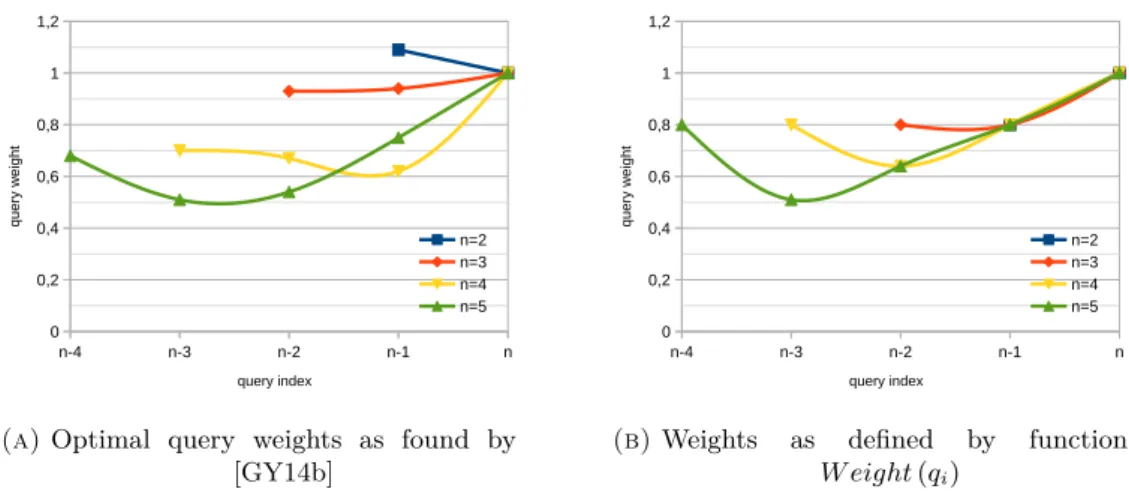
Guan and Yang [GY14a; GY14b] have investigated the optimal weighting factor for a query depending on its position in the query history. They define a function
22 3. Core Concepts n-4 n-3 n-2 n-1 n 0 0,2 0,4 0,6 0,8 1 1,2 n=2 n=3 n=4 n=5 query index query we ight
(a)Optimal query weights as found by
[GY14b] n-4 n-3 n-2 n-1 n 0 0,2 0,4 0,6 0,8 1 1,2 n=2 n=3 n=4 n=5 query index query we ight
(b)Weights as defined by function
W eight(qi)
Figure 3.1.:Query weights depending on the index position of the query and the length
of the session
score(q, d) which calculates the match score of a document dfor a queryq, which is
the result of a regular information retrieval method. The score function of a search sessionS is therefore defined as:
scoreS(d) = n
X
i=1
wi·score(qi, d)
They call this methodquery aggregation, independent of the actual weight factor and score function that is used. Based on data from TREC 2010-2012, Guan and Yang trained a support vector machine to learn the optimal weight factors for different session lengths. The weights they discovered for search sessions that consist of up to 5 queries are displayed in Figure 3.1a. Their findings show that relevance generally decreases with increasing distance to the latest query, with the exception of the very first query, which always remains about as relevant as the second to last query. These experimental findings can be roughly approximated by an exponential function with a baseλ= 0.8, with an exception for the first query in a session:
weight(qi) =
(
λn−i f or i >1
λ f or i= 1
A plot of this function can be seen in Figure 3.1b for comparison. It shall be noted that the experimental results of Guan and Yang are based on query logs that have been obtained from a static search engine and were never tested with a session-based search engine, therefore the suggested value forλis more of a starting point for further optimization.
3.2. Topic Centroid
In exploratory search scenarios it is to be expected that the user is not fully aware of the specific terminology that is required to find the most relevant documents.
3.2. Topic Centroid 23
We discussed in the last section, how the ranking of search results can be improved through query aggregation, but this technique still relies on conventional text retrieval methods which will not be sufficient to find relevant documents that do not necessarily contain the keywords the user has entered. In order to find semantically related documents, we are going to use a search index where topic labels have been assigned to all documents. If we find a way to infer the most relevant topics in a search session, we can efficiently search for other documents in the index that are about these topics. In Section 2.3 we have reviewed a variety of query classification techniques that can help to discover the main topics of a search query by analyzing the text retrieval results of that query. In this section we will introduce topic identification, a novel query classification technique that discovers the most relevant topics in a list of documents that have been tagged with topic labels.
A major benefit of session-based search is that we can learn to understand the user’s intent in multiple iterations. For each query that the user submits, we can analyze the query and the the search result list to enhance the response to the next search query. The same data can be used to improve the search engine’s model of what the user is currently looking for. Therefore we define thetopic centroid, a data structure that holds the most relevant topics in a search session. It can be stored as a list of tuples, each consisting of a topic t and a score s. Later in this section we present a method to update the topic centroid of a search session with the identified topics of a new search query, which we calltopic shift.
With this approach we can suggest more documents that are semantically related to the most recent search results, even if they don’t match the keywords of the user’s query, and we can adjust the scores of matching documents based on the topics they are about.
3.2.1. Topic Identification
We introducetopic identification, a novel method to decide, based on a list of search results, which topics are most relevant to the user’s current search interest. More generally speaking, we will decide which topics are most relevant in a ranked selection of documents from a document collection, where each document has been assigned at least one topic label.
This task is not related to topic detection [All02], which is mainly concerned with text segmentation by recognizing known topics and identifying previously unknown topics, e.g. for news aggregation. Topic identification is related to query classifica-tion [SSY+06; BFG+07; BSD10], although the technique we describe in this section is based on pre-calculated topic models instead of ad-hoc text classification and the topic aggregation methods we use are far more fine-grained than those that are used in related work.
Definition
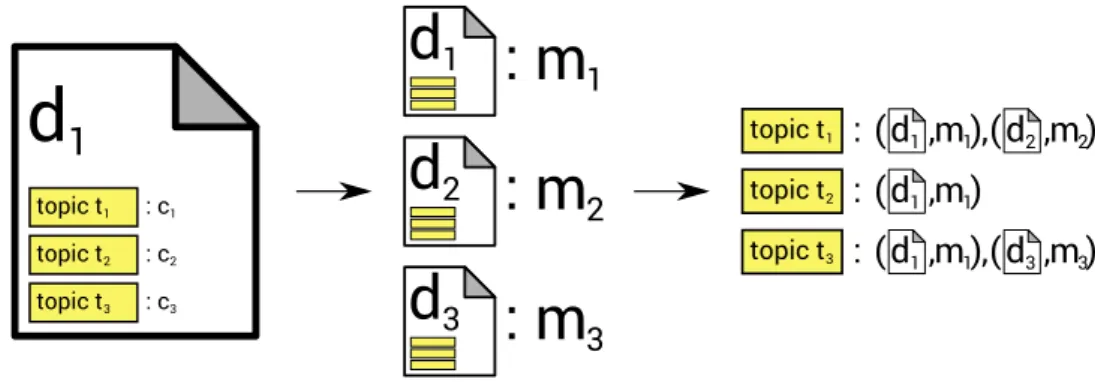
Given a document collection D that consists of documents d1, . . . , dn and a topic
model T that consists of topics t1, . . . , tm, we assume that each document d has
been assigned zero or more topics t (see left panel in Figure 3.2). Furthermore we assume that each topic t that has been assigned to a document d has a certainty