Page | 30
Control and Data Fusion e-Journal: CADFEJL Vol. 2, No. 4, pp. 30-43, Jul-Aug 2018
A Brief Exposition on Brain-Computer Interface
T.M. Amulya
1and VPS Naidu
2 1Dept. of Avionics, Inst. of Science & Technology,
JNTUK, Kakinada, India;
2Multi-Sensor Data Fusion Lab,
CSIR - National Aerospace Laboratories, Bangalore, India
Email ID: [email protected] & [email protected]
Abstract: Brain-Computer Interface is a technology that records brain signals and translates them into useful commands to operate a drone or a wheelchair. Drones are used in various applications such as aerial operations, where pilot’s presence is impossible. The BCI can also be used for patients suffering from brain diseases who lose their body control and are unable to move to satisfy their basic needs. By taking advantage of BCI and drone technology, algorithms for Mind-Controlled Unmanned Aerial System can be developed. This paper deals with the classification of BCI & UAV, methodologies of BCI, the framework of BCI, neuro-imaging methods, BCI headset options, BCI platforms, electrode types & their placement, and the result of feature extraction technique (FFT) with 72.5% accuracy.
Keywords: Brain-Computer Interface (BCI), Unmanned Aerial System, drone technology, Mind Controlled Unmanned Aerial System (MCUAS).
1. Introduction
The BCI is also referred to as Human Machine Interface (HMI) or Man Machine Interface (MMI). It is
a technique where a human brain and machine (computer) are interfaced. The signals are collected from
the human brain and are converted into commands
to move a drone or a wheelchair. There is a lot of process in between converting brain signals into useful commands. Brain Cortex plays a major role in the BCI system, as it is associated with neurological responses and functions. Brain Cortex is the outer most layer that surrounds the brain. It is divided into four different lobes: i)Frontal:
It is located in the front part of the brain, ii)Parietal:
It is present near the centre of the brain, behind the frontal lobe, in front of the occipital lobe and above the temporal lobe, iii)Temporal:
It is present behind the ears and extends to both sides of the brain and iv)Occipital:
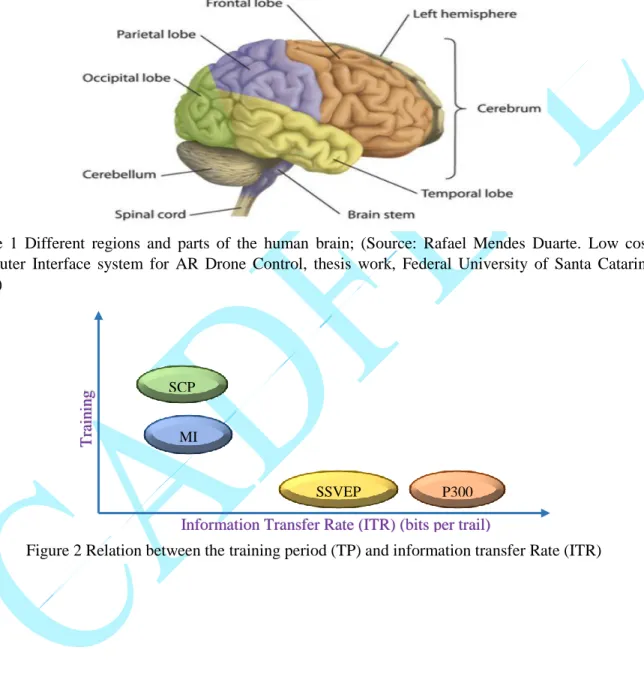
It is located at the back of the brain. The different regions and parts of the human brain are shown in the Figure 1. As the brain cortex is present at the uppermost surface of the brain, any injury to the brain causes damage to the brain cortex and people may lose their bodily control [1]. However, it is easy to collect brain signals from the brain cortex, as it is in the uppermost part of the brain, using non-invasive methods like EEG (Electro-Encephalography), MEG (Magneto-Encephalography), fMRI (functional Magnetic Resonance Imaging) and fNIRS (Functional Near-Infrared Spectroscopy). BCI is like a boon to those who are suffering from brain diseases like paraplegia, tetraplegia, spinal-cord injuries, paralysis motor disabilities, and epilepsy; and eventually losing their body control. In the BCI flight technology, we mainly deal with how a pilot takes-off, flies and lands a drone using just his thought power. In the field of aviation, an EEG cap is fitted to the pilot and his brain signals are interfaced with the computer (and to control surfaces). This paves the way for brain flight technology. In the future, this technology will be able to control passenger flights by using thought power of a pilot. In addition, during space exploration, astronauts will perform complex tasks in highly pressurized suits, which do not afford easy access to manual controls. This brain flight technology leads to control of displays and devices in future flight technology.2. Classification of BCI
Page | 31
BCI could be classified based on different aspects: Bio recording method, Autonomy and Neurological Phenomena.2.1 Bio Recording Method
Biosignals can be recorded using different techniques based on which BCI can be classified as: i)
Invasive: t
he invasive method includes a surgical operation, in which microelectrodes grid is implanted to record intracranial signals either from the cortical surface or from inner brain tissues. These invasive BCIs carry more information compared to non-invasive but these are of high risk and are not used in real-world applications [2]; and ii)Non-Invasive: t
his method does not require a surgical operation: fMRI and fNIRS are non-invasive methods. These measure the hemodynamic response, the delivery of blood to neuronal tissues, however, these have low temporal resolution and therefore not suitable for real-time control of MCUAV’s. EEG and MEG are also non-invasive methods which measure the brain’s electric and magnetic fields respectively and are the best suitable methods [2].2.2 Autonomy
The autonomy of BCI mainly depends on the external stimuli, which in turn depends on the operation of its transducer. The transducer is in the exogenous mode if the presence of external stimuli is needed to evoke the user’s response and therefore the system is synchronous. Otherwise, the transducer is in the endogenous mode and the system is asynchronous. In general, events are executed step by step in synchronous BCI. If anyone of the tasks fails then the whole process fails. Asynchronous BCI is better compared to synchronous BCI, as it is not done step by step. A single event runs all the tasks [2].
2.3 Neurological Phenomena
Neurological Phenomena includes the evoked potentials and induced potentials. The evoked potentials are the electrical potentials which occur due to a continuous stimulus that is measured from the nerves. Induced potentials are caused by imagining the movements [2]. Another classification is based on input types, processing types, and output types. Input types are again classified as invasive and non-invasive methods. The processing types are divided into synchronous and asynchronous, or independent and dependent. We have already discussed synchronous and asynchronous BCI in the previous section. Coming to the Independent and Dependent BCI, the peripheral nerves and muscles do not have an essential role in the operation of an independent BCI. User’s intention is the main thing here. The user selects a specific letter irrespective of imagination and visual stimulus. In contrast, the dependent BCI depends on brain activity. For example, VEP (Visual Evoked Potential) comes under this category [3]. BCI can otherwise be classified as Active, Reactive and Passive based on its output types. Active BCI generates its output directly from brain activity i.e. machine is controlled by thought power of one’s mind. It does not depend on external muscular events for controlling an application. A reactive BCI is a kind of BCI which derives its output from brain activity, by focusing on some external stimuli, which is indirectly modulated by the user for controlling an application. On the other hand, passive BCI gives an output of arbitrarily generated brain signals that are not under voluntary control [4]. A BCI system is also classified as exogenous or endogenous depending on the nature of the recorded signal. Exogenous BCI systems depend on neuron activity evoked by external stimuli. Such stimuli include Visual Evoked Potential (VEP) or auditory evoked potentials. Exogenous BCI systems do not require intensive training. In contrast, endogenous systems do not rely on an external stimulus. It is based mainly on brain rhythms and other potentials. Sensorimotor Rhythms and Slow Cortical Potentials (SCP) comes under this category [3].
3. Classification of UAV
UAV is an aircraft without a human pilot on-board. UAVs are a component of an unmanned aircraft system (UAS) which include a UAV, a ground-based controller, and a system of communication between the two. The flight of UAVs may operate with various degrees of autonomy: either under remote control by a human operator or autonomously by on-board computers. Based on operational characteristics and attributes, there are different classification schemes for UAVs. The brain-controlled UAV’s are classified based on two metrics: Dynamics
Page | 32
and Autonomy of the system [2].3.1 Dynamics
Based on Dynamics, UAVs are classified into three classes: fixed-wing crafts, rotary crafts and airship (or) dirigible balloon [2]. Fixed-wing UAVs operates with high speed and the payload is also heavy. The only limitation is that forward motion is required continuously for them to remain in the air [2], [5]. Fixed wing drones are suitable for fast linear flights to reach distant targets as they can fly with high velocity. They are mainly used for military purposes. In contrast, rotary-wing UAVs possesses low mobility and payload, but the directionality is high and also they can stay in the air [5]. Rotorcrafts are manufactured in different forms such as a monitor (helicopter) or multirotor (a quadcopter, a hexacopter etc.). These types of UAVs grab their attention with their fine manoeuvring capability and these are affordable and vastly accessible. That is why most of the Brain-controlled UAVs use rotorcrafts as their UAV. Airships or dirigible balloons are used for environmental monitoring mission’s coastal surveillance.
3.2 Autonomy of the system
Based on autonomy, UAVs can operate mainly in three modes (Mode1, Mode2 and Mode3). In the mode1, the pilot will be present in the ground station instead of on-board and pilot controls directly all the aircraft systems in the real-time. In the mode2, a pilot and an on-board control system shares the control operation. In the mode3, the aircraft operates automatically without any human intervention directly [2].
4. Methodologies of BCI
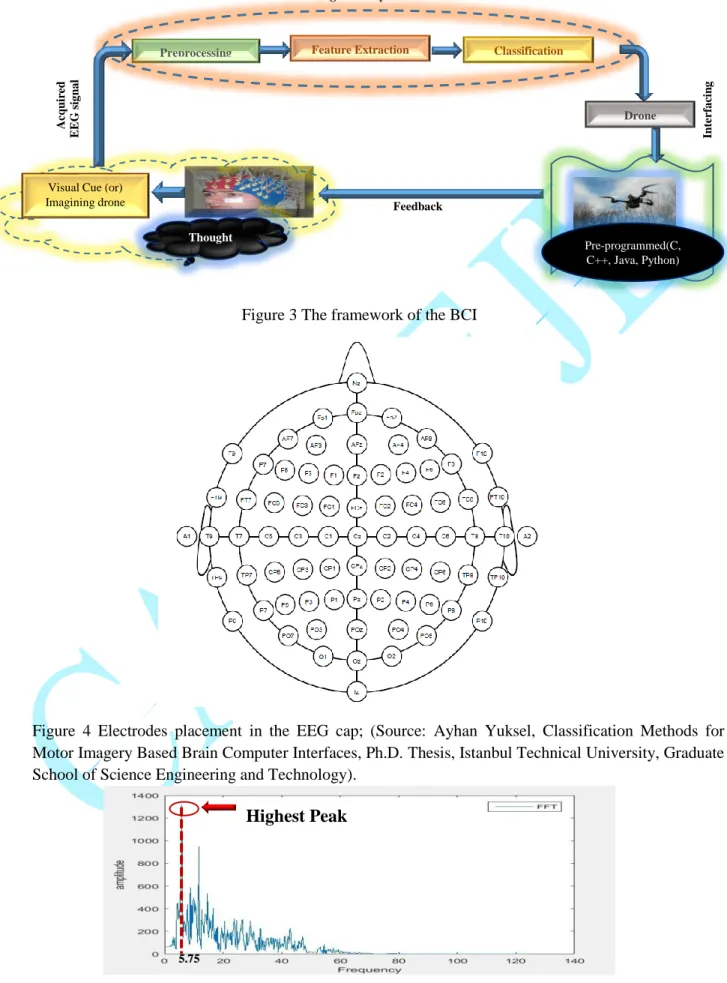
There are different methods for implementing BCI: a) SSVEP based Method, b) Motor Imagery Method, c) P300 Paradigm, d) Slow Cortical Potentials, d) Cortical Neuronal Activation Potentials, and e) Sensorimotor Rhythms. Different types of BCI methodologies are shown in the Table-1. Among these methods, SSVEP (Steady-State Visual Evoked Potential) is the best method. SSVEP does not need any training to the user and the Information Transfer Rate (ITR) is higher compared to other techniques. MI (Motor Imagery) technique needs user training and it has very low ITR. P300 does not need training but due to triggering, it induces some latency. SCP (Slow Cortical Potentials) needs user training and ITR is low. The relation between the training period and information transfer rate is shown in the Figure 2.
4.1 SSVEP based Method
Evoked Potential is an electrical potential that occurs in the cortex after stimulation of a sense organ. For example, there will be an LCD screen containing four stimulation arrows flickering at different stimulus frequencies. When the subject, who sits in front of the LCD screen along with an EEG cap worn, focuses on any one of the blinking stimulators, then the corresponding frequency component of the EEG signal received from the occipital area will be much higher than that of the other blinking stimulators. Therefore, it will be easy to find out which stimulator user had focused his attention on without any training period. In SSVEP based BCI system, frequencies of the stimulator are generally less than 20 Hz [6].
4.2 Motor Imagery Method
Motor Imagery is nothing but imagining a movement or performing an action mentally. The oscillations in the alpha and beta bands can display either an event –related blocking response (or) an event –related amplitude enhancement. The former is named as Related De-synchronization (ERD) and the latter is called Event-Related Synchronization (ERS). ERD is a short- lasting attenuation (or) blocking of rhythms within alpha or beta bands. ERD is observed for about 2 seconds before the onset of movement. It is found during and before visual stimulation. It reflects Primary Visual Processing and feature extraction [6].
4.3 P300 Paradigm
P300 Paradigm is another methodology used for the BCI. The P300 responses are evoked about 300ms after attending to a stimulus. P300 paradigm does not require any training. However, the performance is very low as the user gets infrequent stimulus and consequently, the amplitude of P300 is decreased. The P300 or P3 wave is also called as Event-Related Potential (ERP) and it is generally obtained in an interval between 300ms and
Page | 33
500ms after an infrequent stimulus occurs. The main difference between P300 and SSVEP is that the waveform obtained in P300 is a result of intra-process (within a single place) activities of the brain and not related directly to the given stimuli. In addition, P300 signal can be obtained with various types of stimulators like visual, auditory, and somatic. The Oddball method is used for the BCI studies based on the P300. This is a speller method, which contains a matrix with letters in six rows and six columns on the computer display. A character has to be selected by the user from the matrix and the user has to wait for the illumination of the selected character. The user tries to count the number of times the selected character blinked when the rows and columns are highlighted randomly. Meanwhile, from the user’s parietal cortex an EEG signal is collected. Average amplitude is calculated from each row and column separately and finally, the amplitude for the column and row of the selected character will be higher than that of the other characters. The main disadvantage of P300 paradigm is its latency due to its triggering [6].4.4 Slow Cortical Potentials
Slow Cortical Potentials are nothing but the voltage changes that may be positive or negative that are observed while measuring through the EEG cap. These last for about 0.5 to 10 seconds with an amplitude of nearly 50 mV. With the help of slow cortical potentials a device known as Thought Translation Device (TTD) was developed. TTD, which is a computer program, helps the user to control their SCP’s by providing auditory and visual feedback to the user. People suffering from Amyotrophic Lateral Sclerosis (ALS) were tested with TTD and have shown positive results for basic communication skills. The positive SCP’s are related to the decreased activity in neurons, whereas negative SCP’s are associated with the neuronal activity [6].
4.5 Cortical Neuronal Activation Potentials
This method is not generally used as it is an invasive method and it causes some risk. Moreover, the contact of the electrode placed with the related neuron may be lost as the time passes. The signals recorded are transmitted to a receiver and are processed so that a cursor on a computer screen moves [6].
4.6 Sensorimotor Rhythms
Sensorimotor rhythms are obtained by combining mu and beta rhythms. Sensorimotor rhythms are associated with motor imagery without any movement. These are mostly used for designing endogenous BCIs. As people tend to struggle with motor imagery, extensive user training is required. Imagining visual images of the corresponding real movements is insufficient for a BCI system. This is because sensorimotor rhythm patterns are dissimilar to motor imagery. Therefore, training should emphasize kinaesthetic experiences rather than visual representations of the movements [6].
5. The Framework of BCI
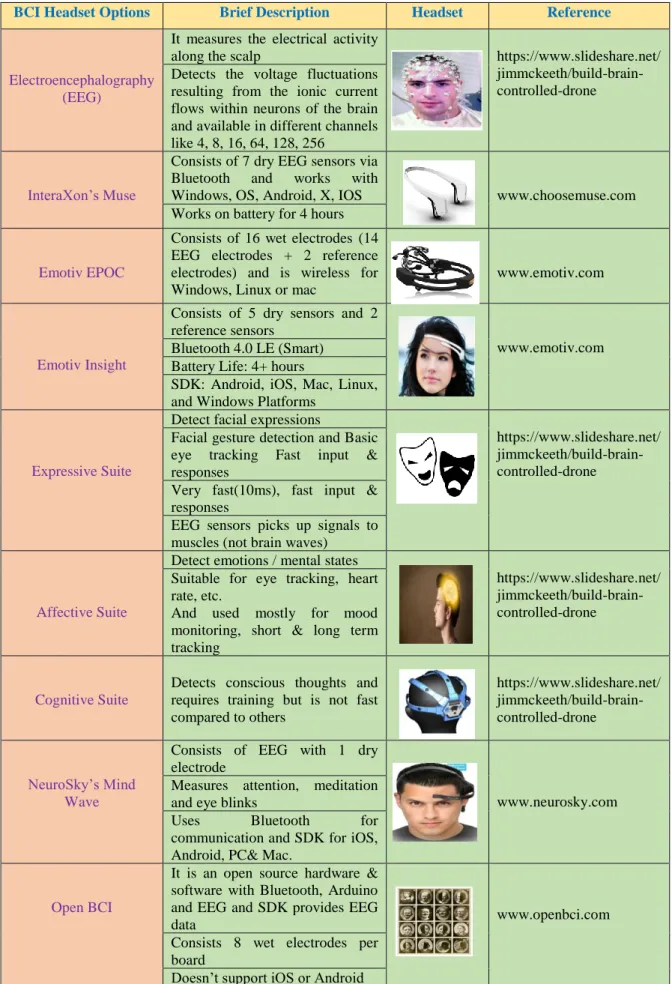
Most of the BCI systems share a similar architecture. The framework of BCI comprises of training and feedback, control strategies, pre-processing, feature extraction, classification as shown in Figure 3.
5.1 Training and feedback
In order to gain control over the aircraft, users have to be trained to control their brain activities. Here, system feedback should also be taken into consideration. For training the brain controlled UAV operators, virtual or real environment or both are used. The feedback is generally visual feedback, so that the subject can see whether the drone is flying or not [2].
5.2 Control Strategies
The brain-controlled UAV operator can control the aircraft either directly or indirectly depending on the BCI design. The pilot uses BCI to directly actuate the aircraft in the state space (i.e., navigating the aircraft to right/left, up/down, forward/backward, etc.) in the direct method. In contrast, the operator controls the aircraft by specifying its future trajectory and destination in the indirect method [2].
5.3 Pre-processing
pre-Page | 34
processing of the raw data but filtering is mostly opted, as it is the easiest method to remove noisy data and extract the desired frequency band. The most common filters used are high-pass, low-pass, band-pass, Butterworth filter, Chebyshev filter etc. The other pre-processing techniques used are Adaptive Filtering (AF), Blind Source Separation (BSS), Unscented Kalman Filter (UKF), Cycle spinning wavelet ICA (CTICA), Common Average Referencing (CAR), Surface Laplacian (SL), Common Spatial Patterns (CSP), Independent Component Analysis (ICA), and Principal Component Analysis (PCA) [2].5.4 Feature Extraction
After smoothing the raw data, as there will be a huge data, desired features are extracted from the data using different feature extraction techniques. Some of the feature extraction techniques used in BCI are as follows:- Fast Fourier Transform (FFT), Discrete Cosine Transform (DCT), Discrete Sine Transform (DST),Continuous Wavelet Transform (CWT), Hilbert-Huang Transform (HHT), Thompson Transform (TT), Short Time Fourier Transform (STFT), Wavelet Packet Transform (WPT), Alpha-Band Power (α-BP),Spectral F-Test (SFT), Auto-Regressive Model (AR) (Yule-Walker Method and Burg’s Method), Auto-Regression-Moving Average (ARMA), Auto-Regressive Conditional Heteroscedasticity model (ARCH), Auto-Regressive Integrated Moving Average (ARIMA), Moving Average Model (MA), Maximum contrast combination (MCC), Average maximum contrast combination (AMCC), Empirical Mode Decomposition (EMD), Multivariate Synchronization Index (MSI), Multivariate linear regression (MLR), Likelihood Ratio Test (LRT), Generalized Likelihood Ratio Test (GLRT), Multi-Taper Method (MTM), Distinction Sensitive Learning Vector Quantization (DSLVQ), Sequential Probability Ratio Test (SPRT), Simplified Matching Pursuit (SMP), Kernel Partial Least-Squares Regression (KPLSR), Double-partial least squares (D-PLS), Minimum Energy Combination (MEC), Least Absolute Shrinkage & Selection Operator (LASSO), Canonical Correlation Analysis (CCA), Multi-set CCA (M-set CCA), Multilayer correlation maximization (MCM), Multi-way CCA (M-way CCA), Phase-Constrained CCA (PCCA), Deep Canonical Correlation Analysis (DCCA),Individual template-based canonical correlation analysis (IT-CCA), Combined-canonical correlation analysis (Combined-CCA),Canonical correlation analysis-Fixed Spatial Filter (CCAFSF), L1-regularized multi-way canonical correlation analysis (L1-MCCA), Filter bank canonical correlation analysis (FBCCA), Binary Sub band CCA method (BsCCA), Combined-tCCA method, Common feature analysis (CFA), Analytic common spatial pattern (ACSP), Task-related component analysis (TRCA),Eigen vectors (Pisarenko’s Method, MUSIC Method,Minimum Norm Method), Dot product (DP), Pseudo-Inverse (pinv), Goertzel’s algorithm [6]-[26].
5.5 Classification
The obtained features have to be classified (for eg: left and right) to convert them into drone commands. The most used classification algorithms used in BCI research are linear classifiers, neural networks, nonlinear Bayesian classifiers, and nearest neighbour classifiers. Some of the classification techniques frequently used are: Linear Discriminant Analysis (LDA), Fisher Linear Discriminant Analysis (FLDA), Stepwise Linear Discriminant Analysis (SWLDA), Bayesian Linear Discriminant Analysis (BLDA), Support Vector Machine (SVM), Gaussian Support Vector Machine (GSVM), Maximum Likelihood (ML), Independent Component Analysis (ICA), Principal Component Analysis (PCA), Naive Bayes (NB), Common Spatial Pattern (CSP), Common Average Referencing (CAR), Surface Laplacian (SL), Adaptive Filtering (AF), Matched Filtering (MF), Genetic Algorithm (GA), Hidden Markov Model (HMM), Multi-Layer Perceptron (MLP), Fuzzy Hopfield Neural Network (FHNN), Learning Vector Quantization (LVQ), Radial Basis Function Neural Network (RBFNN), Fuzzy ARTMAP Neural Network (FANN), Adaptive Logic Network (ALN), Finite Impulse Response Neural Network (FIRNN), Time-Delay Neural Network (TDNN), K-Nearest Neighbour (KNN) classifier, Back Propagation Neural Networks (BPNN), Sequential Selection (SS), Random Forest (RF), Self-Organized Maps (SOM), Extreme Learning Machine (ELM) [6], [27]-[34].
6. Neuro-Imaging methods
Page | 35
Metabolic methods. Electro-Encephalography, Electro-Corticography, Magneto-Encephalography, and Electrical signal acquisition in single neurons comes under Electrophysiological methods and metabolic methods include functional Magnetic Resonance and Near-Infrared Spectroscopy [6].6.1 Electrophysiological methods
These methods include EEG, MEG, ECoG, and Intra-Cortical Neuron Recording.
6.1.1 Electro-Encephalography (EEG)
EEG measures the electric brain activity that is caused by the flow of electric currents in the neurons. It is most widely used, as it is a non-invasive method and also costs less compared to others. The main drawback in this method is this technique is severely affected by the background noise. For EEG measurement, the minimal configuration comprises of one active, one ground, and one reference electrode. The electrodes are made of AgCl [6].
6.1.2 Magneto-Encephalography (MEG)
MEG is a non-invasive imaging technique. The brain’s magnetic activity is registered by means of magnetic induction. In MEG, the magnetic fields are less distorted by the skull and scalp than electric fields. This is the main advantage of MEG. In spite of the advantages, it is more bulky and expensive system [6].
6.1.3 Electro-Corticography (ECoG)
ECoG is an invasive technique for measuring the electrical activity by placing electrodes inside the cortex of the brain. ECoG provides high spatial and temporal resolution compared to EEG [6].
6.1.4 Intra-Cortical Neuron Recording
Intra-cortical neuron recording is an invasive technique that measures electrical activity inside the substantia grisea. It requires microelectrode arrays to implant inside the cortex to capture the potentials and provides much higher temporal and spatial resolution compared to EEG recording [6].
6.2 Metabolic methods
These methods include Functional Magnetic Resonance Imaging (fMRI) and Near Infrared Spectroscopy (NIRS)
6.2.1 Functional Magnetic Resonance Imaging (fMRI)
fMRI is a non-invasive method but it is of high cost and difficult to handle. It provides low temporal resolution and is an indirect measurement, which measures the level of oxygen in the blood (Blood Oxygen Level Dependent (BOLD)). It is non-portable but provides high spatial resolution. It is also bulky and expensive device [6].
6.2.2 Near Infrared Spectroscopy (NIRS)
NIRS uses infrared light to check the cortex functioning and is also a non-invasive method. IR rays enters the skull nearly 1to3cm depth. Here, some of the rays gets attenuated. The changes in the oxy-haemoglobin and De oxy-haemoglobin are measured are measure here [6].
7. BCI platforms
A BCI platform is a software median between the EEG hardware (and software) & the commands we want to convert. There are different kinds of BCI applications. BCI platforms are classified into two main types; one that can run online data and the second one is offline data [35]. A few BCI platforms (open literature) are as follows:
7.1 OpenVibe
Open Vibe is portable and easy to use and is one of the most widely used open source BCI application software currently available. It supports multiple platforms and uses for different research works. However, it is mostly used for VEP [35].
7.2 BCI2000
BCI2000 is used for both online and offline data. Here, TCP/IP is used for communication unlike OpenVibe, which uses the serial port, or USB ports. BCI2000 runs four modules: operator (visualization’s and EEG control), source storage, signal processing and user application (commands to application) [35].
7.3 BrainBay
Page | 36
application. It also supports Human-Computer Interface used to transmit the online data through the TCP/IPprotocol. It was mainly used for Open EEG hardware such as Modular EEG devices [35].
7.4 BCILAB
BCI LAB is a free software Matlab toolbox for BCI. It visualizes the EEG data and extracts the state of mind (BCILAB, 2013). The main drawback of BCI LAB is difficulty in classifying the data [35].
8. Electrodes & its Placement
There are mainly two types of EEG electrodes. They are: wet electrodes and dry electrodes.
8.1 Wet Electrodes
These electrodes are used for recording the signals and are generally made of silver/silver chloride. These electrodes are an inexpensive. For sticking the electrodes to the scalp, a conductive gel is used. Some of the conductive gels used most commonly for EEG cap are:- Ten20 EEG Conductive Paste, Nuprep EEG & ECG Skin Prep Gel, Elefix Conductive EEG Paste, Dermedics EEG gel, Signa gel, Spectra 360, One step EEG gel [36], [37].
8.2 Dry Electrodes
Dry electrodes are comfortable compared to the wet electrodes as they don’t use the conductive gel. They come in the form of a headset and is easy to wear. But the contact impedance is more compared to the wet electrodes [38]. The different types of BCI headset options are shown in the Table-2 [39]. The standard 10-20 system is used when placing the EEG electrodes over the subject’s head. For describing and applying the location of electrodes, the International 10–20 system is used. This system is based on the relationship between the underlying area of cerebral cortex and location of an electrode. The letters O, P, C, T and F stands for occipital, parietal, central, temporal and frontal respectively [35]. The electrodes placement in the EEG cap is shown in figure 4 [40].
9. Result and Discussion
In this section, SSVEP based BCI is demonstrated with FFT. EEG signal x (n) was acquired from O1 (channel 1), Oz (channel 2) and O2 (channel 3) electrodes with sampling frequency of 250Hz for a duration of four seconds. The visual stimulus frequencies are 9.75, 8.75, 7.75 and 5.75 Hz. FFT based spectrum is computed and found the peak in the spectrum and its corresponding frequency as follows:
( )
1 ,..., 2 , 1 , 0 , 2 ) ( 1 ,..., 2 , 1 , 0 , ) ( 2 1 0)
(
1
− = = − = −
− ==
N k s f N k k f N k N nk je
n
x
N
k
X
N n (1)Where, N: Number of samples in signal x; k: Index; s
f
:
Sampling frequency: find ‘k’ at max( X(k)); Stimulus frequency f(k)f
S = .
The computed spectrum, peak magnitude and its corresponding frequency is as shown in the Figure 5. The frequency corresponds to highest peak will be the stimulus frequency. The true and estimated stimulus frequencies are shown in Table-1. True frequencies are 9.75, 8.75, 7.75 and 5.75 Hz. Based on the decision fusion, ‘1’s and ‘0’s are assigned to the expected frequencies respective to the stimulus frequencies. If the obtained values are nearer or equal to the true frequencies then we assigned it as ‘1’, otherwise ‘0’. Based on the final decision, accuracy was calculated. In the final decision, if two out of the three channels got the same value (suppose ‘1’) then that value was taken into consideration. The accuracy was obtained as the ratio of percentage of the total number of 1’s obtained in the final decision to the total count (i.e. 20 trails* 4 stimulus frequencies= 80). In between the two datasets, dataset 1 gave good accuracy. Poor accuracy for dataset 2 (maybe the subject was not
Page | 37
well trained or may have a problem in the occipital region (left or right eye)).Among the channels, O1 (channel 1), Oz (channel 2) and O2 (channel 3), channel 2 that is ‘Oz’ got good accuracy compared to the other two channels. The channel 2 (i.e., ‘Oz’) got ‘76.25%’ and channel 1(‘O1’) got ‘63.75%’. The channel 3(‘O2’) got ‘68.75%’. Magnitude is also shown for each channel and no information was obtained by observing those magnitude values.10. Concluding remarks
Classification BCI, UAV classification, Framework of BCI, BCI recoding methods, BCI platforms, Types of electrodes and their placement are discussed. SSVEP based BCI techniques had been demonstrated with simple and well-proven FFT.
References
[1]
Rafael Mendes Duarte, “Low cost Brain Computer Interface system for AR, Drone Control”, thesis work, Federal University of Santa Catarina, May 2017.[2]
Amin Nourmohammadi, Mohammad Jafari, and Thorsten O. Zander, A Survey on Unmanned Aerial Vehicle Remote Control Using Brain–Computer Interface, IEEE Transactions on Human-Machine Systems, Vol. 48, Issue 4, August 2018, Pgs. 337-348.[3]
Angela T. Chan, Juan C. Quiroz, Sergiu Dascalu, Frederick C. Harris, Jr, An Overview of Brain Computer Interfaces, 978-1-880843-98-7 / copyright ISCA, CATA 2015, March 9-11, 2015, Honolulu, Hawaii, USA.[4]
Minkyu Ahn, Mijin Lee, Jinyoung Choi, and Sung Chan Jun, A Review of Brain-Computer Interface Games and an Opinion Survey from Researchers, Developers and Users, Sensors, August 2014.[5]
Yong Zeng, Rui Zhang, Teng Joon Lim, Wireless communications with unmanned aerial vehicles: opportunities and challenges, IEEE Communications Magazine, Vol. 54, Issue 5, May 2016, Pgs. 36-42.[6]
Luis Fernando Nicolas-Alonso and Jaime Gomez-Gil, Brain Computer Interfaces, a Review, Sensors,2012, doi: 10.3390/s120201211.
[7]
Seyed Navid Resalat, Valiallah Saba, A Study of Various Feature Extraction Methods on a Motor Imagery Based Brain-Computer Interface System, Basic and clinical Neuroscience, January 2016, Vol. 7, No. 1.[8]
Richard M. G. Tello, Sandra M. T. Mullery, Teodiano Bastos-Filho, Andre Ferreira, A Comparison ofTechniques and Technologies for SSVEP Classification, Department of Computer and Electronics (CEUNES), 2014, Brazil.
[9]
Anti Ingel, Machine Learning in VEP-based BCI, Master Thesis, the University Of Tartu Faculty Of Science and Technology, Institute of Computer Science, 2017.[10]
https://nptel.ac.in/courses/117103018/module8/lec30/1.html [Accessed on 15-12-2018][11]
https://www.mathworks.com/examples/signal/mw/signal-ex41524780-multitapermethod [Accessed on 15-12-2018]Page | 38
[12]
Behtash Babadi, Emery N. Brown, A Review of Multitaper Spectral Analysis, IEEE Transactions onBiomedical Engineering, Vol. 61, No. 5, May 2014.
[13]
M. Pregeiizer, Pfurtschcller Graz, Distinction Sensitive Learning Vector Quantization (DSLVQ) application as a classifier based feature selection method for a Brain-Computer Interface, University of Technology, Austria, Artificial Neural Networks, July 1995, Fourth International Conference, DOI: 10.1049/cp:19950595.[14]
Yu Zhang, Guoxu Zhou, Jing Jin, Xingyu Wang, Andrzej Cichocki, Frequency recognition in SSVEP-based BCI using multiset canonical correlation analysis, International Journal of Neural Systems, 24(4): 1450013, June 2014, DOI: 10.1142/S0129065714500130.[15]
https://www.biopac.com/?app-advanced-feature=integrated-rms-emg [Accessed on 15-12-2018]
[16]
Sachin Sharma, Gaurav Kumar, Sandeep Kumar, Debasis Mohapatra, Techniques for Feature Extractionfrom EMG Signal, International Journal of Advanced Research in Computer Science and Software Engineering, Vol. 2, Issue 1, January 2012.
[17]
Mosarrat Jahan, Munish Manas, Bharat Bhushan Sharma, Babu Bikash Gogoi, Feature Extraction and Pattern Recognition of EMG based Signal for Hand Movements, International Symposium on Advanced Computing and Communication (ISACC), 2015, Silchar, India.[18]
Sachin Negi, Yatindra Kumar, V. M. Mishra, Feature Extraction and Classification for EMG Signals Using Linear Discriminant Analysis, 2nd International Conference on Advances in Computing, Communication, & Automation (ICACCA), 2016, 978-1-5090-3480-2, Bareilly, India.[19]
Dalila Trad, Tarik Al-Ani, Mohamed Jemni, Motor Imagery signal Classification for BCI System Using Empirical Mode Decomposition and Band power Feature Extraction, Broad Research in Artificial Intelligence and Neuroscience (BRAIN), Vol. 7, Issue 2, June 2016, ISSN 2067-3957 .[20]
Marcin Kołodziej, Andrzej Majkowski, and Remigiusz J. Rak, Simplified matching pursuit as a new method for SSVEP recognition, 39th International Conference on Telecommunications and Signal Processing (TSP), 2016, Vienna, Austria, 978-1-5090-1287-9.[21]
Bain Yifeng, Xiao Jian, Yu Long, Kernel Partial Least-Squares Regression, International Joint Conference on Neural Networks, Canada, 2006.[22]
Galen Andrew, Raman Arora, Jeff Bilmes, Karen Livescu, Deep Canonical Correlation Analysis, Proceedings of the 30th International Conference on Machine Learning, Atlanta, Georgia, USA, 2013.[23]
Prajwali P. Korde, V. M. Thakare, Fractal Dimension Methods for Feature Extraction in OptimizedHarmony Search-based Hidden Markov Model during Motor Imagery, International Journal of Computer Applications , National Conference on Recent Trends in Computer Science & Engineering (MEDHA 2015).
Page | 39
[24]
Youssef Hmamouche, Alain Casali and Lotfi Lakhal, A Causality-Based Feature Selection Approach ForMultivariate Time Series Forecasting, The Ninth International Conference on Advances in Databases, Knowledge, and Data Applications, Marseille, France.
[25]
R Zerafa et al, To train or not to train? A survey on training of feature extraction methods for SSVEP-based BCIs, Journal of Neural Engineering, 2018. http://iopscience.iop.org/article/10.1088/1741-2552/aaca6e/meta [Accessed on 15-12-2018][26]
Amjed S .Al-Fahoum and Ausilah A. Al-Fraihat, Methods of EEG Signal Features Extraction Using Linear Analysis in Frequency and Time-Frequency Domains, ISRN Neuroscience, Vol. 2014, Article ID 730218, 7pages. http://dx.doi.org/10.1155/2014/730218 [Accessed on 15-12-2018][27]
Martin Simon, Design and Aerodynamic Optimization of a Vertical Take-off and Landing Fixed-Wing Drone with Brain-Computer Interface, thesis work, TUT Department of Mechanical and Industrial engineering, Tallinn, 2018.[28]
http://www.csd.uwo.ca/~olga/Courses/CS434a_541a/Lecture8.pdf21 [Accessed on 15-12-2018][29]
A. Cohen, Hidden Markov models in biomedical signal processing, International Conference of the IEEE Engineering in Medicine and Biology Society, Vol.20 , Nov. 1998, Hong Kong, China, 10.1109/IEMBS.1998.747073.[30]
Micheal T. Manry, Hema Chandrasekharan, Cheng-H suing Hsieh, Signal Processing Using the Multilayer Perceptron, Hand book, CRC press.[31]
https://en.wikipedia.org/wiki/Backpropagation#cite_note-3 [Accessed on 15-12-2018][32]
https://www.solver.com/xlminer/help/neural-networks-classification-intro [Accessed on 15-12-2018][33]
https://en.wikipedia.org/wiki/Random_forest [Accessed on 15-12-2018][34]
https://www.techopedia.com/definition/32068/self-organizing-map-som [Accessed on 15-12-2018][35]
Akshay Raj Gollahalli, Brain-Computer Interfaces for Virtual Quadcopters based on a spiking neural network architecture-NeuCube, thesis work, Auckland University of Technology Faculty of Design & Creative Technologies, School of Computer and Mathematical Sciences.[36]
Joao Paulo Carmo, Nuno Sergio Dias, Helder Raul Silva, Paulo Mateus Mendes, Carlos Couto, and Jose Higino Correia, A 2.4-GHz Low-Power/Low-Voltage Wireless Plug-and-Play Module for EEG Applications, IEEE Sensors Journal, Vol. 7, No. 11, Nov. 2007.[37]
https://bio-medical.com/supplies/paste-gel.html[38]
M. A. Lopez-Gordo, D. Sanchez-Morillo, and F. Pelayo Valle, Dry EEG Electrodes, Sensors (Basel), 2014 Jul; 14(7): 12847–12870, doi: 10.3390/s140712847.Page | 40
[39]
Jim McKeeth, Embarcadero Technologies, Building a Thought-Controlled Drone, Presented at InterDroneConference, Sep.9th, 2015.
[40]
Ayhan Yuksel, Classification Methods for Motor Imagery Based Brain Computer Interfaces, Ph.D. Thesis, Istanbul Technical University, Graduate School of Science Engineering and Technology.Figure 1 Different regions and parts of the human brain; (Source: Rafael Mendes Duarte. Low cost Brain Computer Interface system for AR Drone Control, thesis work, Federal University of Santa Catarina, May 2017.)
Figure 2 Relation between the training period (TP) and information transfer Rate (ITR)
MI SSVEP SCP P300 T rai n ing Per io d
(T
P
)
Page | 41
Figure 3 The framework of the BCIFigure 4 Electrodes placement in the EEG cap; (Source: Ayhan Yuksel, Classification Methods for Motor Imagery Based Brain Computer Interfaces, Ph.D. Thesis, Istanbul Technical University, Graduate School of Science Engineering and Technology).
Figure 5 FFT spectrum of EEG signal Oz
Preprocessing Feature Extraction Classification
Visual Cue (or) Imagining drone movement A cq u ir ed E E G si g n a l Thought In te rf a ci n g Feedback Signal Analysis Pre-programmed(C, C++, Java, Python) Drone Commands
Highest Peak
5.75Page | 42
Table 1 True and obtained stimulus frequencies & magnitudesTrue
Freq.
FFT Freq.
FFT Mag.
Decision of
the individual
channels
Final
Decision
O1
Oz
O2
O1
Oz
O2
O1 Oz O2
9.75 9.76 9.76 9.76 2391 2258 1944 1 1 1 1 8.75 8.78 8.78 8.78 1861 1829 1671 1 1 1 1 7.75 7.81 7.81 7.81 1644 1569 1385 1 1 1 1 5.75 11.7 11.7 5.85 1406 1083 862.9 0 0 1 0 . . . . . . . . . . . . . . . . . . . . . . . . . . . . . . . . . . . . . . . . . . . . 9.75 19.5 19.5 19.5 1022 892.5 836.1 0 0 0 0 8.75 8.78 8.78 8.78 1193 1201 1293. 1 1 1 1 7.75 5.37 7.81 5.37 844 842.0 953.1 0 1 0 0 5.75 29.2 5.85 5.85 559 913.7 561.1 0 1 1 1Total number of ‘1’s in the final decision 58
Page | 43
Table 2 Different types of BCI headset options
(Source: Jim McKeeth, Embarcadero Technologies, Building a Thought-Controlled Drone, Presented at InterDrone Conference, Sep. 9th, 2015).
BCI Headset Options Brief Description Headset Reference
Electroencephalography (EEG)
It measures the electrical activity
along the scalp https://www.slideshare.net/ jimmckeeth/build-brain-controlled-drone Detects the voltage fluctuations
resulting from the ionic current flows within neurons of the brain and available in different channels like 4, 8, 16, 64, 128, 256
InteraXon’s Muse
Consists of 7 dry EEG sensors via Bluetooth and works with
Windows, OS, Android, X, IOS www.choosemuse.com Works on battery for 4 hours
Emotiv EPOC
Consists of 16 wet electrodes (14 EEG electrodes + 2 reference electrodes) and is wireless for Windows, Linux or mac
www.emotiv.com
Emotiv Insight
Consists of 5 dry sensors and 2 reference sensors
www.emotiv.com Bluetooth 4.0 LE (Smart)
Battery Life: 4+ hours
SDK: Android, iOS, Mac, Linux, and Windows Platforms
Expressive Suite
Detect facial expressions
https://www.slideshare.net/ jimmckeeth/build-brain-controlled-drone Facial gesture detection and Basic
eye tracking Fast input & responses
Very fast(10ms), fast input & responses
EEG sensors picks up signals to muscles (not brain waves)
Affective Suite
Detect emotions / mental states
https://www.slideshare.net/ jimmckeeth/build-brain-controlled-drone Suitable for eye tracking, heart
rate, etc.
And used mostly for mood monitoring, short & long term tracking
Cognitive Suite
Detects conscious thoughts and requires training but is not fast compared to others https://www.slideshare.net/ jimmckeeth/build-brain-controlled-drone NeuroSky’s Mind Wave
Consists of EEG with 1 dry electrode
www.neurosky.com Measures attention, meditation
and eye blinks
Uses Bluetooth for communication and SDK for iOS, Android, PC& Mac.
Open BCI
It is an open source hardware & software with Bluetooth, Arduino and EEG and SDK provides EEG
data www.openbci.com
Consists 8 wet electrodes per board