heology is the branch of science that deals with the flow and deformation of materials. Rheological instrumentation and rheologi-cal measurements have become essential tools in the analytical laboratory for characterizing component materials and final products, monitoring process conditions, and predicting product performance and consumer acceptance.
Rheologically speaking, developing network sys-tems (DNS) materials can range from low-viscosity radiation curable monomers to more viscous two-component and thermally curable fluids and gels to
hard, vitrified materials. Knowledge of the rheologi-cal and mechanirheologi-cal properties of these varied systems is important in the design and optimization of flow processes for production and quality control, in pre-dicting storage and stability conditions, and in un-derstanding and designing the required materials mechanical properties.
Rheological behavior is associated directly with performance qualities such as comfort in the case of hydrogel contact lenses, cure time in the case of quick-set epoxy adhesives, and ultimate mechanical strength in the case of structural polymers.
To d a y, rheological instrumentation and rheome-t ry are acceprheome-ted rheome-techniques rheome-tharheome-t are used rheome-to more fully characterize, understand, and control the pro-duction and use of DNS materials. The way in which a particular chemical structure is studied or analyzed, the techniques and instrumentation involved, and
the manner in which they may be used or modified to solve a problem are paramount.
Importance of rheology
In the case of photoinitiated DNS materials, the time–temperature–intensity transformation profile (TTIT) is the controlling rheological parameter. Follow-ing the work by Gilham and Enns in developFollow-ing the use of the time–temperature–transition (TTT) dia-grams, the TTIT profile accounts for photoinitiated re-actions and, like TTT, is analogous to the phase dia-grams used by metallurgists. The TTIT diagram is used to track the effect of temperature, time, and intensity on the physical state of a DNS material. Understanding and predicting the kinetics of these materials is of prac-tical interest both in the manufacturing process and in end-product performance and reliability.
Although there have been many studies on kinet-ics of DNS materials, most have focused on the method of calorimetry, such as differential scanning c a l o r i m e t ry (DSC) or differential thermal analysis ( D TA). In those studies, the definition of the state of cure is not directly correlated to the physical, me-chanical, or rheological properties of the material. Conversely, kinetic methods from rheometry are able to predict properties, such as viscosity and dynamic modulus, which are used to determine manufactur-ing operations and end-product performance of DNS materials.
The kinetics are determined from time-dependent dynamic mechanical response using classical network elasticity theory to relate the measured viscoelastic properties to gelation and vitrification as a function of time, temperature, intensity, etc. DNS materials reac-tions can be classified into those that involve the loss of one molecular species, those that join monomers to-gether without changes in the repeat structure, those that join intermediate molecular weight polymers to-gether (crosslinking), and condensation reactions.
Rheological characterization of DNS materials re-quires several unique instrument capabilities: 1) wide torque, angular displacement, and temperature ranges; 2) data collection rates in excess of 10 sample data points/sec; 3) adjustment for sample volume changes during gelation; and 4) ability to monitor the properties of samples that start out as low-viscosity liquids and proceed to become hard solids.
Rheology of developing network
systems: New techniques, capabilities,
and instruments
Peter K.W. Herh, Steven M. Colo, John Enns, Nick Roye, and Kaj Hedman
Reprinted from American Laboratory News June 2001
R
Rheological instrumentation and
rheological measurements have
become essential tools in the
analytical laboratory for
characterizing component
materials and final products,
monitoring process conditions,
and predicting product
performance and consumer
acceptance.
Rheological instrumentation
In principle, the curing process can easily be fol-lowed by using dynamic mechanical rheological mea-surements as the buildup of a three-dimensional net-work is reflected in the change of viscoelastic properties. To d a y, rheological instrumentation is con-sidered a required analytical tool by scientists and is used on a daily basis. These research-grade instruments are Microsoft (Redmond, WA) Windows™-based, and measurements are made quickly and easily with the use of straightforward, user-friendly software. The op-erator simply loads the sample into the instrument and selects the appropriate experimental conditions; the instrument does the rest.
DNS materials can be single-component or complex mixtures of different materials in which individual com-ponents are mixed together to produce a desired reac-tion profile and/or finished product. Many times, they are not homogeneous, and the properties vary through-out the sample. Tr a d i t i o n a l l y, single-point viscosity tests have been performed using empirical techniques. These simple viscosity experiments compress the complex vis-coelastic response of a sample into a single parameter, and are not adequate for characterizing or providing in-sight into the TTIT of DNS materials. The materials in use today are slated for high-performance applications and, as a result, the cost of these materials is high. De-tailed knowledge and an objective, reproducible, multi-point measurement capable of decomposing the rheo-logical behavior into individual components are n e c e s s a ry. Both the DYNALYSER complete rheological characterization system and the STRESSTECH rheome-ter (ATS RheoSystems/REOLOGICA Instruments [ B o r-dentown, NJ, and North Hollywood, CA]) used in this study provide all of the required instrument features and capabilities.
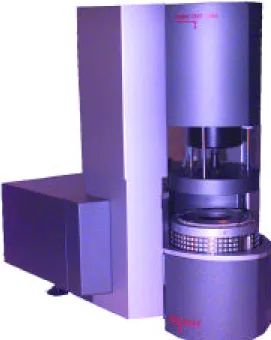
The DYNALY S E R (F i g u re 1) and STRESSTECH (F i g
-ure 2) are research-grade analytical instruments
capa-ble of measuring viscous, elastic, and viscoelastic properties of liquids, gels, and solids. Both instru-ments were developed for use by the serious rheolo-gist, and provide a very broad measurement range, spanning low-viscosity samples such as UV curable monomers to more viscous products such as two-compon ent epoxy systems, gels, and pre pregs through rigid, solid-state samples.
The rheometers incorporate the following features: wide torque, shear stress, temperature, shear rate, and frequency ranges; true Windows-based operational soft-ware; patented Differential Pressure Normal Force Sen-sor; patented Sealed Cell measuring system for testing samples above their boiling point; automatic gap set-ting; remote diagnostics capability via modem; and au-tomatic inertia compensation. In addition, all AT S RheoSystems rheometers are designed on a modular platform to allow easy upgradeability. A wide range of accessories satisfy the most demanding applications with ease of operation.
Temperature control and profiling
Temperature is one of the critical, controlling pa-rameters for DNS materials. The study of DNS materi-als requires precise control of sample temperature and/or sample temperature profiling. Researc h rheometers utilize various temperature control sys-tems in order to achieve the desired stability, range, and transient rates. ATS RheoSystems/REOLOGICA I n s t r uments developed the Joule-Thomson Effect principle for their Extended Temperate Cells (ETC). This approach was selected over other typical designs such as the thermoelectric (Peltier) approach and f o rced-air convection furnace method employed by other commercial rheometers for several important reasons: 1) wide, continuous temperature range; 2) high transient rates without the use of LN2or an
ex-ternal circulator; and 3) minimal temperature gradi-ents in the sample.
Figure 3 shows typical heating and cooling profiles
for the E TC system in th e tempe rature range 2 5 – 1 5 0 °C. The maximum system transient rate is better than 20 °C/min for both heating and cooling.
Figure 1DYNALYSER complete rheological characteriza
-tion system.
N o r m a l l y, when studying DNS materials, transient rates in excess of 5 °C/min are not employed due to sample thermal inertia. However, fast transient rates are useful for preconditioning the sample and for faster test setup and cleanup.
Figure 3 shows that the ETC control loop is criti-cally damped, producing minimum overshoot, while maintaining stability of ±0.1 °C. In addition, with the use of the upper, independently heated and con-trolled clamshell furnace, sample temperature gradi-ents are better than ±0.1 °C.
Fast oscillation data analysis
Tr a d i t i o n a l l y, when performing viscoelastic mea-surements, proper data analysis would require the rheometer to collect data over at least one complete period of oscillation. Therefore, the fastest theoreti-cal data rate in samples/sec (minimum time for each data point) would be equal to the frequency in Hz. H o w e v e r, sampling and calculation delays limit the practical data rate to a much lower value. For many D N S materials, especially radiation curable DNS m a-terials where the events of interest occur with 10 sec of illumination, this data collection rate is too slow to capture the TTIT cure profile. For this reason, a data collection and analysis package called Fast Oscil-lation (AT S R h e o S y s t e m s / R E O L O G I C A I n s t r u-ments) was developed.
The Fast Oscillation program is used to measure rapid, transient changes in a material. Based on the os-cillation program, it works under the same principle where a sinusoidally varying forcing function is ap-plied to the sample and the equally varying sample re-sponse is measured. The measured values are evaluated by one of several sampling methods selected by the u s e r. The number of measurement points to be mea-sured and presented can be set by the user, allowing data collection rates greater than 50 points/sec.
The program also includes the ability to control the shutter of a remote light source. The Relay Set-ting allows the user to set the intervals during which the light source shutter is turned on and off.
User-selectable and quantitative, controlled axial
normal force control
The cure of DNS materials typically results in shrinkage of as much as 10–15%. If the
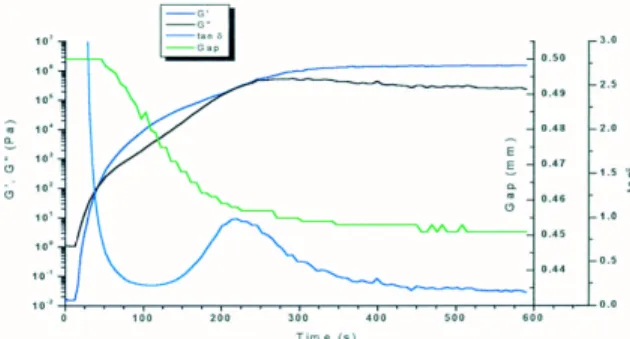
measure-ments are made with the gap at a constant setting, the shrinkage of the materials results in large internal stresses during the cure after gelation. The software that handles this situation allows the operator to change from a controlled gap setting mode to au-totension mode (in which the axial normal force is controlled) at a user-selectable point or event. For measurements in the liquid state, the gap setting needs to be set at a constant value, but by the time the gel point is reached, the shear modulus has in-creased sufficiently for the sample to maintain its shape. Although shrinkage occurs throughout the chemical reaction, internal stresses will develop only after gelation occurs. As soon as the gel point is reached (i.e., tan delta = 1), the instrument changes to autotension mode and maintains the normal force at zero during the remainder of the cure cycle. The shrinkage can be monitored quantitatively using the gap measurements.
An example of an experiment run under these con-ditions is shown in F i g u re 4. A mixture consisting of 2-hydroxyethyl methacrylate, a small amount of ethy-lene glycol dimethacrylate crosslinker, and a photoinitiater in an inert solvent is cured photochemi-cally between the 25-mm-diam plates of the rheometer equipped with the UV cell. Initially, the gap is set at 0.5 mm. The viscosity (eta*) and the moduli (G′and G′ ′) , measured at a frequency of 2 Hz and an oscillatory stress that was preprogrammed to increase from 25 to 2000 Pa during the experiment, rise rapidly after the shutter is opened, while tan delta (= G′ ′/ G′) drops from infinity (G′= 0 in the initial liquid state). When tan delta drops below 1, the autotension mode is em-ployed, and the reduction in the gap can be monitored during the remainder of the cure.
Without this adjustment to reduce the internal stresses, the measurement of the rheological proper-ties in the solid state may be compromised by arti-facts due to the delamination of the sample from the plate or the formation of voids in the sample.
Two-component epoxy system
Two-component epoxies find utility in a wide vari-ety of applications. Normally, these DNS materials are crosslinked by adding equal amounts of resin and hard-e n hard-e r. Of inthard-erhard-est is thhard-e ghard-elation timhard-e or workablhard-e timhard-e of the material. Introducing heat into this system
ates the reaction, decreasing the workable time, thus speeding up the set time. Viscoelastic kinetic properties are monitored as a function of isothermal and non-isothermal cure conditions. The rheological properties measured are G, the shear modulus; eta, the shear vis-cosity; and phase lag, tan delta (G′ ′/ G′) .
Typical results for a commercial two-component, quick-set epoxy system are shown in F i g u re 5, where G* is plotted versus cure time for both isothermal (25 °C) and nonisothermal conditions of 1 and 5 °C/min. The results were run at a frequency of 2 Hz and a command o s c i l l a t o ry stress of 1000 Pa. At a frequency of 2 Hz, the fastest theoretical data rate would be 2 points/sec, al-though the actual sampling rate is slower due to data collection and calculation time lags.
The data show the shear storage modulus (G∗) and tan phase (tan delta) as a function of time (sec). G∗d i s-plays the typical S-shaped curve, while tan delta goes through as maximum and then decreases to a small constant value. Initially, the sample is a low viscosity liquid of low mechanical stiffness, having little or no e l a s t i c i t y. The onset of crosslinking is reflected by the increase in G∗and decrease in tan delta. The initial in-crease in tan delta is attributed to loosening of the sam-p l e ’s sam-preliminary network from internal heat buildusam-p. For stoichiometrically balanced DNS materials, tan delta = 1 coincides to the gel point (GP) measured with the traditional hotplate test.
This result indicates that the cure time decreases as a function of heating rate. Since nonisothermal cure is of practical importance in cure control, the nonisothermal cure curves can be obtained by pro-gramming heating at different heating rates. As the curing reaction reaches completion, the storage mod-ulus approaches a constant value.
Another common use of rheometry for DNS mate-rials is the study of the mechanical properties after cure. Dynamic mechanical thermal analysis (DMTA ) in both torsion and tension modes provides the user information on the thermally induced relaxation transitions and corresponding mechanical stiffness of a DNS material. Experimentally, the challenges rheologically speaking are temperature accuracy and thermal control, the compensation for thermal ex-pansion of the sample, and the alleviation of any molded-in stresses in the test specimen. The DYNAL-YSER and STRESSTECH rheometers, utilizing the
Dif-ferential Pressure Quantitative Normal Force Sensor, allow for continuous monitoring and adjustment of the sample’s thermal expansion.
F i g u re 6 illustrates a typical plot of the storage
modu-lus (G′), the loss modulus (G′ ′), and tan phase versus temperature for a neat and aged isothermal curv e d epoxy material. The aged epoxy material was condi-tioned at 100 °C for 24 hr. The samples for DMTA tor-sional analysis are rectangular with dimensions of 25 mm length, 10 mm width, and 2 mm thickness.
The results show a peak in tan delta around 55 °C, which indicates the glass transition, Tg. The transi-tion of the neat material is broader than the aged ma-terial. Conditioning of the sample at 100 °C for 24 hr allows the curing reaction to continue slowly, nar-rowing the distribution of chain length between crosslinks, reducing the free volume be tween monomer units, and relieving molded-in stresses. As a result, the transition peak is sharper. Below Tg, the values of G′are similar, as expected. Most materials possess stiffness of 1 GPa in the glassy region. Above Tg, the aged material shows a lower value of G′, as a result of less internal stress in the sample. The value of G′in this rubbery region can be directly related to crosslink density.
Glass transitions have been studied by other analyt-ical techniques such as DSC and thermal mechananalyt-ical analysis (TMA). However, many times the transitions of interest are much less pronounced. Particularly, Tg of crosslinked and semicrystalline materials is often difficult to measure by DSC or TMA.
Thermally reversible DNS materials
The gelation behavior of an aqueous system has been studied using the Sealed Cell measuring system. First, a dynamic oscillatory temperature scan was per-formed from 30 to 120 °C at a heating rate of 5 ° C / m i n and a frequency of 0.2 Hz (F i g u re 7). The results indi-cate that the sample possesses a low viscosity of 70 mPa sec at room temperature, and gelation starts at a temperature around 63 °C, as shown by the increase in viscoelastic properties. The reaction continues as a function of temperature and time, and the end result is a thick, gel-like consistency sample at a temperature of 120 °C. Of particular interest are the results above 100 °C, where the data indicate that the properties of
Figure 5Two-component epoxy cure profiles as a function
of heating rate. Figure 6Mechanical properties of neat and annealed
the gelled system are stable. The integrity of the data is maintained well above the boiling point of water.
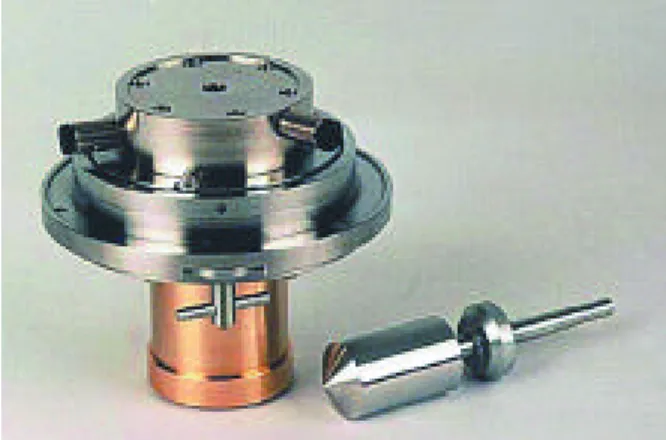
The Sealed Cell measuring system (F i g u re 8) was de-signed to be application-specific for the measurement of viscoelastic rheological properties (G′, G′ ′, tan delta) of solutions above their boiling point. This measuring system, used in conjunction with either the DYNAL-YSER or STRESSTECH, allows measurements under pressure with full dynamic oscillation and viscometric c a p a b i l i t y. The cell employs a noncontacting, air-bear-ing seal rather than standard O-rair-bear-ings. The air-bearair-bear-ing seal is effectively frictionless, and permits dynamic os-c i l l a t o ry testing throughout the frequenos-cy range of the instrument. Aqueous samples and solvent-based sys-tems can be measured above their boiling point. No other device can obtain dynamic oscillatory results, es-pecially on low-viscosity samples, above the sample’s boiling point, due to the mechanical friction limitation of the cell’s seals and bearings.
Rheometer system setup
The DYNALYSER and STRESSTECH rheometers are designed for testing any rheological significant mate-rial: thermoplastics, thermosets, elastomers, semi-solids, and fluids systems. The modular researc h rheometers have a wide range of measuring systems and accessories. Measuring systems are available as concentric cylinders, cone/plate, parallel plate, double concentric cylinders, sealed/pressure cells, and dy-namic mechanical analysis (DMA) of rods, bars, fibers, and films. Special measuring systems for low-volume, high-shear rates, and high sensitivity are also available. The measuring geometries can be made in stainless steel, titanium, polycarbonate, or any user-defined ma-terial. The instruments are supplied standard with the Differential Pressure Quantitative Normal Force Sensor for reproducible sample loading history, thermal ex-pansion measurements, and quantitative normal stress measurements. The diffusion air bearing has a low in-ertia with high axial and radial mechanical stiffness.
The rheometers operate with a separate power supply unit that should be left on continuously. This reduces startup time and makes it possible for the in-strument processor to maintain values for gap and other user-defined settings.
S T R E S S T E C H HR, a high-resolution (HR) version of the STRESSTECH rheometer, allows measurements at microradian displacement and extremely low ap-plied torque. The STRESSTECH rheometer equipped with HR increases the performance specifications to the DYNALYSER level.
Temperature control cells are available using circu-lating fluid, Joule-Thomson Effect, and cry o g e n i c covering the range –180 to 500 °C. All measuring ge-ometries are supported, i.e., cone/plate/parallel plate, concentric cylinder, and solids in torsion and ten-sion. Several high-pressure cells with an upper range of 5800 psig are offered.
Rheometer electronic unit
The rheometer’s electronic components are con-tained within the mechanical unit and the instru-ment is built around a dedicated, high-speed 32-bit central processing unit (CPU). This consolidation en-hances performance and versatility due to electrical connections on the motherboard bus rather than through cables to a separate electronics cabinet. In addition, valuable bench space is kept to a mini-mum. The motor control is based on digital rather than analog drive technology. The unit comes with a built-in diagnostic system and quick diagnostic ser-vice port for serser-vice engineers. Also included is a mo-dem port for remote control operation and fault di-agnostics for service. The electronics power supply is designed to operate on a line voltage between 180 and 260 V or 90 and 140 V, and an operating fre-quency between 47 and 63 Hz.
Software package
RheoExplorer 5.0 software (AT S R h e o s y s t e m s ) is based on the Windows operating platform and runs under Windows NT, 98, or 2000. The standard soft-ware package is a true multitasking interface with se-lectable user levels, thus providing many advantages to the scientist. It is designed to provide flexibility for configuring and using the rheology system. The com-puter is not dedicated to simply running the instru-ment, and is available for other uses when making measurements. The computer can be used for printing
Figure 7Cure behavior of an aqueous system at 120 °C
with the Sealed Cell.
previous results, writing a report, or performing mea-surements with another instrument.
The software enables a normal PC to be used as the interface to allow the user to control the instru-ment and then collect and analyze the resulting data. Vi s c o m e t ry, oscillation under stress and strain control, stress relaxation, creep and recovery, stant rate, yield stress, fast oscillation, process con-trol, project (multiexperiment linking), time–tem-peratur e s uperpo sit ion, a nd sp ectrum transformation packages allow the sample to be an-alyzed via different rheological procedures. Power-ful data analysis capability allows model fitting, graph and table customization, and cut/paste opera-tion to all other Windows-based software.
The software includes possibilities to link user-designed methods, including instrument setup and zero gapping using the project software. The dialogue windows have many storable, editable functions for unique testing requirements, and can be reset to de-fault values using dede-fault buttons. An example is the Oscillation Frequency Step measuring program, in which stresses, delay times, integration periods, and sample sizes may be set individually for all frequen-cies. Another example is the zooming function, which is present in both Vi s c o m e t ry Stress Step and Oscilla-tion Frequency Step, allowing any number of steps and increments to be selected. The instrument also performs controlled strain and constant shear rate measurements, and is supplied with automatic gap ad-justments and thermal expansion compensation us-ing the Differential Pressure Quantitative Normal F o rce Sensor. The system enhances measurement re-producibility since the sample loading history is repro-duced identically each time.
Rheometers for any user level, application, and
budget
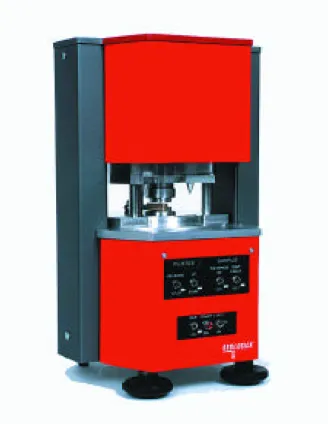
V I S C O A N A LYSER (AT S R h e o S y s t e m s / R E O L O G -I C A -I n s t ru m e n t s), an entry-level research rheometer system, is fully upgradeable to a STRESSTECH unit as the user’s needs and requirements dictate. DSR QC (AT S R h e o S y s t e m s / R E O L O G I C A I n s t ru m e n t s ) (F i g
-u re 9) is an economical dynamic shear rheometer
(DSR) designed to be applications-specific for routine viscoelastic measurements in the QC l a b o r a t o ry.
The rheometers are produced according to ISO 9001 and are tested to operate according to the elec-tromagnetic compatibility rules within the European Community. The instruments are tested to be labeled with the CE-mark.
Conclusion
The important rheological characteristics and results generated with both a DYNALYSER and STRESSTECH rheometer on several different DNS materials have been presented. A detailed interpretation of data and
correla-tion of the rheological response with the physical/chemical properties of different DNS materials was given. The rheological characterization of DNS ma-terials provides important information for engineers and scientists to improve and optimize their products and manufacturing processes. To d a y, most researc h e r s and manufacturers rely on rheological measurements to develop customer-favored products with a competi-tive edge in the marketplace. A reliable researc h - l e v e l rheometer and a thorough understanding of rheologi-cal measurements is now a necessity for success in the m a r k e t p l a c e .
Figure 9DSR QC dynamic shear rheometer.
Mr. Herh is Applications Manager, and Mr. Colo is Presi -dent, ATS RheoSystems, 52 Georgetown Rd., Bord e n -town, NJ 08505, U.S.A.; tel.: 298-2522; fax: 609-298-2795; e-mail: [email protected]; Home page: www.atsrheosystems.com. Dr. Enns is Principal Sci -entist, V I S TAKON J&J Vision Care, Inc., Jacksonville, FL, U.S.A.; tel.: 904-443-3809. Mr. Roye is We s t e rn Region
Manager,REOLOGICA Instruments, Inc., 12344 Burbank
Blvd., Ste. 5, N o rth Hollywood, CA, U.S.A.; tel./fax: 8187532960; Home page: www. re o l o g i c a i n s t ru ments.com. Dr. Hedman is Software Development Man -a g e r, R E O L O G I C A I n s t ruments AB, Lund, Sweden; tel.: (46) 46 127760; fax: (46) 46 125057; Home page: www.reologica.se.