Epipolar Geometry from Two Correspondences
Michal Perd’och, Jirˇı´ Matas and Ondrˇej Chum
Center for Machine Perception, Department of Cybernetics, CTU in Prague, Czech Republic
Abstract
A novel algorithm for robustRANSAC-like estimation of
epipolar geometry (of uncalibrated camera pair) from two correspondences of local affine frames (LAFs) is presented. Each LAF is constructed from three points independently detected on a maximally stable extremal region.
The algorithm assumes that a sufficiently accurate ap-proximation of the fundamental matrix is obtained from two LAF correspondences by the 6-point algorithm of Stewe´nius et al. The so-far-the-best hypotheses are further processed by so-called local optimization to estimate the epipolar geom-etry. Special attention is paid to planar sample degeneracy, since the probability of drawing two coplanar LAF corre-spondences is not negligible. Combining the 6-point solver,
local optimization, and the degeneracy test enablesRANSAC
to draw samples of only two LAFs to generate hypotheses and thus to reduce the number of samples drawn.
We experimentally show that using the 6-point algorithm (approximating the real camera by camera with unit aspect ratio, zero skew, principal point in the center of image, and a common unknown focal length) generates hypotheses that
are sufficient for EG estimation inLO-RANSACframework.
1. Introduction
The problem of wide-baseline stereo has recently re-ceived considerable attention [6, 14, 7, 9]. As a rule, wide-baseline methods establish correspondence of entities which provide geometric constraints stronger than a single point-to-point correspondence. For instance, the popular SIFT keypoint operator [6] determines a location, scale and ori-entation; the latter two quantities implicitly define a second point. TheLAF-MSERmethod of Obdrzˇa´lek et al. [8] exploits local affine frames (LAFs), i.e. three ordered points detected in an affine-covariant way.
The seven point algorithm embedded in RANSAC is a standard method for epipolar geometry estimation [5]. Chum This work was supported by EU project VisionTrain MRTN-CT-2004-005439, the Czech Academy of Sciences project 1ET101210406 and the European Commission project IST-004176 COSPAL.
and Matas [1, 2] studied whether the required seven point-to-point correspondences obtained from three correspondences of LAFs allows efficient estimation of epipolar geometry. Since the speed of RANSACis inversely proportional to an exponential function of the sample size, drawing at random threeLAFinstead of seven point-to-point correspondences potentially reduces running times by orders of magnitude. The key issue is whether the spatial distribution of the nine points – three triplets of nearby point in aLAF– allows good estimates of epipolar geometry. Experiments in [2] show that standardRANSACfails in this case. However, a simple modification calledlocal optimisation of the so-far-the-best
solutionleads to an algorithm that benefits from the small
sample size without losing efficiency; speed-ups of up to103 are reported.
In this paper, we take the approach to an extreme and
design an algorithm that computes EG from two
corre-spondences of local affine frames using the recently pro-posed 6-point EG estimation algorithm of Stewe´nius et al.
[10, 11]. The new 2LAF-LO-RANSACalgorithm is shown ex-perimentally to have competitive performance, requiring a very small number ofRANSACiterations.
The rest of paper is structured as follows. In Section 2 the structure of the 2LAF-LO-RANSACalgorithm and its com-ponents are described in detail. Experiments presented in Section 3 validate the design decisions and performance of the algorithm. The paper is concluded in Section 4.
2. Algorithm
We first introduce the building blocks of the 2LAF-LO -RANSACalgorithm: theRANSACestimator [4], the local op-timisation forRANSAC[1], a method detecting degenerated configurations [3] and the six-point solver forEG[10, 11].
RANSACis a simple but powerful algorithm. Repeatedly, subsets are randomly selected from input dataT and model parametersθfitting the sample are computed. The sizemof the random samples is the smallest sufficient for determining model parameters. In a second step, the quality of the model parameters is evaluated on the full data set. Different cost functions may be used [13], the standard being the size of the support, i.e. the number of data points consistent with
CO - Corner (160 inliers in 626 correspondences) BO - Box (335 inliers in 1472 correspondences)
CW - China Wall (106 inliers in 380 correspondences) WA - Wash1(137 inliers in 591 correspondences) Figure 1. Images pairs and characteristics of problems used in experiments.
the model. The process is terminated when the likelihood of finding a better model becomes low, i.e. the probabilityηof missing a set of inliers I of sizeI withink samples falls under predefined thresholdη0
η= (1−P(I))k. (1)
The probabilityP(I)that an uncontaminated sample of size mis randomly selected fromN=|T |correspondences is
P(I) = I m N m = m−1 j=0 I−j N−j ≈εm, (2) whereεis the fraction of inliersε=I/N. Let the support
S(θ,T,Δ) : Θ → T be the set of data points consistent with modelθi.e.
S(θ,T,Δ) ={x∈ T |ρ(θ,x)≤Δ},
whereρ(θ,x)is a distance measure (e.g. Sampson’s error [5]) andΔa user-specified threshold. The average number of samples that has to be drawn to satisfyη≤η0is
kη0(Sk) =
ln(η0)
ln(1−P(Sk)). (3)
LO-RANSAC(RANSACwith local optimisation). Note that the expression for probabilityηcontrollingRANSACtermination as defined by Equations (1) and (2) is valid only under the assumption that a selection of any random sample not contaminated by outliers leads to the correct solution, i.e. to a solution supported by all inliers. However, as shown in [1], this assumption is often invalid. For standard 7-point and 8-pointEGestimators, all-inlier samples fail at a rate that can be unnoticed and/or ignored2, despite the fact that the
1Images of Wash were gracefully provided by Tinne Tuytelaars. 2At least the problem has not been often reported in the literature.
rate is not negligible — Murray and Tordoff [12] observed that about two to three times more samples were needed than predicted by theory. For algorithms that estimateEG from LAFs, we observed that the percentage of all-inlier samples leading to a correctEGestimate is negligible, less than0.1%on the scenes shown in Fig. 1! This observation is consistent with [2], which demonstrates thatEG cannot be efficiently computed form threeLAFcorrespondences by standardRANSAC. However, it is also shown in [1] that the so called ”local optimisation” overcomes the problem. We show, if an appropriate local optimisation is adopted, the result also holds for the six point solver [11] estimatingEG from twoLAFcorrespondences.
The core insight ofLO-RANSACis the following. For the success of a particular estimator within a RANSAC frame-work, it is not necessary that any all-inlier sample generates an EG hypothesis that is close to optimal. It is sufficient if a significant proportion of EGs estimated from all-inlier samples has support higher (more correspondences consis-tent with it) than almost allEGs estimated from contaminated samples, i.e.EGs with random support. If this property holds, anEGhypothesis from an all-inlier sample is very likely to be so-far-the-best, i.e. it is theEGwith the largest support observed so far. It is proved in [1] that as theRANSAC pro-gresses, only very few so-far-the-bestEGhypothesis emerge. It is therefore possible to apply even fairly complex opti-misation procedures on the so-far-the-best model without affecting overall time complexity.
Degeneracy.The presence of degenerate configurations is a surprisingly common mode of failure of RANSAC. A (dominant) plane is a typical degenerate configuration inEG estimation –EGcannot be recovered from a coplanar, even an all-inlier one. In [3], it was shown that even if a part of a
sample (at least five points out of a seven point sample) lies in a plane, the estimatedEGmay be incorrect and yet having significantly higher than random support. Unsurprisingly, the problem of degenerated configurations is acute if anEG is estimated from a small number (three or two) of LAFs. The smaller the sample the higher the probability that the whole sample comes from a single plane. Potential degen-eracy is therefore checked for each so-far-the-best sample, as suggested in [3]. When a planar configuration is detected, the plane-and-parallax [3] algorithm is exploited to estimate theEG.
Six point solvers in 2LAF-LO-RANSAC.TwoLAFs [8] pro-vide six point-to-point correspondences. Practical six point solvers have been recently introduced [10, 11]. We adopted the algorithm [11], since it has the least restrictive assump-tions about the camera. In [11], it is assumed that the intristic camera parameters are known up to a common focal length f. In the paper, the (unknown) intristic parameters are as-sumed to be: a unit aspect ratio, zero skew, and the principal point in the center of the image. Such an approximation is reasonable for many currently used sensors. Experimentally, we show that the algorithm is not affected by slight deviation from the model (i.e. different focal length, rectangular pix-els see Exp. 3). Note, that theEGbased on the assumptions on actually unknown intristic parameters is only used as an approximation of the fundamental matrixF. Such an approx-imation allows generation of reasonable initial hypotheses while reducing the sample size to twoLAFcorrespondences.
Input:set of data pointsT, thresholdsη0,Δ Output:modelθ∗with largest supportS∗
1. repeat
2. Draw a random sample of minimal sizemfrom data pointsT.
3. Model parametersθicomputed from the minimal set by estimatorE.
4. Calculate the supportSiof the modelθi. 5. ifnew maximum has occurred (|Si| > |Sj| for
∀j < i):
6. ifa degenerated configuration is detected 7. Perform plane-and-parallax search forEG
and appropriate local optimisation. 8. otherwise
9. Apply local optimisation.
10. Store the best modelθ∗with supportS∗. 11. untilthe probabilityηof finding model with
sup-port larger thanS∗falls underη0.
Algorithm 1. The structure of LO-RANSACwith the degenerated configuration test.
2.1.
2LAF-LO-RANSACalgorithm
The 2LAF-LO-RANSAC algorithm is an instance of LO -RANSACwith a test for a degenerated configuration. Its struc-ture is summarized in Alg. 1; the parameters are:T is a set of LAFcorrespondences, the minimal sizem= 2, the estimator Eis the six point solver [11]. Handling of degenerated con-figurations [3] proceeds as follows. If a non-random num-ber of correspondences consistent with a homographyHis found, aplane-and-parallaxmethod [3] is employed. ALAF correspondence outside the plane is sought byRANSAC sam-pling tentative correspondences off the plane. If a correspon-dence is found that leads to anEGwith support significantly (i.e. non-randomly) larger than the support of the original
H-dominated estimate, the plane and parallax algorithm is successful.
3. Experimental results
Four scenes (Fig. 1) with different number of correspon-dences and inlier ratios were chosen to evaluate efficiency and performance of the 2LAF-LO-RANSACalgorithm. In all experiments,LAFs on maximally stable extremal regions [7] were detected and three point tentative region correspon-dences (T) established as in [8]. The quality of tentative correspondences was artificially degraded by untuning the parameters of the matching process.
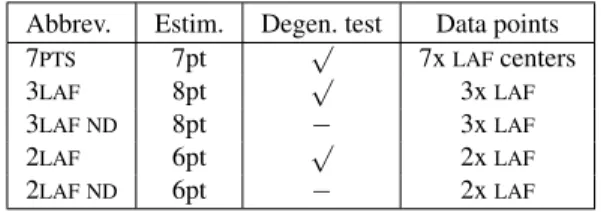
Abbrev. Estim. Degen. test Data points
7PTS 7pt √ 7xLAFcenters
3LAF 8pt √ 3xLAF
3LAF ND 8pt − 3xLAF
2LAF 6pt √ 2xLAF
2LAF ND 6pt − 2xLAF
Table 1.LO-RANSACvariants used.
A reference modelθrof EGwas computed using seven pointLO-RANSACand a setIr, correspondences consistent withθrwas stored (see Fig. 1). ComparedLO-RANSAC vari-ants are listed in Tab. 1.
Experiment 1 (Efficiency of 2LAF-LO-RANSAC). In the-ory, i.e. according to equation (2), drawing minimal samples of sizem= 2should increase the probabilityP(I)and sig-nificantly reduce the expected average number of samplesk (Eqn. 3). In practice, a certain fraction of all-inlier samples will lead to randomEGdue to the influence of noise, poor conditioning and violated assumptions e.g. of equal focal lengths. We defineefficiencyof aLO-RANSACvariant as the fraction of the all-inlier samples that leads to a model with support size (approximately) equal to I. To measure and compare the efficiency, the following synthetic experiment (see Tab. 2) was conducted.
One thousand random all-inlier samples are generated from the inliers of the reference epipolar geometry. For each
Scn. Alg. |θB| |θD| |θN| |θG| 7PTS 6 733 261 785 3LAF 115 779 106 641 CO 3LAF ND 117 0 883 458 2LAF 184 676 140 553 2LAF ND 163 0 837 362 7PTS 0 957 43 998 3LAF 71 912 17 918 BO 3LAF ND 78 0 922 900 2LAF 209 707 84 766 2LAF ND 224 0 776 743 7PTS 19 466 515 815 3LAF 342 517 141 341 CW 3LAF ND 328 0 672 246 2LAF 298 515 187 274 2LAF ND 307 0 693 184 7PTS 110 195 695 646 3LAF 380 369 251 353 WA 3LAF ND 396 0 604 180 2LAF 425 140 435 247 2LAF ND 408 0 592 161
Table 2. Synthetic test, results for 1000 random all-inlier samples. For ND algorithms all hypotheses are assumed non-degenerated.
sample, an initial hypothesisθ0 is computed from a mini-mal set of data points. Subsequent steps ofLO-RANSAC(see Alg. 1) variants with local optimisation and degeneracy test are executed. ColumnθB shows the number ofθ0 hypoth-esis that are consistent with less than an accidental number of correspondences. This fraction of all-inlier hypotheses cannot be distinguished from an outlier contaminated hy-pothesis and hence degrades the efficiency of LO-RANSAC. The number of degenerated and non-degenerated all-inlier samples is shown in columnsθDandθN. Finally, the number of “good” hypothesis is shown in columnθG. Hypotheses are considered “good” if the number of consistent corre-spondences is at least 90% of the|Ir|, i.e. the number of inliers of referenceEG.
We observed (see Tab. 2) that the efficiency of the seven point estimator does not drop under 65% even on the nois-iest scene – Wash. 3LAF-LO-RANSACand 2LAF-LO-RANSAC performs better on the scenes Corner and Box with higher inlier ratio. On the noisy and hard scenes, their efficiency drops down to around 30% for 3LAF-LO-RANSACalgorithm and 25-30% for 2LAF-LO-RANSACalgorithm. Therefore, to achieve a desired probability of success η0, the number of samples drawn before termination needs to take efficiency in account. Note however that in the performance test (Exp. 3) theoretical number of samples is used to observe differences between algorithms.
Experiment 2 (The robustness of the 6pt solver). Pro-posed 2LAF-LO-RANSACalgorithm uses the six point solver [11] to estimate the initial hypothesis that assumes calibrated
Scn. Alg. #inls #samples #LOs
7PTS 162.13 42307.93 8.97 3LAF 161.23 177.47 4.28 CO 3LAF ND 157.69 219.83 4.41 2LAF 160.74 44.65 3.03 2LAF ND 132.22 86.39 3.69 7PTS 334.83 99838.93 9.13 3LAF 334.46 256.08 4.74 BO 3LAF ND 321.23 290.75 4.27 2LAF 334.29 57.02 2.79 2LAF ND 315.58 64.45 2.81 7PTS 106.00 26396.00 8.73 3LAF 104.07 151.15 3.76 CW 3LAF ND 102.86 203.60 3.76 2LAF 101.50 46.84 2.84 2LAF ND 90.38 73.64 3.34 7PTS 136.43 96872.83 8.30 3LAF 135.14 257.93 3.10 WA 3LAF ND 125.23 484.80 3.73 2LAF 130.27 69.61 2.37 2LAF ND 121.22 104.86 2.84
Table 3.Average number of inliers, samples and num-ber of LOs taken in 100 runs of RANSAC algorithms. cameras up to an unknown common focal length. The first three assumptions: the principal point in the middle of the image, zero skew, and unit aspect ratio often hold with mod-ern cameras, while the assumption of common focal length is often violated. The sensitivity to different focal lengths is tested on the Corner scene with focal length ratio of about 3. No significant decrease in performance was observed. Ro-bustness to aspect ratio was tested on the China Wall scene. One coordinate was artificially scaled with factor from 0.5 to 2.0. Similar performance (see Fig. 2) was observed for all factors.
Experiment 3 (The speed of RANSAC algorithms). The speed of 2LAF-LO-RANSAC, 3LAF-LO-RANSACand seven pointLO-RANSACis summarised in Tab. 3. As expected, the average number of samples is highest for the seven point algorithm. For 2LAF-LO-RANSACalgorithm it is around one fourth (i.e. proportional toε) of the 3LAF-LO-RANSAC algo-rithm and about thousand times less compared to the seven point algorithm on hard scenes.
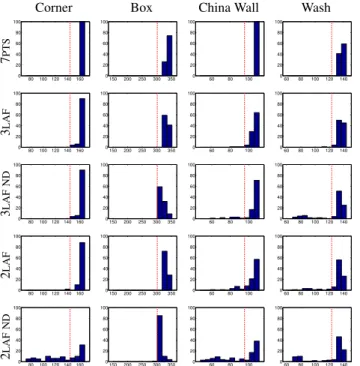
For deeper insight in the performance of algorithms, the histograms Fig. 3 of the support size of the model found in each run were computed. Results show that the degen-eracy test and the special local optimisation is necessary for 2LAF-LO-RANSAC algorithm. The 2LAF-LO-RANSAC al-gorithm without the degeneracy test, i.e. when the so-far-the-best models are processed only with local optimisation, fail to produce a stable solution on difficult problems. On the China Wall and Wash scenes, approximately 40% of ex-ecutions (see Fig. 3) produced solutions with less than 90% of the reference method’s support.
0.5 0.7 1.0 1.25 2.0 70 80 90 100 110 0 20 40 60 #inls #runs 70 80 90 100 110 0 20 40 60 #inls #runs 70 80 90 100 110 0 20 40 60 #inls #runs 70 80 90 100 110 0 20 40 60 #inls #runs 70 80 90 100 110 0 20 40 60 #inls #runs
Figure 2. Number of inliers in 100 runs of 2LAFalgorithm on China Wall scene with different aspect ratios.
Corner Box China Wall Wash
7 PTS 80 100120140160 0 20 40 60 80 100 150 200 250 300 350 0 20 40 60 80 100 60 80 100 0 20 40 60 80 100 60 80 100 120 140 0 20 40 60 80 100 3 LAF 80 100120140160 0 20 40 60 80 100 150 200 250 300 350 0 20 40 60 80 100 60 80 100 0 20 40 60 80 100 60 80 100 120 140 0 20 40 60 80 100 3 LAF ND 80 100120140160 0 20 40 60 80 100 150 200 250 300 350 0 20 40 60 80 100 60 80 100 0 20 40 60 80 100 60 80 100 120 140 0 20 40 60 80 100 2 LAF 80 100120140160 0 20 40 60 80 100 150 200 250 300 350 0 20 40 60 80 100 60 80 100 0 20 40 60 80 100 60 80 100 120 140 0 20 40 60 80 100 2 LAF ND 80 100120140160 0 20 40 60 80 100 150 200 250 300 350 0 20 40 60 80 100 60 80 100 0 20 40 60 80 100 60 80 100 120 140 0 20 40 60 80 100
Figure 3.Number of inliers in 100 runs of RANSAC algorithms. Dashed line delimits 90% of inliers ac-cording to reference model.
4. Conclusions
The 2LAF-LO-RANSACalgorithm that estimates epipolar geometry from twoLAFcorrespondences was proposed. Two LAFcorrespondences provide six point-to-point correspon-dences that are used to generateRANSAChypotheses by the state-of-the-art 6pt solver [10, 11]. Experimentally, it was shown that the algorithm performs well only if the methods [2, 3] for local optimisation and degeneracy detection are used. Compared to 3LAF-LO-RANSACalgorithm, the 2LAF -LO-RANSAC algorithm requires lower number of samples, local optimisations, and significantly lower number of itera-tions than the seven pointLO-RANSACwith degeneracy test. In experiments where the inlier ratio ranged from 23% to 28% the number of iterations ranged from 45 to 70 for 2LAF -LO-RANSAC, 151 to 258 for 3LAF-LO-RANSAC, and 26396 to 99840 forLO-RANSAC.
References
[1] O. Chum, J. Matas, and J. Kittler. Locally optimized ransac. InProc. of the DAGM, pages 236–243, 2003.
[2] O. Chum, J. Matas, and Sˇ. Obdrzˇa´lek. Enhancing RANSAC by generalized model optimization. InProc. of the ACCV, volume 2, pages 812–817, January 2004.
[3] O. Chum, T. Werner, and J. Matas. Two-view geometry estimation unaffected by a dominant plane. InProc. of the CVPR, pages 772–780, June 2005.
[4] M. Fischler and R. Bolles. Random sample consensus: A paradigm for model fitting with applications to image anal-ysis and automated cartography.CACM81, 24(6):381–395. [5] R. Hartley and A. Zisserman. Multiple view geometry in
computer vision. Cambridge, 2nd edition, 2003.
[6] D. Lowe. Distinctive image features from scale-invariant keypoints.IJCV, 60(2):91–110, 2004.
[7] J. Matas, O. Chum, M. Urban, and T. Pajdla. Robust wide baseline stereo from maximally stable extremal regions. In
Proceedings of the BMVC, volume 1, pages 384–393, 2002. [8] J. Matas, Sˇ. Obdrzˇa´lek, and O. Chum. Local affine frames
for wide-baseline stereo. InProc. of the ICPR, 2002. [9] P. Pritchett and A. Zisserman. Wide baseline stereo matching.
InProc. ICCV, pages 754–760, 1998.
[10] H. Stewe´nius.Gro¨bner Basis Methods for Minimal Problems in Computer Vision. PhD thesis, LTH, Sweden, 2005. [11] H. Stewe´nius, D. Niste´r, F. Kahl, and F. Schaffalitzky. A
min-imal solution for relative pose with unknown focal length. InProc. of the CVPR, pages 789–794. IEEE, 2005. [12] B. Tordoff and D. Murray. Guided sampling and consensus
for motion estimation. InProc. 7th ECCV, volume 1, pages 82–96. Springer-Verlag, 2002.
[13] P. H. S. Torr and A. Zisserman. MLESAC: A new robust estimator with application to estimating image geometry.
CVIU, 78:138–156, 2000.
[14] T. Tuytelaars and L. Van Gool. Wide baseline stereo match-ing based on local, affinely invariant regions. InProc. of the 11th BMVC, 2000.