Record Anonymization
Jordi Pont-Tuset1, Jordi Nin2, Pau Medrano-Gracia1, Josep Ll. Larriba-Pey1, and Victor Munt´es-Mulero1
1
DAMA-UPC, Computer Architecture Dept. Universitat Polit`ecnica de Catalunya, Campus Nord UPC, C/Jordi Girona 1-3
08034 Barcelona, Catalonia, Spain {jpont,pmedrano,larri,vmuntes}@ac.upc.edu
2
IIIA, Artificial Intelligence Research Institute CSIC, Spanish National Research Council
Campus UAB s/n 08193 Bellaterra, Catalonia, Spain
Abstract. Microaggregation is one of the most commonly employed microdata protection methods. This method builds clusters of at leastk original records and replaces the records in each cluster with the centroid of the cluster. Usually, when records are complex, i.e., the number of attributes of the data set is large, this data set is split into smaller blocks of attributes and microaggregation is applied to each block, successively and independently. In this way, the information loss when collapsing several values to the centroid of their group is reduced, at the cost of losing thek-anonymity property when at least two attributes of different blocks are known by the intruder.
In this work, we present a new microaggregation method calledOne dimension microaggregation (M ic1D−κ). This method gathers all the values of the data set into a single sorted vector, independently of the attribute they belong to. Then, it microaggregates all the mixed val-ues together. Our experiments show that, using real data, our proposal obtains lower disclosure risk than previous approaches whereas the in-formation loss is preserved.
Keywords: Microaggregation, k-anonymity, Privacy in Statistical Databases.
1
Introduction
Confidential data is usually released to third parties (e.g., politicians and re-searchers) for data analysis. This dissemination has to be in accordance with laws and regulations to avoid the publication of critical private information. In this situation, it is necessary to release data preserving the statistics without V. Torra and Y. Narukawa (Eds.): MDAI 2008, LNAI 5285, pp. 215–226, 2008.
c
revealing confidential information. This is a typical problem, for instance, in official statistics institutes.
Special efforts have been made to develop a wide range of protection methods. These methods aim at guaranteeing an acceptable level of protection of the confidential data. Specific areas such as Privacy in Statistical Databases (PSD) tackle the problem of protecting confidential data in order to publicly release it, without revealing confidential information that could be linked to an specific individual or entity. Good surveys about protection methods can be found in the literature [1,3].
Recently, microaggregation has emerged as one of the most promising data protection methods. For example, the work in [7] shows that microaggregation is used by many official statistics institutes for data anonymization. The basic implementation of microaggregation [3,4,16] works as follows: given a data set withA attributes, small clusters of at least k elements (records) are built and each original record is replaced with the centroid of the cluster to which the record belongs. A certain level of privacy is ensured becausek records have an identical protected value (k-anonymity[15,17,18]).
However, when the complexity of the records in the data set is large and, thus, the number of attributes Ais large, microaggregation techniques suffer from a low statistical utility. This is so because the larger the number of attributes, the larger the distance between the original records in the data set and their corresponding centroids. Therefore, a lot of information of the original data is lost when the protected data set is released.
1 To solve this drawback, the following natural strategy is usually used: the data set is split into smaller blocks of attributes and microaggregation is independently applied to each block. In this way, the information loss is lower, at the cost of an increase of the disclosure risk. In other words, the property of k-anonymity is not ensured anymore, as we explain later in this paper.
In this work, we propose to combine a set of preprocessing steps along with the microaggregation in order to minimize the disclosure risk without losing information. We test this new method using real data sets showing thatM ic1D− κis able to outperform previous microaggregation methods diminishing the risk of disclosure without increasing the information loss. Specifically, we compare our new method with one of the most commonly used microaggregation methods, the MDAV (Maximum Distance to Average Vector) algorithm [4], showing that M ic1D−κachieves lower disclosure risk than MDAV when different groups of attributes are known by an intruder.
This paper is organized as follows. In Section 2 we review some basic concepts related to protection methods in general (and microaggregation in particular). In Section 3, we present our new microaggregation method calledOne dimension microaggregation. Section 4 is devoted to compare traditional MDAV microag-gregation with our new microagmicroag-gregation method with real data sets; we explain the ingredients of our experiments and the obtained results. Finally, Section 5 draws some conclusions and presents some future work.
2
Preliminaries
In this section, we explain some basic concepts that will be useful for the rest of the paper. Namely, we first describe the scenario where a microdata protection method is applied to preserve the privacy of the owners of some statistical data. Then, we recall one of the most used protection methods, microaggregation, and one of its heuristic variants: MDAV. Finally, we describe a way to measure the quality of a given microaggregation method, according to the levels of privacy and statistical utility that it provides.
2.1 Statistical Data Protection
A data setX can be seen as a matrix withnrows (records) andAcolumns ( at-tributes), where each row containsAattributes of an individual. The attributes in a data set can be classified according to two different categories,identifiers
or quasi-identifiers, depending on their capability to identify unique individu-als. Among the quasi-identifier attributes, we distinguish between confidential
andnon-confidential ones, depending on the kind of information they contain. Because of this, we writeX=Xid||Xnc||Xc.
In this paper, we consider the following scenario for statistical disclosure con-trol, which was defined in [3] to compare several protection methods.
(i) Identifier attributes inXare either removed or encrypted. Therefore reduce X toX =Xnc||Xc.
(ii) Confidential quasi-identifier attributesXcare not modified, and so we have Xc =Xc; in this way, the statistical utility of the confidential attributes is completely preserved.
(iii) A microdata protection method ρ is applied to non-confidential quasi-identifier attributes, in order to preserve the privacy of the individuals whose confidential data is being released. This leads to a protected data setXnc =ρ(Xnc).
(iv) The released data set isX=Xnc ||Xc =ρ(Xnc)||Xc.
After applying this protection procedure, the disclosure risk caused by an in-truder that, first, obtains non-confidential attributes from other sources and, then, tries to re-identify entities by using record linkage methods between these external information andXncis reduced, sinceXnchas been obfuscated by using Xnc instead.
2.2 Microaggregation
As we explained before, microaggregation builds small clusters of at least k
elements ofAattributes and replaces the original records by the centroid of the cluster to which the records belong.
The goal of a microaggregation method is to minimize the total Sum of the Square Error SSE= c i=1 xij∈Ci
wherecis the total number of clusters,Ciis thei-th cluster and ¯xiis the centroid ofCi. The restriction is |Ci| ≥k, for alli= 1, . . . , c.
If a microaggregation method is applied to all theAattributes of the original data setX at the same time; then, the resulting protected data setX satisfies the property of k-anonymity [18]: each protected record can correspond to at least k original records. However, in order to increase the statistical utility of the released (protected) information, statistical agencies usually split the whole data setX into blocks of a few attributesai (
C
i=1ai=AwhereC is the total number of blocks), and then apply a microaggregation method to each block, independently. In this way,k-anonymity is not preserved anymore.
In the case of univariate microaggregation (ai = 1), there exist polynomial time algorithms to obtain the optimal microaggregation [8]. The main drawback of univariate microaggregation is that it provides a bad level of privacy, due to its high disclosure risk [13]. However, for the multivariate case (ai >1), the problem of finding the optimal microaggregation is NP-hard [14]. For this reason, multivariate microaggregation methods are heuristic. In this paper, we recall one of the most commonly used multivariate techniques: MDAV microaggregation.
2.3 MDAV Microagregation
The MDAV (Maximum Distance to Average Vector) algorithm [4] is a heuristic algorithm for clustering records in a data setXso that each cluster is constrained to have at leastkrecords.
MDAV works as follows. First, MDAV computes the average record ¯xof all records in X, then, MDAV builds two clusters. In order to build them, MDAV considers the most distant recordxr to the average record ¯xand forms a cluster aroundxr(this cluster containsxrtogether with thek−1 closest records toxr). When the cluster is done, all the records belonging to this cluster are removed from X. Following, the most distant record xs from record xr is taken and a new cluster is done around xs, again, all the records belonging to this cluster are removed. This process is repeated until all the records are assigned to one cluster. Finally, the protected data setX is built replacing the original records inX by the centroid of the cluster to which the record belongs.
Note that this process can be done considering all the attributes in the data set at the same time, or the data set can be split into smaller blocks of attributes and MDAV is independently applied to each block. The former option ensures the k-anonymity property with a large information loss, and the second one ensures a small information loss, butk-anonymity property is not preserved any more.
2.4 Performance Measure for Microaggregation
A microdata protection method must guarantee a certain level of privacy (low disclosure risk). At the same time, since the goal is to allow third parties to perform reliable statistical computations over the released (protected) data, the
protection method must ensure somehow that the protected data is statistically close to the original one.
Therefore, we have two inversely related aspects to measure, for each microdata protection method: thedisclosure risk (DR), which is the risk that an intruder obtains correct links between the protected and the original data; and the infor-mation loss (IL) caused by the protection method. When one of them increases, the other one decreases. The two extreme cases are the following ones: (i) if the original microdata is released, then information loss is zero, but the disclosure risk is maximum; (ii) if the original microdata is encrypted and then released, the dis-closure risk is (almost) zero, but the information loss is maximum.
There are different measures proposed in the literature to evaluate the quality of a data protection method. Such measures can be general (for all protection methods) or specific for a given data protection method. For instance, the goal of microaggregation is to minimize the total Sum of the Square ErrorSSE. Since there are no optimal solutions in polynomial time to multivariate microaggrega-tion, and the methods used are heuristic, the actual value of SSE for a given method is a measure of its quality with regards to information loss.
Regarding privacy, microaggregation provides, by definition, some level of anonymity. If the method is applied to all the attributes (a single block), then the initial parameter k indicates the achieved anonymity: for each protected record, there are at leastkpossible original records which can correspond to it. However, if the original data set is split intorblocks and the microaggregation method is applied to each block independently, then the final level of anonymity obviously decreases: two records which are in the same cluster for one block of attributes may be in different clusters for other blocks, which results in two different protected records.
A possible way of computing the real level of anonymity achieved by a mi-croaggregation method is to consider the ratio between the total number nof records and the number of protected records which are different. This gives the average size of each “global cluster” in the protected data set. We denote ask thisreal anonymitymeasure:
k= n
|{x|x∈X}|
It was introduced in [11] and used in other papers like [12].
3
One Dimension Microaggregation
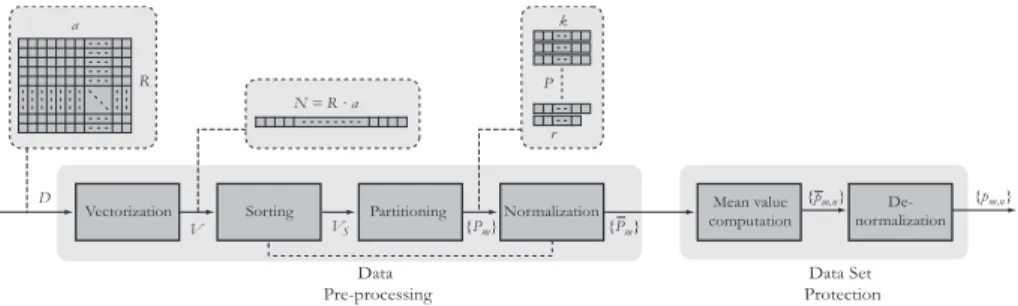
One dimension microaggregation (Mic1D-κ) uses the same vision of data handling based on the vectorization, sorting and partitioning of all the values in the data set presented in [9]. There are several aspects that motivate these three steps:
Vectorization. The first step is vectorization. The basic idea is to gather all the
values in the data set in a single vector, independently of the attribute they belong to. This way, we are ignoring the attribute semantics and, therefore, the possible correlation between two different attributes in the data set.
Sorting. Once all the values are inserted in the unique vector, it is necessary to sort them in order to minimize the SSE value when the clusters (partitions) are done. Note that sorting the values is a way of adding noise.
Partitioning. In order to ensure a certain level of privacy (k-anonymity), we
propose to split the data set in several κ-partitions and to calculate the average value for each partition. Modifying the value ofκ, Mic1D-κallow us to adjust the trade-off between information loss (SSE) and disclosure risk. Note that if the data set was not sorted,κwould not have this property. Since the ranges of values of two different attributes could differ significantly, the sorting step may not merge all the values coming from different attributes appro-priately. For this reason, after the partitioning is complete, data is normalized in each partition and it is sorted and re-partitioned again. Data normalization improves the attribute merging and therefore, it is more difficult for an intruder to re-identify an individual. Finally, data in each partition is substituted by their centroid. All the steps of Mic1D-κare represented in Figure 1.
Mean value computation
De-normalization
{pm,n} {pm,n}
Vectorization Sorting Partitioning Normalization
D
V VS {Pm} {Pm}
Data
Pre-processing ProtectionData Set
N = R · a R a P k r
Fig. 1.Mic1D-κschema
Formally speaking, letDbe the original data set to be protected. We denote byRthe number of records inD. Each record consists ofanumerical attributes or fields. We assume that none of the registers contain blanks. We denote byN the total number of values inD. As a consequence, N =R·a.
LetV be a vector of size N. Mic1D-κtreats values in the data set indepen-dently of the attribute they belong to. In other words, the concepts of record and field is ignored and the N values in the data set are placed in V. We call this processdesemantization.
First,V is sorted increasingly. Let us denote byVsthe ordered vector of sizeN containing the sorted data andvitheith element of vectorVs, where 0≤i < N. Next,Vs is divided into smaller sub-vectors or partitions. Each sub-vector is normalized into the [0,1] interval and they are all sorted and partitioned again. We define κ, where 1 < κ ≤ N, as the number of values per partition. Note that ifκis not a divisor of N the last partition will contain a smaller number of values. LetP be the number of κ-partitions. We call rthe number of values in the last partition where 0≤r < κ. Therefore,N =κP +r. Ifr >0 the we haveP+ 1 partitions. We denote by Pm themth partition.
Letvm,nbe defined as thenth element ofPm:
vm,n:=vmκ+n n= 0. . . κ−1 m= 0. . . P−1 vP,n :=vP κ+n n= 0. . . r−1
For each partitionPm, the mean value of its components is computed: μm= κ−1 n=0 vm,n κ m= 0. . . P −1 μP = r−1 n=0 vP,n r
where the latter expression is applied to the last partition ifr >0, i.e., ifκdoes not divide the total number of values in the data set.
The protected valuepm,nforvm,n is then:
pm,n=μm n= 0. . . κ−1 m= 0. . . P −1 pP,n =μP n= 0. . . r−1
Finally, Mic1D-κde-normalizes the data into the original range. The protected values are placed in the protected data set in the same place occupied by the correspondingvm,nin the original data set. This way, we are undoing the sorting and vectorization steps.
4
Experimental Results
We have tested Mic1D-κand compared our results with those obtained by the MDAV algorithm, using the Census [19] and Water-treatment [10] data sets. The former was extracted using the Data Extraction System of the U.S. Census Bureau and contains 1080 records consisting of 13 numerical attributes. The latter was extracted from the UCI repository and contains 35 attributes and 380 entries. These data sets have been used in previous works [3,11] to compare different microaggregation techniques.
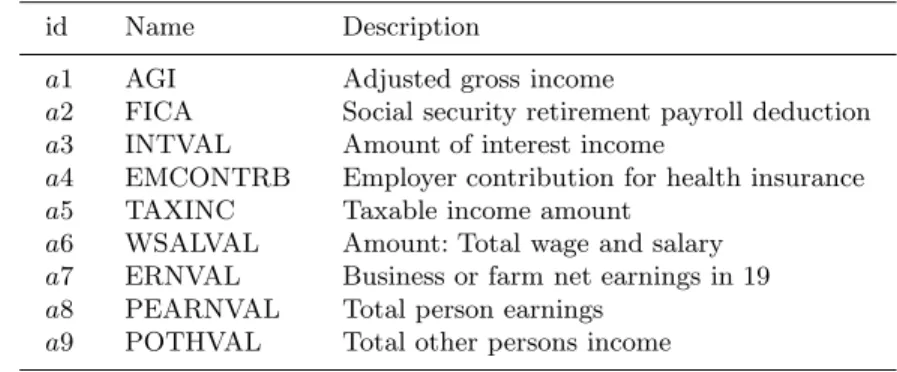
As shown in [12], when protecting a data set using multivariate microaggre-gation, the way in which the data is split to form blocks is highly relevant with regard to the degree of privacy achieved (k value). Similarly, we have reduced both data sets to have 9 attributes, which we detail in Tables 1 and 2.
In both data sets, attributesa1, a2 and a3 are highly correlated, as well as attributesa4, a5 anda6 and attributesa7, a8 anda9. On the contrary, attributes of different blocks are non-correlated. For our experiments, when protecting data using MDAV microaggregation, we assume attributes to be split in three blocks of three attributes each. Also, we consider two situations when protecting the data sets using MDAV microaggregation: blocking correlated attributes and thus non-correlated blocks,i.e., (a1, a2, a3), (a4, a5, a6) and (a7, a8, a9); or blocking non-correlated attributes but correlated blocks,i.e., (a1, a4, a7), (a2, a5, a8) and (a3, a6, a9). Testing these two cases will let us study the impact of the choice of the attributes for the microaggregation groups, based on their correlations.
For each data set and attribute selection method, we apply MDAV microag-gregation using the same parameterizations as those in previous works [11,12].
Table 1.Attribute description of the Census data set
id Name Description
a1 AGI Adjusted gross income
a2 FICA Social security retirement payroll deduction a3 INTVAL Amount of interest income
a4 EMCONTRB Employer contribution for health insurance a5 TAXINC Taxable income amount
a6 WSALVAL Amount: Total wage and salary a7 ERNVAL Business or farm net earnings in 19 a8 PEARNVAL Total person earnings
a9 POTHVAL Total other persons income
Table 2.Attribute description of the Water data set id Name Description
a1 PH-E Input pH to plant
a2 PH-P Input pH to primary settler a3 PH-D Input pH to secondary settler
a4 DQO-E Input chemical demand of oxygen to plant a5 COND-P Input conductivity to primary settler a6 COND-D Input conductivity to secondary settler a7 DBO-S Output biological demand of oxygen a8 SS-S Output suspended solids
a9 SED-S Output sediments
Namely, we protect the data sets using MDAV with parameterk= 5, 25, 50, 75, 100 for the Census data set, andk = 5, 10, 15, 20, 25 for the Water-treatment data set. The selection of these values aims at covering a wide range of SSE values and, thus, studying scenarios with differentinformation loss values.
For Mic1D-κ, we use κ= 3000, 3200, 4000, 4400, 5000 for the Census data set and κ = 300, 500, 800, 850, 900 for the Water-treatment data set. Note that, since Mic1D-κdesemantizes the data set, there is no point in considering different situations related to the correlation of the attributes and, therefore, we protect the data set just once for each parametrization. In order to make the comparison fair, we have chosen the values of κ in Mic1D-κto obtain similar SSE values to those obtained by MDAV after protecting the data sets.
We consider that a possible intruder knows the value of three random at-tributes of the original data set. Different tests are performed assuming that the intruder knows different sets of three attributes. Depending on these attributes the intruder will have information coming from one or more groups. Table 3 shows all the considered possibilities.
First, we suppose that the three known attributes belong to the same MDAV microaggregated block (e.g. (a1, a2, a3) in the correlated scenario or (a1, a4, a7)
Table 3.Different groups of variables known by the intruder 1G (a1, a2, a3), (a4, a5, a6), (a7, a8, a9) C o rrelated 2G (a1, a2, a5), (a1, a3, a7), (a2, a3, a6), (a1, a4, a5), (a2, a4, a6) (a5, a6, a9), (a6, a7, a8), (a1, a8, a9), (a2, a7, a9) 3G (a1, a4, a7), (a1, a5, a8), (a1, a6, a9), (a2, a4, a7), (a2, a5, a8) (a2, a6, a9), (a3, a4, a7), (a3, a5, a8), (a3, a6, a9) 1G (a1, a4, a7), (a2, a5, a8), (a3, a6, a9) N o n-correlated 2G (a1, a4, a5), (a1, a3, a7), (a4, a7, a8), (a1, a2, a5), (a2, a4, a8) (a5, a8, a9), (a3, a6, a8), (a1, a6, a9), (a3, a4, a9) 3G (a1, a2, a3), (a1, a5, a6), (a1, a8, a9), (a2, a3, a4), (a4, a5, a6) (a4, a8, a9), (a2, a3, a7), (a5, a6, a7), (a7, a8, a9)
Table 4.SSE and realkvalues using MDAV-kand Mic1D-κmethods assuming that different groups of variables are known by the intruder using the Census data set
SSE k 1G 2G 3G MD A V -k 5 64.99 5.00 1.92 1.00 25 223.73 25.12 7.00 1.09 50 328.31 51.43 14.66 1.41 75 382.34 77.14 23.18 1.96 100 428.68 108.00 35.00 3.33 Mic1D -κ 3000 32.27 8.37 9.87 5.77 3200 89.18 11.97 13.76 8.26 4000 129.06 20.10 22.09 13.89 4400 310.63 23.15 26.94 17.01 5000 738.12 72.83 76.08 55.02 Correlated attributes SSE k 1G 2G 3G MD A V -k 5 58.49 5.00 1.96 1.02 25 260.13 25.12 7.35 1.24 50 356.47 51.43 15.86 2.05 75 563.79 77.14 24.38 2.83 100 721.91 108.00 36.14 4.62 Mic1D -κ 3000 32.27 5.63 8.51 8.04 3200 89.18 8.01 11.95 11.83 4000 129.06 13.53 19.45 19.19 4400 310.63 16.62 23.64 22.45 5000 738.12 59.77 67.72 67.25 Non-correlated attributes
in the non-correlated). Since the size of the three microagreggation blocks is 3, there are only three options to consider. We denote this case by 1G. Since the intruder only has access to data from one group, MDAV ensures the k-anonymity property (this is the best possible scenario for MDAV). However, note that, usually, the intruder cannot choose the attributes obtained from external sources and it might be difficult to obtain all the attributes in the same group. Second, we assume that the known attributes belong to two different MDAV microaggregated groups. There are many possible combinations of three attributes under this assumption, so nine of them were chosen randomly. We refer to this case as 2G. Finally, case 3G is defined analogously to 2G, and also
Table 5.SSE and realkvalues using MDAV-kand Mic1D-κmethods assuming that different groups of variables are known by the intruder using the Water data set
SSE k 1G 2G 3G MD A V -k 5 28.18 5.09 1.94 1.00 10 46.14 10.00 3.14 1.01 15 72.03 15.20 4.42 1.01 20 94.24 20.00 5.75 1.04 25 114.56 25.33 7.28 1.10 Mic1D -κ 300 32.67 1.62 1.51 1.10 500 65.89 3.25 3.39 1.76 800 80.95 7.87 7.55 4.67 850 132.13 9.65 10.03 6.65 900 255.64 12.95 13.61 9.14 Correlated attributes SSE k 1G 2G 3G MD A V -k 5 69.51 5.00 2.03 1.03 10 126.21 10.00 3.55 1.16 15 173.96 15.20 5.28 1.39 20 259.07 20.00 7.00 1.53 25 247.58 25.33 9.22 1.91 Mic1D -κ 300 32.67 1.11 1.35 1.35 500 65.89 1.78 2.58 2.63 800 80.95 4.74 7.17 6.88 850 132.13 6.54 9.77 8.67 900 255.64 9.07 14.52 11.71 Non-correlated attributes
nine possibilities of known attributes are considered. Note that, in both scenar-ios 2G and 3G, k-anonymity is not ensured by MDAV. Note also that, if the intruder had more than three attributes, it would not be possible to consider 1G. We are considering the case were the intruder only has three attributes to study a scenario were MDAV can still preservek-anonymity.
The first column of Tables 4 and 5 presents the SSE values for all the parame-terizations and situations described before. Note that the range of SSE covered by the two methods is similar, so this allows us to compare the disclosure risk of both methods fairly. For all these scenarios, we computek and the mean of all the k values in each situation is presented in the second, third and fourth columns. Note that, whereas MDAV is affected by the fact that the chosen at-tributes are correlated or not, this effect is not noticeable using M ic1D−κ. Specifically, when the attributes in a group are not correlated, the information loss (SSE) using MDAV tends to be increased since we are trying to collapse the records in a single value, using three independent attributes or dimensions. Nevertheless, this effect can be neglected with our technique since, thanks to the data preprocessing, the whole microaggregation process is performed on a single dimension (vector of values), the semantics of attributes are ignored and the effect caused by attribute correlations is avoided.
Results show that, in general,M ic1D −κachieves lower disclosure risk lev-els (larger values ofk) than those achieved by MDAV for similar information loss (SSE), especially when the attributes chosen come from different microaggregated groups (2G and 3G), which is the most common case. When the intruder has ac-cess to the three attributes coming from a single microaggregated group, MDAV presentsk values which are similar or, in some cases, even larger than those ob-tained byM ic1D−κ(comparing cases with similarSSE). This is normal since MDAV preserves thek-anonymity in this case. However, in the remaining scenarios
(2G and 3G), that represent most of the cases,M ic1D−κachieves largerkvalues than those obtained by MDAV when similarSSEvalues are compared.
5
Conclusions and Future Work
In this paper, we have presented a new type of microaggregation calledOne Di-mension microaggregation. This microaggregation method significantly diminish the problem of attribute selection in multivariate microaggregation achieving in general a higher level of privacy than that obtained by MDAV, one of the most well-known microaggregation methods. This is specially true as, from the attributes known by the intruder, the number of these coming from different microaggregation groups of MDAV increases.
As future work, we plan to further study One Dimension microaggregation using other information loss and disclosure risk measures. We also plan to develop and implement a method for vector partitioning which considers the SSE value when the partitions are done so that we can reduce the SSE value of our method and, therefore, the information loss.
All in all, in this paper we show that microaggregation can be a very useful method for the anonymization of complex records containing a large number of attributes, when it is combined with the data preprocessing proposed in our work.
Acknowledgments
Partial support by the Spanish MEC (projects ARES – CONSOLIDER INGE-NIO 2010 CSD2007-00004 – and eAEGIS – TSI2007-65406-C03-02) and by the Government of Catalunya (grant 2005-SGR-00093) is acknowledged.
The authors from DAMA-UPC want to thank Generalitat de Catalunya for its support through grant number GRE-00352 and Ministerio de Educaci´on y Ciencia of Spain for its support through grant TIN2006-15536-C02-02. Josep L. Larriba-Pey wants to thank UPC, Generalitat de Catalunya and Ministerio de Educaci´on y Ciencia for his I3 grant.
References
1. Adam, N.R., Wortmann, J.C.: Security-control for statistical databases: a compar-ative study. ACM Computing Surveys 21, 515–556 (1989)
2. Domingo-Ferrer, J., Torra, V.: Disclosure control methods and information loss for microdata. In: [6], pp. 91–110 (2001)
3. Domingo-Ferrer, J., Torra, V.: A quantitative comparison of disclosure control methods for microdata. In: [6], pp. 111–133 (2001)
4. Domingo-Ferrer, J., Mateo-Sanz, J.M.: Practical data-oriented microaggregation for statistical disclosure control. IEEE Trans. on Knowledge and Data Engineer-ing 14(1), 189–201 (2002)
5. Domingo-Ferrer, J., Mart´ınez-Ballest´e, A., Mateo-Sanz, J.M., Seb´e, F.: Efficient multivariate data-oriented microaggregation. The VLDB Journal 15, 355–369 (2006)
6. Doyle, P., Lane, J., Theeuwes, J., Zayatz, L. (eds.): Confidentiality, disclosure, and data access: theory and practical applications for statistical agencies. Elsevier Science, Amsterdam (2001)
7. Fels¨o, F., Theeuwes, J., Wagner, G.: Disclosure Limitation in Use: Results of a Survey. In: [6], pp. 17–42 (2001)
8. Hansen, S., Mukherjee, S.: A Polynomial Algorithm for Optimal Univariate Mi-croaggregation. Trans. on Knowledge and Data Engineering 15(4), 1043–1044 (2003)
9. Medrano-Gracia, P., Pont-Tuset, J., Nin, J., Munt´es-Mulero, V.: Ordered Data Set Vectorization for Linear Regression on Data Privacy. In: Torra, V., Narukawa, Y., Yoshida, Y. (eds.) MDAI 2007. LNCS (LNAI), vol. 4617, pp. 361–372. Springer, Heidelberg (2007)
10. Murphy, P., Aha, D.W.: UCI Repository machine learning databases. University of California, Department of Information and Computer Science, Irvine (1994),
http://www.ics.uci.edu/∼mlearn/MLRepository.html
11. Nin, J., Herranz, J., Torra, V.: Attribute Selection in Multivariate Microaggrega-tion. In: Post-Proc. of 11th ACM International Conference on Extending Database Technology (2008)
12. Nin, J., Herranz, J., Torra, V.: How to group attributes in multivariate microag-gregation. Int. J. on Uncertainty, Fuzziness and Knowledge-Based Systems 16(1), 121–138 (2008)
13. Nin, J., Torra, V.: Analysis of the Univariate Microaggregation Disclosure Risk (submitted, 2007)
14. Oganian, A., Domingo-Ferrer, J.: On the Complexity of Optimal Microaggregation for Statistical Disclosure Control. Statistical J. United Nations Economic Commis-sion for Europe 18(4), 345–354 (2000)
15. Samarati, P., Sweeney, L.: Protecting privacy when disclosing information: k-anonymity and its enforcement through generalization and suppression, SRI Intl. Tech. Rep. (1998)
16. Sande, G.: Exact and approximate methods for data directed microaggregation in one or more dimensions. Int. J. of Unc., Fuzz. and Knowledge Based Systems 10(5), 459–476 (2002)
17. Sweeney, L.: Achieving k-anonymity privacy protection using generalization and suppression. Int. J. of Unc., Fuzz. and Knowledge Based Systems 10(5), 571–588 (2002)
18. Sweeney, L.: k-anonymity: a model for protecting privacy. Int. J. of Unc., Fuzz. and Knowledge Based Systems 10(5), 557–570 (2002)