Cache-aware user association in backhaul-constrained
small cell networks
Francesco Pantisano, Mehdi Bennis, Walid Saad, M´
erouane Debbah
To cite this version:
Francesco Pantisano, Mehdi Bennis, Walid Saad, M´
erouane Debbah. Cache-aware user
asso-ciation in backhaul-constrained small cell networks. Modeling and Optimization in Mobile,
Ad Hoc, and Wireless Networks (WiOpt), May 2014, Hammamet, Tunisia. Modeling and
Optimization in Mobile, Ad Hoc, and Wireless Networks (WiOpt) 2014 112th International
symposium on,
<
10.1109/WIOPT.2014.6850276
>
.
<
hal-01094821
>
HAL Id: hal-01094821
https://hal.archives-ouvertes.fr/hal-01094821
Submitted on 16 Dec 2015
HAL
is a multi-disciplinary open access
archive for the deposit and dissemination of
sci-entific research documents, whether they are
pub-lished or not.
The documents may come from
teaching and research institutions in France or
abroad, or from public or private research centers.
L’archive ouverte pluridisciplinaire
HAL
, est
destin´
ee au d´
epˆ
ot et `
a la diffusion de documents
scientifiques de niveau recherche, publi´
es ou non,
´
emanant des ´
etablissements d’enseignement et de
recherche fran¸
cais ou ´
etrangers, des laboratoires
publics ou priv´
es.
Cache-aware User Association
in Backhaul-Constrained Small Cell Networks
Francesco Pantisano
1, Mehdi Bennis
2, Walid Saad
3, and M´erouane Debbah
4Invited Paper
1JRC - Joint Research Centre, European Commission, Ispra, Italy, email: [email protected] 2CWC - Centre for Wireless Communications, Oulu, Finland, email: [email protected]
3Electrical and Computer Engineering Department, University of Miami, Coral Gables, FL, USA, email: [email protected] 4 Alcatel-Lucent Chair in Flexible Radio, SUP ´ELEC, Gif-sur-Yvette, France, email: [email protected]
Abstract—Anticipating multimedia file requests via caching at the small cell base stations (SBSs) of a cellular network has emerged as a promising technique for optimizing the quality of service (QoS) of wireless user equipments (UEs). However, developing efficient caching strategies must properly account for specific small cell constraints, such as backhaul congestion and limited storage capacity. In this paper, we address the problem of devising a user-cell association, in which the SBSs exploit caching capabilities to overcome the backhaul capacity limitations and enhance the users’ QoS. In the proposed approach, the SBSs individually decide on which UEs to service based on both content availability and on the data rates they can deliver, given the interference and backhaul capacity limitations. We formulate the problem as a one-to-many matching game between SBSs and UEs. To solve this game, we propose a distributed algorithm, based on the deferred acceptance scheme, that enables the players (i.e., UEs and SBSs) to self-organize into a stable matching, in a reasonable number of algorithm iterations. Simulation results show that the proposed cell association scheme yields significant gains, reaching up to21% improvement compared to a traditional cell association techniques with no caching considerations.
I. INTRODUCTION
Meeting the stringent quality-of-service (QoS) requirements of emerging wireless services such as multimedia streaming and mobile TV has led to the introduction of novel wireless cellular architectures. Among such architectures, the concept of small cell base stations (SBSs), such as picocells, microcells or femtocells overlaid on existing macro-cellular wireless systems, has emerged as a key solution for delivering high QoS, at low operational costs [1]. In order to reap the benefits of small cell deployments, a number of technical challenges must be addressed such as interference management, load balancing, and capacity limited backhaul links [2].
To overcome the backhaul capacity limitations, state-of-the-art SBS architectures propose the integration of offloading tech-niques and data storage units. In fact, as predicted by Moore’s law (and, more recently, by Kryder’s law), the capacity of modern-day storage units has increased exponentially over the past thirty years with consistently declining costs per stored bit [3]. Driven by this trend, the introduction of storage units within cellular architectures is now seen as an attractive solution to
The research leading to this paper has been partly supported by the Celtic-Plus project SHARING (proj. C2012/1-8), the U.S. National Science Foundation under grants CNS-1253731 and CNS-1406947, and the ERC Starting Grant 305123 MORE.
overcome the backhaul limitations of small cell networks [4], [5].
One promising technique for offloading data from the back-haul of small cell networks is datacaching. Caching has been originally proposed in content distribution networks for enhanc-ing data locality, i.e., by content replication at strategic nodes of the network (e.g., proxy servers), while balancing the network traffic during off-peak intervals [6], [7]. Similarly, an SBS can overcome the limitations of a congested backhaul, by download-ing data contents and, subsequently, bufferdownload-ing them durdownload-ing the periods of time in which the backhaul is less congested. By doing so, the SBSs are able to boost the QoS of the users and reduce traffic over the limited-capacity backhaul links.
Most existing works on caching in cellular networks have focused on enhancing the users’ QoS by leveraging decentralized cloud storage [6], [7], by offloading traffic to device to device (D2D) communication links [8], or by proactive techniques [9] (and references therein). Moreover, the benefits of data caching have been evaluated in terms of energy efficiency [10] or by exploring both spatial and social links among the users [11], [12]. This body of work sheds light on an important tradeoff in small cell networks with caching capabilities. On the one hand, in order to increase the probability of meeting the UEs’ traffic demand, each SBS should download large amounts of diversified contents. On the other hand, the amount of cached data is ultimately limited by the backhaul bandwidth and the storage capacity at each SBS. As a result, the concept of caching is not uniformly applicable to all the SBSs in a network, as each SBS experiences unique network conditions due to the number of UEs currently serviced and the existing traffic load on the backhaul. In summary, leveraging caching in small cell networks demands novel, decentralized approaches in which each SBS decides on which UEs to service, based on its local file availability and the currently experienced network conditions.
The main contribution of this paper is to address the problem of UE-SBS association given the state of the small cell backhaul and the caching capacity at each SBS. By assuming coarse localization estimation, we propose a framework in which the
SBSs make individual decisions on which UE they should
service, based on the availability of cached files, as well as the backhaul congestion state. We model the problem as a one-to-many matching problem and we propose a deferred acceptance algorithm to find a stable matching between UEs and SBSs, given
the storage, backhaul and interference limitations. Simulation results show that, in the proposed cache-based approach, the SBSs overcome the backhaul capacity limitations and improve the UE’s QoS delivery of traditional UE-SBS associations, yielding gains of up to 21% that grow linearly with the SBSs’ storage capacity.
The rest of this paper is organized as follows. In Section II, we introduce the system model and network setting. In Section III, we formulate the UE-SBS association problem as a matching game, and we propose an algorithm to obtain a stable UE-SBS matching. Simulation results are analyzed in Section IV. Finally, conclusions are drawn in Section V.
II. SYSTEMMODEL
Consider the downlink transmission of a single orthogonal frequency division multiple access (OFDMA) macro-cell. In this network,M mobile UEs andN SBSs are deployed, respectively denoted by the sets M = {1, ..., M} and N = {1, ..., N}. Each SBS i can service at most qi UE. We let Li be the set
of UEs serviced by SBSi. The macro-cell spectrum is divided in orthogonal frequency subbands, and each SBSiallocates one subbandwi,m to each UE m∈ Li. The transmit power of each
SBS i ∈ N is denoted by pi. The SBSs are connected to the
core network via a backhaul of limited capacity Bi. Over a
time period T, each UE m requests a number of files f from a set F. For simplicity, we assume that all files have the same size s. The backhaul bandwidth Bi is scheduled over time to
accommodate the UEs’ traffic requests. The files f ∈ F are requested based on their popularity, which is assumed to follow a Zipf distribution with parameterψ[8]. Thus, each UE requests filef with probability ∑f|F|−ψ
x x1
ψ,x∈ F. LetFm={1, ..., Fm},
Fm ⊂ F denote the files requested by UE m during T. For
the transmission of the files in Fm, the instantaneous capacity
between each SBSi and UEmis given by:
ri,m(t) =wi,mlog(1 +γi,m(t)), (1)
where gi,m(t) is the channel gain between UE m and SBS
i, at time t, γi,m(t) =
pigi,m(t)
σ2+Ii,m(t) is the instantaneous
signal-to-interference-plus-noise ratio (SINR) between SBS i and UE
m and σ2 the variance of the Gaussian noise. Moreover, the interference component Ii,m(t) =
∑
j̸=ipjgj,m(t), denotes the
interference produced by the transmissions from other SBSs
j to their respective UE n, which takes place on the same frequency band wi,m allocated to UE m. Here, pj, and gj,m
denote, respectively, the transmit power and the channel gain
between SBSj and UEm.
The UEs are considered to be mobile at a speedνmwithin the
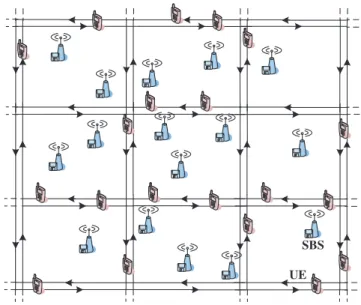
macro-cell modeled as a Manhattan grid map [13], as shown in Fig. 1. In such a grid model, apathis defined by a polyline with a start and an end point. Thus, a UE’s mobility is fully described by its speedνm and its path, which are both chosen to be i.i.d..
While moving along its trajectory, we assume that each UE i
reports its channel gaingi,m(t)to its serving SBSi. This channel
state information (CSI) feedback is reported once per coherence time and is used for deciding on the associations between SBSs and mobile UEs. In fact, while the path loss only depends on the distance between the UE’s location and the serving SBS, two
UE SBS
Fig. 1. Network scenario based on the Manhattan mobility model.
UEs on the same path are likely to experience different fading components, depending on their speed.
In classical networks, an SBS retrieves the UE’s filesf ∈ Fm
only once an explicit request is made by the UE. In such a reactive protocol, the quality of the transmission stream depends on the wireless channel conditions (e.g., received interference) and on the backhaul capacity Bi,m that SBS i allocates to
the UE’s traffic requests. As a result, in a traditional reactive approach, the maximum data rate at which the files inFmcan
be delivered, from an SBSi to a UEm, is:
Ci,m(t) = min{Bi, ri,m(t)}. (2)
Note that, in case of backhaul traffic congestion, the backhaul capacityBi is insufficient for keeping up with the transmission
data rate ri,m(t) (i.e., Bi < ri,m(t) ). As a result, UE m can
experience a considerable QoS degradation (e.g., low resolution or playback, for video applications), for reasons that are indepen-dent from the quality of the wireless transmission. To overcome such limitations, we assume that each SBS is equipped with a data storage unit having a capacity of Ki bytes, that are used
to download data files (e.g., popular video files) in F to be stored at the SBS level, prior to a UE’s requests. Hence, when an SBS i is not servicing any UE1, it can cache a set of files
Di={1, ..., Di},Di⊂ F, by downloading them from the core
network via the backhaul. Note that, by locally caching the files
Di, an SBS can enhance the UE’s QoS, by transmitting at data
rates that are no longer affected by the backhaul status, since the constraint in (2) no longer applies.
This caching procedure can continue until the storage capacity
Ki is exhausted. Upon reaching the maximum storage capacity
Ki, the least popular files are systematically dropped to
accom-modate new file entries, while verifying the storage capacity constraint:
Di·s≤Ki [bits]. (3)
1Equivalently, an SBS can keep copies of the files that have been transmitted
When applying caching techniques to small cell networks, it must be noted that the proportion of cached data is not equal at all SBSs, as it depends on the backhaul conditions experienced by each SBS, and on their storage capabilities. As a result, data caching techniques cannot be applied uniformly to each SBS and, thus, they require novel decentralized approaches in which each SBS selects its own caching strategy, by accounting for both the local storage capacity and the network properties (i.e., backhaul capacity, received interference).
In the following section, we will describe how each SBSs can devise an individual caching strategy, while accounting for the mobility pattern of the incoming users and the network properties.
III. CACHE-AWAREUSERASSOCIATION AS AMATCHING
GAME
A. Problem formulation
Given the system model presented in the previous section, our key goal is to study the problem of UE-SBS association, by focusing onwhich UEshould be serviced by each SBS, given a set of locally available filesDi. We consider that each SBS keeps
track of the CSI feedbacksgi,m(t)that are periodically reported
by each UEmin its vicinity. Based on the CSI sequence, an SBS can learn the UEs’ speed and direction of arrival, and thus infer2 the time instantstIN
i,mandtOU Ti,m , at which usermwill arrive and
leave celli. Once a user is associated (at timetIN
i,m), the files that
are available in the local storage units are transmitted first, at an instantaneous transmission data rate ofri,m(t)bps. The amount
of data cached at SBSitransmitted to a UEmis:|Fm∩ Di| ·s,
and the estimated time to accomplish that is:
ˆ
τi,m(t) =|F
m∩ Di| ·s
ri,m(t)
[sec]. (4) Note that the estimated time in (4) for delivering the files in the cache of SBS i depends on the instantaneous data rate
ri,m(t). Therefore, in case τˆi,m(t) ≥ tOU Ti,m , only a portion of
the cached data can be delivered to UEm, precisely, until UE
m leaves cell i at time tOU T
i,m . As a result, the data cached at
SBSi can be transmitted a UEm starting fromtIN
i,m until time
limitτˆmax
i,m (t), defined as:
ˆ
τi,mmax= min{τˆi,m(t), tOU Ti,m } [sec]. (5)
When a UE m requests a file f that is not locally available in the SBS cache, that file is retrieved from the core network, via the backhaul. In this case, the files are delivered to the UE m at a transmission rate Ci,m(t) as per (2), depending on
whether the bottleneck is represented by the backhaul capacity or the transmission data rate. In order to formalize the UE-SBS association problem, we define a suitable utility function for each UEm∈ Mseeking a set of files f ∈ Fm, and being serviced
by SBS i ∈ N, as the amount of bits that SBS i delivered to UEmduring the service time [tINi,m, tOU Ti,m ]:
2For example, an SBS can estimate the incoming users based on mobility
tracking [14], [15], or based on the received signal strength indicators that a UE periodically broadcasts [16]. Ui,m(tINi,m, t OU T i,m ,τˆ max i,m ) = (6) = ∑τˆmax i,m t=tIN i,m ri,m(t)∆(gi,m(t)) + ∑tOU T i,m t=ˆτmax
i,m Ci,m(t)∆(gi,m(t))
tOU T i,m −tINi,m
,
where∆(gi,m(t))is the interval duration between two
consecu-tive time instantstand it is assumed to be equal to the coherence time at timet. In other words,∆(gi,m(t))is the duration during
which the channel is unchanged, starting from time instantt. In the utility (6), we can see that the files f ∈ {Fm∩ Di}
requested by UEm, and already available at SBS i, are trans-mitted at data rateri,mduring[tINi,m,τˆ
max
i,m ]. In addition, the files
f ∈ {Fm\ Di}, that have to be downloaded from the core
network, are transmitted during[ˆτmax
i,m , tOU Ti,m ]and subject to the
constraints in (2) and (5). As a result, while the QoS of cached files delivery only depends on the wireless channel properties, the files that are not in local caches are also exposed to a possible QoS degradation, due to the backhaul capacity limitations.
Finally, we aim at finding a matching η : M → N that
maximizes the utility Ui,m, by considering the limitations on
the backhaul capacity and storage size. Essentially, this yields the following optimization problem:
arg max η: (i,m)∈η,f∈Di ∑ i∈N ∑ m∈Li Ui,m(tINi,m, t OU T i,m ,τˆ max i,m ), (7) s.t., Di·s≤Ki, ∀i∈ N. (8)
In terms of complexity, solving the UE-SBS association using classical optimization techniques is an NP-hard problem, which depends on the number of SBSs and UEs in the network [17]. Such an exponential complexity makes a centralized approach in-tractable, especially in dense network deployments in which the number of UEs and SBSs significantly grows. As a result, solving the UE-SBS association problem in (7) mandates a decentralized approach in which UEs and SBSs autonomously decide on the UE-SBS association based on their caching capabilities. The formulation and implementation of such a decentralized solution are discussed in the following section.
B. Matching game formulation
For solving the SBS-UE association problem in (7), one suitable framework is that of matching theory [17]. Matching theory provides a computationally tractable set of tools for solving a combinatorial problem such as (7). Essentially, a matching game is defined as follows:
Definition 1. Amatchinggame is defined by two sets of players
(M,N)and a function η:{M ∪ N } → {M ∪ N }, such that:
• |η(m)|= 1, for every UEm∈ M,
• |η(i)| ≤qi, (or equivalently|Li| ≤qi) for every SBSi∈ N,
• η(m) =iif and only ifi=η(m), or equivalently,m∈ Li.
Specifically, we consider a one-to-many matching that assigns to each UE m ∈ M, an SBS i =η(m), i ∈ M, and to each SBS i ∈ M, a set of UEs η(i) ⊂ M, such that |η(i)| ≤ qi,
Algorithm 1: UE-SBS Cell Association Algorithm. Data: Each UEmis initially associated to a randomly selected SBSj,
(j, m)∈η′.
Result: Convergence to a stable matchingη.
Phase I - Incoming UE discovery;
•At timet: each SBSitracks the CSI feedbacksgi,m(t)of the UEmin the vicinity;
•Each SBS estimates the arrival timetIN
i,mandtOU Ti,m of userm;
•At timetINi,m: UEmnotifiesFmto SBSi, and the utilityUi,mis
updated;
Phase II - UE-SBS matching proposal;
forall the discovered UEsmdo
•Incoming usersmare sorted by≻i;
•SBSisends a proposal to the UEiat the top of the preference list and notifiesBi;
•UEmcomputes the data rateCi,m(t)and sorts the SBSs by≻m;
ifi≻mjthen
•UEmaccepts the proposal of SBSi;
•SBSiwill start the transmissions attINi,m.
else
•UEmrefuses the proposal, and SBSisends a proposal to the next preference.
end end
•At timetIN
i,m: UEmgets associated to SBSm,Li← Li∪ {m}.
Phase III - Cache management;
•During[ˆti,m, tINi,m], the SBSs update the cached data sets based on the
file popularity;
•Caching procedure continues until the memory capacity is reached. Beyond that point, least popular files are systematically dropped.
individual preference relations ≻, that are complete, reflexive, and transitive binary relation between the players inMandN. Accordingly, the preference profile of an SBS i, over the set of UEs M is defined by an ordered list Π(i) = {m, n, . . .}, denoting that SBSi prefers to service UEm, rather than UE j, or briefly m≻i n. Similarly,Π(m) ={i, j, . . .} represents the
preferences of UEmover the set of SBSN, indicating that that UEm prefers being associated to SBSi, rather than to SBS j, i.e.,i≻mj.
When defining a preference for an SBS, a UE has no knowl-edge of the files stored at the SBS side. As a result, a UE can only define a preference based on the properties of the SBSs’ transmitted signals. Hence, for any UE m, we propose a preference relation≻mdefined over the set of SBSsN, based
on the transmission data rate of SBS i:
i≻mj⇔Ci,m(t)> Cj,n(t). (9)
Next, we define an analogous preference relation≻i for any
SBSi over the set of UEM, based on the utility in (6). Such a preference relation accounts for a UE’s time of arrival and departure from cell i, and the amount of files requested by UE
m, that are currently available at the SBS side:
m≻i n⇔Ui,m(tINi,m, t OU T i,m ,τˆ
max
i,m )> Ui,n(tINi,n, t OU T i,n ,τˆ
max i,m )
(10) To solve the problem in (7) in a decentralized approach, the SBSs and UEs can individually rank one another, based on the preference relations ≻m, ≻i. The aim of each SBS is to
maximize its own utility, or equivalently, to become associated with the UE, for which the requested files are likely to be
0.5 1 1.5 2 2.5 3 3.5 4 4.5 5 500 1000 1500 2000 2500 3000 3500
Backhaul capacity at the SBS (Bi)[Mbps]
Average utility per UE−SBS link U
i,m
[bps]
Proposed UE−SBS association for SBS with storage capacity: Ki=1 TB Proposed UE−SBS association for SBS with storage capacity: K
i=2 TB
Proposed UE−SBS association for SBS with storage capacity: K
i=3 TB
Traditional non cache−based UE−SBS association approach
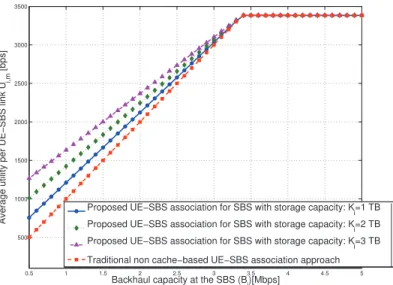
Fig. 2. Average utility per UE-SBS link as a function of the backhaul capacityBi,
for different storage capacitiesKi={1,2,3},M= 120UEs ,N= 120SBSs,
νm= 1m/s.
locally available, inDi, or can be retrieved through a backhaul of
capacityBi. Similarly, the aim of each UEmis to be associated
with the SBS delivering the largest data rate Ci,m(t) for its
requested files.
C. Proposed game solution
In order to find a UE-SBS matching and the problem in (7), we propose a new approach, shown in Algorithm 1, inspired by the deferred acceptance scheme proposed by Gale and Shapley for the stable marriage problem [17]. Algorithm 1 is composed of three main phases: incoming UE discovery, UE-SBS matching proposal, and cache management. Initially, each UE is associated to a randomly selected SBSj3. Then, each SBS idiscovers the incoming UE i ∈ M in the vicinity, using standard tracking techniques such as in [2]. At this stage, SBS i learns the time of arrivaltIN
i,m, and the time left for caching additional contents.
Next, based on the current matching, UEs and SBSs update their respective utilities and individual preferences over one another. In the second phase, each SBS sends a proposal to the most preferred UE m, by notifying the available backhaul capacity
Bi. Upon receiving a proposal, UE m updates its preference
list and accepts the request of SBS i only if it is the most preferred SBS, among the available ones. Otherwise, if rejected, SBS m proposes to the next UE in its preference list. Both UEs and SBSs periodically update their respective utilities and preferences according to the current utilities and ensure that they are associated to their respective first preference.
In order to study the stability of the proposed matching, we use the stability concept used by Gale and Shapley [17], by adapting it to the problem in (7):
Definition 2. A UE-SBS association isstable if there does not
exist two UEsm,n, that are respectively serviced by two SBSs
iand j, althoughmprefersj toi, and nprefersitoj. For our proposed game, the scheme shown in Algorithm 1 will reach a stable matching as follows:
40 60 80 100 120 140 160 180 200 210 2100 2200 2300 2400 2500 2600 2700 2800 Number of SBSs (N)
Average utility per UE−SBS link U
i,m
[bps]
Proposed UE−SBS association for SBS with storage capacity: Ki=1 TB
Proposed UE−SBS association for SBS with storage capacity: Ki=2 TB
Proposed UE−SBS association for SBS with storage capacity: K
i=3 TB
Traditional non cache−based UE−SBS association approach Backhaul−limited regime
Interference−limited regime
Fig. 3. Average utility per UE-SBS link as a function of the number of SBSN, for different storage capacitiesKi={1,2,3}TB,M = 100UEs ,Bi= 2.5
Mbps,νm= 1m/s.
Proposition 1. The proposed Algorithm 1 is based on the
deferred acceptance algorithm, thus, it is guaranteed to converge to a stable matching in a finite number of iterations, as per [17].
IV. SIMULATIONRESULTS
For our simulations, we consider a single cell of a macro-cellular network, modeled as a Manhattan map of500×500 m with a bandwidth of20MHz. In this cell, M UEs andN SBSs are uniformly deployed. The UE’s speed is chosen as i.i.d in the interval νm = [1,10] m/s. The transmit power of each SBS i
ispi= 33 dBm and the assigned bandwidth per UE is wi,m =
720KHz. Transmissions are affected by distance dependent path loss, with path loss exponent 3, and shadowing according to 3GPP specifications [18]. The files in F have a size of s = 2KB. The file requests follow a Zipf distribution with parameter
ψ = 0.4. Each UE requests Di = 1500 files, out of a set of
|F|= 1.5·109 files. Each SBS i∈ N has a memory capacity chosen from an intervalKi= [0.2,3]TB. Similarly, the backhaul
capacity is chosen from an intervalBi = [0.5,5]Mbps.
Prior to the performance evaluation, we considered a training phase of the duration of 600 seconds, in which each SBS has downloaded a set of popular files directly through the backhaul, according the Zipv file popularity distribution.
For comparisons, we consider a traditional non cache-based approach, in which the SBSs accommodate the UE’s data requests by downloading the respective files directly from the backhaul whose capacity is given by Bi. In practice, the utility
of such an approach is still expressed by (6), while setting ˆ
τmax
i,m =tINi,m, since no files are kept at the SBSs’ side.
Figure 2 shows the average utility per UE-SBS link as a function of the backhaul capacity Bi, for different storage
capacities Ki at the SBSs, in a network with N = 120SBSs,
andM = 120 UEs. Figure 2 shows that the proposed caching strategy is mostly beneficial during a regime of limited backhaul capacity (i.e., Bi ≤3.4 Mbps). In fact, the proposed approach
yields a utility gain which is proportional to the probability of having the UE’s files in the serving SBS’ storage unit. For
0 0.5 1 1.5 2 2.5 3 2500 2550 2600 2650 2700 2750 2800 2850
Storage capacity at the SBS (K
i) [TB]
Average utility per UE−SBS link U
i,m
[bps]
Proposed UE−SBS association for UE moving at 1 m/s Proposed UE−SBS association for UE moving at 5 m/s Proposed UE−SBS association for UE moving at 10 m/s
Traditional non cache−based UE−SBS association approach for UE moving at 10 m/s Traditional non cache−based UE−SBS association approach for UE moving at 5 m/s Traditional non cache−based UE−SBS association approach for UE moving at 1 m/s
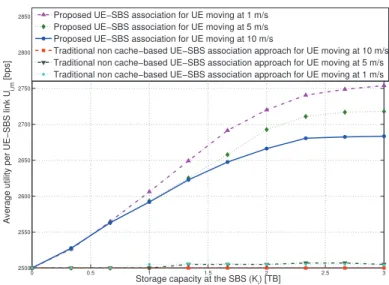
Fig. 4. Average utility per UE-SBS link as a function of the storage capacity per SBS,Ki, for different UEs’ speedsνm={1,5,10}m/s,M= 120UEs,
Bi= 2.5Mbps.
example, Figure 2 shows that the performance gap between the proposed approach and a non cache-based association scheme is 21%, for SBSs with a backhaul capacity of Bi = 2 Mbps
and storage units of 3 TB. Finally, the gains stemming from caching saturate when the backhaul capacity no longer represents a bottleneck for QoS delivery (i.e.,Bi ≥3.4 Mbps). Therefore,
Figure 2 demonstrates that the proposed cache-based approach yields significant utility gains by exploiting local content avail-ability, notably in networks with a limited-capacity backhaul.
Figure 3 shows the average utility per UE-SBS link as a function of the number of SBSs N, for different storage capacities, in a network with M = 100 UEs, and a backhaul capacity of Bi = 2.5 Mbps. Figure 3 shows that, for all the
considered approaches, the average utility of an UE grows with the probability of being serviced by a nearby SBS, yielding higher SINR. Note that, even when higher transmission data rates are possible, delivering the UE’s files in a traditional non cache-based approach is ultimately limited by the backhaul capacity, as per constraint (2). In such a backhaul-limited regime (i.e., 45≤ N ≤ 199 SBSs), locally cached files can be transmitted at data rates larger than the backhaul capacity. For example, Figure 3 shows that the performance gains of the proposed cache-based approach increase with the storage capacityKi, reaching
up to 11% and 6% relative to a non cache-based approach, respectively for Ki = 3 TB, and Ki = 1 TB, in a network
withN = 120 SBSs. Finally, for all the considered techniques, the utility eventually decreases as the received interference grows with the size of the small cell tier. In summary, Figure 3 shows that by locally caching UE’s file, the SBSs are able to overcome the backhaul capacity limitations and improve the QoS delivery, yielding gains that grow linearly with the SBSs’ storage capacity
Ki.
In Figure 4, we evaluate the average utility per UE-SBS link as a function of the caching capabilities at the SBS sides, for different UEs’ speedsνm={1,5,10} m/s. Figure 4 shows that,
for the considered cases, the UE-SBS utility grows linearly with the storage capacity Ki, while depending on the average time
1 20 40 60 80 100 120 140 160 180 200 1 20 40 60 80 100 120 Number of SBSs (N)
Average number of algorithm iterations
Proposed decentralized UE−SBS association approach Centralized UE−SBS association approach
A centralized approach is mathematically intractable for networks with N>30 SBSs
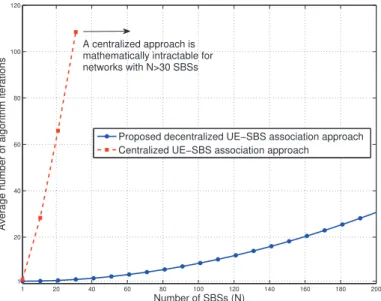
Fig. 5. Average number of algorithm iteration as a function of the network size
N,M= 120UEs,Bi= 2.5Mbps,νm= 1m/s.
a UE is associated to an SBS, the larger is the amount of cached data that an SBS can deliver. For example, the gain of the proposed solution with respect to a traditional UE-SBS association approach is 9% and 7.1%, respectively for a UE’s speed ofνm= 1m/s andνm= 10m/s, for SBSs with a storage
capacity Ki = 2 TB. In a nutshell, Figure 4 shows that the
proposed cache-aware user association approach can enhance the UE’s QoS in a wide range of UEs’ mobility patterns.
In Figure 5, we show the average number of algorithm itera-tions (Phase II of Algorithm 1) required at each SBS to converge to a stable matching, as a function of the number of SBSs in the network. Figure 5 shows that the complexity of a decentralized approach depends on the number of SBSs that can service a given UE. For instance, the average number of algorithm iterations is
17, for a network with M = 120 UEs and N = 120 SBSs,
while it grows up to 20 for a larger network with N = 160 SBSs. Figure 5 also shows the number of iterations required to devise an optimal UE-SBS matching in a centralized fashion. Here, although the deferred acceptance scheme has a polynomial complexity, a centralized approach requires a brute-force search, whose complexity grows exponentially withN [19]. As a result, a centralized solution is computationally intractable for networks larger thanN = 35SBSs. In summary, Figure 5 shows that the proposed distributed approach converges to a stable matching by performing a reasonable number of algorithm iterations at each SBS.
V. CONCLUSIONS
In this paper, we have presented a novel cache-aware UE-SBS association approach for wireless small cell networks. The proposed scheme enables each SBS to select the UEs to be serviced, by accounting for the local availability of cached files, as well as the backhaul and interference limitations. We have modeled the problem as a one-to-many matching game, in which the SBS and UE devise individual preferences over one another. We have proposed an algorithm, based on the deferred acceptance scheme, that enables the UEs and SBSs to generate a list of preferences that are respectively based on the transmission
capacity and a utility that accounts for the SBSs’ data storage capabilities and the UE’s mobility pattern. We have shown that, by using the proposed algorithm, the SBSs and the UEs reach a stable matching in a reasonable number of iterations. Simulation results have shown that, by exploiting local files availability at the SBSs, the proposed cache-based solution enables the SBSs to overcome the limitations of a congested backhaul, and yield significant gains in terms of data delivered to the UEs, reaching up to 21%, with respect to a traditional UE-SBS association approach with no cache considerations.
REFERENCES
[1] J. Andrews, H. Claussen, M. Dohler, S. Rangan, and M. Reed, “Femtocells: Past, present, and future,”IEEE Journal on Sel. Areas in Comm., vol. 30, no. 3, pp. 497 –508, Apr. 2012.
[2] T. Q. S. Quek, G. de la Roche, I. Guvenc, and M. Kountouris,Small Cell Networks: Deployment, PHY Techniques, and Resource Management. New York, USA: Cambridge University Press, Sept. 2012.
[3] M. Kryder and C. S. Kim, “After hard drives - what comes next?”IEEE Transactions on Magnetics, vol. 45, no. 10, pp. 3406–3413, Oct 2009. [4] X. Wang, M. Chen, T. Taleb, A. Ksentini, and V. Leung, “Cache in the air:
exploiting content caching and delivery techniques for 5g systems,”IEEE Communications Magazine, vol. 52, no. 2, pp. 131–139, February 2014. [5] S. Woo, E. Jeong, S. Park, J. Lee, S. Ihm, and K. Park, “Comparison of
caching strategies in modern cellular backhaul networks,” inIn Proc. of the Int’l Conf. on Mobile Systems, Applications, and Services (MobiSys), 2013, pp. 319–332.
[6] N. Golrezaei, K. Shanmugam, A. Dimakis, A. Molisch, and G. Caire, “Wireless video content delivery through coded distributed caching,” in
In Proc. of IEEE Int’l Conf. on Communications (ICC), June 2012, pp. 2467–2472.
[7] ——, “Femtocaching: Wireless video content delivery through distributed caching helpers,” inIn Proc. of IEEE INFOCOM, March 2012, pp. 1107– 1115.
[8] N. Golrezaei, A. Dimakis, and A. Molisch, “Wireless device-to-device communications with distributed caching,” inIn Proc. of IEEE Int’l Symp. on Information Theory Proceedings (ISIT), July 2012, pp. 2781–2785. [9] E. Bastug, J.-L. Guenego, and M. Debbah, “Proactive small cell networks,”
inIn Proc. of Int’l Conf. on Telecommunications (ICT), May 2013, pp. 1–5. [10] V. Siris and M. Anagnostopoulou, “Performance and energy efficiency of mobile data offloading with mobility prediction and prefetching,” in In Proc. of IEEE Int’l Symp. on World of Wireless, Mobile and Multimedia Networks (WoWMoM), June 2013, pp. 1–6.
[11] E. Bastug, M. Bennis, and M. Debbah, “Social and spatial proactive caching for mobile data offloading,” inIn Proc. of IEEE ICC Workshop on Small Cell and 5G Networks (SMALLNETS), June 2014, p. (to appear). [12] K. Hamodouche, W. Saad, and M. Debbah, “Many-to-many matching
games for proactive social caching in small cell networks,” in In Proc. of 12th Int’l Symp. on Modeling and Optimization in Mobile, Ad Hoc, and Wireless Networks (WiOpt), May 2014, pp. 1–5.
[13] F. Bai, N. Sadagopan, and A. Helmy, “Important: a framework to systemat-ically analyze the impact of mobility on performance of routing protocols in adhoc networks,” inIEEE INFOCOM conference, 2003, pp. 825 –835. [14] X. Chen, F. Meriaux, and S. Valentin, “Predicting a user’s next cell with supervised learning based on channel states,” inIn Proc. of IEEE Workshop on Signal Processing Advances in Wireless Communications (SPAWC), June 2013, pp. 36–40.
[15] Y. Yuan, Y. Tang, and C. Lin, “A novel mobility prediction mechanism in heterogeneous networks,” inIn Proc. of Int’l Conf. on Communications and Mobile Computing (CMC), vol. 3, April 2010, pp. 536–540. [16] J. Kim, S. Kim, N. Y. Kim, J. Kang, Y. Kim, and K.-T. Nam, “A novel
location finding system for 3gpp lte,” inIn Proc. of IEEE Int’l Symp. on Personal, Indoor and Mobile Radio Communications, Sept 2009. [17] A. Roth and M. A. O. Sotomayor,Two-Sided Matching: A Study in
Game-Theoretic Modeling and Analysis. New York, USA: Cambridge Press, 1992.
[18] S. Sesia, I. Toufik, and M. Baker,LTE - the UMTS long term evolution. A John Wiley and Son publication - UK, Aug. 2009.
[19] T. Roughgarden, “Computing equilibria: A computational complexity per-spective,”Stanford University, vol. 1, no. 09, Jan 2009.