QoS based Effective and Efficient Selection of Web Service and Retrieval
of Search Information
Dr. Pradeep
Gurunathan
1,
Dr. Padmapriya Anand
2 1A.V.C College of Engineering, Mannampandal, Mayiladuthurai, Tamilnadu, India
[email protected]
2
A.V.C College of Engineering, Mannampandal, Mayiladuthurai, Tamilnadu, India
ABSTRACT
Web services are integrated software components for the support of interoperable machine to machine interaction over a network. Web services have been widely employed for building service-oriented applications in both industry and academia in recent years. The number of publicly available Web services is steadily increasing on the Internet. However, this proliferation makes it hard for a user to select a proper Web service among a large amount of service candidates. An inappropriate service selection may cause many problems to the resulting applications. In this paper, a novel collaborative filtering-based Web service recommender system is proposed to help the users and select services with optimal QoS performance. Our recommender system employ an effective and efficient selection of web services and relevant retrieval of information and makes personalized service recommendation to users based on the clustering results. Compared with existing service recommendation methods, the proposed approach achieves considerable improvement on the recommendation accuracy and the QoS performance metrics adopted in this paper shows the better accuracy and relevant web services..
Keywords
Web services, QoS, Service Oriented Architecture.
1. INTRODUCTION
Web services that evolve various organizations and computing platforms can be composed to create new service-oriented applications efficiently. However, some web services may act maliciously. . Web service recommendation is helpful for users when two or more web services have the similar operation but different in speed, through put, performance. Reputation can be measured from feedback of the user. The reliability of the cumulative result of the feedback for commercial benefit can be degraded by malicious feedback ratings. Malicious users can produce a numerous malicious feedback ratings to threaten the reputation system of web services. Malicious client can be discovered by using Pearson Correlation Coefficient. Diverse client have unlike feedback rating for the same service. Reputation can be measured by the collective sum of the different ratings. A malicious feedback rating prevention scheme is important for the reputation measurement of web services.The proposed work uses the cumulative sum control chart to find malicious feedback ratings and uses standard Bloom filter to provide malicious feedback rating prevention scheme to prevents malicious users and hence recommends the optimal web service.
2. RELATED WORK
E. Michael Maximilien,Munindar P. Singh proposed a paper for Conceptual Model of Web Service Reputation that says detailed information about the reputation of the web service using which user can find the trust worthy web service. Radu Jurca,Walter Binder,Boi Faltings proposed a paper for Reliable QoS Monitoring Based on Client Feedback that says that Service level agreement is a contract between the service requestors and client regarding QoS. If any deviation on that agreement that causing effect to the clients. This paper discussed on QoS monitoring mechanism from the user feedback. The mechanism provides incentives for the clients to report directly about the Qos.
Shangguang Wang, Zibin Zheng, Qibo Sun, Hua Zou and Fangchun Yang proposed a paper on Evaluating Feedback Ratings for Measuring Reputation of Web Services. In this paper, the reputation of web service is usually based on the feedback from the user is discussed. Different user may provide the different feedback, but the malicious user may provide the feedback which affects the recommendation system. In this approach, it first detects malicious feedback ratings by the Cumulative Sum Method, and then reduce the affect of different user feedback preferences by using Pearson Correlation Coefficient.
Zaki Malik and Athman Bouguettaya described an Evaluating Rater Credibility for Reputation Assessment of Web Services infrastructure for evaluating the credibility of raters in a reputation-based framework that would enable trust-based Web services interactions. Our proposed approach could easily be extended to any kind of P2P interactions involving unknown peers.
Danilo Ardagna and Barbara Pernici proposed a Adaptive Service Composition in Flexible Processes in that they says they introduce a new modeling approach to the Web service selection problem that is particularly effective for large processes and when QoS constraints are severe. In the model, the Web service selection problem is formalized as a mixed integer linear programming problem, loops peeling is adopted in the optimization, and constraints posed by stateful Web services are considered. Chrysanthos Dellarocas proposed a paper on Immunizing Online Reputation Reporting Systems Against Unfair Ratings and Discriminatory Behavior on that they evaluates a set of mechanisms, which eliminate, or significantly reduce the negative effects of such fraudulent behavior. The proposed mechanisms can be
1
. Submit a search query through a keyword based text search 2. List the web page based on ranking returned by the search engine3. Scan the keyword and resultant with the URL links, which is usually provided in the returned search result page
4. User makes a choice and may click on several interested results 5. Wait for the desired page(s) is loaded
6. Stay on the page for some time to read/browse the web page
7. If opened web page is not found relevant or unsatisfactory, user move to other results 8. After looking through all the pages either user get his query answered or may submit some
new query using some other keywords if current search results do not serve his search interest.
deceitful buyers and sellers.Noura limam and Raoufboutaba proposed a paper on that Assessing Software Service Quality and Trustworthiness at Selection Time on that they describes a framework for reputation-cognizant software accommodation cull and rating. A choice algorithm is devised for accommodation recommendation, providing SaaS consumers with the best possible culls predicated on quality, cost, and trust. An automated rating model, predicated on the expectancy-disconfirmation theory from market science, is withal defined to surmount feedback subjectivity issues. The proposed rating and cull models are validated through simulations, demonstrating that the system can efficaciously capture accommodation comportment and recommend the best possible choices. Liangzhao Zeng, Boualem Benatallah, Anne H.H. Ngu,Marlon Dumas, Jayant Kalagnanam, Henry Chang proposed a paper on QoS-Aware Middleware for Web Services Composition. This paper represents the problems arise during suggesting the web service for users based on their users level of contentment articulated as useful methods over Qos attributes, while pleasing the users fulfilling the users limitation by the formation of set by the user and concept of complex web service. User integer programming helps in providing two approaches one is regional service and another one is international services.
Farhan Hassan Khan, M.Younus Javed, Saba Bashir [9] presented a framework for dynamic web service composition and execution. At first they discussed major problems of dynamic composition and then proposed an algorithm for dynamic web service composition. They mentioned composition issues like reliability, availability, data distribution. They introduced the concept of multiple repositories for system reliability. Availability is also guaranteed by this concept. An aging factor is used to retrieve up-to-date information they claim that their system is reliable, fault tolerant fats data retrieval.
Liping Liu, Anfeng Liu, Ya Gao[21] used Particle Swarm Optimization for Service Composition. PSO is meaningful for the composition of complex services spread on internet. If there is requirement of multi objective composition only PSO can do so. A non inferior part of solution is provided by PSO group search. The solution meets all the required constraints. They used general service overlay model. They said that their algorithm can be applied to specific compositions.
Liu et al. [19] proposed a QoS-based dynamic web service composition approach. In the approach, they also model web service selection using multi-choice knapsack problem and divide the service selection problems into two classes to facilitate the service selection process. The mathematical models are established for each class respectively. Accordingly, the heuristic selection algorithms are proposed to solve the models.
In summary, most of existing approaches were endeavoring to look for suitable services for composing the business logic of application. These approaches do not handle the situation when there is no feasible solution to fulfill QoS constraints. It is an important issue for finding a solution with smaller amount of constraints violation if there is no a feasible solution to fulfill the QoS constraints. Therefore, to provide a better service, QoS metrics are considered along with user preference and feedback mechanism is suggested in the paper.
3. USER INTERACTION WITH SEARCH MECHANISM IN INFORMATION RETRIEVAL
Search Engine often searches the web and / or local database for a query string. This operation returns only unique web address and unique documents. The whole process is shown in the Figure 1.
Figure 1. User Behaviors in Web Search
Users are asked to search the query in the search engine and surf for the appropriate content relevant to the searched query. Normally, when the user given a query in the search engine to search over the internet, it search for the query and produce the links. In some cases, the link may not contain the relevant page or data, whereas the proposed method produces only the relevant links which contains the relevant page or data.
3.1 Experimental Setup and Procedure for the effectiveness of the search
Intel Core 2 Duo Processor machine equipped with 4 GB of RAM and 32 Bit Version of Windows XP Professional service pack 3 has been used in the experiment. The proposed search mechanism is implemented in java and some of the source codes are used. The Web Server is tomcat server, the data base is Mysql and the port is 3306.
First, a single query was given to a user and is asked to visit first 10 results on Search Engine Result Page (SERP) to retrieve the result for the query in the default web browser and search through search engines like Google, Yahoo and Proposed Search. The user searches the query in the normal way by opening many links he get on SERP.
Users are from different fields with different way of searching/ browsing. Users preferences and the user‟s profession are recorded. The user has to register in to the proposed system, when a user searches a keyword. Otherwise, the proposed system does not provide the links to the search query. When a similar kind of search is given by the same user, automatically the highest rating web links is appeared at the top of the web page.
4. QoS IN SERVICE SELECTION
The QoS is defined as a combination of various attributes of web services such as availability, response time throughput, etc. The QoS is an important element of Web services and other modern technologies. Currently, most of works use successive evaluation of various non-functional aspects in order to attribute a general level of quality to different composite Web services and to select the “best" one from these services.
The following service contract aspects are deliberately considered while selecting multimedia services.
Service Profile - consists of information regarding the organization that provides the service and functionality of the service. The functionality includes various functional parameters such as input, output, precondition and effect. The last type of information is a list of service parameters that contains the information regarding availability, response time and QoS.
Service Model - It describes how the service works and provides different perspective of web service which can be viewed as a process.
Service grounding - Specifies the details of how to access the service. The grounding is to show how the inputs and outputs of an atomic process are to be realized concretely as messages, which carry those inputs and outputs in specific transmittable format.
Core Functionalities - refers to the type of service provided to the user. It is a set of operations and their specified properties that satisfy stated or implied needs can be captured as preconditions and post conditions.
Preconditions are properties that must be true when the service operation is called. It is the responsibility of the caller to guarantee that these properties hold. If the preconditions do not hold, the operation is allowed to behave in an arbitrary manner. Preconditions are for enabling the transition in terms of the Mealy machine.
Post conditions are properties that a service operation guarantees will hold when the service operation exits. But if the precondition does not hold when the service operation is called, the post condition need not hold on exit of the service operation. In Mealy machine, Post conditions forms the specification of the next state and output. On the whole, functionality relates to the transition and output functions with precondition enabling the transition and the output function with post condition specifying the next state and output (Okika & Ravn 2008).
• Protocol - behavior of a system is based on the description of the input events, the response to various scenarios of events, signals, messages, etc. In Mealy machine, it can be viewed as the language accepted by the machine. • Security - refers to techniques and practices that ensure confidentiality properties for a service. Security has a vital
treatment because it differs from other quality properties. It specifies the protocols and coding mechanisms to be used, whereas other qualities provide thresholds on measurable quantities.
• Non Functional Properties - consists ofa set of measurable quality that provides a service. There is a function that maps in to a scaling factor. A contract on a quality gives constraints on the values acceptable for a concrete service.
Throughput is measured in terms of throughput (number of Web service requests served at a given time period) and latency (round-trip time between sending a request and receiving the response).
Number of Service Invocations Throughput
Unit Time
Reliability represents the degree of being capable of maintaining the service and service quality.
𝑅𝑒𝑙𝑖𝑎𝑏𝑖𝑙𝑖𝑡𝑦 = 1 − 𝐹𝑎𝑖𝑙𝑢𝑟𝑒 𝑅𝑎𝑡𝑒
Availability is concerned with whether the Web service is present or ready for immediate use.
𝐴𝑣𝑎𝑖𝑙𝑎𝑏𝑖𝑙𝑖𝑡𝑦 𝑆 =
𝑟𝑒𝑠𝑝𝑜𝑛𝑠𝑒 𝑡𝑖𝑚𝑒
𝑖𝑗𝑡𝑜𝑡𝑎𝑙 𝑟𝑒𝑞𝑢𝑒𝑠𝑡
𝑖𝑗A QoS property can be static or dynamic. A static QoS property value is defined at the time it is described whereas the dynamic QoS property value requires measuring and updating its value periodically. The QoS value from the service consumer‟s perspective can be positive, negative, close, or exact. For example, consumers expect to buy a service with low price and expect to retrieve the service in a low response time. Whereas performance, integrity etc., have
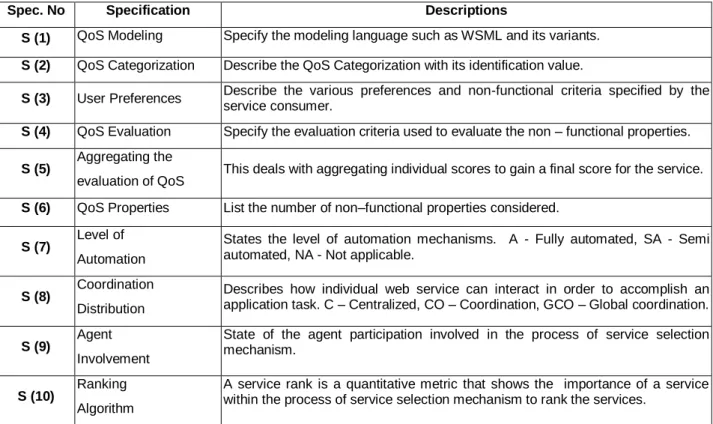
positive trend in which the consumer expects the positives values are better. The Quality of Service based Service Selection (QSS) specification and its descriptions are represented in the Table 1.
Table 1. QSS Specification and Description
Spec. No Specification Descriptions
S (1) QoS Modeling Specify the modeling language such as WSML and its variants. S (2) QoS Categorization Describe the QoS Categorization with its identification value.
S (3) User Preferences Describe the various preferences and non-functional criteria specified by the service consumer. S (4) QoS Evaluation Specify the evaluation criteria used to evaluate the non – functional properties. S (5) Aggregating the
evaluation of QoS This deals with aggregating individual scores to gain a final score for the service. S (6) QoS Properties List the number of non–functional properties considered.
S (7) Level of Automation
States the level of automation mechanisms. A - Fully automated, SA - Semi automated, NA - Not applicable.
S (8) Coordination Distribution
Describes how individual web service can interact in order to accomplish an application task. C – Centralized, CO – Coordination, GCO – Global coordination. S (9) Agent
Involvement
State of the agent participation involved in the process of service selection mechanism.
S (10) Ranking Algorithm
A service rank is a quantitative metric that shows the importance of a service within the process of service selection mechanism to rank the services.
5. RESULTS AND DISCUSSION
Based on the factors such as user preference and feedback, the experts rank the web pages according to user preferences and compared the ranking of web-pages of the proposed method and the ranking produced by Google and Yahoo. For a single query, initially the number of visit (N) to the web link is set to zero for all the results returned by search engine. As the users search for a given is liked by the user and there is a web page available for a search and click on links the value of N is incremented At the last it provides the value of N for each link of each search query i.e. which link is clicked and the number of times clicked for each query. It is stored in the database. Based upon the evaluation criteria, the ranking of domain experts with rankings of the proposed method and ranking by Google and Yahoo search engines. The ranking provided by the domain expert / profession is considered as the ideal one.
Let us consider RDomain Expert is the ranking by Domain Experts, RGoogle is the ranking by Google, RYahoo is the ranking by
Yahoo and RProposed is the ranking done by the proposed mechanism. The value RGoogle – RDomain Expert is the error of
respective webpage provided by Domain Experts and RProposed - RDomain Expert is the same error to user ranking. Less the
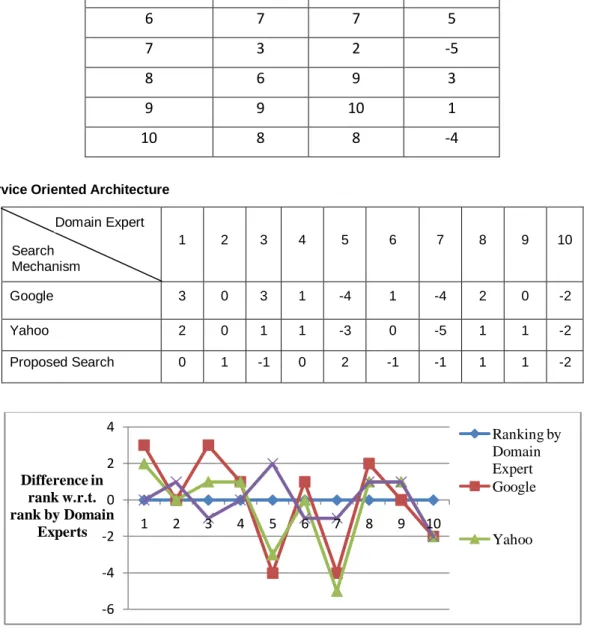
value of error result in more relevant in ranking, and vice versa. Table 2 shows the text search ranking by the domain experts, google, yahoo and proposed search methods. The results are plotted in the graph as shown in the Figure 2. The search results are generally presented in a line of results often referred to as Search Engine Results Pages (SERPs). The information may be a mix of web pages, images, and other types of files. The proposed search mechanism can search data available in databases or open directories. Search engines maintain real-time information by running an algorithm on a web crawler. Search engines use many factors of web pages to rank them. Most common search engines are Google and Yahoo.
Table 2. Text Search Ranking by Domain Experts, Google, Yahoo and Proposed Method
R
Domain-ExpertR
GoogleR
YahooR
Proposed1
4
3
1
2
2
2
3
3
6
4
2
5
1
2
7
6
7
7
5
7
3
2
-5
8
6
9
3
9
9
10
1
10
8
8
-4
Case 1: Service Oriented Architecture 1 2 3 4 5 6 7 8 9 10 Google 3 0 3 1 -4 1 -4 2 0 -2 Yahoo 2 0 1 1 -3 0 -5 1 1 -2 Proposed Search 0 1 -1 0 2 -1 -1 1 1 -2
Figure 2. Ranking error for webpage by different search mechanism for the text search
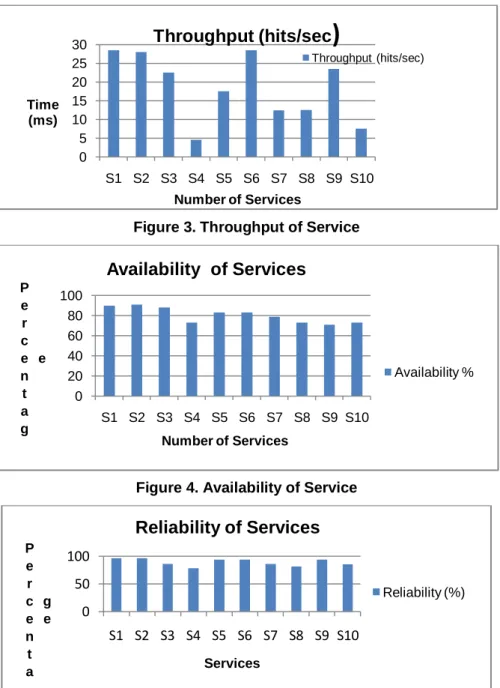
The performance of various QoS metrics adopted for the selected web services are evaluated and the results are represented in the table 3.
Table 3. QoS Performance for a Search Service Service ID Services Throughput
(hits/sec) Reliability (%) Availability %
S1 DictionaryService 28.5 96.3 90 S2 MyService 28 96.5 91 S3 Cloud Service 22.5 86 88 S4 BPEL 4.6 78.2 73 S5 Educational MM Services 17.5 93.6 83 S6 ConvertCSharp2VBService 28.5 93.6 83 S7 Web Service 12.5 85.6 79 S8 SchemaWeb 12.6 81.2 73 S9 StockServices 23.5 93.6 71 S10 Reservation Services 7.6 85.4 73
-6
-4
-2
0
2
4
1
2
3
4
5
6
7
8
9
10
Difference in
rank w.r.t.
rank by Domain
Experts
Ranking by
Domain
Expert
Yahoo
Search Mechanism Domain ExpertThe performances metrics such as s user preference, feedback and rating of services while requesting a service are considered for the proposed work. The Quality of Service is one of the standard measures for web service environment and the prime factors such as throughput, availability of service and reliability of services for the available services are evaluated and represented in the form of graph as shown in figure 3, 4 and 5 respectively.
Figure 3.
Throughput of Service
Figure 4.
Availability of Service
Figure 5. Reliability of Service
6. CONCLUSION
This paper presented an efficient and reliable service selection and the performance of web services are evaluated using different metrics such as user preference, feedback and rating of services while requesting a service and Quality of Services such as throughput, availability of service and reliability of service. Making the provision of services, QoS-aware is the advantage of both requestor and providers in the distributed environment. This paper work exploits an analysis and study of web services discovery with QoS parameters and selection of an optimal web service for a particular task.
REFERENCES
1. E. M. Maximilien and M. P. Singh, “Conceptual model of web service reputation,” ACM SIGMOD Rec., vol. 31, no. 4, pp. 36–41, 2002.
2. R. Jurca, B. Faltings, and W. Binder, “Reliable QoS monitoring based on client feedback,” in Proc. 16th Int. Conf. World Wide Web,2007, pp. 1003–1012.
3. J. R. Douceur, “The Sybil attack,” in Proc. 1st Int. Workshop Peer-to-Peer Syst., 2002, pp. 251–260.
4. S. Wang, Z. Zheng, Q. Sun, H. Zou, and F. Yang, “Evaluating feedback ratings for measuring reputation of web services,” in Proc.IEEE Int. Conf. Serv. Comput., 2011, pp. 192–199.
0 5 10 15 20 25 30 S1 S2 S3 S4 S5 S6 S7 S8 S9 S10 Time (ms) Number of Services
Throughput (hits/sec
)
Throughput (hits/sec) 0 20 40 60 80 100 S1 S2 S3 S4 S5 S6 S7 S8 S9 S10 P e r c e n t a g e Number of ServicesAvailability of Services
Availability %0
50
100
S1 S2 S3 S4 S5 S6 S7 S8 S9 S10
P e r c e n t a g e ServicesReliability of Services
Reliability (%)5. Ardagna and B. Pernici, “Adaptive service composition in flexibleprocesses,” IEEE Trans. Softw. Eng., vol. 33, no. 6, pp. 369–384,Jun. 2007.
6. C. Dellarocas, “Immunizing online reputation reporting systems against unfair ratings and discriminatory behavior,” in Proc. 2nd ACM Conf. Electron. Commerce, 2000, pp. 150–157.
7. N. Limam and R. Boutaba, “Assessing software service quality and trustworthiness at selection time,” IEEE Trans. Softw. Eng.,vol. 36, no. 4, pp. 559–574, Jul./Aug. 2010.
8. L. Zeng, B. Benatallah, A. H. H. Ngu, M. Dumas, J. Kalagnanam,and H. Chang, “QoS-aware middleware for web services composition,” IEEE Trans. Softw. Eng., vol. 30, no. 5, pp. 311–327,May 2004.
9. M. Alrifai and T. Risse, „„Combining Global Optimization with Local Selection for Efficient QoS-Aware Service Composition,‟‟ in Proc. 18th Int‟l Conf. WWW, 2009, pp. 881-890.
10. L. Barakat, S. Miles, and M. Luck, „„Efficient Correlation-Aware Service Selection,‟‟ in Proc. IEEE 19th ICWS, 2012, pp. 1-8.
11. J.S. Breese, D. Heckerman, and C. Kadie, „„Empirical Analysis of Predictive algorithms for Collaborative Filtering,‟‟ in Proc. 14th
Annu. Conf. UAI, 1998, pp. 43-52.
12. R. Burke, „„Hybrid Recommender Systems: Survey and Experiments,‟‟ User Model. User-Adapt.Interact., vol. 12, no. 4, pp. 331- 370, Nov. 2002.
13. J. Canny, „„Collaborative Filtering with Privacy via Factor Analysis,‟‟ in Proc. 25th Int‟l ACM SIGIR Conf., 2002, pp. 238-245.
14. X. Chen, X. Liu, Z. Huang, and H. Sun, „„RegionKNN: A Scalable Hybrid Collaborative Filtering Algorithm for Personalized Web Service Recommendation,‟‟ in Proc. IEEE 8th ICWS, 2010, pp. 9-16.
15. X. Chen, Z. Zheng, X. Liu, Z. Huang, and H. Sun, „„Personalized QoS-Aware Web Service Recommendation and Visualization,‟‟ IEEE Trans. Serv. Comput., vol. 6, no. 1, pp. 35-47R1st Quart., 2013.
16. Chun,D.Culler,T.Roscoe,A.Bavier,L.Peterson,M.Wawrzoniak, and M.Bowman, „„Planetlab:AnOverlayTestbedforBroad-Coverage Services,‟‟ ACM SIGCOMM Comput. Commun. Rev., vol. 33, no. 3, pp. 3-12, July 2003.
17. M. Deshpande and G. Karypis, „„Item-Based Top-n Recommendation Algorithms,‟‟ ACM Trans. Inf. Syst., vol. 22, no. 1, pp. 143-177, Jan. 2004.
18. J.E. Haddad, M. Manouvrier, and M. Rukoz, „„TQoS: TransactionalandQoS-Aware Selection Algorithm for Automatic WebService Composition,‟‟ IEEE Trans. Serv.Comput., vol. 3, no. 1,pp. 73-85, Jan./Mar. 2010. 19. J. Herlocker, J. Konstan, A. Borchers, and J. Riedl, „„AnAlgorithmic Framework for Performing Collaborative
Filtering,‟‟in Proc. 22nd Int‟l ACM SIGIR Conf. Res. Dev. nf. Retrieval, 1999,pp. 230-237.
20. T. Hofmann, „„Collaborative Filtering via Gaussian ProbabilisticLatent Semantic Analysis,‟‟ in Proc. 26th Int‟l ACM SIGIR Conf.Res. Dev. Inf. Retrieval, 2003, pp. 259-266.
21. T. Hofmann, „„Latent Semantic Models for CollaborativeFiltering,‟‟ ACM Trans. Inf. Syst., vol. 22, no. 1, pp. 89-115,Jan. 2004.
22. S.-Y. Hwang, E.-P.Lim, C.-H.Lee, and C.-H. Chen, „„Dynamic WebService election for Reliable Web Service Composition,‟‟ IEEETrans. Serv. Comput., vol. 1, no. 2, pp. 104-116, Apr./June 2008.
23. R. Jin, J. Chai, and L. Si, „„An Automatic Weighting Scheme forCollaborative Filtering,‟‟ in Proc. 27th Int‟l ACM SIGIR Conf.,2004, pp. 337-344.
Author’s Biography
Pradeep Gurunathan received the Bachelor of Science in 1995, Master Degree in 1998 and obtained Master of Technology in Information Technology in Manonmaniam Sundaranar University in 2004. He has completed his Ph.D in the faculty of Information and Communication Engineering at Anna University, Chennai. Currently, he is working as Associate Professor& Dean (Academics) A.V.C College of
Engineering, Mannampandal, Mayiladuthurai, Tamilnadu, India. His area of interest includes Information Retrieval, Distributed Systems
Padmapria Anand is an Associate Professor at the Department of Computer science, and Engineering, A.V.C.College of Engineering. Received her Bachelor of Engineering from Adhi Parasakshi Engineering College, Masters Degree from Annamalai University.Completed her Ph.D at Anna University Chennai. Her research interest includes data mining, image processing.