ScholarWorks
Walden Dissertations and Doctoral Studies Walden Dissertations and Doctoral StudiesCollection
2016
The Move from Recorded to Bedside Shift Report:
Evaluating Barriers to Full Implementation
Elizabeth Jackson Cipra
Walden University
Follow this and additional works at:https://scholarworks.waldenu.edu/dissertations Part of theNursing Commons
This Dissertation is brought to you for free and open access by the Walden Dissertations and Doctoral Studies Collection at ScholarWorks. It has been accepted for inclusion in Walden Dissertations and Doctoral Studies by an authorized administrator of ScholarWorks. For more information, please [email protected].
Walden University
College of Health SciencesThis is to certify that the doctoral study by Elizabeth Cipra
has been found to be complete and satisfactory in all respects, and that any and all revisions required by
the review committee have been made. Review Committee
Dr. Anne Vitale, Committee Chairperson, Health Services Faculty Dr. Tracy Andrews, Committee Member, Health Services Faculty Dr. Tracy Wright, University Reviewer, Health Services Faculty
Chief Academic Officer Eric Riedel, Ph.D.
Walden University 2016
The Move from Recorded to Bedside Shift Report: Evaluating Barriers to Full Implementation
by Elizabeth Cipra
MSN, St. Louis University, 1996 BSN, Indiana University of PA, 1985
Project Study Submitted in Partial Fulfillment of the Requirements for the Degree of
Doctor of Nursing Practice
Walden University January 2016
Many sentinel events in acute care centers can be attributed to miscommunication of patient information at shift change. A growing body of evidence supports the
implementation of bedside shift report as the standardized approach to ensure effective communication by staff. The purpose of this study was to identify the barriers that impede nurses from fully participating in bedside shift report in order to create an educational initiative to develop the nursing staff’s proficiency in performing bedside report. Lewin’s change theory served as the framework for the project. Data for the staff development project were collected using a focus group approach with 18 nurse
participants. A classic method of analysis, defined and outlined by Krueger and Casey (2009), was used to identify themes and categorize results. A second evaluator of the data supported thematic findings. Nurses revealed barriers consistent with the literature including frequent interruptions, patient confidentiality, sensitive issues, and inconsistent report content. Barriers identified by this study, but not evident in the reviewed
literature, included staff unavailability to answer call lights and having to receive report and transfers during report. An education plan was developed based on perceived barriers and evidence in the literature. Implications for positive social change include interventions to refine the current practice of bedside shift report in order to promote effective and efficient communication at change of shift. Findings can inform nursing units in the hospital and other facilities to achieve patient-centered care and improved outcomes. It is critical that nurses understand the positive impact that consistent, timely, and effective shift reports have on providing safe, quality patient care.
Implementation by Elizabeth Cipra
MSN, St. Louis University, 1996 BSN, Indiana University of PA, 1985
Project Study Submitted in Partial Fulfillment of the Requirements for the Degree of
Doctor of Nursing Practice
Walden University January 2016
This project is dedicated to all the nurses on the telemetry unit who want to provide safe, quality, and evidence-based patient care. It is also dedicated to my husband and three daughters who endured and endless stream of paper and books on the dining room table for the last year and a half. Thank you for your patience and your unwavering support.
I would like to thank my preceptor who inspired confidence in me as a nurse, clinical specialist, scholar, and leader. To Dr. Vitale, whose commitment to genuinely wanting to make us scholarly practitioners, thank you. To my family, thank you for tolerating the endless array of papers and books covering the dining room. I never would have made it through without you.
i
List of Tables ... v
List of Figures ... vi
Section 1: Nature of the Project ... 1
Introduction ... 1
Problem Statement ... 2
Purpose Statement ... 3
Goals and Objectives ... 4
Theoretical Foundation ... 5
Nature of the Project ... 5
Significance of the Project ... 6
Implications for Social Change ... 7
Definitions of Terms ... 7
Assumptions and Limitations ... 8
Assumptions ... 8
Limitations ... 9
Summary ... 10
Section 2: Review of the Scholarly Literature ... 11
Introduction ... 11
Literature Search Strategy ... 11
Shift Reporting in Nursing ... 12
ii
Movement to Bedside Shift Report ... 15
Background of Bedside Shift Reporting ... 16
Patient- and Family-Centered Care ... 18
Patient and Nurse Satisfaction ... 20
Sustaining Change ... 21
Barriers to Bedside Shift Report ... 22
Theoretical Framework Literature ... 24
Lewin’s Change Theory ... 24
Background and Context ... 26
Summary ... 28 Section 3: Methodology ... 30 Introduction ... 30 Project Team ... 31 Review of Evidence ... 32 Focus Groups ... 33
Recruitment and Sampling ... 34
Ethical Considerations ... 35
Data Collection, Analysis, and Verification ... 36
Develop “Shift Report: Gaining Confidence at the Bedside” Education ... 37
Curriculum Development ... 37
iii
Evaluation Plan ... 39
Summary ... 40
Section 4: Findings, Discussion, and Implications ... 41
Introduction ... 41
Findings and Discussion ... 42
Focus Groups ... 42
Focus Group Demographics ... 44
Transcript Analysis Process ... 45
Thematic Analysis ... 46
Themes in Focus Groups Supported by the Literature ... 46
Themes in Focus Groups Not Supported by the Literature ... 49
Communication Board ... 51
Recommendations for Policy and Practice ... 53
Implications ... 54
Strengths and Limitations ... 57
Analysis of Self ... 58
Summary ... 60
Section 5: Scholarly Product ... 61
Introduction ... 62
Workshop Curriculum ... 62
iv Implementation ... 66 Evaluation ... 67 Nursing Orientation ... 67 Dissemination ... 68 References ... 69
Appendix A: Focus Group Questions ... 78
Appendix B: Flyer for Recruitment ... 79
Appendix C: Communication Board ... 80
v
Table 1. Combined Demographics of Focus Groups...45
Table 2. Themes in the Literature with Quotes from Focus Group Participants...48
Table 3. Themes not in the Literature with Quotes from Focus Group Participants...51
Table 4. Curriculum as it Relates to Lewin’s Change Theory...63
vi
Figure 1. Barriers and facilitators ………...………..….……….… 13 Figure 2. Lewin’s model depicted as tug-of-war ...26 Figure 3. Gantt chart time line ...31
Section 1: Nature of the Project Introduction
Change-of-shift report has been described as the transfer of essential patient information and the responsibility of patient care between nurses coming on shift and nurses completing their shift (Jeffs et al., 2013). There have been various methods of shift report used over the years, from verbal report outside the patient room or in a conference room, to taped report, to a combination of taped and verbal report (Caruso, 2007).. Regardless of the report method, the literature is consistent regarding the
problems associated with change-of-shift report. These problems include a lack of report consistency and structure, potential failures in communication leading to adverse events, and not providing the opportunity for the patient to be included in the plan of care
(Cairns, Dudjak, Hoffmann, & Lorenz, 2013). The Joint Commission (TJC) estimated
that 65% of sentinel events were the result of communication problems, especially during change of shift report (Cornell, Townsend-Gervis, Yates, & Vardaman, 2013). This prompted the TJC to require a standardized method of shift report as part of the National Patient Safety Goals.
Researchers have supported the use of bedside shift report. Active patient participation in hospital care is shown to result in better health outcomes and places the patient central to information related to care activities (Jeffs et al., 2013). Radtke (2013) reported that bedside report improves communication between nurses, patients, and their families and provides for “patient-focused care and the application of evidence-based care at the bedside” (p. 19). Bedside report serves other functions beyond effective
communication. The nurse can better give the patient the opportunity to be involved in his or her care, perform quality and safety checks, check for misinformation, and ask final questions to ensure continuity of care (Halm, 2013). Petersen, Blackmer, McNeal, and Hill (2013) identified two positive evidence-based behaviors from their study
surveying staff nurses: checking the patient during handover and patients being involved in the handover process. Clearly the literature supports bedside shift report as a means of communication that is beneficial for both the patient and the nurse.
A local community hospital phased out a taped system for change-of-shift report. The chief nursing officer (CNO) established an organizational goal for all nursing units to participate in bedside shift report as part of patient- and family-centered care (C. Cioffi personal communication, October 6, 2014). An 18-bed telemetry unit implemented bedside shift report in July 2014. This clinical specialist and unit manager observed nurses on the unit struggle with giving full report at the patient’s bedside as evidenced by the nurses standing outside the patient rooms and sitting at the work stations during the shift change report.
Problem Statement
Researchers have supported moving change-of-shift report to the patient’s bedside to improve patient safety and quality outcomes (Dufault et al., 2010; Jeffs et al., 2013; Riesenberg, Leitzsch, & Cunningham, 2010; Sand-Jecklin & Sherman, 2013). The organization under study has set a goal that all units will participate in bedside shift report by the end of fiscal year 2015. Nurses on the telemetry unit were trained in implementing the change from recorded report to report at the patient’s bedside in the
summer of 2014. The telemetry unit manager chose to pursue the implementation of bedside report before the CNO announced that all units would be required to convert. In observations, the manager and clinical specialist of the telemetry nursing staff during change-of-shift report indicated that evidence-based bedside shift report was not being carried out effectively or as iterated by the organizational leadership. It was unknown what barriers were keeping the nurses from performing report at the bedside. These barriers to implementation had to be identified in order to develop the necessary
education and skills training for nurses to capably and confidently perform bedside shift report.
Purpose Statement
The purpose of the project was to identify what the nurses for this telemetry unit perceive as barriers to performing change-of-shift report at the patient’s bedside. Several barriers to giving report at the bedside have been identified in the literature. Most of the barriers center around the nurses being uncomfortable in front of the patients, having a lack of confidence, and fear of breaching patient confidentiality (Evans, Grunawalt, Laws & Amato, 2010; McClish, Wood, & Friese, 2011; Sand-Jecklin & Sherman, 2013). Additional barriers include (a) not knowing about sensitive topics that may not have been addressed by the doctors (eg., test results), (b) overtime (Griffin, 2010; Sand-Jecklin & Sherman, 2013), (c) talk and questioning from the patient that would lengthen report (Anderson & Mangino, 2006), and (d) patients asking for things which impede the progress of report (Evans et al., 2011). Barriers identified in the literature may or may not be consistent with barriers experienced by the nurses on the identified telemetry unit.
The change in practice from recorded to bedside shift report on the telemetry unit was ineffective. Kelly (2011) stated that in order for change efforts to be sustained, behaviors “below the waterline” must be targeted (p. 35). On the surface, the telemetry nurses are not performing bedside report as designed by the organization. To better understand this behavior, perceived barriers must be identified, brought to the surface, acknowledged, and acted upon to bring about and maintain the desired change.
Goals and Objectives
In the project, I focused on determining what barriers this unit perceives regarding performing report at the patient’s bedside at the change of shift. TJC (2007) first
addressed effective hand-off communication in the 2006 National Patient Safety Goals (NPSG) where the emphasis was providing accurate information that included an opportunity for nurses to ask and respond to questions. As of 2013, TJC (2013) added bedside shift report as an important practice to keep the patient and family informed for safe continuity of patient care. Nurses performing change-of-shift report at the patient’s bedside can fulfill compliance with these requirements and the organization’s strategic goal of patient- and family-centered care.
At the start of the project, approximately half of the hospital units were using an automated form of recorded report at change-of-shift and when a patient is transferred from one level of care to another. In the following months, this automated recorded report was no longer available for the staff to use at any care transition point. The results of this project will be used to refine the report process on the telemetry unit but can also provide information to other units as they plan implementation and evaluation of bedside
shift report. In addition, the results will be used to develop an educational initiative that addresses the identified barriers to performing shift report at the bedside.
Theoretical Foundation
Implementing change in health care can be challenging due to the complex nature of the environment (Anderson & Mangino, 2006). Sustaining the change can be even more challenging. Lewin’s (1947) change theory served as the framework for this
project. Several researchers used this theory to guide the change of implementing bedside shift report (Caruso, 2007; Chaboyer et al., 2009; McMurray, Chaboyer, Wallis, & Fetherston, 2010; Radtke, 2013). There are three phases of this model: unfreezing the current behavior, moving or changing the behavior, and refreezing or stabilizing the change (Kritsonis, 2005). Kritsonis (2005) added that the change will not be sustained without refreezing. White and Dudley-Brown (2012) agreed that a “refreezing” of the new process must take place after implementation. Lewin also described driving forces that encourage the change or restraining forces that keep it from happening (Lewin, 1947). This model is effective to use for this project because the barriers that keep bedside shift report from being fully implemented must be identified for the change to be sustained.
Nature of the Project
This project provided the opportunity to evaluate and possibly refine the process of bedside shift report on the telemetry unit. Evidenced-based literature application and a focus group approach were used to explore the perceived barriers and concerns of the nurses in reaching full implementation of bedside shift report on the telemetry unit. The
focus group approach provided the opportunity to determine the general attitude of the unit staff regarding the change in practice (Grove, Burns, & Gray, 2013). For the project, a convenience sample of nurses on the telemetry floor was recruited to comprise four focus groups.
The purpose of the focus groups was to elicit from the nurses their perceived advantages (driving forces) and barriers (restraining forces), and what still needs to be developed, to ensure that bedside shift reporting is successfully maintained. The
qualitative information was used to develop change management strategies and education sessions, such as case studies and role playing, to address barriers and concerns the nurses express in the focus group and to increase their confidence and compliance with reporting at the bedside (Cairns et al., 2013).
Significance of the Project
As a patient safety strategy, TJC assesses hospitals for a mechanism of change-of-shift report that allows for the nurses to ask and respond to questions and for patients and families to be informed through shift report at the patient’s bedside (TJC, 2013). The organization under study requires all units in the hospital to perform bedside shift report as one element of the strategic goal of patient- and family-centered care. Identification of barriers to full implementation of bedside shift report on the telemetry unit will inform unit staff and leadership and serve as a guide for developing change management strategies and education sessions focused on refining the process of reporting at the bedside. In addition, the results can inform the other units as they plan the
Implications for Social Change
The American Association of Colleges of Nurses (AACN, 2006) indicated that the Doctor of Nursing Practice (DNP) graduate must be skillful in quality improvement initiatives that not only create evidence-based changes, but also maintain those changes for improved outcomes and patient safety. Identified behaviors not readily visible that impede full implementation of bedside shift report on the telemetry unit will be used to guide and facilitate interventions to refine current practices on the unit and benefit other units as they evaluate the implementation of report at the bedside. This project involved the evaluation of a practice issue in order to promote effective and efficient patient-centered care (AACN, 2006). This project added to the knowledge of barriers to maintaining effective bedside shift report that can benefit the entire organization and other organizations that are struggling with the same practice issue.
Definitions of Terms
The following definitions were used to guide this project.
Barrier: Obstacle to a change process (McMurray et al., 2010).
Change-of-shift report: A term used synonymously with handoff and shift report,
change-of-shift is the transfer of information, authority, and responsibility (Friesen, White, & Byers, 2008) from the off-going nurse to the on-coming nurse with the opportunity to ask questions and clarify information (Cairns et al., 2013). The term is synonymous with handoff and handover.
Evidence: Research findings, knowledge from science, clinical knowledge, and
Level of care change: Movement that patients make between hospital nursing units when their care needs change during acute illnesses (Friesen et al., 2008).
Patient- and family-centered care:An approach to health care that centers on
relationships and collaboration between patients, their families, and health care
practitioners. Patients and families are encouraged to participate in care and in decision making about their care (Tidwell et al., 2011).
Patient safety strategy: Promotion of a patient safety culture using leadership,
teamwork and behavioral change (Weaver, Lubomksi, Wilson, Pfoh, Martinez, & Dy, 2013).
Practice issue: Any situation that puts the patient at risk or affects the nurse’s ability to provide care in line with standards, guidelines, policies, or procedures (College of Registered Nurses Nova Scotia (CRNNS), 2012).
Telemetry unit: Nonintensive, monitored nursing care unit for patients at lower
risk than those requiring care in the intensive care unit(Hollander, Valentine, McCuskey,
& Brogan, 1997).
Assumptions and Limitations Assumptions
Assumptions are statements that are thought of as true by the researcher and peers even though they are not scientifically tested (Grove et al., 2013). This project included the following assumptions:
• Nurses on the telemetry unit received initial training on bedside shift
• Nurses on the telemetry unit understand that bedside shift report is an
organizational goal
• Nurses on the telemetry unit will be willing to participate in the project
• Nurses will discuss and answer questions honestly during the focus groups
Limitations
Limitations are potential influences that the researcher does not have control over but can affect generalizability of the study (Grove et al., 2013). The current project includes several limitations:
1. The barriers identified by the telemetry unit staff may not be
comprehensive.
2. The barriers identified by the telemetry unit may not be generalizable to
other units in the hospital.
3. The barriers identified by the telemetry unit will not be generalizable to
other hospitals.
4. I am employed at the hospital where the project is being implemented.
This may influence volunteers for the focus groups who are acquainted with the student and may influence their responses to the questions.
5. Volunteers are asked to participate in the focus group on personal time;
therefore, scheduled work conflicts may limit participation from this specific population of nurses.
Summary
In this section, I presented a brief overview of the problem that an 18-bed
telemetry unit is experiencing after implementation of bedside shift report. Although the nurses were trained in performing bedside shift report, they are observed reporting away from the patient’s bedside. In order to sustain the change in practice from recorded to bedside report, restraining forces that keep the change from happening must be identified and addressed. These barriers will serve as a guide to develop interventions and
education sessions to refine the bedside shift report process.
In Section 2, I present a literature review and discussion of the change theory framework that guides the quality improvement project. Initial discussion will focus on an introduction to the form of nursing communication known as shift report. Supportive literature on bedside shift report will follow with an emphasis on safety, effectiveness, and accountability; patient and nurse satisfaction; patient- and family-centered care; and aligning with change theory.
Section 2: Review of the Scholarly Literature Introduction
The purpose of this project was to identify what barriers nurses on a telemetry unit perceive to be impediments to performing change-of-shift report at the patient’s bedside. In order to achieve sustainability of the change in practice from a recorded report to bedside report, the restraining forces need to be identified, acknowledged, and acted upon. In Section 2, I will present a synthesis of the scholarly literature describing the significance of the practice issue, the relevance of bedside shift report including patient safety and patient and nurse satisfaction, identified barriers to performing bedside report, and the role of this type of report in patient- and family-centered care. This section will conclude with a review of the change theory to be used as the framework for this project.
Literature Search Strategy
The literature search was conducted electronically using CINAHL, Medline,
ProQuest, and OVID databases. Terms used to search for the literature were handoffs,
nursing handoffs, shift report, change-of-shift report, nursing report, bedside shift report,
bedside handoff, adverse events, patient safety, and patient- and family-centered care. The initial search provided 45 articles. Articles were discarded if they did not contain relevant information related to the topic of interest. In order to obtain a larger number of articles, the Boolean search terms and” and “or” were used between words. A final total of 30 articles were selected as most relevant. Articles were then grouped by the
accountability/patient safety, bedside report and patient-and family-centered care, nurse and patient satisfaction related to bedside report, barriers to bedside shift report, and change theory as it relates to bedside shift report.
Shift Reporting in Nursing Nursing Communication
Communicating accurate and timely patient information is essential in providing safe and quality patient care and ensuring continuity in each patient’s care. This is especially true of nursing’s change-of-shift report. Caruso (2007) described shift report as a time for attentive communication about the patient to ensure safety and continuity of care; yet, this communication rarely includes the patient. According to Halm (2013), approximately 2.9 million change-of-shift reports take place annually in hospitals with an average daily census of 400 and nurses working 12-hour shifts. This frequent transfer of patient data is often cited as contributing to errors, care omissions, treatment delays, repeated work, inappropriate treatment, adverse events, increased length of stay,
avoidable readmissions, and increased costs (Cairns et al., 2013; Halm, 2013; Jeffs et al., 2013; Riesenberg et al., 2010).
Change-of-shift report can take on a variety of forms. Welsh, Flanagan, and Ebright (2010) conducted a qualitative, descriptive pilot study to characterize handoff procedures for nurses at change-of-shift using two types of handoff, taped and written. A convenience sample of nurses from three inpatient units of a Midwestern veteran’s administration medical center participated in semistructured interviews. Data analysis consisted of a grounded theory approach in which two investigators coded the data into
“barriers,” “facilitators,” and “other” categories (p. 149). Themes were then generated and legitimized using a nursing subject matter expert. Six barriers and four facilitators were revealed as displayed in Figure 1.
Barriers Facilitators
Incomplete report “Pertinent” content
Incomplete with non-essential information
Ability to ask questions of off-going nurse Differing quality
between nurses
Report tool in checklist format
Unable to clarify information or ask questions
Ability to take notes while listening
Equipment malfunction Interruptions
Figure 1. Barriers and facilitators adapted from Welsh, C. A., Flanagan, M. E., & Ebright, P. (2010). Barriers and facilitators to nursing handoffs: recommendations for
redesign. Nursing Outlook, 58(3), 148-154.
The investigators concluded that even though the study is not generalizable because the sample is not representative, the findings are consistent with other studies and indicate that these issues with written and taped report are common in acute care facilities (Welsh et al., 2010). Anderson and Mangino (2006) add that these traditional methods of shift report allow for minimal communication between nurses and can ultimately have a negative impact on patient safety related to incomplete information being relayed.
Potential for Errors and Adverse Events
Ineffective change-of-shift report can result in compromised patient safety. TJC estimated that 65% of sentinel events were the result of communication problems,
especially during change of shift report (Cornell et al., 2013). The Agency for Healthcare Research and Quality (AHRQ, 2009) surveyed 176,811 hospital staff on patient safety culture. Almost half of the respondents (49% and 45% respectively) indicated that “important patient care information is often lost during shift changes,” and “shift changes are problematic for patients in this hospital” (AHRQ, 2009, p. 39). Nurses on the
telemetry unit have reported not receiving important patient information during shift report consistent with the AHRQ (2009) survey (S. Moore, personal communication, October 10, 2014).
Miscommunication of patient information at shift change is responsible for almost two- thirds of sentinel events in acute care centers (Cairns et al., 2013; Dufault et al., 2010). Consequently, TJC (2008) now requires a standardized approach to handoff communications, including an opportunity for the staff to ask and answer questions. TJC (2008) launched a National Patient Safety Goal as a patient safety strategy encouraging patients to get involved in their care. Researchers support the implementation of bedside shift report as that standardized approach to ensure effective communication by staff (Dufault et al., 2010; Jeffs et al., 2013; Sand-Jecklin & Sherman, 2013).
Variability in the way that report is accomplished may also introduce errors and potential adverse events (Riesenberg et al., 2010). In a quasi-experimental study, Pothier, Monteiro, Mooktiar, and Shaw (2005) simulated handover scenarios testing three
different types of shift report styles: verbal only, written only, and a combination of written and verbal. In this study, Pothier and colleagues reported that the nurses retained the patient information with the combination of written and verbal report (96-100%), while they did not for verbal only (0-22%) and written only (26-49%). Regardless of which method of report is used, strengths and weaknesses are inherent to all methods (Friesen et al., 2008). Thousands of patients are cared for in hospitals each day so there are thousands of opportunities for mistakes (Baker, 2010), especially when it comes to the transfer of patient information.
Movement to Bedside Shift Report
Traditional methods of shift report do not allow for the patient to become
involved in this communication of information. Anderson and Mangino (2006) described driving forces that have led nursing to move shift report to the patient’s bedside. Easy access to the Internet has given patients medical information that they were not
previously exposed to, giving them more knowledge to make decisions about health care. This knowledge has prompted a change to a more collaborative model of care instead of physicians having exclusive rights over how patients’ care is managed (Anderson & Mangino, 2006). This extends to the acute care setting. Maxson, Derby, Wrobleski, and Foss (2011) expressed that when patients are given the opportunity to participate in bedside report, they are more likely to contribute to their plan of care and to be kept informed of their condition. In addition, bedside change-of-shift report provides an opportunity for nurses to address some of the inefficiencies associated with traditional methods of taped and verbal shift report (Anderson & Mangino, 2006).
Background of Bedside Shift Reporting
Nursing shift report traditionally has been performed away from the patient’s bedside where the patient and family are not actively involved in the information
exchange or even aware that the exchange is taking place (Kerr, Lu, & McKinlay, 2013; Maxson et al., 2011). Today, there is more of an inclusive approach to health care where patients are actively involved in the decision-making process (McMurray et al., 2010). Many hospitals are redesigning their current shift report practices to meet the standards set forth by TJC (Welsh et al., 2010). Moving shift report to the patient’s bedside not only allows the oncoming nurse to visualize the patient, but to ask questions of the previous nurse and encourage participation of the patient into the plan of care (Maxson et al.).
The concept of bedside shift report is not new. Greaves (1999) stated that at the turn of the century, the ward (unit) sisters in England would make rounds with the night nurse on each of the patients to check that standards of care were met through the night. Greaves discussed that this was a “one way” communication including instructions to the nurse (p. 32). Pepper (1978) challenged nurses to vacate traditional report taking place away from the patient’s bedside, usually in a conference room. Pepper stated that a
benefit of giving report atthe patient’s bedside is the ability of the nurse to include the
patient in their care and decisions about their care. According to Pepper, this patient-centered approach to shift report should be accomplished every shift; otherwise, the patient may perceive this as just a daily “exercise” by the nursing staff (p. 74). Telemetry
unit nurses are observed performing change-of-shift report away from the patient’s bedside, which does not allow for patient involvement in planning daily care.
There are a variety of ways that shift report is practiced when transferring the responsibility and accountability of patient care from one nurse to another. This variability increases the risk for missed or incorrect patient information, thereby jeopardizing patient safety (Alvarado et al., 2006). Street et al. (2010) used a cross-sectional survey to ascertain the strengths and limitations of current handover before implementing a new bedside handover process. Street et al. emphasized the significant variations in their current practice, which included the duration of the handover, method, and location where the information was exchanged. Handover at the bedside allowed for patient and family involvement, which could improve handover effectiveness and patient safety (Street et al., 2010). The current practice of shift report on the telemetry unit varies between nurses. Shift report from some nurses have been described as thorough yet timely, while others are described as lengthy with irrelevant information.
Bedside shift report can increase teamwork on the unit and accountability of the staff and is directly related to TJC’s National Patient Safety Goals (TJC, 2008), including Goal 13: to involve the patient in their care as a strategy to improve patient safety (Baker, 2010). In a qualitative study in an inner city, acute care teaching hospital, Jeffs et al. (2013) reported two major themes surfaced while interviewing 43 registered nurses after the implementation of bedside shift report. The two themes, “clarifying information and intercepting errors” and “visualizing patients and prioritizing care,” are reflective of the
safety benefits and accountability that accompany bedside shift report (Jeffs et al., p. 229-230).
Patient- and Family-Centered Care
There is a focus in the literature on patient- and family-centered care, which
highlights collaborationand developing partnerships between the patient, their family,
nurses, and other health care providers (Tidwell et al., 2011). According to Tidwell et al. (2011), one way that nurses can promote this collaboration is by encouraging patients and families to participate in change-of-shift report at the bedside. Griffin (2010) affirmed that sharing patient information at the bedside allows the patient and family to engage in the care and decision-making process at the level they choose to participate, which improves the experience of the patient.
Patients identify several benefits of bedside shift report. In a pilot study to explore patient perceptions of bedside shift report, Friesen, Herbst, Turner, Speroni, and Robinson (2013) surveyed and interviewed patients to determine potential areas for improvement in their report process. A qualitative analysis was conducted on the interview responses in which the researchers identified five themes. First, patients felt the introduction of the new nurse coming on shift was important and left them feeling reassured (Friesen et al., 2013). Second, patients observed communication and collaboration during the shift report (Friesen et al., 2013). Third, the sharing of information during report at the bedside assisted patients in knowing what was being communicated to the next shift (Friesen et al., 2013). Knowing what is communicated is one of the crucial concepts in patient- and family-centered care. The fourth theme
addressed the patient’s perspective: educating health care providers. The patients adopt the role of educator by informing the nursing staff what works best regarding report at the bedside, like using a wipe board to write information the patient wants to know (Friesen et al., 2013). Finally, the fifth theme, managing privacy, was acknowledged by the patients as challenging with both hard-of-hearing patients and sensitive topics (Friesen et al., 2013). Removing the barriers that restrict the patient from participating in bedside shift report is imperative in order to give the patients the opportunity to know.
Both patients and nurses identify benefits of performing change-of-shift report at the patient’s bedside. In a mixed methods study, Sand-Jecklin and Sherman (2013) used anonymous surveys of patients and nurses to evaluate the processes and outcomes of moving from a recorded change-of-shift report to a combination of recorded and bedside report. To survey the patients, Sand-Jecklin and Sherman used an adapted Patient Views
on Nursing Care instrument. The survey was both preimplementation (n=232 patients)
and postimplementation (n=178 patients). Sand-Jecklin and Sherman found significantly
higher scores on “made sure I knew who my nurse was,” “include in shift report discussion,” and “communicated important information about care” (p. 190). The Nursing Assessment of Shift Report instrument developed by Sand-Jecklin and Sherman was used to survey the nurses using the same pre-post implementation design. Sand-Jecklin and Sherman revealed significant improvement after implementation in several areas including effective and efficient means of communication, ensuring accountability, and promoting patient involvement in care.
Patient and Nurse Satisfaction
Bedside shift report serves a number of different functions beyond the transfer of essential patient information, two of which are patient and nurse satisfaction. Vines, Dupler, Van Son, and Guido (2014) conducted a literature review to determine if bedside report promoted patient and nurse satisfaction. Although 95 publications were retrieved, the results were limited by date (2006 and later), hospital setting (acute), and relevance to the proposed purpose, leaving nine articles for review. Vines et al. concluded that the evidence supports using report at the bedside for change-of-shift handovers in an adult acute care setting. In addition, improvements were determined in patient and nurse satisfaction throughout the studies (Vines et al., 2014). Regardless of the supportive evidence for using bedside shift report, nurses on the telemetry unit continue to report away from the patient’s bedside.
Standardizing bedside shift report can positively impact patient satisfaction. The objective of a study by Radtke (2013) was to determine if standardizing shift report to the bedside improves patient satisfaction, specifically in the realm of nursing communication. Prior to bedside report, the score for communication with nurses was 75% (Radtke,
2013). Bedside shift report was implemented on a 16-bed medical/surgical intermediate care unit (Radtke, 2013). Staff was interviewed 1 week after implementation, and patients were interviewed at 1 week and continued through a 3-month time period (Radtke, 2013). Staff gave positive feedback about understanding their patients’ needs and able to plan around these needs. Patient satisfaction survey results increased from 75% satisfaction in nursing communication to 87.6% (Radtke, 2013). It was noted that
they did not reach their goal of 90%; however, the change in practice did result in a significant increase in this area of patient satisfaction (Radtke, 2013).
Patients and nurses identify the benefits of bedside shift report. Maxson et al. (2011) conducted a study to determine if bedside shift report increased patient
satisfaction and patient perception of teamwork. A second purpose was to determine if bedside shift report increased staff satisfaction with communication and accountability. Both the staff and patients agreed to participate in the surveys that took place before the implementation of bedside shift report and 1 month after. Maxson et al. revealed
statistically significant increases in patient perception of their involvement in the plan of
care (p=0.02) and nurses’ perceptions regarding accountability (p=0.0005), medication
reconciliation (p=0.0003), and ability to immediately communicate concerns with
physicians (p=0.008). Anecdotal responses from patients and nurses substantiated the
importance of the change in practice (Maxson et al., 2011, p. 142). Sustaining Change
Lewin’s (1947) change theory served as the framework for several studies when implementing bedside shift report. McMurray et al. (2010) concluded that in order for change to be successful, those managing the change must be aware of nurses’ attitudes, concerns, and level of confidence, especially in the case of communicating in bedside shift report. Caruso (2007) described the stages of change that guided implementation of bedside report, but also gave the change team an understanding of the change process including being able to address potential challenges before the actual change took place.
Radtke(2013) supported these findings stating that one lesson learned from a pilot bedside report process was to identify potential barriers before the intervention began.
Vines et al. (2014) used Lewin’s change theory to develop an educational initiative for staff regarding bedside shift report and provided recommendations for sustaining the initiative as part of everyday nursing practice. Olson-Sitki, Weitzel, and Glisson (2013) used this change model to address collapse of the bedside report process initiated just months earlier. In the unfreezing stage, the focus was engaging staff to recognize the need for the change and to overcome the resistance to maintaining the use of bedside report (Olson-Sitki et al., 2013)). Olson-Sitki et al. re-examined the original implementation of the report process and were able to identify the restraining forces and subsequently develop a plan to move forward with a sustained change in practice. In order to sustain the change in practice to bedside shift report, the restraining forces for the telemetry nurses must be identified so that a plan can be developed to overcome areas of resistance.
Barriers to Bedside Shift Report
Nurses still struggle to fully implement shift report at the bedside even with emerging newer evidence about the importance of actively involving the patient in bedside shift report (Sand-Jecklin & Sherman, 2013). Breaching confidentiality has been frequently cited as a significant barrier in the literature. Nurses are concerned with Health Insurance Portability and Accountability Act (HIPAA) violations and patient privacy when other patients or families are in the room (Anderson & Mangino, 2006; Cairns et al., 2013; Evans et al., 2012; Sand-Jecklin & Sherman; and Radtke, 2013).
Nurses report fears and apprehensions not only about confidentiality, but also bringing up sensitive issues such as test results the physician had not yet discussed with the patient, complicated family dynamics, and having to discuss treatment noncompliance with the patients (Cairns et al., 2013).
The time commitment to complete report is a concern expressed by nurses as a barrier; however, there is limited literature that addresses the length of time difference between bedside report and traditional methods. Cairns et al. (2013) reported a decrease in end-of-shift overtime by 10 minutes per day, or 61 hours per year, representing a cost savings of 23% of the unit’s budget. Tidwell (2011) and colleagues discussed a decrease of almost 250 hours of overtime in a 7-month period of time after implementing bedside shift report, representing a statistically significant decrease. Anderson and Mangino (2006) referenced a decrease in time over shift of 100 hours each pay period over two consecutive pay periods. In one of the only studies to report specific time increment changes, nurses revealed that bedside report averaged 5-7 minutes which was less than their pre-implementation verbal report at the nurse’s station (Caruso, 2007). In most cases, nurses were concerned that patients would talk too long, ask too many questions, or ask for something during report, hence, lengthening the report time (Anderson & Mangino, 2006; Evans et al., 2011; and Sand-Jecklin & Sherman, 2013). Street et al. (2011) added “frequent interruptions” and “nurses chatting during handovers” as barriers to bedside shift report (p. 139).
Theoretical Framework Literature Lewin’s Change Theory
Lewin’s model describes a force field where driving forces and restraining forces exist. Driving forces are “forces toward” something or “forces away from” something, while “restraining forces,” on the other hand, oppose the driving forces (Lewin, 1947, p.28). Lewin (1947) stresses the importance of determining the strength of the opposing forces that contribute to resistance to change..
Olsen-Sitki et al. (2013) discuss a similar circumstance. The authors reported that within several months of the change to the bedside, report was occurring at the nurses’ station, in the hallway, or in a conference room instead of at the patient’s bedside as originally implemented. In the study, introduction of the oncoming nurse was
consistently done, but there was little to no patient interaction. The nursing leadership
team became acutely aware that the new process did not become part of the culture as
intended (Olsen-Sitki et al., 2013).
Implementing change in health care can be challenging due to the complex nature of the environment (Anderson & Mangino, 2006); however, sustaining the change can be
even more challenging. Lewin’s change theory served as the framework for this project.
A successful change includes “unfreezing” of the current behavior, moving to the desired behavior, and “refreezing” the changed behavior (Lewin, 1947). Kritsonis (2005) added that the change will not be sustained without refreezing. White and Dudley-Brown (2012) agreed that a “refreezing” of the new process must take place after implementation.
Implementation of bedside report on the telemetry unit occurred in late July 2014, however, sustaining the change in practice has been challenging. Nurses are observed giving report outside of the patient’s room, in the workstations on the unit, and at times, at the main nursing station. Nurses frequently have to be reminded by the nursing manager to move report to the patient’s bedside (S. Moore, personal communication, October 10, 2014). Giving report at the patient’s bedside continues to be an
uncomfortable practice for nurses on this unit.
In order for the telemetry unit’s current practices to change, obstacles must be determined, specifically, barriers that keep nurses from performing shift report at the patient’s bedside. Lewin’s model describes driving forces that encourage the change and restraining forces that keep it from happening. The driving forces in the project included the benefits of bedside shift report supported by the literature, as well as the
organizational goals of 100% participation in bedside shift report and patient- and family-centered care. The goal, therefore, was to create an environment where the driving forces are stronger than the restraining forces (Kritsonis, 2005; See Figure 2).
In order to change the behavior of the nurses, the restraining forces, or barriers to full implementation of bedside shift report for the telemetry nurses, must be identified. The restraining forces in Figure 2 are those identified in the literature, however, the
specific barriers for this telemetry unit were notknown. Assessment of the restraining
forces for this particular telemetry unit was necessary in order to recognize how much of an influence the barriers contributed to impeding the accomplishment of bedside shift report (White & Dudley-Brown, 2012). This change model can be used to develop an
educational initiative to emphasize the driving forces and alleviate the restraining forces, once identified, in order to meet the desired state of full implementation of bedside shift report.
Figure 2. Lewin’s model depicted as tug-of-war. The strength of the driving forces must
overcome the restraining forces to reach the desired outcome (Lewin, 1947, p. 32).
Restraining and driving forces adapted from; Anderson & Mangino, 2006; Alvarado, et al., 2006; Baker, 2010; Cairns et al., 2013; Caruso, 2007; Evans et al., 2012; Halm, 2013; Jeffs et al., 2013; Maxson et al., 2011; Radtke, 2013; Riesenberg et al., 2010; Sand-Jecklin & Sherman; Street et al., 2010;Tidwell, 2011; Vines et al., 2014; and Welsh et al., 2010). Image: Tug of War Long Clip Art. (2014). Retrieved April 9, 2015, from:
http://www.clker.com/clipart-tug-of-war-long.html
Background and Context
The CNO established an organizational goal for all nursing units to participate in bedside shift report as part of patient- and family-centered care for a 250-bed Mid-Atlantic hospital as an automated system for change-of shift report was phased out (C.
Cioffi, personal communication, October 6, 2014). Nurses who work on various units of
Restraining Forces
Change in culture Concerns about patient confidentiality
Sensitive issues/family issues
Perceived increase in length of report time
Driving Forces
Patient safety Effectiveness and thoroughness of report Nurse and patient satisfaction
Patient- and family-centered care Organizational goals
Desired Outcome
the organization were educated in the summer of 2014 about how to implement the change from recorded report to report at the patient’s bedside. The unit manager and I observed nurses struggle to give report at the patient’s bedside, as evidenced by the
nurses outside the patient’s room in the hallway or at the nurses’ station (S. Moore,
personal communication, October 10, 2014). This practice does not support the mission and philosophy of the organization, which centers on a culture of safety and patient- and family-centered care (Our Core Values, 2015). The organization strives to foster an environment of “communication and collaboration among all members of the
patient/family/healthcare team” and to integrate evidence into every day practice (Our Core Value, para. 2).
The literature clearly identifies barriers to implementing and sustaining bedside shift report, and how those barriers impact performing report. It was not known what the nurses of the telemetry unit perceive as their barriers. The information collected during this project will be used to create an educational opportunity for the nurses of the telemetry unit to refine their current practice of shift report to one that supports the organization’s goals. In addition, valuable information can be provided to other nursing units struggling with implementation and sustainability of bedside shift report.
I have worked in the organization for nearly 12 years, ten years in the staff education department and the last two years as a Clinical Specialist. I support the organization’s goal to transform traditional shift report and move it to the bedside as a patient safety initiative and a reflection of the mission of patient- and family-centered care. Working in the patient care environment during change-of-shift report provided the
opportunity to witness challenges the nursing staff is experiencing with consistently performing report at the bedside since the practice was implemented in July of 2014. Barriers to performing report at the bedside must be identified and dealt with before the change can be sustained. This was accomplished through a focus group approach. Through this project, I listened to the concerns of the nurses not as a supervisor, but instead, as a colleague in the same working environment, and proposed an education plan to overcome barriers to performing change-of-shift report at the patient’s bedside.
Summary
The literature search focused on the facilitators and barriers to bedside shift reporting. Patient safety, nurse and patient satisfaction, patient- and family-centered care, and goals of the organization serve as the facilitators for bedside shift report and are
supported in the literature. Barriers described in the literature include concerns about
patient confidentiality, sensitive issues with the patient and/or family, and the perceived increased amount of time to complete change-of-shift report. However, specific barriers to this group of telemetry unit nurses were not addressed. Lewin’s change model will served as the theoretical framework for understanding how the facilitators (driving forces) and the barriers (restraining forces) impact the sustainability of bedside shift report on the telemetry unit. The information collected from this project will be used to refine the current practice of the telemetry unit nurses, and can provide important
information to those units currently implementing bedside shift report or trying to sustain the practice change.
Section three describes the approach of the project to determine the barriers of telemetry nurses to fully implement bedside shift report as intended and provide education to overcome those barriers. The process, team, focus groups, review of
evidence, development of the education plan and delivery will be discussed. In addition, plans for implementation and evaluation will be described.
Section 3: Methodology Introduction
The purpose of this project was to identify the barriers that impede nurses from fully participating in bedside shift report using a focus group approach. Analysis of the information collected was used to create an educational initiative to refine the nursing
staff’s proficiency in performing bedside report. I led this evidence-based practice
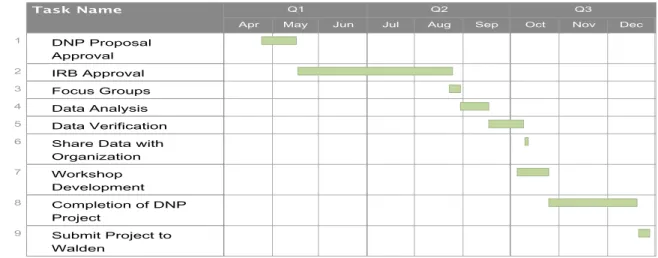
project and directed the activities involved in this process. In this section, I outline the core components of implementation and evaluation of the project. Refer to the Gantt chart time line (Figure 3).
1. A project team of stakeholders was assembled
2. Internal Review Board approval
3. Relevant evidence and literature was presented to the stakeholders
4. Four focus groups of five nurses each was assembled
5. An implementation plan for education delivery to nurses was developed
6. An evaluation plan to be implemented by the project facility was
Timeline for DNP Project
Figure 3. Gantt chart with project timeline.
Project Team
A team was formed to plan and implement this evidence-based practice project. Kelly (2011) emphasized that effective teams are not just formed, but also planned. Team members were invited to participate in this project because of expertise, ability, and interest with seeing this project advanced within the organization. Telemetry-registered nurses were invited to participate in focus groups to provide insight into why bedside shift report is not occurring as intended at the bedside. Crucial to success of this project was verification of the data analysis. Humans are subject to influences of
training, backgrounds, and experiences. Inviting experts to verify the data analysis is a safeguard against this “selective perception” (Krueger & Casey, 2009, p. 115). Team members and their role in this project included the following:
1. I functioned as the focus group facilitator, transcriber, and data analyzer.
2. Full-time dayshift and nightshift telemetry nurses were invited to participate in focus groups on a voluntary basis.
3. The director of professional development and education (PhD), my
preceptor, verified the data analysis due to her experience with nursing research and evidence-based practice projects.
4. The capstone project committee chair was not needed to verify the data
analysis as there were no questions regarding the analysis verification. Review of the literature and data themes were shared with the CNO of the facility and the entire clinical leadership team (CLT) comprised of all of the clinical nurse specialists, clinical specialists, managers, and directors of the organization’s nursing units).
5. The CLT team and I then brainstormed development of the educational
intervention based on the data findings and the literature evidence. Review of Evidence
It is important for the organization that nurses perform change-of shift report at the patient’s bedside to align with their mission of patient- and family-centered care. A brief summary of the evidence and framework for the project was presented to the project team members. The project was implemented at a 225-bed community hospital in
Maryland. The nurses participating in the focus groups were bedside nurses currently working 12-hour shifts on a telemetry unit within the hospital.
A summary of the evidence, including themes identified in the literature as barriers to sustaining bedside shift report, was presented to the clinical leadership team at
the onset of the project implementation. These themes were compared to those obtained through the focus group data analysis using the population of telemetry nurses at the project site. The comparison was highlighted in the presentation to the clinical leadership team at the project’s conclusion.
Lewin’s (1947) change theory served as the framework for the project.
Resistance to change is often rooted in disruption of the situation or the inability to think beyond what is believed by those participating in the change (White & Dudley-Brown, 2012). Lewin’s theory was used to assess the causes of resistance so that strategies can be developed by the project team to strengthen the forces moving toward the change and constrain the forces inhibiting change (Lewin, 1947). In addition, Lewin’s theory was used to guide the evaluation of the educational intervention by observations of change-of-shift report at defined intervals. In addition, the model facilitated the integration of bedside shift report into the nurses’ daily practice.
Focus Groups
Focus groups are a planned series of discussions designed to obtain perceptions of a topic through prepared open-ended questions (Krueger & Casey, 2009). The focus group interview approach gave me the opportunity to obtain the general attitude of the unit staff regarding their practice (Grove et al., 2013). Krueger and Casey (2009)
identified five characteristics of focus groups, included below with a description from the proposed project:
2. Possess certain characteristics (work on a telemetry unit at the project site and have been trained to perform bedside shift report as intended by the organization)
3. Provide qualitative data (perceived barriers to performing shift report at
the bedside consistently)
4. In a focused discussion (facilitated by me)
5. To help understand the topic of interest (what keeps nurses from
performing shift report at the bedside consistently)
A question guide was used to facilitate the discussion and to keep the focus group on task. Key questions asked during the focus groups are what drove the project (Krueger & Casey, 2009; See Appendix A for the focus group questions).
Recruitment and Sampling
Four focus groups were planned. Each focus group consisted of between four and six nurses who work full-time (36 hours per week) or part time (a minimum of 24 hours per week) on the telemetry unit. Each nurse participated in only one focus group. A similar number of dayshift and nightshift nurses were recruited. Participants determined which focus group they participated in based on availability. Participants were not provided the names of those attending the focus groups. Although the typical size of focus groups is five to 10 people, smaller groups can afford more opportunities for the nurses to share opinions (Krueger & Casey, 2009). The limited number also allows all participants to have the opportunity to respond to and discuss each of the questions asked (Terry, 2011).
A flyer was posted inside the unit break room, on the outside door of the break room, and at each nursing station on the telemetry unit requesting participation in the project (See Appendix B for the flyer). The flyer included two incentives:
breakfast/lunch/dinner provided and the nurses had the opportunity to use participation in the focus group for points towards their clinical ladder (M. Gurzick, personal
communication, April 1, 2015).
I discussed the project at morning huddles (brief gatherings of the staff to discuss
important information) to encourageparticipation and clarifyquestions. The prospective
participants were asked to call or e-mail me requesting to participate in one of the focus groups highlighted on the flyer. When contact was made, I determined if the prospective participant was full time or part time, and I asked what focus group they chose to
participate in. It was stressed that participation was contingent on their off-shift
availability. Prospective participants were asked for a phone number and e-mail address to be used for confirmation and reminder purposes only.
Ethical Considerations
The necessary paperwork was submitted in order to obtain approval from Walden University and the project site’s institutional review boards (IRB) prior to the recruitment of the participants. During the confirmation call, the participants were informed that the sessions would be recorded for transcription purposes only. Notes were taken during the focus groups. Names were not used in any of the transcription or note taking. It was important that all participants were informed of the study’s purpose, the study being voluntary and confidential, and that they can choose not to participate further at any time
(Krueger & Casey, 2009). In addition, when the participants arrived for the focus group discussion, they were given written material on the audiotaping of the session, personal confidentiality, and confidentiality regarding anything discussed within the session. They had the opportunity to ask questions and clarify information; the participants were then
directed to sign an informedconsent to verify their understanding of the information
presented.
Each participant was assigned a code number. The list of names of the participants and their codes was kept under lock and key. After the focus groups, I transcribed all audio recordings and developed a transcript using only the assigned codes for the participants (Krueger & Casey).
Data Collection, Analysis, and Verification
This project followed the guidance for focus group interviews as outlined by Krueger and Casey (2009). Audiotape was used to capture the group discussion. Two taping devices were used, one serving as a backup. Immediately following the focus group, the audio recording was downloaded to my personal laptop computer and was saved in more than one location on the computer. I developed a transcript of the taped discussions. The transcript was checked against the audio tapings. An analysis of the transcript followed using a classic analysis strategy defined and outlined by Krueger and Casey, which allowed me to identify themes and categorize results. A descriptive summary was written for each category, capturing what was said in each of the groups. Themes were determined from these descriptive summaries (Krueger & Casey, 2009).
An analysis of the transcript is verifiable when another researcher arrives at similar findings using the same data (Krueger & Casey, 2009). My preceptor at the project site verified the findings. My preceptor was given a copy of the audiotape, a copy of the transcript, and the descriptive summaries. We then compared themes in order to verify the results that I obtained. The project first chair did not need to verify the findings as there was no uncertainty about any of the themes.
Develop Shift Report: Gaining Confidence at the Bedside Education Curriculum Development
The thematic analysis was used to develop the curriculum for an educational workshop. In the analysis, I addressed barriers and concerns from the literature and those the nurses expressed in the focus groups. Key findings from this project, and those from evidence-based practice literature, were summarized in an oral presentation with visuals given to the CNO and clinical leadership team, including recommendations for
curriculum content. The CNO and clinical leadership team provided feedback on the recommendations. I obtained approval of the proposed curriculum from the clinical leadership team.
Educational Delivery Modalities
Workshops are short educational programs designed to teach skills or techniques for participants who work in the same field; workshops include active participation and discussion and are limited to a specific period of time (KU Work Group, 2014). An interactive workshop was developed from themes in the literature and the unique barriers obtained from the focus groups. It will be offered to the telemetry nurses from the unit
where the focus groups are held. The themes will be shared with the participants followed by education covering skills that will help the nurses overcome the identified
barriers. Thenurses will have the opportunity to practicethe skills learned through
role-playing activities in a formal classroom setting. The workshop can be expanded to other units in the facility struggling to maintain bedside shift report.
Develop Implementation Plan
The implementation of the workshop will begin after communicating with the project team members, department CNS, the department manager, and nursing administration to determine the education hours that can be supported by the current budget or built into the budget for the next fiscal year. The following serves as the basic tentative plan for implementation of the workshop:
1. Determine number of education hours available for each nurse on the
telemetry unit
2. Adapt workshop curriculum to be completed within the allotted time
3. Determine the number of times the workshop will need to be offered to
accommodate each staff nurse
4. Determine dates and times of the workshop
5. Secure classrooms for the workshop
6. Work with the department CNS to ensure that all unit nurses are registered
for the workshop
Evaluation Plan
I will prepare the evaluation plan for the project facility to implement. The basic tentative evaluation will consist of two separate elements. The first part of the evaluation will be conducted on the unit where the focus groups were held. Baseline observational data of the frequency of shift report at the bedside using the communication boards and places other than the bedside will be obtained prior to the implementation of staff education. These baseline data will be measured for 5 days at each shift change by an independent anonymous observer using a checklist. The brief checklist will contain the following items:
1. Both nurses were at the patient’s bedside for all, some, or none of the
report.
2. If not at the bedside, where did the nurses give report?
3. If not at the bedside, ask the nurses “why not?”
After the educational workshop, observations will be conducted at 1 month using the same checklist. If barriers other than those covered in the initial education are identified, the team will address what additional education may be required. Education on those barriers will be provided, followed by independent anonymous observations conducted 1 month later. The second part of the evaluation will be for the educational workshop offered to the telemetry nurses. It will consist of a pretest and posttest developed from the literature and information presented in the workshop.
Summary
In this section, I addressed how the project was developed using evidence-based practice and a focus group approach in determining what telemetry nurses perceive as barriers to performing change-of-shift report at the bedside. Data collection and data analysis were outlined. Also presented was the development of an educational workshop and how that will be implemented based on the themes identified in the focus groups and in the literature. This section concluded with a two-pronged evaluation plan that will include both observational data of nurses performing change-of-shift report and a pre- and post-test approach to evaluate effectiveness of the educational program.
In Section 4, I summarize the findings and discussion of the project,
implications/recommendations based on the findings, and the project’s strengths and limitations. The section will close with a concluding statement about the project.