38th WEDC International Conference, Loughborough University, UK, 2015
WATER, SANITATION AND HYGIENE SERVICES BEYOND 2015:
IMPROVING ACCESS AND SUSTAINABILITY
Community Water
plus
: assessing the ‘plus’ of successful
community-managed rural water supply in India
Hutchings, P., Franceys, R., Mekala, S. & Smits, S. (UK)
REFEREED PAPER 2194
In the community management model significant support from government and other entities is needed to
ensure sustainable rural water services. The Community Water plus project investigates the nature and
resource implications of such support in twenty community-managed rural water programmes that have been deemed to be successful in India. This paper presents the research framework and discusses the emerging findings from the first nine case studies. Contrary to the research hypothesis, which is that in these successful cases a significant amount of on-going specialist support will be found, the findings to date are showing a considerable level of support in the project implementation stage but a limited amount of specialist support in the service delivery and capital maintenance phases. However, in many of the cases, the close integration of community management in the prevailing system of local government, particularly the Gram Panchayats, creates an underlying mechanism for support during the service delivery phase. Whilst this arrangement has pragmatic benefits, it also raises questions about the boundaries between what constitutes community management and public service provision, as well as about the lines of accountability between communities, service providers and local governments.
Introducing Community Water
plusCommunity management is the dominant management model for rural water supplies in many low and middle-income countries and is widely believed to have been instrumental in the relative success in increasing access to rural water services in recent decades (Schouten & Moriarty, 2003; Harvey & Reed, 2006; Lockwood & Smits, 2011). However, problems in the sustainability and scalability of the model are leading many to conclude that we have reached the limits of an approach that is too reliant on voluntarism and informality (Moriarty et al., 2013). A consensus is now emerging that communities need continued support from government and other entities in their on-going service delivery tasks (Lockwood & Smits, 2011; Moriarty et al., 2013). Yet this critical support represents uncertain ground for many governments and donors, with a lack of clarity on the form and cost of effective support functions. India, a country at the forefront of efforts to expand access to rural water services, has a long history of community management. Following the scaling up of the model during the sector reforms of the 1990s and 2000s, the country is now home to a variety of community-managed rural water programmes. However, success here also remains uneven, with some notable success stories, but with continued evidence of failure (James, 2004; James, 2011). Both in India and elsewhere in the world, there remains a critical need to understand what mechanisms of support have worked, and to develop realistically costed policies for scaling-up and strengthening such support to community managed rural water supplies.
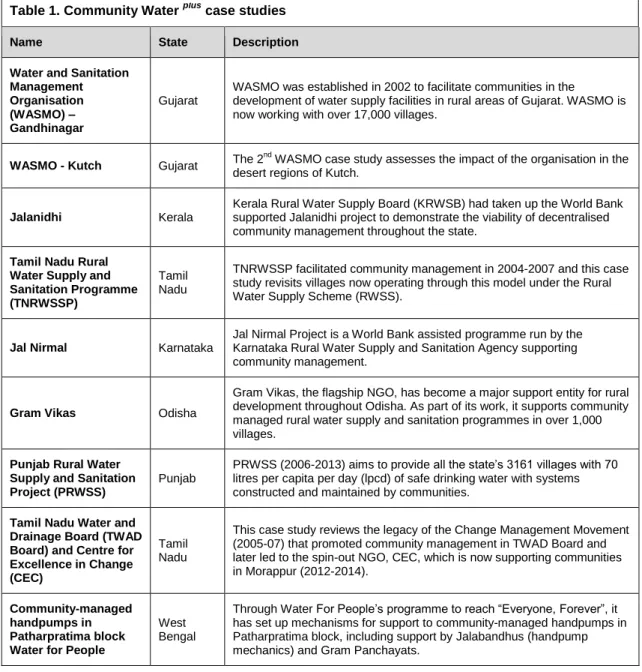
Community Water plus is a research project which aims to gain further insights into the type and amount of support that is needed for community management to be successful. It focuses on twenty case studies across India in order to answer the following research question: ‘What type, extent and style of supporting organisations are apparent in sustainable community managed water service delivery relative to varying technical modes of supply? The research has scanned over 161 community management support programmes in India covering a combined population of nearly 50 million people. Through a detailed process of selection using both secondary data and pilot visits, 20 programmes were selected to become case
studies. This paper presents the emerging findings from the first nine case studies, which are presently in the process of finalisation. The case studies that have shaped these discussions are listed in Table 1. In each case, fieldwork has been conducted in four villages, including three best practice villages from the programme and one ‘control’ village outside the programme. For each case study, data collection has involved between 10 to 30 interviews, 120 to 240 household surveys, and data mining from secondary sources (i.e. financial records, annual reports and other documentation).
Table 1. Community Water pluscase studies
Name State Description
Water and Sanitation Management Organisation (WASMO) – Gandhinagar
Gujarat
WASMO was established in 2002 to facilitate communities in the
development of water supply facilities in rural areas of Gujarat. WASMO is now working with over 17,000 villages.
WASMO - Kutch Gujarat The 2
nd WASMO case study assesses the impact of the organisation in the
desert regions of Kutch.
Jalanidhi Kerala
Kerala Rural Water Supply Board (KRWSB) had taken up the World Bank supported Jalanidhi project to demonstrate the viability of decentralised community management throughout the state.
Tamil Nadu Rural Water Supply and Sanitation Programme (TNRWSSP)
Tamil Nadu
TNRWSSP facilitated community management in 2004-2007 and this case study revisits villages now operating through this model under the Rural Water Supply Scheme (RWSS).
Jal Nirmal Karnataka
Jal Nirmal Project is a World Bank assisted programme run by the Karnataka Rural Water Supply and Sanitation Agency supporting community management.
Gram Vikas Odisha
Gram Vikas, the flagship NGO, has become a major support entity for rural development throughout Odisha. As part of its work, it supports community managed rural water supply and sanitation programmes in over 1,000 villages.
Punjab Rural Water Supply and Sanitation Project (PRWSS)
Punjab
PRWSS (2006-2013) aims to provide all the state’s 3161 villages with 70 litres per capita per day (lpcd) of safe drinking water with systems constructed and maintained by communities.
Tamil Nadu Water and Drainage Board (TWAD Board) and Centre for Excellence in Change (CEC)
Tamil Nadu
This case study reviews the legacy of the Change Management Movement (2005-07) that promoted community management in TWAD Board and later led to the spin-out NGO, CEC, which is now supporting communities in Morappur (2012-2014).
Community-managed handpumps in Patharpratima block Water for People
West Bengal
Through Water For People’s programme to reach “Everyone, Forever”, it has set up mechanisms for support to community-managed handpumps in Patharpratima block, including support by Jalabandhus (handpump mechanics) and Gram Panchayats.
Overview of research framework
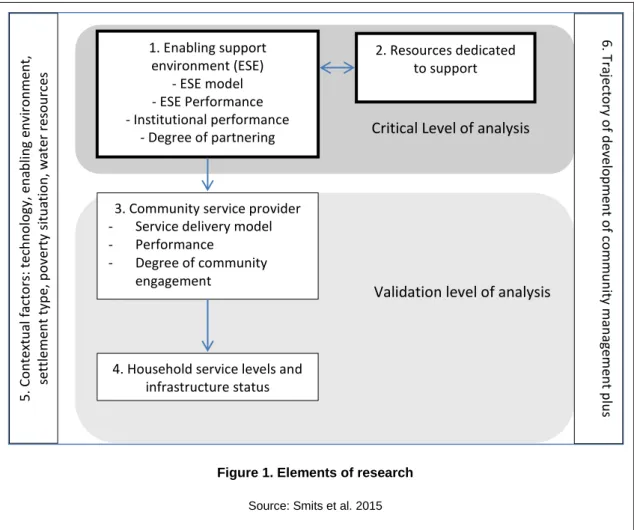
The hypothesis behind the research is that a significant level of external support is needed to deliver ongoing, high-quality water services through a community management model. Key to this support is what is called an ‘enabling support environment’ (ESE) that fulfils what Lockwood and Smits (2011) call service authority and monitoring functions, such as planning, coordination, regulation, monitoring and oversight, and direct support functions, such as technical assistance and financial contributions. Within this research, we are seeking to classify different types of community management by studying the varying types of support provided and the resource implications of these functions. However, in order to validate the degree of success and understand it in a relevant context, the research also focuses on a number of other elements represented in Figure 1. These include the ‘community service provider’ (CSP), which is the actual
institutional entity in-charge of operation and maintenance in the community management model. Data has also been collected at the household level via surveys in order to assess the service levels that people experience, as we understand this as the definitive test of success. These main units of analysis are accompanied by two broader considerations, including a systematic coding of contextual issues such as technology and socio-demographic characteristics of the population being served. This information will then be used to assess whether there are common contextual factors behind success across the case studies. Finally, the trajectories of development of each case study have been assessed so to understand whether there are common developmental pathways in which successful community management has emerged.
Figure 1. Elements of research
Source: Smits et al. 2015
Emerging findings from Community Water
plusThis section follows the Elements of Research diagram presented above by discussing the emerging findings for each category. Given the limited length of this paper, it discusses the overall trends that are emerging rather than specific findings from each case.
Enabling support environment: The research has so far been focused predominately on large-scale programmes that operate at a regional or state level. Many of these involve complex, state-wide organisations that are designed to provide support functions across thousands of villages. The support entities often have a tiered structure of support that works in convergence with the broader institutional system of government, so many of these organisations have offices at the state, district, block and sometimes village level. This enables the enforcement of professional standards through ‘protocolising’ the procedures behind support functions. This has some drawbacks, such as potentially creating slow-moving bureaucracies, but it does ensure that professional standards are usually met, and that solutions are technically sound and it also helps institutionalise good practices. The type of support provided by these specialist entities is predominantly provided in the intensive capital investment stage of a water supply project. It comes in the form of demand creation, needs assessment and management capacity building exercises which accompany capital expenditure on hardware. The continuing level of support in the
post-4. Household service levels and infrastructure status 3. Community service provider - Service delivery model - Performance - Degree of community engagement 5. Co n textu al fact o rs : tec h n o lo gy , en ab ling en viron m en t, se tt le m en t ty p e, p o ve rty si tu atio n , wat er re so u rc es 1. Enabling support environment (ESE) - ESE model - ESE Performance - Institutional performance - Degree of partnering 6. Traj ecto ry o f d ev e lop m en t o f co m m u n ity man agem en t p lu s 2. Resources dedicated to support
Critical Level of analysis
implementation stage from the specialist water supply entities is lower than anticipated. However, this is in part mitigated by the role of non-specialist local government institutions, such as the Gram Panchayat (GP) (village-level government) and Block Development Offices, which provide much of the ‘everyday’ support at the village level. This includes support in tariff collection, administrative support, and the sourcing of spare parts. In fact, the boundaries between the Village Water and Sanitation Committees (VWSC), as the community service providers, and GPs – who nominally fulfil the authority function – are blurred. In many cases, the VWSC is a subcommittee of the GP, has the same president as the GP, and a significant part of the Operational Expenditure (OpEx) is covered out of general GP funds, and not out of dedicated water tariffs.
Resources dedicated to enabling support environment: Across the board, the resources dedicated to support are highly likely to come through publically funded programmes (e.g. WASMO). Donor-funded programmes are also evident but these tend to be part funded by the union or state governments and integrated into their respective state programmes (e.g. the World Bank supported Jal Nirmal and PRWSS programmes). Even the non-government support entities, such as Gram Vikas, are organised through a long standing relationship between the NGO and the state government. This indicates that government resources are critical to building successful support networks. Whilst much of the detailed financial analysis is currently underway and so specific figures cannot be quoted in this paper, it is already clear that the resources dedicated to Capital Expenditure (CapEx) are substantial and clearly accounted for whilst recurrent costs are less transparent and are often covered by various entities. For example, in Gujarat the VWSC pay the salaries of the pump operators, but the energy costs for the pumps is paid by State government and the GPs cover part of the repair costs. This means that there is no single overview of recurrent costs with many users unaware of the indirect subsidies that support their water supply.
Community service provider: Through the study we have validated that in these reportedly successful cases, the CSPs are performing well and can carry out many of the operation and maintenance and administrative tasks required. However, as community management becomes integrated into large-scale programmes, the concept of community involvement is changing with a move away from a voluntary approach to model in which community contribution is formalized through the local government and the VWSC operates as a subcommittee of the government institution. In richer areas, this community contribution is also seen through the payment of tariffs that leads to a more professionalized model, but in poorer areas this means that the community contribution becomes minimal, and the delivery model can be classified as a form of direct provision with community involvement. A question remains with regards to when these models stop being community management and merely a form of public management. This is particularly difficult question to answer in India due to the decentralization of local government down to village level. In certain states, such as Tamil Nadu, practitioners see little difference between the village level government and VWSCs, with both equated to a form of community management. In other states, such as Kerala, a more conventional form of community management exists with communities managing water supply through VWSCs that are completely independent of local government.
Household service levels: In most cases, water supply is being delivered that meets basic service levels in terms of quantity, quality, and reliability, and is comparably better than the services found in control villages. The cases reflect the general trend in India toward pipe water supply as the Water for People programme in West Bengal is the only case study on handpumps, with the rest all focused on expanding piped water. As the sector looks forward, the important policy point to make is that the case studies demonstrate that community management is possible with 24/7 piped water supply schemes.
Contextual factors: Across many cases, an influential contextual factor is the role of water scarcity as a trigger for successful community management (i.e. TWAD-CEC, WASMO in Kutch). It is not exactly clear why this is but it could be that communities are more willing and motivated to take part in programmes when faced with scarcity. From the case selection scanning of 161 cases, it can also be suggested that successful community management is predominately found in wealthier states indicating that higher levels of wealth (and education) appear to be associated with successful community management. This is supported by the evidence at a global level that higher levels of GDP per capita are associated with improved performance in terms of community management (Hutchings et al. 2015).
Potential trajectories of development of community management: The policy landscape for rural water supply is rapidly changing from a focus on basic access, often in the form of constructing tubewells with handpumps, to provision of household piped water supply (MDSS, 2013). This trend is also accompanied by an emphasis on moving away from depleted groundwater to surface water and, so, both the higher propensity to treatment and the uneven distribution of surface water means that in the future there is likely to be a greater role for government as a bulk water provider. Such an arrangement was evident in the
TWAD-CEC case study in which the TWAD Board oversaw a public-private partnership to deliver bulk water to villages across two districts. Treated water was provided at a highly subsided price to village reservoirs and then the VWSC and GP was in-charge of operating and maintaining the local distribution network. This arrangement presents a promising model that locates community management within a bigger publically-managed system that is more easily scalable than conventional forms of community management.
Conclusions
The research hypothesized that there would be a significant amount of on-going specialist support in successful community management programmes yet we found that the on-going support provided by many rural water supply support entities was lower than anticipated. Whilst these support entities provided intensive support during capital implementation much of the on-going support was provided through the everyday functioning of the local government system in India. Reflecting on the argument that community management had often emerged because of the failure of local government to delivery services in rural areas (Harvey and Reed, 2006), what we are seeing in India can be considered a reversal of this trend as local government has become better funded and strengthen through a series of decentralising reforms. In particular, at the village level, the decentralisation of public services to the GP is both reinforcing and challenging community management. A close convergence between this lowest level of government and the VWSC enables communities to make use of the local government’s institutional capital and resources (for example by using the GP accountant for VWSC accounts). It also prevents conflict that can emerge at the village level when two distinct entities have different ideas about the development of water in an area. In this sense, there are clear pragmatic benefits of integrating community management closely with local government as it brings a sense of democratic legitimacy and enhanced capacity to community management. However, it raises questions about the boundaries between what constitutes community management and public service provision, and poses potential problems with regards to the accountability of service provision. For example, under this type of public-community hybrid model, it is not always clear to what extent communities actually have autonomy from local government to take technical (i.e. technology type) and administrative decisions (i.e. tariff levels) regarding water supply? And, in cases where service delivery performance is not meeting the needs of the community, it is not always clear what local body community members can complain to (and to what extent such a body has the means and independence to hold the service provider to account)? As service delivery models continues to adapt in India and elsewhere, it is important that the sector identifies and responses to such potential problems.
Acknowledgements
The Community Water plus project is a three year research project funded by the Department of Foreign Affairs and Trade (DFAT) of the Australian Government as part of the Australian Development Research Awards Scheme. The research is being undertaken by a consortium of partners including the Administrative Staff College of India (Hyderabad), the Centre of Excellence for Change (Chennai), Malaviya National Institute of Technology (Jaipur), Xavier Institute of Social Service (Ranchi), IRC from The Netherlands and Cranfield University, United Kingdom, who are also responsible for overall project coordination. Dr Snehalatha Mekala is the national research coordinator. The authors would like to express thanks to the research teams from each institution and also the research participants who have contributed to this research.
References
Brighu, U. & Poonia, R. (2015). PRWSS. Community Water Plus Case Study. Jaipur. MNIT.
Chary Vedala, S., Jasthi, S. & Uddaraju, S. (2015). WASMO-Gandhinagar. Community Water Plus Case Study. Hyderabad. ASCI.
Chary Vedala, S., Jasthi, S. & Uddaraju, S. (2015). WASMO-Kutch. Community Water Plus Case Study. Hyderabad. ASCI.
Dash, P C. & Panda, P K. Gram Vikas. Community Water Plus Case Study. Ranchi. XISS. Gladston, A. & Daniel, C. (2015). Jalanidhi. Community Water Plus Case Study. Chennai. CEC. Harvey, P.A. and Reed R.A., 2006. Community-managed water supplies in Africa: sustainable or
dispensable?. Community Development Journal, 42 (3), pp. 365-378.
Hutchings, P. (2015). TWAD-Board & CEC. Community Water Plus Case Study. Cranfield. Cranfield University.
Hutchings, P., Chan, M Y., Cuadrado, L., Ezbakhe, F., Baptiste, M., Tamekawa, C., Franceys, F. (2015). A systematic review of success factors in the community management of rural water supplies over the past 30 years. Water Policy (forthcoming).
James, A.J. (2004). India ’ s Sector Reform Projects and Swajaldhara Programme A Case of Scaling up Community Managed Water Supply. Submitted to the IRC International Water and Sanitation Centre. James, A.J., (2011). India: Lessons for Rural Water Supply; Assessing progress towards sustainable
service delivery. The Hague: IRC International Water and Sanitation Centre and Delhi: iMaCS. Lockwood, H. and S. Smits. 2011. Supporting Rural Water Supply: Moving towards a Service Delivery
Approach. Rugby, UK: Practical Action Publishing.
Moriarty, P., Butterworth, J. & Franceys, R. (2013a). Trends in Rural Water Supply : Towards a Service Delivery Approach. Water Alternatives. 6 (3). pp. 329–349.
MDWS, 2013. National Rural Drinking Water Programme. Movement towards ensuring people’s Drinking Water Security in Rural India. Ministry of Drinking Water and Sanitation, Delhi, India. Saraswathy, S. (2015). TNRWSSP. Community Water Plus Case Study. Chennai. CEC.
Rama Rohan Roa, M S. (2015). Jal Nirmal. Community Water Plus Case Study. Chennai. CEC.
Schouten, T. & Moriarty, P. (2003). Community Water, Community Management. From System to Service in Rural Areas. ITDG Publishing, London.
Smits. S, Franceys, R., Snehalatha M, Hutchings, P. (2015) Understanding the resource implications of the “plus” in community management of rural water supply systems in India; key concepts and
research methodology. Working paper 1, Community Water plus.
Smits, S. & Mekala, S. (2015) Community-managed handpumps in Patharpratima. Community Water Plus Case Study. The Hague. IRC.
Tamayo, S.P. y García, M., 2006. Estrategia estatal para el fortalecimiento de entes prestadores de servicios públicos en el pequeño municipio y la zona rural. El programa cultura empresarial adelantado en Colombia. In: Quiroz, F., Faysse, N. y Ampuero, R., 2006. Apoyo a la gestión de Comités de Agua Potable; experiencias de fortalecimiento a comités de agua potable con gestión comunitaria en Bolivia y Colombia. Cochabamba, Bolivia: Centro Agua – UMSS.
Contact details Paul Hutchings Cranfield University Tel: :+44 (0)1234 755576 Email: [email protected] Snehalatha Mekala
Community Water plus National Coordinator Email: sneha_sreedhar@ yahoo.com
Dr Richard Franceys Cranfield University Tel: :+44 (0)1234 755576 Email: [email protected] Stef Smits IRC Email: [email protected]