Allocation Strategies for Data-Oriented
Architectures
Dissertation
zur Erlangung des akademischen Grades Doktoringenieur (Dr.-Ing.)
vorgelegt an der
Technischen Universität Dresden Fakultät Informatik
eingereicht von
Dipl.-Inf. Dipl.-Math. Tim Kiefer
geboren am 25. September 1983 in Saalfeld
Gutachter: Prof. Dr.-Ing. Wolfgang Lehner Technische Universität Dresden Fakultät Informatik
Institut für Systemarchitektur Lehrstuhl für Datenbanken 01062 Dresden
Prof. Johann-Christoph Freytag, Ph.D. Humbold-Universität zu Berlin
Mathematisch-Naturwissenschaftliche Fakultät Institut für Informatik
Lehrstuhl für Datenbanken und Informationssysteme Unter den Linden 6, 10099 Berlin
Tag der Verteidigung: 9. Oktober 2015
Abstract
Data orientation is a common design principle in distributed data management sys-tems. In contrast to process-oriented or transaction-oriented system designs, data-oriented architectures are based on data locality and function shipping. The tight coupling of data and processing thereon is implemented in different systems in a variety of application scenarios such as data analysis, database-as-a-service, and data management on multiprocessor systems. Data-oriented systems, i.e., systems that implement a data-oriented architecture, bundle data and operations together in tasks which are processed locally on the nodes of the distributed system. Alloca-tion strategies, i.e., methods that decide the mapping from tasks to nodes, are core components in data-oriented systems. Good allocation strategies can lead to bal-anced systems while bad allocation strategies cause skew in the load and therefore suboptimal application performance and infrastructure utilization. Optimal alloca-tion strategies are hard to find given the complexity of the systems, the complicated interactions of tasks, and the huge solution space. To ensure the scalability of data-oriented systems and to keep them manageable with hundreds of thousands of tasks, thousands of nodes, and dynamic workloads, fast and reliable allocation strategies are mandatory.
In this thesis, we develop novel allocation strategies for data-oriented systems based on graph partitioning algorithms. Therefore, we show that systems from dif-ferent application scenarios with difdif-ferent abstraction levels can be generalized to generic infrastructure and workload descriptions. We use weighted graph represen-tations to model infrastructures with bounded and unbounded, i.e., overcommited, resources and possibly non-linear performance characteristics. Based on our gen-eralized infrastructure and workload model, we formalize the allocation problem, which seeks valid and balanced allocations that minimize communication. Our al-location strategies partition the workload graph using solution heuristics that work with single and multiple vertex weights. Novel extensions to these solution heuris-tics can be used to balance penalized and secondary graph partition weights. These extensions enable the allocation strategies to handle infrastructures with non-linear performance behavior. On top of the basic algorithms, we propose methods to incorporate heterogeneous infrastructures and to react to changing workloads and infrastructures by incrementally updating the partitioning.
We evaluate all components of our allocation strategy algorithms and show their applicability and scalability with synthetic workload graphs. In end-to-end– performance experiments in two actual data-oriented systems, a database-as-a-service system and a database management system for multiprocessor systems, we prove that our allocation strategies outperform alternative state-of-the-art methods.
Acknowledgments
My gratitude first and foremost goes to my advisor Wolfgang Lehner. His enthusias-tic lectures made me choose my specialty, his advertisement led to my first internship at IBM, and his support made my diploma thesis and the following scholarship pos-sible. Wolfgang kept me on track in the last few years and repeatedly reminded me how awesome my topic is and how thrilling the research around it can be. I remem-ber countless discussions, all following the same script of me being skeptical towards my topic and my results and him pointing out the endless research opportunities. Thank you for believing in me!
I am grateful to Johann-Christoph Freytag for co-advising my thesis and for his many valuable hints. I would like to thank the Deutsche Telekom Stiftung for making this thesis possible, Klaus Kinkel for being all-in on MINT education, Christiane Frense-Heck for organizing everything and solving every problem, and all my fellow scholarship holders for great fun at all the events and meetings.
Special thanks go to Benjamin Schlegel. He sparked my interest in the modern-hardware aspect of my work and offered an alternative when my topic seemed to be a dead end. I would also like to thank Thomas Kissinger for our fruitful collaboration on the NUMA topic. New York made it all possible. . .
I would like to thank Dirk Habich for reading major parts of the thesis and for the many valuable hints that followed in long discussions. My gratitude for proofreading goes furthermore to Claudio Hartmann und Stefanie Gahrig.
I am thankful to all my past and current colleagues for creating an inspiring and fun working atmosphere. Martin Hahmann and Katrin Braunschweig were awesome roommates and I enjoyed our many research-related and off-topic discussions.
All this work would not have been possible without my family and friends. My parents made me who I am today and I will always be grateful for that. Special thanks go to my beloved partner Ilka and my daughter Alexandra. Ilka always had my back, believed in me, encouraged me, and never doubted my eventual success. Alexandra did her part by sleeping through virtually every night. Thank you! You are truly awesome!
Tim Kiefer Dresden, July 13, 2015
Contents
1. Introduction 1
2. Foundations of Data-Oriented Systems 7
2.1. Data Orientation in Database-as-a-Service Systems . . . 8
2.1.1. Allocation Problem in Database-as-a-Service Systems . . . . 8
2.1.2. Implementation Classes of Database-as-a-Service Systems . . 9
2.1.3. Summary and Discussion . . . 12
2.2. Data Orientation in DBMSs for Multiprocessor Systems . . . 13
2.2.1. Allocation Problem in DBMSs for Multiprocessor Systems . . 13
2.2.2. Implementation Classes of DBMSs for Multiprocessor Systems 14 2.2.3. Summary and Discussion . . . 18
2.3. Physical Design Automation for Data-Oriented Systems . . . 19
2.3.1. Automated Data Partitioning . . . 20
2.3.2. Automated Partition Balancing . . . 21
2.3.3. Automated Data Placement . . . 22
2.4. Summary . . . 22
3. Allocation Problem for Data-Oriented Systems 23 3.1. Infrastructure Model . . . 25
3.1.1. Modeled Resources . . . 26
3.1.2. Bounded and Unbounded Resources . . . 26
3.1.3. Models for Combined Load . . . 27
3.2. Workload Model . . . 30
3.2.1. Obtaining the Workload . . . 31
3.2.2. Maintaining the Workload . . . 34
3.3. Allocation Problem . . . 35
3.3.1. Possible Objectives . . . 35
3.3.2. Possible Constraints . . . 36
3.3.3. Problem Formulation . . . 36
3.3.4. Relations to the Partitioning Problem . . . 37
3.3.5. The Case for Individual Resources . . . 37
3.4. Requirements for Allocation Strategies . . . 38
3.5. Related Approaches to the Allocation Problem . . . 39
3.6. Summary . . . 42
4. Balanced K-Way Min-Cut Graph Partitioning 43 4.1. Graph Partitioning . . . 43
4.1.1. Prerequisites . . . 44
4.2. Multi-Constraint Graph Partitioning . . . 50
4.2.1. Prerequisites . . . 51
4.2.2. Multi-Constraint Graph Partitioning Algorithm . . . 53
4.3. Penalized Graph Partitioning . . . 54
4.3.1. Prerequisites . . . 55
4.3.2. Penalized Graph Partitioning Algorithm . . . 58
4.4. Secondary Weight Graph Partitioning . . . 59
4.4.1. Prerequisites . . . 60
4.4.2. Secondary Weight Graph Partitioning Algorithm . . . 61
4.5. Experimental Evaluation . . . 62
4.5.1. Penalized Graph Partitioning in METIS (PenMETIS) . . . . 62
4.5.2. Synthetic Multi-Constraint Partitioning Experiment . . . 63
4.5.3. Synthetic Penalized Partitioning Experiment . . . 65
4.5.4. Scalability Experiments . . . 66
4.6. Summary . . . 73
5. Extensions to Graph Partitioning 75 5.1. Incrementally Updating the Graph Partitioning . . . 75
5.1.1. Incremental Update Strategies . . . 76
5.1.2. Update Cost Considerations . . . 77
5.2. Mapping Graph Partitions to Heterogeneous Infrastructures . . . 77
5.2.1. Heterogeneous Nodes . . . 78
5.2.2. Heterogeneous Links and Sparse Networks . . . 79
5.2.3. Heterogeneous Nodes and Links . . . 80
5.3. Capacity Constraints . . . 81
5.4. Experimental Evaluation . . . 85
5.4.1. Incremental Update Experiment . . . 85
5.4.2. Heterogeneous Infrastructure Experiment . . . 87
5.4.3. Capacity Constraint Experiment . . . 88
5.5. Summary . . . 89
6. Experimental Evaluation in the MTM Database-as-a-Service System 91 6.1. Multi-Tenancy Middleware (MTM) . . . 91
6.2. Multi-Tenancy Database Benchmark Framework (MulTe) . . . 94
6.2.1. Benchmark Framework Concepts . . . 94
6.2.2. Benchmark Framework Implementation . . . 95
6.3. System Performance Experiments . . . 97
6.3.1. Hardware Setup . . . 97 6.3.2. Workload/Workload Model . . . 98 6.3.3. Infrastructure Model . . . 99 6.3.4. Allocation Strategies . . . 100 6.3.5. Performance Metrics . . . 100 6.3.6. Experiment Results . . . 101 6.4. Summary . . . 103
Contents 7. Experimental Evaluation in the ERIS DBMS for Multiprocessor Systems 105
7.1. NUMA Characteristics in Multiprocessor Systems . . . 105
7.1.1. NUMA System Architecture . . . 105
7.1.2. Low-Level–Benchmark Results . . . 107
7.1.3. Design Principles for NUMA-Aware DBMSs . . . 109
7.2. ERIS System Architecture . . . 110
7.2.1. AEUs and Memory Management . . . 110
7.2.2. High-Throughput Data Command Routing . . . 111
7.2.3. Query Processing . . . 113
7.2.4. Load Balancing Strategy . . . 114
7.3. System Performance Experiments . . . 114
7.3.1. Workload . . . 114 7.3.2. Infrastructure . . . 116 7.3.3. Allocation Strategies . . . 116 7.3.4. Performance Metrics . . . 117 7.3.5. Experiment Results . . . 117 7.4. Summary . . . 119 8. Conclusion 121
A. Additional Graph Partitioning Results 125
Bibliography 135
List of Figures 141
1. Introduction
The termdata-oriented architecture is not fixed and does not refer to a single
sys-tem layout. In the context of data management syssys-tems, data orientation is com-monly used to describe distributed data processing systems that make the data a first class citizen and drive the processing based on data locality. Unlike process-oriented or transaction-process-oriented architectures, where a single process is assigned to acquire the necessary data, perform the operations, and return the results, in data-orientated architectures the data drives the processing. Figure 1.1 shows the two different execution strategies, data-orientated and process-orientated, side by side. In data-oriented systems, i.e., systems that implement a data-oriented architecture, transactions1 are split into self contained units of work. Data and the operations performed thereon are bundled intasksand tasks are processed locally on thenodes
of the distributed system. The termallocationin data-oriented systems refers to the
mapping of tasks to nodes. Data locality is a key design principle in data-oriented systems, i.e., tasks are executed where the data resides instead of moving the data to the processing. In other words, a data-oriented architecture uses function ship-ping while process-oriented architectures are based on data shipship-ping. Data can still be moved in data-oriented systems, but only explicitly when tasks communicate to coordinate or perform complex workloads.
Data orientation is a key design principle in various data management systems with very different abstraction levels. The following three exemplary application scenarios use data-oriented systems:
Data Analysis Several data analysis platforms were developed in recent years. Ex-amples are MapReduce at Google, the open-source alternative Hadoop, or Microsoft’s Cosmos. Advanced data processing capabilities, e.g., SQL pro-cessing, are either integral part of the system (e.g., Scope in Cosmos, Zhou et al., 2012) or have been added on top (e.g., Impala on Hadoop, Impala, 2015). Data in these distributed analysis platforms is always processed locally and only intermediate results are transferred between tasks.
Database-as-a-Service Providers like Amazon (Amazon, 2015) or Microsoft (Mi-crosoft, 2015) offer relational databases as a service in their respective cloud infrastructures. A relational database (task) comprises the actual data and the operations, i.e., SQL statements. Databases are stored on a single server (node) or distributed across multiple servers.
Database Management on Multiprocessor Systems Database management sys-tems (DBMSs) on modern multiprocessor syssys-tems face the challenge of ef-ficiently utilizing the available resources. Cores and memory controllers are
data operations hardware resources transaction data shipping Process-Oriented Execution transaction function shipping Data-Oriented Execution
Figure 1.1.: Execution Schemes in Distributed Data Processing Systems distributed among the processors. The best performance can be achieved by treating the multiprocessor system as a distributed system. Optimized storage engines like the one in the in-memory DBMS ERIS execute portions of a query locally on a single core (Kissinger et al., 2014). Parts of the query execution plan and the involved data form a task that is assigned to a multiprocessor (node). Only intermediate data is transferred between tasks if necessary. In this thesis, we investigate allocation strategies for systems that implement data-oriented architectures in general. We demonstrate the applicability of our solutions in two exemplary systems from the second and the third category, respectively. Although the two scenarios are very different, they base on common principles and we show that a unified allocation strategy can be used for both.
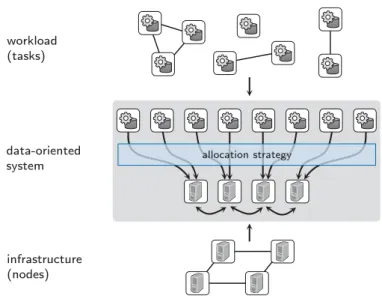
Given that the location of data determines where processing is performed, the allocation is crucial in any data-oriented system. The allocation can lead to a bal-anced or a severely skewed system and has therefore several implications on global system characteristics, e.g., the utilization of the nodes and the performance of the tasks. Consolidation, i.e., co-location and concurrent execution of (possibly unrelated) tasks on single nodes is a central means to optimize utilization, hence cost-effectiveness, and performance in data-oriented systems (Curino et al., 2011). Consequently, the decision on where data resides in data-oriented systems, i.e., the allocation strategy, is commonly taken from the user and optimized by the system. This optimization is workload-driven, i.e., based on the actual tasks. Figure 1.2 shows an abstract data-oriented architecture. Knowledge about both the tasks of the workload and their characteristics as well as the infrastructure is used by an allocation strategy that decides the initial data layout as well as periodic data mi-grations, which are required to balance the load across the nodes. The location of the tasks is transparent to the users of actual data-oriented systems.
Finding an optimal allocation is an inherently difficult problem. The allocation actually comprises two problems, (1) determining a partitioning of the data, i.e., a granularity of the tasks, and (2) finding a mapping of tasks to nodes. Even on a small scale, solving the allocation problem is hard, given the complex interactions
workload (tasks)
infrastructure (nodes) data-oriented
system allocation strategy
Figure 1.2.: Data-Oriented Architecture
that tasks may have (Ahmad and Bowman, 2011). Contention on hardware or operating system resources may lead to performance characteristics that are hard to predict. The presence of heterogeneous hardware, dynamic workloads, and dynamic infrastructures add to the complexity of the problem. To ensure the scalability of data-oriented systems and to keep them manageable with hundreds of thousands of tasks and thousands of nodes, fast and reliable algorithms for the allocation problem are mandatory. However, distributed data processing systems and complex workloads are hard to model and system behavior is hard to predict (Ahmad and Bowman, 2011; Curino et al., 2011). Even with the models, the allocation problem has a huge solution space and the problem itself is NP-hard (e.g., Curino et al., 2011; Schaffner et al., 2013).
An ideal allocation strategy can be used for optimizing different objectives like minimizing the required number of nodes or maximizing task performance. Fur-thermore, it is scalable to thousands of nodes and hundreds of thousands of tasks, flexibly reacts to dynamically changing workloads and infrastructures, and deals with complex, heterogeneous components.
Summary of Contributions
The contribution of this thesis is a set of allocation strategies for data-oriented sys-tems. We thereby assume an existing partitioning and focus on the mapping part of the allocation problem. Our allocation strategies model workload and infrastruc-ture information in weighted graphs and solve the allocation problem based on graph partitioning and mapping algorithms. In detail, our contributions are:
• We analyze data-oriented systems in different application scenarios, specifically database-as-a-service systems and DBMSs for multiprocessor systems. We identify core characteristics of the systems and abstract them to a generic data-oriented system. We formulate the allocation problem based on the abstract data-oriented system.
• We abstract from the infrastructures in the example systems to a generic graph-based representation of available resources. Thereby, we account for non-linear performance caused, e.g., by contention. Furthermore, we intro-duce the notion of bounded and unbounded resources to be able to model commonly oversubscribed resources and resources that render an allocation invalid if overused.
• We abstract from the workloads in the example systems to a generic graph-based representation of the resource requirements. Each task can consume multiple resources that will be treated individually by the allocation strategy. • We present allocation strategies based on balanced k-way min-cut graph par-titioning. We extend known heuristics for graph partitioning and multi-constraint graph partitioning by methods to account for non-linear resource behavior. Thereby, we introduce the notion ofpenalized weightsandsecondary weights. We show how to balance these penalized and secondary weights
dur-ing graph partitiondur-ing. To the best of our knowledge, our method is the first to partition a graph with vertex weights that do not combine linearly to partition weights.
• We show that our basic allocation strategies can be extended to fulfill dif-ferent requirements. We present ways to modify the allocation strategy to account for heterogeneous hardware. Furthermore, we show how an allocation can incrementally be updated after changes to handle dynamic workloads and infrastructures.
• We experimentally evaluate our method using synthetic scenarios. In addition, we implement our allocation strategies in two actual data-oriented systems and evaluate their benefit in end-to-end–performance experiments.
Outline
The structure of this thesis is illustrated in Figure 1.3. Chapter 2 presents foun-dations of data-oriented systems with a focus on database-as-a-service systems and DBMSs for multiprocessor systems. Different implementation strategies and prop-erties of the corresponding systems are described together with existing solutions in this field. Chapter 3 abstracts from actual systems and details all necessary com-ponents of the allocation problem before the problem itself is formulated. First, the infrastructure and the workload model used in the allocation problem are abstracted from actual systems. Second, the allocation problem is defined and variations are discussed. Third, requirements for allocation strategies are derived from the pro-posed models and the problem formulation.
Chapters 4 and 5 present allocation strategies, i.e., solutions for the allocation problem, based on the abstract data-oriented system. Chapter 4 details our allo-cation strategies, which are based on balanced k-way min-cut graph partitioning. Starting from existing graph partitioning algorithms, we propose new methods for graph partitioning with penalized and secondary weights. In Chapter 5, we extend and modify the graph partitioning algorithms to relax previously made assumptions. Details are provided that make the allocations strategies applicable to heterogeneous
8. Conclusion
1. Introduction
2. Foundations of Data-Oriented Systems 2.1. Data-Orientation in
Database-as-a-Service Systems
2.2. Data-Orientation in DBMSs for Multiprocessor Systems 3. Allocation Problem for Data-Oriented Systems 4. Balanced K-Way Min-Cut Graph Partitioning 5. Extensions to Graph Partitioning
6. Experimental Evaluation in the MTM Database-as-a-Service System
7. Experimental Evaluation in the ERIS DBMS for Multiprocessor Systems
State-of-the-art System Abstraction Allocation Strategies Experimental Evaluation
Figure 1.3.: Structure of this Thesis
infrastructures and systems with dynamic workloads and infrastructures. All aspects of the allocations strategies are experimentally evaluated in the corresponding chap-ters.
The allocation strategies in their entirety are experimentally evaluated in two actual data-oriented systems in Chapters 6 and 7. Chapter 6 presents the database-as-a-service system MTM and evaluates our allocation strategies in this system. In Chapter 7, we analyze properties of multiprocessor systems and introduce ERIS, a DBMS that is optimized for multiprocessor systems. Furthermore, we show details of the implementation and evaluation of our allocation strategies in ERIS.
We finally conclude this thesis in Chapter 8 with a summary and a discussion of future work.
2. Foundations of Data-Oriented Systems
In this chapter, we present foundations of data-oriented systems to provide necessary basics for the subsequent chapters. Related work that is relevant to the topic will be presented throughout the three parts of this chapter. We first present two application scenarios that implement data-oriented architectures in Sections 2.1 and 2.2. The two scenarios result in two classes of data-oriented systems, namely database-as-a-service systemsandDBMSs for multiprocessor systems. A variety of actual systems
exist in both classes that differ in the implementation or in the degree of data orientation, i.e., the granularity of tasks and the degree of data locality. By giving an overview of these systems, we show that although being different in many aspects, they follow common principles that allow for a unified allocation strategy. Two example systems, one from each class, are described and evaluated in detail in the experiments Chapters 6 and 7.
Second in this chapter, in Section 2.3, we regard the relation of data-oriented sys-tems to classic distributed relational DBMSs and revisit related work in this field. Distributed DBMSs have been studied at least since the late 1980s and some of the early problems sound surprisingly familiar to our allocation problem. For in-stance, Apers (1988) formulated almost 30 years ago the following problem: “Given the queries and updates, the frequencies of their usage, and the sites where the re-sults have to be sent, determine (1) the fragments to be allocated, and (2) allocate these fragments, possibly redundant, and the operations on them to the sites of the computer network such that a certain cost function is minimized.” While many principles of distributed DBMSs apply to the data-oriented systems in this thesis, the latter add several challenges. Existing commercial distributed DBMSs provide the means for partitioning and distributed processing of data but keep the deci-sions on partitioning and placement to the domain expert. We aim for system sizes that make an automated and possibly fine-grained allocation strategy mandatory. Furthermore, the main focus of distributed DBMSs has traditionally been to scale out huge database applications that would either not fit on a single node or benefit from the parallel data processing. The goal of many data-oriented systems is to also provide and optimize scale-in scenarios to economically run a large number of tasks on a small number of nodes. At last, allocation strategies in data-oriented systems must be able to deal with heterogeneous infrastructures and dynamic workloads, conditions not always found in distributed DBMS scenarios. Nevertheless, related work especially on physical database design advisors and work on automated par-titioning and partition placement provide helpful insights and will be presented in the second part of this chapter.
Two more topics that are important foundations of this thesis are not discussed in this chapter, but later in the thesis. Related work on the allocation problem is best understood after preliminaries like the infrastructure and workload model have been
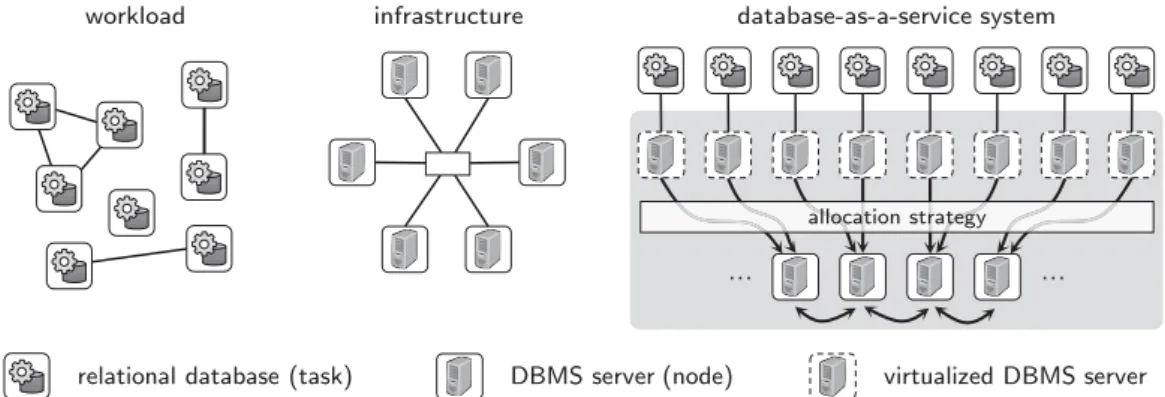
workload infrastructure database-as-a-service system
relational database (task) DBMS server (node) virtualized DBMS server
… …
allocation strategy
Figure 2.1.: Database-as-a-Service Platform Depicted as Data-Oriented System detailed and will hence be presented in Section 3.5 in the next chapter. Foundations of graph partitioning will be given in the context of our new partitioning methods in Chapter 4.
2.1. Data Orientation in Database-as-a-Service Systems
Cloud computing has become a valid usage model for different kinds of applica-tions and a successful business model for several service providers. Using a resource, e.g., the infrastructure (Infrastructure-as-a-Service, IaaS), an application platform (PaaS), or the software itself (SaaS), as a service has several advantages. The re-source can be used flexibly and it is scalable to accommodate different or shifting application needs. Resources can be quickly provisioned in the cloud to offer appli-cations a short time to market. The shift from capital expenditure to operational expenditure and the pay-as-you-go billing model foster start-ups and experimen-tal applications. For service providers, the economy of scale, enabled by resource sharing, renders cloud computing interesting.Offering (relational) databases as a service transfers the advantages of cloud com-puting to the data storage layer of an application and allows applications that rely on a storage layer to run in the cloud. All major cloud service providers offer rela-tional databases as part of their product portfolio (Amazon, 2015; Microsoft, 2015; Oracle, 2015).
2.1.1. Allocation Problem in Database-as-a-Service Systems
Database-as-a-service systems implement data-oriented architectures, the analogies are shown in Figure 2.1. Relational databases comprise the actual data in form of tables and the operations thereon in form of SQL statements. Hence, relational databases form the tasks in the data-oriented system where database objects rep-resent the data. Relational databases can be partitioned which leads to tasks that communicate to execute a workload. The nodes of the system are connected database management system servers, which together build the infrastructure.
Conceptual, the database-as-a-service system offers a virtual DBMS server wherein the service customers create and use their databases. These virtual DBMS
2.1. Data Orientation in Database-as-a-Service Systems database schema database database server operating system hardware resources
Figure 2.2.: Database System Stack
servers are internally mapped to actual server machines. Which layers of the system stack belong to the abstract task and which to the abstract node depends on the actual implementation of the system and will be detailed in the next section.
The allocation problem is of high interest in database-as-a-service systems (e.g., Curino et al., 2011; Schaffner et al., 2013). The allocation strategy can for instance be used to minimize the number of nodes and thereby reduce resource consumption and operational costs. Furthermore, the allocation strategy can help to improve performance, to guarantee service levels, and to ensure availability.
2.1.2. Implementation Classes of Database-as-a-Service Systems
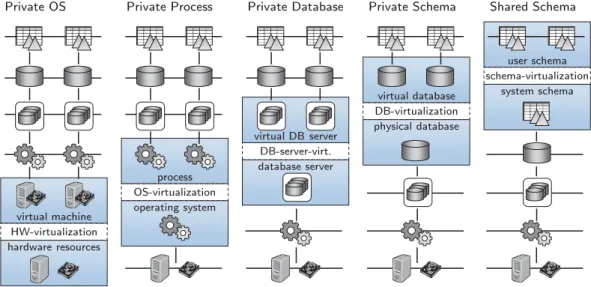
Database-as-a-service systems are implemented by virtualizing the database server and consolidating multiple virtual servers on a single physical server. However, the multi-layered system stack of a database management system, ranging from the hardware layer up to the database schema (shown in Figure 2.2) allows for vir-tualization of different levels with different characteristics of the resulting system. Understanding the individual characteristics is mandatory to be able to extract the necessary workload and infrastructure information to solve the allocation problem (details follow in Chapter 3). Especially, understanding how resources are moni-tored, concurrently used by tasks, and isolated between tasks is important for the infrastructure model. Assuming that only one layer is virtualized in any solution, the stack leads to the five classes that are shown in Figure 2.3 (Hui et al., 2009; Jacobs and Aulbach, 2007; Kiefer and Lehner, 2011; Wang et al., 2008):
1. Private OS (Figure 2.3 on the left), 2. Private Process,
3. Private Database, 4. Private Schema, and
5. Shared Schema (Figure 2.3 on the right).
The data-oriented systems differ among the implementation classes. Especially, the granularity of tasks and nodes depends on the layer that is virtualized and
HW-virtualization hardware resources virtual machine Private OS DB-server-virt. database server virtual DB server Private Database OS-virtualization operating system process Private Process DB-virtualization physical database virtual database Private Schema schema-virtualization system schema user schema Shared Schema
Figure 2.3.: Classification of Database-as-a-Service Systems
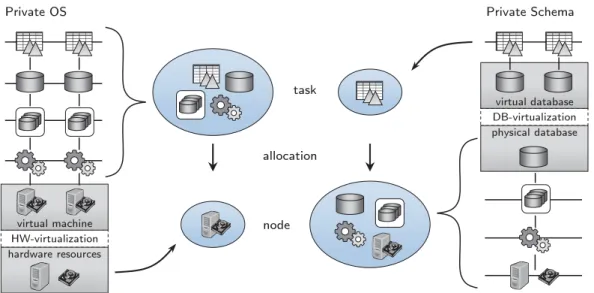
consequently on the portion of the system stack that is shared and the portion that is private. Figure 2.4 exemplarily illustrates what comprises a task and what comprises a node in the Private OS and the Private Schema implementation classes, respectively. In general, layers of the system stack above the virtualized layer belong to the task (and are described in the workload model) whereas layers of the systems stack below the virtualized layer belong to the node (and are hence described in the infrastructure model).
Private OS
With Private OS, hardware is virtualized with the help of virtual machines. Each database application, i.e., each task, comprises the stack from the operating system upward. Hence, for each task the platform has to deploy and maintain an operating system and a database management server with the respective database. This class offers the highest degree of isolation with respect to security, performance, and availability. At the same time, the resource requirements per database are the highest which leads to a rather small number of tasks that can share a single node. Resource usage of each task can be monitored in the database system, in the guest operating system, or by means of the virtual machine monitor.
Private Process
In the Private Process class, the operating system is virtualized. Each task is repre-sented by a database server process and several such processes share the operating system. Since the operating system is only needed once, this class can support a higher number of tasks per node. However, a large number of concurrent pro-cesses may harm the system performance and the individual propro-cesses must request resources responsibly, e.g., only the amount of memory that they actually need.
With private processes, operating system facilities can be used to monitor and isolate certain system resources. The operating system scheduler assigns CPU time
2.1. Data Orientation in Database-as-a-Service Systems HW-virtualization hardware resources virtual machine Private OS DB-virtualization physical database virtual database Private Schema task node allocation
Figure 2.4.: Task and Node Granularity in Database-as-a-Service Systems to the various competing processes and priority levels and sometimes quotas can be used to increase or decrease the share of any process. The main memory is per default not limited by the operating system. Each process can use the same virtual address space. The operating system only takes care of mapping the virtual memory to physical memory and of paging in case of memory shortage.
Lightweight application containers like Docker (Docker, 2015) can be used to further control execution of and increase isolation between the various tasks. Private Database
The third system class shown in Figure 2.3 implements private databases. Here, a single server process hosts a number of private databases, i.e., tasks.
The database management system needs to provision resources and balance loads between different tasks. The different tasks share a database process and hence are usually indistinguishable by the operating system. The only way to isolate the tasks’ performances is by means of managing and isolating DBMS resources. In our experience, buffers (e.g., for pages or sorts) can usually be split and assigned to different databases. Other resources, such as the logging facility, are usually shared and can hence lead to contention.
The detailed isolation options in currently available systems depend on the DBMS implementation and are usually very limited. In the research community, Das et al. (2014) and Narasayya et al. (2013) investigate the problem of performance isolation in shared-process database-as-a-service systems. They present SQLVM, an abstrac-tion for performance isolaabstrac-tion in the DBMS. Furthermore, they implement and test a prototype of SQLVM in Microsoft Azure.
Private Schema
With Private Schema, the database itself is virtualized. Each task can access a virtual database, i.e., a schema, that is mapped to an actual physical database.
ORFDO UHPRWH %DQGZLGWK>*L%V@ /DWHQF\>QV@
(a) 4-Node Machine
ORFDO UHPRWH %DQGZLGWK>*L%V@ /DWHQF\>QV@ %DQGZLGWK /DWHQF\ (b) 8-Node Machine ORFDO UHPRWH %DQGZLGWK>*L%V@ /DWHQF\>QV@ (c) 64-Node Machine Figure 2.5.: Memory Access Benchmark Results
Several schemas can share a single database, which leads to a very low overhead per task (schemas can be added to a database almost indefinitely).
The private schema class is similar to the private database class with respect to the performance isolation characteristics. However, some resources like page buffers may be even harder or impossible to isolate in a shared database.
Shared Schema
In the Shared Schema class, database applications share all layers of the database system stack. The database schema is virtualized such that each task sees a private schema, which is internally mapped to a single system schema (for schema mapping techniques refer to, e.g., Aulbach et al., 2009, 2011).
This class provides the least isolation, because even access structures like indexes are shared. However, the resource overhead per task is the smallest among all classes. This class lends itself to applications where different users share a common (or similar) schema. The loss of any separation of the databases leads to high maintenance costs for operations such as backup or migration.
2.1.3. Summary and Discussion
Concluding this section, there is a variety of possible implementations for database-as-a-service systems. Different characteristics and tradeoffs lead to valid use-cases for all classes. Depending on the implementation, the workload model has to consider different cost factors for a single task. Likewise, the infrastructure model has to analyze the layers of the systems stack that comprise a node. The implementation of the system dictates the infrastructure behavior, e.g., by introducing shared resources that are prone to contention. However, we will show that once the workload and the infrastructure are modeled, the allocation problem remains the same for the abstract data-oriented system that covers all classes.
2.2. Data Orientation in DBMSs for Multiprocessor Systems
2.2. Data Orientation in DBMSs for Multiprocessor Systems
The second category of data-oriented systems considered in this chapter are database management systems for modern multiprocessor systems. Multi-socket-multi-core systems with eight or more sockets and 64 cores are commonly found in data centers. Larger machines exist and the trend points towards even more cores in a single system. However, classic DBMSs face countless challenges with these systems. The software (not being optimized for these systems) contains many critical sections and central data structures that quickly lead to contention and hinder scalability (e.g., Huber and Freytag, 2009; Johnson et al., 2008, 2009; Pandis et al., 2010; Salomie et al., 2011).As a consequence of the high main memory capacities in today’s servers, modern database systems are very often in the position to store their entire data in main memory. Latency and bandwidth of the main memory are the major bottlenecks of such in-memory DBMSs. The significance of these bottlenecks increases with the trend towards tera-scale multiprocessor systems that exhibit non-uniform memory access (NUMA). On NUMA platforms, each multiprocessor has its own local main memory that is accessible by other multiprocessors via a communication network. Database systems running on NUMA platforms face several issues such as the in-creased latency and the dein-creased bandwidth when accessing remote main memory. Our experiments with three NUMA systems of different sizes show that mod-ern database management systems can achieve the highest performance by treating shared-memory NUMA systems like distributed systems. The results in Figure 2.5 show a factor of up to ten for both latency (10x higher) and bandwidth (10x lower) when comparing local to remote memory accesses (the experiment is presented in de-tail in Section 7.1). Understanding sockets as individual nodes, which are connected by a fast network and equipped with dedicated memory controllers, and design-ing for memory locality avoids costly remote memory accesses and yields higher throughputs.
2.2.1. Allocation Problem in DBMSs for Multiprocessor Systems
Database management systems on multiprocessor systems can leverage the data-oriented execution principle to account for the character of the machine as dis-tributed system. Relations are partitioned and partitions together with the opera-tions thereon form tasks. Tasks are mapped to multiprocessors of the machine, i.e., the nodes of the data-oriented system. One way of thinking is to see the storage component in the DBMS as the data-oriented system that offers data containers to the query execution component. Data containers are transparently mapped to actual memory by the allocation strategy. Figure 2.6 sketches data processing on a multiprocessor system depicted as a data-oriented system.
The next section will present various approaches to data management on multi-processor systems with varying degrees of data orientation. It turns out that not all approaches provide the means to enforce locality of data accesses, e.g., some ap-proaches only partition the logical data organization but not the physical data. The allocation strategy is not that significant in these systems because it only affects a small part of the actual processing.
workload (queries) infrastructure data processing system
task multiprocessor (node) virtualized data container
data partition data access operation
… …
allocation strategy
Figure 2.6.: Data Processing on a Multiprocessor System Depicted as Data-Oriented-System RAM threads access data organized in data containers stored in memory belonging to processes
RAM RAM RAM
running in operating systems
Figure 2.7.: Data Access Stack in Database Management Systems
For systems that provide the means for data locality, solving the allocation prob-lem can be used to achieve various objectives. The throughput can be optimized by balancing load and by co-locating tasks that heavily communicate. The power consumption of the system can be optimized, e.g., in low load phases, by using a smaller number of multiprocessors and sending idle multiprocessors to power-saving modes.
2.2.2. Implementation Classes of DBMSs for Multiprocessor Systems
Different approaches have been proposed to deal with the characteristics of modern hardware in database management systems. To our knowledge, there is no classifica-tion of the different systems based on data orientaclassifica-tion. We propose a classificaclassifica-tion based on the abstract data access stack in database management systems shown in Figure 2.7. The classification, shown in Figure 2.8, distinguishes classes based on
2.2. Data Orientation in DBMSs for Multiprocessor Systems partitioned in shared OS processes partitioned in shared process memory partitioned in shared memory data containers partitioned in shared container data access share data threads Shared-Everything Logical Partitioning Physiological/Physical Partitioning Partition Locality Process Partitioning
RAM RAM RAM
RAM RAM RAM RAM
Figure 2.8.: Classification of Data-Oriented Approaches to Modern Hardware the step in the data access stack, where the data or the access is partitioned. For instance, in the second class (Logical Partitioning), the data, more specifically the logical data access, is partitioned. This classification scheme leads to the following five classes:
1. Shared-Everything (Figure 2.8 on the left), 2. Logical Partitioning,
3. Physiological/Physical Partitioning, 4. Partition Locality, and
5. Process Partitioning (Figure 2.8 on the right).
Details about all five classes are presented in the following paragraphs. Shared-Everything
The first class, shared-everything, is not actually data-oriented. However, since there are systems that try to tackle the challenges of modern hardware without data orientation, they are shown for the sake of completeness. In shared-everything systems, parallel transactions (threads) access all data concurrently. The data is not partitioned and accesses are not separated. An example for a shared-everything system is the Shore-MT storage manager by Johnson et al. (2009), a multithreaded advancement of the Shore storage manager. Shore-MT improves scalability by op-timizing locks, latches, and synchronization (critical sections) and thereby reducing contention on storage manager components like the bufferpool manager or the free space and transaction management. Shore-MT does not consider partitioning the data or the access to the data, the memory layout, or memory locality.
The HyPer system by Kemper and Neumann (2011) is a shared-everything in-memory system written from scratch that uses processor-inherent lazy copy-on-write and virtual memory management to support OLTP and parallel OLAP transactions. Multiple read-only queries can be executed at a time, but writing requests are ex-ecuted sequentially to ensure consistency without synchronization. This approach obviates the need for locking and latching of data objects or index structures, an otherwise constant source for contention and bottlenecks. HyPer also considers par-titions of data to increase the possible degree of parallelism. Partition allows for one writer and multiple readers per partition as well as multiple readers (but no writers) in a shared data partition. However, updating transactions that span mul-tiple partitions require exclusive access to the system like in the initial sequential approach.
Logical Partitioning
Systems that use logical partitioning are the second class of systems in our clas-sification, shown second from the left in Figure 2.8. To our knowledge, Pandis et al. (2010) were the first to use the term data-oriented architecture (DORA) in the context of database management systems (we use the same term but under-stand it more generally and for a wider class of systems). The authors argue that the execution of transaction processing contains a high number of critical sections and that database management systems face significant performance and scalability problems on highly-parallel hardware. They further argue that the primary cause of the contention problem are the uncoordinated data accesses that are characteristic for conventional transaction processing systems. Based on these observations they propose to couple each thread with a disjoint subset of the database (thread-to-data assignment, or task in our terminology) instead of the classic coupling of a thread with a transaction. As a consequence, each thread can use a light-weight thread-local locking mechanism and contention on global locking structures is severely reduced. Another consequence of the thread-to-data assignment is that load needs to be bal-anced whenever there is skew in the data or the accesses. Since data is only logically partitioned, i.e., only the access to the data is partitioned and assigned to different threads but the data remains without physical partitioning or alignment, changing the partitioning is a light-weight operation. The authors describe the load balanc-ing mechanism briefly but omit details on the decision makbalanc-ing process that leads to balancing actions. Keeping the data physically unpartitioned does not prevent contention on page latches or false page sharing.
Physiological/Physical Partitioning
In a follow-up paper, Pandis et al. (2011) recognize the problem of the overhead and complexity of page latching protocols as well as of conflicts due to false sharing. As a solution, the authors propose the use of multi-rooted B+Trees as a way to enhance logical partitioning and capture most types of physical data accesses as well. This data organization scheme is called physiological partitioning (PLP) by the authors and systems that follow this approach form the third class in our classification in Figure 2.8. Under PLP, a thread is assigned to a sub-tree root of the multi-rooted
2.2. Data Orientation in DBMSs for Multiprocessor Systems
B+Tree and it is ensured that requests distributed to each thread reference only the corresponding sub-tree. As a result, threads can bypass the partition mapping and their accesses to the subtree are entirely latch-free. At the same time, the underlying multi-rooted B+Tree supports fast repartitioning and does not require distributed transactions when requests span partitions. Together with the partitioning of the access structures (B+Trees), the authors discuss different partitioning strategies for the underlying heap data. The different partitioning strategies lead to different characteristics with respect to access synchronization and balancing costs.
In contrast to the following class, the various partitions in the PLP system are spread out in memory, agnostic to the NUMA characteristics of multiprocessor sys-tems.
Partition Locality
The fourth class in Figure 2.8, Partition Locality, adds memory partitioning and par-tition locality to the already parpar-titioned data containers. The ATraPos system by Porobic et al. (2014) uses logical and physical partitioning and relies on data parti-tioning and placement to maximize locality of data accesses. Adaptive repartiparti-tioning is used to maintain data locality under changing workloads. ATraPos furthermore keeps the system state (e.g., locks and lists of transactions) in hardware-aware data structures that require only socket-local data accesses.
The ERIS system (Kissinger et al., 2014) is an in-memory database management system written from scratch that also belongs in this class. ERIS applies many of the aforementioned principles, e.g., logical partitioning, physical data partitioning, and socket-local data structures. We use ERIS for the experimental evaluation of our allocation strategies and will hence describe it in detail in the corresponding Chapter 7.
Leis et al. (2014) present a NUMA-aware query evaluation framework for the pre-viously mentioned HyPer system. The framework is based on the notion of amorsel,
a partition of data. The size of a morsel is a tuning parameter, experimentally de-termined to be 100,000 tuples in the paper. Tasks, i.e., units of a pipeline job and a particular morsel to execute on, are distributed at runtime based on utilization and locality (favoring locality but allowing work-stealing).
Process Partitioning
Naturally, classic shared-nothing distributed database management systems can also be deployed on multiprocessor systems. Multiple processes with separate address spaces simulate the various nodes of the network and the multiprocessor intercon-nects are used for explicit communication. Process Partitioning systems form the fifth class in Figure 2.8.
Distributed shared-nothing databases have been research topics as early as in the 1980s. It is beyond the scope of this thesis to provide a comprehensive overview of all the results. Dewitt and Gray (1992) make a case for shared-nothing architectures and against database machines back in 1992. The article explains many concepts of parallel databases that are still valid today, e.g., scaleup, speedup, data and pro-cessing skew, pipeline and partition parallelism, range and hash partitioning. The
authors furthermore give an overview of back then state-of-the-art shared nothing database management systems like Teradata, Tandem, Bubba, and Gamma. Despite using the same principles, the emphases and bottlenecks were different when I/O was dominating, main memory was comparably small and networks slow. For instance, the article states that loading a terabyte database would take 12 days and nights at a megabyte-per-second speed. Apers et al. (1992) even propose PRISMA/DB, a dis-tributed main-memory database. Although having a prototype with 100 processing nodes and a combined main memory of 1.6 GiB, the idea was certainly ahead of its
time.
Stonebraker et al. (2007) revisit the idea of shared-nothing database architectures in the context of grids of multi-core systems. The proposed H-Store system deploys an independent instance (i.e., with own indexes, tuple storage, and a disjoint par-tition of the main memory) on each core of the system. The data is parpar-titioned horizontally and transactions are executed single-threaded and sequentially on each core. Hence, there is no synchronization of access like locks or latches to a data par-tition needed. However, depending on the data that is accessed, multiple parpar-titions need to communicate and coordinate distributed transactions.
As multi-socket machines with NUMA characteristics gained popularity, re-searchers played with shared-nothing setups to circumvent remote memory accesses. In Porobic et al. (2012), the authors perform a detailed analysis of different shared-nothing (and shared) deployments in NUMA systems. To show the performance im-pact of the NUMA architecture on a DBMS, they use multiple instances of ShoreMT. We have previously investigated memory access characteristics and cache effects in NUMA systems based on a synthetic benchmark that mimics a database system’s behavior as well as a shared-nothing setup using the MySQL database system (Kiefer et al., 2013).
2.2.3. Summary and Discussion
We showed in this section that many approaches to data management systems on modern multiprocessor systems can be understood as data-oriented systems. We attempted to provide a concise classification for the variety of research prototypes and implemented systems. The classification is based on the step of the access stack where the data access is partitioned and concurrent accesses are isolated. The classification does not fit all systems perfectly, but gives an orientation how the various systems behave. Given the allocation problem, which is the core of this thesis, only systems that provide means for data locality, i.e., systems from the two rightmost classes in Figure 2.8, are good candidates for further investigation. Only when tasks can clearly be separated and assigned to nodes, can the allocation strategy be used to optimize for a given objective. From our experiences and our experiments on NUMA systems, it seems that database management systems that focus on data locality will outperform systems that ignore the physical data layout.
2.3. Physical Design Automation for Data-Oriented Systems
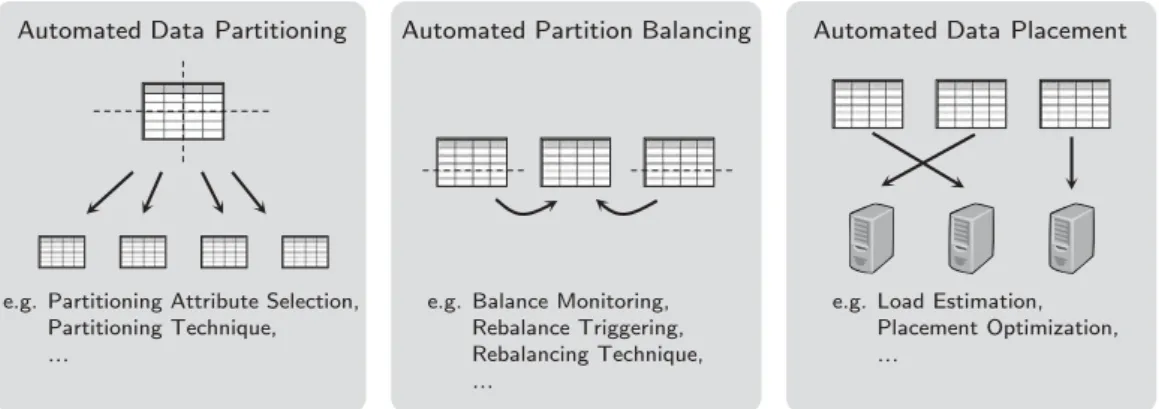
Automated Data Partitioning
e.g. Partitioning Attribute Selection, Partitioning Technique, …
Automated Partition Balancing
e.g. Balance Monitoring, Rebalance Triggering, Rebalancing Technique, …
Automated Data Placement
e.g. Load Estimation, Placement Optimization, …
Figure 2.9.: Physical Design Automation Overview
2.3. Physical Design Automation for Data-Oriented Systems
The physical design of a database traditionally comprises several aspects of its actual setup like the creation of indexes or materialized views. In the context of distributed databases, the partitioning of relations and the placement of partitions, hence the allocation, also belong to the physical design. The physical database design greatly influences application performance as it is commonly a tradeoff between performance and storage or maintenance overhead. Also, favoring certain queries in the expected workload over others is a tradeoff to be made by the physical design. Hence, auto-mated or assisted tuning of the physical database design has been a vast research area for decades.Classic advisors recommend indexes and materialized view (e.g., Agrawal et al., 2000; Zilio, 1997). These advisors frequently use the database system’s query opti-mizer and the underlying cost model in a so-calledwhat-if modewhere query
execu-tion costs are estimated without the need to physically deploy the setup. Together with an algorithm that searches the solution space, the optimizer’s estimations can help to find beneficial indexes and materialized views. Index advisors are used at design time (or in certain intervals) and need the expected query workload as input. Like all workload-based design advisors, index advisors assume that the expected workload is known or that a trace can be collected that resembles the actual work-load well enough.
Regarding distributed databases, two aspects of the physical design are especially important. First,partitioningdecides how to split up data. In the field of automated
data partitioning, we further distinguish betweenpartition advisorsthat are used at
design time with an expected workload and partition balancers which react to the
actual workload at runtime and try to adapt the partitioning accordingly. Second,
placement decides where to put each partition and consequently the partitions that
are co-located.
Many researchers investigate both aspects, partitioning and placement, but focus on one in particular. Some articles that investigate partitioning also cover placement, often with simplifying assumptions like: (1) always spread data to all nodes, (2) load from different partitions adds up linearly, (3) nodes are all equal, or (4) the network is homogeneous and fully connected. Other works assume the partitioning to be
fixed and only investigate the placement. We point out related work that focuses on the aspects of partitioning and partition placement in the subsequent sections. Figure 2.9 shows the different problems addressed by physical design automation in distributed database management systems. Furthermore, the figure highlights some challenges in each area.
2.3.1. Automated Data Partitioning
The framework of using the query optimizer’s cost estimates without physically deploying the setup has been extended to propose data partitioning schemes as well. Zilio et al. (1994) use a simple heuristic to select partitioning keys: attributes that have the highest weight based on operation type and frequency in the workload (e.g., a join has a higher weight than a group-by). An extension of the algorithm considers the top ranked partitioning key candidates and exhaustively probes all combinations against the optimizer to find the best partition keys. The first author of the paper later substantially extends the algorithms and also considers concurrent reorganization in his thesis (Zilio, 1997).
First to solely use the cost model of the optimizer, as opposed to heuristics or a separate cost model, were Rao et al. (2002). Based on a given workload of SQL statements, the authors seek to determine how to partition the base data across mul-tiple nodes in a shared-nothing parallel database management system. A rank-based enumeration method is used to find candidate solutions and so-calledinteresting par-titionings are considered, i.e., partitionings that are not optimal for certain queries
but benefit the global cost. Replication of tables is not considered by the authors. Agrawal et al. (2004) extended the idea to incorporate vertical and horizontal partitioning into automated physical database design. The authors propose an inte-grated solution to partitioning, indexes, and materialized views again based on the expected SQL workload and costs estimated by the optimizer. A similar approach was proposed by Zilio et al. (2004), a continuation of the author’s previous work.
A more recent approach by Nehme and Bruno (2011) considers partitioning and replication of tables. Given a database, a query workload, and a storage bound, the authors’ method tries to find a partitioning strategy such that the size of replicated tables does not exceed the storage bounds and the overall cost for the workload is minimized. Unlike previous approaches, this algorithm is deeply integrated in the query optimizer to improve the search for candidate solutions, e.g., by early pruning of partial configurations.
A slightly different approach by Pavlo et al. (2012) is based on a separate analytical cost model and large neighborhood search to explore the solution space. The au-thors try to minimize distributed transactions in the shared-nothing system H-Store while mitigating effects of temporal skew. The developed tool, Horticulture, con-siders horizontal partitioning, replication, replicated secondary indexes, and stored procedure routing. The authors specifically target OLTP workload and make strong assumptions on the database schema and workload, e.g., a hierarchical schema.
A project called Schism by Curino et al. (2010) aims at minimizing the number of distributed transactions by assigning each tuple individually to a partition such that the number of transactions that span multiple partitions is minimized. The
2.3. Physical Design Automation for Data-Oriented Systems
authors use graph partitioning techniques to come up with an assignment of tuples to partitions based on the workload, which is modeled as a graph. The idea of modeling the workload as a graph and using graph partitioning algorithms to find a partitioning is picked up by Kumar et al. (2013, 2014) in the SWORD project. Both Schism and SWORD will be revisited in Section 3.5 where we present an in-depth analysis of closely related approaches to the allocation problem for data-oriented architectures.
2.3.2. Automated Partition Balancing
Partition balancers are based on the simplifying assumption that balancing load across all partitions leads to the best physical setup. Unlike partitioning advisors, balancers try to improve the partitioning at runtime. Partition balancers can be used with any initial partitioning to eventually find a balanced partitioning. Furthermore, partition balancers can naturally react to changing workloads. The main challenges are (1) to monitor the system behavior with minimal impact on performance to be able to detect imbalances and (2) to quickly react to imbalances with (ideally incremental) new partitioning rules.
Early work on load balancing in shared-nothing database systems, e.g., by Rahm and Marek (1993), assumes that in parallel join processing, relations would by dy-namically redistributed to the actual join processors. Based on the current CPU utilization and a cost model, the number of join processors as well as the active join processors are selected dynamically.
Scheuermann et al. (1998) investigate load balancing in shared memory parallel disk systems. The authors introduce a notion ofdisk heatbased on inter-arrival times
of requests. An online greedy heuristic tries to dynamically balance load (referred to as disk cooling) by migrating data away from the hottest disks. The migration
mechanism is invoked at fixed intervals and only if certain conditions are met. The abovementioned ATraPos system (Porobic et al., 2014) dynamically re-partitions data to balance resource utilization while minimizing transaction syn-chronization overhead. Based on monitored metrics, e.g., costs for actions on sub-partitions, and a cost model, an iterative algorithm tries to improve the partitioning by moving work to the most under-utilized core. ATraPos uses thread-local moni-toring data structures and eventual global aggregation to reduce the impact of the monitoring on performance. Once a set of repartition actions, i.e., split or merge, is found, the regular executions is paused to migrate the data. The balancing algorithm is invoked at flexible intervals, depending on the characteristics of the workload.
The morsel-driven query evaluation framework introduced before (Leis et al., 2014) does not balance the partitioning in the classic sense by invoking a separate balancing algorithm. Instead, each worker is able to steal work from other sockets in the absence of local tasks. By writing results to local memory, a worker that steals work implicitly changes the partitioning of the data. A lock-free meta data structure, i.e., a list of available and executable tasks (referred to as dispatcher in
the paper), is maintained and used by workers to determine the next task to execute and hence the next data partition to work on.
2.3.3. Automated Data Placement
Besides data partitioning, data placement is the second big challenge in distributed databases. Once data is split into a given number of partitions, each of the partitions needs to be assigned to a node in the system. A simplification of the problem is to assume equal nodes and a homogeneous topology. Then, the problem is reduced to building as many subsets of partitions as there are nodes.
Mehta and Dewitt (1997) analyze data placement in shared-nothing parallel database systems. The authors state that in the absence of remote access, the data placement determines the distribution of data and the corresponding operators. The paper considers declustering to balance load across the nodes of the shared-nothing system. A method, based on simulations of the DBMS as closed queuing system, is presented to determine the degree of declustering and the subset of nodes to store the data. The quality of the method depends on the ability to model the DBMS and the underlying hardware and the accuracy of the simulator.
Schaffner et al. (2013) propose the Robust Tenant Placement (RTP) problem that assigns tenants to nodes in a multi-tenancy database-as-a-service system. The RTP and the methods used to solve it will be revisited in Section 3.5.
Curino et al., 2011 investigate workload-aware database consolidation. The psented Kairos system consolidates databases based on the predicted combined re-source utilization. The Kairos system will also be revisited in Section 3.5.
2.4. Summary
In this chapter, we presented foundations of data-oriented systems. We introduced two application scenarios, database-as-a-serviceand DBMSs for multiprocessor sys-tems, that use data-oriented systems. Classifications of systems, based on the extent
of data locality and the proportion of private and shared resources, were proposed in both scenarios. Different characteristics and tradeoffs of the various different imple-mentations lead to valid use-cases for all classes. Depending on the implementation, the workload model has to consider different cost factors for a single task. Likewise, the infrastructure model has to analyze the layers of the systems stack that comprise a node. We will show in the next chapter that all systems can use a unified alloca-tion strategy once the workload and the infrastructure of the data-oriented systems are abstracted in the corresponding models.
Second in this chapter, we recapitulated related work in the field of physical design automation in distributed database management systems. Approaches to automatic data partitioning, partition balancing, and partition placement are important foun-dations to better understand the allocation problem in data-oriented systems.
In the next chapter, we present the allocation problem for data-oriented systems. We first abstract from specific data-oriented systems to generic infrastructures and workloads and then formulate the actual allocation problem.
3. Allocation Problem for Data-Oriented
Systems
In this chapter, we introduce the allocation problem for data-oriented systems. We showed in the previous chapter that a wide variety of actual systems with different characteristics implement data-oriented architectures. The allocation strategy to solve the allocation problem in this thesis is applicable to data-oriented systems in general. However, to use the allocation strategy, specific data-oriented systems have to be generalized to an abstract data-oriented system. The abstract system is a common denominator of all data-oriented systems and acts as an interface to the actual allocation strategy. Figure 3.1 sketches the generalization of a (class of) database-as-a-service system(s) to the abstract data-oriented system. The hardware resources of the system are collected in theinfrastructure. The infrastructure model,
detailed in Section 3.1, describes system abstractions and necessary information to derive from the actual system. The applications that run in the database-as-a-service system are collected in the workload. The workload model in Section 3.2
details how to describe a workload and provides hints on how to obtain the workload. Since actual data-oriented systems differ greatly, methods to obtain workload and infrastructure information for a given system have to be provided by domain experts. Given the infrastructure and workload information, the allocation problem it-self is formalized and variations thereof are discussed in Section 3.3. In general, the allocation problem is to find a mapping from workload tasks to infrastructure nodes. Assuming that there are considerably more tasks than nodes, several tasks share nodes and the mapping determines the overall system performance as well as other system properties. Consequently, the allocation strategy, which provides that mapping, is used to optimize the system. Different objectives, e.g., performance or resource consumption, and corresponding constraints, e.g., given resources or per-formance guarantees but also availability, maintainability, or isolation, are discussed in Section 3.3.
In the simplest case, the workload is static and the infrastructure is fixed. In this case, the allocation strategy can be used to find a mapping at compile time (offline) that is once implemented and never changed. When the workload or the infrastructure change dynamically, the allocation strategy has to adapt the mapping at runtime (online) to compensate for the changes. In this thesis, we assume dynamic workloads and infrastructures1 and our allocation strategy is able to incrementally update a mapping.
1
In our models, workload and infrastructure are constant for (possibly short) intervals of time and may change between these intervals. This approach differs from, e.g., modeling the workload as a continuous time series.
HW-virtualization hardware resources virtual machine Private OS task node workload information (tasks) infrastructure information (nodes) execution platform workload model (Section 3.2) infrastructure model (Section 3.1)
specific data-oriented system abstract data-oriented system allocation problem, objective, constraints (Section 3.3) allocation layer/strategy …
Figure 3.1.: Abstracting a Specific Data-Oriented System
Data Partitioning Problem The allocation problem takes workload tasks and as-signs them to infrastructure nodes. Another problem, the data partitioning prob-lem, is closely related to the allocation problem and sometimes the two problems
are treated together. The data partitioning problem is to decide whether or not and into how many pieces to partition a database object. Depending on the specific data-oriented system, this may include the selection of partition keys, key ranges, or individual tuple-to-partition mappings. In this thesis, we mostly assume that the data partitioning problem is solved separately before the workload is abstracted in the workload model. However, we briefly discuss the data partitioning problem here and again later in this chapter to highlight the correlation to and the interactions with the allocation problem.
Both, the data partitioning problem and the allocation problem are loosely con-nected because decisions made in solving one problem may influence the solution of the other problem. If, for instance, a relation is partitioned into many small pieces, each piece may fit on a processing node that is too small to hold the entire parti-tion. Therefore, the solution space for the allocation problem changes. The other way around, assigning a relation to a node with very limited scan performance may encourage the partitioning algorithm to split the relation and scan it in parallel.
The data partitioning problem has been of interest ever since the first partitioned databases were available (e.g., Ries and Epstein, 1978). Aspects to consider in the solution are the size of the relations and the capacities of the nodes, i.e., relations that do not fit on a single node always have to be partitioned. When partitioning is optional, it is a tradeoff between costs induced by communication and distributed protocol overhead and gains caused by the use of additional resources. Depending on the workload it may be beneficial to decluster, i.e., spread out, a relation to utilize the combined bandwidth of several nodes in a large scan operation. When relations