Towards Accountable Systems
Edited by
David Eyers
1, Christopher Millard
2, Margo Seltzer
3, and
Jatinder Singh
41 University of Otago, NZ,[email protected]
2 Queen Mary University of London, GB, [email protected]
3 Harvard University – Cambridge, US, [email protected]
4 University of Cambridge, GB,[email protected]
Abstract
This report documents the program and the outcomes of Dagstuhl Seminar 18181 “Towards Accountable Systems”, which took place from April 29th to May 4th, 2018, at Schloss Dagstuhl – Leibniz Center for Informatics. Researchers and practitioners from academia and industry were brought together covering broad fields from computer and information science, public policy and law.
Many risks and opportunities were discussed that relate to the alignment of systems techno-logies with developing legal and regulatory requirements and evolving user expectations.
This report summarises outcomes of the seminar by highlighting key future research directions and challenges that lie on the path to developing systems that better align with accountability concerns.
Seminar April 29–May 4, 2018 – http://www.dagstuhl.de/18181
2012 ACM Subject Classification Applied computing→Law, Computer systems organization → Cloud computing, Security and privacy, Social and professional topics→ Governmental
regulations,Social and professional topics→Technology audits
Keywords and phrases accountability, compliance, audit, systems, engineering, cloud computing,
internet of things, law, regulation, GDPR, security, privacy, data provenance
Digital Object Identifier 10.4230/DagRep.8.4.126 Edited in cooperation with Jennifer Cobbe
1
Executive Summary
David Eyers (University of Otago, NZ)
Christopher Millard (Queen Mary University of London, GB) Margo Seltzer (Harvard University – Cambridge, US)
Jatinder Singh (University of Cambridge, GB)
License Creative Commons BY 3.0 Unported license
© David Eyers, Christopher Millard, Margo Seltzer, and Jatinder Singh
Background and Motivation
Technology is becoming increasingly pervasive, impacting all aspects of everyday life. Our use of apps and online services is tracked and extensively processed (data analytics), and the results are used for various purposes, predominately advertising. Monitoring and surveillance by sensors in smart cities creates vast amounts of data, much of which can be identifiably linked with people. Smart home, health and lifestyle monitoring, and other sensor technologies yield sensitive personal data; mobile phones reveal people’s positions, and their calls are
Except where otherwise noted, content of this report is licensed under a Creative Commons BY 3.0 Unported license
Towards Accountable Systems,Dagstuhl Reports, Vol. 8, Issue 04, pp. 126–163 Editors: David Eyers, Christopher Millard, Margo Seltzer, and Jatinder Singh
Dagstuhl Reports
tracked leading to data that can be used to determine social linkages and sometimes mental wellbeing. Such collection and analysis of personal data raises serious privacy concerns. A key aspiration is to provide end-users with a means to understand their digital footprints, and control the propagation, aggregation and retention of their data.
Concerns over data movement, location, processing and access have led to increasing regulation, both national and international. An example is the recently adopted EU General Data Protection Regulation (GDPR) that reinforces and expands individual rights, as well as restrictions and obligations regarding personal data. However, data moves easily beyond geographical boundaries, and use of cloud computing resources may mean that stored data may be replicated in multiple locations worldwide, with potential for conflicts between applicable laws and jurisdictions. Governments may demand access to data (whether stored locally or remotely) and this may result in complex legal disputes. Regulations, codes of conduct, and best practices can incentivise the use of particular technical mechanisms for data management. Examples include encryption and anonymisation, for example when using medical data for research. However, there are often misalignments between legal/regulatory aims and the capabilities of the technologies.
Key issues concern how to demonstrate compliance with regulations, such as those regarding how data is handled and used, and, in cases of failure, how to hold the appropriate entities accountable. This is a particular challenge for wide-scale, federated, or cross-border systems. In large or complex systems, data may be handled by many different parties, falling under various management regimes and jurisdictions. Such concerns are not only horizontal (e.g., data being exchanged between parties, across geographic regions) but also vertical, where different levels of the services stack are managed by different parties (e.g., a company application running over a Heroku PaaS that runs over Amazon IaaS). Most end-users (people!) are oblivious to the potential complexity of such systems, let alone the complexity of the legal requirements that underpin such architectures. In general, the lack of transparency and uncertainty about the means for compliance with legal obligations, along with a lack of technical means for managing such concerns, may inhibit innovative technology development (a “chilling factor”), may escalate compliance costs, may trigger inappropriate policy responses, and may work to undermine public trust in technology.
These concerns will only grow in prominence, given the increasing deployment of sensors, generating ever-more data; actuators, giving systems physical effects; and the use of machine learning, facilitating automation. In response, this seminar brought together experts from the computer science and legal communities, spanning academia and industry, to explore issues of accountability as it relates to data and systems. The seminar aimed to: (i) raise awareness of and establish new research directions concerning issues of accountability as they relate to systems, given directions in systems technologies; (ii) explore developing legal and regulatory requirements; and (iii) investigate issues of user empowerment. A key goal was to increase awareness that law, regulation and requirements for data usage, management, security, confidentiality, quality and provenance should align with the technology, andvice versa: technologists should be legally-aware and lawyers should be technology-aware.
Seminar Structure
Due to the diverse backgrounds of the participants, the first day was focused on introductions and ensuring that everyone had a common grounding in key topics. This included a series of guided discussion sessions: Lilian Edwards provided an introduction to legal and regulatory considerations, particularly the European Union General Data Protection Regulation (GDPR); Jon Crowcroft introduced emerging technical architectures such as edge computing; Bertram
Ludäscher led a session exploring data provenance; and Ben Wagner introduced broader ethical and social concerns. A motivating case study was also presented highlighting how an apparently enthusiastic view of emerging Internet of Things technologies might obscure a plethora of questionable social and policy implications.
The structure of the week included multiple breakout sessions in which working groups examined particular topics (below) and reported back summaries of their discussions at plenary sessions. The working group sessions were interspersed with an interactive case study session, that focused on the technological compliance concerns of a hypothetical global hotel chain seeking to introduce a series of IoT and cloud technologies in the current regulatory environment, and a session in which participants were able to present their recent research, abstracts for (most of) which are included in this report.
Moving forward
The topics explored by the working groups at the seminar spanned policy, legal and technical considerations. The topics were seeded by the organisers but were ultimately gathered from the participants through a preference allocation process. The chosen topics included:
Trust in systems.
Who is, could or should be accountable in complex systems? Engineering accountable systems.
Is there a place for data provenance in accountable systems? Anonymity, identity and accountability.
Thinking beyond consent.
Automating the exercising of rights for collective oversight.
Each group was asked to produce an abstract summarising the key issues, challenges and ways forward from the discussion. These abstracts are included in this report, and indicate many potential opportunities for research.
Generally, it was felt that this seminar represented only the start of this important discussion. It is clear that there is a substantial and urgent need for closer interactions between
the technical and legal domains, such that (i) the computer science communities better understand the legal requirements and constraints that impact the design, implementation and deployment of technology; and (ii) the legal communities gain more of a grounding in the nature, capabilities, and potential of the technology itself. It was also recognised that there is potential for better collaboration amongst different computer science communities; for example, to have greater interactions between those working in systems, provenance and machine learning.
In light of this, key to moving forward is to work to form collaborative research proposals, and to organise relevant meetings, in order to drive progress on the topics, challenges and research opportunities identified during this seminar. As issues of accountability increase in importance and urgency, it is vital that researchers across academia, industry and civil society work together to proactively confront these challenges.
2
Table of Contents
Executive SummaryDavid Eyers, Christopher Millard, Margo Seltzer, and Jatinder Singh. . . 126 Working groups
Trust in Systems
Jennifer Cobbe, Jon Crowcroft, David Eyers, Krishna P. Gummadi, Joshua A. Kroll, Derek McAuley, Michael Veale, and Michael Winikoff . . . 131
Who is Accountable?
Ben Wagner, Virgilio Almeida, Tristan Henderson, Heleen Louise Janssen, Chris-topher Millard, and Barbara Staudt Lerner. . . 132
Engineering Accountable Systems
Martin Henze, Virgilio Almeida, Jean Bacon, Melanie Herschel, Maximilian Ott, Frank Pallas, Thomas Pasquier, Silvia Puglisi, Margo Seltzer, Michael Winikoff, and Martina Zitterbart . . . 137
Provenance for Accountable Systems
Lilian Edwards, Melanie Herschel, Bertram Ludäscher, Ken Moody, Thomas Pasquier, and Jatinder Singh . . . 141
Anonymity, Identity and Accountability
Jean Bacon, Heleen Louise Janssen, Joshua A. Kroll, Silvia Puglisi, Jatinder Singh, and Martina Zitterbart . . . 144
Post-Consent
Jennifer Cobbe, Martin Henze, Bertram Ludäscher, Ken Moody, Maximilian Ott, and Margo Seltzer . . . 147
Automating Data Rights
Michael Veale, Lilian Edwards, David Eyers, Tristan Henderson, Christopher Mil-lard, and Barbara Staudt Lerner. . . 149 Overview of Talks
Tutorial–Cloudy with a hint of accountability
Jon Crowcroft . . . 156
Tutorial–ML : transparency, control, user rights and the GDPR
Lilian Edwards . . . 156
Tutorial–A Brief Introduction to Provenance in Workflows and Databases
Bertram Ludäscher . . . 157
Tutorial–Ethical/social: Rights, Ethics and Accountability
Ben Wagner. . . 157
Raising Users’ Awareness for their Exposure to Cloud Services
Martin Henze . . . 158
Purpose-driven provenance solutions
Melanie Herschel . . . 159
Accountable systems. Some practical experiences from a governmental perspective.
Establishing Requirements for Accountable Systems: The Case of Elections
Joshua A. Kroll . . . 160
Confidential Analytics – Use Cases and Building Blocks
Maximilian Ott . . . 161
Accountable systems, messy environments
Michael Veale . . . 161
Trust, Responsibility, and Explanation
Michael Winikoff . . . 162 Participants. . . 163
3
Working groups
3.1
Trust in Systems
Jennifer Cobbe (University of Cambridge, GB), Jon Crowcroft (University of Cambridge, GB), David Eyers (University of Otago, NZ), Krishna P. Gummadi (MPI-SWS – Saarbrücken, DE), Joshua A. Kroll (University of California – Berkeley, US), Derek McAuley (University of Nottingham, GB), Michael Veale (University College London, GB), and Michael Winikoff (University of Otago, NZ)
License Creative Commons BY 3.0 Unported license
© Jennifer Cobbe, Jon Crowcroft, David Eyers, Krishna P. Gummadi, Joshua A. Kroll, Derek McAuley, Michael Veale, and Michael Winikoff
At the outset the group noted the difficulty of defining trust, acknowledging that it means very different things in different contexts. It was noted that this is an inherently interdisciplinary area, and, with participants being from computer science and law backgrounds, it was felt that a proper study of trust in systems would benefit from the input of others from disciplines such as philosophy, psychology, and sociology. It was also noted that there may be circumstances in which distrust (which may not necessarily result in not using a system) is more appropriate than trust. However, trust was generally recognised as being the “beliefs/faith you need to have about the things that you cannot verify”, and the group eventually settled on trust in this context as involving “confidence in the behaviour of a system”.
Various factors which affect trust/distrust were identified. Social factors may affect which individuals, organisations, and systems are trusted. It was acknowledged that well-developed and properly-enforced regulatory frameworks can help engender trust. People often also rely on mental models and folk theories; this has been shown, for example, in relation to social media feeds, with people becoming upset when their theories fail [1][2]. Contextual factors were also felt to be important, given that the consequences of a system failure can be very different for different people–for example, a robot tripping up an elderly person may be a much bigger problem than if it was someone younger. Cultural factors are also important; concepts of privacy, for example, differ between geographies, communities, and demographics. Finally, it was noted that infrastructure, including security infrastructure, plays a role in engendering trust.
The group moved on to discuss technological features which could be engineered into systems to assist trustworthiness. Predictability, reliability, and repeatability were felt to help manage user expectations of their interactions with systems, as trust may result where systems behave as expected. While transparency was generally felt to be a useful means of improving trustworthiness, it was acknowledged that there are unresolved questions over the extent to which it is useful and over what kind of information should be exposed. Safety marks were considered, but the difficulty of verifying software poses a problem. Engineering for security and privacy were also considered to be important factors in developing trustworthy systems. Finally, giving users control was considered to be an important feature of trust, as it was felt that users may lose trust when a system is beyond their control.
Following this discussion, the case study selected was that of a voice-controlled robotic vacuum cleaner. This interacts in a complex way with its environment, and use of such a device requires trust in the robot, trust in the organisation who makes the robot, and trust in the infrastructure involved in the robot. It was felt important that it would do what was expected, but also that it would not do anything unexpected (it should work when turned on, should stop when it is turned off, etc.). It should take context into account so
as to be unobtrusive and safe, could refuse to take actions which would be unsafe, and the consequences of failure should be considered and mitigated so far as possible so as to avoid harm when faults occur. Given that the robot would be voice-controlled, it should be clear about when it is listening and when it isn’t, and a clear off switch for the microphone should be available. The organisation who makes the robot should not retrospectively decide to sell user data from devices which were sold on the basis that this would not occur. The group also considered that a button which would explain why the robot had taken an action would help engender trust in its decisions.
In terms of next steps, it was felt that there was a need for significant research in this area, including on what trust means in different contexts, on what factors affect trust and distrust, and on what technical approaches could potentially engender trust so as to help engineer trustworthy systems. It was felt that there was a need for a toolkit which would help people assess their own interpretation of trust and trustworthiness. The group agreed that it was important that trustworthy components or features not be hoarded commercially, to avoid the development of an industry that is paid by the existence of the problem. Finally, the group concluded that it was important to avoid having to repeatedly start this work from scratch–there is a need for work to be done on developing a knowledge base which can be compositional in terms of concerns, intentions, solutions, and so on.
References
1 Motahhare Eslami, Karrie Karahalios, Christian Sandvig, Kristen Vaccaro, Aimee
Rick-man, Kevin Hamilton, Alex Kirlik, 2016,First I “like” it, then I hide it: Folk theories of social feeds, CHI 2016 – Proceedings, 34th Annual CHI Conference on Human Factors in Computing Systems
2 Taina Bucher, 2017The algorithmic imaginary: exploring the ordinary affects of Facebook algorithms, Information, Communication and Society, 20(1), pp.30–44
3.2
Who is Accountable?
Ben Wagner (Wirtschaftsuniversität Wien, AT), Virgilio Almeida (Federal University of Mi-nas Gerais-Belo Horizonte, BR), Tristan Henderson (University of St Andrews, GB), Heleen Louise Janssen (Ministry of the Interior and Kingdom Relations, NL), Christopher Millard (Queen Mary University of London, GB), and Barbara Staudt Lerner (Mount Holyoke College – South Hadley, US)
License Creative Commons BY 3.0 Unported license
© Ben Wagner, Virgilio Almeida, Tristan Henderson, Heleen Louise Janssen, Christopher Millard, and Barbara Staudt Lerner
Who is or could or should be accountable / responsible in complex systems?
3.2.1 Identify specific issues that more precisely describe it in a specific use case
Specific use case: a connected camera used in a smart home. The camera is used to
open the door (for example, to delivery persons) based on facial recognition.
Which actorscould or should be accountable for the camera?
1.Educators of designers and the public
2.Research ethics boards (in academia and industry) 3.Standards bodies
4.Regulators, including Data Protection Authorities (DPAs)–acting in determining norms 5.Designers
6.Manufacturers of hardware 7.Developers of software 8.Cloud Service Providers 9.Connectivity providers 10.Social media platforms 11.Installers
12.End-users
13.Regulators, including DPAs–acting in an enforcement capacity 14.Courts
Whyare or should these actors be accountable?
Knowledge Control Proximity
At what stage in the processing do they become accountable and how can they be
made more accountable and responsible?
Ex ante: before the product design phase starts
Production: during the design, development, installation and deployment of the product
Ex post: after the product has been deployed
These actors are considered accountable because of their knowledge of systems in operation, because of proximity to the system and (at least a certain amount of) control at a certain moment in processing.
3.2.2 Propose mechanisms to address the issue (tech-soc-reg, etc.).
Under what conditions could or should these actors be held accountable and at what stages? To identify mechanisms that could be used to address the issue who is or could or should be accountable / responsible in complex systems, we discussed a variety of different actors in the home camera use case and how they might be made more accountable:
1. The home owner or occupier could be held responsible for ensuring the camera does not
cover public spaces.
2. The designer or developer could be held responsible for non-automated opening of the
door.
3. The system integrator could be held responsible for operation of the system.
4. The Software as a Service (SaaS) provider could be held responsible for the cloud service
(e.g., facial recognition or authentication).
5. The camera designer could be held accountable and incentivised to conduct an ethical
impact assessment.
6. The retailer (e.g., a department store such as John Lewis, or even Amazon Marketplace?)
could be held accountable for bringing the product to market.
⇒ All individual solutions can create greater accountability of the system
1. The home owner or occupier could be made responsible for ensuring the camera does not cover public spaces.
Ex ante
education, e.g. domestic science teaching in schools could include how to maintain a smart home
Production
proper installation procedures could prevent the house owner from mis-installing additional information about obligations and potential for misuse provided to home owner (e.g. through the set-up interface or a manual)
a big red sticker / smartphone interface informing users that they need to set up the device correctly (e.g., “DO NOT CONNECT THIS DEVICE TO THE INTERNET UNTIL YOU HAVE SET A NEW PASSWORD”)
Ex post
liability for privacy violation in a public space (cf. Ryneš case)
2. Designer or Developer could be made responsible for non-automated opening of the door.
Ex ante:
engineering training/education to think about challenges of automation Production:
information provided in UX during the set-up scheme default set to non-automation
Ex post:
product recall for unfixable product
litigation and enforcement action by regulators
3. System integrator could be made responsible for operation of the system. Ex ante:
a clear specification that conforms to all relevant state of art standards (ethical system design, ISO, IEEE)
Production:
update the system
keep users informed about problems/vulnerability and proper usage
employ user-centric design and extensive testing of system in controlled environment do not collect data that are not needed (data minimization, select while you collect) obtain user feedback and update product accordingly
Ex post:
professional standards developed further based on reports of system integrator DPO reports of system integrator shared
4. Software as a Service provider could be made responsible for the cloud ser-vice.
Ex ante:
responsible for security of supply chain cloud standards certification (ISO, CSA) Production:
authentication and access controls
SaaS providers monitor for security vulnerabilities and notify home owners (push for competitive advantage, market power)
Ex post:
breach notification if SaaS leaks data
could be forced to do product recall if product cannot be updated or fixed
5. Camera designer could be accountable and conduct an ethical impact assess-ment.
Ex ante:
camera designer follows a relevant code of conduct for software developers
designer conducts an ethical impact assessment to assess risks and document them Production:
check that they are following the actions that were determined in the impact assessment
update impact assessment based on process of development
Ex post
self-motivated reasons to be ethical
market pressure to be ethical (e.g. offering a trustworthy/accountable product as a competitive advantage)
6. Point of sales person (a department store such as John Lewis, or even Amazon Marketplace?) could be accountable for bringing product into market.
Ex ante:
training for staff
sourcing appropriate products (don’t sell insecure products) know your supply chain and take responsibility for vendors Production:
follow-up information to customer to ensure ethical usage of product and provide support in doing so
deploy an ethical chatbot
Ex post
product recall if it becomes insecure and cannot be patched provide lifetime warranty for product and insurance mechanism
provide support for customers if they have subsequent problems (e.g. unable to update device)
3.2.3 Evaluate the efficacy of the mechanisms proposed / mapping the complexity:
Potentially contentious issues include:
Large number of actors–who can be held accountable: designer/toolmakers–people having more knowledge about bottleneck problems?
Reasonableness of assigning responsibility to tool makers (e.g. maker of motion detector sensor that is incorporated into the camera)
Dual/multiple use challenge
Non-legal versus legal mechanisms (What carrots or sticks might be needed to make non-legal mechanisms effective?)
A conflict between legal norms and ethical frameworks may arise. How paternalistic should systems be to be effective?
3.2.4 Next steps, research directions, gaps in current knowledge
Research directions:
Are current and proposed impact assessment mechanisms (e.g. GDPR Art 35 DPIA, AINow Algorithmic Impact Assessments) suitable for use by all of the actors in the system?
Could there be certifications associated with the technology, and what organisation would do those certifications? For example, certification assuring that all data are encrypted. It might be beneficial to have standard APIs to support integration of IoT devices. For example, how to control a lock. Who should define those? Can there be some certification about whether a device satisfies those interfaces?
What makes an actor accountable, e.g. are knowledge, proximity and control the most appropriate benchmarks to determine accountability? Can accountability vary/change in the process of operation? How does this relate to the role of the data controller in the GDPR, and to legal liability?
References
1 Opinion 3/2010 on the principle of accountability, Data Protection Working Party Article
29 (adopted on 13 July 2010)
2 Opinion 1/2010 on the concepts of “controller” and “processor”, Data Protection Working
Party Article 29 (adopted on 16 February 2010)
3 A. Crabtree, T. Lodge, J. Colley, C. Greenhalgh, K. Glover, H. Haddadi, Y. Amar,
R, Mortier, J. Moore, L. Wang, P. Yadav, J. Zhao, A. Browns, L. Urquharts and D. McAuley. Building Accountability into the Internet of Things: The IoT Data Box Model, in: Journal of Reliable Intelligent Environments (2018) 4, p. 39–55. See
https://link.springer.com/content/pdf/10.1007%2Fs40860-018-0054-5.pdf.
4 R.H. Weber, Accountability in the Internet of Things, in: Computer Law and Security Review (2011), Volume 27, Issue 2, April 2011, Pages 133–138.
ht-tps://doi.org/10.1016/j.clsr.2011.01.005.
5 L. Urquhart, T. Lodge and A. Crabtree, Demonstrably doing accountability in the In-ternet of Things, School of Computer Science, University of Nottingham, UK. See
ht-tps://arxiv.org/pdf/1801.07168.pdf.
6 W. Kuan Hon, E. Kosta, C. Millard and D. Stefanatou,Cloud Accountability: The Likely Impact of the Proposed EU Data Protection Regulation, Queen Mary School of Law Legal
Studies Research Paper No. 172/2014; Tilburg Law School Research Paper No 07/2014. See https://papers.ssrn.com/sol3/papers.cfm?abstract_id=2405971
7 W. Kuan Hon, C. Millard and J. Singh, Twenty Legal Considerations for Clouds of Things (January 4, 2016). Queen Mary School of Law Legal Studies
Re-search Paper No. 216/2016. Available at SSRN: https://ssrn.com/abstract=2716966 or http://dx.doi.org/10.2139/ssrn.2716966.
3.3
Engineering Accountable Systems
Martin Henze (RWTH Aachen, DE), Virgilio Almeida (Federal University of Minas Gerais-Belo Horizonte, BR), Jean Bacon (University of Cambridge, GB), Melanie Herschel (Uni-versität Stuttgart, DE), Maximilian Ott (CSIRO – Alexandria, AU), Frank Pallas (TU Berlin, DE), Thomas Pasquier (University of Cambridge, GB), Silvia Puglisi (The Tor Project – Seattle, US), Margo Seltzer (Harvard University – Cambridge, US), Michael Winikoff (Uni-versity of Otago, NZ), and Martina Zitterbart (KIT – Karlsruher Institut für Technologie, DE)
License Creative Commons BY 3.0 Unported license
© Martin Henze, Virgilio Almeida, Jean Bacon, Melanie Herschel, Maximilian Ott, Frank Pallas, Thomas Pasquier, Silvia Puglisi, Margo Seltzer, Michael Winikoff, and Martina Zitterbart
Also from an engineering perspective, accountable systems raise certain challenges and research questions. In particular, we feel that engineers who should implement accountable systems require support in doing so. The more engineering-focused aspects of accountable systems were discussed in two consecutive working groups which are jointly reported on here. In both groups, the discussions on how to engineer (complex) accountable systems were guided by the question of what are the best practices, design guidelines, implementation guidelines, operational guidelines, and re-usable technical primitives required to provide transparency of operation, allow for verification against a specification, and assign responsibility for actions. We subsume respective research and development activities under the term “Accountability Engineering”.
In particular, we foresee the engineering of accountable systems to become relevant in settings comprising multiple actors and stakeholders with “accountability chains” having to be established across system, organizational, domain, and even regulatory boundaries. For instance, we envision scenarios from the field of logistics, where multiple companies are involved in the distribution of goods–employing technologies like autonomous and connected vehicles–and where responsibility must be assigned to the correct party as soon as shipped goods turn out to have been damaged (broken, not sufficiently cooled, ...) somewhere during the transportation or supply chain.
When discussing accountability in such scenarios, it is important to keep in mind that there are different perspectives and hence different motivations to cater for accountability. Motivations for striving towards accountability vary significantly–ranging from regulatory compliance to business-driven risk-benefit weighings (e.g., when deciding about whether to use a certain service or not [1]) and ethical considerations. Independently from this, however, an area that we believe has not received appropriate consideration so far is considering accountability as a higher level service or system property/quality for which one can charge extra or which can be used to differentiate from competitors in competitive markets.
As a foundation for realizing accountable systems using Accountability Engineering, we require a common understanding of “accountable systems” specifically for engineers. Here, we particularly distinguish between three different aspects of accountability which must be reflected in Accountability Engineering:
Transparency: Accountable systems must provide evidence about relevant facts concerning involved systems [2, 3] as well as external events and incidents. Systems themselves as well as provided evidence must be auditable and must facilitate justifiability to multiple parties (and not only to the one party operating a system).
Verifiability: Beyond mere transparency, accountability also requires that stakeholders are able to verify aspects such as the compliance with regulatory givens, the conformance
with agreements, etc. Accountable systems must reflect this need in the collection and provision of evidence.
Responsibility: Finally, the concept of accountability is closely related to responsibility [4]. Aspects such as assigning ‘blame’? to the party actually responsible for a damage or the enforcement of reparations must be technically supported by accountable systems. Last but not least, this also includes the need for being able to ‘fix’ systems after a damage or malfunction has actually occurred.
To appropriately address all these aspects, Accountability Engineering requires a broad, multidisciplinary understanding that combines knowledge from domains such as technology, business, law, and others. In many cases, this understanding will also have to cover multiple contextual environments (e.g., when an international delivery or supply chain comprises multiple legal/regulatory regimes). As a further precondition for making Accountability Engineering successful, it is important that engineers understand that accountability is an integral part of a product or service specification and not an add-on that can be (easily) added at a later point of time, possibly even at an extra charge.
On this basis, we envision the field of Accountability Engineering to be concerned with important research questions such as
What information to provide to an engineering team that is about to embark on an accountable systems project?
What to teach students about how to build accountable systems?
What regulations are in place that have implications for the system that is to be built? How to incorporate regulatory changes into the life-cycle of a product or service? How to manage different context-specific regulatory regimes?
How to consider ethics when designing, implementing, and operating accountable systems? Even though considerably related, Accountability Engineering will differ from traditional software or systems engineering in multiple respects. In particular, it will be shaped by a strong focus on multidisciplinary stakeholder analysis (calling for approaches such as i* [5] or GRL [6], which capture stakeholders, their goals, and their dependencies on each other, and on the system-to-be).
Furthermore, the collection, flow, and use of evidence data as well as questions around proving the trustworthiness and provenance of such data will play a dominant role [7]. Different from other fields, the disclosure of such data across organizational boundaries will foreseeably be essential in the context of Accountability Engineering. This will lead to many challenges regarding organizations’ unwillingness to share internal data with business partners or–e.g., in case of a dispute going to court–with third parties [1]. However, achieving accountability and, thus, desirable overall outcomes, necessarily requires some evidence information to be revealed in a trustworthy and non-disputable manner. Especially for contexts involving multiple cooperating parties, there will also be a need for technically implemented ‘evidence chains’ (e.g. provenance record [8], information flow audit [9]) that make respective data available to multiple stakeholders in different granularities–e.g., allowing the final recipient of a perishable good to access all temperature measurements that indicate conditions that it was exposed to during transit while another party only sees values exceeding a certain, predefined temperature corridor.
Meeting such requirements in concrete technical systems will call for novel technical building blocks beyond measures already established in other contexts (such as security, for example) [10]. In particular, we consider further research on the following technical mechanisms to be highly important and valuable for the establishment of accountable systems and, thus, to play an integral role in the field of Accountability Engineering:
Access control for different actors at different granularities: To achieve technically implemented accountability across organizational boundaries, one party (A) must be able to access (some) data collected by and possibly internal to another party (B). At the same time, it must be prevented that information about third parties (e.g., B’s customers) are leaked through respective mechanisms.
Demonstrably trustworthy data capture, storage, and aggregation: Parties will have to be able to demonstrate that they took reasonable effort in making their systems “correct”, secure, and tamper-“proof”. Noteworthily, “correctness” and “proof” are not necessarily to be understood in the rather strict meaning established in computer science. Instead, Accountability Engineering will presumably also refer to and significantly profit from the more differentiated understanding established in the legal domain.
Verifiable (possibly distributed) ledgers at the point of interaction between different parties: Whenever accountability-related data crosses organizational boundaries in an evidence chain, there is the risk of data being manipulated in the interest of downstream parties, especially when an incident actually happened. Distributed ledger technologies are a promising approach for ensuring unalteredness of evidence data in such settings and could provide several benefits over traditional public key infrastructure schemes–especially in settings involving a multitude of potentially mutually mistrusting parties.
Mechanisms for verifying / assessing the “truthfulness” of data in chains of evidence: Being able to assess the truthfulness of evidence data provided throughout evidence chains is essential for achieving accountable systems. Besides technologies that have long been discussed in the context of Trusted Computing, other mechanisms such as advanced plausibility checks will foreseeably also play a significant role in this regard. To be practically relevant, any such mechanism must also support different granularity layers so that necessary abstractions or data transformations (see first point above) do not completely hinder truthfulness assessments.
Mechanisms and approaches for representing and interacting with cross-organizational chains of evidence on different levels of detail: Besides assessing truthfulness, chains of evidence must also be represented and interacted with for multiple purposes to achieve accountability. In particular, this includes identifying the causes of damage that may be recognized at later stages, demonstrating compliance with regulatory requirements or business agreements, etc. Such interactions must be possible at different levels of detail for technical and non-technical users as well as by automated means. This necessitates a broad range of technical mechanisms for querying and exploring evidence data that are particularly tailored to accountability-related problems.
On this more technology-focused level, we therefore envision Accountability Engineering to deal with additional questions, including:
What specifically needs to change in the development process to realize accountable systems?
What type of accountability queries will accountable systems (typically) have to answer? Does it suffice to capture (in machine processable form) only “base-level” facts, or are higher-level facts such as commitments between parties, contracts, etc. also necessary? What impact can be expected from the existence of autonomous systems? Do they require paradigmatically different information to be captured and provided? Is there a need for “explanation” of “decisions” autonomously being made by such systems?
Assuming adequate evidentiary capture, how do we support accountability queries, including verification as well as the various forms of exploration and navigation outlined above?
These and many further engineering-related questions will have to be answered on the way towards actually accountable systems. As outlined above, however, the field of Accountability Engineering is inherently transdisciplinary and cannot be mastered from the perspective of engineering (technical systems) alone. Of the many possible paths coming into consideration as next steps towards the establishment of a novel field of Accountability Engineering, we therefore want to particularly highlight the following two:
Conduct case studies together with experienced lawyers in the context of specific scenarios, rather than abstract considerations: In the course of such case studies, accountability-related conflicts should be anticipated as going to court. Based on a set of assumptions defined to avoid catch-all “It depends” conclusions, respective disputes should then be “emulated” as running through usual legal processes and procedures. On this basis, it should then be explored how specific technologies could change things to the better or even to the worse.
Establish a research community exploring the increasingly relevant field of Accountability Engineering from different angles, including–at least–technical primitives, specific implic-ations for engineering processes, legal requirements and implicimplic-ations, and educational aspects: In the light of past experiences with transdisciplinary research on novel tech-nologies, we foresee a multitude of challenges to be overcome in this regard: Fostering participants’ willingness to actually accept and get into the possible contributions of “other” disciplines; avoiding the assumption of unchangeable or unrealistically overestim-ated givens and requirements from the “own” discipline; counteracting ever-repeating paths of argumentation without progress; establishing a critical mass of community members sufficiently experienced in multiple domains and so forth. All these challenges notwithstanding, fostering transdisciplinary activities is indispensable for paving the way towards accountable systems that actually matter in practice.
References
1 Frank Pallas.An Agency Perspective to Cloud Computing. In: 2014 International Confer-ence on Grid Economics and Business Models (GECON), (pp. 36–51). Springer, 2014
2 Joshua A. Kroll, Joanna Huey, Solon Barocas, Edward W. Felten, Joel R. Reidenberg,
David G. Robinson, and Harlan Yu. Accountable Algorithms. 165 U. Pa. L. Rev. 633 (2016–2017)
3 Martin Henze, Daniel Kerpen, Jens Hiller, Michael Eggert, David Hellmanns, Erik
Müh-mer, Oussama Renuli, Henning Maier, Christian Stüble, Roger Häußling, and Klaus Wehrle. Towards Transparent Information on Individual Cloud Service Usage. In 2016 IEEE Interna-tional Conference on Cloud Computing Technology and Science (CloudCom), (pp. 366–370). IEEE, 2016.
4 Derick W. Brinkerhoff.Accountability and health systems: toward conceptual clarity and policy relevance. Health policy and planning 19.6 (2004): 371–379.
5 Early requirements: i*[http://istar.rwth-aachen.de/tiki-view_articles.php] 6 GRL[http://jucmnav.softwareengineering.ca/foswiki/UCM/DraftZ151Standard]
7 Andreas Haeberlen.A Case for the Accountable Cloud. ACM SIGOPS Operating Systems Review, 44(2):52–57, 2010.
8 Thomas Pasquier, Jatinder Singh, Julia Powles, David Eyers, Margo Seltzer, and Jean
Bacon.Data provenance to audit compliance with privacy policy in the Internet of Things. Personal and Ubiquitous Computing 22, no. 2 (2018): 333–344.
9 Thomas Pasquier, Jatinder Singh, Jean Bacon and David Eyers.Information flow audit for PaaS clouds. In IEEE International Conference on Cloud Engineering (IC2E), pp. 42–51, 2016.
10 Denis Butin, Marcos Chicote, and Daniel Le Métayer. Strong Accountability: Beyond Vague Promises. Reloading Data Protection: Multidisciplinary Insights and Contemporary
Challenges, Springer, pp.343–369, 2014.
3.4
Provenance for Accountable Systems
Lilian Edwards (The University of Strathclyde – Glasgow, GB), Melanie Herschel (Universität Stuttgart, DE), Bertram Ludäscher (University of Illinois at Urbana-Champaign, US), Ken Moody (University of Cambridge, GB), Thomas Pasquier (University of Cambridge, GB), and Jatinder Singh (University of Cambridge, GB)
License Creative Commons BY 3.0 Unported license
© Lilian Edwards, Melanie Herschel, Bertram Ludäscher, Ken Moody, Thomas Pasquier, and Jatinder Singh
Provenance generally refers to metadata that describes the production process of some end product. The W3C PROV standard [3] defines provenance as “a record that describes the people, institutions, entities, and activities involved in producing, influencing, or delivering a piece of data or a thing.” [2, 1]
In the context of the accountability of systems that involve information technology, we are particularly interested in the provenance of outcomes of (partly) digital processing, e.g., decisions based on machine learning,ad hoc interactions in smart environments, output data
of big data processing pipelines, or actuations in cyber-physical systems. This provenance includes for instance the processing history, starting from input data via intermediate results, all the way to the final outcome. Indeed, provenance may offer a useful source of audit and ‘evidence’ that has the potential to associate different actors of a process to their actions, indicate and possibly verify alignment of the actual processing with expectations, and assist compliance with legal obligations [4, 6]. More generally, provenance may support us in achieving transparency, verifiability, and indicating those responsible (or at least, where further investigation or explanations are due), which are three important dimensions of accountability. Provenance may be important to establishing strict (i.e., non-fault-based) legal liability: see the EC Product Liability Directive article 6 which states directly that “a product is defective when it does not provide the safety which a person is entitled to expect” and that this depends in part on “the use to which it could reasonably be expected that the product would be put” and the time when the product was put into circulation–both of these may depend on recording provenance. Based on an illustrative use-case, we argue that provenance plays a critical role in raising levels of accountability in systems. However, technical and legal challenges remain, and the interplays between the technical and legal aspects require further consideration.
In the following, we focus on the technical challenges, discussed based on an example use case.
3.4.1 Use Case: Ambient Assisted Living
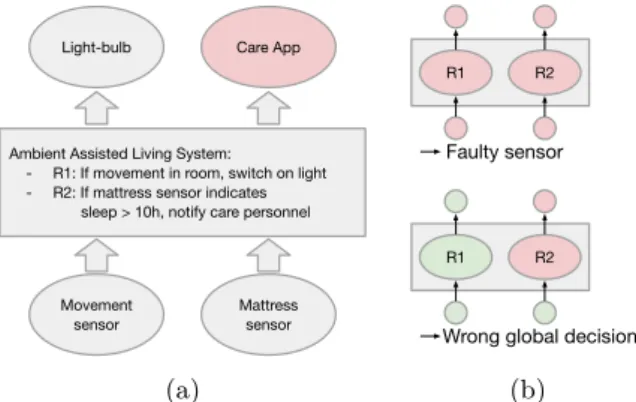
As an example illustrating the potential benefits of provenance for accountable systems, let us consider a smart-home environment targeted towards ambient assisted living. This environment aims at supporting elderly people or people with disabilities in maintaining their independence by living at home as long as possible. Through the analysis of data collected by sensors, video, and context information provided for example through a medical history, and
Light-bulb Care App
Movement sensor
Mattress sensor Ambient Assisted Living System: - R1: If movement in room, switch on light - R2: If mattress sensor indicates sleep > 10h, notify care personnel
R1 R2
Faulty sensor
R1 R2
Wrong global decision
(a) (b)
Figure 1Examples of provenance in a sample ambient assisted living use case.
artificial intelligence, supportive actions may be automated. For instance, switching off the stove when nothing is cooked, setting off an alarm when a person remains suspiciously long in bed, switching on dimmed light when movement is noticed on the way to the bathroom at night, sending notifications to care givers, coordinating medical care, etc. Essentially, as depicted in Figure 1, data is collected and transmitted to the analysis system, which then triggers actions on various devices (e.g., the stove, the light bulb, or a smartphone app receiving notifications).
Given this scenario, imagine that at some point, a family member notices that no notification was sent, even though the person was spending too much time in bed. How can this system behavior be accounted for? Clearly, there are many possible causes to this (faulty) system behavior: sensors may be faulty, the data from sensors was not processed, contradictory data was processed leading to an uncaught exception in processing, the analysis system failed, etc. With the availability of proper provenance traces that track any data processing in the ambient assisted living environment, we can actually narrow down the causes for the system behavior. Different provenance scenarios are depicted in Figure 2, where green coloring indicates that data was traced in a component and red indicates that no data was associated with a component. In the upper figure, we see that no data is available at the sensor level, clearly indicating a faulty sensor. The lower figure shows that sensors produced data that was processed but then translated to another (possibly wrong action). This indicates that the decision model made a wrong decision.
Given the illustrative example above, we see that provenance indeed is important meta-data for accountability. But how to design systems that collect such provenance? In the following, we propose three system architectures that may be used to that effect.
3.4.2 Architectures for Provenance Capture
To model systems such as the one described above, we consider sensors and smart devices, the decision making system, and the vendor of the smart-home solution. A first solution to capture provenance would be a closed system, where the (proprietary) devices communicate directly with the vendor’s cloud where the decision making, and the provenance capture, is based. Clearly, this offers no or very little visibility of the data and provenance, and raises privacy and security concerns. A second architecture involves a personal hub located in the home network that mediates between the smart-devices and the vendor cloud and that performs the decision making, thus putting the computing closer to the edge [5]. This way, only information that is relevant to the vendor services may be communicated, improving the
privacy compared to the first solution. Finally, a third option is to extend the capabilities of smart devices themselves, leveraging their increasing computing capabilities to perform computations right at the source and support provenance capture and communication. The three architectures have different characteristics concerning privacy, transparency, control of the data, disclosing different information available to capture provenance.
3.4.3 (Provenance) Data Disclosure
More generally, the information available to generate provenance data will be dependent on the will and incentives for parties to collaborate in transparently disclosing their actions. An ideal situation would be fully transparent parties willing to disclose any details of data processing or decision making. At the opposite end of the spectrum are uncollaborative parties refusing to participate in the generation of provenance data. In such a scenario provenance can only be inferred from the observation of systems events (or records thereof) that are within reach of the users (e.g., recording network activity). Neither end of the spectrum is desirable: total transparency presents security, privacy and business risk, while a total lack of transparency may reflect badly on the concerned party and a certain level of transparency is legally required. It remains to be determined what level of detail is required to permit the identification of a problem’s root cause, while limiting risk where privacy, security and competitive advantage are concerned. We may even go further so as to state that one may want fine-grained provenance for internal root cause identification, while disclosing a more abstract representation to other parties.
3.4.4 Summary and Challenges
The above considerations demonstrate that provenance is valuable information for accountable systems, e.g., as a source of evidence that can assist in indicating responsibility, or help in debugging and fixing a system. However, various challenges lie ahead on the path to practically collecting and using provenance in accountable systems. Interesting research questions include: Can provenance be privacy preserving? How can we meet requirements for accountable systems without disclosing additional information? How can we guarantee the availability of the provenance data? What are the legal requirements regarding the management of provenance data? Similarly, how can we ensure the integrity of collected provenance? Also, to capture and use provenance in a complex system involving various parties, how can we support interoperability (at all levels: system, syntactic, semantic)? References
1 Lucian Carata, Sherif Akoush, Nikilesh Balakrishnan, Thomas Bytheway, Ripduman Sohan,
Margo Seltzer, and Andy Hopper. A Primer on Provenance. Communications of the ACM,
57 (5): 52–60 (2014)
2 Melanie Herschel, Ralf Diestelkämper, and Houssem Ben Lahmar. A survey on provenance:
What for? What form? What from?. The VLDB Journal, 26 (6): 991–906 (2017)
3 Luc Moreau and Paolo Missier, eds. PROV-DM: The PROV Data Model. W3C Recom-mendation. https:// www.w3.org/ TR/ prov-dm, 2013
4 Thomas Pasquier, Jatinder Singh, Julia Powles, David Eyers, Margo Seltzer, and Jean
Bacon. Data provenance to audit compliance with privacy policy in the Internet of Things.
Personal and Ubiquitous Computing, 22 (2): 333–344 (2018)
5 Weisong Shi, Jie Cao, Quan Zhang, Youhuizi Li, and Lanyu Xu. Edge computing: Vision
6 Jatinder Singh, Jennifer Cobbe, and Chris Norval. Decision Provenance:
Cap-turing data flow for accountable systems. arXiv preprint arXiv:1804.05741, ht-tps://arxiv.org/abs/1804.05741, (2018)
3.5
Anonymity, Identity and Accountability
Jean Bacon (University of Cambridge, GB), Heleen Louise Janssen (Ministry of the Interior and Kingdom Relations, NL), Joshua A. Kroll (University of California – Berkeley, US), Silvia Puglisi (The Tor Project – Seattle, US), Jatinder Singh (University of Cambridge, GB), and Martina Zitterbart (KIT – Karlsruher Institut für Technologie, DE)
License Creative Commons BY 3.0 Unported license
© Jean Bacon, Heleen Louise Janssen, Joshua A. Kroll, Silvia Puglisi, Jatinder Singh, and Martina Zitterbart
Group questions: Does accountability necessitate the identification and/or visibility of the actors involved? and In what contexts can a violation of privacy be justified to achieve accountability?
3.5.1 Considerations about the relation between accountability and identity
Identity has a clear relation to accountability. Identity is important as a means for determining those to hold to account, which can be challenging in a complex system. Does accountability necessarily mean that it is associated with an identifiable person? Identification also poses considerations with regards to the ‘users’ of a system. Does an individual need to be identifiable–explicitly, or through a pseudonym? Or can (or should?) systems be built in a way so that the details of the individual’s identity are not required while still being accountable? And how do the design decisions relating to identity impact on the levels of accountability that systems help to support. Ultimately, ‘it depends’, issues of identity and anonymity relate to the particular context.
Considerations on accountability: If a system is to support accountability, it needs to
record sufficient data to identify relevant events and actors as required by its specification. In a system-of-systems, this accountability data may be partitioned according to the system components and their functionalities. We assume that access to audit data is controlled so that only authorised parties can see it. We assume that a case has been made and authorised for the data to be gathered for legitimate purposes. In this section we assume, at least initially, that the audit data are correct.
3.5.2 Use case: check-in/check-out in public transportation systems
The group identified a use case in which the issues that come with accountability, anonymity and identity can be concretely explored. To investigate options available and trade-offs that might be made, it considered an urban transport system such as the Paris Metro or the Boston T. The group supposed that the initial system design allows people to be completely anonymous, for example, if they choose to use cash to buy tokens. A token will buy any length of journey at any time, and deposited on entry–no other information is available. Suppose such a system is due to be upgraded to meet the following requirements:
Start and end points of journeys are to be recorded to aid resource planning.
Different charging models for different journey lengths, different times of day, days of the week, etc.
Consequences of these changes (as well as aiding modelling and planning, as above) are that: Individual actions can be inferred–their home and work locations and travel habits. Police can be assisted in identifying who could have been present when some crime took place at some location.
If a system is to support accountability it needs to record sufficient data to identify relevant events and actors as required by its accountability specification. In complex system environments this accountability data may be partitioned according to the system components and their functionalities. We assume that access to audit data is controlled so that only authorised parties can see it. We assume that a case has been made and authorised for the data to be gathered for legitimate purposes. In this section we assume, at least initially, that the audit data is correct.
Tensions between accountability on one hand and privacy on the other may arise in these systems, as well as the question of how these tensions can be managed. Specificallyhow can accountability in check-in/check-out in city public transportation systems be managed? Three
main systems were considered:
Token-systems (system as used in the Paris metro). With a one-off deposit of a generic token, people travel unidentifiably.
Card based systems (London Oyster Card system or credit card system). People can be identified with credit cards and whenever the London Oyster Card is connected to an identifiable person.
Biometric system (e.g. a future airport with seamless flow systems), where people are identifiable, e.g. by cameras, device traces, other sensors, etc. This use case was not discussed in detail; the group took note of its emergence in the near future.
3.5.3 Drivers for the use of check-in&out systems
Transport related: The group discussed which specific drivers for ‘change’ exist –e.g. for
taking the step away from token-based systems to those entailing check-in/check-out. Taking the Paris Metro with anonymous paper tickets as a starting example, the group noted that original purpose–solely securing that travellers pay for their journey–was less amenable towards city goals of better transport planning and management. As such, many public transport systems use check-in/check-out ticketing approaches: journey tracking provides for insight in understanding travelling patterns, potentially leading to saving money and better allocation of resources (e.g. by offering different services during rush hours for higher prices). The question arose to what extent a traveller’s identity is required for such insights. The group questioned whether the use of identities is necessary for transport planning. There may be different levels of aggregation regarding the identities used, or different methods for tracking flow of passengers once travelling, potentially leading to less of an impact on privacy/anonymity. For the detection of fraud by the transport organisation, knowledge of the identity of the travellersmight assist–depending on the specifics of its implementation. Not transport related: For crime prevention, detection and prosecution, knowledge of
someone’s identity may be helpful as well, but it is not clear to what extent an identifiable ticket necessarily assists investigation. Generally, data mining and analytics, to give more information of the flow of people throughout the city (beyond transport purposes) was also identified as a driver.
Other drivers for check-in&check-out are that alternative forms of ticketing can be used, and services can be built on top. For instance, using personal credit cards for ticketing could (by tracking travellers), mean additional services may be offered, such as (targeted) services
such as advertisements for trips, experiences, food, etc. In order to realise these customised services, some degree of traveller identity will be required. At present, it appears that privacy and anonymity are being eroded due to commercial and financial incentives.
The group concluded that any next step seems at least to result in increased tracking possibilities and therefore a greater impact on privacy and anonymity.
Typical issues: The group identified typical issues and concerns coming with the use of
identifiable check-in/check-out in city public transportation systems: All methods can bring statistics
Public acceptability (agency, personal autonomy, self-determination) Identifiability/re-identifiability
Simplified analytics Facilitated ‘function creep’
Discouraging bad-behaviour (gaming the system) Anonymous travel will become less self-evident Unclear what more exactly happens to the data
(Prior) design decisions (and constraints) are important
Fundamental change of a system once in operation is very expensive
3.5.4 Mechanisms to address the tension between accountability and privacy in transportation systems
The main question considered was: Does accountability necessitate for identification and/or visibility of travellers for the actors? The group discussed the token and card-types of check-in
and check-out systems in public transportation, and how they could be made accountable while respecting the privacy (anonymity and identity) of the individual. The group identified various types of cards, including:
Fully-identified fare cards
Contactless credit card payments, ID cards (based on biometrics) Pseudonymous fare cards
e.g. Oyster cards
Fully anonymous electronic fare cards anonymous card paid by e-cash/Zcash payments, trustworthiness of anonymity
A key takeaway was that while all solutions bring statistics, no one solution deals with all accountability and privacy concerns. In short,there is a trade-off. Potential barriers to
improvements and change in city public transportation systems include: Fundamental change of a system once in operation is very expensive The increasing number of actors
Challenges of dual/multiple use (i.e. data and services beyond transport)
3.5.5 General takeaway: context is key
The group concluded that context is key, highlighting some general questions and considera-tions regarding the identity–anonymity–accountability tradeoffs:
Determine the actors involved in the processing of the personal data What values are in play? How much protection should each value deserve?
Discrimination (e.g. when means are unreasonably allocated to certain zones based on data, or when certain passengers are unreasonably targeted/checked)
Broader benefits of individual-oriented analytics
The necessity of individual-oriented analytics, are aggregates as effective? Security implications, both technical and societal
Preventing bad behaviour, defining the threat model
What is necessary to record (considering each actor, each purpose)? How to resolve conflicts regarding data retention and data protection?
How can technology contribute to support oversight practices while respecting privacy/an-onymity?
ID-management: what are the technical, management and ‘user’ considerations Reliability and accuracy of identification mechanisms
References
1 Pfitzmann, Andreas, and Marit Hansen. “A terminology for talking about privacy by data
minimization: Anonymity, unlinkability, undetectability, unobservability, pseudonymity, and identity management.” (2010).
2 Branscomb, Anne Wells. “Anonymity, autonomy, and accountability: Challenges to the
first amendment in cyberspaces.”The Yale Law Journal 104.7 (1995): 1639–1679.
3 Christopherson, Kimberly M. “The positive and negative implications of anonymity in
Internet social interactions: “On the Internet, Nobody Knows You’re a Dog”.”Computers in Human Behavior 23.6 (2007): 3038–3056.
3.6
Post-Consent
Jennifer Cobbe (University of Cambridge, GB), Martin Henze (RWTH Aachen, DE), Bertram Ludäscher (University of Illinois at Urbana-Champaign, US), Ken Moody (University of Cambridge, GB), Maximilian Ott (CSIRO – Alexandria, AU), and Margo Seltzer (Harvard University – Cambridge, US)
License Creative Commons BY 3.0 Unported license
© Jennifer Cobbe, Martin Henze, Bertram Ludäscher, Ken Moody, Maximilian Ott, and Margo Seltzer
The group agreed that there seems to be a trend in academia, industry, and government to frame issues around the appropriate use of personal data in terms of consent, often drawing on experiences of the medical domain. However, the digital domain has characteristics which make it quite different from the medical domain; sufficiently so that it seems prudent to question the applicability of consent as a basis for processing personal data. Indeed, a significant body of research indicates that relying on consent for the processing of personal data is flawed in many ways [8, 7, 10, 11, 2, 9, 6, 4].
Unlike in the medical domain, users in the digital realm are subjected to a constant onslaught of consent requests from web sites and apps, each with their own privacy policy, as opposed to the comparatively small number of such documents presented by a trusted medical professional. Privacy notices are often very long, confusing, legalistic, and use euphemisms to describe the processing in question (e.g. describing the sale of user data as “sharing”). Given the length, complexity, and number of privacy policies it is unlikely indeed that anybody reads all of them. Indeed, a 2008 study concluded that it would take ten full days to read all the privacy policies with which users are confronted each year [5] (that number presumably having grown greatly in the last decade). Not only is it clear from the literature that people usually do not read privacy policies and often do not understand what they are consenting to, but research has also shown that whether users give consent is heavily dependent on
contextual clues [1] (giving data controllers significant influence over whether data subjects give consent to processing). The use of manipulative or deceptive practices in gaining the consent of data subjects is well-documented.1 Finally, a problem which arises in the digital
domain which does not necessarily arise in the medical domain (unless machine learning tools are being used), is that personal data are frequently used to build predictive models, the outputs of which are unforeseeable for data subjects and which may cause their own kind of privacy harms [3]. Given this, it is not clear how one could adequately inform and seek consent from data subjects for such processing.
As a result of these various issues, the group felt that, in order to develop accountable systems of the future, better approaches to providing a lawful basis for processing personal data which respects and protects the rights to privacy and data protection of data subjects is needed. Identifying potential legal bases which provide meaningful control for data subjects as well as developing technical means to protect personal data but which do not rely on consent were thought to be key areas for further research.
References
1 Acquisti, A., Brandimarte, L, and Lowenstein, G., 2015,Privacy and human behaviour in the age of information, Science, 347(6221), 30 January, pp.509–514
2 Brandimarte, L., Acquisti, A., Loewenstein, G., 2010,Misplaced confidences: privacy and the control paradox, Ninth Annual Workshop on the Economics of Information Security 3 Crawford, K. and Schultz, M., 2013, Big Data and Due Process: Toward a Framework
to Redress Predictive Privacy Harms, New York University Public Law and Legal Theory Working Papers, Paper 429.
4 Doteveryone, 2018,People, Power and Technology: The 2018 Digital Understanding Report 5 McDonald, A. M. and Cranor, L. F., 2008,The Cost of Reading Privacy Policies, I/S: A
Journal of Law and Policy for the Information Society, 4(3), pp.541–565
6 Mantalero, A., 2015,The future of consumer data protection in the E.U. Rethinking the “notice and consent” paradigm in the new era of predictive analytics, CLSR, Vol. 30, pp.643–
660
7 Moores, T., 2005,Do consumers understand the role of privacy seals in e-commerce?, Com-munication of the ACM, 48(3), pp.86–91
8 Privacy Leadership Initiative, 2001,Privacy Notices Research Final Results, Harris Inter-active, 2001
9 Solove, D., 2013,Privacy Self-Management and the Consent Dilemma, 126 Harvard Law Review, p.1880
10 TRUSTe, 2006, Consumers have a false sense of security about online privacy–Actions inconsistent with Attitudes, TNS, 2006
11 Turow, J., Hoofnagle, C.J., Mulligan, D.K., Good, N., 2007,The federal trade commission and consumer privacy in the coming decade, ISJLP, No. 3, pp.723–749