Restructuring Juvenile Corrections in California
:
A Report to the State Legislature
by
Sele Nadel-Hayes, MPP
Goldman School of Public Policy, University of California at Berkeley &
Daniel Macallair, MPA, Executive Director Center on Juvenile and Criminal Justice
September 2005
Funding was provided by a grant from the Ernst Van Loben Sels and Haigh Scatena Foundations. Conclusions and opinions do not necessarily reflect the views of the report’s sponsors.
CEN TER ON JUVENI LE AN D CRI MI N AL JUSTI CE
w w w .cjcj.org
54 DORE STREET SAN FRANCISCO CALIFORNIA 94103 415-621-5661 FAX: 415-621-5466 WWW.CJCJ.ORGExecutive Summary
Youth corrections in California is at a crossroads. In response to the near universal
recognition of California’s failed approach to youth corrections, Governor Schwarzenegger, with support from the California Legislature, has launched one of the largest restructuring initiatives of youth corrections in state history. Reforms currently underway involve significant
management, oversight, and administrative staffing changes. These changes are intended to precede sweeping structural changes at the operations level. This report presents an overview and recommendation for implementing a more effective, rational, and humane system of juvenile corrections for California.
Juvenile corrections reform in California will require a major reallocation of resources from the state level to individual counties and regions. County probation departments comprise the largest segment of the state’s juvenile justice system by providing services to over 97% of the juvenile offenders population not sentenced to state-administered correctional facilities. The expansion of county probation resources, offers the best option for establishing a range of community-based and regional correctional services that could reduce or eliminate the need for state administered correctional facilities.
State’s that are now recognized as leaders in the youth corrections field such as Missouri, and Utah, achieved their success by shifting to a regionalized model that diversified correctional services. These states also achieved success by abolishing their use of large 19th century training schools and replacing them with an array of small secure facilities that emphasize treatment. The modern approach to youth corrections pioneered by these, and other states, offers a clear contrast to California’s outdated congregate institutional system.
The next step in restructuring youth corrections in California involves eliminating the state’s reliance on large training schools and shifting the emphasis to county and regionally administered services. This restructuring of youth corrections must allow for the establishment
of service and facilities that will meet the challenges of California’ s diverse youth offender population.
Based on the findings of this report, the following recommendations to restructure youth corrections in California are offered for consideration.
• Create or expand county and/or regional-based treatment facilities that can absorb the youth offender populations currently housed in state-run correctional facilities.
• Create a permanent funding stream that reallocates resources from state-run correctional institutions to county probation departments.
• Establish a state-administered oversight body that provides technical assistance and monitoring of county and regional juvenile justice treatment and custodial programs.
• Utilize private and nonprofit agencies’ evidence-based services and programs to expand the range of correctional options at the county and regional level.
Table of Contents 1. Introduction ... 6 2. Methodology ... 8 2.1. Literature Review... 8 2.2. Stakeholder Interviews... 9 2.3. Budget Analysis ... 9 2.4. Legal Analysis... 10
3. Presents State of the DJJ ... 10
3.1. Internal and Independent Audits and Evaluations... 11
3.2. DJJ Programs and Population ... 15
3.2.1. Programs Overview... 15
3.2.2. Statistics on Wards... 16
4. Findings... 18
4.1. Stakeholder Goals ... 18
4.1.1. Short term goals ... 19
4.1.2. Long term goals... 24
4.2. Legal Constraints... 25
4.2.1. Pathways to Custody and Treatment... 25
4.2.2. Conditions of Treatment... 29
4.3. Budget ... 31
4.4. County-level Services ... 33
4.4.1. Santa Cruz County, California ... 33
4.4.2. Santa Clara County, California ... 36
4.5. State-level Programs ... 39
4.5.1. State of Utah... 39
4.5.2. State of Missouri ... 44
5. Recommendations ... 46
5.1. Data analysis and reporting must reflect quality data collection ... 46
5.2. Counties are able to serve wards appropriately... 46
5.3. Private sector agencies serve youth efficiently ... 50
Table of Figures
Figure 1. Racial and Ethnic Composition of New DJJ Placements in 2003 ... 18
Figure 2. Stakeholder Goals... 20
Figure 3. Pathways in the Juvenile Justice System ... 27
Figure 4. Transition Plan Principles... 30
Figure 5. Budget Expenditure Areas ... 32
Figure 6. Ward per Capita Cost for Fiscal Year 2004-05 ... 32
Figure 7. Services and Programs of the Juvenile Probation Division... 37
Figure 8. Outcomes of Juvenile Probation Department ... 39
Figure 9. Criteria for Qualification as a Serious Youth Offender... 42
1.
Introduction
The focus of this report is on identifying a system of correctional services that will replace the existing eight Division of Juvenile Justice institutions. In 2005 Governor Schwarznegger began the largest administrative restructuring of the state’ s corrections system in 30 years. The
California Department of Corrections and Rehabilitation, Department of Corrections, and Division of Juvenile Justice were consolidated into one large department. The purpose was to streamline management functions and establish a system of centralized control where sweeping reforms could be better coordinated and monitored.
This report will present research findings showing how structural changes require closing
structurally outdated large correctional institutions in favor of smaller county or regionally based facilities. The report will examine the significant budgetary, legal, and political constraints to implementing this new system. In California, the process of allocating funds is a time-intensive process of political negotiation that is often far removed from objective policy analysis. Despite the Governor’ s promises of broad systemic reform, no new resources are being offered in this years budget for youth corrections (Schwarzenegger, 2005). As a result reform efforts will need to be carried out with little or no additional state funds.
Secondly, as a result of a comprehensive lawsuit filed against the state for inhumane conditions within its youth correctional facilities, reforms will be strongly influenced by judicial mandates. These mandates set timelines under which specific changes must be implemented. The mandates support many of the complaints that led to the development of a new vision for juvenile
of wards in the system. Finally, in a system affecting such diverse populations, it is often the case that some stakeholders’ concerns are not addressed in the evaluation processes. The historical situation of juvenile corrections has allowed some groups more access to these processes than others and to the political capital necessary to further their agendas for the governance of the system. This report represents the contributions and opinions of many stakeholder groups not often heard in such proceedings, holding the level of influence of each constant.
The ability of decision-makers to construct a replacement juvenile justice system relies on the ability of all stakeholders to communicate their needs strategically. Because some stakeholders have had significant influence over decision-makers to guide the governance of the juvenile corrections system, this research has been conducted to supplement this influence with
perspectives from populations not traditionally incorporated into the analysis. This will lead to a system more accountable to the general public and better able to meet the needs of the
populations it seeks to serve. The primary goal of this report is to identify key elements of stakeholder visions and evaluate their feasibility within system constraints. Drawing upon stakeholder interviews and publications, these elements will represent a composite overview of the expectations for a new system of providing services to the juvenile population. The
secondary goal of this report is to organize critical information about structural models from other jurisdictions and the baseline requirements of stakeholders to determine how the replacement system will function. As other states and regions have approached juvenile corrections from within different contexts, it is critical that elements of successful systems be translated into practices appropriate for California and lessons from other jurisdictions are reflected in the California system’ s design.
The scope of this report is limited to an analysis of how specific practices would function in California’ s context. It has been demonstrated that the state of juvenile corrections in California is unique in its design, oversight, evaluation, and impact. As such, successful practices in jurisdictions with vastly different populations, legal constraints, and political priorities may not be as successful here. This analysis allows all stakeholders to move toward choosing a system of care that appropriately serves the needs of California, beyond the extensive problems that have plagued the existing juvenile corrections system for decades and create the context for reform. In addition, this report will reflect the policy priorities of the larger juvenile justice reform
community, not those who do not wish to see changes in the system, though their impact on the decision-making process will be addressed in the feasibility analysis.
2.
Methodology
This research is grounded in four main sources of information: academic, practitioner, and advocate publications; comprehensive and strategic stakeholder interviews; Governor Arnold Schwarzenegger’ s 2005-06 California budget proposal and commentary from advocates; and legal documents from the California court system and other states’ general laws. The resulting analysis is the construction of a model system of services to replace the existing DJJ system based on the priorities, concerns, and smart practices culled from the research process.
2.1. Literature Review
In the review of relevant literature, there exists the opportunity to identify smart practices from case programs, practitioners, and other experts. The literature reflects three general models for service provision for juveniles in the corrections system. Case studies of programs that represent
a system of county-level care, programs that represent a privatized system of care, and programs that represent possibilities for reform within the existing institutional structure have been
analyzed for possible inclusion in the California replacement model.
2.2. Stakeholder Interviews
The purpose of including stakeholder interviews is twofold. First, stakeholders provide critical input in developing system goals and evaluation criteria to ensure they reflect a broad span of perspectives. Because stakeholders represent a wide range of practitioners, they are uniquely capable of providing insight into the practical possibility of different models’ functioning in California. In addition, the collective input of stakeholders allows for the construction of a baseline minimum standard of care against which proposed systems may be measured. As individuals identify key elements of a successful juvenile corrections system, these requirements will be combined to create a minimum standard that will satisfy as many stakeholders as
possible. This will also allow competing priorities to be reflected in the final recommendations.
2.3. Budget Analysis
A critical initiator in the efforts to reform the existing California juvenile justice system is the substantial budgetary inefficiency caused by the high cost per ward without demonstrable reform outcomes and with such a failure of the rehabilitative and care goals of the system. The budget analysis section will provide an overview of the distribution of youth corrections funds in California as it functions presently in order to demonstrate the current funding priorities within the juvenile corrections system. In addition it will provide a starting point for the cost-benefit analysis of restructuring the system. Secondly, the budget analysis section will provide an
overview of how the different proposals will allow for different allocations of the corrections budget and generate revenue from alternative funding streams.
2.4. Legal Analysis
The existing juvenile corrections system functions under the larger Youth and Adult Correctional Agency and within local, state, and federal laws. This agency is currently undergoing a process or reorganization initiated by the office of the Governor. As the reorganization process
continues, the laws and mandates governing the DJJ will shift and change. However, the
inclusion of an overview of the legal constraints associated with the housing and care of juvenile wards is critical to the selection of an appropriate replacement structure. The legal analysis section will incorporate these changes into the design of the new structure, as well as the numerous reforms in response to the consent decree stipulation handed down as a result of
Farrell v. Allen.
3.
Present State of the DJJ
The effects of media, community, and governmental scrutiny of the DJJ system have resulted in significant attention to the problems with the existing system. While this report is not designed to encompass a detailed description of the myriad problems and system failures, it is important to situate the system within the larger context of juvenile justice reform in California. When the ward population reached its peak of 10,114 wards in June 1996, a flurry of academic and governmental evaluations and audits of the system were conducted. The goal of many of these studies was to better understand the population, services, and outcomes of the DJJ system. More recently, these studies have shifted to analytical reports on how the system should be serving the incarcerated population and the broader community affected by a youth population engaged in
illegal and criminal behavior. The authors of these reports range in expertise and influence and many of the reports represent research performed by service providers and advocates with direct relationships to youth – those at risk of arrest or incarceration, those incarcerated at the point of service, and those being served post-release. Despite its clear relevance to system reform and restructuring because of its unique connection to the wards, this information has only begun to be utilized by decision-makers. At present, large strides have been made by decision-makers to incorporate input from these stakeholders into reform efforts, though significant disparities remain with respect to foundational priorities for the entire juvenile justice system.
3.1. Internal and Independent Audits and Evaluations
The Office of the Inspector General’ s Accountability Audit report outlines 241 recommendations for reform of the day-to-day operations of the existing DJJ facilities and programs based on four years of evaluation (Cate, 2005). The OIG reviewed audits of the DJJ and documentation of its progress in implementing previous recommendations as well as the report issued by the
Corrections Independent Review Panel in 1994. It also conducted site visits and reviewed ward and facility files, logs, and records at each of the eight DJJ institutions. Each of the
recommendations from previous audits and generated from new information was classified according to the progress of the department in implementing them as fully, substantially, partially or not implemented.
The most egregious unmet recommendations from previous audits were with respect to the Special Management Programs (SMPs) that allowed wards to be held on lockdown for 23 hours daily with 1 hour of recreation for longer than the temporary duration for which these programs were intended. At N.A. Chaderjian, 39 wards were on lockdown for over 30 days and three for
over 200 days. At H.G. Stark, 103 wards are held in confinement for the sole reason that there are not enough teachers to provide each ward with mandated educational services. In fact, all of the studied institutions are failing to provide the mandated four hours daily of educational instruction on a consistent basis. An average of eighteen classes are cancelled daily at Ventura Correctional Facility due to teacher absences. At the Southern Reception Center, 78 percent of wards had cumulative subject scores below the 25th national percentile rate in 2004. The institutions are also failing to meet institutional mandates for assessment and treatment. At the Southern Reception Center, 85 percent of wards were not assessed within the 45-day required time period.
The DJJ is currently undergoing significant administrative reform. Governor Schwarzenegger’ s Reorganization plan has instituted several reforms to the governance of all aspects of California corrections, including the DJJ institutions. The primary focus of the current reorganization is on improved management of the existing facilities and systems with the assumption that the
persistent problems with the system will see solutions with these changes (Swarzenegger, 2005). Toward this end, the plan imposes significant changes to consolidate the top level of
administration and management to create one entity responsible for the Department of
Corrections of which the DJJ is a part, the elevation of rehabilitation and treatment services, and the creation of proactive functions and responsibilities such as planning and research, risk management, and community partnerships (Schwarzenegger, 2005).
With respect to the DJJ, the new structure places the existing institutions under the Department of Corrections and Rehabilitation through a new Division of Juvenile Corrections Division
charged with efficiently operating and managing youth facilities and to rehabilitate youthful offenders. Several functions are transferred from the former DJJ.
Generally, the Division will provide for the secure custody of wards, while providing the environment for carrying out its statutory mission of providing training,
treatment, and rehabilitative services designed to protect public safety by returning wards to society better equipped to lead law-abiding lives (Schwarzenegger, 2005). Though this reorganization will have some impact on the efficiency of DJJ
management and operations, it is not clear that it will have significant impact on the improvement of conditions of facilities, the ability of wards to better meet educational and treatment goals, and reduce costs and recidivism. In fact, existing leadership has identified these goals as primarily policy and budgetary goals not within the scope of the Reorganization Plan. As such, additional reform measures must be implemented in order to meet these goals (Hickman, 2005).
The Little Hoover Commission’ s hearings on DJJ reform have generated focused comments from expert practitioners on the goals and objectives of California’ s juvenile justice system as a whole. For the most part, these experts have expressed the importance of maintaining clear administrative distinction between DJJ and the larger Department of Corrections, to meet the long term need for a State level agency to coordinate juvenile justice policy, and institutionalized inspections and evaluations of facilities and programs by outside agencies. Specifically, experts have identified the critical need for elevated emphasis on rehabilitation in the DJJ to match the custodial responsibilities of the institution and to create and uphold a strategic plan for evaluating each institution’ s progress in meeting its responsibilities and institute sanctions when those
responsibilities are not met (Burrell, 2005). These solutions come in response to the
demonstrated failure of the DJJ to provide health, education, and re-entry programs even at the basic level mandated by California and federal laws and to create and sustain partnerships with local agencies capable of providing services and oversight. Perhaps most critically, experts have identified several means of funding these basic services employed by other states and
municipalities that have been underutilized in California, if utilized at all (Steinhart, 2005).
The General Corrections Review of the DJJ was conducted by Barry Krisberg and the National Council on Crime and Delinquency, an independent and well respected criminal justice research agency for the purposes of this report. The review was completed at the request of the California Attorney General (AG), the DJJ (YA), and the Prison Law Office (PLO). The report provides findings and recommendations based on a three-year assessment of the entire DJJ system within the areas of Ward Classification, Access to Lawyers and Ward’s Rights, Use of Force and Ward Safety, Restricted Programs including Special Management Programs and Temporary Detention, andAccess to Religious Services. Krisberg reviewed current DJJ policies, training materials, statistical data, and interviews with wards and staff at the N.A. Chaderjian Youth Correctional Facility, the Heman G. Stark Youth Correctional Facility, the Fred C. Nelles Youth Correctional Facility, the Preston Youth
Correctional Facility, the El Paso De Robles Youth Correctional Facility, and the Ventura Youth Correctional Facility.
Krisberg’s key findings were that the DJJ invests a substantial amount of staff time and resources collecting detailed information about its wards, but these data are not organized into an effective system to guide either security or custody needs; that there is not an effective system to ensure that these data are incorporated in day-to-day custody, treatment, and training decisions; that facilities are unsafe and
possess serious physical design issues that made security a difficult problem; that ward-on-ward abuse and excessive use of force by staff are common in all facilities studied; that wards are being held in restrictive programs for significantly longer periods than the temporary intent of the system; that the wards rarely, if ever, file grievances about being denied access to lawyers or legal reading materials and are rarely visited by attorneys; that the existing Ward Grievance System (WGS) is underutilized and therefore ineffective; and that access to religious services constitutes approximately 13 percent of ward complaint letters.
3.2. DJJ Programs and Population
The DJJ has six areas of focus in its effort to meet the needs of juvenile corrections in California: Prevention and Early Intervention Advocacy, Transitioning Offenders to the Community,
Handling of Violent Offenders, Restorative Justice, Public Safety, and Correctional Education (Allen, 2005). At a time when the existing system and structure of services for wards in the DJJ is serving the fewest number of wards in the past fifteen years and has been highly criticized for its inadequate scope of services and its high recidivism rate, there exists an opportunity to evaluate the effectiveness of programs in meeting these goals. While different facilities have diverse ward populations and vary with respect to the services provided at the institutions, these six focus areas are theoretically applied to all institutions. Because the existing structure of DJJ
facilities are large warehouse-style prison design, the scope of services is limited to those that can be administered most efficiently to the most wards.
3.2.1. Programs Overview
Three levels of programming – Basic Core Programs, Specialized Ward Programs, and
Supplemental Ward Programs – comprise the treatment arm of the DJJ’ s joint charge to provide custodial and treatment services to California’ s juvenile offenders. Basic Core Programs are educational programs separated into three components – academic, career/vocational, and character education. These skills are theoretically transferable to post-release opportunities and wards have access to a variety of academic achievement programs such as remedial reading, writing, and mathematics, obtaining a high school diploma or GED, and college-level coursework toward an Associate degree.
Specialized Ward Programs consist of programs that are for individuals whose treatment needs exceed Basic Core Programs. These programs range from formal drug and alcohol abuse treatment and medical/psychiatric-intensive treatment to programs designed for specific ward populations like younger boys, females, and sex offenders. This level of programming also includes post-release skills-training programs, such as the Planned Re-Entry Program (PREP), work experience programs, and public service camps.
Supplemental Ward Programs focus on other aspects of treatment and development not met by the other levels of programming. These include relationship-building programs, as met by the Foster Grandparent Program and Volunteer Services, knowledge-building, as met by parenting programs and classes and the Free Venture program giving wards access to partnerships with
businesses, and repeat-offender prevention, such as speaker bureaus where wards speak to local schools and organizations and victim services program.
3.2.2. Statistics on Wards
The Office of the Inspector General’ s report held a central concern – that the DJJ had employed sophisticated data collection practices for wards entering the system in the Reception Centers, but failed to utilize this data for analytical purposes, to improve their system of care, or to evaluate their services (Cate, 2005). Due to this failure, in-depth information about the ward population on a system-wide level is limited. Some facilities generate internal reports on
incidents and other population management information, but this information is not available to the public. The population information necessary to determine how the system may be
restructured to better serve the population is twofold. First, information about the home county or region of each ward will allow for accurate assessment of local facilities required to provide services and programs. Second, information about the offenses that led to the wards’ DJJ
incarceration will allow for accurate projection of the types of services and programs required by the wards. At present, this data is not consistently available, though it is collected in the
reception centers. The most recent report on this information is from 2003 and was published by the Office of the Attorney General (Lockyer, 2003).
The State’ s system of youth correctional institutions is comprised of eight facilities located throughout the California that currently house an approximately 3,300 wards. An additional 200 youth offenders are being housed in the general population of the adult Department of
Corrections and 3,991 youth are being tracked as a condition of parole. Of the 3,314 wards in DJJ facilities, 3,164 or 95 percent are male. All 150 female juvenile offenders are housed in the
Racial and Ethnic Composition of New CYA Placements in 2003 Black 31% Other or Unknown 2% Hispanic 50% Asian and Pacific
Islander 3% Native American 0% Caucasian 14%
Ventura Correctional Facility. Wards have an average length of stay of 22.4 months, though the range for length of stay is between 2 months and 6 years. Between July 2004 and February 2005, the average daily parole caseload was 4,040 of which 2,781 or 68 percent were placed on
violation within this same period. This failure rate does not include former wards who re-offend beyond the duration of parole.
In 2003, 73 percent of 1,009 new placements in the DJJ were between 15 and 17 years of age, 3.9 percent were between 10 and 14 years of age and 22 percent were age 18 or older. As shown in Figure 1 below, the racial and ethnic composition of these 1,009 wards was 3.2 percent Asian and Pacific Islander, 31.3 percent Black, 48.9 percent Hispanic, 0.4 percent Native American, 14.4 percent Caucasian, and 1.8 percent Other or unknown.
4.
Findings
4.1. Stakeholder goals
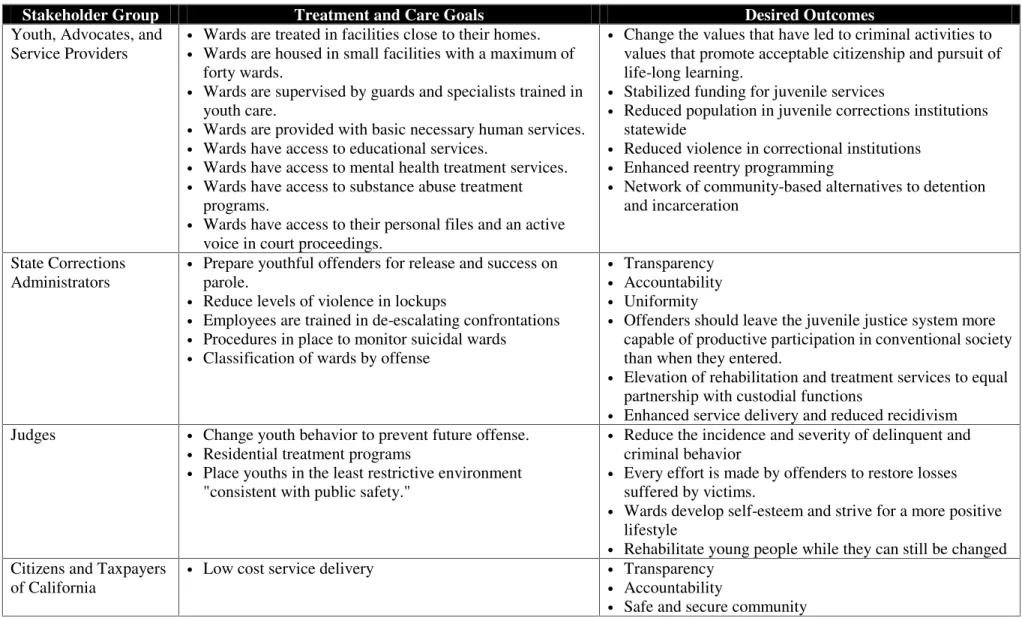
In determining the best system of care to replace the current structure of institutions, the goals for short-term and long-term outcomes must be considered. Figure 2 shows the short-term and long-term goals identified by four main stakeholder groups – youth, advocates, and service providers; CDCR administrators; judges; and the general population of California, specifically identified as citizens and taxpayers, though non-citizens and non-taxpayers living in California may also share these goals.
4.1.1. Short term goals
Short term goals represent stakeholder and institutional requirements for the treatment of wards and the services offered by the system, primarily on a day to day basis. These goals have been identified because the current system lacks the oversight necessary to presume all wards are treated with the same standard of care. While some wards may experience an appropriate balance
Figure 2. Stakeholder Goals
Stakeholder Group Treatment and Care Goals Desired Outcomes
Youth, Advocates, and
Service Providers • • Wards are treated in facilities close to their homes. Wards are housed in small facilities with a maximum of forty wards.
• Wards are supervised by guards and specialists trained in youth care.
• Wards are provided with basic necessary human services. • Wards have access to educational services.
• Wards have access to mental health treatment services. • Wards have access to substance abuse treatment
programs.
• Wards have access to their personal files and an active voice in court proceedings.
• Change the values that have led to criminal activities to values that promote acceptable citizenship and pursuit of life-long learning.
• Stabilized funding for juvenile services
• Reduced population in juvenile corrections institutions statewide
• Reduced violence in correctional institutions • Enhanced reentry programming
• Network of community-based alternatives to detention and incarceration
State Corrections
Administrators • Prepare youthful offenders for release and success on parole. • Reduce levels of violence in lockups
• Employees are trained in de-escalating confrontations • Procedures in place to monitor suicidal wards
• Classification of wards by offense
• Transparency • Accountability • Uniformity
• Offenders should leave the juvenile justice system more capable of productive participation in conventional society than when they entered.
• Elevation of rehabilitation and treatment services to equal partnership with custodial functions
• Enhanced service delivery and reduced recidivism Judges • Change youth behavior to prevent future offense.
• Residential treatment programs
• Place youths in the least restrictive environment "consistent with public safety."
• Reduce the incidence and severity of delinquent and criminal behavior
• Every effort is made by offenders to restore losses suffered by victims.
• Wards develop self-esteem and strive for a more positive lifestyle
• Rehabilitate young people while they can still be changed Citizens and Taxpayers
of California • Low cost service delivery • • Transparency Accountability
of rehabilitative and custodial services, audits and evaluations show the dearth of these services in all eight DJJ facilities.
Facilities
Many advocates have emphasized the importance of the physical plant of treatment and care services. Drawing from successful models, housing wards in facilities near their home
communities allows wards to work closely with family, school, and potential employers giving them access to localized networks from which they may draw support after release from the system (Books Not Bars, et. al, 2005). The ability to make connections to extra-institutional resources while serving their term of incarceration will allow for a continuum of care less disrupted than the existing system. Because the existing “warehouse-style” design of DJJ facilities breeds violence and ward abuse, housing wards in small facilities or small clusters within large facilities is highly preferred (Books Not Bars, 2005). These structures allow wards to benefit from intensive case management and more personal relationships between guards and wards. The regulations for DJJ mandate a ward to guard ratio of 9 to 1, though many facilities are operating with ratios of up to 50 wards per guard (Cate, 2005). Beyond the actual number of guards and staff responsible for custodial and rehabilitative services, advocates have emphasized the importance of special trainings and evaluations of guards to ensure they meet the standards of care for working with youth populations.
Facility administrators have expressed changes to the system of care that will promote less violence in the facilities to increase the safety of wards and personnel. In addition to sharing the youth and advocate goals that lead to improved relationships between wards and personnel, administrators believe that better classification and physical segregation of wards will lead to
reductions in violence as wards with more “hard-core” offenses held separately from wards convicted of less-violent or non-violent offenses will allow personnel to specialize their custodial duties (Hickman, 2005). Because administrators are ultimately accountable to California
taxpayers, they have the shared goal of housing and providing services to wards at the lowest efficient monetary cost.
Judicial representatives from juvenile courts throughout California have expressed concern with the safety of wards within the existing facilities. Many judges prefer residential treatment facilities that emphasize treatment, rather than strictly custodial functions. Some judges have sought to place wards in the least physically restrictive facilities that meet the particular requirements that maintain a level of public safety for the California population from the particular threats of youth wards. More specifically, judges have sought to identify a minimum level of security that will serve to protect the public from offenders based on the nature of his or her offense.
Services
Youth within different levels of the juvenile justice system and former DJJ wards have identified three key areas in which the existing system has failed – services that provide basic human needs, educational services, and medical and other health services (Johnson, 2005). Wards are granted rights to basic necessary care while wards of the system. These are mandated by the California Welfare and Institutions Code and include access to religious services of their choosing, adequate food and clothing, and a minimum level of recreation opportunities and physical activity (Johnson, 2005).
With respect to educational services, youth and advocates require basic academic and vocational education in a school district model that adheres to the same educational standards as public school districts. Though the existing Educational Services Agency is charged with meeting this standard, the structure of the system does not provide incentives to educational service providers and wards suffer significantly as a result. Not only are wards denied basic educational services as the minimum of four hours daily due to absentee teachers and administrative lockdowns, they are not given access to services that will allow them to excel outside of the system post-release, such as GED preparation or employability programs.
In terms of health services, wards should have access to medical care and information about the medications they are prescribed, specifically with respect to the effects of medications and alternatives to psychotropic drugs (Johnson, 2005). In addition, many wards require specialized treatment that will create an environment that will support their transition to non-criminal behavior post-release, in particular intensive treatment, specialized counseling, sex offender treatment, and other special behavior treatment should be provided in correctional treatment centers and intermediate care facilities.
In constructing reform measures and system evaluations, CDCR and DJJ administrators have set a baseline standard for service provision that services must prepare the wards for release and success on parole. This, combined with cost-minimizing goals for the overall system, does not allow for specific goals for service provision beyond this general requirement. In response to in-depth evaluations of the existing system, administrators have demonstrated a preference for
improved systems of confinement rather than therapeutic services in their willingness to bring new programs to the existing facilities (Cate, 2005).
Judges have demonstrated a preference for services that change youth behavior to prevent a future offense. This emphasis on reduced recidivism has been actualized in a myriad of
innovative sentences for youth offenders, both within DJJ facilities and in the larger community. Many judges have adopted principles of restorative justice, a term that represents the process of identifying the harm the offender has caused to the victim and the broader community and charges the offender with tasks and responsibilities that are designed specifically to restore that deficit. These sentences range from intensive treatment services to personal apologies to proactive community service (OJJDP, 2004).
Monitoring and Oversight
While many youth and advocate stakeholders identified critical changes to the system of setting policies for personnel contact with wards and enacting more stringent enforcement of guard conduct policies, the key stakeholders concerned with monitoring and oversight are the CDCR and DJJ administrators. While there have been many studies and reports on the opportunities for improved administration in the juvenile justice system (see Section 3.1), the key components of these stakeholders’ goals for treatment and care of wards consist of better conflict management and problem-solving trainings for personnel and better monitoring of the needs of at-risk wards, such as those displaying suicidal tendencies or susceptible to attack by other wards.
4.1.2. Long term goals
Long term goals represent stakeholder and institutional priorities for the future of youth corrections, and for the post-release lives of California youth. The very existence of a separate
corrections system for juvenile offenders demonstrates the understanding of youth as a
population in need of different treatment from adult offenders. A central tenet of this need is the belief that youth are capable of reforming their behavior and not becoming repeat offenders in the juvenile or adult corrections system.
Many of the desired outcomes articulated by stakeholders reflect this overarching belief. In fact, it serves as a point of unity among stakeholders and helps to create a foundation for identifying new systems that meet stakeholder goals. In particular, many stakeholders have emphasized the need to change the values and circumstances that have led to criminal activities to values and opportunities that promote acceptable citizenship and pursuit of life-long learning and they should leave the juvenile justice system more capable of productive participation in conventional society than when they entered.
4.2. Legal Constraints
The selection of a new model of providing care to the existing ward population is constrained by the existing pathways to custody and treatment and new developments handed down as a result of litigation by families of current and former wards of the DJJ.
4.2.1. Pathways to Custody and Treatment
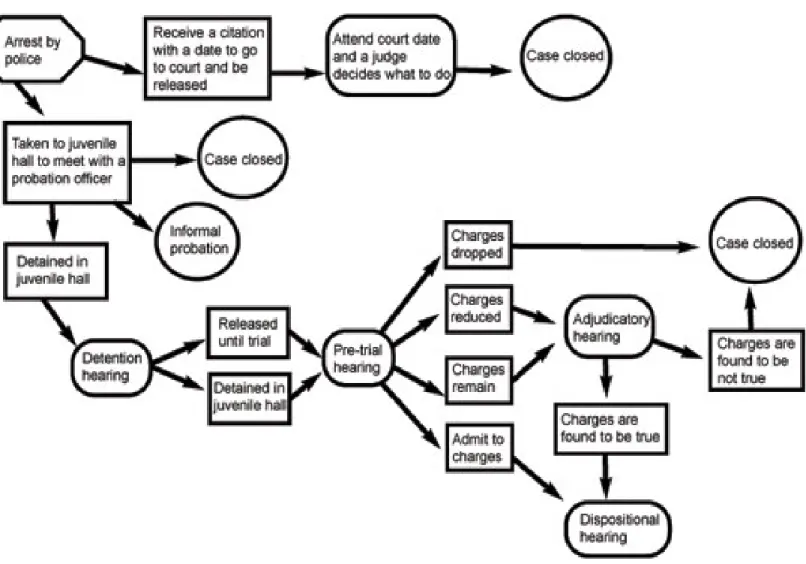
As shown in Figure 3, there are five options for how and where youth are served in the juvenile corrections system. This is decided primarily based on the type of offense the youth has
committed and the outcomes of trials and hearings. When a juvenile is arrested by the police, he or she either receives a citation with a date to attend a court hearing or is taken to juvenile hall to meet with a probation officer. At the meeting with the probation officer, the youth may be further
detained in juvenile hall, be mandated to receive informal probation, or his or her case may be closed. After further detention in juvenile hall, there is a detention hearing where it is decided whether the youth should be released until trial or further detained in juvenile hall. At the pre-trial hearing, there are four possible outcomes: charges may be dropped, charges may be
reduced, charges may remain the same, or the youth may admit to the charges. If the charges are dropped, the case is closed. If the charges are reduced or remain the same, the youth attends an adjudicatory hearing where the charges are found to be true or not true. If the charges are found to be not true, the case is closed. If the charges are found to be true or if the youth admits to the charges in the pre-trial hearing, he or she must attend a dispositional hearing where it is
Probation
The youth is released to a parent or guardian with a list of strict rules from the court that must be followed. These rules range from mandates for school attendance, counseling services, house arrest, or association with specifically identified others. If the youth does not adhere to the rules, re-arrest can result.
Treatment Program
The youth is sentenced to mandatory completion of a treatment program designed to provide specific rehabilitation for the problem that resulted in the arrest. These programs are typically for drugs, alcohol, violent behavior, and anger and range from residential to day treatment programs. The presiding judge may mandate a specific treatment program, particularly if the youth exhibits behavior for which no treatment programs exist within the geographical or financial reach of the youth or his family.
Out of Home Placement
The youth is removed from the home of his or her parent or guardian and placed in a facility administered by social workers or counselors. Often these facilities house small numbers of other youth and may be in one’ s local community or in a different city or town. These facilities are also often administered privately, by non-profit and for-profit organizations, or by municipalities and have varying extents of security to serve a range of youth.
Camp or Ranch
The youth is placed in a smaller secure or staff secure training school run by the county’ s probation department. Presently, twenty counties operate such facilities which are designed to
house youth convicted of serious crimes or several prior cases as a last placement option before being sentenced to the DJJ.
Division of Juvenile Justice
The youth is sentenced to one of the eight high security institutions operated by the DJJ after being convicted of a serious crime or as a last resort for lesser offenses. Wards of the DJJ are supposed to be under the age of eighteen unless they will finish their sentence before their twenty-first birthday in order to ensure youth convicted as adults receive the appropriate
educational and treatment services. See Section 3.2 for further explanation of the impact of this system.
4.2.2. Conditions of Treatment
In November 2004, the Superior Court of California in Alameda County issued a consent decree in the case of Margaret Farrell v. Walter Allen, the Director of the DJJ (Farrell v. Allen). The purpose of the consent decree was to mandate corrective action on the part of the DJJ in creating and implementing remedial plans to reduce violence and the need for the use of force within the DJJ, for the treatment and management of wards on suicide watch and those with psychiatric needs, for the hiring of a Medical Director, to evaluate special management programs and reduce the length of stay for wards in special management programs, and to hire an expert in the field of programmatic access for wards with disabilities (Sabraw, 2004).
Based on recommendations from several expert reports released in early 2004, the court required the DJJ to address deficiencies in six areas: general corrections, mental health, medical care, education, sex offender treatment, and wards with disabilities. The consent decree also
constructed a standard of monitoring compliance that allowed for the evaluation of the DJJ’ s implementation by a Special Master charged with determining whether a facility is in substantial compliance in an area.
Following the agreement of the consent decree, the court issued a consent decree stipulation to further mandate compliance of the conditions of treatment. First, the stipulation set dates by which the DJJ must submit interim and remedial plans for the six areas and re-titled the “General Corrections” area “Ward Safety and Welfare” to further emphasize therapeutic rehabilitation over custodial responsibilities. The stipulation also mandated four remedial steps: to end the lockdown model employed at N.A. Chaderjian Youth Correctional Facility and Heman G. Stark Youth Correctional Facility and institute an open programming model and later extend this model to all other institutions; to implement a ward incentive plan to encourage positive program through positive reinforcement; to ensure wards on the Special Management Programs are
provided access to educational, treatment, and other services outside their cells on a daily basis; and to submit a programmatic description of the rehabilitative model chosen for the DJJ.
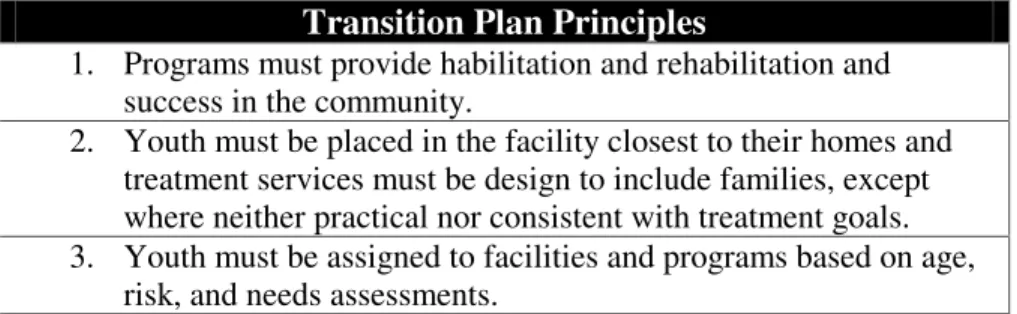
The court mandated the rehabilitative model meet ten guidelines (Sabraw, 2005). These guidelines, along with stakeholder goals and priorities, inform the evaluation of the models outlined in Section 4.5.
Figure 4. Transition Plan Principles
Transition Plan Principles
1. Programs must provide habilitation and rehabilitation and success in the community.
2. Youth must be placed in the facility closest to their homes and treatment services must be design to include families, except where neither practical nor consistent with treatment goals. 3. Youth must be assigned to facilities and programs based on age,
4. Facilities and programs should maximize youth/staff interaction with adequate supervision and intervention.
5. Facilities and living units should provide a safe and supportive environment that promotes rehabilitative goals.
6. The DJJ must emphasize positive reinforcement rather than punitive disciplinary measures.
7. Lockup may be used only as a temporary intervention in emergencies or as a last resort.
8. All staff that supervise wards must be qualified to provide rehabilitative and treatment services and must be provided with the training and support they need to succeed in their jobs. 9. Programs should be based on evidence and best practices, will be
evaluated for effectiveness.
10. Transition planning for successful reintegration must be provided to wards prior to release to the community.
4.3. Budget
The transformation of the DJJ is constrained by the Governor’ s corrections budget allocation for the overall system. Once the budget for the DJJ is approved, other resources may be identified as particularly appropriate for supplementing this allocation. The proposed budget is charged with all expenses associated with administration and operation of the DJJ’ s eight institutions and sixteen statewide offices serving parolees.
As a result of the numerous changes to California’ s juvenile justice system, two practices and circumstances have important impacts on the budget – a significant decrease in the size of the ward population and the disbursement of funds to counties to provide custodial, treatment, and supervision services to specific ward populations.
The Governor’ s current budget proposal for DJJ is $400.2 million dollars, a reduction of $8.1 million from the previous year’ s allocation. This allocation will allow for 3,860.4 positions in the agency and will be charged with serving the 3,330 wards projected to be housed in DJJ facilities by June 30, 2006, serving the 3,450 parolees projected by the same date, and providing local
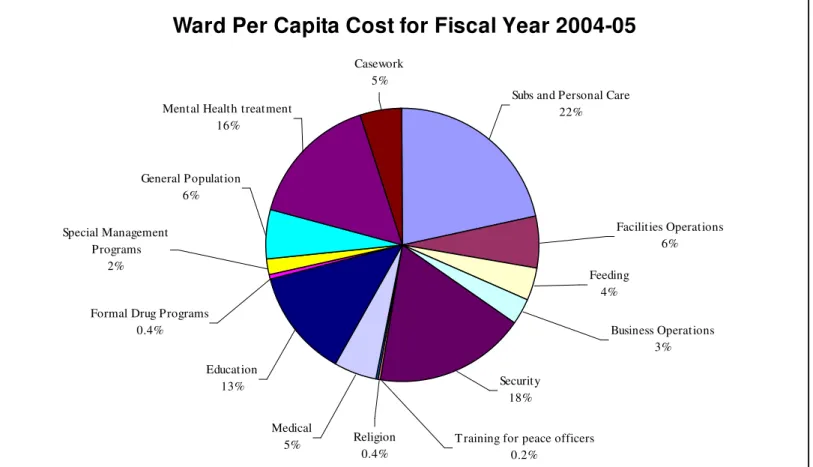
Ward Per Capita Cost for Fiscal Year 2004-05
Education 13% Formal Drug Programs
0.4% Special Management Programs 2% General Population 6%
Mental Health treatment 16%
Training for peace officers 0.2% Medical 5% Religion 0.4% Security 18% Business Operations 3% Feeding 4% Facilities Operations 6% Subs and Personal Care
22% Casework
5%
assistance to counties charged with parolee and other localized services (Schwarzenegger, 2005). Figure 5 below outlines the five key areas that comprise these expenditures: Institutions and Camps, Parole Services and Community Corrections, Education Services, DJJ Board, and Administration.
Figure 5. Budget Expenditure Areas
Expenditure in thousands
Institutions and Camps $310,525
Parole Services and Community Corrections 41,209
Education Services 44,522
DJJ Board 3,251
Administration 31,040
Distributed Administration -30,347
Total $400,200
In the most recently completed fiscal year, the ward per capita cost was $71,700, which included a wide range of custodial and treatment services (see Figure 6 below) (Allen, 2005).
4.4. County-level Services
Presently, most counties operate facilities and programs designed to serve youth whose offenses do not warrant placement in the DJJ. While many large counties are able to offer a wide range of custody and treatment services, smaller counties often face challenges in meeting the needs of their juvenile population alone. These systems have been in place for many years, and serve to divert nearly all arrested youth from being placed in the DJJ. In 2003, 221,875 youth were arrested in California and only 1,008 or 0.4% were placed under wardship at the DJJ (Lockyer, 2003). The others were released to probation departments, received counseling and were released, or were turned over to their parents or guardians. Counties that have been particularly successful in diverting youth from the DJJ employ a range of intervention options.
In addition to housing youth in juvenile halls or in-home detention programs, twenty-eight counties operate ranches and camps designed as a “ last chance” option for youth with repeat non-violent offenses or for whom the probation has deemed particularly promising for rehabilitation. Ranches and camps have varying rates of success.
4.4.1. Santa Cruz County, California
Santa Cruz County’ s juvenile corrections services are located within the Probation Department. It is guided by four values: family preservation, interagency collaboration and coordinated service delivery system, family involvement, and cultural competence. The continuum of services consists of early intervention, intake and detention, and supervision and special programs.
The early intervention programs are the Santa Cruz City Juvenile Diversion Program and the Watsonville City Juvenile Diversion Program. In Santa Cruz, the program is located at the Santa Cruz Police Department (SCPD) and is staffed by a county probation officer. The probation officer meets with the young person and his or her guardian upon arrest to determine how the intervention will be handled with the goal of diverting the young person from entering the formal probation and criminal justice system. In Watsonville, a non-profit student assistance agency called PajaroValley Prevention and Student Assistance has developed a program to serve
students within the school district. Here, a probation officer screens all juvenile arrest reports and citations and meets with all first offenders in person to determine the need for counseling and intervention services.
If a young person is arrested for anything beyond a first offense, an intake probation officer investigates the offender to decide whether he or she can be released prior to or detained until a court hearing. The intake probation officer has the option to use community service hours, counseling, essays, Peer Court, Neighborhood Accountability Boards, educational classes, diversion through the police department, or referral to the District Attorney in serious cases. After intake, youth have three options for custody: juvenile hall, home supervision and electronic monitoring, or the Youth Community Restoration Program (Y-CORP). If a youth is detained by the court in juvenile hall beyond ten days, a needs assessment determines whether he or she requires mental health counseling, substance abuse counseling, anger management groups, a victim awareness program, life skills program, job development programs, or a pre-placement program. Home supervision and electronic monitoring are mandated by the court to allow youth to remain in their homes under the supervision of probation aides. Youth have restricted options
for leaving their homes (generally for school, work, authorized treatment programs, or other approved appointments) and remain in these programs between citation and the conclusion of dispositional hearings.Y-CORP is an alternative to commitment days in juvenile hall where youth work on community restorative projects such as stream clearance and erosion control. Each day of work is performed in lieu of one day in juvenile hall. Y-CORP is also conducting a job training and mentoring project with local businesses to provide subsidized employment to youth instead of placement in juvenile hall.
Supervision and special programs are programs that contribute to reductions in juvenile crime in the county. These programs include a juvenile community court, increased police presence in some communities, regional general supervision, gang intervention, intensive supervision for high-risk offenders, placement prevention programs, out of home placements, and a juvenile job placement program.
These programs are often funded by joint sources, including matching grants and staff support from individual cities, mental health agencies, the federal government, and the State. The overall budget for juvenile probation services is approximately $5.3 million.
The probation department sought to reform its detention practices in four ways: reduced population in juvenile hall, reduced recidivism, reduced length of stay, and reduced Latino population of detainees. Between 1997 and 2005, the juvenile hall population fell from 61 to 18 wards in March 2005 and has reduced its average length of detention to 10 days, which is
detention programs completed their programs without re-offending and ninety-eight percent of youth in the electronic monitoring program completed all scheduled meetings and court dates. The average daily Latino population in juvenile hall decreased 49 percent between 1998 and 2003 (Rhoades, 2004).
4.4.2. Santa Clara County, California
Santa Clara County provides juvenile corrections services primarily within the Juvenile
Detention Division and the Juvenile Probation Division of the County’ s Probation Department. The Juvenile Detention Division operates the juvenile hall and several programs designed to divert some juvenile offenders from secure custody. The Juvenile Probation Division operates five programs: early intervention, supervision, treatment, rehabilitation, and record-sealing.
The Juvenile Detention Division is designed to serve youth in juvenile halls on a temporary basis, preferring to provide services to assist youth with their social reintegration back into the community and address their social, physical, behavioral, psychological, and emotional needs (SC Probation Department website). Before a young person is admitted to juvenile hall, a probation officer conducts a screening to determine whether he or she may be better served by release to a responsible adult or community release program. Many of the on-site programs are targeted to extremely specialized segments of the population and wards are placed in programs based on needs assessment. The assessment is conducted for youth held in juvenile hall for over 72 hours and is conducted with a multi-agency approach where youth are evaluated for
educational, substance abuse, mental health, referral, case management, and transition planning needs. The juvenile hall also houses some offenders who are being detained for a specific period
of time due to Court order. These youth have access to the same assessment and services as those being housed for transitional purposes prior to an adjudicatory or dispositional hearing.
On-site programs include substance abuse treatment and education, mental health treatment and counseling, planned parenthood, religious services and counseling, gang intervention, victim awareness, anger management, Girl Scouts, career planning, maintenance and community service work programs, Foster Grandparent Program, support network for battered women, outreach programs, cultural diversity programs, and literacy programs and are operated in part by community-based organizations.
Two detention alternatives operated by this division are the electronic monitoring program, where youth may be monitored remotely and participate in probation group counselor
supervision instead of being housed in juvenile hall and weekend maintenance and community service work programs for youth with minimal charges or offenses.
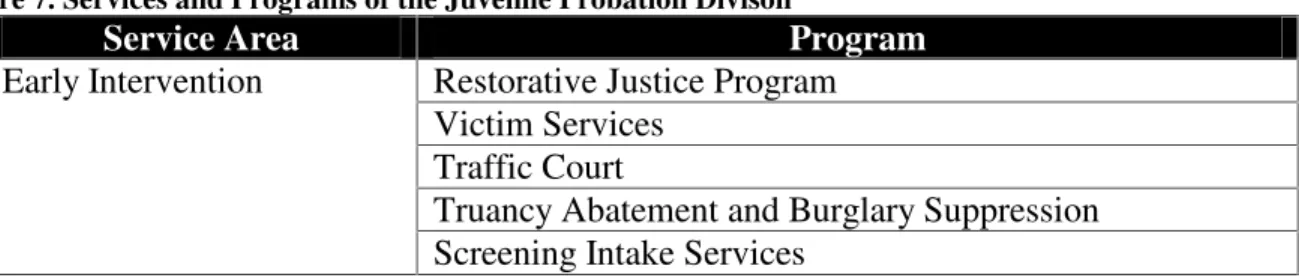
The Juvenile Probation Division operates programs that serve youth who are arrested but whose cases are not sent to the County’ s District Attorney for prosecution. Within its five service areas, the Division operates seventeen specialized programs and three levels of custodial services. Figure 7 below shows these programs by service area.
Figure 7. Services and Programs of the Juvenile Probation Divison
Service Area Program
Restorative Justice Program Victim Services
Traffic Court
Truancy Abatement and Burglary Suppression Early Intervention
Probation Supervision
Alternative Placement Academy
First Offender Close Up Services (FOCUS) Gang Violence Suppression
Court Support Supervision Services
Foster Care
Substance Abuse Services Mental Health Services
Domestic Violence and Family Violence Services Treatment Services
Youth Education Advocate Services (for special education)
Juvenile Rehabilitation Facilities
Ranch Adjustment and Orientation Programs Rehabilitation Services
Community-based Aftercare
Record-Sealing Services Record-sealing application and procedural support
In 2003, the juvenile hall had an average daily population of 242 wards (2003 annual report). The Department also served 412 youth in probation-related services, programs, and facilities. The total budget for Probation Services in 2003 was $95.4 million, which also provided for 927 FTE positions. For 2005, the budget proposes $95.7 million for 778 FTE positions and reduced service provision.
The Department is subject to performance-based budgeting by the County administration. As such, the department has identified five outcome measurements on which budgetary decisions are based: successful completion of probation, no new offenses, payment of victim restitution, completion of community service, and successful enrollment in school, training, or employment. Figure 8 below shows that for the period between 2003 and 2004, the department has succeeded in ensuring their services contribute to positive trends in almost all of these outcome areas.
Figure 8. Outcomes of Juvenile Probation Department
Outcome 2003 2004 Change
Rate of successful completion
of probation 89% 96% Increase 7%
Rate of payment of restitution
to victims 77% 79% Increase 2%
Rate of completion of
community service work 87% 93% Increase 6% Rate of successful enrollment in
school, training, or employment 96% 87% Decrease 9% Rate of clients with new
sustained petitions (recidivism) 38% 35% Decrease 3% 4.5. State-level Programs
Model state-level facilities operate under stringent state-mandated guidelines but represent a wide range of facility structures. Missouri and Utah have gained attention as model systems because they continually evaluate their programmatic offerings and for their ability to meet goals of treatment and confinement. Both states emphasize the importance of therapeutic rehabilitation and focus on ensuring youth who are released from their systems have a plan to deter them from the possibility of re-entry. Wards’ needs are assessed and treated in small regional facilities and incorporate the resources unique to that area that are beneficial to the ward’ s rehabilitation – their families, business and professional networks, and others. Finally, services are located within Human Services divisions on the state level, completely separate from adult corrections, recognizing the importance of the potential for juvenile offenders to be habilitated and
rehabilitated differently than adults.
4.5.1. State of Utah
The mission of the Division of Juvenile Justice Services is to provide comprehensive services for at risk youth within the framework of the Balanced and Restorative Justice Model. Community Protection, Accountability, and Competency Development, are integrated goals and
The Division has twelve guiding principles:
• Protect the community by providing the most appropriate setting for the youthful offender. • Provide secure, humane, and therapeutic confinement to a youth who has demonstrated that
he/she presents a danger to the community.
• Hold youth accountable for delinquent behavior in a manner consistent with public safety
through a system of graduated sanctions, rehabilitative measures, and victim restoration programs.
• Provide a continuum of diverse early intervention, community based, and secure correctional
programs.
• Promote a functional relationship between a youth and his/her family and/or assist the youth
in developing the skills for alternative or independent living.
• When it is in the best interest of the youth and community, provide placements in close
proximity to the youth’ s family and community.
• Promote ongoing research, evaluation, and monitoring of Division programs to determine
their effectiveness.
• Strengthen rehabilitative opportunities by expanding linkages to human service programs and
community resources.
• Provide assistance to the Juvenile Court in developing and implementing appropriate
offender dispositions.
• Provide for efficient and effective correctional programs within the framework of
professional correctional standards, legislative intent, and available resources.
• Promote continuing staff professionalism through the provision of educational and training
• Provide programs to increase public awareness and participation in Juvenile Justice Services. Governance
The care of Utah’s delinquent youths is primarily provided by Juvenile Court Probation, the Division of Child and Family Services, and the Division of Juvenile Justice Services. The Division of Child and Family Services has day care and residential services for dependent and neglected children. In addition, the Division of Child and Family Services provides services to youths under the age of 12 who have been found to be delinquent and youths over the age of 12 who are less seriously delinquent. Probation provides day treatment programs and supervision to youthful offenders. This population largely includes youths who are still in the homes of their parents or are in the custody of the Division of Child and Family Services. The Division of Juvenile Justice Services provides care for delinquent youths who require removal from home. It is a division of the Department of Human Services and the Board of Juvenile Justice Services is responsible for approving policy. The Division’s Director provides statewide policy leadership and administrative oversight. The Division was reorganized during FY 2001 to increase its efficiency and provide better services to delinquent youths and the community. The
reorganization led to a change from three regional offices with a coordinating central office to four programmatic offices: Early Intervention Services, Community Programs, Correctional Facilities, and Rural Programs.
Programs and Services
The Division’s residential programs range from community based programs to secure care. In addition, Juvenile Justice Services administers Utah’s receiving centers, youth service programs, locked detention, detention diversion programs, and residential work programs, providing graduated responses to youths in proportion to the severity of their behavior and according to
their needs for treatment. The continuum has evolved change in response to a variety of factors including resource availability, innovations in treatment and programming, community values, and changing demographics. In addition, initiatives of the Utah State Legislature and juvenile justice partners have sought to enhance the continuum and have changed the manner in which programming is applied.
Utah’ s Serious Youth Offender law, enacted by the 1995 Legislature, was designed to move some youths beyond the Juvenile Justice System and to provide more severe sanctions for the most serious juvenile offenders and to remove them from costly juvenile programs that appeared to be having little impact. To qualify as a serious youth offender, a youth must be at least 16 years of age at the time of an offense and meet one of three offense criteria. Youths who are at least 16 and meet either of the first two criteria are charged directly in the adult court system. Juveniles who are charged with one of the 10 serious felony offenses are initially given a hearing in Juvenile Court. If the State meets its burden to establish probable cause to believe that the juvenile committed one of the specified crimes, the Juvenile Court binds the juvenile over to the adult court system. Transfer can be avoided if the juvenile meets all three of the following criteria: (1) the minor has not previously been adjudicated delinquent for a felony offense involving the use of a dangerous weapon; (2) the offense was committed with one or more other persons and the youth appears to have a lesser degree of culpability than the confederates; and (3) the minor’ s offense was not committed in a violent, aggressive, or premeditated manner. Figure 9. Criteria for Qualification as a Serious Youth Offender
Criteria
1. Youth is charged with murder or aggravated murder.
2. Youth is charged with a felony-type offense after having been committed to a secure facility.
3. Youth is charged with at least one of 10 serious felony offenses.
a. Aggravated arson b. Aggravated assault c. Aggravated kidnapping d. Aggravated burglary e. Aggravated robbery f. Aggravated sexual assault g. Discharge of a firearm from a
vehicle
h. Attempted aggravated murder i. Attempted murder
j. Felony-type offense involving the use of a dangerous weapon
Population Served and Cost
During 2004, Utah’s population of 10 - 17 year old youths numbered 310,053, a slight increase above the number in 2003 (309,475). Beginning in 2004, the age group is expected to grow steadily and reach 341,000 by 2010. The majority of these youth (75%) live in four urban counties of Weber, Davis, Salt Lake, and Utah. Another 9.5% of all youths live in three of the state’s fastest growing counties, Cache, Washington, and Iron. Based on an analysis of
individuals who turned 18 during the 2003 calendar year, nearly 38% of Utah’s youths will have some contact with the juvenile justice system by age 18. Nearly 3% will be found by the Juvenile Court to be victims of dependency, neglect, or abuse. Over 29% will be charged with at least one offense and referred to the Juvenile Court. In a substantial number of cases, involvement with the Court will lead to in-home supervision by Juvenile Court probation or transfer of custody from parents to the Division of Juvenile Justice Services or the Division of Child and Family Services. (Annual Report, 2004).
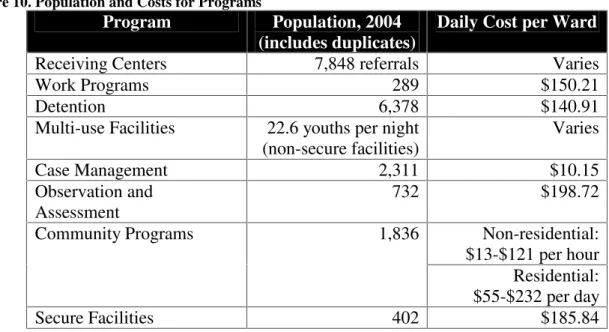
Figure 10. Population and Costs for Programs
Program Population, 2004
(includes duplicates) Daily Cost per Ward
Receiving Centers 7,848 referrals Varies
Work Programs 289 $150.21
Detention 6,378 $140.91
Multi-use Facilities 22.6 youths per night
(non-secure facilities) Varies
Case Management 2,311 $10.15 Observation and Assessment 732 $198.72 Non-residential: $13-$121 per hour Community Programs 1,836 Residential: $55-$232 per day Secure Facilities 402 $185.84 4.5.2. State of Missouri
The mission of the Division of Youth Services is to enable youth to fulfill their needs in a responsible manner within the context of and with respect for the needs of the family and the community. DYS programs are established to provide the mandated services enumerated in Chapter 219.016 in the Revised Statutes of the state of Missouri. These services include
assessment, care and treatment, and education of all youth committed to its care and custody by the juvenile courts and to those youth committed by the courts of general jurisdiction through dual sentencing provision. The division’ s primary goal is to provide a menu of residential and community services in numerous locations statewide to prevent re-offense.
The Missouri Constitution established the State Board of Training Schools in 1945 mandating for the first time the “ rehabilitation and guidance of juvenile offenders” . Through this mandate, the training schools were considered to be educational rather than penal institutions. In l974, the Division of Youth Services was created and located within the Department of Social Services.