106
Power optimization of wind mill turbine blade for
different cross section
Muhammad A.R Yass Hussein Ali Hussein Mahmood Abdulzahra Shkara Electromechanical Department , University of Technology
[email protected] [email protected] [email protected]
Abstract
The aim of this paper was to attain best optimization for twist angle and the chord of wind mill blade by using CFD code with Schmitz, Betz and .Lift to drag twist optimization along with Genetic Algorithm method. The technical point of view to change the cross section of the blade by using symmetry airfoil (NACA-0012), unsymmetrical airfoil (NACA-4412) and supercritical airfoil (Eppler-417). The best optimization Method was Schmitz chord optimization and lift to drag for twist optimization which increase the Cp 10.3% for Eppler 417 , 9.5% for NACA 4412 and 16% for NACA 0012. All results were plotted and tabulated for all optimization results.
Keywords: Optimal Design, Algorithms, Betz Schmitz Lift/Drag optimization, Wind Power, Computational Fluid Dynamics, Aerodynamic.
CFG Schmitz Betz Lift To Drag Genetic Algorithm Symmetrical Unsymmetrical Eppler-417 Schmitz Lift To Drag 3.01 Eppler-417 509 Unsymmetrical 31 Symmetrical
Schmitz Lift /Drage optimization , Betz
List of Symbols
Symbol Definition Units
ω angular speed Rad/sec
n rotational speed 1/sec
X tip speed ration ---
αD Angle of Attack deg
r Rotor Local radius m
CL coefficient of lift
C(r) Chord length m
Β(r) Pitch Angle deg
W wind Speed m/sec
Cx Coefficient of Axial Force ---
Cy Coefficient of Normal Force ---
P Power watts
M Torque N/m
v Axial Speed m/sec
u Normal Speed m/sec
Tangential Interference ---
CL Coefficient of Drag ---
107
Φ(r) Setting Angle deg
γ(r) Wind Angle deg
R Blade Length m
B No of blade ---
FL Lift Force N
FD Drag Force N
Vtip Velocity at tip of Blade m/sec
V1 Stream Velocity m/sec
Introduction
1. Betz optimizationFigure (1) shows the velocities and the angles in a given distance, r, from the rotor axis. The rotor shown on the figure is with two blades, i.e. B = 2. To design the rotor we have to define the pitch angle β and the chord length c. Both of them depend on the given radius, that we are looking at therefore we sometimes write β(r) and c(r).
Figure (1). Velocities and Angles
The blade, as shown on the figure is moving up wards, thus the wind speed, seen from the blade, is moving down wards with a speed of u. We have
(1)
Betz does not include rotation of the wind, i.e. a’ = 0
Therefore (2)
Now we define the “tip speed ration” i.e.
X (3) Combining these equations we get
(4) Or
(5) And then the pitch angle
Here ω is the angular speed of the roto given by
ω = 2π n Where n is the rotational speed of the rotor in and per second.
108
(6)
Where αD is the angle of attack, used for the design of the blade. Most often the
angle is chosen to be close to the angle, that gives maximum glide ration, see figure 2 that means in the range from 5 to 10°, but near the tip of the blade the angle is sometimes reduced.
Chord length, c(r):
If we look at one blade element in the distance r from the rotor axis with the thickness dr the lift force is ρ w2 c dr CL (7)
The drag force ρ w2 c dr CD (8)
For the rotor plane (torque) we have
(9)
(10) For the rotor axis (thrust) we have
(11)
(12) Now, in the design situation, we have CL >> CD, then (9) and (10) becomes
(13) And then the power produced
(14) If we have B blades, (3.16) including (3.17) gives
(15) According to Betz, the blade element would also give
(16) Using v1 = 3/2 w cos (γ) and u = w sin (γ), then (15) and (16) gives
(17)
Where CL, is the coefficient of lift at the chosen design angle of attack, αA, D.
Figure(4) Forces on the Blade Element Figure (3) Blade Section
109
2. Schmitz optimization
Schmitz has developed a little more detailed and sophisticated model of the flow in the rotor plane. The torque M in the rotor shaft can only be established because of the rotation of the wake, cf. Appendix A which is a result of the conservation law for angular momentum
The power can be calculated as (18)
Where M is the torque in the rotor shaft and ω is the angular speed. According to the conservation rule of angular momentum, the torque in the rotor shaft can only be established because of a swirl induced in the slipstream in the flow downstream of the rotor. As for the axial speed v it can be shown theoretically that the change in the tangential speed in the rotor plane is half of the total change, i.e. we have in the rotor plane
Or (19) (20) The factor is tangential interference
As mentioned previously index 1 is used for the upstream situation, index 2 and 3 for rotor plane and downstream respectively. In the following index 2 is sometimes omitted – for simplicity.
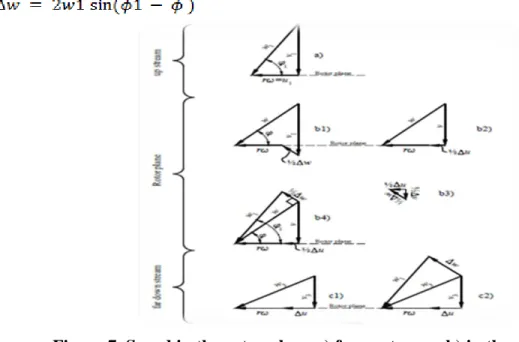
Now look at the flow in the rotor plane, what is important here is the relation = + (21)
The change in w1 is because of the airfoil effect. If we assume that the drag is very
low (compared to lift, i.e. CD << CL => CD ≈ 0) then the Δw vector is parallel to the lift force vector dFL (because of the conservation law of momentum) and we – per definition of the direction of lift force – also have that the Δw vector is perpendicular to w Based on these considerations we have the following geometrical relations
(22) (23) Combining (25) and (26) we get
(24)
Figure (6) Downstream Rotation of the Wake
110
(25)
Figure 7. Speed in the rotor plane a) far upstream; b) in the rotor plane and; c) far down stream
Now, let us look at the power! From the conservation of momentum we have (26) Where dq is the mass flow through the ring element in the radius r with the width dr, i.e.
(27) Power equals “torque multiplied by angular velocity” and (neglecting drag) then
(28) In the bottom transaction above we have used the relation sin(x) cos(x) = sin (2x). We have now a relation for the power of the ring element as a function of the angle φ but we do not know this angle? The trick is now to solve the equation d (dP)/dφ = 0 to find the angle that gives maximum power. Doing this for (28) we get
(29) From d (dP)/dφ = 0, it follows
Or (30) (31)
(32) Using the result of (24), (25) and (30) in (26) we get
(33) Where we again use sin (2x) = 2 sin(x) cos (x).
From the air foil theory we have
111
(34) Where we have used (22) and φ = 2/3φ1.
Combining (34) and (33) we get
(35)
Results and Discussions
Fig. (8) Power coefficient and tip speed ratio (TSR) at none twist opt, Schmitz opt for eppler417 airfoil.
Fig. (9) Power coefficient and tip speed ratio (TSR) at none twist opt, betz opt for eppler417 airfoil.
112
Fig. (10) Power coefficient and tip speed ratio (TSR) at lift/drag twist opt, none Chord opt for eppler417 airfoil.
Fig. (11) Power coefficient and tip speed ratio (TSR) at lift/drag twist opt, Schmitz opt for eppler417 airfoil.
Fig. (12) Power coefficient and tip speed ratio (TSR) at lift/drag twist opt, betz opt for eppler417 airfoil.
113
Fig. (13) Power coefficient and tip speed ratio (TSR) at none twist opt, Schmitz opt for NACA 4412 airfoil.
Fig. (14) Power coefficient and tip speed ratio (TSR) at none twist opt, betz opt for NACA 4412 airfoil.
Fig. (15) Power coefficient and tip speed ratio (TSR) at lift/drag twist opt, none Chord opt for NACA 4412 airfoil.
114
Fig. (16) Power coefficient and tip speed ratio (TSR) at lift/drag twist opt, Schmitz opt for NACA 4412 airfoil.
Fig. (17) Power coefficient and tip speed ratio (TSR) at lift/drag twist opt, betz opt for NACA 4412 airfoil.
Fig. (18) Power coefficient and tip speed ratio (TSR) at none twist opt, Schmitz opt for NACA 0012 airfoil.
115
Fig. (19) Power coefficient and tip speed ratio (TSR) at none twist opt, betz opt for NACA 0012 airfoil.
Fig. (20) Power coefficient and tip speed ratio (TSR) at lift/drag twist opt, none Chord opt for NACA 0012 airfoil.
Fig. (32) Power coefficient and tip speed ratio (TSR) at lift/drag twist opt, Schmitz opt for NACA 0012 airfoil.
116
Fig. (21) Power coefficient and tip speed ratio (TSR) at lift/drag twist opt, betz opt for NACA 0012 airfoil.
Fig. (22) Combination between None Fig. (23) Combination between none opt twist and none chord opt. twist opt and Schmitz chord opt.
Fig. (24) Combination between non Figs (25) combination between lift/drag Twist opt and betz chord opt. Twist opt and none chord opt.
117
Fig. (26) Combination between lift/drag Figs (27) combination between lift/drag twist opt and Schmitz chord opt. twist opt and Betz chord opt.
Fig. (28) Combination between None Fig. (29) Combination between none twist and none chord opt. Opt Twist opt and Schmitz chord opt.
Fig. (30) Combination between non Figs (31) combination between lift/drag Twist opt and betz chord opt. Twist opt and none chord opt.
Fig. (32) Combination between lift/drag Figs (33) combination between lift/drag Twist opt and Schmitz chord opt. Twist opt and betz chord opt.
118
Fig. (34) Combination between None Fig.(35) Combination between none twist and none chord opt. Twist opt and Schmitz chord opt.
Fig. (36) Combination between non Figs (37) combination between lift/drag Twist opt and betz chord opt. Twist opt and none chord opt.
Fig. (38) Combination between lift/drag Figs (39) combination between lift/drag Twist opt and Schmitz chord opt. Twist opt and betz chord opt. Table (1) combination between None twist optimize and none chord optimize for
Eppler 417 airfoil. Position (m) Chord (m) Optimized chord(m) Twist (deg) Optimized twist (deg) Non opt Cp Optimized Cp 1 0 0.1 0 0 0 0.014887 0 2 0.13 0.128 0 0 0 0.0346 0 3 0.23 0.114 0 0 0 0.078642 0 4 0.33 0.104 0 0 0 0.154333 0 5 0.43 0.086 0 0 0 0.281359 0 6 0.53 0.074 0 0 0 0.383703 0 7 0.63 0.066 0 0 0 0.444314 0 8 0.73 0.060 0 0 0 0.38085 0 9 0.83 0.057 0 0 0 0.315684 0 10 0.93 0.055 0 0 0 0.24123 0 11 1.03 0.055 0 0 0 0.152779 0 12 1.13 0.055 0 0 0 0.050189 0
119
Table (2) combination between non twist optimize and Schmitz chord optimize for Eppler 417 airfoil. Position (m) Chord (m) Optimized chord(m) Twist (deg) Optimized twist (deg) Non opt Cp Optimized cp 1 0 0.1 0.1 0 0 0.01488 7 0.014214 2 0.13 0.128 0.1608 0 0 0.0346 0.03282 3 0.23 0.114 0.1318 0 0 0.07864 2 0.073582 4 0.33 0.104 0.1143 0 0 0.15433 3 0.142813 5 0.43 0.086 0.0803 0 0 0.28135 9 0.266172 6 0.53 0.074 0.0665 0 0 0.38370 3 0.369098 7 0.63 0.066 0.0597 0 0 0.44431 4 0.431021 8 0.73 0.060 0.0565 0 0 0.38085 0.394001 9 0.83 0.057 0.0551 0 0 0.31568 4 0.327272 10 0.93 0.055 0.0529 0 0 0.24123 0.253994 11 1.03 0.055 0.0503 0 0 0.15277 9 0.16843 12 1.13 0.055 0.0484 0 0 0.05018 9 0.062451
Table (3) combination between none twist optimize and Betz chord optimize for eppler417 airfoil. Position (m) Chord (m) Optimized chord(m) Twist (deg) Optimized twist (deg) Non opt Cp Optimized cp 1 0 0.1 0.1 0 0 0.014887 0.014618 2 0.13 0.128 0.1953 0 0 0.0346 0.03356 3 0.23 0.114 0.1472 0 0 0.078642 0.074883 4 0.33 0.104 0.1335 0 0 0.154333 0.145248 5 0.43 0.086 0.0841 0 0 0.281359 0.270193 6 0.53 0.074 0.0668 0 0 0.383703 0.373505 7 0.63 0.066 0.0613 0 0 0.444314 0.432677 8 0.73 0.060 0.0576 0 0 0.38085 0.385637 9 0.83 0.057 0.0560 0 0 0.315684 0.30833 10 0.93 0.055 0.0536 0 0 0.24123 0.231625 11 1.03 0.055 0.0509 0 0 0.152779 0.140465 12 1.13 0.055 0.0488 0 0 0.050189 0.024818
Table (4) combination between lift/drag twist optimize and none chord optimize for eppler417 airfoil. Position (m) Chord (m) Optimized chord(m) Twist (deg) Optimized twist (deg) Non opt Cp Optimized cp 1 0 0.1 0 0 44.77 0.014887 0.020688 2 0.13 0.128 0 0 24.46 0.0346 0.049394 3 0.23 0.114 0 0 17.78 0.078642 0.115833 4 0.33 0.104 0 0 13.82 0.154333 0.248332 5 0.43 0.086 0 0 11.21 0.281359 0.348924 6 0.53 0.074 0 0 9.38 0.383703 0.379495 7 0.63 0.066 0 0 8.019 0.444314 0.391713 8 0.73 0.060 0 0 6.97 0.38085 0.432725 9 0.83 0.057 0 0 6.14 0.315684 0.41975 10 0.93 0.055 0 0 5.46 0.24123 0.39172 11 1.03 0.055 0 0 4.91 0.152779 0.32935 12 1.13 0.055 0 0 4.44 0.050189 0.260351
120
Table (5) combination between lift/drag twist optimize and Schmitz chord optimize for eppler417 airfoil.
Position (m) Chord (m) Optimized chord(m) Twist (deg) Optimized twist (deg) Non opt Cp Optimized cp 1 0 0.1 0.1 0 44.77 0.014887 0.032954 2 0.13 0.128 0.27049 0 24.46 0.0346 0.07942 3 0.23 0.114 0.22041 0 17.78 0.078642 0.192883 4 0.33 0.104 0.18223 0 13.82 0.154333 0.384023 5 0.43 0.086 0.15407 0 11.21 0.281359 0.45869 6 0.53 0.074 0.13294 0 9.38 0.383703 0.465429 7 0.63 0.066 0.11666 0 8.019 0.444314 0.490052 8 0.73 0.060 0.10381 0 6.97 0.38085 0.462652 9 0.83 0.057 0.09344 0 6.14 0.315684 0.405513 10 0.93 0.055 0.08490 0 5.46 0.24123 0.301678 11 1.03 0.055 0.07778 0 4.91 0.152779 0.216395 12 1.13 0.055 0.07175 0 4.44 0.050189 0.109162
Table (6) combination between lift/drag twist and Betz chord optimize for eppler417 Position (m) Chord (m) Optimized chord(m) Twist (deg) Optimized twist (deg) Non opt cp Optimized cp 1 0 0.1 0.1 0 44.77 0.014887 0.033917 2 0.13 0.128 0.3285 0 24.46 0.0346 0.081512 3 0.23 0.114 0.2460 0 17.78 0.078642 0.198014 4 0.33 0.104 0.1954 0 13.82 0.154333 0.401821 5 0.43 0.086 0.1616 0 11.21 0.281359 0.460007 6 0.53 0.074 0.1376 0 9.38 0.383703 0.462543 7 0.63 0.066 0.1198 0 8.019 0.444314 0.482884 8 0.73 0.060 0.1060 0 6.97 0.38085 0.450525 9 0.83 0.057 0.0950 0 6.14 0.315684 0.389835 10 0.93 0.055 0.0861 0 5.46 0.24123 0.210473 11 1.03 0.055 0.0787 0 4.91 0.152779 0.129527 12 1.13 0.055 0.0724 0 4.44 0.050189 -0.03285
Table (7) combination between none twist and none chord optimize for NACA 4412 Position (m) Chor d(m) Optimized chord(m) Twist( deg) Optimized twist (deg) Non opt cp Optimized Cp 1 0 0.1 0 0 0 0.014714 0 2 0.13 0.128 0 0 0 0.046631 0 3 0.23 0.114 0 0 0 0.140096 0 4 0.33 0.104 0 0 0 0.285899 0 5 0.43 0.086 0 0 0 0.417685 0 6 0.53 0.074 0 0 0 0.492292 0 7 0.63 0.066 0 0 0 0.46395 0 8 0.73 0.060 0 0 0 0.404959 0 9 0.83 0.057 0 0 0 0.34101 0 10 0.93 0.055 0 0 0 0.29121 0 11 1.03 0.055 0 0 0 0.157782 0 12 1.13 0.055 0 0 0 0.059998 0
121
Table (8) combination between none twist and shmitz chord optimize for NACA 4412 Position (m) Chord (m) Optimized chord(m) Twist( deg) Optimized twist (deg) Non opt cp Optimized cp 1 0 0.1 0.1 0 0 0.014714 0.0121 2 0.13 0.128 0.1608 0 0 0.046631 0.038457 3 0.23 0.114 0.1318 0 0 0.140096 0.116077 4 0.33 0.104 0.1143 0 0 0.285899 0.241517 5 0.43 0.086 0.0803 0 0 0.417685 0.362942 6 0.53 0.074 0.0665 0 0 0.492292 0.456121 7 0.63 0.066 0.0597 0 0 0.46395 0.496897 8 0.73 0.060 0.0565 0 0 0.404959 0.451815 9 0.83 0.057 0.0551 0 0 0.34101 0.392289 10 0.93 0.055 0.0529 0 0 0.29121 0.330744 11 1.03 0.055 0.0503 0 0 0.157782 0.251474 12 1.13 0.055 0.0484 0 0 0.059998 0.159009 Table (9) combination between none twist and Betz chord optimize for NACA 4412
Position Chord Optimized chord(m)
Twist Opt twist (deg) Nonopt cp Optimized 1 0 0.1 0.1 0 0 0.014714 0.012436 2 0.13 0.128 0.1953 0 0 0.046631 0.03931 3 0.23 0.114 0.1472 0 0 0.140096 0.118296 4 0.33 0.104 0.1335 0 0 0.285899 0.246012 5 0.43 0.086 0.0841 0 0 0.417685 0.369488 6 0.53 0.074 0.0668 0 0 0.492292 0.462925 7 0.63 0.066 0.6131 0 0 0.46395 0.49202 8 0.73 0.060 0.0576 0 0 0.404959 0.439679 9 0.83 0.057 0.0560 0 0 0.34101 0.379403 10 0.93 0.055 0.0536 0 0 0.29121 0.303125 11 1.03 0.055 0.0509 0 0 0.157782 0.224856 Table (10) combination between lift/drag twist and none chord optimize for NACA
4412 Position (m) Chord (m) Optimized chord(m) Twist (deg) Optimized twist (deg) Non opt cp Optimized cp 1 0 0.1 0 0 44.77 0.014714 0.017668 2 0.13 0.128 0 0 24.46 0.046631 0.053726 3 0.23 0.114 0 0 17.78 0.140096 0.160656 4 0.33 0.104 0 0 13.82 0.285899 0.327199 5 0.43 0.086 0 0 11.21 0.417685 0.451364 6 0.53 0.074 0 0 9.38 0.492292 0.505915 7 0.63 0.066 0 0 8.019 0.46395 0.504498 8 0.73 0.060 0 0 6.97 0.404959 0.458572 9 0.83 0.057 0 0 6.14 0.34101 0.40566 10 0.93 0.055 0 0 5.46 0.29121 0.346607 11 1.03 0.055 0 0 4.91 0.157782 0.274614 12 1.13 0.055 0 0 4.44 0.059998 0.186755
122
Table (11) combination between lift/drag twist and Schmitz chord optimize NACA 4412 Position (m) Chord (m) Optimized chord(m) Twist (deg) Optimized twist (deg) Non opt cp Optimized cp 1 0 0.1 0.1 0 44.77 0.014714 0.017108 2 0.13 0.128 0.27049 0 24.46 0.046631 0.050579 3 0.23 0.114 0.22041 0 17.78 0.140096 0.149095 4 0.33 0.104 0.18223 0 13.82 0.285899 0.311193 5 0.43 0.086 0.15407 0 11.21 0.417685 0.435322 6 0.53 0.074 0.13294 0 9.38 0.492292 0.495229 7 0.63 0.066 0.11666 0 8.019 0.46395 0.508197 8 0.73 0.060 0.10381 0 6.97 0.404959 0.473028 9 0.83 0.057 0.09344 0 6.14 0.34101 0.419267 10 0.93 0.055 0.08490 0 5.46 0.29121 0.36353 11 1.03 0.055 0.07778 0 4.91 0.157782 0.292848 12 1.13 0.055 0.07175 0 4.44 0.059998 0.206172 Table (12) combination between lift/drag twist and Betz chord optimize for NACA
4412 Position (m) Chor d (m) Optimized chord(m) Twist (deg) Optimized twist (deg) Non opt cp Optimized cp 1 0 0.1 0.1 0 44.77 0.014714 0.017729 2 0.13 0.128 03285 0 24.46 0.046631 0.052127 3 0.23 0.114 0.2460 0 17.78 0.140096 0.153206 4 0.33 0.104 0.1954 0 13.82 0.285899 0.31984 5 0.43 0.086 0.1616 0 11.21 0.417685 0.441032 6 0.53 0.074 0.1376 0 9.38 0.492292 0.496225 7 0.63 0.066 0.1198 0 8.019 0.46395 0.503986 8 0.73 0.060 0.1060 0 6.97 0.404959 0.463603 9 0.83 0.057 0.0950 0 6.14 0.34101 0.404833 10 0.93 0.055 0.0861 0 5.46 0.29121 0.3406 11 1.03 0.055 0.0787 0 4.91 0.157782 0.276464
Table (13) combination between none twist and none chord optimize for NACA 0012 Position (m) Chord (m) Optimized chord(m) Twist (deg) Optimized twist (deg) Not opt cp Optimized cp 1 0 0.1 0 0 0 0.000174 0 2 0.13 0.128 0 0 0 -0.00408 0 3 0.23 0.114 0 0 0 0.006821 0 4 0.33 0.104 0 0 0 0.149255 0 5 0.43 0.086 0 0 0 0.275467 0 6 0.53 0.074 0 0 0 0.371223 0 7 0.63 0.066 0 0 0 0.421798 0 8 0.73 0.060 0 0 0 0.435749 0 9 0.83 0.057 0 0 0 0.413793 0 10 0.93 0.055 0 0 0 0.36963 0 11 1.03 0.055 0 0 0 0.336319 0 12 1.13 0.055 0 0 0 0.290134 0
123
Table (14) combination between none twist and Schmitz chord optimize for NACA 0012 Position (m) Chord (m) Optimized chord(m) Twist (deg) Optimized twist (deg) Not opt cp Optimized cp 1 0 0.1 0.1 0 0 0.000174 -0.00045 2 0.13 0.128 0.2808 0 0 -0.00408 -0.00657 3 0.23 0.114 0.2210 0 0 0.006821 0.016584 4 0.33 0.104 0.0899 0 0 0.149255 0.191419 5 0.43 0.086 0.0799 0 0 0.275467 0.318112 6 0.53 0.074 0.0782 0 0 0.371223 0.388399 7 0.63 0.066 0.0766 0 0 0.421798 0.417243 8 0.73 0.060 0.0746 0 0 0.435749 0.390651 9 0.83 0.057 0.0737 0 0 0.413793 0.341254 10 0.93 0.055 0.0733 0 0 0.36963 0.289406 11 1.03 0.055 0.0745 0 0 0.336319 0.225732 12 1.13 0.055 0.0758 0 0 0.290134 0.143907 Table (15) combination between none twist and Betz chord optimize for NACA 0012
Position (m) Chor d (m) Optimized chord(m) Twist (deg) Optimized twist (deg) Not opt cp Optimized cp 1 0 0.1 0.1 0 0 0.000174 -0.00071 2 0.13 0.128 0.3411 0 0 -0.00408 -0.00738 3 0.23 0.114 0.2467 0 0 0.006821 0.015674 4 0.33 0.104 0.0965 0 0 0.149255 0.191311 5 0.43 0.086 0.0838 0 0 0.275467 0.317766 6 0.53 0.074 0.0809 0 0 0.371223 0.38558 7 0.63 0.066 0.0786 0 0 0.421798 0.436423 8 0.73 0.060 0.061 0 0 0.435749 0.374287 9 0.83 0.057 0.0739 0 0 0.413793 0.325118 10 0.93 0.055 0.0743 0 0 0.36963 0.260124 11 1.03 0.055 0.0754 0 0 0.336319 0.196855 Table (16) combination between lift/drag twist and none chord optimize for NACA
0012 Position (m) Chor d (m) Optimized chord(m) Twist (deg) Optimized twist (deg) Not opt cp Optimized cp 1 0 0.1 0 0 0 0.000174 0.001161 2 0.13 0.128 0 0 17.46 -0.00408 -0.00258 3 0.23 0.114 0 0 10.78 0.006821 -0.008 4 0.33 0.104 0 0 6.82 0.149255 0.14141 5 0.43 0.086 0 0 4.21 0.275467 0.353794 6 0.53 0.074 0 0 2.38 0.371223 0.458744 7 0.63 0.066 0 0 1.019 0.421798 0.478665 8 0.73 0.060 0 0 -0.027 0.435749 0.462643 9 0.83 0.057 0 0 -0.86 0.413793 0.42578 10 0.93 0.055 0 0 -1.53 0.36963 0.380246 11 1.03 0.055 0 0 -2.09 0.336319 0.328655 12 1.13 0.055 0 0 -2.56 0.290134 0.269691
124
Table (17) combination between lift/drag twist and Schmitz chord optimize NACA 0012 Position (m) Chord (m) Optimize d chord(m) Twist (deg) Optimized twist (deg) Not opt cp Optimized cp 1 0 0.1 0.1 0 0 0.000174 0.001493 2 0.13 0.128 0.1939 0 17.46 -0.00408 -0.0026 3 0.23 0.114 0.1580 0 10.78 0.006821 -0.00862 4 0.33 0.104 0.1306 0 6.82 0.149255 0.161339 5 0.43 0.086 0.1105 0 4.21 0.275467 0.398831 6 0.53 0.074 0.0953 0 2.38 0.371223 0.479487 7 0.63 0.066 0.0836 0 1.019 0.421798 0.489343 8 0.73 0.060 0.0744 0 -0.027 0.435749 0.441659 9 0.83 0.057 0.0670 0 -0.86 0.413793 0.399568 10 0.93 0.055 0.0608 0 -1.53 0.36963 0.347289 11 1.03 0.055 0.0557 0 -2.09 0.336319 0.272019 12 1.13 0.055 0.0514 0 -2.56 0.290134 0.212296 Table (18) combination between lift/drag twist and Betz chord optimize NACA 0012
Position (m) Chord (m) Optimized chord(m) Twist (deg) Optimized twist (deg) Not opt cp Optimized cp 1 0 0.1 0.1 0 0 0.000174 0.001512 2 0.13 0.128 0.2355 0 17.46 -0.00408 -0.00276 3 0.23 0.114 0.1764 0 10.78 0.006821 -0.00911 4 0.33 0.104 0.1401 0 6.82 0.149255 0.163139 5 0.43 0.086 0.1159 0 4.21 0.275467 0.407402 6 0.53 0.074 0.0987 0 2.38 0.371223 0.478764 7 0.63 0.066 0.0858 0 1.019 0.421798 0.475984 8 0.73 0.060 0.0760 0 -0.027 0.435749 0.431522 9 0.83 0.057 0.0681 0 -0.86 0.413793 0.381167 10 0.93 0.055 0.0617 0 -1.53 0.36963 0.325524 11 1.03 0.055 0.0564 0 -2.09 0.336319 0.243131 Table (19). The optimization results showed with the following tables for Eppler 417
Non optimized cp
Optimized cp
Optimization method Percentage of optimization (% ) 1 0.4443 0.4310 Non twist opt , Schmitz chord
opt
-3 2 0.4443 0.4327 Non twist opt , Betz chord opt -2.6 3 0.4443 0.3917 Lift/drag twist opt , non-chord
opt
-11.8 4 0.4443 0.4901 Lift/drag twist opt , Schmitz
chord opt
10.3 5 0.4443 0.4829 Lift/drag twist opt , betz chord
opt
8.7
125
Table (20) For NACA 4412 airfoil Non optimized
cp
Optimized cp
Optimization method Percentage of optimization (% ) 1 0.464 0.4969 Non twist opt , Schmitz
chord opt
7 2 0.464 0.492 Non twist opt , betz chord
opt
6 3 0.464 0.5045 Lift/drag twist opt ,
non-chord opt
8.7 4 0.464 0.5082 Lift/drag twist opt , Schmitz
chord opt
9.5 5 0.464 0.504 Lift/drag twist opt , betz
chord opt
8.6 Table (21) For NACA 0012 airfoil
Non optimized cp
Optimized cp
Optimization method Percentage of optimization (% ) 1 0.4218 0.4172 Non twist opt , Schmitz
chord opt
-1 2 0.4218 0.4364 Non twist opt , betz chord
opt
3.5 3 0.4218 0.4787 Lift/drag twist opt ,
non-chord opt
13.5 4 0.4218 0.4893 Lift/drag twist opt ,
Schmitz chord opt
16 5 0.4218 0.4760 Lift/drag twist opt , betz
chord opt
13
Discussion
The aerodynamic design point of view for all wind turbine blade is the airfoil section which is the more sophisticate aerodynamic principles to capture the winds energy more effectively .L/D ratio is the technical point of selecting the airfoil and doesn’t matter what type of airfoil select except some side view point which also important and its related to L/D ratio like amount of angle at each section of wind mill blade for giving high L/D ratio, so the significant point to select the maximum L/D ratio range from the working area of the airfoil section and the amount of angle at that range that gives quieter and capable of generating more power from less wind speed, so it gives higher TSR many factor to e consider for chord optimization one of these factor tangential interference because the rotation of the wind does exist, number of blade which present the frontal area facing the wind, also the blade length which is manger parameter to be consider for chord optimization.
Betz consider the tangential interference equal to zero and Schmiz consider the coefficient of equal to zero that was the reason Schmitz method gives largest chord than the Betz method .Lift/drag take the best L/D angles operate the airfoil section only with that angle by that technical this method was the best for twist angle optimization.
Twist angle which based on L/D ratio is the significant parameter to calculate for chord optimization. Also the curvature of airfoil section is much important for optimization that why the proper one (symmetry) gives the highest value and Eppler 417 gives less value due to its complicated curvature
All these parameter, optimization method betz, Schmitz lift/drag twist optimization and genetic algorithm have been built to gather to get best result for highest coefficient of power.
126
Conclusion
- Best windmill blade airfoil selection should be at high L/D and low angle of attack. - Highest CP can be attained if optimization done for twist angle and for chord length
together
- Highest CP optimization value always occur at mid length of blade(approximately 55% of blade length
- Optimization increase the CP value about 10-16%
- Optimum methods increase the root chord approximately 100% at the root and 30% at the tip
Reference
Burton T., Sharpe D., Jenkins N., and Bossanyi E. , 2001. Wind Energy Handbook. Jhon Wiley & Sons.
Jonkman J. M. ,December 2003,Modelling of the UAE wind turbine for refinement of FAST AD. Technical Report NREL/TP-500-34755, National Renewable Energy Laboratory
Schepers J.G. et.al. , February 2002,. Final report of IEA Annex XVIII: ’Enhanced field rotor aerodynamics database’. Technical Report ECN-C-02-016, Energy research Centre of The Netherlans.
Bak C., Gaunna M., Anderson P. ,Buhl T., Hansen P.,Clemensen K., and Moeller R. 8-11 January 2007, Wind tunnel test on wind turbine airfoil with adaptive trailing edge geometry, 45th AIAA Aerospace Sciences Meeting and Exhibit, Reno, Nevada,
.