ON DATA CACHING FOR MOBILE CLOUDS
A Thesis by YING FENG
Submitted to the Office of Graduate and Professional Studies of Texas A&M University
in partial fulfillment of the requirements for the degree of MASTER OF SCIENCE
Chair of Committee, Alexander Sprintson Co-Chair of Committee, Radu Stoleru
Committee Member, I-Hong Hou Head of Department, Chanan Singh
May 2014
Major Subject: Computer Engineering
ABSTRACT
Recent advances in smart device technologies have enabled a new computing paradigm in which large amounts of data are stored and processed on mobile de-vices. Despite the available powerful hardware, the actual capabilities of mobile devices are rather limited as they are often battery powered. This work explores data caching for k-out-of-n computing in mobile cloud environments, with the goal of distributing data in a way that the expected future energy consumption for nodes to retrieve data is minimized, while preserving reliability. More specifically, we pro-pose to place data caches (in addition to the originally stored data) based on the actual data access patterns and the network topology. Consequently, we formulate the cache placement optimization problem and propose a centralized caching frame-work that optimally solves the problem and a distributed solution that approximates the optimal solution. The distributed caching framework (DC) learns data access patterns by sniffing packets and informing a resident cache daemon about popular data items. Extensive evaluations are carried out through both simulations and a proof-of-concept hardware implementation. The results show that our proposed
D-C effectively improves the energy efficiency by up to 70% when compared with a no-caching framework, and even outperforms the centralized framework when taking the overhead into account.
DEDICATION
To My Parents, Teachers That Were,
Teachers That Are and
ACKNOWLEDGEMENTS
I wish to thank my advisor Dr. Radu Stoleru, without whom this work would have been an unrealized dream. His methods of intuitive thinking, research methodology and outlook on life will be something I will treasure and learn from in the years to come. I would like to thank him for accepting me into the LENSS lab, which provided me with the necessary exposure to the field of mobile cloud. I would also like to thank Dr. Alexander Sprintson and Dr. I-Hong Hou for being part of my committee.
I also wish to thank all the members in the Laboratory for Embedded Networked Sensor Systems, especially Jay Chen, for their support and help during the course of my study. This work would not have been possible without their constructive advice and criticism.
I wish to thank my parents for their constant love, support and encouragement. Last, but not the least, I would like to acknowledge my friends, for making my stay in College Station memorable and fun-filled.
TABLE OF CONTENTS Page ABSTRACT . . . ii DEDICATION . . . iii ACKNOWLEDGEMENTS . . . iv TABLE OF CONTENTS . . . v
LIST OF FIGURES . . . vii
LIST OF TABLES . . . viii
1. INTRODUCTION . . . 1
2. STATE-OF-ART . . . 5
3. PRELIMINARIES AND PROBLEM FORMULATION . . . 8
3.1 Overview and General Definitions . . . 8
3.2 Cache Placement Formulation . . . 9
3.3 Cache Placement Policy . . . 10
4. CENTRALIZED/IDEAL CACHING FRAMEWORK . . . 12
5. DISTRIBUTED CACHING FRAMEWORK . . . 14
5.1 System Architecture . . . 14
5.2 Statistics Collection . . . 16
5.3 Distributed Cache Placement . . . 17
5.3.1 When will a fragment cache be created? . . . 17
5.3.2 How to coordinate the cache placement . . . 18
5.3.3 How to select a cache agent . . . 19
5.4 Distributed Cache Replacement . . . 19
5.5 Integrated Solution . . . 20
6. SIMULATION RESULTS . . . 22
6.1 Effect of Requests Number . . . 22
6.2 Effect of Buffer Size . . . 24
7. SYSTEM IMPLEMENTATION AND EVALUATION . . . 29 8. CONCLUSIONS AND FUTURE WORK . . . 34 REFERENCES . . . 35
LIST OF FIGURES
FIGURE Page
1.1 An overview of data allocation for k-out-of-n computing framework. . 2 5.1 System architecture of cross-layer design for proposed distributed caching
framework . . . 15 5.2 An example of cache placement in distributed caching framework . . 17 6.1 Effect of requests number on (a). Energy Consumption; (b). Retrieval
Rate; (c). Prefetching Overhead; (d). Total Caches. The test scenario is based on 14 nodes, 12 files, and the buffer size is set to be holding up to 24 fragments. . . 24 6.2 Effect of buffer size on (a). Energy Consumption; (b). Retrieval Rate;
(c). Prefetching Overhead; (d). Total Caches. The test scenario is based on 14 nodes, 12 files, and the number of requests is fixed to 600. 26 6.3 Effect of nodes number on (a). Energy Consumption; (b). Retrieval
Rate; (c). Prefetching Overhead; (d). Total Caches. The test scenario is based on 12 files, 600 requests, and the buffer size is set to be holding up to 24 fragments. . . 28 7.1 Router deployment and network topology . . . 31
LIST OF TABLES
TABLE Page
3.1 Summary of Notations . . . 9
5.1 Features and Sniffing Specifics of Packets . . . 16
6.1 Simulation Parameters and Basic Setting . . . 23
6.2 Energy Savings under the Effect of Requests Number . . . 25
6.3 Energy Savings under the Effect of Buffer Size . . . 27
6.4 Energy Savings under the Effect of Nodes Number . . . 27
1. INTRODUCTION
Mobile clouds provide an alternate solution for cloud computing (e.g., big data storage and processing) in environments where internet or high performance com-puters are unavailable. When the infrastructure network is damaged or unavailable in scenarios such as disaster responses [25] and battlefields [24], an infrastructureless mobile cloud formed by mobile devices becomes an attractive option. However, data access in a mobile cloud encounters several challenges such as intermittent connec-tion, mobility, unreliable devices, and limited energy resources. Depending on the dynamic nature of the network, the route between nodes may change or it may be unstable over time. Nodes in the network can be inaccessible due to energy depletion, software/hardware failure, or mobility, leading to more broken links. Consequently, these must be taken into account when planning to allocate data or provide services in a mobile cloud.
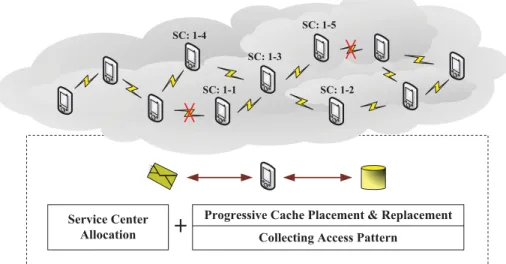
As nodes in a wireless network may become inaccessible, additional mechanisms for ensuring data reliability must be employed. A k-out-of-n system [8] is a widely used and well-studied technique in many engineering fields when developing a fault-tolerant system. It describes an n-component system that can function properly as long as k (k ≤ n) or more of the n components function properly. The k-out-of-n concept is also applied to distributed storage system where each file is encoded into n fragments by erasure coding and stored ton different nodes, called service centers (SC). When a client node needs to access a file, it retrieves k fragments from k different SCs and reconstruct the file locally. In such a manner, the functionality of the system is guaranteed as long as k or more SCs are accessible. Figure 1.1 shows an overview of data allocation in ak-out-of-ncomputing framework, in whichn = 5,
Figure 1.1: An overview of data allocation for k-out-of-n computing framework. k = 3, and each fragment is represented asfileId−fragId.
Because each node has a different failure probability and different distances to the client nodes, the locations of service centers directly affect the energy efficiency and data availability of the system. The k-out-of-n distributed storage system in [5] places the service centers in a way to minimize the expected energy consumption for client nodes for accessing the service centers. They assumed the network is homogeneous and all nodes have equal probability to request each file. However, in reality, not all nodes request all files and some files may be requested only by a small portion of nodes. For instance, given a network of rectangle shape, if the files are requested only by client nodes located at the shorter edges of the rectangle, it will be extremely energy inefficient to place service centers at the center of the network. Additionally, for security concerns, client nodes are not allowed to keep the decoded files locally and nodes always need to retrieve the data fragments from the service centers whenever a file is needed for reading. This security constraint causes an unavoidable high energy consumption and heavy network traffics. To address these challenges, we propose to cache some “popular” data fragments in the network and
allow client nodes to retrieve data fragments from nearby caching nodes instead of always going to the farther service centers.
Our caching strategy is designed based on two observations: temporal locality of file access and the group mobility exhibited by nodes. Temporal locality of file access means that a file recently accessed by a node is likely to be accessed again by the same node in the near future. Thus collecting statistics, i.e., how files were accessed by nodes in the past, lays ground for predicting the future. Group mobility exhibited by nodes indicates that nodes often move as a group instead of moving individually. As a result, placing cached data within a group of nodes that tend to move together can also greatly improve the performance.
To the best of our knowledge, we are the first to investigate the data caching fork -out-of-ncomputing. Our objective is to determine the data to be cached and to select the caching nodes in a mobile network such that the expected energy consumption for nodes to access the data is minimized. Our proposed solutions monitor the file request activities and make caching decisions based on the past statistics and the failure probabilities of nodes. We first formulate the problem as an Integer Linear Programming (ILP) problem and solve it using a centralized caching algorithm (CC). We then propose a lightweight and distributed caching framework in which nodes learn the files’ popularity in a distributed manner and cooperate with each other to decide the cache placement. Finally, as the cache buffer is finite, the least frequently used (LFU) algorithm is adopted for buffer management.
The proposed solutions are evaluated through a real hardware implementation and extensive simulations. For hardware implementation, a daemon that perform-s the cache placement and replacement iperform-s implemented aperform-s a Linux kernel module. A modified Kernel-AODV module [22] was used as the routing protocol. A cross-layer communication allows the network cross-layer to pass the sniffed information to our
middleware (above the transport layer, and below the application layer). Both the cache daemon and Kernel-AODV are running on the RouterBoard 433UAH hard-ware and evaluated in a network of 8 nodes. Through extensive simulations, we evaluate the impacts from parameters such as the number of requests, buffer size, and network size. We compare our distributed caching framework with a no-caching scheme, centralized caching and ideal-caching in terms of energy consumption and data availability.
The rest of this thesis is organized as follows. Section 2 presents the related works. Section 3 formulates the optimal cache placement problem fork-out-of-nsystem and provides an effective placement policy. In Section 4, two caching frameworks, a centralized caching and an ideal caching are presented. In Section 5, a distributed cache framework is proposed. Section 6 presents performance evaluation results from simulations. Section 7 presents the hardware implementation and evaluation. Finally, section 8 concludes the thesis and discusses future work.
2. STATE-OF-ART
Data caching has been widely used in Internet to enhance the performance of web services [15] [14] [19]. However, there have not been many research efforts dedicated to mobile environments.
Dowdy and Foster [12] were among the first to study the cache placement for cooperative networks. The optimality of this problem in terms of access cost has its root in the multi-facility location problem [3] [1], which is NP hard. Baev et al. [2] proposed a 10-approximation algorithm for placing replicas in arbitrary networks by taking into account data access frequency and node storage capacity. Tang et al. [26] improved this by delivering a 4-approximation (2-approximation for uniform-size data items) solution. Both algorithms considered cache placement for multiple data items, but they became inapplicable in situations where data did not come in batches. Jin et al. [20] mathematically proved that the number of replicas of each item in the optimal solution is proportional top2/3, wherepis the access probability of the item, and verified its huge performance gains when compared with the proportional replication strategy. Taking advantage of these results, our work also integrate the peculiar characteristics of mobile environment, i.e. unstable links, node mobility, and energy constraint, into our model.
Yin et al. [27] proposed three caching schemes: CacheData, CachePath, and HybridCache. The idea is to analyze passing-by data and cache either data or path to a known cache node. However, the design was focused on the system point of view and did not take into account the complexity of on-the-fly caching. A less aggressive caching scheme is to maintain caches only on the client sides, to which we refer as cache-on-clients. COOP is an example of such schemes for mobile ad-hoc networks
proposed by Du et al. [13]. To avoid overflowing active clients’ buffer, COOP applied both inter and intra category rules to reduce duplicates within the cooperation zone. Another similar scheme, COCA presented by Chow et al. [7], employed a different strategy for buffer control. Two types of mobile clients, low activity mobile clients (LAM) and high activity mobile clients (HAM) were identified. A centralized server replicates appropriate data items to LAMs so that HAMs can make use of them. Building upon COCA, GroCoCa [6] introduced the concept of tightly-coupled group (TCG), defined as a set of peers pursuing a similar movement pattern and exhibiting a similar data affinity. Cache cooperation was then performed within TCGs. The major drawback of cache-on-clients schemes was that their performance degrades when servicing multiple highly-active clients concurrently.
The aforementioned research implicitly or explicitly assumed a group-based mo-bility [17] model. Hara [16] quantified the impact of node momo-bility on data avail-ability in mobile ad-hoc networks. The result revealed that the Reference Point Group Mobility model had larger partition sizes and higher connectivity compared to other mobility models. As a result, cooperative caching is intrinsically suitable for Group Mobility model. Our work also assumes a group-mobility model, but should be categorized as an “in-between” algorithm between the cache-on-the-fly and the
cache-on-clients. We allow caches to be placed along the paths from clients to the
data source, but the caching activity happens after the observation of popular data. Additionally, more factors have been considered for cache agent selection, including the distance to the clients, failure probability, buffer availability and data security.
When considering the reliability of a distributed storage system, Dimakis et al. proposed several erasure coding algorithms, together with their maintenance schemes for distributed storage [10] [9] [11]. Erasure coding was essentially the theory behind the k-out-of-n data storage in mobile computing. MDFS [18] was the first work
to create a distributed file system on mobile devices. Chen et al. [4] [5] studied the service center allocation problem in mobile cloud and introduced the “expected distance” by taking into account the nodes’ failure probability. Yadi et al. [23] proposed a caching scheme, named CAROM, that combines data replication and erasure codes to improve data availability and responsiveness. However, CAROM did not consider how to optimally place the encoded and replicated data. Compared with the traditional data caching, caching for k-out-of-n computing framework is a much more complicated problem. Facing the challenges that did not appear in these previous works, our caching algorithm considers issues such as dual-request resolution and fragments coordination for a file.
3. PRELIMINARIES AND PROBLEM FORMULATION
3.1 Overview and General Definitions
This work builds on the service center allocation algorithm proposed in [5]. [5] considered a mobile ad-hoc network consisting ofN nodes. Each nodevi is associated with a failure probabilityPfi and the expected distanceDij is obtained by estimating the “expected hop count” between nodeviand nodevj, with their failure probabilities considered. Under the assumption that data transmission/reception is the major source of energy consumption, the objective of service center allocation problem is to minimize the expected distance from client nodes to their closestk service centers. On the other hand, each newly created file is encoded inton fragments and dis-tributed to n selected service centers. Any subset of k fragments is able to recover the original file. As the access pattern of the file is unknown at the file creation time, the service centers are only selected based on the network topology. Without con-sidering the access pattern, some service centers may be used much more frequently than others, leading to network hot spots.
To overcome this, we combine caching with service center allocation. The items to be cached are fragments of the stored files. The cache placement and replacement decision are made based on the collected file access patterns. We call the nodes that hold caches as cache agents (service centers included). There are several character-istics of the cache agents. From the “resource” perspective, each cache agent vi is associated with a buffer of capacityLi. As time elapses, the availability of a caching agent may vary with the number of cached items, Ai. From the “demand” perspec-tive, the client nodesU request fragments from the cache agents and the agents learn the request frequencyrof each file. Intuitively, the more popular the file is (i.e., with
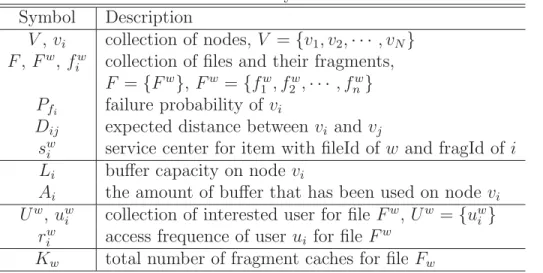
Table 3.1: Summary of Notations Symbol Description
V, vi collection of nodes, V ={v1, v2,· · · , vN} F, Fw,fiw collection of files and their fragments,
F ={Fw}, Fw ={f1w, f2w,· · · , fnw} Pfi failure probability of vi
Dij expected distance between vi and vj
sw
i service center for item with fileId ofw and fragId of i
Li buffer capacity on node vi
Ai the amount of buffer that has been used on node vi
Uw,uw
i collection of interested user for file Fw, Uw ={uwi }
rw
i access frequence of user ui for file Fw
Kw total number of fragment caches for file Fw
higher requests frequency r), the larger the number of caches we need to maintain for that file. We use Kw to represent the total number of fragment caches that will be created for file Fw.
Table 3.1 presents all the notations we have so far defined. 3.2 Cache Placement Formulation
Now we are ready to formulate the cache placement optimization problem. The objective of the problem is to minimize the total expected distance from every po-tential user to its k cache agents. For convenience, we omit the file index w and represent the file as F in the problem formulation. Based on the previous definition, two mapping variables are defined as follows:
xl
i: a binary variable indicating whether vi is a cache agent for fl.
yl
ij : a binary variable indicating whether vj is assigned tovi for retrieving fl.
The following Integer Linear Program (ILP) then expresses our cache placement problem.
Minimize l∈F i∈V j∈U Dijyijl rj (3.1) s.t. l∈F i∈V xl i ≤K (3.2) l∈F i∈V yl ij ≥k,∀j ∈U (3.3) xl i ≥yijl ,∀i∈V,∀j ∈U,∀l ∈F (3.4) xl sl = 1,∀l ∈F (3.5) l∈F xl i ≤min{k−1, Li−Ai},∀i∈V (3.6) xl i, yijl ∈ {0,1},∀i∈V,∀j ∈U,∀l ∈F (3.7)
The first constraint (Eq. 3.2) indicates that up to K fragment copies will be placed on the cache agents for this file. The second constraint (Eq. 3.3) ensures that each potential user has accesses to at least k different fragment caches. The third constraint (Eq. 3.4) makes sure that if a potential user is assigned to a node for a particular fragment, then the node must be a cache agent for that fragment. Eq. 3.5 ensures that the service centers are also cache agents. Eq. 3.6 creates a buffer limit on each cache agent. Also, for security purposes, less than k cached fragments can be created for each file. The last constraint (Eq. 3.7) is the binary requirement for the decision variables.
3.3 Cache Placement Policy
We adopt the findings from [20] to help determine the number of caches for each file, Kw, given the file’s popularity and the nodes’ buffer size. In Eq. 3.8 below, n is the number of service centers selected when a file is created, φ represents the correlation between a file’s popularity and the total number of its cached fragments,
and rw is the request frequency of file Fw. The minimum number of caches for each file is n because each file is encoded and distributed to n service centers at the creation time. Eq. 3.9 defines a user-configured variableηto represent the percentage of occupancy allowed on cache agents’ buffer. Combining Eq. 3.8 with Eq. 3.9 and configuring a proper η, we can then solve for φ.
Kw = max{n, φ·(
i∈U
ri)2/3} (3.8)
η= total # of fragment copies of all files
overall buffer size of all nodes =
wKw
iLi
(3.9)
Based on this, files with higher popularity are given higher priority when selecting the cache placement. In specific, given a collection of files{Fw}, the cache placements for each file is determined one by one based on its Kw value. The process repeats until all files are associated with a specific Kw.
4. CENTRALIZED/IDEAL CACHING FRAMEWORK
The basic idea of centralized caching framework is to collect the global information and to solve the optimization problem on a master node. According to temporal locality and group mobility, the learned statistics in the near past can very well predict the future activities. To be more concrete, the master node collects collects information regarding on network topology and file access pattern by exchanging control messages, and determines the optimal cache placement in the future based on these learned statistics.
As time goes on, the network topology changes and the cached items may be-come obsolete. Therefore, the algorithm is executed periodically to adapt to these dynamics. Each round of the algorithm gives an updated solution for cache place-ment, which may or may not differ from the previous placement. Given an updated placement, the newly chosen fragment caches are immediately fetched by the cache agents, and the old caches can be kept as long as they do not violate the capacity or security constraints. If a cache buffer is full, we replace its content using the least frequently used (LFU) policy.
We refer to the framework described above as centralized caching (CC) and define a simple variation of CC as ideal caching(IC). The only difference between them is that CC uses the previous time slot for cache placement optimization while
IC “foresees” the future access pattern and topology. IC simply serves as the true op-timal or the ground truth of our caching framework and no other caching algorithms could outperform IC.
Although the centralized solution provides an optimal solution, it is computation-ally infeasible in a large scale network and has single node failure disadvantage. As
a result, in the next section, we propose a lightweight distributed caching framework to approximate the optimal solution.
5. DISTRIBUTED CACHING FRAMEWORK
The goal of distributed caching framework (DC) is to allow each individual n-ode to make its own caching decision without the need of global information. The distributed algorithm does not collect the topology information or all files’ access pattern, and is robust to node failures.
5.1 System Architecture
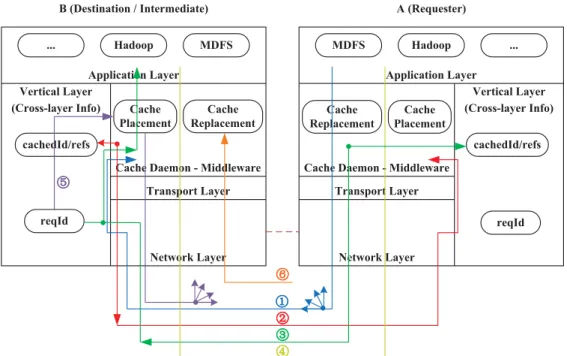
Figure 5.1 describes the system architecture of our cross-layer design forDC. We add our middleware, which includes the cache daemon (CDaemon) on top of the transport layer. A cross-layer communication channel is built between the network layer (where Kernel-AODV resides) and our middleware. The CDaemon actively interacts with the network layer: CDaemon collects the access pattern information, such asreqId and their counters for each requested fragment from the network layer; and the network layer also looks up cache information, such as cache ID (cacheId) and reference number (refs) maintained in CDaemon. A step-by-step explanation of the framework based on a file request example is also given in Figure 5.1. Suppose
A is a file requester, and B is an intermediate node or the destination node.
• Step 1: To request for a file, client node A broadcasts a file request (fileReq) packet containing the file ID, the requester ID, and an initial hop count value (set to 0).
• Step 2: Upon receivingfileReq,B examines whether the request has been seen before. If it is a new request, B updates the hop count maintained in this
fileReq and rebroadcasts the packet. NodeB then usescachedId to check with
!"# $% " ! & ' $% (&) $% * +, - $% .% *,/ 0* $% !"# - $% " ! & ' $% (&) $% .% *,/ * +, 0* 1 ." + * / .02/ ķ ĸ Ĺ ĺ Ļ ļ
Figure 5.1: System architecture of cross-layer design for proposed distributed caching framework
reply (fileRep) including the hop count information. (Note that sending back
a fileRep may require a route discovery in reactive routing protocol.)
• Step 3: Upon receiving all the fileReps, the CDaemon in A decides which are the closest cached fragments and unicasts fragment requests (fragReq) to these cache agents. (Note that unicasting thefragReqmay also require a route discovery.)
• Step 4: When fragReq reaches the destination, a TCP session is established for reliable data transmission.
Step 5 and Step 6 are related to the cache placement/replacement of DC and
Table 5.1: Features and Sniffing Specifics of Packets Packets Protocol Dst Port Dst Addr Sniff? and Actions
fileReq UDP/IP CDaemon broadcast yes, checkcachedId
fileRep UDP/IP CDaemon unicast no, –
fragReq UDP/IP CDaemon unicast yes, update reqId
data TCP/IP MDFS unicast no, –
5.2 Statistics Collection
To learn the file access pattern, the network layer sniffs the passing-by packets and delivers the packets of interest to the middleware. In this way, CDaemon learns the file request frequency and whom the file is requested by. As cross-layer commu-nication also introduces computation overhead, only the packets that are necessary should be passed to the middleware. Table 5.1 summarizes the packets defined in our framework and the packets that CDaemon is interested in. fileReq is sniffed so that CDaemon can check if any cached fragment is available locally and replies if necessary. fragReq is sniffed at intermediate nodes so that nodes can learn about the popularity and request frequency of the file.
The process of sniffing packets is done efficiently at network layer by several filters. The network layer simply examines a very small part of each arrival packet and determines weather to pass it to the middleware. The fields that are checked in each packet are shown below:
• Protocol Type: All the control packets are sent via UDP, and from which we
can rule out the unnecessary data packets;
• Destination Port: There may be other UDP packets, and we are only interested
in those sent to the CDaemon port;
a -- - - -3 -4 -5 -6 -7 -
-Figure 5.2: An example of cache placement in distributed caching framework greement on the payload structure. Therefore, the network layer can easily recognize the packets such asfileReq,fileRep, andfragReq by reading the first few bytes of the payload.
5.3 Distributed Cache Placement
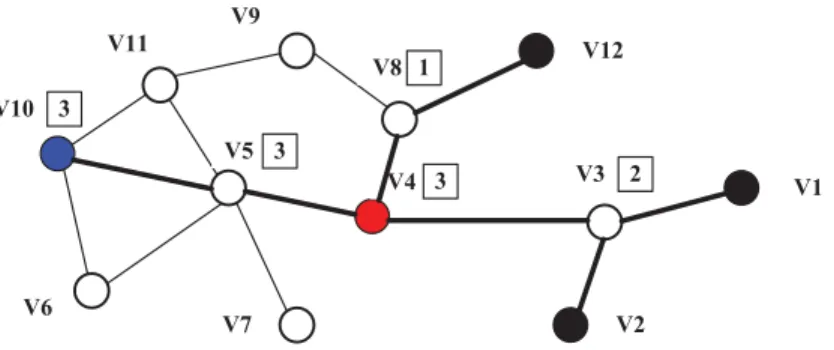
Once nodes have identified the popular fragments needed to be cached,DC algo-rithm needs to determine where to place the cache fragments to maximize the energy saving. The intuition is to select the nodes that are closest to the file requestors in terms of the hop-count. We assume that the node that first observes the popular fragment is the closest one to the users group. Nodes on the route from the file requestor to the service centers cooperate to determine the best cache agent. An example is illustrated in Figure 5.2.
5.3.1 When will a fragment cache be created?
A new fragment cache is added when we find the counter associated with the fragment exceeds a predefined thresholdθ. Suppose θis set to 3 in Figure 5.2. After v1, v2, and v12 make the same fragReq destined for v10, v4, v5, and v10 will update
their counter of the requested fragment to 3. This will trigger DC to add a new fragment cache.
frequency that the cached fragments are updated. We determine θ by estimating the average number of requests that each fragment cache will serve. If the number of actual requests exceeds the predefined value, then an extra fragment cache is necessary. The average number of requests is estimated as following:
ri =file request frequency
ri =fragment request frequency for this file
K =total # of fragment copies of this file
kri K = kri max{n, φ·(ri)2/3} ≈ k φ (5.1)
From Eq. 5.1, we then setθ to be k/φ.
5.3.2 How to coordinate the cache placement
In the previous example, whenv4,v5 andv10 all reach the threshold defined byθ, only one of them should initiate its cache placement module. Since our objective is to minimize the distance from the file requestors to the fragment cache, v4 seems to be the best candidate among the three. From the observation that the node closest to the file requestors reaches the threshold earlier than other candidate nodes (v5 and v10),v4 can actively notify other candidates NOT to cache the fragment. This is achieved by piggybacking a flag infragReq atv4 to inform other nodes on the route, i.e., v5 and v10, to flush their request counters for this fragment. In this manner, only one new cache will be created, and it is placed closest to the file requestors.
5.3.3 How to select a cache agent
Although only v4 will initiate its cache placement module, any node in its vicin-ity has a chance to be selected as the cache agent. v4 coordinates with all its 1-hop neighbors and determines the best cache agent by comparing their qualification s-cores, defined in Eq. 5.2.
score(i)=I(i)· α·Pfi+ (1−α)·LiL−Ai i (5.2)
In Eq. 5.2,I(i) is an indicator variable showing whether adding the new fragment cache will violate the security constraint on vi, and α is a weight parameter in the range (0,1). We define the score in such a way to eliminate the nodes that may violate the security constraint, and give the nodes with lower failure probability or more buffer space higher score.
To be more specific on how the control messages are exchanged between v4 and its neighbors, v4 first broadcasts an exchange request (exReq) to its neighbors. Up-on receiving the messages, nodes compute their qualificatiUp-on scores and reply with
(exRep) messages. v4 then compares those scores with its own score and sends a (
ex-Cfm) message to the node with the highest score (if the best node is not v4 itself). The node selected to be the new cache agent will explicitly prefetch the corresponding fragment. The process corresponds to the Step 5 in Figure 5.1.
5.4 Distributed Cache Replacement
Since caches may become inactive and the buffer may be fully occupied, a cache replacement policy is necessary to ensure the effectiveness of the caching algorithm. Similar to the centralized solution, the LFU algorithm is adopted to manage the
buffer. Specifically, we assign a reference number (refs) to each cached fragment, and the number is incremented by 1 whenever the fragment is accessed. If a cache agent’s buffer is full, the cache replacement module will be activated and evict the fragment with the smallest refs. This process corresponds to Step 6 in Figure 5.1.
5.5 Integrated Solution
Combining all the procedures described in this section, Algorithm 1 is the pseu-docode illustrating our distributed caching framework.
Algorithm 1 Integrated Distributed Caching
1: On arrival of a packet:
2: if UDP packet && CDaemon portthen 3: sniff the payload, obtain message type
4: if valid length of the type then
5: wrap as a task, insert into task queue;
6: end if 7: else 8: return; 9: end if 10: 11: On processing of a task: 12: if taskType == fileReqthen 13: if first time to see itthen 14: check cachedId, re-broadcast
15: end if
16: else if taskType == fileRep then 17: if destined for itself then
18: Process
19: end if
20: else if taskType == fragReq then 21: if destined for itself then
22: Updaterefs
23: else if optional then
24: if reach the threshold then 25: Piggyback, generate exReq
26: end if
27: end if
28: else if taskType == exReq then 29: Compute score, generate exRep
30: else if taskType == exRep then
31: Select agent, generate exCfm if necessary
32: else if taskType == exCfm then 33: Retrieve the desired fragment
34: ... 35: end if
6. SIMULATION RESULTS
Our main goal is to compare our proposed distributed caching (DC) framework with no-caching (NC), centralized caching (CC) and the ground truth ideal caching (IC) in terms of:
• Average energy consumption: 1 unit per fragment per hop for retrieving files (assuming uniform-size fragments).
• Average retrieval rate: the successful rate (percentage) of retrieving files among all the access requests.
• Average prefetching overhead: the same unit as energy consumption, but only accounting for overhead by prefetching caches to new cache agents.
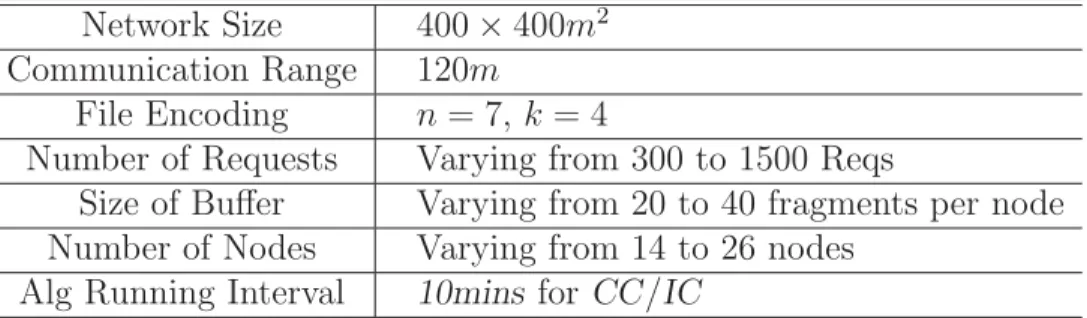
Simulations were conducted using Matlab R2009a. We considered a mobile net-work, where nodes were randomly deployed and moved based on the Reference Point Group Mobility (RPGM) model [17]. Specifically, we used the 4-hour mobility traces generated in [5]. For the file access pattern, we assumed a Zipf’s distribution with α set to 1. Table 6.1 presents the basic configurations for the experiments. We were particularly interested in evaluating the caching performance through the effect of the following parameters: 1) number of requests; 2) buffer size; 3) network size.
6.1 Effect of Requests Number
Figure 6.1 depicts the performance metrics of runningNC,CC,DC, andIC algo-rithms with increasing number of requests. In general, all three caching algoalgo-rithms introduce significant reduction (more than 50%) in energy consumption compared to NC, and the effect becomes more evident (more than 70%) as the number of
Table 6.1: Simulation Parameters and Basic Setting Network Size 400×400m2
Communication Range 120m
File Encoding n = 7, k= 4
Number of Requests Varying from 300 to 1500 Reqs
Size of Buffer Varying from 20 to 40 fragments per node Number of Nodes Varying from 14 to 26 nodes
Alg Running Interval 10mins for CC/IC
requests increases. With more caches residing in the network, the data availability (measured by retrieval rate) also increases (around 13%). This implies an improved energy efficiency since we are retrieving more files with less energy. On the other hand, relocating caches to new cache agents incurs overhead, the amount of which, however, is minor (less than 10%) with respect to the total energy consumption.
A closer observation on the caching algorithms shows that our proposed DC achieves better performance in comparison with the other two. Though the energy consumption in CC is smaller than that in DC, which is not surprising as CC uses the global knowledge for optimization, the difference between them is minor. This demonstrates that partial topology information and data access pattern are sufficien-t for DC to make a good caching decision. While looking at the huge prefetching overhead in CC, it may not be worthwhile to spend so much communication and computation cost to attain such small energy gains. In other words, the subopti-mal solution given by DC is good enough for most applications. Table 6.2 shows their respective energy savings, where the gross saving is the difference between the actual energy consumption with caching from the one in NC, and the net saving is calculated by further deduction of the prefetching overhead. Apparently,DC is more efficient than CC when prefetching overhead is considered. Lastly, by investigating the ground truth IC, we see that more than 60% of the energy consumption is a
0 1000 2000 3000 4000 5000 6000 7000 8000 200 400 600 800 1000 1200 1400 1600 Energy Consumption Number of Requests NC CC DC IC 70 75 80 85 90 95 100 105 200 400 600 800 1000 1200 1400 1600 Retrieval Rate Number of Requests NC CC DC IC 200 300 400 500 600 700 800 900 1000 200 400 600 800 1000 1200 1400 1600 Prefetching Overhead Number of Requests CC DC 280 300 320 340 360 380 400 200 400 600 800 1000 1200 1400 1600 Total Caches Number of Requests CC DC
Figure 6.1: Effect of requests number on (a). Energy Consumption; (b). Retrieval Rate; (c). Prefetching Overhead; (d). Total Caches. The test scenario is based on 14 nodes, 12 files, and the buffer size is set to be holding up to 24 fragments.
must-pay price due to the buffer limit and security constraint, and the best retrieval rate under the given node failure and mobility model is close to DC (less than 3% better). As a result, given partial network topology and data access pattern informa-tion, the performance of DC can approach to optimal when the file access frequency is high.
6.2 Effect of Buffer Size
Figure 6.2 depicts the performance metrics of running NC, CC, DC, and IC algorithms with varying buffer sizes. Table 6.3 presents the gross and net energy savings for CC and DC. The most significant observation is that with more buffers, the performance of CC and DC are both improved, and their performance gaps
Table 6.2: Energy Savings under the Effect of Requests Number Alg Saving 300Req 600Req 900Req 1200Req 1500Req
CC gross 809 1808 2748 3694 4666
net 437 1275 2030 2830 3744
DC gross 747 1790 2652 3481 4478
net 450 1321 2189 3035 3943
decrease as the buffer size increases. The reason for the first result is straightforward: with larger buffers, more caches can be placed in the network, resulting in fewer hop counts when retrieving files. Such improvement ceases when reaching the maximum point exerted by security constraint. (Note that the maximum is 36 fragment caches per node for the given k value and file number.) This also explains for the change of the retrieval rate. As for the second result, it can be explained by the total number of caches. Starting from 28, the curve of total caches in CC falls below that in DC, indicating that CC does not make full use of the buffer. This is primarily because each round in CC finds the optimal placement for the current time slot independently. When the updated solution needs to merge with the previous solution, lots of conflicts may occur due to buffer capacity or security constraint, leading to a large number of evictions. On the other hand, DC avoids this effect by integrating those two factors into the score evaluation of cache candidates. This narrows the gap of energy consumption between DC and CC, and this also explains the huge prefetching overhead inCC. By comparison withIC, it is shown that the performance of DC approaches optimal when the buffer is relatively rich.
6.3 Effect of Nodes Number
Figure 6.3 depicts the performance metrics of running NC, CC, DC and IC al-gorithms with varying number of nodes in the network. Table 6.4 presents the gross and net energy savings forCC andDC. An immediate observation is that the
0 500 1000 1500 2000 2500 3000 3500 4000 4500 20 25 30 35 40 Energy Consumption Size of Buffer NC CC DC IC 65 70 75 80 85 90 95 100 105 20 25 30 35 40 Retrieval Rate Size of Buffer NC CC DC IC 200 300 400 500 600 700 800 20 25 30 35 40 Prefetching Overhead Size of Buffer CC DC 250 300 350 400 450 500 20 25 30 35 40 Total Caches Size of Buffer CC DC
Figure 6.2: Effect of buffer size on (a). Energy Consumption; (b). Retrieval Rate; (c). Prefetching Overhead; (d). Total Caches. The test scenario is based on 14 nodes, 12 files, and the number of requests is fixed to 600.
mance ofNC is highly subjective to the number of nodes and their movements. For energy consumption, more nodes usually implies more hops, therefore more energy consumption. When there are not enough nodes in the area and the network density is relatively low (below 22 in our simulation), adding more nodes to the network only forms paths with more hops, thus slightly increasing the energy consumption for retrieving the data. After the network density has reached a “saturated” point (22 in our simulation), the chance of nodes finding better or shorter paths to cache agents increases and thus the total energy consumption starts to decrease. As for the retrieval rate, higher number of nodes generally provides more candidate cache agents and thus improves the data availability. Another interesting observation is
Table 6.3: Energy Savings under the Effect of Buffer Size Alg Saving 20Buf 24Buf 28Buf 32Buf 36Buf 40Buf CC gross 1691 1808 1840 1891 1895 1897
net 1105 1275 1348 1430 1451 1437
DC gross 1563 1790 1820 1861 1851 1849
net 1195 1321 1391 1464 1461 1451
Table 6.4: Energy Savings under the Effect of Nodes Number Alg Saving 14Node 18Node 22Node 26Node
CC gross 1808 2013 2391 2386
net 1275 1300 1600 1569
DC gross 1790 2055 2334 2325
net 1321 1491 1712 1673
that with caching enabled, the fluctuation of both energy and retrieval rate reduces because the file requests become more likely to be fulfilled by the nearby cache agents rather than the service centers farther away. As there are always cached fragments somewhere in the network, the failures of the service centers do not significantly bring down the performance of the system. After examining CC, DC and IC, it is clear that our proposed DC is much more effective under all circumstances.
0 1000 2000 3000 4000 5000 14 16 18 20 22 24 26 Energy Consumption Number of Nodes NC CC DC IC 70 75 80 85 90 95 100 14 16 18 20 22 24 26 Retrieval Rate Number of Nodes NC CC DC IC 450 500 550 600 650 700 750 800 850 900 14 16 18 20 22 24 26 Prefetching Overhead Number of Nodes CC DC 300 350 400 450 500 550 600 650 14 16 18 20 22 24 26 Total Caches Number of Nodes CC DC
Figure 6.3: Effect of nodes number on (a). Energy Consumption; (b). Retrieval Rate; (c). Prefetching Overhead; (d). Total Caches. The test scenario is based on 12 files, 600 requests, and the buffer size is set to be holding up to 24 fragments.
7. SYSTEM IMPLEMENTATION AND EVALUATION
The hardware implementation was done on RouterBoard 433UAH, which had a 670MHz Atheros CPU, 128MB SDRAM, 512MB NAND storage, and was config-ured with three 10/100 Mbit/s Ethernet ports, and two 2.4/5GHz radio cards. We installed the OpenWrt operating system, an embedded system based on Linux k-ernel 2.6. The OpenWrt allowed us to customize the packages (applications/kk-ernel modules) and build a user-configured image for flashing. Specifically, three pack-ages we developed or modified were added into OpenWrt: 1) Kernel-AODV as a kernel module, for acting as the underlying routing protocol; 2) CDaemon as a ker-nel module, for sniffing packets and handling cache placement/replacement events; and 3) SimpleFS as an application, for emulating the mobile distributed file system (MDFS).
Our Kernel-AODV was developed based on [22], which provided an open source AODV routing protocol based on Linux kernel 2.4. We modified it so that it can adapt to the latest kernel version of the Openwrt, i.e., kernel 2.6. The radio cards were by default disabled, with no wireless interfaces configured, and the mode was set to access point. Furthermore, the firewall was by default configured to reject all packet forwarding events. To run Kernel-AODV on this board, we modified the
files /etc/config/wireless andetc/config/firewall to enable wireless transmission and
packet forwarding in a wireless ad-hoc network. In addition, we manually configured a wireless interface for one of the radio cards, wlan0, and let it act as an AODV device, before inserting the Kernel-AODV module. With these, we were able to ping across nodes in a multi-hop manner.
We used the kernel space socket interface for sending and receiving packets. To facilitate packet sniffing, we utilized Netfilter [21] mechanism. Its current architecture includes five hooks in the IP layer and NF IP P RE ROUT ING is the first hook for all incoming packets. We registered a callback function for this hook and any packet that traveled through it would invoke the callback function. By reserving the first few bytes of the payload for message type, we could recognize the intercepted packets efficiently and deliver them to CDaemon if necessary. A vertical channel across multiple layers was created to facilitate cross-layer communication between our middleware and network layer.
Lastly, we implemented a SimpleFS that behaves like a simple mobile distributed file system (MDFS). Basically, SimpleFS accepted two different commands, create andretrieve. Commandcreate fileId fragIdcreated a fragment at the current node (service center) under the application-defined directory. At the time of inserting the CDaemon module, this particular directory would be scanned and used to initialize cache table (i.e., cachedId) maintained in CDaemon. Command retrieve fileId
broadcasted a fileReq to the network and performed the whole-stack file retrieval procedure. We usedSimpleFS to test and evaluate the performance of our CDaemon. To demonstrate the effectiveness ofDC on real hardware, we deployed 8 routers in our department, as shown in Figure 7.1. Because of the hardware and resource limitation, we considered only deployments in static network. We set transmission power to 15dBm and ensured a multi-hop network topology, though some of the links might be unstable due to the interference or obstacle in between. 5 files were created and distributed by SimpleFS with n = 5 and k = 4. The service centers were determined at the time when the files are created. The buffer size at each node was set to be 6 (can cache up to 6 fragments). In a one-hour period, each node generated 60 requests (480 requests in total) according to files’ popularity, which
Figure 7.1: Router deployment and network topology
follows a Zipf’s distribution.
Similar to the simulation in Section 6, we measured the energy consumption, re-trieval rate, and prefetching overhead. Besides, communication overhead and routing overhead were also measured. Communication overhead included the control packets introduced by k-out-of-n framework (flReq, flRep, and frReq) and caching (exReq,
exRep, and exCfm); routing overhead referred to the control packets for
Kernel-AODV (rreqand rrep). We included the routing overhead to assess the performance of our caching framework under a reactive routing protocol.
Each row of Table 7.1 presents the performance of NC and DC under different popularity thresholdθ. As expected, the energy consumption decreased when caching was enabled, and the effect of energy reduction was significant, especially under small θ (31% reduction whenθ= 6). (Alternatively, we could viewNC as a special case of
and communication overhead (from 0 to 166.5 packets) introduced by caching was higher for smaller θ. The reason was that with small θ, the popularity threshold could be easily reached, leading to frequent cache agent selection, cache prefetch, and replacement activities. However, the frequent update indeed helped identify the most popular and active data fragments, which effectively reduced the energy consumption in future data access. As for the data retrieval rate, which was nearly 100% in all cases, the benefit from caching was not so obvious. This was majorly because we deployed the system in a small static network and the failure probability of nodes and links were low.
As for the communication overhead, it did not vary much with the change of θ. Counterintuitively, higher θ should generate more communication overhead as more nodes would reply toflreqs and cause moreflreps. However, at the same time whenθ was higher, it was also more probable that the file requestors could go through fewer hops to retrieve the data. Therefore, the pros and cons brought by θ canceled out with each other and obscured the impacts fromθ. A similar result was also observed in the change of routing overhead. It was also noticed that the overhead caused by routing protocol was not negligible (but acceptable) because Kernel-AODV was a reactive protocol, which discovered the routes on-demand by flooding control packets. We expected the routing overhead in a proactive routing protocol should be much smaller.
Based on these observations, there was an unavoidable tradeoff between the en-ergy gain and overhead. Considering the fact that the control packets were much smaller (around 24 bytes in our case) than data fragments (which could be orders of megabytes), we might ignore their influence in our analyses. By adding up the energy consumption and the prefetching overhead, we found that the optimal θ was 8 in our network. This value conformed with the mathematical formulation derived
Table 7.1: Performance Metrics for Proof-of-Concept Evaluation Alg
Overhead for Energy Retrieval
Consumption Rate
Prefetch Communication Route (Framework/Cache)
NC(θ =∞) 292.5 95.83% – 1926.5 / – 7930.5
DC(θ= 10) 212.1 96.83% 10.3 1804.8 / 62.9 6610.4
DC(θ = 8) 203.3 96.67% 16.0 1864.9 / 105.5 6972.1
DC(θ = 6) 199.1 97.33% 24.9 2053.1 / 166.5 7240.1
in Eq. 5.1, which predicted 8.45 for the given parameters. This result proved that our formulation for estimating the optimal θ was correct.
8. CONCLUSIONS AND FUTURE WORK
This work investigates data caching in the k-out-of-n computing framework. A set of nodes are selected as cache agents for placing popular data fragments, such that the expected data retrieval energy can be minimized. Both the centralized and the distributed solutions are proposed and evaluated. The simulation results demonstrate that the transmission energy is reduced by up to 70%, and the data availability is improved by 13%, on base of no-caching framework. Comparing the Distributed Caching DC with the Centralized Caching CC, we show that while DC has no global information, its solution is close to the optimal one given by CC. If taking the prefetching overhead into account,DC may even outperforms CC. In the system evaluation, we observe a significant energy reduction (up to 31%) ofDC over no-caching scenario even in a small network (8 nodes) with moderate request number (480 in total). The overhead introduced by data transmission and control packets in
DC is less than 5%.
Continuing the work, we plan to evaluate the effect of routing protocols onDC. In particular, we are interested in experimentingDC under a proactive routing protocol such as OLSR. We envision thatDC should perform even better under proactive pro-tocols as the additional number of control packets generated by the routing protocol is much less. Although the evaluation has shown that our estimation of popularity threshold (θ) is correct, we are also working on an improved algorithm for determin-ing θ in a hope to reduce the computation complexity. Lastly, we plan to integrate our distributed caching framework with MDFS into Hadoop architecture such that any MapReduce applications may be ported to mobile devices and benefit from the energy-efficient and reliable features of our framework.
REFERENCES
[1] Ivan Baev and Rajmohan Rajaraman. Approximation algorithms for data place-ment in arbitrary networks. InProceedings of the 12th annual ACM-SIAM sym-posium on Discrete algorithms, pages 661–670, 2001.
[2] Ivan Baev, Rajmohan Rajaraman, and Chaitanya Swamy. Approximation algo-rithms for data placement problems. SIAM Journal on Computing, 38(4):1411– 1429, 2008.
[3] Jaroslaw Byrka. An optimal bifactor approximation algorithm for the metric uncapacitated facility location problem. InApproximation, Randomization, and Combinatorial Optimization. Algorithms and Techniques, pages 29–43. Springer, Berlin, Germany, 2007.
[4] Chien-An Chen, Myounggyu Won, Radu Stoleru, and Geoffrey Xie. Energy-efficient fault-tolerant data storage & processing in dynamic networks. In Pro-ceedings of the 14th ACM International Symposium on Mobile Ad Hoc Network-ing and ComputNetwork-ing, pages 281–286, 2013.
[5] Chien-An Chen, Myounggyu Won, Radu Stoleru, and Geoffrey Xie. Resource allocation for energy efficient k-out-of-n system in mobile ad hoc networks. In Proceedings of the 22nd International Conference on Computer Communications and Networks, pages 1–9, 2013.
[6] Chi-Yin Chow, Hong Va Leong, and Alvin Chan. Group-based cooperative cache management for mobile clients in a mobile environment. In Proceedings of the International Conference on Parallel Processing, pages 83–90, 2004.
[7] Chi-Yin Chow, Hong Va Leong, and Alvin Chan. Peer-to-peer cooperative caching in mobile environments. In Proceedings of the 24th International Con-ference on Distributed Computing Systems, pages 528–533, 2004.
[8] David W Coit and Jia Chen Liu. System reliability optimization with k-out-of-n subsystems. International Journal of Reliability, Quality and Safety Engineer-ing, 7(2):129–142, 2000.
[9] Alexandros G Dimakis, Vinod Prabhakaran, and Kannan Ramchandran. De-centralized erasure codes for distributed networked storage. Networking, IEEE/ACM Transactions on, 14(SI):2809–2816, 2006.
[10] Alexandros G Dimakis and Kannan Ramchandran. Network coding for dis-tributed storage in wireless networks. In Networked Sensing Information and Control, pages 115–134. Springer, New York, NY, 2008.
[11] Alexandros G Dimakis, Kannan Ramchandran, Yunnan Wu, and Changho Suh. A survey on network codes for distributed storage. In Proceedings of the IEEE, volume 99, pages 476–489, 2011.
[12] Lawrence W Dowdy and Derrell V Foster. Comparative models of the file as-signment problem. ACM Computing Surveys, 14(2):287–313, 1982.
[13] Yu Du, Sandeep KS Gupta, and Georgios Varsamopoulos. Improving on-demand data access efficiency in manets with cooperative caching. Ad Hoc Networks, 7(3):579–598, 2009.
[14] Sandra G Dykes and Kay A Robbins. A viability analysis of cooperative prox-y caching. In Proceedings of the 20th Annual Joint Conference on Computer Communications, volume 3, pages 1205–1214, 2001.
[15] Li Fan, Pei Cao, Jussara Almeida, and Andrei Z Broder. Summary cache: A scalable wide-area web cache sharing protocol. Networking, IEEE/ACM Trans-actions on, 8(3):254–265, 1998.
[16] Takahiro Hara. Quantifying impact of mobility on data availability in mobile ad hoc networks. Mobile Computing, IEEE Transactions on, 9(2):241–258, 2010. [17] Xiaoyan Hong, Mario Gerla, Guangyu Pei, and Ching-Chuan Chiang. A group
mobility model for ad hoc wireless networks. In Proceedings of the 2nd ACM international workshop on Modeling, analysis and simulation of wireless and mobile systems, pages 53–60, 1999.
[18] Scott Huchton, Geoffrey Xie, and Robert Beverly. Building and evaluating a k-resilient mobile distributed file system resistant to device compromise. In Proceedings of the Military Communications Conference, pages 1315–1320, 2011. [19] Sitaram Iyer, Antony Rowstron, and Peter Druschel. Squirrel: A decentral-ized peer-to-peer web cache. In Proceedings of the 21st ACM Symposium on Principles of Distributed Computing, pages 213–222, 2002.
[20] Shudong Jin and Limin Wang. Content and service replication strategies in multi-hop wireless mesh networks. In Proceedings of the 8th ACM international symposium on Modeling, analysis and simulation of wireless and mobile systems, pages 79–86, 2005.
[21] Jzsef Kadlecsik, Harald Welte, James Morris, Marc Boucher, and Rusty Russell. The netfilter/iptables project. http://www.netfilter.org/, 2004.
[22] Luke Klein-Berndt. Kernel aodv from national institute of standards and tech-nology (NIST). http://w3.antd.nist.gov/wctg/aodv_kernel/, 2002.
[23] Yadi Ma, Thyaga Nandagopal, Krishna PN Puttaswamy, and Suman Banerjee. An ensemble of replication and erasure codes for cloud file systems. In Pro-ceedings of the IEEE International Conference on Computer Communications, pages 1276–1284, 2013.
[24] Cherukuri Rajabhushanam and Ayyaswamy Kathirvel. Survey of wireless manet application in battlefield operations. International Journal of Advanced Com-puter Science and Applications, 2(1):50–58, 2011.
[25] George M Stephen, Zhou Wei, Chenji Harshavardhan, Myounggyu Won, Y-ong Oh Lee, Andria Pazarloglou, Radu Stoleru, and Prabir Barooah. Distress-net: a wireless adhoc and sensor network architecture for situation management in disaster response. Communications Magazine, IEEE, 48(3):1–9, 2010. [26] Bin Tang, Himanshu Gupta, and Samir R Das. Benefit-based data caching in ad
hoc networks. Mobile Computing, IEEE Transactions on, 7(3):289–304, 2008. [27] Liangzhong Yin and Guohong Cao. Supporting cooperative caching in ad hoc