PROJECT MANAGEMENT 1391
CHALLENGES OF IT PROJECT PORTFOLIO SELECTION 1392
Petrović Dejan, Mihic Marko, Obradović Vladimir
ORGANIZATIONAL PROJECT MANAGEMENT MATURITY ANALYSIS OF ENERGY SECTOR COMPANIES 1400 Mihic Marko, Petrović Dejan, Obradović Vladimir
EMOTIONAL INTELLIGENCE: NEW COMPETENCE OF PROJECT MANAGERS 1407
Obradović Vladimir, Petrović Dejan, Ristic Milica
HOW TO SELECT THE BEST PROJECT MANAGER? 1415
Baruch Keren, Yossi Hadad, Zohar Laslo
APPLICATIONS OF RANKING INDEXES OF PROJECT ACTIVITIES FOR PROJECT MANAGEMENT TASKS 1422 Yossi Hadad, Baruch Keren, Zohar Laslo
PROJECT SUCCESS ANALYSIS: EVIDENCE FROM SERBIA 1429
Todorović Marija, Toljaga-Nikolić Danijela, Mitrović Zorica
RISK MANAGEMENT METHODS: HOW TO DEAL WITH RISKS IN A PROJECT 1436
Toljaga-Nikolić Danijela, Todorović Marija, Bjelica Dragan
DEFINING “SUCCESS” FOR PROJECT MANAGEMENT INFORMATION SYSTEM: A CROSS SECTIONAL STUDY 1444 Bjelica Dragan, Mitrović Zorica, Todorović Marija
RISK INDEX AS PROJECT RISK MEASURE 1451
Komazec Nenad, Stankovic Miomir, Savić Suzana
THEORY OF COMPLEXITY AND INNOVATION PROJECTS 1460
Dodevska Zorica, Mihic Marko
SELECTION AND PRIORITIZATION OF CAPITAL PROJECTS IN THE PUBLIC SECTOR 1469 Radovic Sonja, Pejic Sanja, Stojkovic Svetlana
PROJECT MANAGEMENT ON INTERNET – BLOGGERS AS FOCUS COMMUNITY 1475
Velimir Tasic
ASPECTS OF PUBLIC RELATIONS AND FINANCIAL MODELS WITHIN NGO'S 1483 Radonic Milenko, Dogović Marko, Drecun Ivana
1391
CHALLENGES OF IT PROJECT PORTFOLIO SELECTION
*Dejan Petrović, Marko Mihić, Vladimir Obradović Faculty of Organisational Sciences, Belgrade
Abstract: This paper presents possible challenges in the process of IT project portfolio selection. The paper begins with explanation IT project portfolio management. IT project portfolio management needs to ensure that the group of IT projects support achievement of the goals of the corporate strategy. The paper considers key aspects of IT selection process and introduces organizational support for IT project portfolio selection. An established PMO that is actively supported at the executive level can help solve problems with project selection and initiative approval.
Key words: project management, project portfolio management, project selection, IT project, portfolio management office
1. INTRODUCTION
The task of the IT project portfolio management is to ensure a consistent approach to the classification, selection, prioritization and planning of the right IT projects and programmes in the company (Reyck, Grushka-Cockayne, Lockett, Calderini, Moura, & Sloper, 2005). The aims of IT project portfolio management are as follows:
optimization of IT project portfolio results (not an individual project or portfolio); harmonization of IT projects and programmes with the company’s strategy; selection of IT projects and programmes to be realized;
defining IT projects and programmes priorities; discontinuing or stopping IT projects or programmes;
coordination of internal and external resources for IT projects and programmes; and organizational learning between IT projects and programmes.
2. IT PROJECT PORTFOLIO MANAGEMENT
An efficient realisation of an IT project is said to be a key factor of the company’s business success. This is, however, only partly true. The achieved competitive advantage is not the result of efficient work on a project only. The fact that companies conduct real IT projects is important. IT project portfolio management is meant to ensure a successful execution of the company’s strategy through the most effective and most efficient execution of respective IT projects possible (Verhoef, 2002). It is closely related to the role of the top management in the company and with the key decision makers in creating the environment in which set goals can be achieved.
According to Cooper, Edgett and Kleinschmidt (1997), works dealing with the issues of project portfolio have appeared since 1970. In these works, elements such as “selection of research-developmental projects“, “resource allocation in research-developmental projects“, “project prioritization“and “portfolio management“ are analysed.
The majority of works on this topic deal with the problem of portfolio management by defining the optimization methods and techniques (Cooper, Edgett, & Kleinschmidt, 1998). According to these works, the portfolio management problem appears to be a limited optimization in the conditions of uncertainty: multiproject and multilevel model of decision making should be achieved by means of mathematical programming. The starting models for the selection of projects were mathematically oriented and they used techniques such as linear, dynamic and full number programming. The aim was to develop a portfolio of new and existing projects to maximize some function goals (e.g., the expected profit) as the issue of setting resource limitation.
The application of these methods immediately revealed some difficulties in solving the problems of IT portfolio management (Verhoef, 2002). Contrary to the many methods developed in an early stage of the * The paper is a result of research within the framework of Project No.179081, named: “Researching contemporary tendencies of strategic management using specialized management disciplines in function of competitiveness of Serbian economy”, which is supported by the Ministry of Education and Science of the Republic of Serbia
approach to this problem, none of these could be adequately implemented in the IT project portfolio management.
The IT projects are recognized as a vital fact for any company. The influence of the IT projects upon the future of any company is certainly strong since they are related to all the important events and processes in the company, be it the development of a new product, the implementation of a new service process, the change in organizational structure or the launching of a new business (Russell, 2003). The IT project portfolio is a collection of projects which together with other projects make the strategy of the company’s investments.
The project portfolio management means the implementation of knowledge, skills, methods and techniques upon a set of projects in order that the needs and expectations of the company’s investment should be attained and even exceeded (Dye & Pennypacker, 1999). This calls for a balance to be made between strategic and tactical requirements. The IT project portfolio management usually requires that a definition should be made of what is possible and what is necessary. Balancing between the possibilities and the needs generally results in finding the best possible solution within limited resources.
There is a gap today between a majority of management models and the environment in which the IT projects are executed. These models emerged in the circumstances in which it was possible to predict the consequences of certain decisions and the project’s impact upon the company and the community in general. A successful IT project portfolio in the project environment nowadays is characterised by a number of non-economic features, uses an iterative budgeting process and what appears to be the best decision for an organization may not be viewed as such for all its stakeholders. Today’s the IT project environment is much more complex compared to a majority of management models, and such a complexity must be taken into account in defining „the best“ IT project portfolio to be executed.
The IT project portfolio management focuses upon a clear definition of the values the projects bring to the company (Kaplan, 2001). The IT project portfolio management is applied to all projects, to making decisions as regards the selection and prioritization, which is in accord with the strategic goals and the development of the company.
Alongside decision making on the IT projects execution within a portfolio, there is another process of the final approval of the very beginning and of some specific phases in the IT project execution underway. There certainly must exist a lower level of decision making that takes place in the real time of the IT project execution. Decisions within the IT portfolio are made during the given time intervals, all the projects being discussed together, whereas at a lower level decisions are made on individual IT projects at any moment the project passes from one execution phase into another. All this may cause conflicts between the two levels of decision making, since in decision making processes we most frequently deal with different people, even different criteria.
Decision making at the portfolio level, although taking all the IT projects together and making a comparison among them, does not pay enough attention to individual projects (Levine, 1999). On the other hand, the lower level of decision making focuses upon only one IT project, leaving out all the other IT projects. It is of great importance for the company that these two different decision making processes be integrated and harmonized. The dominance of either of the two is unwelcome in any company.
The weakness of the IT portfolio model appears to be insufficient accuracy or relevance of the facts on the basis of which the processing, the analysis, and the conclusion procedures are conveyed and then a final decision is made. The models used in IT portfolio decision making are by far more advanced compared to the input data. Financial indicators, criteria and the processing and presentation methods themselves may be well created and functional for making the final decision. However, all these calculations and use of the seemingly appropriate criteria may lead to a wrong decision, if the data used are incorrect, inaccurate or unreliable (Morris, 1997). If we wish to enhance the success of an IT portfolio decision making process, we must ensure that we have as high a quality of input data.
In their research Cooper, Edgett and Kleinschmidt (1997) have found that the main problems the companies encounter in the project selection and portfolio management are the following:
1. The project portfolio does not reflect the strategy of the company; 2. The portfolio quality is poor;
3. The checking procedures and the decision making procedures at check points are inefficient; 4. Scarce resources and lack of focus;
The issue raised in the companies that apply the project-oriented organization concept is whether the undergoing IT projects should be discontinued or deprioritized in favour of certain better quality projects that we become acquainted with. On one hand, we should try to keep the resources engaged in IT projects flexible and capable of shifting from one project to another, as the need may be. The reason for such an attitude is found in the need that the company’s management be granted an opportunity to allocate resources in a best possible way, regardless of their current use. On the other hand, there are attitudes that the resources involved should remain in the project all along, regardless of whether there is a more attractive project in sight. Here the issues of continuity and the morale of the project team and the project manager appear to be considerably more important than an optimal allocation of resources. Such a view resulted from the attitude that discontinuing and restarting the project would mean a substantial loss of resources and time, that a shift from one project to another would by all means affect the projects and that a launch and discontinuation or a final suspension of a project would all need additional time and costs (Wysocki, 2004). The new IT projects always appear better than those under way, therefore the resources in the projects that are in the final phases are usually transferred as a support to new projects. Such support sometimes results in the projects deprived of resources in this way being never completed (Thomas, 1993). The far-reaching consequences and damages for the company fail to be perceived in that moment.
There is no universal rule on how we should act or set the company policy in such cases (Norton & Kaplan, 2003). It is certain that the long-term IT projects call for a continuity in order that satisfactory results should be obtained. On the other hand, there is a need that the company responds to changes in the market by introducing a flexible model of resources distribution. Many companies find that using only financial methods and criteria in giving priorities to IT projects prove inappropriate. The reasons most frequently lie in the financial simplification, which results into an unreliable image of the project, especially prior to the launching of the project, when the prioritizing is most necessary, but also, during the execution of the project. Analyses carried out upon executions of projects have shown that the evaluations of key parameters on the bases of which decisions are made were significantly incorrect.
Statistical implications of the portfolio choice are complex and varied. They include the analysis of both internal and external factors of the company, the company’s market position, the strengths and weaknesses of the company. These analyses may be used to create a wide perspective of strategic directions as well as specific initiatives for achieving competitive advantage (Cleland, 1999). Such a procedure may be used in developing focused goals of the IT project portfolio and determining the necessary resources for its support. In estimating the strategic position of the company a portfolio matrix is used, where the different criteria for the company positioning are presented in one or more graphs within two description dimensions. A decision maker may use such a presentation to estimate the current position as well as the position the company wishes to occupy in the future. It is clear that the company’s strategic direction must be defined prior to the analysis of the individual projects for the IT project portfolio. Successful organizations conduct a broad strategy preparation and planning before individual projects are analysed.
Upon determining the strategic direction, it is necessary that IT projects be selected and resources allocated. The IT projects selection includes the identification of opportunities, the estimate of organizational fitting, the cost analysis, the cost and risk analysis, the forming and the selection of the portfolio. The success of the IT project portfolio depends on the readiness and the support of the company’s management (Verhoef, 2002). This is more important, sometimes even crucial, than just the selection of the method to be used in project selection.
A periodical review of IT project portfolio is absolutely necessary (Bridges, 1999). This means that each active project should be checked, those on the waiting list as well, and should be compared to another. The aim of this check is to find out whether there is the right set of active projects and whether these projects are still in accord with the strategic goals of the company.
To aid the decision making process it is necessary that general criteria are established, as well as the evaluation of each IT project related to those criteria. Since a majority of decisions are based on multiple factors, it is necessary to evaluate each criterion in order to establish a relative importance of each of them. Thus we could identify what is most important for the company, and every project could be measured as regards the criteria that are defined as important (George et al., 2005).
The company must establish an unbiased mechanism of monitoring and control of IT projects (Reyck, Grushka-Cockayne, Lockett, Calderini, Moura, & Sloper, 2005). Measuring may be based on the revenue from the project in relation to the resources invested; then there is measuring of a number of projects within the project portfolio and a continual adjustment to the overall goals of the company. It is very important that there exists an agreement from the start on the process of authority determination. Only when the company
defines its overall goals and the investment strategy into the IT projects, will it be able to create an optimal group of projects or an IT project mix to implement its strategy and achieve goals.
In order to achieve a respective relation between the risk and the extent of revenue from the investment into IT projects, it is necessary that each project be evaluated on the basis of its two characteristics: technical difficulties and added value. The secret of a successful IT project management is in understanding critical relations between the probability of success and the values the project will earn if successful. This provides a good basis for quality decision making on the input portfolio of IT projects.
A majority of portfolio decisions is aggravated by a long time horizon, high level of uncertainty and a large number of variables affecting each project (Ghasemzadeh & Archer, 1999). The tools most commonly used in developing a business model that would predict a potential project value are a learning diagram, a sensitivity analysis and a decision tree.
The purpose of the decisions related to the IT project portfolio is not only the selection of right projects; it is also the inclusion and strengthening of appropriate personalities and their groups who are to realize these decisions efficiently and effectively. Creating an adequate level of participation between cross-functional teams allows for a constructive dialogue between decision makers and those who are in charge of enacting them, which leads to coordination of ultimate actions to be conducted (Englund, Graham, & Dinsmore, 2003).
The portfolio analyses and deals with the future events and possibilities where the majority of information necessary in the selection of projects is at best uncertain, and at worst is largely unreliable. The decision making environment is dynamic, and the status and the perspective of the IT projects in a portfolio constantly change in accordance with the inflow of new information and technologies. The IT projects in a portfolio are in different phases of execution and compete for available resources. However, the comparison among the IT projects is made with varied quantities and reliability of information. The resources distributed among the projects are limited, which is to say that the decision on resource allocation to one project means depriving another project of resources, and the transfer of resources from one project to another usually leaves deep scars.
3. SELECTION OF IT PROJECT PORTFOLIO
The selection of IT project portfolio is one of the crucial steps in the portfolio management process. It is a periodical activity of choosing one portfolio among the available project propositions and projects which are underway, and which achieve the defined organizational goals in a desired way, without exceeding the resources available or breaking other limitations (Archer & Ghasemzadeh, 1996). IT projects selecting directly guides and adjusts business activities to the strategic guidelines of the company. It is within this process that decisions are made on the future execution of IT projects as well as on any vital aspects of their realization.
By undertaking a proactive approach to the IT project selection and real performance management the companies significantly enhance the achievement of IT project goals as regards time, quality and costs, as well as making sure that these projects will facilitate the overall business success. Using quality principles in decision making on evaluation and management of IT project portfolio profitability and productivity may be significantly improved. The IT projects, however, include factors that account for the complexity in the process of project portfolio harmonization. One of the most important among them is the interaction of the projects within the portfolio (Mantel & Meredith, 1999). IT projects are not independent, they overlap and are related to each other by depending critically on each other, in different ways.
Although there are numerous methodologies to be used in selecting an IT portfolio, so far the consensus on which one is most effective has not been reached (Reyck, Grushka-Cockayne, Lockett, Calderini, Moura, & Sloper, 2005). As a consequence, every company tends to choose a methodology that corresponds to the existing organizational culture and allows for the analysis of project attributes it considers the most essential. The conventional methods of measuring IT values, the estimation of what is easily measurable – costs – and the expectation that an automatic cost saving or cost avoiding practice will pay the investment off do not, in fact, represent the real value IT earns to the company. The problem is reflected in the IT professionals’ inability to establish a link to the business value of the proposed IT solution which consequently fail to get the manager’s support until it is too late. The problem of inadequate communication is often largely based on the fact that IT managers do not have an effective access to the data they need in order to approach the benefits of a certain IT initiative.
Numerous IT managers estimate IT investments solely on the basis of IT costs saving. While this approach is valid in case the critical factors of success are directed towards reducing exploitation costs in time, it may prove problematic when it is necessary to take into consideration the overall value created by an innovative application of information technologies in business (Sommer, 1999).
As a consequence, the strategic role of investments in new IT initiatives that may lead towards new business opportunities for an organization is neither recognized nor measured. One of the key problems in the total cost scenario implementation is the lack of communication between business activities and technology management, when decision making on implementing new information technologies and the resulting specific business benefits are concerned.
Without the knowledge of where and how IT earns value for the organization, it is impossible to measure this value in concrete quantitative terms. Also, without financial guidelines in defining the value of increased business flexibility, it is difficult to develop a meaningful proposition of values to invest in any IT initiative. In preparing the input data for the portfolio selection it is necessary to analyse whether the project is worth the risk undertaken (Cooper, Edgett, & Kleinschmidt, 1998). This means conducting an overall identification of potential risks, risk estimation, the analysis on the impact the risk may have on the project, a discussion on the moves to reduce risk and estimation as to whether the project is still justified after the risk reduction costs are added.
The input information for portfolio selection is to allow for (Levine, 1999):
finding out which of the projects proposed bears the greatest value for the company, so that the priorities in resource allocation may be defined.
an estimation of the projects proposed in view of their importance for the overall portfolio, especially as regards the availability of resources and the realization of other projects.
identifying projects which lag behind the planned terms by 25 percent or more and analysing influences upon the entire portfolio in case these projects are discontinued (depending on the availability of resources and the realization of other projects).
The choice of the method to be used in the project estimate depends on the purpose of the project. The most frequently used methods of project estimate of individual IT projects are the following:
economic revenue – net current value, internal profit-making rate, return on capital, pay off terms, expected value
benefit-cost techniques – include the calculation of the benefit-cost ratio, where the inputs represent the total value of all benefits and costs
risk analysis – a combination of the probability of events (usually undesired events) and consequences related to the event. Every project carries a certain risk of failure to reach the desired goals
potential project success – specific measuring of the probability of project success degree of acquaintance with the organizational strategy
degree of acquaintance with the activities of competition degree of acquaintance with the organizational financial goals.
Individual projects may be estimated as good, however, they may be negative from the point of view of the company (Kerzner, 2003). Therefore it is essential that the project be analysed not only from the aspect of its success, but from the aspect of its contribution to the overall goal of the company as well. The project must not endanger the existing benefits and advantages the company has. No decision on the project requires all the analyses possible, nor is every element equally important.
Strategic decisions affecting the IT portfolio focus should be executed in a broad context that takes into account both external and internal business factors, and before the project portfolio is selected. The frame of the project selection should be flexible enough to allow for prior selecting of individual techniques and methodologies that are adequate for the relevant data analysis and decision making on the selection in a certain type of projects (Markowitz, 1991).
The project portfolio selection and adjustment is an iterative process (Meta Group, 2002). The existing projects require resources from the set available therefore the time of execution and resources are interdependent and affect new projects. It is a general practice that the review of the estimate of the project key elements is conducted at the end of each phase, in order to determine whether the project is eligible to be continued.
As regards the plan and the input information we have when we enter the decision making and the project execution processes, further execution may change many things. The best project may prove to be only average, and sometimes it is necessary to discontinue the project since it does not promise satisfactory results (Ghasemzadeh & Archer, 1999). During the execution stage it is therefore necessary that requireded adjustments be made, in accordance with the changes that appeared in the process.
The current IT projects that reached a certain key event should be reviewed again at the same time when new projects are analysed to be selected into the IT project portfolio. Thus it is possible to, in accordance with the resources available, generate a combined portfolio in regular intervals, and this is defined by:
project completion or project abandoning new project proposition
changes in strategic focus review of available resources changes in the environment
Problems related to the project failure and project discontinuation may be reduced if those working on the project approval are better organized and more careful in the decision making process. Within the IT project portfolio the scopes of performances for each project must be identified. It is necessary that certain acceptable values that would serve as an alarm tool within the IT project portfolio management system should be defined in advance.
4. PORTFOLIO MANAGEMENT OFFICE AS ORGANIZATIONAL SUPPORT FOR IT PORTFOLIO PROJECT SELECTION
Companies usually have a large number of different projects within their portfolio and the more these differ, the more complex their management process becomes (Englund, Graham, & Dinsmore, 2003). In order that a successful execution of an individual IT project be supported and its compliance with the goals of other projects and with the overall organizational strategy be ensured, there must exist a specific integrative structure, e.g., strategic centre, expert group, centre for competence in project management or a portfolio office (Block & Frame, 2001; Bolles, 2002; Dinsmore, 1993; Miranda, 2003). Some of these may be virtual organizational units (Gareis & Huemann, 2000; Seltzer, 1999).
The hierarchically highest level is the Portfolio Management Office. The Portfolio Management Office defines projects and programmes in accordance to the general organizational strategy and goals. Its basic role is managerial and is related to the project portfolio management process phases, from defining the portfolio and categories of projects (such as IT projects) to the control and periodical review of the existing priorities and plans. The Office can also be viewed as the director or managing board headquarters, with an impact upon the strategy and a general direction of the company’s development. Though primarily engaged in the activities on the strategic management level, it works together with the members of the Project Management Office on the operational jobs related to coordination of project activities, developing and spreading the project management principles throughout the company in certain situations (changes in plans, radically changed business conditions, delay caused by lack of resources, etc.).
The strategic role of the PMO is primarily concerned with the project portfolio development and management and its coordination with the organizational strategic goals. Hence the PMO provides the basis for a quantitative estimate of the portfolio management success in the organization and promotes the awareness of the portfolio management value.
The PMO provides numerous benefits for the organization that implements it, in view of the portfolio management process standardization, project execution improvement, professionalism building, improvement of organizational performances, etc. However, the other part of the PMO implementation has negative aspects that diminish the importance of the benefits listed above. Its significant weaknesses are: implementation costs, stress and conflicts, dualism in decision making, lack of clearly defined responsibilities, delays in execution, etc.
In a large number of organizations the implementation of the PMO remains, unfortunately, at the operational level, therefore the support of modern PM concepts in strategic planning and management is minimized. The management of such an organization will have to make additional efforts towards restructuring, changing the business methods and improving the PM competence level in their employees in order to position the PMO on a strategic level, that is, on project management as a basic competence of the company. Only in this way will the advantages of corporate project management be fully visible.
5. CONCLUSION
Modern companies rely on their IT to a large extent and this cannot be denied. It is almost impossible nowadays or in future to imagine a successful business without an equally successful IT. On the other hand, the link among these structures is often not strong enough so as to make this relation useful for new investments and joint projects. In order to understand why some organizations earn greater financial value from implementing the same information technologies compared to some others, numerous research have been conducted. Among the best practices certainly is the joint vision of valuable opportunities that exist both in the IT and in business units, quality business planning for any initiative and an effective linking of projects and programmes. The basis of all these is the portfolio management with its process of work. In the project-oriented organization, strategic management is implemented by way of project portfolio management. Classification, selection, prioritization, planning, monitoring and control of programmes and projects are defined and analysed as basic elements of project management. The IT project portfolio management is to allow for a consistent approach to classification, selection, prioritization, planning and execution of the right IT projects and programmes in the company. The IT project portfolio management is characterised by uncertainty as well as by changing information, dynamic possibilities, manifold goals, strategic analyses, interdependence of projects, manifold decision making and group decision making. Defining and managing the IT portfolio is today one of the most demanding processes in modern business. The development and selection of the IT project portfolio is a process which helps optimize a set of IT projects, not just one project. The approaches in IT portfolio development vary from simple ranking, based on a cost reduction rate, to very complex methodologies that take into consideration the interrelations among the projects. Organizations tend to select a methodology appropriate to their organizational identity and allowing for the analysis of project attributes they consider the most essential. Regardless of the model chosen, the goals should be related to the portfolio optimization, not only the optimization of individual projects. The choice of IT project portfolio mostly depends on the company’s strategic direction, its capabilities, limitations and the complexity of the project.
REFERENCES
Archer, N. P., & Ghasemzadeh, F. (1996). Project Portfolio Selection Techniques: A Review and a Suggested Integrated Approach (Innovation Research Working Group Working Paper No. 46). Hamilton, Ontario: McMaster University.
Block T. R., Frame J. D. (2001). Today`s Project Office: Gauging Attitudes. PM Network, 15(8), 50-53. Bolles D. (2002). Building Project Management Centers of Excellence. New York, NY: AMACOM.
Bridges, N. D. (1999). Project Portfolio Management: Ideas and Practices. In Dye, D. L., & Pennypacker S. J. (Eds.), Project Portfolio Management (pp. 45-54). West Chester, PA: Center for business Practices. Cleland, I. D. (1999). The Strategic Context of Projects. In Dye, D. L., & Pennypacker S. J. (Eds.), Project
Portfolio Management (pp. 3-22). West Chester, PA: Center for Business Practices.
Cooper, R. G., Edgett, S. J., & Kleinschmidt, E. J. (1997). Portfolio Management in New Product Development: Lessons from the Leaders, Phase I. Research Technology Management, 40(5), 16-28.
Cooper, R. G., Edgett, S. J., & Kleinschmidt, E. J. (1998). Best Practices for Managing R&D Portfolios, Research Technology Management,41(4), 20-33.
Dinsmore, P. C. (1993). The AMA Handbook of Project Management. New York, NY: AMACOM.
Dye, L. D., Pennypacker, J. S. (1999). An Introduction to Project Portfolio Management. In Dye, L. D., & Pennypacker J. S. (Eds.), Project Portfolio Management (pp. xi-xvi). West Chester, PA: Center for Business Practices.
Englund, R. L., Graham R. J., & Dinsmore, P. C. (2003). Creating the Project Office: A Manager’s Guide to Leading Organizational Change. The Jossey-Bass Business & Management Series. New York, NY: Wiley.
Gareis, R., Huemann, M. (2000). Project Management Competences in the Project-oriented Organisation. In Turner J. R., & Simister S. J. (Eds.), The Gower Handbook of Project Management. Aldershot, UK: Gower.
George, M. et al. (2005). Fast Innovation - Achieving Superior Differentiation, Speed to Market and Increased Profitability. New York, NY: McGraw-Hill.
Ghasemzadeh, F., Archer, N. (1999). Project Portfolio Selection Techniques: A Review and a Suggested Integrated Approach, In Dye, D. L., & Pennypacker S. J. (Eds.), Project Portfolio Management (pp. 207-238). West Chester, PA: Center for business Practices.
Kaplan, J. D. (2001). White Paper: Strategically Managing Your IT Portfolio. PRTM’s Insight, April 1. Kerzner, H. (2003). Project Management. Eight edition. New York, NY: John Wiley & Sons.
Meredith, R. J., & Mantel, J. S., Jr. (1999). Project Selection. In Dye, D. L., & Pennypacker S. J. (Eds.), Project Portfolio Management (pp. 135-168). West Chester, PA: Center for Business Practices. Markowitz, H. M. (1991), Portfolio Selection. London, UK: Basil Blackwell.
Meta Group (2002). Centralizing Management of Project Portfolios. Meta Group, January 29. Miranda, E. (2003). Running the Successful Hi-Tech Project Office. Boston, MA: Artech House. Morris, P. (1997). The Management of Projects. London, UK: Thomas Telford.
Norton, D., & Kaplan, R. (2003). The Strategy-Focused Organization. Boston, MA: Harvard Business School Press.
Reyck, B. D., Grushka-Cockayne, Y., Lockett, M., Calderini, S., Moura, M., & Sloper, A. (2005). The impact of project portfolio management on information technology projects. International Journal of Project Management, 23(7), 524-537.
Russell, A. (2003). Managing High-Technology Programs and Project. New York, NY: John Wiley & Sons. Seltzer, L. (1999). The Virtual Office. PC Magazine. October 19.
Sommer, R. (1999). Portfolio Management for Projects: A New Paradigm. In Dye, D. L., & Pennypacker S. J. (Eds.), Project Portfolio Management (pp. 55-60). West Chester, PA: Center for business Practices. Thomas, R. J. (1993). New Product Development: Managing and Forecasting for Strategic Success. New
York, NY: Wiley.
Verhoef, C. (2002). Quantitative IT portfolio management, Science of Computer Programming, 45(1), 1–96. Wysocki, R. (2004). Project Management Process Improvement. Boston, MA: Artech House.
ORGANIZATIONAL PROJECT MANAGEMENT MATURITY ANALYSIS OF
ENERGY SECTOR COMPANIES
Marko Mihić1, Dejan Petrović2, Vladimir Obradović3 1Faculty of Organizational Sciences, [email protected] 2 Faculty of Organizational Sciences, [email protected] 3 Faculty of Organizational Sciences, [email protected]
Abstract: This paper discusses the current situation in project management in the energy sector in Serbia, by analyzing the results of the project management maturity research. The research was conducted on a relevant sample of project managers and members of project teams implementing energy projects in more than 70 organizations in Serbia. Firstly, the paper presents an overview of the generic project maturity model, followed by the presentation of data on current and projected situation in energy sector in Serbia, with the aim of understanding the context of the research. Secondly, it moves on to presenting the results of research and the analysis of results obtained. Finally, the paper offers recommendations for improvement of specific aspects of project maturity, as an answer to the challenges that the Serbian energy sector is likely to face in the years and decades to come.
Keywords: energy sector companies, projects, project management maturity 1. INTRODUCTION
At the beginning of the second decade of the twenty-first century, Serbia has been facing numerous problems in the energy sector. Great dependence on import of oil and natural gas, which constitute as much as 17.4% of the total national import volume (Statistical office of the Republic of Serbia, 2013), obsolete electrical and energy capacities, low energy efficiency in almost all sectors (Oka et al.), represent only several among many problems affecting the country’s development. As an attempt to solve some of these problems, Serbia has adopted The Energy Sector Development Strategy of the Republic of Serbia by 2015 (MMERS, 2005). The Strategy lists the following five energy policy priority programs in the forthcoming period (MMERS, 2005):
Priority of continuous technological modernization of the existing energy facilities/systems/sources in the following sectors: oil, natural gas, coal including strip mining and underground mining, power sector, production facilities – thermal power plants and hydro power plants, distribution systems, thermal energy sector – district heating companies and industrial power plants.
Priority of economical use of quality energy products and increase in energy efficiency in production, distribution and utilization of energy by end consumers of energy services.
Priority of use of new renewable energy sources and new, more energy efficient and environmentally acceptable energy technologies and installations/equipment for energy utilization.
Priority for extraordinary/urgent investments in new power sources with new gas technologies (combined gas-steam thermal energy installations).
Priority of constructing new energy infrastructure facilities and electric and thermal power sources within the energy sectors of Serbia, as well as capital-intensive infrastructure, within the frameworks of regional pan-European infrastructure systems connected with Serbian systems.
Aiming to implement the priority programs and encourage the development of energy sector, the strategy has envisioned investments of up to EUR 8 billion between 2008 and 2015 (MMERS, 2005). Given the overall workload anticipated over the mentioned period, the emerging imperative is the need to establish an efficient system of project management in energy sector.
2. PROJECT MANAGEMENT MATURITY ANALYSIS OF ENERGY PROJECTS
Maturity models can be implemented in almost all processes in an organization, including quality management maturity, energy management maturity, human resource management maturity, overall organizational maturity model, etc. Recognizing the significance of project management in achieving organizational strategic goals, it was to be expected that the organizations would develop the need for
assessing the project management maturity (Cooke-Davis and Arzymanov, 2003). The key reasons for the growing interest and significance of these models underline the fact that many organizations implementing project management principles were unable to measure the success of implementation, or to compare their own practices with those of other organizations. Additionally, these models enable the identification of phases critical to the process of advancing of project management practices and achieving higher performance levels (Mihic, 2010). Maturity models identify strengths and weaknesses of the organizations and provide data used for benchmarking (Judgev and Thomas, 2002).
Project maturity can be viewed as a capacity of an organization to successfully implement its projects and programs. Analysis of the project maturity allows for evaluation of achievement of strategic goals through implementation of project management principles. The research conducted by Loader (2006), indicates the existence of a strong link between organizational project maturity and the success of the projects it implements. Organizations at a higher project maturity level are also more successful in implementation of their projects, whereas those at lower project maturity levels often encounter problems such as failing to achieve project objectives, exceeding deadlines and budget, underachieve client requirements, etc.
Analysis of some of the best known project maturity models, such as CMM, PMMM, OPM3, PRINCE2, EFQM, IPMA project excellence award model, etc, helps define a generic project maturity model consisting of five levels: initial, repeatable, managed, distributed and continual improvement level (Mihic, 2010). The level of project maturity can be determined by means of standardized questionnaires containing key elements of project maturity in an organization (Crawford, 2006). The elements of project maturity have been derived from knowledge areas defined by Project Management Institute (PMI, 1996).
The energy sectors of most countries are facing numerous challenges, most of which represent the results of multi-decade global orientation towards fossil fuels as the main generators of economic growth. Such orientation is contrary to the sustainable development principles, which, in relatively close future, can lead to serious environmental, economic, social and political consequences on a global level (UN, 1987). In addition, the accelerated economic growth of certain countries or regions contributes to an increase in the overall energy consumption worldwide (Zhang and Wang, 2011). Therefore, projects in the field of energy tend to focus more on the development of energy efficiency, construction of facilities for producing energy from renewable sources and electrification in developing countries.
Several general characteristics of the projects in this area can be identified in accordance with the established practices of implementation of energy projects and Flyvbjerg and Flyvbjerg’s research (2004). The characteristics are as follows:
Energy projects are classified as capital investment projects and often require substantial financial investments.
Inherent to these projects are numerous risks that come as a result of the inability to forecast all threats in the process of long-term planning.
Implementation of these projects is complex and often includes hundreds (or thousands) of activities. Implementation of these projects does not employ standardized technology.
Decision making and planning involves a number of stakeholders who may have conflicting interests at times.
Workload may significantly differ at times.
Project budgets are often set without contingency reserves for funds and time, which leads to exceeding budget or time boundaries, often resulting in exceeding the deadlines and costs or in underachieving of forecasted benefits in the majority of projects.
Organizations in energy sector operate in a very dynamic environment with significant risk exposure; in addition, these risks have escalated since the beginning of the global downturn. The mentioned environment, being prone to frequent fluctuations, affects the regular operations of energy companies, and also influences project management in this field. Nevertheless, the problems such as delayed implementation or exceeded budgets are not exclusive characteristics of energy projects; rather, they are a reflection of project management shortcomings connected with an organization’s deficient project maturity. Improving project maturity may result in improved project success.
3. OVERVIEW OF THE EMPIRICAL RESERCH
Empirical research of the project maturity in the energy sector in Serbia was conducted in 2013 on a sample of 75 respondents from 75 organizations. The respondents were expected to answer a questionnaire built around key aspects of project maturity. Five questions were defined for each of the aspects. The
questionnaire also featured questions important for appreciation of the strategic aspect of project management analysis. To ensure the collection of high-quality data important for understanding and verifying the obtained results, focus groups and interviews included key management personnel from selected organizations. The data was processed using the software package SPSS ver.16.0.
Data about a broad span of characteristics of organizations and projects that were researched, speak in favor of relevance of the questionnaire. The research encompassed some of the largest and most prominent organizations from the Serbian energy sector, as well as smaller organizations that provide goods and services to the energy companies. The average number of participants in projects covered by this research was 84.61; falling within the interval ranging from 5 to 240. The average duration of the projects was 19.98 months, with the duration ranging between 2 and 90 months. Average project budget was EUR 7.452.367, i.e. ranging between EUR 30.000 to EUR 55 million. The research included 10 program managers/directors, 27 project managers and 38 members of project teams. The majority of projects in organizations covered by this research were implemented in Serbia, whereas only a few were executed abroad (in ex-Yugoslav states). Based on the data about the characteristics of the sample, it can be concluded that the research presented herein is consistent with the trends in the area of project management in the energy sector in Serbia and can, therefore, be taken as a foundation for assessing the actual state of matters in project management in the organizations observed, as well as for the formulation of recommendations for further improvement. Furthermore, it is useful to point out that there are no statistically relevant dependencies between the success of the implementation and the number of people hired for the projects, the duration of project implementation and project budgets. Therefore, the sample constitutes an adequate basis for further research of project maturity in the Serbian energy sector.
The principles of examination of project maturity in individual organizations were used as a starting point for analysis of project maturity in Serbian energy sector. Inclusion of the majority of energy companies in Serbia in this research facilitated the identification of common characteristics of project management practices in this sector nationwide.
The research presented herein was envisaged so as to incorporate all questions and elements of project maturity most pertinent to the successful implementation of this type of projects, not necessarily adhering to the format of any of the existing project maturity models mentioned in the second chapter. The research of the project maturity in energy sector, presented in this paper, is the first of this kind in Serbia. The results obtained in this research, as well as the recommendations for further improvement, may largely contribute to the more efficient implementation of energy projects.
Analysis of the results obtained should be complemented with the results of the statistical testing relating to the existence of statistically relevant dependencies between certain categories in the research conducted and statistical differences in maturity between strategic and operational levels of management of observed projects.
According to Andersen and Jessen (2003), the concept of maturity indicates that there might be a development from one level of capability to a higher one. One of the goals of this research is to establish whether there is a statistically important difference in maturity between managing the project as a whole and managing individual activities within it. For this purpose, we have compared 2 groups of answers relating to the questions that directly correspond to different levels of project management: the level of project/program and the level of activities. The value of paired t-test equals 4.143, with statistical relevance at 0, which means that there is statistically important difference in project maturity on the level of project/program on one side and project activities on the other. In addition, according to statistical data, we can conclude that energy projects in Serbia are better managed on the level of entire program/project than on the level of individual activities.
4. ANALYSIS OF RESEARCH RESULTS AND DISCUSSION
Analysis of gathered results relating to various aspects of project maturity and individual questions has shed the light on some of the obvious problems in the area of managing energy projects in Serbia. Some of these problems are as follows:
Project management office is not adequately developed; IT systems are not sufficiently used;
Poor risk management;
Poor planning, particularly in the segment concerning the use of methods, techniques and mechanisms for monitoring project implementation;
Poor results in the area of planning and implementation of benefits, etc.
Furthermore, certain positive examples of project maturity can be identified in individual elements or questions, such as:
Clearly defined responsibilities and roles of project managers an project staff; Relatively efficient financial management;
Largely successful identification and alignment of benefits; Relatively sound communications management, etc.
The results relating to project maturity elements or questions should not be observed independently from other elements or questions. Discerning correlations between different processes of project management provides for appropriate examination of the project maturity and enables us to determine the true nature of any deficiencies, and implement the appropriate improvement measures accordingly.
The results relating to the existence of well-defined responsibilities of project managers and project staff can be considered satisfactory. Given that the clearly defined roles and responsibilities of project management and staff are one of the prerequisites for successful project communication, it is understandable that positive results in this segment reflect positively on solid results in communications management. However, fairly low results were recorded in the segments concerning the existence of project management office (42.7% positive answers and as much as 32% negative answers). The main functions of project management office (PMO) are: risk management; communications management; use of software tools in project management, and stakeholder management (Mihic, 2010). Also the PMO plays an important role in project monitoring and coordination. Despite the fact that relatively good results were achieved in some segments of communications management and monitoring of project costs, underdeveloped PMO largely contributed to the poor research results in the area of risk management, IT support and stakeholder management. Absence of a fully functioning PMO or its partial existence in many organizations has a profoundly adverse effect on the existence of efficient mechanisms for project monitoring and coordination among projects/activities with the purpose of transferring surplus resources to those projects or activities that need them. The conclusion is that energy companies in Serbia need to establish PMOs as functional units that would strive to efficiently contribute to the implementation of the organizational strategy. The manager of PMO would have complete responsibility for achieving the project goals of an organization. Based on the results of dependency analysis, it is possible to conclude that the PMO is particularly essential in organizations involved in the implementation of multiple projects involving a vast number of participants, long duration and a sizable budget.
Analysis of planning of the projects/programs points to certain discrepancies between the processes of planning and implementation of projects/programs. Namely, the results of monitoring of the course of projects are in collision with the results relating to resource allocation planning and establishing efficient mechanisms for monitoring project implementation. Given that energy projects often imply considerable funding, and that, as a result of long duration, frequent changes take place in the course of implementation, it is important to monitor the course of the project on a regular basis. Consequently, it is understandable that over 90% of the organizations partially or fully monitor the use of resources and changes in cost structure. However, in order for the monitoring to be efficient, it is important to clearly define and implement a system for monitoring the course of project. This system should largely be supported by information technologies, i.e. appropriate software solutions. Poor results in these segments are the result of an inadequate structure and level of development of the PMO, as mentioned earlier in this paper. Fairly low implementation of project planning methods and techniques (such as WBS diagrams, milestones, schedule analysis, etc.) are rather easy to identify in the segment of planning of projects/programs. The use of these methods largely contributes to the success of project implementation as it forms the basis for risk analysis, assessing the duration of the project, its budget, number of participants in the project, etc. Taking all of the above into account, the conclusion is that the organizations operating in the energy sector in Serbia are in need of efficient mechanisms for measuring project progress indicators. These systems should be supported by appropriate software solutions and should be implemented both on the level of individual activities and on the level of programs. Likewise, there is a need for consistent use of methods and techniques of project planning, which, in turn, can contribute to the improvement of other elements of project maturity and improve projects’ success rate. This finding was confirmed by analysis of dependencies.
Results of research relating to the identification and alignment of all benefits that the project/program should produce can be regarded as positive (68% positive answers, and only 6.7% negative answers). However, other aspects of benefits management show serious deficiencies, primarily in areas of planning, monitoring and securing the benefits. More often than not energy projects produce direct benefits that are fairly easily identifiable. They mainly consist in improving the energy balance of the country or region, growth of employment in the energy sector, securing procurements for energy industry, increased certainty of energy
supply to consumers, etc. (Mihic et al. 2011, 2012a, 2012b). However, poor results relating to planning, monitoring and securing the benefits, primarily stem from the complexity of this type of projects (several hundreds or thousands of activities, long implementation periods, unforeseen events…) and identified deficiencies in use of project planning methods and techniques. Analysis of dependencies has proven that efficient benefits management is critical for the success of any project.
Risk management is of the weakest aspects of project maturity. It has already been pointed out that energy projects often encounter problems such as exceeding deadlines and budgets. The root cause of these lies in the project/program planning phase. The planning phase in energy projects is often affected by varied stakeholder interests in terms of time or cost constraints. The budget is often set according to estimated costs, and it often does not include contingency reserves. The situation is similar in the case of overall project duration. Since the budget and the timeframe are preset, the need for thorough risk analysis seems to disappear. This analysis would, however, cover a detailed identification of risks, assessing the likelihood of their occurrence, and defining the procedures for risk avoidance, reduction or addressing the consequences. This is the reason why risk analysis is taken somewhat more seriously on the level of entire project/program, whereas on the level of activities only key risks and the likelihood of their occurrence, reduction procedures and response plans are identified.
In terms of the strategic aspect of project management in Serbian energy sector, the gathered results indicate the need for improvement of the implementation of strategic management in observed organizations. To be precise, 61.3% of managers in the surveyed organizations have recognized the need for strategic management and 72% of the organizations have a strategic plan in place. This in itself is a positive result. However these results are inconsistent with the much less positive results of the examination of well-defined phases in strategic management and the existence of the department for planning and (strategic) analysis. Likewise, positive results were recorded in relation to the examination of central coordination of resources in an organization (62.7% positive answers), but these were also inconsistent with the identified deficiencies of project management office, efficient coordination of multiple projects and the existence of professional mechanisms for project monitoring. The results obtained lead to the conclusion that Serbian energy sector is in need of further strengthening of the links between strategic and project management, in order for the strategic goals of an organization, as well as of the entire country, to be achieved. The links between an organization and project management should be strengthened trough the development of strategic plans specifying the roles and responsibilities of both the functional units and the PMO in the attainment of an organization’s strategic goals during the course of project implementation.
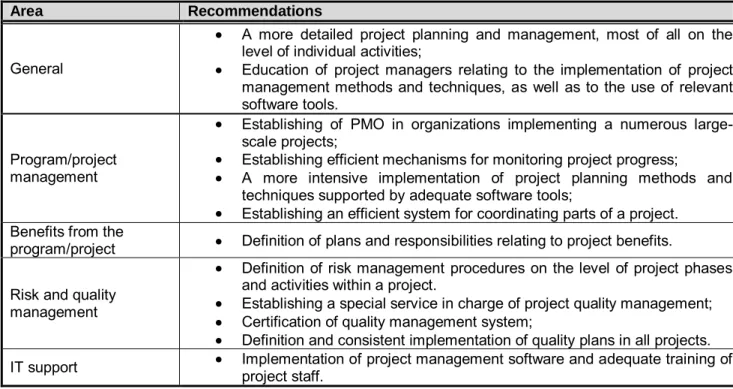
Having in mind the previously described characteristics of project maturity in Serbian energy sector, it is necessary to define measures aimed at removing deficiencies in project management and at encouraging a faster development of the energy sector. The proposed measures are presented in Table 1.
Table 1: Summary of recommendations for improving project management maturity in Serbian energy sector
Area Recommendations
General
A more detailed project planning and management, most of all on the level of individual activities;
Education of project managers relating to the implementation of project management methods and techniques, as well as to the use of relevant software tools.
Program/project management
Establishing of PMO in organizations implementing a numerous large-scale projects;
Establishing efficient mechanisms for monitoring project progress;
A more intensive implementation of project planning methods and techniques supported by adequate software tools;
Establishing an efficient system for coordinating parts of a project. Benefits from the
program/project Definition of plans and responsibilities relating to project benefits. Risk and quality
management
Definition of risk management procedures on the level of project phases and activities within a project.
Establishing a special service in charge of project quality management; Certification of quality management system;
Definition and consistent implementation of quality plans in all projects. IT support Implementation of project management software and adequate training of project staff.
5. CONCLUSION
The research of project management maturity in the energy sector was conducted in Serbia in 2013. It featured a questionnaire divided into nine areas of project maturity. The research has shown that organizations in this industry are not fully prepared for numerous, dynamic, large-scale changes expected in the forthcoming period. Energy projects, their complexity and inherent risks, as well as the fast-paced changes characterizing the contemporary market and world in general, impose an obligatory improvement of nearly all project management processes in organizations. An integrated analysis of results from the entire questionnaire confirmed that managers lack proper training for leading energy projects, stressing the need to implement extensive measures aimed at professional and specialized trainings. An analysis relying on the elements of project maturity detected several critical points relating to project management in Serbian energy sector. Key areas that, according to the results, require immediate improvements are: establishing of a functional PMO; utilization of risk management tools; use of software solutions for planning and monitoring project implementation; improved communication with stakeholders, etc. The statistical analysis of gathered answers confirmed that an adequate implementation of project management methods and techniques is necessary in projects requiring substantial investments, involving long duration and numerous staff, because it contributes to a higher success rate of projects. In addition, a statistical analysis confirmed that project management teams focus more on projects than on individual activities within them. This also stresses the need for a more intensive implementation of project management methods and techniques in energy projects implemented in Serbia.
Energy sector in Serbia faces considerable challenges. Investments expected in this area over the years to come can potentially generate immense benefits to the society. Nevertheless, in order for these benefits to be generated, it is important to manage the projects in this area efficiently. Application of the project management maturity model facilitates assessment of the current capacities of Serbian organizations to successfully implement energy projects, and offers a set of recommendations aimed at improving project management processes. Only a consistent implementation of project management concepts in the energy sector will lead to the achievement of strategic goals of, not only the energy companies, but also the Republic of Serbia, as defined in the national development strategies.
REFERENCES
Andersen, E. S., Jessen, S. A. (2003). Project maturity in organizations. International Journal of Project Management, 21 (6), 457-461.
Cooke-Davis, T.J., Arzymanov, A. (2003). The maturity of project management in different industries: An investigation into variation between project management models. International Journal of Project Management, 21 (6), 471-478.
Crawford, J.K. (2006). The Project Management Maturity Model. Information Systems Management, 23 (4), 50-58.
Flyvbjerg, B., Flyvbjerg, C. (2004). Procedures for Dealing with Optimism Bias in Transport Planning: Guidance Document, United Kingdom Department for Transport, London, UK.
Loader, R.J. (2006). The role of enterprise project management in improving organizational project performance. International Conference in Project Management, Sydney, Australia.
Mihic M. (2010). Strategic Aspects of Project Management Maturity Analysis of Serbian ICT Sector. Proceedings of the XIV International symposium YUPMA 2010, Opening lecture, Zlatibor, Serbia. Mihic M., Petrovic, D., Vuckovic, A. (2012a). Energy efficiency project portfolio optimization for public
buildings. Metalurgia International, 17 (6), 166-173.
Mihic, M., Petrovic, D., Vuckovic, A. (2011). Possibilities of application of Cost-Benefit analysis to energy efficiency projects in buildings. Economic Themes, 49 (3), 355-378.
Mihic, M., Vuckovic, A., Vuckovic, M. (2012b). Benefits management in energy efficiency projects in public buildings. Management, 17 (62), 57-66.
MMERS (2005). Energy development strategy of the Republic of Serbia by 2015. Ministery of Minning and Energy of the Republic of Serbia, Retrieved from http://www.mie.gov.rs/dokumenta/ (accessed: 20 August 2012) (In Serbian)
Oka, S., Sedmak, A., Djurovic-Petrovic, M. (2006). Energy efficiency in Serbia – research and development activity. Thermal Science, 10 (2), 5-32.
PMI (1996). A Guide to the Project Management Body of Knowledge. PMI Standards Committee, Project Management Institute, Newtown, PA, USA.
Statistical office of the Republic of Serbia, External trade of the Republic of Serbia, 2012, final data. Belgrade, 2012., Retrieved from
http://webrzs.stat.gov.rs/WebSite/repository/documents/00/01/07/42/st12g072013e.pdf (accessed: 3 August 2013)
UN (1987). Report of the World Commission on Environment and Development – Our Common Future. United Nations, Available online at: http://www.un-documents.net/our-common-future.pdf (accessed: 20 August 2012)
Zhang, M., Wang, W. (2011). Analysis of China’s energy utilization for 2007. Energy Policy, 39 (3), 1612-1616.
EMOTIONAL INTELLIGENCE: NEW COMPETENCE
OF PROJECT MANAGERS
Vladimir Obradović1, Dejan Petrović2, Milica Ristić3
1University of Belgrade, Faculty of Organizational Sciences, [email protected] 2University of Belgrade, Faculty of Organizational Sciences, [email protected] 3University of Belgrade, Faculty of Organizational Sciences, [email protected]
Abstract: Emotional intelligence is not a new concept. However it is not applied to modern management in an adequate manner. This paper tries to examine whether this personal characteristic is needed competence for successful project manager. For this purpose, substantial theory review was conducted and two surveys were analyzed. Results show that there is correlation between success of project managers and their competence. Also it is clearly shown that project managers do need to have emotional intelligence in order to run successful projects and move forward in their careers.
Keywords: emotional, intelligence, competence, project, manager
„Emotional intelligence, more than any other factor, more than intelligence, or expertise, counts 85% to 90% success on the job... Intelligence is the limit. You need but it, but it cannot make you a star. Emotional intelligence can.“ Warren Bennis 1. INTRODUCTION
Project managers should understand that the people involved in it represent a heart and a soul of every single project - their relationships, skills and ability to function as a compact entity. Skilled project managers from the first day of the project focus their attention on the understanding of human dynamics and predict possible human interaction along the project. Human Dynamics is based on researches originated back from 1979, which involved more than 40,000 people from 25 different cultures. They identify and document the inherent differences in the functioning of the people as a part of a system. Generally, team dynamic is defined as a motivating and driving force that "pushes" the team members towards achieving their goal or mission. It is a social process in which people interact and behave in accordance with environment of the group they belong to.
The starting point for the use of emotional intelligence is when you realize that project management refers to the work with other people. Project manager's success depends on the other people involved in the project. In order to achieve what was important, it is necessary to work at the team level. Big and important projects generally require big and effective project team, as well as an effective project manager. Efficient project teams do not just happen, they are carefully prepared by a group of highly qualified (in terms of skills and abilities) and motivated individuals who have a clear picture of their own goals and receive a clear and tangible evidence of their accomplishments.
People do not realize the importance of emotions in general, and today especially they do not understand their key role in the doing business. In terms of project management, emotional intelligence can be crucial to the success of the project. It is essential that the project manager becomes aware of his own feelings, learn to trust them and accept them as a source of information. If he or she properly recognize and regulate its own emotions and the emotions of the team members, this will be helpful in carrying out the project activities, resolving potential problematic issues, becoming a better leader and will create a "dream team", which will be, thanks to the good atmosphere and the energy, more productive and achieve a better performance.
2. EMOTIONAL INTELLIGENCE
Intelligence comes from the Latin word inteligere, which means understand, comprehend. Many definitions do not currently define it as mental function. Certain authors state that intelligence is the ability to solve new problems and cope with new situations, and some believe that it includes the capacity for abstract thought,