Green Principles, Parametric Analysis, and Optimization for Guiding
Environmental and Economic Performance of Grid-scale Energy Storage
Systems
byMaryam Arbabzadeh
A dissertation submitted in partial fulfillment of the requirements for the degree of
Doctor of Philosophy
(Natural Resources and Environment) in the University of Michigan
2018
Doctoral Committee:
Associate Professor Jeremiah X. Johnson, Co-Chair Professor Gregory A. Keoleian, Co-Chair
Professor of Practice Jose Alfaro Associate Professor Shelie A. Miller Professor Levi T. Thompson
Maryam Arbabzadeh [email protected]
ORCID iD: 0000-0002-8798-4836 © Maryam Arbabzadeh 2018
ii
DEDICATION
To Maman
iii
ACKNOWLEDGMENTS
The completion of this dissertation would not have become possible without the unconditional help and support of many amazing people:
First and foremost, I would like to express my deepest gratitude to my advisors, Professor Gregory Keoleian and Professor Jeremiah Johnson for their endless guidance and support. Thank you for all your advice, encouragement, and giving me confidence. It has been a true privilege to have you both as my mentors.
I would also like to express my gratitude to the rest of my committee members, Professor Shelie Miller, Professor Jose Alfaro, and Professor Levi Thompson, for the helpful discussions and insightful feedback that have been essential for me to complete and improve this dissertation. I would like to extend my gratitude to Professor Ramteen Sioshansi, for many things I have learnt from him during our collaboration on the last study of my dissertation.
I would like to acknowledge NSF Sustainable Energy Pathways Program (Grant#1230236), Dow Sustainability Fellows Program, Rackham Graduate School, and School for Environment and Sustainability for providing financial support.
I would also like to thank the members of Center for Sustainable Systems (CSS) for their intellectual support: Helaine Hunscher, Geoffrey Lewis, Robb De Kleine, Nicole Ryan, Shamitha Keerthi, Amy Chiang and all other CSS researchers. I am also grateful to researchers at Electrical Engineering and Computer Science and Industrial and Operations Engineering departments, Hamidreza Tavafoghi and Yaser Zerehsaz, for their valuable suggestions.
To all my amazing friends in Ann Arbor: Once, I was told that close friends could become your family and I laughed at it. But now, I truly believe in this, as I have had your unconditional love and support during my life in Ann Arbor. We have laughed and cried together and you have always
iv
been ready to help no matter if I was struggling with an optimization question, or I needed tips for a job interview, or I just needed a tea company to forget the bitter feeling of homesickness. The wonderful memories and moments we shared together are the best part of my PhD life.
Above all, I want to express my most sincere gratitude to my family: Maman, Baba, and Maedeh. None of this would have been possible without the endless love and support of you. I wish I was not this far from you for the past six years, and I am sorry that I was not able to be there for you when you needed me. But you yourself have always gave me motivation and taught me to be determined and strong throughout my path, while I am pursing my goals. I would also like to thank my uncle Massoud for all your unconditional support and encouragement!
And finally, Alireza, your kindness, patience, and support made this journey possible. Your motivating words kept me going when the going got hard. Thank you for being such a great companion!
v
TABLE OF CONTENTS
DEDICATION ... ii ACKNOWLEDGMENTS ... iii LIST OF TABLES ... ix LIST OF FIGURES ... x ABSTRACT ... xv Chapter 1: Introduction ... 11.1. Sustainability challenges in deployment of grid-scale energy storage systems ... 3
1.2. Overview of chapters ... 5
1.2.1. Chapter 2- Vanadium redox flow batteries to reach greenhouse gas emissions targets in an off-grid configuration ... 7
1.2.2. Chapter 3- Twelve principles for green energy storage in grid applications ... 10
1.2.3. Chapter 4- Parameters driving environmental performance of energy storage systems across grid applications ... 12
1.2.4. Chapter 5- Energy storage for time-shifting and greenhouse gas reductions under varying renewable penetrations- A CAISO case study ... 14
References ... 18
Chapter 2: Vanadium redox flow batteries to reach greenhouse gas emissions in an off-grid configuration ... 24
Abstract ... 24
2.1. Introduction ... 25
2.1.1. Objectives and Energy System Assumptions ... 27
vi
2.2.1. Life Cycle Assessment ... 28
2.2.2. Life Cycle Emissions Data ... 29
2.3. Results ... 36
2.3.1. Life Cycle Assessment Results ... 36
2.3.2. Scenarios Analysis Results ... 37
2.3.3. Optimization Results ... 38
2.3.4. Sensitivity Analysis ... 42
2.4. Conclusions and Discussion ... 43
Appendices ... 46
Appendix A. ... 46
Appendix B. The assumption for recycled content methodology... 47
Appendix C. Scenario Analysis Details ... 47
Appendix D. ... 48
Appendix E. ... 48
References ... 50
Chapter 3: Twelve principles for green energy storage in grid applications ... 54
Abstract ... 54
Abstract Art ... 54
3.1. Introduction ... 55
3.1.1. Elements of Principles for Green Energy Storage ... 58
Principles for Green Energy Storage in Grid Applications... 59
3.2. The Principles ... 60
Principle #1: Charge clean & displace dirty. ... 60
Principle #2: Energy storage should have lower environmental impact than displaced infrastructure. ... 63
vii
Principle #3: Match application to storage capabilities to prevent degradation. ... 64
Principle #4: Avoid oversizing energy storage systems. ... 65
Principle #5: Maintain to limit degradation. ... 66
Principle #6: Design and operate energy storage for optimal service life. ... 67
Principle #7: Design and operate energy storage with maximum round-trip efficiency. ... 68
Principle #8: Minimize consumptive use of non-renewable materials. ... 69
Principle #9: Minimize use of critical materials. ... 70
Principle #10: Substitute non-toxic and non-hazardous materials. ... 70
Principle #11: Minimize the environmental impact per unit of energy service for material production and processing. ... 71
Principle #12: Design for end-of-life. ... 72
3.3. Discussion ... 73
Appendices ... 76
Appendix A. Principle #1: Charge clean, displace dirty ... 76
Appendix B. Principle #11: Minimize the environmental impact per unit of energy service for material production and processing. ... 76
References ... 77
Chapter 4: Parameters driving environmental performance of energy storage systems across grid applications ... 84
4.1. Introduction ... 85
4.2. Case studies: Energy Time-shifting, Frequency Regulation, and Power Reliability ... 88
4.3. Methods ... 89
4.3.1. Universal Model Equations ... 90
4.3.2. Extreme Parameter Testing ... 94
4.3.3. Latin Hypercube Sampling... 95
viii
4.5. Discussion ... 105
Appendix A. The results of LHS modeling in maximum case scenario ... 108
Appendix B. Spider diagrams for net, use-phase, and upstream emissions ... 114
Appendix C. List of twelve principles for green energy storage systems in grid applications ... 119
References ... 120
Chapter 5: Energy storage for time-shifting and greenhouse gas reductions under varying renewable penetrations- A CAISO case study ... 126
Abstract ... 126
5.1. Introduction ... 128
5.1.1. Case study: Energy Time-shifting in CAISO ... 131
5.2. Methodology ... 133
5.2.1. Energy System Assumptions ... 133
5.2.2. Optimization ... 134 5.2.3 Scenarios ... 136 5.3 Results ... 136 5.4 Discussion ... 142 References ... 144 Chapter 6: Conclusions ... 149
6.1. A case study of energy storage integration within an off-grid configuration (Chapter 2) 149 6.2. Principles for green energy storage in grid applications (Chapter 3) ... 150
6.3. Key parameters for driving environmental performance of grid-scale energy storage (Chapter 4)... 151
6.4. Optimization model for deployment of energy storage within CAISO (Chapter 5) .... 151
6.5. Recommendations for Future Research ... 152
ix
LIST OF TABLES
Table 1-1 An overview of chapters ... 6
Table 1-2 Influence of parameters on net CO2eq emissions in time-shifting, frequency regulation, and reliability applications [56] ... 13
Table 2-1 NG Reciprocating Engine Typical Performance Parameters ... 30
Table 2-2 Life Cycle GHG Emissions Results ... 37
Table 2-3 Life cycle emissions target optimization results ... 41
Table 2-4 Definition of variables ... 46
Table 2-5 The assumption for recycled content methodology... 47
Table 2-6 Life cycle emissions in different scenarios ... 47
Table 2-7 Contribution to total cost of delivered electricity in different scenarios ... 47
Table 2-8 Electricity storage/generation cost by technology type ... 48
Table 2-9 Base case assumptions ... 48
Table 2-10 Life cycle inventory sources ... 48
Table 3-1 Natural gas and coal emissions factors ... 76
Table 3-2 The detailed GHG emissions assumptions for VRFB materials production and manufacturing of the battery in the model ... 76
Table 4-1 Nomenclature ... 85
Table 4-2 Selected Energy Storage System for Each Grid Application ... 89
Table 4-3 Possible Ranges for Energy Storage Systems Parameters* ... 92
Table 4-4 Grid Application Assumptions ... 93
Table 4-5 Default Values for Spider Diagrams ... 94
Table 4-6 Influence of parameters on net CO2eq emissions in time-shifting, frequency regulation, and reliability applications ... 106
Table 5-1 Nomenclature ... 127
x
LIST OF FIGURES
Fig. 1-1 U.S. Annual Energy Storage Deployment Forecast, 2012-2022E (MW) [3] ... 1
Fig. 1-2 Annual Energy Storage Market Size, 2012-2022E (Million $) [3] ... 1
Fig. 1-3 Installed non-pumped hydro storage in 2016 [7] ... 2
Fig. 1-4 Model components for battery storage integration with wind energy ... 9
Fig. 1-5 Categories of principles for green energy storage systems [38] ... 11
Fig. 1-6 Optimal size of nine energy storage technologies in different combinations of installed wind and solar capacity in CAISO, assuming 0, $50/ton, $100/ton, and $200/ton of CO2 emissions taxes ... 16
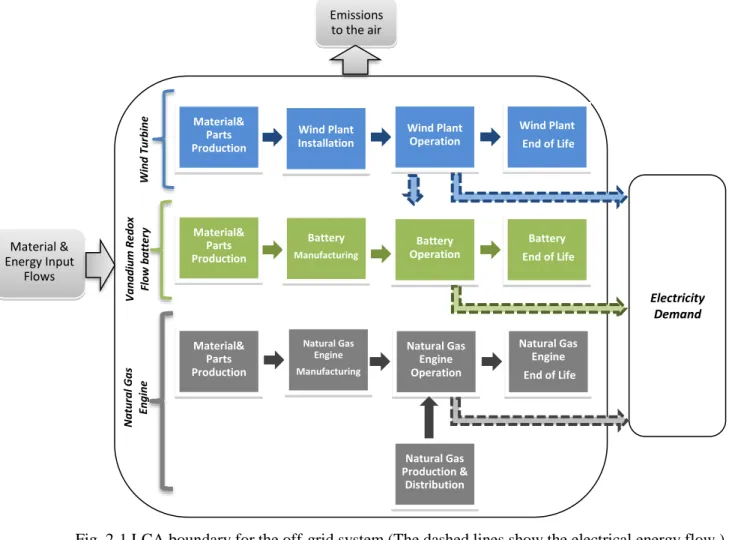
Fig. 2-1 LCA boundary for the off-grid system (The dashed lines show the electrical energy flow.) ... 29
Fig. 2-2 (a) Total emissions and total costs of the system in scenario 2 with natural gas combustion and wind energy. (b) Total emissions and total costs of the system in scenario 3 with natural gas combustion and wind energy integrated with VRFB as energy storage. (The storage capacity is held constant at 400MWh.) ... 38
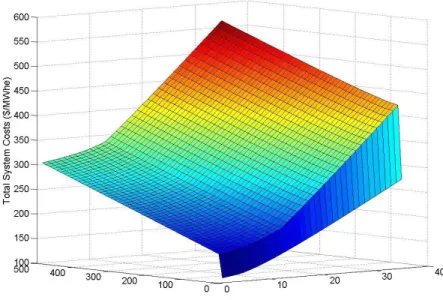
Fig. 2-3 Total emissions of the system (in g of CO2-eq/kWh) in different system configuration . 39 Fig. 2-4 Total costs of the system (in $/MWh) in different system configuration ... 40
Fig. 2-5 Cost of carbon mitigation in different system configuration (minimum at T=1, B=0) ... 40
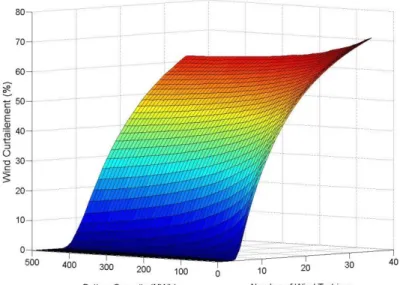
Fig. 2-6 Wind curtailment in different system configurations ... 41
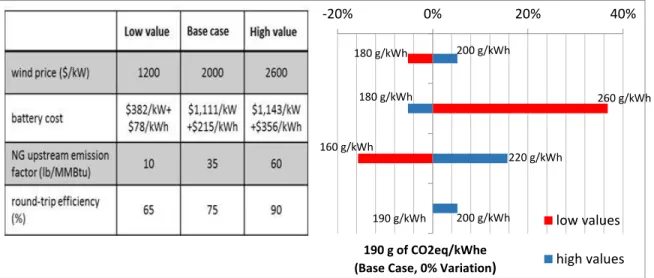
Fig. 2-7 Results of sensitivity analysis to wind price, battery cost, NG upstream emissions factor and round-trip efficiency... 43
Fig. 3-1 Categories of principles for green energy storage systems. ... 54
Fig. 3-2 List of principles for green energy storage systems. ... 60
Fig. 3-3 Net GHG emissions in different charge-displace scenarios for an energy storage system with 75% round-trip efficiency. (*Net Emissions include fuels’ combustion and upstream emissions for the fuel. Negative amounts are shown in parentheses.)... 62 Fig. 3-4 The impact of battery sizing on emissions intensity of delivered electricity and stored
xi
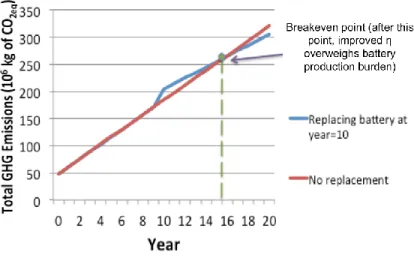
electricity utilization in two scenarios with (a) 5 wind turbines and (b) 25 wind turbines. ... 66 Fig. 3-5 Total GHG emissions of the off-grid configuration after 20 years in 2 scenarios: Replacing the battery (η=60%) with a more efficient one (η =95%) at Year 10 and no replacement scenario. ... 68 Fig. 3-6 Net use-phase GHG emissions in different charge-displace scenarios, assuming 3 values for the energy storage round-trip efficiency. (Net use-phase emissions include fuels’ combustion and upstream emissions for the fuel. Negative amounts are shown in pare ... 69 Fig. 3-7 The impact of decreasing battery production burden on total emissions in the micro-grid case study, which includes 25 wind turbines, natural gas, and VRFB. ... 72 Fig. 4-1 Impacts of each parameter on CO2eq net emissions in three applications: time-shifting application, frequency regulation, and power reliability in case of PbA technology. Two scenarios are assumed: 1) energy storage is charged with natural gas, and displaces coal based electricity generation, 2) energy storage is charged with coal, and displaces natural gas generation. “ES Burden” stands for energy storage production burden. X-axis represents the minimum, average, and maximum values for each parameter. ... 97 Fig. 4-2 Dominance of parameters over upstream, use-phase, and net emissions in time-shifting, frequency regulation, and reliability applications in case of PbA technology. Two scenarios are assumed: 1) energy storage is charged with natural gas, and displaces coal based electricity generation, 2) energy storage is charged with coal, and displaces natural gas generation. “ES Burden” stands for energy storage production burden. The color scales vary by application and charging pattern. ... 98 Fig. 4-3 Impacts on life cycle CO2eq emissions due to assumptions for energy storage round-trip efficiency, energy storage service life, energy storage production burden, annual degradation in energy storage capacity and round-trip efficiency, heat rate of charging technology, and heat rate of displaced technology in time-shifting application (minimum size scenario). Two scenarios are assumed: 1) energy storage is charged with natural gas, and displaces coal based electricity generation (left column), 2) energy storage is charged with coal, and displaces natural gas generation (right column) ... 101 Fig. 4-4 Impacts on life cycle CO2eq emissions due to assumptions for energy storage round-trip efficiency, energy storage service life, energy storage production burden, annual degradation in energy storage capacity and round-trip efficiency, heat rate of charging technology, and heat rate
xii
of displaced technology in frequency regulation application (minimum size scenario). Two scenarios are assumed: 1) energy storage is charged with natural gas, and displaces coal based electricity generation (left column), 2) energy storage is charged with coal, and displaces natural gas generation (right column) ... 103 Fig. 4-5 Impacts on life cycle CO2eq emissions due to assumptions for energy storage round-trip efficiency, energy storage service life, energy storage production burden, annual degradation in energy storage capacity and round-trip efficiency, heat rate of charging technology, and heat rate of displaced technology in power reliability application (minimum size scenario). Two scenarios are assumed: 1) energy storage is charged with natural gas, and displaces coal based electricity generation (left column), 2) energy storage is charged with coal, and displaces natural gas generation (right column) ... 105 Fig. 4-6 Impacts on life cycle CO2eq emissions due to assumptions for energy storage round-trip efficiency, energy storage service life, energy storage production burden, annual degradation in energy storage capacity and round-trip efficiency, heat rate of charging technology, and heat rate of displaced technology in time-shifting application (maximum size scenario). Two scenarios are assumed: 1) energy storage is charged with natural gas, and displaces coal based electricity generation (left column), 2) energy storage is charged with coal, and displaces natural gas generation (right column) ... 109 Fig. 4-7 Impacts on life cycle CO2eq emissions due to assumptions for energy storage round-trip efficiency, energy storage service life, energy storage production burden, annual degradation in energy storage capacity and round-trip efficiency, heat rate of charging technology, and heat rate of displaced technology in frequency regulation application (maximum size scenario). Two scenarios are assumed: 1) energy storage is charged with natural gas, and displaces coal based electricity generation (left column), 2) energy storage is charged with coal, and displaces natural gas generation (right column) ... 111 Fig. 4-8 Impacts on life cycle CO2eq emissions due to assumptions for energy storage round-trip efficiency, energy storage service life, energy storage production burden, annual degradation in energy storage capacity and round-trip efficiency, heat rate of charging technology, and heat rate of displaced technology in power reliability application (maximum size scenario). Two scenarios are assumed: 1) energy storage is charged with natural gas, and displaces coal based electricity generation (left column), 2) energy storage is charged with coal, and displaces natural gas
xiii
generation (right column) ... 113 Fig. 4-9 Impacts of each parameter on net, use-phase, and upstream emissions in time-shifting application. “ES Burden” stands for energy storage production burden. It is assumed that energy storage is charged with natural gas and displaces coal based electricity generation. X-axis represents the minimum, average, and maximum values for each parameter. (VRFB=vanadium redox flow battery, PbA= lead-acid battery, NaS= sodium-sulfur battery, CAES= compressed air energy storage, PHES= pumped-hydro energy storage) ... 115 Fig. 4-10 Impacts of each parameter on net, use-phase, and upstream emissions in time-shifting application. “ES Burden” stands for energy storage production burden. It is assumed that energy storage is charged with coal based electricity generation and displaces natural gas. X-axis represents the minimum, average, and maximum values for each parameter. (VRFB=vanadium redox flow battery, PbA= lead-acid battery, NaS= sodium-sulfur battery, CAES= compressed air energy storage, PHES= pumped-hydro energy storage) ... 116 Fig. 4-11 Impacts of each parameter on net, use-phase, and upstream emissions in frequency regulation application. “ES Burden” stands for energy storage production burden. It is assumed that energy storage is charged with natural gas and displaces coal based electricity generation. X-axis represents the minimum, average, and maximum values for each parameter. (PbA= lead-acid battery, Li-ion= lithium-ion battery) ... 116 Fig. 4-12 Impacts of each parameter on net, use-phase, and upstream emissions in frequency regulation application. “ES Burden” stands for energy storage production burden. It is assumed that energy storage is charged with coal based electricity generation and displaces natural gas. X-axis represents the minimum, average, and maximum values for each parameter. (PbA= lead-acid battery, Li-ion= lithium-ion battery) ... 117 Fig. 4-13 Impacts of each parameter on net, use-phase, and upstream emissions in power reliability application. “ES Burden” stands for energy storage production burden. It is assumed that energy storage is charged with natural gas and displaces coal based electricity generation. X-axis represents the minimum, average, and maximum values for each parameter. (VRFB=vanadium redox flow battery, PbA= lead-acid battery, NaS= sodium-sulfur battery, Li-ion= lithium-ion battery) ... 118 Fig. 4-14 Impacts of each parameter on net, use-phase, and upstream emissions in power reliability application. “ES Burden” stands for energy storage production burden. It is assumed that energy
xiv
storage is charged with coal based electricity generation and displaces natural gas. X-axis represents the minimum, average, and maximum values for each parameter. (VRFB=vanadium redox flow battery, PbA= lead-acid battery, NaS= sodium-sulfur battery, Li-ion= lithium-ion battery) ... 119 Fig. 5-1 Scenarios for the optimization model ... 136 Fig. 5-2 Optimal size (in MW) of nine energy storage technologies in different combinations of installed wind and solar capacity in CAISO, assuming 0, $50/ton, $100/ton, and $200/ton of CO2 emissions taxes... 138 Fig. 5-3 Optimal operation of six storage technologies on March 1st in CAISO, assuming 20 GW of wind capacity, 20 GW of solar capacity, and $100/ton of CO2 emissions tax. MCP ($/MWh), ES charged (𝒒𝒕𝒄 in MW), and ES discharged (𝒒𝒕𝒅 in MW) are shown in the secondary vertical axis. (NaS, Li-ion, and ZBB are not deployed under this level of renewables penetration) ... 139 Fig. 5-4 Renewable (wind and solar) curtailment before and after deploying specific technologies in CAISO, assuming 0, $50/ton of CO2, $100/ton of CO2, and $200/ton of CO2 emissions tax (“W” stands for wind, “S” stands for solar, and the numbers on top of bars show the emissions tax level) ... 140 Fig. 5-5 Renewable (wind and solar) curtailment in case of PHES deployment with middle and maximum renewable penetration level, assuming 0 and $200/ton of CO2 emissions tax ... 141 Fig. 5-6 Li-ion energy capacity reduced cost, assuming 20 GW of solar penetration and 10 GW of wind penetration... 142
xv
ABSTRACT
The development and deployment of grid-scale energy storage technologies have increased recently and are expected to grow due to technology improvements and supporting policies. While energy storage can help increase the penetration of renewables, reduce the consumption of fossil fuels, and increase the grid sustainability, its integration into the electric grid poses unique sustainability challenges that need to be investigated through systematic sustainability assessment frameworks. The main objective of this dissertation is to develop principles and models to assess the environmental and economic impacts of grid-scale energy storage and guide its development and deployment.
The first study of this dissertation is an initial case study of energy storage to examine the role of cost-effective energy storage in supporting high penetration of wind energy and achieving emissions targets in an off-grid configuration. In this study, the micro-grid system includes wind energy integrated with vanadium redox flow battery (VRFB) as energy storage, and natural gas engine. Life cycle greenhouse gas (GHG) emissions and total cost of delivered electricity are evaluated and generation mixes are optimized to meet emissions targets at the minimum cost. The results demonstrate that while incorporating energy storage consistently reduces life cycle GHG emissions in the system by integrating more wind energy, its integration is cost-effective only under very ambitious emission targets.
The insights from this case study and additional literature review led to the development of a set of twelve principles for green energy storage, presented in the second study. These principles are applicable to the wide range of energy storage technologies and grid applications, and are developed to guide the design, maintenance, and operation of energy storage systems for grid applications. The robustness of principles was tested through a comprehensive literature review and also through in-depth quantitative analyses of the VRFB off-grid system.
xvi
parameters (e.g. energy storage service-life) that influence the environmental performance of six energy storage technologies within three specific grid applications (including time-shifting, frequency regulation, and power reliability). This study reveals that round-trip efficiency and heat rate of charging and displaced generation technologies are dominant parameters in time-shifting and regulation applications, whereas energy storage service life and production burden dominate in power reliability.
Finally, an optimization model is developed in the fourth study to examine the real-world application of energy storage in bulk energy time-shifting in California grid under varying renewable penetration levels. The objective was to find the optimal operation and size of energy storage in order to minimize the system total costs (including monetized GHG emissions), while meeting the electricity load and systems constraints. Simulations were run to investigate how the operation of nine distinct storage technologies impacted system cost, given each technology’s characteristics. The results show that increasing the renewable capacity and the emissions tax would make it more cost-effective for energy storage deployment. Among storage technologies, pumped-hydro and compressed-air energy storage with lower capital costs, are deployed in more scenarios.
Overall, this research demonstrates how sustainability performance is influenced by storage technology characteristics and the electric grid conditions. The systematic principles, model equations, and optimizations developed in this dissertation provide specific guidance to industry stakeholders on design and deployment choices. The targeted audience ranges from energy storage designers and manufacturers to electric power utilities.
1
CHAPTER 1
Introduction
There has been a rapid development in grid-scale energy storage systems due to technology improvements and recent policies promoting their deployment such as California’s requirement of 1,325 MW of storage by 2020 [1] and the Federal Energy Regulatory Agency Order 755 [2]. Figures 1-1 and 1-2 show how annual energy storage deployment and market size have changed in the U.S. recently and how they are projected to grow within the residential, non-residential, and utility segments [3]. Based on these figures, it is expected that the U.S. energy storage market will grow to roughly 2.5 GW in 2022, 11 times the size of the 2016 market (231 MW). Also, by 2022, the U.S. energy storage market is expected to be worth $3.1 billion, a nine-fold increase from 2016 [3]. However, energy storage integration into the electric grid poses fundamentally unique challenges, and therefore there is a significant need to develop robust methods and frameworks to systematically understand the impacts of energy storage deployment, which is the focus of this dissertation.
Fig. 1-1 U.S. Annual Energy Storage Deployment Forecast, 2012-2022E (MW) [3]
2
Energy storage can be a potential solution to the integration challenges of intermittent renewable energy such as wind energy and solar energy, reduce greenhouse gas (GHG) emissions, and enhance grid reliability and sustainability [4]. Other grid applications for energy storage systems include energy time-shifting (energy arbitrage), frequency regulation, and transmissions and distribution upgrade deferral, among others [5]. Types of energy storage technologies vary greatly from electrochemical technologies such as batteries; including flow battery and lithium-ion (Li-ion) battery; to compressed air energy storage, flywheels, and pumped-storage technology [6]. Fig.1-3 shows the share of each non-pumped hydro storage technology in the total installed storage capacity of 2016 [7]. Each of these storage technologies has unique characteristics that determine which subset of energy storage technologies is suitable to meet the application’s performance requirements.
Fig. 1-3 Installed non-pumped hydro storage in 2016 [7]
Several studies have reviewed technical characteristics of energy storage technologies and identified the potential grid applications for each storage technology. These include comprehensive reports by Sandia National Laboratory and the Department of Energy (DOE) [5], [8], [9], [10]. In other reports, Electric Power Research Institute (EPRI) reviewed storage technologies performance characteristics such as service life, efficiency, response time, and compared the suitability of such systems for grid applications including peak shaving, serving in micro-grids, and wind integration [4], [11]. Additionally, Rahman et al. identified potential grid applications for each storage technology based on the technology’s main advantages and disadvantages [12]. Their results showed that vanadium redox flow and sodium-sulfur batteries
3
could be a promising technology for renewable energy integration, and flywheels were applicable for frequency regulation. In a comparison of technical characteristics of energy storage systems including power rating, discharge time, storage duration, and lifetime cycle life, Chen et al. identified a suitable application range for each technology [13]. These and other studies [14] - [17] show that deployment of an energy storage system for a specific grid application depends on the storage technology characteristics match with the performance requirements of the desired application.
1.1. Sustainability challenges in deployment of grid-scale energy storage systems
While energy storage supports different grid applications, its extensive adoption in the power grid is limited by high costs. The range for energy storage capital cost differs substantially from one technology to another and also within one storage technology itself. For instance, pumped-hydro storage capital cost (energy component) varies from $5/kWh to $100/kWh and Li-ion battery cost varies between $600/kWh-$2500/kWh [18].
Several studies have identified the economic challenges in deployment of energy storage systems. As discussed by Sardi et al., the cost of energy storage systems; particularly batteries; is the major obstacle to their adoption. In this regard, the current deployment of energy storage is generally uneconomical, as the overall energy storage installment cost is higher than the total benefits obtained from its deployment [19]. Abeygunawardana et al. discuss that at the current market prices of energy storage devices, in most cases, it is not quite cost-effective to utilize energy storage for distribution upgrade deferral application alone [20]. However, combining benefits for one or more complementary storage applications may provide the extra value needed to justify the use of storage for distribution deferral alone. Zheng et al argue that despite the advances in material science and power electronic techniques that have facilitated the effective employment of new storage technologies, the high cost and control issues still limit the wide applications of energy storage systems [21]. Dunn et al. specified varying characteristics across sodium-sulfur (NaS), Li-ion, and redox-flow batteries [22]. They concluded that a successful future for these technologies depended on using low cost materials in order to decrease the installed costs of batteries while improving their performance and durability. A report by DOE identified the cost-competitiveness of energy storage systems as one of the main challenges in the widespread use of energy storage
4
systems [6]. According to Mohd et al., decreasing the capital costs of energy storage systems would lead to dramatic changes in the design and operation of the electric grid [23].
Besides economic issues, both the development and deployment of energy storage systems can lead to different environmental outcomes. Several studies have examined the environmental implications during the production of energy storage systems. In this regard, Tarascon emphasized that, regardless of storage technology, materials with minimum environmental footprint must be developed in an attempt towards green storage systems [24]. Larcher and Tarascon argued that the only feasible path towards greener and more sustainable batteries is rooted in designing electro-active materials that release fewer CO2 emissions and cost less energy during production, while providing comparable performance to today’s electrodes [25]. In another study, McManus examined the environmental impacts of different types of batteries, concluding that Li-ion batteries had the highest contribution to GHG emissions and metal depletion, but nickel metal hybrid had a higher cumulative energy demand [26].
With 29% of total US GHG emissions coming from burning fossil fuels for electricity generation in 2015 [27], renewables are rapidly expanding options to reduce the carbon intensity of power generation and achieve environmental improvements in the power sector. Large-scale integration of intermittent renewables into the electrical grid, however, poses critical challenges. While energy storage utilization can lead to higher penetration of renewable energy, its deployment may not always lead to environmental benefits. Indeed, environmental impacts of energy storage during its operation within the power grid depend on the grid application, the grid profile, and the existing generation mix. For example, Lin et al. showed that depending on the power grid configuration, the integration of energy storage for power systems reserves application may not necessarily lead to environmental improvements [28]. Their results emphasized the need for a more systematic approach in examining the environmental performance of energy storage deployment. In an examination of energy arbitrage application in Texas, Carson and Novan showed that energy storage integration would increase the average daily GHG emissions due to an increase in off-peak fossil fuel generation [29]. In another study, Hiremath et al. emphasized the significance of energy storage operation in the overall environmental performance of these technologies, especially when they had different characteristics parameters [30].
5
These examples show that the production, operation, and deployment of energy storage systems within a grid application have a significant impact on the environmental and economic outcomes of utilizing such systems. While previous studies have provided valuable insights into the economic and environmental implications of energy storage systems, there remains the need for systematic sustainability assessment tools that provide robust guidance on the development and deployment of these technologies. The central objective of this dissertation is to develop novel tools to evaluate the economic and environmental impacts of integrating energy storage systems within the electric grid and develop principles for guiding deployment of those technologies. A wide range of energy storage systems and their grid applications are studied in this dissertation to investigate how sustainability implications in terms of environmental and economic aspects change across storage technologies within different grid applications.
1.2. Overview of chapters
Table 1-1 provides an overview of chapters, outlining each chapter’s research aims and the energy system assumptions including the grid application, energy storage technology studied, and the impacts assessed. In Chapter 2, the role of VRFB energy storage is assessed in integrating wind energy and reaching emissions targets in an off-grid model. Life cycle GHG emissions and total cost of delivered electricity are evaluated and generation mixes are optimized to meet emissions targets at the minimum cost. The results demonstrate that while incorporating energy storage consistently reduces life cycle carbon emissions, it is not cost effective to reduce wind curtailment except under very low emission targets.
A set of twelve principles for green energy storage systems is developed in Chapter 3, which is applicable to the wide range of energy storage technologies and grid applications. In this chapter, potential environmental impacts of energy storage systems development and operation are studied through a comprehensive literature review and through an in-depth quantitative analyses of the off-grid case study from Chapter 2.
In Chapter 4, the impact of six parameters on environmental outcomes of integrating selected energy storage technologies is assessed using model equations, which are applied to time-shifting, frequency regulation, and power reliability applications. This chapter concludes that efficiency
6
and heat rates parameters dominate in time-shifting and regulation applications, whereas energy storage service life and production burden dominate in power reliability.
Chapter 5 examines a real-world case study of energy storage application in time-shifting the peak load of California. An optimization model is developed to find the optimal state of charge and size of energy storage in order to minimize the system total costs (including GHG emissions), while meeting the electricity load and systems constraints. Simulations are run to investigate how the operation of seven distinct battery storage technologies along with pumped-hydro energy storage, adiabatic compressed energy storage, and diabatic compressed energy storage change given their energy storage characteristics. Scenarios with four emission taxes of 0, $50/ton of CO2, $100/ton of CO2, and $200/ton of CO2 are developed to test the operation of each energy storage system under different tax assumptions. The findings show that increasing the installed capacity of wind and solar energy would make it more cost-effective for the energy storage to be deployed and among storage technologies PHES and D-CAES are built in most scenarios due to their lower costs.
Table 1-1 An overview of chapters
Research Aims Grid Application Technology Studied Impacts Assessed
Chapter 2
An analysis of ESS*
operation and its environmental and economic impacts, while emissions targets in an optimization model
Wind integration VRFB* Life cycle GHG
emissions and cost
Chapter 3
Universal principles for green energy storage- highlighting significant parameters
Across applications Full range of energy storage technologies A full range of environmental impacts Chapter 4 An in-depth analysis to determine the influential parameters on GHG emissions Time-shifting Frequency regulation Power reliability Batteries: VRFB, Li-ion*, PbA*, NaS*
CAES*
PHES*
Flywheels
Life cycle GHG emissions
7 Chapter 5
An in-depth analysis of emissions and costs across technologies with various parameters within an optimization model Time-shifting in CAISO* Batteries: VRFB, Li-ion, PSB*, ZBB*, PbA, NaS D-CAES A-CAES PHES Operational GHG emissions and life cycle
costs
* (ESS= energy storage system, VRFB=vanadium redox flow battery, PbA= lead-acid battery, NaS= sodium-sulfur
battery, Li-ion= lithium-ion battery, CAES= compressed air energy storage, PHES= pumped-hydro energy storage, CAISO= California Independent System Operator, D-CAES= diabatic compressed air energy storage, A-CAES= adiabatic compressed air energy storage, PSB=polysulfide bromide battery, ZBB= zinc Bromine Battery)
1.2.1. Chapter 2- Vanadium redox flow batteries to reach greenhouse gas emissions targets in an off-grid configuration
1.2.1.1. Research aims
Negative environmental impacts and uncertain prices of fossil fuels are powerful drivers behind new research to understand how to improve technologies supporting renewables. Despite these sustainability opportunities, large-scale integration of variable and non-controllable renewables into the electrical grid poses critical challenges that may be overcome through the use of energy storage systems. In two separate studies of solar energy, Zahedi, and Denholm and Margolis reviewed the challenges in large-scale integration of solar systems and the impact of economically and technically viable energy storage systems in alleviating these challenges [31], [32]. In another study, Denholm and Hand found that storage equal to one day of average demand could enhance the penetration of solar and wind energy up to 80% in the Electric Reliability Council of Texas market [33]. Electric Power Research Institute (EPRI) examined the applications of various energy storage technologies to smooth the integration of grid-connected wind energy [11].
The second chapter of this dissertation investigates the operation of an energy storage system within an off-grid configuration to increase the wind penetration and analyzes the associated environmental and economic impacts. This micro-grid system includes wind energy integrated with energy storage besides natural gas as a back-up generation. The relationship between total system costs and life cycle emissions are used to optimize the generation mixes to achieve emissions targets at the least cost and determine when VRFBs are preferable over wind curtailment.
Several studies have conducted optimization in an isolated system that include renewable energy, energy storage, and other sources of generation to achieve the minimum cost. For example, in an
8
optimization of a stand-alone hybrid system including PV panels, wind energy, and diesel generator, Merei et al. showed that the integration of batteries with renewables was economical and environmentally preferable. They also showed that using redox flow batteries specifically in combination with renewables and diesel was the best option in comparison to lead-acid and lithium-ion batteries integration [34]. In another study, Kaabeche et al. showed that a hybrid system including PV/wind/diesel/battery was more economically viable compared to a PV/wind/battery system and also a diesel generator only system [35]. In addition to batteries, several optimization studies examined hybrid configurations including other storage systems such as compressed air or pumped hydro energy storage [36], [37], [38], [39].
As discussed earlier, while energy storage can help integrate more renewables and potentially increase the grid sustainability, it is critical to evaluate the life cycle environmental impacts associated with the production and operation of such systems. For example, in an analysis of life cycle energy requirements and emissions from large-scale storage systems coupled with renewables, Denholm and Kulcinsi showed that despite the added emissions and energy input, these systems offered lower emissions than fossil fuel based electricity [40]. Other studies also included emissions in their analysis of off-grid systems which included renewables integrated with energy storage [41], [42].
While economic and environmental analyses have been conducted in these previous studies, there remains the need for further examination of the economic and environmental trade-offs between curtailment and energy storage. This chapter examines the trade-offs between environmental and economic metrics when utilizing vanadium redox flow batteries (VRFB) to integrate wind energy and explores the role of energy storage in achieving very low emissions targets. This study contributes to the literature through assessing the full life cycle GHG emissions of all system components and evaluates the total cost of the system. Based on these evaluations, it is determined when the value of large-scale energy storage outweighs the cost of wind curtailment, i.e. when energy storage is preferable over additional wind capacity. The results of this research are published in Applied Energy as “Vanadium redox flow batteries to reach greenhouse gas emissions targets in an off-grid configuration” [43].
9 1.2.1.2. Energy system studies and approach
The case study is intended to represent an island with the same size as “Grosse Ile”, Michigan. The island system is an isolated grid and the generation options are assumed to be wind energy integrated with VRFB energy storage and natural gas as a back-up generation. VRFBs offer high round-trip efficiency and different grid applications [44]. By utilizing life cycle analysis, Rydh compared VRFB and PbA batteries, concluding that that former had a lower environmental impact, greater net energy storage efficiency, and longer cycle-life [45]. Joerissen et al. identified load leveling and seasonal energy storage in small grids and stand-alone PV systems applications for VRFB [46]. Stiel and Skyllas-Kazacos assessed the environmental and economic benefits of integrating VRFB with remote wind/diesel power systems, showing that such system had lower carbon emissions and net present cost compared to wind/diesel system [47]. These and other studies focus on economic and environmental aspects of integrating energy storage, without addressing emissions targets, which is a critical criterion especially for decision and policy-makings. In this study, first total environmental GHG emissions of integrating VRFB with wind energy is assessed through a full LCA of all system components. Then the trade-offs between total emissions and total cost of the system are evaluated using an optimization model. In this model, optimal generation mixes comprised of VRFBs, wind turbines, and natural gas reciprocating engines (Fig. 1-4) are determined to minimize the delivered cost of electricity to the isolated load, while meeting progressively more challenging life cycle GHG emissions targets.
Fig. 1-4 Model components for battery storage integration with wind energy
Wind Turbine Vestas V90
(3 MW)
Vanadium Redox Flow Battery (VRFB)
Natural Gas (NG) Reciprocating Engine (3 MW)
10
1.2.2. Chapter 3- Twelve principles for green energy storage in grid applications
1.2.2.1. Research aims
As mentioned earlier, the integration of energy storage systems into the electrical grid can lead to different environmental outcomes based on the grid application, the existing generation assets, and the electrical demand. While studies already cited in the previous sections [24], [25], [26], [28], [29], [30] provide important insights into the environmental impacts of grid-scale energy storage, those who design, maintain, and operate such systems lack a comprehensive and systematic set of principles that can yield improved environmental outcomes. This chapter fills a research gap by providing a transparent set of principles as a novel tool to guide integration, operation and maintenance, design, and material choices that influence environmental outcomes from developing and deploying energy storage systems. The objective is to guide designers, decision makers, and utility operators on design choices and deployment scenarios. These principles for green energy storage build upon the robust body of research that aims to improve environmental outcomes through better design and operation:
Keoleian and Menerey introduced a guidance manual for life cycle design, emphasizing the importance of addressing environmental issues in designing sustainable systems, which led to evolvement of a variety of frameworks to support green design [48]. For example, two sets of twelve principles for green chemistry and twelve green engineering principles made important contributions to guide design of environmentally benign products and processes [49], [50]. In an examination of these principles, Krichhoff demonstrated that combining green chemistry with green engineering would lead to maximum efficiency and minimum waste [51]. In two other studies, McDonough et al. demonstrated the industrial application of green engineering principles [52] while Diwekar used the green engineering principles to develop an integrated computer-aided framework for designing chemical process [53].
While other studies have successfully provided guidance and structure to green design and products, energy storage technologies pose unique assessment challenges that are not fully addressed by those approaches. Inspired by and building off the 12 engineering principles [49], 12 principles for green energy storage are developed in this chapter to provide insights into and improve the environmental outcomes when integrating energy storage systems into power grid.
11
The principles for green energy storage are published in Environmental Science & Technology as “Twelve principles for green energy storage in grid applications” [54].
1.2.2.2. Energy system studied and approach
These principles are broadly applicable to the wide range of energy storage technologies (e.g. batteries, flywheels) and grid applications (e.g. energy time-shifting, frequency regulation) for which they are being used or considered. Principles were developed through comprehensive literature review and were presented to diverse audiences including electrochemists, engineers, industrial ecologists, and sustainability scientists. The principles are grouped into three categories (Fig. 1-5): (1) system integration for grid applications, (2) the maintenance and operation of energy storage, and (3) the design of energy storage technologies. The first category of principles addresses the specific nature of the grid applications for which energy storage is considered. Existing grid infrastructure and electricity demand profiles influence environmental outcomes from the integration of energy storage systems. The second category addresses impacts associated with the operation phase and also the importance of efficient maintenance of energy storage system to provide the desired outcomes. The third category highlights the importance of performance characteristics of storage system such as efficiency and service life and addresses the impacts from materials and production phase.
12
1.2.3. Chapter 4- Parameters driving environmental performance of energy storage systems across grid applications
1.2.3.1. Research aims
The principles address the importance of the operational parameters of energy storage such as service life, round-trip efficiency, and degradation but do not address how their influence would vary across grid applications. Motivated and guided by this need, a universal set of equations is developed in this chapter to investigate the influence of selected parameters on the environmental outcomes of integrating energy storage for specific applications. Existing environmental assessments of energy storage systems have not systematically evaluated the influence of various parameters on environmental performance of these technologies. This chapter aims to fill this research gap by illustrating that across the full range of parameters, environmental outcomes could be positive or negative. The main focus is to understand the interaction between energy storage parameters (e.g., round-trip efficiency, degradation, service life, and production burden) and grid application parameters (e.g., generators’ heat rates). This parametric analysis indicates the relative importance of each parameter in determining the environmental performance of utilizing energy storage, and provides guidance to determine, systematically, when and how to choose storage systems to achieve positive environmental outcomes.
In 2012, Hittinger et al. evaluated the impact of energy storage parameters on the economic cost of providing energy service across grid applications [55]. The study presented here is novel because it presents a parametric analysis tool to identify how selected parameters drive environmental outcomes in grid applications, providing new insights for the design and deployment of new technologies and the modification and improvement of existing ones.
1.2.3.2. Energy system studied and approach
Three case studies of energy storage applications—energy time-shifting, frequency regulation, and power reliability applications—are selected to demonstrate the impact of parameters on the environmental performance of energy storage. These grid applications were chosen to illustrate a wide range of performance requirements such as required energy storage power rating, capacity, and number of cycles. Suitable technologies were selected for each grid application through a comprehensive literature review. To illustrate the range of outcomes for net emissions during the
13
operation of energy storage, a range of energy storage parameters and grid application parameters are assumed. A full literature review was conducted to find a feasible range for parameters of potential energy storage systems that were suitable for each application.
The impacts of selected parameters on net emissions are summarized in Table 1-2 and published as “Parameters driving environmental performance of energy storage systems across grid applications” in Journal of Energy Storage. This table shows the relative differences of the parameters’ influence across time-shifting, frequency regulation, and power reliability applications based on our baseline assumptions [56]. The assumptions include energy storage sizing, discharge duration, and number of cycles per year, and are defined for each of the three applications. Given these assumptions, each application represents a generalized case study rather a specific grid example.
Table 1-2 Influence of parameters on net CO2eq emissions in time-shifting, frequency regulation, and
reliability applications [56]
Time-shifting Frequency Regulation Power Reliability
Round-trip efficiency
Annual degradation
Heat rate charge
Heat rate displace
Service life
Energy storage production burden
14
1.2.4. Chapter 5- Energy storage for time-shifting and greenhouse gas reductions under varying renewable penetrations- A CAISO case study
1.2.4.1. Research aims
The environmental and economic impacts of energy storage integration depend on the energy system characteristics such as the generation mix, energy storage sizing, and energy storage operation within the power grid. Many studies have optimized the operation and size of an energy storage system for a given grid application from an economic point of view. For example, Ho et al. optimized the scheduling and capacity of an energy storage system to achieve minimum investment cost using integer linear programming in a distributed energy generation system [57]. Their results indicated that for renewable integration application, energy storage with high capital costs was advised to operate in daily cycles (vs. weekly cycles) due to intermittency of renewables. In another study, Parra et al. optimized the size of lead-acid (PbA) and Li-ion batteries for time-shifting application in a 100-home community in cases of time-of-use or real-time-pricing tariffs [58]. Their results showed that the time-of-use tariff is much more attractive for demand-shifting in that community. In addition to economic analysis, few studies have included environmental emissions accounting in their optimizations. For example, Hemmati et al. developed a multistage generation expansion plan for a test system to minimize the total costs including the emissions cost [59]. Their results showed that adding energy storage into the test system would decrease the planning costs as well as environmental pollutions due to the reduced need for installing peak demand capacity. de Sidternes et al. modeled an electricity system with demand and renewable generation data from the Electricity Reliability Council of Texas to determine the optimal portfolio of generation capacities to meet the demand in 2035 at minimum cost, subject to system requirements, operational limits, and a mass-based CO2 limit [60]. In their analysis, energy storage capacity was defined exogenously, therefore, they did not consider the capital cost of the energy storage system. Also, they assumed two generic energy storage systems rather than a specific technology for the analysis.
An optimization model is developed in Chapter 5 to evaluate the role of cost-effective energy storage in time-shifting the peak load of California Independent System Operator (CAISO), while accounting for the GHG emissions. The objective function in this optimization is to minimize the
15
total costs of the system, which include natural gas operating fuel costs, energy storage capital costs, and a GHG emissions cost as a tax imposed on the system. The goal is to find the optimal natural gas generator production level, optimal size, optimal operation of energy storage, and optimal level of wind and solar energy delivered to demand. This novel approach contributes to literature through investigating which of the studied storage technologies is cost-effective for integration into CAISO, when the renewable energy generation and the emissions tax are increased exogenously.
1.2.4.2. Energy system studied and approach
The case study examined is the application of energy storage for bulk energy time-shifting in CAISO. Due to the great development of renewable energy and also the state recent actions towards advancing energy storage [1], [61], California has become an interesting case study to analyze the impact of energy storage integration. In this regard, Solomon et al. evaluated the opportunities for the higher utilization of renewable energy in California in scenarios with and without energy storage integration [62]. In another two comprehensive studies by National Renewable Energy Laboratory, value of energy storage was estimated in California with high penetration of renewable energy [63], [64].
The load data as well as all the generation data including natural gas generator marginal cost and marginal emissions, nuclear, imports, hydro, and all renewable except for wind and solar resources are collected from EPA Clean Air Markets Program Data, U.S. Energy Information Administration (EIA), and CAISO online resources [65]- [68]. Wind and solar generations are assumed to change exogenously based on pre-defined hourly capacity factors and assumed installed capacities of 0, 10, 20 GW for wind energy and 0, 20, 40 GW of solar energy. The wind and solar capacity factors across the state are estimated using NREL WIND Toolkit and NSRDB resources [69], [70]. In this optimization, natural gas generator production level, size and operation of energy storage, and the level of delivered wind and solar energy are optimized to minimize the total system costs. Total costs include the natural gas operating marginal costs, energy storage capital costs, and monetized GHG emissions cost. Total emissions of the system are calculated using the generators’ marginal emissions and monetizing them through an emissions tax rate. For the electric energy time-shifting application, several energy storage technologies offer the most suitable characteristics: pumped-hydro storage, flow batteries, PbA batteries, Li-ion batteries, sodium-sulfur batteries, and
16
compressed-air energy storage [5], [56]. In this analysis, simulations are run for each of those particular technologies in various scenarios to investigate how the optimal results would change across technologies.
Fig. 1-6 shows the relative size of the selected technologies that are deployed in different combinations of installed wind and solar capacity, assuming 0, $50/ton of CO2, $100/ton of CO2, and $200/ton of CO2 emissions tax. This figure shows that an expensive technology such as Li-ion battery is deployed only in scenarios with high installed capacity of wind energy and high emissions tax of $200/ton of CO2. On the other hand, less costly technology such as PHES is deployed in more scenarios.
Fig. 1-6 Optimal size of nine energy storage technologies in different combinations of installed wind and solar capacity in CAISO, assuming 0, $50/ton, $100/ton, and $200/ton of CO2 emissions taxes A summary of key findings of this dissertation and recommendations for future research are presented in Chapter 6. Areas for future research include examining other sustainability impacts
17
(beyond GHG emissions) associated with the production and deployment of grid-scale energy storage technologies, a comprehensive investigation of end-of-life strategies for energy storage technologies, and examining the robustness of twelve principles developed in Chapter 3 by applying them to other grid examples. Also, the optimization model developed in Chapter 5 can be applied to other electric grids with different characteristics from CAISO, which is assumed to have no coal generation. Many other opportunities for future exploration are also highlighted throughout this dissertation.
18 References
[1] California Public Utilities Commission. Order instituting rulemaking pursuant to Assembly Bill 2514 to consider the adoption of procurement targets for viable and cost-effective energy storage systems, 2013; https://www.sce.com/wps/wcm/connect/435ea164-60d5-433f-90bc-b76119ede661/R1012007_StorageOIR_D1310040_AdoptingEnergyStorageProcurementFramew orkandDesignProgram.pdf?MOD=AJPERES.
[2] Federal Energy Regulatory Commission. Order No. 755, Frequency regulation compensation in the wholesale power markets: Comments of ISO/RTO council, 2011; https://www.ferc.gov/whats-new/comm-meet/2011/102011/E-28.pdf
[3] “U.S. Energy Storage Monitor: Q3 2017 Executive Summary,” 2017. [Online]. Available: https://www.greentechmedia.com/research/subscription/u-s-energy-storage-monitor#gs.Uq=IIcs. [4] Electricity Energy Storage Options, A white paper on applications, costs, and benefits; EPRI 1020676; Electric Power Research Institute: Palo Alto, CA, USA, 2010; http://large.stanford.edu/courses/2012/ph240/doshay1/docs/EPRI.pdf.
[5] Energy storage for electricity grid: benefits and market potential assessment; SAND2010-0815;
Sandia National Laboratory: Livermore, CA, USA, 2010;
http://www.sandia.gov/ess/publications/SAND2010-0815.pdf.
[6] Grid Energy Storage; U.S. Department of Energy: Washington, DC, USA, 2013; http://www.sandia.gov/ess/docs/other/Grid_Energy_Storage_Dec_2013.pdf.
[7] Tracking Clean Energy Progress 2017; International Energy Agency: Paris, France, 2017; https://www.iea.org/media/etp/tracking2017/TrackingCleanEnergyInnovationProgress.pdf. [8] Market and Policy Barriers to Energy Storage Deployment; SAND2013-7606; Sandia National Laboratory: Livermore, CA, USA, 2013;
http://www.sandia.gov/ess/publications/SAND2013-7606.pdf.
[9] Evaluating Utility Procured Electric Energy Storage Resources: A Perspective for State Electric Utility Regulators; SAND2012-9422; Sandia National Laboratory: Livermore, CA, USA, 2012; http://www.sandia.gov/ess/publications/SAND2012-9422.pdf.
[10] DOE/EPRI 2013 Electricity Storage Handbook in Collaboration with NRECA; SAND2013-5131; Sandia National Laboratory: Livermore, CA, USA, 2013; http://www.sandia.gov/ess/publications/SAND2013-5131.pdf.
[11] Energy Storage for Grid Connected Wind Generation Applications; EPRI 1008703; Electric Power Research Institute: Palo Alto, CA, USA, 2004;
19
[12] F. Rahman, S. Rehman, and M. Abdul-Majeed, “Overview of energy storage systems for storing electricity from renewable energy sources in Saudi Arabia,” Renewable and Sustainable Energy Reviews, vol. 16, no. 1, pp. 274-283, 2012.
[13] H. Chen, T. Cong, W. Yang, Ch. Tan, Y. Li, and Y. Ding, “Progress in electrical energy storage system: A critical review. Progress in Natural Science, vol. 19, no. 3, pp. 291-312, 2009. [14] H. Ibrahim, A. Ilinca, and J. Perron, “Energy storage systems—Characteristics and comparisons,” Renewable and Sustainable Energy Reviews, vol. 12, no. 5, pp. 1221-1250, 2008. [15] The Role of Energy Storage with Renewable Electricity Generation; NREL NREL/TP-6A2-47187; National Renewable Energy Laboratory: Boulder, CO, USA, 2010; http://www.nrel.gov/docs/fy10osti/47187.pdf.
[16] K.C. Divya and J. Ostergaard, “Battery energy storage technology for power systems-An overview,” Electric Power Systems Research, vol. 79, pp. 511-520, 2008.
[17] W. F. Pickard, A. Q. Shen, and N. J. Hansing, “Parking the power: Strategies and physical limitations for bulk energy storage in supply-demand matching on a grid whose input power is provided by intermittent sources,” Renewable and Sustainable Energy Reviews, vol. 13, no. 8, pp. 1934-1945, 2009.
[18] A. B. Gallo, J. R. Simoes-Moreira, H. K. M. Costa, M. M. Santos, and E. Mooutinho dos Santos, “Energy storage in the energy transition context: A technology review,” Renewable and Sustainable Energy Reviews, vol. 65, pp. 800-822, 2016.
[19] J. Sardi, N. Mithulananthan, M. Gallagher, and D. Q. Hung, “Multiple community energy storage planning in distribution networks using a cost-benefit analysis,” Applied Energy, vol. 190, pp. 453-463, 2017.
[20] A. Abeygunawardana and G. Ledwich, “Estimating benefits of energy storage for aggregate storage applications in electricity distribution networks in Queensland,” IEEE, 2013.
[21] Y. Zheng, Z. Y. Dong, F. H. Luo, K. Meng, J. Qiu, and K. P. Wong, “Optimal Allocation of Energy storage system for risk mitigation of discos with high renewable penetrations,” IEEE Transactions on power Systems, vol. 29, pp. 212-220, 2013.
[22] B. Dunn, H. Kamath, and J-M Tarascon, “Electrical energy storage for the grid: A battery of choices,” Materials for Grid Energy, vol. 334, pp. 928-935, 2011.
[23] A. Mohd, A. Schmelter, N. Hamsic, and D. Morton, “Challenges in integrating distributed energy storage systems into future smart grid,” IEEE, pp. 1627-1632, 2008.
[24] J-M. Tarascon, “Towards Sustainable and Renewable Systems for Electrochemical Energy Storage,” ChemSusChem, vol. 1, no. 8-9, pp. 777-779, 2008.
[25] D. Larcher and J-M. Tarascon, “Towards greener and more sustainable batteries for electrical energy storage,” Nature Chemistry, vol. 7, no. 1, pp. 19-29, 2015.
20
[26] M. McManus, “Environmental consequences of the use of batteries in low carbon systems: The impact of battery production,” Applied Energy, vol. 93, pp. 286-295, 2012.
[27] U. S. Environmental Protection Agency, “Inventory of U. S. greenhouse gas emissions and
sinks: 1990-2015,” (430-P-17-001), Washington, DC, 2014;
https://www.epa.gov/sites/production/files/2017-02/documents/2017_complete_report.pdf. [28] Y. Lin, J. X. Johnson, and J. L. Mathieu, “Emissions impacts of using energy storage for power system reserves,” Applied Energy, vol. 16, pp. 444-456, 2016.
[29] R. T. Carson and k. Novan, “The private and social economics of bulk electricity storage,” Journal of Environmental Economics and Management, vol. 66, no. 3, pp. 404-423, 2013.
[30] M. Hiremath, K. Derendorf, and T. Vogt, “Comparative life cycle assessment of battery storage system for stationary applications,” Environmental Science & Technology, vol. 49, no. 8, pp. 4825-4833, 2015.
[31] A. Zahedi, “Maximizing solar PV energy penetration using energy storage technology,” Renewable & Sustainable Energy Review, vol. 15, no. 1, pp. 866–870, 2011.
[32] P. Denholm and R. M. Margolis, “Evaluating the limits of solar photovoltaics (PV) in electric power systems utilizing energy storage and other enabling technologies,” Energy Policy, vol. 35, no. 9, pp. 4424–4433, 2007.
[33] P. Denholm and M. Hand, “Grid flexibility and storage required to achieve very high penetration of variable renewable electricity,” Energy Policy, vol. 39, no. 3, pp. 1817–1830, 2011. [34] G. Merei, C. Berger, and D. U. Sauer, “Optimization of an off-grid hybrid PV–Wind–Diesel system with different battery technologies using genetic algorithm,” Solar Energy, vol. 97, pp. 460–473, 2013.
[35] A. Kaabeche and R. Ibtiouen, “Techno-economic optimization of hybrid photovoltaic/wind/diesel/battery generation in a stand-alone power system,” Solar Energy, vol. 103, pp. 171–182, 2014.
[36] H. Ibrahim, R. Younès, a. Ilinca, M. Dimitrova, and J. Perron, “Study and design of a hybrid wind–diesel-compressed air energy storage system for remote areas,” Applied Energy, vol. 87, no. 5, pp. 1749–1762, 2010.
[37] H. Ibrahim, R. Younès, T. Basbous, a. Ilinca, and M. Dimitrova, “Optimization of diesel engine performances for a hybrid wind–diesel system with compressed air energy storage,” Energy, vol. 36, no. 5, pp. 3079–3091, 2011.
[38] J. S. Anagnostopoulos and D. E. Papantonis, “Simulation and size optimization of a pumped– storage power plant for the recovery of wind-farms rejected energy,” Renewable Energy, vol. 33, no. 7, pp. 1685–1694, 2008.
![Fig. 1-1 U.S. Annual Energy Storage Deployment Forecast, 2012-2022E (MW) [3]](https://thumb-us.123doks.com/thumbv2/123dok_us/10230200.2926891/18.918.150.786.686.1036/fig-u-annual-energy-storage-deployment-forecast-mw.webp)
![Table 1-2 Influence of parameters on net CO 2eq emissions in time-shifting, frequency regulation, and reliability applications [56]](https://thumb-us.123doks.com/thumbv2/123dok_us/10230200.2926891/30.918.112.807.575.933/influence-parameters-emissions-shifting-frequency-regulation-reliability-applications.webp)