CAUTION: READ ALL SAFETY GUIDES BEFORE
For Installation In:
1. Manufactured (Mobile) Homes 2. Recreational Vehicles & Park Models 3. Modular Homes & Buildings
SEALED COMBUSTION
DOWNFLOW GAS FURNACE
MODELS: DGAA, DGAH, DGPA, AND DGPH
IMPORTANT - Only individuals having proven experience with this type of equipment should attempt to perform set-up.
Proper furnace set-up and adjustment is the responsibility of the retailer/homeowner and is not covered under warranty.
FURNACE START-UP CHECK LIST • Has roof jack crown been correctly installed?
• Has furnace gas valve and burner orifice been correctly con-verted for Propane. gas where applicable?
• Has furnace gas valve been de-rated for altitudes above 2000 feet where applicable?
• Is gas line outlet pressure properly set for fuel type? (natural gas is 3.5" W.C.; Propane is 10" W.C.)
• Is cross-over duct installed per home builder and UPG installa-tion instrucinstalla-tions?
• Has furnace been operated through a complete heating cycle? • Has the pilot flame been adjusted properly? (DGPH and DGPA
Models)
INSTALLATION
INSTRUCTION
TABLE OF CONTENTS
FURNACE SPECIFICATIONS . . . .2 GENERAL INFORMATION . . . .3 INSTALLATION STANDARDS . . . .3 CODE COMPLIANCE . . . .3HIGH ALTITUDE INSTALLATION . . . .3
MINIMUM FURNACE CLEARANCES . . . .3
RETURN AIR REQUIREMENTS . . . .4
CLOSET INSTALLATIONS . . . .4
AIR DISTRIBUTION SYSTEMS . . . .4
ROOF JACK . . . .6
EXISTING FURNACE REPLACEMENT . . . .6
NEW HOME INSTALLATION . . . .6
INSTALLATION IN SNOW REGIONS . . . .6
LOCATING AND CUTTING ROOF JACK OPENING . . . .6
INSTALLING ROOF JACK IN ROOF . . . .6
DUCT CONNECTORS . . . .9
INSTALLATION OF SCREW ATTACHMENT DUCT CONNECTOR . . . .10
INSTALLATION OF TAB ATTACHMENT DUCT CONNECTORS . . . .10
INSTALLATION OF THE FURNACE . . . .11
CEILING RINGS . . . .12
ELECTRICAL WIRING . . . .12
CONNECT POWER SUPPLY WIRES . . . .12
CONNECT THERMOSTAT WIRES . . . .12
WALL THERMOSTAT . . . .13
WIRING DIAGRAMS . . . .14
GAS PIPING . . . .19
INSTALLATION AND CHECKING OF GAS LINE 19 HIGH ALTITUDE DERATION CHART . . . .21
FURNACE SPECIFICATIONS
DGAA — AUTOMATIC IGNITION — WITH BUILT-IN COIL CABINET — 4 TON - A/C READY
MODEL NO. Factory Equipped for use with Input/BTUH Output/BTUH
DGAA056BDTA NATURAL GAS 56,000 45,000
DGAA070BDTA NATURAL GAS 70,000 56,000
DGAA077BDTA NATURAL GAS 77,000 62,000
DGAA090BDTA NATURAL GAS 90,000 72,000
DGPA — STANDING PILOT — WITH BUILT-IN COIL CABINET — 3 TON - A/C READY
DGPA056ABTA NATURAL GAS 56,000 45,000
DGPA070ABTA NATURAL GAS 70,000 56,000
DGPA077ABTA NATURAL GAS 77,000 62,000
DGPA090ABTA NATURAL GAS 90,000 72,000
DGPH — STANDING PILOT — WITH BUILT-IN COIL CABINET — 3 TON - NO A/C CONTROLS
DGPH056ABTA NATURAL GAS 56,000 45,000
DGPH070ABTA NATURAL GAS 70,000 56,000
DGPH077ABTA NATURAL GAS 77,000 62,000
DGPH090ABTA NATURAL GAS 90,000 72,000
DGAH — AUTOMATIC IGNITION — HEATING ONLY — NO COIL CABINET
DGAH056BBSA NATURAL GAS 56,000 45,000
DGAH077BBSA NATURAL GAS 77,000 62,000
ELECTRICAL SPECIFICATIONS
Electrical Power Supply 115 Volts - 60 Hz - 1 Phase
Breaker or Fuse 15 Amp
Thermostat Circuit 24 Volt - 60 Hz - 40 VA
Nominal Anticipator Setting .50
Gas Valve Inlet 1/2" NFPT
19-1/2” 76” 12” 9-3/4” 24-3/4” 23” 19-1/2” 59-1/2” 12” 9-3/4” 24-3/4” 23”
GENERAL INFORMATION
NOTE: The words “Shall" or “Must" indicate a requirement which is essential to satisfactory and safe product perfor-mance.
The words “Should" or “May" indicate a recommendation or advice which is not essential and not required but which may be useful or helpful.
IMPORTANT - These instructions are primarily intended to assist qualified individuals experienced in the proper installa-tion of heating and/ or air condiinstalla-tioning appliances. Some local codes require licensed installation service personnel for this type of equipment. Read all instructions carefully before start-ing the installation.
INSTALLATION STANDARDS
CODE COMPLIANCEThe installer must comply with all local codes and regulations which govern the installation of this appliance. Local codes and regulations shall take precedent over these regulations where applicable. In lieu of local codes, the appliance shall be installed in accordance with one or more of the following standards.
Manufactured homes in the U.S.A.:
1. Federal Manufactured Home Construction & Safety Standard (H.U.D. Title 24, Part 3280).
2. National Fuel Gas Code (ANSI-Z223.1, NFPA-54). 3. National Electrical Code (NFPA 70).
Manufactured homes in Canada:
1. Natural Gas and Propane Installation Code (CAN/CSA B149.1).
2. Canadian Electrical Code, Part 1 (CSA C22.1)
Recreational Vehicles in U.S.A.:
1. Standard on Recreational Vehicles (NFPA 1192, formerly NFPA 501C).
2. National Electrical Code (NFPA 70). Recreational Vehicles in Canada:
1. Unit installation shall comply with current CSA standard CAN/CGA-Z240.4.2 - Installation Requirements for Pro-pane Appliances and Equipment in Recreational Vehi-cles.
2. Unit electrical wiring and grounding shall comply with current CSA standard C22.2 No.148/CAN/CSA-Z240.6.2 - Electrical Requirements for recreational vehicles. HIGH ALTITUDE INSTALLATION
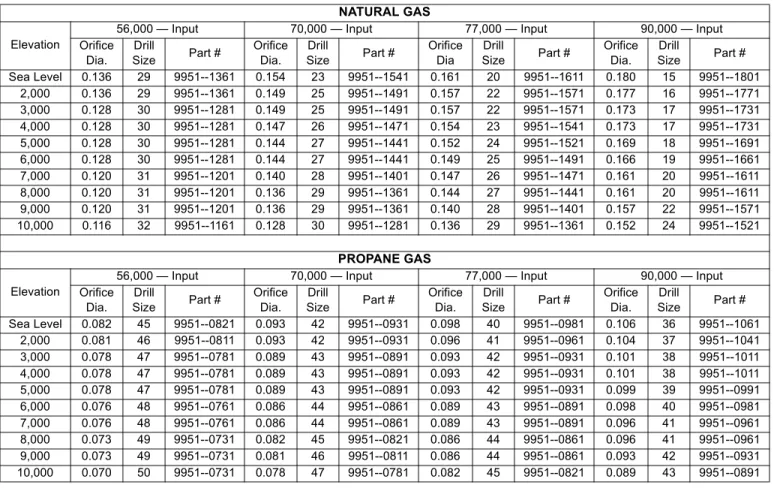
For elevation above 2,000 feet, derate furnace input 4% for each 1,000 feet of elevation above sea level. Derating is accomplished by reducing the orifice size. See Derating Chart for orifice size.
In Canada, for elevations from 2000 to 4500 feet derate by reducing gas manifold pressure to 3.0” W.C. for natural gas and 9.0” W.C. for LP gas.
MINIMUM FURNACE CLEARANCES
Access for servicing is an important factor in the location of any furnace. A minimum of 24 inches should be provided in front of the furnace for access to the heating elements and controls. This access may be provided by a closet door or by locating the furnace 24 inches from a facing wall or partition. These furnaces are design certified for the following minimum clearances from combustible material in alcove or closet installation
Improper installation may damage equipment, can create a shock hazard, and will void the war-ranty.
The furnace shall be installed so the electrical components are protected from water.
The furnace is not to be used for temporary heat-ing of buildheat-ings or structures under construction. Do not test the fuel system at more than 14 inches water column after furnace has been con-nected to the fuel line. Such testing may void the warranty. Any test run above 14 inches water col-umn may damage the furnace control valve which could cause an explosion, fire, or asphyxi-ation.
• Never attempt to alter or modify this furnace or any of its components.
• Never attempt to repair damaged or inoperable components. Such action could cause unsafe opera-tion, explosion, fire and/or asphyxiation.
• If a malfunction has occurred, or if you feel that the furnace is not operating as it should, contact a quali-fied service agency or gas utility for assistance.
Table 1: MINIMUM CLEARANCES
CLOSET ALCOVE BACK 0” 0” SIDES 0” 0” FRONT 6” 24” TOP 2” 2” ROOF JACK 0” 0” DUCT 0” 0”
RETURN AIR REQUIREMENTS
CLOSET INSTALLATIONSAdditional Requirements
Additional requirements for floor and ceiling return system for closet installed sealed combustion heating appliance are given in the next paragraph.
Floor or Ceiling Return Air System
Listed in the next paragraph are the conditions to be met by Manufactured Home Manufacturers to have U.L. acceptance of in-floor or ceiling return air systems of closet installed direct vent forced air heating appliances for Manufactured Homes to be sold in the United States.
1. The return-air opening into the closet, regardless of loca-tion, is to be sized not less than specified on the appli-ance's rating plate.
2. If the return-air opening is located in the floor of the closet (versus the vertical front or side wall), the opening is to be provided with means to prevent its inadvertent closure by a flat object placed over the opening.
3. The cross-sectional area of the return duct system (when located in the floor or ceiling of the manufactured home) leading into the closet is to be not less than that of the opening specified on the appliance's rating plate. 4. The total free area of openings in the floor or ceiling
reg-isters serving the return-air duct system is to be not less than 150% of the size of the opening specified on the appliance's rating plate. At least one such register is to be located where likelihood of its being covered by car-peting, boxes, and other objects is minimized.
5. Materials located in the return duct system have a flame spread classification of 200 or less.
6. Non-combustible pans having one-inch upturned flanges are located beneath openings in the floor return duct system.
7. Wiring materials located in the return duct system con-form to Article 300-22 (B&C) of the National Electrical Code (NFPA-70).
8. Gas piping is not run in or through the return duct sys-tem.
9. The negative pressure in the closet as determined by test with the air-circulating fan operating at high heating speed and the closet door closed is to be not more nega-tive than minus 0.05-inch water column.
10. For floor return systems, the manufactured home manu-facturer or installer shall affix a prominent marking on or near the appliance where it is easily read when the closet door is open. The marking shall read:
AIR DISTRIBUTION SYSTEMS
For proper air distribution, the supply duct system shall be designed so that the static pressure does not exceed the listed static pressure rating on the furnace rating plate. Three typical distribution systems are illustrated in Figure 2. Location, size and number of registers should be selected on the basis of best air distribution and floor plan of the home. The Air Temperature Rise is to be adjusted to obtain a tem-perature rise within the range(s) specified on the furnace rat-ing plate.
HAZARD OF ASPHYXIATION, DO NOT COVER OR RESTRICT FLOOR OPENING.
FIGURE 2 : Air Distribution Systems
A Single trunk duct
Dual trunk duct
Transition duct 1
B*
Dual trunk duct with crossover connector
Crossover
C
Transition Duct with Branches
Branches
3
1. Crossover Duct must be centered directly under furnace. 2. Use 12” Diameter Round or insulated Flex-duct only.
3. Terminate Flex-duct (opposite furnace) in the center of the trunk duct.
4. Flex-duct material must be pulled tight — No Loops or unnecessary dips — Air Flow may be impeded. 4
FIGURE 3 : Closet To Door Clearance - 6” or Greater
FIGURE 4 : Furnace To Closet Door Clearance - 1” To 6”
FIGURE 5 : Furnace To Closet Door Clearance - Less Than 1”
5”or greater * Closet to Door Clearance
Furnace to Closet Door Clearance —
5 Inches or more
1. 6 inches minimum clearance must be provided on side where return is located, and
2. 6 inches minimum clearance must be maintained from the Return Air Grille Part No.
7900-287P/A * White
Return Air Closet Door Part No. 7900-7771/C * White
The closet door have a minimum of of free area in the upper half of the door.
MUST 250 Square Inches
250 SQ. IN. MINIMUM FREE AREA 50 SQ. IN. MINIMUM FREE AREA 250 SQ. IN. MINIMUM FREE AREA B CLOSET DOOR FURNACE front of furnace. A
If opening for return air is located in the floor or sidewalls and below the top of the furnace casing:
Furnace to Closet Door Clearance —
Greater than 1 Inch and Up to 5 Inches
1.
2. A fully louvered closet door have a minimum of 250 of free area in the upper half of the door.
MUST Square Inches
The closet door have a minimum of
of free area in the upper half of the door and a minimum of of free area in the lower area of the door. The lower closet door grille may be omitted if an undercut of 2-1/2 inches is provided in the door.
MUST 250 Square Inches 50 Square Inches
As an option to the lower grill, an undercut of 2-1/2" will provide 50 Square. Inches of free area.
250 SQ. IN. MINIMUM FREE AREA 50 SQ. IN. MINIMUM FREE AREA 250 SQ. IN. MINIMUM FREE AREA B
Furnace to Closet Door Clearance —
Less than 1 Inch
The closet door MUST have three return air grilles. The total free area of the two upper grilles must be minimum of . The total free area of the lower grille MUST be aminimum of .
250 Square Inches
50 Square Inches The grilles MUST BE ALIGNED directly opposite the return air grille of the furnace door.
250 SQ. IN. MINIMUM FREE AREA 50 SQ. IN. MINIMUM FREE AREA
ROOF JACK
EXISTING FURNACE REPLACEMENT
If this furnace replaces an existing furnace, do the following: 1. If a 2nd roof, roof cap or addition has been made to the
existing roof of the home, remove the old roof jack com-pletely! To avoid the possibility of an improperly installed pipe or gaps in the old roof jack, INSTALL A NEW ROOF JACK. Your ceiling and roof height will determine the cor-rect roof jack to use. Refer to the vent selection table, of the furnace installation instructions.
2. After unpacking the roof jack, check the rain caps. Insure they are not damaged, tilted or crooked. Do not twist, crush or sit on the roof caps during installation. Damaged roof caps will cause improper furnace operation. The fur-nace will not heat properly and could result in explosion. 3. Before inserting the roof jack into the furnace top,
inspect the furnace flue and combustion air opening for debris or insulation which might have fallen in during pre-installation steps. Do not proceed unless all debris has been cleaned out or removed.
4. After installing roof jack on furnace top collar, check to make sure there is no gap in back or side between the pipe collar and the furnace casing top.
5. Use only the pipes provided with the roof jack assembly. Do not add to or adapt other sheet metal pipes. Do not cut, insert or add other pipes to this assembly.
6. In no case should there be a gap between sections of the flue pipe or the combustion air pipe. If necessary to prevent excessive air leakage, the installer should seal
NEW HOME INSTALLATION
If this furnace is installed on a new home do the following: 1. Inspect the furnace top collars for signs of insulation or
ceiling debris which might have fallen in during cutting of the ceiling and roof holes. Remove all debris before con-tinuing.
2. After unpacking the roof jack, check the rain caps. Insure they are not damaged, tilted or crooked. Do not twist, crush or sit on the roof caps during installation. Damaged roof caps will cause improper furnace operation. The fur-nace will not heat properly and could result in explosion. 3. Before inserting the vent pipe into the furnace top,
inspect the furnace flue and combustion air opening for debris or insulation which have fallen in during pre-instal-lation steps. Do not proceed unless all debris have been cleaned out or removed.
4. After installing roof jack on furnace top collar, check to make sure there is no gap in back or side between the pipe collar and the furnace casing top. If necessary to prevent excessive air leakage, the installer should seal joints in the combustion air tube with aluminum type or other suitable sealant.
INSTALLATION IN SNOW REGIONS
When the combustion air pipe inlet is covered or blocked with snow, the furnace will not operate properly due to the depleted combustion air supply.
Therefore, if the furnace will be located in regions where snow accumulation on the roof exceeds 7" or in H.U.D. Snow Load Zones, a roof jack extension (Part No. 7680B6541) is recommended.
LOCATING AND CUTTING ROOF JACK OPENING To facilitate the proper installation of the roof jack, it is very important that the roof jack opening in the ceiling and roof be on the same vertical center line as the furnace flue collar. See Figure 9.
Mark this location on ceiling and scribe a circle with a 5" radius (10" diameter) around this mark. Cut opening for roof jack through ceiling and roof. (If furnace was installed during construction, cover furnace and flue opening to prevent debris from entering flue when hole is cut for roof jack.) INSTALLING ROOF JACK IN ROOF
(See Figure 6 & 7 for Dimensional requirements.) Insert roof jack into opening in the roof.
The roof jack should be secured to the furnace before roof flange (flashing) is secured to the roof. This will insure a bet-ter alignment of the flue pipe and furnace flue collar. Caulk around and under roof flange to provide a water tight seal, before securing roof jack flashing to roof.
Failure to follow all venting instructions can result in fire, asphyxiation, or explosion.
Only use the appropriate roof jack. See Figures 6 & 7 for correct application.
Do not exceed the maximum height as deter-mined from Figures 6 & 7. Installer should allow an additional 1-1/2" travel before the flue pipe assembly is fully extended against the built-in stop. This provides an additional safeguard against the flue assembly being pulled from the roof jack during transportation or other stress conditions.
FIGURE 6 : Standard Roof Jack
WARM AIR DUCT DUCT CONNECTOR
ROOF
76" 59-1/2"
WARM AIR DUCT DUCT CONNECTOR FLUE GASES COMBUSTION AIR CAULK UNDER FLASHING 19 1/2" CAULK UNDER FLASHING FLUE GASES COMBUSTION AIR 19 1/2" CAREFULLY CAULK ALL AROUND SWIVEL JOINT WITH
SEALANT SUPPLIED BY FURNACE MANUFACTURER.
IMPORTANT
SEAL ROOF JACK FLASHING TO THE ROOF JACK AND ROOF.
THIS IS THE INSTALLER'S RESPONSIBILITY. The End of Upper Portion of Roof Jack need Not extend below the ceiling.
A
B
1 2
The 4084-7141 is dimensionally the same as 4000-7141/C and is available only in Canada. The 4084-7151 is dimensionally the same as 4000-7151/C and is available only in Canada.
DGAH FURNACES DGPH, DGPA, & DGAA FURNACES INSTALLATION DIMENSIONS INSTALLATION DIMENSIONS
“A” ADJUSTABLE HEIGHT “B” ADJUSTABLE HEIGHT 70” to 79” 75” to 86” 83” to 104” 90” to 116” 127” to 157” 86” to 95” 91” to 102” 99” to 120” 106” to 132” 143” to 173”” 4000-6101/A 4000-6121/A 4000-6141/A 4000-6151/A 4000-6171/A 4000-7101/C 4000-7121/C 4000-7141/C 4000-7151/C 4000-7171/C SWIVEL FLASHING ADJUSTS FROM 0/12 TO 5/12 PITCH SLANT FLASHING 3/12 PITCH FLOOR DGPH, DGPA, DGAA, MODELS DGAH MODELS
FIGURE 7 : Roof Jack With Removable Crowns
DGAH FURNACES DGPH, DGPA, & DGAA FURNACES INSTALLATION DIMENSIONS INSTALLATION DIMENSIONS
“A” ADJUSTABLE HEIGHT “B” ADJUSTABLE HEIGHT 85” to 101” 99” to 129” 101” to 117” 115” to 145” 4000-9161/A 4000-9181/A 4000-8161/C 4000-8181/C SWIVEL FLASHING ADJUSTS FROM 0/12 TO 5/12 PITCH SLANT FLASHING 3/12 PITCH 76" 59-1/2"
IMPORTANT
SEAL ROOF JACK FLASHING TO THE ROOF JACK AND ROOF.
THIS IS THE INSTALLER'S RESPONSIBILITY.
A
B
CAREFULLY CAULK ALL AROUND SWIVEL JOINT WITH SEALANT SUPPLIED BY FURNACE MANUFACTURER.
The End of Upper Portion of Roof Jack need Not extend below the ceiling.
CAULK UNDER FLASHING CAULK UNDER FLASHING ROOF
WARM AIR DUCT DUCT CONNECTOR
WARM AIR DUCT DUCT CONNECTOR
FLOOR
DGPH, DGPA, DGAA, MODELS DGAH MODELS
DUCT CONNECTORS
FIGURE 8 : Duct Connector Dimensions
12 13 11 18 14 SEECHART 3 4 1834 2 38 2 38 2 32 388 3 8 4 38 2 38 2 38 DUCT CONNECTOR PART NUMBER DUCT CONNECTOR DEPTH 7990-6011 7990-6021 7990-6041 7990-6061 7990-6071 7990-6081 7990-6101 7990-6121 1” 2” 4-1/2” 6-1-2” 7-1/2” 8-1/2” 10-1/4” 12-1/4”
DUCT CONNECTOR DIMENSIONS
13 11 18 14 3 4 2 38 2 38 2 32 388 SEECHART 12 1834 3 8 4 38 2 3 8 2 3 8 DUCT CONNECTOR PART NUMBER DUCT CONNECTOR DEPTH 7990-6211 7990-6221 7990-6241 7990-6261 7990-6271 7990-6281 7990-6301 7990-6321 1” 2” 4-1/2” 6-1-2” 7-1/2” 8-1/2” 10-1/4” 12-1/4”
DUCT CONNECTOR DIMENSIONS
FIGURE 9 : Recommended Floor Cut-out 2-3/4 MIN. 23-1/4 20-1/2 9-7/8 2-1/8 1-3/8 6-3/8 9-3/4 20 3-1/4 1-1/8 15 15 1 REAR WALL
OF ENCLOSURE CEILING CUT-OUT FOR ROOF JACK
FLOOR CUT-OUT FOR DUCT CONNECTOR FURNACE OUTLINE OPTIONAL GAS OR ELECTRIC ENTRANCE FLOOR FUTURE REFRIGERANT LINE ENTRANCE FRONT PANEL OF FURNACE
FIGURE 10 : Duct Connector Depth
DUCT CONNECTOR DEPTH FLOOR FLOOR JOIST SUPPLY DUCT
INSTALLATION OF SCREW ATTACHMENT DUCT CONNECTOR
1. Make floor cut out as shown in Figure 9.
2. Determine the depth of the floor cavity from the surface of the floor to the top of the supply air duct and select the appropriate duct connector from the chart.
3. Place locating bracket (supplied with the duct connector) to the back edge of the floor opening. See Figure 11. 4. Apply a water based duct sealant to the 1/2" supply duct
attachment flange of the duct connector.
5. Determine which of the four positions the duct connector best centers over the supply duct and insert it through the floor cutout.
6. When properly aligned with the supply duct, secure the duct connector to the floor with nails, flat head screws or staples.
7. Use screws as required to secure the duct connector to the supply duct.
8. Cut out the opening to the supply duct. If sealant was not used, the installer should tape the mating flanges to pro-vide a good air seal.
NOTE: Duct sealant and tape must be classified as meeting HUD Standard 3280.715, U.L. Standard 181A. If tape is used to provide a better air seal, it should be a type approved by the applicable national or local codes.
INSTALLATION OF TAB ATTACHMENT DUCT CONNECTORS
1. Make floor cut out as shown in Figure 9.
2. Determine the depth of the floor cavity from the surface of the floor to the top of the supply air duct and select the appropriate duct connector from the chart.
3. Place locating bracket (supplied with the duct connector) to the rear of the floor area for the furnace. See Figure 12.
4. Determine which of the four positions the duct connector best centers over the supply duct and insert it through the floor cutout.
5. Mark cut-out location on the supply duct and remove the duct connector.
6. Cut out the opening to the supply duct.
7. Bend tabs down through and back up under the supply duct.
8. Secure the duct connector to the floor with nails, flat head screws or staples.
The duct connector is designed for use on ducts down to 12" in width. When using the connector on smaller width ducts, there will not be sufficient clearance to bend the tabs on two sides of the duct connector.
In such cases the tabs may be attached to the sides of the duct by using sheet metal screws or other suitable fasteners. Holes for sheet metal screws are provided in three (3) tabs on each side of the duct connector. If more than 3 tabs need to be used to provide a more secure and air tight connection, the remaining tabs can also be fastened to the duct with screws after drilling the required screw holes.
FIGURE 11 : Duct Connector Screw Attachment
LOCATOR BRACKET
NAILS, FLAT HEAD SCREWS OR STAPLES
SCREWS
FLOOR
SUPPLY DUCT
FIGURE 12 : Duct Connector Tab Attachment
LOCATOR BRACKET
NAILS, FLAT HEAD SCREWS OR STAPLES
BEND TABS UNDER DUCT OPENING TO SECURE TO THE SUPPLY DUCT.
FLOOR
INSTALLATION OF THE FURNACE
1. Remove the front panels and set the furnace onto the duct connector. Slide it back until the rear of the unit engages the locator bracket.
2. Secure the front of the furnace with two screws at the mounting holes provided.
3. Secure the top of the furnace to a structural member using screw through the strap at the back of the furnace. Strap may be moved to any of the holes located along the top back of the furnace. Installer may provide an equivalent method, such as screws through the casing side.
NOTE: Combustion air tube and flue pipe are part of the same assembly. Only the combustion air tube need be fas-tened to the furnace.
1. Check to be certain that the flue pipe and combustion air tube are present.
2. Pull the telescoping flue tube and combustion air tube assembly down from the roof jack. Slide the flue tube/ combustion air tube assembly down firmly over the fur-nace flue outlet and combustion air collar. Insure that the back, side and front of combustion air tube collar is fully engaged and is in contact with gasket. Fasten the com-bustion air tube to the furnace comcom-bustion air collar using a 1/2 inch sheet metal screw. (Screw hole provided in combustion air tube and furnace combustion air collar. See Figure 14.
FIGURE 13 : Installation of Furnace
SECURE FURNACE TO FLOOR WITH TWO NAILS OR SCREWS. FURNACE SEATED AGAINST THE LOCATOR BRACKET
The inner flue pipe must be present.
It is mandatory that the combustion air pipe and flue pipe assembly be fully engaged. The com-bustion air pipe MUST be securely fastened to the furnace with a sheet metal screw in the hole provided.
Use a 1/2" blunt or sharp end sheet metal screw to fasten roof jack combustion air pipe to furnace combustion air collar. Screw hole is provided in the pipe and collar. Excessively long screws may extend to flue pipe and puncture it. Screws are not to exceed 1 1/2" in length.
FIGURE 14 : Connecting Roof JAck to Furnace
COMBUSTION AIR TUBE SECURE STRAP TO WALL FLUE PIPE FURNACE FLUE OUTLET GASKET FRONT OF FURNACE COMBUSTION AIR TUBE COLLAR
It is mandatory that the combustion air and flue tube assembly be fully engaged at back sides and front, and combustion air tube securely fastened to the furnace with a sheet metal screw in the screw hole provided.
CEILING RINGS
The ceiling ring is to meet fire stop requirements. Accessory Ceiling Ring (P/N 7660-2841) may be used, (See Figure 15) or the manufactured home manufacturer or the installer may use other approved methods to stop fire.
If required, three (3) sections of Accessory Ring may be used as shown in Figure 15 to provide closer clearance around roof jack.
ELECTRICAL WIRING
CONNECT POWER SUPPLY WIRES 1. Remove the field wiring cover.
2. Insert 115 volt wires through the large plastic bushing on the left side of the furnace (See Figure 16). If conduit is used it should be secured to the control box.
3. Connect the “hot" wire to the BLACK pigtail lead, and the “neutral" wire to the WHITE pigtail lead. Secure all con-nections with suitable wire nuts and wrap with electrical tape.
4. Connect the “ground" wire to the grounding screw. 5. Reinstall the control panel cover and secure mounting
screw.
CONNECT THERMOSTAT WIRES
1. Insert 24 volt wires through the small plastic bushing just above the control panel.
2. Connect the thermostat wires to the furnace low voltage pigtails. See Figure17 (heating only) and Figure 18 (heating and cooling).
3. Connect low-voltage circuit to the wall thermostat pig-tails.
NOTE: Five-conductor thermostat cable is recommended for all installations to allow easy installation of an air conditioning system at a later time.
Eighteen gauge thermostat wire is highly recommended. Smaller gauge thermostat wire may be used only if the guide-line below is followed.
Do not use thermostat wire smaller than 22 gauge. If thermo-stat wire smaller than 18 gauge is used, pay particular atten-tion that the connecatten-tions between the different wire sizes are tight.
Operational problems may be caused by loose connections or by the use of thermostat wire that is too small to carry the required load. Any such problems are the responsibility of the installer.
A separate 115 V.A.C. supply circuit must be used for the fur-nace. The circuit should be protected by a 15 amp fuse or cir-cuit breaker.
FIGURE 15 : Ceiling Rings
TO INSTALLER: Incoming power must be polar-ized. Observe color coding.
SHOCK HAZARD - DISCONNECT
ELECTRI-CAL POWER SUPPLY TO THE UNIT BEFORE SERVICING TO AVOID THE POSSIBILITY OF SHOCK INJURY OR DAMAGE TO THE EQUIP-MENT.
A
B
THERMOSTAT WIRE LENGTH (FURNACE TO THERMOSTAT) THERMOSTAT WIRE GAUGE 0 - 45 feet 22 0 - 70 feet 20FIGURE 16 : Field Wiring
NOTE: Cover should not be removed except when servicing the controls. THIS SCREW DOES
NOT NEED TO BE REMOVED IN ORDER TO REMOVE THE FIELD WIRING COVER. (JUST LOOSEN).
WALL THERMOSTAT
Avoid locations where the thermostat could be subject to drafts from outside, or exposed to direct light from lamps, sun, fireplaces, etc., or affected by air from a duct register blowing directly on the thermostat.
The wall thermostat should be located 52 to 66 inches above the floor. The preferred location is on an inside wall situated in an area with good air circulation, and where the tempera-ture will be reasonably representative of other living areas the thermostat is controlling.
NOTE: In order to provide proper ventilation control when using DGPH model furnaces with Coleman Blend Air ventilation systems, it is required that a 4-wire wall thermostat and Blower Relay Kit 7900-7761 be installed.
FIGURE 17 : Wiring for Heat Only Thermostat WHITE GREEN BLACK RED YELLOW WHITE RED FURNACE CONTROL BOX
FIGURE 18 : Wiring for Heat-Cool Thermostat
WALL THERMOSTAT CONDENSING UNIT BLEND AIR CONTROL BOX WHITE GREEN RED YELLOW WHITE GREEN RED YELLOWBLACK
BLACK RED GREEN WHITE
NOT FACTORY INSTALLED
FURNACE CONTROL
BOX
WIRING DIAGRAMS
NOTE: In order to provide proper ventilation control when using DGPH model furnaces with Coleman Blend Air ventilation sys-tems, it is required that a 4-wire wall thermostat and Blower Relay Kit 7900-7761 be installed.
FIGURE 19 : Wiring Diagram for DGPH056, DGPH070, DGPH077
BLOWER MOTOR MANUALRESET LIMIT SWITCH BLK GND. SCREW NEU. LI WHT BLK ORG WHT BLK ORG FAN SWITCH TRANSFORMER 2 3 1 GAS CONTROL BLU GRN SYSTEM SWITCH BLK ORG BRN WALL THERMOSTAT WHT RED RED 3 AMP FUSE LINE LOAD 24V SEC. 120V PRI. GRY TO EARTH GND. AUTO RESET LIMIT SWITCH W R 2 3 1 4 5 6 7 8 9 115 VAC GND SCREW .
NOTE: In order to provide proper ventilation control when using DGPH model furnaces with Coleman Blend Air ventilation sys-tems, it is required that a 4-wire wall thermostat and Blower Relay Kit 7900-7761 be installed.
FIGURE 20 : Wiring Diagram for DGPH090 BLOWER MOTOR MANUALRESET LIMIT SWITCH BLK WHT ORG FAN SWITCH TRANSFORMER 2 3 1 BLU SYSTEM SWITCH WHT ORG BRN WHT RED RED 3 AMP FUSE LINE LOAD 24V SEC. 120V PRI. GR Y AUTO RESET LIMIT SWITCH W R 2 3 1 4 5 6 7 8 9 115 VAC BLK GRN BLK WHT WALL THERMOSTAT NEU. LI WHT BLK GND. SCREW
TO EARTH GND. CONTROLGAS
PRESSURE SWITCH COMBUSTION BLOWER MOT OR BLK WHT ORG WHT RED BLU COMBUSTION BLOWER RELAY 2 4 5 6 1 3 GR Y GND. SCREW
FIGURE 21 : Wiring Diagram for DGPA056, DGPA070, DGPA077 BLOWER MOTOR MANUAL RESET LIMIT SWITCH BLK ORG FAN SWITCH TRANSFORMER 2 3 1 BLU GRN SYSTEM SWITCH BLK BRN WHT RED RED 3 AMP FUSE LINE LOAD 24V SEC. 120V PRI. GR Y AUTO RESET LIMIT SWITCH W R 2 3 1 4 5 6 7 8 9 115 VAC BLK GRY BLK WALL THERMOSTAT NEU. LI WHT BLK GND. SCREW
TO EARTH GND. CONTROLGAS
BLK WHT WHT G Y GRN YEL BLEND-AIR CONTROLBOX (IF EQUIPPED) WHT RED GRN BLK A/C CONDENSING UNIT CONTACTOR WHT RED GRN BLK ORG ORG 3 1 2 4 5 6 A/C BLOWER RELAY GND. SCREW
FIGURE 22 : Wiring Diagram for DGPA090 BLOWER MOTOR MANUAL RESET LIMIT SWITCH BLK ORG FAN SWITCH TRANSFORMER 2 3 1 BLU GRN PRESSURE SWITCH WHT BLK RED RED 3 AMP FUSE LINE LOAD 24V SEC. 120V PRI. GR Y AUTO RESET LIMIT SWITCH W R 2 3 1 4 5 6 7 8 9 115 VAC BLK GRY BLK WALL THERMOSTAT NEU. LI WHT BLK GND. SCREW
TO EARTH GND. CONTROLGAS
BLK WHT WHT Y YEL BLEND AIR CONTROLBOX (IF EQUIPPED) RED BLK A/C CONDENSING UNIT CONTACTOR WHT RED GRN BLK ORG ORG 3 1 2 4 5 6 COMBUSTION BLOWER RELAY BLK A/C BLOWER RELAY WHT COMBUSTION BLOWER MOT OR SYSTEM SWITCH GRN WHT GRN WHT G 2 4 5 6 1 3 GR Y BRN BLU GND. SCREW
FIGURE 23 : Wiring Diagram for DGAA and DGAH Models SENSOR ROD COMBUSTION BLOWER MOT OR NEUTRALS BLEND AIR CONTROL BOX (if equipped) UPPER LIMIT SWITCH W G R Y BLU GRY WHT GRN BLK RED YEL ORG GRN BLU BLU BRN BRN BLK BLK WHT WHT COMBUSTION AIR SWITCH LOWER LIMIT SWITCH YEL WHT BLK RED BLOWER MOTOR TO EARTH GROUND NEUTRAL L1 115 VAC BLK SYSTEM SWITCH GROUND SCREW WHT WHT TRANSFORMER RED BLU COM 24 VAC RED BLK WALL THERMOSTAT TO A/C CONDENSING UNIT (if equipped)
GAS VALVE HOT SURFACE IGNITOR WHT HEA T COOL L1 XFMR BLK BLK LOAD LINE 1 2 3 4 5 6 7 8 9 6 5 4 3 2 1 1 2 3 4 5 6 7 8 9
INCOMING POWER MUST BE POLARIZED. OBSERVE COLOR CODING.
GRN WHT RED BLK
GND. SCREW
GAS PIPING
INSTALLATION AND CHECKING OF GAS LINE Gas Supply piping must be sized in accordance with the rec-ommendations contained in National Fuel Gas Code (ANSI-Z223.1, NFPA-54) unless local codes or regulations state oth-erwise.
Materials used and pipe sizing for U.S. manufactured homes must comply with requirements contained in Manufactured Homes A119.1, Recreational Vehicles A119.2 and H.U.D. Title 24, Section 3280.705 and any local or state codes. NOTE: The gas line inlet on the gas valve is 1/2-14 N.P.T. The gas line may be installed through the furnace floor or fur-nace side to the gas valve.
For natural gas operation, the furnace is designed for 7" W.C. inlet gas pressure. Pressure to main burner is then reduced to 3 1/2" W.C.
For Propane gas operation, the furnace is designed for 11" W.C. inlet gas pressure. Pressure to main burner is then reduced to 10" W.C.
IMPORTANT - When converting gas valve from or to Pro-pane gas, it will be necessary to change main burner orifice to prevent an underfired or overfired condition. See label inside lower furnace door for complete instructions.
Pilot Adjustment
On models equipped with standing pilot ignition, the pilot should be adjusted so that the flame is approximately 1” in height (500 BTU / hr.). This will allow proper burner ignition without excessive fuel usage. The pilot adjustment screw is located on the top of the gas valve.
Observing Burner Operation
1. Observe burner to make sure it ignites. Observe color of flame. On natural gas the flame will burn blue with appre-ciably yellow tips. On Propane gas a yellow flame may be expected. If flame is not the proper color call a quali-fied service technician for service.
2. Let furnace heat until blower cycles on. 3. Turn thermostat down.
4. Observe burner to make sure it shuts off. 5. Let the furnace cool and blower cycle off.
If any abnormalities are observed when checking for correct operation, such as burner failing to ignite or to turn off, sooty flame, etc., call your nearest authorized service technician as shown in the Service Center List included in the home owner envelope with the furnace.
If Furnace Fails to Operate Properly
1. Check setting of thermostat - and position of HEAT/ COOL switch if air conditioning is installed. If a set-back type thermostat is employed be sure that the thermostat is in the correct operating mode.
2. Check to see that electrical power is ON.
3. Check to see that the knob or switch on the gas control valve is in the full ON position.
4. Make sure filters are clean, return grilles are not obstructed, and supply registers are open.
5. Be sure that furnace flue piping is open and unob-structed.
To install gas line and to connect it to the gas valve, care must be taken to hold gas valve firmly to prevent misalignment of the burner orifice, or to damage gas valve which could result in improper heating, explosion, fire or asphyxiation. DO NOT USE EXCESSIVE PIPE SEALANT ON PIPE JOINTS. Pipe sealant, metal chips or other foreign material that could be deposited in the inlet of the gas valve, when gas pipe is installed or carried through the gas piping into the gas valve inlet after installation, may cause the gas valve to malfunction and could result in possible improper heating, explosion, fire or asphyxiation. Also, pipe sealant must be resistant to Propane gas.
Where regulations require, a main shut-off valve shall be installed externally of furnace casing. After piping has been installed, turn gas on and check all connections with a leak detector or soap solution.
Never use open flame to test for gas leaks as fire or explosion could occur.
Do not test the fuel system at more than 14" W.C. after furnace has been connected to fuel line. Such testing could void the warranty. Any test run above 14" W.C. may damage furnace control valve which could cause an explosion, fire or asphyxiation.
If the gas input to the furnace is too great because of excessive gas pressure, wrong size orifice, high altitude, etc., the burner flame will be sooty and may produce carbon monoxide, which could result in unsafe operation, explosion, and/ or fire or asphyxiation.
Should overheating occur, or the gas supply fail to shut off, shut off the manual gas valve to the furnace and allow burner to run until furnace cools down and blower shuts off before shutting off the electrical supply.
FINAL PROCEDURE
INSTALL FURNACE DOORSInstall the lower door first by sliding the bottom of the door down until the tabs on the casing base engage the slots in the bottom door end cap. Then push the top of the lower door in until the door clips snap into place. Install the upper door in a similar manner, first engaging the slots in the top of the upper door on the tabs on the casing top. Then snap the bottom of the upper door into place against the casing.
FINISH AND TRIM
Alcove and Closet Installations may now be finished and trimmed as necessary.
FURNACE AND AIR CONDITIONER INSTALLATIONS
If an air conditioner is installed which does not use the blower for air distribution and operates completely independent of the furnace, the thermostat system must have an interlock to prevent the furnace and air conditioner from operating at the same time. This interlock system usually contains a heat-cool switch which must be turned to either HEAT or COOL to acti-vate either heating or cooling operation, or a positive OFF switch on the cooling thermostat.
When used in connection with a cooling unit the furnace shall be installed parallel with or on the upstream side of the cool-ing unit to avoid condensation in the heat exchanger. For installations with a parallel flow arrangement, the furnace must be equipped with a damper to prevent cold air from being discharged up around the heat exchanger. Cold air causes condensation inside the exchanger and can cause it to rust out which can allow products of combustion to be cir-culated into the living area by the furnace blower resulting in possible asphyxiation. An air flow activated automatic damper, P/N 7900-6771, is available from furnace manufac-turer. See Figure 24.
NOTE: See label on coil panel for conversion and lighting instructions. Obtain a temperature rise within the ranges specified on the name plate.
FIGURE 24 : Anti-Backflow Damper
FURNACE BASE DUCT CONNECTOR AUTOMATIC DAMPER SUPPLY DUCT OPENING
FOR BEST AIR DELIVERY INSTALL DAMPER WITH BLADES PARALLEL TO SUPPLY DUCT. NOTE:
HIGH ALTITUDE DERATION CHART
Table shows 4% Input Reduction per 1,000 feet Elevation. Reference Source: NFPA No. 54, ANSI Z 223.1, National
Fuel Gas Code.
For Canadian high altitude (2000 - 4500 feet), reduce gas manifold pressure to 3.0” W.C. for natural gas, 9.0” W.C. for Propane gas.
NATURAL GAS Elevation
56,000 — Input 70,000 — Input 77,000 — Input 90,000 — Input
Orifice Dia. Drill Size Part # Orifice Dia. Drill Size Part # Orifice Dia Drill Size Part # Orifice Dia. Drill Size Part # Sea Level 0.136 29 9951--1361 0.154 23 9951--1541 0.161 20 9951--1611 0.180 15 9951--1801 2,000 0.136 29 9951--1361 0.149 25 9951--1491 0.157 22 9951--1571 0.177 16 9951--1771 3,000 0.128 30 9951--1281 0.149 25 9951--1491 0.157 22 9951--1571 0.173 17 9951--1731 4,000 0.128 30 9951--1281 0.147 26 9951--1471 0.154 23 9951--1541 0.173 17 9951--1731 5,000 0.128 30 9951--1281 0.144 27 9951--1441 0.152 24 9951--1521 0.169 18 9951--1691 6,000 0.128 30 9951--1281 0.144 27 9951--1441 0.149 25 9951--1491 0.166 19 9951--1661 7,000 0.120 31 9951--1201 0.140 28 9951--1401 0.147 26 9951--1471 0.161 20 9951--1611 8,000 0.120 31 9951--1201 0.136 29 9951--1361 0.144 27 9951--1441 0.161 20 9951--1611 9,000 0.120 31 9951--1201 0.136 29 9951--1361 0.140 28 9951--1401 0.157 22 9951--1571 10,000 0.116 32 9951--1161 0.128 30 9951--1281 0.136 29 9951--1361 0.152 24 9951--1521 PROPANE GAS Elevation
56,000 — Input 70,000 — Input 77,000 — Input 90,000 — Input
Orifice Dia. Drill Size Part # Orifice Dia. Drill Size Part # Orifice Dia. Drill Size Part # Orifice Dia. Drill Size Part # Sea Level 0.082 45 9951--0821 0.093 42 9951--0931 0.098 40 9951--0981 0.106 36 9951--1061 2,000 0.081 46 9951--0811 0.093 42 9951--0931 0.096 41 9951--0961 0.104 37 9951--1041 3,000 0.078 47 9951--0781 0.089 43 9951--0891 0.093 42 9951--0931 0.101 38 9951--1011 4,000 0.078 47 9951--0781 0.089 43 9951--0891 0.093 42 9951--0931 0.101 38 9951--1011 5,000 0.078 47 9951--0781 0.089 43 9951--0891 0.093 42 9951--0931 0.099 39 9951--0991 6,000 0.076 48 9951--0761 0.086 44 9951--0861 0.089 43 9951--0891 0.098 40 9951--0981 7,000 0.076 48 9951--0761 0.086 44 9951--0861 0.089 43 9951--0891 0.096 41 9951--0961 8,000 0.073 49 9951--0731 0.082 45 9951--0821 0.086 44 9951--0861 0.096 41 9951--0961 9,000 0.073 49 9951--0731 0.081 46 9951--0811 0.086 44 9951--0861 0.093 42 9951--0931 10,000 0.070 50 9951--0731 0.078 47 9951--0781 0.082 45 9951--0821 0.089 43 9951--0891
REPAIR PARTS LIST
1 3 2 8 9 8 23 19 22 21 18 17 16 1 7 5 12 11 11 25 24 13 4 BURNER ORIFICE (SEE CHART) BURNER ORIFICE (SEE CHART) 26 3 2DGAA, DGAH
DGAA, DGAH
DGPA, DGPH
DGPA, DGPH
14 10 15 28 29 27 6 DGPA056ABTA DGPA070ABTA DGPA077ABTA DGPA090ABTA DGPH056ABTA DGPH070ABTA DGPH077ABTA DGPH090ABTA DGPA056ABTA DGPA070ABTA DGPA077ABTA DGPA090ABTA DGPH056ABTA DGPH070ABTA DGPH077ABTA DGPH090ABTA DGAA056BDTA DGAA070BDTA DGAA077BDTA DGAA090BDTA DGAH056BBSA DGAH077BBSA DGAA056BDTA DGAA070BDTA DGAA077BDTA DGAA090BDTA DGAH056BBSA DGAH077BBSA 14 DGAA, DGAH DGPA, DGPH 6 20 HEAT/COOL HEAT ONLY
DGAA
ITEM DESCRIPTION DGAA056BDTA DGAA070BDTA DGAA077BDTA DGAA090BDTA
1 Switch, Pressure 024-27666-000 024-27666-000 024-27666-000 024-27666-000
2 Tubing Silicone (2’ Req’d) 028-11957-000 028-11957-000 028-11957-000 028-11957-000 3 Limit Switch, Manual (Upper) 025-35358-000 025-35358-000 025-35358-000 025-35358-000 4 Assembly, Booster (w/Motor) 373-19801-820 373-19801-820 373-19801-820 373-19801-820 5 Control Board, Integrated 031-01932-000 031-01932-000 031-01932-000 031-01932-000
6 Valve, Gas 7990-328P 7990-328P 7990-328P 7990-328P
7 Bracket, Valve 073-19801-064 073-19801-064 073-19801-064 073-19801-064
8 Thermostat (Heat /Cool) Accessory (See Page 6)
9 Exchanger, Heat (w/Gaskets) 373-19804-651 373-19805-651 373-19806-651 373-19806-650
10 Sensor, Flame 025-35354-000 025-35354-000 025-35354-000 025-35354-000
11 Switch, System 7681-3301 7681-3301 7681-3301 7681-3301
12 Transformer (115-24V, 40 VA) 2940A3541 2940A3541 2940A3541 2940A3541
13 Switch, Limit 025-35380-000 025-35380-000 025-35381-000 025-35381-000
14 Burner Assembly, Auto Ignition (Includes items 10 & 15)
373-19801-403 373-19801-403 373-19801-403 373-19801-403
15 Ignitor, Hot Surface 1474-052P 1474-052P 1474-052P 1474-052P
16 Filter (2 Req’d) (16x20x1) 1214-2511 1214-2511 1214-2511 1214-2511
17 Panel, Door (Upper) Accessory (See Page 6)
18 Panel, Door (Lower, Tall) 373-19801-740 373-19801-740 373-19801-740 373-19801-740
19 Motor (See note 2) 1468-220P 1468-220P 1468-220P 1468-220P
20 Assembly, Motor Mount (See Note 3) 373-19806-100 373-19806-100 373-19806-100 373-19806-100
21 Plug, Connector 025-21192-000 025-21192-000 025-21192-000 025-21192-000
22 Capacitor, Run (See Note 3) 024-20063-000 024-20063-000 024-20063-000 024-20063-000
23 Wheel, Blower 1472-2761 1472-2761 1472-2761 1472-2761 24 Relay, Fan --- --- --- ---25 Relay, Booster --- --- --- ---26 Switch, Fan --- --- --- ---27 Thermocouple --- --- --- ---28 Burner, Pilot --- --- --- ---29 Tube, Pilot --- --- --- ---30* Diagram, Wiring 035-15289-001 035-15289-001 035-15289-001 035-15289-001
NOTE: *Not Shown
New replacement parts shown in bold face type at the first printing of parts list dated 9/02. Major components and suggested stocking items are shown with shaded item number. “<“ Across from row indicates a change in that row.
--- Not applicable to specified model.
2. For Serial Numbers lower then 001207164- Replacement DGAA motors also require Motor Mount Assembly 373-19806-100 if replaced motor has integral, flex-arm motor mount.
3. DGAA with 5-Ton Blowers are provided as an accessory item and are not standard equipment from the factory. See Page 6
DGAH
ITEM DESCRIPTION DGAH056BBSA DGAH077BBSA
1 Switch, Pressure 024-27666-000 024-27666-000
2 Tubing Silicone (2’ Req’d) 028-11957-000 028-11957-000 3 Limit Switch, Manual (Upper) 025-35358-000 025-35358-000 4 Assembly, Booster (w/Motor) 373-19801-820 373-19801-820
5 Control Board, Integrated 031-01932-000 031-01932-000
6 Valve, Gas 7990-328P 7990-328P
7 Bracket, Valve 073-19801-064 073-19801-064
8 Thermostat (Heat /Cool) Accessory (See Page 6)
9 Exchanger, Heat (w/Gaskets) 373-19804-651 373-19806-651
10 Sensor, Flame 025-35354-000 025-35354-000
11 Switch, System 7681-3301 7681-3301
12 Transformer (115-24V, 40 VA) 2940A3541 2940A3541
13 Switch, Limit 025-35380-000 025-35381-000
14 Burner Assembly, Auto Ignition (Includes itemss 10 & 15)
373-19801-403 373-19801-403
15 Ignitor, Hot Surface 1474-052P 1474-052P
16 Filter (2 Req’d) (16x20x1) 1214-2511 1214-2511
17 Panel, Door (Upper) Accessory (See Page 6)
18 Panel, Door (Lower, Short) 373-19801-790 373-19801-790
19 Motor (See Note 3) 024-31948-000 024-31948-000
20 Assembly, Motor Mount ---
---21 Plug, Connector 025-21192-000 025-21192-000 22 Capacitor, Run --- ---23 Wheel, Blower 1472-2761 1472-2761 24 Relay, Fan --- ---25 Relay, Booster --- ---26 Switch, Fan --- ---27 Thermocouple --- ---28 Burner, Pilot --- ---29 Tube, Pilot --- ---30* Diagram, Wiring 035-15289-001 035-15289-001
NOTE: *Not Shown
New replacement parts shown in bold face type at the first printing of parts list dated 9/02. Major components and suggested stocking items are shown with shaded item number. “<“ Across from row indicates a change in that row.
--- Not applicable to specified model.
3. DGAH with 5-Ton Blowers are provided as an accessory item and are not standard equipment from the factory. See page 6.
DGPA
ITEM DESCRIPTION DGPA056ABTA DGPA070ABTA DGPA077ABTA DGPA090ABTA
1 Switch, Pressure --- --- --- 024-27666-000
2 Tubing Silicone (2’ Req’d) --- --- --- 028-11957-000
3 Limit Switch, Manual (Upper) 025-35358-000 025-35358-000 025-35358-000 025-35358-000
4 Assembly, Booster (w/Motor) --- --- --- 373-19801-820
5 Control Board, Integrated --- --- ---
---6 Valve, Gas 7956-336P 7956-336P 7956-336P 7956-336P
7 Bracket, Valve 073-19801-064 073-19801-064 073-19801-064 073-19801-064
8 Thermostat (Heat /Cool) Accessory (See Page 6)
9 Exchanger, Heat (w/Gaskets) 373-19804-651 373-19805-651 373-19806-651 373-19806-650
10 Sensor, Flame --- --- ---
---11 Switch, System 7681-3301 7681-3301 7681-3301 7681-3301
12 Transformer (115-24V, 40 VA) 2940A3541 2940A3541 2940A3541 2940A3541
13 Switch, Limit 025-35380-000 025-35380-000 025-35381-000 025-35381-000
14 Standing Pilot, Burner Assembly (Includes items 10 & 15)
373-19801-401 373-19801-401 373-19801-401 373-19801-402
15 Ignitor, Hot Surface --- --- ---
---16 Filter (2 Req’d) (16x20x1) 1214-2511 1214-2511 1214-2511 1214-2511
17 Panel, Door (Upper) Accessory (See Page 6)
18 Panel, Door (Lower, Tall) 373-19801-740 373-19801-740 373-19801-740 373-19801-740
19 Motor (See Note 3) 024-31948-000 024-31948-000 024-31948-000 024-31949-000
20 Assembly, Motor Mount --- --- ---
---21 Plug, Connector 025-21192-000 025-21192-000 025-21192-000 025-21192-000 22 Capacitor, Run --- --- --- 024-20045-000 23 Wheel, Blower 1472-2761 1472-2761 1472-2761 1472-2761 24 Relay, Fan 3110-3301 3110-3301 3110-3301 3110-3301 25 Relay, Booster --- --- --- 3110-3301 26 Switch, Fan 7975-3281 7975-3281 7975-3281 7975-3281 27 Thermocouple 7945-3481 7945-3481 7945-3481 7945-3481 28 Burner, Pilot 9880-0141 9880-0141 9880-0141 9880-0141 29 Tube, Pilot 029-22188-000 029-22188-000 029-22188-000 029-22188-000 30* Diagram, Wiring 035-15287-001 035-15287-001 035-15287-001 035-15288-001
NOTE: *Not Shown
New replacement parts shown in bold face type at the first printing of parts list dated 9/02. Major components and suggested stocking items are shown with shaded item number. “<“ Across from row indicates a change in that row.
--- Not applicable to specified model.
3. DGPA with 4 or 5-Ton Blowers are provided as an accessory item and are not standard equipment from the factory. See Page 6
DGPH
ITEM DESCRIPTION DGPH056ABTA DGPH070ABTA DGPH077ABTA DGPH090ABTA
1 Switch, Pressure --- --- --- 024-27666-000
2 Tubing Silicone (2’ Req’d) --- --- --- 028-11957-000
3 Limit Switch, Manual (Upper) 025-35358-000 025-35358-000 025-35358-000 025-35358-000
4 Assembly, Booster (w/Motor) --- --- --- 373-19801-820
5 Control Board, Integrated --- --- ---
---6 Valve, Gas 7956-336P 7956-336P 7956-336P 7956-336P
7 Bracket, Valve 073-19801-064 073-19801-064 073-19801-064 073-19801-064
8 Thermostat (Heat Only) Accessory (See Page 6)
9 Exchanger, Heat (w/Gaskets) 373-19804-651 373-19805-651 373-19806-651 373-19806-650
10 Sensor, Flame --- --- ---
---11 Switch, System 7970-3331 7970-3331 7970-3331 7970-3331
12 Transformer (115-24V, 40 VA) 2940A3541 2940A3541 2940A3541 2940A3541
13 Switch, Limit 025-35380-000 025-35380-000 025-35381-000 025-35381-000
14 Standing Pilot, Burner Assembly (Includes items 10 & 15)
373-19801-401 373-19801-401 373-19801-401 373-19801-402
15 Ignitor, Hot Surface --- --- ---
---16 Filter (2 Req’d) (16x20x1) 1214-2511 1214-2511 1214-2511 1214-2511
17 Panel, Door (Upper) Accessory (See Page 6)
18 Panel, Door (Lower, Tall) 373-19801-740 373-19801-740 373-19801-740 373-19801-740 19 Motor (See Note 3) 024-31948-000 024-31948-000 024-31948-000 024-31949-000
20 Assembly, Motor Mount --- --- ---
---21 Plug, Connector 025-21192-000 025-21192-000 025-21192-000 025-21192-000 22 Capacitor, Run --- --- --- 024-20045-000 23 Wheel, Blower 1472-2761 1472-2761 1472-2761 1472-2761 24 Relay, Fan --- --- --- ---25 Relay, Booster --- --- --- 3110-3301 26 Switch, Fan 7975-3281 7975-3281 7975-3281 7975-3281 27 Thermocouple 7945-3481 7945-3481 7945-3481 7945-3481 28 Burner, Pilot 9880-0141 9880-0141 9880-0141 9880-0141 29 Tube, Pilot 029-22188-000 029-22188-000 029-22188-000 029-22188-000 30 Diagram, Wiring 035-15285-001 035-15285-001 035-15285-001 035-15286-001
NOTE: *Not Shown
New replacement parts shown in bold face type at the first printing of parts list dated 9/02. Major components and suggested stocking items are shown with shaded item number. “<“ Across from row indicates a change in that row.
--- Not applicable to specified model.
3. DGPH with 4 or 5-Ton Blowers are provided as an accessory item and are not standard equipment from the factory. See page 6.
BURNER ORIFICE CHART (Normal Altitude Only 4)
MODEL 056 070 077 090
NATURAL GAS 9951-1361 9951-1541 9951-1611 9951-1801
LP GAS 9951-0821 9951-0931 9951-0981 9951-1061
NOTES
4. Contact Customer Service for installations at altitudes over 2000 feet above sea level. “<“ Across from row indicates a change in that row.
ACCESSORY PARTS LIST
DESCRIPTION DGAA DGAH DGPA DGPH
Thermostat (Heat/Cool) 025-38251-000 025-38251-000 025-38251-000 --- <
Thermostat (Heat Only) --- --- --- 025-38252-000 <
Door Panel (Upper) 373-19802-010 373-19802-010 373-19802-010 373-19802-010 4-Ton Blower Ass’y
7900-7741/A
Motor --- --- 1468-220 1468-220
Run Capacitor (7.5 MFD) --- --- 024-32020-000 024-32020-000
Motor Mount --- --- 373-19806-100 373-19806-100
Blower Wheel --- --- 1472-2761 1472-2761
5-Ton Blower Ass’y 7900-7751
Motor 024-31975-000 024-31975-000 024-31975-000 024-31975-000
Run Capacitor (20 MFD) 024-20051-000 024-20051-000 024-20051-000 024-20051-000 Motor Mount 373-19802-930 373-19802-930 373-19802-930 373-19802-930