About this lab:
“Oersted's experiments, using a relatively simple instrument, were enough to rock the foundations of Newtonian Mechanics. The nature of magnetic force was distinct from the forces known until then. It was certainly not a central force, since it was not oriented along a straight line between two interacting points, as happens with gravitational forces, interacting forces between electrical charges at rest, or between the two poles of a magnet. “ (See Oersted discussion below.)
After observation of forces involving magnetized materials (compass, etc.), observation of non-electrostatic forces on moving electric charges (current) raised many difficult questions. The magnetic field concept was devised, and electric current sources of this field investigated.
One question has been of interest up to the present: Why are there no observed point magnetism sources (magnetic monopoles), interacting radially as for electric charge, even though Maxwell's electromagnetic equations allow for such? Why do observed
elementary sources of magnetism produce dipole magnetic field configurations, either indivisible, or producing two dipoles from one on division?
Suggested answers connect these questions to the properties of elementary particles and to the very early evolution of our universe.
References: Physics: Cutnell & Johnson, 6th ed., Chapter 21 (Wiley);
Physics for Scientists and Engineers, Serway & Beichner, 5th ed., Chapter 29 (Saunders)
Apparatus Balance, permanent magnet, power supply with built in meter, wire loop circuit boards
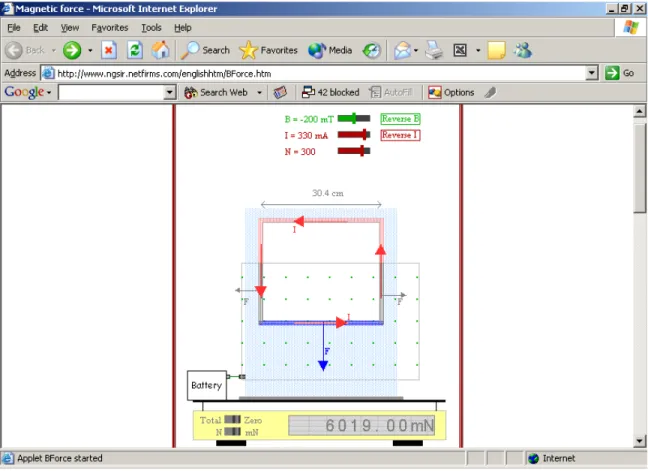
http://www.ngsir.netfirms.com/englishhtm/BForce.htm
Figure 1 Note the horizontal forces. The net force is down (forces cancel on vertical loop segments). What is the direction of the magnetic field?
Note that the balance switch is set to "tare" - the gravitational weight forces have been subtracted, leaving only the magnetic force. The force units have been set to milliNewtons.
Current magnetism sources: Moving electric charge creates magnetic field. Charges flowing along a long straight wire will produce a concentric magnetic field along any circle surrounding the wire. Wrap your right hand around the wire with your thumb pointing in the direction of the conventional current (flow of positive charges). By convention, your curled fingers point in the direction of the magnetic field that curves around the wire. The magnetic field, B, at a distance r from a very long, straight wire carrying current I is
B=
2r (1) where 0 , the “permeability” constant, is Tesla·meter/ampere
(mks units).
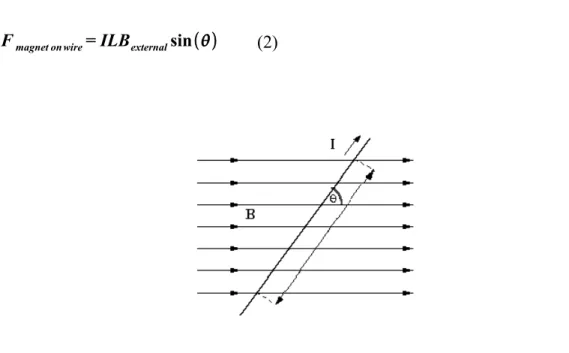
Magnetic forces on currents: Besides being the source of magnetic fields, moving charges experience a force from external magnetic fields (other sources). If a magnet is placed near a wire current, the wire experiences a magnetic force because the external magnetic fields interact with the moving charges (no current, no force). For a straight wire of length l carrying a current I as shown below, the force on the wire is
Fmagnet on wire=ILBexternalsin (2)
Figure 2 A straight wire segment in an external magnetic field. L is the length of the segment lying in the field.
Another right hand rule determines the direction of the force. With your fingers along the field lines and your thumb in the conventional current direction (direction a positive charge would flow, regardless of sign of actual charge carriers) , your palm would push in the direction of the force. Here, the force, F, is perpendicularly down into the page. The force is maximum when the wire is perpendicular (θ =900) to the magnetic field.
The mks unit for the magnetic field, B, is the Tesla (T), which has the units of
Newtons/Ampere·meter. Another common magnetic field unit is the gauss (G); 1G = 10-4
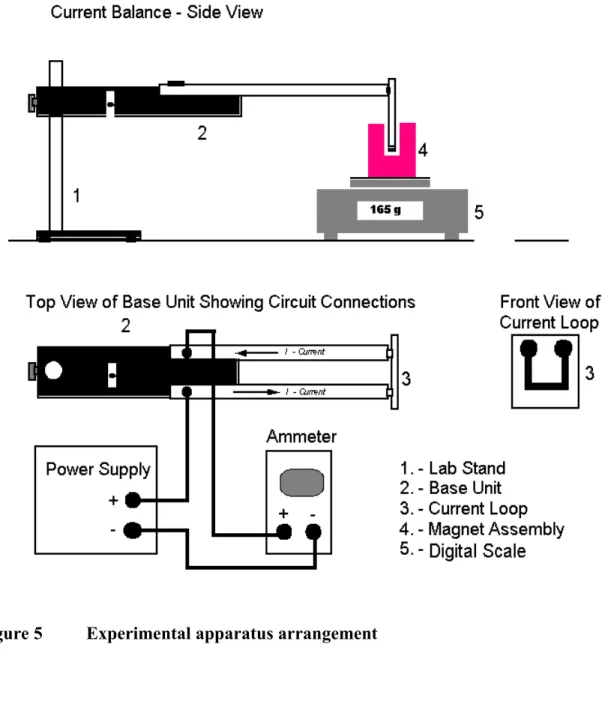
In the apparatus shown below an electronic balance measures the magnetic force from the current loop that is suspended in the magnetic field of the magnet assembly.
Fon magnet depends on the product of the current I, the loop length L within the magnetic field B, on the field strength B and on sin(θ ). Here, θ = 900.
Study the top view of the base unit below. Current from the power supply travels down one of the unit's arms to the current loop (see below). The other arm returns the current to an ammeter (or multimeter) to measure the current The front view of the current loop shows a thick (foil) wire connected to the base unit's arms. The magnetic force on the vertical wire parts cancel (because flows are opposite); only the horizontal wire section within the permanent magnet field B mag contributes to a vertical magnetic force that
changes the apparent "weight" of permanent magnet assembly that sits on the pan of the balance.
The balance measures mmagnet , the mass weight equivalent to the magnetic force on the magnet due to current I:
Fon magnet=mequivalentg
By Newton's action-reaction (third) law, the force on the magnet due to the current loop is equal and opposite to the force on the current loop due to the magnet.
The magnetic force on the current loop, due to the magnet, is then
Figure 3 Experimental apparatus involving a balance, a permanent magnet and a small, electric current carrying loop.
Figure 5 Experimental apparatus arrangement
PROCEDURE
A) FORCE VERSUS CURRENT AT FIXED LENGTH
Horizontal loop segment lengths: SF40= 1.2cm; SF37=2.2cm; SF39=3.2cm; SF38=4.2cm; SF41=6.4cm;
1. Select one current loop (long length, for greater sensitivity) and record its model number, e.g. "SF 42". Record the length of its horizontal loop length L. Attach the current loop to the end of the base unit with the foil (wire) end extending down. 2. With no load, turn on and zero the electronic balance. Set Mode for grams. Then put the magnet assembly on the balance, wait for stability and re-zero (tare) . The balance will now automatically subtract out the magnet mass and read only the force from the magnet - current interaction. To turn off, press and hold.
3. Move the lab stand and base unit so the horizontal position of the conductive foil (wire) on the current loop passes between the pole region of the magnets (this is the groove-like region of the magnet). The current loop fiber board must not touch the magnet.
4. Connect the power supply to the metal board arms (+ and - outputs.) Set the two right hand controls full clockwise and leave them. Turn the two left hand controls full ccw, for zero current. The right of these two is coarse, the left fine current control. Current meter is integral.
5. Set the loop current power supply near maximum. Record the balance mass reading m and the current I, including sign as given by the ammeter. Take four current readings, reducing the current each time; reverse and increase with opposite polarity for a maximum of 8 data points (4 positive + 4 negative). F mag should reverse with I, if balance is “tared”.
6. Multiply your mass data (kg) by g to obtain interaction force: F magnetic. Plot F1 mag (Newtons) vs current I1 (amperes) in Graphical Analysis and do a linear fit. You should have a pretty good straight line. If not, review your procedure and technique. Divide the best linear fit slope by L1 (convert L1 value to meters) to calculate B(L1), the B mag field of the permanent magnet, (Eq. 2). Record L1 value and B(L1).
7. Repeat for one other loop length value L2. Plot F2 mag vs. I2. Determine B(L2).
B) FORCE VERSUS WIRE LENGTH AT FIXED CURRENT
1. Select one current loop and record its model number, e.g. "SF 38" and length L. Attach the current loop to the end of the base unit with the foil (wire) end extending down.
2. Adjust the current to a large value (for greater sensitivity). Note current I . From the balance mass, calculate and enter into GA the force in Newtons and length L (meters).
This time enter the L value as negative.
Change the current loop and repeat for the same + and – currents as before. Repeat this procedure for a total of 4 loops (8 data points = 4 loops, each having one positive and one negative value, same | I |). You will not plot vs. current, so the sign of L must carry the information about the direction of current flow. If you don't do this, you will get a "V" plot, instead of a straight line.
Plot F mag vs length L (+ or -) and do a linear fit. Divide the slope of your fit by | I | to calculate B ( I ), the B mag field of the permanent magnet, from Eq. 2. Record | I | value and B( I ).
3. Calculate and report the ratios of your determinations of B mag: R1 = B(L1)/B( I ) and R2 = B(L2)/B( I ) .
Oersted's Magnetic Needle
24.2 x 13.2 x
33.5
Steel and
mahogany CAT. 1851 : 19.O.II
Duas agulhas magneticas com um arame ou fio de cobre para transmittir a corrente voltaica. Servem para mostrar a influencia da corrente sobre a direcção da agulha. Two magnetic needles with a wire or copper thread to transmit the voltaic current. They show the influence of the current on the direction of the needle.
Chris(Convert L1
value to
meters.)tian
Oersted
1777 - 1851
In 1801, Oersted began a series of journeys to Germany and France during the course of which he got to know Ritter. The two of them succeeded in demonstrating the existence of relationships between electrical phenomena, heat, light and chemical effects. They did, however, encounter some difficulties in the attempt to discover a relationship between electricity and magnetism
W. Gilbert, in his work De Magnete in 1660, had stated that electricity and magnetism were two manifestations of a single force inherent to all matter. In 1785, Coulomb had determined the quantitative law governing the interaction between electrically charged bodies, with his electrostatic balance. The qualitative behaviour of static electricity had already been determined by the French physicist, Charles du Fay, in 1733. As a result of Coulomb's studies, the scientific community accepted the independence of magnetic and electrical behaviour manifested by matter, since "magnetic fluids" could never leave a magnetic bar whereas electrical fluids could.
Meanwhile, the German school of thought, influenced by the Philosophy of Nature, believed in the unity of all forces and tried to establish a relationship between electricity and magnetism. These studies had a decisive influence on Oersted's research work.
In January 1804, Oersted went back to Denmark where he continued his investigation in Physics and Chemistry. In his work "Research on the Identity of Electrical and Chemical Forces", published in 1812, he suggested that magnetic phenomena were produced by electricity. In 1817, together with Esmark, he built a huge battery with a small internal resistance, with which he carried out several studies on electrical phenomena. In the winter of 1819-1820, when he delivered a series of talks on electricity, magnetism and galvanism to an audience that already knew about the principles expounded in the Philosophy of Nature, he remarked on the effect of an electrical current on a magnetic needle. Contrary to what was often said, this occurrence was not simply accidental, as he had been working for some years on this problem.
On July 21, 1820, Oersted announced his discovery in an article entitled "Experimenta circa effectum conflictus electriciti in acum magneticam". Some of his experiments are described in this article, as well as some rules for determining the direction of the force on the magnetic pole.
According to Oersted, when two ends of a battery are connected by means of a metal wire, an "electric conflict" is produced in the conductor and the surrounding space, causing the magnetic needle to be deflected.
In the same article, Oersted also stated that "the pole below the point through which the negative electricity enters is moved to the East and the pole above the point through which the negative electricity enters is moved to the West". This observation leads to the conclusion that the "electrical conflict" must describe coaxial circles, with the common axis of these circles coincident with the wire conducting the electricity. Besides this circular movement, there is also a progressive movement over the length of the electrical conductor, a spiral line resulting from the association of these two movements.
Oersted's experiments, using a relatively simple instrument, were enough to rock the foundations of Newtonian Mechanics. The nature of magnetic force was distinct from the forces known until then. It was certainly not a central force, since it was not oriented along a straight line between two interacting points, as happens with gravitational forces, interacting forces between electrical charges at rest, or between the two poles of a magnet.
The Gabinete de Física of the University of Coimbra (Portugal) has two examples of a device to observe the results of Oersted´s experiment.