Weight-Aware Core Extraction in
SAT-Based MaxSAT Solving
?Jeremias Berg and Matti J¨arvisalo
HIIT, Department of Computer Science, University of Helsinki, Finland
Abstract. Maximum satisfiability (MaxSAT) is today a competitive approach to tackling NP-hard optimization problems in a variety of AI and industrial domains. A great majority of the modern state-of-the-art MaxSAT solvers are core-guided, relying on a SAT solver to iteratively extract unsatisfiable cores of the soft clauses in the working formula and ruling out the found cores via adding cardinality con-straints into the working formula until a solution is found. In this work we propose weight-aware core extraction (WCE) as a refinement to the current common ap-proach of core-guided solvers. WCE integrates knowledge of soft clause weights into the core extraction process, and allows for delaying the addition of cardinal-ity constraints into the working formula. We show that WCE noticeably improves in practice the performance of PMRES, one of the recent core-guided MaxSAT algorithms using soft cardinality constraints, and explain how the approach can be integrated into other core-guided algorithms.
1 Introduction
Several recent breakthroughs in algorithmic techniques for the constraint optimization paradigm of maximum satisfiability (MaxSAT) are making MaxSAT today a compet-itive approach to tackling NP-hard optimization problems in a variety of AI and in-dustrial domains, from planning, debugging, and diagnosis to machine learning and systems biology, see e.g. [8, 14, 34, 17, 13, 11, 25]
A great majority of the most successful MaxSAT solvers today are based on the so-called core-guided MaxSAT solving paradigm, see e.g. [16, 29, 4, 31, 12, 30]. Such solvers iteratively use Boolean satisfiability (SAT) solvers for finding unsatisfiable cores, i.e., sets of soft clauses that together with the hard clauses are unsatisfiable, of the in-put MaxSAT instance. After finding a new core, the core is essentially compiled into the MaxSAT instance via adding a cardinality constraint enforcing that one of the soft clauses in the core cannot be satisfied. An in-built property of core-guided solvers is hence that the MaxSAT instance grows at each iteration due to compiling a new core into the instance. This can lead to the instance becoming bloated, as many, possibly large, cores are compiled, intuitively making the job of the SAT solver increasingly dif-ficult. One way of improving core-guided solvers is to develop more efficient ways of compiling the cores, decreasing the blow-up of the instance. Most recently, progress in
?Work supported by Academy of Finland (grants 251170 COIN, 276412, 284591); and DoCS
core-guided solvers has been made by developing new ways of compiling the cores via soft cardinality constraints[31, 30, 12].
In this work we proposeweight-aware core extraction(WCE) as a technique that refines the process of how cores are extracted and when they are compiled into the working formula during core-guided MaxSAT search. WCE integrates knowledge of soft clause weights into the core extraction process, and allows for delaying the addi-tion of cardinality constraints into the working formula by enabling the extracaddi-tion of more cores between compilation steps, thereby also intuitively making the job of the core extractor (SAT solver) easier. In this paper we explain in detail how a specific implementation of clause cloning allows integrating WCE into PMRES, the first al-gorithm making use of soft cardinality constraints [31]. We also show empirically that WCE noticeably improves the performance of PMRES in practice on standard weighted partial MaxSAT benchmarks from the most recent MaxSAT solver evaluation. Going beyond PMRES, we also explain how ideas behind WCE can be integrated into other core-guided algorithms employing soft cardinality constraints, and to what extent the presented ideas can be used in some of the other MaxSAT approaches utilizing SAT solvers for core extraction.
In terms of related work, ideas underlying WCE have been previously applied for computing lower bounds for MaxSAT instances [18, 20–23]. Specifically, the lower bounds are applied in the context of core-guided MaxSAT solving before the actual search in [18]. Furthermore, WCE also bears some resemblance with the (weaker) ap-proaches to obtaining bounds during branch-and-bound search for MaxSAT based on detecting unsatisfiable cores by e.g. unit propagation [20–23].
The rest of the paper is organized as follows. After necessary background on MaxSAT (Section 2) and a detailed description of the PMRES algorithm (Section 3), we present our main contributions, weight-aware core extraction in the context of PMRES (Sec-tion 4). We then present empirical results on the speed-ups obtained via WCE on PM-RES (Section 5), and further, explain how and to what extent the presented technique can be integrated into other SAT-based MaxSAT algorithms (Section 6).
2 Maximum Satisfiability
For background on weighted partial maximum satisfiability (MaxSAT in short), recall that for a Boolean variablex, there are two literals, the positivexand the negative¬x.
A clause is a disjunction (_) of literals, and a CNF formula a conjunction (^) of clauses. When convenient, we treat a clause as a set of literals and a CNF formula as a set of clauses. We assume familiarity with other logical connectives and denote by CNF( )
a set of clauses logically equivalent to the formula ; we can assume without loss of generality that the size of CNF( )is linear in the size of [33].
A MaxSAT instance consists of a set of hard clausesFh, a set of soft clausesFs, and
a functionw:Fs !Nthat associates a positive integral cost to each of the soft clauses.
We extendw to a setS ✓ Fs of soft clauses byw(S) = PC2Sw(C). Further, let
wmin
S = minC2S{w(C)}, i.e., the smallest weight among the clauses inS. Ifw(C) = 1
A truth assignment⌧ is a function from Boolean variables to true (1) and false (0).
A clauseC is satisfied by⌧ if⌧(l) = 1for a positive or⌧(l) = 0for a negative literal
l2C. A CNF formula is satisfied by⌧ if⌧ satisfies all clauses in the formula. If some ⌧ satisfies a CNF formula, the formula is satisfiable, and otherwise unsatisfiable. An assignment⌧ is a solution to a MaxSAT instanceF = (Fh, Fs, w)if⌧satisfiesFh. We
denote the set of soft clauses not satisfied by⌧ byF¯⌧, i.e.,F⌧¯={C2Fs |⌧(C) = 0}.
The cost of⌧ isw(F⌧¯). A solution⌧ is optimal (forF) ifw(F⌧¯)w(F⌧¯0)for every
solution⌧0toF. We denote the cost of optimal solutions toF by COST(F). Without
loss of generality, we will assume that a MaxSAT instance always has a solution, i.e., thatFhis satisfiable.
A central concept in modern SAT-based MaxSAT algorithms is that of (unsatisfi-able) cores. For a MaxSAT instanceF = (Fh, Fs, w), a subsetS✓Fsof soft clauses
is an unsatisfiable core ofF iffFh[Sis unsatisfiable. An unsatisfiable coreSis
mini-mal (an MUS) ofF iffFh[S0is satisfiable for allS0⇢S.
3 The PMRES Algorithm
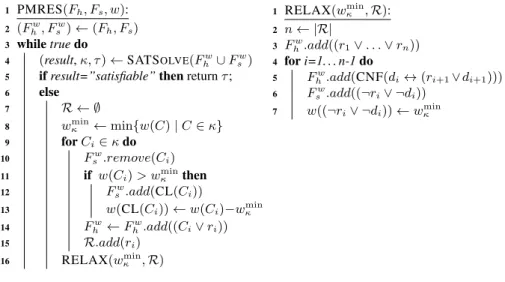
In order to explain weight-aware core extraction, we will use the PMRES algorithm [31]. Figure 1 gives PMRES in pseudo-code. When invoked on a MaxSAT instance(Fh, Fs, w)
PMRES works by iteratively calling a SAT solver (line 4) on a working formula, ini-tialized toFh[Fs, i.e., considering all hard and soft clauses of the input formula as
a SAT instance (line 2). If the working formula is satisfiable (line 5), PMRES returns the satisfying assignment reported by the SAT solver, which is guaranteed to be an optimal solution to the MaxSAT instance [31]. Otherwise the SAT solver returns an unsatisfiable coreof the working formula. PMRES then proceeds by removing all of the soft clauses in the core from the working formula andcloninga subset of them;
1 PMRES(Fh, Fs, w): 2 (Fw
h, Fsw) (Fh, Fs) 3 whiletruedo
4 (result,,⌧) SATSOLVE(Fw h [Fsw) 5 ifresult=”satisfiable”thenreturn⌧; 6 else 7 R ; 8 wmin min{w(C)|C2} 9 forCi2do 10 Fw s .remove(Ci) 11 if w(Ci)> wminthen 12 Fw s.add(CL(Ci)) 13 w(CL(Ci)) w(Ci) wmin 14 Fhw Fhw.add((Ci_ri)) 15 R.add(ri) 16 RELAX(wmin ,R) 1 RELAX(wmin ,R): 2 n |R| 3 Fw h.add((r1_. . ._rn)) 4 fori=1. . . n-1do 5 Fw h.add(CNF(di$(ri+1_di+1))) 6 Fw s.add((¬ri_¬di)) 7 w((¬ri_¬di)) wmin
clause cloning is a common way of extending MaxSAT algorithms from unweighted to weighted MaxSAT [3, 6, 30, 31, 12], and works as follows. First the minimum-weight
wmin
of clauses in the coreis determined (line 8). Then each clause incoreis
re-moved (line 10), and a soft clone CL(C)of each clauseC 2withw(C)> wmin
is
introduced to the working formula and given the weightw(C) wmin
(lines 11-13).
After clause cloning, PMRES extends eachC 2 by a fresh relaxation variable
rand adds the extended clauseC_ras hard to the working formula (line 14). The intuition here is that settingr = 1allows for the corresponding soft clause to be left
unsatisfied, while settingr = 0 forces the corresponding clause to be satisfied. Fi-nally, PMRESrelaxes the found core by adding a soft cardinality constraint over the introducedrvariables via the function RELAX(wmin
,R)(line 16). The added
car-dinality constraint is encoded as hard and soft clauses using additional new variables
d1, . . . , d|| 1, and essentially enforces that either exactly one of the introduced
re-laxation variables is set to true, or some soft clause corresponding to(ri ! ¬di)is
falsified (lines 2–7 of RELAX). In order to see this, notice first that the hard clause
(r1_. . ._r||)forces at least one relaxation variable to be set to true, Assume then
that two variablesrkandrtfor somek < tare both set to true. Then the hard clauses
of formdi $ (ri+1_di+1)imply that dj is set to true for allj < t. Specifically
the variabledk is set to true, and the soft clause encoding(rk !¬dk)will become
falsified.
We end this section by discussing two improvements that have been proposed for PMRES and other similar core-guided MaxSAT algorithms; the so-called stratification and hardening rules [26, 4, 5]. Assume that PMRES in invoked on a MaxSAT instance
F = (Fh, Fs, w). The stratification rule aims at prioritizing the extraction of cores
for whichwmin
is large. Since the sum of the minimum weights of the extracted cores
is a lower bound on the optimal cost of the MaxSAT instance, the goal in extracting cores with large minimum weights is to decrease the total number of iterations required for termination. More precisely, PMRES extended with stratification maintains a bound
wmax, initialized by a heuristic. During solving, PMRES does not invoke the SAT solver
onFw
h [Fsw, i.e., all of the clauses of the working formula, but rather, only on a subset
of them consisting of all hard clauses and the soft clauses with weight greater than
wmax. Whenever this subset of the working formula is satisfiable, the algorithm checks
if the SAT solver was invoked on the whole working formula, i.e., whetherwmax = 1.
If that is the case, the algorithm terminates. Otherwise the value ofwmax is decreased
heuristically, and the search continues. Several different strategies for updatingwmax
have been proposed [4, 5]. A fairly simple one is to initializewmax to the maximum
weight of the soft clauses, i.e.,wmax = max{w(C) | C 2 Fs} and update it by
decreasing it to the highest weight of soft clauses that is lower than the current value of
wmax.1
The hardening rule attempts to further exploit information that can be obtained from the satisfying assignments obtained during solving in conjunction with stratifica-tion. For some intuition, notice that all subsets of the working formula that PMRES
1In our implementation used in the experiments of this work, we use the slightly more
so-phisticateddiversity heuristic[5] which attempts to balance the number of new soft clauses introduced and the amount thatwmaxis decreased.
with stratification invokes the SAT solver on, always includeFh. Hence whenever the
SAT solver returns satisfiable, the returned assignment⌧ is a solution to the MaxSAT instance, and as such an upper bound on the optimal cost of the instance. The harden-ing rule exploits this fact by notharden-ing that any solution⌧2that does not satisfy a clause
C 2Fw
s withw(C)> w(F⌧¯)will havew(F⌧¯2)> w(F¯⌧)and as such can not be an
optimal solution toF. Hence all such soft clauses have to be satisfied by any optimal
solution toF and can therefore be hardened, i.e., turned into hard clauses.
Even though the presentation here is specific to PMRES, the stratification and hard-ening rules can be used in conjunction with several different core-guided MaxSAT al-gorithms. This is also the case for weight-aware core extraction presented next.
4 Weight-Aware Core Extraction for PMRES
We now describe weight-aware core extraction (WCE), a generic technique designed to improve performance of PMRES and other similar MaxSAT algorithms. WCE delays the addition of cardinality constraints to the working formula with the aim of extracting more valid cores (or “core mining”) from the working instance before adding more constraints to the formula.
Clause Cloning through Assumptions (without Cloning)WCE requires clause cloning to be implemented in a specific way throughassumptionswhich essentially avoid ac-tual clause cloning (copying) altogether. A similar approach to clause cloning is taken in [1]. For more details, we first need to overview how core extraction is usually imple-mented in SAT-based MaxSAT solving. Several modern SAT solvers allow querying for the satisfiability of a CNF formula under a set of assumptions, represented as a partial assignment of the variables in the formula. Whenever the formula is unsatisfiable un-der those assumptions, the SAT solver returns some subset of the assumptions that are required in the proof of unsatisfiability. Notice that not only are unsatisfiable formulas unsatisfiable under all assumptions, but a satisfiable formula may also be unsatisfiable under some assumptions. For example, consider the CNF formulaF ={(x_y),(¬x)}. Although the formula is satisfiable, it is unsatisfiable when assumingx= 1ory= 0.
Core-guided MaxSAT solvers make use of the assumptions interface in SAT solvers by extending each soft clause C 2 Fs with a fresh assumption variable A(C)and
sending the extended clauseC_A(C)to the SAT solver. During each SAT solver call, all assumption variables are assumed false, thus reducing all extended clausesC_A(C)
toC. Whenever the working formula is unsatisfiable, the SAT solver will return the
extracted corein terms of the subset of assumption variables corresponding to the clauses in. Importantly for the PMRES algorithm, this means that each clauseCi 2 is already extended with the variableA(Ci)and that variable can be reused as the
relaxation variablerithat would otherwise be introduced on lines 15-16 in the algorithm
described in Figure 1. Notice that whenever the SAT solver is invoked without assuming the value ofA(Ci)and the variable only appears in the extended clauseCi_A(Ci), it can
be set to true by the SAT solver, thereby satisfying the extended clause and effectively removing the clause from the formula. The same argument does not hold as soon as other constraints involvingA(Ci)are added to the formula.
With this, clause cloning through assumption variables is implemented as follows. Assume that a clauseC 2extended with the assumption variableA(C)needs to be
cloned, i.e., it is a member of some extracted coreandw(C)> wmin
. A simple way of
improving on the naive description of clause cloning in Section 3 is to introduce a new soft clauseC0 = (¬A(C))with weightw(C0) =w(C
i) wmin . The correctness of this
follows by noting that the extended clause(C_A(C))will be hard in all subsequent SAT
solver calls. Thus satisfyingC0forces the clauseCto be satisfied as well, achieving the
same effect as cloning the wholeC. To further improve on this, notice that asC0would
be added as a soft clause, it would also be extended with an assumption variable and the extended clauseC0_A(C0)would be sent to the SAT solver. This creates the logical
chain¬A(C0)!¬A(C)!C. The basic form of clause cloning would then assume
the variableA(C0)to false in subsequent SAT solver calls, thus forcingCas well. To
refine this, note that the same affect is achieved by simply assuming the value ofA(C)to
false instead, thus removing the need of introducing the clauseC0at all. In more detail,
when a coreis extracted, the minimum weightwmin
is computed. Then the weight
of each clauseC 2is decreased bywmin
. In subsequent SAT calls, the assumption
variable of each clauseCwith weightw(C)>0is assumed false, essentially treating
that clause as soft. All other clauses are treated as hard. Refining clause cloning in this way blurs the line between hard and soft clauses. When discussing PMRES with clause cloning implemented through assumptions we say that a clauseCis soft as long as the
internal SAT solver is invoked assumingA(C) = 0, i.e, as long asw(C)> 0. When
w(C)drops to0, the extended clause(C_A(C))becomes hard. Notice that in order for
w(C)to become0, the clauseChas appeared in at least one core. Hence we have added a cardinality constraint overA(C)so not assuming the value of it does not remove the
clauseC from the formula.
Except for removing the need of introducing clones to the formula, implementing clause cloning through assumptions also results in tighter cardinality constraints, as illustrated by the following example.
Example 1. LetF = (Fh, Fs, w)be a MaxSAT instanceFh={(x_y),(y_z)},Fs = {C1 = (¬x), C2 = (¬y), C3 = (¬z)}, andw(C1) = 1andw(C2) = w(C3) = 2.
Assume that we invoke the basic version of PMRES, i.e., the algorithm in Figure 1, onF
and that it first extracts the core{C1, C2}. After relaxing the core the working instance (Fw
h, Fsw, w)consists ofFhw =Fh^(C1_r1)^(C2_r2)^CNF(r1+r2 = 1)h,
Fw
s = CL(C2)^C3^CNF(r1+r2 = 1)swithw(CL(C2)) = 1, w(C3) = 2. Here
we use CNF(r1+r2 = 1)h and CNF(r1+r2 = 1)s to denote the hard and soft
clauses, respectively, introduced in the RELAXsubroutine. If PMRES next extracts and relaxes the core{CL(C2), C3}, the final working formula will have the hard clauses
Fw
h = Fh^(C1_r1)^(C2_r2)^(CL(C2)_r3)^(C3_r4)^CNF(r1+r2 = 1)h^CNF(r3+r4 = 1)h and the soft clausesFsw = CL(C3)^CNF(r1+r2 = 1)s ^CNF(r3+r4 = 1)s. This instance is satisfiable by setting r2 = r3 = 1and
r1 = r4 = 0. In total there are 4different ways of satisfying the added cardinality
constraints. A similar argument holds even if we use the assumption variables of soft clauses in cores when encoding the cardinality constraints and introduce the negations of those variables as soft clauses when performing clause cloning.
If we instead use assumptions to implement clause cloning, the final working for-mula will have the hard clausesFw
h =Fh^(C1_A(C1))^(C2_A(C2))^CNF(A(C1)+
A(C2) = 1)h ^CNF(A(C2) + A(C3) = 1)h and the soft clauses Fsw = C3 ^
CNF(A(C1) +A(C2) = 1)s^CNF(A(C2) +A(C3) = 1)swithw(C1) =w(C2) = 0
andw(C3) = 1. Asw(C3)>0, the final SAT call will be made assumingA(C3) = 0.
Under the assumption, there is only a single way of satisfying the added cardinality constraints. Even disregarding the assumptions, there are only2ways of satisfying the added cardinality constraints with one of them resulting in the rest of the instance
be-coming satisfiable. ⌅
WCEHaving discussed clause cloning in conjunction with WCE, we now turn to de-scribing WCE in detail. For some intuition, consider the following example.
Example 2. Consider again the MaxSAT instanceF from Example 1 and assume that
PMRES with clause cloning implemented through assumptions first extracts{C1, C2}.
The working formula(Fw
h, Fsw, w)will then becomeFhw = Fh^(C1 _A(C1))^
CNF(A(C1) +A(C2) = 1)handFsw =C2^C3^CNF(A(C1) +A(C2) = 1)swith
w(C2) = 1, w(C3) = 2. The only core of the instance is{C2, C3}. Notice, however,
that ignoring the added cardinality constraints at this stage and invoking the SAT solver on the (simpler) subset of the working formula consisting ofFw
h =Fh^(C1_A(C1))
andFw
s =C2^C3withw(C2) = 1, w(C3) = 2would result in the exact same core
being extracted. ⌅
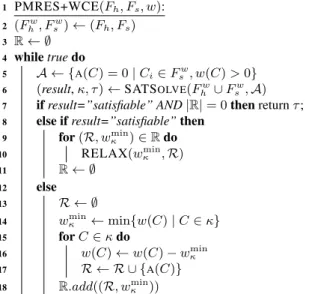
The pseudocode of PMRES extended with WCE is shown in Fig. 2. Before invoking its SAT solver, PMRES with WCE first adds an assumptionA(C) = 0for all soft clauses
C withw(C) > 0 (line 5). Then it invokes the SAT solver on the working formula with these assumptions. If a coreis extracted,wmin
is computed and the weight of
all clauses in the core decreased bywmin
(lines 14 and 16). However, instead of
im-mediately calling RELAX(wmin
,R), the tuple(R, wmin)is added to the setR(line
18). Then the SAT solver in invoked again with a new set of assumptions. Notice that at each iteration, the weight of at least one soft clauseC is dropped to0. In
subse-quent SAT solver calls the value ofA(C)is not assumed anymore, effectively removing that clause from the formula until the cardinality constraints are added, which is why the working formula will eventually become satisfiable. The algorithm then checks if new cores have been extracted since the last time cardinality constraints were added. If so, the corresponding cardinality constraints are added to the formula and the loop iterates (lines 8-11). If there are no new cores, the algorithm terminates and returns the satisfying truth assignment as an optimal MaxSAT solution (line 7).
Similarly to the stratification rule, all working formulas of PMRES extended with WCE contain the original hard clausesFh. As such, whenever the working formula is
satisfiable, the algorithm obtains an upper bound on the cost of the optimal solutions. The bound might in some cases allow PMRES with WCE to terminate even before all cardinality constraints have been added to the working formula.
Example 3. Consider the MaxSAT instanceF from Examples 1 and 2. Invoke PMRES
with WCE onF and assume that the first core it extracts is again1={C
1, C2}. Now
the addition of cardinality constraints is delayed and the SAT solver is invoked onFw h =
1 PMRES+WCE(Fh, Fs, w): 2 (Fw h, Fsw) (Fh, Fs) 3 R ; 4 whiletruedo 5 A {A(C) = 0|Ci2Fsw, w(C)>0} 6 (result,,⌧) SATSOLVE(Fw
h [Fsw,A) 7 ifresult=”satisfiable” AND|R|= 0thenreturn⌧; 8 else ifresult=”satisfiable”then
9 for(R, wmin )2Rdo 10 RELAX(wmin ,R) 11 R ; 12 else 13 R ; 14 wmin min{w(C)|C2} 15 forC2do 16 w(C) w(C) wmin 17 R R[{A(C)} 18 R.add((R, wmin ))
Fig. 2: PMRES+WCE, the PMRES algorithm with WCE. In the pseudocode, the assumption variable of a soft clauseCused in core extraction is given byA(C).
Fh^(C1_A(C1))andFsw =C2^C3withw(C1) = 0, w(C2) = 1andw(C3) = 2. As
w(C1) = 0, the variableA(C1)is not assumed to any value and the clause(C1_A(C1))
can be satisfied by settingA(C1) = 1. Nevertheless, PMRES+WCE still extracts the
core2 ={C
2, C3}. On the third iteration the SAT solver is invoked onFhw = Fh^ (C1_A(C1)^(C2_A(C2))andFsw=C3withw(C1) =w(C2) = 0andw(C3) = 1
assumingA(C3) = 0. This instance is satisfiable. Next the algortihm adds cardinality
constraints to form the same (satisfiable) final working instance as shown in Example 1. Then it would invoke the SAT solver on that instance, find it satisfiable, and terminate.
However, by investigating the second to last SAT solver call we see that PMRES+WCE might be able to terminate without adding any cardinality constraints at all. First note that after extracting the cores1 and2we know that COST(F) wmin
1 +wmin2 = 1 + 1 = 2. Now, the second to last SAT solver call is performed on the clauses (x_y),(y_z),(¬x_A(C1)),(¬y_A(C2)),(¬z_A(C3))assumingA(C3) = 0.
The assumption propagatesz= 0which in turn propagatesy= 1andA(C2) = 1. At
this point, all clauses except for(¬x_A(C1))are already satisfied. If the internal SAT
solver now satisfies the clause by settingx = 0, the cost of the assignment it returns will be2, thus proving that COST(F)2and allowing the algorithm to terminate early.
Although we in general can not guarantee early termination, empirically we found that
it does happen. ⌅
The correctness of WCE is based on the correctness of PMRES. For more intuition, note that all cores that are extractable by PMRES with WCE are a subset of the cores that could be extracted by PMRES with clause cloning implemented through assumptions, and that the final working instance of both algorithms is the same.
Related WorkThe method presented in [18] for computing MaxSAT lower bounds is equivalent to running Algorithm 2 until the working instance becomes satisfiable for the first time, returning the sumPwmin
over all of the cores extracted; already this
lower bounding step is shown in [18] to improve the performance of specific MaxSAT algorithms compared to starting search with the trivial bound of0. Alternatively, WCE can be seen as a more thorough integration of the bound computation and the MaxSAT algorithm itself by performing the lower bound computationin-betweeneach core com-pilation step. Computation of lower bounds has also received significant interest in the context of branch-and-bound MaxSAT solvers [21–23, 20], which rely heavily on good lower bounds in order to prune the search tree. For example, in [21] the authors propose a technique in which unit propagation is used to extract several cores of the working instance in order to compute a lower bound. The main difference to WCE is that WCE is not limited to cores detectable by unit propagation.
Integrating Stratification and HardeningWe end this section by discussing how the commonly used stratification and hardening rules can be integrated with WCE. There are two obvious ways of integrating stratification in conjunction with WCE. The first one is to prefer WCE to stratification: initialize the boundwmax heuristically [5] and
assume the assumption variable A(C) to false only for each of the clauses C with w(C) wmax. Then iteratively extract cores over the subset of soft clauses under
con-sideration, delaying the addition of cardinality constraints until the instance becomes satisfiable. At that point, add the cardinality constraints and continue. Whenever the in-stance remains satisfiable after the addition of cardinality constraints, harden any pos-sible clauses and decrease the boundwmax. The algorithm can terminate when no new
cores can be extracted and the SAT solver has been invoked on all soft clauses. Another, dual way of integrating the two is to prefer stratification to WCE, i.e., to delay the addition of cardinality constraints untilwmaxhas been decreased to1, at which
point all cardinality constraints are added and the boundwmaxis reinitialized. However,
the choice between preferring stratification or WCE to the other influences the applica-bility of the hardening rule and the quality of the satisfiable assignments produced by WCE and stratification. Preferring WCE to stratification we know that, whenever the boundwmax needs to be lowered, all clausesCwithw(C) wmaxare satisfied, thus
allowing for the hardening of several soft clauses. In contrast, when preferring stratifi-cation to WCE, sound use of the hardening rule requires considering the delayed soft cardinality constraints, of which the SAT solver has had no information during search. The empirical results presented next support this intuition, as preferring WCE to strat-ification leads to performance boosts within PMRES, while preferring stratstrat-ification to WCE actually degrades performance compared to PMRES without using WCE.
5 Experiments
We investigate how WCE affects the performance of the PMRES algorithm in practice. Since the implementation of PMRES by the original authors—coined Eva500a as it participated in MaxSAT Evaluation 2014 [9]—is not available in open source, we re-implemented PMRES on top of the open-source core-guided MaxSAT solver
Open-WBO [29], following the description in the paper introducing the algorithm [31] using Glucose [10] as the underlying incremental SAT solver.
In the experiments we compare the following MaxSAT algorithms.
– PMRES: our re-implementation of the PMRES algorithm using stratification, im-plemented using assumption variables on soft clauses, hardening, and clause cloning implemented through assumptions.
– PMRES+WCE: PMRES extended with WCE, preferring WCE to stratification. – PMRES+WCE (S/to/WCE): PMRES extended with WCE, preferring stratification
to WCE.
– Eva500a [31]: the closed-source implementation of PMRES that participated, and won the industrial category of the 2014 MaxSAT Evaluation.
For reference, we also provide a comparison with MSCG15b [30], a closed-source as the best-performing core-guided MaxSAT solver using soft cardinality constraints in 2016 MaxSAT evaluation. As we will explain later in Section 6, WCE could also be integrated into MSCG.2As benchmarks we used the weighted partial industrial (630)
and crafted (331) instances from the 2016 MaxSAT Evaluation [9]. The experiments were run on 2.83-GHz Intel Xeon E5440 quad-core machines with 32-GB RAM and Debian GNU/Linux 8 using a per-instance timeout of 3600 seconds.
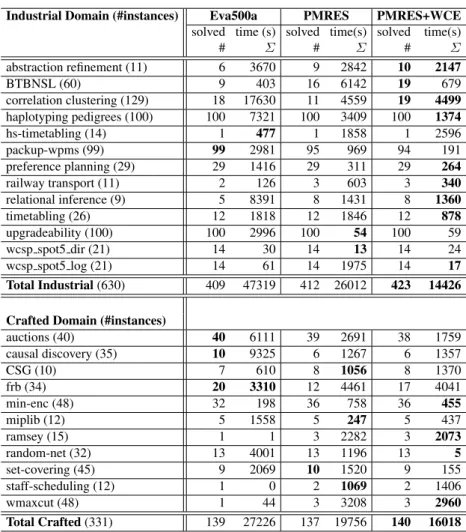
An overview of the results, comparing the performance of Eva500a and the vari-ants PMRES, PMRES+WCE, and PMRES+WCE (S/to/WCE) of our implementation, is provided through Fig. 3, Fig. 4, and Table 1. The “cactus” plot of Figure 3 gives the number of instances solved (x-axis) by the individual solvers under different per-instance time limits (y-axis) over all benchmarks. More detailed results are provided in Table 1, with the industrial and crafted benchmarks separated by domain, showing the number of instances from each domain, and the number of solved instances and the cumulative running time used for solving the solved instances for each solver. First, note that our PMRES re-implementation is competitive in terms of overall performance with Eva500a; on the industrial instances PMRES solves three more instances overall and uses cumulatively only 55% of the running time that Eva500a uses on the respec-tively solved instances. On the crafted instances, PMRES solves two instances less than Eva500a but still uses noticeably less time over all solved instances.
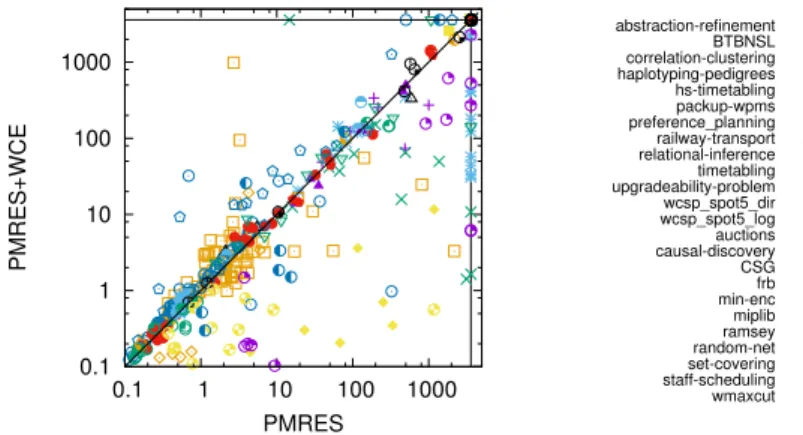
Turning to the influence of WCE on the performance of PMRES, we observe that PMRES+WCE (preferring WCE to stratification) has noticeably improved performance wrt PMRES (and thus also Eva500a), solving 11 more industrial and 3 more crafted in-stances (14 and 1 more than Eva500a). Notice that of all three solvers, PMRES+WCE is the best performing on both industrial and crafted benchmarks. Most interestingly, PMRES+WCE uses at the same time much less time on the solved instances; on the industrial instances PMRES+WCE uses in total 55% of the time PMRES uses and 30% of the time Eva500a uses, even though PMRES+WCE solves more instances than PMRES and Eva500a individually. A similar observation can be made of the crafted instances; PMRES+WCE uses 81% of the time used by PMRES and 59% of the time used by Eva500a, again solving more instances than either one. The scatter plot of Fig. 4 gives a per-instance running time comparison on a log-log scale of PMRES+WCE
Table 1: Comparison of Eva500a, PMRES, and PMRES+WCE: number of solved instances (#) and the cumulative running time used for solving the instances (⌃) for the individual solvers, divided into the Industrial (top) and Crafted (bottom) benchmarks according to the individual domains with the number of instances from each domain given in parentheses.
Industrial Domain (#instances) Eva500a PMRES PMRES+WCE solved time (s) solved time(s) solved time(s)
# ⌃ # ⌃ # ⌃ abstraction refinement (11) 6 3670 9 2842 10 2147 BTBNSL (60) 9 403 16 6142 19 679 correlation clustering (129) 18 17630 11 4559 19 4499 haplotyping pedigrees (100) 100 7321 100 3409 100 1374 hs-timetabling (14) 1 477 1 1858 1 2596 packup-wpms (99) 99 2981 95 969 94 191 preference planning (29) 29 1416 29 311 29 264 railway transport (11) 2 126 3 603 3 340 relational inference (9) 5 8391 8 1431 8 1360 timetabling (26) 12 1818 12 1846 12 878 upgradeability (100) 100 2996 100 54 100 59 wcsp spot5 dir (21) 14 30 14 13 14 24 wcsp spot5 log (21) 14 61 14 1975 14 17 Total Industrial(630) 409 47319 412 26012 423 14426 Crafted Domain (#instances)
auctions (40) 40 6111 39 2691 38 1759 causal discovery (35) 10 9325 6 1267 6 1357 CSG (10) 7 610 8 1056 8 1370 frb (34) 20 3310 12 4461 17 4041 min-enc (48) 32 198 36 758 36 455 miplib (12) 5 1558 5 247 5 437 ramsey (15) 1 1 3 2282 3 2073 random-net (32) 13 4001 13 1196 13 5 set-covering (45) 9 2069 10 1520 9 155 staff-scheduling (12) 1 0 2 1069 2 1406 wmaxcut (48) 1 44 3 3208 3 2960 Total Crafted(331) 139 27226 137 19756 140 16018
and PMRES, with the ticks below the y = x line representing instances on which PMRES+WCE is faster that PMRES. The colors of the ticks distinguish between the benchmark domains listed in Table 1.
Next, we consider the question of the relative influence of preferring stratification or WCE within PMRES. Here we observe that PMRES+WCE (S/to/WCE)—preferring stratification over WCE—actually harms the overall performance of PMRES notice-ably, making it perform worse than Eva500a overall (see Fig. 3). This supports the earlier discussed intuition that preferring WCE to stratification assures that whenever the boundwmax needs to be lowered, all clausesC withw(C) wmaxare satisfied,
thus allowing for hardening several soft clauses. In contrast, when preferring stratifi-cation to WCE, sound use of the hardening rule requires considering the delayed soft cardinality constraints, of which the SAT solver has had no information during search.
Finally, we consider the relative performance of PMRES+WCE and MSCG15b. Here we note that this is not a direct comparison of the influence of WCE in the sense that MSCG15b does not implement the PMRES algorithm of Eva500a, but rather a different core-guided algorithm using soft cardinality constraints, OLL [2, 30]. As we will explain later in Section 6, WCE can also be integrated into the OLL algorithm. However, we could not implement WCE directly to MSCG as MSCG is not available in open source. Nevertheless, a comparison of the performance of PMRES+WCE and MSCG15b is provided in Table 2. Overall MSCG15b solves 12 more industrial in-stances than PMRES+WCE. However, at the same time MSCG used considerably more time per solved instance; this can be observed by inspecting the total cumulative
0 500 1000 1500 2000 2500 3000 3500 460 480 500 520 540 560 Timeout Instances PMRES+WCE PMRES Eva500 PMRES+WCE (S/to/WCE)
Fig. 3: Solver comparisons: Number of instances solved (x-axis) by the individual solvers under different per-instance time limits (y-axis).
0.1 1 10 100 1000 0.1 1 10 100 1000 PMRES+WCE PMRES abstraction-refinement BTBNSL correlation-clustering haplotyping-pedigrees hs-timetabling packup-wpms preference_planning railway-transport relational-inference timetabling upgradeability-problem wcsp_spot5_dir wcsp_spot5_log auctions causal-discovery CSG frb min-enc miplib ramsey random-net set-covering staff-scheduling wmaxcut
Fig. 4: Solver comparisons: Per-instance running time comparison of PMRES (x-axis) and PM-RES+WCE (y-axis), with the ticks below they= xline representing instances on which PM-RES+WCE is faster than PMRES.
Table 2: Comparison of MSCG15b and PMRES+WCE: percentage (%) and number (#) of solved instances and the cumulative running time used for solving the instances (⌃) for the individual solvers, divided into Industrial (top) and Crafted (bottom) benchmarks according to the individual domains with the number of instances from each domain given in parentheses.
Industrial Domain (#instances) MSCG15b PMRES+WCE solved time (s) solved time (s)
% # ⌃ % # ⌃ abstraction refinement (11) 90.9 10 17096 90.9 10 2147 BTBNSL (60) 21.7 13 885 31.7 19 679 correlation clustering (129) 25.6 33 19780 14.7 19 4499 haplotyping pedigrees (100) 100.0 100 1343 100.0 100 1374 hs-timetabling (14) 7.1 1 167 7.1 1 2596 packup-wpms (99) 100 99 410 95.0 94 191 preference planning (29) 100 29 2021 100 29 264 railway transport (11) 27.3 3 283 27.3 3 340 relational inference (9) 44.4 4 3167 88.9 8 1360 timetabling (26) 46.2 12 764 46.2 12 878 upgradeability (100) 100.0 100 118 100.0 100 59 wcsp spot5 dir (21) 81.0 17 2776 66.7 14 24 wcsp spot5 log (21) 66.7 14 19 66.7 14 17 Total Industrial(630) 435 50333 423 14426
Crafted Domain (#instances)
auctions (40) 60.0% 24 313 95.0% 38 1759 causal discovery (35) 82.9% 29 6851 17.1% 6 1357 CSG (10) 100.0% 10 825 80.0% 8 1370 frb (34) 73.5% 25 4298 50.0% 17 4041 min-enc (48) 66.7% 32 27 75.0% 36 455 miplib (12) 41.7% 5 56 41.7% 5 437 ramsey (15) 13.3% 2 1335 20.0% 3 2073 random-net (32) 100.0% 32 288 40.6% 13 5 set-covering (45) 46.7% 21 1530 20.0% 9 155 staff-scheduling (12) 16.7% 2 1244 16.7% 2 1406 wmaxcut (48) 10.4% 5 3651 6.3% 3 2960 Total Crafted(331) 187 20417 140 16018
ning times: while PMRES+WCE uses 14416 seconds to solve 423 instances, MSCG15b uses a noticeable 35917 seconds more to solve additional 12 instances. Looking more closely at the results on a benchmark domain basis, we notice that the main advantage of MSCG15b is within the correlation clustering domain, where the solver also uses a noticeably amount of time to solve an additional 14 instances; furthermore, notice that the correlation clustering domain is over-represented among the full benchmark set with 129 instances. On the other hand, PMRES solves twice as many instances as MSCG15b within the relational inference domain, using at the same time only 43% of the cumulative running time of MSCG15b. The abstraction refinement domain
pro-vides another example where PMRES+WCE solves instances cumulatively noticeably faster than MSCG15b: here the solvers solve the same number of instances, but the cumulative running time of PMRES+WCE is less than 13% of that of MSCG15b (i.e., an 8x speed-up relative to MSCG15b). Turning to the crafted domains, we observe that MSCG15b clearly dominates on several of them. This is an interesting observation, also in that Eva500a never participated in the crafted MaxSAT evaluation categories.
6 WCE and Other SAT-Based MaxSAT Algorithms
In this section we discuss WCE in a more general setting and the question of to what extent it could be applied to other recently proposed MaxSAT algorithms.
The key to integrating WCE with a core-guided MaxSAT algorithm is whether clause cloning can be implemented through assumptions in the algorithm. As far as we understand, the reason clause cloning through assumptions can be added to PMRES is the fact that no clause ever appears in a core more than once. In more detail, let be a core extracted by PMRES during solving and assumeC 2needs to be cloned, i.e., thatw(C)> wmin
. Since the extended clauseC_A(C)is added to the working
formula as hard, that clause is not going to be extracted in any subsequent cores, but rather, only its clone CL(C)or some of the soft clauses added in RELAX(wmin
,R).
This simple observation is a key to implementing clause cloning through assumptions. WPM1As an example of an algorithm in which clause cloning seems to be difficult to implement through assumptions, consider the WPM1 algorithm [24, 3]. WPM1 works similarly to PMRES in the sense that it uses a SAT solver to extract and relax unsatisfi-able cores of the input instanceF. Given a core, WPM1 clones its clauses similarly to PMRES and extends each clauseCi2(now of weightwmin ) with a fresh relaxation
variableri. For WCE, the key difference between PMRES and WPM1 is that WPM1
leaves all extended clausesCi_riassoftin the working formula and adds a cardinality
constraint CNF(Pri= 1)ashardclauses. Hence the extended clause might appear in
subsequent cores, making it difficult if not impossible to also reuse it as its own clone. Finally, we point out MaxSAT algorithms to which WCE can be integrated.
OLL & K Two algorithms that closely resemble PMRES3are OLL [2, 30] and K [1].
Both extract cores iteratively, harden and clone the clauses in cores, and compile them into the formula using soft cardinality constraints. In contrast to PMRES, OLL makes use of cardinality networks in order to dynamically modify the previously added cardi-nality constraints while K uses parametrized constraints for bounding their size. In both cases the clauses in the extracted cores are hardened and do not appear in subsequent cores, and as such WCE could be incorporated into both algorithms. Indeed, at least the K algorithm does implement clause cloning through assumptions [1]. The MSCG15b MaxSAT solver considered in Section 5 implements OLL.
WPM3 [7] maintains a set of at-most constraints, initialized to not allow any soft clauses to be falsified. During solving all clauses are treated as hard and the at-most
3Originally in [31] PMRES was formalized as a special case of the so-called MAXRES [19]
constraints as soft, and hence all cores are subsets of these constraints. After finding a new core, WPM3 performs clause cloning and then merges the constraints to form new ones that make effective use of the global core structure. In contrast to OLL and PMRES, the cardinality constraints in the extracted cores are not hardened, but instead removed from the instance. To the best of our understanding, the version of WPM3 presented in [7] does not use the SAT solver iteratively, but instead rebuilds it on each iteration. Hence the idea of implementing clause cloning through assumptions is not ap-plicable to this version of WPM3, even though it might be if the algorithm is extended with incremental cardinality constraints in the spirit of [28]. However, the discussed requirement of a clause in a core not appearing in any subsequent cores is satisfied by the algorithm. Thereby delaying the modification of cardinality constraints could be incorporated to the presented version of WPM3.
WMSU3[27] maintains a single cardinality constraintPr2Rr= over the setRof
relaxation variables of clauses appearing in cores extracted so far. When a new coreis extracted, all the assumption variablesA(C)of clausesC 2are reused as relaxation variables, i.e., added into the setR, after which a new bound is computed and the solver invoked again. Here is a lower bound on the optimal cost of the instance. As noted in Section 4, WCE can be viewed as an extension of the lower bounding technique from [18], the difference being that WMSU3 extended with WCE would perform such a core mining step in between each modification of the cardinality constraint, not only before the cardinality constraint is added.
SAT-IP HybridsFinally, also the SAT-IP hybrid solvers MaxHS [15] and LMHS [32], based on the implicit hitting set approach to MaxSAT, could potentially make use of specific ideas related to WCE. Specifically, WCE could be incorporated into thedisjoint core extraction phase—that is very important in terms of performance in practice [15]— in this context in a straight-forward way: instead of ruling out each clauseC in a core from the working instance during the disjoint phase, lower the weight of all clauses in the core bywmin
, and rule out only those clauses whose weight is lowered to0.
7 Conclusions
We proposed weight-aware core extraction (WCE) as a refinement to the approach taken by various core-guided MaxSAT solvers for compiling the cores extracted at each iter-ation of search. WCE allows for extracting multiple cores of the same working formula by taking into account the residual weights of the current soft clauses, thereby postpon-ing the compilation step and allowpostpon-ing the SAT solver to work on a less bloated workpostpon-ing formula. We detailed WCE in the context of PMRES, a representative of the most recent line of core-guided MaxSAT solvers that use soft cardinality constraints in the compi-lation step, and showed empirically that WCE noticeably improves the performance of PMRES on standard weighted partial MaxSAT benchmarks. We also outlined how to integrate ideas behind WCE into other core-guided MaxSAT algorithms. The empirical results obtained for PMRES suggests that integrating WCE into other recent MaxSAT solvers may provide further improvements to the state of the art.
References
1. Alviano, M., Dodaro, C., Ricca, F.: A MaxSAT algorithm using cardinality constraints of bounded size. In: Proc. IJCAI. pp. 2677–2683. AAAI Press (2015)
2. Andres, B., Kaufmann, B., Matheis, O., Schaub, T.: Unsatisfiability-based optimization in clasp. In: Proc. ICLP Technical Communications. LIPIcs, vol. 17, pp. 211–221. Schloss Dagstuhl - Leibniz-Zentrum fuer Informatik (2012)
3. Ans´otegui, C., Bonet, M., Levy, J.: Solving (weighted) partial MaxSAT through satisfiability testing. In: Proc. SAT. Lecture Notes in Computer Science, vol. 5584, pp. 427–440. Springer (2009)
4. Ans´otegui, C., Bonet, M., Levy, J.: SAT-based MaxSAT algorithms. Artificial Intelligence 196, 77–105 (2013)
5. Ans´otegui, C., Bonet, M.L., Gab`as, J., Levy, J.: Improving SAT-based weighted MaxSAT solvers. In: Proc. CP. Lecture Notes in Computer Science, vol. 7514, pp. 86–101. Springer (2012)
6. Ans´otegui, C., Didier, F., Gab`as, J.: Exploiting the structure of unsatisfiable cores in MaxSAT. In: Proc. IJCAI. pp. 283–289. AAAI Press (2015)
7. Ans´otegui, C., Gab`as, J., Levy, J.: Exploiting subproblem optimization in SAT-based MaxSAT algorithms. Journal of Heuristics 22(1), 1–53 (2016)
8. Argelich, J., Le Berre, D., Lynce, I., Marques-Silva, J., Rapicault, P.: Solving Linux upgrade-ability problems using Boolean optimization. In: Proc. LoCoCo. Electronic Proceedings in Theoretical Computer Science, vol. 29, pp. 11–22 (2010)
9. Argelich, J., Li, C.M., Many`a, F., Planes, J.: MaxSAT Evaluations, http://maxsat.ia.udl.cat/ 10. Audemard, G., Lagniez, J.M., Simon, L.: Improving Glucose for incremental SAT solving
with assumptions: Application to MUS extraction. In: Proc. SAT. Lecture Notes in Computer Science, vol. 7962, pp. 309–317. Springer (2013)
11. Berg, J., J¨arvisalo, M., Malone, B.: Learning optimal bounded treewidth Bayesian networks via maximum satisfiability. In: Proc. AISTATS. JMLR Workshop and Conference Proceed-ings, vol. 33, pp. 86–95. JMLR.org (2014)
12. Bjørner, N., Narodytska, N.: Maximum satisfiability using cores and correction sets. In: Proc. IJCAI. pp. 246–252. AAAI Press (2015)
13. Bunte, K., J¨arvisalo, M., Berg, J., Myllym¨aki, P., Peltonen, J., Kaski, S.: Optimal neighbor-hood preserving visualization by maximum satisfiability. In: Proc. AAAI. pp. 1694–1700. AAAI Press (2014)
14. Chen, Y., Safarpour, S., Marques-Silva, J., Veneris, A.: Automated design debugging with maximum satisfiability. IEEE Transactions on Computer-Aided Design of Integrated Circuits and Systems 29(11), 1804–1817 (2010)
15. Davies, J., Bacchus, F.: Exploiting the power of MIP solvers in MaxSAT. In: Proc. SAT. Lecture Notes in Computer Science, vol. 7962, pp. 166–181. Springer (2013)
16. Fu, Z., Malik, S.: On solving the partial MaxSAT problem. In: Proc. SAT. Lecture Notes in Computer Science, vol. 4121, pp. 252–265. Springer (2006)
17. Guerra, J., Lynce, I.: Reasoning over biological networks using maximum satisfiability. In: Proc. CP. Lecture Notes in Computer Science, vol. 7514, pp. 941–956. Springer (2012) 18. Heras, F., Morgado, A., Marques-Silva, J.: Lower bounds and upper bounds for MaxSAT. In:
Proc. LION. Lecture Notes in Computer Science, vol. 7219, pp. 402–407. Springer (2012) 19. Larrosa, J., Heras, F.: Resolution in Max-SAT and its relation to local consistency in weighted
CSPs. In: Proc. IJCAI. pp. 193–198. Professional Book Center (2005)
20. Li, C.M., Many`a, F., Mohamedou, N.O., Planes, J.: Resolution-based lower bounds in MaxSAT. Constraints 15(4), 456–484 (2010)
21. Li, C.M., Many`a, F., Planes, J.: Exploiting unit propagation to compute lower bounds in branch and bound Max-SAT solvers. In: Proc. CP. Lecture Notes in Computer Science, vol. 3709, pp. 403–414. Springer (2005)
22. Li, C.M., Many`a, F., Planes, J.: Detecting disjoint inconsistent subformulas for computing lower bounds for Max-SAT. In: Proc. AAAI. pp. 86–91. AAAI Press (2006)
23. Lin, H., Su, K., Li, C.M.: Within-problem learning for efficient lower bound computation in Max-SAT solving. In: Proc. AAAI. pp. 351–356. AAAI Press (2008)
24. Manquinho, V., Marques-Silva, J., Planes, J.: Algorithms for weighted boolean optimization. In: Proc. SAT. Lecture Notes in Computer Science, vol. 5584, pp. 495–508. Springer (2009) 25. Marques-Silva, J., Janota, M., Ignatiev, A., Morgado, A.: Efficient model based diagnosis
with maximum satisfiability. In: Proc. IJCAI. pp. 1966–1972. AAAI Press (2015)
26. Marques-Silva, J., Argelich, J., Grac¸a, A., Lynce, I.: Boolean lexicographic optimization: algorithms & applications. Annals of Mathematics and Artificial Intelligence 62(3-4), 317– 343 (2011)
27. Marques-Silva, J., Planes, J.: On using unsatisfiability for solving maximum satisfiability. CoRR abs/0712.1097 (2007)
28. Martins, R., Joshi, S., Manquinho, V., Lynce, I.: Incremental cardinality constraints for MaxSAT. In: Proc. CP. Lecture Notes in Computer Science, vol. 8656, pp. 531–548. Springer (2014)
29. Martins, R., Manquinho, V., Lynce, I.: Open-WBO: A modular MaxSAT solver. In: Proc. SAT. Lecture Notes in Computer Science, vol. 8561, pp. 438–445. Springer (2014) 30. Morgado, A., Dodaro, C., Marques-Silva, J.: Core-guided MaxSAT with soft cardinality
con-straints. In: Proc. CP. Lecture Notes in Computer Science, vol. 8656, pp. 564–573. Springer (2014)
31. Narodytska, N., Bacchus, F.: Maximum satisfiability using core-guided MaxSAT resolution. In: Proc. AAAI. pp. 2717–2723. AAAI Press (2014)
32. Saikko, P., Berg, J., J¨arvisalo, M.: LMHS: A SAT-IP hybrid MaxSAT solver. In: Proc. SAT. Lecture Notes in Computer Science, vol. 9710, pp. 539–546. Springer (2016)
33. Tseitin, G.S.: On the complexity of derivation in propositional calculus. In: Siekmann, J.H., Wrightson, G. (eds.) Automation of Reasoning: 2: Classical Papers on Computational Logic 1967–1970, pp. 466–483. Springer (1983)
34. Zhu, C., Weissenbacher, G., Malik, S.: Post-silicon fault localisation using maximum satis-fiability and backbones. In: Proc. FMCAD. pp. 63–66. FMCAD Inc. (2011)