Canada’s Academic Research and Development in UAS: A Survey
Hugh H.-T. Liu
Institute for Aerospace Studies, University of Toronto, 4925 Dufferin Street, Toronto, Ontario, Canada E-mail: [email protected]
Unmanned aerial systems (UAS) hold great promise for applications as diverse as natural resource monitoring, infrastructure inspection (pipeline, railways), agriculture, mineral exploration, journalism, and search & rescue operations. This is perhaps the most vibrant sector of the aerospace industry, growing more quickly than any other segment. It is forecast that the UAS sector will continue to experience strong growth for the next decade. Given Canada’s vast geographical landscape (e.g. the Arctic) and natural resources, the Canadian commercial or civil UAS market is expected to grow rapidly. Canada has a long and successful history of leadership in aviation. Canadian companies and research institutions have also emerged to take leading roles in the growing civilian UAS research and development, nationally and internationally. This survey paper provides a recent overview of Canada’s research capacities in UAS, especially to cover the landscape of Canada’s academic networks, and research institutions in this area.
Keywords: survey, Canada, R&D, UAS
1. Introduction
Unmanned Aerial Systems (UAS) hold great promise for applications as diverse as natural resource monitoring, infrastructure inspection (pipeline, railways), agriculture, mineral exploration, journalism, and search & rescue op-erations. This is perhaps the most vibrant sector of the aerospace industry, growing more quickly than any other segment. It is forecast that the UAS sector will continue to experience strong growth for the next decade, and the UAS technology is positioned to become disruptive in many different application areas. While the majority of the UAS market has historically been dedicated to mili-tary and security applications, the bulk of the predicted growth will come from civilian and commercial applica-tions. Given Canada’s vast geographical landscape and natural resources, the Canadian UAS market is expected to grow rapidly. Canada has a long and successful history of leadership in aviation. Canadian companies and research institutions have actively participated in the growing civil-ian and commercial UAS research and development, even take leading roles in some areas, nationally and interna-tionally.
This paper attempts to provide an overview of Canada’s research capacities in the UAS sector, especially to cover the landscape of Canada’s academic networks and research institutions in this area. In other words, the focus of this report is placed upon the ‘research roadmap’ within Canada’s landscape. A long-term, more ambitious goal of such a survey exercise is to identify strategic themes in UAS
research and development that are vital to build strong ca-pabilities in selected areas with international reputation. It will also offer some guidelines to discover and create op-portunities in the UAS sector that will propel Canadian aerospace companies and research community forward into a prosperous future in this field. It may encourage Canadian researchers to bring their unique expertise and collectively span all key scientific and technological areas related to the research and development of versatile UAS platforms for civil applications. With these viewpoints, the research survey will focus on the following key aspects:
• UAS research and development categorized by regions, research areas, and development applications;
• a list of Canada’s major academic units, and research institutions that have a dedicated UAS portfolio; and
• statistical data analysis based on the roadmap.
2. Scope and Method of Survey
The survey is conducted to cover research and edu-cational institutions and academic networks (centres) in Canada. The scope is limited to search for staff members of research interests, expertise, or affiliation with the UAS sector. Please note that industry players in the UAS sec-tor are very active and are often taking a leading role in research and development, especially at the higher techni-cal readiness levels (TRL) in terms of product or service development. The industrial activities are not included in our survey, as our mission is to build the research capac-ity roadmap from academic perspective. We have taken the
following search approaches to build our database:
(1) a thorough search of UAS related research was con-ducted through the website of the Natural Science and Engineering Research Council (NSERC) of Canada (2013-17)a, where research grant competition results
are available to public;
(2) a comprehensive search of UAS related research was conducted going through postsecondary institutions (universities and colleges) across Canada, based on the “Universities Canada”b membership list, as well as provincial list of educational institutions;
(3) a representative search of technical publications by Canadian authors on topics related to the UAS re-search, by going through two major professional soci-eties’ publication archives in the field: the International Electrical and Electronics Engineering (IEEE: IEEE Explore), and the American Institute of Aeronautics and Astronautics (AIAA: AIAA ARC).
Based on the above scope of search, the rest of the re-port is divided into four sections. Section 3 covers Canada’s research capacity in the category of UAS development dis-ciplines, where the subjects are classified by aeronauti-cal science and engineering disciplines. Section 4 presents Canada’s research capacity in the category of UAS applica-tion areas, including both commercial and defence domains. Section 5 describes Canada’s research capacity categorized by the geographical landscape. Finally, Section 6 makes a list of major academic units, research centres or networks that have a dedicated UAS portfolio.
3. Research Capacity by UAS Development Disciplines
First, we categorize Canada’s UAS research capacity by the following development disciplines, where the sub-jects are classified according to standard aeronautical sci-ence and engineering disciplines:
• aerodynamics (AER),
• guidance, navigation and control (GNC),
• aircraft design and manufacturing (ADM),
• propulsion (PRP),
• structures and materials (SNM), and
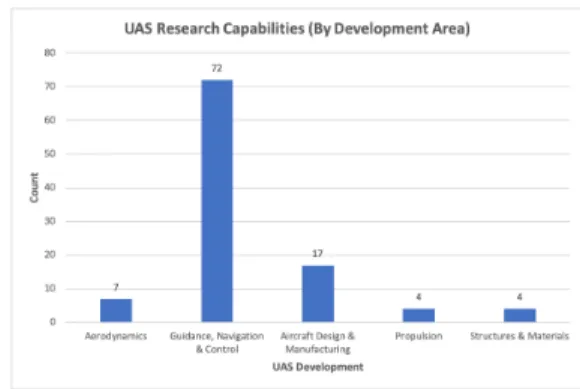
Fig. 1. UAS research by disciplines
These research and development areas are categorized for two reasons: 1) they cover technology disciplines that are common in aerospace science and engineering, therefore they are compatible and convenient for comparative study; 2) these technical areas are considered directly contributed to UAS development. It helps to distinguish from R&D re-lated areas that are user-based, application oriented. The latter scenario will be covered in the next section. Based on the scope of search, 127 researchers are identified to have UAS portfolio, where 104 researchers are involved in the UAS development categories.
7 out of 104 researchers are identified in ‘aerody-namics’. The UAS aerodynamics research and projects include: Aerodynamic characterization and improvement of an unmanned helicopter (Ghaemi); Multidisciplinary Design Optimization (Suleman); Whirl-tower Open Loop Experiments and Simulations with an Adaptive Pitch Link Device for Helicopter Rotor Vibration (Nitzsche); Climatic Wind Tunnel, Hemi-Anechoic Chambers, shaker table, UAS Testing Ground, UAS Proving Ground (Ekmekci); Drones for enabling computational environmental flow dy-namics studies (Bitsuamik).
4 out of 104 researchers are identified in ‘propulsion’. The UAS propulsion research and projects include: Multi-disciplinary design optimization of UAVs (Suleman); Hy-brid Power Plant Design (Gueaicb); Dynamic Characteri-zation of Brushless DC Motors and Propellers (Lanteigne); Fuel cell power systems for UAS applications, Lightweight High-Performance Fuel Cells for Unmanned Aerial Vehicle Propulsion (Zhou).
4 out of 104 researchers are identified in ‘struc-tures and materials’. The UAS struc‘struc-tures and materi-als research and projects include: Composite Materimateri-als (Mertiny); Multidisciplinary design optimization of UAVs
a
http://www.nserc.ca
b
(Suleman); Printed unmanned aerial vehicles using paper-based electro-active polymer actuators and organic ion gel transistors (Grau).
Quite a few (17 out of 104 ) researchers are iden-tified in ‘aircraft design and manufacturing’. The UAS design and manufacturing research and projects include: Scalable Highly Maneuverable Unmanned Aerial Vehicles for Confined Spaces (Ramirez-Serrano); Multidisciplinary design optimization of UAVs (Suleman); PrecisionHawk conducted to improve the state of the art in UAS systems, remote sensing and airspace safety (Furgeson); Marine Robot Autonomy, Developement of Autonomous Vehicles (Sato); Design and Manufacturing of Biologically Inspired Micro Aerial Vehicle Wings Using Rapid Prototyping (Lal-iberte); Design of a Novel Auto-Rotating UAS Platform for Underground Mine Cavity Surveying (Marshall); De-sign, Construction and Testing of a Novel UAS Platform for Cavity Surveying (Mitchell); BitDrones: Towards Using 3D Nanocopter Displays as Interactive Self-Levitating Pro-grammable Matter (Vertegaal); Design and testing of foam-inflated wings for small unmanned aerial vehicles, study of Micro Aerial Vehicles in Confined Spaces (Bramesfeld); Omnicopter, Disturbance Rejection (Nokleby); Long-range Communication Framework for Autonomous UASs, Design and Control of a Quadrotor Unmanned Aerial Vehicle, UAS Based System for Real Time Flash Flood Monitoring in Desert Environments Using Lagrangian Microsensors, Hy-brid Power Plant Design (Gueaieb); HyHy-brid power plant, energy efficient path planning, trajectory optimization, pitch control of tilting bi-rotor, Dynamic Characterization of Brushless DC Motors and Propellers, Height Estimation of a Blimp Unmanned Aerial Vehicle Using Inertial Mea-surement Unit and Infrared Camera (Lanteigne); Synchro-nized Swarm of Unmanned Vehicle Systems for Large-Scale Dynamic Applications, Forest Fire Monitoring, VTOL fixed-wing AV, Formation Control, Autonomous Soar-ing SUrveillance, Visual-based surveillance and sensSoar-ing using multi-UASs, Fault-Tolerant Control (Liu); Printed unmanned aerial vehicles using paper-based electroactive polymer actuators and organic ion gel transistors (Grau); Aircraft Modeling and Simulation (Botez); UAS for water survalliance (Pomeroy).
The majority of researchers is identified in the develop-ment category of ‘guidance, navigation and control’, which is not surprising. GNC has played a critical role of providing enabling technology in the UAS research and development. Instead of covering every single research topic, projects are divided into the following subjects:
• vision-based (enhanced) research to enable/improve au-tonomy (Barczyk, Barfoot, Kelly, Dudek)
• UAS in unstructured (uncertain, confined, GPS de-nied) environment (Lynch, Ramirez-Serrano, Brames-feld, Mehrandezh)
• UAS Navigation (Barczyk, Furgeson, Li, Atia, El-Rabbany, Nokleby, McCabe, Waslander)
• path planning (Sasiadek, Lanteigne, Liu)
• collision/obstable avoidance (de Ruiter, Liu, Desbiens)
• UAS performance (Vaughan)
• localization and mapping (Najjaran, Kelly, Polushin, Jenkin)
• flight control (Shi, Liu, Zhang, Mann, Etele, LiuX, Givigi, LiuG, Schoellig, Maggiore, Mills, Berkane, Roberts, Nahon, Sharf, Ny, Paranjape)
• sensing (Al-Tahir, Coleman, De Silva, Gong, Straznicky, Glen, Armenakis, Mackenzie, Remmel)
• coordination, formation, cooperation (Liu, Mann, Pan, Tayebi, Kirubarajan, Cheng, Shen, Abdessameud)
• operations (O’Young)
• intelligent algorithms (including NN, AI) (Liu, Schwartz, Ouyang, Necsulescu, Meger, Eramian)
• Simulation, Virtual Reality, Augmented Reality, (Chung, Botez, Grant)
• communicaitons (Gueaieb)
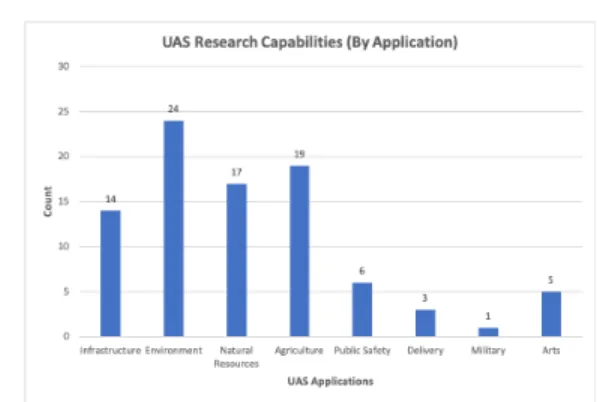
4. Research Capacity by UAS Applications Unmanned aerial vehicles (UAVs) hold great promise for applications as diverse as natural resource monitoring, infrastructure inspection (pipeline, railways), agriculture, mineral exploration, journalism, and search & rescue op-erations. This is perhaps the most vibrant sector of the aerospace industry, growing more quickly than any other segment. In our survey of Canada’s research capacity in the category of UAS applications, the similar pattern was discovered. The following 8 subjects are covered for poten-tial applications, out of 89 applications specified:
• infrastructure • environment • natural resources • agriculture • public safety • delivery
• defence (military)? and
• arts
Fig. 2. UAS Research by Applications
to: pipeline inspection, power line inspection, construction, mapping. Some projects are:
• innovative mapping applications (Wang, Najjaran)
• remote sensing (Fisher, McLeod, Armenakis, Zhang, Th´eau)
• terrestrial photogrammetry (Tannant, Ferworn)
• special (inaccessible, indoor) infrastructure (Hilde-brand, McCabe)
Environmentapplications include but not limited to: Disaster Monitoring, Forestry, Hydrology, Wildfire, Wet-land Inspection, Environment Monitoring. Geography, ge-ology are also categorized here. Some project topics include:
• image and video analysis (Ray, Robichaud)
• intelligent algorithms (include DL, AI) (Ray, Meger, Th´eau)
• mapping, survey (McDermid, Shahbazi, Hill, Shaw, Shea, Jenkin)
• remote sensing (Eaton, Daggupati, Armenakis, Pomeroy)
• precision applications (Leblon)
• modeling, database (Kovacs, Aaron)
• GNC (Liu, Zhang, Schoellig)
Natural resourcesapplications include but not lim-ited to: mining, wildlife. (McDermid, Shahbazi, Wang, Reich, Coops, Hunt, Najjaran, Runesson, Dech, Braun, Hassanein, Marshall, Mitchell, Franklin, Schoellig, Th´eau
Public Safety applications include but not limited to: search and rescue, surveillance (Najjaran (Liu, Arme-nakis, Jain, Mehrandezh, Paranjape).
Agriculture applications include but not limited to: farming. Examples include: vineyard (Jamieson), cat-tle (Church), precision agriculture (Leblon, Walters), soil moisture/nutrient (Aaron), vegetation (He).
Artsapplications loosely assemble the following: me-dia, culture, entertainment, journalism.
5. Research Capacity by Regions
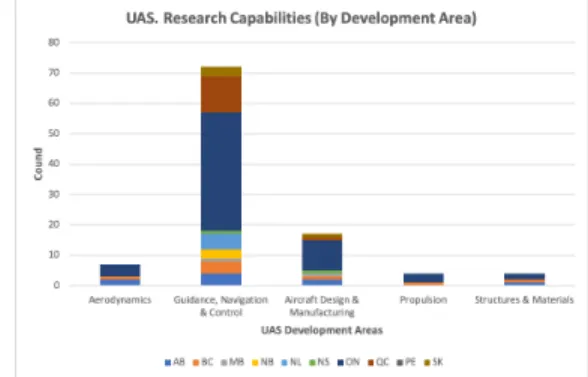
Given Canada’s vast geographical landscape (e.g. the Arctic) and natural resources, the Canadian commercial or civil UAS market is expected to grow rapidly. Canada has a long and successful history of leadership in aviation. Traditionally the aerospace sector is concentrated in the provinces of Ontario and Quebec. As UAS research and development emerges, we are pleased to find that research activities are active across provinces, becoming a national trend.
Fig. 3. UAS Research by Regions
Fig. 4. UAS Research by Regions: Distribution Percentage
Please note, the distribution may not be accurate for a couple of factors. 1) it has a bias weight reporting on the province of Ontario, due to the author’s personal knowledge; 2) the researchers in Quebec are much smaller than expected, perhaps due to language barriers during the scope of search.
Based on the previous survey of research capacities in terms of disciplines and applications, the regional distri-bution can further be broken down into their respective development disciplines and applications, give a more com-prehensive perspective.
Fig. 6. UAS Research by Regions with Applications
Canadian researchers have emerged recently to take active or even leading roles in the growing civilian UAS market nationally.
6. UAS Flight Training Schools
UAS training has become a critical component in the market. We added a new survey of drone flight schools across the country, discovering the total 97 flight schools. It also indicates the active development in Canada in this sector.
Fig. 7. UAS Flight Training Schools
Fig. 8. UAS Flight Training Schools by Provinces
7. UAS Research Centres and Specialist Groups
Based on the scope of search, a number of UAS re-search centres, specialist groups are identified with dedi-cated UAS profile. The following list is organized alpha-betically.
CARRE c The University of Toronto’s Centre for
Aerial Robotics Research and Education (CARRE) was established in May 2015 to meet the demand for engineers and scientists with the highly interdisciplinary training needed to contribute to the burgeoning field of Unmanned Aerial Systems (UAS) and aerial robotics. The objective of CARRE is to become an internationally-recognized cen-tre for aerial robotics and the nucleus of aerial robotics research and teaching at the University of Toronto. The development of commercial UASs requires a broad array of technical skills, across multiple disciplines - CARRE brings together aerodynamicists, structural designers, ma-terials engineers, propulsion experts, control specialists, and roboticists, to design and develop state-of-the-art aerial robotic platforms. CARRE is able to leverage the range of expertise available at UTIAS, partner institutions, and in-dustrial collaborators.
UVic CfAR d The UVic Center for Aerospace
Re-search is an organization devoted to the promotion of Unmanned Aerial Vehicles for commercial and research ap-plications. UVic CfAR is available to partner with industry in order to apply research in the area of unmanned aircraft to real world applications. UVic CfAR develops application specific solutions using our wide range of capabilities and industrial partners. This includes design, ground and flight based testing or manufacture.
c
http://carre.utoronto.ca/
dhttp://www.uvic-cfar.com/index.html
e
The ACE Centre for UAV Research, located at the University of Ontario Institute of Science and Technol-ogy e utilizes the most sophisticated climatic wind tunnel and testing chambers in the world to push the UAS indus-try into new territories. At this epicenter of UAS research and product development, [the centre] helps researchers and manufacturers discover what it takes to handle the harshest climates on earth from frigid northern storms to the hottest desert heat.
Centre for Innovation and Research in Un-manned Systems. f Southern Alberta Institute of Tech-nology (SAIT) is supporting innovation and new techTech-nology development through its Centre for Innovation and Re-search in Unmanned Systems (CIRUS). ReRe-searchers with SAIT’s Applied Research and Innovation Services depart-ment, faculty from SAIT’s School of Construction, students and industry partners converge in this cross-disciplinary environment to address challenges, create efficiencies, and develop and test new products and applications. CIRUS will expand the role unmanned systems play in data acqui-sition and management, and create organizational efficien-cies across a variety of sectors and regulatory environments. The Canadian Centre for Unmanned Vehicle Systems(CCUVS)gis a federally registered not for profit company (2007), located in Medicine Hat, AB whose pur-pose is to facilitate sustained, profitable growth in the Canadian civil and commercial unmanned systems sec-tor. CCUVS is governed by a Board of Directors, drawn from across Canada, representing academia, industry and government and working primarily in the air unmanned systems environments. Head office staff members are based in Medicine Hat, Alberta.
National Research Council Canada’s Civilian Un-manned Aircraft Systems program. https://www.nrc-cnrc.gc.ca/eng/index.html
Unmanned aviation systems have the potential to ac-complish tasks faster, safer and more reliably than their manned equivalents. The Civilian Unmanned Aircraft Sys-tems (CivUAS) program proactively aims to develop, ad-vance, de-risk and certify innovative UAS solutions for key
industrial sectors in Canada. With a proven ability to part-ner with industry on research and technology development across multiple disciplines, the CivUAS program plays an important role in supporting the emergence of unmanned flight into the commercial aviation sector. The program further offers an unmatched technology infrastructure and complementary technical expertise that will foster the inte-gration of UAS technology into key sectors such as oil and gas, defence and security, agriculture, natural resources and critical infrastructure environment.
The Uninhabited Aircraft Systems Training, Innovation and Leadership Initiative (UTILI) h is lead by Carleton University, the University of Ottawa, Queens University, ´ETS, and Universit de Sherbrooke. In this Industrial-stream CREATE program, running from 2019 to 2025, it will “train engineers and scientists in the safe and effective operation of Uninhabited Aircraft Sys-tems (UAS) or ‘drones’ ”.
It is worth pointing out the following organizations and societies that are affiliated with UAS research and devel-opment in Canada.
• Transport Canada i is a federal institution,
“lead-ing the Transport Canada portfolio and work“lead-ing with our partners. Transport Canada is responsible for transportation policies and programs. We promote safe, secure, efficient and environmentally responsible transportation”. TC is actively involving government, academia, and industry to develop the policies and guidelines in the UAS sector.
• Unmanned Systems Canadaj Mission statements: “to represent the interests of the unmanned vehicle systems community which includes industry, academia, government, military, and other interested persons; to promote public awareness, education and appreciation for the Canadian unmanned vehicle systems community to itself, to Canadians and worldwide.”
• Standards Council of Canadak The Standards Council of Canada (SCC) is a federal Crown corporation responsible for promoting standardization in Canada. It reports to Parliament through the Minister of Inno-vation, Science and Economic Development Canada. It
fhttp://www.sait.ca/ g http://www.ccuvs.com/ hhttps://carleton.ca/utili/ ihttps://www.tc.gc.ca/en/transport-canada.html j https://www.unmannedsystems.ca/about-us/ k https://www.scc.ca/en/about-scc/what-we-do
leads and facilitates the development and use of national and international standards and accreditation services in order to enhance Canada’s competitiveness and well-being. Its mission “involves working with our stake-holders and customers to promote efficient and effective standardization that strengthens Canadas competitive-ness and social well-being. Everything we do is aimed at improving Canadians’ quality of life.” The TC20/SC16 Unmanned aircraft systems is the Canadian mirror com-mittee representing Canada in the International Stan-dards Organization (ISO) for UAS stanStan-dards develop-ment.
• Canadian Aeronautics and Space Institutel Vi-sion and MisVi-sion: “to advance the art, science, engi-neering and applications relating to aeronautics, space and related technologies in Canada; to provide a focus for communications and networking for aeronautics and space communities in Canada; to assist members in de-veloping skills, exchanging information, and sharing tal-ents in their areas of interest; to promote Canadian com-petence and international competitiveness in aeronau-tics, space and related technologies and their applica-tions; to foster national pride and international esteem for Canadas accomplishments in aeronautics, space and related technologies.”
• Aerospace Industries Associations of Canada m
AIAC is the voice of Canada’s aerospace industry. The mission is “to understand, build consensus and provide leadership on policy issues of interest to the industry, also work to increase Canadas profile on the world stage by communicating our air and space accomplishments and by promoting Canadian aerospace companies in for-eign markets.”
8. Conclusions
This article presents the landscape of Canada’s re-search capacity in Unmanned Aerial Systems (UAS) de-velopment. The coverage is described by three different perspectives: development disciplines, applications, and
re-gions. In terms of disciplines, the roadmap is charted 5 major technical aspects: aerodynamics (AER), guidance, navigation and control (GNC), design and manufacturing (ADM), propulsion (PRP), and structures and materials (SNM). The research focus is placed on GNC (68%), the research direction points to the integration of UAS, and intelligence of UAS development. In terms of applications, the roadmap is charted by 9 commercial and civil applica-tion domains, including infrastructure, environment, natu-ral resources, agriculture, public safety, delivery, arts and defence (military). Research and development is consistent with Canada’s landscape and resources, over 83% applica-tions cover infrastructure (16%), environment (27%), nat-ural resources (19%), and agriculture (21%). In terms of regional distribution, the findings are: 53% located in On-tario. The rest are evenly distributed between western (AB, BC, MB, SK 24%) and Quebec and maritime provinces (22%).
Acknowledgement
This paper was originally developed as a report com-missioned for Transport Canada’s Innovation Policy Direc-torate to provide an overview of Canada’s research capaci-ties in UAS in 2018. With rapid growth in the field, much update has been made since and is presented here in this pa-per. The author would like to acknowledge his graduate stu-dents in the updated version of 2020 - Ms. Shangyi Xiong and Ms. Han (Flora) Fu, for their data collection, as well as the graduate students in 2018 for their initial data collec-tion and analysis, Ms. Han (Flora) Fu, Mr. Joshua Furtado, Mr. Silas Graham, Mr. Blago Hristovski, Ms. Katharina Krieger, Mr. Kelvin Wu, and Mr. Yih Tang Yeo.
Hugh H.T. Liuis a Professor of the Univer-sity of Toronto Institute for Aerospace Stud-ies and currently serves as the Director of the Centre for Aerial Robotics Research and Ed-ucation (CARRE).
lhttp://www.casi.ca/
m