A Generic Model for NFC-based Mobile Commerce
Hsu-Chen Cheng
Department of Information
Management, Chinese
Culture University
[email protected]
Jen-Wel Chen
Department of Information
Management, National
Taiwan University
[email protected]
Abstract - Near Field Communication is a short-range wireless communication technology. The majority of handset manufacturers showed interests in it and invested in developing NFC-enabled devices. Several NFC trials and researches have been launched allover the world. However, these trials only used NFC-enabled handset as a contactless smart card. It did not reaDy reveal the ability of NFC technology. In order to adapt to the verity of commerce process for NFC-based mobile environment, we propose a generic model for NFC-based mobile commerce (NMC). The model characterizes the issues and technologies involved in the processes, including service initialization, ordering, payment, shipping/collection, loyalty management, and customer service. Based on NMC model, we implement in a traditional meal service to verify the feasibility and flexibility of the model.
Keywords - Near field communication, mobile commerce, RFID, Extensible Markup Language (XML).
1. Introduction
Near Field Communication (NFC) is a short-range wireless communication technology which was developed by NXP semiconductors, Sony and Nokia [1]. The majority of handset manufacturers showed interests in it and invested in developing NFC-enabled devices. There are three use cases for NFC: read/write mode, card emulation mode, and peer-to-peer mode. The read/write mode means that an NFC-enhanced handset can be used as a RPID reader/writer to obtain and write data from external tags. In card emulation mode, the NFC-based handset resembles a RPID card to allow external readers to access it. The peer-to-peer mode enables two handsets to transfer data mutually with tapping. With computing, storage and communication ability, NFC-enabled device acts as a critical enabler for mobile commerce, such as product demonstration, ordering, payment, loyalty management, and service enhancement.
Several NFC trials and researches have been launched all over the world. Nokia, Citigroup, and MasterCard launched a NFC trial in New York in 2007. They equip handsets with MasterCard PayPass contactless payment capability [2]. In London, an NFC trial was launched by Transit Operators in November 2007 [3]. Indian government plans to give rural pensions via NFC-based handsets [4]. In Taiwan, Chunghwa Telecom [5] has launched an NFC trial in the public transportation system. However, these trials only used NFC-enabled handset as a contactless smart card by card emulation mode. It did not really reveal the ability of NFC
Tain-Yow Chi
Department of Information
Management, Chinese
Culture University
[email protected]
Pin-Hung Chen
Department of Information
Management, National
Taiwan University
[email protected]
technology. Research [6] used NFC-based coupons system to enhance the loyalty management for mobile commerce. Research [7] proposed an authentication mechanism for NFC-based virtual coupons system. In research [8], the author gave some experience about using NFC technology in meal service. Other than only including payment process, these researches extended the NFC technology to involve in more processes of mobile commerce, such as loyalty management. However, they did not detail how to construct the NFC-based mobile commerce system.In order to adapt to the verity of commerce process for NFC-based mobile environment, we propose a generic model for NFC-based mobile commerce (NMC). The model characterizes the issues and technologies involved in the processes, including service initialization, ordering, payment, shipping/collection, loyalty management, and customer service. Based on NMC model, we implement an NFC-based mobile service in a normal restaurant to verify the feasibility and flexibility of the model. The rest of paper is organized as follows. In section 2, we describe the detail ofNMC model. In Section 3, we describe the implementation of the model in a restaurant environment. Finally, in Section 4, we present our conclusions and future work.
2. NMC Model: A Generic Model for NFC-based
Mobile Commerce
By observing the process of conventional commerce and the characteristics of NFC technology, we proposed a NMC model to define the procedure of NFC-based mobile commerce. As shown in Fig. 1, there are six phases in the NMC model, which includes initialization, order, payment, shipping/collection, services, and loyalty management. Except for the initialization phase, every phase can be implemented independently. For different scenario, the sequence of the phases may be various.
2.1 Initialization phase
Before providing NFC-based service, constructing an NFC mobile commerce environment is needed. There are four critical components: back-end services, terminal service, tags, and handsets.
I) NFC-based back-end service
The back-end service is responsible for all information exchange during the commerce process. It provides the functions for customers to load applications, transfer catalogs of products, exchange their order information, and deals with service calls from customers. The back-end servtce IS managed by NFC-based service provider.
2) Generic terminal application (GTA)
Before any commerce activity, a terminal application has to be preloaded in NFC-based handset. The application is responsible for retrieving information from back-end service, loading catalogs from merchants, and accessing the security element on the handset. Because of the limitation of memory size, customers cannot load different application for each merchant. Therefore, a generic terminal application allows customers to roam in different merchants.
3) Function tags
Function tags trigger the GT A to communicate with back-end service or activate the connection. These tags are used to construct an NFC-based service environment and should follow NFC Data Exchange Format (NDEF) [9] to make handset recognizing easy. Four types of tag are defined in the NMC Model: First-time Tag (FT), Product Tag (PT), Coupon Tag (CT), and Service Tag (ST). These four tags are interacted by tapping a handset on them.
4) NFC-enabled handset
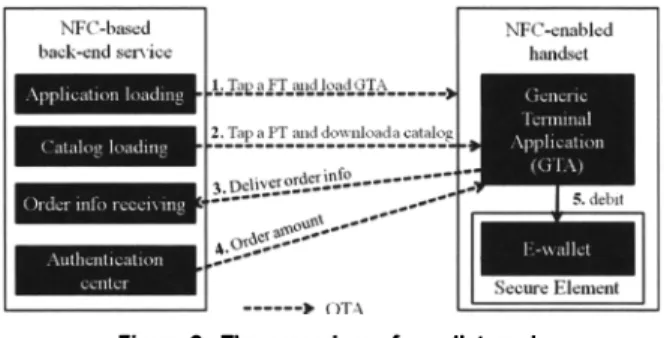
Before using the NFC-based service, GT A has to be loaded in the NFC-enable handset in advance. FT is to enable users to load the GT A by over-the-air (aT A) (Fig. 2 step I). When a handset taps the FT, the uniform resource identifier (URI) storing in FT will guide the handset to connect to back-end server to load GT A.
2.2 Ordering phase
After initialization, the customer can start to use NFC-enabled handset to download the catalog and place the order.
1) Merchant's catalog
PT is designed to stand for a particular item or service, and it may be embedded in an e-poster. All the ordering behavior is by tapping the handset on the PT. The handset will retrieve the content of the PT and launches the corresponding GT A automatically. Then, GTA will download the corresponding catalog from the back-end server according to the content stored in the PT (Fig. 2, step 2). After that, GTA can display the product information such as descriptions, images, videos, and product dependent options.
ISBN 978-89-5519-139-4
-2010-2) Order/ Options of the items
There are several product or service dependent options, such as flavor, size, volume, and for-here or to-go, etc. When customers tap the handset on PT, they can place the order directly and choose the options easily on the screen.
2.3 Payment phase
There are two payment methods available in the NMC model: e-wallet mode (Fig. 2) and credit card mode (Fig. 3).
When using e-wallet mode, the customer use the token stored in secure element (SE) to pay the order. Customers have to prepay for the token. After ordering, GT A will submit the order information to the back-end server (step3). Then, the back-end authentication will give GT A the authority to check the e-wallet balance (step 4) and auto debit (step 5).
NFC-based back-end sen·ice
---. OTA
NFC-enabled handset
Figure 2. The procedure of e-wallet mode
Another payment method is credit-based and postpaid credit card mode, like Visa Wave and MasterCard PayPass. Before using this mode to accomplish the transaction, a bank issued credit card applet has to be preloaded on the handset. In figure 3, we describe the payment flow of credit card mode. After ordering, GT A will record an order number in the SE (step 4). Then, the customer takes the handset to the counter. The merchant's reader can get the order number (step 5) and inform bank's reader how much the customer should pay (step 6). After that, the bank's reader will exchange the authentication information with the credit card applet on the handset (step 7). Finally, bank's reader will get authorization code form issuer to finish the transaction (step 8).
NFC-based
---.OTA
Figure 3. The procedure of credit card mode
2.4 Shipping/Collection phase
In this phase, customers can choose how they receive their products or services. For physical products, they can choose a place to ship or to collect, such like their home address or exit number of shopping mall. For virtual products, such as on line music or video game, it should be transferred virtually to a particular storage device by email or short message.
2.5 Loyalty management phase
Loyalty program is designed to attract a customer to purchase again. A coupon is a common loyalty tool and NFC technology makes virtual coupons feasible.
I) Receiving coupons
Customers can receive coupons by tapping a CT which accounts for downloading a coupon.
2) Coupon sharing mechanism
With NFC-enable handsets, customers can share their coupons with others more easily. Furthermore, merchants can develop more attractive marketing program. For example, if the original coupon discount is 2 percent and it is transferred to more than 10 people, the discount will increase to 10 percent. These can be implemented by NFC peer-to-peer mode. 2.6 Service phase
The NFC-based service call is placed by tapping a ST. If customers require assistance for any problem, they can just tap the ST by the handset. The service request will be addressed, and the corresponding service can be delivered as soon as possible. Furthermore, customers can place a particular service call by tapping different kind STs or by selecting the service category on a screen, for example, requesting a new product, or requesting table cleaning service in a restaurant.
3. Implementation
in
a Restaurant
In order to verify the NMC model, we implement these six phases in a restaurant scenario. We use J2ME to implement GTA on Nokia 613li and use asp.net to implement back-end service on server. Fig. 4 illustrates a restaurant case with phase-by-phase discussion in the following text.
customer (~ ~System ~ ( e-wallet )
/
~~
~
,,~---'-~ ~hippiBg or collectioD selecti~,~
~---
~
Figure 4. The use case of restaurant scenario
cook
waiter
3.1 Initialization
First, we installed an NFC-based Restaurant Back-end Server (NRBS) for receiving meal orders and exchanging information with correlated systems. In addition, we designed a menu attached to the wall and tables in the restaurant called e-menu (fig. 5). The e-menu is like a regular menu, except that each food picture has been embedded in a PT, which is used for ordering by handset. And there is a FT attached at the corner of the e-menu for providing consumers to download the GTA.
The FT records the URI in NDEF bookmark format to tell a handset where to load the GT A. The PT records four kinds of information: System ID (SID), Merchant's ID (MID), Product ID (PID), and URI for loading catalog «SID; MID; PID; URI». The CT records a URI in NDEF bookmark format to tell a handset where to load coupons. The ST records a URI which can let customer place services calls.
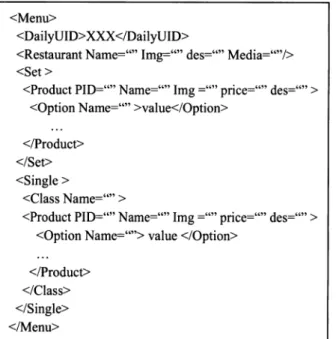
<Menu>
<DailyUID> XXX <lDailyUID>
<Restaurant Name="" Img='''' des="" Media=""/> <Set>
<Product PID="" Name="" Img ="" price="" des="" > <Option Name="" >value</Option>
<!Product> </Set> <Single>
<Class Name="" >
<Product PID="" Name="" Img ="" price="" des="" > <Option Name=""> value </Option>
<!Product> </Class> </Single> <!Menu>
To coordinate the tags, we designed a GTA called Ordering MIDlet (OM). It has the capability of recognizing tags and XML-based catalogs (Fig. 6). As we mentioned before, it is not possible to load a terminal application for each different merchants. So, the OM should use the information of MID recorded in the PT indentify which XML catalog should NFC-based back-end service send to GTA. We call the XML catalog Restaurant Products List (RPL) and it allows merchants to define their own meal set. In RPL, the DailyUID is used to differentiate every order. There are two types of meals: set meals (Set) and single items (Single). Every product includes five segments: a name, images, a PID, a price, and a description. In addition, option represents what optional choices for customers (e. g., less salt or spicy). The item class (Class) exists in <Single> and classifies products (e. g., <Class Name="dessert"».
3.2 Order
A Customer can simply choose what he/she wants and taps the food picture with a handset. As long as the handset senses the PT behind the food picture, it will launch GT A by the MIDP 2.0 push registry mechanism [9]. GT A can retrieve the content of the PT, and link to back-end service according to the URI and MID. The server will provide the proper catalog to the handset according to the MID. After that, the handset can show product information and its option. When customers pick a item and select its options, they can submit the order or continuing to browse the catalog. Moreover, the customer's preference may be stored in the handset in advance to avoid having to select the same options every time. The order process Pseudo-Code illustrate on fig. 7.
GT A gets SID, MID, PID, URI from PT If SID is legal
Get RPL from URI Do Loop
Get product info. from RPL in terms ofPID If the customer want to buy it.
For each option in the product Display and select the option
If the customer wants to buy one another product Select a product on screen or tapping PT to Get PID Until the customer finish order
Send ordered Products and Ootions to NRBS Figure 7. The Pseudo-code of GTA ordering process
3.3 Payment
In our experiment, we implement two of payment methods: e-wallet and credit card.
I) E-Wallet
Once a consumer place hislher order and determines to pay bye-wallet, the application will activate the connection and transfer the order information to the back-end service by 3G or GPRS. Then, the back-end authentication will request the
ISBN 978-89-5519-139-4
-2012-application to check the e-wallet and auto debit if the balance is sufficient.
2) Credit Card
If the customer decides to pay by credit card, similarly, the GT A will upload the order information to back-end service by 3G or GPRS, and write the order number into SE. After that, the order information will be recognized by external readers. 3.4 Shipping/collection
Once the bill is paid, the consumer will be asked to choose Dine-in or take-away.
1) Dine-in
If a customer chooses to dine-in, he/she can use the handset to tap the seat tag (fig. 8) which is embedded on the table. Seat tag is kind of service tag. GT A will transfer the seat number to back-end service, and waiter can use this information to deliver the service.
2) Take-away
After receiving the customer's order, the back-end service will transfer the order information to the screen/printer in the kitchen. For take-away, consumers just wait for the SMS which will inform them where to take out their meal. 3.5 Loyalty
If the consumer completes the ordering process, the back-end service will send a restaurant coupon to the handset directly. Or customers may just tap the handset on CT to download the coupon for a special discount. The customer may share coupons with others, so that more than one customer benefits from the coupon discount.
3.6 Service
In order to construct a NFC-based barrier-free service, we install a number of tags which can be place services. Consumers simply tap these tags with their handsets and then select the service, their selection will send to the backend service.
1 lfI1IlIBt 1 1-1 ...;li.'m::;::..._1 1-1 -=Z---,
UD
up
OLJ
1 : taP(~~~-... -.. ~ .... ~ .... ~ ... ~}~.~"y'M~~.~r, .. ~~ .... ~~.-.. ~.-.. -.. -... -.. -... -... ~U
1
Bac!c=lndarvjcel
Crtdlt caa! agent ""] , 3:con~t()t ...
J.; ..
~~f..f.~~t.~klg
...L ...
:n
4 : uPI~ GTA by.QT~
18ltapO
U'
...
~!.~~==
..
:.::.t;1.} ··· .. ·· ..
:·=l ..
~:
sendoa!~ ~.~b!!{l_
...23: ta,l 22: .2fRWlAll._
--... __ ... ""_ .... ; ···· __ ···1
... ~.;~!Y.~!!.~m~
I--~ _ _ -;---~ __ --; _ _ -+i ___ ··.!:=l3'-.!:.=:5en=.d setV=.!""ice,...,rif:"um""ber(=.>.)'--__ .... ___ ... ..
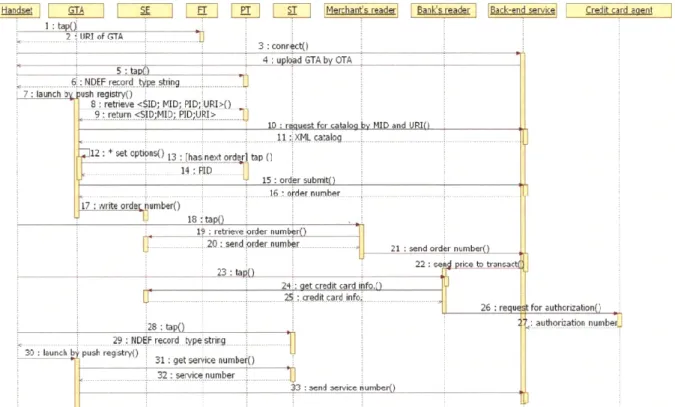
Figure 9. The sequence diagram of restaurant scenario 3.7 Scenario Sequence
Fig. 9 is the sequence diagram of restaurant scenario. It describes the event sequence from tapping the FT to download the GT A, to place a service call. The detail is describes as follows.
1. A customer uses a NFC-enabled handset to tap the FT.
2. FT returns a URI ofthe GTA.
3. The handset connects to back-end service according to the URI of FT.
4. The handset loads the GTA from the back-end service.
5. The customer uses the handset to tap the e-menu. 6. The handset gets the NDEF record of the GTA. 7. The handset launches the GTA by the push registry. 8. Then, the GTA read the information in PT. 9. The GTA gets <SID; MID; PID; URI> set.
10. The GT A connects to back-end service to download the catalog.
11. The GTA gets the RPL.
12. The customer can place the order and selects the product options on the screen.
13. If the customer wants to order another item, he/she can tap another PT.
14. The GTA gets PID from PT.
15. The customer finishes a order and submits to the back-end service.
16. The back-end service returns a order number to GT A. 17. The GTA write the order number to the SE of the
handset.
18. The customer takes the handset to tap the merchant's reader.
19. The merchant's reader retrieves the order number store in handset's secure element.
20. Merchant's reader gets the order number.
21. Then, the merchant's reader sends the order number to back-end service.
22. The back-end service sends the total amount to the bank's reader.
23. The customer uses the handset to taps the bank's reader.
24. The bank's reader connects to credit card applet store in secure element.
25. The bank's reader gets the credit card information. 26. The bank's reader requests the credit card agent for
authorization.
27. The back-end service gets the authorization number. 28. The customer taps a service tag.
28-31. The GTA gets a service number and sent it to back-end service.
4. Conclusion
In this paper, we propose a generic model for NFC-based mobile commerce. The model characterizes the issues and technologies involved in the processes, including service initialization, ordering, payment, shipping and collection, loyalty management, and customer service. Based on NMC model, we implement the service in a normal restaurant in order to verify the feasibility and flexibility of the model. We also implement a generic terminal application and a XML-based catalog to fulfill the requirement of a generic
mobile commerce. According to the experience, service providers can built up a feasible NFC-based solution to satisfy several mobile commerce scenarios.
REFERENCES
[1] NFC forum, "Near Field Communication and the NFC Forum: The Keys to Truly Interoperable Communications," white papers,
http://www.nfc-forum.orglresourceslwhite ~apers/nfc _forum _ Marketin g_ white ~aper.pdf.
[2] The NYC mobile trial, http://www.mastercard.com/us/paypasslmobile. [3] Card Technology, http://www.cardtechnology.com/.
[4] Contactless news,
http://www.contactlessnews.com/2008/04/04/india-to-use-nfc-in-pensio n-distribution.
ISBN 978-89-5519-139-4
-2014-[5] Chunghwa Telecom NFC trial, http://www.realmedia.com.tw/eventlnfc/.
[6] S. Dominikus and M. Aigner, "mCoupons: An Application for Near Field Communication (NFC)," Proceedings of 21 st International conference on Advanced Information Networking and Applications Workshops (AINAW 07'), vol. 2, pp. 421-428, May 2007.
[7] M. Aigner, S. Dominikus, and F. Martin, "A System of Secure Virtual Coupons Using NFC Technology," Proceedings of 5th IEEE International Conference on Pervasive Computing and Communications (PerCoM 07'), pp. 362-366, March 2007.
[8] S. Erkki and H. Juha, "Experiences from Near-Field Communication (NFC) in a Meal Service System," Proceedings of the I st Annual RFID Eurasia Conference, pp. 1-6, Sept. 2007.
[9] Sun Developer Network Article-The MIDP 2.0 Push Registry http://developers.sun.com!mobility/midp/articles/pushregl